Archives for category: Budget Cuts

Every time I see New Hampshire Governor Chris Sununu interviewed on CNN, he plays the role of the GOP “moderate.” Don’t be fooled. When it comes to education, he’s a clone of Betsy DeVos.

Veteran New Hampshire Garry Rayno pulls away the mask of “moderate” that Sununu wears in this article in InDepthNH.

This is an important article for everyone to read, no matter where you live. It explains succinctly the true goals of the privatization movement.

He writes:

Public education has been since its inception with the work of Horace Mann, the great equalizer.

Students from poor families have been able to compete with students from the other side of the tracks, maybe not in reality, but close enough to at least have an opportunity to excel.

Many of the founding fathers understood the need for an educated public if democracy was going to survive and thrive.

A responsible citizen is an informed citizen, and that appears to be the problem today. Too many people interested in power instead of governing don’t want a truly informed public. Instead, they want enough of the public spoon fed “alternative facts,” conspiracy theories, and outright lies to ensure they retain power although they have views that are both harmful to the majority of citizens and allow the tyranny of the minority to overturn the will of the majority.

At the heart of the minority’s transformation plan is the destruction of the public school system.

New Hampshire has had a front row seat to the war on education since Chris Sununu was elected governor and named his rival for the Republican nomination in 2016, Frank Edelblut, to be Education Commissioner, a man without any experience in public education, which was the first for someone holding that position in our lifetime.

If Sununu did not know what would happen when he put Edelblut in charge of this critical state department, shame on him, because Edelblut’s one term in the House was a roadmap for his actions during his two terms as commissioner, his second ending in March 2025.

Sununu has also packed the State Board of Education with school choice advocates instead of supporters of public education, so you have the two entities in the executive branch responsible for the state’s public education systems, maybe not anti-public schools, but certainly not advocates for the state’s public education system.

According to the statutes, the education commissioner “is responsible for the organizational goals of the department and represents the public interest in the administration of improving the effectiveness and efficiency of administrative and instructional services to all public schools in New Hampshire.”

Notice it says public schools, not private schools or religious schools, or homeschooling, or learning pods, or any of the other non-public entities that are approved vendors under the state’s Education Freedom Account program, some with questionable philosophies or intent.

An attempt by lawmakers this year to better define the education commissioner’s qualifications and responsibilities to the public school system was defeated this term by the same element that pushed to establish the EFA program and then to expand it, although this year’s attempt to increase the income threshold to participate in the program failed on the last day of the session to act on bills.

The outright attacks on public education began in New Hampshire about a decade ago but gained more warriors as FreeStaters/Libertarians swelled the ranks of the House and Senate Republican members.

The attack on public education here has been much the same as it has been in other states, mostly in the south and the west, with claims of the indoctrination of students by leftwing faculty members.

They have also attacked educators directly and have tried to pack school boards — without much success — to undermine curriculum, educators and slash budgets as happened in Croydon several years ago when the annual school meeting was poorly attended due to a snowstorm.

The Republican majority in the 2021-2022 legislature passed the state’s divisive concepts law forbidding teaching controversial subjects such as institutional racism.

The law was recently found unconstitutional by a US District Court judge.

That was the same term the EFA program was approved after earlier unsuccessful attempts.

Both the EFA program and the divisive concepts law were included in the state’s biennial budget package because they were not likely to pass on their own.

The same folks also tied education into the trumped out recent outrage over the LGBTQ community and sold it as an attack on parental rights.

The intent was to start a war between parents and educators, although parents already have many of the rights touted by the anti-public school advocates.

The theory touted was that educators were keeping information from parents about their students and their sexual identification and that educators were urging students to explore different sexual identities.

Then came the book banning other areas of the country experienced like Florida where some school libraries were stripped of books.

The red herring advocates touted here came from a national app that contains almost every book published that students could access both in schools and at home, and not on school library shelves.

Some tried to enlist town and city libraries in the surveillance of children and what they read and accessed, but that did not go very far.

All of this goes to create the appearance that schools are hotbeds of leftist politics and anti-parental values, some fueled by Edelblut in an op-ed he sent to media outlets.

And despite all this ginned up controversy, local public schools that educate about 90 percent of the school age children in the state remain very popular with parents and the public at large.

If that is true, you have to ask what is behind the push to demonize public schools like political candidates demonize opponents.

Keep in mind this attack on public education occurs at the same time when the superior court’s latest education funding decision says the state does not provide enough money to cover the cost of an adequate education for every student and the way it raises its biggest contribution to public education — the Statewide Education Property Tax — is unconstitutional.

Education is governments’ —not just state government’s — single biggest expense, costing about $3.5 billion a year.

If you are a Libertarian or Free Stater who believes “taxation is theft,” destroying public schools will shift the cost directly to parents, and you could keep a lot more of your money to spend as you see fit and not for the good of society.

And if you espouse the philosophy of the Koch Foundation or former US Education Commissioner, Betsy DeVos, you not only keep more of your money, one of the largest union-backed workforces in the country will be dismantled when certified teachers are no longer needed.

Without a public education system, a child would receive the education his or her parents could afford and for many, particularly minorities, and the historically poor, that may not be much beyond the time they turn 16 and have to go to work to keep the family treading the economic waters.

And then maybe they will work for a lot less than if they had a high school, or even a college education.

And without even an adequate education, how informed will the general public be or how capable of the critical thinking needed to realize all those folks touting their parental rights really do not have their best interests at heart.

Garry Rayno may be reached at garry.rayno@yahoo.com.

Distant Dome by veteran journalist Garry Rayno explores a broader perspective on the State House and state happenings for InDepthNH.org. Over his three-decade career, Rayno covered the NH State House for the New Hampshire Union Leader and Foster’s Daily Democrat. During his career, his coverage spanned the news spectrum, from local planning, school and select boards, to national issues such as electric industry deregulation and Presidential primaries. Rayno lives with his wife Carolyn in New London.
Marilou Johanek is a veteran journalist in Ohio. She writes here about the Republican politicians who used their power to impose universal vouchers on the state. The main beneficiaries are children of the affluent who are already enrolled in private and religious schools and who can already afford the tuition. The losers are the vast majority of public school students, whose schools are underfunded.

What does the future hold for states that skimp on the education of the next generation while lavishing billion-dollar subsidies on the families of the well-off?

Johanek writes:

My way or the highway may be your boss’s motto and your cross to bear. But if that is the mantra of publicly elected officials in a representative government — as it sure seems to be in Ohio — all of us have a problem. A big one. 

The political bosses in Ohio conduct the people’s business with take-it-or-leave-it ultimatums. They’re not running a democracy; they’re dictating decisions made. They do not entertain questions about their extremist agenda to ban invented threats, ignore real ones, claw back rights, reduce women to breeders, welcome polluters to state parks, or defund public education to pay for private schools. 

When challenged over their arguably lawless mandates, Ohio Republican leaders mount a full court press to dismiss, disparage, intimidate, and circumvent countervailing forces that dare confront absolute power. Consider the all-out effort of GOP chieftains to scuttle a statewide lawsuit challenging the constitutionality of the Republican fetish to fund private schools with hundreds of millions of apparently unlimited public tax dollars.

The partisans sprang into action to protect the $1-billion-dollar-and-counting boondoggle they created last year with universal vouchers that pay private school tuition for the affluent few at the expense of the many — a majority of Ohio students who attend traditional public-school districts. Ever since GOP lawmakers — led by Ohio Senate President and go-to financier of diocesan schools Matt Huffman — opened the government dole to any private school student with their voucher change slipped into the state budget, unaccountable public spending on private schools has exploded.

The amount of tax dollars going to students already attending private, mostly religious schools tripled the first school year uncapped voucher money was there for the taking. Many of the private school families sweeping up the easy cash earn north of $250,000 annually. The initial Republican rationale for diverting state educational funding from public to parochial schools was that the public handouts offered low-income families in failing school districts access to better school options. 

But that excuse was a ruse to subsidize religious education with taxpayer money and gradually starve public education of critical financial support. The flood of public funds to prop up Catholic schools came from the same general revenue pool that was supposed to keep public school districts afloat not be shortchanged by private education giveaways.  

The fallback for fiscally depleted districts is school levies that fail more often than not. Which, as every public school parent knows, means likely cuts to staff, extracurricular programs, student support services, and capital improvements, decades overdue, shelved again.

Little wonder that more than 200 school districts across Ohio have joined a growing coalition contesting the unprecedented release of public funds to every private school family — regardless of income or quality of home district — in a lawsuit bound for trial. 

They argue the private school “EdChoice” voucher expansion breaking the public education budget violates the state constitution by creating a separate, unequal and segregated school system of privatized education bankrolled with money the state is constitutionally obligated to spend on public education alone. Meanwhile public school students go to class in crappy buildings erected in the 1950s (because there’s no money to build a new ones) and enjoy fewer, if any, electives in music and art, or reading tutors, or enough counselors, AP course offerings, gifted services, or small class sizes, etc. 

The billion-dollar windfall to offset private school tuition many families can afford would be a godsend to public schools making do with less. God bless those who choose to send their students to expensive parochial institutions. But none of us agreed to collectively finance your private school choice that, frankly, serves a private interest, not a public one.

We agreed instead to fund what serves the greater good, not what satisfies individual preference. We do the same with other public services (besides free public education) when our taxes support local law enforcement, fire protection, mental health resources, metro park amenities and other community systems that benefit everybody. The lawsuit to strike down Ohio’s harmful universal vouchers recently added the Upper Arlington school district, in a suburb of Columbus, to its ballooning list of participants.

Ohio’s Republican Lt. Gov. Jon Husted personally pressured the district to pass on the legal fight before the school board voted to join it. Ohio’s Republican Attorney General Dave Yost tried and failed to get a Franklin County court to dismiss the voucher lawsuit altogether. Huffman, the architect of the school privatization scheme in the legislature, refused to sit for a lawsuit deposition. 

He even balked at submitting written answers. Finally, the Lima Republican appealed to the Republican-majority state supreme court (he engineered) to judge him above accountability per the litigation. The GOP my-way-or-the-highway bosses aren’t finished trying to out-maneuver public school advocates fighting for fair and equitable public funding. But their secret is out. 

In the school year that just ended, taxpayers forked over a billion dollars’ worth of tuition payments for a slice of well-off students enrolled in pricey private schools. That’s not okay with public school families eying another school levy or their kids will do without. The state’s autocrats bosses should be on notice; their take-it-or-leave-it dictate on universal vouchers went too far. 

It provoked a public education crusade willing to see you in court, Messrs. Huffman, Yost and Husted. So save the trial date. It’s Nov. 4. 

Jan Resseger writes with cogency and insight about the frightening trend to defund public education. Trump once said that he loves the poorly educated—the rubes who buy whatever lies he is peddling, the gullible who hang on his every word, the low-information voters who trust him—and that same philosophy seems to be dominant in red states. That is, to defund public schools with a costly combination of tax cuts and privatization, while enriching grifters, religious proselytizers, and stripmall charters.

Resseger writes:

Ohio’s fiscal troubles certainly have been exacerbated by the hugely expensive universal EdChoice Expansion voucher expansion now projected to divert over a billion dollars in the current fiscal year out of the school foundation budget line (that also funds the state’s public schools) to pay for private school tuition mostly for upper income students already enrolled in private and religious schools.

But the depletion of the state’s fiscal capacity isn’t merely attributable to the universal school voucher expansion.  In mid-May, The Statehouse News‘ Jo Ingles published a brief warning from Ohio’s Governor Mike DeWine about the tax cut his Republican legislative colleagues inserted into the budget he signed in June of 2023:  “Ohio’s tax revenue has come in below projections for four out of the last five months. And while some state leaders who advocated for tax cuts in the last budget say they’re still waiting to see more data, Gov. Mike DeWine said he thinks that’s why the state is seeing a shortfall.” Ingles elaborates: “The Office of Budget and Management had projected close to $23.2 billion in tax revenue by this point in the fiscal year, but it’s collected just under half a billion less… DeWine hasn’t included an income tax cut in any of the three budgets he’s proposed. But his fellow Republicans in the legislature passed $3.1 billion in tax cuts in the budget that took effect last July, largely through consolidation of four tax brackets into two. DeWine signed the budget into law.”

As part of a major report last November on the danger of state tax cutting, the Center on Budget and Policy Priorities reviews what happened in Kansas back in 2012, when according to  far-right dogma, the Kansas legislature and Governor Sam Brownback tried to boost the state’s economy through what they hoped would be economic growth followed by trickle-down economics: “Billed as a way to boost the state economy, the tax cuts led instead to plunging revenues and cuts in K-12 schools and higher education, as well as other public services… In 2017 lawmakers agreed on a bipartisan basis to repeal most of the tax cuts.” (States’ Recent Tax-Cut Spree Creates Big Risks for Families and Communities, report, p. 10)

Tax cutting in Ohio has never been quite as damaging as it was in Kansas, but it has been a persistent problem for years. Back in 2017 after the state passed a biennial budget without a tax cut, PolicyMatters Ohio’s Zach Schiller celebrated: “The biggest news about taxes in the new Ohio budget is what isn’t in it… Ohio has been on a tax-cutting spree that has lasted most of the last dozen years. These cuts have sapped the state of billions of dollars a year of vitally needed revenue….”

Times have changed, however. A week ago the Center on Budget and Policy Priorities launched a  project to track tax slashing today across far-right Republican states. One story features Ohio: “States have gone on a tax-cutting spree in recent years. More than half have slashed income taxes for wealthy people and corporations, in some cases by extraordinary amounts.” In Ohio: “Republican members of the state legislature are blaming slowing economic growth for the emerging revenue gap, but that is likely compounding the problem rather than causing it. The more straightforward culprit is a pair of personal income tax cuts passed in 2021 and 2023 (the two most recent biennial state budgets). The cuts are already costing the state nearly $2 billion in lost revenue each year… Ohio also made a flurry of other costly tax and budget choices last year. Most notably, the state cut its Commercial Activity Tax and removed income limits for its private school voucher program, leading to a spike in enrollment. These changes, which mostly benefit corporations and wealthy families, could exacerbate the state’s revenue shortfalls.”

When states cut taxes as Ohio just did in the two most recent biennial budgets, the result is not merely a one time revenue loss. In last November’s report, the Center on Budget and Policy Priorities details what has been happening in Ohio and 25 other states: “State policymakers nationwide have embarked on a tax-cutting spree over the past three years, using the cover of temporary budget surpluses stemming from robust federal aid in response to COVID-19 and the economic recovery that followed. The tax cuts—-most of which are both permanent and tilted toward wealthy households and corporations—-will weaken state revenues by large and growing amounts over time, limiting these states’ ability to maintain support for schools and other vital public services….”

Permanent tax cuts affect state budgets again and again, year after year: “Twenty-six states cut their personal income tax rates and/or corporate income tax rates, 13 of them multiple times. Permanent cuts to tax rates are especially harmful to state balance sheets since they reduce revenues every year going forward absent further legislative action, in contrast to temporary or one-time tax cuts… Combined, the cuts will cost those 26 states an estimated $124 billion by 2028, including $13 billion that they have already lost (2022-2023) and $111 billion over the next five years….”

The Center on Budget and Policy Priorities projects that by 2028, the tax cuts that were part of Ohio’s biennial budgets passed in 2021 and 2023 will cost the state more than $10.5 billion.

The fiscal consequences for Ohio will, of course, also be complicated by the annual cost of the uncapped, ever-expanding universal EdChoice Expansion vouchers, enacted in the budget passed in 2023. Ohio has five different private school voucher programs. Earlier this week, the leader of the Ohio Coalition for Equity and Adequacy of School funding, Bill Phillis published data showing that in the past year, due to the legislature’s action, the new  EdChoice Expansion vouchers grew explosively by 274.3 percent.

In late March, the Cleveland Plain Dealer‘s Laura Hancock reported that the enormous expansion of EdChoice Expansion vouchers in Ohio will bring the state’s investment in its five private school tuition voucher programs to at least a billion dollars by the end of the current fiscal year on October 1, 2024.  In Ohio, a total of 152,118 students, according to Hancock’s data, now attend private schools using tax funded vouchers, with most of the new participants in the universal EdChoice Expansion program upper income students who were already enrolled in private schools at their parents’ expense. The state simply began giving away to these families $6,165  for each K-8 student and $8,407 for each high school student.

Ohio is on the cusp of completing the enactment of the Fair School Funding plan, a new public school funding formula designed to ensure that Ohio’s 610 public school districts can all afford the real costs of the services necessary to meet the needs of Ohio’s 1.6 million students in public schools, including the needs of disabled students, English learners, and students in districts where family poverty is concentrated. Our legislators have always said the phase-in must be renegotiated in each biennial budget because its full enactment will depend on the amount of state revenue available. In 2023, Ohio’s legislators completed the first two steps of the phase in.

Clearly the full funding of the third step of the plan in the budget that must pass by June 30, 2025 will be threatened by a revenue shortage created by not only the extravagant voucher expansion for the wealthy but also by the legislature’s repeated state tax cuts.

Jon Valant and Nicolas Zerbino of the prestigious nonpartisan Brookings Institution examined the Arizona voucher program and were surprised to find that it was a giveaway to the richest families in the state.

Voucher advocates did not like their findings and tried to discredit their analysis.

They responded here.

In May, we released a short Brookings report showing which families are most likely to get voucher funding through Arizona’s now-universal Empowerment Scholarship Account (ESA) program. The analysis isn’t complicated, and the results couldn’t be much clearer. A highly disproportionate share of Arizona’s ESA recipients come from the state’s wealthiest and most educated areas. That’s an important finding, even beyond Arizona, since this program is at the forefront of a wave of universal voucher initiatives that’s currently sweeping across red states (and some purple states). What happens with Arizona’s program could foreshadow what’s to come in many parts of the country.  

These universal (or near-universal) programs are much more threatening to public education systems than the smaller, more targeted voucher programs that preceded them. They raise concerns about fundamental issues such as civil rights protections and the separation of church and state. Early research and reporting points to ballooning state budgetswasteful spending, and tuition increases from opportunistic private schools. Meanwhile, hardly anything in the academic literature suggests that universal ESA programs will improve student performance. And yet, the push to remake the U.S. education system in the form of universal school voucher programs continues.  

Having entered the fray with our own analysis of a universal ESA program, we’ve gotten a close look at the information environment surrounding these recent initiatives. Suffice to say, it isn’t healthy, at least if we hope for a functional policymaking process. A network of pro-voucher interest groups, think tanks, funders, and politicians are filling an information vacuum with misleading data, faulty or disingenuous arguments, and advocacy that masquerades as research.  

Here, we’ll respond to four critiques we’ve heard from that crowd. Part of our goal is to show why their specific critiques of our work are baseless, misleading, or just kind of odd. In doing so, we also hope to illuminate how dangerous the information environment surrounding universal ESAs has become now that many state leaders are dragging their education systems into uncharted territory based on little more than ideology, political calculation, and a fingers-crossed hope that the voucher advocates aren’t leading them astray.  

Here are the critiques: 

Critique 1: We got our analysis wrong because someone else found something different  

Our main results are probably best summarized by Figure 1, below, which appeared in our original post. 

FIGURE 1

The Arizona ZCTAs (ZIP codes, basically) with the lowest poverty rates have the highest share of school-age children who received an ESA. The ZCTAs with the highest poverty rates have the lowest rates of ESA take-up. It’s an extremely straightforward analysis, and we provide a detailed description of what we did in the piece

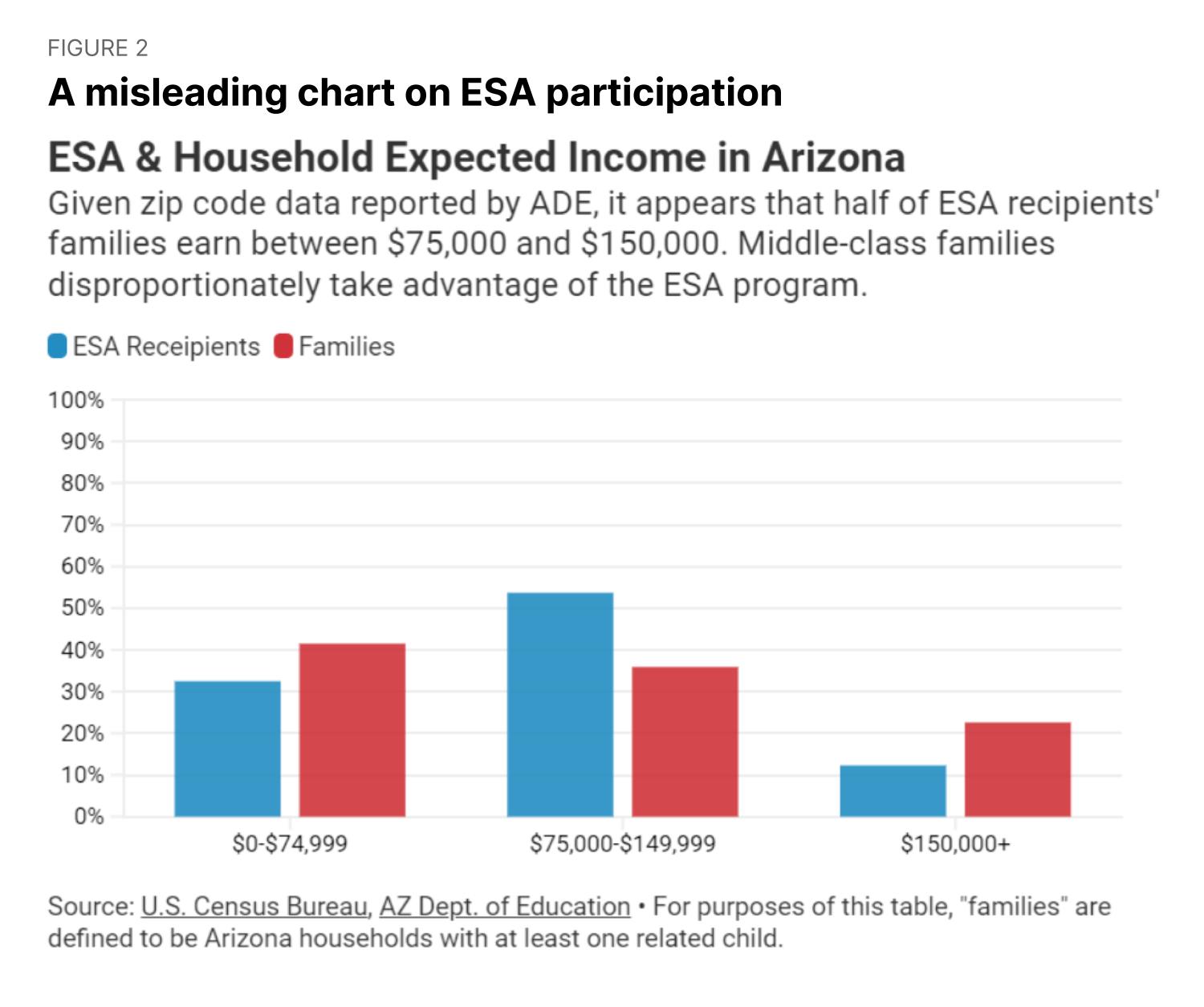
Before we published our post, an organization called the Common Sense Institute (CSI) of Arizona—a “non-partisan research organization” with several staff members from former governor Doug Ducey’s administration—looked into a similar question. CSI’s chart, below, tells a completely different story from our chart. 

A misleading chart on ESA particicpation

CSI makes it look like relatively few wealthy families in Arizona get ESAs. So, why the discrepancy?  

It’s because CSI presented an apples-to-oranges comparison that’s bound to tell that story. The data issue is subtle, but they present ZIP code-level data for ESA recipients (blue bars, on the left) and household-level data for families (red bars, on the right). Many households in Arizona make $150,000 or more, so the far-right, red bar is quite tall. However, few ZIP codes have enough households earning more than $150,000 that the median household income rises above that threshold. As a result, many ESA recipients who earn more than $150,000 aren’t included in the $150,000+ category in this chart. Instead, these households—which earn more than $150,000 themselves but live in ZIP codes where the median income is below $150,000—are included in one of the other blue bars.  

Maybe that’s an innocent mistake, but it’s certainly not an accurate representation of which Arizona residents are getting ESAs. 

Critique 2: We didn’t place Arizona’s ESA program in the proper context of its other school choice programs 

Education Next published an article from Jason Bedrick of the Heritage Foundation that accuses us of omitting key context that, if presented, would markedly change the takeaways from our analysis. Bedrick points out that Arizona’s universal ESA program exists alongside several tax-credit scholarship programs (true) and that families are prohibited from participating in the ESA and tax-credit scholarships simultaneously (also true). He then shares a few numbers, does some hand-waving, and concludes that our “fatally flawed” analysis is deeply misleading because of this omission. 

Curiously, Bedrick doesn’t show the relative size of the ESA and tax-credit scholarship programs in Arizona. Here’s the obvious chart to illustrate that comparison—one that EdNext maybe could have requested before publishing yet another round of Heritage Foundation talking points on ESAs:  

FIGURE 3

These tax-credit scholarship (TCS) programs are small relative to a large-and-growing universal ESA program that’s projected to exceed $900 million this year. On top of that, most TCS dollars are going to recipients above 185% of the federal poverty level—the threshold for reduced-price lunch eligibility. (One note: the most recent numbers available for the ESA program come from FY24, while the most recent numbers available for TCS programs come from FY23.)   

In other words, this critique—which really isn’t about the universal ESA program we analyzed in the first place—doesn’t even point to context that meaningfully changes the interpretation of our data.  

It’s important to emphasize, too, that our analysis was primarily about the high-income households that are obtaining a disproportionate share of Arizona’s ESAs. In that post, we tried to present data in the most straightforward, defensible way possible. If our goal had been to present the most damning data possible, there’s more we’d have said.  

Here’s a doozy of an example. According to U.S. Census Bureau data, Arizona has 300 ZCTAs with at least 250 children under age 18. (The other 60 ZCTAs are smaller, which makes them difficult to analyze.) Of those 300 ZCTAs, the one with the single-highest take-up rate for ESAs (236 of every 1,000 children) is the one with the single-highest median household income (about $173,000).  

Critique 3: Arizona’s ESA program is too new to assess who will participate 

Maybe the most peculiar response we’ve seen is from Mike McShane of EdChoice, who published an op-ed in Forbes.  

McShane appeals to Everett M. Rogers’ “diffusion of innovation” theory, which suggests that new technologies and ideas are adopted sequentially by different groups (from early adopters to laggards). McShane asserts that we should expect wealthier and more educated families to be the early adopters of a universal ESA program. He implores us to “think of the first people to own a personal computer, or a cell phone. They started with tech nerds and the wealthy, and eventually worked their way to everyone else.”  

Let’s play a game of “one of these things is not like the others” with personal computers, cell phones, and a universal ESA program. Yes, we’d expect wealthier families to be the first to buy computers and cell phones. Those things cost a lot of money. A universal ESA program gives you money. We might expect poorer families—with fewer resources and potentially worse public-school options—to jump first at that opportunity. Even the usual dynamic of uneven information diffusion is complicated in this context, as the ESA program was available to families with children in low-rated schools long before it became universal.  

Regardless, there’s reason for concern that vouchers will be more exclusively adopted by the wealthy over time. Jason Fontana and Jennifer Jennings studied the early implementation of a universal ESA account in Iowa. They found that private schools responded to ESA eligibility by increasing their tuition. If this response continues to play out, we might see desirable private schools becoming unaffordable to low-income families that cannot cover a growing gap between the value of their voucher and cost of enrollment. In the long term, this creates a risk of extreme stratification across the public and private sectors.  

Chile may provide a glimpse of that potential future. In a 2006 paper in the “Journal of Public Economics”, Chang-Tai Hsieh and Miguel Urquiola analyzed a universal voucher program in Chile. They found suggestive evidence that “the main effect of unrestricted school choice was an exodus of ‘middle-class’ students from the public sector… [which] had a major effect on academic outcomes in the public sector.” These patterns, along with widening achievement gaps between rich and poor, led Chile to drastically modify that program.   

Critique 4: We’re targeting ESA programs when the real villains are public schools 

A fourth set of critiques presents more conceptual arguments about education reform. Perhaps the most data-infused of these comes from The Goldwater Institute, which notes that Arizona spends a great deal of money to “subsidize public school instruction” for wealthy families. It accuses us (and/or others) of a double standard in how we object to using government funds to pay for wealthy students’ private schooling but not public schooling.  

We think this critique reveals just how far the rhetoric surrounding universal ESAs has drifted from Americans’ traditionally held views about education. Americans have long accepted—in fact, embraced—a double standard for public and private schools. Our public education system, with all its flaws, has been a foundational institution for supporting the country’s economic, social, and democratic well-being. Americans have found a rough consensus on how to approach K-12 education: provide free public schooling to everyone (including the wealthy!), allow families to pay for private education if they’d like to opt out of the public system, and maybe create a few opt-out opportunities via school choice policy for those unable to pay. 

We’ve entered a period in which conservative lawmakers are confronted with legacy-defining decisions about whether to abandon that long tradition and embrace universal vouchers at the risk of kneecapping their states’ public education systems. Worse, they’re doing it in a polluted information environment that has plenty of loud voices but hardly any credible research to guide or support their decision-making. Now that a few states—including Arizona—have taken that risky leap of faith, the least we can ask of other state leaders is to wait and see what happens

Stephen Dyer, former state legislator in Ohio, wrote in his blog “Tenth Period” that the 85% of Ohio’s children who attend public schools are being shortchanged by the state. First the state went overboard for charter schools, including for-profit charters and virtual charters and experienced a long list of money-wasting scandals. Then the state Republicans began expanding vouchers, despite a major evaluation showing that low-income students lost ground academically by using vouchers. As the state lowered the restrictions on access to vouchers, they turned into a subsidy for private school tuition.

He writes:

Since 1975, the percentage of the state budget going to Ohio’s public school students has dropped from 40% to barely 20% this year — a record low.

This is stunning, stunning data. But the Ohio General Assembly and Gov. Mike DeWine today are committing the smallest share of the state’s budget to educate Ohio’s public school kids in the last 50 years. And it’s not really close.

What’s going on here?

Simple: Ohio’s leaders have spent the last 3+ decades investing more and more money into privately run charter schools and, especially recently, have exploded their commitment to subsidize wealthy Ohioans’ private school tuitions. This has come at the expense of the 85% of Ohio students who attend the state’s public school districts. 

Look at this school year, for example. In the budget, the state commits a little more than $11 billion to primary and secondary education. That represents 26.6% of the state’s $41.5 billion annual expenditure. However, this year, charter schools are expected to be paid $1.3 billion and private school tuition subsidies will soar to $1.02 billion (to give you an idea of what kind of explosion this has been, when I left the Ohio House in 2010, Ohio spent about $75 million on these tuition subsidies). So if you subtract that combined $2.32 billion that’s no longer going to kids in public school districts, now Ohio’s committing $8.7 billion to educate the 1.6 million kids in Ohio’s public school districts. That’s a 21.1% commitment of the state’s budget. 

Some perspective:

  • That $8.7 billion is about what the state was sending to kids in public school districts in 1997, adjusted for inflation.
  • The 21.1% commitment currently being sent to kids in public school districts is by far the lowest commitment the state has ever made to its public school students — about 7% lower than the previous record (last year’s 22.2%) and 20% lower than the previous record for low spending in the pre-privatization era. 
  • The voucher expenditure alone now drops state commitment to public school kids by nearly 10%.
  • The commitment to all students, including vouchers and charters, represents the fifth-lowest commitment since 1975. Only four years surrounding the initial filing of the state’s school funding lawsuit in 1991 were lower. The lowest commitment ever on record was 1992 at 25.2% of the state budget. Don’t worry, though. Next year, the projected commitment to all Ohio students will be 25.3% of the state budget.
  • What is clear now is that every single new dollar (plus a few more) that’s been spent on K-12 education since 1997 has gone to fund privately run charter schools and subsidize private school tuitions mostly for parents whose kids already attend private school. 

What’s even more amazing is that even if charters and vouchers never existed and all that revenue was going to fund the educations of only Ohio’s public school students, the state is still spending a smaller percentage of its budget on K-12 education than at any but 4 out of the last 50 years. And next year it’s less than all but 1 of those last 50 years.

Ohio’s current leaders have essentially divested from Ohio’s greatest resource — its children and future — for the last 30 years.

Please open the link and finish reading the post. Ohio has also slashed funding for public higher education.

Does this disinvestment in children and higher education make any sense? Who benefits?

Writing in The New Yorker, Jessica Winter deftly connects the spread of vouchers with deep-seated racism, phony culture war issues, and the war on public schools. Winter is an editor at The New Yorker.

She writes:

In October, 2018, on the night of a high-school homecoming dance in Southlake, Texas, a group of white students gathered at a friend’s house for an after-party. At some point, about eight of them piled together on a bed and, with a phone, filmed themselves chanting the N-word. The blurry, seesawing video went viral, and, days later, a special meeting was called by the board of the Carroll Independent School District—“Home of the Dragons”—one of the wealthiest and highest-rated districts in the state. At the meeting, parents of Black children shared painful stories of racist taunts and harassment that their kids had endured in school. Carroll eventually convened a diversity council made up of students, parents, and district staffers to address an evident pattern of racism in Southlake, although it took nearly two years for the group to present its plan of action. It recommended, among other things, hiring more teachers of color, requiring cultural-sensitivity training for all students and teachers, and imposing clearer consequences for racist conduct.

As the NBC reporters Mike Hixenbaugh and Antonia Hylton recounted in the acclaimed podcast “Southlake,” and as Hixenbaugh writes in his new book, “They Came for the Schools: One Town’s Fight Over Race and Identity, and the New War for America’s Classrooms,” Southlake’s long-awaited diversity plan happened to emerge in July, 2020, shortly after the murder of George Floyd by a Minneapolis police officer sparked Black Lives Matter protests against racism and police brutality across the United States. It was also the same month that a journalist named Christopher Rufo published an article in City Journal headlined “Cult Programming in Seattle,” which launched his campaign to make “critical race theory”—an academic discipline that examines how racism is embedded in our legal frameworks and institutions—into a right-wing panic button. A political-action committee called Southlake Families pac sprang up to oppose the Carroll diversity plan; the claim was that it would instill guilt and shame in white children and convince them that they are irredeemably racist. The following year, candidates endorsed by Southlake Families pac swept the local elections for school board, city council, and mayor, with about seventy per cent of the vote—“an even bigger share than the 63 percent of Southlake residents who’d backed Trump in 2020,” Hixenbaugh notes in his book. Some nine hundred other school districts nationwide saw similar anti-C.R.T. campaigns. Southlake, where the anti-woke insurgency had won lavish praise from National Review and Laura Ingraham, was the blueprint.

“Rufo tapped into a particular moment in which white Americans realized that they were white, that whiteness carried heavy historical baggage,” the education journalist Laura Pappano writes in her recent book “School Moms: Parent Activism, Partisan Politics, and the Battle for Public Education,” which also digs into the Southlake controversy. Whiteness could feel like a neutral default mode in many communities because of decades of organized resistance to high-density housing and other zoning measures—the bureaucratic backhoes of suburbanization and white flight. Today, the Carroll school district, though still majority white, has significant numbers of Latino and Asian families, but less than two per cent of the district’s students are Black.

In this last regard, Southlake is not an outlier, owing largely to persistent residential segregation across the U.S. Even in highly diverse metro areas, the average Black student is enrolled in a school that is about seventy-five per cent Black, and white students attend schools with significantly lower levels of poverty. These statistics are dispiriting not least because of ample data showing the educational gains that desegregation makes possible for Black kids. A 2015 analysis of standardized-test scores, for instance, identified a strong connection between school segregation and academic-achievement gaps, owing to concentrated poverty in predominantly Black and Hispanic schools. A well-known longitudinal study found that Black students who attended desegregated schools from kindergarten to high school were more likely to graduate and earn higher wages, and less likely to be incarcerated or experience poverty. Their schools also received twenty per cent more funding and had smaller classroom sizes. As the education reporter Justin Murphy writes in “Your Children Are Very Greatly in Danger: School Segregation in Rochester, New York,” this bevy of findings “lends support to the popular adage among desegregation supporters that ‘green follows white.’ ”

These numbers, of course, don’t necessarily reflect the emotional and psychological toll of being one of a relatively few Black kids in a predominantly white school. Other recent books, including Cara Fitzpatrick’s “The Death of Public School: How Conservatives Won the War Over Education in America” and Laura Meckler’s “Dream Town: Shaker Heights and the Quest for Racial Equity,” have also considered how those costs have been weighed against the moral imperative of desegregation. This is the axial force of a lineage that runs from the monstrous chaos that followed court-ordered integration in the nineteen-fifties and sixties and the busing debacles of the seventies to the racist slurs thrown around at Southlake. As my colleague Louis Menand wrote last year in his review of Rachel Louise Martin’s “A Most Tolerant Little Town: The Explosive Beginning of School Desegregation,” “It was insane to send nine Black teen-agers into Central High School in Little Rock with eighteen hundred white students and no Black teachers. . . . Desegregation was a war. We sent children off to fight it.” To Rufo and his comrades, there was no such war left to be fought; there were only the bitter-enders who hallucinate microaggressions in the wallpaper and whose books need to be banned from school libraries. A mordant irony of Rufo’s imaginary version of critical race theory is that Derrick Bell, the civil-rights attorney and legal scholar who was most closely associated with C.R.T., eventually came to be skeptical about school-integration efforts—not because racism was effectively over or because legally enforced desegregation represented government overreach, as the anti-C.R.T. warriors would hold today, but because it could not be eradicated. In a famous Yale Law Journal article, “Serving Two Masters,” from 1976, Bell cited a coalition of Black community groups in Boston who resisted busing: “We think it neither necessary, nor proper to endure the dislocations of desegregation without reasonable assurances that our children will instructionally profit…”

In the years before Brown v. Board of Education was decided, the N.A.A.C.P.—through the brave and innovative work of young lawyers such as Derrick Bell—had brought enough lawsuits against various segregated school districts that some states were moving to privatize their educational systems. As Fitzpatrick notes in “The Death of Public School,” an influential Georgia newspaper owner and former speaker of the state’s House declared, in 1950, “that it would be better to abolish the public schools than to desegregate them.” South Carolina, in 1952, voted 2–1 in a referendum to revoke the right to public education from its state constitution. Around the same time, the Chicago School economist Milton Friedman began making a case for school vouchers, or public money that parents could spend as they pleased in the educational marketplace. White leaders in the South seized on the idea as a means of funding so-called segregation academies. In 1959, a county in Virginia simply closed down its public schools entirely rather than integrate; two years later, it began distributing vouchers—but only to white students, as Black families had refused to set up their own segregated schools.

Despite these disgraceful origins, vouchers remain the handmaiden of conservative calls for “school choice” or “education freedom.” In the run-up to the 2022 midterms, Rufo expanded his triumphant crusade against C.R.T. into a frontal assault on public education itself, which he believed could be replaced with a largely unregulated voucher system. “To get universal school choice, you really need to operate from a premise of universal public-school distrust,” Rufo explained. He had been doing his best to sow that distrust during the previous two years.

Twenty states currently have voucher programs; five states launched universal voucher programs in 2023 alone. But reams of evidence show that vouchers negatively impact educational outcomes, and the money a voucher represents—around eight thousand dollars in Florida, sixty-five hundred in Georgia—is often not nearly enough to cover private-school tuition. In practice, then, vouchers typically act as subsidies for wealthy families who already send their children to private schools; or they pay for sketchy for-profit “microschools,” which have no oversight and where teachers often have few qualifications; or they flow toward homeschooling families. Wherever they end up, they drain the coffers of the public schools. Arizona’s voucher system, which is less than two years old, is projected to cost close to a billion dollars next year. The governor, Katie Hobbs, a Democrat and former social worker, has said that the program “will likely bankrupt the state.”

Back in Texas, Governor Greg Abbott has become the Captain Ahab of school choice—he fanatically pursued a voucher program through multiple special sessions of the state legislature, failed every time to sink the harpoon, and then tried to use the rope to strangle the rest of the education budget, seemingly out of spite. Abbott’s problem is not only that Democrats don’t support vouchers but that they’ve also been rejected by Republican representatives in rural areas, where private options are scarce and where public schools are major local employers and serve as community hubs. (Southlake’s state representative, a Republican with a background in private equity, supports Abbott’s voucher scheme—a bizarre stance to take on behalf of a district that derives much of its prestige, property values, and chauvinism from the élite reputation of its public schools.) White conservatives in Texas and elsewhere were roused to anger and action by Rufo-style hysteria. But many of them may have realized by now that these invented controversies were just the battering ram for a full-scale sacking and looting of public education.

The board of the Pasadena Unified School District debated whether charter schools should share in the receipts of a new tax. The board voted 4-3 not to include the charters. The three members who voted in favor of including the charters said that the votes of the parents of 2,000 charter students would help meet the 2/3 majority needed to pass the tax. The four who voted “no” held that charters are independent of the district and should not benefit from its taxes. The members opposing the sharing said that the charters could affiliate with the district but they choose not to.

The Pasadena school board considered a resolution to approve an education parcel tax for the ballot in the November 2024 election. The resolution was moved for approval and seconded. The board discussed and voted down an amendment in the ballot language to add charters as beneficiaries of the measure.

Board President Kim Kenne and Members Patrick Cahalan and Tina Fredericks voted to add charter schools as beneficiaries of the parcel tax on the November ballot.

Member Cahalan appreciated the public comments from charter supporters whose families have students in both regular PUSD schools and charter schools. The district’s survey about the November measures showed the potential support for passing this measure and the facilities bond is very close to the ⅔ needed for passage. He wanted the support of the approximately 2000 charter school parents to get it over the threshold. He proposed a board resolution to spell out the sharing of monies…

Those voting against the amendment were Michelle Richardson-Bailey, Patrice Marshall McKenzie, Yarma Velazquez and Jennifer Hall Lee.

Vice President Hall Lee spoke about having charters in the district authorized by other entities, not PUSD, like the L.A. County Board of Education. She spoke of the history of charters. While initially founded to help the public schools, they have become competitors and have become anti-union. She said she is a union-supporter, and she believes there is competition between charters and PUSD schools, like in Altadena. She spoke against the argument that charters are needed to be cutting edge options. PUSD is recognized in state education circles as a cutting edge district of excellence. Later in the meeting she mentioned that members of the California Charter Schools Association (CCSA) were present earlier. She found that CCSSA is funded by the Walton family, and a director of CCSA is also an employee of Walton Enterprises. The wealth of the Walton family is problematic when the CCSA threatens legal action against the district.

Member Marshall McKenzie introduced herself to the charter supporters in attendance, who had referred to her by a shorter version of her name not used by her. She spoke about her deep roots in the community and in PUSD public schools; her parents attended PUSD schools. She spoke of her university training in state public universities, her full commitment to public education as democratic, a creator of society, a lever of economic mobility, and a center of community. These things are really important to her and are why she ran to be on the board of education. She was not prepared to entertain or accept any amendments tonight, as those are longer conversations.

Member McKenzie said that she was clear on the nature of charters as separate Local Education Agencies (LEAs), which have the ability to raise money from their parents, and which get their own Average Daily Attendance (ADA) money from the State. These funds do not go to PUSD. She pushed back on the charter supporters’ comments about inclusion and building community, saying, “If you are willing to convert your charters to be affiliated charters or dependent charters, let’s have that conversation about how we build community and how we serve all of the students in the area of the Pasadena Unified School District because now we’re all public schools.” She said she has been consistent on this point.

Member McKenzie made the same argument back in 2019 at the joint meeting of the City Council and the PUSD Board, when charters wanted some of the Measure J sales tax monies. At the time she said, “Since charters are their own LEA, that would be like PUSD giving Measure J money to Glendale Unified. We would not do that. So why would we give these dollars away as well?  I just don’t understand the logic in that.  So right or wrong, I’m going to be consistent in my position on that.” She struggles with the situational alliance with PUSD. “When it’s convenient for you, you want to be PUSD kids, you want to be public school kids, and when it’s not convenient for you, you’re very happy to divest… I feel like right now you’re not with us; it’s for your personal benefit and not for the greater good of the community.”

Like Vice-President Hall Lee, she referred to the origin of charter schools as being the center of innovation and providing flexibility for educators in curriculum development and with staffing, but charters have gone far away from those principles in the current charter and school landscape. “We simply just cannot afford to fund two systems out of one pot of money, and what you’re asking us to do is to dilute this one small pot of money even smaller.” She referred to the parcel tax amount being small compared to PUSD’s state funding and budget challenges. Yet she said she was very supportive of the bond and the parcel tax as a voter and a property owner who is happy to make the investment in public education. She reiterated that charters could have the same flexibility in curriculum development and staffing and special programs if they were PUSD-affiliated charters, but if they aren’t willing to have that conversation, she stated that she’s  not willing to go down this road of sharing funding. Member McKenzie ended by saying she can’t support the amendment without a longer dialogue and a building of community with those in charters.

Regarding the argument about losing the votes of many parents with children at both a charter and a PUSD high school, Member Velazquez said, “They have the choice to support our public high schools. I support our PUSD teachers; I support our PUSD staff. I am a proud CFA (California Faculty Association, the faculty union for the CSU system) member. I am a proud educator in the public education system in this beautiful state of California. I am a ‘NO’ on the amendment.”

Seventeen high school students in Georgia marked the 70th anniversary of the Brown decision by writing an article calling on the state’s political leaders to fully fund public schools, instead of funding vouchers. They are members of the Georgia Youth Justice Coalition.

They wrote in the Atlanta Journal-Constitution:

As young Georgians, we share the belief that all children should have the freedom to pursue their dreams and that our futures depend on receiving a great education. To get there, we must equip every public school with the resources to deliver a quality education for every child, no matter their color, their ZIP code or how much money their parents make.

Unfortunately, we find ourselves in yet another moment of massive resistance to public education with increasingly aggressive efforts on behalf of the state of Georgia to privatize our public schools and return us to a two-tiered system marked by racial segregation. As public school students in high schools across Georgia, we believe that the 70th anniversary of Brown v. Board of Education is not just a cause for celebration but an invitation to recommit ourselves to the promise of a public education system that affirms an essential truth: Schools separated by race will never be equal.

Even as our country celebrates the anniversary of Brown this month, we know that our state actively worked to obstruct desegregation, which did not meaningfully take place for another 15 years. Seven years after the Supreme Court’s ruling that separating children in public schools on the basis of race was unconstitutional, the Georgia General Assembly revoked its school segregation law in 1961. Another 10 years later, a court-ordered desegregation plan finally took effect — in 1971.

In 2024, educators across Georgia, from Albany to Atlanta, from Valdosta to Vinings, from Dalton to Dublin, and everywhere in between, are working hard to provide students like us with a quality education, empowering us to build a brighter future in Georgia for all. Yet politicians in the Georgia Capitol seem dedicated to resegregating and privatizing our public schools by taking tax dollars meant to support all of the students in our communities and giving it to unaccountable voucher programs that favor the wealthiest few.

The long and shameful history of vouchers is something that politicians who forced them to become law this year don’t want us to know. In many cities, public education funding was funneled to private “segregation academies” where white children received better resources than children of color. Instead of making our public schools stronger and moving us all forward together, these politicians are defunding our public schools by more than $100 million and working to drag us backward to the days when Georgia was still resisting court-ordered desegregation.

We want our leaders to get serious about what works: fully funding our public schools so that we can improve our neighborhood schools. That’s where 1.7 million public school students in Georgia learn and grow, and where we all can have a say. Research all across the country shows that voucher programs will not improve student outcomes in Georgia, but we know what will best serve students.

Young Georgians like us need investments in our public schools so we have the opportunity to learn and thrive. Gov. Brian P. Kemp has $16 billion of unspent public funds — enough to cover the costs of funding our schools and investing in our communities. Georgia has one of the highest overall rates of child poverty in the nation. Yet our state is one of only six states that provides schools with no specific funding to support children living in poverty. By refusing to give our schools what they need, we are setting our schools and our students up for failure.

Politicians brag about Georgia’s teachers being among the highest paid in the South even though they know they have created a crisis around public education that puts our teachers, our parents and students like us in an impossible position. Right now, nearly every school district in Georgia operates with a waiver to avoid adhering to classroom size restrictions because they cannot afford to hire enough teachers. And though the American School Counseling Association recommends a counselor-to-student ratio of 1:250, Georgia mandates a counselor-to-student ratio of 1:450 students. Many schools cannot even meet that ratio because of a lack of funding. All of that is by design because politicians have refused to update Georgia’s school funding formula for nearly 40 years.

This year, as we celebrate 70 years since Brown v. Board of Education, we invite every Georgian to join us in our call for fully funded neighborhood public schools so that every Georgia student has an inviting classroom, a well-rounded curriculum, small class sizes and the freedom to learn.

The writers are members of the Georgia Youth Justice Coalition. Nia G. Batra is a sophomore at Decatur High School. Hunter Buchheit is a senior at Walton High School. Ava Bussey is a senior at Marietta High School. Keara Field is a senior at McDonough High School. Saif Hasan is a junior at Lambert High School. Jessica Huang is a senior at Peachtree Ridge High School. Shivi Mehta is a junior at the Alliance Academy for Innovation. Bryan Nguyen is a senior at the Gwinnett School of Mathematics, Science, and Technology. Rhea Sethi is a senior at North Gwinnett High School. Maariya Sheikh is a senior at Campbell High School. Harrison Tran is a junior at Jenkins High School. Sharmada Venkataramani is a sophomore at South Forsyth High School. Thomas Botero Mendieta is a junior at Archer High School. Kennedy Young is a senior at Campbell High School.

After Spectrum News reported that millions of dollars had been sent from Texas charter schools founded by Mike Miles to Colorado charter schools in the same chain, parents and students demanded Miles’ resignation as superintendent of Houston Independent School Disttrict. Elected officials have called for an investigation but recognize that neither the State Commissioner (Mike Morath) nor Governor Abbott are likely to criticize Miles, whom they appointed.

HOUSTON — U.S. Rep. Sylvia Garcia formally requested that the U.S. Department of Education investigate the issues at Houston ISD and the financing of schools in the area, according to a letter obtained by KHOU 11 News.

In the letter dated May 15, the Congresswoman refers to recent news stories that reported Ector ISD near Midland, Texas allegedly sent state funds from Texas to Third Future Schools, a charter school operated in Colorado. She requested that an audit be conducted on Ector ISD.

Spectrum News Texas report highlighted a pair of million-dollar-plus checks allegedly sent from Third Future Schools in Texas to its campuses in Colorado. The report accused Houston ISD Superintendent Mike Milesof sending Texas tax dollars out of state.

Miles has issued a statement responding to the report, saying the report “either intentionally or through gross incompetence, mischaracterized commonplace financial arrangements between charter schools and the charter management organizations that support them.” 

RELATED: HISD Superintendent Mike Miles responds to report he funneled TX taxpayer money to Colorado | TEA commissioner, Third Future Schools also respond

Garcia expressed concerns over the financial stability of HISD following last year’s takeover by the state of Texas. This comes after widespread layoffs were announced leading to protests from those affected and HISD families.

RELATED: More Houston ISD parents protest over principals reportedly being forced out

RELATED: She was principal of the year in 2023. A year later, she said HISD forced her to resign

Texas Education Commissioner Mick Morath has confirmed that the TEA complaints team will look into allegations against Miles

The congresswoman also requested the issuance of federal funds by the state from the pandemic that were to be used to supplement public education at HISD be audited.

“It pains me that my home school district has been taken over and is seemingly being intentionally run into the ground and (I) request any additional assistance you can provide to protect our schools and our students,” Garcia said in the letter.

Garcia went on to claim that the state is punishing HISD.

“Houston is a vibrant and diverse community, and our state government is punishing us for that; we need your help,” she said in the letter.

Mike Miles, the Superintendent imposed on the Houston public schools by a state takeover, set up a chain of charter schools in Colorado. His charters are running a big deficit. They are also getting poor academic results. One of them closed.

Miles is still getting paid as a consultant to his charter chain.

Miles opened charter schools in Texas.

Investigative reporter Brett Shipp learned that millions of dollars are being transferred from Miles’s Texas charters to his Colorado charters, to pay down their debt.

When he asked the charter leaders about this transfer, he was told that all the charters are in the same chain, so no problem.

But Texas parents complain that their schools are underfunded. When Shipp interviewed them, they were shocked to hear that their tax dollars were being sent to underwrite the deficit of charters in Colorado.