Ezra Klein is a columnist for The New York Times. His podcast is wildly popular. He synthesizes events that seem disparate.
He explains succinctly the moment we are in.
Ezra Klein is a columnist for The New York Times. His podcast is wildly popular. He synthesizes events that seem disparate.
He explains succinctly the moment we are in.
Texas Governor Greg Abbott is holding hostage the more than five million students in public schools while he demands vouchers for kids who are already enrolled in private and religious schools. Abbott has refused to increase funding for the state’s public schools unless the legislature approves vouchers, most of which will subsidize the affluent.
Last year, the legislature refused to approve vouchers. Since then, Abbott engineered the defeat of several anti-voucher Republicans. He’s hoping to win approval in the current session. Vouchers will pass easily in the state senate. We will see what happens in the House, where rural Republicans stood against vouchers in the past, before Abbott’s purge.
Abbott is playing Reverse Robin Hood. He is stealing from the poor to pay for the rich. Billionaires like Jeff Yass, the richest man jnnOennstlvsnia, and Betsy DeVos of Michigan, are funding his intransigence with millions in campaign contributions.
The Texas Monthly reports that school superintendents are increasing class sizes, laying off teachers, eliminating electives, and doing whatever they can to keep their doors open.
The article says:
Two years ago, during the 2023 legislative session, superintendents of Texas schools were optimistic that state lawmakers would boost public-education funding. After all, soaring inflation was straining the already meager finances of districts across the state, and lawmakers had at their disposal a $32.7 billion budget surplus. Spending some of that money on the urgent educational needs of the state’s children might have seemed like an uncontroversial proposal.
Instead, the unthinkable happened: Legislators left Austin without putting any significant new money into schools or giving teachers a raise. The consequences have been dire.
Texas’s public schools were already among the most poorly resourced in the country: Our per-student funding is about 27 percent less than the national average. The basic allotment—the minimum amount of funding per student that school districts receive from the state—has been stuck at $6,160 since 2019. That would need to be upped by about $1,400 just to keep pace with rising costs. Public education advocates worry that lawmakers will provide only face-saving increases to the basic allotment in 2025 while diverting billions to private schools.
Many school leaders have had to undertake draconian austerity measures. Nearly 80 percent of districts have reported challenges with budget deficits. Given the stakes, 2025 could be a pivotal year for Texas’s public-education system….
Texas Monthly spoke to a group of superintendents to ask about how they were coping. They all spoke about the budget cuts and unfunded mandates (like requiring the hiring of police officers without providing funding). One superintendent, Jennifer Blaine of Spring Branch, said:
JB, Spring Branch: We don’t have anywhere else to cut. We are cut to the bone. I consolidated everything I could, and I cut everything that I could. If we have to cut further, you’re talking about severely impacting academics in the classroom and, quite frankly, safety and security. Five and a half million kids are in Texas public schools, and I don’t understand how our legislators and our governor don’t see this as a crisis. If we don’t educate these kids to the highest levels and prepare them for postsecondary success, we’re going to crumble as a state. I don’t know where the disconnect is. Education is the great equalizer. But nobody is talking about that, and I think it’s a missed opportunity because this is not going to end well.
The title of the article in the print edition was “A Legislature That Will Spend at Least as Much Per Pupil as Louisiana.”
As part of the radical overhaul of the federal government, some 2 million employees were asked to resign and accept a leave with pay if they did. But there is no money appropriated to pay for the offer, and there are multiple lawsuits opposing it. Nor was there any consideration of the value of the employee’s work.
When Elon Musk took charge of Twitter, he made a similar offer and fired 80% of the workforce. He got rid of content moderation teams and opened the platform to Nazis and misinformation. The downside was that he lost every major advertiser, and he’s now suing them for conspiring to hurt Twitter.
The New York Times reported on the final day of the offer:
Some federal employees have a new symbol for their resistance to President Trump’s and Elon Musk’s radical overhaul of the U.S. government: a spoon.
Last week, in an email with the subject line “Fork in the Road,” the administration urged federal workers to consider resigning from their posts and said they would be paid through September — a bid to rapidly shrink the size of the work force.
Union leaders have urged employees not to accept the offer, questioning its legality and legitimacy. And on Wednesday, workers at the Technology Transformation Services, the tech-focused arm of the General Services Administration, made their displeasure with the offer known during an organization-wide meeting with their new leader, a former employee at Mr. Musk’s automaker Tesla, by sharing spoon emojis in an online chat, according to people familiar with the response.
In the meeting, Thomas Shedd, a former Tesla engineer who was appointed to lead technology efforts at the G.S.A., attempted to assuage worries about the deferred resignation plan and told workers to “read as much as you can” about the offer, according to an audio recording provided to The New York Times. He also urged federal workers to review information posted on the website of the Office of Personnel Management.
“Have that context in mind as you think through the decision you have to make in the next 24 to 30 hours,” Mr. Shedd added. “The deferred resignation is the first step in streamlining the federal work force. In-person work will be the next step.”
His assurances did not appear to work. Employees in the tech division rained down spoon emojis in the chat that accompanied the video meeting, which was watched by more than 600 people, according to photos of the chat screen provided to The Times and three people familiar with the reaction. Some employees also added spoon emojis to their statuses on Slack, a workplace communication app.
“Thomas: Whether you mean to or not, you’re playing a role in destroying TTS,” one worker wrote in the chat.
“The culture is the people,” another employee wrote. “Without the people, TTS is NOTHING.”
After Mr. Musk’s $44 billion acquisition of Twitter in 2022, he sent an email with the same subject line — “Fork in the Road” — to the company’s employees, offering them a buyout to leave the company if they didn’t want to participate in his “extremely hardcore” vision.
During the Twitter takeover, employees used the salute emoji as a sign of solidarity with their co-workers and as a goodbye during mass layoffs.
After renaming the social media service as X, Mr. Musk has pushed for severe cuts to the federal government. He shared a post that estimated 5 to 10 percent of the federal work force would take the deferred resignation offer, potentially saving the government $100 billion.
The last date to accept the offer is Feb. 6, according to the email to government workers.
Simon Rosenberg is a leader of the resistance to Trumpism. He blogs at Substack, where his blog is called Hopium. He wrote today:
Morning/Afternoon all. If Donald Trump has a superpower it has been the evasion of responsibility for the bad things he’s done in his life. Yesterday he blamed Biden, Obama, Pete Buttigieg, DEI for the 67 dead in the Potomac. Deflect, blame others, rinse, repeat. So let’s be clear about a few things today:
Trump Is Trying To Break The US Government And Owns All The Troubles That Come From It – Trump’s savage attack on the day to day operations of our government will result in many, many bad things to happen. The 67 dead in the Potomac are an example. He has gutted the leadership of our government’s aviation security and has waged a war against rank and file employees of the government including air traffic controllers. When things fail like they did this week outside of Reagan National Airport we must hold the President to account. He is literally trying to break things now and when they break there is one person to blame and it sure isn’t Mr or Mrs DEI.
It is possible those outside of DC don’t understand the scale and scope of the purges happening at senior levels of every department and agency right now. Incredible knowledge, expertise and operational capacity are being lost. The entire National Security Council career staff, for example, was just sent home last week. They are disabling the ability of the US government to carry out its daily responsibilities.
Trump’s Economic Agenda Is Causing Prices To Rise For Everyone. Tariffs Will Raise Them Even Further – As we discussed with Rob Shapiro earlier this week the President’s proposed economic policies will raise prices for everyone, re-ignite inflation, raise taxes on middle class Americans, cut benefit programs that will cause costs to rise on a wide variety of services including health care and provide extraordinary tax breaks for the wealthy and corporations. As Rob explained to us the tariffs Trump may implement tomorrow are a national sales tax on an incredible array of goods including food, oil and gas, wood and other construction products. Prices on all these things will rise significantly, immediately, perhaps as early as tomorrow, and further fuel inflation.
Trump’s inflationary agenda is already re-igniting inflation. From Reuters this morning, Key US inflation measure posts largest monthly gain since April:
U.S. inflation increased by the most in eight months in December amid a surge in consumer spending, suggesting the Federal Reserve would probably be in no hurry to resume cutting interest rates soon.
Other data on Friday showed labor costs rose in the fourth quarter as wages edged up. Price pressures picked up in the fourth quarter, stalling the progress in lowering inflation.
We all need to be very clear that Trump has no plan to lower prices and costs. Regardless of his rhetoric his plan actually seeks to raise prices and costs, not lower them, and here we are – inflation and costs are rising for every American, already.
Mass Deportation Will Raise Prices For Americans, Disrupt Our Businesses and Slow Growth – As we discussed with David Leopold last week Trump’s mass deportation plan is going to remove millions of workers from our labor force at a time of historically low employment. This will cause our companies to lose long-time productive employees; make it far harder for all companies to hire and grow; prices will rise for food, health care, day care, restaurants, hotels and many, many other items; families and communities will be shattered. All of this contribute to re-igniting inflation, ensuring the Fed does not lower interest rates, keeping mortgages and borrowing costs for all companies and Americans at elevated levels, slowing growth and worsening the cost of living crisis in America. It will also have this effect, via Hopium community member Catherine G:
My daughter-in-law is a prosecutor. Victims of crime and witnesses are now not showing up for court dates and/or preparation because they are afraid ICE will seize them at the court house. That means cases can’t be prosecuted and that means criminals stay free to commit more crimes. Party of law and order my sweet Aunt Annie.
The savage treatment of the migrants we are sending back, the bullying of countries to accept them, the levying of tariffs on our closest allies, the threat or actual seizure of land from sovereign nations/allies will turn America into a rogue nation, a pariah state, and make us a far less safe and successful nation.
Life Saving Aid Programs, Medical Research, Clinical Trials, Public Health Programs Are Still Turned Off – It’s possible that the most dangerous actions Trump has taken so far involve a wide array of programs whose funding remains stolen/frozen. Here is a new NYTimes story today that suggests the cut off of foreign aid programs could result in millions of people dying around the world in the coming months, How The World Is Reeling From Trump’s Aid Freeze:
In famine-stricken Sudan, soup kitchens that feed hundreds of thousands of civilians trapped in a war zone have shut down.
In Thailand, war refugees with life-threatening diseases have been turned away by hospitals and carted off on makeshift stretchers.
In Ukraine, residents on the frontline of the war with Russia may be going without firewood in the middle of winter.
Some of the world’s most vulnerable populations are already feeling President Trump’s sudden cutoff of billions of dollars in American aid that helps fend off starvation, treats diseases and provides shelter for the displaced.
n a matter of days, Mr. Trump’s order to freeze nearly all U.S. foreign aid has intensified humanitarian crises and raised profound questions about America’s reliability and global standing.
“Everyone is freaking out,” Atif Mukhtar of the Emergency Response Rooms, a local volunteer group in the besieged Sudanese capital, Khartoum, said of the aid freeze.
Soon after announcing the cut off, the Trump administration abruptly switched gears. Secretary of State Marco Rubio said this weekthat “life-saving humanitarian assistance” could continue, offering a respite for what he called “core” efforts to provide food, medicine, shelter and other emergency needs.
But he stressed that the reprieve was “temporary in nature,” with limited exceptions. Beyond that, hundreds of senior officials and workers who help distribute American aid had already been fired or put on leave, and many aid efforts remain paralyzed around the world.
Most of the soup kitchens in Khartoum, the battle-torn capital of Sudan, have shut down. Until last week, the United States was the largest source of money for the volunteer-run kitchens that fed 816,000 people there.
“For most people, it’s the only meal they get,” said Hajooj Kuka, a spokesman for the Emergency Response Rooms, describing Khartoum as a city “on the edge of starvation.”
After the American money was frozen last week, some of the aid groups that channel those funds to the food kitchens said they were unsure if they were allowed to continue. Others cut off the money completely. Now, 434 of the 634 volunteer kitchens in the capital have shut down, Mr. Kuka said.
“And more are going out of service every day,” he added.
Many of the aid workers, doctors and people in need who rely on American aid are now reckoning with their relationship with the United States and the message the Trump administration is sending: America is focusing on itself.
Most of the soup kitchens that feed 816,000 people in Khartoum have shut down. Patients were told to leave a U.S.-funded refugee hospital on the Myanmar border. Organizations that provide maternal care, vaccinations and firewood were forced to suspend operations.
“It feels like one easy decision by the U.S. president is quietly killing so many lives,” said Saw Nah Pha, a tuberculosis patient who said he was told to leave a U.S.-funded hospital in the Mae La refugee camp, the largest refugee camp on the Thai-Myanmar border.

Across the US a freeze/theft of government funding has crippled medical research, clinical trials and other basic public health care systems.
Governor Gavin Newsom has been fighting a two-front war: the devastating fires in Los Angeles and the massive amount of disinformation about the state’s efforts.
One widespread rumor is that Governor Newsom cut the state’s firefighting budget by $100 million in the year before the LA fires.
Politifact reviewed the facts. As usual, it’s complicated. Newsom did cut the fire budget by $100 million at the same time that the overall fire budget increased. If you want to see how this happened, read the report in full.
Here is the conclusion.
Cal Fire’s budget and spending have grown
Cal Fire’s total base wildfire protection budget has nearly tripled over the past 10 years (from $1.1 billion in 2014‑15 to $3 billion in 2023‑24), according to a March analysis by the Legislative Analyst’s Office before the 2024-25 budget was approved.
Cal Fire’s overall budget also has increased, with its combined budget for fire protection, emergency fire suppression, resource management and fire prevention more than doubling over the past 10 years from $1.7 billion in 2014‑15 to $3.7 billion in 2023‑24. (Newsom’s office sent us similar information showing budget increases.)
The number of staff members working in fire prevention have similarly grown during that same decade rising from 5,756 to 10,275.
Another way to look at Cal Fire is through expenditures rather than the budgeted amount because it’s not unusual for the state to dip into other pots of money to spend more than budgeted for addressing fires.
The legislative analyst’s office estimated total Cal Fire expenditures have risen during Newsom’s tenure:
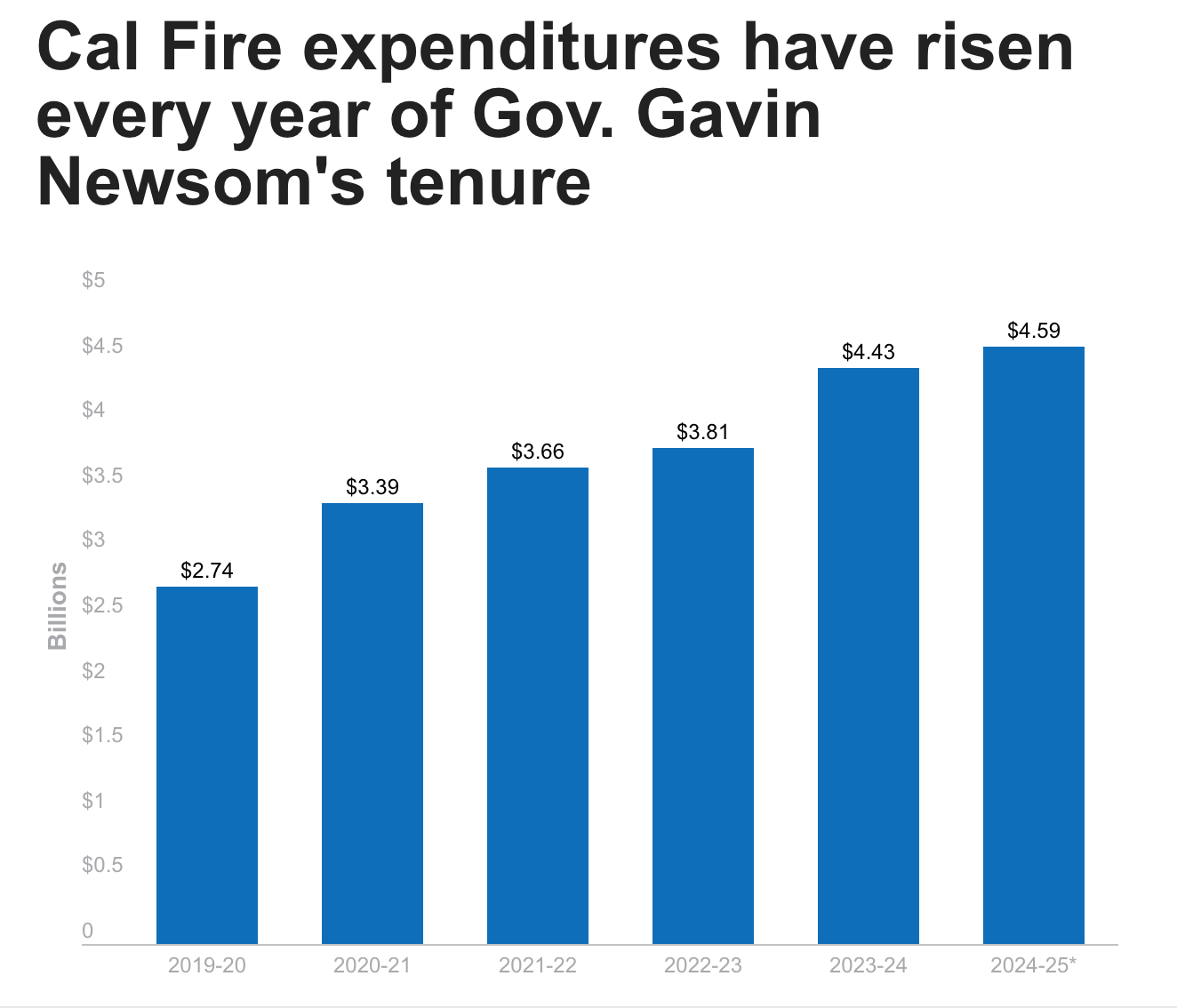
* The 2024-25 amount does not yet reflect additional costs being incurred for the current Los Angeles-area wildfires.
Source: California Legislative Analyst’s office estimate, not adjusted for inflation, provided to PolitiFact
Sherrilyn Ifill is a law professor who holds an endowed chair at Howard University. She is a former president and director-counsel of the NAACP Legal Defense Fund.
In this post, she offers sage advice about how to recharge your batteries and re-engage in the struggle for a better society. She wrote this piece soon after the 2024 election. It’s good advice.
….But ours is a subtle strength
Potent with centuries of yearning,
Of being kegged and shut away
In dark forgotten places.
We shall endure
To steal your senses
In that lonely twilight
Of your winter’s grief.
-Pauli Murray, To the Oppressors (1939)
The truth is that things are going to get very bad. America has gone over the cliff’s edge. How hard we land in the ravine below remains to be seen. But we are one week in, and things are already quite dire. Trump’s first round of cabinet nominees, and his insistence that his picks be installed without a vote of Congress is a defining moment. It demonstrates that there will be no bottom with this Administration.
Donald Trump and his coterie of supporters are firmly in control of the most powerful and wealthy country in the world. And because they are in charge of this country – which perhaps undeservedly, has stood as an example throughout much of the world as a symbol of freedom, equality, ethics, the rule of law and democracy – other countries will fall in our wake.
I am saying this now because I have always tried to be honest in my writings and analysis about this country. I say all of this because I have been able over the years to encourage my clients, my colleagues, my staff, my family and community to believe that we can fight and win. I have infected other people with my unshakeable optimism about what we can accomplish to transform this country.
I am going to keep fighting. It’s what I do. But I do not want to lead you astray. Because I do think that many of us – especially those of us in communities likely to be targeted by this Administration – need to see this moment as one in which we are focused on surviving this difficult time. I have faced the fact that we will not be able to move much forward in the next few years. In fact, I expect things to become so dire over the next two years, that we will scarcely recognize the country we live in. I expect that fear and cruelty will become part of our daily diet. We will hear the frightening sound of silence, as those who speak out most boldly against the excesses of the incoming administration, against its policies, against Musk and against Russia, find themselves at cross-purposes with a vindictive and cruel administration with almost unimaginable power to control communications, law, and the sense of reality itself.
Perhaps it won’t be that bad. But we are here in some measure, because far too many failed to imagine that the worst could happen. I have written already about “the nadir,” and I believe we must face it.
And so, our goal now must be first and foremost to survive this dark period with as much of our values, dignity, integrity, work, financial stability and physical and mental health intact as possible. We must also work to protect our families and communities, and to hold in place our most trusted and needed institutions, a modicum of the rule of law, our constitutional commitment to equality and to free expression.
As I have said in earlier pieces, this is “planting time.” Planting is work. That work must be aimed at building ideas, theories, paradigms, institutions, skills, practices, and alliances that we can seed now for a future harvest – a fulsome and lush democracy that will reflect the very best of us.
We are not “watching the Trump show” this time. We’ve seen it already. We can dip in every now and then, but we must not become paralyzed watching the train wreck. We will, of course, push back against injustice, and defend our rights and citizenship when necessary in the courts. We will demand that congressional representatives, our Governors and our Mayors, act to protect our democratic rights. Even when we know they will not stand up for what is right, we must not be silent. We must not make it easy for them to be cowards or to take our rights. We must still call, write and email our representatives and show up at town halls and meetings. Remember that those who have fought for us over these past years are tired too. Let them see us in these spaces and hear from us.
But our primary work must be first and foremost to work in our communities – both physical and ideological. To build them up and to share time and ideas with those committed to democracy and justice. We each need a curriculum of local service.
We also need a personal curriculum that will allow us to contribute to the building of the future we dream of for ourselves and our families. That means that our core work must be to commit during this time to do less watching, and more learning and more growing. We need to become better citizens for the democracy we want. That means we must dedicate time to expanding our thinking and our knowledge, and to building up our democratic imagination. That means our work is to imagine, to ally, to experiment, restore, befriend, study, read, write, serve, and create. Every one of us. Even as chaos swirls around us.
I encourage you to show your children and grandchildren real things – nature, animals, how things are built, how to cook from scratch. Teach them cursive writing, so that they have a signature all their own. Take them to live concerts and theater. Go on field trips. Infuse their lives with memories of things that are true and concrete.
If you teach, use primary documents in your teaching, take your students to historic sites, listen to audio of oral arguments and speeches so that they will feel confident in their understanding of history, and know that history was made by human beings not machines.
If you litigate, do it with the expectation that you will win. And act like it. Show out. Be excellent and remain confident. Those who can still feel shame – whether those at your opponents table or those on the bench – will feel it when you hold the standard high. And your clients will never forget it.
If you organize, never stop. Plant those seeds deep in our communities.
If you hold office. Hold it. Do not give up your power. Use your voice. Master every rule. Make a record. I repeat. Make a record–so that the truth might be known.
To protect ourselves and our loved ones, there are also pragmatic things we must do. I’ve thought of a few:
Heather Cox Richardson reports on the preparations for Trump’s return to the White House. At the top of the priority list is removing all those officials who are not loyal to Trump. Forget the fact that those who took an oath of office pledged their loyalty to the Constitution. The higher loyalty in 2025 is to Trump personally.
She writes:
The incoming Trump administration is working to put its agenda into place.
Ranking member of the House Oversight and Government Reform Committee Representative Gerry Connolly (D-VA) warned that the loyalty purge “threatens our national security and our ability to respond quickly and effectively to the ongoing and very real global threats in a dangerous world.”
Although experts on the National Security Council usually carry over from one administration to the next, Aamer Madhani and Zeke Miller of the Associated Press today reported that incoming officials for the Trump administration are interviewing career senior officials on the National Security Council about their political contributions, how they voted in 2024, and whether they are loyal to Trump. Most of them are on loan from the State Department, the Federal Bureau of Investigation, and the Central Intelligence Agency and, understanding that they are about to be fired, have packed up their desks to head back to their home agencies.
The National Security Council is the main forum for the president to hash out decisions in national security and foreign policy, and the people on it are picked for their expertise. But Trump’s expected pick to become his national security advisor—his primary advisor on all national security issues—Representative Mike Waltz (R-FL) told right-wing Breitbart News that he wants to staff the NSC with people who are “100 percent aligned with the president’s agenda.”
But during Trump’s first term, it was Alexander Vindman, who was detailed to the NSC, and his twin Eugene Vindman, who was serving the NSC as an ethics lawyer, who reported concerns about Trump’s July 2019 call to Ukraine president Volodymyr Zelensky to their superiors. This launched the investigation that became Trump’s first impeachment, and Trump appears anxious to make sure future NSC members will be fiercely loyal to him.
With extraordinarily slim majorities in the House and Senate, Republicans are talking about pushing through their entire agenda through Congress as a single bill in the process known as budget reconciliation. Budget reconciliation, which deals with matters related to spending, revenue, and the debt limit, is one of the few things that cannot be filibustered, meaning that Republicans could get a reconciliation bill through the Senate with just 50 votes. If they can hold their conference together, they could get the package through despite Democratic opposition.
House speaker Mike Johnson and Republican leaders have said that the House intends to pass a reconciliation bill that covers border security, defense spending, the extension of Trump’s 2017 tax cuts, spending cuts to social welfare programs, energy deregulation, and an increase in the national debt limit.
But Li Zhou of Vox points out that it’s not quite as simple as it sounds to get everything at once, because budget reconciliation measures are not supposed to include anything that doesn’t relate to the budget, and the Senate parliamentarian will advise stripping those things out. In addition, the budget cuts Republicans are circulating include cuts to popular programs like Medicaid, the Affordable Care Act (more commonly known as Obamacare), the Inflation Reduction Act’s investment in combating climate change, and the supplemental nutrition programs formerly known as food stamps.
Still, a lot can be done under budget reconciliation. Democrats under Biden passed the 2021 American Rescue Plan and the 2022 Inflation Reduction Act under reconciliation, and Republicans under Trump passed the 2017 Trump tax cuts the same way.
A wrinkle in those plans is the Republicans’ hope to raise the national debt limit. As soon as they take control of Congress and the White House, Republicans will have to deal immediately with the treasury running up against the debt limit, a holdover from World War I that sets a limit on how much the country can borrow. Although he has complained bitterly about spending under Biden, Trump has demanded that Congress either raise or abandon the debt ceiling because the nonpartisan Congressional Budget Office estimates that the tax cuts he wants to extend will add $4.6 trillion to the deficit over the next ten years, and cost estimates for his deportation plans range from $88 billion to $315 billion a year.
Republicans are backing away from adding a debt increase to the budget reconciliation package out of concern that members of the far-right Freedom Caucus will kill the entire bill if they do. Those members want no part of raising the national debt and have demanded $2 trillion in budget cuts before they will consider it. Tonight, Senate majority leader John Thune (R-SD) told Jordain Carney of Politico that Senate Republicans expect the debt limit to be stripped out of the budget reconciliation measure.
So Republicans are currently exploring the idea of leveraging aid to California for the deadly fires in order to get Democrats to sign on to raising the debt ceiling. Meredith Lee Hill of Politico reported that Trump met with a group of influential House Republicans over dinner Sunday night at Mar-a-Lago to discuss tying aid for the wildfires to raising the debt ceiling. Today, House speaker Mike Johnson (R-LA) confirmed to reporter Hill that this plan is under discussion.
Indeed, Republicans have been in the media suggesting that disaster aid to Democratic states should be tied to their adopting Republican policies. The Los Angeles fires have now claimed at least 24 lives. More than 15,000 firefighters are working to extinguish the wildfires, which have been driven by Santa Ana winds of up to 98 miles (158 km) an hour over ground scorched by high temperatures and low rainfall since last May, conditions caused by climate change.
On the Fox News Channel today, Representative Zach Nunn (R-IA) said: “We will certainly help those thousands of homes and families who have been devastated, but we also expect you to change bad behavior. We should look at the same for these blue states who have run away with a broken tax policy…. Those governors need to change their tune now.” Senator Ron Johnson (R-WI) blamed Democrats for the fires and said of federal disaster relief: “I certainly wouldn’t vote for anything unless we see a dramatic change in how they’re gonna be handling these things in the future.”
Aside from the morality of demanding concessions for disaster aid after President Joe Biden responded with full and unconditional support for regions hit by Hurricane Helene (although Tennessee governor Bill Lee is still lying that Biden delayed aid to his state, when in fact he delayed in asking for it, as required by law), there is a financial problem with this argument. As economist Paul Krugman noted today in his Krugman Wonks Out, California “is literally subsidizing the rest of the United States, red states in particular, through the federal budget.”
In 2022, the most recent year for which information is available, California paid $83 billion more to the federal government than it got back. Washington state also subsidized the rest of the country, as did most of the Northeast. That money flowed to Republican-dominated states, which contributed far less to the federal government than they received in return.
Krugman noted that “if West Virginia were a country, it would in effect be receiving foreign aid equal to more than 20 percent of its G[ross] D[omestic] P[roduct].” Krugman refers to the federal government as “an insurance company with an army,” and he notes that there is “nothing either the city or the state could have done to prevent” the wildfires. “If the United States of America doesn’t take care of its own citizens, wherever they live and whatever their politics, we should drop “United” from our name,” he writes. “As it happens, however, California—a major driver of U.S. prosperity and power—definitely has earned the right to receive help during a crisis.”
Today, Biden announced student loan forgiveness for another 150,000 borrowers, bringing the total number of people relieved of student debt to more than 5 million borrowers, who have received $183.6 billion in relief. This has been achieved through making sure existing debt relief programs were followed, as they had not been in the past.
Establishment Republicans continue to fight MAGA Republicans, and MAGA fights among itself: former Trump ally Steve Bannon yesterday called Trump’s sidekick Elon Musk “truly evil” and vowed to “take this guy down.” But even as their enablers in the legacy media are normalizing Republican behavior, a reality-based media is stepping up to counter the disinformation.
This article just appeared on the website of The New York Review of Books.
https://www.nybooks.com/online/2025/01/11/their-kind-of-indoctrination/
It is my review of Trump’s plans for K-12 education.
NYRB is the most distinguished literary-political journal in the nation. It has a huge readership. It reaches a different audience than education journals.
If you subscribe to NYRB, you can open it in full. If you don’t, it costs $10 for 10 issues. Or, if you wait, I will post it in full in a few weeks.
Scott Tomlinson, opinion writer for The Houston Chronicle, predicts that MAGA voters, especially in Texas, are soon to have an unwelcome surprise, thanks to the DOGE commission of Elon and Vivek. They voted for deep budget cuts. They voted to downsize the federal government, aka the “Deep State.”
He writes:
President-elect Donald Trump’s coalition splintered over visas for specially skilled workers in recent weeks, which turned especially ugly on Twitter, now known as X.
Elon Musk told critics of the program, including Steve Bannon and Tucker Carlson, to “Take a big step back and FUCK YOURSELF in the face. I will go to war on this issue the likes of which you cannot possibly comprehend.”
Solving the immigration crisis is relatively easy compared to balancing the budget, which Musk is supposed to be focusing on. When Trump voters find out what must be cut or whose taxes must rise to stop deficit spending, they’ll start grabbing pitchforks.
U.S. politicians from both parties have unintentionally experimented with the global economy. By running up huge deficits, they tested Modern Monetary Theory, an idea put forward by the left.
MMT was a hot topic during the Obama administration, with proponents arguing that economic powerhouses like the United States don’t have to worry about deficits. Governments can print as much money as they want through borrowing as long as inflation doesn’t rise.
Conventional macroeconomic theory recommends governments spend money, cut taxes and raise deficits during recessions. When the economy grows, governments should spend less, raise taxes and build surpluses. Governments should act as economic shock absorbers. We’re good at spending but not taxing.
Musk promises to cut federal spending by a third, or $2 trillion. The Texas Legislature ranks 10th in the nation for dependency on the federal government to pay for state spending, according to economists at Wallet Hub.
Federal funds pay for a third of the state budget, the Legislative Budget Board reports.
Imagine what would happen to Texas if the Legislature had to come up with $30 billion to make up for federal spending cuts?
Every dollar the federal government spends has a champion somewhere. If Musk tries to cut popular programs, the backlash over H1-B visas will seem like a walk in the park.
.
Heather Cox Richardson recalls the days of bipartisan consensus around the goals of liberal democracy, in which government protected the rights of individuals. By today’s MAGA standards, President Dwight D. Eisenhower would be considered a dangerous leftwinger.
She wrote on her blog, “Letters from an American”:
Cas Mudde, a political scientist who specializes in extremism and democracy, observed yesterday on Bluesky that “the fight against the far right is secondary to the fight to strengthen liberal democracy.” That’s a smart observation.
During World War II, when the United States led the defense of democracy against fascism, and after it, when the U.S. stood against communism, members of both major political parties celebrated American liberal democracy. Democratic presidents Franklin Delano Roosevelt and Harry Truman and Republican president Dwight D. Eisenhower made it a point to emphasize the importance of the rule of law and people’s right to choose their government, as well as how much more effectively democracies managed their economies and how much fairer those economies were than those in which authoritarians and their cronies pocketed most of a country’s wealth.
Those mid-twentieth-century presidents helped to construct a “liberal consensus” in which Americans rallied behind a democratic government that regulated business, provided a basic social safety net, promoted infrastructure, and protected civil rights. That government was so widely popular that political scientists in the 1960s posited that politicians should stop trying to court voters by defending its broadly accepted principles. Instead, they should put together coalitions of interest groups that could win elections.
As traditional Republicans and Democrats moved away from a defense of democracy, the power to define the U.S. government fell to a small faction of “Movement Conservatives” who were determined to undermine the liberal consensus. Big-business Republicans who hated regulations and taxes joined with racist former Democrats and patriarchal white evangelicals who wanted to reinforce traditional race and gender hierarchies to insist that the government had grown far too big and was crushing individual Americans.
In their telling, a government that prevented businessmen from abusing their workers, made sure widows and orphans didn’t have to eat from garbage cans, built the interstate highways, and enforced equal rights was destroying the individualism that made America great, and they argued that such a government was a small step from communism. They looked at government protection of equal rights for racial, ethnic, gender, and religious minorities, as well as women, and argued that those protections both cost tax dollars to pay for the bureaucrats who enforced equal rights and undermined a man’s ability to act as he wished in his place of business, in society, and in his home. The government of the liberal consensus was, they claimed, a redistribution of wealth from hardworking taxpayers—usually white and male—to undeserving marginalized Americans.
When voters elected Ronald Reagan in 1980, the Movement Conservatives’ image of the American government became more and more prevalent, although Americans never stopped liking the reality of the post–World War II government that served the needs of ordinary Americans. That image fed forty years of cuts to the post–World War II government, including sweeping cuts to regulations and to taxes on the wealthy and on corporations, always with the argument that a large government was destroying American individualism.
It was this image of government as a behemoth undermining individual Americans that Donald Trump rode to the presidency in 2016 with his promises to “drain the swamp” of Washington, D.C., and it is this image that is leading Trump voters to cheer on billionaires Elon Musk and Vivek Ramaswamy as they vow to cut services on which Americans depend in order to cut regulations and taxes once again for the very wealthy and corporations.
But that image of the American government is not the one on which the nation was founded.
Liberal democracy was the product of a moment in the 1600s in which European thinkers rethought old ideas about human society to emphasize the importance of the individual and his (it was almost always a “him” in those days) rights. Men like John Locke rejected the idea that God had appointed kings and noblemen to rule over subjects by virtue of their family lineage, and began to explore the idea that since government was a social compact to enable men to live together in peace, it should rest not on birth or wealth or religion, all of which were arbitrary, but on natural laws that men could figure out through their own experiences.
The Founders of what would become the United States rested their philosophy on an idea that came from Locke’s observations: that individuals had the right to freedom, or “liberty,” including the right to consent to the government under which they lived. “We hold these truths to be self-evident,” Thomas Jefferson wrote, “that all men are created equal, that they are endowed by their Creator with certain unalienable Rights, that among these are Life, Liberty and the pursuit of Happiness,” and that “to secure these rights, governments are instituted among men, deriving their just powers from the consent of the governed.”
In the early years of the American nation, defending the rights of individuals meant keeping the government small so that it could not crush a man through taxation or involuntary service to the government or arbitrary restrictions. The Bill of Rights—the first ten amendments to the Constitution—explicitly prohibited the government from engaging in actions that would hamper individual freedom.
But in the middle of the nineteenth century, Republican president Abraham Lincoln began the process of adjusting American liberalism to the conditions of the modern world. While the Founders had focused on protecting individual rights from an overreaching government, Lincoln realized that maintaining the rights of individuals required government action.
To protect individual opportunity, Lincoln argued, the government must work to guarantee that all men—not just rich white men—were equal before the law and had equal access to resources, including education. To keep the rich from taking over the nation, he said, the government must keep the economic playing field between rich and poor level, dramatically expand opportunity, and develop the economy.
Under Lincoln, Republicans reenvisioned liberalism. They reworked the Founders’ initial stand against a strong government, memorialized by the Framers in the Bill of Rights, into an active government designed to protect individuals by guaranteeing equal access to resources and equality before the law for white men and Black men alike. They enlisted the power of the federal government to turn the ideas of the Declaration of Independence into reality.
Under Republican president Theodore Roosevelt, progressives at the turn of the twentieth century would continue this reworking of American liberalism to address the extraordinary concentrations of wealth and power made possible by industrialization. In that era, corrupt industrialists increased their profits by abusing their workers, adulterating milk with formaldehyde and painting candies with lead paint, dumping toxic waste into neighborhoods, and paying legislators to let them do whatever they wished.
Those concerned about the survival of liberal democracy worried that individuals were not actually free when their lives were controlled by the corporations that poisoned their food and water while making it impossible for individuals to get an education or make enough money ever to become independent.
To restore the rights of individuals, progressives of both parties reversed the idea that liberalism required a small government. They insisted that individuals needed a big government to protect them from the excesses and powerful industrialists of the modern world. Under the new governmental system that Theodore Roosevelt pioneered, the government cleaned up the sewage systems and tenements in cities, protected public lands, invested in public health and education, raised taxes, and called for universal health insurance, all to protect the ability of individuals to live freely without being crushed by outside influences.
Reformers sought, as Roosevelt said, to return to “an economic system under which each man shall be guaranteed the opportunity to show the best that there is in him.”
It is that system of government’s protection of the individual in the face of the stresses of the modern world that Franklin Delano Roosevelt, Harry Truman, Dwight Eisenhower, and the presidents who followed them until 1981 embraced. The post–World War II liberal consensus was the American recognition that protecting the rights of individuals in the modern era required not a weak government but a strong one.
When Movement Conservatives convinced followers to redefine “liberal” as an epithet rather than a reflection of the nation’s quest to defend the rights of individuals—which was quite deliberate—they undermined the central principle of the United States of America. In its place, they resurrected the ideology of the world the American Founders rejected, a world in which an impoverished majority suffers under the rule of a powerful few.

 Diane Ravitch's blog