A federal judge in Arkansas blocked a state law requiring the display of the 10 Commandments in public school classrooms.
The Hill reported:
A judge ruled Monday to permanently bar several school districts from following Arkansas’s law to display the Ten Commandments in public school classrooms.
U.S. District Judge Timothy Brooks ruled the law violates the Establishment Clause and the free exercise rights of the plaintiffs.
“Act 573’s purpose is only to display a sacred, religious text in a prominent place in every public-school classroom. And the only reason to display a sacred, religious text in every classroom is to proselytize to children. The State has said the quiet part out loud,” the judge wrote.
The ruling affects several Arkansas school districts but is not a statewide ban.
“Today’s decision ensures that our clients’ classrooms will remain spaces where all students, regardless of their faith, feel welcomed and can learn without worrying that they do not live up to the state’s preferred religious beliefs,” said Heather Weaver, senior counsel for the American Civil Liberties Union’s Program on Freedom of Religion and Belief.
Jeff LeMaster, communications director for the office of state Attorney General Tim Griffin, said the office is “reviewing the opinion and will appeal.”
The ruling comes after the 5th U.S. Circuit Court of Appeals upheld Louisiana’s state law requiring the Ten Commandments be posted in classrooms. Arkansas is under the U.S. 8th Circuit Court of Appeals.
A split in decisions could lead the case to the Supreme Court, which some proponents of the law are hoping for.
Let’s be clear. Hanging a citation from the Bible does not change student behavior. It does not make them more likely to obey the commandments. It is an effort to indoctrinate children, but it probably doesn’t do that either.
The Biblical verse is given a place to please adults.
It might be useful if education researchers compared the crime rate in districts that do or don’t hang the 10 Commandments in classrooms.
Governor Sarah Huckabee Sanders is holding the line on spending, except for vouchers, which h will get a big boost. About 85% of the students using vouchers never attended public schools, so Governor Sanders is handing out money to pay for students already enrolled in private and religious schools.
Poor people in Arkansas don’t get much help in the budget, but affluent families get tax cuts and vouchers to pay for private schools, religious schools, and home schools.
Arkansas lawmakers are set to convene April 8 to hash out next year’s state budget. In a Wednesday letter to lawmakers, Sanders said she’s proposing a 3% increase, a pretty standard figure on par with recent years.
But what’s going to be funded in this mostly flat spending plan, and what’s not? At first blush, it looks like well-to-do Arkansans are the big winners, cashing in on private school vouchers and more income tax cuts.
Sanders’ proposed 2026-27 budget, presented to lawmakers by Arkansas Department of Finance and Administration Director Jim HudsonWednesday morning, includes up to $379 million for the Arkansas LEARNS vouchers that parents who opt out of traditional public schools can tap to pay private school or homeschool expenses. That’s a big increase over the $187 million budgeted for vouchers last time.
The 2025-26 school year was the first in which all students in Arkansas were eligible for these vouchers, and the price tag keeps creeping higher. Ballooning costs are pretty much a given, based on what’s happened in other states that pioneered this tricky transfer of wealth from the poor and middle class to their wealthy overlords by paying fancy kids’ tony tuitions for them. Just ask Arizona and Florida.
Lawmakers have made a number of adjustments and budget increases for LEARNS after voucher costs quickly exceeded the budgeted amount. In January, a legislative committee signed off on giving another $32 million in one-time reserve funds to Arkansas’s newly universal school voucher program, bringing its total cost in the current 2025-26 school year to $309.4 million, which covers more than 44,000 students. That $309 million is the base amount proposed for 2026-27, but Sanders’ budget proposes an extra $70 million for it, just in case.
Arkansas Advocates for Children and Families warned in January that vouchers are doing all the things opponents warned they would: creating new spending obligations for taxpayers to cover private school tuitions and other costs that were never on the public dime before; chipping away at public schools’ financial resilience; and generally busting budgets.
These set-aside amounts that were incorporated into the state’s school voucher fund this year, and which are being teed up to be added next year to the tune of $70 million, look a lot like a trap. Last go-round, lawmakers approved about $187 million for vouchers, but then added another $122 million to the school voucher cause in piecemeal fashion over the course of the fiscal year, to ultimately spend $309 million. Now lawmakers are looking at $309 million as the floor for voucher spending for 2026-27, and will almost certainly throw in that set-aside $70 million, too (if not more). How many hundreds of millions more are we going to add in these payouts for the well-to-do each year, in slapdash fashion? Don’t say we didn’t warn you!
Long ago, back in the 1990s, the idea of vouchers was proposed as a brand new idea. Its advocates said that vouchers would “save poor kids trapped in failing public schools.” They presented themselves as champions of poor and needy kids and predicted that vouchers would change the lives of these children for the better. Eminent figures proclaimed that school choice was “the civil rights issue” of our time.
Of course, as many writers have explained, vouchers were not a brand new idea. They were popular among segregationists after the 1954 Brown decision. Several Southern states passed voucher laws in that era that were eventually knocked down by federal courts as a ploy to maintain all-white schools.
Trump’s first Secretary of Education Betsy DeVos –never considered a leader of civil rights–championed vouchers. So does Trump’s current Secretary of Education Linda McMahon.
But guess who’s getting vouchers? Not the poor kids. Not the neediest kids. Mostly the kids who were already enrolled in religious and private schools.
The story is the same in every state but accentuated in states where every student can claim a voucher, regardless of family income, as in Florida and Arizona.
Now the numbers are available in Arkansas: 88% of students who use vouchers never attended public schools.
On Oct. 3, the Arkansas Department of Education released its annual report on school vouchers (or as the state calls them, “Educational Freedom Accounts”). The voucher program, which was created by Gov. Sarah Sanders’ Arkansas LEARNS Act in 2023, gives public money to private school and homeschool families to pay the cost of tuition, fees, supplies and other expenses.
Among the takeaways of the new report: Just one of every eight voucher participants in Year 2 of the program was enrolled in a public school the year before. (Year 2 was the 2024-25 school year; we’re currently in Year 3.)
This matters because Sanders and other school choice supporters often frame vouchers as a lifeline for poor families to escape failing public schools. Opponents of voucher programs say the money tends to mostly go to existing private school and homeschool families.
Arkansas is deep-red, so of course the Legislature banned abortion. Supporters of abortion rights gathered enough signatures to put the issue to the voters, but the politicians knocked their referendum off the ballot. But the issue has not gone away.
I thought readers might like to read about the persistence of abortion right supporters.
The Arkansas Times is a dissident website that keeps readers informed about events like this one. If you want to know what Governor Sarah Huckabee Sanders is doing, this is a great source.
For proof of the sorry state of reproductive rights in Arkansas, consider that for the second year in a row, no protesters even bothered to show at the annual Planned Parenthood Garden Party.
It’s been a brutal run here since the U.S. Supreme Court’s Dobbs decision of 2022 whipped away the national right to abortion access, pulling the trigger on an Arkansas law primed to ban virtually all abortions in the state as soon as our blood-red state government officials could get away with it.
Since then, the annual Planned Parenthood fundraiser still goes on. But the protesters who used to hoist their placards of bloody, dismembered fetus parts in view of the wine sippers and bidders at the silent auction tables aren’t a problem anymore. Transgender people and immigrants have displaced abortion care providers as the right’s new bogeyman, leaving reproductive rights advocates to regroup in peace.
Planned Parenthood Great Plains Executive Director Emily Wales was in town for a party nonetheless. And while she didn’t sugarcoat the status report, it wasn’t quite as bitter as you might expect.
“Arkansas has paved the way for some pretty awful policies, not just for abortion access, but also excluding us from the Medicaid program and then continuing to pass anti-abortion billswhen there is really no abortion that is accessible for people,” Wales said. “That is not about health care, it’s about messaging and fear.”
Arkansas’s consolation prize for winning this race to the bottom is that we’re down here pioneering tips and tricks to share with other states who find themselves shut off from access to necessary medical care. A decade ago, then-Gov. Asa Hutchinson blocked Planned Parenthood clinics in Arkansas from collecting Medicaid reimbursements for non-abortion services. (Federal reimbursements for abortions generally were banned even before the Supreme Court overturned Roe v. Wade.) Now, Planned Parenthood affiliates in other states are facing similar threats, and the Trump administration maintains a chokehold on the Title X federal funding that once helped cover the cost of family planning consultations, prescriptions and procedures.
“I don’t want to lean into our trauma or say that we’re resilient, because we’ve always been under attack,” Wales said. “But we have learned lessons about how to adapt and change and meet the moment. And right now, we have sister affiliates in Planned Parenthood who are trying to figure out what happens if they lose Medicaid, or if their Title X funding that was recently cut for many Planned Parenthoods doesn’t come back, what do they do? And for places like Arkansas, we are now in the position of advising other Planned Parenthoods on how you keep your doors open.”
Doesn’t seem like much to brag about until you consider that Arkansas’s two Planned Parenthood clinics – one in Little Rock and one in Rogers – are seeing increasing numbers of patients each year, even with the state’s abortion ban in place. The number of patients served by Planned Parenthood in Arkansas rose nearly 45% from July 2023 to July 2024. Turns out they really do provide lots of other medical services after all!
Iffy weather necessitated a change of venue for this year’s garden party, from the grounds of a historic home in the Quawpaw Quarter to the decidedly less garden-themed Next Level Events in the Union Station basement. The regulars showed up anyway, their numbers weighted toward people old enough to have a glimmer of memory of the pre-Roe days, but a three-dozen-strong corps of young volunteers organized the nametag table and passed out hors d’oeuvres.
Speakers skipped those apologetic qualifiers that used to precede seemingly every statement about abortion. None of that tired and defensive, “Nobody likes abortion, but …” anymore.
Instead, speakers leaned into the freedom that comes with having little to lose. The din of a chatty, tipsy crowd packed into a subterranean space helped, too. “I feel like I could say anything and you wouldn’t know,” Wales said. “I could be wildly offensive about, perhaps, the current administration, and no one would ever know.”
Other speakers laughed about the time Lori Williams, longtime clinical director at Little Rock Family Planning Services and the night’s winner of the Brownie Ledbetter Award, helped torpedo a 2013 bill to require ultrasounds for abortion access at six weeks by pulling out an alarmingly phallic vaginal ultrasound probe during a legislative committee hearing.
Sarah Thompson, a leader with Grandmothers for Reproductive Rights and winner of this year’s Christina Mullinax Persistent Spirit Award, lamented progress made and lost.
“When I needed abortion care in Arkansas, I had to leave the state, and it was a long time ago. And now young women still have to leave the state to obtain abortion care,” Thompson said. “I’ll never stop doing this work. It’s part of who I am for the rest of my life.” (It should be noted that many Arkansas women still do access abortion services without leaving the state thanks to the prevalence of mail-order medication for early term abortions — though many Republicans want to put a stop to that as well.)
Arkansas is part of Planned Parenthood of Great Plains, a consortium that includes Oklahoma, Kansas and Missouri. Abortion is legal in Kansas, and last year, Missouri voters reinstated abortion rights, although state lawmakers there are angling to repeal them again. That kind of heartache is familiar to the 100,000+ Arkansans who signed a petition to give the state a chance to vote on reinstating abortion rights in 2024, only to see that opportunity smothered by dubious legal shenanigans.
“Care in Arkansas does not look the way we want it to, and eventually it will return to what it needs to be, but we’re going to keep working on that,” Wales said. “Until then, we will be creative and thoughtful, and we are not about to be intimidated by what’s happening at the federal level, because we are really, really good at undermining authority.”
Peter Greene, now retired after 39 years as a teacher in Pennsylvania, is a prolific writer. He has his own blog Curmudgacation, and he writes a column for Forbes. I am one of his most fervent admirers. He is a font of wisdom and common sense. In this post, he examines the cruelty of certain Arkansas elected officials who hate trans people. Greene notes the contradiction by those who claim they support “parental rights,” but not the rights of parents who support their children’s wish to be a different gender.
The bill authorizes lawsuits, and the language around the actual suing and collecting money part is long and complex– complex enough to suspect that Bentley, whose work experience is running tableware manufacturer Bentley Plastics, might have had some help “writing” the bill. The part where it lists the forbidden activities is short, but raises the eyebrows.
The bill holds anyone who “knowingly causes or contributes to the social transitioning of a minor or the castration, sterilization, or mutilation of a minor” liable to the minor or their parents. The surgical part is no shocker– I’m not sure you could find many doctors who would perform that surgery without parental consent, and certainly not in Arkansas (see 2023 law). But social transitioning? How does the bill define that?
“Social transitioning” means any act by which a minor adopts or espouses a gender identity that differs from the minor’s biological sex as determined by the sex organs, chromosomes, and endogenous profiles of the minor, including without limitation changes in clothing, pronouns, hairstyle, and name.
So a girl who wears “boy” jeans? A boy who wears his hair long? Is there an article of clothing that is so “male” that it’s notably unusual to see a girl wearing it? I suppose that matters less because trans panic is more heavily weighted against male-to-female transition. But boy would I love to see a school’s rules on what hair styles qualify as male or female….
The person filing the suit against a teacher who used the wrong pronoun or congratulated the student on their haircut could be liable for $10 million or more, and they’ve got 20 years to file a suit.
I’m never going to pretend that these issues are simple or easy, that it’s not tricky for a school to look out for the interests and rights of both parents and students when those parents and students are in conflict. But I would suggest remembering two things– trans persons are human beings and they are not disappearing. They have always existed, they will always exist, and, to repeat, they are actual human persons.
I was in school with trans persons in the early seventies. I have had trans students in my classroom. They are human beings, deserving of the same decency and humanity as any other human. I know there are folks among us who insist on arguing from the premise that some people aren’t really people and decency and humanity are not for everyone (and empathy is a weakness). I don’t get why some people on the right, particularly many who call themselves Christians, are so desperately frightened/angry about trans persons, but I do know that no human problems are solved by treating some human beings as less-than-human. And when your fear leads to policing children’s haircuts to fit your meager, narrow, brittle, fragile view of how humans should be, you are a menace to everyone around you. You have lost the plot. Arkansas, be better.
Trump and his acolytes have thrown around the term “critical race theory” without e we defining it. He picked it up from rightwing extremist Chris Rufo, who thought that it could be used as a blunderbuss to smear public schools. He convinced large numbers of anxious white parents that the public schools were teaching their children to be embarrassed and feel guilty about being white. That, Rufo implied, was the inevitable result of teaching the unpleasant facts about slavery, Jim row, and racism.
Here is a different point of view, written by Alan Leveritt in The Arkansas Times.
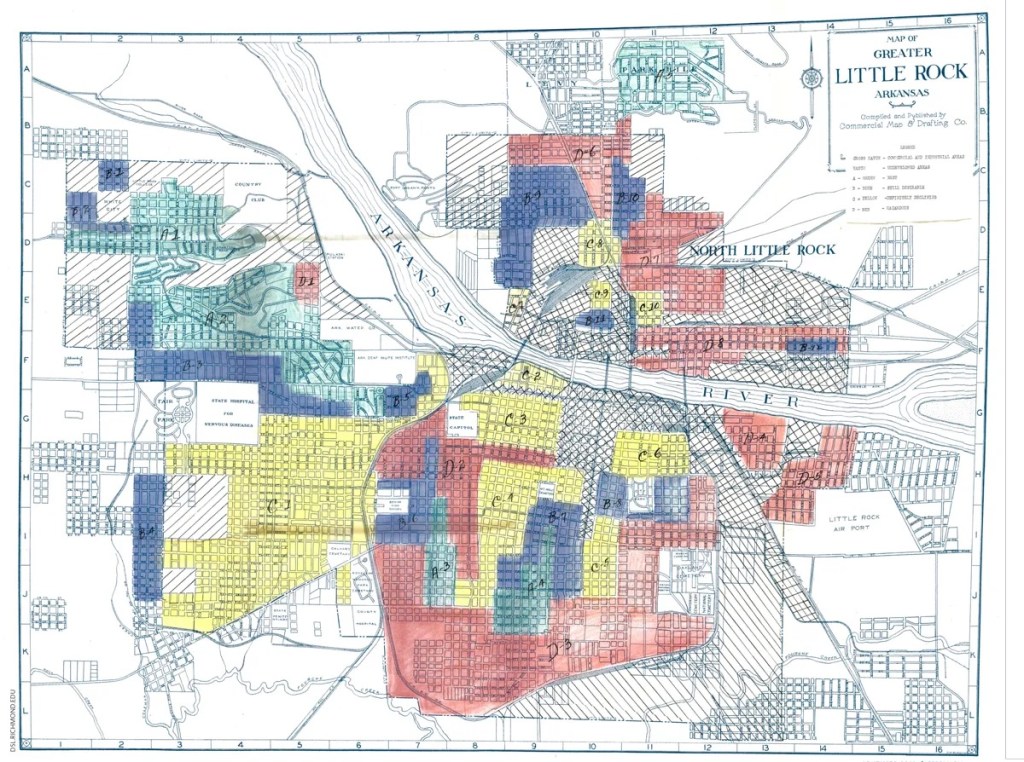
Believed to be circa 1945, a map illustrates redlining practices in the Little Rock area. Red means Black neighborhoods and no loans, while green means white neighborhoods and access to FHA loans.
Credit: dsl.richmond.edu
I came close to graduating from college, damn close in fact. Last I looked (about 30 years ago) I was three hours and an overdue parking ticket short of a history degree from UA Little Rock. But even though I remain a doubtful scholar, I am a devoted student of Arkansas history and its ability to instruct us regarding some very big issues facing our country.
I am, of course, talking about critical race theory.
Army 1st Lt. J.P. Leveritt came back from World War II, got his master’s degree in physical education and in 1950, along with my mother, built one of the first houses in Lakewood in North Little Rock for $8,000. Thus began my family’s long and beneficial association with critical race theory.
To paraphrase the Oxford American Dictionary, critical race theory argues that many of our social and economic institutions have been created for and by white people. Those institutions, many dating back almost a century, were designed to lift white people up and keep Black people down. I am a direct beneficiary of that system.
When President Franklin Roosevelt tried to create the Federal Housing Administration as part of the New Deal, his proposal to make home ownership accessible to ordinary people through federal home loan guarantees met with opposition from members of both parties. What we take for granted today was just one step from communism then. Southern Democrats ultimately agreed to support the establishment of a Federal Housing Administration on the condition that Black citizens be excluded. Now white people could more easily become homeowners and Black people could more easily become renters.
When my parents bought their home in Lakewood, they had to sign a covenant never to sell to Black buyers. This was an actual FHA requirement. Had they not signed, the FHA would have refused to guarantee them any loans in Lakewood. If Black people could move into Lakewood, the property values there would crater, putting the FHA loans at risk, was the explanation.
Another FHA innovation was to rate neighborhoods based on class and race, the thought being that neighborhoods occupied by Black people were too risky for government guaranteed loans. The Little Rock/North Little Rock redline map is color-coded, with green neighborhoods approved for FHA loans and red neighborhoods (predominantly African American) ineligible for bank loans. Thus the son of Lakewood homeowners inherits $175,000 upon his mother’s death in 2012, while the Black son of Rose City renters gets nothing.
This is an example of critical race theory in action. The primary source of intergenerational wealth is home equity. Even though Black households earn 60% of what white households earn, they only have 5% as much wealth. That wealth should have come from home ownership, which never occurred because the game was rigged.
My dad had a good war. He grew up in Smackover and went to Arkansas A&M at Monticello, where he played for the Rambling Boll Weevils and learned deep tissue massage as a trainer. He was headed to North Africa as a medic but through a series of happy accidents, wound up in the White House as President Truman’s masseuse and private trainer.
As with all vets after the war, the GI Bill allowed him to further his education and receive low-interest home loans among other benefits. But while the language of the GI Bill was inclusive of all vets, it was administered by the states, which meant that Black vets, especially in the Jim Crow South, received on average 70% of the benefits their white comrades did. Despite the GI Bill of 1944 offering free college education, it was 11 years before the first Black veteran enrolled as an undergraduate in a state-supported college in Arkansas with the exception of all-Black Arkansas AM&N. Up to then, they were directed to vocational schools if at all. The low-interest home loans the GI Bill provided weren’t much help, either. Because Black veterans could not live in white neighborhoods and Black neighborhoods were redlined, they seldom could get a loan to buy a house where they were permitted to live.
Discrimination for FHA mortgages and GI benefits has in part been remedied by various civil rights laws, many of them from President Lyndon Johnson’s time. But to understand the great economic disparity between the races, we need to know history, especially Arkansas history. The economic disparities we see today are a direct result of what happened years ago when we came up with race-based barriers to education and wealth.
Why would our Legislature and governor try to disappear this history? Why would they try to decertify an Advanced Placement African American Studies class in our high schools, or discourage honest study of systems that set some of us up to thrive but left others to struggle? Their argument that if we teach these facts, some white child might be made to feel guilty is pure nonsense.
Get over it. It’s our history. Teach our kids the truth and maybe they will be better people than we are.
The Thought Police lost an important case in Arkansas! Score one for librarians, booksellers, and people who read books! It’s a setback for those who don’t read books, never have, never will.
A federal judge Monday tossed out parts of an Arkansas state law that allowed librarians and booksellers to be sent to prison for up to a year for allowing minors to access “obscene” or “harmful” materials, whatever local officials might decide is “obscene” or “harmful.” Probably gay penguins.
In his ruling, US District Judge Timothy Brooks found that the law, Act 372, violated the First Amendment and also generally sucked, was overly vague, and didn’t provide adequate guidance to libraries and booksellers to help them avoid being arbitrarily prosecuted. The law created a new process for complaints and required libraries (tell you what, just assume “and booksellers” is part of every sentence, OK?) to shelve “harmful” materials in a special adults-only section, although it didn’t mandate that such a section be behind a beaded curtain like at an old video store. A similar law in Idaho — minus the librarian-jailing — is also being challenged in federal court, as are multiple other censorship laws.
Brooks wrote that the law “deputizes librarians and booksellers as the agents of censorship; when motivated by the fear of jail time, it is likely they will shelve only books fit for young children and segregate or discard the rest,” which was of course the point. For all the Mad Moms’ insistence that they only want to protect tiny innocent kids from “obscene” materials, the actual targets of book banning tend to be anything rightwing parents dislike, especially mentions of LGBTQ people, books about race, and sex education.
Holly Dickson, executive director of the ACLU of Arkansas, said yippee, now we can poison kids’ minds, destroy the family, and kill God, or at least that’s how wingnuts will interpret what she actually said, which was
“This was an attempt to ‘thought police,’ and this victory over totalitarianism is a testament to the courage of librarians, booksellers, and readers who refused to bow to intimidation…”
To learn more about the court decision, open the link.
At the behest of Arkansas Governor Sarah Huckabee Sanders, the legislature enacted a voucher program. As in every other state with vouchers, most are used by students already enrolled in private or religious schools. The voucher is a subsidy for families who could already pay but are happy to take the extra money.
The Arkansas LEARNS Act, signed into law in 2023 by Gov. Sarah Sanders, created a voucher program that sends public money to private school families to use for tuition, fees and other expenses. This school year, the program is open to many homeschoolers as well. Homeschool families don’t have tuition bills to pay, but they’re able to use voucher funds for a variety of other education-related expenses, such as books and supplies, curricula, computers and other technology, and private tutoring.
Some of those vendors appear to focus in whole or in part on “equine-assisted therapy” services for people with disabilities or trauma. Others appear to simply offer kids the opportunity to ride, interact with and care for horses. But all of them have been given the go-ahead by the Arkansas Department of Education to receive taxpayer dollars at a time when the state has cut inflation-adjusted spending in other areas.
Relatively speaking, equestrian centers are unlikely to eat up too much of the overall voucher pie. Each LEARNS voucher costs the public about $6,856 in the current 2024-25 school year, and there are about 14,000 students in the program this year, most of whom attend private schools. (About 3,000 are homeschooled.) The majority of the roughly $96 million that Arkansas spends on vouchers is flowing to private schools, such as Little Rock Christian Academy or Shiloh Christian School in Springdale.
The idea of publicly subsidizing horseback riding seems to be striking a nerve in a way that paying private school tuition does not. But one could argue there’s not a lot of difference between the two.
There are no income-eligibility requirements for either homeschool or private school households to receive a voucher. Well-off homeschool families who already paid out of pocket for riding lessons before Arkansas LEARNS can now get them comped by the state. In the same vein, families who paid private school tuition before LEARNS are now getting a taxpayer-funded boost to their bank accounts, freeing them to spend that money on whatever else they please (including horseback riding, if they wish).
The majority of the Supreme Court of Arkansas opposes abortion. So, they blocked a referendum on abortion access on flimsy technical grounds. Democracy, be damned in Arkansas. To read the background and the Court’s opinions, please open the link.
The Arkansas Supreme Court today likely drove a final stake through the heart of a ballot initiative to restore abortion rights in Arkansas. In a 4-3 decision, the court denied the request from the group backing the measure to restart the review process after the secretary of state preemptively disqualified the group last month due to a piece of paperwork the group failed to include in its final submission of the petition.
Despite collecting signatures from more than 100,000 Arkansans — and despite the fact that the plain language of the statutes appeared to show that the review process for the petition should have continued — the court ruled that paperwork omission was fatal to the group’s effort.
For those following the case, this has always been the fear: Even if the law was on their side, the majority of the court opposes abortion. Ultimately the law is what the Supreme Court says it is. Among the grab-bag of flimsy arguments offered by Attorney General Tim Griffin, they found a couple they could stretch to suit the purpose of disqualifying the abortion petition.
In a blistering dissent, Associate Karen Baker took the majority to task for their descent into Calvinball:
Even a cursory review of how the present ballot initiative has progressed since its inception demonstrates that both the respondent and the majority have treated it differently for the sole purpose of preventing the people from voting on this issue.
“Today is a dark day in Arkansas,” said Rebecca Bobrow, a spokesperson for Arkansans for Limited Government (AFLG), the group leading the petition effort. “This morning, by a vote of 4-3, the Arkansas Supreme Court upheld Secretary Thurston’s disqualification of the Arkansas Abortion Amendment. More than 102,000 Arkansas voters exercised their constitutionally protected right to engage in direct democracy by signing the petition to get the Arkansas Abortion Amendment on the ballot. The Court’s majority ratifies Secretary Thurston’s decision to silence those voices.”
Theoretically, AFLG could file a lawsuit in federal court. But for procedural and timing reasons, that is extremely unlikely to help. In all likelihood, it’s over: Citizens will not have the opportunity to vote to restore abortion rights in November.
How naive some citizens of Arkansas were! They thought they could get a referendum on the state ballot to change the state’s draconian abortion ban which allows no exceptions for rape, incest or the life of the woman.
They gathered enough signatures to qualify for the ballot but the Secretary of State, no doubt acting with Governor Sarah Huckabee Sansers’ support, found reasons to throw the referendum proposal out. No democracy for Arkansas!
Arkansas Secretary of State John Thurston on Wednesday rejected petitions for a proposed amendment to make abortion legal in the state again under certain circumstances.
Why it matters: The proposed amendment would allow abortion through the first 18 weeks of pregnancy, and also in cases of rape, incest, fatal fetal anomaly or to save the pregnant person’s life.
State of play: In a letter to Arkansans for Limited Government, which is spearheading the effort, Thurston said the group failed to submit a statement identifying all paid canvassers by name.
He said it also didn’t provide a statement confirming it had provided each canvasser with proper documentation and training about the state’s law before they started gathering signatures.
“By contrast, other sponsors of initiative petitions complied with this requirement. Therefore I must reject your submission,” Thurston wrote.
Between the lines: “Even if your failure to comply with [the law] did not require me to reject your submission outright, it would certainly mean that signatures gathered by paid canvassers in your submission could not be counted for any reason,” the letter reads.
Thurston claims 14,143 of the 101,525 submitted signatures were collected by paid canvassers.
The remaining 87,382 signatures collected by volunteers fall short of the required 90,704 for a proposed constitutional amendment.
What they’re saying: “At multiple junctures — including on July 5 inside of the Capitol Building — we discussed signature submission requirements with the Secretary of State’s staff,” Arkansans for Limited Government (AFLG) said in a statement emailed late Wednesday.
The secretary of state’s office supplied the organization with all paperwork to submit the petitions, AFLG said, adding that the group had no reason to suspect it was incomplete.
AFLG says it supplied a list of paid canvassers to the state,and that’s known because it was obtained through a Freedom of Information Act request to the Secretary of State’s office and “released by our opposition in an attempt to intimidate our supporters.”
More than 101,000 Arkansans participated in this heroic act of direct democracy and stood up to loudly proclaim their support for access to healthcare. They deserve better than a state government that seeks to silence them.”
The other side: “Today the far left pro-abortion crowd in Arkansas showed they are both immoral and incompetent,” Gov. Sarah Huckabee Sanders posted on X.
What we’re watching: It’s unclear what legal recourse Arkansans for Limited Government can take; however its statement concluded: “We will fight this ridiculous disqualification attempt with everything we have. We will not back down.”



 Diane Ravitch's blog