Archives for category: Arizona

Thomas Ultican, retired teacher of advanced mathematics and physics in California, has been keeping track of the privatization movement. In this post, he criticizes the Republican Party for its war on public schools. There was a time when Republicans supported their community schools. They provided strong support for bond issues and were active on local school boards. Today, however, Republicans as a party have led privatization efforts, knowing that it is intended to defund their public schools. None of the promises of privatization have panned out. Surely they know that they are destroying not only their own community’s public schools but a foundation stone in our democracy.

Privatization promotes segregation. Public schools bring people from different backgrounds together. As our society grows more polarized, we need public schools to unite us and build community.

Ultican writes:

This year, state legislators have proposed in excess of 110 laws pertaining to public education. Of those laws 85 were centered on privatizing K-12 schools. Republican lawmakers sponsored 83 of the pro-privatization laws. Which begs the question, has the Grand Old Party become the Grifting Oligarchs Party? When did they become radicals out to upend the foundation of American greatness?

The conservative party has a long history of being anti-labor and have always been a hard sell when it came to social spending. However, they historically have supported public education and especially their local schools. It seems the conservative and careful GOP is gone and been replaced by a wild bunch. It is stupefying to see them propose radical ideas like using public money to fund education savings accounts (ESA) with little oversight. Parents are allowed to use ESA funds for private schools (including religious schools), for homeschool expenses or educational experiences like horseback riding lessons.

A review of all the 2025 state education legal proposals was used to create the following table.

In this table, ESA indicates tax credit funded voucher programs. There have been 40 bills introduced to create ESA programs plus another 20 bills designed to expand existing ESA programs. Most of 2025’s proposed laws are in progress but the governors of Texas, Tennessee, Idaho and Wyoming have signed and ratified new ESA style laws. In addition, governors in Indiana, South Carolina and New Hampshire signed laws expanding ESA vouchers in their states.

None of the 16 proposals to protect public education or 3 laws to repeal an existing ESA program were signed by a governor or passed by a legislature.

Fighting in the Courts

June 13th, the Wyoming Education Association (WEA) and nine parents filed a lawsuit challenging the Steamboat Legacy Scholarship Act, Wyoming’s new voucher program. The suit charged:

“… the program violates the Wyoming Constitution in two key ways. One for directing public dollars to private enterprises, which the lawsuit says is clearly prohibited. The second for violating the constitution’s mandate that Wyoming provide ‘a complete and uniform system of education.”’

On July 15, District Court Judge Peter Froelicher granted a preliminary injunctionagainst the state’s universal voucher program. He wrote, “The Court finds and concludes Plaintiffs are, therefore, likely to succeed on the merits of their claims that the Act fails when strict scrutiny is applied.” The injunction will remain in effect until the “Plaintiffs’ claims have been fully litigated and decided by this Court.”

Laramie County Court House

Last year, The Utah Education Association sued the state, arguing that the Utah Fits All Scholarship Program violated the constitution. April 21st, District Court Judge Laura Scott ruled that Utah’s $100-million dollar voucher program is unconstitutional. At the end of June, the Utah Supreme Court agreed to hear an appeal of Scott’s ruling. However, the decision seems well founded.

The Montana Legislature, in 2023, established a statewide Education Savings Account (ESA) voucher program. It allows families of students with disabilities to use public funds deposited into personal bank accounts for private educational expenses. In April this year, Montana Quality Education Coalition and Disability Rights Montana brought suit to overturn this program. In July, the Montana Federation of Public Employees and the organization Public Funds Public Schools joined the plaintiffs in the suit. The legal action awaits its day in court.

At the end of June, the Missouri State Teachers Association sued to end the enhanced MOScholars program which began in 2021 funded by a tax credit scheme. This year in order to expand the program; the states legislature added $51-million in tax payer dollars to the scheme. The teachers’ suit claims this is unconstitutional and calls for the $51-million to be eliminated.

Milton Friedman’s EdChoice Legal Advocates joined the state in defending the MOScholars program. Their July 30thmessage said, “On behalf of Missouri families, EdChoice Legal Advocates filed a motion to intervene as defendants in the lawsuit brought by the Missouri National Education Association (MNEA) challenging the state’s expanded Empowerment Scholarship Accounts Program, known as MOScholars.” It is unlikely EdChoice Legal Advocates are representing the wishes of most Missouri families.

In South Carolina, the state Supreme Court ruled in 2024 that its Education Trust Fund Scholarship Program was unconstitutional. The lawsuit was instituted by the state teachers union, parents and the NAACP. The program resumed this year after lawmakers revised it to funnel money from the lottery system instead of the general fund. 

The South Carolina effort has been twice ruled unconstitutional for violating prohibitions against using public funds for the direct benefit of private education. Legislators are proposing funneling the money through a fund that then goes to a trustee and then to parents, who then use it for private schools. 

 Sherry East, president of the South Carolina Education Association stated:

“We just don’t agree, and we think it’s unconstitutional.”

“We’ve already been to court twice. The Supreme Court has ruled twice that it is unconstitutional. So, we don’t understand how they’re trying to do a loophole or a workaround. You know, they’re trying to work around the Constitution, and it’s just a problem.” 

The South Carolina fight seems destined to return to the courts but they have vouchers for now.

Last year in Anchorage, Alaska, Superior Court Judge Adolf Zeman concluded that there was no workable way to construe the state statues in a way that does not violate constitutional spending rules. Therefore, the relevant laws “must be stuck down in their entirety.” This was the result of a January 23, 2023 law suit alleging that correspondence program allotments were “being used to reimburse parents for thousands of dollars in private educational institution services using public funds thereby indirectly funding private education in violation … of the Alaska Constitution.” Alaska has many homeschool students in the correspondence program.

Plaintiff’s attorney Scott Kendall believes the changes will not disrupt correspondence programs. He claims:

“What is prevented here is this purchasing from outside vendors that have essentially contorted the correspondence school program into a shadow school voucher program. So that shadow school voucher program that was in violation of the Constitution, as of today, with the stroke of a pen, is dead.”

The Big Problem

GOP legislators are facing a difficult problem with state constitutions prohibiting sending public dollars to private schools. The straight forward solution would be to ask the public to ratify a constitutional amendment. However, voucher programs have never won a popular vote so getting a constitutional change to make vouchers easier to institute is not likely.

Their solutions are Rube Goldberg type laws that create 100% tax credits for contributing to a scholarship fund. A corporation or individual can contribute to these funds and reduce their tax burden by an equal amount. Legislators must pretend that since the state never got the tax dollars it is constitutional. Lawyers who practice bending the law might agree but common sense tells us this is nonsense.

The big problem for the anti-public school Republicans is voucher schools are not popular. They have never once won a public referendum.

Laura Meckler of the Washington Post visited Arizona to learn about the effects of an expansive program of charter schools and vouchers. Arizona voted overwhelmingly against vouchers in a state referendum in 2018. Vouchers lost by 65-35%. The rightwing legislature and Governor Douglas Ducey, encouraged by billionaire Charles Koch, ignored the views of the electorate and enacted a large voucher program.

Now the state underwrites the tuition of kids who were already in private schools, many of whom come from affluent families. Voucher schools admit the students they want and exclude those they don’t want.

Arizona’s charter sector includes for-profit charters and charters run by entrepreneurs and grifters. It has experienced numerous scandals.

There’s no accountability for voucher schools and minimal accountability for homeschoolers whose parents spend money on sports equipment, ninja warrior training, toys, LEGO sets, and a wide variety of nonacademic stuff.

Eli Hager of ProPublica wrote that the cost of vouchers had blown a huge hole in the state’s budget, making it necessary to reduce spending on highway projects, water infrastructure, and other critical needs.

Vouchers and charters have not produced academic gains. On the National Assessment of Educational Progress (NAEP), Arizona is among the lowest-ranking states.

But the biggest consequence of voucher expansion has been the closing of neighborhood public schools. .

Meckler writes:

PHOENIX — The party at John R. Davis Elementary School was in full swing, but at the snow cone station, the school’s librarian was in tears.

In the cafeteria, alumni marveled at old photographs on display and shook their heads. On a wall of the library, visitors posted sticky notes to describe their feelings: “Angry,” read a purple square. “Anxious,” said a pink one. “Annoyed.” “Heart broken.” “Bummed.” And more than any other word: “Sad.”

Ten days later, John R. Davis Elementary School would close — not just for the summer, but for good.

Now, as the new school year begins, the Roosevelt Elementary School District opens with just 13 schools. That’s almost a third fewer than it had last spring, a response to enrollment declines as the state offers unprecedented taxpayer funding for alternatives to public school.

The party gave the community a few hours to celebrate the school’s 43 years — to say goodbye.

“It’s a grieving process for me,” Antionette Nuanez, the librarian, told a pair of Davis graduates who dropped by the party. Everyone at the party, it seemed, was feeling the loss — loss of tradition, of community, of simply having a school in walking distance. Nuanez, in particular, was overcome with the emotion of it all: “It’s like a death,” she said.

Perhaps more than any other state, Arizona has embraced market competition as a central tenet of its K-12 education system, offering parents an extraordinary opportunity to choose and shape their children’s education using tax dollars, and developing a national reputation as the Wild West of schooling.

The state has supported a robust charter school system, tax money for home schooling and expansive private school vouchers, which are available to all families regardless of income. Nearly 89,000 students receive Empowerment Scholarship Accounts, a form of vouchers, state data show; a second voucher program awarded nearly 62,000 tax-supported private school scholarships in 2024, though some students received more than one. More than 232,000 students attend charter schools.

Together, these programs help explain why just 75 percent of Arizona children attended public schools in 2021, the most recent year for which data is available. That’s one of the lowest rates in the country.

Supporters of school choice say families are turning to alternatives because public schools are not serving their children well. It’s only right, they argue, that tax dollars follow children to whatever educational setting their families choose.

Critics complain that vouchers eat up state funding, benefit families who can afford private school on their own, disrupt communities and send tax dollars to schools that face little accountability. Unlike public schools, private schools don’t have to administer state tests. They can pick and choose their students, while public schools must educate everyone.

The modern school choice movement began in 1990 with a small voucher program in Milwaukee and has grown into a central plank of the Republican education agenda, with programs now operating in more than half the states. In 2022, Arizona created the first universal program — open to all, not just low-income families. Since then, about a dozen conservative states have adopted universal or near-universal programs. And in July, President Donald Trump signed into law the first federal voucher program, which will require states to opt in, at an estimated cost of $26 billion over the next decade.

Some state programs have now grown so large that spillover effects on public schools are coming into view. In Ohio, the legislature agreed toincrease voucher spending to $1.3 billion by 2027, up from just over $1 billion in 2025, while traditional public schools, which serve far more children, were given a smaller increase — and less than what public education advocates say had been promised under a multiyear agreement to ramp up school spending. In Florida, which has a $4 billion voucher program, public schools districts are seeing enrollment declines, meaning less money from the state and, in many cases, budget cuts.

The ramifications for public education have been particularly clear in Arizona, offering an early picture of K-12 education under the Republican vision of maximum school choice, or what proponents call education freedom. Here, public schools are starting to close.

The challenge: more competition for the same number of students. For the past 15 years, the state’s school-age population has remained steady, though the overall population has grown, said Rick Brammer, principal manager of Applied Economics, a consulting firm that has analyzed enrollment trends, demographic data and the effects of school choice programs in dozens of Arizona school districts.

“You’re taking the same size pie and cutting it into more pieces,” Brammer said. “As we’ve created and funded alternatives, we’ve just emptied out school after school from the districts. In a tight nutshell, that’s the whole story.”

The Grand Canyon Institute has been tracking the growth and cost of vouchers and charter schools in Arizona for several years. The vast majority of students who take vouchers (almost 3/4). But this year, a larger share were drawn from district schools and charter schools.

The report contains a number of excellent graphics. Open the lin to see them.

This is the Grand Canyon Institute release:

FOR IMMEDIATE RELEASE

Cost of Universal ESA Vouchers

Contact: Dave Wells, Research Director, dwells@azgci.org or 602.595.1025 ex. 2.

Summary of Findings

  • 73% of Universal ESA voucher enrollees have never attended district or charter schools (including adjustments for students entering Kindergarten).
  • In FY2025, however, net new Universal ESA voucher enrollees primarily came from charter and district schools.
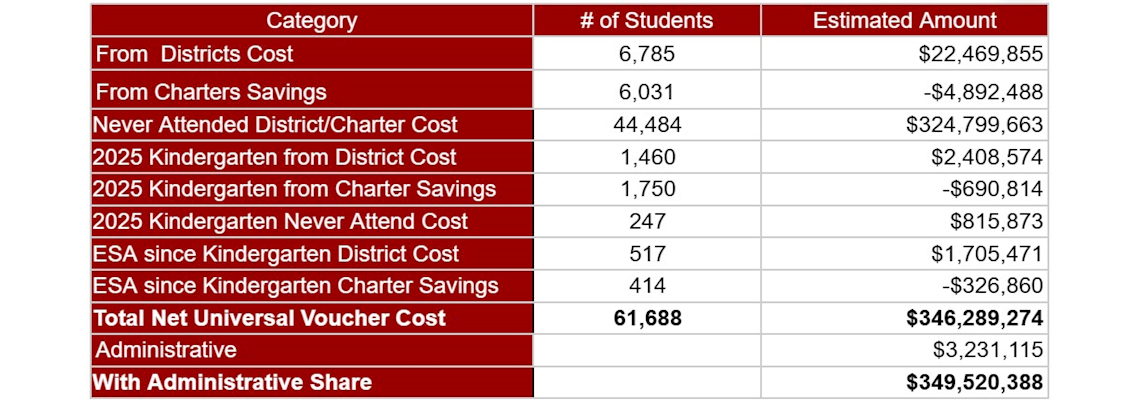
  • While the total cost of the overall ESA program in FY2025 is expected to be $872 million, the net cost after adjusting for where students would have otherwise attended is $350 million for those in the universal ESA voucher program. This represents a slight increase from the $332 million estimated by the Grand Canyon Institute last year.

The Grand Canyon Institute (GCI) estimates a $350 million net cost to the state’s General Fund in FY2025 (July 2024-June 2025) for the universal component of Arizona’s Empowerment Scholarship Account (ESA) voucher program based on a student’s school of origin. This represents a slight increase over the estimated FY2024 cost of $332 million. The estimate assumes basic student funding weights. 

The Joint Legislative  Budget Committee currently estimates the total annual cost of the ESA program to be $872 million, which includes the original targeted program and the universal component. Because student-level data on the universal program is not separated out by the Arizona Dept. of Education, GCI must estimate the origin of universal program enrollees. GCI’s estimate reflects the net cost the state would have incurred if the universal ESA voucher program did not exist. Almost every single child in the original targeted program had to attend a district or charter school for at least 45 days before enrolling in the program. GCI uses historical data on where the targeted students had come from previously, dating back to FY2017, along with current data on where all ESA students have left district or charter schools to estimate the distribution of students across district and charter schools for the original targeted program and the remainder are allocated to the universal program. 


In FY2025, the net growth in the universal ESA vouchers was 7,660 of the total enrollment of 61,688. GCI estimates that 73% of ESA universal voucher recipients never attended a district or charter school, slightly lower than the rate of 80% in FY2025. This includes estimates for kindergarten students using ESA universal vouchers. 

The primary driver of the change in FY2025 was a significant increase in the portion of net new enrollees from district and charter schools. GCI examined the marginal changes since last year and estimates that nearly half the net gain in universal participants of 7,660 from FY2024Q2 to FY2025Q2 came via Kindergarten. Analyzing changes in the portion of students previously attending a district or charter school, GCI estimates that less than 10% never attended (or would have never attended for Kindergarten) while half came from charter schools and just over 40% came from districts.

This change helped lessen the growth of the net cost of the program. GCI presumes that Kindergarten students do not have a record of prior attendance but would mirror the same distribution.  Given that charter school enrollment is about one-fourth of district enrollment, charter schools have been significantly disproportionately impacted by the Universal ESA program.

Despite the change in FY2025, the majority of participants in the universal ESA program never attended a district or charter school should be self-evident. For FY2025, the Quarter 3 Executive and Legislative ESA report identifies that of the total 87,602 students enrolled in the ESA voucher program (targeted and universal), regardless of when they first enrolled, only 33,942 students  moved from charter or district schools to an ESA. Virtually all targeted participants must first enroll in a district or charter school first. The universal program does not require prior attendance. 

Access the full report here.

The Grand Canyon Institute, a 501(c) 3 nonprofit organization, is a centrist think tank led by a bipartisan group of former state lawmakers, economists, community leaders and academicians. The Grand Canyon Institute serves as an independent voice reflecting a pragmatic approach to addressing economic, fiscal, budgetary and taxation issues confronting Arizona.

Laurie Roberts, columnist for The Arizona Republic, asked the question that is the title of this post. Why indeed? Charters and vouchers, we were promised, would “save poor kids from failing schools” but all too often, school choice is far worse than the neighborhood public school.

When you see the abysmal test scores for this online school, you understand why the operators of voucher schools demand exclusion from state testing. This charter school has horrible scores, but as Trump often reminds us, “parents know best.” Except when they don’t.

Roberts looks beyond the promises and follows the money. That’s always a good strategy.

Roberts writes:

Pity poor Primavera Online Charter School.

It seems dastardly “activists” are trying to shut down this fine academic institution — to deny the school the $80 million in public money it needs annually to provide students with a “D” education.

It’s “lawfare”, we are told. An attack on President Donald Trump’s agenda and a sneak attempt to shut down school choice.

“The voters of this country have spoken loud and clear … that President Trump’s agenda, which includes school choice, is highly favored by the voters,” Jesse Binnall, the school’s lawyer, declared. “Instead of getting on board with this policy, you have some people that are trying to use various versions of lawfare … in order to get in the way of school choice.”

Binnall and Primavera CEO Damian Creamer, surrounded by some of the state’s elected leaders, held a press conference outside the state Capitol on Wednesday to bemoan Primavera’s plight as the Arizona Board of Charter Schools considers shutting down the online alternative school.

No less than U.S. Rep. Andy Biggs stood with them.

Biggs, who has enjoyed more than $32,000 in campaign contributions from Creamer, according to Open Secrets.

Creamer also has donated to a who’s who of Republican state legislators, which likely explains why some of them showed up to support him on Wednesday.“We hope that everyone is going to do the right thing,” Binnall continued. “But, unfortunately, we know activists have infected this process far too much.”

Primavera gravy train could be slowing down

Earlier this month, the charter school board — a board dominated by appointees of former Republican governor and school choice champion Doug Ducey — took the first step toward revoking the school’s charter.

This, after 12News reporter Craig Harris — yeah, he’s the “activist” to whom Binnall was referring — began asking questions about why we’re paying Creamer tens of millions of dollars to fail children.

The state Board of Education has slapped Primavera with a “D” rating in each of the last three years. It is the only charter school in the state to rate three straight D grades.

The charter board, meanwhile, has given Primavera its second worst rating — Does Not Meet Standard — over the last two years and its worst rating — Falls Far Below Standard — four times since 2017.

Yet, the school continues to rake in our money. Nearly $80 million last year.

Of that, Harris reports that Primavera paid $54 million to its parent company, StrongMind, for curriculum and management.

StrongMind has just one shareholder: Creamer.

Just $12.4 million of that $80 million went to teachers, with another $6 million for advertising.

In all, Harris has reported that Creamer has pocketed at least $24 million in public money via shareholder distributions and direct payments since 2017.

We are paying $80 million for this?

Now, however, the gravy train appears to have run its course. So the push is on — with a little oomph from politicians who have enjoyed Creamer’s contributions — to make sure it doesn’t get derailed.

“We have to be confident that these people who serve … the people of Arizona are going to do the right thing for the children of Arizona,” said Binnall, who also has worked for Trump.

Creamer maintains his school, which caters to at-risk students, would have earned a grade of “C” had it been judged as an alternative school. But he’s the one who failed to apply for the designation.

Even so, the school’s record of academic achieved has dropped even as its enrollment has jumped to 8,000 students.

According to state assessment results, the percentage of students rated proficient in English has dropped from 36% in 2022 to 23% last year.

Math proficiency dipped from 13% in 2022 to 9%.

The only thing booming is Creamer’s bank account.

But, sure, it’s lawfare to question whether we should be doling out $80 million every year to this school.

“We hope that everyone is going to do the right thing,” attorney Binnall said. “But, unfortunately, we know activists have infected this process far too much.”

Reach Roberts at laurie.roberts@arizonarepublic.com. Follow her on X (formerly Twitter) at @LaurieRobertsaz, on Threads at @LaurieRobertsaz and on BlueSky at @laurieroberts.bsky.social.

This article just appeared on the website of The New York Review of Books.

https://www.nybooks.com/online/2025/01/11/their-kind-of-indoctrination/

It is my review of Trump’s plans for K-12 education.

NYRB is the most distinguished literary-political journal in the nation. It has a huge readership. It reaches a different audience than education journals.

If you subscribe to NYRB, you can open it in full. If you don’t, it costs $10 for 10 issues. Or, if you wait, I will post it in full in a few weeks.

The preceding post was reported by ProPublica, an absolutely essential journalistic enterprise that serves the public interest.

Please read Peter Greene’s take on the same story. He adds additional research and his professional experience as a veteran teacher.

Greene writes:

Call it a zombie school, one more piece of predictable detritus washed up on the wave of voucher laws. Here’s an instructive tale.

ARCHES Academy was a charter school operating in Apache Junction, Arizona. But in March of 2024, the state board that oversees Arizona charters voted unanimously to shut the place down. Mind you, the board in Arizona is pretty charter friendly, but ARCHES had so many problems. Under 50 students were left at a K-8 school dinged for soooo many problems.

Chartered in 2020, promising a “holistic” approach that grouped students by ability rather than age, then put on an Assessment Consent Agreement in 2023. Financial mismanagement. Poor record-keeping. IRS violations. Violations of state and federal law. Academic results in the basement. State rating of D. Founder and principal Michelle Edwards told the board “Mistakes were made and compounded over time.” So, general incompetence rather than active fraudster work.

So ARCHES the charter school was shut down, because charters still have to answer to the state for their performance and competence.

But you know who doesn’t have any oversight at all in Arizona?

Private schools that accept taxpayer-funded vouchers.

So Edwards simply re-launched her school as the Title of Liberty (a name taken from a verse in the Book of Mormon). Some of her pitch was visible in a piece in The Arizona Beehive, a Mormon-flavored newsmagazine, in the summer of 2024.

As changes happen in the public education system, many families who belong to The Church of Jesus Christ of Latter-day Saints have become more concerned about the potential influence of conflicting ideologies expressed in their children’s classrooms.

In the article, Edwards addresses her own concerns.

Principal Michelle Edwards, an early childhood specialist, has been in the education system for many years. The academy is a culmination of a dream of hers. “I recently had one student who was really struggling,” says Michelle, “and I couldn’t tell her about her divine abilities, that she’s a child of God, or who her father in heaven is.”

The article promises a Personal Learning Plan and notes that if tuition is an issue, the school will help parents apply for the Arizona ESA voucher to cover costs.

What the article doesn’t mention is that Edwards just had the school, under another name and as a charter, shut down by the state. But then, nobody, not even the state itself, told anyone.

Edwards’s new school went heavily with the religious pitch, with the website announcing “Christ-centered, constitutionally-based, education for all….”

Why doesn’t Arizona have anything in place to help apparently well-meaning folks like Edwards get into the education biz? Why doesn’t it exert even the slightest bit of oversight of the vendors cashing in on taxpayer-funded vouchers? I suspect it hints at what programs like Arizona’s voucher extravaganza are really about– and it’s not about a robust, choice-filled education environment. It’s about defunding and dismantling public education (and the tax burdens that go with it). But you can’t just tell folks, “We’re going to end public education.” So instead, hand them a pittance of a voucher and announce that you’re giving them freedom! And after that, you’ve washed your hands of them. The wealthy can still afford a top-notch education for their kids, and if Those People end up wasting their kids time in sub-prime, fraudulent, or incompetent pop up schools, well, that’s their problem.

If folks like the Arizona voucher crowd were serious about choice, they would provide transparency and oversight, rather than letting any shmoe rent a storefront and call it a school. But Arizona isn’t serious about choice. It’s serious about dismantling public education. It’s serious about getting public tax dollars into private hands and funding religious groups. And people like the families at Title of Liberty and even Edwards herself will just keep paying the price.

The Heritage Foundation’s Project 2025 holds up Arizona as a shining exemplar of what education should be in every state. Vouchers for all, rich and poor alike. Everyone choosing the kind of school or home school they like. Happiness reigns. Or so they claim.

In several articles, ProPublica has taken a close look at what’s happening in Arizona. It’s not a pretty picture. Open the link to read this article in full. It was written by Eli Hager of ProPublica, published there and on the Raw Story website.

The reality is ugly. Arizona does have universal vouchers, but most are used by well-to-do families whose children were already enrolled in private schools. About 60,000 of Arizona’s 1.3 million students use vouchers. Clearly, the vast majority of the state’s students attend public schools. Meanwhile, Arizona’s state budget has exploded because of the added cost of paying everyone’s tuition at private schools. And the public schools are underfunded, ranked 48th in the nation for per-pupil spending.

One afternoon in September, parents started arriving for pickup at Title of Liberty Academy, a private Mormon K-8 school in Mesa, Arizona, on the eastern outskirts of Phoenix.

Individually, the moms and dads were called in to speak to the principal. That’s when they were told that the school, still just a few months old, was closing due to financial problems.

There would be no more school at Title of Liberty.

Over the course of that week, more parents were given the news, as well as their options for the remainder of the school year: They could transfer their children to another private or charter school, or they could put them in a microschool that the principal said she’d soon be setting up in her living room. Or there was always homeschooling. Or even public school.

These families had, until this moment, embodied Arizona’s “school choice” ideal. Many of them had been disappointed by their local public schools, which some felt were indoctrinating kids in subjects like race and sex and, of course, were lacking in religious instruction. So they’d shopped for other educational options on the free market, eventually leading them to Title of Liberty.

One mom had even discovered the school by window shopping: It was in the same strip mall as her orthodontist’s office, next to a ChinaPalace, and she’d noticed the flags outside with Church of Jesus Christ of Latter-day Saints imagery. (The school was not formally affiliated with the church.)

An LDS member herself, she was soon ready to start paying tuition to the school from her son’s Empowerment Scholarship Account — a type of school voucher pioneered in Arizona and now spreading in various forms to more than a dozen other states. ESAs give parents an average of over $7,000 a year in taxpayer funds, per child, to spend on any private school, tutoring service or other educational expense of their choice.

Yet Arizona’s ESA program provides zero transparency as to private schools’ financial sustainability or academic performance to help parents make informed school choices.

For instance, the state never informed parents who were new to Title of Liberty and were planning to spend their voucher money there that it had previously been a charter school called ARCHES Academy — which had had its charter revoked last school year due to severe financial issues. Nor that, as a charter, it had a record of dismal academic performance, with just 13% of its students proficient in English and 0% in math in 2023.

When it was a charter (which is a type of public school), these things could be known. There was some oversight. The Arizona State Board for Charter Schools had monitored the school’s finances and academics, unanimously coming to the conclusion that it should be shut down.

Yet just a month after the board’s decision, ARCHES was re-creating itself as a renamed, newly religious private school, simply by pivoting to accept voucher dollars.

In other words, it was closed down by a public governing body but found a way to keep existing and being funded by the public anyway, just without the standards and accountability that would normally come with taxpayer money.

Arizona does no vetting of new voucher schools. Not even if the school or the online school “provider” has already failed, or was founded yesterday, or is operating out of a strip mall or a living room or a garage, or offers just a half hour of instruction per morning. (If you’re an individual tutor in Arizona, all you need in order to register to start accepting voucher cash is a high school diploma.)

There is “nothing” required, said Michelle Edwards, the founder and principal of ARCHES and then of Title of Liberty, in an interview with ProPublica. It was “shocking how little oversight” the state was going to provide of her ESA-funded private school, Edwards said.

According to charter board members as well as parents and family members of her former students, Edwards is a well-intentioned career educator who cares deeply about children. But she has repeatedly struggled to effectively or sustainably run a school.

She said that when she first transformed her charter school into a private school, she and her team called up “every agency under the sun” asking what standards the new school would have to meet, including in order to accept voucher funds. For example, what about special education students and other vulnerable children — would there be any oversight of how her school taught those kids? Or instructional time — any required number of minutes to spend on reading, writing, math, science?

State agencies, she said, each responded with versions of a question: “Why are you asking us? We don’t do that for private schools.”

“If you’re gonna call yourself a school,” Edwards told ProPublica, “there should be at least some reporting that has to be done about your numbers, about how you’re achieving. … You love the freedom of it, but it was scary.”

This school year, ProPublica has been examining Arizona’s first-of-its-kind “universal” education savings account program. We are doing so both because other states have been modeling their own new ESA initiatives after this one, and also because President-elect Donald Trump has prioritized the issue, most recently by nominating for secretary of education someone whose top priority appears to be expanding school choice efforts nationwide. (And Betsy DeVos, his first education secretary, was and remains a leading school voucher proponent.)

These programs are where the U.S. education system is headed.

In our stories, we’ve reported that Arizona making vouchers available even to the wealthiest parents — many of whom were already paying tuition for their kids to go to private school and didn’t need the government assistance — helped contribute to a state budget meltdown. We’ve also reported that low-income families in the Phoenix area, by contrast, are largely not being helped by vouchers, in part because high-quality private schools don’t exist in their neighborhoods.

But the lack of any transparency or accountability measures in Arizona’s ESA model is perhaps the most important issue for other states to consider as they follow this one’s path, even some school choice supporters say.

Yeah, yeah, I know it’s a strange headline, but it’s true.

Here is the story: Politico reporter goes to Arizona to cover the voucher story. Discovers that the chief advocate for vouchers is a beautiful, charming mom who uses state money to home-school her five children.

Writer is wowed by this mom. Writer notes that mom is funded by DeVos and Koch machine. It doesn’t matter. She’s so charming and pretty, who cares that vouchers are busting the state budget?

Writer pays more attention to the adorable mom than to those fighting to stop the damage she is doing to kids, public schools, and communities. Somehow she becomes the hero of the story.

Who cares that vouchers are used mostly by families whose kids never went to public schools? Who cares that vouchers are harming the state’s public schools?

Who cares that Arizona voters overwhelmingly rejected voucher expansion? Who cares that the legislature ignored their vote?

Who cares that less than 5% of the state’s students are undermining the state budget and the schools that educate the other students?

Families, mostly from high-income zip codes, have applied the taxpayer funds for everything from ski lift passes to visits to trampoline parks, a $4,000 grand piano, more than a million dollars in Legos, online ballet lessons, horse therapy and cookie-baking kits. Proponents justify expenditures like these in the name of parents’ prerogative to shape their children’s education or by pointing to wasteful spending by public schools. As a result, ESA costs have ballooned from the legislature’s original estimated price tag of $100 million over two years, to more than $400 million a year — a figure, critics have noted, that would explain more than half of Arizona’s projected budget deficit in 2024 and 2025.

Ain’t it grand?

Love is love, even when it is underwritten by billionaires!

ProPublica published a story about which families benefit from Arizona’s universal voucher program. It is not low-income families.

The state’s so-called Education Savings Accounts (or Empowerment Scholarship Accounts) were enacted by the Legislature in 2011. Whatever they are called, they are vouchers, which violate Arizona’s Constitutional ban on public funds for religious schools. They initially contained restrictions as to which students qualified to receive a voucher. The usual claim for vouchers was that they would “save poor kids from failing public schools.” However, that never happened.

From the start, the Republicans in control wanted vouchers for all students, not just those from low-income families. Even though there was a state referendum in which voters overwhelmingly rejected voucher expansion in 2018, the Legislature ignored the vote and passed universal vouchers in 2022. Any student, whatever their family income, is entitled to use public money for tuition in a private or religious school or for home schooling.

The result: few students from low-income families use vouchers.

The article in ProPublica explains why.

Vouchers don’t cover the cost of most private schools.

Most private schools are not located in low-income neighborhoods.

Low-income families can’t afford the cost of transportation to and from private schools.

In Arizona, as in other states, most students who take vouchers were already enrolled in no public schools. Their parents can afford to pay the tuition. Now the state subsidizes them. And in many cases, the schools raise their tuition in response to the state subsidy.

EJ Montini of the Arizona Republic thinks something is not quite right with Arizona’s State Superintendent of Education Tom Horne. He rejects federal funding for poor kids and promotes rightwing groups and theories. He explains:

I’m not yet prepared to call Arizona Superintendent of Public Instruction Tom Horne incompetent, though I’d have to admit, he’s recently made a very good case for himself.

The Arizona Republic’s Nick Sullivan outlined in a blow-by-blow article the misrepresentations Horne made while trying to explain to state lawmakers what could have been the loss of millions of Title I federal dollars meant for schools that serve low-income households.

For example, Horne told lawmakers that a deadline for allocating the money had expired. The U.S. Department of Education said such a deadline does not exist.

His administration said there was no possibility of receiving a deadline waiver. The Republic contacted the feds, who, in turn, told Horne’s people it was not too late, and a waiver was subsequently granted.

It goes on. One bumbling bit of misinformation after the next.

All of which would be easy – and even logical – to write off as incompetence, were it not for some of the other things Horne has done.

A lawsuit on accountability Horne wants the state to lose

Most recently, for example, his department was sued by The Goldwater Institute after Attorney General Kris Mayes cracked down on ridiculous purchases being made by people collecting Empowerment Scholarship Account money.

Taxpayer money. Your money.

ESA recipients were buying stuff like $1,000-plus Lego sets, pianos, luxury car driving lessons, ski resort passes and much more.

Given that, new rules came into play requiring school voucher recipients to actually justify their expenses.

The parents suing with Goldwater’s help called such demands “bureaucratic hoops” and “arbitrary paperwork,” instead of, you know, common sense.

Meantime, Horne said he wants the state to lose the lawsuit. Really.

A nonprofit that teaches kids the ‘softer side’ of slavery

You might also recall how, a while back, Horne opened up the education department’s website to lessons from PragerU, an kooky, extremist nonprofit claiming to be an alternative to “dominant left-wing ideology in culture, media and education.”

About this Horne said, “It’s alright for teachers to teach controversial views as long as both sides are presented, and the problem we’ve had is in some classes, only the extreme left side has been presented, so these present an alternative.”

An alternative? One PragerU video shows an animated Christopher Columbus presenting the softer side of slavery, saying, “Being taken as a slave is better than being killed, no? I don’t see the problem.”

Neither does Horne. Which is a problem.

A group that promotes book bans and quoted Hitler

Just as it was a problem when Horne spoke before a group of East Valley supporters of Moms for Liberty, a right-wing operation out of Florida that believes “liberty” involves book banning, victimizing LGBTQ children, suppressing accurate American history and more.

The group has as one of its goals filling school boards with like-minded individuals and Horne pledged to join them in their effort, saying, “That’s going to be my main occupation for 2024.”

A pledge he made even after the group got national attention when the leader of a chapter in Indiana published a newsletter for members that prominently displayed a quote attributed to Adolf Hitler: “He alone who OWNS the youth, GAINS the future.”

Horne is an intelligent man. His official government profile proudly notes that he “graduated Magna Cum Laude from Harvard College and with honors from Harvard Law School.” And that he is a “classical pianist who has soloed with local orchestras” and has “taught legal writing at ASU Law School.”

All of that argues against the notion that Horne is incompetent. In fact, it seems to suggest just the opposite. Something much worse.

He does this stuff on purpose.

Reach Montini at ed.montini@arizonarepublic.com.