Leonie Haimson is a public school activist in New York City who fights for smaller class size, student privacy and against privatization of public funds.
She wrote on her blog:
Please email Comptroller Lander and ask him to audit DOE charter rent spending and lack of matching funds for public schools – more on this below.
ask the comptroller to audit DOE’s charter rental payments now!
Last Thursday, September 18, 2025, several large charter school networks held a protest rally in Cadman Plaza and a march across the Brooklyn Bridge to push for the continued expansion of the charter school sector. This was apparently provoked by the fact that the leading candidate for Mayor, Zohran Mamdani, has said he opposes allowing more charter schools to open, especially since they have reached their legal cap in NYC under state law.
Liz Kim, reporter at Gothamist, got hold of a tape of a speech that Eva Moskowitz, CEO of the largest charter school chain, Success Academy, gave to her Charter Management Staff and 158 new teachers, exhorting them to attend this march and rally, and to make at least five “phone-to-action” calls to their elected officials.
In the speech, Moskowitz harshly reprimanded those who had not yet done so: “You did not do the phone-to-action because you thought, ‘This is not very serious,’” she said. “So I want to just reset for all of you. It is an existential threat.” And:
“We have faced threats throughout the last 20 years, we have a core competency in political threats, unfortunately. But this is one of these moments where there is heightened risk, policy risk, political risk, and so we are going to do what we’ve always done, which is to stand up for children and families in a massive way in Cadman Plaza to speak our minds and to make sure that government works for children and families. … government doesn’t naturally work for the people. It has to be forced and made to work for the people. So we’re doing two things. One is this parent mobilization, and the second is our phone to action campaign.
And our goal is to send elected officials, two million messages. Now, teachers, you’ll do a network one now and then when you get to your schools, you’ll do a local one. But I have to say that I was a little disappointed in the network, because only 25% of the network was doing the phone to action. …And you know, would be natural for you not to understand we have these nice offices, Aren’t they nice? Very nice.
You guys [work] for a not for profit, you are highly compensated. You could say, What? What? Me worry? What’s there to worry about? But there’s a lot to worry about, and this is not a theoretical worry. We lived through eight years of Bill de Blasio. The first thing he did when he became mayor is he threw out three of our schools.”
This is untrue. De Blasio did not kick out three of her schools; he rejected three Success charter co-locations that had been proposed by Bloomberg before he left office but not yet implemented. De Blasio also accepted co-locations for five other Success charter schools.
In any event, after a barrage of negative television ads, DOE officials were browbeaten into finding and renting private space for these three Success charter schools at city expense for $5.4K – $11K per student. By last year, the number of Success charter schools rented directly by DOE had risen to nine, with buildings added under both Mayor de Blasio and Mayor Adams, at a cost of $14.3 million annually. By renting these buildings directly and failing to ask Success to rent the buildings themselves, they are sacrificing 60 percent reimbursement from the state for those expenses.
At the meeting, Moskowitz was clear that she was requiring all network staff and teachers to both make phone calls and participate in the rally:
“When we ask you to do phone to action, you kind of do it. You can’t make people chase you down. … we’ve kind of gotten loosey goosey here and just know your managers are going to hold you accountable to an extraordinary standard of performance. … When your network are giving a directive, I think we’re getting a little democratic here. We are quite hierarchical.
There is a chain of command, and when your boss asks you to do something, assuming it’s not unethical or a question of conscience, you do the task. Are we clear? I do not want to have to chase people down for phone to action. Is there some argument or particular reason? Anyone live in New Jersey? Okay, that’s not an excuse. I hate to tell you, list your 120 Wall Street address and get it done. ….”
She then told her staff and teachers to take out their phones and make all five phone calls to elected officials right then and there.
According to a report in Labor Notes, Success Academy employees were also required to send emails to elected officials, and were ordered to “submit screenshots of these emails to their managers to confirm they had sent them.”
Success Academy was not the only charter chain to make participation in the rally mandatory for staff, parents and students. It was also required by the Zeta charter chain, founded by Emily Kim, former attorney for Success Academy. A document sent to staff at Zeta Charter Schools made this clear:
“100% attendance expected from all Zeta families, students, and staff. Each student must attend with a parent/guardian to ensure the safety of every child. Students cannot attend the rally without an adult family member or authorized chaperone.”
Students, their parents and staff had to arrive at Zeta at 6:30 AM to get on the bus to Cadman Plaza, according to the schedule. If parents wanted to bring their younger children, they had “to bring their own seats for the bus ride to the rally,” presumably meaning they had to pay for their own transportation to get to Cadman Plaza.
Teachers at Zeta were told it was their responsibility to get parents to attend:
“All teachers must ensure 100% completion through family follow-up calls Mon., Sept. 8th- Wed., Sept. 10th. Your Principal and Operations Director will share a school-wide tracker to follow up and log all family calls accordingly.”
There is a real question about whether mandatory attendance at a political event or forcing teachers to make political phone calls is legal. The day after the rally, on Friday, John Liu, Chair of the Senate NYC Education Committee and Shelley B. Mayer, Chair of the Senate Committee on Education sent a letter to NY State Education Commissioner Betty Rosa and John King, Chancellor of State University of New York, whose agencies authorize and oversee charter schools.
Senators Liu and Mayer expressed “great concern that many charter schools in New York City cancelled classes and pressured students, families, and staff to participate in a political “March for Excellence” on September 18, 2025. We urge the state to conduct a thorough investigation into potential violations of state law.”
They also pointed out how“canceling classes during a school day and forcing families and students to engage in a political rally is an egregious misuse of instructional time and state funds. We urge SUNY and the State Education Department to exercise their oversight authority and fully investigate this matter to determine any possible violations of state law, and if such violations are found, to claw back a portion of state per capita funding from each school administration that engaged in this event, and to take steps to ensure future misuse of student’s precious school time does not continue.”
Though they didn’t specify any laws that might have been broken, in 2023 Governor Hochul signed into law Senate Bill 4982, which prohibits employers from coercing employees into attending or participating in meetings where the primary purpose is to communicate the employer’s opinions on religious or political matters. The law also holds that the courts may impose monetary penalties on employers who do this, and that employees can seek “equitable relief and damages” in court if they do.
In any case, this is not the first time that Eva Moskowitz and Success Academy have been found guilty of breaking laws. Repeatedly, her charter schools have been shown to deny students their legal rights, violating their privacy, and pushing out those who do not make the grade either in terms of behavior or test scores. A sample of these documented violations are listed at the end of this blog post.
Evidence of inflated charter rental payments and missing matching funds
Another issue of great concern is how charter schools now drain more than $3 billion dollars annually from the DOE budget, plus charge more than a hundred million dollars per year to DOE in rental subsidies. NYC is the only district in the nation that is obligated to either co-locate charters in public schools or help pay for their rent in private buildings. This applies to all new and expanding charter schools since 2014, after they go through a perfunctory appeal process, according to a law pushed through by then-Governor Andrew Cuomo and the charter lobby. The amount spent on their rental expenses by DOE has risen sharply over time –though 60% of these expenditures are supposed to be reimbursed by the state.
In 2019 and 2021, Class Size Matters issued two reports that provided evidence that DOE had overspent on rental assistance to charter schools by $21 million. We also revealed suspicious charges for rental subsidies paid by DOE to several charter schools, including those run by Success, that owned or subleased their own buildings.
In one case, the rent for two Success Academy charter schools housed at Hudson Yards increased from approximately $793,000 to over $3.4 million in one year – more than quadrupling , causing DOE to pay $3 million in rental subsidies for those two schools alone in 2020.
We also found that public schools co-located with charter schools were owed millions of dollars in matching funds for facility enhancements, compared to the amounts required by state law. From 2014 to 2019, 127 co-located public schools were owed a total of $15.5 million.
Please email Comptroller Lander and ask him to audit these programs
Shortly after the release of our second report, in March 2022, Senator John Liu, Senator Robert Jackson, and Rita Joseph, chair of the Council Education Committee, sent a letter to Comptroller Brad Lander, urging him to audit this spending, based upon our troubling findings. I recently learned that no such audit has been conducted. An analysisalso shows that Lander has audited fewer DOE programs than any other NYC Comptroller since 2003 at this point in office.
We are now engaged in examining DOE own reports of their spending on charter school rent, which continues to rise sharply higher each year, as well as their continuing failure to provide sufficient matching funds to public schools for facility upgrades and repairs.
Please email the Comptroller now and urge him to launch an audit on these programs before he leaves office in January, by filling out the form here.
Where it says, “Your Suggestion,”please write:
“I urge you to audit DOE spending on charter rent, especially charter schools that own or sublease their own buildings, as well as charters whose buildings DOE rents directly and thus is unable to receive 60% reimbursement from the state. Also please audit the lack of public school matching funds, as there is evidence that they continue to be owed millions for facility upgrades.”
Feel free to rephrase this in any way you like.
On my blog, at the end of this post, is a list revealing the documented pattern of Success Academy violations, including failing to provide students with their mandated services, repeatedly suspending them for minor infractions, violating their privacy, and pushing them out when they do not conform to rigid behavioral expectations or do not score high enough on standardized exams.
2. If you haven’t already, please also fill out this brief survey on class sizes at your school this year. So far, from the unscientific sample of teachers and parents who have responded, class sizes have increased in as many schools as have decreased, despite the fact that more than 700 schools received funds to lower class size. If DOE is simply pushing up class sizes in the schools that did not receive this funding, that would be a matter of great concern.
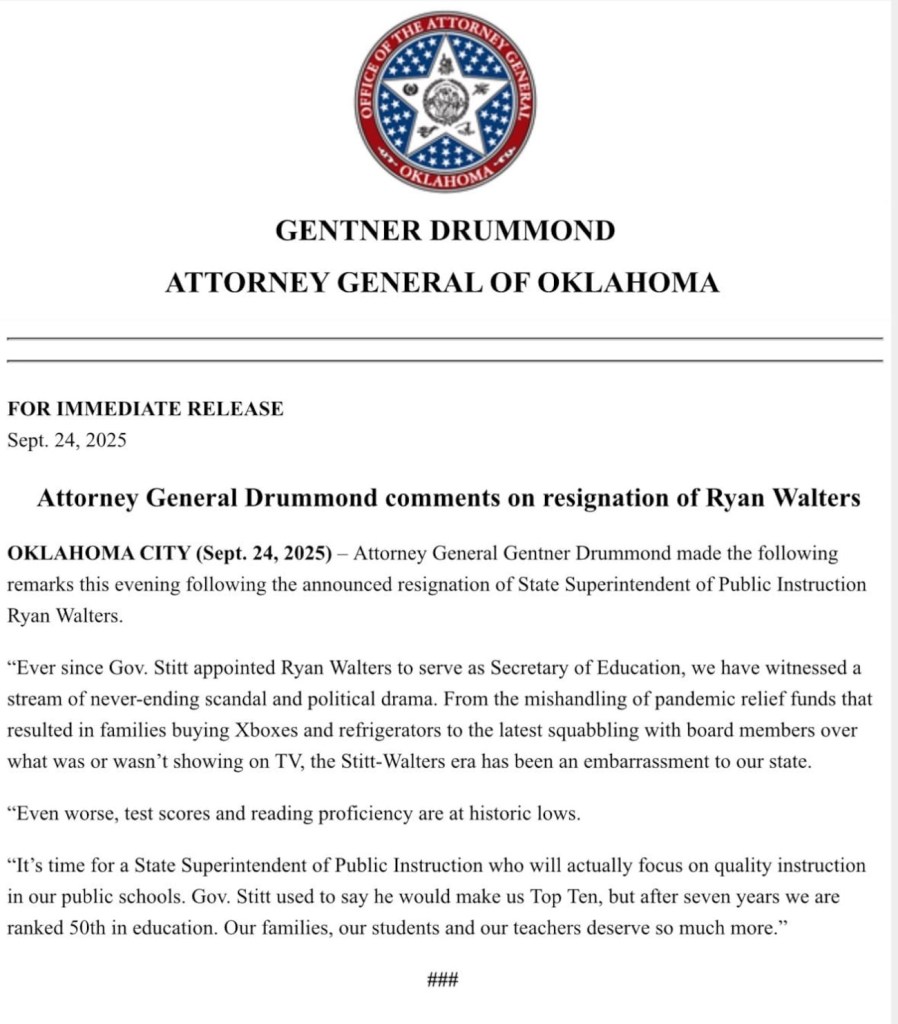
After raising a national profile by taking MAGA ideas to absurd extremes, Ryan Walters resigned yesterday, going out in a blaze of ignominious display.
John Thompson explains:
For months, I’ve been hearing predictions that State Superintenent Ryan Walters would not serve out his term. Originally, the rumors had to do with the questionable legality of his actions. Recently they have focussed on the Republicans, who once supporteded him, but who are now fed up with his antics.
Since I submitted this piece, yesterday, Walters said “he is ‘excited’ to step down and accept his new position. He said his goal is to ‘destroy the teachers unions.’”
Walters announced he will become the CEO of the Teacher Freedom Alliance (which says it has 2,748 teachers enrolled.) He proclaimed: “For decades, union bosses have poisoned our schools with politics and propaganda while abandoning parents, students, and good teachers. That ends today. We’re going to expose them, fight them, and take back our classrooms,” said Walters in a press release. “At the Teacher Freedom Alliance, we’re giving educators real freedom, freedom from the liberal, woke agenda that has corrupted public education. We will arm teachers with the tools, support, and freedom they need, without forcing them to give up their values. This is a battle for the future of our kids, and we will not lose.”
Below is background information on how Walters got to this point.
What’s been happening to American public schools lately is different: more coordinated, more creative, and blanketing the nation. Pressure on what kids learn and read is coming from national parents’ movements, the White House, the Supreme Court.
Rosin further explains that Ryan Walters “has pushed the line further than most.”
Walters recently announced an ideology test for new teachers moving to Oklahoma from “places like California and New York.” And, although the Oklahoma Supreme Court has issued a temporary stay on Walters’ standards, he’s “tried to overhaul the curriculum, adding dozens of references to Christianity and the Bible and making students ‘identify discrepancies in 2020 elections results.’”
The first of two podcasts review how Walters has “already succeeded in helping create a new template for what public schools can be.” Part two will go even deeper into how “Walters and a larger conservative movement seem to be trying to redefine public schools as only for an approved type.” As he said, “If you’re going to come into our state … don’t come in with these blue-state values.”
Rosin starts with Walters’ “Office of Religious Liberty and Patriotism,” and his claim, “For too long in this country, we’ve seen the radical left attack individuals’ religious liberty in our schools. We will not tolerate that in Oklahoma.” He said this in a video sent to school administrators who were supposed to play it for every student and every parent.
This mandate, however, is the opposite of his approach when he was an award-winning “woke” middle school teacher. Rosin interviewed two of Walters students, Shane and Starla, about his “parodies,” that were called, “little roasts.”
Shane, a male conservative, compared Walters’ “little roasts,” such as “Teardrops on My Scantron,” to those of Jimmy Kimmel.
Starla, a lesbian. said of her teacher, “He was woke! (Laughs.) He was a woke teacher.” And she praised his teaching about the civil rights movement.
Rosin reported that today’s Ryan Walters is “unrecognizable” in comparison to the teacher they knew. And, “Shane compared it to how you’d feel about your dad if he remarried a woman you didn’t like.”
In 2022 , when running for State Superintendent, pornography was Walters’ issue. He strongly supported HB 1775, which was a de facto ban on Critical Race Theory. It forbid teaching things like, “an individual, by virtue of his or her race or sex, is inherently racist, sexist or oppressive, whether consciously or unconsciously.”
Walters’ top target was a high school teacher, Summer Boismier, who, in response, covered her bookshelves with butcher paper. But she also posted a QR code for a Brooklyn library, which had books that Walters said were pornography. Boismier resigned, but Walters successfully asked the Oklahoma State Board of Education to revoke her teaching certificate. He said, “There is no place for a teacher with a liberal political agenda in the classroom. Ms. Boismier’s providing access to banned and pornographic material to students is unacceptable and we must ensure she doesn’t go to another district and do the same thing.”
After being labeled a pedophile, Boismier started to get serious threats. Then the Libs of TikTok started a campaign against alleged gay teachers who were supposedly “groomers,” prompting bomb threats.
Then, as Rosin explained, “state Democrats called for an impeachment probe, and Walters leaned in harder.” For instance, Walters ramped up his campaign against teachers unions who he called a “terrorist organization.”
Walters also claimed that a “civil war” was being fought in our schools.
Rosin reported on how Walters gained a lot of attention “when he said teachers could cover the 1921 Tulsa Race Massacre, where white Tulsans slaughtered hundreds of Black people, but they should not, quote, ‘say that the skin color determined it.””
Then, “Walters accused the media of twisting his words. He said that “kids should never be made to feel bad or told they are inferior based on the color of their skin.”
Trump responded on Truth Social, “Great job by Oklahoma State Superintendent Ryan Walters on FoxNews [sic] last night. Strong, decisive, and knows his ‘stuff.’” And, “I LOVE OKLAHOMA!”
There was pushback when it was learned that “one of the few Bibles that met Walters’ criteria is the “God Bless the USA Bible.” It was “endorsed by Lee Greenwood and President Trump. It sells for $59.99.”
As the first part of the podcast came to an end, it reviewed Walters’ recent setbacks.
The U.S. Supreme Court stopped Oklahoma’s plan for the nation’s first publicly funded religious charter school. The Oklahoma Supreme Court has paused the Bible plan. And the special test by Prager U. for teachers from California, New York, and other “woke” states, faces legal challenges.
And Walters was lambasted after sexually explicit images of naked women were seen on a screen inside his office.
Part two will give Walters a chance to tell his side of the story. Rosin previews his response by quoting him: “Yeah, they’re outrageous liars.”
Walters spent most of his energy promoting evangelical Christianity in the public schools. He wanted Bible-based lessons, the Ten Commandments in every classroom, and prayer in the schools. He was an outspoken MAGA guy and tried to insert doubts about the 2020 election in the social studies curriculum.
The final straw may have been the time recently when Walters conducted a meeting with members of the State Board of Education in his office and two attendees saw pornography on his television screen. Walters meanwhile had been ranting about pornography in school libraries.
Mike DeGuire is a veteran educator in Denver. He says it’s time to take stock and assess the damage that “reform” has inflicted on students and public schools in Denver.
Is public education a public or a private good? This issue is at the heart of the school choice debate sweeping the country.
Advocates for school choice are advancing policies that move us toward the privatization of our schools, treating our children’s futures as commodities rather than community investments. This well-funded bi-partisan coalition promotes privatization through charter school expansion, vouchers, tax credits, and education savings accounts. Republicans use the words “parental rights, freedom and competition,” while neoliberal Democrats brand it as “innovation and expanding opportunity.”
Public education is one of the last shared institutions that binds us together across race, class, and geography; when we weaken it, we weaken democracy itself.
The result is the same for communities when privatization becomes a reality in red states with vouchers or in blue cities where most charter schools are located. Vouchers segregate schools by class and race, diminish the importance of community, and severely limit funding for public schools.
Charter schools operate like private schools, create competition for students, often have unelected boards. Additionally, the charter schools, not the community, get to determine who enrolls, who stays, and what kind of learning takes place. As marketplace ideology takes over, public dollars and democratic control move from local neighborhood schools to private boards and political operatives.
Denver Public Schools (DPS) shows how this movement works in a blue city, and why it matters now in Trump’s vision of America’s education system.
Different slogans, same destination
On the right, and in most Republican-led states, legislatures enacted policies to privatize education with vouchers and education savings accounts (ESAs) designed to route public funds to private and/or religious schools. Often, these tactics originate with model bills written and promoted by the American Legislative Council (ALEC) and their allies. The goal is to let public dollars “follow the child,” which means diverting them away from democratically governed school districts.
On the neoliberal Democratic side, the mechanism is the charter-centric “portfolio model.” Local school boards often elected with large amounts of pro-reform money approve policies to close or “restart” neighborhood schools. Then they open new charters, bring in “operators” deemed to be “effective,” and the district “manages” the schools and their networks like an investment portfolio.
This storyline was supercharged under the Obama administration’s Race to the Top, which rewarded states for removing barriers to charter growth and for aggressively initiating school “turnarounds.”
The overlap with Republicans and Democrats is structural. Both sides define schooling as a marketplace and shift authority from elected school boards to private actors, like charter boards, appointed authorities, and national nonprofits. In their book, “Wolf At the Schoolhouse Door,” Jack Schneider and Jennifer Berkshire describe “how Republicans and Democrats joined to support failed policies whose ultimate goal was to eliminate public education and replace it with a free-market approach to schooling.”
Charles Siler, who worked as a lobbyist for the libertarian Goldwater Institute, told the Washington Post that “Charter schools are part of the incremental march towards full privatization. In many ways, charter schools are the gateway to total public-school dismantling.” Since vouchers are unpopular with the public and some lawmakers, Siler continued, “privatizers have to engage in incrementalism, and they use different names to create a sort of moving target.”
Both camps sell the public on privatization by claiming that “failing test scores” prove neighborhood schools, especially those serving Black and Brown students, are broken beyond repair. They argue the racial achievement gap is proof that these schools must be shut down and replaced with charters through “school choice.”
This narrative is deeply misleading. First, decades of research show that standardized test scores mostly measure socioeconomic status and neighborhood inequality, not the quality of individual schools. Poverty, housing insecurity, and systemic racism drive disparities, not the mere fact of attending a district school.
Second, the research demonstrates that replacing schools with charters has not closed achievement gaps. Denver Public Schools illustrates the point: after years of churn, closures, and huge charter expansion, racial disparities in achievement persist. Black and Latino students continue to score lower on state tests than white peers — not because they are “trapped in failing schools,” but because privatization has siphoned resources from their neighborhoods, destabilized communities, and ignored root causes.
Bipartisan funding for similar goals
The funding networks and foundations knitting these free-market agendas together are deep-pocketed and bipartisan. For instance, the conservative Walton Family Foundation underwrites charter startups and charter facilities nationwide, spending well over $1 billion on this effort. The majority of their political spending goes to Republican causes, with over 2/3 of their PAC money going to Americans for Prosperity, founded by the Koch brothers.
In his book, “Kochland: The Secret History of Koch Industries and Corporate Power in America,” journalist Christopher Leonard describes how the American Legislative Exchange Council (ALEC), a Koch-funded right-wing group, creates model legislation which can be introduced in state legislatures. Many of these bills aim towards privatizing schools by implementing voucher programs.
City Fund raised millions, largely from Netflix founder Reed Hastings and hedge fund manager John Arnold, to spread charter schools in over 40 cities through portfolio management systems and by bankrolling local political action groups. While Hastings supports Democratic causes, he is opposed to teacher unions and believes that local school boards should be abolished. Arnold, also a Democrat, gifted the KIPPcharter network millions, and like many billionaires today, is seen as cozying up to the Trumpadministration for influence.
The Bradley Foundation and ALEC financed the policy and political infrastructure for vouchers and ESAs for decades. The Bradley Foundation, the Colorado-based Coors family, and the Koch foundation were three of the six billionaire families that funded Project 2025, which has been the playbook for Trump since he took office in January.
Many of these same philanthropic and political dollars fund both a Republican voucher push and a Democratic-branded charter expansion — two lanes of the same privatizing highway.
Denver: a “portfolio” laboratory
Denver is often cited by education reformers as a national model as it implemented unified enrollment, systematic school closures, and rapid charter school growth. But the backstory behind who paid for these policies is less sanguine. A Network for Public Education report details how Denver Public Schools became a neoliberal “experiment,” using a web of nonprofits and political groups to expand charters and restructure the school district.
Both Republicans and Democrats contributed large amounts of money in Denver school board elections to promote corporate reforms, such as teacher pay for performance, school choice systems, and enrollment zones. In the 2017 DPS school board election, billionaires gave huge sums to the Denver candidates favoring charter school expansion. According to a report from the Network for Public Education Action, these included “Colorado billionaires Phillip Anschutzand Kenneth Tuchman, and out-of-state billionaires John Arnold of Texas and the Alice, Jim and Stuart Waltons of Arkansas.”
Both sides define schooling as a marketplace and shift authority from elected school boards to private actors, like charter boards, appointed authorities, and national nonprofits.
Meanwhile, years of churn and school closures left communities reeling. Even reform-friendly analyses concede that the “portfolio model” era meant opening lots of charters and closing or “replacing” dozens of neighborhood schools. Researchers studying this model have cited significant concerns with the efficacy of the model, including equity issues, narrow reliance on test scores, instability and churn, tensions among schools, and loss of democratic control and community voice.
In a 2016 article, progressive education advocate David Osborne documented that “Since 2005 [Denver] has closed or replaced 48 schools and opened more than 70, the majority of them charters.”
The billionaires’ money helped maintain a pro-charter majority school board until 2019 when teacher union-backed candidates were elected because of organized community backlash to the reforms and unrest after a teacher-led strike that year. That shift caused alarm bells among the billionaire backers of the pro-charter movement. They moved quickly to expand their funding to two political action groups in Denver.
RootED and Denver Families for Public Schoolsreceived over $38 million from Reed Hastings’ City Fund organization, which they used to promote their pro-charter agenda through grants to charter schools, local think tanks, and other community groups. Their efforts paid off in the 2023 school board election, when three of their endorsed candidates won their elections after Denver Families Action spent nearly $1 million to promote their campaign.
Outside spending has transformed Denver board elections into major dark money funding events, with the 2023 election hitting $2.2 million, just shy of the 2019 record of $2.3 million.
In an op-ed for Charter Folks, Clarence Burton and Pat Donovan, leaders for Denver Families for Public Schools, described their plans to repeat the 2023 wins in the upcoming November 2025 school board election. They may spend some of their vast resourcesfrom City Fund to sway voters.
In the next four years, DPS faces continued enrollment declines, and district leaders seem inclined to approve more closures to rebalance finances. That is the portfolio playbook’s endgame: when money is scarce, close neighborhood schools and expand privately run options. If successful in electing their endorsed candidates, Denver Families Action is poised to help that happen.
Do charters drain district resources? What the evidence says
District leaders and parents feel the fiscal squeeze when enrollment flows to charters. Fixed costs don’t disappear just because 5% or 10% of students leave. Research consistently warns that losses to enrollment can trigger costs that are not fully “variable” — you can’t cut 1/20th of a teacher or 1/10th of a bus route. Studies from New York and other locales estimate significant per-pupil losses in host districts as charter school share rises.
A policy brief from the National Education Policy Center summarizes the structural mechanisms that occur with fixed costs, diseconomies of scale, and shifting student composition. The brief describes how “a network of philanthropists and wealthy donors have reshaped the political economy of school finance, advocating for school voucher policies, charters, and privatization in the face of declining public-school enrollments.”
Pro-charter think tanks argue the picture is “mixed,” especially longer-term if districts close schools and cut staffing, the very things communities have fought against. But even those reviews concede there are short-term inefficiencies and significant harms. In practice, these policies mean closures, layoffs, and program cuts in neighborhood schools.
This bipartisan push undermines neighborhood schools, deepens inequality, and places corporate interests above the common good.
Trump-world raises the stakes
Under President Trump’s second term, privatization is not just encouraged; it’s federal policy. A January 29, 2025, White House directive ordered the Education Department to steer states toward using federal formula funds to support K-12 “choice” initiatives, which was a direct push for vouchers and related schemes.
Trump’s “Agenda47” likewise spotlights universal school choice as a signature plank, tied to dismantlingprior civil-rights guidance and reshaping federal oversight. Plans to weaken or abolish the Education Department are framed as clearing the path for parental choice.
Trump’s Education Secretary Linda McMahon increased the federal department budget for charter schools by $60 million to a historic record of $500 million. At the closing session of the National Democratic Governors Association meeting, McMahonstressed to the governors they should open charterand micro-schools to promote more competition. This is the Republican Lane, wide open.
The Heritage Foundation’s Project 2025 promoted federal tax credits for vouchers, which are now approved federal legislation. The CEO of Democrats for Education Reform is pushing Democratic governors to use these new federal vouchers to expand learning opportunities for economically disadvantaged students or lose “free federal money.”
The policy highway already built by the neoliberal Democrats (charter growth, closures, portfolio management) has made it easier for a voucher-first administration to push public taxpayer dollars out of democratically governed systems. That’s the interlock: Democrats normalized the market; Trump-world aims to privatize the whole store.
The bottom line
Denver is not an outlier — it’s a warning. A bipartisan coalition normalized the idea that public education should be run like an investment portfolio, where schools are opened, closed, and “reconstituted” based on technocratic dashboards and political spending. The Trump administration’s voucher agenda, promoted for decades by the Koch brothers and other conservatives accelerates the same logic, now directs federal policy to help states route public dollars out of public governance altogether.
If we believe education is a public good — funded equitably, governed democratically, and accountable locally — the public must see charter expansion and vouchers as two halves of the same privatization project. When education is treated as a public good, it is essential for democracy, civic participation, economic stability, and social cohesion.
Every child deserves an equal chance in life. Therefore, education must remain a public good — not a marketplace where opportunity is limited to the school’s choice of selecting students. The question isn’t whether our schools should be run like private businesses. It’s whether we are willing to fight for education as a right, not a privilege.
And, if the public cares about our children’s future,they need to vote, organize, and promote legislation accordingly.
Mike DeGuire, Ph.D., is the vice chair of Advocates for Public Education Policy. He has been a teacher, district level reading coordinator, executive coach, and a principal in the Denver metro area for most of his education career. He also worked as a leadership consultant for several national education organizations, and as an educator effectiveness specialist with the Colorado Department of Education. His writing is also featured on a4pep.org.
Joe Perticone of The Bulwark describes the committee that has been created by House Republicans to recast what happened on January 6, 2021. They aim to show that it was mostly staged by anti-Trump provocateurs, with substantial help from the FBI. And at the same time, despite what everyone saw with their own eyes, it was “a day of love,” because Trump said so.
Frankly, I can’t make sense of it. Why would Trump praise a large group of people driven and controlled by anti-Trump forces?
A new House subcommittee has been established to finally, at long last, give the January 6th attack on the U.S. Capitol the investigation Donald Trump thinks it deserves. Two weeks ago, Republicans tucked its formation into a rule vote that, among other things, approved a resolution expressing support for the House Oversight Committee’s Jeffrey Epstein investigation. The new subcommittee’s Republican members, appointed by House Speaker Mike Johnson, have all held conspiratorial views about what transpired at the Capitol that day.
Atop the subcommittee will be Rep. Barry Loudermilk (R-Ga.). The other Republicans joining him will be:
Rep. Morgan Griffith (R-Va.)
Rep. Troy Nehls (R-Texas)
Rep. Clay Higgins (R-La.)
Rep. Harriet Hageman (R-Wyo.)
Democrats, for their part, put their more pugnacious members on the subcommittee as a counterbalance of sorts. The list includes Reps. Eric Swalwell (D-Calif.), Jasmine Crockett (D-Texas), and Jared Moskowitz (D-Fla.).
Loudermilk had been advocating for the formation of this panel for quite some time, saying over the summer that setting it up was a high priority for Trump. The nature and extent of the proposed subcommittee’s jurisdiction had been debated for months before Loudermilk introduced the resolution establishing it in July. The Capitol riot has been a consistent focus of Loudermilk’s throughout the 119th Congress and even before it was convened: Back in December, he oversaw the publication of a report that downplayed January 6th by emphasizing—as the lawmaker put it in a prefatory letter—“that there was not just one single cause for what happened at the U.S. Capitol . . . it was a series of intelligence, security, and leadership failures at several levels and numerous entities.”
The committee structure is unique. Loudermilk will have unilateral subpoena authority, allowing him to go through with decisions that even a majority of subcommittee members might oppose.
But I don’t think Loudermilk need worry much about being stymied in his quest to uncover the real truth behind January 6th. The new subcommittee is stacked with lawmakers who have peddled baseless conspiracy theories about that day.
Loudermilk himself claimedwidespread voter fraudleading up to the attack and voted againstestablishing the original January 6th Committee that then-Speaker Nancy Pelosi put together.
Over the years, Higgins’s conspiracy theories have proliferated like daisies in an unmowed field. He claimed that “ghost buses” had provided transportation to many of the rioters, by which he meant that the buses were most likely non-MAGA plants being used to cause trouble for Trump.¹ His evidence for the “ghost buses” claim, which he presented on blown-up posters in a hearing with former FBI Director Christopher Wray, consisted of photographs showing that there were many buses parked at Union Station on the day of the attack. (Union Station hosts more than 2.6 million intercity bus riders per year.)
The FBI was not only involved in actions on January 6th from within. They had, I suspect, over two-hundred agents embedded within the crowd, including agents—or as they would call [them], “human assets”—inside the Capitol dressed as Trump supporters before the doors were opened.
Higgins has also claimed a large portion of the January 6th crowd consisted of actual FBI agents. As he told Newsmax in 2023:
Along with Higgins, Nehls has spread the “fedsurrection” conspiracy theory that the FBI was behind the attack, elevating claims that wedding planner Ray Epps was one of the government’s plants. Epps, a two-time Trump voter who became a central character in a wild yarn of conspiraciesaround that day, later pleaded guilty to January 6th–related charges. He was ultimately pardoned by Trump as part of the mass absolution on the first day of the new administration.
Hageman, who defeated Rep. Liz Cheney (R-Wyo.) in a Republican primary after Cheney worked on the original January 6th Committee, has cosponsored legislation claiming Trump didn’t engage in any wrongdoing with regard to the attack. Hageman also signed on to an October 2024 letter to then–Attorney General Merrick Garland demanding he not withhold any evidence that could show how the FBI may have been involved in January 6th.
“The American people deserve to know those federal employees involved in formulating and carrying out the events on January 6th,” Hageman said in a statement accompanying the letter. “With today’s weaponized federal government, led in no small part by an FBI that continues to target conservatives, we should take every measure to ensure the truth is revealed.”
And while Griffith hasn’t openly promoted conspiracy theories in the way that Nehls and Higgins have, he did, like the others, vote against the 2020 election certification.
If you’re wondering why Republicans feel there is a need to relitigate the findings of the original January 6th Committee, the simplest explanation is purely political. The new subcommittee is meant to downplay the events of the attack, shift blame to the Democratic lawmakers and staff who hid behind locked doors while Trump watched television footage of the mob roaming the hallways of the Capitol, and—perhaps most importantly—to validate the president’s longstanding delusion that January 6, 2021, was a “day of love” for all involved.
This post is about the brutal tactics of ICE. In the instance described, ICE agents broke into the home of a U.S. citizen at 5:30 am, smashing his doors. Five people were arrested, two of them American citizens. One who was handcuffed and shown on television being led away by ICE was the homeowner, an American citizen, born in Texas.
Every time I see one of these ICE videos, I get outraged. I have seen them knocking people to the ground who were photographing them. I have seen them smash car windows and drag people out through the window. I have seen them brutalizing people suspected of being illegal. I have seen them beat up protestors. All while wearing a mask, but not a badge or shield. and I keep wondering, “is this America?”
Joyce Vance served as the U.S. Attorney for the Northern District of Alabama. She knows the law and she has a deep love of justice, compassion, and America.
She writes a blog called Civil Discourse, where this excerpt appeared. She is appalled by ICE’s thuggish tactics, and also by Kristi Noem’s showboat tactics. Noem’s behavior towards others reminds us that she killed a young dog because she couldn’t train him. She is known as “Ice Barbie.”
Vance reminds us that ICE in earlier days followed the law. Now, many people object to its actions, specifically, snatching people off the street, throwing them into an unmarked van, disappearing them, all without a warrant. And the masks! Are they being arrested or kidnapped? No one knows. No wonder people call them “Trump’s Brownshirts.”
Vance writes:
For weeks now, the news has been a deluge, making it impossible to keep up with everything. This week so far has been no exception. We know that this is intentional, at least in part. It tends to distract from things like the fact that the Epstein Files have yet to be released. There’s a constant hum of Trump’s incessant push to grow a more muscular, imperial presidency that will allow the Article II branch of government to eclipse the Article I and Article III branches.
But some days, it can be helpful to stop and focus on one small incident to get a snapshot of what’s happening. Today, I focused on some reporting about ICE, one of the agencies under the control of DHS Secretary Kristi Noem.
A lot has been written about how Trump has transformed ICE. I know many of you have seen that and are deeply concerned by it, as am I.
ICE’s congressionally designated mission focuses on immigration enforcement and transnational crime. When I was a prosecutor, we worked serious cases with ICE agents. They were competent investigators. They knew how to get cases done. We did some of the early crypto for crime cases with them and also international networks that were engaged in human sex trafficking, drug trafficking, and elder abuse. They worked computer intrusion cases that had a transnational aspect. We did immigration cases with them, focusing on prosecuting people who were illegally in the U.S. after a prior deportation and who had violent criminal history or were involved in gangs. But what we didn’t do was bust into an American citizen’s house at 5:30 a.m. with the DHS Secretary along.
Newsweek reported that Noem “joined federal immigration agents during an early morning operation in Elgin, Illinois, on Tuesday that resulted in multiple people being led away in handcuffs, and two U.S. citizens being briefly detained.” CBS reported that five people were arrested during the raid, among them two U.S. citizens, who were released after showing their papers.
It’s a simple, red brick, ranch-style house. Witness video, taken after a pre-dawn explosion was heard by neighbors, shows agents peeking into the home, a helicopter flying overhead with a spotlight right on the house in what people in the video describe as a “very quiet neighborhood.”
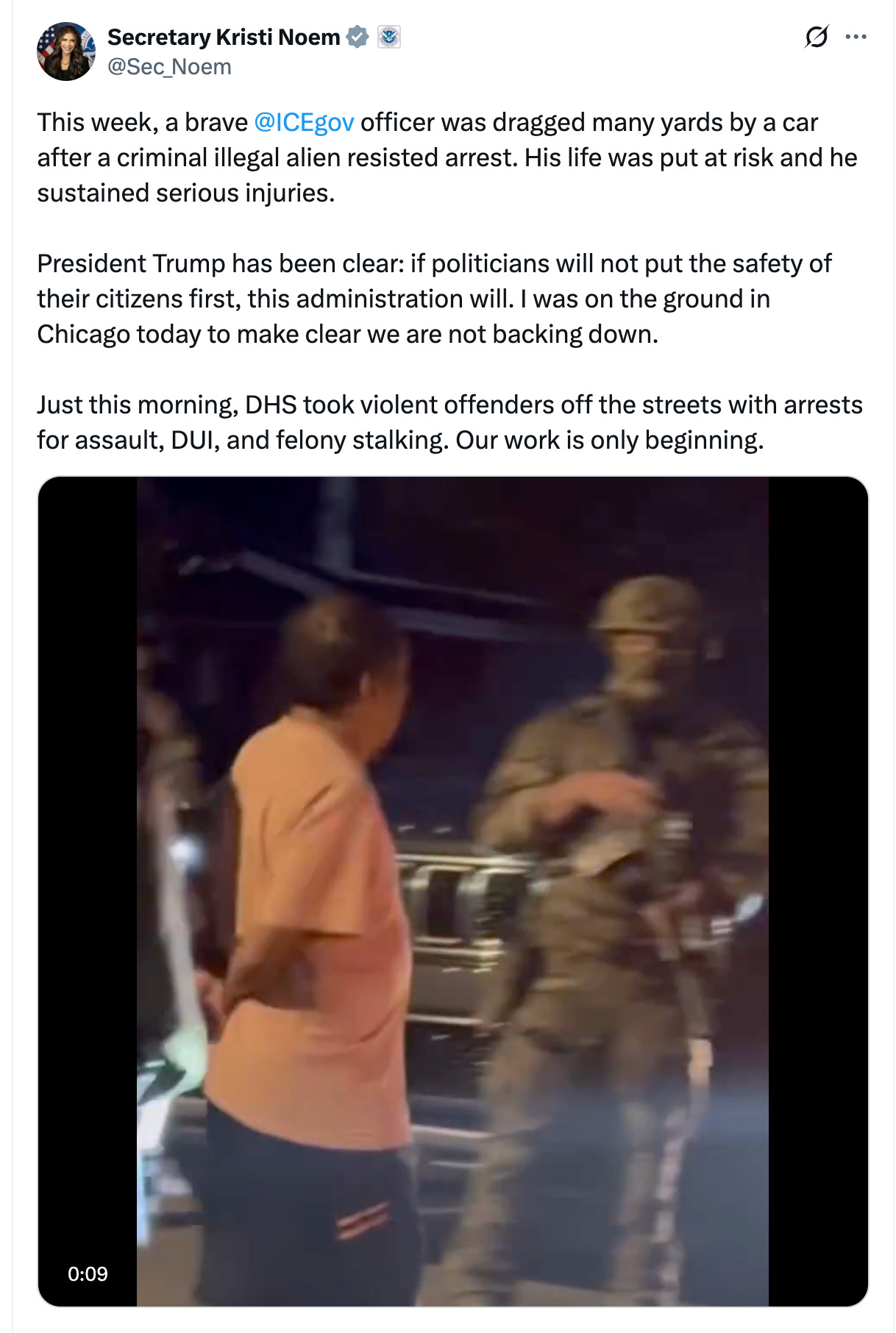
This is what Noem posted Tuesday morning, characterizing the men, including the two U.S. citizens who were subsequently released, as violent offenders.
By 8:30 a.m. local time, DHS was responding to these reports, tweeting that “No U.S. citizens were arrested, they were briefly held for their and officers’ safety while the operation in the house was underway. This is standard protocol. Please see our release on those arrested.”
American Immigration Council Senior Fellow Aaron Reichlin-Melnick tweeted that the man seen in the video was a U.S. citizen named Joe Botello. “They smashed in the doors, dragged him and his roommates out in handcuffs, then posted a video online suggesting he was a criminal, despite knowing he was released soon after,” he wrote, relying on a report from the Chicago Tribune. The agents were masked and armed when they made forcible entry into Botello’s home, destroying both his front door and a glass patio door, according to the Tribune. An agent asked the Texas-born Botello, “how he was able to speak English so well.”
It was another poorly executed raid where people’s rights, in this case, American citizens, were violated.
By the way, the Secretary’s presence might seem like a small thing here, but it’s not. It’s not amusing. It’s not cosplay. It’s not cute. It’s not shake your head and then look away. It’s dangerous. And it was done, apparently, for a photo op.
I spoke with my former colleague Sarah Saldaña, who served as the Director of ICE from 2014 to 2017 and as U.S. Attorney for the Northern District of Texas from 2011 to 2014. She was the last presidentially-appointed, Senate-confirmed Director of ICE. I asked her about participating in law enforcement actions. She told me, “ICE removal operations in the field are highly sensitive and potentially dangerous events. Enforcement removal officers are fully armed and trained to respond to various, often unexpected scenarios that they might encounter. Our focus in removal operations under the Obama Administration was on individuals who presented threats to national security and public safety, and those with convictions of serious criminal offenses. As Director and with training only as an attorney and agency manager, I would never have considered actually interjecting myself into the execution of such an operation. I could easily represent a distraction to officers and, without the proper training, present a danger to them, the persons sought, and to myself.”
Noem, too, should be concerned about the security risk her presence creates. Furthermore, if Noem accompanied agents to the scene, as the reporting indicates, she made herself a witness. If I’m a criminal defense lawyer for one of the men or a plaintiff’s lawyer in a civil suit, I’m cutting the subpoena for her testimony pronto. This is why smart prosecutors know better than to go along when a search warrant is executed, let alone an attorney general or a cabinet secretary. But Noem likes her photo ops. It’s just another sign of the less-than-professional way Trump’s appointees are running government, following Pam Bondi’s comments about prosecuting people for First Amendment-protected speech earlier this week.
Just as members of Congress challenged FBI Director Kash Patel during his oversight hearing on the Hill today, we have to continue to speak out and challenge Noem, Bondi, Kennedy, and others who aren’t up to doing the job the American people deserve. Americans speaking up is precisely what this administration doesn’t want. They want us to be overwhelmed by all the stories about all the things. They want us to be intimidated from exercising our right to speak, lest we fall under attack too. So, our job is to make sure that doesn’t happen. “Courage is contagious” is becoming one of our mottos for this administration. Keep focusing on the truth. Keep speaking out. Keep going.
Disney announced that it was bringing back the Jimmy Kimmel show, starting tomorrow.
He was suspended for saying that the killer of Charlie Kirk was a MAGA adherent. He was wrong. No one knows the motive of Tyler Robinson, who had not been identified or arrested when Kimmel spoke.
If everyone who made a mistake was suspended from the screen, not many people would be left. The news could be announced by robots using AI. Comedians would disappear.
Disney released this statement:
“Last Wednesday, we made the decision to suspend production on the show to avoid further inflaming a tense situation at an emotional moment for our country,” the Walt Disney Company, ABC’s parent company, said in a statement.
“It is a decision we made because we felt some of the comments were ill-timed and thus insensitive,” the statement said. “We have spent the last days having thoughtful conversations with Jimmy, and after those conversations, we reached the decision to return the show on Tuesday.”
The outcry against Kimmel’s suspension was so loud that Disney backed down. His removal was seen as a test of the guarantee of free speech in the First Amendment to the Constitution.
Public protest mattered!!
Now what about the teachers, members of the military, and others who have been suspended or fired for not saying the “right” words about the murder of Charlie Kirk? The suppression of speech has been widespread and over-the-top, based on political passions and prejudice.
There was a time long ago when the FCC would block the merger of two major television networks. Too much consolidation is not healthy for democracy. But under Brendan Carr, the prospect of a megabillionaire buying two networks is possible because he’s a friend of Trump.
The most stunning revelation occurs in the last paragraph.
Inside the halls of Hudson Yards, and across CNN’s bureaus worldwide, staffers have been anxiously whispering about the suddenly real possibility of yet another corporate takeover. The network, which has already changed ownership twice in the past decade and weathered multiple leadership shakeups, may soon be thrust into another period of upheaval as the Ellison family prepares a bid for Warner Bros. Discovery, the David Zaslav–led conglomerate that owns CNN.
An Ellison takeover would be unlike anything CNN has seen in its 45-year history. Since acquiring Paramount, David Ellisonhas sought to steer CBS News into more Donald Trump-friendly waters, installing a MAGA-leaning ombudsman to review complaints of bias and moving to acquire Bari Weiss’ The Free Press with plans to install her as editor in chief, or something close to it. WBD already dialed back CNN’s aggressive, Jeff Zucker-led Trump reporting when it took over the network as its parent company in 2022, but an Ellison regime could go much further. In such a scenario, it’s likely that the anti-woke, anti-D.E.I. Weiss, who has spent years bashing the mainstream press, would not only wield influence at CBS News, but would ultimately be handed editorial authority at CNN itself.
According to nearly a dozen current employees and people familiar with the mood inside CNN, that prospect has unnerved network staffers, who harbor deep unease at the idea of reporting to Weiss. The fears have only deepened by the expectation that Ellison would pursue cuts if he merges CBS News and CNN—which I understand would be the plan should he acquire WBD—to eliminate redundancies.
Mark Thompson, CNN’s chief executive, has certainly picked up on the palpable fear in his newsroom, and has spent the past week attempting to steady the ship. I’m told that he has spoken privately with senior staff and on Monday phoned into the company-wide morning editorial meeting from London, urging calm and focus. When the Ellison family’s plan leaked to the press last week, Thompson also addressed the matter in an all-staff memo, signaling the seriousness in which CNN’s leadership is digesting the situation.
“News about potential consolidation and where our broader sector is headed is an everyday part of our industry,” Thompson said in the memo, obtained by Status. “I therefore suggest that you take this story and any subsequent similar ones with a sense of proportion. The best way we can safeguard CNN’s future as an outstanding independent global news provider is to take our own destiny in our hands and execute our own strategy as energetically and successfully as we can. Our predecessors never let speculation about changes of parent company ownership–and there were more than a few–distract them from the task of building a successful CNN and I don’t think we should either.”
Still, Thompson’s reassurances have hardly erased the anxiety, given that an Ellison takeover would be no ordinary change of corporate hands, a la AT&T’s purchase of the WarnerMediaassets. Many staffers were already worried by WBD’s existing plan to spin off CNN and other linear networks into a separate company by early next year, which would be led by notorious cost-cutter Gunnar Wiedenfels. “Keep calm and carry on doesn’t cut it in this context,” one staffer told me this week. “People are very worried,” said another, noting that Weiss “seems to have a lot of preconceived and incorrect notions about CNN.” A third added bluntly, “No one knows what the hell to expect.”
“It’s quite something for an organization that has constantly been on pins and needles for several years now, wondering what new change will come next,” that staffer continued, underscoring the constant uncertainty.
There’s also a strong sense of déjà vu. CNN is preparing to launch its second standalone streamer next month, as we previously reported, just three years after Zaslav pulled the plug on CNN+ following the WBD takeover. Thompson stressed in his memo last week that CNN’s streamer will launch “on time and on budget,” no matter the speculation swirling around the company. “Indeed, we plan to double down on the whole digital plan and execute it as soon as we can,” he told staff in his memo. But if Ellison gains control, the fate of CNN’s digital strategy could be rewritten, just as it was when Zaslav gained the keys to the castle.
Of course, the necessary caveats do apply. The Ellison family may be preparing a bid, but they have yet to submit a formal offer. It also goes without saying that if the family does make a play for WBD, corporate transactions take time to shake out. And even if the WBD board immediately accepts an offer, it would still take several months to close and then more time for the Ellison family to determine next steps for the company’s pile of assets. Nevertheless, WBD’s board may not ultimately have much of a say in the matter, given its members have a fiduciary responsibility to shareholders. If they receive a good offer, it’s difficult to see how they’d reject it.
In truth, CNN’s future may soon be beyond the control of both Thompson and Zaslav. While Zaslav may hope to gin up interest from rival bidders, it’s hard to imagine there are other companies that would wish to swallow WBD’s entire portfolio of assets whole, never mind whether they have the ability or desire to outbid the Ellison family, which is said to be preparing a cash offer after seeing their wealth surge nearly $100 billion last week. For CNN staffers who never quite adjusted to WBD ownership and might still yearn for the Zucker years, the reality is sobering: yet another transformation may soon be on the horizon, one that could redefine the network’s identity in a much more significant way.
The Ellison family saw its wealth surge by nearly $100 billion in the last week. Think about it.
The Idaho state legislature passed a $50 million plan to subsidize vouchers. The usual arguments for vouchers–choice and competition–don’t apply in a largely rural state. The primary beneficiaries will be wealthy families whose children are already enrolled in private schools. The biggest losers will be rural schools, which desperately need upgrades.
“(I)t shall be the duty of the legislature of Idaho, to establish and maintain a general, uniform and thorough system of public, free common schools.” — Article IX, Section 1, Idaho Constitution
A coalition of public school advocates announced Wednesday that it is asking the Idaho Supreme Court to rule that a refundable tax credit for families who send their kids to private schools is a violation of the Idaho constitution’s education clause.
We say it’s about time.
And just in time, since House Bill 93, which was passed last legislative session, allows families to start applying for the credits in January.
The law set aside up to $50 million for the tax credits.
We would much rather see that $50 million go toward the public education system, hiring more teachers, more counselors, repairing derelict school buildings and properly funding special education, which has an $80 million shortfall, according to the Office of Performance Evaluations.null
Most voucher schemes in other states started out like Idaho’s — small, limited and targeted. But state after state, the vouchers grew and are blowing holes in state budgets everywhere.
Many of these vouchers go to wealthy families who already have the means to pay for private school, and the vouchers merely subsidize part of the cost of a private school tuition.
The vouchers are open to fraud, waste and abuse.
There’s no accountability built into Idaho’s voucher system.
The Idaho Supreme Court won’t be interested in such policy discussions, but justices will be interested in hearing what we think is a valid constitutional argument.
One word, in particular, provides their best legal challenge: “uniform.”
We are compelled by the testimony Wednesday of one mother who said her children were denied entry to a public school based on their religion. A public school can’t do that.
The argument is not without precedent.
A district court judge in Salt Lake City halted Utah’s education savings account programearlier this year, according to Idaho Education News. The state’s teachers’ union argued that the Utah Constitution bars state dollars from funding an education system that’s not free or open to all students.
In June, an Ohio state judge struck down that state’s voucher program, ruling that the program created a separate, unfunded, nonpublic system and funneled public money to private religious institutions. That, the judge ruled, violated constitutional mandates to fund a single public school system.
In 2024, the South Carolina Supreme Court struck down a 2023 law that created a private school voucher system. The court said the law illegally funneled state public funds to private schools, which is prohibited by the state constitution. The decision said vouchers undermine the state’s mandate to support public schools for all students.
We find it particularly appropriate that Idaho’s organizers announced this legal challenge on Constitution Day. Yes, it’s referring to the U.S. Constitution, but Idaho legislators should hold Idaho’s Constitution in equally high regard.
Where are all of Idaho’s “original meaning,” “not a living document” conservatives in this state when it comes to the state constitution’s education clause?
Because, if you read the Idaho Constitution plainly, vouchers just don’t pass muster.
Let’s hope the Idaho Supreme Court sees it the same way.
Statesman editorials are the opinion of the Idaho Statesman’s editorial board. Board members are opinion editor Scott McIntosh, opinion writer Bryan Clark, editor Chadd Cripe, newsroom editors Dana Oland and Jim Keyser and community members John Hess, Debbie McCormick and Julie Yamamoto
MSNBC broke the bombshell story: before the 2024 election, undercover FBI agents handed a paper bag with $50,000 cash to Tom Homan. They heard that Homan was soliciting bribes. The meeting was filmed.
The investigation of Homan for corrupt activities was quashed by Trump’s Department of Justice, presumably with the full knowledge of Attorney General Pam Bondi and FBI Director Kash Patel.
In an undercover operation last year, the FBI recorded Tom Homan, now the White House border czar,accepting $50,000 in cash after indicating he could help the agents — who were posing as business executives — win government contracts in a second Trump administration, according to multiple people familiar with the probe and internal documents reviewed by MSNBC.
The FBI and the Justice Department planned to wait to see whether Homan would deliver on his alleged promise once he became the nation’s top immigration official. But the case indefinitely stalled soon after Donald Trump became president again in January,according to six sources familiar with the matter. In recent weeks, Trump appointees officially closed the investigation, after FBI Director Kash Patel requested a status update on the case, two of the people said.
It’s unclear what reasons FBI and Justice Department officials gave for shutting down the investigation. But a Trump Justice Department appointee called the case a “deep state” probe in early 2025 and no further investigative steps were taken, the sources say.
On Sept. 20, 2024, with hidden cameras recording the scene at a meeting spot in Texas, Homan accepted $50,000 in bills, according to an internal summary of the case and sources.
The federal investigation was launched in western Texas in the summer of 2024 after a subject in a separate investigation claimed Homan was soliciting payments in exchange for awarding contracts should Trump win the presidential election, according to an internal Justice Department summary of the probe reviewed by MSNBC and people familiar with the case. The U.S. Attorney’s office in the Western District of Texas, working with the FBI, asked the Justice Department’s Public Integrity Section to join its ongoing probe “into the Border Czar and former Acting Director of Immigration and Customs Enforcement Tom Homan and others based on evidence of payment from FBI undercover agents in exchange for facilitating future contracts related to border enforcement.”
Homan, who served as acting director of Immigration and Customs Enforcement early in Trump’s first term, openly claimed during the 2024 campaign that he would play a prominent role in carrying out Trump’s promised mass deportations.
Asked for comment about MSNBC’s exclusive reporting, the White House, the Justice Department and the FBI dismissed the investigation as politically motivated and baseless.



 Diane Ravitch's blog