Archives for the month of: January, 2025

John Thompson, historian and retired teacher in Oklahoma, keeps close watch on state politics. He looks for rays of hope in a gerrymandered state.

He writes:

In Oklahoma, where rightwing MAGAs, led by Governor Kevin Stitt, State Superintendent Ryan Walters, and our most extreme state legislators, continue to double down on irrational and, above all, cruel agendas, it remains unclear whether Democrats and adult Republicans will be successful in pushing back. But there are still reasons for hope.

Although Walters remains the best known voice for absurdity, I still believe that Gov. Stitt’s agenda would be the most destructive – if he could get it done. For instance, the Oklahoma Supreme Court was as thoroughly corrupt as any in the nation – before we created an apolitical Judicial Nominating Commission. Stitt’s attempt to dissolve the commission failed. But dark money PACs tied to Stitt fueled a campaign to remove the three justices who were appointed by Democrats.

In the last month, Stitt said that “Oklahomans see that you need one neck to choke, and it’s usually the governor,” [so] “let the governor (…) put these people in place and then hold them accountable.” Clearly, he was implying that he, the outgoing governor, should appoint “most state-wide officials,” including the Oklahoma Corporation Commission, and the Superintendent of Public Instruction. That would be the path back to our state’s corrupt oligarchy of my youth.

And, as the legislative session is about to open, the Oklahoma Voice recalls Gov. Stitt’s signing of “Oklahoma’s legislative darling.” The law has been “dubbed the ‘Women’s Bill of Rights.’” It “claims to champion fairness and safety for women” by setting “legal definitions for ‘male’ and ‘female,’ tying them firmly to biological sex assigned at birth.”  The Voice further explains, “Oklahoma’s law isn’t just tone-deaf to this reality — it pours gasoline on the fire.” Then it reminds Stitt that the law will clearly undermine efforts to attract businesses to Oklahoma.

The 2025 legislative session also creates opportunities for extremists to show how brutal they can be, but it also provides opportunities to push back against the worst of the worst. In 2023, Republican Rep. Jim Olsen successfully opposed a bill that would “ban schools from physically punishing disabled children.” Olsen said, “He that spareth his rod hateth his son.” So the Bible “tells us that if you will not use the rod on a disobedient child, you do not love that child.”

Now, after an interim study, on the “effectiveness of properly administered corporal punishment,” there is reason to hope that Olsen will allow that simple, humane provision to become law.

But, Republican Sen. Lisa Standridge seems to have drawn from the political tactic of shipping immigrants to northern cities in order to deny the basic human rights of homeless persons in small town Oklahoma, as well as our two biggest cities.  Sen. Standridge, “would prevent municipalities in all cities with a population under 300,000 from using city resources to operate homeless shelters or perform homeless outreach.” It would both outlaw smaller communities’ efforts to serve the unhoused, but provide  an incentive for them to move to Oklahoma City and Tulsa, which are both facing homelessness crises. Oklahomans have condemned the proposed law as “cruel,” “heartless,” “horrible.” “disgusting,” “shameless,” and a continued attack on democracy.

And that brings us back to Ryan Walters, who has a long history of calling teachers unions “terrorist organizations.” He has received national headlines by calling classrooms “terrorist training camps.” He then linked teachers unions to the New Year’s terrorist attack in New Orleans. The Oklahoma Voice’s Janelle Stecklein pushed back, asking, “Does our state superintendent have a screw loose?”

Stecklein noted Walters’ use of taxpayer resources to bolster his national reputation. She then contrasted his behavior with the “Oklahoma Standard,” which was illuminated by our response to Timothy McVeigh’s 1995 bombing of the Alfred P. Murrah Federal Building in Oklahoma City, killing 168 people. She also noted Walters’ campaign to stir up fear and hatred, comes at a time when there were 39 school shootings in 2024, in which 18 people were killed.

And most recently, Walters has filed a $474 million lawsuit claiming “The United States Departments of Homeland Security and Immigration and Customs Enforcement, and Education, along with United States Border Patrol and Safety must be held accountable for their failure to properly secure the nation’s border.”

Perhaps the most noteworthy, recent evidence that Oklahomans are starting to reject rightwing MAGA-ism can be found in a recent poll in The Oklahoman, which graded Ryan Walters’ performances. After all, as The Oklahoman notes, “Legislative leaders acknowledge that they have few levers at their command to force Walters to change course,” leaving that to the voters.

More than 4,000 readers took part in the online poll conducted Jan. 6-10, which asked the question: What grade would you give School Supt. Ryan Walters for his job performance this year?

An overwhelming 95% of those who responded gave him an “F.”

Comments by the poll-takers were especially illustrative. Here are just a few examples:

“My out-of-state friends LOVE to poke fun at Oklahoma whenever they read news stories about Walter’s’ idiotic antics. Don’t think for a minute that this doesn’t hurt our state’s ability to attract and retain economic development prospects. If my out-of-state friends are aware of what is happening to our public school system, so are professional site locators.” 

“Walters is what happens when people vote a straight party ticket … people’s children and grandchildren are paying the price of Ryan Walters and his lofty political ambition. He will literally do anything to get his name in the paper, online, and live media. 

“Religious zealots should not be in charge of the public schools.” 

“Walters is an unqualified incompetent under whose ‘leadership’ our children’s education has nosedived for the bottom. He’s also misused public funds for his own promotion and travel, for which he should be prosecuted. Not even addressing his unconstitutional mandates, he simply can’t or won’t do his job and needs to be removed from office.” 

“Worst Oklahoma state superintendent of education ever. His rhetoric is damaging to public education.” 

“I have never heard one kind word about public teachers come from this Ryan Walters’ mouth. He has never once given us any kind of encouragement. On the contrary, he insults us and makes false accusations. He accuses us of teaching hate. He has no idea that we not only teach our state standards, but we also teach a host of other things like kindness, citizenship, love of country, and just being good human beings.”

“Wasting our money on Bibles! I am religious, and spiritual, and Bibles can be found online. Also, he is a homophobe who is not interested in the rights of all, just the rights of some.”

And my favorite:

“Your grading scale didn’t go far enough. I would give Walters a ‘Z minus’ with the minus being an infinity’s worth. He is doing nothing but destroying Oklahoma schools.” 

Due to gerrymandering, Republican extremists – and their funders – have obtained unchallengeable political power. But we may be approaching a point where voters will back away from straight party voting, and perhaps empowering Democrats and reasonable Republicans. After all, their new Senate Pro Tem Lonnie Paxton, says in regard to Ryan Walters that Republican leaders will “continue to continue to try to inspire him to do the things that need to be done to educate our kids.” But falling short of the courage we need, Paxton adds, “at the end of the day, it’s his decision on what he does.”

I have frequently criticized Bill Gates for his half-baked efforts to “reform” American public schools, all of which have done terrible damage to the schools.

Now Elon Musk is sticking his nose into elections in other countries, and Bill Gates is calling him out.

This article appeared in Business Insider:

Bill Gates doesn’t like how Elon Musk has involved himself in the politics of foreign countries such as the UK and Germany.

“It’s really insane that he can destabilize the political situations in countries,” Gates said in an interview with the UK newspaper The Times published Saturday.

Musk has become increasingly vocal about his views on UK and German politics in recent weeks.

Earlier this month, Musk called for the removal of British Prime Minister Keir Starmer. The TeslaCEO accused Starmer of not doing enough to prevent the rape of girls when he was Britain’s chief prosecutor from 2008 to 2013.

And on Saturday, Musk spoke virtually at a campaign rally for the Alternative for Germany, Germany’s far-right party. Germany is set to hold national elections in February.

In December, Musk said in an op-ed for Welt am Sonntag, a prominent German newspaper, that the AfD was “the last spark of hope for this country.” He also praised the party for its “controlled immigration policy.”

“I think in the US foreigners aren’t allowed to give money. Other countries maybe should adopt safeguards to make sure superrich foreigners aren’t distorting their elections,” Gates told The Times.

Musk’s political influence has increased significantly following President Donald Trump‘s victory in November. Musk spent at least $277 million backing Trump and other GOP candidates in last year’s elections.

That bet has since paid off for Musk, who called himself Trump’s “first buddy.” The billionaire has joined Trump on calls with world leaderssuch as Turkish President Tayyip Erdogan.

Gates previously criticized Musk for his obsession with going to Mars. Gates said he would rather spend money on vaccines than on rockets. Go, Bill!

If only WE had laws limiting the contributions of billionaires to political campaigns!

Governor Gavin Newsom has been fighting a two-front war: the devastating fires in Los Angeles and the massive amount of disinformation about the state’s efforts.

One widespread rumor is that Governor Newsom cut the state’s firefighting budget by $100 million in the year before the LA fires.

Politifact reviewed the facts. As usual, it’s complicated. Newsom did cut the fire budget by $100 million at the same time that the overall fire budget increased. If you want to see how this happened, read the report in full.

Here is the conclusion.

Cal Fire’s budget and spending have grown

Cal Fire’s total base wildfire protection budget has nearly tripled over the past 10 years (from $1.1 billion in 2014‑15 to $3 billion in 2023‑24), according to a March analysis by the Legislative Analyst’s Office before the 2024-25 budget was approved.

Cal Fire’s overall budget also has increased, with its combined budget for fire protection, emergency fire suppression, resource management and fire prevention more than doubling over the past 10 years from $1.7 billion in 2014‑15 to $3.7 billion in 2023‑24. (Newsom’s office sent us similar information showing budget increases.)

The number of staff members working in fire prevention have similarly grown during that same decade rising from 5,756 to 10,275.

Another way to look at Cal Fire is through expenditures rather than the budgeted amount because it’s not unusual for the state to dip into other pots of money to spend more than budgeted for addressing fires. 

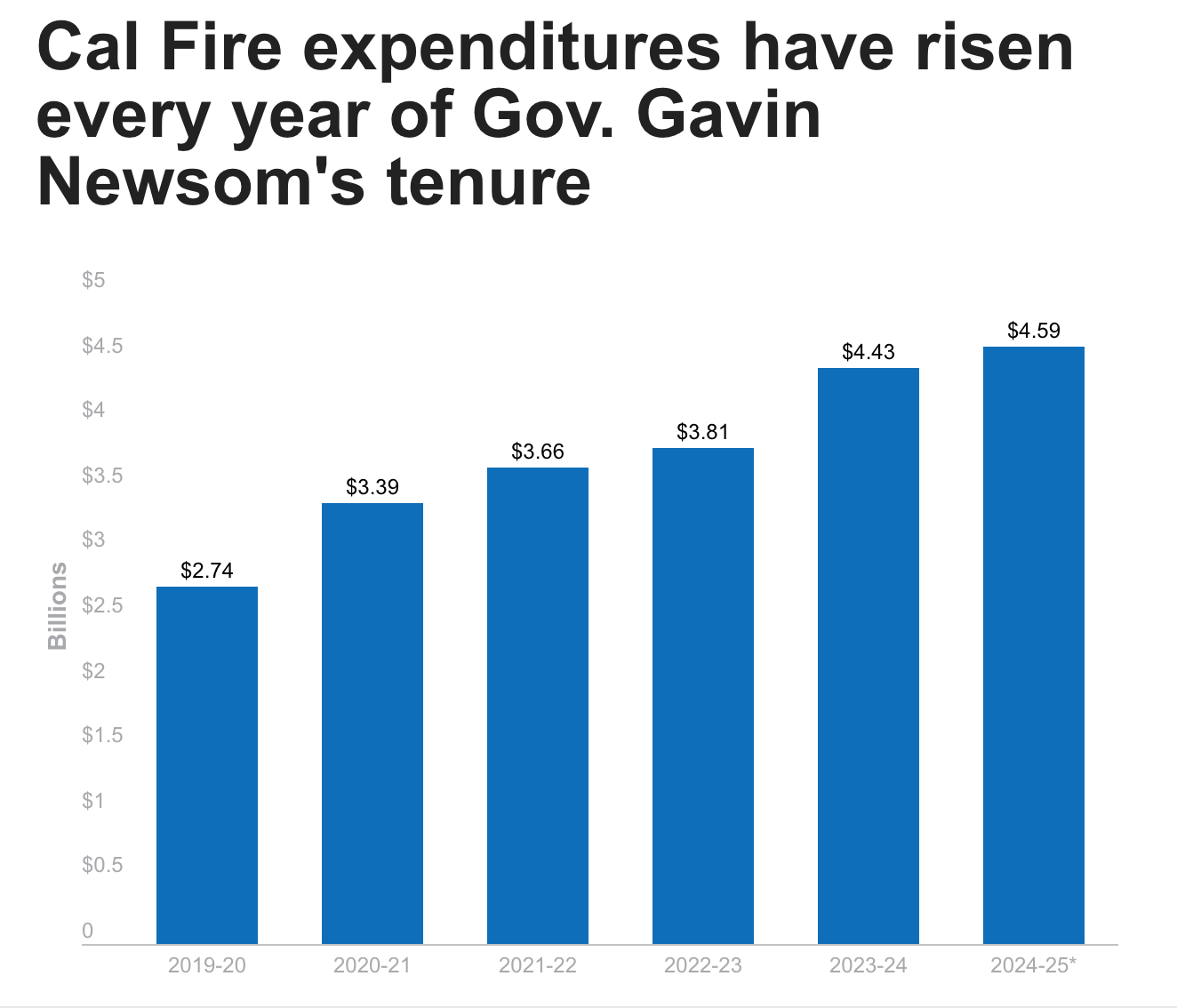
The legislative analyst’s office estimated total Cal Fire expenditures have risen during Newsom’s tenure:

* The 2024-25 amount does not yet reflect additional costs being incurred for the current Los Angeles-area wildfires.

Source: California Legislative Analyst’s office estimate, not adjusted for inflation, provided to PolitiFact

Politico reported that the president of Colombia refused to allow U.S. military aircraft to land; the two airplanes were carrying immigrants who had been detained. Trump immediately slapped a 25% tariff on all goods imported from Colombia to the U.S. He threatened that the tariff might rise to 50%.

More than a quarter of Colombia’s exports are sent to the U.S. The two countries have a free-trade agreement.

I am not an economist but I wonder: If Trump damages the Colombian economy, won’t that encourage more Colombians to enter the U.S. illegally in search of work?

The Founding Fathers were unequivocally opposed to creating a theocracy. The Constitutuon they wrote provided that there would be no religious tests for any government office. The First Amendment guaranteed freedom of religion and asserted that Congress would make no law to establish any religion. They did not want the new United States of America to be a Christian nation.

Yet there has always been a vocal minority that does want the U.S. to be a Christian nation.The more diverse we are, the more these extremists want to impose their religion on everyone.

Pete Hegseth, Trump’s new Secretary of Defense, is apparently a Christian nationalist. He has Christian nationalist tattoos. Too bad for non-Christians and atheists. He will probably assume that every woman and person of color I a high-ranking position is a DEI hire. Only straight white men, he assumes, are qualified. Like him.

The Guardian reported:

In a series of newly unearthed podcasts, Pete Hegseth, Donald Trump’s pick for defense secretary, appears to endorse the theocratic and authoritarian doctrine of “sphere sovereignty”, a worldview derived from the extremist beliefs of Christian reconstructionism (CR) and espoused by churches aligned with far-right Idaho pastor Douglas Wilson.

In the recordings, Hegseth rails against “cultural Marxism”, feminism, “critical race theory”, and even democracy itself, which he says “our founders blatantly rejected as being completely dangerous”.

For much of the over five hours of recordings, which were published over February and March 2024, Hegseth also castigates public schools, which he characterizes as implementing an “egalitarian, dystopian LGBT nightmare”, and which the podcast host Joshua Haymes describes as “one of Satan’s greatest tools for excising Christ from not just our classrooms but our country”.

Elsewhere in the recordings, Hegseth expresses agreement with the principle of sphere sovereignty, which, in CR doctrine, envisions a subordination of “civil government” to Old Testament law, capital punishment for infringements of that law such as homosexuality, and rigidly patriarchal families and churches.

Julie Ingersoll, a professor and director of religious studies at the University of North Florida who has written extensively about Christian reconstructionism and Christian nationalism, told the Guardian: “When these guys say they believe in the separation of church and state, they’re being duplicitous. They do believe in separate spheres for church and state, but also in a theocratic authority that sits above both.”

Hegseth’s far-right beliefs have garnered attention as his nomination to lead the world’s largest military has proceeded. The former Fox News television star and US National Guard officer, decorated after deployments that included special operations in Iraq and Afghanistan, has also garnered negative attention over media reports on his allegedly excessive drinking and allegations of sexual assault.

On Hegseth’s probable assumption of a high-ranking cabinet position in the Trump administration, and how he might view his constitutional role, Ingersoll said: “These folks are not particularly committed to democracy. They’re committed to theocracy.”

She added: “If the democratic system brings that about, so be it. If a monarchy brings it about, that’s OK, too. And if a dictatorship does, that’s also OK. So their commitment is to theocracy: the government of civil society according to biblical law and biblical revelation.”

Logan Davis, a researcher, consultant and columnist from Colorado, grew up in a reformed Calvinist church similar to Pilgrim Hill Reformed Fellowship, which Hegseth now attends, and spent middle and high school in a classical Christian school affiliated to the one Hegseth’s children now attend.

In November he wrote a column entitled “Pete Hegseth and I know the same Christian Nationalists”.

Asked how Hegseth would understand his oath if sworn in as secretary of defense, Davis said: “Hegseth will be swearing to defend the constitution that he, to the extent he is aligned with Doug Wilson, does not believe includes the separation of church and state.”

Asked if Hegseth’s performance of his duties might be influenced by the belief that, as Wilson put it in a 2022 blogpost, “We want our nation to be a Christian nation because we want all the nations to be Christian nations,” Davis said: “I can tell you that the reformed leaders around him … are all sincerely hoping that that is how he will view his mandate.”

Open the link to finish reading the article.

Joel Westheimer is Professor of Education and Democracy at the University of Ottawa. He is also a columnist for CBC Radio in Ontario. His most recent book is What Kind of Citizen? Educating Our Children for the Common Good.

This column appeared in the Globe & Mail in Canada.

When Mark Zuckerberg declared that Meta would stop its fact-checking efforts on its social media platforms, he was conducting a master class in bowing to authoritarianism. The move has been viewed as an effort to placate U.S. president-elect Donald Trump, who has praised Meta’s decision. But while it’s easy to direct our outrage at Mr. Zuckerberg personally, his announcement reflects something much deeper and more troubling: the rarefied world of the modern plutocrat.

Social norms govern behaviour for most people, setting limits on what we deem acceptable. But those norms are no longer the same across different social and economic strata. We would like to believe that commonly held norms reflect ideals of fairness, decency and accountability. But Mr. Zuckerberg and his fellow plutocrats share their own set of norms that privilege shareholder value, political expediency and the maintenance of their unparalleled influence. These norms, values and perceptions of what is acceptable behaviour are shaped not by the needs of democracy or society, but by the insulated, self-reinforcing logic of their own milieu – a logic wherein bowing to a fascist seems reasonable, even admirable.

As former deputy prime minister Chrystia Freeland pointed out more than a decade ago, plutocrats live entirely insulated from the rest of us. Their lives are global. They move from one Four Seasons hotel to another. They eat at the same restaurants. They see only each other. As much as we would like to believe otherwise, Mr. Zuckerberg, Jeff Bezos, Elon Musk and their peers do not feel guilty at night. They sleep fine.

The chasm between their world and ours mirrors the grotesque wealth inequality that defines our era, an inequality not seen since the days of the robber barons. And like that earlier gilded age, this one is undermining democracy at its core.

The insulated world plutocrats live in also allows for dangerous indifference to the consequences of their decisions. While the rest of society grapples with misinformation, rising authoritarianism and the erosion of trust in public institutions, the tech elite shrug. Their wealth not only shields them from the effects of democratic decline but often ensures they benefit from it. After all, authoritarian regimes offer stable environments for market expansion and profit maximization – no pesky regulations or democratic checks to contend with.

The implications are chilling. Meta’s decision isn’t just a policy shift; it’s a reflection of a deeper decay in democratic accountability. In a world where billionaires and their companies wield extraordinary power, platforms such as Facebook and X have become the de facto public squares of our time. Yet these spaces are governed not by the public interest but by the profit margins of the ultra-wealthy. When this small handful of individuals decide what speech is amplified, suppressed or ignored, they fundamentally reshape the boundaries of democratic discourse.

What does it mean for democracy when the norms governing the lives of the wealthiest people on Earth are so utterly detached from the values of the societies their platforms claim to serve; when truth is sacrificed to political gain; when fascism is appeased to protect market share; and when those with unimaginable resources opt to placate authoritarianism rather than challenge it? These decisions do not occur in a vacuum. They emerge from a cultural context that prizes wealth and influence above all else – even the integrity of democratic systems.

Mr. Zuckerberg’s announcement is a reminder that democracy does not simply erode; it is eroded. The responsibility for this erosion lies not just with one, two or three men or companies, but with a broader culture of plutocratic complacency and complicity. The erosion is cumulative, each decision stacking upon the next to create a structure that serves the interests of the few at the expense of the many.

The rest of us, however, are not powerless. History demonstrates that when perverse norms of the wealthy are weaponized against democracy, people can and do fight back. From labour movements to civil-rights struggles, ordinary citizens have reclaimed power from elites before and can do so again. Norms can be reimagined and reclaimed. It’s time to insist that truth is not negotiable, that democracy is not a product to be monetized, and that the plutocrats of our age should not be above accountability.

The robber barons of old built railroads and monopolies; today’s tech barons shape reality itself. If we fail to hold them accountable, the price will be not just economic inequality, but the very fabric of democracy. And that is a cost we cannot afford to pay.

When I worked in George H.W. Bush’s administration from 1991-92 as Assistant Secretary of Education, I quickly learned about the importance of the Department’s Inspector General. He or she is nonpolitical, a guardian of the Department’s integrity, a watchdog. The IG is a crucial safeguard against corruption. Trump fired a bunch of them Friday night.

He acts as though he is a king or a dictator and the laws do not apply to him.

Heather Cox Richardson explained that his firing of them was illegal:

We have all earned a break for this week, but as some of you have heard me say, I write these letters with an eye to what a graduate student will need to know in 150 years. Two things from last night belong in the record of this time, not least because they illustrate President Donald Trump’s deliberate demonstration of dominance over Republican lawmakers.

Last night the Senate confirmed former Fox News Channel weekend host Pete Hegseth as the defense secretary of the United States of America. As Tom Bowman of NPR notes, since Congress created the position in 1947, in the wake of World War II, every person who has held it has come from a senior position in elected office, industry, or the military. Hegseth has been accused of financial mismanagement at the small nonprofits he directed, has demonstrated alcohol abuse, and paid $50,000 to a woman who accused him of sexual assault as part of a nondisclosure agreement. He has experience primarily on the Fox News Channel, where his attacks on “woke” caught Trump’s eye.

The secretary of defense oversees an organization of almost 3 million people and a budget of more than $800 billion, as well as advising the president and working with both allies and rivals around the globe to prevent war. It should go without saying that a candidate like Hegseth could never have been nominated, let alone confirmed, under any other president. But Republicans caved, even on this most vital position for the American people’s safety.

The chair of the Senate Armed Services Committee, Roger Wicker (R-MS), tried to spin Hegseth’s lack of relevant experience as a plus: “We must not underestimate the importance of having a top-shelf communicator as secretary of defense. Other than the president, no official plays a larger role in telling the men and women in uniform, the Congress and the public about the threats we face and the need for a peace-through-strength defense policy.”

Vice President J.D. Vance had to break a 50–50 tie to confirm Hegseth, as Republican senators Lisa Murkowski of Alaska, Susan Collins of Maine, and Mitch McConnell of Kentucky joined all the Democrats and Independents in voting no. Hegseth was sworn in early this morning.

That timing mattered. As MSNBC host Rachel Maddow noted, as soon as Senator Joni Ernst (R-IA), whose “yes” was secured only through an intense pressure campaign, had voted in favor, President Trump informed at least 15 independent inspectors general of U.S. government departments that they were fired, including, as David Nakamura, Lisa Rein, and Matt Viser of the Washington Post noted, those from “the departments of Defense, State, Transportation, Labor, Health and Human Services, Veterans Affairs, Housing and Urban Development, Interior, Energy, Commerce, and Agriculture, as well as the Environmental Protection Agency, Small Business Administration and the Social Security Administration.” Most were Trump’s own appointees from his first term, put in when he purged the inspectors general more gradually after his first impeachment.

Project 2025 called for the removal of the inspectors general. Just a week ago Ernst and her fellow Iowa Republican senator Chuck Grassley co-founded a bipartisan caucus—the Inspector General Caucus—to support those inspectors general. Grassley told Politico in November that he intends to defend the inspectors general.

Congress passed a law in 1978 to create inspectors general in 12 government departments. According to Jen Kirby, who explained inspectors general for Vox in 2020, a movement to combat waste in government had been building for a while, and the fraud and misuse of offices in the administration of President Richard M. Nixon made it clear that such protections were necessary. Essentially, inspectors general are watchdogs, keeping Congress informed of what’s going on within departments.

Kirby notes that when he took office in 1981, President Ronald Reagan promptly fired all the inspectors general, claiming he wanted to appoint his own people. Congress members of both parties pushed back, and Reagan rehired at least five of those he had fired. George H.W. Bush also tried to fire the inspectors general but backed down when Congress backed up their protests that they must be independent.

In 2008, Congress expanded the law by creating the Council of Inspectors General on Integrity and Efficiency. By 2010 that council covered 68 offices.

During his first term, in the wake of his first impeachment, Trump fired at least five inspectors general he considered disloyal to him, and in 2022, Congress amended the law to require any president who sought to get rid of an inspector general to “communicate in writing the reasons for any such removal or transfer to both Houses of Congress, not later than 30 days before the removal or transfer.” Congress called the law the “Securing Inspector General Independence Act of 2022.”

The chair of the Council of Inspectors General on Integrity and Efficiency, Hannibal “Mike” Ware, responded immediately to the information that Trump wanted to fire inspectors general. Ware recommended that Director of Presidential Personnel Sergio Gor, who had sent the email firing the inspectors general, “reach out to White House Counsel to discuss your intended course of action. At this point, we do not believe the actions taken are legally sufficient to dismiss” the inspectors general, because of the requirements of the 2022 law.

This evening, Nakamura, Rein, and Viser reported in the Washington Post that Democrats are outraged at the illegal firings and even some Republicans are expressing concern and have asked the White House for an explanation. For his part, Trump said, incorrectly, that firing inspectors general is “a very standard thing to do.” Several of the inspectors general Trump tried to fire are standing firm on the illegality of the order and plan to show up to work on Monday.

The framers of the Constitution designed impeachment to enable Congress to remove a chief executive who deliberately breaks the law, believing that the determination of senators to hold onto their own power would keep them from allowing a president to seize more than the Constitution had assigned him.

In Federalist No. 69, Alexander Hamilton tried to reassure those nervous about the centralization of power in the new Constitution that no man could ever become a dictator because unlike a king, “The President of the United States would be liable to be impeached, tried, and, upon conviction of treason, bribery, or other high crimes or misdemeanors, removed from office; and would afterwards be liable to prosecution and punishment in the ordinary course of law.”

But the framers did not anticipate the rise of political parties. Partisanship would push politicians to put party over country and eventually would induce even senators to bow to a rogue president. MAGA Senator John Barrasso of Wyoming told the Fox News Channel today that he is unconcerned about Trump’s breaking the law written just two years ago. “Well, sometimes inspector generals don’t do the job that they are supposed to do. Some of them deserve to be fired, and the president is gonna make wise decisions on those.”

Newsweek reports that school officials and students in Bridgeport are planning to stand up for their fellow students who are immigrants. Meanwhile, the students are protesting in the best way possible, holding posters that say: “WE ARE ALL ILLEGALS.” The kids are alright.

A school district in Connecticut is defying President Donald Trump‘s order to allow Immigration and Customs Enforcement (ICE) agents to go to sensitive locations.

Bridgeport Public Schools announced on Tuesday guidelines designed to protect students in the event of an attempted raid by ICE agents at any of its schools.

Newsweek has contacted the White House via email for comment outside of normal office hours.

Why It Matters

Trump has begun implementing sweeping immigration reforms and is preparing to target millions of undocumented immigrants. The school district’s stance signals the emergence of grassroots opposition to the administration’s plans to initiate the largest mass deportation operation in U.S. history.

What To Know

Bridgeport Public Schools’ announcement came after the acting director of the Department of Homeland Security (DHS) issued a directive on January 21 ending the policy that ICE agents would not conduct actions in or near “sensitive” areas, such as churches, hospitals or schools.

Interim school superintendent Dr. Royce Avery reaffirmed that the school district’s immigration enforcement guidelines remain in place. Avery said that ICE agents and other government officials are prohibited from entering school buildings, boarding buses or attending school events without prior written approval from the superintendent.

“Every student in Bridgeport, regardless of their immigration status, has the right to feel secure and supported in our schools,” he said.

Avery did not say if any ICE raids were planned in Bridgeport. He added that Bridgeport Public Schools does not collect or store information about students’ immigration status, ensuring their privacy is protected….

What People Are Saying

Interim school superintendent Dr. Royce Avery said in a press release: “I became an educator to advocate for all students, and I will ensure their rights and privacy are upheld. Our schools will remain a safe space where all students can learn, grow, and succeed without fear or discrimination.”

Acting Secretary of Homeland Security Benjamine Huffman said in a statement: “This action empowers the brave men and women in CBP [Customs and Border Protection] and ICE to enforce our immigration laws and catch criminal aliens—including murders and rapists—who have illegally come into our country. Criminals will no longer be able to hide in America’s schools and churches to avoid arrest. The Trump Administration will not tie the hands of our brave law enforcement and instead trusts them to use common sense.”

Janet Murguía, president and CEO of Latino civil rights and advocacy organization UnidosUS, told Newsweek: “Many of the president’s proposed executive orders, however, are strictly punitive measures such as changing enforcement targets to include schools, churches and hospitals, and are designed to inflict pain on the most vulnerable—families, children and even the sick and injured.”

Scott Maxwell, opinion writer for The Orlando Sentinel, points out a glaring example of double standards of justice: Matt Gaetz and anyone else charged with the same behavior. Matt Gaetz got away with behavior that would land anyone else in jail. It is astonishing that Trump thought he was the right person to hold the highest position in the Justice department.

Maxwell writes:

By now, most of you have probably heard about the U.S. House report on the behavior and actions of former Florida Congressman Matt Gaetz.

If you haven’t actually read the full report, I’d encourage you to do so.

The descriptions of drug- and sex-fueled parties seem like something you’d expect in a tabloid report about Charlie Sheen — not an American lawmaker recently nominated to be this country’s attorney general.

But the most important thing to know about this report is that House investigators concluded that Gaetz repeatedly broke the law.

The report mentioned “illicit drug use” a half-dozen times and said there was “substantial evidence that Representative Gaetz met with women who were paid for sex and/or drugs” on “at least 20 occasions.”

It cited testimony that “Victim A recalled receiving $400 in cash from Representative Gaetz … which she understood to be payment for sex. At the time, she had just completed her junior year of high school.”

The report’s conclusion: “… there was substantial evidence that Representative Gaetz violated House Rules, state and federal laws, and other standards of conduct prohibiting prostitution, statutory rape, illicit drug use, acceptance of impermissible gifts, the provision of special favors and privileges, and obstruction of Congress.”

Maybe none of this surprises you.

What should outrage you, though, is that virtually all of this behavior — including multiple accusations of law-breaking — was greeted with a collective shrug by Florida law enforcement.

I know it’s tempting to consider this story just another report about slimy behavior from another slimy politician. But I’d encourage you to look at this report in terms of how justice is generally doled out in this state and country — with powerful and connected people getting a pass while we throw the book at low-level offenders.

In fact, I’d like to juxtapose the Gaetz report to another Florida case I wrote about just two weeks ago in a column titled: “Prison for poor addicts. Deals for wealthy crooks. Twisted ‘justice’ ”

That piece featured a federal judge from Orlando who was incredulous that federal mandatory-minimum sentencing laws required him to send a homeless drug addict to prison for five years for taking $30 from a man who asked him to deliver a package of drugs.

Judge Roy “Skip” Dalton argued that this destitute man of the streets with no history of drug dealing needed treatment for his addiction, not five years in prison. Dalton said a lengthy prison sentence wouldn’t make the community any safer, wouldn’t help the man with his addiction and would cost taxpayers gobs of money.

The justification for tough sentences is supposedly that lawbreakers deserve no mercy or sympathy — unless you’re a member of Congress.

Or a fraud-committing CEO.

Or the kid whose parents cut big campaign checks.

The reality is that this country has two systems of “justice” — one for the powerful and privileged and one for everyone else.

Politicians and law enforcement love to talk about how they’re “tough on crime” — until they or their friends are involved.

Need proof? Consider the long list of lame excuses by Florida law enforcement agencies for why they didn’t pursue charges against Gaetz.

Remember: The House report said that Gaetz “Violated State Laws Related to Sexual Misconduct” and “Used Illegal Drugs” — with some of those alleged activities taking place in Seminole County at the home of former legislator-turned-lobbyist Chris Dorworth.

But when the Orlando Sentinel asked state and local law-enforcement agencies why they didn’t do anything, they merely made excuses and pointed fingers.

Attorney General Ashley Moody’s office said local police or FDLE should’ve handled things.

The FDLE wouldn’t answer questions.

And the Seminole County Sheriff’s Office said that no one came to them with allegations and that they thought the feds were on the case.

I’ve seen less buck-passing at the U.S. Mint.

Imagine how ridiculous it would sound if you heard that chorus of excuses from authorities for some street-level criminal:

We thought the other guys were handling this. This isn’t our job. Nobody directly complained to us about these activities (that were widely documented in the media)

Also, it’s worth noting that none of these investigative agencies said they didn’t think crimes were committed — just that they didn’t think they were the ones who should be doling out justice.

For his part, Gaetz, who comes from an extremely wealthy family in Florida’s panhandle, has denied any legal wrongdoing.

“My 30’s were an era of working very hard — and playing hard too,” he said. “It’s embarrassing, though not criminal, that I probably partied, womanized, drank and smoked more than I should have earlier in life. I live a different life now.”

Way back in his 30s. Gaetz is 42.

Most Floridians would be quaking in their flip-flops if Congress released a report that said they had broken all kinds of laws. Not Gaetz. He’s already back on Twitter (X), promoting Bitcoin and fuming about immigration proposals.

Why? Because Gaetz knows how justice in this country works.

If you’re poor and lacking connections, you’ll be sent to prison for small-time crimes. But if you’re powerful and connected, you’ll get a pass — and maybe a talk-show deal or Cabinet nomination.

smaxwell@orlandosentinel.com

The U.S. Supreme Court announced yesterday that it will rule on whether Oklahoma taxpayers should pay for a religious charter school. The Court has been inching closer to shattering the wall of separation beteeen church and state. Its 6-3 rightwing majority seems to be eager to find a case where they can rule that states that refuse to pay tuition at religious schools are denying freedom of religion.

Is this the case?

If the Court does decide that Oklahoma must pay tuition for students at religious schools, the majority will have to stop claiming that they are Originalists, bound by the original intent of those who wrote the Constitution. It has never been the policy of any state to pay tuition at any religious school. The Supreme Court has issued a long line of decisions that rule against taxpayer responsibility for religious school tuition.

The effects of such a ruling would be to reduce funding for public schools, which enroll 85-90 percent of all students, to promote racial and religious segregation, and to endorse discrimination since religious and private schools are exempt from federal laws requiring the admission of students without regard to race, religion, gender, or disability.

Troy Closson of The New York Times reported:

The Supreme Court agreed on Friday to consider a high-profile case that could open the door to allowing public dollars to directly fund religious schools.

The widely watched case out of Oklahoma could transform the line between church and state in education, and it will come before a court whose conservative majority has broadly embraced the role of religion in public life.

The case centers on a proposal for the nation’s first religious charter school, St. Isidore of Seville Catholic Virtual School. The school would be online, and its curriculum would embed religious teachings throughout lessons, including in math and reading classes.

As a charter school, it would be run independently from traditional public schools. But public taxpayer dollars would pay for the school, and it would be free for students to attend.

The question of whether the government can fully finance a religious school has proved especially divisive within the school choice movement and across Oklahoma. Some conservative Christian leaders, including Gov. Kevin Stitt and Ryan Walters, the firebrand state superintendent who has sought to require teaching from the Bible in public schools, have backed St. Isidore’s creation.

They urged the Supreme Court to take up the case, believing the conservative-leaning court would decide in the school’s favor.

A coalition of religious leaders, advocates of public schools and some other state Republicans say the proposal is unconstitutional. Oklahoma’s Republican attorney general, Gentner Drummond, argued it would “open the floodgates and force taxpayers to fund all manner of religious indoctrination, including radical Islam or even the Church of Satan.”

After St. Isidore was approved by a state board in June 2023 in a narrow 3-to-2 vote, the Oklahoma Supreme Court blocked its creation. The justices wrote in a majority opinion that the school would “create a slippery slope” that could lead to “the destruction of Oklahomans’ freedom to practice religion without fear of governmental intervention.”

Still, as more Republican state legislatures move to support school vouchers and other options for parents to use public money to educate their children in private schools, including religious schools, some legal experts believe that charter schools would become another major arena in the debate.

Justin Driver, a professor at Yale Law School, said that a Supreme Court decision that allows religious charter schools “would represent nothing less than a sea change in constitutional law.”

“It is difficult to overstate the significance of this opinion for our constitutional order and the larger American society,” Mr. Driver said.

The case will present new education questions for the U.S. Supreme Court’s 6-to-3 conservative majority, which has shown an openness to religion in the public sphere. Justice Amy Coney Barrett, a member of the conservative bloc, recused herself from the case but did not explain why.

In a 2022 ruling, the court ruled that a high school football coach had the right to pray on the field after his team’s games.

Other recent cases have barred Maine and Montana from excluding religious schools from state tuition programs or scholarships to students in private schools. Chief Justice John G. Roberts Jr. wrote in both cases that states are not required to support religious education, but that those that opt to subsidize private schools cannot discriminate against religious ones.

Supporters of St. Isidore argue that blocking a religious charter school from receiving funding violates the First Amendment’s protection of religious freedom. Jim Campbell, the chief legal counsel for Alliance Defending Freedom, a legal group representing the Oklahoma state charter board, praised the court’s decision to hear the case.

“Oklahoma parents and children are better off with more educational choices, not fewer,” Mr. Campbell said in a statement. “There’s great irony in state officials who claim to be in favor of religious liberty discriminating against St. Isidore because of its Catholic beliefs.”

The school was initially set to open in August and would be managed by the Roman Catholic Archdiocese of Oklahoma City and the Diocese of Tulsa. Leaders of the school say it would accept students of all faiths.

But opponents say that it would run into conflict with the constitutional prohibition on government establishment of religion, infringing on religious freedom. “Converting public schools into Sunday schools would be a dangerous sea change for our democracy,” several organizations, including Americans United for Separation of Church and State, said in a joint statement on Friday.

For decades, the hybrid nature of charter schools — sharing features of both public schools and private institutions — has made it difficult for courts to determine how different education issues should apply to them, according to Preston Green, a professor at the University of Connecticut who studies educational law.

Still, Mr. Green said he believes St. Isidore’s argument “could be very attractive” to the conservative justices — and that if the court ultimately sides with the charter school, “the implications are potentially huge.”

In the movement to remove barriers to funding religious education, “charter schools are really the next frontier,” Mr. Green said. “And it doesn’t end here.”