Archives for the month of: June, 2024

Harold Meyerson is an editor at The American Prospect. He ranks out Elon Musk in this article for his maniacal greed. At a moment like this, I think of the book The Spirit Level, which argues that the happiest societies are those with the most equality. Tesla stockholders apparently approved the $50 billion payday.

Meyerson writes:

It’s election season near and far. Voting begins today, and continues through Sunday, for the European Parliament, in which parties of the far right are expected to pick up seats. India’s just-completed election demonstrated the limits of Hindu nationalism, with lower-class (and -caste) Hindus joining Muslims to put the brakes on Prime Minister Modi’s Hindu-über-alles policies. Mexico’s incoming president is a female progressive climate scientist—a trifecta breakthrough for our southern neighbor. And on July 4, U.K. voters will go to the polls, likely to reject the continued misrule of the Etonian twits and LizTrussian libertarians who lead the Tory party.

But the most ridiculous and outrageous of this month’s elections will take place one week from today in our very own United States. On June 13, Tesla shareholders will vote on whether to grant founder and CEO Elon Musk a bonus worth roughly $50 billion (estimates range from $45 billion to $56 billion).

This is the first time in recorded history that the proposed pay level of a single person has been so large that it’s actually a macroeconomic issue.

Over the past several months, we’ve seen shareholder fights over various CEO compensation packages, including the reward of $30 million to the outgoing head of Boeing. The proposed Musk bonus, however, is more than 1,000 times the amount proposed for Boeing’s ex. No remotely comparable paycheck appears ever to have existed. The Musk bonus is more in line with the amount of money that Congress appropriated for Ukraine—$61 billion—earlier this year after months of legislative and political maneuvering. Moving this amount of money is customarily a question before nations, not shareholders or banks, and only very wealthy nations at that.

The tale begins in 2023, when Musk purchased Twitter through some bank loans secured by his Tesla holdings, as well as $20 billion that Musk put up himself through the sale of some of his Tesla stock. His moves caused Tesla’s share value to plummet, costing him roughly another $20 billion or thereabouts. In consequence, Musk fell from his perch as the planet’s wealthiest person all the way down to the planet’s third-wealthiest person. By granting Musk $50 billion in stock, Tesla shareholders could push him back up to where Musk believes he belongs: not just Earth’s wealthiest human, but also a guy worth more than the GDP of numerous small countries.

This isn’t the first time Musk’s cronies on Tesla’s board of directors have asked shareholders to reward him with a bonus of this size, but the reward that those shareholders approved was struck down by a chancery judge in Delaware, where Tesla, like most major U.S. corporations, is incorporated. On June 13, shareholders will not only have the opportunity to rectify that judge’s mistake, but also to move the company’s incorporation from Delaware to Texas, where law and the Texas Rangers have always favored the rich. 

Several of the leading companies that advise shareholders on how to vote, including ISS and Glass Lewis, have recommended that shareholders reject granting the bonus, noting that the value of Tesla’s stock ain’t what it used to be, and that other companies have now entered the market that Tesla effectively had to itself for the past decade. Musk himself has lobbied for the bonus on X (the new name for Twitter) and issued dark hints that he might redirect his energies to some of the other companies he owns, such as SpaceX, if he’s not suitably rewarded. (His redirected energies to X, I’m compelled to report, have not necessarily helped that company.) Indeed, just this week, Musk ordered Nvidia to redirect AI chips that Tesla had ordered to two of his other companies, X and xAI.

In both speech and action, Musk has made clear that he abhors unions, telling one New York Times DealBook forum that he’s opposed to the very idea, and refusing to bargain with the Tesla mechanics in Sweden—where 90 percent of the workforce is unionized and employer acceptance of unions is the norm—who’ve joined a union. But by withholding those AI chips from Tesla and redirecting them to his other concerns, and by threatening to all but abandon Tesla unless he gets his greater-by-orders-of-magnitude-than-anything-in-human-history bonus, Musk has become the one-man equivalent of a protesting union: Give me a raise or I’ll walk off the job.

Let it not be said, then, that Elon Musk is against all unions. When it comes to the Union of Elon Musk, he’s a total fanboy.

~ HAROLD MEYERSON

Follow Harold Meyerson on Twitter

In the past few years, Republican-controlled states have established or expanded expensive voucher programs. The so-called “wall of separation” between church and state—a phrase coined by Thomas Jefferson—is crumbling. Republicans and the 6-3 conservative majority on the Supreme Court are taking a sledgehammer to that wall, to make sure that public money underwrites tuition at private and religious schools. Public schools enroll the vast majority of American K-12 students, from 80-90%. They are being stripped of resources so that a small minority can go private.

Laura Meckler and Michelle Boorstein wrote in The Washington Post:

Billions in taxpayer dollars are being used to pay tuition at religious schools throughout the country, as state voucher programs expand dramatically and the line separating public education and religion fades.


School vouchers can be used at almost any private school, but the vast majority of the money is being directed to religious schools, according to a Washington Post examination of the nation’s largest voucher programs.


Vouchers, government money that covers education costs for families outside the public schools, vary by state but offer up to $16,000 per student per year, and in many cases fully cover the cost of tuition at private schools. In some schools, a large share of the student body is benefiting from a voucher, meaning a significant portion of the school’s funding is coming directly from the government.

In just five states with expansive programs, more than 700,000 students benefited from vouchers this school year. (Those same states had a total of about 935,000 private school students in 2021, the most recent year for which data are available.) An additional 200,000 were subsidized in the rest of the country, according to tracking by EdChoice, a voucher advocacy group. That suggests a substantial share of about 4.7 million students attending private school nationwide are benefiting from vouchers — a number that is expected to grow.

The programs, popular with conservatives, are rapidly growing in GOP-run states, with a total of 29 states plus D.C. operating some sort of voucher system. Eight states created or expanded voucher programs last year, and this year, Alabama, Georgia and Missouri have approved or expanded voucher-type programs. Some recently enacted plans are just starting to take effect or will be phased in over the next few years…

In Ohio, the GOP legislature last year significantly expanded its voucher program to make almost every student eligible for thousands of dollars to attend private school. As a result, more than 150,000 students are paying tuition with vouchers this year — up from about 61,000 in 2020. About 91 percent of this year’s voucher recipients attend religious schools, the Post analysis found. When vouchers for students with autism and other disabilities — who typically seek specific services — are removed from the list, the portion going toward religious education rises to 98 percent. (Unless otherwise noted, the Post calculations exclude schools for students with disabilities.)

In Wisconsin, 96 percent of about 55,000 vouchers given this school year went toward religious schools, The Post found. In Indiana, 98 percent of vouchers go to religious schools. (Indiana state data only specifies the number of vouchers for schools with at least 10 recipients.)
In Florida, several programs combine to make every student in the state eligible for vouchers, with more than 400,000 participating this year. At least 82 percent of students attend religious schools, The Post found. Florida is first in the nation in both the number of enrolled students and total cost of the voucher program — more than $3 billion this year.


And in Arizona, more than 75,000 students are benefiting from the Empowerment Scholarship Program, which pays for any educational expense. In 2022-2023, three-fourths of the money — about $229 million — went to 184 vendors. Most of that money went for tuition, 87 percent of it to religious schools.


Arizona also has an older voucher program, funded by tax credits, which last year subsidized tuition for at least 30,000 students. (The state tracks only the number of scholarships given, and one student can receive multiple scholarships.) Since this program was created in 1998, 19 of the 20 schools that received the most money were religious, according to a state report. Those 19 schools received about 96 percent of the $767 million spent between 1998 and 2023 at the top 20 schools.

Peter Greene describes the new movement to place chaplains in schools to act as mental health counselors. The politicians behind this demand want Protestant evangelical chaplains, no doubt, but the schools will have requests for all sorts of religions. Not only from the myriad Protestant sects, but from Catholics, Muslims, Jews, Mormons, Unitarians, Buddhists, Hindus, and many others. There would certainly be a need for three Jewish chaplains: Reform, Conservative, and Orthodox. And every other religion will have divisions that must be addressed. Will there also be mental health counselors for kids who don’t want a chaplain?

Peter Greene writes:

The push for school chaplains is moving across the country, pushed by the National School Chaplain Association, a group that pretty clearly hopes school chaplains will be a means of putting a particular brand of Christianity in schools. 

So far the movement’s two big wins are in Texas and Florida, where the legislatures actually passed a law allowing anyone who wants to call themselves a chaplain to get into schools that set up the chaplain post. In Texas, the big pushback came from actual professional chaplains, and so far, one charter school has decided to bring in a “chaplain,” because a real chaplain has actual training, sometimes specialized, and follows a set of professional ethics and is not, in fact, just some untrained true believer who thinks Jesus wants him to go recruit some children. In fact, several states have said no to the amateur hour first-amendment-busting bill.

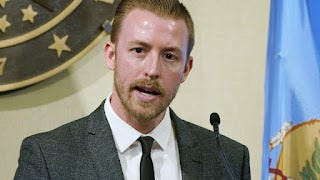
Ryan Walters of Oklahoma

Florida also passed a “chaplain” law, and that led to a predictable next step, which was for the Satanic Temple to announce that they would also be offering chaplains, with said announcement followed by Governor Ron DeSantis declaring that he couldn’t read the plain English of the law that he would forbid any such thing to happen. 

The law is written to avoid any obvious First Amendment violation; in fact, it doesn’t even require the “chaplain” to have a religious affiliation. But never mind– DeSantis will tell you what is and is not a legitimate religion.

Well, if Texas and Florida are going galumphing off into far right field, you know Oklahoma will be close behind.

So here comes SB 36, passed through the House and now facing the Senate. The bill is a step up from the versions in Texas and Florida and some other states by virtue of some amendments to the bill. It requires the “chaplain” to have some sort of “ecclesiastical endorsement from their faith group” indicating they are an “ordained minister or member in good standing.” It even requires them to have a bachelor’s degree and some graduate work. The House also added a “no proselytizing” clause. 

None of this really addresses the issue that chaplains are not trained as child mental health professionals. Nor does it make it any less a violation of the First Amendment.

Critics have noted that the bill has one particular religion in mind. But you know some other group is cued up and ready to go. And Oklahoma’s Education Dudebro-in-Chief Ryan Walters has come out swinging.

Let me be crystal clear: Satanists are not welcome in Oklahoma schools, but they are welcome to go to hell.

Legislators have also announced their inability to read and their misunderstanding of the Constitutionopposition to the Satanic Temple. SB 36 simply wouldn’t invite the Satanic Temple to send ministers to school children, said one group. 

Instead, it gives permission for the local school boards to decide whether to implement a chaplain program, leaving the decision to the duly elected school board members who represent their community’s values. Additionally, parents can decide whether or not to let their child participate in the program.

All true, but it skips over the part where the Constitution forbids discriminating against an employer on religious grounds. This is not news. The Good News Club, a program of the Child Evangelism Fellowship way back in 2001 won its case before SCOTUS that it must be allowed to have an after school club like any other group. And that was followed by the Satanic Temple winning cases to have its own after school Satan club in districts, because the First Amendment is clear on not allowing the government to pick and choose which religions are okay.

Dudebro Walters is not a dummy. He most certainly knows all this (he was an AP history teacher). But he’s got an audience to play to. So here he is on Fox News, sitting in an office, playing the rightwing hits.

Asked to respond to the Satanic Temple’s stated intention to expose “harmful pseudo-scientific practices in mental health care,” Walters says 

I am not surprised that people who worship Satan lie. They are liars. What they are trying to do in worshipping Satan is ruin the lives of children, undermine the very Judeo-Christian values of this country and destroy our schools.

The Satanic Temple has always been pretty clear that they do not worship Satan, but are on a mission to push back against those with a theocratic bent. Walters declares 

Satanism is not a religion and we will not allow them in our school. Our bill will not allow Satanists into our schools. It will only allow religions, religions that we have protected in our country since the outset.

Sooo much baloney here. The IRS says that the Satanic Temple is a religion. And if we’re going to have state officials going around declaring what is and is not a real religion, there is all sorts of bad trouble ahead. This has been a tough line for us to draw as a country, because “since the outset,” we have not protected all religions. The Puritans of Massachusetts used to banish or execute folks of different religions– and I’m not talking about the Salem witch trials, but folks like Mary Dyer, who was executed in Boston for being a Quaker who wouldn’t stay properly banished. Or we could talk about when the Baptists had a fun nickname for the Catholic Church and/or the Pope– the whore of Babylon.

Please open the link to finish reading this outstanding article.

Mary Trump, the niece of Donald Trump, has repeatedly warned about the dangerous character of her uncle. She wrote the national bestseller Too Much and Never Enough: How My Family Created the World’s Most Dangerous Man.

She wrote on her blog today:

In the wake of the 80th anniversary of D-Day, I’m reminded just how stark the choice before us is—on the one hand, a man who understands sacrifice and honors service, on the other one who, after strenuously avoiding his own service calls those who died fighting for democracy “suckers” and “losers” and then turns around, as he did last Saturday, and says, telling the truth for once, “unless you are a psycho or a crazy person or a very stupid person, who would say that, anyway?”

Well, Donald, according to your former Chief of Staff, General John Kelly, you would—and you did.

Last Saturday also marked 150 days until Election Day, which means we now have 145 days to save this country. Just as in 2020, we are on a knife’s edge in the choice between democracy and what we can now clearly say is fascism. (Back in the more innocent days of the fall of 2020, we were still calling it autocracy.) The difference now, of course, is that the edge of the knife is even thinner, the stakes higher, and the electorate by turns more misinformed, more checked out, and more demoralized than we were almost four years ago. And all of us continue to be traumatized to one degree or another, a fact that is barely acknowledged. 

So, what do we do? I think the first thing we must do, is to make clear to Americans exactly what they’re choosing between — Uncle Sam or the crazy uncle who wants to burn it all down.

Uncle Sam, representative of the best of what America aspires to, was well-represented last weekend in Normandy, France, where President Biden traveled to pay his, and our, respects to the original Antifa activists — the brave allied soldiers who stormed the beaches to liberate a continent and save the world from the dark forces of fascism which the other uncle is currently stoking. 

While in France, President Joe Biden visited the Aisne-Marne, the American cemetery in France where many of our heroes are buried. Five years ago, my convicted felon uncle refused to go to Aisne-Marne because it was raining. He didn’t want to mess up his hair. Seriously. But, much worse, he didn’t see the point in wasting his time going to see the aforementioned “suckers” and “losers”—those whose bravery helped turn the tide against the Third Reich.

Joe Biden reminded the world what American leadership and courage look like. He reminded the world of the power of alliances. He reminded the world what is best about America. Every day, my convicted felon uncle holds up a mirror to the worst of us, and it’s long past time people start looking—really looking—at what is reflected there.

While President Biden stood with our allies and argued that the United States should continue to lead the fight against fascism, my convicted felon uncle was being interviewed by “Dr.” Phil McGraw and Sean Hannity, altogether three of the greatest examples of white men failing up in American, and he made it clear that one of the driving forces behind his wanting to be president again is “revenge.” He wants to be free and clear to go after his political enemies. Although the two sycophants tried mightily to steer Donald away from the subject, he could not be dissuaded—and he couldn’t have been more clear:

“Sometimes revenge can be justified,” he told McGraw

“I would have every right to go after them,” he told Hannity.

We are reminded every day that convicted felon Donald Trump hates America — he hates its people, its ideals, its democracy, its judicial system, its leaders, its rule of law. He even hates his own followers. At Saturday’s rally, he came right out and admitted it: “I don’t care about you. I just want your vote.” That he openly courts and aligns himself with the same forces we defeated in Europe 80 years ago makes it all so much worse.

Joe Biden has pulled us out of the hole we were in thanks to the Trump administration’s horrific and willful mishandling of the pandemic and the economic collapse that ensued; he has restored our standing in the world; he honors the memories of those who sacrificed everything so that our democracy might endure. My uncle, the convicted felon, honors nothing and he will continue to rally the darkest forces—that he himself has lifted from their hiding places—to erase those memories and render those sacrifices meaningless. 

This is not, by any stretch of the imagination, a normal election. In 146 days, Americans are going to choose what kind of country we want to be going forward. Will it be the same country that fought on those beaches against the evil of tyranny and fascism? Or will we choose to align the most powerful country in history with the malicious designs of the enemies we risked so much to vanquish?

There is a palpable sense of fear among the good guys these days. In Europe, our allies wonder who we are. At home, we wonder the same. Are we the good guys or the bad guys? Are we aligned with Uncle Sam or the uncle who can’t seem to speak without lying or act without committing crimes against our country and our Constitution? In just a few months, we will know. 

I believe in the America Joe Biden and his party represents. I believe our best chance forward is to make sure the administration stays in Democratic hands, we increase the Democrat’s Senate majority, and make sure we take over the House. Overall, we are a good people, striving to do better. I believe we are better than my convicted felon uncle and the hatred he espouses and inspires.

America has won this fight before. In 146 days, we can win it again.

This story is deeply worrisome, frightening, alarming. An avid fan of Trump initiated a recall of the elections clerk, Cindy Elgan, of Esmeralda County and two other county officials. 82% of the county’s 620 voters went for Trump. The county uses Dominion Voting machines.

The angry Trump supporter, Mary Jane Zakas, listens to rightwing media exclusively. She is certain that the election was rigged, even though Trump won more than 82% in the county. She believes the Dominion machines were programmed to steal votes. She accuses Elgan of rigging the vote. She has traversed the county collecting signatures of registered voters to recall Elgan.

Elgan is baffled. She is a Republican. She voted for Trump. She knows almost every one of the 620 voters in the sparsely setttled county. But Trump supporters think she’s part of the deep state.

They falsely claimed the election was stolen by voting software designed in Venezuela, or by election machines made in China. They accused George Soros of manipulating Nevada’s voter rolls. They blamed “undercover activists” for stealing ballots out of machines with hot dog tongs. They blamed the Dominion voting machines that the county had been using without incident for two decades, saying they could be hacked with a ballpoint pen to “flip the vote and swing an entire election in five minutes.” They demanded a future in which every vote in Esmeralda County was cast on paper and then counted by hand.

And when Elgan continued to stand up at each meeting to dispute and disprove those accusations by citing election laws and facts, they began to blame her, too — the most unlikely scapegoat of all. She had served as the clerk without controversy for two decades as an elected Republican, and she flew a flag at her own home that read: “Trump 2024 — Take America Back.” But lately some local Republicans had begun referring to her as “Luciferinda” or as the “clerk of the deep state cabal.” They accused her of being paid off by Dominion and skimming votes away from Trump, and even though their allegations came with no evidence, they wanted her recalled from office before the next presidential election in November.

When Zakas brought in a recall petition, Elgan saw the names of friends, people who knew her well but now are convinced the election was stolen from Trump, and she let it happen. The more Elgan defended the accuracy of the vote, the more Zakas was convinced that Elgan was part of the Deep State.

She [Zakas] listened to a self-proclaimed cybersecurity expert from Colorado named Mark Cook, who claimed that voting machines could be hacked with a cellphone. She heard Jim Marchant, then the Republican nominee for Nevada’s secretary of state, say that Nevada’s election officials had been “installed by a deep state cabal.” She heard local Republican leaders say Dominion machines had stolen votes, even though Fox News had agreed to pay Dominion nearly $800 million to settle a lawsuit for spreading the same lies. And most of all she continued to listen to Trump as his election denialism intensified. “We will root out the communists, Marxists, fascists and the radical left thugs that live like vermin within the confines of our country, that lie and steal and cheat on elections,” he said during a Veterans Day speech in New Hampshire last year.

Zakas came up short on the numbers who signed the recall petition. She will appeal to the courts.

Tom Ultican, retired teacher of physics and mathematics, writes here about the recent decision by local officials to open a PUBLIC SCHOOL in New Orleans. This is a symptom of the failure of the “all-charter” idea.

He writes:

New Orleans Public Schools, aka Orleans Parish School District (OPSD), became America’s first and only all charter school district in 2017. After hurricane Katrina, the state took over all but five schools in the city. When management was transferred to charter organizations in 2017, OPSD officially became an all charter district. This August, the city will open district-operated Leah Chase K-8 School, ending the all charter legacy.

According to Superintendent Avis Williams, the infrastructure required for the district to run Leah Chase will make it easier to open future district-run schools. OPSD will become both a charter school authorizer and regular school district. There is hope that New Orleans, Louisiana (NOLA) is pulling out of an abyss and tending towards a healthy public school system….

All-Charter NOLA Doomed from the Beginning

Public investment in education is widely viewed as the key to America’s success. Since the 19thcentury, communities have developed around local public schools. This opportunity was taken from NOLA neighborhoods…

Louisiana’s state takeover law required schools scoring below average to be closed. If this were real, half of the schools in the state would be closed every year. Instead, arbitrary state performance scores based on testing data, attendance, dropout rates and graduation rates were established. Similar ratings are used to evaluate NOLA charter schools. The nature of privatized schools and testing results led to almost half of the charter schools created being closed.

The NOLA school enrollment system allows parents to research the 100 schools and apply for up to eight of them. The algorithm selects the school from one of the eight if space is available. It is not uncommon for students to ride a bus past schools within walking distance of their homes. This complicated system is driving segregation.

For many education professionals, this system looked like a sure failure from the beginning. Communities could not develop around their schools and the schools would not be stable; important aspects of quality public education….

The All Charter District is a Failure

In 2021, Secretary of Education Miguel Cardona visited OPSD. He heard first-hand the growing disillusionment with the all charter system. Four of the six parents told him they wanted to go back to neighborhood schools. Parents complained about Teach for America, placing unqualified teachers in schools and the One App process for not offering school choice.

Senator Bouie wrote a two-page paper, A Moral Imperative and Case For Action”, stating: After spending 6 Billion dollars of tax payers’ money to become the only all-Charter system in the State, a staggering 73% of our children are not functioning at grade level, compared to 63% in 2005, when the State took control of over 100 of our schools.”

He also shared:

“In other words, fellow citizens, this 15-year flawed experiment has yielded no best practices identified to improve student and school performance, no State protocol for Charter Law Compliance, and no student performance improvement. It has, however, yielded other devastating consequences for our children and our community.”

He mentioned the 26,000 students between the ages of 16 and 24 who went missing. The privatized charter school system was unable to account for them which is expected and natural for a public school district.

Bouieu They are transported past a neighborhood school to attend a failing school across town” and eliminating the ineffective One App central enrollment system claiming,It has created inequities by Race and Class and admissions by chance (lottery) and not choice.”

Raynard Sanders who has over forty years of experience in teaching, education administration and community development, said the charter experiment has “been a total disaster in every area.”He asserted NOLA had “the worst test scores since 2006, the lowest ACT scores, and the lowest NAEP (National Assessment of Educational Progress) scores.”

Based on a 2015 study by the Center for Popular Democracy, Sanders declared, “Charter schools have no accountability and, fiscally, charter schools in New Orleans have more fraud than existed in the OPSD (Orleans Parish School District).” The fraud claim was used by the state in 2003 against OPSD to begin taking schools.

Loyola University Law Professor Bill Quigley stated“NOLA reforms have created a set of schools that are highly stratified by race, class, and educational advantage; this impacts the assignment to schools and discipline in the schools to which students are assigned.”

He contended, “There is also growing evidence that the reforms have come at the expense of the city’s most disadvantaged children, who often disappear from school entirely and, thus, are no longer included in the data.”

Professor of Economics, Doug Harris, and his team at Tulane University are contracted to study school performance in New Orleans. Harris claims schools have improved since Hurricane Katrina. However Professor Bruce Baker of Rutgers University disagrees. He noted that the school system is not only smaller but less impoverished. Many of the poorest families left and never returned. So the slightly improved testing results are not real evidence of school improvement.

The latest testing data from 2023 saw NOLA public schools receive failing grades but based on Louisiana’s new progress indicator, the district received a C, meaning an F for assessments and an A in growth.

In a letter to the editor, former OPSD superintendent, Barbara Ferguson, stated:

“The state took over 107 of New Orleans’ 120 public schools and turned them into charter schools. Last year, 56 of New Orleans’ 68 public schools had scores below the state average. Thus, after nearly 20 years, over 80% of New Orleans schools remain below the state average. This charter school experiment has been a failure.”

Final Words

In 2006, with the school board out of the road and RSD in charge, philanthropists Bill Gates, Eli Broad and others were ready to help.

Naomi Klein’s 2007 book, The Shock Doctrine, labeled these school reforms, a prime example of “disaster capitalism”, which she described as “orchestrated raids on the public sphere in the wake of catastrophic events, combined with the treatment of disasters as exciting market opportunities.” She also observed, “In sharp contrast to the glacial pace with which the levees were repaired and the electricity grid brought back online, the auctioning-off of New Orleans’ school system took place with military speed and precision.”

Desires of New Orleans residents were ignored. Neoliberal billionaires were in charge. In all the excitement, few noticed that these oligarchs had no understanding of how public education functions. They threw away 200 years of public school development and replaced it with an experiment. The mostly black residents in the city were stripped of their rights.

Thousands of experienced black educators were fired and replaced by mostly white Teach For America teachers with 5 weeks of training. Instead of stable public schools, people were forced into unstable charter schools. Instead of professional administration, market forces drove the bus!

Clearly, the all charter school system is a failure.

This discussion, led by Dahlia Lithwick of Slate, is the most important information you will read today, this week, this month. It explains the theocratic movement that is taking control of the seats of power, imperiling democracy. It describes who they are. You will learn about “dominionism,” about “the Seven Mountains,” about a distorted view of religion that seeks power. They play the long game, with the goal of controlling our society.

This is the only post today. We really have to focus on the root issue in American political life today, the one that makes it impossible to address any problems. Religious extremism is it.

Lithwick is a lawyer, journalist, and senior editor at Slate. She interviews Rachel Laser, the president and CEO at Americans United for Separation of Church and State—a nonprofit education and advocacy organization that works in courts, legislatures, and the public square to protect religious freedom—and Katherine Stewart, an author and journalist who has closely covered religious extremism for the past fifteen years; her latest book is The Power Worshippers: Inside The Dangerous Rise of Religious Nationalism. Her new book, Money, Lies and God: Inside the Movement to Destroy American Democracy, will be published next February.

Please open the link to Slate to read the arntire discussion. It’s terrifying.

Dahlia Lithwick: So Katherine, I think we’re going to start with you, and we’re going to talk about this movement. I would love to define it, because we put a lot under this rubric of white Christian nationalism.

Katherine Stewart: Let’s talk about what Christian nationalism is and what it isn’t. Christian nationalism is not a religion—it’s not Christianity. I think of it as a mindset, and also a machine. The mindset is this ideology, the idea of America as essentially a Christian theocracy or a Christian nation whose laws should be based on the Bible, and a very reactionary reading of the Bible. It’s also a political movement that exploits religion in this organized quest for power. As a political movement, it is leadership-driven and it’s organization-driven. It has this deeply networked organizational infrastructure that is really the key to its power. There has been five decades of investment in this infrastructure, and it’s the leaders of this network who are really calling the shots.

We can group their organizations into categories. I’ll throw out a few names, but this is by no means comprehensive. There are these right-wing groups like the Family Research Council. You have networking organizations like the Council for National Policy, which gets much of the movement’s leadership cadre on the same page, and brings them together with these very deep-pocketed funders. There are think tanks such as the Heritage Foundation. And there’s a vast right-wing legal advocacy ecosystem that includes groups like the Alliance Defending Freedom, with its $100-plus-million-per-year budget; also, the Becket Fund, Liberty Counsel, First Liberty Institute, Pacific Justice Institute—and they align with the aims of the Federalist Society and related organizations that mobilize enormous sums of money to shape the courts.

Another feature of this movement that is often overlooked is the pastor networks like Watchmen on the Wall and Church United, or groups like Faith Wins, that draw together and then mobilize tens of thousands of conservative or conservative-leaning pastors as movement leaders. If you can get the pastors, you can get their congregations. Often pastors are the most trusted voices in their congregations. So they reach out to these pastors, draw them into networks, and give them tools to turn out their congregations to vote for the far-right candidates that they want.

And then, of course, there’s this information sphere—or propaganda sphere—of the type that the Alitos, with their “Appeal to Heaven” flag, are clearly tied into. It’s a kind of messaging sphere that outsiders often simply don’t know about, but it’s incredibly self-contained and repeats over and over again a certain core set of messages.

Rachel, I think we know about the ways in which these movements and groups have targeted Congress and targeted the executive branch. We have seen the laying on of hands of the clergy when Donald Trump assumed office. We know a lot about Mike Johnson, we know a lot about Marjorie Taylor Greene, and the ways in which these religious ideas have embedded themselves in the other two branches of government.

But it’s harder and murkier to understand how it intersects with the courts. I would love for you to explain when this movement really turns its attention to the courts, and how this movement manages to bring this sprawling network to making change at the federal judiciary.

Rachel Laser: I think we have to start with the Federalist Society, which was founded in 1982. That was around the time when all of the religious-right groups were getting active. They were intentionally shifting their focus from school segregation to abortion. In the late ’80s and early ’90s, we saw this shadow network of legal groups forming. That accompanied what the Federalist Society was doing with the judiciary. The Alliance Defending Freedom was founded in the early ’90s, the Becket Fund in the early ’90s, First Liberty in 1997, Jay Sekulow’s American Center for Law and Justice back in 1990, Liberty Counsel in 1989. So when we were seeing the “moral majority,” and this sort of burgeoning religious extremist movement in the country, they got really smart and decided to focus on the courts, and, boy, are we seeing the rewards of that today.

Stewart: And the movement is extremely strategic. Very patient. I think the key to their success is that long-range thinking and their strategy.

From the very beginning, they set about picking the right cases to bring to the right courts and they created these novel legal building blocks that would sideline, and in some cases obliterate, the establishment clause. They’ve turned civil rights law on its head, and expanded the privileges of religious organizations substantially, including the right to taxpayer money.

Katherine, you wrote a piece in 2022 describing how the movement gets supercharged. You flagged three things that happened after Dobbs: First, the rhetoric of violence among movement leaders appears to have increased significantly from the already alarming levels I had observed in previous years. Second, the theology of dominion—that is the belief that right-thinking Christians have a biblically derived mandate to take control of all aspects of government and society—is now explicitly embraced. And third, the movement’s key strategists were giddy about the legal arsenal that the Supreme Court had laid at their feet as they anticipated the overturning of Roe v. Wade

Can you talk about how those three themes are playing out now? I mean, we live in that world. That’s mifepristone, that’s EMTALA, that’s the in vitro fertilization decision out of the Alabama Supreme Court.

Stewart: By acknowledging the legitimacy of a state interest in zygotes and blastocysts and fetuses, they really provide a legal system with a set of purely religiously grounded rights that can be used to strip women of all kinds of rights and basically turn our bodies and lives over to federal and state authorities.

But Dobbs is really just the inevitable consequence of this movement’s power. They’re not stopping here. The movement leaders are determined to end all abortion access everywhere. When they say abortion, they also mean some of the most effective and popular forms of birth control, as well as miscarriage care that’s necessary to save women’s lives and health. We’re seeing the consequences of this all over the country, where women are suffering devastating health consequences when they can’t get the miscarriage care that they need.

I’ve been attending right-wing conferences and strategy gatherings for 15 years for my research, and they tell us over and over again what they intend to do, and then they do it, and then they boast about what they’ve done. They’re really not hiding, and their aims are not hard to discern if you’re paying attention.

In the last 15 years, the rhetoric of violence has become more extreme. Fifteen years ago, the religious right sometimes wanted to portray itself as just wanting a seat at the table in the noisy forum of American democracy, saying, “We just want to have our voices heard and be counted.” But the calls for dominion, the calls for total domination, have become louder and more explicit. And part of that is a consequence of the rise of a spirit-warrior style of religion, embodied in movements like the New Apostolic Reformation, which is a sort of charismatic Christian evangelical movement. It’s a relational network, rather than a formal denomination, and it’s grown enormously in recent years. It has deep roots in Christian Reconstructionism and Calvinism, but it didn’t really get going until Loren Cunningham and Bill Bright, these two Christian-right leaders, both said they had a dream.

They both seemed to have the same dream that God told them that they needed to take over the seven “mountains,” or spheres, of culture, which they identified as things like government, education, business, media, and the like. They shared these ideas with some figures like Lance Wallnau and Peter Wagner. Wagner was a key figure in the “church planting” movement—a movement of establishing or planting new churches. Wagner ran with the idea of taking over the seven mountains as taking back dominion from Satan.

That notion of “Seven Mountains” dominionism has spread very quickly—not just among networks like the New Apostolic Reformation and other charismatic networks, but the language and style of “Seven Mountains Dominion” and this sort of spirit-warrior religion has spread to other sectors of the movement that are not remotely identified with the NAR or charismatic Christianity.

NAR churches often cite the Watchman Decree, a very theocratic prayer, which references the seven mountains. They often fly the “Appeal to Heaven” flag. Now you have people like Mike Johnson, who’s affiliated with the Southern Baptist Convention, displaying an “Appeal to Heaven” flag outside his office and appearing on podcasts run by very overt “Seven Mountains” dominionists, and you have a lot of white-power and militia groups that were not particularly religious before—they were more focused on race—but now they’re adopting the language and style of “Seven Mountains” dominionism. So when you see Mike Johnson’s “Appeal to Heaven” flag, when you see the Alitos flying the “Appeal to Heaven” flag, it doesn’t mean that they are necessarily affiliated with the New Apostolic Reformation, or that they’re members of these militias at all, but it really tells us who they’ve been talking to.

Most people in the mainstream, at the center right, really don’t know anything about this flag. They wouldn’t think to fly it. It’s like a relic of the revolutionary period. And it’s been revived now, and it’s being promoted by people on the extreme far right. So when they fly it, they’ve reinterpreted it as taking a stand for the idea of America as a Christian theocratic nation rather than a pluralistic democracy. They see it as a call for profound, and even violent, revolution. It’s really astonishing to see it flying over the Alitos’ beach house. Again, it doesn’t mean that they’re paid-up members of militia groups or charismatic Christian groups. It just means they spend their time in the same information and propaganda bubbles where this flag stands for God and country and armed insurrection.

Laser: If you believe that rights are God-given, instead of given by the people, then you can see how you can jump quickly to “and I can use violence to protect those rights.” That’s what has shown up in the polls.

PRRI [Public Religion Research Institute] did a poll on Christian nationalists, and they found Christian nationalists are about twice as likely as the rest of us to believe in political violence. That’s what we saw on Jan. 6 with the parading “Appeal to Heaven” flags that were at the insurrection. I think another important point to make here is the authoritarian nature of this Christian nationalist movement. This movement is rooted in the belief that America is a country given to European Christians, and that our laws and policies must reflect the same. If you believe that, you are antidemocratic, because democracy is rooted in equality. So the end goal of this Christian nationalist movement has to be the toppling of democracy to achieve their goal. And that’s why we saw so many of them fueling the insurrection.

The antidote to Christian nationalism is the separation of church and state, because it refuses to let Christian privilege into the law, it refuses to let conservative Christianity be the guiding principle in America. It insists that America keep to its promises that are embedded in our Constitution, of religious freedom as a basic human right. And that’s why Christian nationalists have gone after the separation of church and state, and that’s why their allies at the Supreme Court are on a crusade to eradicate church–state separation—because they are in lockstep with a movement that must get rid of church–state separation in order to accomplish its goals.

#########################

My comment:

Will we be a theocracy or a society struggling to improve democracy? Please open the link. After reading this, you can understand why it is so important to the theocrats to destroy the separation of church and state and to funnel public money into religious organizations. That’s one of the crucial issues on the ballot in November. If you don’t want to be controlled by these power-hungry zealots, get active.

Heather Cox Richardson relies on her experience and knowledge of history to debunk the demented ideas of the quacks and madmen planning for Trump’s next term in office. They believe that every change in the U.S. Constitution was part of a left wing plot, rather than a natural evolution to adapt to societal change. Please open the link to read her analysis in full.

She writes:

Yesterday the Washington Post published an article by Beth Reinhard examining the philosophy and the power of Russell Vought, the hard-right Christian nationalist who is drafting plans for a second Trump term. Vought was the director of the Office of Management and Budget from July 2020 to January 2021 during the Trump administration. In January 2021 he founded the Center for Renewing America, a pro-Trump think tank, and he was a key player in the construction of Project 2025, the plan to gut the nonpartisan federal government and replace it with a dominant president and a team of loyalists who will impose religious rule on the United States. 

When Republicans took control of the House of Representatives in 2023, Vought advised the far right, calling for draconian cuts to government agencies, student loans, and housing, health care, and food assistance. He called for $2 trillion in cuts to Medicaid over ten years, more than $600 billion in cuts to the Affordable Care Act, more than $400 billion in cuts to food assistance, and so on. 

Last month the Republican National Committee (RNC), now dominated by Trump loyalists, named Vought policy director of the RNC platform committee, the group that will draft a political platform for the Republicans this year. In 2020 the Republican Party did not write a platform, simply saying that it “enthusiastically” supported Trump and his agenda. With Vought at the head of policy, it is reasonable to think that the party’s 2024 platform will skew toward the policies Vought has advanced elsewhere.

Vought argues that the United States is in a “post constitutional moment” that “pays only lip service to the old Constitution.” He attributes that crisis to “the Left,” which he says “quietly adopted a strategy of institutional change,” by which he appears to mean the growth of the federal government to protect individual Americans. He attributes that change to the presidency of President Woodrow Wilson beginning in 1913. Vought calls for what he calls “Radical Constitutionalism” to destroy the power of the modern administrative state and instead elevate the president to supreme authority.

There are historical problems with this assessment, not least that it attributes to “the Left” a practical and popular change in the U.S. government to adjust it to the modern industrial world, as if somehow that change was a fringe stealth campaign. 

While it has been popular among the radical right to bash Democratic president Woodrow Wilson for the 1913 Revenue Act that established the modern income tax, suggesting that it was this moment that began the creation of the modern state, the recasting of government in fact took place under Republican Theodore Roosevelt a decade before Wilson took office, and it was popular without regard to partisanship. 

The liberalism on which the United States was founded in the late 1700s came from the notion—radical at the time—that individuals have rights and that the government generally must not intrude on those rights. This idea was central to the thinking of the Founders who wrote the Declaration of Independence, who put into the form of a mathematical constant—“we hold these truths to be self-evident”—the idea that “all men are created equal” and that they have the right to “life, liberty, and the pursuit of happiness,” as well as the right to live under a government of their own choosing….

Tearing apart the modern state, as those like Vought advocate, would take us back to the world Roosevelt recognized as being antithetical to the rights of individuals promised by the Declaration of Independence. 

A key argument for a strong administrative state was that it could break the power of a few men to control the nation. It is no accident that those arguing for a return to a system without a strong administrative state are eager to impose their religion on the American majority, who have rejected their principles and policies. Americans support abortion rights, women’s rights, LBGTQ+ rights, minority rights: the equal rights articulated in the Declaration of Independence. 

And therein lies the second historical problem with Vought’s “Radical Constitutionalism.” James Madison, the key thinker behind the Constitution, explained why a democracy cannot be based on religion. As a young man, Madison had watched officials in his home state of Virginia arrest itinerant preachers for attacking the established church in the state. He was no foe of religion, but by 1773 he had begun to question whether established religion, which was common in the colonies, was good for society. By 1776, many of his broad-thinking neighbors had come to believe that society should “tolerate” different religious practices, but he had moved past tolerance to the belief that men had a right of conscience. 

In that year, he was instrumental in putting Section 16 into the Virginia Declaration of Rights on which our own Bill of Rights would be based. It reads: “That religion, or the duty which we owe to our Creator, and the manner of discharging it, can be directed only by reason and conviction, not by force or violence; and therefore all men are equally entitled to the free exercise of religion, according to the dictates of conscience; and that it is the mutual duty of all to practice Christian forbearance, love, and charity toward each other.”

In 1785, in a “Memorial and Remonstrance against Religious Assessments,” Madison explained that what was at stake was not just religion, but also representative government itself. The establishment of one religion over others attacked a fundamental human right—an unalienable right—of conscience. If lawmakers could destroy the right of freedom of conscience, they could destroy all other unalienable rights. Those in charge of government could throw representative government out the window and make themselves tyrants. 

Journalist Reinhard points out that Trump strategist Steve Bannon recently praised Vought and his colleagues as “madmen” who are going to destroy the U.S. government. “We’re going to rip and shred the federal government apart, and if you don’t like it, you can lump it,” Bannon said. 

In July 2022 a jury found Bannon guilty of contempt of Congress for his defiance of a subpoena from the House Select Committee to Investigate the January 6th Attack on the U.S. Capitol, and that October, U.S. District Judge Carl Nichols, a Trump appointee, sentenced him to four months in prison. Bannon fought the conviction, but in May 2024 a federal appeals court upheld it. 

On June 6, Judge Nichols ordered him to report to prison by July 1.

I recently visited the Metropolitan Museum of Art, one of the world’s finest museums, to see a memorable exhibition. It’s called “The Harlem Renaissance and Transatlantic Modernism.”

It is a spectacular collection of works by and about African-American artists. The art is drawn from museums around the country. You may never see these artworks in one space again.

The quality of the art is breath-taking. I know that many of you don’t live in or near New York City, but this is a good reason to plan a trip. The show runs through the end of July.

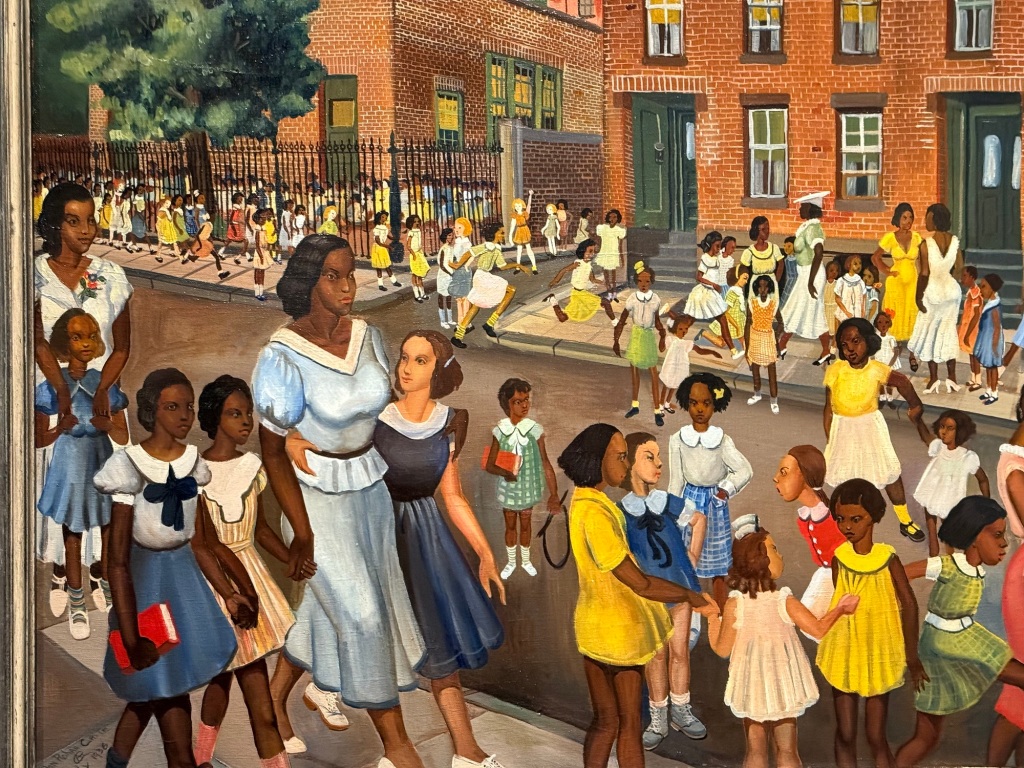
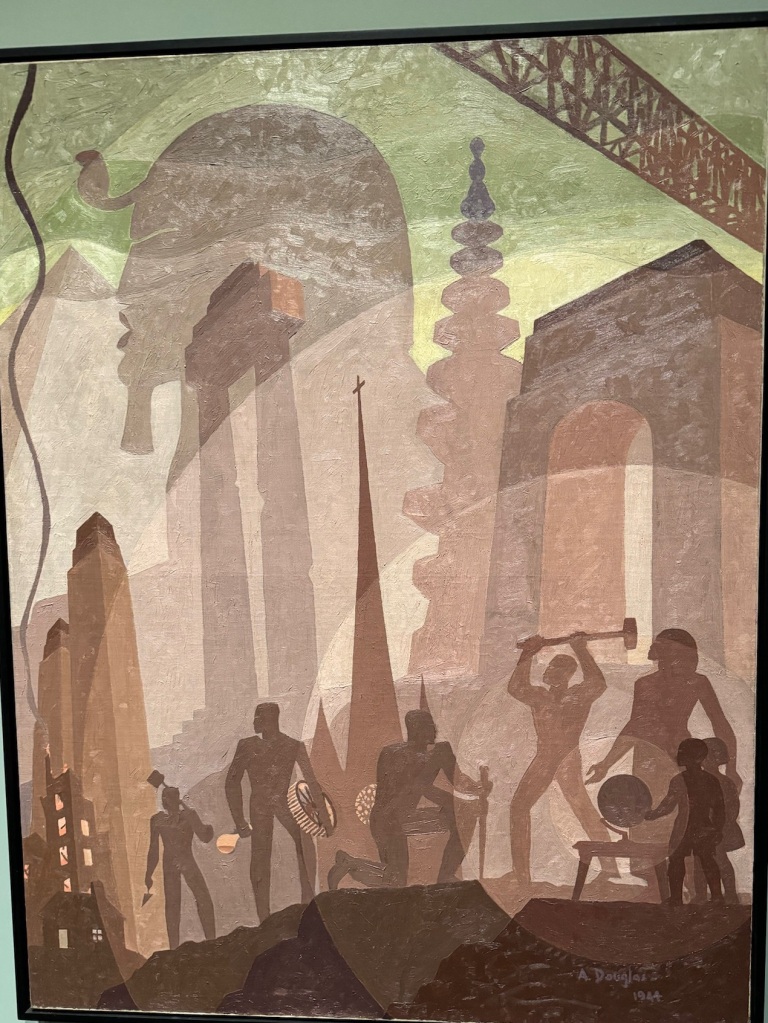
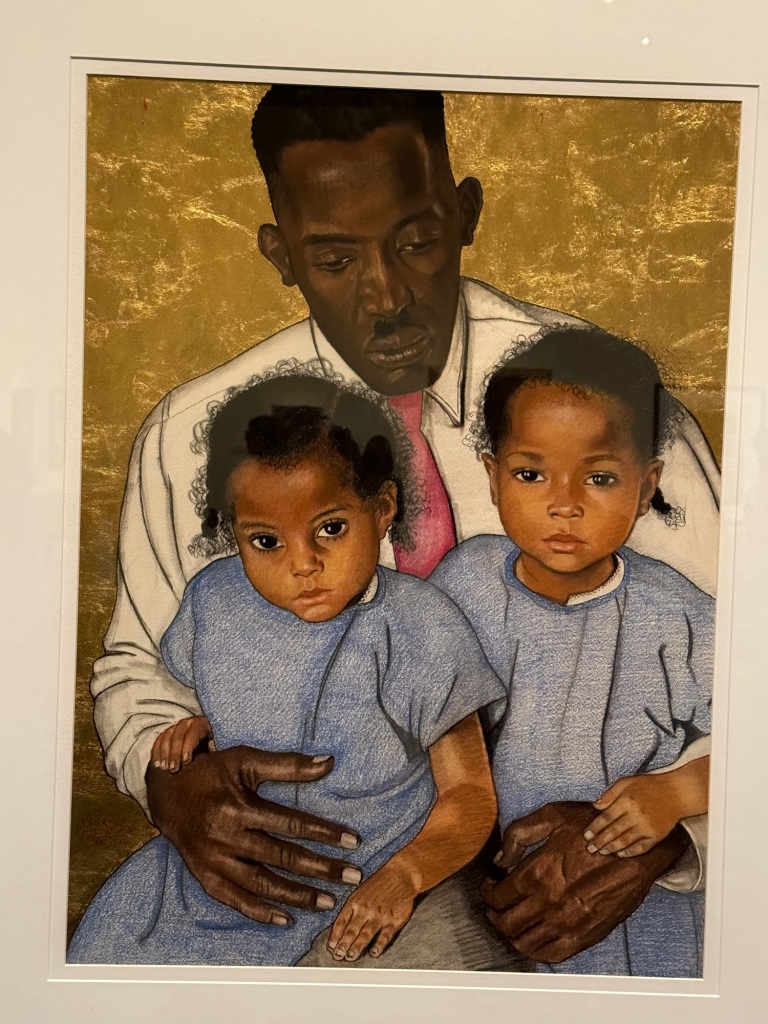
Here are a few of the photos I took with my cell phone. I wish I had taken more. Some of the pictures are off-center because the crowds were large, and I didn’t have a clear path.

Painted by William H. Johnson (1901-1970), “Mom and Dad, 1944.” This folk-art painting of the artist’s mother and a portrait of his late father was borrowed from the Smithsonian American Art Museum.

Painted by Allan Rohan Crite (1910-2007). It is titled “School’s Out” and was painted in 1936. It depicts children emerging from Everett Elementary School in Boston. It was lent to the exhibition by the Smithsonian American Art Museum.

Painted by Aaron Douglas (1879-1979). Titled “Building More Stately Mansions, 1944.” It is owned by the Fisk University Galleries in Nashville. According to the artist, “his objective was to spotlight the contributions of exploited Black labor to great civilizations worldwide. He thus resituated African American history in a global context, in which the sphinx of Egypt appears together with the spire of a Western cathedral, the tiers of an Asian Buddhist pagoda, and a building crane extending over American skyscrapers, emblems of modernity meant to connote growth.”

Painted by Winold Reiss (1886-1953), who emigrated from Germany to America. It is a painting of Fred Fripp, a graduate of the Penn School and a teacher, with his daughters Carol and Evelyn. The painting is owned by the Fisk University Galleries in Nashville.

The caption of the portrait says:

“The sitter looks away in introspection while his young daughters gaze outward, settled into the security of their father’s steadying embrace.

“Reiss met Fred Fripp when he traveled to South Carolina to portray the Gullah-speaking Black residents of St. Helena Island, whose ancestors were among the last enslaved West African people forcibly brought to the United States. The luminous triple portrait, its triangular composition and gold leaf background reminiscent of Renaissance madonnas, celebrates Fripp as a teacher, scholar, and parent.”

As I viewed this magnificent exhibit, I kept wondering about the African-American artists. In their wildest dreams, did they ever imagine that their paintings and sculptures would one day be shown in the nation’s premiere museum?

The exhibition is a large and rich portrayal of the artists and intellectuals of the Harlem Renaissance. If you can’t get to New York by July 28, the last day, you might consider buying the catalogue from the Met.

The usual understanding of democracy is “one man [person], one vote.” No matter how rich or powerful you are, your vote counts the same as that of the poorest person in the same district. We know from experience that the very rich win power by making lavish political donations, but at the ballot box each person has only one vote and all votes are counted equally.

At its recent convention, The Texas Republican Party endorsed an outrageous scheme to cancel the foundation of democracy. It’s not enough for them that billionaires are funding pliable politicians. The state Republicans want to cancel the principle of “one person, one vote.”

They adopted a plank that imposes a sort of electoral college on statewide elections. The winner will not be the candidate with the most votes, but the candidates who win a majority of counties. “The State Legislature shall cause to be enacted a State Constitutional Amendment to add the additional criteria for election to a statewide office to include the majority vote of the counties with each individual county being assigned one vote allocated to the popular majority vote winner of each individual county,” the new plank says.

Democrats are concentrated in big cities; Republicans are the majority in large numbers of small rural counties. If this plank weee to become part of the State Constitution, Democrats would never again be elected Governor, Lieutenant Governor, or U.S. Senator. Democrats might win the popular vote by a large majority, yet still lose the election if they don’t win a majority of the counties in the state.

This proposed Constitutional Amendment is a stake in the heart of democracy. Democrats must organize and elect candidates who want to strength of our society, not destroy it.