Archives for the year of: 2023

Nicholas Kristof is a columnist who is terrific on many issues but consistently wrong when he writes about education. As far back as 2009, I criticized Kristoff for a column in which he called American education “our greatest national shame,” citing Eric Hanushek’s since-discredited work on teachers (the best get students to produce high test scores, bad teachers don’t). Peter Greene took Kristoff to task in 2015 for being an educational tourist, making quick visits and issuing pronouncements that are wrong. I also chastised him in 2017 for endorsing for-profit schools in Africa.

Now, he has outdone all of his previous gaffes. He has discovered the amazing, miraculous, astonishing transformation of Mississippi.

Based on the impressive rise of 4th grade reading scores on NAEP, Kristof proclaims that Mississippi has lessons for the nation.

With an all-out effort over the past decade to get all children to read by the end of third grade and by extensive reliance on research and metrics, Mississippi has shown that it is possible to raise standards even in a state ranked dead last in the country in child poverty and hunger and second highest in teen births.

In the National Assessment of Educational Progress, a series of nationwide tests better known as NAEP, Mississippi has moved from near the bottom to the middle for most of the exams — and near the top when adjusted for demographics. Among just children in poverty, Mississippi fourth graders now are tied for best performers in the nation in NAEP reading tests and rank second in math.

Its success wasn’t because of smaller classes. That would cost money.

It wasn’t because of increased funding.

It wasn’t because Mississippi reduced child poverty.

It wasn’t because of desegregation.

It was because Mississippi embraced the “science of reading,” strict discipline, relentlessly focusing on test scores, and using behavioral methods that sound akin to a “no excuses” charter school.

In 2000, Mississippi received a gift of $100 million from a Mississippi-born tech entrepreneur to launch a statewide reading initiative. In 2013, the legislature invested in full-day pre-K, where children got a start on letters, numbers, and sounds.

The 2013 legislation also enacted third-grade retention. Any child who didn’t pass the third-grade reading test was retained. Most researchers think retention is a terrible, humiliating policy. But Kristof assures readers that failing students get a second chance to pass. 9% of students in third grade flunked. He considers this policy to be a great success, inspiring third graders to try harder, citing a study funded by Jeb Bush’s foundation (Florida also practices third grade retention, which lifts its fourth grade reading scores on NAEP).

Kristof writes:

“Mississippi is a huge success story and very exciting,” David Deming, a Harvard economist and education expert, told me. What’s so significant, he said, is that while Mississippi hasn’t overcome poverty or racism, it still manages to get kids to read and excel.

“You cannot use poverty as an excuse. That’s the most important lesson,” Deming added. “It’s so important, I want to shout it from the mountaintop.” What Mississippi teaches, he said, is that “we shouldn’t be giving up on children.”

The lessons: it’s okay to forget about poverty; forget about segregation; forget about funding. Rely on “the science of reading” and third-grade retention. It’s cheap to follow Mississippi’s lead, which Kristof considers an advantage.

But!

Kristof minimizes Mississippi’s eighth-grade scores on NAEP. He writes: “One challenge is that while Mississippi has made enormous gains in early grades, the improvement has been more modest in eighth-grade NAEP scores.

That’s an understatement.

Eighth grade reading scores in Mississippi have gone up over the past two decades, but scores went up everywhere. In the latest national assessment (NAEP), 37 states had scores higher than those of Mississippi on the NAEP eighth grade reading test. Only one state (New Mexico) was lower. The other 13 were tied. In Mississippi, 25% of the state’s students in 2019 (pre-pandemic) were at or above proficient, compared to 20% in 2003. Nationally, in 2019, 29% of students were at or above proficient*.

In 2019, 42 states and jurisdictions outperformed Mississippi in percentage of students at or above proficient in eighth grade math, eight were tied, and only two scored below Mississippi. 24% were at or above proficient in 2019, a big increase over 2009 when it was 15%. But Mississippi still lags the national average, because scores were rising in other states.

Has Mississippi made progress in the past decade? Yes. Is it a model for the nation? No. When impressive fourth grade scores are followed by not-so-impressive scores in eighth grade, it suggests that the fourth grade scores were anti Oakley boosted by holding back the 9% who were the least successful readers. A neat trick but not an upfront way to measure progress.

It seems fairly obvious that the big gains in NAEP in fourth grade were fueled by the policy of holding back third graders. Jeb Bush boasted of the “Florida Miracle,” which was based on the same strategy: juice up fourth grade scores by holding back the lowest performing third graders.

In 2019, fourth graders in Florida scored 7th in reading and 5th in math on NAEP, by scale scores. However, Florida’s eighth grade scores, like those of Mississippi, are middling, compared to other states. Florida eighth graders ranked #35 in eighth grade math. In eighth grade reading, 21 states and jurisdictions ranked higher than Florida, 21 are not significantly different, and 10 were below Florida.

Florida’s eighth grade reading scores have been flat since 2009; so have its its eighth grade math scores. Florida is a state that has gamed the system. Mississippi is following its lead.

Mississippi has made progress, to be sure. But it is not a national model. Not yet.

What’s worrisome about this article is that Kristof asserts that poverty doesn’t matter (it does); funding doesn’t matter (it does); class size doesn’t matter (it does). In his account, states that want to improve test scores can do it without raising teachers’ salaries, without upgrading buildings, without spending a nickel to improve the conditions of the schools or the well-being of children. Children who are hungry, lack medical care, and are homeless or ill-housed are not likely to learn as well as those who have advantages.

Does this explain why so many rightwingers love “the science of reading”? Publishers are rolling out new programs. Education can be reformed in the cheap. Can’t expect taxpayers to foot the bill, can you?

Kristof’s fundamental error is his determination to find miracles, silver bullets, solutions that fix everything. He did it again.

The U.S. Department of Education appends this disclaimer to every NAEP publication.

*NAEP achievement levels are performance standards that describe what students should know and be able to do. Results are reported as percentages of students performing at or above three achievement levels (NAEP Basic, NAEP Proficient, andNAEP Advanced). Students performing at or above the NAEP Proficient level on NAEP assessments demonstrate solid academic performance and competency over challenging subject matter. It should be noted that the NAEP Proficient achievement level does not represent grade level proficiency as determined by other assessment standards (e.g., state or district assessments). NAEP achievement levels are to be used on a trial basis and should be interpreted and used with caution. Find out more about the NAEP reading achievement levels.
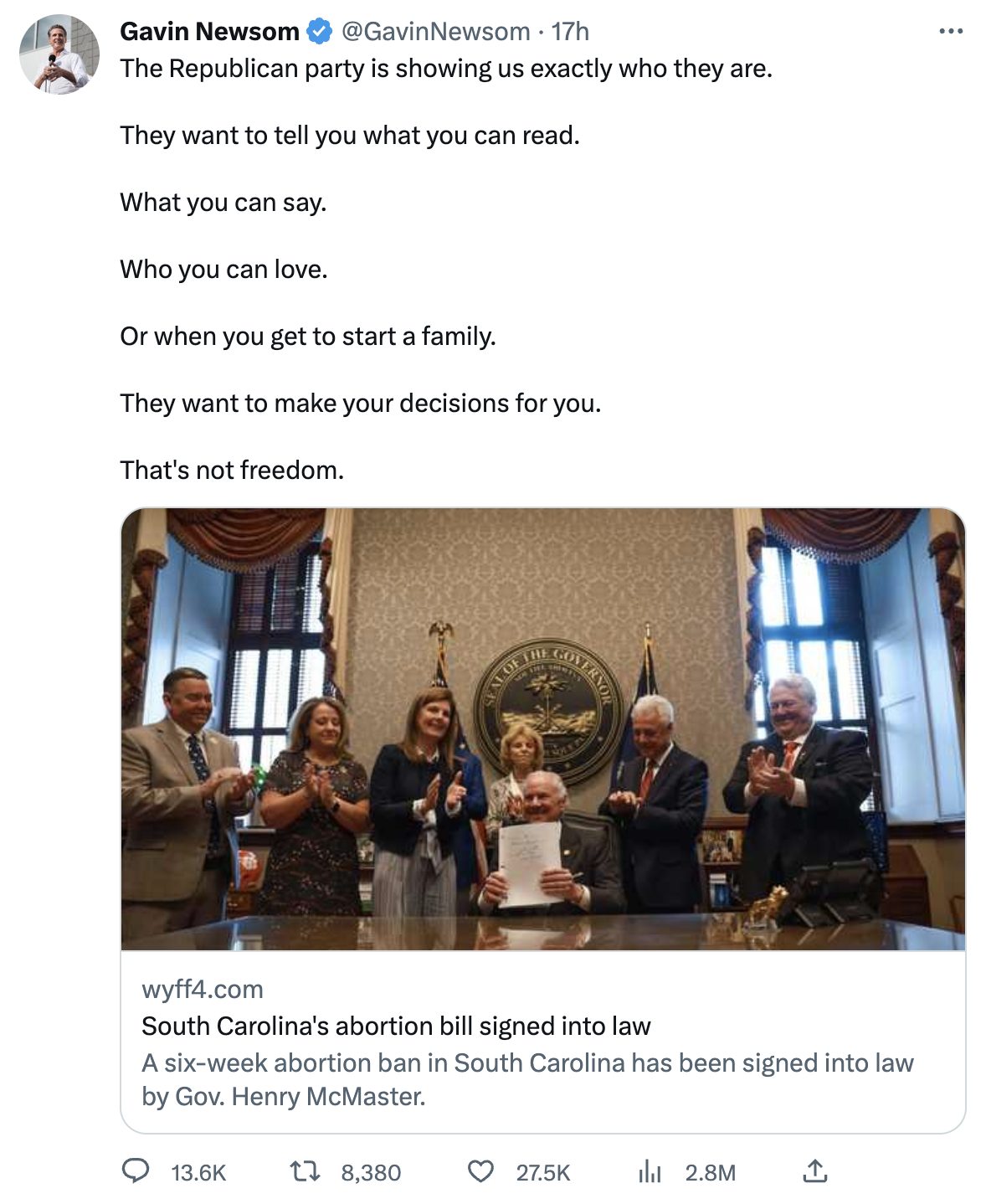
Gavin Newsom, Governor of California, regularly sends out emails pointing out the errors and hypocrisies of Republicans in other states. I enjoy them.

South Carolina, Diane…

Where the Republican governor just signed a six-week abortion ban, which he says will “begin saving lives.” All while that very same governor refuses to do anything about the fact South Carolina has one of the highest homicide rates in the country — more than 2x the rate of California.

Tweet from Gavin Newsom: 'The Republican party is showing us exactly who they are. They want to tell you what you can read. What you can say. Who you can love. Or when you get to start a family. They want to make your decisions for you. That's not freedom.'

You can’t make this up.

Today’s Republican party refuses to regulate assault weapons while gun violence is the leading cause of death of kids in America, but will champion the regulation of women’s bodies and take away reproductive freedom.

This is what Republicans want to do nationally.

And worse.

Be outraged.

Gavin

Michelle Goldberg, a regular columnist for the New York Times, writes that the views of the Oklahoma City terrorist Timothy McVeigh are now in the mainstream of the Republican Party. He was a gun lover. He killed 168 people to strike a blow for his convictions. Now, almost the entire Republican Party embraces his vision of free access to guns.

She writes:

Timothy McVeigh, the right-wing terrorist who killed 168 people in the 1995 Oklahoma City bombing, cared about one issue above all others: guns. To him, guns were synonymous with freedom, and any government attempt to regulate them meant incipient tyranny.

“When it came to guns,” writes Jeffrey Toobin in “Homegrown,” his compelling new book about the Oklahoma City attack, “McVeigh did more than simply advocate for his own right to own and use firearms; he joined an ascendant political crusade, which grew more extreme over the course of his lifetime and beyond.”

Reading Toobin’s book, it’s startling to realize how much McVeigh’s cause has advanced in the decades since his 2001 execution. McVeigh, who was a member of the K.K.K. and harbored a deep resentment of women, hoped that blowing up the Alfred P. Murrah Federal Building would inspire an army of followers to make war on the government. This didn’t happen immediately, although, as the historian Kathleen Belew has written, there was a wave of militia and white supremacist violence in the bombing’s aftermath. But today, an often-inchoate movement of people who share many of McVeigh’s views is waging what increasingly looks like a low-level insurgency against the rest of us…

Mass shootings have become so frequent that we are no longer shocked when one happens. They have become background noise.

The reason that America endures a level of gun violence unique among developed countries, and that we can often do little about it, is so many politicians have views on guns that aren’t far afield from McVeigh’s. As Representative Jamie Raskin, a Democrat from Maryland, has pointed out, it’s become common to hear Republicans echo McVeigh’s insurrectionary theory of the Second Amendment, which holds that Americans must be allowed to amass personal arsenals in case they need to overthrow the government. As the MAGA congresswoman Lauren Boebert once put it, the Second Amendment “has nothing to do with hunting, unless you’re talking about hunting tyrants.”

The Republican Party’s fetishization of guns and its fetishization of insurrection — one that’s reached a hysterical pitch since Donald Trump’s presidency — go hand in hand. Guns are at the center of a worldview in which the ability to launch an armed rebellion must always be held in reserve. And so in the wake of mass shootings, when the public is most likely to clamor for gun regulations, Republicans regularly shore up gun access instead.…Today’s Republican Party can scarcely tolerate anything getting between an eager buyer and a deadly weapon.

It’s hard to think of a historical precedent for a society allowing itself to be terrorized in the way we have. The normalization of both right-wing terrorism and periodic mass shootings by deranged loners is possible only because McVeigh’s views have been mainstreamed. “In the nearly 30 years since the Oklahoma City bombing, the country took an extraordinary journey — from nearly universal horror at the action of a right-wing extremist to wide embrace of a former president (also possibly a future president) who reflected the bomber’s values,” wrote Toobin.

As it happens, in the hours after the Oklahoma City bombing, before the authorities knew who McVeigh was, he was pulled over during a routine traffic stop and then arrested for carrying a gun without a permit. In 2019, however, Oklahoma legalized permitless carry. Under the new law, McVeigh would have been let go.

Ron DeSantis wants to make America just like Florida, where the maximum leader (Ron DeSantis) has a docile legislature that lets him decide what everyone else is allowed to do and punishes those bold enough to ignore his orders.

That’s why he is running for President. He thinks the whole nation needs and wants a maximum leader with a reactionary view of behavior and morality.

Florida is where you are free to do whatever Ron DeSantis tells you to do and free to think what he believes. If you disagree, you are no longer free.

The Miami Herald editorial board says DeSantis has turned Florida into a mean state. No, you don’t want to make America Florida.

Florida, under Gov. Ron DeSantis and Republican Legislature, is increasingly hard to recognize. It’s an intolerant and repressive place that bears scant resemblance to the Sunshine State of just a few years ago.

The 2023 legislative session cemented those appalling setbacks. Florida is now a state where government intrusion into the personal lives of Floridians is commonplace. What will it take for citizens to push back on this unprecedented encroachment on their rights? And, more broadly, what if Desantis supporters get what they want, which is to “make America Florida”?

The latest round of laws makes Florida sound more and more dystopian — something voters in the rest of the nation should note if they are considering what a DeSantis presidency could look like. The state has new rules for who can use which bathroom, what pronouns can be used in schools, which books can be taught and when women can get an abortion (almost never.) There are measures to strip union protections from public employees, keep transgender children and their parents from choosing to seek medical treatment, prevent universities from discussing diversity or inclusion and ban talk of gender identity or sexuality in schools all the way through 12th grade.

There is a growing awareness that Biden managed to outsmart Kevin McCarthy in the debt negotiations. Robert Hubbell thinks so. Biden is a lot smarter than he gets credit for. Fifty years in Congress counts for something.

Hubbell writes:

A key part of the Republican mythology heading into 2024 is that Joe Biden is addled to the point of incoherence and incompetence. So, on the eve of the House vote on the debt ceiling legislation, Republicans are struggling with the reality that Biden bested them in a high-stakes negotiation in which they were holding a nuclear bomb they were willing to detonate. 

As Rep. Lauren Boebert admitted on Twitter, “We got absolutely destroyed in this negotiation.” Or, as former-adult-in-the-room GOP Rep. Nancy Mace tweeted, “Republicans got outsmarted by a President who can’t find his pants.” [See my criticism of Rep. Mace in Concluding Thoughts.]

          As Charlie Sykes aptly noted, Republicans are experiencing “cognitive dissonance” as they struggle to digest their defeat. In the Orwellian logic of the GOP, Kevin McCarthy is declaring “total victory” for negotiating a deal that has ignited calls for his removal as Speaker. As Freedom Caucus member GOP Rep. Chip Roy said,

I want to be very clear: Not one Republican should vote for this deal. Not one. It is a bad deal. No one sent us here to borrow an additional $4 trillion to get absolutely nothing in return. . . . [The deal is] a complete and total sellout . . . and a betrayal of the House power-sharing arrangement.

          While McCarthy is attempting to convince his caucus that the sow’s ear compromise bill is a silk purse for Republicans, Biden is being praised in the political press for his Ninja-like negotiating skills. See Jennifer Rubin in Washington PostOpinion | The debt ceiling shows Biden’s underrated deal-making prowess. Or, as Josh Marshall of Talking Points Memo put it, How the “F” Did Joe Biden Do That? For a comprehensive analysis of Biden’s negotiating strategy, see Daily KosThe many levels of genius in Pres. Biden’s negotiating strategy.

          It may take a few days for Republicans to understand what just happened to them, but here is an example. One of McCarthy’s proudest achievements is that he imposed new work requirements for SNAP food assistance for recipients between 50 and 54 years old. But Biden negotiated “carve-outs” to that expanded work requirement that will actually increase the amount of SNAP funding by expanding the pool of eligible recipients. Per the NYTimes,

[The Congressional Business Office] said a series of changes in work requirements for food stamp eligibility — tightening them for some adults, but loosening them for others including veterans — would actually increase federal spending on the program by $2 billion.

While Republicans demanded stricter work requirements be a part of the compromise, the White House bargained to lessen the impact, and the budget office estimated that overall, the deal would increase the ranks of the program, making an additional 78,000 people eligible for nutrition assistance.

          Got that? The signature achievement of Republicans designed to kick people off SNAP will instead increase funding for the program (by $1.8 billion) and expand the number of eligible recipients. As Josh Marshall said, “How the “F” did Biden to that?” Democrats should help pass the bill through Congress before more such details emerge.

         The “good” news is that a floor vote in the House will likely occur on Wednesday—five days before the US will not have sufficient cash to pay all of its bills.  Late on Tuesday evening, the legislation cleared a key hurdle in the House, passing out of the House Rules Committee. As a result, the bill will be put to a vote on Wednesday. See NYTimesDebt Ceiling Deal Moves Toward House Vote Despite GOP Revolt.

          But . . . many Democrats are unhappy with compromises made by Biden to avoid default. Two of the leading criticisms involve the age-based increased work requirements for SNAP recipients and changes to the permitting process for energy projects.

          As to SNAP, Biden agreed to increase the existing work requirements to include beneficiaries 50 to 54 years old. But as noted above, carve-outs to those increased work requirements have the effect of increasing the total number of Americans eligible for SNAP benefits. Still, the precedent of using a debt-ceiling negotiation to target the poorest and most vulnerable Americans is a bad one. See Michael Hiltzik, Los Angeles TimesHiltzik: Debt ceiling deal is all about punishing the poor.

          A corollary to the GOP’s effort to punish the poor is their effort to protect the rich. By reducing funding for the IRS and leaving tax rates untouched, the two groups unaffected by the debt-ceiling compromise are ultra-wealthy Americans and large corporations. See Raw StoryProgressives condemn Biden-GOP debt ceiling deal as ‘cruel and shortsighted’.

A second major point of criticism is the concession to “fast track” future energy projects, thereby limiting environmental review. And the deal expressly grants special consideration for the Mountain Valley Pipeline, a Joe Manchin pet project. See The Guardian, ‘An egregious act’: debt ceiling deal imperils the environment, critics say | Environment.

Per The Guardian,

Environmental groups, already angered by Biden’s ongoing embrace of large fossil fuel projects, such as the recently approved Willow oil drilling operation in Alaska, said these provisions mean that Democrats should block the debt deal when it is voted upon in Congress this week.

“President Biden made a colossal error in negotiating a deal that sacrifices the climate and working families,” said Jean Su, energy justice program director at the Center for Biological Diversity. “Congress should reject these poison pills and pass a clean debt ceiling bill.”

          But apart from the permitting concessions, Biden managed to protect the massive investments in climate and clean energy achieved in the infrastructure bill and Inflation Reduction Act passed during the last session of Congress. The Inflation Reduction Act alone invested $369 billion in climate protection and clean energy—the largest investment in protecting the environment by an order of magnitude. That investment will reduce carbon emissions by 40% by 2030. See CNBC, Inflation Reduction Act: Climate change provisions.

          The criticisms over cruelty targeting the poor and special accommodations for a pipeline that will make Joe Manchin richer are well-taken. But as the director of the Office of Management and Budget, Shalanda Young, said in defense of the bill:

We are in divided government. This is what happens in divided government. They get to have an opinion and we get to have an opinion, and all things equal, I think this compromise agreement is reasonable for both sides.

And we must remember that as we evaluate the provisions of the bill, the implied question is always, “Compared to what?” Here, the relevant comparison is to a national default that would have injured hundreds of millions of Americans and millions of American businesses. Retirement savings would have been decimated, and monthly benefit checks would have been diminished or halted. It is legitimate and reasonable to evaluate (and criticize) the proposed bill, but to do so without recognizing the alternative outcome is an incomplete analysis.

*****************************************

Hubbell goes on to chastise former moderate Nancy Mace of South Carolina, who has gone full-MAGA in her cruel taunts aimed at Biden, who apparently negotiated the pants off McCarthy.

Heather Cox Richardson writes about Biden’s deliberately low-key description of the deal he made with Kevin McCarthy. McCarthy is on television, Biden is not. McCarthy claims victory, Biden is quiet. What gives? (Interesting comment at the end of the post: Tara Reade, the woman who accused Joe Biden of sexually assaulting her has moved to Russia “for her safety.”)

She writes:

“[O]ne of the things that I hear some of you guys saying is, ‘Why doesn’t Biden say what a good deal it is?’” President Joe Biden said to reporters yesterday afternoon before leaving the White House on the Marine One helicopter. “Why would Biden say what a good deal it is before the vote? You think that’s going to help me get it passed? No. That’s why you guys don’t bargain very well.”

Biden’s unusually revealing comment about the budget negotiations was actually a statement about his presidency. Unlike his Republican opponents, he has refused to try to win points by playing the media and instead has worked behind the scenes to govern, sometimes staying out of negotiations, sometimes being central to them.

The result has been, as Daily Beast columnist David Rothkopf summarized today, historic. Biden has worked to replace 40 years of supply-side economics with policies to rebuild the nation’s economy and infrastructure by supporting ordinary Americans. The American Rescue Plan gave the United States a faster economic recovery from the COVID pandemic than any other major economy. The Bipartisan Infrastructure Law has already funded more than 32,000 projects in more than 4,500 communities in all 50 states, Washington D.C., and U.S. territories.

The Inflation Reduction Act made the biggest investment in addressing climate change in our history, and according to University of Washington transportation analyst Jack Conness, it and the CHIPS and Science Act have already attracted over $220 billion in private investment, much of it going to Republican-dominated states: Tennessee, Nevada, North Carolina, and Oklahoma have each attracted more than $4 billion; Ohio, more than $6 billion; Arizona, more than $7 billion; South Carolina, more than $9 billion; and Georgia, more than $13 billion.

Victoria Guida in Politico yesterday reported that the reordering of the economy under Biden and the Democrats has reversed the widening income gap between wage workers and upper-income professionals that has been growing for the past 40 years. The pay of those making an average of $12.50 an hour grew by almost 6% from 2020 to 2022, even after inflation.

Those gains are now at risk as pandemic measures end and the Fed raises interest rates to bring down inflation, although the wage increases are only a piece of the inflation puzzle: Talmon Joseph Smith and Joe Rennison of the New York Times today reported that companies raising their prices to “protect…profits” are “adding to inflation.” In other words, companies pushed prices beyond normal profit margins during the pandemic and the economic recovery, then maintained those higher profit margins with the Russian invasion of Ukraine, and continue to maintain them now.

The fight over the debt ceiling is both an example of the different approaches to negotiation on the part of Biden and Republicans like House speaker Kevin McCarthy (R-CA), and part of the larger question about the direction of the country.

On January 13, 2023, Treasury Secretary Janet Yellen warned McCarthy that the Treasury was about to hit the borrowing limit established by Congress and that she would have to resort to extraordinary measures in order to meet obligations until Congress raised the debt ceiling.

On March 9, as part of the usual budget process, Biden produced a detailed budget, which was a wish list of programs that would continue to build the country from the bottom up. He told McCarthy he would meet with the speaker as soon as he produced his own budget, which McCarthy could not do because the far-right House Freedom Caucus (these days being abbreviated as HFC) wanted extreme cuts to which other Republicans would never agree.

On April 26 the House Republicans passed a bill that would require $4.8 trillion in cuts but was quite vague about how it would do so apart from getting rid of much of the legislation the Democrats had just passed. HFC members said they would not raise the debt ceiling until the Senate passed their bill. That is, they would drive the United States into default, crashing the U.S. and the global economy, until the president and the Democrats agreed to their policies. Even then, they would raise it only until next spring, with the expectation that it would then become a key factor in the 2024 election.

Biden insisted all along that he would not negotiate over the debt ceiling, which pays for money already appropriated under the normal process of Congress and which Congress raised three times under former president Trump even as he added $7.8 trillion to the national debt. Biden said he would happily negotiate over the budget. McCarthy, meanwhile, was out in front of the cameras and on social media insulting Biden and insisting that it was Biden’s fault that talks took so long to get started.

Late Saturday, the two sides announced an agreement “in principle” to raise the debt ceiling for two years—clearing the presidential election. As the Washington Post’s Catherine Rampell noted, it protects current spending on Social Security, Medicare, and Medicaid; keeps tax rates as they are; increases spending on defense and veterans’ programs; leaves most other domestic spending the same; cuts a little from the expanded funding of the Internal Revenue Service; and tweaks both the permitting process for energy projects and the existing work requirements in the food assistance program.

As Rampell points out, “this much-ballyhooed ‘deal’ doesn’t seem terribly different from whatever budget agreement would have materialized anyway later this year, during the usual annual appropriations process, under divided government. To President Biden’s credit, the most objectionable ransoms that Republicans had been demanding are all gone.”

Now the measure has to get through both parties, with congressmembers back in Washington today after the holiday weekend. Freedom Caucus members are howling at the deal. Representative Chip Roy (R-TX) is threatening to bottle the measure up in the House Rules Committee, which decides what bills make it to the floor. The Freedom Caucus forced McCarthy to stack that committee with far-right extremists as part of his deal for the speakership (it has nine Republicans but only four Democrats on it). But Josh Marshall of Talking Points Memo suggests that McCarthy’s alliance with Representatives Jim Jordan (R-OH) and Marjorie Taylor Greene (R-GA) might pay off here, since the two have thrown their weight behind the measure.

Even if the measure does pass before the June 5 deadline when the Treasury runs out of money, it has had an important effect. As Rampell noted, it has weakened the United States. It has enabled both China and Russia to portray the U.S. as unstable and an unreliable partner. As if to prove that criticism, Biden had to cancel a trip to Australia and Papua New Guinea, where he was strengthening the Indo-Pacific alliances designed to weaken Chinese dominance of the region. (And Russia continues to involve itself in U.S. politics: today Tara Reade, the woman who in 2020 accused Biden of sexually assaulting her, appeared on Russian television next to alleged spy Maria Butina to say she has fled to Russia out of fear for her life in the U.S.)

Writing in Foreign Policy, Howard W. French sees a more sweeping problem with the debt ceiling fight: it “highlights America’s warped priorities.” “[W]hen a rich and powerful country finds it easier to cut back on the way that it invests in its people, in education, in science, and in making sure that the weakest among them are not completely left behind than to curtail useless and profligate weapons spending,” he said, “there are reasons to worry about the foundations of its power.”

Notes:

https://www.whitehouse.gov/briefing-room/statements-releases/2023/05/12/fact-sheet-biden-harris-administration-kicks-off-infrastructure-week-by-highlighting-tremendous-progress-rebuilding-americas-infrastructure-18-months-in/

https://www.whitehouse.gov/build/

https://www.whitehouse.gov/omb/briefing-room/2023/03/09/fact-sheet-the-presidents-budget-for-fiscal-year-2024/

https://www.jackconness.com/ira-chips-investments

https://www.politico.com/news/2023/05/29/low-income-wages-employment-00097135

https://home.treasury.gov/news/press-releases/jy1188

https://home.treasury.gov/news/press-releases/jy1454

https://rollcall.com/2023/04/26/house-passes-1-5-trillion-debt-limit-increase-spending-cuts/

https://www.washingtonpost.com/opinions/2023/05/28/debt-limit-deal-budget-differences/

https://www.politico.com/news/2023/05/30/debt-ceiling-deal-house-rules-committee-republicans-00099245

https://talkingpointsmemo.com/edblog/freak-cavalcade-but-not-more

​​https://www.thedailybeast.com/joe-biden-accuser-tara-reade-claims-she-defected-to-russia-after-sexual-assault-allegations

Jeffrey Epstein, sexual predator and child abuser, became a very rich man as a financial advisor to the rich and famous. When he died awaiting trial, he was allegedly worth $600 million. His estate paid off claims to more than 100 women whom he had abused.

Due to his notoriety and his many powerful friends, he continues to be a fascinating figure. The Wall Street Journal somehow obtained his daily diaries and has written several stories about his interactions with his important friends.

This one was published a few weeks ago in the Wall Street Journal:

On Monday, Sept. 8, 2014, Jeffrey Epstein had a full calendar. He was scheduled to meet that day with Bill Gates, Thomas Pritzker, Leon Black and Mortimer Zuckerman, four of the richest men in the country, according to schedules and emails reviewed by The Wall Street Journal.

Epstein also planned meetings that day with a former top White House lawyer, a college president and a philanthropic adviser, three of the dozens of meetings the Journal reported he had with each of them.

Six years earlier, in 2008, Epstein pleaded guilty to soliciting and procuring a minor for prostitution, and he subsequently registered as a sex offender. He was arrested again in 2019 on sex-trafficking charges, and died that year in jail awaiting trial.

Mr. Gates, the co-founder of Microsoft, has said they discussed philanthropy, and it was a mistake to meet with Epstein. Mr. Black, a co-founder of Apollo Global Management, who has said previously he met for tax and estate advice, declined to comment. The other two men haven’t previously discussed their meetings with Epstein and didn’t respond to requests for comment. Mr. Pritzker is chairman of Hyatt Hotels and Mr. Zuckerman is a real-estate investor and media owner.

That Monday featured appointments at two luxury hotels in midtown Manhattan—the Park Hyatt and Four Seasons. Epstein was also scheduled to host several visitors at his sprawling townhouse near Central Park.

Epstein’s driver picked him up in the morning and brought him to meet the Microsoft mogul and Hyatt hotel heir at the Park Hyatt hotel near Central Park.

Epstein had met with each of them before. In 2011, Epstein was discussing a multibillion-dollar charitable fund with JPMorgan Chase executives and wrote in emails to them that he could involve Mr. Gates and Mr. Pritzker.

On this day, Mr. Gates was scheduled to spend several hours with Epstein, accompanying him to various meetings. Mr. Gates runs, with his ex-wife, one of the world’s biggest philanthropies. 

“As Bill has said many times before, it was a mistake to have ever met with him and he deeply regrets it,” said a spokeswoman for Mr. Gates.

Mr. Pritzker, part of a wealthy and politically connected Chicago family, was a frequent guest at Epstein’s townhouse, according to the documents. 

Mr. Pritzker and Hyatt representatives didn’t respond to requests for comment about the scheduled meetings.

The schedule called for Epstein and Mr. Gates to head two blocks along 57th Street to the skyscraper that houses the offices of Apollo Global Management. 

Epstein had been scheduled to meet with its co-founder Mr. Black the day before, and the two men were slated to meet again three days later, the documents show.

Mr. Black had more than 100 meetings scheduled with Epstein from 2013 to 2017. They typically met at Epstein’s townhouse and occasionally at Mr. Black’s office, the documents show.

The billionaire stepped down as Apollo’s CEO in March 2021. An Apollo review found he paid Epstein $158 million for estate planning and tax work. 

Mr. Black declined to comment about the scheduled meetings. Apollo has said Epstein was working for Mr. Black, not Apollo.

Epstein and Mr. Gates were next scheduled to head to Epstein’s townhouse to meet with Mr. Zuckerman, the owner of U.S. News & World Report.

At the time of the meeting, Mr. Zuckerman also owned the Daily News and was executive chairman of Boston Properties, a big owner of office buildings. 

Mr. Zuckerman was scheduled to meet Epstein more than a dozen times over the years. On some occasions, the two men planned to meet at Mr. Zuckerman’s office or home, which was near Epstein’s townhouse, the documents show. 

One night in January 2014, Epstein waited past 11 p.m. to meet with Mr. Zuckerman, who was scheduled to visit his townhouse at 10:30 p.m., the documents show. 

A spokeswoman for Mr. Zuckerman had no comment on the scheduled meetings.

The Four Seasons, a luxury-hotel chain in which Mr. Gates’s investment firm holds a stake, was the next scheduled stop. There, Epstein introduced Mr. Gates to Kathryn Ruemmler, who until earlier that year had served as President Obama’s top White House lawyer.

Over the next few years, Epstein often had appointments with Ms. Ruemmler, who was a partner at Latham & Watkins at the time and is now general counsel at Goldman Sachs

Ms. Ruemmler had a professional relationship with Epstein and many of their meetings were about a mutual client, a Goldman Sachs spokesman said. “I regret ever knowing Jeffrey Epstein,” Ms. Ruemmler said. 

The spokeswoman for Mr. Gates said Epstein never worked for Mr. Gates. A spokeswoman for Latham & Watkins said Epstein wasn’t a client of the firm.

Epstein returned to his Upper East Side townhouse in the afternoon, the schedule shows. One of the largest private homes in Manhattan, the townhouse was originally built for a Macy’s heir.

At 4:30 p.m., Epstein was scheduled to meet with Ramsey Elkholy, a musician and anthropologist. Mr. Elkholy had several other meetings with Epstein over the years.

Mr. Elkholy said one of Epstein’s girlfriends had introduced them, and that he occasionally went to Epstein for financial and book publishing advice. “When I heard about everything that happened, I was sick to my stomach,” he said.

“In hindsight, I realize that Jeffrey was a very good con man,” Mr. Elkholy said. “He could give the impression that he was helping you when in fact he was mostly B.S.-ing.”

The next person on Epstein’s calendar, Leon Botstein, was running late that day. The longtime president of Bard College was arriving at LaGuardia Airport and planned to head straight to the townhouse, the documents show.

Mr. Botstein said he first visited Epstein’s townhouse in 2012 to thank him for $75,000 in unsolicited donations for Bard’s high schools, then visited again over several years in an attempt to get more. He also invited Epstein to events at the college.

Mr. Botstein said fundraising for the school was his responsibility, and that he met just as frequently with other potential donors.

“It was a humiliating experience to deal with him, but I cannot afford to put my pride before my obligation to raise money for the causes I’m responsible for,” Mr. Botstein said.

“It looked like he was someone who was convicted and served his time,” Mr. Botstein said. “That turned out to be corrupt, but we didn’t know that.”

The last meeting scheduled for the day was with Barnaby Marsh, a philanthropic adviser to wealthy families. At the time, Mr. Marsh was an executive at the John Templeton Foundation, which donates to various science and research groups. He had roughly two dozen meetings with Epstein.

Mr. Marsh said he often went to Epstein’s townhouse for gatherings because it was full of academics and wealthy people who discussed philanthropy ideas. “So many of these billionaires knew him,” Mr. Marsh said. “And he would sit in the corner, just kind of watching.”

Mr. Marsh said Epstein openly discussed his jail time. Mr. Marsh said, however, that he never saw evidence Epstein made significant donations. “He was a lot of talk, but he never did anything.” 

That is just one day in Epstein’s calendar. He was scheduled to meet regularly with some of those same people, and infrequently with others. Here is a look at how often they appeared in Epstein’s schedule in the year before and the year after that day:

Paul Bonner is a retired teacher and principal. He suggests a way to undermine the complaints about CRT, WOKE, and other scarecrows.

Perhaps the greatest injustice of all of this sound and fury for nothing, is that few of the individuals who are the most outspoken concerning cultural disinformation have set foot in a school in the last decade, much less observed or engaged in classroom instruction. Most of the right wing celebrities who profit from all of this noise send their children to private schools. Well intentioned policy makers and Washington politicians also opt for private schools when they are available. It is my experience that when school officials open their doors the reception from the public is very positive. I was principal of an elementary school where my predecessors actually barred members of the community from the building. There was a metal pull down door at the front of the office that was always closed by 4:00 pm. The neighborhood perception of the school was bad because there were no relationships between the school and community.

When I got there, I stopped using the metal door and invited the real estate developers to come and see what we were doing. The overall outlook toward the school from all constituencies, including the staff, improved dramatically. I took similar steps at my previous school, invited the “difficult” parents in, and increased afternoon activities to accentuate the positive. According to Gallup (August 2022) 76% of parents are satisfied with their child’s public school (Compare that to 22% for Congress), it was 82% before the pandemic.

My experience has taught me that if we are open to parents being in the schools and participating in activities, the dissatisfaction reduces significantly. Yes, it is well documented on this blog and through other media outlets that there are nefarious actors pushing a destructive agenda, but it is important that we fight their lies with the good that takes place in schools. The knee jerk firing and isolation of teachers who teach about diversity is one example of the the defensive posture taken by district and state leaders.

Part of the reason, certainly not all, that the right wing disinformation campaigns take root is because school officials too often take cover and act to separate schools from the greater community. We simply don’t know one another. Our best weapon against false opaque charges of indoctrination is to open our doors, invite the community in, and get the positive out.

This may be the best article about education that you will read all year. It is as good an explanation as you will find of “the Finnish miracle.”

As Chaltain explains, the success of the schools is only one part of the picture. For the sixth year in a row, Finland has been named “the happiest country in the world,” based on these metrics: “healthy life expectancy, GDP per capita, social support, low corruption, generosity in a community where people look after each other and freedom to make key life decisions.

The secret to happiness: “Taking a holistic view of the well-being of all the components of a society and its members makes for better life evaluations and happier countries.”

Sam Chaltain writes:

I spent last week in Finland, the small Scandinavian country that, for educators, has become a Mecca of sorts. And while I was there, a surprising thing happened:

I came for the schools.

I stayed for the library.

It’s hard not to be aware of the schools, which have experienced a dramatic metamorphosis over the past half-century.

For much of the early 20th century, Finland was agrarian and underdeveloped, with a GDP per capita trailing other Nordic countries by 30 to 40 percent in 1900. But in 1917, Finland declared its independence from Russia, and insisted that women be heavily represented in its first parliament.

As a result, the new nation prioritized a whole slate of policies that have helped support the development over time of a society that values and protects children. Free preschool programs enroll 98 percent of children in the country. Compulsory education begins at the age of seven, and after nine years of comprehensive schooling, during which there is no tracking by ability, students choose whether to enroll in an academic or a vocational high school. The graduation rate is nearly 95 percent.

Finland’s deep investments in the welfare of all people impact every aspect of public life. “It seems to me that people in Finland are more secure and less anxious than Americans because there is a threshold below which they won’t fall,” said Linda Cook, a political scientist at Brown University who has studied European welfare states. “Even if they face unemployment or illness, Finns will have some payments from the state, public health care and education.”

On our tour of schools in Helsinki and Turku (the current and former capitals), we saw evidence of both the “Finnish Miracle,” and features far less miraculous.

In every location, the atmosphere in the rooms and hallways were marked by an orderly, active hum, the kind that emerges only when everyone knows one’s role, responsibility and contribution. Classes are just four or five hours a day, and as many as one-third of the courses Finnish students take are non-academic.

Lest a visitor decide that any one of these solutions would solve their country’s own problems, our host for the week — Ari Koski of Turku University — warned us that “a Finnish system doesn’t work in any school outside Finland. Everything influences everything else — and if you take one piece out, it doesn’t work anymore.”

Of those influences, Koski believes Finland’s teacher preparation program is the most important. Only eight universities are permitted to prepare teachers, and admission to these programs is highly competitive: less than one of every ten applicants is accepted.

You can imagine my surprise, then, when almost every classroom lesson I observed was . . . OK. As one of my traveling colleagues said, “I feel like I’ve seen this movie before.” And that’s because we have seen it before — teacher-driven, content-heavy, “sit and get” instruction.

Where’s the miracle in that?

Then I remembered that the goal of the Finnish system is equity — as in, choose any school, anywhere, and it will be of a certain quality — and that they have actually achieved it.

In other words, Finland’s goal is not to spark the creation of spectacular schools — it’s to ensure an entire country of good ones.

Its miracle, therefore, flows from its integration, not its innovation.

Whereas its schools may not be hotbeds of innovative teaching, the newest public library in its capital city may be the most spectacular model for the future of learning that I have ever seen.

It’s known simply as Oodi. It opened in 2018 — a gift to the Finnish people to honor a century of independence. And it is a beautiful, vibrant, multigenerational civic hub for creativity and connection.

“Oodi is what you want it to be,” explains its website. “Meet friends, search for information, immerse yourself in a book or work. Create something new in a studio or an Urban Workshop — seven days a week, from early in the morning till late in the evening.

“Oodi is a meeting place, a house of reading and a diverse urban experience. Oodi provides its visitors with knowledge, new skills and stories, and is an easy place to access for learning, relaxation and work.”

It is, in other words, the ideal “school” of the future — a living meeting place of discovery that is open to all….

Please open the link and read the rest of this wonderful post. The secret of Finland’s success is not its schools; nor even its wonderful new library. It’s the nation’s determination to ensure that everyone does well.

Compare the Finnish approach to what is happening here:

In education: competition, standardization, winners and losers, privatization, state-funded religious schools, charters and vouchers; schools without nurses. The search for silver bullets, innovation, miracles.

In society: high income inequality, high wealth inequality, many people in poverty, many people without healthcare, many homeless people.

What are our politicians talking about: critical race theory, drag queens, trans kids, book banning, censorship, making people work for any government assistance.

Do you see a pattern here?

The Washington Post tells the story of Baby Milo. His mother learned midway through her pregnancy that the fetus had a rare fatal condition. It would die within hours or days of its birth. She wanted to get an abortion but Florida abortion law made it impossible. The unborn baby had a heartbeat. No doctor would break the law by performing an abortion despite the fatal diagnosis. She had to carry the baby for three months. Baby Milo was born, then died in 99 hours. That must have made legislators happy to know the baby was born, despite the toll on its mother and father.

Milo Evan Dorbert drew his first and last breath on the evening of March 3. The unusual complications in his mother’s pregnancy tested the interpretation of Florida’s new abortion law.

Deborah Dorbert discovered she was pregnant in August. Her early appointments suggested the baby was thriving, and she looked forward to welcoming a fourth member to the family. It didn’t occur to her that fallout from the U.S. Supreme Court’s decision to overturn a half-century constitutional right to abortion would affect them.

A routine ultrasound halfway through her pregnancy changed all that.

Deborah and her husband, Lee, learned in late November that their baby had Potter syndrome, a rare and lethal condition that plunged them into an unsettled legal landscape.

The state’s ban on abortion after 15 weeks of gestation has an exception for fatal fetal abnormalities. But as long as their baby’s heart kept beating, the Dorberts say, doctors would not honor their request to terminate the pregnancy. The doctors would not say how they reached their decision, but the new law carries severe penalties, including prison time, for medical practitioners who run afoul of it. The hospital system declined to discuss the case.

Instead, the Dorberts would have to wait for labor to be induced at 37 weeks.

For the next three months, the Dorberts did their best to prepare for their second son’s short life. They consulted with palliative care experts and decided against trying to prolong his life with high-tech interventions.

“The most important thing for us was to let him know he was loved,” Deborah said.

The day before Milo was born, the Dorberts sat down with their son Kaiden to explain that the baby’s body had stopped working and that he would not come home. Instead, someday, they told Kaiden, they would all meet as angels. The 4-year-old burst into tears, telling them that he did not want to be an angel….

Without functioning kidneys, a fetus with Potter syndrome cannot produce the amniotic fluid that allows the lungs to expand and that cushions the growing body. The babies who survive until birth typically have contracted limbs, club feet and flattened features from being compressed against the uterus wall.

But after Deborah’s 12-hour labor, Milo turned out to be 4 pounds and 12 ounces of perfection, with tiny, flawlessly formed hands and feet and a head of brown hair.

“I thought I had my miracle,” said Peter Rogell, the baby’s grandfather, who attended the delivery. He allowed himself a moment of hope until the obstetrician cut the umbilical cord that for 37 weeks had performed the functions Milo’s underdeveloped lungs and missing kidneys would now take over.

He never cried or tried to nurse or even opened his eyes, investing every ounce of energy in intermittent gasps for air.

“That was the beginning of the end,” Rogell said, recalling the persistent gulps that he thought at first were hiccups but turned out to be his grandson’s labored efforts to inhale.

Lee read a book to his dying son — “I’ll Love You Forever,” a family favorite that the Dorberts had given Kaiden for Valentine’s Day — and sang Bob Marley’s “Three Little Birds.”

For 99 minutes that lasted a lifetime, they cuddled and comforted their newborn.

Ron DeSantis recently changed the Florida abortion law to make it more restrictive: abortions not permitted after six weeks. The Governor and legislature have essentially banned abortion in the state since few women know they are pregnant within six weeks. They may think their period is delayed, and they won’t have time to get the required doctor’s approval.

The six-week ban won’t go into effect until after the state’s Supreme Court has decided a challenge to the 15-week ban. Since DeSantis appointed four of seven justices, the court’s approval is expected.

Expect more heart-breaking stories, more grief, more sadness.