Audrey Watters says in this post that she never wanted to be the Cassandra of Ed-tech, but she can’t help herself. There are simply too many for-profit phonies that are coming on to the market and too many dupes willing to buy them.

She writes on her blog “Second Breakfast”:

The future is here. It’s just not very evenly distributed.” This quotation, attributed to science fiction author William Gibson, is often used to imply that some lucky few, particularly those surrounded by silicon gadgetry, live in some glorious high-tech promised land; while the rest of us, without access to that machinery, remain stuck in an industrial, even pre-industrial past.

That always strikes me as a huge misread — not just of the fictional tomorrows that Gibson has imagined, but of the realities of various technologies today. The uneven distribution isn’t simply about the “haves” and “have-nots” of the latest in fancy consumer electronics. Rather, it’s about what sorts of possibilities, what sorts of agency, what sorts of freedoms these technologies might afford us. Who even gets to have a future.

The future is here” — and let’s just say that “the future” is some sort of automated classroom – what exactly does it look like? What’s the distribution of that future? And for the community in and around that classroom, what sort of future, whose future, does the robot teacher enable?

“The future is here.” Or at least, some version of a rather Gibson-esque dystopia looms threateningly: “Rural NY School District Will Be One of First to Bring Humanoid Robot Into Classroom,” Melissa Manno reported this week for New York Focus. The Salamanca City Central School District, located on the Seneca Nation reservation, has agreed to purchase a robot from Realbotix for use in the upcoming school year. “The female robot, named Sally, will have a “lifelike appearance” with silicone skin and long brown hair. … Students will use a unique identification code when interacting with the robot during class, allowing it to access their learning data and provide personalized support based on their past communication with the avatar, [Realbotix CEO Andrew] Kiguel said. ‘They’ll be able to say, “Hey, I’m student number 1234,” and then the robot will be like, “Hey, we were talking about this yesterday, do you want to continue that conversation?”’

“Hey, I’m student number 1234” – number 1234 in a district where about 80% of the students are classified as “economically disadvantaged” and almost 32% live in poverty. Number 1234 in a district where 32% of students identify as indigenous. Uneven distribution indeed.

And Sally, ah Sally. Sally “will be stationary in a seated position but have a wide range of upper-body movements and facial expressions.” The district reportedly will pay $57,590 for the robot, which “unlike other Realbotix robots … will not have advanced features such as facial recognition and recording.” Realbotix, “previously known as Tokens.com,” Kotaku’s John Walker informs us, “a crypto company that has since pivoted to the latest fad, after purchasing sex doll maker Simulacra.”

Realbotix, for its part, insists that this new education-focused product and the old, sex companion robot RealDoll “do not share employees, payroll, physical locations, or technology.” But as robotics researcher Julie Walker notes on Bluesky, “a ‘teacher’ robot built by a company whose core embodiment expertise is companion and sex robots is going to carry that design logic into the classroom, whether anyone intends it or not.” And as all the AI-in-education evangelists keep insisting – and have insisted now for one hundred years – the automation of the classroom means that the teacher can focus more on caring for her students, the very gendered practices that these robots (both embodied and as chatbots) also promise.

“We anticipate benefits we cannot yet fully foresee,” the Realbotix press release insists. It gestures at a future that’s both here and not-yet-so. What’s being distributed unevenly in this future isn’t simply gadgetry: it’s surveillance, ideology, racism, patriarchy, control. Dystopia. The sexbot just embodies, makes explicit, what’s a more subtle message encoded into the rest of AI-in-education.

The future that’s promised is a return to some imagined, idyllic past, others try to tell us. “Bring back testing,” we hear over and over and over, as though the polycrises faced by schools and students and communities are because too many people balked at bubble-sheets.

The Debate Over Standardized Testing Is About to Converge With Two Scary On-Campus Realities” Nick Ripatrazone writes in Slate. Those scary realities that demand a return to more standardized testing and, by extension, better “standards,” he implies. The latest college students – those who’ve somehow made it to campus without adequate SAT scores – simply aren’t “college-ready,” he argues. “Already hampered with budgets cuts and bloated class sizes, professors will now regularly be tasked with remedial instruction in all subject areas, not merely in unique situations. Without standardized testing as a reasonable barometer of student skill, colleges will be flooded with students of unknown abilities. American higher education might not be able to withstand such a crisis.”

And of course, plenty of the pressures to keep and expand testing don’t simply come from the tsk-tsking professoriate or contributors to The Atlantic. They come from tech companies, who’ve profited from the push to digitize not just teaching but testing. (These two are, as education psychologists insisted a century ago, inseparable – that is, if you see the classroom as simply a laboratory where students can be trained and tracked and measured like mice in mazes.)

Meanwhile

Teachers save time with AI. Their students may pay the price,” Jill Barshay reports. (I’m not sure I really even believe the “save time” bit, to be honest.)

The End of Homework? Teachers Grapple With Cheating in the Age of AI” by Greg Toppo. (Obligatory reminder: Generative AI is itself built on data theft and plagiarism. It’s pretty rich to expect young people to look at a world rife with fraud and exploitation and then notcheat. These are the values one implicitly encourage when one tells them they must use “AI” to secure their future.)

To AI-Proof Lawyers, Some Law Schools Restrict Technology,” Kathryn Palmer writes.

I’m willing to retire the “ed-tech’s Cassandra” title – trust me, I’ve never really wanted it – because damn, I would not have predicted that Colin Kaepernick, of all people, would become an ed-tech villain. And yet here we are, with Kaepernick and his AI company Lumi Story AI engaged in some awfully shady shit across multiple school districts.

I mean, it’s bad enough to sell schools a product in which students’ imagination is co-opted and corralled by “AI.” But to use his celebrity as a marketing gimmick to quite literally buy students’ and shape superintendents’ support is pretty gross.

Back in May, 404 Media wrote, in horror, that “Researchers Wanted Preschool Teachers to Wear Cameras to Train AI.” Parents too were angry that their children might be recorded – audio and video – in order to “develop and evaluate AI models for assessing classroom interaction quality.” What about privacy protections? How would this data be used? What rights did families have to consent or to refuse, and what would be the implications of the latter – that is, how would those children who opted out retain access to their classmates and teachers?

None of these sorts of questions come up in a similar sort of research scenario, described in a story this week in The 74– a reminder that too often, education technology journalism gets far too excited about the education technology at the expense of the very humans involved: “Nebraska Head Starts Use Vests With ‘Talk Pedometers’ to Boost Early Literacy.” In this particular project, preschoolers’ conversations are recorded; their vocalizations quantified, analyzed. But here, rather than a privacy invasion, the technology is framed as a superpower.

The reference to the pedometer in the headline should immediately give us pause because those fitness devices sold the world on the importance of “10,000 steps” – a figure that was always more about marketing than an indicator of some threshold for actual health. (Indeed, the “30 million word gap” is a problematic and questionable framing in and of itself.)

To finish the post, open the link.

The Miami Herald reported on the burgeoning demand for boutique schools by billionaires moving to Florida. Why Florida? Because the state has no state income tax.

Where should a billionaire send his or her children to school? Surely not the public schools, where they would rub shoulders with kids who are from all kinds of backgrounds.

The arrival of wealth has encouraged the opening of new schools for the super-rich.

Will the super-rich be satisfied with an AI-driven school at a time when educators are becoming skeptical of the educational value of AI?

Will elite families line up to enroll their privileged children in a charter chain designed originally for impoverished children in Harlem? Will their progeny flourish in a “no excuses” setting where test scores are king?

The story says:

A controversial billionaire-backed artificial intelligence school is planting a new flag in Miami Beach.

Alpha School, which has no traditional teachers, only two hours of core learning per school day and $65,000 annual tuition, just paid $19 million for the former one-acre home of the Papillon Montessori campus at 1021 Biarritz Drive in Normandy Isle, according to Miami-Dade property records and the city of Miami Beach. Without teachers, students take part in workshops led by adults called “guides.”

The transaction closed in June. By August, Alpha Miami Beach, a K-8 school with one of the highest tuitions in Miami-Dade, is scheduled to open for the 2026-27 school year. For comparison, annual tuition at Ransom Everglades School is about $54,300, while Gulliver Prep charges about $56,000.

The three-building campus, which can accommodate as many as 250 students, has operated as a Montessori school since 1999. Property records indicate the school sold the campus after facing a foreclosure lawsuit. The complex comes with a swimming pool, hydroponic garden, koi pond and outdoor classrooms.

Alpha School Miami, which already operates a campus across from Tropical Park in west Miami-Dade, now brings its educational model to one of South Florida’s wealthiest communities.

“We are very excited and happy to support this new school,” Miami Beach Planning Director Deborah Tackett told an Alpha representative during a city meeting where the school pledged it would comply with all existing restrictions governing the property. For Miami Beach, the acquisition represents more than a real estate transaction. It also reflects a broader trend in which wealthy newcomers are fueling demand for elite schools, concierge healthcare, private clubs and other services catering to high-income families.

The school did not respond to requests for comment.

The driving force behind Alpha is billionaire software entrepreneur and principal investor Joe Liemandt of Austin, Texas, who says the company’s mission is nothing less than reinventing education through artificial intelligence. Liemandt, founder of Trilogy Software and ESW Capital, is worth $6 billion, according to Forbes.

Influx of wealth drives private school demand

The purchase of the old Montessori campus is another sign that the influx of affluent families into South Florida is reshaping not only the luxury real estate market but also the institutions that serve it.

Many of the billionaires relocating themselves or their company headquarters to the region have chosen Miami Beach as home. Finding upscale private schooling for their children has become an issue.

Ken Griffin, the billionaire founder and CEO of the hedge fund Citadel, has said South Florida needs more top-tier schools to continue attracting wealthy families to the area. He has been a leading voice in encouraging other billionaires and business leaders to move to South Florida.

Griffin, who moved from Chicago to Miami along with Citadel’s global headquarters in 2022, has donated $50 million to expand the New York-based Success Academy charter school network into South Florida.

Andy Ansin, a real estate developer and the owner of WSVN/Channel 7, is another wealthy South Floridian looking to expand private schooling in Miami-Dade.

Ansin told the Miami Herald he is in the process of purchasing land in the northeastern part of the county. He plans to work with a school operator to turn the parcel into the site of a new private school on par with Ransom Everglades and Gulliver Prep.

“We really need a top private school in the northeastern part of the county,” Ansin said. “There’s tremendous demand.”

An alum of Ransom Everglades, Ansin served on the school’s board for 15 years. During that time, Ansin said families from New York would tell him, “‘Well, we’re only going to move to Miami if our kids can get into Ransom.’” He realized Miami-Dade needed more private schools, he said.

Ansin said he cannot disclose the exact location of the site, and he does not yet know which school will operate on the site. He said he wants to partner with a well-regarded school operator, and he would be interested in a school that focuses on “modern-day learning practices,” like teaching with AI.

To the north, real estate billionaire and Miami Dolphins owner Stephen M. Ross is getting involved in private education in Palm Beach County.

Related Ross, a West Palm Beach-based real estate firm founded by Ross, recently announced it is backing a West Palm Beach campus of the prestigious Pine Crest School. The private school already has campuses in Fort Lauderdale and Boca Raton.

Alpha’s AI curriculum raises eyebrows

Alpha’s arrival in Miami Beach comes as the controversial school rapidly expands nationwide. The hallmark of Alpha’s curriculum is its use of artificial intelligence to help students master the required academic curriculum in about two hours a day, co-founder MacKenzie Price said in a school podcast on YouTube.

Price is an Austin, Texas, mother who grew disenchanted with public schools and joined forces with Liemandt to open Alpha School.

Liemandt says Alpha is unique. It combines AI with learning science to teach students about 10 times faster than traditional instruction. Under the model, students spend roughly two hours each day working with an AI tutor on core academics before shifting not to the 3Rs, but the 4Cs — critical thinking, communication, collaboration and creativity. The school does not require an admissions test.

Students take part in workshops on leadership, entrepreneurship, financial literacy, public speaking and teamwork led by their “guides.”

Ultimately, Liemandt says he hopes to create an AI-powered learning platform that can be delivered on a tablet costing less than $1,000 and reach 1 billion children worldwide. He says he has committed $1 billion to the effort.

Education experts say AI has the potential to personalize instruction. Critics, however, argue that students still benefit from traditional classroom interaction, teacher-led instruction and social learning.

Read more at: https://www.miamiherald.com/news/local/community/miami-dade/miami-beach/article316497031.html#storylink=cpy

Andy Spears reports that the Walmart billionaires are supporting MAGA Marsha Blackburn in the race for Governor of Tennessee.

The Waltons of Arkansas are totally committed to eroding public schools and privatizing public funding, so Blackburn is promising to expand state support for vouchers.

Spears writes:

The youngest son of Walmart founder Sam Walton is now on the Marsha Blackburn bandwagon.

The latest campaign financial report indicates that pro-Blackburn Team Tennessee PAC received $100,000 from Walton in the last reporting period.

The Walton family has long supported private school discount coupons – otherwise known as school vouchers. These schemes divert funds from working-class families to wealthy families to use as tuition discounts at private schools. 

Walton joins payday predators Advance Financial, Pennsylvania billionaire and privatization advocate Jeff Yass, the CEO of Jimmy John’s, and General Motors in supporting Blackburn and her reverse Robinhood economic and education agenda. 

Blackburn has pledged to further expand Tennessee’s $300 million school voucher scheme if the 74-year-old career politician wins the Governor’s race. 

Tennessee’s Race to the Bottom: In a Corvette with a Driver Fueled by Jimmy John’s

When I worked in the federal government during the administration of President George W. Bush, I learned a lot about how the civil service functions. I was Assistant Secretary for Education Research and Innovation in the U.S. Department of Education. A small number of people in my office were political appointees. The vast number were civil servants.

The highest ranking civil servants were designated SES–Senior Executive Service. Only the very best civil servants reached that rank. These are people with long and distinguished careers. They are the best of the best. Like most civil servants, they are nonpartisan and they have lifetime tenure.

Miles Taylor informs us that Trump has just turned these top civil servants into at-will employees. He can fire them for any reason or no reason.

This is part of his Project 2025 plan to remove resistance to his total control of the government.

Miles Taylor was Chief Of Staff in the Department of Homeland Security during Trump’s first term. He famously wrote an op-d for The New York Times with the byline “Anonymous,” describing his role in “the resistance” inside the Trump administration.

Miles Taylor wrote on his Substack blog “Defiance”:

The president did something yesterday that almost no one noticed. He signed an order that will allow him to fully hijack (and politicize) the federal government, like never before.

While the country was looking elsewhere, Donald Trump signed an executive order on Wednesday to convert roughly 8,000 of the federal government’s most senior career officials into employees he can fire for any reason, or no reason at all. 

The order is called “Implementing Schedule Policy/Career in the Excepted Service,” a name obviously engineered to be skimmed past. And surprisingly, almost everyone obliged. The coverage that followed dutifully reported that thousands of workers are now “easier to fire,” which is true and also misses the point entirely.

The point is that these are the top lieutenants across the federal government. In other words, these are the people serving right under Trump’s political appointees (the ones he assigns to run federal departments and agencies). Presidents get “their people” to reshape policy priorities. And Americans count on the rest of the government staff, the career officials, to carry out the workings of those agencies and follow the law faithfully and impartially. Trump has just upended that centuries-old system.

His executive order would, in effect, triple the number of people inside of government who he can personally toss out on a whim, as easily as his own top henchmen. It’s a breathtaking takeover of the machinery of state. And if it’s not challenged in the courts, it will make it easier for Trump to weaponize almost every agency under his purview.

The number of “political appointees” in the executive branch hovers around 4,000. Think of these as the top jobs. Each president comes in and spins up an HR operation to bring in ideologically-aligned folks to fill those roles, most of which are in charge of running key departments, agencies, boards, and commissions across the federal government. You can see them all here in what’s called the “Plum Book.” They serve at the pleasure of the president and can be hired and dismissed at will. 

That was the kind of role I was in as DHS chief of staff in the first Trump administration. I wasn’t protected by anything other than the president’s favor. That’s why — when you make a decision to speak out about wrongdoing — you’ve got to be prepared to quit or be fired. You have no protections if you fall out of favor with the president. Unfortunately, that’s why you see so many Pam Bondis and Todd Blanches, eagerly doing whatever Trump wants. They know how easy it is to lose their job.

That four thousand number is important. It’s the practical measure of a president’s direct grip on the executive branch. Everyone underneath those positions, some two million civil servants, has historically been insulated from political whim by removal protections dating to the reforms that ended the spoils system back in the 1800s. Those protections are the entire reason a new president inherits a functioning government, rather than giant shell of a machine to reconfigure each time we have a national election.

Yet Trump just took 8,000 of those highest-ranking career officials and effectively turned them into potential shock troops. They are no longer protected workforce. The office directors, deputy directors, chiefs of staff, senior advisers, and people who draft regulations and decide who receives federal grants have been stripped of their protections, which means Trump can dispose of them whenever he wants and for whatever reason. Add that to the 4,000 appointees he already controls, and the universe of executive-branch officials who now serve entirely at his pleasure has, in functional terms, roughly tripled. 

The White House disputes this with a smirk. These remain “career” positions, they insist. They are not technically political appointments. Strictly speaking, this is correct. But as the nonpartisan Partnership for Public Service put it, that’s “a distinction without a difference.” It’s now just a meaningless category. The president can toss them out as easily as his own, hand-picked loyalists. And surely the White House is already thinking about how they’ll short-circuit the “merit” process to restock those vacant roles with campaign aides and January 6 rioters.

The chilling effect has begun either way, before any of these 8,000 people have been replaced. An official who can now be fired this very afternoon for “subversion of presidential directives” — the order’s own language — does not need to be hand-picked to understand what is now expected of him or her. The threat does all the work. And the result is that Donald Trump has expanded the ranks of his political army almost instantly.

What just happened is almost certainly illegal. A coalition of federal employees unions are, I hope, prepared to fight hard. There already have been against similar orders. Here’s why they need to take this one down.

The president’s authority to pull positions out of the protected civil service comes from a provision of Title 5 that lets him make only “necessary exceptions” from the competitive service. That word, “necessary,” was something government managers were keenly aware of when I was in the executive branch. Job categories could only be reclassified in extenuating circumstances — basically where it was urgently necessary to create a position that wasn’t selected through the normal competitive service system. 

Reclassifying 8,000 senior careerists to make them fireable at will is not “necessary” for good administration. It’s the total opposite of the merit-based system the laws exist to protect in the first place. Indeed, the rights being stripped away are supposed to be written in stone, e.g. the right to notice before firing, the right to appeal to an independent board, etc.. A president cannot use a magic wand to erase the very protections Congress wrote into law. They were put in place for this exact reason, that is, to prevent presidents from either party from simply firing all the top people across government and stuffing agencies with inexperienced, political bootlickers.

Upon reading it, I found the most revealing detail to be how the order was seemingly written to escape scrutiny. A rule this consequential would normally have to go through what’s called the Administrative Procedure Act, requiring a period of public comment, a reasoned justification, and review by a court that can strike it down as arbitrary, if needed. But Trump didn’t want that. He wanted to wave his wand. So the White House performed a quiet bit of engineering. They wrote the rule to make the president himself (not the Office of Personnel Management) the official who formally moves positions into this new category because the president, unlike an agency, is not technically bound by that Act. They might as well have admitted their goal was to break the law.

The famously brutal English king Henry VIII didn’t need to appoint every man in his court to make every man in his court afraid. All he had to do is make them aware that he might swing the axe at any time. In America, we’ve spent more than a century building a civil service so that the people who enforce our laws answer to the law and not to the mood of one man. Yesterday afternoon, Donald Trump tried to change that. 

All I can tell you now is this: we’re going to help fight it. Stay tuned.

Your friend, in defiance,

Miles Taylor

P.S. Help spread the defiance by sharing this

When I first started blogging in 2012, the number of people reading the blog astounded me. Every day, between 15,000-25,000 people read what I wrote.

Most of the referrals to the blog were coming through Facebook.

Then, in 2016 or so, there was a precipitous and inexplicable drop. Something happened but I don’t know what. I know I offended some powerful people, but that was my job. I still have had more than 43 million page views since 2012, so I shouldn’t complain.

But something similar happened to Judd at Popular Information.

He writes:

“Here are the facts:

In 2021, 34,594 people subscribed to Popular Information after seeing our reporting on Google, Facebook, and Twitter (now X).

We are more than halfway through 2026, and just 932 people have subscribed to Popular Information from those same platforms.

“Our work is better than it was five years ago. (We were recently awarded the David Nyhan Prize for Public Policy Journalism by Harvard’s Shorenstein Center.)

“But the billionaires who control Google, Facebook, and X have made the decision to choke off traffic to independent outlets like Popular Information. They are not interested in building an audience for stories like the one you are about to read.”

The algorithm changed. Someone knows, but I don’t. It changed for my blog, around the time that I began opposing Trump. Now the algorithm has changed for Judd.

Here is Judd’s latest post.

https://open.substack.com/pub/popularinformation/p/the-truth-about-the-viral-911-petition?r=rls8&utm_medium=ios

Carol Burris, executive director of the Network for Public Education, wrote about the harm that charters and vouchers are inflicting on public schools. Her article appeared in The Progressive.

It begins:

‘School Choice’ Does Not Provide Better Education for All Families

Voucher and charter school programs are taking funds that could make our public schools stronger.

Please open the link as I cannot copy the article.

https://progressive.org/public-schools-advocate/school-choice-does-not-provide-better-education-for-all-families-burris-20260724/

Mike Simpson posts amazing memes on Twitter and BlueSky. He calls himself “Big Education Ape.” He makes the point with his illustrations.

Here is one of his best: THE GHOST OF ELI BROAD: TWENTY-FIVE YEARS OF VULTURE PHILANTHROPY AND THE ONGOING DESTRUCTION OF AMERICAN PUBLIC EDUCATION.

I wasn’t able to copy some tables and graphics. Please open the link to read the post in full.

Eli Broad was one of the billionaires who was eager to tear apart public education and remake it. I referred to him, the Waltons, and the Gates Foundation as “the Billionaires Boys Club,” which was chapter 10 of my book The Death and Life of the Great American School System: How Testing and Choice Are Undermining Education.

Eli Broad’s distinctive contribution to the corporate reform movement was his Broad Academy, where aspiring superintendents were “trained” with his ideas. All expenses were paid, and trainees got to hobnob with others. They also had the Academy’s help in job placement; many “graduates” of the Broad Academy were placed as superintendents in big-city districts, imbued with the ideology that schooling was a business, that low-performing schools should be closed and replaced by charter schools. Eli and his wife Edythe were both graduates of the Detroit Public Schools, but they were not grateful for what they learned.

In 2009, when I was writing the book, I was not aware that the Billionaire Boys Club had many more members and that some were women. There was Alice Walton, Betsy DeVos, the Koch brothers, John Arnold, Joel Greenberg, Daniel Loeb, Jeff Yass, and many more. I posted a far longer list of the super-rich underwriting the privatization of public money in my book Slaying Goliath.

I once was invited by Eli Broad to meet at his gorgeous apartment in New York City, overlooking Central Park. He wanted to know why I was critical of his efforts. He told me that he knew nothing about teaching or curriculum, but he knew a lot about business management and organization. His belief was that public schools could improve by better management.

Mike Simpson performs a public service here by updating the legacy of Eli Broad.

He writes:

How a billionaire’s “vision” became a scandal-soaked legacy — and why it refuses to die, now dressed in Yale’s ivy

There’s a particular kind of audacity required to spend a quarter-century systematically dismantling public education, leave a trail of federal indictments, billion-dollar procurement disasters, and devastated communities in your wake — and then get your name engraved on a building at Yale University. That, in essence, is the story of Eli Broad, the Broad Academy, and its reincarnation as The Broad Center at Yale School of Management. If you were hoping the death of Eli Broad in 2021 would finally close this chapter of American education history, well — ghosts don’t follow rules. And this one has a $100 million endowment.

Part I: Venture Philanthropy — When Billionaires Play School

Let’s start with the concept that makes all of this possible: “venture philanthropy.” It sounds benign — even noble. In practice, it means a billionaire who made his fortune in housing construction (KB Home) and insurance (SunAmerica) decided he understood public education better than educators, parents, communities, or — heaven forbid — children.

Eli Broad’s core thesis, launched formally in 2002 with the Broad Superintendents Academy (BSA), was elegantly simple and catastrophically wrong: public school systems are just badly managed corporations, and what they need is corporate managers.

Not teachers. Not child psychologists. Not community leaders. Corporate managers. Preferably ones with MBAs, military command experience, or backgrounds in supply-chain logistics. Because nothing says “I understand the developmental needs of a seven-year-old” quite like a background in restructuring defense procurement contracts.

The curriculum reflected this philosophy with almost comedic precision:

  • 10% — Actual education: pedagogy, curriculum, child development
  • 90% — Corporate operational reform: fiscal optimization, data-driven accountability, labor relations, and what the Academy euphemistically called “reform accelerators” — which, translated from the original MBA-speak, meant privatization strategies

The program was free to participants — tuition, travel, lodging, all covered. Because when you’re deploying an ideological army, you don’t charge the soldiers.

Part II: Yale Said “Yes” — And Charged It to Prestige

In 2019, the Eli and Edythe Broad Foundation committed $100 million to Yale University to transform the independent, unaccredited Los Angeles operation into The Broad Center at Yale School of Management. The transition was completed in 2020, and the unaccredited LA entity was quietly sunsetted — like a getaway car abandoned after the heist.

The rebranding was masterful. Suddenly, the same ideological pipeline that had produced federal convicts, FBI raid subjects, and a generation of “disruptors” who disrupted primarily the educational lives of low-income children of color was now operating under the imprimatur of one of the world’s most prestigious universities.

The center today operates two flagship tracks, both tuition-free:

The 2026–27 MMS cohort is already being assembled, per the center’s own Instagram, described as “leaders committed to reimagining” public education — which, given the network’s history, should be read as a threat as much as a promise.

Beyond the programs themselves, the center has launched an aggressive data aggregation initiative — a centralized repository hosted on GitHub tracking superintendents across more than 10,000 of the nation’s 13,000 public school districts, aggregating over 180,000 data points across 23 states. The stated goal is academic research. The unstated goal, critics argue, is mapping the vacancy pipeline for the next generation of Broad placements.

Part III: The Damage Ledger — Twenty-Five Years of “Disruption”

Let’s be precise about what the word “disruption” meant in practice. A landmark 2022 longitudinal study published in Educational Evaluation and Policy Analysis tracked two full decades of Broad Academy graduates and delivered findings that would be devastating — if anyone in the venture philanthropy world were capable of embarrassment:

  • No statistically significant positive effects on district spending, student completion rates, or test scores
  • Broad-trained superintendents had 18% shorter tenures than non-Broad peers in equivalent districts
  • The only statistically significant footprint left behind? A sustained, measurable trend toward increased charter school enrollment and sector privatization

In other words, after 25 years and hundreds of millions of philanthropic dollars, the Broad Academy’s measurable legacy in public education was: more charter schools and shorter superintendent tenures. That’s it. That’s the product.

The Human Cost

The abstract numbers become concrete when you look at specific communities:

Oakland & Detroit saw aggressive charter expansion and centralized fiscal management that critics argued deepened structural deficits and fractured community trust for generations.

Chicago experienced the largest single wave of school closures in modern U.S. history — 50 neighborhood schools shuttered in 2013 under Broad-network-affiliated Barbara Byrd-Bennett — triggering federal civil rights complaints alleging the closures disproportionately harmed low-income students of color.

Seattle watched Broad graduate Maria Goodloe-Johnson (BSA Class of 2003) get fired in 2011 following a state audit revealing $1.8 million in public funds funneled into a contracting program that provided little to no actual services — with investigators concluding she exercised a “severe lack of oversight” despite early warnings.

Part IV: The Scandal Hall of Fame — From Procurement Fraud to Federal Prison

Here is where the story transitions from ideologically troubling to criminally spectacular.

John Deasy — The iPad That Broke LAUSD

Deasy (BSA Class of 2006) championed a $1.3 billion initiative to put Apple iPads loaded with Pearson software into the hands of every LAUSD student. The rollout failed within days — students bypassed security filters almost immediately — but the procurement scandal was far worse than the technical failure.

Internal records revealed that Deasy and his deputies had close personal and professional ties to Apple and Pearson executives prior to the bidding process, raising serious allegations of a rigged procurement cycle. The FBI seized boxes of district records. Deasy resigned in 2014. The district eventually abandoned the program and settled for millions in refunds.

His post-resignation career? He was immediately hired by the Broad Center as a Superintendent-in-Residence — coaching the next generation of urban leaders. Because in this ecosystem, failure is a credential.

Barbara Byrd-Bennett — The Federal Prison Graduate

Byrd-Bennett’s career arc is the Broad model in miniature: leave Cleveland in fiscal distress, leave Detroit in structural chaos, get hired as a “turnaround expert” in Chicago, execute the largest school closure wave in American history, then get indicted on 20 counts of federal mail and wire fraud.

Federal investigators proved she steered $23 million in no-bid contracts to SUPES Academy and Synesi Associates — the very consulting firms she had worked for immediately before taking the CPS helm. Internal emails laid bare her motive with a candor that would be almost admirable if it weren’t so brazen: she needed the money because she had “tuitions to pay and casinos to visit.”

In exchange, she was promised a 10% kickback disguised as future consulting fees funneled into trust funds for her twin grandsons. She pleaded guilty and was sentenced to four and a half years in federal prison.

Robert Runcie — The Perjury Arrest

Runcie (BSA Class of 2009) took over Broward County Public Schools — the nation’s sixth-largest district — and oversaw a culture of severe administrative bid-rigging around an $800 million capital bond program, with independent investigations revealing contracts steered to pre-selected corporate entities.

Following the 2018 Parkland school shooting, which exposed deep systemic lapses in district safety infrastructure, a statewide grand jury investigation led to Runcie’s arrest by the Florida Department of Law Enforcement on felony perjury charges in April 2021 — prosecutors proving he lied under oath about communications regarding procurement contracts.

He resigned in exchange for a $743,000 separation agreement. Paid by taxpayers.

Alberto Carvalho — The AI Echo of the iPad Disaster

If the Deasy iPad scandal was the defining Broad-era procurement catastrophe of the 2010s, Alberto Carvalho’s LAUSD tenure became its 2020s technological sequel — almost as if the universe decided one billion-dollar tech procurement disaster per decade wasn’t sufficient.

Carvalho, a celebrated figure on the corporate-reform speaking circuit who regularly headlined Broad Center leadership panels, aggressively championed a contract with “AllHere,” a tech startup contracted to build a multi-million dollar AI student-chatbot tool for LAUSD. The project collapsed into total insolvency. The startup’s founder was indicted for fraud. Federal investigators traced systemic steering of contracts that bypassed traditional public bidding protections.

In early 2026, FBI agents raided Carvalho’s personal residence and district offices. He was placed on paid administrative leave and subsequently resigned — a modern, tech-era echo of the Deasy iPad scandal, separated by exactly one decade and approximately zero lessons learned.

Part V: The Carousel — How Failed Superintendents Get Recycled

One of the most structurally revealing features of the Broad model is what happens after a superintendent fails. In a normal accountability framework, catastrophic failure — federal indictment, FBI raids, mass community protests, historic labor strikes — would end careers.

In the Broad ecosystem, it typically accelerates them.

The recycling mechanism operates in three predictable stages:

Stage 1 — The Soft Landing: Departing executives are caught by the philanthropic safety net. Foundations like Broad, Walton, or Gates place them into well-funded “fellow,” “executive coach,” or “senior advisor” roles at charter management organizations or policy think tanks. The local political dust settles. The national network maintains their status.

Stage 2 — The Headhunter Buffer: National executive search firms — operating with screening frameworks that prioritize corporate operational metrics over community approval or longevity — present the executive to a new school board in another state as a “courageous, battle-tested change agent.” The fact that the “battle” was largely against the parents and teachers of the previous district is presented as a résumé enhancement.

Stage 3 — The Next Major District: Re-hired at a higher salary, with stronger contractual protections, and a golden parachute clause ensuring that the next failure will also be financially comfortable.

Mike Miles left Dallas ISD under multiple internal investigations and extreme executive turnover, founded a charter network, and was then directly appointed by the Texas Education Agency — which had dissolved Houston ISD’s elected school board — to run the entire Houston district with even fewer democratic constraints than before.

Jean-Claude Brizard left Rochester under a 95% teacher vote of no confidence, was immediately recruited to lead Chicago Public Schools (the nation’s third-largest system), triggered the historic 2012 Chicago Teachers Strike within 17 months, was pushed out with a $250,000 buyout, and transitioned smoothly into senior advisory roles at national education foundations.

The pattern is not a bug. It is the feature.

Part VI: Buying the Boardroom — How Venture Philanthropy Captured School Governance

The Broad playbook cannot function under genuine democratic oversight. A superintendent who closes 50 neighborhood schools, eliminates teacher tenure protections, and converts public schools into privately managed charter networks will be fired by an elected school board that answers to the community — unless that school board has been pre-selected to not do that.

The solution was elegant and corrosive: buy the school board elections.

Because local school board races historically required minimal campaign capital, the injection of billionaire wealth fundamentally altered the political landscape. The money flows not directly to candidates (which faces statutory limits) but through Independent Expenditure Committees and Super PACs — allowing unlimited spending on sophisticated polling, negative television ads, and targeted digital saturation.

In Los Angeles, Eli Broad, the Walton family, and allied donors regularly poured $5 million to $10 million per election cycle into LAUSD board races — specifically to achieve a “pro-reform majority” that would protect executives like John Deasy and later Austin Beutner (a former investment banker with no education background whatsoever) from community accountability.

In Oakland, independent groups funded by the California Charter Schools Association outspent local parent-teacher associations 10-to-1, successfully seating board members who routinely approved charter petitions and fiscal consolidation plans drafted by Broad Residency staff embedded in the central office.

When even this proved insufficient — when local civic resistance made winning democratic elections too expensive or unpredictable — the network pivoted to eliminating the elections entirely:

  • Chicago: Mayoral control legislation allowed Mayor Rahm Emanuel to single-handedly install Broad executives without board confirmation.
  • Houston: The Texas Education Agency dissolved the elected school board entirely and replaced it with a state-appointed body, allowing direct installation of Mike Miles.
  • Detroit: The short-lived Education Achievement Authority bypassed the traditional school board to implement a centralized, non-unionized reform experiment under Broad graduate John Covington.

The structural message is unambiguous: the corporate management model and democratic accountability are incompatible. When democracy gets in the way, the solution is to remove democracy.

Part VII: The Network Map — 1,000 Alumni and Counting

The Broad Network now comprises more than 1,000 alumni spanning major urban school districts, charter management organizations, state education agencies, and venture philanthropy foundations — with its heaviest concentrations precisely where the playbook finds the most fertile ground:

California remains the densest hub, with alumni embedded throughout LAUSD, Oakland Unified, and San Diego Unified central offices, as well as major CMOs like KIPP SoCal, Aspire Public Schools, and Green Dot.

Texas has become the fastest-growing hub, with Houston ISD under state-appointed Miles serving as the current flagship experiment, alongside significant placement within Dallas ISD, Fort Worth ISD, the Texas Education Agency, and massive charter entities like KIPP Texas and IDEA Public Schools.

New York serves as the “soft landing” capital of the network — hundreds of alumni operating within Wall Street-adjacent education foundations, charter advocacy groups, and elite national search firms headquartered in Manhattan.

Illinois and Pennsylvania — Chicago and Philadelphia specifically — remain high-density environments where teams of Broad Residents are embedded in central operations managing financial stabilization, facilities restructuring, and school assignment data systems.

Meanwhile, the network has largely migrated out of direct superintendencies — where the political friction is high and the tenure is short — and into the broader ecosystem where influence is durable and accountability is minimal: senior director roles at the Gates Foundation, the Walton Family Foundation, and the Chan Zuckerberg Initiative; high-level education consultancies like Watershed Advisors and Instruction Partners; and, of course, The Broad Center at Yale SOM itself, where the current MMS cohort is being trained to carry the philosophy forward.

Part VIII: Yale — Laundering a Legacy in Ivy

Let us be direct about what the Yale partnership accomplishes that the standalone Los Angeles operation never could: institutional legitimacy laundering.

The Broad Academy, operating independently, was unaccredited, ideologically transparent, and easy to critique. Its graduates were called “Broadies” — a term used by both allies and critics — and the pipeline was visible enough that parent groups, teachers’ unions, and education researchers could track, document, and organize against it.

The Broad Center at Yale SOM is something different. It is now embedded within one of the world’s most prestigious academic institutions, granting an Ivy League master’s degree, hosting fellows in New Haven, and publishing peer-reviewed research. The same corporate management philosophy that produced federal convictions and FBI raids now arrives in urban school districts wearing a Yale credential.

The center’s new data aggregation initiative — tracking superintendents across more than 10,000 districts, aggregating 180,000+ data points — is framed as academic research. Critics see it as something more operational: a comprehensive national vacancy map for the next generation of Broad placements, now with the algorithmic sophistication that the original Los Angeles operation could only dream of.

The 2025-26 Fellowship cohort of 17 fellows is already gathering in New Haven for weeklong modules at Yale SOM. The 2026-27 MMS cohort is being assembled. The pipeline flows.

The Synthesis: What Twenty-Five Years Actually Taught Us

Here is what a quarter-century of Broad-style education reform has empirically demonstrated:

The Promise: The Reality

Corporate management improves district outcomes/No measurable positive effect on test scores, graduation rates, or spending efficiency”

Disruptors” bring needed change/18% shorter tenures; accelerated community fracture

Charter expansion improves options/Statistically significant increase in privatization; no demonstrated academic gains

Data-driven accountability improves teaching/Curriculum narrowing; teaching to the test

Free consulting support helps districts/Permanent embedding of private ideology on public payroll

School board reform improves governance/Systematic dismantling of democratic accountability

The most damning verdict is not the federal indictments — though those are damning. It is not the FBI raids — though those are spectacular. It is not even the $23 million in no-bid kickback contracts or the billion-dollar iPad disasters.

It is this: after 25 years, hundreds of millions in philanthropic investment, and the placement of Broad-trained executives in over 160 school systems, there is no credible empirical evidence that any of it helped a single child learn to read better.

What it did produce — measurably, statistically, reproducibly — was more charter schools, shorter superintendent tenures, and a revolving door of well-compensated executives cycling between urban districts, consulting firms, and Ivy League fellowship programs while the communities they “disrupted” rebuilt themselves from the wreckage.

Epilogue: The Ghost That Won’t Be Exorcised

Eli Broad died in April 2021. His foundation subsequently announced it would spend down its assets and close. The Los Angeles operation was already gone, folded into Yale two years prior.

And yet — the ghost persists. It persists in the 2026-27 MMS cohort assembling in New Haven. It persists in the 180,000 data points tracking superintendent vacancies across 10,000 districts. It persists in the career of Mike Miles, currently running Houston ISD under state protection from democratic accountability. It persists in the aftermath of Alberto Carvalho’s FBI-raided departure from LAUSD — a scandal so structurally identical to the Deasy iPad disaster of 2014 that it reads less like history repeating and more like history plagiarizing itself.

The Broad Center at Yale SOM is not a reformed version of the Broad Academy. It is the Broad Academy with better branding, an Ivy League address, and a GitHub repository. The philosophy is identical. The network is intact. The pipeline flows.

The only thing that has genuinely changed is the zip code — from Los Angeles to New Haven — and the price tag of the credential being handed to the next generation of disruptors preparing to be deployed into the public schools of America.

Eli Broad may be gone. But his ghost has tenure.

And unlike the superintendents he trained, it shows no signs of an early exit.


Sources:

  • : The Broad Center institutional history, curriculum breakdowns, alumni scandal documentation, EEPA 2022 longitudinal study findings, and school board funding mechanics — as documented in comprehensive public education policy research and investigative reporting compiled in the source brief above.
  • : EdSource — “FBI raid of Los Angeles Superintendent Carvalho’s home, office may be linked to student AI chatbot” (2026) — edsource.org
  • : Los Angeles Times — “How probe into failed startup led to LAUSD superintendent investigation” (March 1, 2026) — latimes.com
  • : Yale School of Management — “The Broad Center Announces 2025-26 Cohort of the Fellowship for Public Education Leadership” — som.yale.edu

Master Source List: The Ghost of Eli Broad & The Broad Center at Yale


🏛️ The Broad Center at Yale SOM — Official Sources

$CITETitleSourceLinkThe Broad Center — Official Program Overview Yale School of Management som.yale.edu/centers/the-broad-center Master’s in Public Education Management — Admissions Yale School of Management som.yale.edu — MMS Admissions Broad Center Announces 2025-26 Fellowship Cohort Yale School of Managementsom.yale.edu — 2025-26 Fellowship Broad Center Announces 2025-26 Master’s Cohort Yale School of Management som.yale.edu — 2025-26 MMS Cohort


📊 Academic Research & Empirical Studies

$CITETitleSourceLinkThe Case of Broad Superintendents— Full EEPA Longitudinal Study (2022) Educational Evaluation and Policy Analysis / Tom Dee tom-dee.github.io — EEPA-Broad.pdf New Study: Broad Supes Made No Difference, Other Than Increasing Charter Schools Diane Ravitch’s Blogdianeravitch.net


🗞️ Investigative Journalism & Policy Criticism

$CITETitleSourceLink Critics Target Growing Army of Broad Leaders Education Week edweek.org The Broad Foundation’s Impact on Public Schools Facebook — Oakland Parent Sharon Higgins Analysis facebook.com — Broad Foundation Analysis


⚖️ Barbara Byrd-Bennett — Federal Conviction (Chicago)

$CITETitleSourceLink Former Chief Executive of Chicago Public Schools Sentenced to More Than Four Years in Prison U.S. Department of Justice — Official Press Release justice.govBarbara Byrd-Bennett — Full Coverage Archive WTTW Chicago Public Media news.wttw.com Barbara Byrd-Bennett — Wikipedia Overview Wikipediaen.wikipedia.org


⚖️ Robert Runcie — Broward County Perjury Arrest

$CITETitleSourceLinkFDLE Arrests Broward County Schools Superintendent Robert Runcie for Perjury Florida Department of Law Enforcement — Official Release fdle.state.fl.us Former Broward Superintendent Robert Runcie Avoids Trial — Perjury Charge Dropped CBS News Miami cbsnews.com/miami State Drops Perjury Charge Against Former Broward Schools Superintendent Miami Herald miamiherald.comPerjury Charge Dropped Against Ex-Broward Schools Superintendent NBC Miami nbcmiami.com


🤖 Alberto Carvalho — LAUSD FBI Raid & AllHere AI Scandal

$CITETitleSourceLinkFBI Raid of Los Angeles Superintendent Carvalho’s Home and Office May Be Linked to Student AI ChatbotEdSource edsource.org How Probe Into Failed Startup Led to LAUSD Superintendent Investigation Los Angeles Times latimes.com


📌 Quick Citation Reference Guide

For the article sections, citations map as follows:

  • Broad Center Yale programs → , , , 
  • EEPA 2022 empirical study → , 
  • General Broad criticism & history → , 
  • Byrd-Bennett federal conviction → , ,
  • Runcie perjury arrest → , , ,
  • Carvalho FBI raid / AllHere AI → ,

⚠️ Research Note: Several additional primary sources — including the original EEPA journal publication, the Jeffrey Hubbard California Supreme Court ruling, the Maria Goodloe-Johnson state audit, and the Jean-Claude Brizard Chicago strike documentation — are recommended for deeper verification. Additional searches can be run to surface those specific primary documents on request.

George Will is a respected voice of conservatism, not MAGA, but the thoughtful conservatism that once was Republican philosophy. Thoughtful conservatives were fiscally prudent and careful about their public language. They looked carefully before engaging in new policy. They viewed innovation with suspicion. They demanded honesty and integrity from those who held the Presidency. They did not tolerate Presidents who ignored the Constitution or who engaged in profiteering.

George Will is that kind of conservative.

Here is what he wrote about Todd Blanche, who has been nominated by Trump to serve as the Attorney General of the United Dtates.

What benefit of norms is owed to someone who disdains norms? There are many sufficient reasons to oppose confirming Todd Blanche as attorney general. Presidents generally are owed some deference in selecting Cabinet members, but “some” implies limits, lest the Senate’s advice-and-consent duty be drained of responsibility. And not all presidents are equally owed. Today’s president is owed little, given his contempt for the unwritten rules of civility that can lubricate a congenial society’s governance. 

Eight days after the 2024 election, Donald Trump set the tone of his second term by announcing his beau ideal of an attorney general: Rep. Matt Gaetz. This insult lasted eight days, until Gaetz withdrew as nominee. He had resigned from the House earlier, reportedly to prevent release of the House Ethics Committee’s report on his alleged drug use and sexual misconduct, which a woman said included sex with her twice when she was 17.

Trump settled for Pam Bondi as attorney general, with Blanche as her deputy. While Blanche was the Justice Department’s second-in-command, the U.S. attorney for the District of Columbia, a Justice appendage, sought criminal indictments of six congressional Democrats, all with military or intelligence backgrounds. They had made a video

Made while Trump’s administration was killing people on boats (in international waters) suspected of carrying drugs, the video said what the Uniform Code of Military Justice says: Do not obey illegal orders. A grand jury did something vanishingly rare in criminal cases. It refused to indict the six.

Blanche was acting attorney general when the Justice Department took seriously Seashellgate. His department secured a second indictment of former FBI director James B. Comey, this time for posting a photograph of shells arranged on a beach to read “86 47”; “86” is slang for “remove.”Trump is the 47th president. Blanche’s DOJ pretended to regard Comey’s infantile gesture as a prosecutable threat.

Republican senators now have demanded Blanche’s assurances that the proposed $1.776 billion slush fund, for compensating persons Trump designates as victims of Biden administration persecution, is dead. But this grift was incubated in Blanche’s DOJ.

Blanche, who serves at the pleasure of the president, signed a memo pledging that the IRS is “Forever Barred” from “examinations” of Trump, certain members of his family, the Trump Organization and “related or affiliated individuals.” This “negotiated” — try not to snicker — settlement between the president and the executive branch he heads exemplifies the administration’s sludge of self-dealing. 

Trump sicced Blanche’s compliant Justice Department on Federal Reserve Chair Jerome H. Powell, ostensibly about fictitious criminality in construction spending, actually to pressure Powell to resign. With Blanche as deputy, then acting, attorney general, the Justice Department (per the Economist) gave courts inaccurate information “nearly 100 times in Mr Trump’s first 14 months.”

In April, Blanche became acting attorney general when Trump fired Bondi. “Nobody has any idea why,” said Blanche. Plausible reports said Trump considered Bondi insufficiently aggressive about prosecuting his enemies. Blanche has said, cloudily, that “some” Justice Department prosecutions “involve men, women, and entities” that Trump “has had issues with. … That is his right, and indeed it is his duty to do that, meaning, to lead this country.”

Blanche said it is “completely false” that the president targets political enemies. Trump merely “wants justice.” Blanche said he was not “celebrating” Trump’s pardons of almost all the approximately 1,500 Jan. 6 rioters when, to a gathering of Trump supporters, he praised the “generous” pardons as one of the administration’s accomplishments. 

If at most four Republican senators had, in committee or floor votes, behaved as independently as the Founders thought senators would, Bondi, Kristi Noem, Tulsi Gabbard, Pete Hegseth, Robert F. Kennedy Jr. and others would not have been confirmed to offices far above their competences. Children probably have died of measles, and of hepatitis B passed from mothers to infants, because of vaccine hesitancy promoted by Kennedy, who lied when he promised not to indulge in such quackery if confirmed as secretary of Health and Human Services. 

Now comes Blanche. He received this embarrassingly backhanded endorsement (in the Wall Street Journal) from former attorney general William Barr: Blanche “will run the department as effectively as anyone could under President Trump.” Is this sufficient reassurance for Republican senators? Or will, at last, a nominee trigger their gag reflexes?

Once, when someone noted that Sen. Richard Russell, the Georgia Democrat, had “served under” six presidents, Russell bristled, saying he “served with” six. It will be a pleasant surprise if, concerning Blanche, a few Republican senators become similarly sensitive about those prepositions.

This is one of Randi Weingarten’s best speeches. She delivered it at the 2026 Convention of the American federation of Teachers on July 26 in Washington, D.C.

Not only does she identify income inequality as a dire threat to our democracy, she speaks one of the greatest lines I have ever read:

Mr. President, you don’t own July Fourth. You own Jan. 6.

Randi points out that the dramatic income inequality of our times is destroying the middle class. Unions build a strong middle class. The large increase in the number of billionaires is it a sign of a healthy society; it is a sign of gross inequality.

As more people slip out of the middle class or hang on by their fingertips, our social problems get worse.

How do we restore a thriving middle class? Encourage the growth of strong unions.

She reminds us that today only 1 of every 10 workers belongs to a union. Union workers are paid more, significantly more, than non-union workers. In mid-century America, when 1 in 3 American workers were in a union, we had the largest middle class and the lowest income inequality. And she says, “That’s why, in the long term, growing the union movement is key to solving America’s affordability crisis.”

Rightwingers have done their best to eviscerate unions. And they have won significant victories in the courts.

But, despite the obstacles, the AFT is growing. It now has the largest number of members in its history: 1.875 million members. Al Shanker and Sandy Feldman would be proud of that accomplishment.

Unions are key to a better life.

Randi said in her address:

We plan our conventions years in advance. When we decided to hold this convention in our nation’s capital, to coincide with the celebration of America’s founding 250 years ago, who would have thought that the grievances that led to the American Revolution would be so relevant and relatable today? Or that America would have a new kind of aristocracy based on mind-blowing wealth? 

In the United States, there are now 1,000 billionaires—and the world’s first trillionaire—at a time when nearly half of American households—46 percent—don’t earn enough to make ends meet. 

This wealth imbalance—the top 1 percent having as much wealth as the entire bottom 90 percent of Americans combined—has led to a power imbalance that affects the lives of everyone in our country. These oligarchs influence policy. They have the power to undo social progress. To sway financial markets, monopolize the media, buy elections and undermine democracy.

In an earlier period of extreme wealth inequality, the country elected Franklin D. Roosevelt, and his New Deal programs lifted millions of Americans out of poverty.

This time, the country elected Donald Trump, and well … 

Remember that warning—about the barbarians at the gate? Well, the barbarians aren’t at the gate, they are inside, including at the highest levels of government. 

The president and his cronies are abusing government powers to punish political opponents. Every day they find new ways to attack voting, presumably to entrench themselves. Their war on working-class Americans includes stripping collective bargaining rights from 1 million federal workers, including members of our union, in the biggest act of union-busting in U.S. history. All while engaging in the most blatant corruption in modern American history to enrich themselves. 

The attacks—on unions, on working people, on public education, on higher education, on the public good, on democracy—didn’t start with Trump. They’ve been decades in the making, going back to the 1971 memo by future Supreme Court Justice Lewis Powell that successfully plotted corporate dominance in American politics. And the Supreme Court’s 2010 Citizens United decision that fueled the massive surge of “dark money” in elections—which has now been supercharged by the court’s ruling last month that blew up whatever campaign finance limits were left. And its 2018 Janus decision that anti-union forces hoped would drive a stake through the heart of public sector unions. Project 2025 became the playbook to enact this extremist agenda. This year’s Callais decision not only gutted what remained of the 1965 Voting Rights Act but did so in time to affect the 2026 elections. Then there’s the bare-knuckled crusade to destroy public education and higher education. Just look at Christopher Rufo’s tweets, or his unabashed declaration years ago that “To get to universal school choice, you really need to operate from a premise of universal public school distrust.”

And I haven’t even gotten to Big Tech and artificial intelligence.

Yes, the other side has enormous power. But this is what they don’t have: the power of the people. 

That’s not a mere slogan; it’s the potential to work together, to bargain together, to protest together, to vote together, to act together to bring about change—real, lasting, life-improving change. That is the power and potential of our movement and of the AFT.

Our union stands at the intersection of the ways that regular people gain and exercise power in our democracy—through public education, unions and voting. 

The skills and knowledge people secure through public and higher education expand opportunity—that’s power. Union contracts improve economic well-being—that’s power. Elections—voting for people who answer to their constituents, not wealthy donors—that’s power. 

It’s power not just for ourselves, but for our students, our patients and our communities. Power to build what Martin Luther King Jr. called the “beloved community”—an America where hate has no home. Where the trans nurse, the Palestinian teacher, the Jewish student, and every person regardless of race, religion, ethnicity, gender or place of origin, feels welcome, safe and valued.

We use our power for good—against chaos, cruelty and corruption. We care, we fight and we show up—for a better life for all. Oh, and one more thing: We get shit done! 

We are a fighting union. To quote the president of Texas AFT, Zeph Capo, “Our members will forgive us if we fight and lose, but they’ll never forgive us if we don’t even fight.” 

Look at what we have fought for, and won, in these last two years—despite constant challenges.

Through the AFT’s student debt clinics and our other activism, we have helped more than 1 million borrowers, many of them our members, get $78 billion in student debt forgiven! That is life-changing; people can start a family, buy a home, save for retirement. 

The AFT has filed more than 25 lawsuits against the illegal actions of the Trump administration. If I talked about all of them, I would blow everyone’s bets on the length of the speech. So here are just a few: The Trump administration tried to stop any school—pre-K through college—from doing anything that could be construed as advancing diversity, equity and inclusion, essentially erasing 60 years of civil rights law. And it sought to condition all federal funding for schools on compliance with its dictates. We sued, and we won. We challenged the administration’s policies to detain and deport noncitizen students and faculty for participating in protected political speech. Again, we won. We sued to stop the administration from stripping federal funding from universities and to stop its efforts to control curriculum, hiring and speech. You guessed it—we won.

And then there’s the collective bargaining victories. Like for better wages—from Boston to Kansas City, from Chicago to Los Angeles and so many more. That’s the union difference: Union workers’ wages are 11 percent higher than nonunion workers. Unionized teachers earn 24 percent more in states with collective bargaining, and education support professionals earn 13 percent more.

And as we speak, the city council in New York City is voting to provide every United Federation of Teachers-represented paraprofessional a $10,000 “Respect Check” that the union has relentlessly fought for. 

Life is better with a union.

It goes beyond wages. Take the United Educators of San Francisco, whose successful strike this year led to winning premium-free healthcare not only for members but for their families. 

And paid parental leave. Kudos to our affiliates in Boston, Chicago, Cleveland, Fairfax County (Va.), New York City and Oregon for making great strides to help families thrive. 

And safe staffing. The UFT has had some incredible wins through arbitration. And in New Jersey, our healthcare union, Health Professionals and Allied Employees, has negotiated 14 contracts in a row with enforceable safe-staffing provisions. And now one of our newest affiliates, Hawaii Nurses and Healthcare Professionals, has created a broad coalition to do the same. 

And we have a sacrosanct commitment to retirement security. After a generation-long battle, we won passage of the Social Security Fairness Act that gave millions of public workers the full benefits they had earned but been denied. Our New York unions made great progress this year to fix Tier 6; now younger workers who had inferior pensions can retire in their late 50s. And AFT Massachusetts, AFT Pennsylvania and our Alaska affiliates are making progress on retirement security as well. 

There’s also what we have fended off. The Philadelphia Federation of Teachers reached an agreement to stop the cuts of 340 school-based positions for the coming school year. In Utah, a labor coalition including AFT Utah gathered more than 250,000 signatures and got the Legislature to repeal a ban on public sector bargaining. AFT New Hampshire has a mean game of whack-a-mole—defeating right-to-work, school vouchers and campus carry legislation, and successfully challenging a law that restricted teachers’ rights to teach and students’ access to honest history. In New York, our unions—United University Professions and the Public Employees Federation—and a broad community coalition successfully fought to keep SUNY Downstate hospital open after years of threatened closure, and they secured $1.1 billion to upgrade and expand facilities and services. 

These are fights we’ll have to keep waging. The Republicans’ Big Ugly Bill cuts $1 trillion in Medicaid, makes the largest cuts to nutrition assistance in history, triples the cost of student debt for tens of millions of Americans, and threatens hundreds of rural hospitals with closure—all to give $1 trillion in new tax cuts to the richest 1 percent. State and local budgets are seeing the strain. We’ll keep fighting, school district by school district and hospital by hospital. 

Then there is artificial intelligence—the most seismic industrial revolution of our time. From UUP in New York to the University Professionals of Illinois, we’ve won strong contract language so AI won’t be used to take our jobs, replace our professional judgment, or evaluate or discipline us.

And density matters: Like New York State United Teachers in education, Oregon’s density in healthcare is making a difference. The Oregon Federation of Nurses and Health Professionals secured the largest raises in its history—nearly 35 percent over four years for registered nurses. And OFNHP and HNHP in Hawaii have aligned all their contract expiration dates for the next Kaiser battle. 

And then there is the protection of our students, our patients and our neighbors from brutal immigration tactics, like the recent fatal shootings by ICE agents in Texas and Maine of two men who should be alive today. Healthcare locals in Oregon won legislation to protect healthcare facilities from immigration enforcement. Educators across the country have fought for their students’ release from U.S. Immigration and Customs Enforcement detention centers. Our Twin Cities union family peacefully and courageously stood up to the occupation and harsh immigration enforcement that led to the killing of Renee Good and Alex Pretti and terrified thousands of immigrant families. We were there with mutual aid—food, diapers, rent money, books, toys and safe passage for children to and from school. 

The AFT is always at the ready to help—like with our program for states and locals in crisis. Right now, we are helping our members in Florida, who are in the bull’s-eye of anti-union attacks intended to wipe them out. Let me be clear: We are with you every step of the way. And we’re investing in our affiliates through our MOVE grants, which affiliates are using as fuel to engage members, connect with community and strengthen their power. 

This is what the power of the people looks like: caring, fighting, showing up and getting shit done. 

This administration is waging a war on knowledge, from school voucher schemes, to erasing rather than facing history, to selling the Department of Education off for parts, to its all-out assault on higher education. Here, too, we’re not just fighting back; we’re putting forward big ideas. 

The AFT and the American Association of University Professors have launched a national higher education campaign. We’re fighting to keep vital research funded and against attacks on academic freedom. We won collective bargaining rights for higher education employees in Maryland and made strides toward free college in Connecticut and Pennsylvania. In April, the AFT and AAUP released “A Blueprint for Strengthening and Transforming Higher Education”—and we launched it in Texas, because that is ground zero in the attacks on critical thinking. 

Through AFT Healthcare’s Code Red campaign, we’re working to secure safe staffing limits, enforceable workplace-violence standards, and contracts that help recruit and retain frontline caregivers. That’s good for patients and for healthcare workers.

And on AI, we have a multifaceted plan: from limiting screens and child-facing AI for young students, to a tech tax to hold tech companies accountable for the massive disruptions their products are creating, to contract language, to our National Academy for AI Instruction to help educators master AI so AI doesn’t master us. AI is not going away, so we’re going to fight for the protections that matter to our members, our families and our communities.

And of course, we give out books, 11 million and counting, to children and families through our Reading Opens the World program.

All this is why the AFT is bigger, badder and more big-hearted than ever.

The AFT is the fastest-growing union in the AFL-CIO. Since our last convention, we have organized 173 more units, with close to 60,000 new members in these new locals. New affiliations have deepened our work in states like Hawaii, Michigan, North Carolina and Pennsylvania. And many existing locals have grown as well. 

I am thrilled to announce that, despite everything that’s been thrown at us, we have hit a historic milestone: We proudly represent more members than ever before. Today the AFT is 1.875 million members strong! 

People see the value of belonging. They see that we’re a fighting union—and that we get shit done! It’s amazing. You are amazing. And we are not going to let up. Too few people have the benefit of a union. 

Half of all nonunion workers want to join a union, but only 1 in 10 workers in the U.S. belongs to a union. Americans are 14 times more likely to have an Amazon Prime membership than to be a member of a labor union.

In the mid-20th century, when 1 in 3 American workers were in a union, we had the largest middle class and the lowest income inequality. That’s why, in the long term, growing the union movement is key to solving America’s affordability crisis. 

But what do we do now? We’ve got to win elections. And here’s why. 

As I said, 46 percent of households—55 percent of households of color—did not earn enough to make ends meet in 2024. And inflation has soared since then. That means there’s not enough to put food on the table, gas in the tank and still cover rent. It means constant stress and struggle. 

Our members see it every day in the people they teach, heal and protect. 

And our members feel it.

This winter we surveyed AFT members about the financial issues that keep them up at night, and 7,500 responded. Nearly three-quarters report living paycheck to paycheck, and more than a third say they are unable to cover all of their monthly bills.

There are few things worse than the fear of not being able to provide for your family. Reading our members’ responses took me back to my teenage years when my father was laid off. I remember my parents whispering about which bills they had to pay now and which they could hold off on until he found work. They tried to protect my sister and me from knowing, but there’s no hiding anxiety that deep. 

Millions of Americans believed Trump’s promises to end inflation and make America affordable again on “day one.” It’s “day 542” since he took office. Is anybody paying under $2 a gallon for gas like he promised? What happened to the “DOGE dividend checks”? Or your tariff rebate check? After they got rid of the Obamacare tax credits, have they fixed healthcare? 

Trump isn’t worried about being able to afford healthcare, housing or anything else. Since returning to the White House, he has raked in more than $2.2 billion, through what government watchdogs call unprecedented corruption and self-dealing. 

The president has called the affordability crisis “bullshit.” And he has said, “I don’t think about Americans’ financial situation.” But he has made it worse.

Trump’s tariffs sent the strong economy he inherited into a slump, even with an AI bubble. His trade wars are costing American families $1,000 more every year. He started a costly war against Iran that has left us worse off than when it started. Trump said taxpayers wouldn’t pay “one dime” for his ballroom, but it turns out we’re on the hook for hundreds of millions of dollars. 

We’re not holding our breath for the president to deliver on his promises to lower costs. We’re fighting for economic security and to put more money in our members’ pockets—like the 1 million borrowers we’ve helped get Public Service Loan Forgiveness relief. Our Fight for Affordability builds on that work, with resources to help navigate medical and credit card debt and on other support people are legally entitled to but may not know about. 

And we are working with allies in Congress on bold solutions, like increasing the minimum wage to $25 and passing the Working Americans’ Tax Cut Act, which would exempt 104 million lower-income adults from federal taxes—paid for by millionaires paying a fairer share. We’re pushing for increased funding for public schools and colleges. We’re fighting back against the draconian cuts to Medicaid and to rural hospitals. Millions of children risk going hungry because of the heartless changes to the Supplemental Nutrition Assistance Program in the Big Ugly Bill; we are fighting for every single one of them. 

But we need majorities in statehouses and in Congress this year, and ultimately the White House, to secure the foundational changes we seek.

Threats to Democracy

We face another grave danger: dire threats to democracy. I know, some of you are thinking, here she goes. But really, when is the erosion so much that we can’t get our freedoms back? 

I remember the scoffing when terms like “authoritarian” were first used. And I have been asked repeatedly about why I used the term “fascist” in the book I wrote, Why Fascists Fear Teachers. 

Unfortunately, the answer is clearer every day. 

I don’t actually care what you call it, but I care very much about what Trump is doing. He is weaponizing the justice system to target political opponents, journalists and dissenters. He is sending armed forces trained for war to police American cities, especially to Democrat- and Black-led cities. He is using the presidency for his own benefit and to enrich himself and his family. He is trying to obstruct free and fair elections to maintain power. 

Donald Trump keeps trying to overturn the results of the 2020 election. He urged on the Jan. 6 rioters and pardoned even those who brutally attacked officers bravely protecting the Capitol. 

He is aggressively testing the legal and constitutional limits of presidential power. 

Then there are the lies. It started with crowd size but now he lies about everything—about election results, the economy, his critics, the war in Iran. Even the botched paint job on the Reflecting Pool. 

And sadly, instead of uniting the country to celebrate the great American experiment of democracy, what did Trump do for the 250th? He held what he described as “the most spectacular TRUMP RALLY of them all.” 

Mr. President, you don’t own July Fourth. You own Jan. 6.

I speak and write about democracy a lot because education is vital to understanding, and understanding is vital to acting. If we don’t heed the warnings from the generals who worked for Trump in his first term; if we don’t recognize the hallmarks of authoritarianism—fear, division, isolation and apathy; if we don’t learn the lessons of tyrants, how do we the people have the shared understanding and the urgency to organize and mobilize for democracy to work for working people. 

As I wrote last year, fascists fear teachers because they fear a well-educated citizenry. They fear what educators do—the teaching of critical thinking, of honest history, of pluralism—because their brand of greed, power and privilege cannot survive in a democracy of diverse, educated citizens. We see it in the book bans. In the attacks on DEI. In the efforts to control what schools and universities can and cannot teach. And in the attempts to rewrite and whitewash history. 

To be clear: Fascists don’t just fear teachers—they fear, loath and try to silence all of us who stand up for democracy, dignity, fairness and opportunity for all. 

And stand up we must. 

Americans are losing faith in democracy. Seven in 10 U.S. adults say they are dissatisfied with the way democracy is working in the country. Young Americans in particular feel the country is on the wrong track. 

I understand the disappointment. But we cannot give up on democracy. Winston Churchill was right when he said in 1947, “Democracy is the worst form of government except for all those other forms that have been tried.”

But we must improve it. As John Dewey said, “Democracy has to be born anew every generation, and education is its midwife.”

Look at where democracy is being born anew: In Hungary, where this spring 80 percent of voters turned out to reject Viktor Orbán’s far-right agenda, ending his 16-year grip on power. In South Korea, where labor unions spearheaded mass protests and nationwide “strikes to defend democracy” after the president declared martial law. And here at home, at May Day and “No Kings” protests in small towns, suburbs and cities across America, where millions of people turned out to say we will not stand by while democracy is dismantled. 

We are not helpless to change what is wrong. We can build a better future and a stronger democracy. But that requires winning in November. 

Elections

As big and bad and big-hearted as we are, neither bargaining nor bullhorns alone will get us out of these treacherous times. 

To get a working-class tax cut, to pass living-wage legislation, to get limitless money out of politics, to fix the healthcare system, to strengthen education, and to restore vital safety net and climate programs, we have to win majorities in 2026 and the White House in 2028. We have to elect people who support working people, leaders with real plans to make life better. 

Strengthening public schools and stopping the reckless runaway train that private school vouchers are becoming should not be a partisan issue. Ensuring everyone who works can earn a living wage should not be a political issue. Fighting so everyone has access to high-quality, affordable healthcare should be a human priority, not one party’s priority. Shoring up Social Security to keep seniors out of destitution should have universal support. Addressing the climate crisis that threatens all humanity should unify all humanity.

Perhaps one day these issues will be bipartisan. 

But sadly, the reality is that since Trump’s first term, Republican officeholders’ support for our priority issues averaged just 8 percent, while Democrats averaged 95 percent. Do I wish that was different? Of course. And do I wish Democrats were bolder? I do. But Republican leaders don’t even seem to want to try. 

This election will decide whether we are a country governed by the people or ruled by the powerful. A country of opportunity or oligarchy. A country whose people live in freedom or in fear. 

Do we want a future where billionaires and a trillionaire continue to grow their wealth at the expense of working people? Or one where working people earn a decent wage, support their families and take a vacation once in a while? 

Do we want a future in which classrooms lack resources and life-changing research is abandoned? Or one in which we can nurture the potential of every student and continue to lead the world in bold discoveries? 

Do we want a future where big healthcare corporations put profits over people? Or one in which every person—every person—has access to healthcare, and healthcare professionals have the resources, staffing and power to help their patients? 

Do we want a future ruled by tech bros and robots? Or a future grounded in dignity and humanity? 

Do we want a future in which elections are rigged to maintain one-party control and government is for sale to the highest bidder? Or one in which every person’s vote matters and government serves the people? 

That’s what’s at stake in November 2026. And the future we want is within reach. We can win majorities in the House and in the Senate and in state capitals. Majorities who will act on our priorities. 

But only if we vote, get others out to vote, and protect the vote. That’s why we are committing to our most ambitious election program ever.

Here’s the math: 1.3 million AFT members and their families live in a place where there is a competitive race in November. 600,000 of us are in battleground gubernatorial states. 464,000 live in the states with the seven top U.S. Senate battleground races. We need to flip four seats to win a Senate majority that works for working folks. And we have more than 1,000 members and voting family members in 86 critical, competitive congressional districts. We only need a net gain of three seats to win a working folks’ majority in the U.S. House. Can we do it?

With the AFL-CIO, we have a goal of reaching 2 million new voters. That means the AFT has to turn out about 200,000 more householders than in the last election. That means we need 28,000 volunteers to make calls, knock on doors and get out the vote—28,000 out of 1.875 million. Can we do it?

And it’s not just about getting out the vote in this election but also about protecting the vote. That’s why we are launching a new Democracy Defenders election protection program. We are recruiting 5,000 members to make sure that people can exercise their right to vote free from intimidation. Our Democracy Defenders will be part of the 50,000 people the AFL-CIO is recruiting for this critical work. Can we do it? 

People power can win, but we need to be all in, and that means we need you to be all in. No one can do everything, but each of us can do something to win in November and achieve the better future we fight for. 

So are we going to vote? Are we going to get out the vote? Are we going to protect the vote? 

Conclusion

That’s the energy and commitment we need to achieve the America we dream of: An America where everyone has opportunity and economic security. An America where everyone’s dignity and freedoms are respected. An America whose democracy not only endures but finally lives up to its noble ideals. 

I’ve spoken often this year about Martin Luther King Jr.’s final book, Where Do We Go from Here: Chaos or Community? Since January 2025, we have experienced a lot of chaos, fear and division. 

Lately, I find myself drawn to another piece of King’s wisdom—that the “arc of the moral universe is long, but it bends toward justice.” I still believe that, and I hope you do too. 

But the arc doesn’t bend on its own. It bends toward freedom and opportunity through the work you do every day making a difference in people’s lives—in classrooms, at the bedside, in our communities. You bend the arc. Unions bend the arc. Voting bends the arc. The power of the people bends the arc toward justice.

On this 250th anniversary of our nation, that is our responsibility. That is what I am asking you to do, what I am asking us to do—this bigger, badder, big-hearted union and our 1.875 million members. 

And when we do, when we bend that arc, we will change the trajectory of our nation and secure a better future for all, from sea to shining sea. Thank you. 

Watch the full speech

https://www.aft.org/media/oembed?url=https%3A//youtu.be/oIASmJ3ZO70&max_width=0&max_height=0&hash=Sadl1eN7tbOr37C7SenWNH-Hx34YmVOAuIc7CHYyQyQ

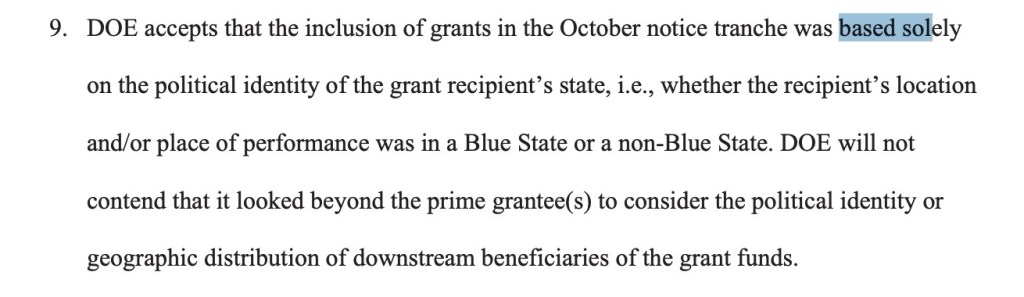
The person who is elected President usually says on election night that he will govern on behalf of the American people. He makes a point of obligation to be respectful for all Governors, to send FEMA to any state that has suffered from natural disasters, regardless of whether they vote for him or his rival.

Trump has said frankly that he hates his enemies. He sometimes doesn’t pretend to care about states that did not vote for him.

Aaron Parnas of the Parnas Perspective points out that the Trump administrative made decisions about environmental grants based solely on whether the states supported him in the 2024 elections. This involved billions of dollars in grants.

Parnas wrote:

A major constitutional violation, confirmed in court. The Trump administration admitted in court filings this month that it canceled 284 Biden era clean energy grants worth billions of dollars based solely on whether the recipient state voted for Kamala Harris in 2024 and had two Democratic senators. A lawyer for the Energy Department conceded that none of the terminations were based on any programmatic, statutory, cost reduction, or performance related factor, directly contradicting Energy Secretary Chris Wright’s June congressional testimony that no decisions were made on politics. The Energy Department disputes any contradiction, saying Wright was distinguishing between the review process and the timing of the cancellations, but hundreds of additional grants the department had itself recommended for cancellation were left untouched simply because they sat in states that backed Trump.

Real projects and real money were caught in the fallout. The politically targeted cancellations halted funding for hundreds of energy projects, including electrical grid upgrades in California and Oregon, methane leak reduction efforts in Colorado, and clean hydrogen fuel hubs in California and the Pacific Northwest. The cuts came in October alongside a broader White House push to pressure Democratic lawmakers during a government funding standoff, with Trump publicly threatening to slash what he called Democrat agencies. Some grant recipients have since sued to try to recover their funding, and this is not the first time the Energy Department has admitted politics played a role, since a federal judge already ruled in two earlier cases that more than a dozen grants were improperly canceled for political reasons, though this latest admission is far broader and more detailed.

Democrats say it exposes a dangerous pattern with more to come. Senator Patty Murray and Representative Marcy Kaptur called the cancellations an outright un-American weaponization of government and accused the administration of corruptly abusing its power to punish states over how they voted. The controversy lands as the administration finalizes new rules, expected by October, that would give Trump’s political appointees direct control to review, block, or revoke federal grants across the entire government, worth more than a trillion dollars annually. Budget office director Russell Vought has defended the changes as necessary to ensure democratic control of spending, but critics, including antipoverty groups, scientists, and city leaders, have flooded the government with comments warning the rules would let the administration extend this kind of political targeting far beyond energy grants. Center on Budget and Policy Priorities fellow Devin O’Connor said the willingness to be this blatant in court should be taken as a serious warning about what the new framework could enable nationwide.