Due to the the Omicron surge of COVID, the Network for Public Education and NPE Action has again rescheduled our in-person conference. It will now be April 30-May 1.
Still in Philadelphia. Still a star-studded roster of parents, educators, and friends of public schools.
Certainties: Great speakers. Terrific panels. Ample time to discuss your concerns. Wonderful opportunity to meet your favorite bloggers. Guaranteed: excitement about joining with old and new friends to learn from one another and to plan for the future.
Gary Rubinstein has followed the progress of the much-lauded Success Academy charter chain, supposedly the most successful in the nation. He has noted that SA graduates only a small fraction of those it admits. He estimates that about 75% are gone before graduation.
Success Academy has argued that a 75% attrition rate isn’t so bad because it is about a 11% attrition per year, compounded, which, they say, is what happens in public schools too. But I don’t think this is a valid argument. Getting into Success Academy is supposed to be like winning the lottery. The attrition rate should be miniscule if Success Academy is as good as they claim. You don’t just give away a winning lottery ticket.
When I was writing The Death and Life of the Great American School System: How Testing and Choice Are Undermining Education (2010), I researched the history of merit pay. I learned that it has been tried again and again for a century, and it has always failed. Business-minded people think that the lure of a bonus will force teachers to work harder and get better results. But merit pay doesn’t work. Its main effect is to demoralize teachers. Michael Bloomberg tried it in NYC, and it failed. It was tried in Tennessee from 2007-2010 with a fat bonus of $15,000. It failed there too. Wherever it was tried, it failed. The theory is wrong, and as the great W. Edwards Deming argued, it doesn’t work in business either.
In 2010, I was invited to meet with the Domestic Policy leadership at the Obama White Housek (Melody Barnes, head of the Domestic Policy Council; Rahm Emanuel, President Obama’s chief of staff; and Roberto Rodriguez, the President’s education advisor). They asked me what I thought of the Common Core standards. I suggested that they give it a trial in two or three states and see how it works before rolling it out nationally. They dismissed the thought. They said national standards had to be in place by 2012, before the election. Then they asked what I thought of merit pay, and I said what I wrote here in the first paragraph. They told me that they were releasing $1 billion for a Teacher Incentive Fund. Waste of my time. Probably a waste of theirs too.
Three years and $11.7 million later, the Charleston County School District doesn’t have much to show for its controversial program that linked teacher pay to student performance.
The Bridge program, devised during previous Superintendent Nancy McGinley’s administration and funded by a $23.7 million Teacher Incentive Fund grant, was supposed to encourage and retain quality teachers by rewarding them financially for good performance. Instead, teacher turnover increased at most of the program’s pilot schools, and internal polls showed that teachers weren’t motivated by the sometimes-paltry payouts.
The district has spent more than half of the grant so far, with only $614,900 going to teacher bonuses since 2013. The bulk has gone to pay consultants and a top-heavy bureaucracy of teacher coaches and evaluators to keep the program running.
The school board voted in February to pay one last round of teacher bonuses this fall and let the federal government keep the remainder of the funds. After that, Bridge will die a quiet death.
Well, quiet for some. For Drayton Hall Elementary teacher Patrick Hayes, the founder of the advocacy group EdFirstSC who has railed against the plan since the district won the grantin 2012, it’s hard not to say “I told you so.”
“It’s absolutely eroded trust and morale. There’s a universal sense that people don’t believe we’re doing our jobs,” Hayes said.
While Hayes said most teachers are comfortable with a principal observing them in class, they were often nervous waiting for the next surprise visit from an evaluator hired by the district office.
“When you get people focused on external rewards, they’re so anxious about those rewards, they focus on that instead of the job you want them to do,” Hayes said. “Overall, the notion that we need the adults to feel more nervous so that the kids will do better is flawed.”
McGinley declined to comment for this story.
Bridge started as a pilot program in 13 high-poverty, high-turnover schools, including North Charleston High and Burns Elementary. Using a formula based on student test score improvements, classroom observations and state evaluations, the district started doling out yearly bonuses of $1,000 to $4,000 for high-performing teachers and school administrators at those schools.
According to the timetable for the federal grant, the district was supposed to start evaluating all of its teachers on the Bridge measures this school year and roll out the raises to every school starting in 2016-17. District Superintendent Gerrita Postlewait estimated in February that the rollout would put a $5 million dent in the district’s already-tight budget next year alone. And once the five-year grant runs out, the district would be on the hook to fund the program without federal support.
School board Chairwoman Cindy Bohn Coats said she didn’t vote to end Bridge because it was an abject failure but because it wasn’t a big enough success to justify the expense.
“With these grants, you have to show such a success that when the grant ends, you’re willing to forgo something you’re doing in favor of that, or find a way to continue paying for it,” Coats said.
Long before Postlewait and the board nixed Bridge, teachers were railing against the program. An October report from the Charleston Teacher Alliance recommended returning the grant money to federal coffers, citing a survey that found just 16 percent of teachers in Bridge pilot schools thought the program was working.
“We are paid for our service, not for its outcome,” said Charleston Teacher Alliance Director Jody Stallings, a Moultrie Middle teacher. “The same is true of soldiers, police officers and doctors, for very good reason. The factors that go into our success depend on so much more than individual effort.”
Stallings said his group tried to convince both the McGinley administration and interim Superintendent Michael Bobby that the Bridge plan was “flawed, wasteful and doomed.” But it wasn’t until after Postlewait took office in July that the tide started to turn against the plan.
Despite Bridge’s many outspoken detractors, a district spokesman wrote that the program “received favorable feedback” when federal Teacher Incentive Fund workers paid a visit in spring 2015. And it did have local supporters, even toward the end.
In November, shortly after taking over responsibility for Bridge from previous district leaders, Project Director Anita Huggins wrote in an email to Postlewait that a panel of five school principals unanimously supported accepting another year’s worth of grant money. Listing some of the principals’ comments, she wrote that returning the funds during an $18 million budget crisis “could be a significant PR challenge” and “could exacerbate CCSD’s culture of ‘not finishing’ anything.”
“Regardless of whether we admit it,” she quoted one principal as saying, “the grant has resulted in an increased awareness of student achievement data.”
By that time, Bridge was already hobbled. In October, the district office had reassigned 10 TIF grant-funded professional development coordinators to school-level positions paid by the General Operating Fund, moving them out of the Bridge program. Postlewait had also begun putting a wide array of district projects under the microscope, from reading interventions to behavior management programs, looking for a “return on investment” to justify their continued existence.
Bridge wasn’t a total loss. The district was able to collect classroom observation and student growth data for “nearly all teachers” this school year, according to a district spokesman, and the program put the district ahead of the curve when the state started requiring all teachers to complete student learning objective paperwork.
Coats said she hopes conversations like the one that brought about Bridge’s demise will become a regular occurrence as the district moves toward a zero-based budgeting system that takes no expense for granted.
“I don’t think Charleston County School District will ever be a truly successful district until we are willing to do that on an annual basis,” Coats said. “Look at programs. Are they working? Should we expand them? Should they continue?”
In 2014, Russia invaded Ukraine and took control of the Crimean Peninsula, which was then absorbed into Russia. Presently, Putin has stationed at least 100,000 troops on Ukrainian borders, and leaders in the West are fearful that he intends to invade and seize control of all Ukraine. Ukraine has a long and terrible history under Russian control. In the late 1920s and 1930s, Stalin collectivized Ukrainian agriculture and sent troops to export Ukrainian crops to Russia. Millions of Ukrainians were killed or starved to death in the ensuing famine. Historian Robert Conquest wrote a history of these events callled Harvest of Sorrow. It is a terrifying history. Today, it appears that Vladimir Putin wants to reassemble the Soviet Union. He once called its dissolution the worst geopolitical tragedy of the 20th century.
Secretary of State for Defence Ben Wallace discusses NATO, Ukraine and Russia.
Defence Secretary in Olsztyn, Poland.
I have lost count of how many times recently I have to had to explain the meaning of the English term “straw man” to my European allies. That is because the best living, breathing “straw man” at the moment is the Kremlin’s claim to be under threat from NATO. In recent weeks the Russian Defence Minister’s comment that the US is “preparing a provocation with chemical components in eastern Ukraine” has made that “straw man” even bigger.
It is obviously the Kremlin’s desire that we all engage with this bogus allegation, instead of challenging the real agenda of the President of the Russian Federation. An examination of the facts rapidly puts a match to the allegations against NATO.
First, NATO is, to its core, defensive in nature. At the heart of the organisation is Article 5 that obliges all members to come to the aid of a fellow member if it is under attack. No ifs and no buts. Mutual self-defence is NATO’s cornerstone. This obligation protects us all. Allies from as far apart as Turkey and Norway; or as close as Latvia and Poland all benefit from the pact and are obliged to respond. It is a truly defensive alliance.
Second, former Soviet states have not been expanded ‘into’ by NATO, but joined at their own request. The Kremlin attempts to present NATO as a Western plot to encroach upon its territory, but in reality the growth in Alliance membership is the natural response of those states to its own malign activities and threats.
Third, the allegation that NATO is seeking to encircle the Russian Federation is without foundation. Only five of the thirty allies neighbour Russia, with just 1/16th of its borders abutted by NATO. If the definition of being surrounded is 6% of your perimeter being blocked then no doubt the brave men who fought at Arnhem or Leningrad in the Second World War would have something strong to say about it.
It is not the disposition of NATO forces but the appeal of its values that actually threatens the Kremlin. Just as we know that its actions are really about what President Putin’s interpretation of history is and his unfinished ambitions for Ukraine.
We know that because last summer he published, via the official Government website, his own article “On the Historical Unity of Russians and Ukrainians”. I urge you to read it, if you have time, because while it is comprehensive on his arguments it is short on accuracy and long on contradictions.
We should all worry because what flows from the pen of President Putin himself is a seven-thousand-word essay that puts ethnonationalism at the heart of his ambitions. Not the narrative now being peddled. Not the straw man of NATO encroachment. It provides the skewed and selective reasoning to justify, at best, the subjugation of Ukraine and at worse the forced unification of that sovereign country.
President Putin’s article completely ignores the wishes of the citizens of Ukraine, while evoking that same type of ethnonationalism which played out across Europe for centuries and still has the potential to awaken the same destructive forces of ancient hatred. Readers will not only be shocked at the tone of the article but they will also be surprised at how little NATO is mentioned. After all, is NATO ‘expansionism’ not the fountain of all the Kremlin’s concerns? In fact, just a single paragraph is devoted to NATO.
The essay makes in it three claims. One: that the West seeks to use division to “rule” Russia. Two: that anything other than a single nation of Great Russia, Little Russia and White Russia (Velikorussians, Malorussians, Belorussians) in the image advanced in the 17th Century is an artificial construct and defies the desires of a single people, with a single language and church. Third, that anyone who disagrees does so out of a hatred or phobia of Russia.
We can dispense with the first allegation. No one wants to rule Russia. It is stating the obvious that just like any other state it is for the citizens of a country to determine their own future. Russia’s own lessons from such conflicts as Chechnya must surely be that ethnic and sectarian conflicts cost thousands of innocent lives with the protagonists getting bogged down in decades of strife.
As for Ukraine, Russia itself recognised the sovereignty of it as an independent country and guaranteed its territorial integrity, not just by signing the Budapest Memorandum in 1994 but also its Friendship Treaty with Ukraine itself in 1997. Yet it is the Kremlin not the West that set about magnifying divisions in that country and several others in the Europe. It has been well documented the numerous efforts of the GRU and other Russian agencies to interfere in democratic elections and domestic disputes is well documented. The divide and rule cap sits prettiest on Moscow’s head not NATO’s.
Probably the most important and strongly believed claim that Ukraine is Russia and Russia is Ukraine is not quite as presented. Ukraine has been separate from Russia for far longer in its history than it was ever united. Secondly the charge that all peoples in Belarus, Russia and Ukraine are descendants of the ‘Ancient Rus’ and are therefore somehow all Russians. But in reality, according to historian Professor Andrew Wilson in his excellent essay for RUSI entitled “Russia and Ukraine: ‘One People’ as Putin Claims?” they are at best “kin but not the same people”. In the same way Britain around 900AD consisted of Mercia, Wessex, York, Strathclyde and other pre-modern kingdoms, but it was a civic nation of many peoples, origins and ethnicities that eventually formed the United Kingdom.
If you start and stop your view of Russian history between 1654 and 1917 then you can fabricate a case for a more expansive Russia, perhaps along the lines of the motto of the Russian Tsar before the Russian Empire “Sovereign of all of Rus: the Great, the Little, and the White” – Russia, Ukraine and Belarus respectively. And crucially you must also forget the before and after in history. You must ignore the existence of the Soviet Union, breaking of the Russian-Ukrainian Friendship Treaty, and the occupation of Crimea. Far more than footnotes in history, I am sure you will agree.
Ironically, President Putin himself admits in his essay that “things change: countries and communities are no exception. Of course, some part of a people in the process of its development, influenced by a number of reasons and historical circumstances, can become aware of itself as a separate nation at a certain moment. How should we treat that? There is only one answer: with respect!” However, he then goes on to discard some of those “historical circumstances” to fit his own claims.
Dubious to say the least, and not in anyway a perspective that justifies both the occupation of Crimea (in the same way Russia occupied Crimea in 1783 in defiance of the Russo-Turkish Treaty of Kuchuk-Kainarji in 1774) or any further invasion of modern Ukraine, as an independent sovereign country.
The last charge against the West by many in the Russian Government is that those who disagree with the Kremlin are somehow Russophobes. Leaving aside that GRU officers deployed nerve agents on British streets or that cyber hacking and targeted assassinations emanate from the Russian state, nothing could be further than the truth.
Russia and the UK share a deep and often mutually beneficial history. Our allegiances helped to finally defeat Napoleon and later Hitler. Outside of conflict, across the centuries we shared technology, medicine and culture. During the 18th Century Russia and Britain were deeply tied. Between 1704 to 1854, from age of Peter the Great through Catherine the Great and well into the 19th Century the British were to be found as admirals, generals, surgeons, and architects at the highest level of the Russian Court. The father of the Russian Navy – one Samuel Greig – was born in Inverkeithing in Fife.
That shared admiration is still true today. The British Government is not in dispute with Russia and the Russian people – far from it – but it does take issue with the malign activity of the Kremlin.
So, if one cold January or February night Russian Military forces once more cross into sovereign Ukraine, ignore the ‘straw man’ narratives and ‘false flag’ stories of NATO aggression and remember the President of Russia’s own words in that essay from last summer. Remember it and ask yourself what it means, not just for Ukraine, but for all of us in Europe. What it means the next time…
The event is sponsored by Public Funds Public Schools and the Network for Public Education.
Dr. MacLean is author of the brilliant book Democracy in Chains, which documents the Koch brothers’ relentless efforts to privatize government functions.
Peter Greene explains how the Koch machine is creating new brands to hide its identity from the unsuspecting. The billionaires Charles and his late brother David were infamous for funneling Dark Money through front groups whose names sounded innocuous or inspiring. Now Charles Koch is reaching out to a new generation, attempting to pour his rancid wine into new bottles. One of the most insidious aspects of “reform” is the way it steals sweet-sounding names and attaches them to its odious goal of privatization. To understand the sham of “reform,” you need to understand that the words usually mean the opposite. “Reform” has nothing to do with reform; it is a cover for disruption and privatization.
Greene writes:
Remember when Charles Koch wrote that he had done an oopsie by being so partisan and dividing the country? That was back in late 2020, and it was followed by the rise of a new Koch Brand–Stand Together–which in turn spawned a new substack about fixing education called “Learning Everywhere.” It turns out that the Koch metamorphosis was not done yet.
“Learning Together” was co-hosted by Lisa Snell, director of K-12 education policy for Stand Together, aka the Charles Koch Institute. Previously she spent 23 years as Director of Education at the Reason Foundation. Her co-host is Adam Peshek, who is part of the same Kochtopus, having arrived Jeb Bush’s ExcelinEd (formerly FEE). Peshek also works at Yes, Every Kid, a rebranding of some standard reform ideas. The substack started out playing the reformy hits (did you know schools are built on the factory model? well, they weren’t, but did you think so anyway? Snell and Peshek would like you to think so). So, Charles Koch Institute is now Stand Together Trust, an organization that now has a hip young vide. Check out the website– “We help you tackle the roots of America’s biggest problems” in bold print over dynamic vides. Hugging! Clapping! Black people! “Everyone is tired of all the fighting over problems with very little focus on real solutions.” Among the issues they want to address is education, and their dynamic new solutions are…well, the same old ones. They insist that education is currently one-size-fits-all (news to teachers in public schools), and they have the same old right-tilted complaints– we spent more money but test scores didn’t go up! Families give education a C (but we’re not going to point out that they give far higher grades to the local schools they know). Individualized education is where it’s at.
There’s a video in which Sal Khan, promoter of an educational program that involves students sitting and passively watching a video, complains that education involves students sitting passively while listening to a teacher. Other “leaders” they bring up are Diane Tavenner, head of Summit Schools (a school-in-a-box not-great tech product). There are lots of pictures of exciting active learning, all of which could have come from a public school. Aaron Frumin, founder of unCommon Construction, who talks about how frustrated he became “as a teacher” which he was for the two whole years he spent with Teach for America. His program uses students as laborers to build houses, an innovative program pretty much like the one the vocational technical school in my county has had for sixty years. Here’s Todd Rose “By any measure, the system doesn’t work.” Rose was a professor at Harvard’s Graduate School of Education and founder of the Center for Individual Opportunity and he runs the think tank Populace. And he has a Story, in which he dropped out of high school (“The system failed me.”) There’s some more talk about believing in students (which, again, is not unheard of in public schools). “Success doesn’t have to mean one thing. We need our education system to have a much broader view of success.”
That’s the pitch. Well, actually, the pitch is use your money to invest in these people doing this stuff. But also, we got 11 major education bills passed in 8 states in 2021, and somehow we don’t talk about what those bills did, like pushing privatization of education or gagging of teachers. There are case studies of success, like Cadence Learning, one more cyber-school venture, this one launched by Chris Cerf, Ian Rowe and Steven Wilson–all god privatization champions.
Meanwhile, the known recipients of ST grants are not so much education revolutionaries as the same old Koch style conservative crews. Americans for Prosperity, Bill of Rights Institute, Bellwether Education, Foundation for Individual Rights in Education, Texas Public Policy Foundation, Vela Education Fund.
The substack has now transformed into a new title– Permissionless Education. That term has cropped up several places lately, and it really captures the Libertarian mindset of not wanting to have to ask for anyone’s permission to do anything ever, a mindset I can recognize immediately because I live with a pair of four-year-old toddlers.
Open the link and read on to understand what the Kochtopus is really aiming for with all these new names and old faces.
Throughout the country and in Illinois, we have seen the rise of well-funded disinformation campaigns targeting school boards and educators.
This event will cover: Who’s behind the disinformation campaign around masks/vaccines mandates, an erosion of LGBTQ+ rights and the way race is being taught in our schools? How can we band together to support our school boards and staff who are being threatened and to protect public education?
Hear from an excellent panel and connect with others around Illinois who are organizing in their communities to stand up for inclusion, safety, and teaching a full and accurate history in our schools that protects all students
Panelists include: — Jennifer Berkshire, Co-Author “A Wolf at the Schoolhouse Door” — State Senator Cristina Pacione-Zayas, Former VP Policy for Erikson Institute and ISBE board secretary and member — Nathaniel Rouse, Director of Equity, Race, and Cultural Diversity Initiatives, Barrington 220 — Julie Harris, Educator of 31 years Tinley Park CCD146
Hosted by Indivisible Illinois, Illinois Families for Public Schools, Indivisible Illinois Social Justice Alliance and more.
North Carolina has been in the forefront of destructive education policies ever since the Tea Party won control of the state’s General Assembly (legislature) in 2010. Charters, vouchers, TFA, high-stakes testing, hostile indifference to teachers, etc.
But the rightwingers in NC wanted more. They wanted their own version of the Tennessee Achievement School District. They knew that Tennessee lawmakers had created a special district containing the state’s lowest-scoring schools; these schools would show dramatic improvement if handed over to charter operators.
The North Carolina legislators ignored the clear evidence that the Tennessee ASD was a failure, despite the state’s investment of $100 million from Race to the Top funding. Failure was no deterrent, no way to dissuade them from launching the magic elixir of privatization.
The Innovative School District was supposed to contain five schools, but every time a school was designated, its district fought to keep the school. The ISD opened with only a single school, and that one school had a principal, a superintendent, and a charter management organization. An awful lot of administrators for one school.
Alex Granados wrote about the collapse of this bad idea in EdNC:
In an experiment, a hypothesis is tested. In the case of the Innovative School District(ISD), the hypothesis was that some of the state’s lowest-performing schools could be improved if they were grouped into one district, given charter school-like flexibility, and turned over to the management of alternative operators.
To judge by the biennium budget passed by the General Assembly in November 2021, North Carolina lawmakers must have concluded that the ISD experiment did not yield the result of improving schools, at least not in the way it was originally conceived. What other conclusion can be drawn from the fact that lawmakers put an end to the project in their two-year spending plan?
Background
The Achievement School District bill was passed during the 2016 General Assembly short session. At the heart of the legislation was the creation of a district that would eventually include five low-performing schools from around the state that could be turned over to charter school operators.
It was originally called the Achievement School District and its first superintendent, Eric Hall, said at the time that it was modeled after similar experiments from other states that had “mixed results.”
“We have an opportunity as a state to redefine what it means in North Carolina,” Hall told the State Board of Education in 2017. But that redefinition never quite came to be.
A single school
The initial plan was that all five schools in the ISD would be up and running by the 2018-19 school year. It is now the 2021-22 school year, and there is still only one school. That is thanks to, in large part, massive resistance from some of the districts approached by the state.
The single school that was taken over as part of the ISD was Southside-Ashpole Elementary School in Robeson County. And it’s been a tough journey both for the school and for the district — since its inception, the ISD has had four superintendents and the school has had three principals.
Current ISD Superintendent Ron Hargrave told the State Board of Education in December 2021 about visiting a kindergarten class at Southside-Ashpole on his first day. A teacher said to him: “‘Well, you’ll be number four,’ and she was talking about the number of superintendents who’ve come through there,” he said.
Hargrave replied, “I’m going to do everything in my power to make sure you don’t need a number five, because I’m here to stay.”
But turnover hasn’t been the only issue.
The nonprofit charter organization that was running the operation was ultimately relieved of its responsibilities by the State Board of Education. You can read about the difficulties with that organization, Achievement for All Children (AAC), in N.C. Policy Watch here and here.
‘No common ground’
Did Southside-Ashpole improve? According to data, no.
Trip Stallings, whose team conducted the external evaluation of the ISD when he was with the Friday Institute for Educational Innovation, said that a single school’s performance can’t really tell us anything about how well the ISD concept might work as a multi-school turnaround program.
“Because they only had one school in three years, you can’t really use that experience to validate or disprove the ISD approach,” he said. But there are a number of issues evident from even the experience of a single school that may have weakened the ISD structurally, according to Stallings.
One issue was that the legislation that created the ISD assumed there would be a wide variety of Charter Management Organizations (CMOs) vying to manage schools in the ISD. Instead, only three CMOs applied to manage Southside-Ashpole. The State Board of Education asked all three to resubmit their original proposals and, ultimately, the revised proposal from AAC was accepted.
“The real question is, ‘Why did other CMOs not apply?’” Stallings said.
Former ISD Superintendent Eric Hall presents to the State Board of Education Thursday, April 5, 2018. Alex Granados/EducationNC
Another problem, according to Stallings, was the disconnect among the operator, the State Board of Education, and the state Department of Public Instruction (DPI) regarding how the ISD as a program should be implemented and managed.
“For example, none of the parties really reached agreement on the question of what this ‘charter-like flexibility’ means,” he said.
As a result, a superintendent, principal, and CMO leader all tried to assert separately how the single school in the district needed to operate. This led to confusion and dysfunction, he said.
Finally, Stallings said that the remote nature of the program was a “significant handicap.” DPI, AAC, and the school were all in separate locations and remote from each other not just geographically, but also culturally.
“They didn’t see many things in the same way,” he said. “For some issues, there was no common ground.”
According to the budget, Southside-Ashpole Elementary School will continue as part of the ISD until 2023-24 at the latest, when it will be returned to the Public Schools of Robeson County.
Craig Horn, a former Republican state representative from Union County, said this is terrible news. Not because he was a big fan of the ISD — he said he wasn’t — but because it is indicative of how the General Assembly operates.
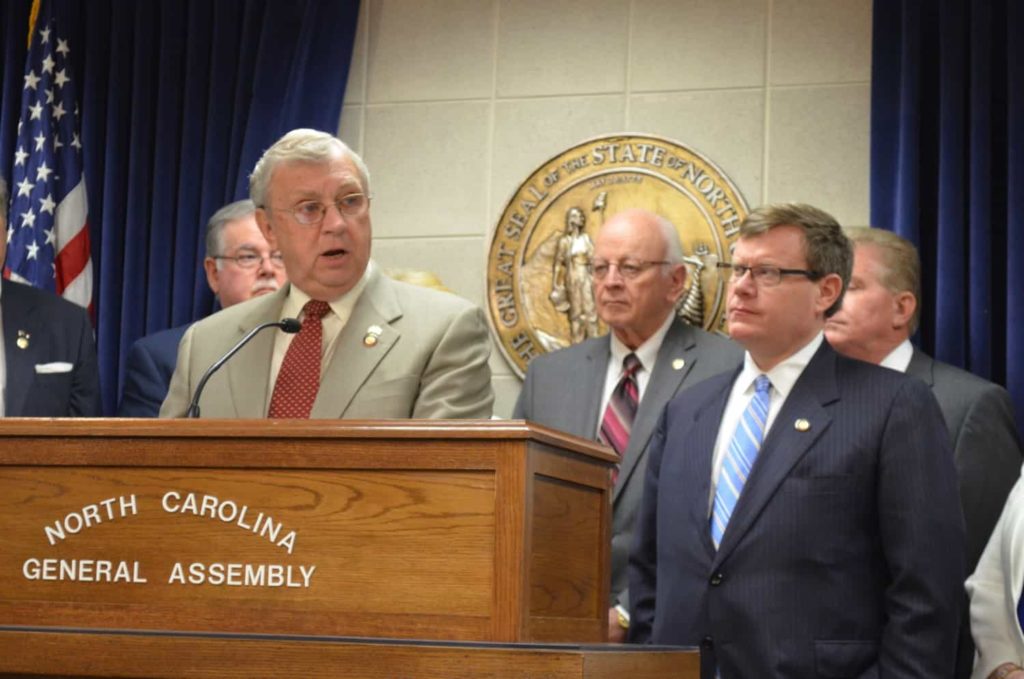
Rep. Craig Horn, R-Union, talking about the education portions of the budget at a 2017 press conference. Alex Granados/EducationNC
Horn, an influential legislator when it came to education, lost his seat when he ran for the state superintendent position and lost to Catherine Truitt in 2020. He was there for the inception of the ISD.
“I’m going to suggest that rather than sit down and work out the problems, it’s easier and faster to say, ‘Ok, we’re done. We’re not doing it,’” he said.
Horn had a lot of problems with the ISD program, but said that if it has failed, he hopes lawmakers have done their homework to understand why.
“If we can say that we did our homework, we actually talked to the people inside, we actually talked to parents and students, we actually made some adjustments and we’re still failing, OK, then we made an informed decision,” he said. “But my experience with the General Assembly is they don’t always make informed decisions.”
Preparing for transition
The State Board of Education heard from the current leaders of the ISD and Southside-Ashpole at the December 2021 meeting.
Derrick Jordan, associate superintendent of agency schools, told the Board that efforts to improve the school are still happening.
“There is absolutely still work to be done, but there is an unwavering commitment to improving outcomes for the students at Southside-Ashpole,” he said.
And Hargrave stressed to Board members that the students in that school are “full of potential.”
“It is a school full of children who desire to be loved and desire to be taught, and they have a hunger for learning,” he said.
Freddie Williamson, superintendent of the Public Schools of Robeson County, said the district is ready to have the school back and is already working with the school and the ISD to prepare for a “smooth, seamless transition.”
There isn’t yet a timeline for the transition, but when Southside-Ashpole does return back to the control of Robeson County schools, State Board of Education member Olivia Oxendine said she hopes it keeps innovation a priority. She said innovation takes a long time, and whatever the ISD, the new teachers, new principal, or the community have done, it should continue.
“Whatever is beginning to happen called innovation, let’s carry it forward,” she said.
Nothing on the record shows that there was either innovation or achievement at the one school in the experimental district. But whatever it is, says Ms. Oxendine, keep doing it, even though it yielded no improvement.
The full story of North Carolina’s failed experiment is fascinating. The bill to create the state’s Innovative School District was sponsored by Republican Rob Bryan. The money to promote the bill was supplied by an ultra-conservative businessman from Oregon named John Bryan (no relation to the legislator). After the bill passed, the state Board of Education selected Achievement for All Children (AAC) as the charter operator, although it had no experience turning around low-performing schools.
Mecklenburg County Republican Senator Rob Bryan sponsored the bill as a member of the House in 2016 that became law and created the ISD. That law specifies that the ISD can have up to five schools, selected from the lowest-performing in North Carolina.
Bryan argued at the time that the new district would provide much-needed reforms, but the following year, as Policy Watch reported, he received at least $5,000 as a “stipend” for his work with AAC.
Several other low-performing schools, including two in Durham, were targeted for state takeover in 2017, but resisted the move. Then-ISD Superintendent Eric Hall ended his pursuit of those schools.
That left Southside-Ashpole, which began operating as the state’s first and only school within the Innovative School District at the start of the 2018-19 school year. Southside-Ashpole has an enrollment of 270, 95% of whom are students of color: Black, Latinx and American Indian.
In its first year as an ISD school, there was a wholesale house cleaning at Southside-Ashpole: After Superintendent Allen abruptly left, the State Board of Education hired Ellerbe to replace her. School principal Bruce Major also suddenly resigned, and AAC then hired Bowen.
It remains unclear whether the changes were due to job performance.
Meanwhile, there has also been a major upheaval within AAC’s business partner, TeamCFA, a Charlotte-based nonprofit that provides financial, instructional and management support to more than a dozen schools in North Carolina and four in Arizona.
TeamCFA is AAC’s curriculum partner, according to the ISD website.
TeamCFA was started by John Bryan (no relation to Rob Bryan), a retired Oregon businessman who has used his wealth to promote school choice causes.
John Bryan is also a major contributor to Republican lawmakers and was instrumental in helping to pass the North Carolina law that created the ISD. From 2013 to 2016, Rob Bryan’s campaign received more than $22,000 in contributions from John Bryan, state reports show. John Bryan also contributed to then-Gov. Pat McCrory, Lt. Gov. Dan Forest, NC House Speaker Tim Moore and Senate President Pro Tem Phil Berger.
Raleigh’s News & Observer reported in October that Bryan and the Challenge Foundation, which Bryan also formed, stopped funding TeamCFA. In his final founder’s letter, Bryan talked about passing on the responsibility to other private investors and philanthropists.
TeamCFA had received as much as 95% of its annual revenue from Bryan and the Challenge Foundation, the paper reported. TeamCFA also receives $510,000 annually from the Charles Koch Foundation.
The NC Republican leadership was heavily funded by John Bryan from Oregon. Bryan was the funder of TeamCFA. TeamCFA was the partner of the only charter operator that applied to manage the district that was created by legislation funded by John Bryan.
What happened to the 270 students in the one school in the Innovative school District? Well, they have had a constant turnover of principals and superintendents. They were Guinea pigs for legislators who don’t know them and apparently don’t care about them.
Our flawed policy is the result of deeply ingrained flawed thinking.
The United States, he writes, is the victim of a combination of forty years of skepticism of government solutions and acceptance of “let’s be realistic about what we can accomplish” thinking.
For example, for decades scattershot treatments of outcomes have characterized bi-partisan education improvement efforts with little to nothing to show for it except undermined public education and stress. The driving causes of inequitable outcomes, systemic inequity, its enabler, racism, and resultant precarious lives remain rampant and unaddressed.
Instead, the dominant education interventions have been to push or blame individuals. These include rewards and punishments for educators or students based on standardized test scores; rigid discipline regimes; and, more recently, a focus on developing grit to work through, put up with, or overcome rather than eliminate challenging social and economic conditions.
Equally, if not more, insidious is you-can’t-save-everyone solutions, such as escape hatches for some kids through charter schools and vouchers, most of which are no better than local public schools. More broadly, the lack of universal health care and inequitable funding of schools through local real estate yield the same help-a-few result.
This is a remarkable document in the New York Times. It details the planning and coordination for violent action that began as soon as the results of the 2020 were clear. The Oathkeepers, extremists who refused to accept Trump’s loss, started their efforts to stockpile weapons and convene in D.C. on January 6. Of course, other groups and unaffiliated individuals joined them.
This account directly contradicts the claims by Trumpers that Antifa or the FBI were behind the riots or that the insurrectionists were peaceful protestors exercising their First Amendment rights.