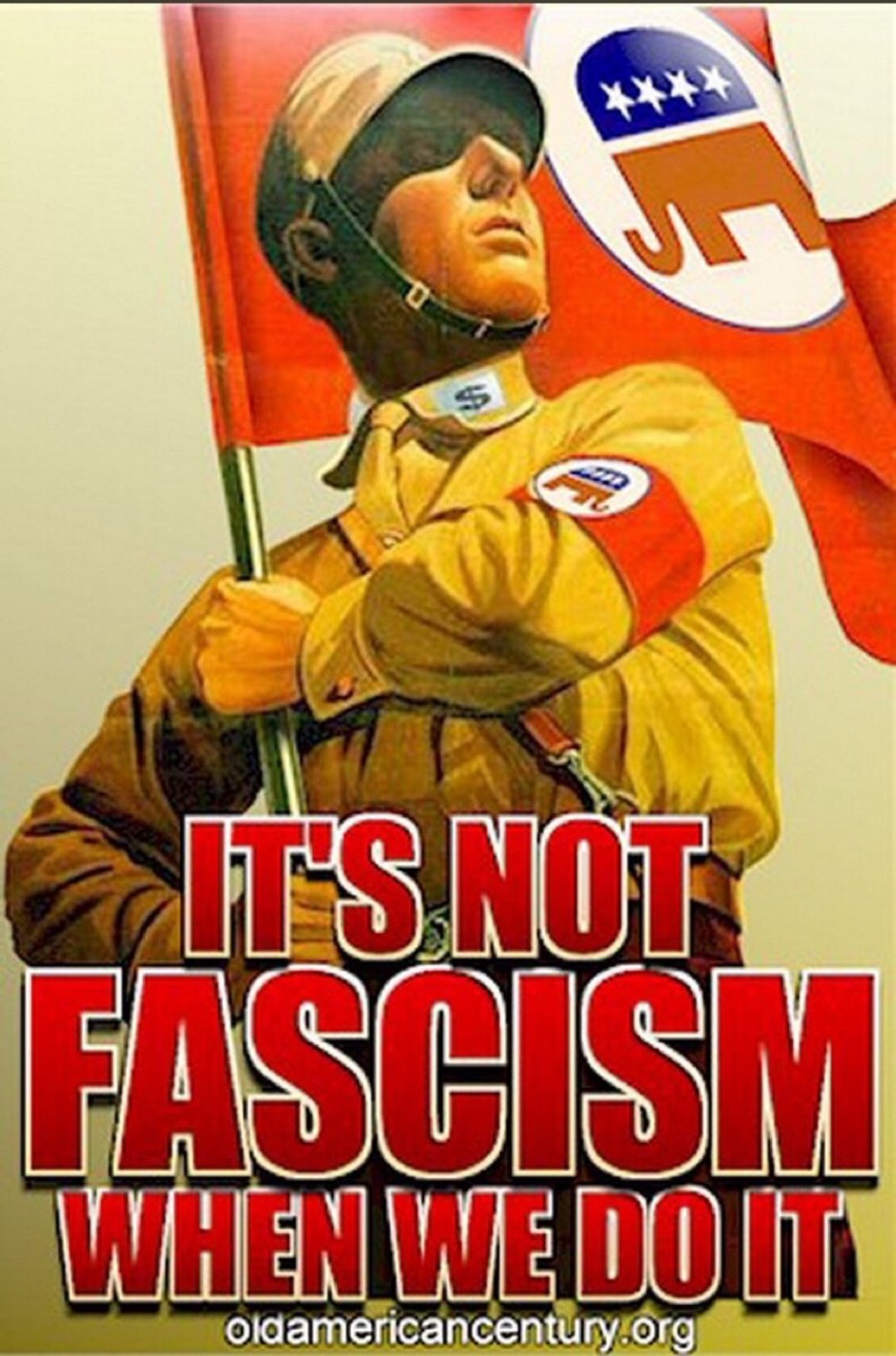
The current Republican Party has reverted to the ace card it held in the 1950s: its followers refer to every government program as socialism. SOCIALISM!! This one word is supposed to terrify everyone into fearing that government is about to take away their freedoms. Those politicians who do this should be asked if they are willing to abandon their own right to Social Security and Medicare. One of their favorite targets in recent years is public education. They are trying to persuade the public that their local public schools are socialism. This is nonsense. The following opinion piece by Janet Ward appeared in the Concord Monitor.

A few years ago at a gathering in my town, a fiery speaker said that our government is reaching into our pockets through taxation in order to steal our hard-earned money to pay for programs that are simply giveaways to growing numbers of the “undeserving.” This is not true.

This lie has been created because the former president, the moneyed interests who support him, and the inventors and funders of the “Big Lie” regarding our free and fair 2021 election are painfully aware that the people they wrongly label as the “undeserving” have the right and the power to vote.

Let us be clear. The former president and his supporters are convinced that our democracy itself poses an existential threat to their way of life. They would prefer a plutocracy, a government controlled by the wealthy.

In our democracy, we, you and I, govern ourselves through representation by legitimately elected legislators. Social programs exist because we the people believe that these programs are necessary and appropriate and that such programs, like our public schools, contribute to the common good, to the well-being of our entire society. But an insidious revolution, decades in the making, is bearing terrible fruit.

The long-standing belief that public schools benefit our entire society has been intentionally and successfully undermined through a decades-long strategy organized and executed by such entities as the State Policy Network and the American Legislative Exchange Council (ALEC) which provides templates of legislation to Republican lawmakers in every state to achieve such things as the dismantling of public education. But why target public schools?

Last year the Republican majority in our New Hampshire Legislature voted to approve a school voucher program. It is now legal for public tax dollars to be used to pay for private, religious or home-schooling programs over which we taxpayers have virtually no oversight. When asked why they supported school vouchers, Republican legislators, most of whom had been educated in public schools, said that they believed New Hampshire public school students were being brainwashed by teachers’ unions to believe in socialism. This is not true.

Good government is not socialism. Socialism is a system of government in which the government owns the means of production. Our country is not socialist. It is a capitalist country where individuals or corporations own the means of production and where decisions regarding prices, production and the distribution of goods are based on competition in a free market….

What will happen if Big Lies are allowed to prevail? Our democracy will be destroyed. The perpetrators of these lies will become the governors of our nation, and the dreams of Americans like Jefferson, Madison and Lincoln will die.

The death of our democracy will happen soon, on our watch, unless each of us uses the powerful weapon that our democracy has provided to us — our vote. Remove the liars and manipulators from office. Vote to restore our democracy.
The Network for Public Education posted this article by Mark Perna, which originally appeared in Forbes.

Mark C. Perna: Why Education Is About To Reach A Crisis Of Epic Proportions

If you missed this widely shared article the first time it was burning around the internet, here’s a chance to catch up. This piece by Mark C. Perna for Forbes lays out just how bad the current crisis is.

In order to reach and teach students effectively, teachers must forge a human connection with them. Today’s younger generations simply will not move forward in their education and career journey without that connection. This is a non-negotiable; it’s just who they are.

The vast majority of teachers truly want to forge that meaningful connection with students. In fact, for many it was the driving force behind their decision to enter the profession. But, understaffed and overworked as they are, many simply have no time to show students that they see, hear, and care about them. Survival mode—where many teachers have lived for the past two years—doesn’t allow much room for relationship building.

This creates a vicious cycle. Students aren’t performing, so more burdens are placed on teachers to help students hit the mark, thus decreasing teachers’ time and bandwidth to forge a human connection with students that is the basis for all learning. Teachers’ legs are cut out from under them, yet they’re still expected to carry their students across the finish line. It’s a gridlock.

What’s the fallout of all this burnout and lack of connection? We’ll see significant drops in three vital areas:

A drop in young people entering the profession, a drop in education quality, and a drop in graduation rates are three problems Perna predicts. Follow this link to read the whole piece.

You can view the post at this link : https://networkforpubliceducation.org/blog-content/mark-c-perna-why-education-is-about-to-reach-a-crisis-of-epic-proportions/

———-

Anthony Faiola writes in the Washington Post that a Russian invasion of Ukraine would cause global disruption of food and fuel supplies.

More than 100,000 Russian troops are massed near Ukraine amid a flurry of diplomatic efforts to defuse the prospect of conflict. Should peace not prevail, western-gazing Ukrainians would pay the highest price. But in a worst-case scenario, the cost of a major Russian invasion of Ukraine — one of the world’s largest grain exporters — could ripple across the globe, driving up already surging food prices and increasing the risk of social unrest well beyond Eastern Europe.

As tensions mount, one focus of economic concern is the global impact of extreme Western sanctions on Russia — a major exporter of agricultural goods, metals and fuel, particularly to Western Europe and China. Should the crisis escalate to the point of triggering staggering sanctions, the blow could spike prices and worsen global supply chain woes by tightening markets for commodities including natural gas and metals such as nickel, copper and platinum used in the manufacturing of everything from cars to spacecrafts.

Yet perhaps just as crucially, a major Russian incursion would also affect the flow of goods from Ukraine, the world’s fourth-largest supplier of wheat and corn. A major disruption of Ukrainian exports — especially in conjunction with any interruption in even larger Russian grain exports — could pile onto a global inflationary cycle that in many countries is already the worst in decades.

Concern is especially focused on fuel and food. Last year, global food prices surged 28.1 percent to their highest level in a decade, according to the United Nation’s food agency. Worries of war have already driven U.S. corn futures to their highest levels since June and sent wheat futures to two-month highs before a recent easing.

Over the past 20 years, bountiful Ukrainian harvests boosted the country’s role as a global breadbasket. Some of its biggest clients are economically battered, war-torn or otherwise fragile states in the Middle East and Africa, including Yemen, Lebanon and Libya, where grain shortages or cost surges could not only deepen misery but churn up unpredictable social consequences.

The world waits to see what Putin wants and commands.

The Washington Post reports that more than half the school districts in Virginia are defying Governor Youngkin’s order to eliminate mask mandates.

Youngkin boasted on a conservative radio program that only a small percentage of districts were not complying with his belief that masks should be optional.

But a Washington Post analysis shows that the majority of Virginia public school districts — enrolling more than two-thirds of the state’s students — have opted to disobey Youngkin’s mask-optional order. As of Wednesday, two days after the order was supposed to take effect, 69 districts, or 53 percent, are still requiring masks for all students inside schools. Cumulatively, those districts enroll 846,483 students, or about 67 percent of the state’s public school student population. The divide falls along partisan lines, although not perfectly: Almost every district that opted to make masks optional is in a locality that voted for Youngkin in the 2021 gubernatorial election.

The widespread defiance suggests Youngkin will have enormous difficulty in enforcing his mask-optional mandate, which is already the subject of two lawsuits: one from parents in Chesapeake, and one from seven school boards that oversee some of the state’s largest, most prominent school districts. A hearing on the second suit is scheduled for next week. Youngkin has said he will use every tool at his disposal to carry out his order as those cases wind through the court system, and his spokeswoman did not rule out disciplining disobedient districts by yanking their state funding…

Frederick Hess, a senior fellow and director of education policy at the right-leaning American Enterprise Institute, said he thinks Youngkin should stay the course on his masking policies, while vigorously fighting back against the two lawsuits challenging the executive order.

If parents prioritize the health and safety of their children, they will tell them to wear a mask in school and wherever groups of people congregate.

You may recall that a Texas state legislator named Matt Krause released a list of some 850 books that he thought should be removed from school libraries. Even public libraries are under pressure to clear their shelves of the books that Krause identified. The books are about race, racism, sex education, anything related to LGBT, student legal rights, and gender.

This link includes the full list of books that Krause wants to ban.

Yesterday, Christopher Tackett (@cjtackett) tweeted that the book purge has begun in his district.

He wrote:

Today in Granbury ISD, at the High School library, they came with a hand cart and carried away multiple boxes of books tagged with “Krause’s List”.

They can do this because the board voted 7-0 on Monday to change district policy allowing books to be removed prior to a review.

He wrote that students, parents, and teachers protested to the school board but their voices were ignored. The superintendent pushed for the purge and ridiculed the opponents as “gaslighters and radicals.”

Some excellent comments from outside Texas. This one from Hugh G. Merriman:

The parallels are chilling…

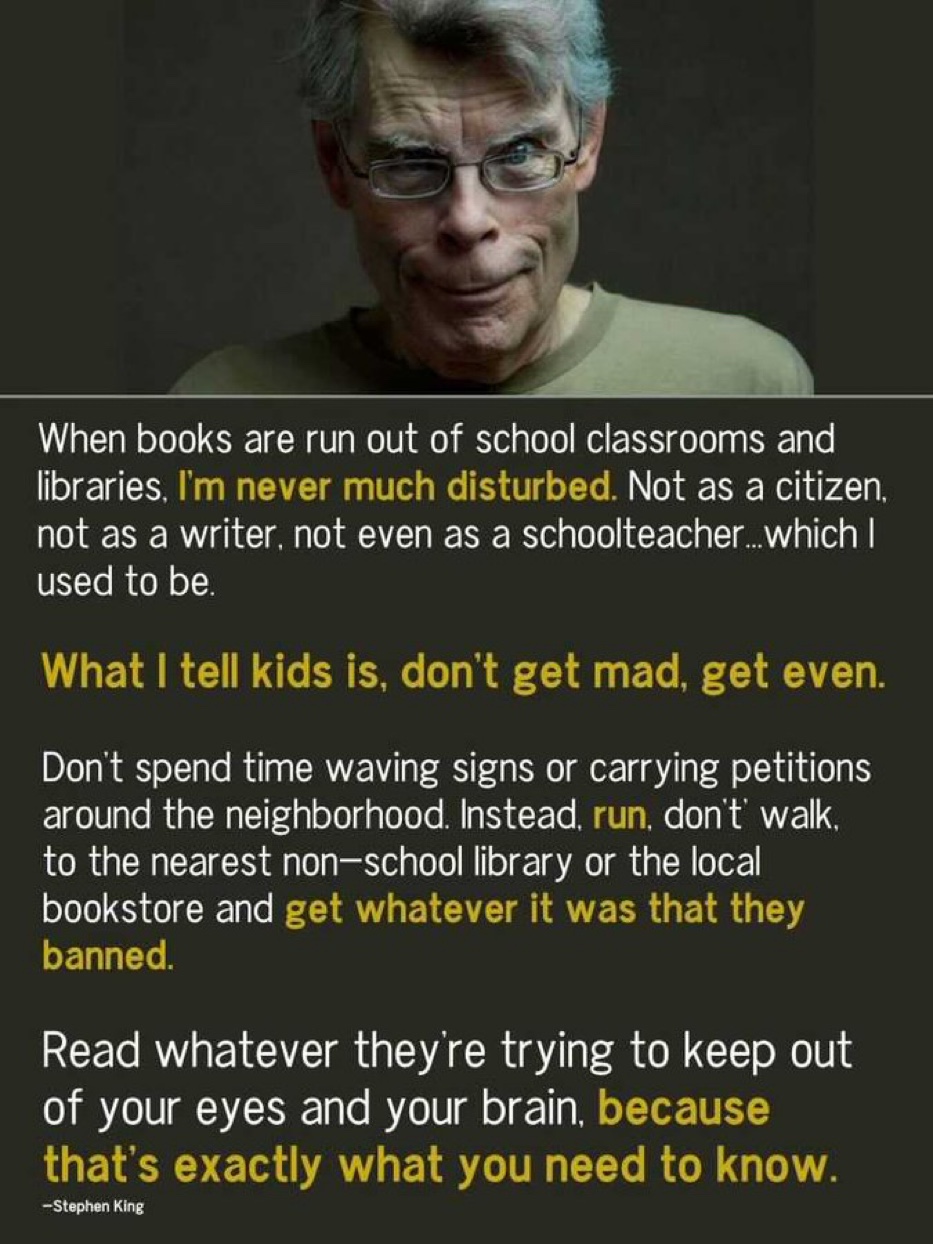
And this advice, quoted from Stephen King:

I disagree with the opening line in the King quote. I am very much disturbed when books are banned from schools and school libraries. Next, they will pull them from the public library, and not many students can afford to buy the banned books. Protest, wave signs, speak up. Be loud. Make noise.

The school board in McMinn County, Tennessee, voted 10-0 to ban the Pulitzer-Prize winning graphic novel Maus from its schools. Board members complained about unacceptable language (“God damn”) and nudity (nude mice). The book by Art Spiegelman is about his father’s brutal experiences during the Holocaust. Presumably, the board wants the story of genocide told in a pleasant, inoffensive way.

Teachers in the district testified on behalf of the book.

The members of the school board heard from English language arts instructional supervisors about why the book was being used in the curriculum, the meeting minutes show.

Board member Tony Allman took issue with how the content would be redacted, and added, “We don’t need to enable or somewhat promote this stuff. It shows people hanging, it shows them killing kids, why does the educational system promote this kind of stuff? It is not wise or healthy,” according to the meeting minutes.

In response, instructional supervisor Julie Goodin countered, “I was a history teacher, and there is nothing pretty about the Holocaust, and, for me, this was a great way to depict a horrific time in history,” the meeting minutes say.

“Mr. Spiegelman did his very best to depict his mother passing away, and we are almost 80 years away. It’s hard for this generation. These kids don’t even know 9/11. They were not even born. For me, this was his way to convey the message,” Goodin continued.Black parents say movement to ban critical race theory is ruining their children’s education

Melasawn Knight, another instructional supervisor, echoed Goodin’s stance that the graphic novel depicts history as it happened, the meeting minutes indicate.

“People did hang from trees, people did commit suicide and people were killed, over six million were murdered,” Knight said.

“I think the author is portraying that because it is a true story about his father that lived through that. He is trying to portray that the best he can with the language that he chooses that would relate to that time, maybe to help people who haven’t been in that aspect in time to actually relate to the horrors of it.

“Is the language objectionable? Sure. I think that is how he uses that language to portray that,” Knight said.

It is not possible to teach the history of the Holocaust without acknowledging organize brutality, savagery, mass murder, and sadism. Teaching the history honestly is no doubt offensive to Nazis, but one imagines they are not a significant bloc in McMinn County. If the school board wants to protect students against the reality of the Holocaust, what are teachers allowed to say about slavery, Jim Crow, lynchings, and the KKK?

The Holocaust is personal to me. My mother and grandmother left Balti, Bessarabia, and arrived in the United States in 1917. My grandfather came before the war. Most of the family stayed in Europe. My father’s parents came in the 19th century from Lomza, Poland. Most of their family stayed in Poland.

Not one member of my family survived the war. All perished in the Holocaust.

Inappropriate comparisons to the Holocaust are common and undermine its significance. Just today, Robert F. Kennedy, Jr., apologized on Twitter for comparing the effort to vaccinate people to the Holocaust. An incredibly vicious comparison since vaccines save lives; no one’s family is being burned in a furnace because of getting vaccinated.

A message from the Anti-Defamation League.

Soon after the reunification of Germany, ADL organized a leadership mission to a united Germany. One of our most significant meetings was with Dr. Rita Süssmuth, then-head of the Bundestag (Germany’s House of Representatives). One member of our group asked her about teaching young Germans about the Holocaust.

Her answer is even more relevant today than it was then.

She said that one can’t talk about that horror in the same way to the young generation as speaking to their parents or grandparents. They are too far removed from the events of World War II. What is necessary, she reasoned, are creative approaches to make the history relevant and visceral.

Süssmuth’s comment comes to mind as we observe International Holocaust Remembrance Day on Jan. 27, which is also the anniversary of the liberation of the Nazi concentration camp Auschwitz-Birkenau. There is no doubt that more than 80 years after World War II, a variety of factors are coming together posing challenges to Holocaust memory, but all the news in this arena is not bad. It’s a good time to take stock.

The negatives are abundant. First, as is often discussed, a major instrument for educating young people — the living testimony of survivors — is diminishing rapidly as most survivors are gone. One hears over and over again that a survivor speaking about his or her experience before a classroom or school assembly has awakened the students as to what the Holocaust was all about and why they should care about it.

Second, the statistics on the lack of knowledge about even the basics of the Holocaust are concerning. A Pew survey revealed that more than 80 percent of Americans know that it was an attempt at the annihilation of Jews, but far fewer have any idea as to how Hitler came to power and how the horrors came to pass.

The Claims Conference surveyed younger Americans and found that 63 percent of millennials and Gen X-ers did not know that six million Jews had been murdered in the Holocaust.

And ADL’s Global 100 Survey several years ago found that only 54 percent of people worldwide had ever heard of the Holocaust and 32 percent thought it was greatly exaggerated or a myth.

Third, the meaning of the Holocaust is undermined seemingly every day by its trivialization through inappropriate analogies. In the hyper-political and polarized world we live in, exacerbated by social media, it seems that everything one doesn’t like is compared to the Nazis or the Holocaust.

And, of course, one of the most egregious comparisons — often meant to undermine the significance of Holocaust memory — is equating Israeli treatment of the Palestinians to the Nazi treatment of Jews. In other words, so the warped logic goes: The world had its Holocaust, now “the Jews have their own.”

Fourth, Holocaust denial continues to have a life of its own and has found a particular lifeline as extreme right groups look for respectability. There is no doubt that historically the association of the murder of six million Jews with Nazism and fascism has been the major obstacle for decades for such groups to gain legitimacy in political circles. Denying or at least diminishing the Holocaust can open a pathway for revival for extreme right groups who until now have been largely excluded from a role in democratic societies.

This is a powerful combination of factors. There is, however, the other side, where a good deal of progress has been made in Holocaust awareness and acknowledgement.

In the early days, it was Jews and Israelis who were the leaders in educating about the Holocaust. Israel, as a home for the largest number of survivors, invested in the matter with Yad Vashem, Yom HaShoah and the Eichmann trial. Over the last few decades, however, we have seen growing involvement of other governments and broader societies in this project. This is a good development.

So, the U.N., often seen as hostile to the Jewish people because of its many anti-Israel stances, has incorporated two important Holocaust-related elements into its programming and policies. The first is that of today, International Holocaust Remembrance Day, which produces annual programs, statements and recollections and keeps the attention of the international community on this genocide for one day.

The second is a resolution passed just recently which denounces Holocaust denial as against U.N. values.

Another cross-country effort, initiated by Sweden, is the International Holocaust Remembrance Alliance, which, in effect, builds on the U.N. initiative to implement educational processes about the Holocaust in participating countries. Recently, its participants met in Malmo, Sweden to discuss practical ways to move forward on Holocaust education and combatting antisemitism. And, of course, many Holocaust museums have cropped up across the U.S. and Europe, the most important the U.S. Holocaust Memorial Museum, which attracts large numbers of visitors, most of whom are not Jewish.

And then there are the many efforts by non-governmental organizations, two of particular significance being the Shoah Foundation’s vital interview project of survivors and ADL’s Echoes and Reflections public school education curriculum and program on the Holocaust.

These and many others try to live up to Süssmuth’s plea for creativity in connecting young people to the Holocaust. Holocaust knowledge and awareness are clearly more important than ever because of the passage of time, the surge of antisemitism, the loss of shame about antisemitism as the Holocaust is more distant, and the rise in extremism of all kinds and the efforts to legitimize fascism.

Examples are the use of artifacts, photographs and testimony to encourage students to present their own questions about those events; real time questions and responses from Holocaust survivors using hours of pre-recorded video footage; and the use of local U.S. news sources during the period of Nazi rule and how events were seen from an American perspective. Holocaust awareness and acknowledgement are clearly more important today than ever.

Kenneth Jacobson, ADL

Michael Hiltzik of the Los Angeles Times explains why American copyright law benefits major corporations, not the creators of original works.

In 2022, he says, there will be a bumper crop of well-known titles that will enter the public domain, including Winnie the Pooh, Ernest Hemingway’s The Sun Also Rises, poetry collections by Dorothy Parker and Langston Hughes, and first novels by William Faulkner and Agatha Christie. A number of sound recordings, including ones by Al Jolson and Enrico Caruso will no longer be copyrighted.

Hiltzik writes:

As it happens, however, this massive release isn’t something entirely worth celebrating. Instead, it’s a pointer to the sheer absurdity of American copyright law, which long ago came under the thumb of the entertainment industry and distant heirs of artists determined to preserve what is essentially a windfall.

It’s proper to keep in mind that copyright law was not designed originally to keep cash flow running for future generations of a creator’s family. The idea was always to preserve an incentive for creators to create, by guaranteeing that they would be able to enjoy the fruits of their own labor for a set period.

The first U.S. copyright law, passed in 1790, established a limit of 14 years, and allowed the original creator, if still living, to renew the copyright for another 14 years.

Eventually, the term was extended to 28 years, plus a single renewal option of another 28. (The vast majority of copyrights were never renewed.) The 1976 Copyright Act extended the term to 50 years from the date of an author’s death, and the 1998 Sonny Bono Act increased it to 70 years after the death of the author, and to 95 years after publication for corporate works-for-hire.

The Walt Disney corporation and the families of George Gershwin and Oscar Hammerstein, among others, have lobbied effectively to keep their copyrights intact. Disney wants to protect its rights to Mickey Mouse as long as possible. Even though A.A. Milne’s book Winnie the Pooh will no longer be copyrighted, Disney owns and defends the animated forms of Winnie, as well as the trademark of ”Winnie the Pooh.” The Disney copyright on Mickey Mouse is scheduled to expire January 1, 1924, but Hiltzik bets that Disney will lobby for another extension of the law to protect its property.

A notable feature of all this maneuvering over copyright terms is that it hasn’t done much to straighten out the mazes of copyright claims afflicting some of our culture’s most important and popular creative legacies.

Emily Dickinson, for instance: The Belle of Amherst died in 1886 with the vast majority of her poems unpublished (indeed, unknown). That was 136 years ago, but most of her works are still subject to a copyright claimed by Harvard University, which maintains that “all applications to quote or reprint Emily Dickinson material should go through the Harvard University Press Permissions Department.”

Harvard zealously defends its control of Emily Dickenson’s works.

Otto Frank, the father of Anne Frank, holds the copyright to her diary until the 2040s, even though she died in 1945 at age 15 in a concentration camp.

The family of Dr. Martin Luther King holds the copyright to everything he wrote, including his speeches.

Hiltzik writes: As I reported in 2015, the King family stringently controlled broadcasting of King’s seminal “I Have a Dream” speech without royalty payments, even as the 50th anniversary of its Aug. 28, 1963 delivery on the National Mall approached in 2013.

When I compiled an antholgy of great Americans speeches, poems, and songs called The American Reader in 1990, I had to pay the family royalties to include not only the ”I Have a Dream” speech, but his important ”Letter from a Birmingham City Jail.” They are significant historical documents, and I wrongly assumed they were in the public domain.

Extending the copyright of original works for a century does not encourage creativity, especially when the creator of that work has died. The descendants should have a reasonable time to enjoy the fruitsof their relatives’ labors. But that too should be limited to a generation, not monetized through multiple generations. It is even harder to justify the century-long copyright eagerly sought and won by corporations.

Hiltzik concludes:

A return to the fundamental principles on which copyright law was originally based would point to a reduction in copyright terms, not the persistent efforts to lengthen them. That’s especially so in the digital age. As the Duke scholars [at Duke’s Center for the Study of the Public Domain], argue, “the public domain is being impoverished just as its opportunities for creativity, innovation, democratic participation, and knowledge advancement are transformed.”

Knowing the power of the corporate lobbyists, he is doubtful that the terms of copyright will be reducedn more likely, they will be extended yet again. You know, Mickey Mouse.

Governor Youngkin invited parents to report the names of teachers who are violating the state’s vague and ill-defined law banning the teaching of “divisive concepts,” critical race theory, and anything else any parents object to.

Peter Greene describes the creative responses of respondents. Responses to an email address can come from anywhere, not just Virginia. You too can write to Youngkin’s Stasi.

Anyone can send their reports to the tip line email:

helpeducation@governor.virginia.gov

Greene writes:

But of course you know what else happened next. The tip line has apparently been hit with a variety of reports, like a complaint that Albus Dumbledor “was teaching that full blooded wizards discriminated against mudbloods.” Some of this has been goaded on Twitter by folks like human rights lawyer Qasim Rasgid. And John Legend correctly pointed out that under the guidelines of the decree, Black parents could legitimately complain about Black history being silenced (because, as sometimes escapes the notice of anti-CRT warriors, some parents are Black). Ditto for LGBTQ parents.

Greene also includes a useful list of questions to answer if you write the Governor: like, “who was your favorite teacher and what did they teach?”

Glenn Youngkin’s campaign for Governor of Virginia was fueled in large part by attacks on public schools. Youngkin said that the state’s public schools were indoctrinating students with critical race theory. He pledged to put an end to it. After he took office, he continued his rant against CRT; he even set up an email site where parents can complain about teachers. And to add to his rightwing cred, he banned mask mandates. A number of school districts are suing him to preserve their mask mandates.

Dana Milbank wrote about the elite private schools where Youngkin sent his own children. They very explicitly teach critical race theory. Youngkin knew what was going on: he was a member of the board.

Milbank wrote:

Not only is Virginia’s new Republican Gov. Glenn Youngkin banning the fictional menace of critical race theory from public schools, but he’s also turning the commonwealth into a little Stasi State. He’s setting up a tip line so parents can report to the government any school official they consider to be teaching something “divisive.”

“We’re asking for folks to send us reports,” he told a conservative radio host Monday, The Post reported. “We’re going to make sure we catalogue it all,” he added, “to make sure we’re rooting it out.”

The state’s deputizing of residents to act as informants will have the obvious effect of deterring even mentions of slavery or race, which means Youngkin has imposed a de facto “memory law” whitewashing Virginia’s, and the country’s, deep and ongoing history of white supremacy…

The public schools of Virginia do not teach critical race theory.

But do you know which schools do teach “divisive” concepts, including something resembling critical race theory? The private D.C. schools Youngkin had his children attend. And you know who was on the board of governors of one of those schools while it was beefing up its anti-racism policies? Glenn Youngkin.

Youngkin, a professed fan of public school parents’ rights, exercised his own parental rights not to send his children to Virginia public schools but rather to National Cathedral School and St. Albans School, twin private all-girl and all-boy schools in D.C. under the auspices of the Episcopal Church.
National Cathedral’s website listed Youngkin as a member of its governing board from 2016 through 2019, and he was chair of its finance committee. To their credit, both National Cathedral and St. Albans were, during that time, leaders in developing anti-racism teachings, even before the murder of George Floyd heightened national awareness of systemic racism. Youngkin’s spokeswoman, Macaulay Porter, said that Youngkin “stepped off the board after 2019” and that both schools “changed a lot over the years.”

DEI — Diversity, Equity and Inclusion — has been a priority at National Cathedral for many years. The school has an extensive staff devoted to the initiative, as well as programming that includes affinity groups such as diversity forums, an equity board, an intersectionality council and a student diversity leadership conference. A National Cathedral strategic plan approved by the board in 2018 — during Youngkin’s tenure — “includes the mandate to ‘Advance an Inclusive Educational Environment,’ ” which involved “integrating related action steps into the fabric of everything we are and do as a school community.”

Among the other things National Cathedral has done: made time in the school schedule for “critical conversations around topics of race, anti-racism, social justice, and inclusion”; added courses such as “Black Lives in Literature” and “Courageous Dialogues”; developed new hiring protocols “as a result of our anti-bias work” and required diversity training for all staff members; and included in the school’s summer reading list books such as Robin DiAngelo’s “White Fragility: Why It’s So Hard For White People To Talk About Racism….”

St. Albans has undertaken similar anti-racism initiatives. Among the books promoted on the school’s website are “White Fragility,” “Critical Race Theory: An Introduction,” Henry Louis Gates Jr.’s “Stony the Road: Reconstruction, White Supremacy and the Rise of Jim Crow,” and Ibram X. Kendi’s “Stamped from the Beginning: The Definitive History of Racist Ideas in America.”
St. Albans also directed faculty to read Kendi’s “How to Be an Antiracist.” Fox News and other conservative outlets this past fall blasted a St. Albans’s “anti-bias” policy draft.

Youngkin’s own children were lucky to have attended schools that make its students grapple with uncomfortable and, yes, “divisive” issues. So why is he now using the powers of the state to intimidate teachers who would give Virginia’s public school students the same advantage?