So Pennsylvania has unveiled a new plan to stop the exodus with the help of an organization pushing the same policies that made teaching undesirable in the first place.
Count on Jan Resseger to follow the news that matters most for the well-being of America’s children. West Virginia Senator killed President Biden’s ambitious Build Back Better plan, an effort to reverse climate change, invest in education, reduce child poverty, and much more. But the child tax credit, which directly helps children, is not dead yet, she writes.
It would appear that Senator Joe Manchin’s sabotage of the expanded Child Tax Credit as part of Build Back Better has killed the restoration of last year’s extraordinary but temporary improvement of this federal program as part of the American Rescue Plan COVID relief bill. But America’s child poverty advocacy coalition has not yet given up and neither have the experts at the Center on Budget and Policy Priorities. Democratic leaders in Congress—Senators Sherrod Brown, Michael Bennet, Cory Booker, Ron Wyden and Raphael Warnock—and Representatives led by Rosa de Lauro are still in conversation with Republican Senators Mitt Romney, Richard Burr and Steve Daines, who have offered two versions of their own Republican Child Tax Credit proposal.
It is urgently important for America’s public school educators and child advocates to keep on pushing for expanding the Child Tax Credit and making it fully refundable. The educational damage of child poverty cannot be solved through school reform. While teachers can support children whose lives are ravaged by our society’s alarming economic inequality, public schools alone cannot undo the stresses and privations that poverty imposes on America’s poorest children.
Much of the ongoing conversation this month has been about the Family Security Act, proposed by Senator Romney and other Republicans, which would replace the Build Back Better Better version of the Child Tax Credit that was rejected by Senator Joe Manchin. Last week a coalition of national child advocacy organizations, the First Focus Campaign for Children, wrote a letter to Senators Mitt Romney, Steve Daines and Richard Burr to explain why their recent version of the Family Security Act isn’t good enough: this most recent version will leave America’s very poorest children in worse straits than a version Romney proposed in 2021.
Here is the First Focus Campaign for Children: “The good news is that we know what works to reduce child poverty.” A 2019 landmark National Academy of Sciences, Engineering, and Medicine (NASEM) “study finds that a child allowance, operating as an extension of the Child Tax Credit, is the most powerful tool we have to combat child poverty and narrow the racial poverty gap. Extensive research shows when households with children receive cash transfers, they spend it on resources that support their children’s healthy development—improving their physical and behavioral health and educational outcomes and leading them to earn more as adults… The first version (2021) of the original Family Security Act proposed by Senator Romney would have cut child poverty by an estimated 32.6%… Households with the least resources would have been eligible to receive the full (newly increased) Child Tax Credit… Unfortunately, as the Family Security Act morphed into version 2.0, changes focused on adults were made to the Child Tax Credit and significantly reduced the positive impact it would have on millions of children. The ‘best interests of children’ became an afterthought as the focus shifted to some sort of ‘deservedness’ standards for adults that has the effect of punishing children. As a result, the Niskanen Center’s updated analysis shows that the Family Security Act 2.0 would only reduce child poverty by just 12.6%.”
The Center on Budget and Policy Priorities details the primary reason why the latest version of the Family Security Act would punish children in families with the lowest income: “To qualify for the maximum credit for each child in the family, families would need to have earned at least $10,000 in the prior year… Families with earnings below $10,000 would receive a proportional credit. For example, a family earning $5,000 would receive 50 percent of the maximum credit for each child.” Families with no income would no longer qualify, but couples earning up to $400,000 per year would qualify as would single parents making up to $200,000 annually.
But, as the Center on Budget and Policy Priorities further explains: “The $10,000 earnings requirement to receive the full credit would apply to all families, including parents with babies and young children, retired grandparents caring for their grandchildren, and parents with disabilities that may limit their ability to work. It would also newly require caregivers not only to live with the child but also to have legal custody of the child, which is stricter than current law and may disqualify many grandparents or other relatives who care for children from claiming the credit. And it would impose a new restriction for families that include immigrants: under current law, children must have a Social Security number (SSN) to qualify for the Child Tax Credit, but the proposal would impose an additional requirement that a parent also have an SSN, denying the credit to children who are U.S. citizens if their parents lack an SSN.”
The Center on Budget and Policy Priorities explains another serious problem when several of the provisions of the newest version of the Family Security Act, are computed together: “The Romney proposal… (would require) families with low and moderate incomes to pay for more than half the cost of expanding the credit… The Romney plan would dramatically cut the Earned Income Tax Credit (EITC) a credit that provides an income boost for workers with low and moderate incomes, and eliminate the ‘head of household’ tax filing status, which millions of single parents who work at low-paying jobs use when they file their income tax returns… For example, consider a single mother who has a toddler and a daughter in second grade and works as a home health aide, making $25,000 a year. Her family’s Child Tax Credit would grow by $3,640 under the Romney plan, but they would lose $4,105 from the EITC cuts and the elimination of the head of household filing status, for a net income loss of $465. If both children were age 6 or older, the net income loss would be even larger: $1,665.”
The Center on Budget and Policy Priorities summarizes what would be the primary effects of the latest Family Security Act provisions: “Denying the full credit to children based on their parents’ earnings would do virtually nothing to boost parental employment and would withhold help from the children who most need it….
Open the link and read the rest of her important analysis.
Arthur Camins is a lifelong educator and social justice activist. In this post, he explains why Democrats are wrong to pursue Republican voters with Republican themes instead of promoting policies that uplift the common good. Centrism has not helped the Democratic Party.
He writes:
Republicans lead. Democrats follow. And that makes all the difference. Libertarian and wealth-protecting Republican ideologues invest to influence and change most people’s normative ideas and values, whereas Democrats seek to discern and appeal to what voters already think. That has been the case for decades. It has been a triumph for conservatism and the protection of privilege. For Democrats, it remains a losing strategy to win elections, a disaster for a more equitable nation, or any hope of avoiding the worst effects of climate change.
The Republican’s route to power has been to shift public thinking toward several big ideas and implied values: Resources are scarce and therefore competition and inequity are natural and inevitable. Therefore, the pursuit of personal advancement is the only reasonable course of action. In that context, the advance of underrepresented minorities has been understood as coming at the expense of White people. The values message has been, “Look out for yourself because no one else will.” That dystopian message is designed to enable Republicans’ core idea: Financial regulation and taxes on wealth are a counterproductive limitation.
Responding to Republican inroads with white working class and lower-middle class voters in the Nixon and Reagan years, Democratic leadership, led in particular by Bill Clinton, pursued a different approach. They attempted to gain or retain political office by discerning how people already think and crafting appeals and policies to meet them. In pursuit of votes of the elusive undecided voters, Democrats picked up on conservative themes, ceding the war of ideas to Republicans.
For example, upon signing the Personal Responsibility and Work Opportunity Reconciliation Act of 1996 and in an exchange with reporters on August 22, 1996, President Bill Clinton said, “The new bill restores America’s basic bargain of providing opportunity and demanding, in return, responsibility.”
Clinton was responding to Ronald Reagan’s characterization of minority welfare recipients as con artists eating steak and driving Cadillacs living off the tax contributions of hardworking, law-abiding white workers.
“Here in America, we’ve never guaranteed success — that’s not what we do. More than in some other countries, we expect people to be self-reliant. Nobody is going to do something for you. We’ve tolerated a little more inequality for the sake of a more dynamic, more adaptable economy. That’s all for the good. But that idea has always been combined with a commitment to equality of opportunity to upward mobility — the idea that no matter how poor you started, if you’re willing to work hard and discipline yourself and defer gratification, you can make it, too. That’s the American idea.”
So, we have Democrats at the highest level parroting the conservative shibboleth that poverty is a problem of the failure of personal responsibility and self-discipline rather than racism and inequity built into the structure of our socio-economic system.
Mainstream Democratic response to the push for charter schools is yet another example of their acceptance of deeply conservative language and with it, its underlying ideology. Publicly supported alternatives to democratically governed public education have several roots: getting tax dollars for religiously based schools; support for schools to skirt the Supreme Court rulings against the segregationist separate-but-equal doctrine; acceptance of the idea that government-led bureaucracies cannot be reformed democratically; attempts to squeeze profit from K-12 schools at taxpayers’ expense; and last but not least, undermining the influence of strong public-sector unions. The tagline du-jour for all of this is the right to parental choice, the core of which is the idea that education is a personal consumer good rather than a shared society necessity.
The bipartisan education policy of the last forty years has been a response to insecurity. American schools predictably fail to live up to the absurd disingenuous or naïve promise that education can provide equity in a systemically inequitable society. For Republicans, such insecurity is an opportunity to sew fear and division while promoting their everyone-out-for-yourself dogma. Unfortunately, Democrats rather than challenge that core ideology, have settled for, “You can’t save everyone, so let’s save a few.”
William J. Mathis, Ph.D., has served as a school superintendent and vice-president of the Vermont state school board. He also served as Managing Director of the National Education Policy Center and is the president-elect of the Horace Mann League of America.
In the beginning, Kansas irregulars attacked Missouri. Missouri replied in kind. It was an unneighborly kind of war. Little mercy was asked and little was given. The Osceola raid, it was said,counted but one survivor. But with the rush of hot-blood, truth is often the victim. The partisans vowed righteous vengeance on each other, heated their rhetoric and twisted their courage for the oncoming civil war. It left 215,000 laying on the ground.
We fumble through our historical rolodex for comprehensible parallels to the insurrection ofJanuary 6; looking for something that explains, something that restores, something that fills the emptiness.
Such conflicts are not innocent unexpected surprises by play-pretend soldiers. Aggressive words lead to aggressive actions. People die.
Then, as now, crises were foreshadowed. Jayhawkers and Harper’s Ferry were not accidents. Our Constitution neglected the humanity of 4 million enslaved African Americans. Chief Justice Roger Taney, author of the Dred Scott decision, concluded that Blacks could not be citizens because they were not. Ranked the worst Supreme Court decision in history, this judicial miscarriage was influenced by President Buchanan who, until our times, was widely criticized as the nation’s worst president.Alienating both North and South, he could have prevented the Civil War – but he didn’t.
We have great accomplishments but we also have great fiascos. Benedict Arnold sold out when his ego was not stroked. Vice President Aaron Burr killed Alexander Hamilton in a duel and launched a “filibuster” or invasion of Mexico. Acerbic Andrew Johnson got impeached and U. S. Grant’s administration is known for corruption. But Grant’sreal sin was the wink and nod he gave to the oppression of native Americans. After teaming up with red-baiting Senator Joe McCarthy, PresidentRichard Nixon resigned in disgrace.
These shames pale in comparison to Donald Trump’s behavior. What the former president has in common with this rogue’s gallery is a selfish disregard of people and an enormous regard for himself. His minions flatter their Emperor and compliment his new clothes while ignoring his buck nakedness. It took a 26 year-old woman’scourage to say the Emperor was dressed a little light for the weather.
Meanwhile, black-robed justices summoned older spirits, “’tis time! ‘tis time! Double, double toil and trouble.” In one infamous week of opinions they overturned laws on women’s health, religion in the schools, scuttled environmental protections and approved carrying a gun in a society suffering thesickness of repeated mass murders.
Compounding these benighted events, the worst inflation in forty years placed the greatest burdenon people of limited means. The more affluent saw their investment portfolios crash faster than their travel plans. Hit with covid, a cautious population isolated itself while Russia weaponizedoil. The blockade of Ukrainian food threatens the world food supply.
Will the Center hold? – We have survived many crises and in turn, been strengthened by them. But the past is not always the predictor of the future. Rather, the turn of the tale lies in our ability to cohere as a nation and as a society.
We speak of the “United States.” Is it? The East and West coasts are solidly blue while the South and the mid-West are red. The economic and migration patterns increase and sharpen the inflection points. Will we see “Bloody Kansas” again? What is this beast that slaughters people claiming protection of a Constitutional right?
The “greatest generation,” those who came of age in World War II, and gave us the baby boom are coming to the end of their lives. We see the fading of the institutions that for one small flash made the American Dream a reality for some. We promised equality and access to opportunities.Instead, the wealth and educational gaps are increasing while politicians gerrymander voting districts to freeze political power to their advantage. School privatization claims “freedom of choice’ but the least reflection shows the reality is segregation and inequalities. At the same time, the exploding costs of elite higher educationinstitutions, make them inaccessible to children on the wrong side of the wealth gap. People advantaged by this system want to keep it that way.
We have survived the litany of our devils and prospered by the actions of our saints. Yet, the purpose of a democratic society is to build and sustain a fair and just society. It is endangered. We face an election that will likely tell the tale. Our obligation is to select leaders based not on the thin chaff of election season but on the principles and wisdom by which the candidates havegoverned, their commitment to the strengtheningof the commonwealth, and their manifest compassion to embrace all citizens.
Andrea Gabor is the Bloomberg Professor of Bisiness Journalism at Baruch College of the Coty University of New York.
Nearly all of the 20 largest US school districts will offer online schooling options this fall. Over half of them will be offering more full-time virtual school programs than they did before the pandemic. The trend seems likely to continue or accelerate, according to an analysis by Chalkbeat.
That’s a problem. School closings over the last two years have inflicted severe educational and emotional damage on American students. Schools should now be focusing on creative ways to fill classrooms, socialize kids and convey the joy of collaborative learning — not on providing opportunities to stay home.
Historically, various forces have pushed for online education — not all of them focused on improving education. These include: the quest for cheaper, more efficient modes of schooling; the push to limit the influence of teachers unions by concentrating virtual teachers in non-union states; and a variety of medical and social factors that lead some students and families to prefer online learning.
Since the pandemic, some virtual programs have reasonably stressed medically fragile students. But others are seizing on online education in a rushed effort to shore up public-school enrollments, which plummeted in some cities. The prevalence of these programs in Los Angeles, Philadelphia, Dallas and New York is particularly worrying, as they target poor and minority students who are likely to be particularly ill-served by online school options.
A new study shows that while young children, especially, are bouncing back from the pandemic-era academic doldrums, the gap between high-poverty and low-poverty schools remains greater than it was pre-pandemic.
Research, where it exists, shows consistently worse educational outcomes for online schools than for traditional public schools.
Students in cyber schools do their coursework mostly from home and over the internet, with teachers often located in different states and time zones. There is little comprehensive information about the curricula, student-teacher ratios, how much actual teaching occurs, or what if any academic supports are provided by the schools.The adverse impact of the pandemic on the emotional well-being and social skills of children — one-third of school leaders reported a surge in disruptive student behavior during the past school year — is a cautionary lesson for online learning.
Graham Browne, the founder of Forte Preparatory Academy, an independent charter school in Queens, New York, said recently that he saw a sharp increase in “aggressive or threatening” behavior, especially among 6th graders who spent much of the previous two years online.
During a recent multi-day field trip to a camp run by the Fresh Air Fund, Browne said he noticed that during team-building exercises, such as figuring out how to carry a large object over a low bridge, students resorted to screaming at each other. Previously, he said, they would have worked out a strategy for maneuvering the object together.
Equally concerning, when the school offered an online option during the 2020-2021 school year, Browne found that close to half of his highest achieving 8th graders — those taking algebra rather than pre-algebra — selected the option because it gave them the flexibility to pursue academics at their own pace.
“Our school is small, so having such a large portion of high-performing students out of the building has an impact on peer tutoring, student morale, and a culture of team building that we emphasize at school,” Browne said.
Opinion. Data. More Data.Get the most important Bloomberg Opinion pieces in one email.EmailBy submitting my information, I agree to the Privacy Policy and Terms of Service and to receive offers and promotions from Bloomberg.
The most immediate threat, however, comes from the private sector and especially from for-profit virtual charter schools, which are of notoriously poor quality; just 30% met state school-performance standards, compared with 53% for district-run virtual schools before the pandemic. These schools, which spend heavily on advertising, boomed during school lockdowns, when traditional schools were struggling to offer online instruction. At the nation’s largest for-profit network, enrollment grew 45% to 157,000 students during the past year.
What kids need most are robust in-person learning opportunities and the chance to experiment. Schools also need to maintain reassuring safety protocols as Covid-19 variants continue to spread.
This is the time for schools to adopt engaging learning approaches, such those of a high-poverty school in the Bronx that uses the Bronx River as a science laboratory, and of the Leander, Texas school district that turned over the development of an anti-bullying strategy to high school students, in the process building young leaders.
Some of these projects could be adapted to a hybrid format by giving students the option to do some work remotely, while also emphasizing in-person collaboration.
What makes no educational sense is the rush to embrace online schooling. Experience has demonstrated its severe disadvantages. State oversight isn’t strong enough to mitigate them. Before barreling ahead, research should be financed and conducted by independent scholars to pinpoint the potential benefits. Until that happens, schools should do everything they can to keep kids in classrooms.
The Justice Department is investigating President Donald Trump’s actions as part of its criminal probe of efforts to overturn the 2020 election results, according to four people familiar with the matter.
Prosecutors who are questioning witnesses before a grand jury — including two top aides to Vice President Mike Pence — have asked in recent days about conversations with Trump, his lawyers, and others in his inner circle who sought to substitute Trump allies for certified electors from some states Joe Biden won, according to two people familiar with the matter. Both spoke on the condition of anonymity to discuss an ongoing investigation.
The prosecutors have asked hours of detailed questions about meetings Trump led in December 2020 and January 2021; his pressure campaign on Pence to overturn the election; and what instructions Trump gave his lawyers and advisers about fake electors and sending electors back to the states, the people said. Some of the questions focused directly on the extent of Trump’s involvement in the fake-elector effort led by his outside lawyers,including John Eastman and Rudy Giuliani, these people said.
In addition, Justice Department investigators in April received phone records of key officials and aides in the Trump administration, including his former chief of staff, Mark Meadows, according to two people familiar with the matter. That effort isanother indicator of how expansive the Jan. 6 probe had become, well before the high-profile, televised House hearings in June and July on the subject….
The revelations raise the stakes of an already politically fraught probe involving a former president, still central to his party’s fortunes,who has survived previous investigations and two impeachments. Long before the Jan. 6 investigation, Trump spent years railing against the Justice Department and the FBI; the investigation moving closer to him will probably intensify that antagonism.
Many elements of the sprawling Jan. 6 criminal investigation have remained under wraps. But in recent weeks the public pace of the work has increased, with a fresh round of subpoenas, search warrants and interviews. Pence’s former chief of staff, Marc Short, and lawyer, Greg Jacob, appeared before the grand jury in downtown Washington in recent days, according to the people familiar with the investigation. Both men declined to comment.
The Justice Department efforts are separate from the inquiry underway by the House committee, which has sought to portray Trump as responsible for inciting the Capitol riot and for being derelict in his duty for refusing to stop it. Both Short and Jacob have testified before the committee, telling lawmakers that Pence resisted Trump’s attempts to enlist him in the cause…
No former president has ever been charged with a crime in the country’s history. In cases when investigators found evidence suggesting a president engaged in criminal conduct, as with Richard M. Nixon and Bill Clinton, investigators and successive administrations concluded it was better to grant immunity or forgo prosecution. One goal was to avoid appearing to use government power to punish political enemies and assure the tradition of a peaceful transfer of power.
Attorney General Merrick Garland has vowed that the Jan. 6 investigation will follow the facts wherever they lead and saidthat no one is exempt or above scrutiny, while refusing to divulge information outside of court filings.
Garland told NBC News in a Tuesday interview that the department pursues justice “without fear or favor. We intend to hold everyone, anyone, who was criminally responsible for the events surrounding January 6th, for any attempt to interfere with the lawful transfer of power from one administration to another, accountable — that’s what we do. We don’t pay any attention to other issues with respect to that.”
PRETRIAL DETENTION CENTER 5, Moscow — One morning last week, the prison guard called my name through the cell door: “Be ready in 10 minutes. There’s a commission to see you.”
There are many inspections that pass through this prison, but this one was different. Sitting at the center of a long table and flanked by the prison warden and other uniformed officials was Tatyana Potyaeva, the human rights ombudswoman for the city of Moscow. “Quite a few people have inquired about you,” she said. Looking through her folder, she mentioned Natalia Solzhenitsyna, the widow of Nobel Prize-winning writer Alexander Solzhenitsyn, as well as Dmitry Muratov, editor of the now-closed Novaya Gazeta newspaper and co-recipient of the 2021 Nobel Peace Prize. “So I wanted to see how you were.”
I was fine, I said, as I do to every visiting commission — adding that my only complaint was over being imprisoned for my political views in the first place. My conditions are okay. I know they must certainly be better than what my grandfather experienced when he was arrested on “anti-Soviet” charges in 1937 before being sent to the gulag. He survived that (and went on to serve in World War II, earning some of the highest military decorations). I can certainly survive this.
I did have one request for the ombudswoman, though. On Sept. 11, Moscow will hold municipal elections for some 1,400 district council seats across the city. Until I am convicted, I still enjoy my voting rights. The prison where I am held is only a 40-minute drive from my home and my polling place in downtown Moscow — so I said I wanted to exercise my right to vote. The ombudswoman promised to look into it.
“Voting rights,” of course, is a difficult phrase in Vladimir Putin’s Russia. For years, our elections have been deprived of any real meaning. Politicians who posed a genuine challenge to the Kremlin have been murdered, imprisoned or pushed into exile. Some opposition parties have been banned. Independent media outlets have been shut down. And, on top of all that, the authorities have introduced a variety of electoral “reforms” that are clearly designed to allow manipulation of the results.
But even when your vote does not affect the results, it’s still important to express your voice. Years ago, I visited the former Gestapo headquarters in Cologne, Germany, which now houses a museum of national socialism. Among its exhibits is a ballot from one of the many plebiscites held in 1930s Germany to demonstrate universal support for the Führer. Someone had carefully put a cross next to the word “Nein” — “No.” I remember looking at that ballot and thinking that, even though the person who used it might not have changed the course of history, he or she took a step to reject the crimes committed with the complicity of the supportive or silent majority.
Since Putin’s invasion of Ukraine in February, more than 16,380 Russians have been detained at antiwar protests across the country. More than 2,400 have been charged with administrative offenses for speaking out against the war. Dozens, including me, have been arrested under a new Criminal Code clause that penalizes public opposition to the war by up to 15 years’ imprisonment. Earlier this month, a Moscow court sentenced municipal lawmaker Alexei Gorinov to seven years in prison for denouncing the war on Ukraine at his district council meeting. In the same period since the start of the war, some 150,000 people have chosen to simply flee Russia.
But there are many more people in this country who oppose Putin’s war on Ukraine — yet aren’t prepared to risk years in prison by speaking out publicly. (The situation that, I believe, would be true of most societies.) And that is why September’s elections matter. Residents of the capital will have a chance to take a stand on the situation just an hour’s flight away from Moscow, where cities continue to be bombed and people continue to die every day as a result of Putin’s imperial ambitions. Putin’s own United Russia party has placed support for the war — still euphemistically referred to by the state media as a “special military operation” — at the center of its municipal campaign platform. Meanwhile, the so-called official opposition parties, such as the Communists or Just Russia, seem to be competing to show who can be the loudest at expressing support.
The one exception is Yabloko, Russia’s veteran liberal party. It has managed to retain access to the ballot in Moscow, and it opposes Putin’s war on Ukraine. Some of its leading members, including journalist and historian Lev Shlosberg and Moscow municipal lawmaker Andrei Morev, have been fined for making public antiwar statements. In September, Yabloko will be fielding candidates across Moscow, and even though they won’t be able to say much because of the new laws criminalizing antiwar speech, the party’s stance is well known. “Our stand for peace is a matter of principle,” said Maxim Kruglov, a member of the Moscow City Duma and Yabloko’s campaign coordinator. The word “peace” is still legal in Russia, at least for now.
In a few weeks, Muscovites will get a rare chance to say “no” to dictatorship and aggression, as that anonymous German did with their ballot. I may have few rights in a Russian prison, but that is one I am certainly intending to exercise.
Democrats: your best strategy for the fall elections is to campaign aggressively for public schools.
Berkshire and Schneider write that Democrats were panicked by Glenn Youngkin’s election as Governor in Virginia, which they attributed to his attacks on “critical race theory” in the schools and his pandering to far-right fake parents’ groups. Steve Bannon (and Chris Rufo) claimed that the road to a takeover was by seizing control of local school boards and destroying public schools.
Berkshire and Schneider say that their campaign is failing. Even in Trump territory, voters are supporting their public schools and rejecting the crazies.
They write:
As it turns out, GOP candidates running on scorched-earth education platforms have fared quite poorly in school board elections. In places like Georgia, Montana, New Hampshire and New York, voters have rejected culture warriors running for school board, often doing so by wide margins. A recent Ballotpedia review of more than 400 school board contests in Missouri, Oklahoma and Wisconsin found that race, gender and COVID were indeed influential in determining election outcomes, but not in the way one might expect. As they found, candidates who ran in opposition to a “conflict issue” — sexual education curricula, for instance, or a focus on race in the district — were more likely to lose their races.
Cherokee County, Ga., a rural county northwest of Atlanta, offers an instructive example. The county’s schools made national headlines recently after ProPublica reported on a group of white parents protesting the hiring of a Black educator brought on to serve as the first Diversity, Equity and Inclusion officer. Yet voters in the county, which Trump won by nearly 70 percent in 2020, overwhelmingly rejected hardline candidates for school board. A self-proclaimed family values slate, backed by the national 1776 Project PAC, and which ran in opposition to critical race theory and school district equity plans, failed to pick up a single seat.
Voters in Coweta County, Ga., sent a similar message to another slate of candidates endorsed by the 1776 Project. All four challengers were bested by board incumbents in the May primary, while a fifth — a controversial incumbent who participated in the Jan. 6 insurrection and claimed that students were being indoctrinated with critical race theory through district-provided Chromebooks — was unseated by a landslide in a runoff election in June.
It isn’t that these deep red countries have suddenly begun to turn blue. Instead, the culture war approach is falling short because Americans have direct experiences that contradict what they’re hearing from candidates.
Please open the link and read the good news for yourself.
Ruth Ben-Ghiat writes a post on her blog about threats to democracy. One of this is described in this post: the threats to libraries and librarians by extremists who want to ban books.
This essay is dedicated to librarians and library staff across America, and to a family member who worked as a library clerk in an elementary school for many years.
“It felt like a knife in my heart,” said Audrey Wilson-Youngblood, a Texas library services coordinator, of the flood of accusations from parents that she and other library staff in the Keller Independent School District harmed students by having books on LGBTQ themes in their collections.
Across the country, librarians in school and municipal libraries feel that knife being turned. Activist parents, sometimes working in conjunction with GOP politicians or right-wing groups such as Moms for Liberty, are waging an authoritarian-style assault on libraries and librarians.
When illiberal forces are on the march, the education system and any public institution that encourages independent thinking and pluralism become targets. In Texas and elsewhere, the spread of censorship, and harassment meant to silence library workers –including by labeling them as pedophiles — models the authoritarian culture the right is trying to install in America school by school and town by town.
It’s not surprising that libraries and librarians trigger the enemies of our democracy. Public libraries are places where community members of all backgrounds, political beliefs, and economic situations gather, and where elderly and lonely people can find a sense of companionship. This is why socialscientists single out libraries as antidotes to the conditions that harm civic life and ultimately degrade democracy: political polarization, disinformation, economic inequality, and isolation.
School and public libraries also have long provided refuge to people of all ages with difficult home situations, and librarians can become trusted mentors and guides.
My weekly visits as a child to my own town library set me on a path of learning. The library also became a personal anchor for me when I went through a difficult period as a teenager, to the point where I took a job there as a messenger clerk, as did a close friend (who is now a member of the Lucid community).
Shelving and straightening the books, and seeing how they were treated with such care, instilled a lifelong respect for the craft of writing and a commitment to intellectual freedom that sustain me today. As my friend notes, the library was “a safe space to think and dream.”
Of course, thinking and dreaming are activities that run counter to authoritarianism: “Believe, Obey, and Fight” was the Fascist slogan. Books become threatening objects, as centuries of bookburnings by repressive political and religious entities attest.
In the US, myriad state laws and book bans seek to remove the history of White racism, slavery, and Fascist genocides from view, along with writings about LGBTQ identities and experiences. In the Keller, Texas, school system alone, as of March almost three dozen books had been sent for review by a district-formed book committee on the grounds that they are “pornographic” or will create “emotional distress.”
Florida Governor Ron DeSantis, an expert in authoritarian double-speak, calls his version of such censorship “curriculum transparency.” Yet there is nothing transparent about the process by which books are removed. As Carolyn Foote, a retired Texas librarian and co-founder of the advocacy group FReadom Fighters notes, these aggressions are about “breaking that contract of trust” between librarians and the public and degrading professional ethics.
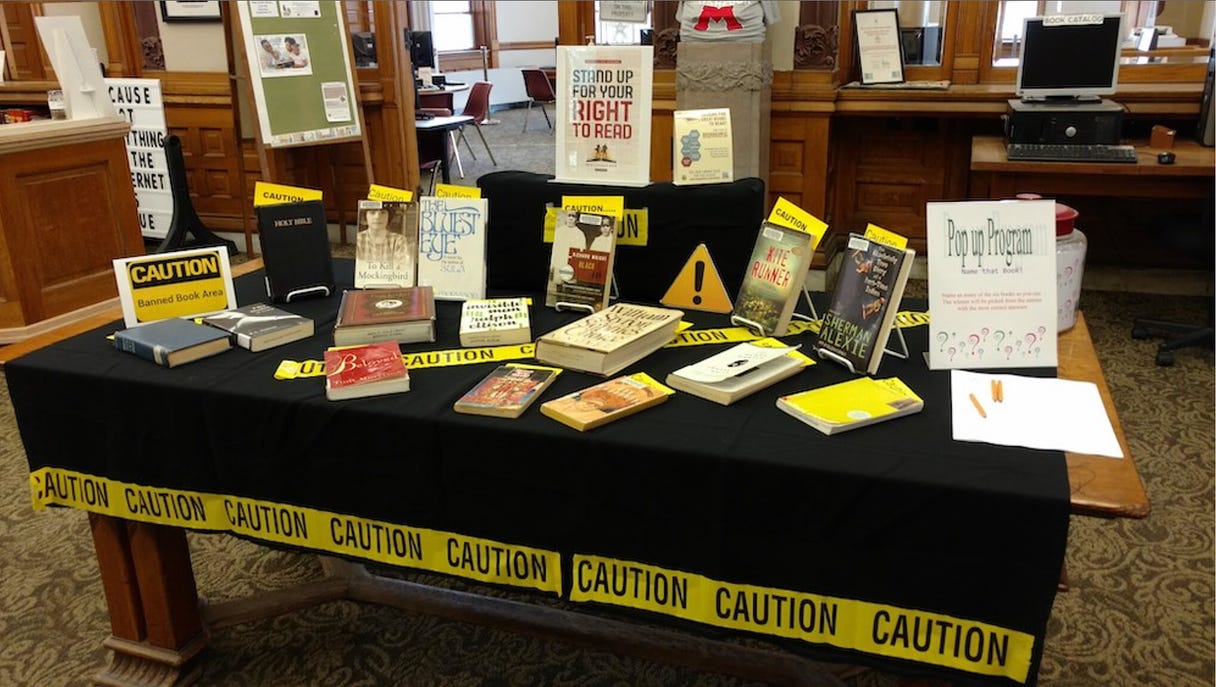
A display protesting book bans and restrictions at a local library. Charles Hickley/CC BY 2.0
The goal is not just to create a hostile work environment for library staff, but also to pressure administrators to submit to corrupt tactics such as banning books on spurious grounds and accepting slanderous speech used against their colleagues.
For right-wing parents and politicians aren’t just going after books. They are also personally attacking library employees as “groomers” who encourage inappropriate behaviors and relationships with children.
Associating LGBTQ individuals and their allies with pedophilia is an established strategy among the global right, including in Viktor Orban’s Hungary. And Vladimir Putin uses fake sex-crime charges to imprison researchers who are writing about things he wants buried.
Ideological fanaticism spurs attempts to dig into librarians’ private lives and harass them so they will resign. In Virginia Beach, GOP state representative Tim Anderson filed a FOIA Act request in May 2022 to learn the identities of librarians at schools that had materials some parents saw as sexually explicit.
It also lies behind attempts to criminalizelibrarians. In Clinton Township, NJ, the police department received a request for criminal charges to be made against librarians whose institutions had books with “obscene” content. And some states are challenging laws that shield teachers, researchers and librarians from prosecution. An Oklahoma law removed exemptions for teachers and librarians “from prosecution for willful violations of state law prohibiting indecent exposure to obscene material or child pornography.”
Unsurprisingly, many librarians have left their jobs. Some have resigned, others have been fired for refusing to remove books from their collections. Wilson-Youngblood, a 19-year veteran of the Keller school district, resigned due to the stress of working in a hostile environment. In small towns such as Vinton, Iowa, the library itself has had to close for lack of staffing.
Vinton’s fate may portend the future, since the number of groups targeted for censorship is bound to expand. In Vinton, right-wing activists not only objected to the presence of LGBTQ staff and LGBTQ-themed books, but displays of books by Vice President Kamala Harris and First Lady Jill Biden. For radicalized Republicans, Democrats are not just people with different opinions, but political enemies whose ideas should be banned.
Luckily, the digitization of books makes it hard for total bans on content for children to stick. The Brooklyn Public Library’s Books UnBannedprogram offers a free library card to people aged 13 to 21 across the U.S. so they can check out books digitally.
Yet libraries and librarians urgently need our support. Contacting your town or school administration to express solidarity and approval with current policies is one way you can push back. Another is to step up as a volunteer or even run for office on a town or school board that has oversight on library issues.
What Amanda Litman, executive director and co-founder of Run For Something, said about school boards in our interview is also true of libraries. They play “a foundational role in determining the kinds of citizens that kids ultimately become.” Libraries, and librarians, are essential to a healthy democratic society.

 Diane Ravitch's blog