The superintendents in 29 districts near Philadelphia joined to call for charter funding reform and an end to unfunded mandates.

With a new governor, state budget hearings underway and a court ruling on their side, superintendents from 29 urban school districts held press conferences Tuesday to call attention to the need for charter reform, inequities and school safety in urban schools.

Five Philadelphia-area superintendents spoke at Upper Darby High School as part of the caucus of Pennsylvania League of Urban Schools press conference, to call attention to the need for charter reform and funding inequities that are dramatically impacting children who attend urban schools.

The 29 districts teach over 300,000 students in the state.

Christopher Dormer, superintendent of Norristown Area School District and president of the PLUS caucus, said superintendents were speaking for students who have been underfunded and underserved for far too long.

Putting a face to one of those students, Dormer spoke about first grader Estefania, one of 140 students identified as an English learner. Her school has only three English language development teachers to help in 25 classrooms.

Dormer said his district has more than 1,550 English learners, a population that has grown by 104% in the past 10 years. The district has 31 professional staff members, with 50 students for each certified teacher.

Dormer said the district has been funded in an unconstitutional manner and districts like his have had to make difficult financial choices over the past 20 years. He said those choices have led to cutting staff, curtailing programs and raising local property taxes just to survive.

Dormer noted that when districts do receive funding outcomes are different. Over the past two years, his district has received $8 million in additional funding through the program Level Up.

“This has allowed us to significantly reverse the trend of cutting positions over the decade,” Dormer said. “Just these past two years we’ve added back 60 new staff positions … to reduce class size at all levels and we were able to hire reading specialists for the first time to serve our elementary schools.”

His district has seen an increase in reading proficiency thanks to the increased funding, but it is still shortchanged by $10 million a year.

Dormer also took aim at charter school funding and noted that more than 92% of the 500 school boards statewide have adopted resolutions supporting reform to Pennsylvania’s charter school law.

“If that doesn’t say bipartisan support, I don’t know what does,” Dormer said. “This isn’t about choice, this isn’t about competition, and this is about a charter funding formula that boosts the payment of cyber charter tuition and special education tuition significantly above the real costs that are incurred by charter and cyber charter schools to provide educational and specialized services.”

Unfunded mandates

Dr. Dan McGarry, Upper Darby superintendent agreed, saying forced cuts and reduction of public education, an increase in unfunded mandates along with the rise and expansion of cyber charter schools significantly altered public education in the state beginning in the mid-2000s.

McGarry said at one point districts were reimbursed by the state for the tuition cost of charter schools but that was changed. He said that the cost is over $8 million in Upper Darby to the budget and the district sends out $11 million to charter schools.

The overwhelming majority of students in Pennsylvania are enrolled in public schools, but the legislature lavishes funding on charters and Cybercharters.

Either the legislators don’t care about the future of their state or they got big campaign donations from the billionaire charter funders or Cybercharter lobbyists.

Republicans in Missouri, ascendant in the Legislature, voted to defund public libraries in the state because librarians objected to censorship and filed a lawsuit. There are 399 public libraries in the state. The bill has not yet been approved by the State Senate yet, so there’s a chance that the cuts might be reversed. PEN reported that nearly 300 books have already been withdrawn from circulation in response to censors.

Late Tuesday night, the Missouri House of Representatives voted for a state operating budget with a $0 line for public libraries. While the budget still needs to work its way through the Senate and the governor’s office, state funding for public libraries is very much on the chopping block in Missouri.

This comes after Republican House Budget Chairman Cody Smith proposed a $4.5 million cut to public libraries’ state aid last week in the initial House Budget Committee hearing, where Smith cited a lawsuit filed against Missouri by the American Civil Liberties Union of Missouri (ACLU-MO) as the reason for the cut.

That will teach them a lesson! Reading is dangerous! Stay home and watch unfiltered porn on your computer, and you don’t need to learn any new words. Why read a book when you can get the real deal at home and be completely illiterate?

This article by three scholars—Pauline Lipman, Camika Royal, and Adrienne Dixson—closes the book on Paul Vallas’ record in education. It was published in Truthout.

Vallas’s solution for struggling schools was a corporate-style, top-down accountability system of high-stakes tests, test-prep teaching and punishment for failure — an experiment on Chicago’s Black and Brown children that set the stage for national education policy under George W. Bush. Schools that failed to meet test score targets were put on a warning list, on probation, or reconstituted by Vallas’s central office.

Counter to research consensus, based on their scores on a single test, tens of thousands of students were sent to summer school, held back a grade for as long as three years, prevented from 8th grade graduation, or assigned to remedial transition high schools where a pared-down curriculum of math, English and world studies revolved around intensive test preparation.

It was typical for schools, particularly in Black communities, to spend up to one quarter of the school year drilling for tests in reading and math. Music and art were cancelled and social studies began in May — after testing. Engaging, culturally relevant classes were turned into test prep. In some schools, Test Best and Test Ready booklets were the curriculum for weeks. CPS Office of Accountability staff told me that when Vallas left in 2001, 59 schools — mostly Black — were using mandated Direct Instruction, in which teachers read scripts and students respond with scripted answers. Not surprisingly, under this regime test scores went up. However, a 1999 National Research Council assessment expert “concluded that Chicago’s regular year and summer school curricula were so closely geared to the [standardized test] that it was impossible to distinguish real subject mastery from mastery of skills and knowledge useful for passing this particular test.”

Turning schools into test prep factories — and punishing and publicly shaming “failing” schools, students, teachers and parents in Black communities — took a toll. Some of the most dedicated and revered teachers left the system. For example, in one Black elementary school Lipman worked with, from 1997-2000, 26 of 37 teachers left, to be replaced by a succession of inexperienced teachers and interns. An award-winning teacher at the school explained that they couldn’t live with the ethical crisis of Vallas’s policies; for both teachers and students “it’s like a hammer just knocking them down.” A 2000 University of Chicago study reported nearly one-third of eighth graders retained in 1997 dropped out by fall 1999. In 2000, Parents United for Responsible Education won a civil rights complaint against CPS under Vallas for adverse discriminatory impact of the retention policy on Black and Latinx students. Expulsions, particularly of Black students, also surged, as documented in a 2001 Chicago Reporter article titled “Alternative education: Segregation or solution?”

When test scores flattened in 2001, Vallas left. But the system he set up of ranking and sorting schools based on an inappropriate use of standardized tests, and disregarding the historical disinvestment and racism schools had suffered, laid the foundation for almost 200 school closings and turn-arounds and the education market that followed. These school closings, 90 percent predominantly Black, devastated Black communities in particular. Vallas’s electoral campaign focuses on fighting crime, but the disruptions from the school closings that were a major factor in the destabilization of Black communities can be traced back to Vallas’s reign at CPS.

Please open the link and read the full article.

If Vallas should win, the students and teachers of Chicago will endure the failed policies of the past two decades.

The statehouse in Nashville, Tennessee, was surrounded by parents and students demonstrating in favor of gun control and against the GOP-controlled legislature’s protection of guns. The protest follows the murder of three children and three staff members at the Coventry School in Nashville.

Three Democratic members of the legislature joined the protest, chanting with the protestors.

The GOP leadership threatened to expel the Democrats. The speaker of the House absurdly claimed that the three Democrats were encouraging an insurrection.

Parents and children held signs and shouted chants during a large protest at the Tennessee capitol last week following a deadly school shooting. And while no one was arrested or injured, Republican House Speaker Cameron Sexton is comparing the demonstration to the Jan. 6 insurrection.

During the House Floor session on Thursday — days after the Covenant School shooting — Reps. Gloria Johnson, D-Knox, Justin Pearson, D-Memphis, and Justin Jones, D-Nashville, stood up and chanted with protestors in the gallery.

Pearson and other Democrats attempted to acknowledge the large group of protesters during session, but were told to stick to the subject of the bill by Speaker Cameron.

“We listened to them and helped to elevate the issue that they are demanding justice for,” said Pearson.

House Speaker Cameron Sexton said their actions were more than a breach of decorum, comparing it to the January 6th insurrection in remarks to outlets.

“Two of the members; Representative Jones and Representative Johnson, have been very vocal about Jan. 6 and Washington, D.C., about what that was,” said Sexton. “What they did today was equivalent, at least equivalent, maybe worse depending on how you look at it, to doing an insurrection in the State Capitol.”

Sexton warned that there will likely be consequences for the trio.

“It could be removal of committees; it could be censorship; it could be expulsion from the General Assembly. Anywhere in between,” said Sexton.

Leaders in the Democratic caucus are defending their colleagues. Nashville Democrat John Ray Clemmons says he believes Speaker Sexton is exaggerating.

“You show me the broken windows, you show me anyone who went into the speaker’s office and put their chair up on his desk and trashed his office, you show me where a noose was hanging anywhere on the legislative plaza,” said Clemmons, citing damage committed during the Capitol riot, which resulted in five deaths before and after the event.

The three rebellious Democrats were stripped of their committee assignments. Their member badges were deactivated. Their telephones were disconnected.

In a press conference Monday, Jones says Sexton is more focused on politics than addressing last week’s mass shooting.

“We are members, who are standing in the well, telling our speakers and our colleagues that kids should not be murdered in school,” Jones said, “and rather than address that issue, the speaker has spent more time on Twitter this weekend talking about a fake insurrection than he did about the deaths of six people including 9-year-old children.”

It is not yet clear if the lawmakers will face expulsion. Sexton has not commented on whether they will face further discipline.

A tweet:

Three Tennessee Democrats have been stripped of their committee and subcommittee assignments by the Republican dominated legislature for speaking out against gun violence in the wake of the Nashville shooting that killed three children.

Democracy is dead in Tennessee.

@Sethaweitz

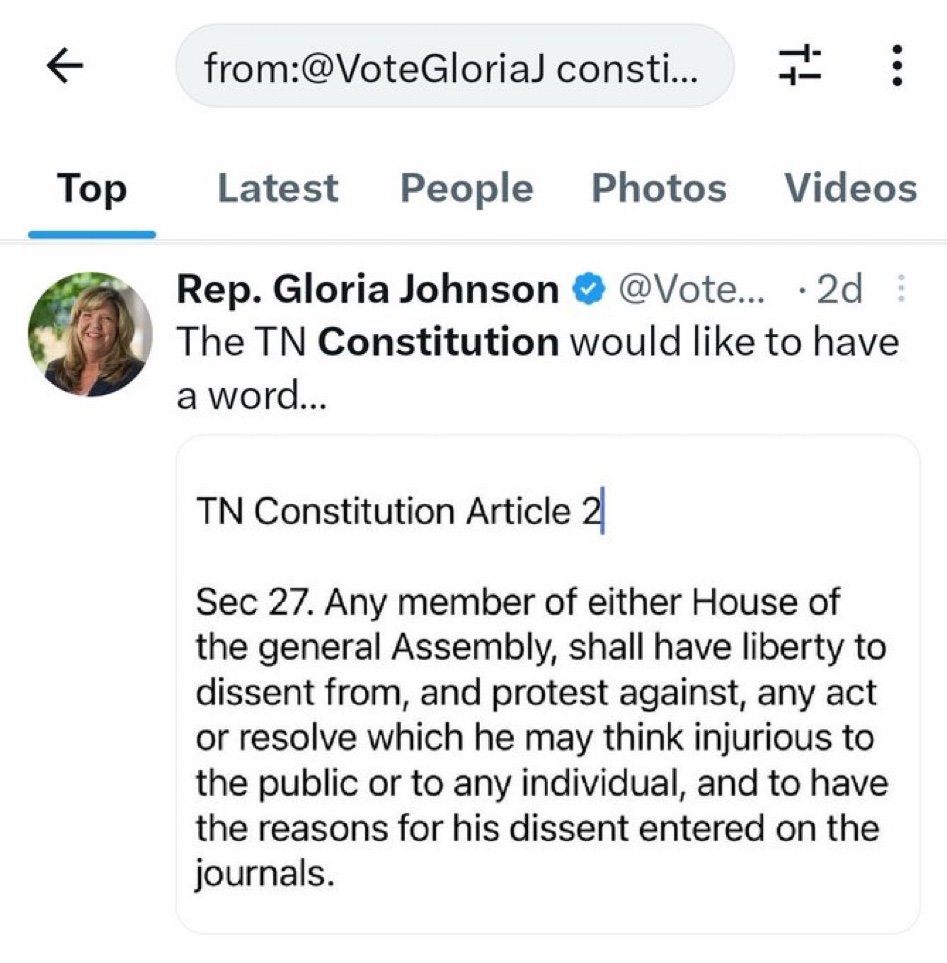
Rep. Gloria Johnson, one of the three Democrats, tweeted:

Governor Ron DeSantis should be careful whom he picks on. Not only did Disney outsmart DeSantis and retain control of DisneyWorkd, but its CEO announced at a shareholder meeting in California that Disney plans to grow in Florida. He also rapped DeSantis for trying to punish Disney for exercising its constitutional right to free speech.

The Orlando Sentinel reported:

The Walt Disney Co. plans to invest $17 billion in Walt Disney World over the next 10 years and create 13,000 new jobs, CEO Bob Iger said Monday, as he accused Gov. Ron DeSantis of being vindictive over Disney’s response to the so-called “don’t say gay” law last year….

Disney World will host 50 million visitors this year, and its planned expansion will bring even more guests and employees to the state in the years to come, along with generating more taxes, Iger said.

“Our point on this is that any action that thwarts those efforts, simply to retaliate for a position the company took, sounds not just anti-business, but it sounds anti-Florida, and I’ll just leave it at that,” he said….

During the company’s annual meeting, Iger also said Disney loves Florida and has heavily invested in the state over the past 50 years in its expansion of the Disney World resort, as the state’s largest taxpayer and through its charitable actions.

The state’s relationship with Florida has “kind of been a two-way street,” Iger said.

But that changed last year when former CEO Bob Chapek spoke out against Florida’s Parental Rights in Education legislation, which restricts discussion of sexual orientation and gender identity in early-grade classrooms. That drew DeSantis’ ire and led to a law dissolving of the company’s special land use, utilities and public service district, Reedy Creek.

“And while the company may have not handled the position that it took very well, a company has a right to freedom of speech just like individuals do,” Iger said.

He said DeSantis dissolved Reedy Creek “in effect to seek to punish a company for its exercise of a constitutional right.”

“And that just seems really wrong to me, against any company or individual but particularly against the company that means so much to the state that you live in,” he added.

Heather Cox Richardson is a historian who writes on today’s issues with a critical lens. Here, she analyzes a very important election in Wisconsin that is key in reversing an unfairly gerrymandered state map and restoring abortion rights.

A key fight over democracy is currently taking place in Wisconsin. On April 4, voters in the state will choose a new judge for Wisconsin’s Supreme Court. That judge will determine the seven-person court’s majority, a majority that will either uphold or possibly strike down the state’s gerrymandered voting maps that are so heavily weighted toward Republicans as to make it virtually impossible for Democrats to win control of the legislature.

Political scientists judge Wisconsin to be the most gerrymandered state in the country. The state is divided pretty evenly between Democrats and Republicans, although the Democrats have won 13 of the past 16 statewide elections. But despite the state’s relatively even political split, the current district maps are so heavily tilted for Republicans that Democrats have to win the statewide vote by 12 points just to get a majority in the assembly: 50 of the 99 seats. Republicans, though, can win a majority with just 44% of the vote.

The process of changing Wisconsin into a stronghold of Republican power began in the 2010 elections, when Republicans launched Operation REDMAP to take over state legislatures before the redistricting process based on the 2010 census began. That year, the billionaire brothers Charles G. and David H. Koch pumped money into Wisconsin. Along with a strong talk radio media ecosystem, they helped to elect Governor Scott Walker to curb the power of public sector unions, which they blamed for what they considered excessive state spending.

The election of Governor Walker and a Republican legislature began the process of taking control of the state. Using granular voting data and sophisticated mapping software, the Republicans gerrymandered the state so severely that they retained control of the assembly going forward even though Democrats won significantly more votes.

As Ari Berman explained in Mother Jones, Republicans used that power to take away the bargaining rights of public sector unions in order to defund and demoralize one of the Democratic Party’s core constituencies. Berman quotes right-wing strategist Grover Norquist, who wrote that the Wisconsin policies were a national model. “If Act 10 is enacted in a dozen more states, the modern Democratic Party will cease to be a competitive power in American politics…. It’s that big a deal.” The assembly also passed at least 33 new laws during the Walker years to change election procedures and make it harder to vote.

When Democrat Tony Evers won election as governor in 2018, Democrats won all four statewide races. They also won 53% of the votes for state assembly—203,000 more votes than the Republicans did—but because of gerrymandering, the Democrats got just 36% of the seats in the legislature. The Republicans there immediately held a lame duck session and stripped powers from Evers and Democratic attorney general Josh Kaul. Then they passed new laws to restrict voting rights. The legislature went on to block Evers’s appointees and block his legislative priorities, like healthcare, schools, and roads.

Polls showed that voters opposed the lame duck session by a margin of almost 2 to 1, and by 2020, 82% of Wisconsin voters had passed referenda calling for fair district maps.

But when it came time to redistrict after the 2020 census, the Republican-dominated legislature carved up the state into an even more pro-Republican map than it had put into place before. Ultimately, the new maps gave Republicans 63 out of 99 seats in the assembly and 22 out of 23 in the state senate. They came within two assembly seats of having a supermajority that would enable them to override any vetoes by the governor, essentially nullifying him, although Evers had been reelected by 53.5% of the vote (a large margin for Wisconsin).

With gerrymandered districts virtually guaranteeing their reelection, Republicans are insulated from popular opinion. In the 2021–2022 session, they ignored the governor, refusing to confirm Evers’s appointees and going nearly 300 days without passing a single bill. They also ignored popular measures, refusing to let 98% of Democratic bills even be heard and refusing to address gun safety issues—although 81% of Wisconsinites wanted background checks for gun sales—or abortion rights, even though 83% of Wisconsin residents wanted at least some abortion rights protected after the Supreme Court’s overturning of Roe v. Wade last June put back into effect a law from 1849.

This radicalized Wisconsin assembly also mattered nationally when it became a centerpiece of Trump’s attempt to overturn the 2020 presidential election. Nearly 75% of the Republicans in it worked to cast doubt on that election. After an audit turned up “absolutely no evidence of election fraud”—according to a Wisconsin judge—they tried to take control of elections away from a bipartisan commission and turn it over to the legislature they control. Senator Ron Johnson led the effort, calling for Republicans to take control of the elections because, he said, Democrats can’t be expected to “follow the rules.” In the 2022 election, the Trump-endorsed Republican candidate for governor, Tim Michels, promised, “Republicans will never lose another election in Wisconsin after I’m elected governor.”

Their effort failed only because they fell two seats shy of the supermajority they needed.

By shaping the state maps and limiting the power of Democratic constituencies, Republicans have also taken control of the state supreme court, which sides with the Republican lawmakers’ attempts to cement their own power. Now voters have the chance to shift the makeup of that court. Doing so would make it possible that new challenges to the gerrymandered maps would succeed, returning fairness to the electoral system.

Wisconsin journalist Dan Shafer, who writes The Recombobulation Area, is following the race closely. His coverage reveals how the candidates’ framing of the election mirrors a larger debate about democracy. Theoretically, the election is nonpartisan, but Republicans paid former state supreme court justice Dan Kelly $120,000 to consult on Trump’s false elector scheme to overturn the 2020 presidential election, and he was on the payroll of the Republican National Committee until last December. In 2012 he defended the Republicans’ gerrymandered maps in court.

For her part, Milwaukee County judge Janet Protasiewicz has made it clear she opposes the gerrymandered maps. “Let’s be clear here: The maps are rigged. Absolutely positively rigged,” she said in a candidates’ forum in January. “They do not reflect the people in the state. They do not reflect accurate representation, either in the State Assembly or the State Senate. They are rigged, period. I don’t think it would sell to any reasonable person that the maps are fair.”

Shafer notes that supreme court terms are for ten years, so if the court does not shift in this election, it, along with the gerrymandered maps, will remain in place “for the foreseeable future.” The race ultimately comes down to checks and balances, he says. The court has not checked the legislature, which has entrenched one-party rule in Wisconsin.

“This isn’t to say the maps should be redrawn to instead benefit Democrats,” Shafer continues. “Far from it. It’s about fairness. Some years Democrats will win a majority, other years Republicans will win a majority. If one party isn’t doing their job, voters should be able to do something about it. It’s about crafting a system that reflects the people of Wisconsin and can be responsive to the state’s voters. We don’t have that right now. And that has to be the goal.”

—

Notes:

The Recombobulation Area

Wisconsin is the most gerrymandered state in the country. The race for Wisconsin Supreme Court could change that. 

The Recombobulation Area is a six-time TEN-TIME Milwaukee Press Club award-winning weekly opinion column and online publication written and published by veteran Milwaukee journalist Dan Shafer. Learn more about it here…

Read more

12 days ago · 13 likes · Dan Shafer

The Recombobulation Area

The race for Wisconsin Supreme Court kicks into gear at WisPolitics forum

The Recombobulation Area is a six-time Milwaukee Press Club award-winning weekly opinion column and online publication written and published by veteran Milwaukee journalist Dan Shafer. Learn more about it here…

Read more

3 months ago · 5 likes · 3 comments · Dan Shafer

ShareLIKECOMMENTSHARE

Read Letters from an American in the app

Listen to posts, join subscriber chats, and never miss an update from Heather Cox Richardson.

Get the iOS app
Get the Android app

© 2023 Heather Cox Richardson
548 Market Street PMB 72296, San Francisco, CA 94104 
Unsubscribe

Start writing

Virginia Governor Glen Youngkin sends his own children to an elite private school that never bans books and teaches critical race theory, But the governor ran on a platform of “parental rights,” which has unleashed censorship and book banning in the state’s public schools.

The schools of Spotsylvania have posted a list of 14 books that will be withdrawn to protect children from ideas their parents don’t like. Among the 14 are two by Nobel-prize winning author Toni Morrison.

The books were challenged for having “sexually explicit material” in them, according to a message to families from superintendent Mark Taylor.

The superintendent of Spotsylvania public schools has no prior experience in education. His appointment was made after hard-right conservatives won control of the school board. Aside from his lack of experience, Mark Taylor was controversial because of incendiary comments he made on social media. “They allegedly include memes mocking trans people and school shootings, racist innuendos and calls for parents to pull their children out of public schools.”

By the end of the week, the school district will remove:

“All Boys Aren’t Blue” by George M. Johnson

“Like a Love Story” by Abdi Nazemian

“Dime” and “America” by E.R. Frank

“Sold” by Patricia McCormick

“Out of Darkness” by Ashley Hope Perez

“Beloved” and “The Bluest Eye” by Toni Morrison

“Looking for Alaska” by John Green

“The Perks of Being a Wallflower” by Stephen Chbosky

“Water for Elephants” by Sara Gruen

“Neanderthal Opens the Door to the Universe” by Preston Norton

“More Happy Than Not” by Adam Silvera

“Nineteen Minutes” by Jodi PicoultSpotsylvania superintendent floats elimination of all school libraries

In a statement, Taylor pointed to a Virginia lawthat requires school districts to establish parental notification policies for instructional materials with sexually explicit materials, saying the 14 books fall under that category.

Taylor added that the division doesn’t have the resources to review whether the roughly 390,000 books in all school libraries have similar materials, so purging the 14 books from the shelves would be the only way to ensure they aren’t accessible….

Taylor noted in his message to families that the decision won’t stop teachers from including the pulled books in classroom assignments, which would have to be shared with parents under the law. According to the district, the books will be stored until they are donated.

What teacher will be brave enough or foolish enough to assign a banned book?

Dr. Mike DeGuire, a retired principal in the Denver Public Schools, has been keeping track of the money flowing into Denver’s mayoral race, which will be held tomorrow.

There are 17 candidates in the race. If no candidate wins a majority, there will be a runoff on June 6.

The two leading candidates are corporate education reformer Mike Johnston and Kelly Brough. Brough was CEO of the Denver Metro Chamber of Commerce and is supported by the business community. Johnston was endorsed by the Denver Post , which gives a tremendous boost to his campaign. He previously ran for Governor in 2018 but ran third behind Jared Polis. He ran for the Senate in 2020 but dropped out after former governor John Hickenlooper entered the race.

This is what Mike DeGuire discovered about the funding of Mike Johnston’s campaign:

Denver will select a new mayor for the first time in 12 years on April 4, 2023. Money has been pouring into the campaigns of Kelly Brough and Mike Johnston from rich developers, investors, and corporate executives. While Brough has received almost $1 million in independent expenditure money for her campaign, Mike Johnston has topped that amount by more than double, at $2.3 million as of April 2.

As reported in the Denverite on March 31, 2023, “The lion’s share of the reported contributions into Advancing Denver, the IE supporting Johnston, came from a group of out-of-state donors (between his campaign and his super PAC, 67% of his non-Fair Elections Fund contributions come from out of state): $779,804 from Reid Hoffman, co-founder of LinkedIn, who lives in California; $250,450 from Steve Mandel, a hedge fund billionaire who lives in Connecticut. Another $100,000 came from John Arnold, a former Enron trader from Texas known as the “King of Natural Gas,” who along with his wife gave to Advancing Denver. (Arnold was cleared of wrongdoing in the collapse of Enron.)”

The money from Hoffman, the Arnolds, and Mandel are only the beginning of outside support from rich donors. Yet why are the billionaires and millionaires giving so much to Johnston’s campaign? The article continues to state, “It’s unknown how they crossed paths, what issues exactly they worked on together in the past, and why they care specifically about Denver. Johnston “has a history of billionaire donors backing him through independent groups. Donors he likely met through his work on education reform issues, giving him a national profile.”

And there is the probable connection: Education Reform! Mike Johnston was the primary author of SB-191, Colorado’s controversial teacher evaluation bill, passed in 2010. He supported using testing to determine teacher evaluations and the closing of schools if students did not show improvements over time. His career has been heavily tied to the reform movement privatizers who have been working to promote increased expansion of charter schools. In addition to his work on the infamous teacher evaluation SB191 bill, he serves on the Board and co-founded New Leaders for New schools, an organization established to teach” a pro-privatization and business focused ideology to prospective school leaders.” He also participated in the Aspen-Pahara Institute fellowship training in 2012, which is designed to provide participants with strategies to spread the message of corporate reform in public schools.

While his role as Mayor would not directly enable him to impact the Denver Public schools, there is no question that he wants to be involved in the city’s school system. His responses to an Educate Denver survey indicate his desire to influence and possibly control how the district makes decisions on governance and other policies. In response to one of the questions from the Educate Denver survey, he stated, “As Mayor, my goal is to work closely with teachers, administrators, and parents to make sure the City is supporting DPS while using my position to push for better outcomes.”

Over the past decade, Johnston developed connections with a number of hedge fund investors and corporate executives who are committed to privatizing the public education system. WHO are they?

Reid Hoffman donated $904,678 to Johnston’s campaign. Hoffman is worth $2–3 billion. In 2011, he supported pro-charter candidates in Louisiana and he gave similar monetary support in 2018 in the same state.

Steve Mandel donated $250,000. He is worth $3.6 billion. For years, Mandel has given large amounts of money to candidates who support charter school expansion.

John and Laura Arnold donated $99,000.Their net worth is $3.3 billion. In the last decade, they have given millions to candidates across the country who support charter schools and who will push to privatize education.

Kent Thiry donated $300,000. His net worth is $44 million. Over the last ten years, he has given thousands of dollars to candidates who are committed to expanding charter schools and opposing teacher unions.

Reuben Monger donated $100,000. He is a former director of Stand for Children, an organization focused on spreading charter schools in cities across the U.S.

Lawrence Berger donated $100,000. He is the CEO of Amplify, a curriculum and assessment company worth millions which has been supporting charter schools as it sells its education technology systems to schools across the country.

Josh Bekenstein donated $50,000. He is worth over $6 billion. He is the co-chairman of Bain Capital, and has contributed to candidates and referendums supporting charter school expansion in several states.

Katherine Bradley donated $25,000. She is on the Board of Kipp Charter schools, the largest charter school chain in the country. She donated to candidates supporting charters for decades.

Emma Bloomberg and David Youngren each donated $10,000, and for years, they donated to candidates who want to expand the charter network schools.

Other investors who represent the hedge fund industry and who seem to be looking to make profits in the Denver mayoral race include: Art Reimer, a private wealth advisor with Raintree Solutions, donated $100,000, and Eric Resnick, CEO for KSL Capital Partners,another private equity firm, donated $50,000, and he was also part of the Vail Valley Foundation, where he knew Johnston. There are almost ten other investors who have contributed $5–10,000 to his Advancing Denver IE.

Denver citizens should think twice about this blatant monetary influence of wealthy investors who are trying to buy the mayoral election for Johnston.

Johnston is clearly the favorite in the race due to his Denver Post endorsement.

Mike Johnston began his career in Teach for America, then became a principal, then won a seat in the State Senate. He is a solid corporate reformer.

I was in Denver in 2010 and was scheduled to debate State Senator Mike Johnston before a room full of civic leaders. He had proposed a law to evaluate teachers based on the test scores of their students, with 50% of their evaluation based on test scores. The debate didn’t happen because Johnston was delayed. As I concluded my remarks, he arrived, jubilant that his legislation (SB191) had just passed. He then spoke about the dramatic transformation that his legislation would bring about. Bad teachers and bad principals would be exposed and fired.

In the future, Johnston claimed, all of Colorado would have great teachers, great principals, great schools, thanks to the law he put in place.

None of those bold promises came true. As his reform ally Van Schoales wrote in Education Week in 2017, the reformers were gravely disappointed to discover that most teachers in the state were not teaching tested subjects. Every single one of the state’s 268 charter schools waived out of the evaluation plan.

Educators were overwhelmingly against SB191. They knew something that the reformers didn’t know: student test scores measure not teacher quality, but the students in the classroom. Teachers in affluent districts got high scores; teachers teaching the most vulnerable students (SPED and ELL) tended not to see big test score gains or none at all.

The results were appalling:

Colorado Department of Education data released in February show that the distribution of teacher effectiveness in the state looks much as it did before passage of the bill. Eighty-eight percent of Colorado teachers were rated effective or highly effective, 4 percent were partially effective, 7.8 percent of teachers were not rated, and less than 1 percent were deemed ineffective. In other words, we leveraged everything we could and not only didn’t advance teacher effectiveness, we created a massive bureaucracy and alienated many in the field.

Broken promises. But no matter. The money is flowing in, and Mike Johnston—reformer extraordinaire—is likely to be the next mayor of Denver.
While traveling in the Midwest, I visited Illinois State University, which has an excellent teacher education program. A leader of that program recently wrote me while in a state of distress. One of her best students, she said, was just fired by her district. Why? One parent objected to a book in her classroom.

Who will want to teach when teachers’ lives and reputations can be jeopardized by one angry parent? Maybe that is the point: Demonize public schools and their teachers to build support for vouchers, where uncertified teachers are hired and the Bible is the beginning and end of all knowledge.

Here is an excerpt from the letter I received:

Tonight, I’m writing to you to share the story of the most amazing teacher I have ever worked with in my nearly 25 years in education–except she is no longer a teacher as of last Thursday. I know you have committed your career to fighting injustices like hers, so it is my hope that you might amplify her story in the fight against misinformation and teacher defamation.

As a teacher educator at Illinois State University, I met Sarah Bonner 10 years ago when she was in my action research capstone class as the final requirement for her master’s degree. During the year I worked with her, I was struck by her approach to education, and I encouraged her to continue working toward a doctorate degree. Since that time, I have had the opportunity to work closely with her, co-designing a framework that paired literature and inquiry as a way to expand 8th grade students’ in rural Illinois worldviews; co-teaching alongside her to maintain my connection to the classroom and to continue to evolve our work; guiding her in her dissertation work where she connected with teachers who were interested in transforming their own teaching; watching her mentor emerging, new, and experienced teachers; and witnessing the blossoming of students under her guidance–especially those who are often marginalized in largely conservative, small schools. I can honestly say that I have never had the opportunity to work with a more compassionate, innovative, and thought-provoking teacher. She’s by far a better teacher than I was when I was still in the middle school classroom, and working alongside her has pushed me to be an even better teacher educator than I was before.

For this reason, I cannot begin to describe the devastation that I experienced when I learned less than two weeks ago that not only was she being attacked by our local conservative “news” station, but that her district advised that she seek union representation to represent her while they investigated the story. She received this news on Wednesday, March 15. By Friday March 17 she learned that she was being put on paid leave the next week so they could investigate–and they hadn’t even talked with her yet.

What was the story? As a part of a book tasting day, Sarah consulted NCTE, ALA, and Good Reads to find award-winning and notable books that would reflect her students’ interests–and checked out nearly 100 books from the public library. One of those books was Juno Dawson’s “This Book Is Gay.” A student picked up the book, a sex education book for LGBTQ+ youth, snapped some pictures of its pages, and sent those pages home. Rather than approaching Sarah with questions or concerns, this child’s parents alerted the media outlet, and a witch-hunt began.

Suddenly, the wild and false allegations began: Sarah was requiring this book; the book was a regular part of her classroom library; she was sharing pornography with children; she was grooming children. And then, they went to her class website, which shared a link to Common Sense Media’s Netflix Documentary page, which so happened to feature Moneyshot, and now she was encouraging students to watch and learn about porn. Ironically, this film hadn’t even been released when she was last in the classroom. The story just kept growing until this award-winning teacher realized that she could not go back to that community again. And so, by this past Thursday, she had officially resigned. In just over a week, a teacher’s reputation, livelihood, and life was completely upended.

Sarah is fortunate brcause she’s got the deep knowledge and experience to bounce back and counter the current narrative. Unfortunately, this kind of experience is not unique, and too often teachers who aren’t equipped to handle it take huge hits. It’s impacting their mental health, their careers, their entire livelihoods. We have a narrative around a teacher shortage. We don’t have a teacher shortage—we have a shortage of respect and support for teachers. And we live in Illinois, a liberal state that requires LGBTQ+ history and contributions to be taught by 8th grade. Too many people are watching the antics happening in states like Florida and thinking those are outliers. They are not. Sarah is an award-winning teacher. She is a leader in and on the executive board of the National Council Teachers of English. And yet, she will no longer impact the lives of so many students.

Democracy is in peril as we continue to bow to pressures to restrict the books students can read. We cannot normalize allowing a few loud voices’ the power to destroy careers and lives. I have attached the statement she wrote and read to her board upon her resignation.

Here is Sarah Bonner’s statement to her school board:

Thank you to the Heyworth Board and Administrative team for allowing me to speak this evening. If you know anything about me as a professional, you know that this is not the way I would have chosen to be here tonight. Twenty years ago when I was given the keys to my very first classroom, I knew teaching was my calling. And, while I’ve taught in previous school districts over the years, Heyworth was the place that allowed me to become the professional I was meant to be.

Throughout my time here, I earned both my Masters and Doctorate degrees with the help of district tuition waivers. I became the National Council of Teachers of English (or NCTE) Media Literacy Teacher of the Year in 2018 along with the national Outstanding Middle Level Educator award the following year. I wrote and published a book through Teachers College Press to further the teaching field. Additionally, I hosted and supported numerous future teachers from Illinois State University as they began their journey into the classroom. Lastly – most importantly – I had the opportunity to connect with the best kids I’ve ever worked with in my career.


Our community – or even our nation – may never know the gravity of what teachers bear on a regular basis. For me, I not only worked tirelessly on designing and cultivating meaningful learning experiences for my students, but I also worked hard to maintain healthy relationships with students and families, upheld weekly and transparent communication among all shareholders, contributed regularly to the junior high teacher team, worked a second teaching job at Illinois State University to better support my family, served as the Middle Level Section Steering Committee Chairperson for NCTE, wrote a doctoral dissertation, published a book for teachers, along with being a partner, a mother, and a human wrestling with being newly diagnosed with multiple sclerosis.

With all of this weighing heavily on my plate, I depended on national communities like the American Library Association and NCTE as well as reading communities like Goodreads to help generate texts that engage all readers with a vast collection of interests. The activity my students and I participated in last week was made up of close to 100 different books recommended from these spaces. Given the nature of the lesson compressed with a heavy list of responsibilities, vetting each and every single text for explicit details was impossible. Should the book in question be available to students? Yes. However, should this specific book have been a part of the 100 choices during this class activity? No. Simply put, the title was on the ALA Rainbow Reading Awardee list and I picked it along with a few others because I knew students in my class had interests. To make students, families, community members feel unsafe was never the intention of my decision making.

While I’m saddened by how the events have played out over the last week, there’s a piece of me that isn’t surprised. Being an innovator in teaching means that boundaries, perspectives, and ideas need to be pushed. When I realized years ago that our kids who would receive these amazing scholarships to these Big 10 schools were coming back the following year because they couldn’t adjust to life outside of a rural small town, I knew I needed to do something. I knew I needed to disrupt traditional learning practices to embody the needs of today’s world. Our kids deserve learning experiences that prepare them for our world and not just our town. However, being a changemaker often comes with a cost…especially if you’re one of the only ones willing to take risks and think differently.


London’s favorite soccer coach, Ted Lasso – the man who makes us all believe in the power of believe – said it best ”You know, people have underestimated me my entire life. And for years, I never understood why. It used to really bother me. But then one day, I saw this quote by Walt Whitman. It said, “Be curious, not judgmental.” All of a sudden it hits me. Of all those that used to belittle me, not a single one of them was curious. They thought they had everything all figured out. So they judged everything, and they judged everyone. And I realized that their underestimating me… who I was had nothing to do with it. ‘Cause if they were curious, they would’ve asked questions.”
As I leave here tonight, I hope you will remember a few things:

  1. Sometimes things need to break in order to rebuild it stronger. Encourage
    curiosity. As you enter a space of healing, I hope the district and Heyworth community can find a place to listen and understand that you all want the best for our kids. Our teachers especially deserve to be heard and questioned in responsible ways.
  2. Remember to support your teachers moving forward. If I were them at this point, I would feel scared, unsafe, and paralyzed knowing that I could be next. Our teacher community needs reassurance that innovation is still supported and protected as time moves on.
  3. And, remember the good I brought to our kids and community by taking innovative risks in Language Arts. While I’ve been here, I have witnessed students stand up for other students with disabilities, fight against racism, organize trash clean ups, create documentaries that tell the untold stories of their community, advocate for safe spaces, strengthen their own beliefs, shape their own personal identities, and critically think about the world around them. With the work I’ve been able to do with students, I’m reminded on a daily basis that our kids will be the hope our future needs.

The Heyworth school district has lost a teacher who is dedicated to their children and her profession.

Katherine Marsh is an award-winning novelist who writes for children in grades fifth-through-eighth. At that age in the 1980s, she remembers falling in love with books. But she knows that children today are not reading for fun as much as they used to. NAEP data say so; parents as well. She knows that the ubiquity of cell phones, the Internet, abd television explain some of that decline in reading.

But she believes there is a problem with the way children are taught reading. No, she’s not talking about phonics and how children learn to read. She refers to the pedagogical approach that is required by the Common Core. children in school are taught to analyze what they read. This technical mindset, she believes, kills the joy of reading.

She writes in The Atlantic:

What I remember most about reading in childhood was falling in love with characters and stories; I adored Judy Blume’s Margaret and Beverly Cleary’s Ralph S. Mouse. In New York, where I was in public elementary school in the early ’80s, we did have state assessments that tested reading level and comprehension, but the focus was on reading as many books as possible and engaging emotionally with them as a way to develop the requisite skills. Now the focus on reading analytically seems to be squashing that organic enjoyment. Critical reading is an important skill, especially for a generation bombarded with information, much of it unreliable or deceptive. But this hyperfocus on analysis comes at a steep price: The love of books and storytelling is being lost.

This disregard for story starts as early as elementary school. Take this requirement from the third-grade English-language-arts Common Core standard, used widely across the U.S.: “Determine the meaning of words and phrases as they are used in a text, distinguishing literal from nonliteral language.” There is a fun, easy way to introduce this concept: reading Peggy Parish’s classic, Amelia Bedelia, in which the eponymous maid follows commands such as “Draw the drapes when the sun comes in” by drawing a picture of the curtains. But here’s how one educatorexperienced in writing Common Core–aligned curricula proposes this be taught: First, teachers introduce the concepts of nonliteral and figurative language. Then, kids read a single paragraph from Amelia Bedelia and answer written questions.

For anyone who knows children, this is the opposite of engaging: The best way to present an abstract idea to kids is by hooking them on a story. “Nonliteral language” becomes a whole lot more interesting and comprehensible, especially to an 8-year-old, when they’ve gotten to laugh at Amelia’s antics first. The process of meeting a character and following them through a series of conflicts is the fun part of reading. Jumping into a paragraph in the middle of a book is about as appealing for most kids as cleaning their room.

But as several educators explained to me, the advent of accountability laws and policies, starting with No Child Left Behind in 2001, and accompanying high-stakes assessments based on standards, be they Common Core or similar state alternatives, has put enormous pressure on instructors to teach to these tests at the expense of best practices. Jennifer LaGarde, who has more than 20 years of experience as a public-school teacher and librarian, described how one such practice—the class read-aloud—invariably resulted in kids asking her for comparable titles. But read-alouds are now imperiled by the need to make sure that kids have mastered all the standards that await them in evaluation, an even more daunting task since the start of the pandemic. “There’s a whole generation of kids who associate reading with assessment now,” LaGarde said.

Under the duress of Commin Core, students are analyzing passages without reading the whole book. They are getting read to do the same on the tests. This is a sure fire way to make reading a chore, not a pleasure.

The architect of the Common Core standards, David Coleman, used to claim all sorts of miraculous things that would happen, if everyone taught the way he wanted. Test scores would rise, achievement gaps would close, etc. in the decade after Commin Core was introduced in 2010, none of those miracles came to pass.

Coleman believed that children needed to interpret what was put in front of them, without context. Understand the four corners of the text in front of them. This may make sense for a test, where the only thing in front of the student is a short passage, but it’s no way to read for pleasure.

Worse, this approach is a sure fire way to turn reading into a dull exegesis of language, not into a source of joy.