Nancy Flanagan, now retired, taught music for many years. She is a keen observer of teaching and also of the pundits who regularly criticize teachers. She has been there, done that, and has no sympathy for armchair “experts.”

She recently reviewed a book that won her praise: Alexandra Robbins’s THE TEACHERS: A YEAR INSIDE AMERICA’S MOST VULNERABLE, IMPORTANT PROFESSION.

This book, Flanagan writes,

does what many other books about teaching are not able to do–take the reader right into the classroom, and describe what’s happening, with empathy and perception. There are lots of books about problems in American education, and lots of books that suggest solutions for those problems, but we seldom get to see examples, conversations and the people doing the work.

If you want a drone’s eye view of American public education—where it’s been, what bedevils the century-old movement to improve it—I would recommend Diane Ravitch’s trio of excellent books that follow education reform over the last couple of decades, or A Wolf at the Schoolhouse Door: The Dismantling of Public Education and the Future of School by Jack Schneider and Jennifer Berkshire.

But if you want to see what happens in the classroom and in the lives of teachers, Robbins accomplishes that better than any book I’ve read since Tracy Kidder’s Among Schoolchildren, written in 1989, which now feels like ancient history. The book is a tour de force—every teacher I know who’s read it agrees—unapologetically written from the POV of teachers without feeling the need to make excuses or backpedal.

I read an advance copy of the book and was similarly impressed. I felt that at this very moment, when teachers are being vilified by the likes of Betsy DeVos, Ron DeSantis, and other red state politicians, Alexandra Robbins’ book is a necessary antidote to scurrilous claims that teachers are “grooming” students for a life of perversity or training them to be Marxists. People who rain insults on teachers should be barred from public life.

Robbins follows three excellent teachers and describes their lives, their trials and successes.

Robbins highlights things that other education books don’t notice or can’t be bothered with–in-building teacher jealousies and vindictiveness, physical violence against teachers, the long-term effects of cuts to things once considered normal in every school, what it’s like to sit in an IEP meeting with a recalcitrant parent or clueless colleague.

Flanagan writes:

This book is also the first and best description I have read about the impact of the pandemic on teaching and learning. There have been endless articles and research on “learning loss”–all rife with meaningless data and numbers–but nobody talks about the impact of being expected to position family needs as secondary to students’ needs. Robbins gets this right–there is a line between acting morally vs. choosing school over family, a choice that teachers were urged to make, and reviled when they chose their own families and their own health. We have not yet reconciled that, here in America—but the book makes a good start on it.

Highly recommended for everyone, but especially teachers. It’s a fairly fast and facile read, although well-documented with endnotes, and should give teachers a lift, knowing that their work and their dilemmas have been acknowledged.

As I wrote in an earlier post, NAEP Proficient is not the same as “grade level.” NAEP Proficient is equivalent to an A or an A-. Secretary of Education Cardona made the egregious error of saying at a Congressional hearing on April 18 that 2/3 of the students in this nation were below grade level. He was wrong.

Tom Loveless, then of the Brookings Institution (now retired), wrote an excellent article in 2016, providing a history of NAEP and explaining just how high the standard for NAEP Proficient is. He was responding to the wildly inaccurate claims of rightwing ideologues, who said the same things that Secretary Cardona said.

Here are some excerpts from his article, “The NAEP Proficiency Myth.”

Equating NAEP proficiency with grade level is bogus. Indeed, the validity of the achievement levels themselves is questionable. They immediately came under fire in reviews by the U.S. Government Accountability Office, the National Academy of Sciences, and the National Academy of Education.[1] The National Academy of Sciences report was particularly scathing, labeling NAEP’s achievement levels as “fundamentally flawed.”

Despite warnings of NAEP authorities and critical reviews from scholars, some commentators, typically from advocacy groups, continue to confound NAEP proficient with grade level. Organizations that support school reform, such as Achieve Inc. and Students First, prominently misuse the term on their websites. Achieve presses states to adopt cut points aligned with NAEP proficient as part of new Common Core-based accountability systems. Achieve argues that this will inform parents whether children “can do grade level work.” No, it will not. That claim is misleading….

Today’s eighth graders have made it about half-way to NAEP proficient in 25 years, but they still need to gain almost two more years of math learning (17 points) to reach that level. And, don’t forget, that’s just the national average, so even when that lofty goal is achieved, half of the nation’s students will still fall short of proficient. Advocates of the NAEP proficient standard want it to be for allstudents. That is ridiculous. Another way to think about it: proficient for today’s eighth graders reflects approximately what the average twelfth grader knew in mathematics in 1990. Someday the average eighth grader may be able to do that level of mathematics. But it won’t be soon, and it won’t be every student.

In the 2007 Brown Center Report on American Education, I questioned whether NAEP proficient is a reasonable achievement standard.[2] That year, a study by Gary Phillips of American Institutes for Research was published that projected the 2007 TIMSS scores on the NAEP scale. Phillips posed the question: based on TIMSS, how many students in other countries would score proficient or better on NAEP? The study’s methodology only produces approximations, but they are eye-popping….

Singapore was the top scoring nation on TIMSS that year, but even there, more than a quarter of students fail to reach NAEP proficient. Japan is not usually considered a slouch on international math assessments, but 43% of its eighth graders fall short. The U.S. looks weak, with only 26% of students proficient. But England, Israel, and Italy are even weaker. Norway, a wealthy nation with per capita GDP almost twice that of the U.S., can only get 9 out of 100 eighth graders to NAEP proficient.

Finland isn’t shown in the table because it didn’t participate in the 2007 TIMSS. But it did in 2011, with Finland and the U.S. scoring about the same in eighth grade math. Had Finland’s eighth graders taken NAEP in 2011, it’s a good bet that the proportion scoring below NAEP proficient would have been similar to that in the U.S. And yet articles such as “Why Finland Has the Best Schools,” appear regularly in the U.S. press….[3]

NAEP proficient is not synonymous with grade level. NAEP officials urge that proficient not be interpreted as reflecting grade level work. It is a standard set much higher than that. Scholarly panels have reviewed the NAEP achievement standards and found them flawed. The highest scoring nations of the world would appear to be mediocre or poor performers if judged by the NAEP proficient standard. Even large numbers of U.S. calculus students fall short.

As states consider building benchmarks for student performance into accountability systems, they should not use NAEP proficient—or any standard aligned with NAEP proficient—as a benchmark. It is an unreasonable expectation, one that ill serves America’s students, parents, and teachers–and the effort to improve America’s schools.

The Florida Legislature passed amendments to laws today to revoke Disney’s efforts to escape the control of Governor Ron DeSantis. The governor was outraged because Disney openly opposed his “Don’t Say Gay” law. He got the legislature to dissolve Disney’s self-governing Reedy Creek district. But before the legislature acted, Disney made an agreement with its own Reedy Creek district board to extend its control for decades.

DeSantis’s new board met today and began the takeover process, raising Disney’s taxes. The legislature acted to void Disney’s efforts to extend its own control. The new law will lead to legal challenges.

Imagine, if you dare, a DeSantis presidency. Any corporation that dared to disagree with his multiple prejudices would be singled out for spiteful treatment. DeSantis is a mean, angry, hateful wannabee dictator. Woe to those who dare to challenge him.

Florida legislators on Wednesday quickly responded to Gov. Ron DeSantis’ call to retroactively invalidate an agreement between Walt Disney World and its special taxing district, adopting amendments despite warnings that the proposal will not withstand a constitutional challenge.

The Florida State Affairs Committee and the Senate Rules Committee each added an amendment to bills regulating land use and development regulations that requires the DeSantis-appointed board overseeing all of Disney’s parks and resorts to vote on the Disney agreement that limits the authority of the governor’s new supervisors to infrastructure and taxing issues.

The move came on the same day the Central Florida Tourism Oversight District Board of Supervisors met and announced a series of proposals that will require the governing board whose revenues come from Disney to raise taxes on itself.

Under the amendments added to SB 1604 and HB 439, special districts would be prohibited from complying with development agreements executed three months or less before new laws take effect that change how district board members are selected.

The amendment also would give new boards four months to review any development agreements and decide if they should be re-adopted. “The Legislature sets up special districts and allows them, and therefore we should be able to change how we think some of those things need to happen as we move forward,’’ said Rep. Stan McClain, R-Ocala, the sponsor of the House amendment.

IS THIS CONSTITUTIONAL?

But Democrats, who have for years criticized Republican lawmakers for their willingness to give Walt Disney World favorable treatment, said the amendments now appeared to be singling out the company for punitive treatment.

They warned that if passed, the provision would violate the Constitution. “I’m all about corporate accountability, but this isn’t it,” said Rep. Anna Eskamani, D-Orlando. “And it continues to be a distraction for us to focus on real life issues by continuing the Disney versus DeSantis drama.”

Sen. Shevrin Jones, D-West Park, said he worried the amendment would “set a very bad precedent” that “opens up the floodgates” for future legislatures. He said the Disney-backed district appears to have “operated within the law, and this shouldn’t be how we govern.”

Both McClain and the Senate sponsor, Sen. Blaise Ingoglia, R-Spring Hill, were asked if they could name other special districts to which the law would apply and how many would be affected. Neither could answer.

“I’m not sure how many, but I can think of one,’’ Ingoglia told the Senate Rules Committee, referring to the new Central Florida Tourism Oversight District.

The amendments come after DeSantis announced there would be “more to come” in his war against Disney, the largest single-site employer in the United States with 75,000 workers and an economic linchpin of the state’s tourism industry.

DESANTIS’ FIRST EFFORT DIDN’T WORK

Last year, DeSantis wanted to dissolve the Reedy Creek Improvement District, the special taxing district created in 1967 to pay for municipal services to the 39-square-mile area where Disney built its theme parks, hotels and resort areas at a time when the nearest urban development was more than 16 miles away.

After Disney officials voiced opposition to the Parental Rights in Education Bill, which prohibited classroom instruction on gender identity issues in certain grades, legislators rushed through a bill to dissolve the district.

But, after it became law, Disney quietly pointed to another state law that requires the state to pay for any outstanding debts before a special district is dissolved and, if the district were to be dismantled as the governor wanted, it would cost Florida taxpayers nearly $1 billion.

Lawmakers returned in special session in February, repealed the law dissolving the district and replaced it with a plan to allow the governor to appoint the district’s governing board.

But, before that law could take effect, Disney outmaneuvered the state by adopting a series of development agreement and restrictive covenants that undermined the authority of the DeSantis-appointed board. Invalidating those agreements, however, is expected to be a lengthy legal fight.

At its meeting on Wednesday, Central Florida Tourism Oversight District Board voted to void the agreements with no discussion. But because state and federal contract law may create legal obstacles to that decision, the legislation attempts to help them achieve the goal.

In the House, McClain had difficulty explaining the amendment under questioning from Eskamani. “The Florida Constitution says we can’t pass retroactive laws impairing contracts. Can you explain how is your amendment constitutional?’’ she asked. “Obviously this would be a new law,’’ McClain answered.

Read more at: https://www.miamiherald.com/news/politics-government/state-politics/article274492771.html#storylink=cpy

Florida Governor Ron DeSantis thinks that if he bans or censors a subject, then the thing he banned will disappear. Obviously, he hates gays. Therefore, his state board of education voted in the last hour or so to ban any mention of sexual orientation or gender identity unless they are part of a reproductive health course. Ironically, Florida has a very large gay population in Miami and Fort Lauderdale and elsewhere. But DeSantis believes he can appeal to the MAGA base by repeatedly showing his hatred for gays. Every fascist must have scapegoats. For DeSantis, it’s gays, trans, and drag queens, but also Blacks and immigrants. And any books about them. Some Republican mega donors have decided to back off and withhold funding him to see how far he goes with his calculated campaign of hatred and divisiveness.

The Orlando Sentinel reported:

The State Board of Education on Wednesday voted to bar Florida middle school and high school teachers from “intentionally” teaching students about sexual orientation or gender identity, unless the lessons are part of a reproductive health course or are “expressly required” by the state’s academic standards.

Teachers who do otherwise could be suspended or their teaching license could be revoked.

Education Commissioner Manny Diaz, the head of the Florida Department of Education, said the rule is meant to “provide clarity” to teachers about what they can and cannot teach on those topics.

The new rule goes beyond the state’s Parental Rights in Education laws — dubbed by critics as “don’t say gay” — that prohibits classroom instruction on sexual orientation and gender identity in kindergarten through third grade, and older grades in cases when the lessons are deemed to be not “age appropriate.”

It would also go beyond what Republican legislative leaders have proposed during the 2023 legislative session, which would extend classroom restrictions on those topics through eighth grade.

For years, it has been obvious that school funding is unfair. Reliance on the local property tax widens inequities and assures that the students in the most affluent districts attend well-funded schools, while students in low-wealth districts attend under resourced schools. This arrangement assures that the poorest kids attend schools with the fewest resources.

Scholars at the National Education Policy Center have proposed a plan to wipe out funding inequities and assure that all students have the same opportunity to attend a well/resourced school. Ironically, the representatives in Congress least likely to support such a proposal are those who live in the districts that would benefit most.

School finance is unfair. Politicians should provide child’s school with the resources needed to support that child’s education. But some children live in areas that can (and do) adequately fund their schools, and others do not.

A recent report published by the Albert Shanker Institute explains this problem and proposes a plan to help fix it with a strategic use of federal funding. The report is authored by NEPC Fellow Bruce Baker of the University of Miami, Matthew Di Carlo of the Albert Shanker Institute, and NEPC Fellow Mark Weber of Rutgers University.

“This proposal, with full funding and compliance, would provide every school district with the estimated revenues necessary to reach the goal of average national outcomes in mathemat­ics and reading,” the authors write.

The goal is intentionally very modest. The price tag? $52 billion per year—or roughly double what the federal government currently provides to K-12 schools, which are funded overwhelmingly by state and local revenue. (About eight percent of K-12 funding is currently provided by the federal government.)

In return, state and local governments would be required, in order to participate in the program and receive the additional funding, to increase their contributions to K-12 funding by about 13 percent, or about $80 billion. But this 13 percent increase would not be required of all states and localities. The increases would be concentrated in areas that currently have the ability to contribute additional revenue to K-12 education (based on aggregate income and/or gross domestic product) but choose not to do so.

This approach to incentivizing contributions differs from current federal K-12 education spending policy. Federal funding presently takes student needs into account but does not consider the “fiscal effort” that local and/or state governments are willing to spend on meeting these needs.

Baker, Di Carlo, and Weber write:

Effort (and capacity) is an important piece of the school funding puzzle because some states’ economies are so small relative to their students’ needs that they are essentially unable to raise enough revenue to fund their schools adequately, whereas other states simply refuse to provide sufficient resources despite having the option to do so.

They continue, “California, Colorado, Florida, and North Carolina currently exhibit severe and widespread funding gaps despite having the means to rectify them.”

Other states, including New York and New Jersey, also have high aggregate incomes and gross domestic products, but they choose to use a relatively high share of those resources to fund education.

Unlike the new state and local funds, the new federal funding would, under the proposal, be concentrated in districts in 34 states where small economies and/or high expense levels (due to factors such as labor costs and/or higher student needs) make it very difficult to adequately fund education. States in this category include Arkansas, Kentucky, Maine, Mississippi, South Carolina, and West Virginia.

Participation in the new funding program would be voluntary. States with the capacity to increase funding could choose to opt out rather than to boost K-12 budgets to adequate levels. However, if every state in the nation chose to participate, the share of students in inadequately funded districts would decline from 55 percent (about 26 million students) to 0 percent. In addition, the program would reduce the funding gap between the highest and lowest poverty districts in each state by more than 60 percent.

“While a handful of states’ finance systems do a reasonably good job of providing adequate funding for all students, most do not,” Baker, Di Carlo, and Weber write, continuing:

Insofar as roughly 90 percent of all K-12 revenue comes from state and local sources, any serious effort to improve this situation will require substantial addi­tional investment from states and districts. The federal government cannot compel such investment directly, but it can play a crucial role in helping the students most in need, while also incentivizing new state and local investment by rewarding states that contrib­ute a reasonable fair share of their resources to public schools.

The Network for Public Education has its own blog, where it posts timely articles about the attacks on public schools and ongoing strife over privatization. This is an important article by Maurice Cunningham about the continuing interest of the Walton Family Foundation in Massachusetts. Walton (and other billionaires) tried but failed to win a state referendum to allow unlimited expansion of charter schools in 2016; Maurice Cunningham played an important role by exposing the Dark Money behind the referendum, which was pitched as “saving poor minority kids from failing public schools.” When school boards, civil rights groups, teachers’ unions, parent associations and other friends of public schools saw who was paying the bills, they overwhelmingly defeated the referendum. It would have been quite a coup to plant the flag for privatization in Massachusetts, the birthplace of Horace Mann.

Maurice Cunningham: Banned in Boston (Globe): the Walton Family’s 2021 Political Team

Maurice Cunningham is a retired professor and experienced tracker of dark and murky money in education politics. Periodically he rolls out some of the information that some media outlets never quite get around to publishing.

We all love us some Market Basket so imagine if the Walton family of Arkansas (d/b/a WalMart) bankrolled a takeover of our local grocer! News coverage would be constant—the Globe, the two NPR radio stations, local TV descending on shoppers to ask about their favorite possum pie recipes (it’s an Arkansas delicacy).  But the Waltons spend millions to privatize Massachusetts public schools and what do we get for coverage? Bupkis.

So read on if you dare, you’ll see this information nowhere else, the super-secret 2021 WALTON POLITICAL TEAM!

What is the 2021 Walton political team? It is America’s wealthiest family underwriting fronts that seek to influence government to achieve the policy goal of school privatization. As political scientists Kristin A. Goss and Jeffrey M. Berry teach us philanthropies sometimes act as interest groups. This political spending constitutes, as Robert Reich has written in Just Giving: Why Philanthropy Is Failing and How It Can Do Better, a little recognized and unaccountable form of oligarchic power.

The National Parents Union is one of his favorite groups to track, and he’s adding another to the mix.

Mea culpa, mea culpa, mea maxima culpa! Because I’ve been leaving Educators for Excellence out of these equations. E4E is a billionaire funded “teacher” house operation intended to undermine real democratic unions. Diane Ravitch explains E4E here: “It is funded by the reactionary anti-union Walton Family Foundation, the Rightwing William E. Simon Foundation, the anti-union Bodman Foundation, and the Arnold Foundation, which wants to eliminate pensions.” From 2017-2021 E4E took in $5,495,000 from the Waltons, some of which probably found its way to Boston.

As to that asterisk in 2020 the Waltons sent $400,000 to Massachusetts Parents United to establish National Parents Union, installing MPU  president Keri Rodrigues as co-founder (the other co-founder mysteriously disappeared, to be replaced as treasurer my Rodrigues’s husband). In 2021 the Waltons duked NPU another $1,200,000.

I did a search for “Walton Family Foundation” from 2017-present in the Boston Globe archives and found only five references[1] for Walton Family Foundation. None covered Massachusetts WFF’s political largess but for one letter to the editor (in response to a letter from NPU/MPU/Walton agent Keri Rodrigues) and a snippet from AP. Except . . .

For a 2021 op-ed by free-lance journalist Amy Crawford titled Do-it-yourself education is on the rise. Crawford offers a big plug for Rodrigues and wrote that WFF “channeled $700,000 into direct grants (to NPU) for technology, training, and supplies for homeschooling families, cooperatives, and learning pods, in which families pool resources to hire a private teacher.” But what I think Crawford meant was the $700,000 invested in NPU by the Vela Fund, a joint venture of the Waltons and Charles Koch. Both the Waltons and Koch seek the privatization of public schools.

The post is filled with detail and specifics of particular interest to folks who follow education in Massachusetts.

Bottom line: The Waltons spend millions to influence education policy in Massachusetts and the Globe not only keeps its readers in the dark about that but promotes DFER and Rodrigues/National Parents Union/Massachusetts Parents United as authentic voices of Democrats and parents.

Read the full post here. 

You can view the post at this link : https://networkforpubliceducation.org/blog-content/maurice-cunningham-banned-in-boston-globe-the-walton-familys-2021-political-team/

———-

For the past dozen years, since the attack on public schools went into high gear, the same lie has been trotted out again and again to defame public schools. The slanderers say that 2/3 of American students are reading “below grade level.”

At Congressional hearings on the education budget on Tuesday April 18, the same ridiculous claim was made by U.S. Secretary of Education Miguel Cardona. He said that only 33% are reading at proficiency. He said this is “appalling and not acceptable for the United States. 33% of our students are reading on Grade level.” (At about 45:00).

This is nonsense. Its’s frankly appalling to hear Secretary Cardona repeating the lie spread by rightwing public school haters. He really should be briefed by officials from the National Assessment Governing Board before he testifies again.

On the NAEP (National Assessment of Educationsl Progress) tests, “proficient” does not represent grade level. Proficient is a high bar. Although the federal testing agency does not equate its achievement levels to letter grades, I would estimate (based on my seven years of experience as a member of the NAEP Governing Board) that “proficient” is about the same as an A or an A-. Do we really expect that every student merits an A? I don’t think so.

The website of the National Center on Education Statistics states clearly:

Achievement Levels

NAEP student achievement levels are performance standards that describe what students should know and be able to do. Results are reported as percentages of students performing at or above three NAEP achievement levels (NAEP Basic, NAEP Proficient, and NAEP Advanced). Students performing at or above the NAEP Proficient level on NAEP assessments demonstrate solid academic performance and competency over challenging subject matter. It should be noted that the NAEP Proficient achievement level does not represent grade level proficiency as determined by other assessment standards (e.g., state or district assessments).

Could it be any plainer? Students who score at or above NAEP Proficent “demonstrate solid academic performance and competency over challenging subject matter.” Furthermore, the NAEP Proficient level “does not represent grade level proficiency.”

Would someone please tell Secretary Cardona? When he repeats the lies of the rightwing propagandists, he maligns every teacher and student in the nation.

Someone should also inform Secretary Cardona that the NAEP achievement levels are set by panels of educators and non-educators; as such, they are subjective judgments. They have been used on a trial basis for 30 years without getting definitive clearance by testing experts commissioned by Congress to review their validity. “The latest evaluation of the NAEP achievement levels was conducted by a committee convened by the National Academies of Sciences, Engineering, and Medicine in 2016. The evaluation concluded that further evidence should be gathered to determine whether the NAEP achievement levels are reasonable, valid, and informative. Accordingly, the NCES commissioner determined that the trial status of the NAEP achievement levels should be maintained at this time.”

Please, Secretary Cardona, stop saying that “only 33% of American students can read proficiently” and that “only 33% are reading at grade level.”

It’s not true.

When asked about vouchers, Secretary Cardona said he opposes them because they take money away from public schools. That’s true, but far from the whole truth. 75-80% of vouchers subsidize students who already attend private schools. They are a transfer from the public to the affluent. Kids who leave public schools to use vouchers lose academic ground, and most return to their public school within two-three years in need of help catching up. Vouchers fund religious schools that may discriminate against students, families, and staff who do not share their religion or who are gay or who have disabilities. They choose the students they want.


Furthermore, religious schools indoctrinate. Some religious schools teach fake science and history. Religious schools force taxpayers to pay for religious views they do not share.

There are many reasons to oppose vouchers but Secretary Cardona seems unaware of them. I recommend that he invite veteran voucher researcher Joshua Cowen of Michigan State University to brief him on why vouchers for religious and private schools are a pernicious and ineffective policy.

Rep. Tricia Cotham ran for office as a Democrat and was elected as a Democrat. She had previously been Teacher-of-the-Year and claimed to be a strong advocate for the state’s beleaguered public schools. She switched her party and joined the Republicans, giving them the one vote they needed to have a supermajority in both houses. Republicans can now override Democratic Governor Roy Cooper’s vetos.

The NC General Assembly has been consistently hostile to public schools and to teachers. They have authorized charter schools, including for-profit schools, and vouchers. Many financial scandals have marked the charter sector.

Yet Rep. Cotham just voted to give the Republican-dominated General Assembly contro of charters. No critics or skeptics allowed!

Former Democratic lawmaker Tricia Cotham sealed her move to the Republican Party this week by co-sponsoring a bill that would remove the State Board of Education from the charter school approval process.

Under House Bill 618, that approval would be handed over to a new Charter School Review Board, whose members must be “charter school advocates in North Carolina.”

The new review board would replace the Charter School Advisory Board.

Most members of the new review board would be chosen by the General Assembly, which is currently led by state Republicans. The review board’s membership would include the State Superintendent of Public Instruction or a designee, four members appointed by the House, four by the Senate and two members appointed by the state board.

Open the link to read more.

Paul Waldman and Greg Sergeant of the Washington Post described the social pressure within the community that cause dthe book censors in the county to back off.

It isn’t every day that the ruminations of local bureaucrats in a small rural Texas county become national news. But when commissioners in Llano County — population 21,000 — voted Thursday to keep its three-branch library system open, the moment was closely monitored by the biggest news organizations in the country.

That’s because Llano County has become a national symbol of local right-wing censorship efforts after officials threatened to close its libraries entirely rather than allow offending materials to remain on shelves. Under intense scrutiny, the commission blinked. Its leader acknowledged feeling pressure from “social media” and “news media.”

The commissioners’ apparent reluctance for Llano to be seen as a locus of censorship points to an unexpected development: Skirmishes emanating from book bans at schools and libraries in red states and counties, once localized affairs, are becoming viral national sensations. And the American mainstream appears to be paying attention.

Like many other similar conflicts, this one was triggered by a single Llano resident, Bonnie Wallace, who objected in 2021 to library books she pronounced “pornographic filth.” A bunch were removed, including unobjectionable materials such as Maurice Sendak’s “In the Night Kitchen” and Isabel Wilkerson’s “Caste: The Origins of Our Discontents.”

The county also dissolved its libraries’ advisory board and reconstituted it with advocates of book removal, including Wallace herself. After other residents sued for the books’ return, a judge ordered the books placed back on the shelf, prompting the county to consider shutting the libraries pending the suit’s resolution.

At Thursday’s hearing, several of Llano’s self-designated commissars of book purging read explicit sex scenes from young adult books, but they went further, advocating for closure. One said: “I am for closing the library until we get this filth off the shelves.”

When the national media paid attention, other residents of Llano County realized that extremists were taking the lead and giving their community a bad name. Shame is a strong motivator.

But one of the big surprises of these sagas has been outbreaks of resistance to book purges in the reddest places, and here again, some locals dissented. One said: “We have to be a community that values knowledge.” Another fretted: “We are all over the media, and this is making us look pretty bad as a community.”

It turns out that even in an overwhelmingly conservative place (Donald Trump won nearly 80 percent of Llano’s votes in 2020), plenty of people value free expression. Many Republicans aren’t on board with the right’s censorship agenda. And these folks can organize.

To be fair to Llano County’s conservatives, many insist they don’t want to burn or censor books. As they told one of us (Paul Waldman) in interviews in Llano last fall, they only wanted material to be age-appropriate.

But that doesn’t explain opposition to books about racism. And even if some conservative voters are more measured, these efforts are open to abuse. In places such as Florida, they have allowed lone conservative activists to remove dozens of books from schools based on flimsy or absurd objections.

The book-banning impulse is taking on a crazed life of its own. At a Llano County tea party meeting in November, Waldman witnessed Wallace passionately pleading that “I need more conservative friends” to help get “pornography out of the library,” adding: “We must, must, must keep fighting.” It was obvious that, for people like Wallace, the prospect of controlling which books their community can access has been a thrill.

Such right-wing activists thought they had good reason for confidence. After Republican Glenn Youngkin was elected Virginia governor in 2021 on a dishonestly termed “parental rights” platform, some censorship-minded activists imagined they had a national mandate. But arguably only the GOP base was paying attention to that issue at the time (swing voters were focused on school closures).

Now, the national media — and perhaps the mainstream of the country — are watching these local abuses unfold. “Every day it seems there’s a new book banned, an art exhibit canceled, or a drag performance under threat,” Jonathan Friedman of PEN America told us. “People are waking up to the fact that state and local governments are running rampant.”

National opinion isn’t cooperating with the censors. In the 2022 elections, many prominent culture-warring GOP candidates lost. (Florida Gov. Ron DeSantis is an exception.) Polls show large percentages of parents are concerned about schools banning books and that Americans overwhelmingly reject bans based on teachings about history and race.

Therein lies a trap for the GOP. The activist base is demanding increasingly reactionary censorship measures, and officials such as DeSantis are obliging for 2024 primary purposes. Yet as these local far-right lurches attract attention, they taint the national GOP as extreme.

Democrats should take heed. Some still appear skittish about culture-war issues, as evidenced when Education Secretary Miguel Cardona told TPM’s Hunter Walker that “we want to stay above” censorship controversies, as if ignoring them would make them go away or is good politics.

But when the national spotlight falls on censorship, the right is exposed, the left is energized and moderates balk at seeing their communities controlled by a small band of extremists.

Democrats must speak to those resisting these outbreaks of hysteria in deep-red places such as Llano. In some of them, fundamental liberal values still endure. The way to respond to this wave of censorship isn’t to hope it burns out, but to flush it into the light and confront it head on.

Overall, the story in Llano County is encouraging. It shows that civic leaders don’t want their community to be known for book banning.

But what’s really discouraging is the loud silence from the U.S. Department of Education. Why is Secretary Cardona silent? Why does he want to stay out of censorship controversies? Why isn’t he defending teachers and librarians? Why isn’t he standing up for the right to read?

This is a perilous time. American schools, teachers, and librarians need a champion not milquetoast. Teachers and librarians know that their jobs are at risk if they stand up to the vigilantes. What does Secretary Cardona have to lose? He should be speaking out against vouchers. He should be speaking out against censorship. He should be defending the accurate teaching of American history. He cannot float above the issues without appearing weak.

Democrats must speak out against censorship and privatization. That is a winning strategy.
ProPublica, in conjunction with the Idaho Statesman, took a close at schools in Idaho, which spends less on education than any other state. Conditions for teaching and learning are terrible, in large part because the state requires a 2/3 majority to pass a bond issue. Does Idaho care about the rising generation? Does it care about its future?

Jan Bayer sank into the couch in the family room of her Bonners Ferry, Idaho, home and stared at her phone, nervously awaiting a call. Her twin teenage daughters were nearby, equally anxious.

It was election night in March 2022, and Bayer, the superintendent of the Boundary County School District in a remote part of Idaho on the Canadian border, had spent months educating voters about a bond that would raise property taxes to replace one of her district’s oldest and most dangerous buildings: Valley View Elementary School. Built just after World War II, the school was falling apart.

The walls were cracked. The pipes were disintegrating. The ceilings were water-stained. The electrical system was maxed out and the insulation was nearly nonexistent. Classrooms froze in the winter and baked in the summer. The roof, part of which had already collapsed once, was nearing the end of its lifespan. Outside, potholes pocked the parking lot and deep splits formed in warped sidewalks. The kindergarten playground, weathered from decades of brutal winters, had turned hazardous; at times, sharp screws protruded from some of the equipment, and kids routinely got splinters from the wooden crossbeams.

Most worrisome to Bayer and her staff: Kindergarten students had to cross a street multiple times a day just to navigate the sprawling six-building campus, a piecemeal attempt to add much-needed classroom space.

The bond promised to fix all that — if voters approved it.

“You’re just honestly praying for a miracle,” Bayer said. “I said a lot of prayers all day long, saying, ‘OK, we can do this. We can do this.’”

At about 8:30 p.m., a call came in from the county clerk. More than 2,000 people voted, and about 54% of them supported the bond, the clerk said. Bayer’s heart sank and she broke into tears. In Idaho, a majority wasn’t enough. The state is one of just two in the nation that require support from two-thirds of voters to pass a bond.

Bayer shared the results with the school board, school staff and the facilities committee. Over the next several hours, she received calls and messages from community members. They told her to keep fighting. So she did. The district put another bond on the ballot in August, and students rallied to support it. On Election Day, the high school football team even stood on the bridge over the Kootenai River and held yellow signs that read “Vote Yes for Kids,” hoping to persuade voters as they drove to the Boundary County Fairgrounds to cast their votes. But the second bond fared worse. Just over 40% of voters backed the new measure, which hit the ballot as residents received a notice that their property assessments were going to rise and voters were worried about tax increases. “It went down in a ball of flames,” Bayer wrote to the school board.

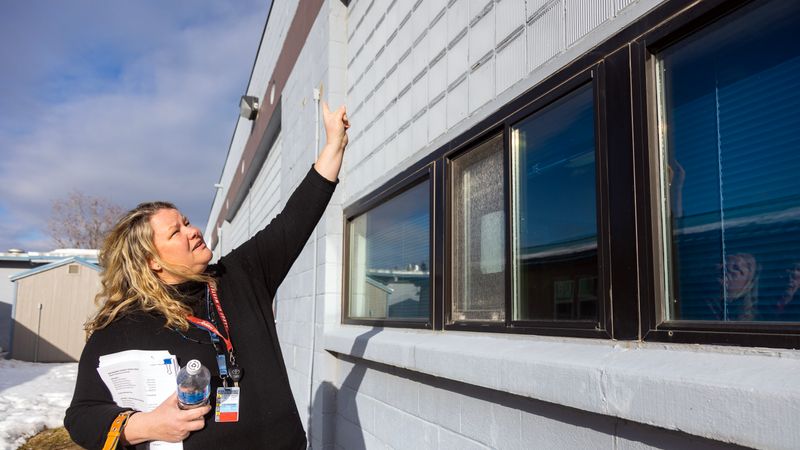
Boundary County School District Superintendent Jan Bayer points out that part of an exterior wall of a school building is made of glass blocks painted blue, which are not efficient for heating and cooling. The rest of the building is made of cinder blocks that came from a naval training station that was decommissioned in the 1940s.

No other state spends less on education per student than Idaho, according to a recent report from the U.S. Census Bureau, which surveys and ranks school finance systems. It also ranks last in the nation in terms of school infrastructure spending per pupil, a state report shows. So over the past several decades, rural districts across the state have faced the same challenge as Bayer: To improve or replace aging — and sometimes dangerous — facilities, they must appeal to local taxpayers and clear some of the nation’s most restrictive thresholds for school funding. Despite urgent needs, most of these efforts fail, an investigation by the Idaho Statesman and ProPublica has found. As a result, students across the state must learn amid dire conditions.

In one Idaho school, the foundation is crumbling. In another, so few bathrooms serve hundreds of kids that students have soiled themselves, according to school officials and local media. And in yet another, a portion of a roof recently failed during off-hours, sending water flooding into a classroom and bathrooms, destroying books and temporarily limiting learning space.

Since 2006, districts have mounted 217 bond attempts to remedy these types of problems and accommodate growing student populations. Had Idaho required only a majority of voters to support the measures — the threshold in most states — 83% of them would have passed. Instead, just 44% were approved, according to an analysis of bond measures and election data by the news organizations.

Please open the link and read this story. It makes you wonder whether the public cares about education and students. People complain about test scores but all too often they are unwilling to pay for an up-to-date school system. Charters and vouchers are a pointless diversion. They guarantee that the public schools attended by most students will be impoverished and under-resources.