Josh Cowen of Michigan State University is among the most experienced voucher researchers in the nation. He is a member of the inner circle of voucher researchers and has been for nearly two decades. He began the work believing that vouchers were promising. As the research accumulated over the years and converged, he realized that vouchers harm the students they are meant to help. I have invited Josh to contribute to this blog whenever he wishes.

He writes here about the claim that the offer of vouchers causes public schools to do better, known as “competitive effects.” Nonsense, he writes.

Over the last few months, as I’ve written here in this blog and elsewhere about how recent data and research show incredibly harmful school voucher impacts for kids, one question that some readers have asked me to address has been the issue of so-called “competitive effects” of vouchers and school choice.

The idea comes from economics, and basically holds that competition between two or more providers of a good or service lowers costs and ultimately provides greater value to consumers. In the economics of education world, the idea that school choice policy forces competition onto public schools to improve the “product” of education is summarized as “a rising tide lifts all boats.”

Before I give you the details, here’s the take-home point: academic research does show that the threat of school choice pressures do prompt upticks in public school test score achievements. That’s particularly true for schools that stand to lose financially from voucher enrollment.

Those tend to be the vulnerable schools with respect to both longstanding historical marginalization, and economic health.

So here’s what you should ask yourself: is that really the way we want to spend public dollars to improve academic outcomes?

Here’s what I mean.

Participant vs. Competitive Effects

First, some definitions. If you’re not in the weeds of school choice research or advocacy, it’s important to clarify the difference between participant and competitive effects because researchers and advocates point to both.

Participant effects are the impact of school vouchers on kids who use them to attend private school. Competitive effects are the impact of school vouchers on kids who stay behind in public classrooms.

It’s inarguable that school vouchers have devasting participant effects. Over the last decade, as voucher programs have gotten larger, we’ve seen impacts as high as twice the academic damage that the pandemic caused to test scores.

But as I wrote above, it’s also true that research shows modest, positive competitive impacts. That is to say: vouchers appear to genuinely pressure public schools to drive up test scores. But voucher advocates who point to that outcome rarely talk about academic drops for kids who use vouchers themselves. When they do, they use industry-funded positive research from groups like the Heritage Foundation or the Goldwater Institute to mask what independent analysts have found.

And as I’ve written both for this page and elsewhere, kids who leave public schools for vouchers tend to do so only temporarily. Their parents are what you might call “voucher curious.” They try a private school out, tend to have average academic declines that are as large as anything we’ve seen in the history of education policy research, and then go back to public schools. Thankfully their outcomes do improve after returning to public education. Studying those kids in Milwaukee, my co-authors and I called that return to academic progress “life after vouchers.”But because these are some of the most at-risk kids in our classrooms, these disruptions can cause long-term if not permanent damage.

So I never want to dismiss the children who temporarily move to voucher schools. They’re not lost to us and they need our help too. Which means it’s important not to talk about competitive effects on public schools without always remembering the horrible outcomes for kids who do leave for vouchers.

It’s “Settled:” Direct Investment in Public Education Works

But what if, despite all of that collateral damage vouchers cause, you’re still wondering about competitive impacts? Just as few voucher activists will cite harmful participant effects when advertising competition, most competition studies do not include analysis of which policy alternatives might be better.

Here’s the obvious alternative: simply spending more money on public schools in the first place.

When I was in graduate school in the early 00’s, the prevailing truism on public school spending was that additional increases in funding had limited value. This thinking was driven almost entirely by the remarkable influence of one man, the economist Eric Hanushek, who compared it to simply “throwing money” at a problem—a phrased used more recently by Betsy DeVos, among others.

Just like the research on voucher participant effects has been entirely upended by more recent evidence, that old work on school spending has been retired by more technically sophisticated statistical approaches and more finely grained data. When it comes to education, money matters—how much, and how it’s spent.

Northwestern economist and National Academy of Education member Kirabo Jackson, one of today’s leading authorities on the subject of school spending, describes the debate as “essentially settled:” direct investment in public education has had consistently large impacts on outcomes ranging from test scores, to graduation rates, to adult earnings later in life. Just a few months ago here in Michigan where I write, University of Michigan scholars released a study showing school finance improvements through our state’s equalization reforms even reduced local crime rates.

Remember that every time you see a conservative scholar point to competition as a policy lever to impact public schools. There may be some small short-term benefit on test scores, but it’s not a substitute for direct and sustained investments directly in schools, teachers and kids.

Just Because We Can, Doesn’t Mean We Should

So yes, research does tend to show that if states threaten public schools with the loss of revenue by implementing private school vouchers, public school test scores may improve somewhat.

Does that mean public schools are better off with vouchers? No. It simply means that so long as standardized tests are the coin of the realm for accountability and revenue, reasonable school leaders will have no choice but to react accordingly. It’s almost tautological: public schools need funding, and threatening to reduce their funding with vouchers is going to have some response—whether desirable or not. In states that have bans on reproductive rights for example in a post Roe v. Wade world, I’m sure we’re going to see the number of abortions drop drastically.

Does that mean eliminating Roe was good public health?

As a researcher who’s become a strong advocate for public schools by following the data and following simply the right thing to do, I put little stock in conservative arguments centered around competitive school voucher impacts simply because the same outcome—test scores—shows massive academic declines for kids who actually go to voucher schools. To me it’s the same argument as saying something like “sure this vaccine kills sick people to whom we administer it, but it doesn’t harm a perfectly healthy patient.”

That’s not public health. And it’s not public education either.

Finally a simple comment on identity and policy. I identify as a white male who is married to a woman. The vast majority of school voucher research comes from white men like me. Vouchers originated with a while male economist. I decline to accept the idea implied by school competition that there is something moral about setting low-income children and communities of color—as public schools threatened with voucher-induced funding loss often are serving—against each other to improve outcomes.

Research might show it can work, but just because we can does not mean we should.

Let’s just take the other research-supported route and spend more money on public education, period. One way or another, I don’t think a person needs to be a public school advocate to realize that threatening schools is hardly an optimal role for public policy. Not when there’s a more supportive way available simply by investing in schools as if our children’s lives and futures matter.

My thought: it’s possible to think of many policies that would lead to improved competitive effects, but would be horrible policies. As Josh says, just because you can doesn’t mean you should. Suppose your school or district threatened to horse whip children who misbehave; that would lead to better behavior, but only by inflicting inhumane punishments. Similarly, you could cut truancy by administering harsh punishments on those who are truant. There are all sorts of ways to induce competitive effects.

In the case of vouchers, it involves encouraging students to leave their public school to attend a voucher school where they will get an inferior schooling and likely return to their underfunded public school.
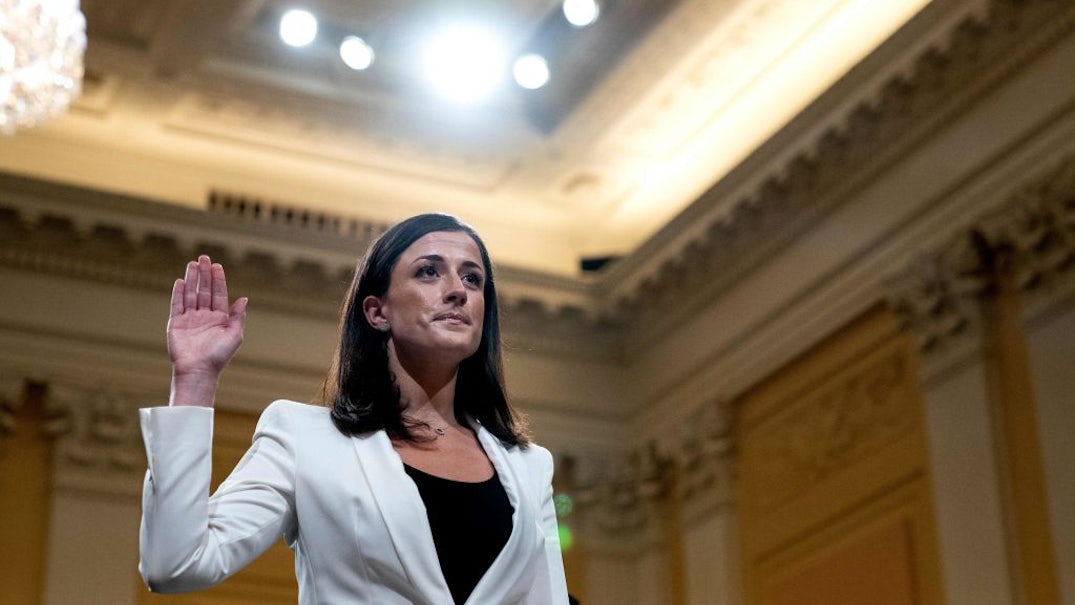
Ellie Honig and friends have a podcast called Cafe Insider. It offers insights into current politics. In this free edition, the question is why Attorney General Merrick Garland is moving so slowly to prosecute the planners of the 1/6 insurrection, one of the biggest federal crimes in U.S. history.

Note From Elie: DOJ and The Cost of Getting There Second

By ELIE HONIG

Featured Image

Cassidy Hutchinson is sworn in by the House Select Committee to Investigate the January 6th Attack on the US Capitol on June 28, 2022. (Photo by Stefani Reynolds / AFP)

Sign up free to receive the CAFE Brief in your inbox every Friday: cafe.com/brief

Become a member of CAFE Insider: cafe.com/insider

Dear Reader,

Cassidy Hutchinson is the perfect witness for a potential prosecution of Donald Trump. She had insider access as an aide to former White House Chief of Staff Mark Meadows; she was inside the West Wing during the frantic days leading up to January 6, and then as the Capitol attack went down that fateful afternoon, two years ago today. Her testimony is damning to Trump and others, and is corroborated in key respects by independent evidence. She is a compelling figure, at once likable, sympathetic, and believable. She is a prosecutor’s dream.

Also: Cassidy Hutchinson lied to federal investigators, under penalty of perjury.

This is not a matter of opinion or debate. It is a fact, openly admitted now by Hutchinson herself. And it’s not even Hutchinson’s fault, not entirely. I place much of the blame on Justice Department prosecutors who twiddled their thumbs for far too long and let themselves get beaten to the punch by the January 6 Committee. This is the cost of DOJ’s dilatory, meandering, hand-wringing approach to its investigation of the real power sources behind the coup attempt. This is the cost of getting there second.

During the first year-and-a-half or so after January 6, the Justice Department focused its prosecutorial efforts on the people who physically stormed the Capitol. Attorney General Merrick Garland vowed at his February 2021 confirmation hearing to “begin with the people on the ground and we work our way up.”

Of course, DOJ had to prosecute those who breached the Capitol and, for the most part, the feds have done an admirable job on these 900-plus cases.

The problem, however, was with Garland’s bureaucratic, bottom-up approach. Yes, prosecutors sometimes do start at ground level and work up the chain of command – but aggressive prosecutors know you don’t have to do it that way. In fact, circumstances sometimes give prosecutors a direct shot at the upper echelons of power, and there’s no reason to refrain from going after the bosses until after you’re done with the riff-raff. To put it in concrete terms: DOJ absolutely could have identified and talked to Hutchinson, Pat Cipollone, Marc Short, and other key White House insiders back in, say, mid-2021. The Justice Department has now spoken with all these folks, and other well-situated witnesses, but it didn’t get around to them until mid- to late-2022.

In the meantime, while DOJ was focused exclusively on the guys in face paint and rhino horns, the January 6 Committee – armed with less powerful investigative tools and resources– got to Hutchinson first. In February 2022 – before she gave her blockbuster, nationally broadcast testimony in June 2022 – she testified behind closed doors. The Committee asked Hutchinson whether she knew anything about a dispute on January 6 between Trump and Secret Service agents, who refused his command to take him to the Capitol. Hutchinson testified that she had heard of no such thing. At this point, Hutchinson was represented by a lawyer named Stefan Passantino, a former Trump White House ethics lawyer (yes: ethics) who was being paid by Trump’s “Save America” political action committee. (Put a pin in this; we’ll get back to Passantino in a bit).

This testimony by Hutchinson, given under penalty of perjury, was false. Months later, in June 2022, she testified publicly that she had heard that Trump had lashed out physically and verbally at Secret Service agents, at one point physically lunging for the steering wheel of the presidential SUV. In a subsequent deposition in September 2022, Hutchinson admitted that she had lied to the Committee the first time around. After her original false testimony, Hutchinson was racked with worry; she said to Passantino, “Stefan, I’m f****d. I just lied… I lied. I lied, I lied, I lied.” (That’s four “I lieds,” for those keeping count.)

There are perfectly understandable and defensible reasons why Hutchinson lied in her first deposition. As she later explained to the Committee, she was under enormous personal and financial pressure to hew to the party line and avoid testifying in any way that might harm Trump. According to Hutchinson, Passantino reinforced that perception, telling her that, “We just want to focus on protecting the President.” Worse, Hutchinson testified that when she told Passantino during prep sessions about the incident between Trump and the Secret Service, Passantino told her, “No, no, no, no, no… We don’t want to go there. We don’t want to talk about that.” (That’s five “nos,” for those keeping count.) Passantino said she could simply claim she did not recall, and there’s no way the Committee could know what she did or did not remember. Passantino contests Hutchinson’s account and starkly denies any wrongdoing.

While this was all going down, Garland was asleep at the wheel. When Hutchinson testified publicly in June 2022, federal prosecutors reportedly were “astonished” as they sat on their couches, watching on television along with the rest of us in the general public.

So here’s the problem now for DOJ (and the Fulton County DA). Hutchinson, as vital a witness as she is, is also damaged goods. She’s probably not fatally undermined but, make no mistake, defense lawyers will have a field day cross-examining her:

You lied to the Committee, didn’t you? (Yes)

You knew you were testifying to the United States House of Representatives, right? (I knew that)

And you knew you were testifying under penalty of perjury, right? (That’s right)

Just like you’re under penalty of perjury now at this trial? (Yes).

But you lied. (Correct)

You knew you could get prosecuted and go to federal prison if you lied, didn’t you? (I did)

Yet you lied, anyway. (Yes)

“I lied, I lied, I lied, I lied.” Those were your words. (Right)

By the way: you haven’t been prosecuted for perjury, have you? Even though you lied? (No, I haven’t)

These prosecutors did you a favor. They could have thrown you in prison, but they gave you a free pass, didn’t they? (Well, I guess I haven’t been charged with anything)

But you did commit perjury. (I suppose so)

Again: I find Hutchinson, on the whole, to be remarkably credible. I believe the substance of her testimony, and I believe that she lied only because of pressure applied by Passantino and others in Trumpworld. But there’s no denying it: this line of cross-examination will hurt.

Yes, Hutchinson has a plausible explanation why she originally lied to the Committee. I’ve seen plenty of witnesses in her situation, and it’s common and understandable for a person who feels financial or political or personal pressure to shade the truth. Prosecutors will surely make this argument if they ever call Hutchinson as a witness and need to rehabilitate her. But it’s an unforced error by DOJ. The Justice Department got beat to the punch, and now they needlessly have to fight a battle over Hutchinson’s credibility. By their inaction, Justice Department prosecutors have handed defense lawyers a gift.

Garland boosters sometimes argue: oh, but he is the humble tortoise, the slow but steady technician who lacks flash but wins the race in the end. Sounds reassuring, but this is apologist pablum. Speed absolutely matters. There’s a reason why prosecutors fight like mad to get to key witnesses first, and then protect them against having to testify in other settings: to prevent a Hutchinson-like scenario where, through no real fault of the witness herself, she winds up giving testimony that undermines her credibility down the line.

As I’ve noted many times in this space, prosecutors may still indict Trump, someday. But Garland’s own delay will make the ultimate job – securing a conviction – even more difficult than it needed to be.

Stay Informed,

Elie

This is one of the most heartening statements I have seen in a long time.

Statement of Support for Art Professor Fired from Hamline University

January 9, 2023MPAC

It is with great concern that the Muslim Public Affairs Council (MPAC) views the firing of an art professor, Erika López Prater, from Hamline University on the grounds of showing a fourteenth-century painting depicting the Prophet Muḥammad. We issue this statement of support for the professor and urge the university to reverse its decision and to take compensatory action to ameliorate the situation.

News sources report that the matter reached the university administration after a Muslim student complained to them about the professor showing the image in class. Subsequently, undergraduate students at the university received an email from the administration declaring the incident to be “undeniably inconsiderate, disrespectful and Islamophobic.” Because the professor was hired as an adjunct, her contract was not renewed and she was effectively fired. 

As a Muslim organization, we recognize the validity and ubiquity of an Islamic viewpoint that discourages or forbids any depictions of the Prophet, especially if done in a distasteful or disrespectful manner. However, we also recognize the historical reality that other viewpoints have existed and that there have been some Muslims, including and especially Shīʿī Muslims,  who have felt no qualms in pictorially representing the Prophet (although often veiling his face out of respect). All this is a testament to the great internal diversity within the Islamic tradition, which should be celebrated.  

This, it seems, was the exact point that Dr. Prater was trying to convey to her students. She empathetically prepared them in advance for the image, which was part of an optional exercise and prefaced with a content warning. “I am showing you this image for a reason,” stressed the professor:

There is this common thinking that Islam completely forbids, outright, any figurative depictions or any depictions of holy personages. While many Islamic cultures do strongly frown on this practice, I would like to remind you there is no one, monothetic Islamic culture.

The painting was not Islamophobic. In fact, it was commissioned by a fourteenth-century Muslim king in order to honor the Prophet, depicting the first Quranic revelation from the angel Gabriel. 

Even if it is the case that many Muslims feel uncomfortable with such depictions, Dr. Prater was trying to emphasize a key principle of religious literacy: religions are not monolithic in nature, but rather, internally diverse. This principle should be appreciated in order to combat Islamophobia, which is often premised on flattening out Islam and viewing the Islamic tradition in an essentialist and reductionist manner. The professor should be thanked for her role in educating students, Muslim and non-Muslim alike, and for doing so in a critically empathetic manner. 

In a time of rampant Islamophobia, highly offensive and racialized images of the Prophet Muḥammad abound on the internet and on social media. We consider these images to be inappropriate and not dissimilar to “black face” or Anti-Semitic cartoons; even if such images and their makers are protected by law, social opprobrium is due to them by all those who are reasonable and decent. As Muslims, of course, we must respond in a calm and graceful manner as befits our religion: 

 The servants of the Compassionate are those who walk humbly upon the earth, and when the ignorant address them [with insulting words], they respond, ‘peace.’ (Q 25:63)

Given the ubiquity of Islamophobic depictions of the Prophet Muḥammad, it hardly makes sense to target an art professor trying to combat narrow understandings of Islam. There is an unmistakable irony in the situation, which should be appreciated. Additionally, misusing the label “Islamophobia” has the negative effect of watering down the term and rendering it less effective in calling out actual acts of bigotry.

Finally, we stress the importance of education in the Islamic tradition. On the basis of our shared Islamic and universal values, we affirm the need to instill a spirit of free inquiry, critical thinking, and viewpoint diversity in the university setting.

Muslim Public Affairs Council


Jan Resseger keeps close tabs on education in Ohio, which is constantly under attack in the legislature. In this post, she reviews what happened in the past year. The “good” consists of bad things that didn’t happen. The Republican-dominated legislature is intent on constant privatization of public funds. Ohio is rife with failing charters and ineffective vouchers. The legislature wants more failure. The chair of the House Education Committee, Andrew Brenner, calls public schools “socialism.” The Ohio legislature deserves a spot on this blog’s Wall of Shame.

Jan Resseger wrote:

In the midst of the big 2022 Christmas week storm, a frozen sprinkler-system pipe burst at the Ohio Statehouse and flooded the state senate chamber. This year in Ohio’s gerrymandered, supermajority Republican legislature, democracy itself has been so severely threatened that many of us wondered if the event was an expression of cosmic justice.

As Ohio Supreme Court Chief Justice Maureen O’Connor retired due to the state’s mandated age limit,O’Connor—herself a Republican—condemned legislators who created one gerrymandered legislative and Congressional district map after another, O’Connor told the Associated Press: “My advice to them was, please review the Constitution and maybe go back to, what is it, fourth or fifth grade and learn about our institutions… And maybe, just maybe, review what it was like in Germany when Hitler intimidated the judiciary and passed those laws that allowed for the treatment of the Jewish population… This country cannot stand if the judiciary is intimidated.” The AP reports that, “In retirement, she has pledged to champion a constitutional amendment that fixes Ohio’s redistricting process…”

BAD THINGS THAT DID NOT HAPPEN IN 2022

The 134th Ohio General Assembly did not pass Ohio Senate Bill 178 to hollow out the Ohio State Board of Education and shift its primary responsibilities (including overseeing the Department of Education itself) to a new cabinet Department of Education and the Workforce under the Governor. Politics have already to some degree invaded the Ohio State Board of Education, because the governor already appoints 8 of its 19 members. And during the past two years there have been several legislative/gubernatorial interventions to gerrymander the districts of elected members to favor Republicans, and to fire unruly members and appoint new members who would be more faithful to Ohio Republicans’ priorities.

In 2022, the Ohio Senate passed SB 178 to move the important functions of the State Board of Education under the governor’s control, to insulate the state board from the will of the people, and to remove many of the State Board’s responsibilities. In December, during the last week of the legislative session, SB 178 was heard by the House Education Committee, but the bill never came up for committee vote and never was acted on by the Ohio House. At 2:30 AM, before the the 134th General Assembly permanently adjourned at 6:30 AM, Senate President Matt Huffman inserted the entire 2,144 page SB 178 into HB 151 to ban transgender girls from sports, inserted another amendment to ban school vaccine mandates, and sent the entire package back to the Ohio House, where it failed by 6 votes. Although this problematic bill failed in the 134th General Assembly, Senate President Matt Huffman has pledged another attempt during 2023 to politicize the State Board of Education in the 135th Ohio General Assembly.

A Mass of Culture War Bills Will Die Because They Never Came Up for a Vote (For details, see Honesty for Ohio Educationor the Northeast Ohio Friends of Public Education.)

  • HB 322, HB 327, and HB 616 to ban teaching and materials about divisive concepts including racism and sexual orientation.
  • HB 529 to demand that school curricula be posted online.
  • HB 454 to ban gender affirming care for minors.
  • HB 704 to affirm that gender identity is identifiable at birth according to DNA.
  • HB 722 to ban discussion of any ‘sexually explicit’ content and establish a ‘parents bill of rights.’
  • SB 361 to enable former military troops to become teachers with relaxed credentialing.
  • SB 365 to include curriculum about free market capitalism in educational standards.

HB 290, the “Backpack” universal education savings account voucher programnever came up for a vote in the 134th General Assembly. Most people expect, however, that a similar bill will be introduced in the 135th General Assembly, perhaps as part of the FY 2024-2025 biennial budget bill. For more information see here.

GOOD THINGS THAT DID NOT HAPPEN IN 2022

The Ohio Legislature did not pass HB 497 to eliminate the Third Grade Reading Guarantee. After HB 497 passed the Ohio House by a margin of 82-10 and after the bill was unanimously endorsed by the Ohio State Board of Education, HB 497 was never considered by the Ohio Senate Primary and Secondary Education Committee and never forwarded for a vote by the full Ohio Senate. The bill died with the end of the 134th Ohio General Assembly. The bill would have eliminated mandatory retention in third grade of any student who does not reach a proficient score on the state’s third grade achievement test. Research demonstrates that holding kids back in grade damages self esteem and makes it more likely that students will drop out of school before graduating from high school. For background see here.

BAD THINGS THAT HAPPENED IN 2022…

Keep reading to learn about the “Bad Things That Happened in 2022” and the One Good Thing That Happened.

Jan concluded her post:

There is no reason to believe that in 2023 the legislative majority of Ohio’s 135th General Assembly will be supportive of Ohio’s public schools. Persistence will be required as advocates press for the full six year phase-in of adequate school funding under the Cupp-Patterson Fair School Funding Plan. And, as Ohio Public Education Partners declares, we must demand that the Legislature “rejects the school privatization agenda, which includes school voucher schemes (and) charter schools….”

The Network for Public Education has released a new report on for-profit charters, which grew during the pandemic years. The report is titled Chartered for Profit II: Pandemic Profiteering. It builds on the findings of a report published by NPE in 2021. For-profit charters not only divert money away from the public schools, which enroll the vast majority of students in every state, but they skim off profits that should have been spent on students and teachers. The report details the nefarious deals that enrich the charter operators. Every citizen who cares about our future should be aware of the facts detailed in this report. We believe readers will be genuinely shocked by the findings in this report, which shows how scammers and grifters have gotten a stronghold in the charter industry, to the detriment of students, teachers, and taxpayers.

Here is the executive summary:

In March of 2021, the Network for Public Education published Chartered for Profit: The Hidden World of Charter Schools Operated for Financial Gain. In this follow-up report on the charter for-profit sector, we chronicle its expansion during the years of the Covid-19 pandemic by reporting growth in the number of schools, the number of for-profit corporations that run them, and student enrollment.

Acccording to our research, the for-profit sector dominated the charter school sector during the pandemic years. As the pandemic wore on – the percentage of charter schools run by for-profits jumped from 15 percent to 16.6 percent of the charter sector. This is a far greater percentage than is reported by the National Alliance for Public Charter Schools, which inexplicably does not report schools run by for-profit Education Management Organizations (EMOs) that control only one or two schools. These micro-EMOS comprise nearly half of all for-profit EMOs.

However, the number of schools run for profit underestimates the true growth of for-profit schooling during Covid 19. The percentage of students attending a charter school designed to produce a profit for its management company soared. According to the Common Core of Data of the National Center for Education Statistics, the total student enrollment in charter schools during the second year of the pandemic (the 2021-2022 school year) was 3,676,635. Student enrollment in for-profit-run charter schools jumped to 731,406 that year.

That means that 20 percent of all charter school students, 1 in 5, were enrolled in a charter school managed by a for-profit management corporation by the pandemic’s end.

More disturbing is that 27 percent of the students attending for-profit-run schools were enrolled in low-quality virtual charter schools that teach students either exclusively or primarily online. That was in 2021. During the prior year (2020) the number was even higher.

Those who defend for-profit charter schooling claim it is no different from public schools using vendors for transportation services or to purchase textbooks. However, as this report explains, for-profit chartering is very different from vendors who supply discreet products and services. We detail the various ways in which the owners of EMOs extract profit via a lack of oversight and regulation that fails to protect taxpayers from sweetheart deals, sweeps contracts, and related party transactions designed to enrich EMO owners, their friends and their family members. And we explain how the acquisition of real estate and exploitative lease and purchase agreements drive the expansion of for-profit-run charter schools and, in some cases, put the school at financial risk.

Chartered For-Profit II: Pandemic Profiteering makes a case for substantive state and national reform so that the best interests of students and taxpayers trump financial gain. Like our first report, it provides insight into the most controversial sector of the charter school world—charters operated for financial gain.

Michelle Goldberg, a columnist for the New York Times, writes here about Governor Ron DeSantis’s bold move to crush a progressive public college in Florida by naming right wingers to its board. DeSantis boasts that Florida is the state where “woke” goes to die, so of course he must take control of this “woke” college and destroy it. He’s showing his fascistic instincts. Whatever he can’t control, whatever dissents from his hardline views must die.

She writes:

New College of Florida has a reputation for being the most progressive public college in the state. X González — a survivor of the Parkland school shooting who, as Emma González, became a prominent gun control activist — recently wrote of their alma mater, “In the queer space of New College, changing your pronouns, name or presentation is a nonevent.” In The Princeton Review’s ranking of the best public colleges and universities for “making an impact” — measured by things like student engagement, community service and sustainability efforts — New College comes in third.

Naturally, Gov. Ron DeSantis of Florida wants to demolish it, at least as it currently exists. On Friday, he announced six new appointments to New College’s 13-member board of trustees, including Chris Rufo, who orchestrated the right’s attack on critical race theory, and Matthew Spalding, a professor and dean at Hillsdale College, a conservative Christian school in Michigan with close ties to Donald Trump. (A seventh member will soon be appointed by Florida’s Board of Governors, which is full of DeSantis allies.)

The new majority’s plan, Rufo told me just after his appointment was announced, is to transform New College into a public version of Hillsdale. “We want to provide an alternative for conservative families in the state of Florida to say there is a public university that reflects your values,” he said.

The fight over the future of New College is about more than just the fate of this small school in Sarasota. For DeSantis, it’s part of a broader quest to crush any hint of progressivism in public education, a quest he’d likely take national if he ever became president. For Rufo, a reconstructed New College would serve as a model for conservatives to copy all over the country. “If we can take this high-risk, high-reward gambit and turn it into a victory, we’re going to see conservative state legislators starting to reconquer public institutions all over the United States,” he said. Should he prevail, it will set the stage for an even broader assault on the academic freedom of every instructor whose worldview is at odds with the Republican Party.

Rufo often talks about the “long march through the institutions,” a phrase coined by the German socialist Rudi Dutschke in 1967 but frequently attributed to the Italian communist Antonio Gramsci. Thwarted in their hope of imminent revolution, the new left of Dutschke’s generation sought instead to bore into political and cultural institutions, working within the system to change the basic assumptions of Western society. Rufo’s trying, he said, to “steal the strategies and the principles of the Gramscian left, and then to organize a kind of counterrevolutionary response to the long march through the institutions.”

This grandiose project has several parts. Rufo has been unparalleled in fanning public education culture wars, whipping up anger first against critical race theory and then against teaching on L.G.B.T.Q. issues. This year, he is turning his attention to diversity, equity and inclusion programs, and, with his colleagues at the Manhattan Institute, will soon unveil model legislation to abolish such programs at state schools. In New College, he sees a chance to create a new type of educational institution to replace those he’s trying to destroy. When we spoke, he compared his plans to Elon Musk’s takeover of Twitter.

Later this month, Rufo said, he’ll travel to New College with a “landing team” of board members, lawyers, consultants and political allies. “We’re going to be conducting a top-down restructuring,” he said, with plans to “design a new core curriculum from scratch” and “encode it in a new academic master plan.” Given that Hillsdale, the template for this reimagined New College, worked closely with the Trump administration to create a “patriotic education” curriculum, this master plan will likely be heavy on American triumphalism. Rufo hopes to move fast, saying that the school’s academic departments “are going to look very different in the next 120 days.”

The values of the people who are already at New College are of little concern to Rufo, who, like several other new trustees, doesn’t live in Florida. Speaking of current New College students who chose it precisely for its progressive culture, Rufo said: “We’re happy to work with them to make New College a great place to continue their education. Or we’d be happy to work with them to help them find something that suits them better.”

Of course, as both leftist revolutionaries and colonialists have learned over the years, replacing one culture with another can be harder than anticipated. New College students may not go quietly. Steve Shipman, a professor of physical chemistry and president of the faculty union, points out that tenured professors are covered by a collective bargaining agreement, which makes it hard to fire them unless there’s cause. People like Rufo “are making statements to make impact,” Shipman said. “And I really don’t know how viable some of those statements are on the ground.”

We’ll soon find out. “We anticipate that this is going to be a process that involves conflict,” said Rufo.

Nancy MacLean, professor of history at Duke University, and Lisa Graves, board president of the Center for Media and Democracy, warn readers not to be fooled by billionaire Charles Koch’s efforts to rebrand himself as a nice guy who has mellowed, who no longer wants to fund divisive, hateful organizations. A nice guy.

The media fell for it. The new, nice Charles Koch.

MacLean and Graves write: Don’t believe it. Koch won’t stop until democracy is dead.

They write:

Koch, the single most influential billionaire shaping American political life, never changed course. And the head fake he pulled off in 2020 succeeded in securing for his vast donor network—and the hundreds of organizations they underwrite—the freedom to operate, virtually without scrutiny, over the two years since. In that time, far from ceasing their efforts to divide the country, they have ramped them up. Like a snake shedding its skin as it grows, Koch was merely rebranding—yet again after exposure—and grouping his numerous operations under a sunny new name: Stand Together.


In August, the Center for Media and Democracy (CMD) reported that Koch-funded organizations spent over $1.1 billion in the 2020 election cycle. At the same time his book claiming to have changed course was in press, Koch spent almost 50 percent more than the record amount the Koch network had raised in the 2016 cycle: $750 million. Koch did not endorse Trump, though his spending buoyed the top of the ticket and helped maintain a GOP Senate majority to secure Koch-backed policies and judicial nominees embraced by Trump.

One of these organizations, Koch’s Americans for Prosperity (AFP), a 501(c)(4) tax-exempt organization, claimed it was involved in more than 270 races in the 2020 election, reaching almost 60 million voters with door-knocking, phone calls, postcards, digital ads, and more. AFP also played heavily in the battle for U.S. Senate seats in Georgia, in January 2021—even as Koch was still getting favorable coverage for his supposed withdrawal from divisive electoral politics. AFP Action, the super PAC arm, alone raised and spent $60 million nationwide in that election cycle.

Meanwhile, other key organizing enterprises, think tanks, litigation outfits, campus centers, and more that were previously backed by the Koch network continue operating today, sometimes under new names, and with expanded funding. These include endeavors we consider unethical, only some of which we have the space to highlight here.

Take, for example, Koch’s longest running quest: enchaining democracy by rigging the rules of governance to free corporations from customary oversight and to prevent the will of the vast majority of Americans from securing federal, state, and local policies to improve their lives. With the connivance of Trump, the generalship of Federalist Society leader Leonard Leo, and the well-funded campaigning of Leo’s Judicial Crisis Network, the arch-right billionaire succeeded in capturing a supermajority in the U.S. Supreme Court. Koch had told his allied billionaire backers that this was one of his top priorities for the Trump Administration—along with the dramatic tax cuts for corporations and the wealthy that he also secured.

Senator Sheldon Whitehouse, Democrat from Rhode Island, a climate hero and senior member of the Senate Judiciary Committee, exposes how they did it in a recently published book, The Scheme: How the Right Wing Used Dark Money to Capture the Supreme Court. The long effort to reshape the judicial system, going back to the notorious Lewis Powell Memo of 1971, culminated in the Trump Administration’s appointment of more than 230 “business-friendly” federal judges, including three Supreme Court Justices, in a project overseen by longtime Koch allies Leo and Donald McGahn, who served as Trump’s legal counsel until 2018. The 6-3 stacked court is already delivering bombshell decisions for the coalition that put it in power, from undermining our options for mitigating devastating climate change and limiting the power of agencies to regulate corporations, to revoking people’s Constitutional freedom to decide whether and when to bear children. The current court term with the Koch-backed faction in control is expected to soon overthrow affirmative action and other hard-won reforms.

The Koch-funded American Legislative Exchange Council (ALEC) also continues its long campaign to shackle democracy on behalf of its corporate backers. Passing voter ID restrictions that make it harder for Americans to exercise their right to vote became a top ALEC priority after the United States elected its first Black President, Barack Obama. That measure was first voted on at an ALEC task force meeting co-chaired by the National Rifle Association in 2009.

ALEC is one of the nation’s leading promoters of charter schools, vouchers, and anti-union legislation. You can learn more about ALEC by reading Gordon Lafer’s The One Percent Solution.

Please open the link and read the article. Learn about the “new” Charles Koch, same as the old one.

If you are looking for a good read, read Nancy MacLean’s Democracy in Chains, which provides the context for understanding the links between the Koch brothers, Milton Friedman, and free-market economics. Suffice it to say that one of their goals was to privatize Social Security. Still working on that.

Entrepreneur Steve Perry opened a charter chain called Capital Preparatory Schools, which recently was a finalist for the Yass Prize, which acknowledges outstanding charter schools. The chain won a prize of $500,000, which it will use to expand. The first-place winner was Arizona Autism Charter Schools, which won $1 million. The Yass Prize is called a STOP award, meaning Sustainable, Transformational, Outstanding, and Permissionless.

On the federal government website for charter schools, the Yass prize is described thus:

The mission of the STOP Awards is to identify and support more best in class education providers who can tackle the challenges and deliver an education for students that is Sustainable, Transformational, Outstanding and Permissionless. The STOP Foundation for Education is not just a philanthropy. And the STOP Award is not just a prize. It’s a movement intended to transform education for everyone. Complete the online application form.

The prize is administered by the Center for Education Reform of Washington, D.C., which supports charter schools, vouchers, and virtual charters, and opposes public schools.

Capital Prep operates in New York City and Connecticut. Its schools were recognized for providing outstanding education, and because 100% of its graduates were accepted at four-year colleges and universities since 2006. Its school in Harlem was co-founded by musician Sean Combs, also known as P. Diddy.

Gary Rubinstein has a history of examining charter schools that claim miraculous results. He took a close look at the Capital Prep Schools and learned from state data that they are actually low-performing schools. Please open the link to see his documentation.

He writes:

The 100% college acceptance graduation rate….implies that the students at the school have been successful in their academics. So I thought I’d go to the public New York State data site to see if this is the case.

In general, the test scores at the Perry / P. Diddy school are some of the lowest in the city. Most notable is that in their 8th grade class of 71 students, exactly 1 scored a passing score of a 3 on the recent state tests…[Scores range from 1-5].

School wide, only 6% of the students in all grades got a 3 on the math state test.

For the older grades, I see that no students passed the Geometry or the Algebra II Regents exams.

Now I’m not saying that test scores are everything, but when only 1 out of 71 8th graders gets a 3 on the state test, this definitely runs counter to the image that the 100% college acceptance rate is supposed to indicate.

The New York Capital Prep schools have only been open for a few years, but the Connecticut Capital Prep schools have been around for over 15 years. So I also looked at the Connecticut publicly available data, which has a lot of useful information on it.

One thing I found was that their Four-Year graduation rate has been as low as 56% in recent years…

On the college readiness index, the school fared very poorly…

The college entrance rate for 2020 was not 100% but about 77%

That school also had 0% passing an AP exam even though 38% took an AP exam…

So anytime you see a claim that some school is beating the odds because they have a 100% college acceptance rate, you should know that there is usually more to the story than that one statistic.

Again, open the link.

Charter schools have managed to occupy an unusual spot in the spectrum of educational institutions: When it’s time to get public funding, they insist they are “public schools.” But in court cases where charters were fighting to be exempt from state laws governing employment practices or financial accountability, they insist they are not “state actors.” It is logically impossible to be both a public school but not a state actor.

In a current court case, a North Carolina charter chain wants the courts to declare that its schools are not state actors because they enforce policies for girls’ dress that is inconsistent with state and federal law.

Public schools are state actors. In effect, this charter chain wants to be declared “not a public school” even as it continues to be publicly funded. Why? It wants to preserve its right to ignore state and federal laws against discrimination.

Peter Greene explains the background of this case:

In the regularly pro-choice Wall Street Journal, Baker Mitchell and Robert Spencer want to complain about a court decision declaring that their charter schools are, in fact, public schools. This, they warn, “imperils the charter school movement.” Their complaint is a big pile of deep fried baloney.

The case that prompted this whinging

One of the charter schools operated by Roger Bacon Academy was sued by some parents over a dress code requiring girls to wear skirts (or skorts–but none of that pants-wearing stuff, ladies). Such a big deal. Who knew?

“We’re a school of choice. We’re classical in our curriculum and very traditional. I believe that the more of the traditional things you have in place, the more they tend to reinforce each other,” he said in a phone interview. “We want boys to be boys and girls to be girls and have mutual respect for each other. We want boys to carry the umbrella for girls and open doors for them … and we want to start teaching that in grammar school.”

RBA is owned and operated by Baker Mitchell, Jr., one of the titans of charter profiteering. Back in 2014, Marian Wang profiled the “politically-connected businessman who celebrates the power of the free market,” and how he perfected the business of starting nonprofit charter schools and then having those schools lease their buildings, equipment, programs, etc. from for-profit companies owned and operated by Baker Mitchell, Jr. Mitchell (now in his early eighties) thinks the rule is great:

The case bounced up through the various court levels until it landed in front of the full panel of the Fourth Circuit Court of Appeals, which declared that the rule was junk and had to be thrown out. Not a worthwhile call-back to what one dissenting judge called “the age of chivalry” as the majority noted such an age was also the age “when men could assault their spouses” and that chivalry “may not have been a bed of roses for those forced to lie in it.”

Nor did the court accept the argument that girls were still getting good grades. “We cannot excuse discrimination because its victims are resilient enough to persist in the face of such unequal treatment.”

So what’s the big deal? (Spoiler alert: that state actor thing)

Mitchell and Spencer are not whining about the loss of their ability to require girls to show their legs. They protest that the policy was created by parents; well, so was the lawsuit, so that hardly seems like a useful point. And it’s not the main concern,

The case hinged on the question of whether or not charter schools are “state actors” aka actual public schools. The court said, “Yes, they are.”

Mitchell and Spencer complain that no court has ever done such a thing and therefor: The Fourth Circuit’s finding appears to have been based on little more than the convention of calling charters “public charter schools” and their being mostly funded by public sources.

This is kind of hilarious, because the “convention” of calling these school public was created entirely, and purposefully, by the charter industry and its supporters. They have insisted loudly and often that charter schools are absolutely public schools, and have engaged in uncountable arguments with anyone who dares to say otherwise. Of course, they have also frequently insisted that they are private businesses when it’s convenient for fending off state scrutiny or grabbing PPP pandemic relief money.

And despite Mitchell and Spencer’s apocalyptic warnings, you know who applauded the court’s ruling?

The National Alliance for Public Charter Schools. The importance of this case could not be overstated, as it was the first time a federal appellate court considered whether public charter school students deserve the same constitutional civil rights protections as district public school students. The en banc court clearly and unequivocally affirmed that charter schools are public schools and, accordingly, must be bound by the US Constitution. Moreover, public charter school students have the same constitutional and civil rights as their district public school peers.

Galen Sherwin, ACLU senior staff attorney, observed that the ruling was important because The court rightly recognizes that ruling otherwise would leave states free to establish parallel, privately operated public school systems in a constitution-free zone, free to implement race segregation, religious discrimination, etc.

So what are they really, really upset about?

The tell comes a little further down the piece.
The ruling comes at a time when the charter-school movement is growing. Oklahoma’s attorney general recently issued a legal opinion stating that religious organizations must be allowed to operate charter schools in the Sooner State. A key aspect of the opinion was a finding that charter schools are not state actors and, therefore, the Constitution’s Establishment Clause doesn’t prohibit the inculcation of religious values, as it does in government-run schools.

If charter schools are state actors, then that might get in the way of expanding religious charters. And sure enough– we find amicus briefs filed by Catholic Charities of the Diocese of Arlington VA, Notre Dame Law School Religious Liberty Clinic, the Jewish Coalition for Religious Liberty, and the Religious Freedom Institute. “These experts,” say the writers, confusing advocacy and lobbying with expertise, say the Fourth Circuit’s ruling would undercut charter schools.

Well, no. They would undercut the extension of private religious organizations into a sweet, sweet chance to get their hands on public tax dollars while still enjoying unregulated freedom to indoctrinate some students into their religion while also discriminating against whatever students they choose to discriminate against in a taxpayer-funded Constitution-free zone.

Are we done yet?

Of course not. The school has petitioned the Supreme Court to hear their appeal. It invokes the 14th Amendment and features this kind of flag-waving:


North Carolina charter schools—like many throughout the Nation—build upon a critical insight: Empowering private entities to operate publicly funded schools with minimal government oversight supercharges educational innovation and expands parental choice. The decision below profoundly threatens this model.

“Supercharges innovation.” Sure. Making girls wear skirts is one hell of a supercharged innovation. My usual offer stands–name one educational innovation that has come out of the modern charter school sector.

Mitchell and Spencer want you to know that damn ACLU is behind this case, but they aren’t exactly being represented by a Mom and Pop firm. Aaron Streett is an attorney with Baker Botts, a multinational law firm (where both Amy Coney Barrett and Ted Cruz once worked), and that he’s the chair of their Supreme Court and Constitutional Law Group. Streett says that the majority opinion “contradicts Supreme Court precedent on state action…and limits the ability of parents to choose the best education for their children.”

The argument is simple enough–we are not a public school, so we should get to do whatever the hell we want (and be paid by taxpayer dollars while we do it).

It’s a tough call for the charter biz–if they aren’t public schools, then at this point they really aren’t much different from private voucher schools, so what’s the point of them? But if they want to market themselves as public schools, they can damn well operate under public school rules.

Who knows if SCOTUS will hear this, or what they will decide. But regardless of how things end up, it looks like the charter movement’s days of being able to have things both ways may be coming to an end.

Kevin Welner, who is both a lawyer and a professor of education policy at the University of Colorado at Boulder, wrote about these issues on Valerie Strauss’s Answer Sheet blog last June, after the U.S. Supreme Court ruled that Maine could not exclude two religious schools from state funding when it provided public funding to other private schools, even though the religious schools openly discriminate against LGBT students, families, and staff, as well as non-Christians. The case is called Carson V. Makin.

Welner suggests that the Maine case may erase the line between charter schools and vouchers.

Welner wrote:

If charter schools are state actors, they cannot engage in religious teaching or discrimination. The Peltier litigation did not, however, involve any claim by the school that its sexist dress code arose out of protected religious beliefs. If religious-liberty claims were to be asserted around a comparable policy adopted by a charter school run by a religious organization, the state-action inquiry should be very similar, if not identical, and the charter school should be prohibited from engaging in discrimination.

But as today’s Carson v. Makin decision illustrates, the introduction of free-exercise protections could greatly complicate the overall analysis. If courts side with a church-run charter school, finding that state attempts to restrict religiously infused teachings and practices at the school are an infringement on the church’s free-exercise rights, then the circle is complete: Charter school laws have become voucher laws.

If the Supreme Court hears the Peltier case, if it decides that charter schools are not state actors, if charters may discriminate against girls, LGBT students, and non-Christians, then as Welner says, charters are no different from vouchers. But if they are not state actors, then charter schools are not public schools. But they are free to discriminate against any group, without regard to federal law. And they are free to teach religious doctrine and to close their schools to non-believers. States will then be directly funding schools that teach religious zealotry and openly engage in discrimination.

A loss for American democracy, but a victory for Donald Trump, who appointed three religious extremists to the Supreme Court; Mitch McConnell, who refused to allow President Obama to fill Justice Scalia’s empty seat on the Court after the Justice died in March 2016 (on the absurd grounds that it was too close to a presidential election), as well as his rush to allow Trump to name Amy Coney Barrett to fill Justice Ruth Bader Ginsburg’s seat only weeks before the 2020 election; the far-right wing Leonard Leo and the Federalist Society, which selected the judicial candidates for Trump. And while it may be impolitic to say so, I blame Justice Ruth Bader Ginsberg for refusing to resign her seat in 2014 or 2015, when Obama would certainly have been able to replace her. She had had four bouts with pancreatic cancer, and good reason to step down and give Obama a chance to replace her. Instead she stayed on and died at age 87, gambling that Hillary Clinton would replace Obama. She lost her bet, and the nation has a Supreme Court that is imposing a deeply reactionary agenda.

You may have noted, if you have followed this blog for a long time, that I am a big fan of Peter Greene. Peter is a wonderful writer, has a great sense of humor, and was a classroom teacher for 39 years in Pennsylvania. In addition to his own blog Curmudgacation, Peter is a regular columnist at Forbes, where he educates business people.

He writes so much so quickly that I sometimes miss terrific columns. This is one that I missed. It was published in 2019 in Forbes. The topic remains pertinent. Just in the past few days, I have had to defend the proposition that charter schools are not public schools. They call themselves public schools, but that doesn’t mean it is so.

Peter Greene explains here why charter schools are not public schools.

Modern charter schools prefer to attach the word “public” to their descriptions. Many of the charter advocacy groups include “public charter” in their title. And truthfully, there are no regulations attached to the term–any school can attach the word “public” to its title without having to worry about any sort of penalty.

So technically, any charter school can call itself a public school. Heck, any private or parochial school can call itself a public school if it’s so inclined. But while modern charter schools are financed by public tax dollars, they are not truly public schools for the following reasons.

Transparency

When City Paper recently reported on the salaries of DC charter teachers and administrators, it required extra digging to come up with the information because charter schools are exempt from the Freedom of Information Act. In fact, City Paper reported that a teacher employed by the charter was not even allowed to see the salary scale for her own job. In 2014, when the New York state controller wanted to audit the books of Eva Moskowitz’s Success Academy, the charter leader took him to court and won, barring the state from trying to see how public tax dollars were spent.

Public schools are required to provide a transparent look at their finances. At times, some outlets have gone so far as to publish the salaries of individual teachers, and that’s perfectly legal. Nor are public school boards allowed to meet privately or in secret. Everything that happens in a public school is paid for with public dollars, and is therefor subject to public scrutiny. Charters deliberately avoid that level of scrutiny.

Subject To State Law

The details here vary from state to state (here’s a handy chart for looking up your own state), but charter schools generally don’t have to play by the same rules as public schools. Non-discrimination, health and safety, and school year length are often (but not always) exceptions–beyond the specific exceptions, charters operate as they will, and may in some states request additional waivers. So, for instance, many states do not require charter teachers to be certified. Public schools, meanwhile, must play by all the rules laid down by the state.

Student Population

Modern charter schools have a variety of techniques for controlling which students they serve. It begins with advertising, which signals which students are most likely to feel like the school is a good fit for them. Charters are not required to provide programs that meet all special needs; they don’t necessarily turn those students down, but if a school tells you that they do not offer the program that your child needs, will you really enroll there? And while lotteries are supposed to select students randomly, lotteries themselves often require committed parents willing to work their way through the paperwork and bureaucracy, so that the system allows parents to self-select for providing the kind of support and commitment that makes students more successful.

Once the student is in the school, there are a variety of ways to nudge the child out. We’ve seen the “Got To Go” list at Success Academy; families can be nudged out with repeated suspensions and disciplinary action.

Charter supporters note that some public schools, such as magnet or special program schools, do not accept all students either, and that is true. However, even if the child is not selected for the magnet school, the district is still responsible for that child’s education and will enroll her elsewhere. If a student has severe special needs that the district cannot meet in house, the district must still assume financial responsibility for providing the child with an education at some specialized facility.

When students walk out the door of a charter school, they cease to be the charter’s responsibility. But as long as a student lives within the public school’s designated area, that student is the district’s responsibility.

Local Control

Public schools answer to the public. They are run by elected school boards who must meet and take action in public. Charter advocates have expressed frustration with this system and even suggest that school boards be done away with. Many public systems have been attacked on this front, with their school boards thrust aside by state takeover or a switch to mayoral control. Such changes make those systems less public, and often are a step toward converting public schools to charters.

Charter schools could be operated by a locally elected board, but they almost never are. Instead, charter schools are owned and operated by private individuals or boards, sometimes located far away from the school itself. Sometimes control of the charter is separated from the community by a series of managerial handoffs–Group X technically owns and operates the charter, but they hire Corporation Y to actually run the school.

When municipal assets like water systems and parking facilities are handed off to private companies to run, we call it by its name–privatization. Turning a school over to a private company to own and operate is no different.

Why Bother?

Why do charter schools and their boosters insist on using the term “public”? Here’s what Todd Ziebarth, senior vice president at the National Alliance for Public Charter Schools, told Emma Brown of the Washington Post as he argued that charters are public schools.

And it’s a term that matters, he said: Americans have high regard for the importance of public education, and private schools carry connotations of exclusivity that don’t apply to charters.

In other words, “public” carries a host of connotations that are important for marketing purposes. Brown was interviewing Ziebarth in 2016 for his reaction to the National Labor Relations Board ruling that charters are private corporations.

We can talk another day about whether charter schools are helping or hurting, whether they’re good policy or bad. What we should not need to discuss is whether or not they are public.

Next time someone insists that charter schools are public schools, I can send them a link to this article.

There’s another tell that shows what charters are. When COVID began spreading, Congress passed a program for small businesses and nonprofits called the Paycheck Protection Program. The Small Business Administration gave out almost $800 billion to save jobs. Many private and religious schools applied for and received PPP grants, as did churches, synagogues, mosques, and businesses. Public schools were not allowed to apply for PPP money because there was another program specifically for public schools. Some charter schools applied for and received over a billion dollars of PPP money, while also collecting money from the public school fund. The average charter school received far more than the average public school because many of the charters double-dipped from both funds. If charter schools were public schools, they would not have been eligible for PPP money.