When I first had a chance to read the College Board’s AP African American Studies syllabus, I predicted that the College Board was likely to beat a hasty retreat if its bottom line was jeopardized. I have not yet seen the revised edition, but the media is reporting that certain hot topics and prominent names were deleted to make the course palatable to Ron DeSantis and other conservative governors.

The New York Times reported:

After heavy criticism from Gov. Ron DeSantis, the College Board released on Wednesday an official curriculum for its new Advanced Placement course in African American Studies — stripped of much of the subject matter that had angered the governor and other conservatives.

The College Board purged the names of many Black writers and scholars associated with critical race theory, the queer experience and Black feminism. It ushered out some politically fraught topics, like Black Lives Matter, from the formal curriculum.

And it added something new: “Black conservatism” is now offered as an idea for a research project.

This last addition was a direct concession to criticism from the conservative National Review, which assailed the AP course as Neo-marxist indoctrination that left out the voices of African American conservative writers and scholars.

The Times’ story continues:

But the study of contemporary topics — including Black Lives Matter, incarceration, queer life and the debate over reparations — is downgraded. The subjects are no longer part of the exam, and are simply offered on a list of options for a required research project.

And even that list, in a nod to local laws, “can be refined by local states and districts.”

The expunged writers and scholars include Kimberlé W. Crenshaw, a law professor at Columbia, which touts her work as “foundational in critical race theory”; Roderick Ferguson, a Yale professor who has written about queer social movements; and Ta-Nehisi Coates, the author who has made the case for reparations for slavery. Gone, too, is bell hooks, the writer who shaped discussions about race, feminism and class.

After the curriculum was released, Professor Crenshaw said that even if her name and others had been taken out of the curriculum because secondary sources — theorists or analysts — were being eliminated in favor of facts and lived experience, the decision sent a troubling message. “I would have made a different choice,” she said. “Even the appearance of bowing to political pressure in the context of new knowledge and ideas is something that should not be done.”

But she said she was also disappointed because she had believed the course would capitalize on a hunger of young students to learn “ways of thinking about things like police brutality, mass incarceration and continuing inequalities.”

Instead, she said, “the very same set of circumstances that presented the need for the course also created the backlash against the content that people don’t like.”

David Blight, a professor of American history at Yale University, said Wednesday that he had written an endorsement of the new curriculum, at the College Board’s request, and that he believed it had much to offer not just about history but also about Black poetry, art and the origins of the blues, jazz and hip-hop. But he withdrew his endorsement on Wednesday, after learning that some sections had been cut.

“I withdrew it because I want to know when and how they made these decisions to excise these people, because that’s also an attack on their academic freedom,” Dr. Blight said.

PEN America, a free speech organization, echoed that concern. While the College Board had said the changes were not political, the board “risked sending the message that political threats against the teaching of particular types of content can succeed in silencing that content,” said Jeremy C. Young, senior manager of free expression and education at PEN America…

Dr. Gates, who was a consultant to the curriculum, said he was “sorry that the College Board’s policy is not to require secondary sources in its curricula.” He teaches Harvard’s introduction to African American studies, “and academic subjects such as ‘Intersectionality’ and critical race theory, the 1619 Project, reparations for slavery, Black homophobia and antisemitism are fair game, of course, for such a class,” he said in an email. The 1619 Project is an initiative by The New York Times.

The College Board insists it made its changes in December before DeSantis denounced the syllabus.

But the conservative attack on the syllabus began last September, when Stanley Kurtz received a leaked copy and wrote a scathing critique in The National Review called “Neo-Marxing the College Board with AP African American Studies.”

He wrote in September:

A new and sweeping effort to infuse leftist radicalism into America’s K–12 curriculum has begun. The College Board — the group that runs the SAT test and the Advanced Placement (AP) program — is pilot-testing an AP African American Studies course. While the College Board has withheld the course’s curriculum framework from the public, I have obtained a copy.

Although K–12 teachers and academic consultants working with the College Board have publicly denied that AP African American Studies (APAAS) either pushes an ideological agenda or teaches critical race theory, those denials are false. APAAS clearly proselytizes for a socialist transformation of the United States, although its socialism is heavily inflected by attention to race and ethnicity. Even if there were no laws barring such content, states and local school districts would have every right to block APAAS as antithetical to their educational goals. In any case, APAAS’s course content does run afoul of the new state laws barring CRT. To approve APAAS would be to gut those laws.

Kurtz followed with additional articles in The National Review lambasting the course as radical leftist indoctrination that violated state laws prohibiting the teaching of critical race theory. He applauded DeSantis’s attack on the course.

Although the College Board insisted that it’s revisions had nothing to do with the conservative pushback and was completely nonpolitical, Kurtz laughed:

Here’s the reality. The College Board is in a panic. Its repeated attempts to keep the APAAS curriculum secret have failed. That curriculum has now been widely published, and the teacher’s guide has been exposed here at NRO as well. My sources tell me that at least one other red state is seriously considering pulling out of the course. More red states are likely doing the same. The College Board knows that if it doesn’t stop the bleeding, the red states will be lost.

The College Board knew it had a problem months before DeSantis condemned the course. Could it take the risk of offering a course that would be rejected by red states that had already banned “critical race theory?”

The Times pointed out:

Acceptance for the new curriculum is important to the College Board, a nonprofit, because A.P. courses are a major source of revenue. The board took in more than $1 billion in program service revenue in 2019, of which more than $490 million came from “AP and Instruction,” according to its tax-exempt filing.

The College Board is a nonprofit but it pays hefty salaries. According ito Forbes, its Chief Executive Officer David Coleman (the architect of the Common Core standards) was paid $1.8 million in salary in 2018 (the last year that figures were available), and its president received more than $1 million. The company holds over $1 billion in assets.

Could they risk publishing a course that might be rejected by every red state? Maybe. But would they? Clearly, it was decided that it was easier to drop the controversial names and topics than to offend powerful conservative figures who might hurt their revenues.
The editorial board of the Idaho Statesman—the largest newspaper in the state— published the following statement about the rush to enact vouchers in Idaho. In doing so, it confirms the suspicion that the sudden deluge of voucher bills in red states is the result of cut-and-paste model legislation written by ALEC, the corporate-funded bill-mill of the far right.

The Idaho Senate Education Committee on Tuesday agreed to print a bill that would bring school vouchers to Idaho.

Idaho Sen. Tammy Nichols, R-Middleton, introduced the bill, the “Freedom In Education Savings Accounts,” which would allow Idaho families to collect taxpayer dollars to use for private school tuition.

It’s cut-and-paste legislation from the American Legislative Exchange Council.

If approved, Idaho wouldn’t be the first state to have vouchers. Other states, such as Wisconsin, Indiana and Arizona, have had vouchers for several years. Utah legislators are considering a school voucher system.

“This legislation has been modeled after Arizona, with 10 years of experience and is considered the gold standard being used by most other states,” Nichols said in introducing her bill.

So let’s take a look at Arizona’s experience to see what’s in store for Idaho if this bill becomes law.

In November, the Grand Canyon Institute analyzed the zip code distribution of applications for Arizona’s new universal Empowerment Scholarship Account voucher program. The centrist think tank found:

High-income zip codes are overrepresented in voucher applications, and low-income zip codes are underrepresented. While only 11% of Arizona’s students live in zip codes with median incomes of more than $100,000, those students made up nearly 20% of the voucher applicants. Meanwhile, more than half of Arizona’s students live in zip codes with median incomes less than $60,000, but those students made up only 32% of the applicants.

Nearly half (45%) of the applicants came from the wealthiest quarter of students in the state, living in zip codes where the median household income is $80,000 or more.

80% of the applicants were not in public school, meaning these students were already attending private schools, being home schooled or are just entering schooling — not being “rescued” from a “failing” school.

Only 3.5% of all applicants came from zip codes that qualified for the earlier version of school vouchers that sought to help kids living in failing districts.

Arizona is unable to measure academic impacts of the voucher program because there were no accountability measures in the legislation.

A school voucher is worth $7,000, but the average private school tuition is over $10,000.

Private schools can accept or reject students as they choose.

Total private school subsidies in Arizona have now reached $600 million.

Indiana has had similar concerning results with its expanded voucher program. Since Indiana expanded its voucher program in 2011, most vouchers simply have gone to students already enrolled, according to Chris Lagoni, executive director of the Indiana Small and Rural Schools Association. Of the 44,376 students enrolled in private schools and using vouchers in Indiana, only 421 of those students had moved from a failing public school, putting a big hole in the argument that vouchers are there to “save” children from terrible schools.

Like Arizona, the cost of Indiana’s school voucher program has grown considerably, from a modest $20 million in 2011 to more than $300 million today.

And even though Indiana’s education budget has grown to $8.2 billion, per pupil funding for students in public schools is still below pre-recession levels.

Interesting to note that some of the reasons Nichols cited for the need for school vouchers are inflicted by far-right legislators like Nichols: “declining test scores, overcrowding, students not meeting grade-level benchmarks, bullying, teacher wages, staffing shortages, curriculum issues, indoctrination, and the list goes on,” she said. At least three of those reasons — overcrowding, teacher wages and staffing shortages — are direct results of underfunding public education, and perhaps more students would meet grade-level benchmarks, such as third-grade reading, if Nichols hadn’t led the charge to kill a $6 million early childhood literacy grant two years ago.

If school voucher advocates are not willing to discuss the negative impacts of school vouchers or come up with solutions to avoid these problems, then we know that this is not a serious proposal, rather an exercise in ideological pandering. Idaho is doomed to make the same mistakes other states have made if the Republican supermajority rams through vouchers.

Statesman editorials are the unsigned opinion of the Idaho Statesman’s editorial board. Board members are opinion editor Scott McIntosh, opinion writer Bryan Clark, editor Chadd Cripe, newsroom editors Dana Oland and Jim Keyser and community member Maryanne Jordan.

Read more at: https://www.idahostatesman.com/opinion/editorials/article271887797.html#storylink=cpy

Robert Hubbell writes a thoughtful, informative blog. I’m posting this as part of my personal project to understand the new face of white supremacy. White supremacy has always been there, simmering below the surface. Trump invited them to show their faces and step into the daylight. They did, and DeSantis is sending them signals that he wants to be their champion.

Florida Governor Ron DeSantis has set his anti-education sites on Florida’s state colleges. Through a series of political and legal maneuvers, he has ceded control over Florida’s state colleges to ultra-conservative culture warriors like Christopher Rufo. In short order, DeSantis has announced that he will rid Florida state colleges and universities of curricula not “rooted in Western tradition” or that “compels belief in critical race theory or related concepts such as intersectionality.”

Amid the torrent of reporting on Ron DeSantis’s attack on critical race theory and intersectionality, the quiet part is often left unsaid. So let me say it: DeSantis’s educational agenda is code for racism and white supremacy. (Other parts of his agenda seek to erase the dignity and humanity of LGBTQ people.) DeSantis’s invocation of “Western tradition” is meant to suppress knowledge regarding the people (and contributions) of Asia, Africa, South America, Oceania, and the Indigenous Peoples of the Americas. See Talking Points Memo, DeSantis Makes 2024 Ambitions Clear As He Pours Gasoline On His ‘Woke’ Education Fire.

Given DeSantis’s generalized ignorance, his call to focus on “Western tradition” is a slippery slope that will inevitably lead to the discussion of unpleasant truths about America. For example, the enslavement of Black people was a “tradition” in North America for 246 years—and the abolition of that evil practice is relatively recent (155 years ago). So, a college course that honestly addresses the Western “traditions” of North America should include an examination that the role of slavery played in the economic, social, and political development of America.

But DeSantis isn’t stopping at converting Florida’s colleges and universities into re-education camps in the worst traditions of the USSR. He is seeking to up-end centuries of “Western tradition” embodied in the Constitution and the English common law: the requirement of a unanimous jury to impose capital punishment. DeSantis has floated the idea that a less-than-unanimous jury verdict can impose a sentence of death—an unconstitutional proposal designed to inflict the death penalty on more Black and Latino Americans. See Vox, Ron DeSantis wants to make it much easier for the state to kill people.

DeSantis is willing to do all this because he wants to capture Trump’s loyal base—which is the only hope that DeSantis has of becoming a credible candidate. As Trump becomes mired in criminal prosecutions, DeSantis will become emboldened and radicalized beyond his already extremist views. Doing so ignores the lessons of the 2022 midterms: persuadable Americans are done with Trump and his MAGA extremism. Like all military generals, Ron DeSantis is fighting the last war (the presidential election of 2020) and has failed to heed the tectonic shift that occurred in the midterms.

Garry Rayno of InDepthNH reports on opposition to the funding of New Hampshire’s expansive voucher plan, which has never been submitted to a public referendum. A lawsuit has been filed to block the use of public school funds for unaccountable vouchers. The voucher program, serving mostly kids who already attend students in private and religious schools, is far more expensive that its sponsor low-ball projections.

CONCORD — A bill to expand the uses for the state’s Education Trust Fund ran into opposition Friday as opponents said it would give the new Education Freedom Account program a blank check without accountability.

The prime sponsor of House Bill 440, Rep. Glenn Cordelli, R-Tuftonboro, said the bill simply “cleans up and codifies” what is in legislation elsewhere in statutes and comes at the Department of Education’s request. He noted the current trust fund statute does not address money for kindergarten or leases for charter schools.

“This bill clarifies (sections of law),” Cordelli said, “so there is a full picture of what comes out of the Education Trust Fund.”

However, those testifying in opposition at a public hearing Friday before the House Education Committee, said the bill is not a “housekeeping measure” but an attempt to divert millions of dollars to the Education Freedom Account program from public schools without sufficient accountability.

“The program was funded for two years as a pilot program and now you are giving it a blank check,” said David Trumble. “Why take a huge gamble. You built a program with no foundation for it and now you want to build a tall skyscraper on it.”

HB 440 would allow the Education Trust Fund to be used to pay for Education Freedom Account grants to parents and for phase-out grants to school districts losing students to the program.

The bill also changes the funding for the state’s portion for charter school leases from the general fund to the Education Trust Fund.

The Department of Education would be able to use 1 percent of the money in the Education Trust Fund to administer the EFA program, under the bill.

The Legislative Budget Assistant was not able to determine the cost of the changes in the bill because the department had not responded at the time of the bill’s printing, but noted the 1 percent going to the department would be $10.6 million in the current fiscal year, and $11 million in fiscal year 2024 and $11 million in fiscal year 2025.

The use of the fund for the EFA program is being challenged in court as the plaintiffs claim the program uses money earmarked for public education for private programs.

The suit challenging the funding for what has been described as the most expansive voucher program in the country, claims money raised by the Lottery Commission, and money from the Education Trust Fund may only be used for adequate education grants to school districts, citing the law creating the fund in 1999.

The suit, brought by Deb Howes as a citizen taxpayer, who is also president of AFT (American Federation of Teachers)-New Hampshire, seeks an injunction blocking the state from using any more of the Trust Fund Money to fund the EFA program.

Speaking at the public hearing, Howes reiterated her opposition to the bill, saying it is not a housekeeping measure.

“If money is coming out of (the Education Trust Fund),” she said, “does not mean it should be coming out of it.”

Public school and district tax money is not limitless, Howes said, noting it is all coming out of taxpayers pockets.

“When you run short of money,” Howes said, “you are going to shortchange the 160,000 kids in public schools.”

Please open the link to read the rest of the article.

Charlie Sykes used to be a conservative Republican. Then Trump became President, and Sykes became a Never Trumper (maybe before the election, I’m not sure). Charlie and other Never Trumpers and their friends created a website called The Bulwark. It is consistently interesting. Charlie wrote the following post.

He wrote:

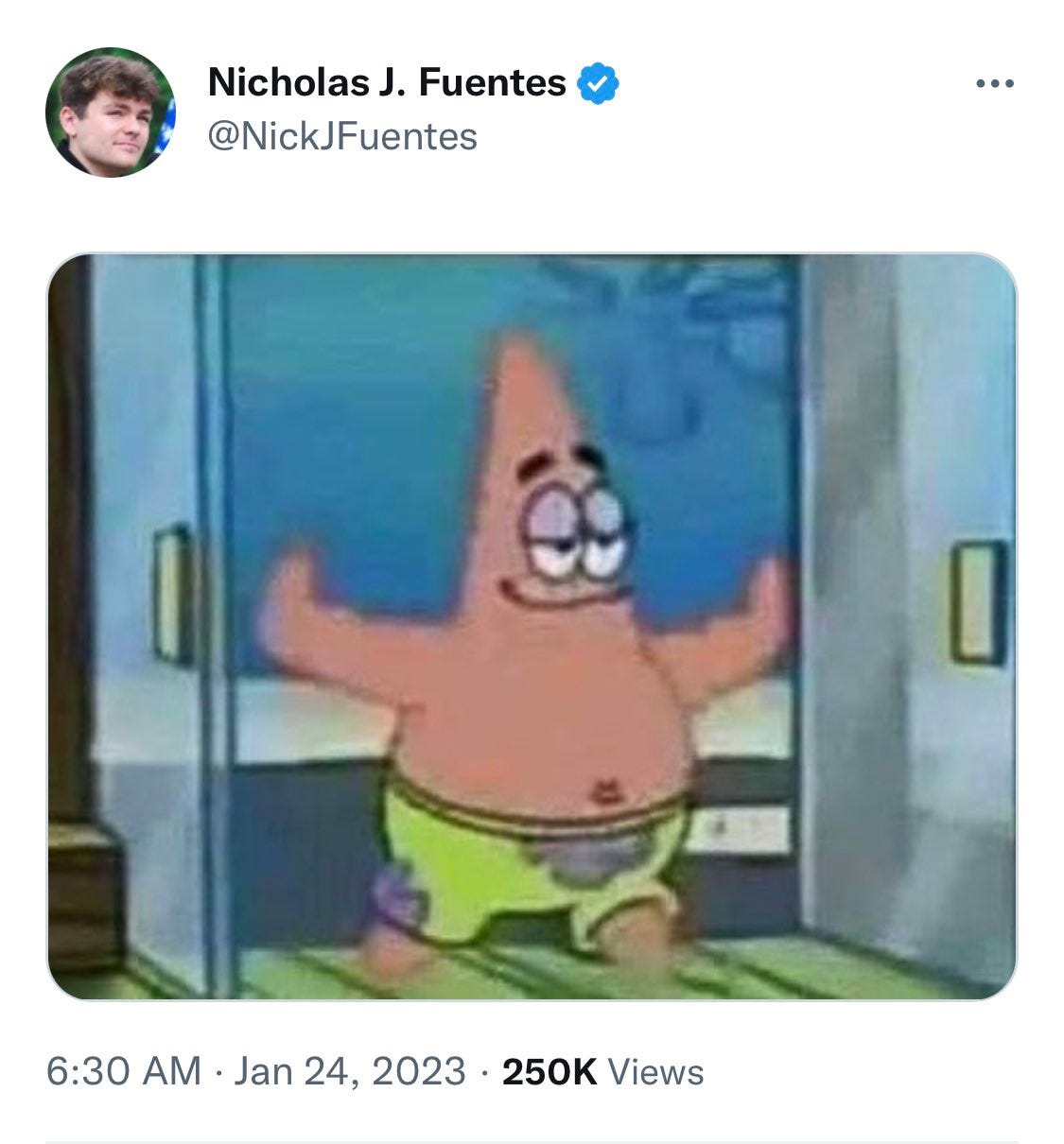
When Twitter banned neo-Nazi Nick Fuentes back in December 2021, the site’s Head of Safety and Integrity, Yoel Roth said, “Hateful conduct has no place here.”

But Roth is gone, Elon Musk is in charge, and the Nazis are back.

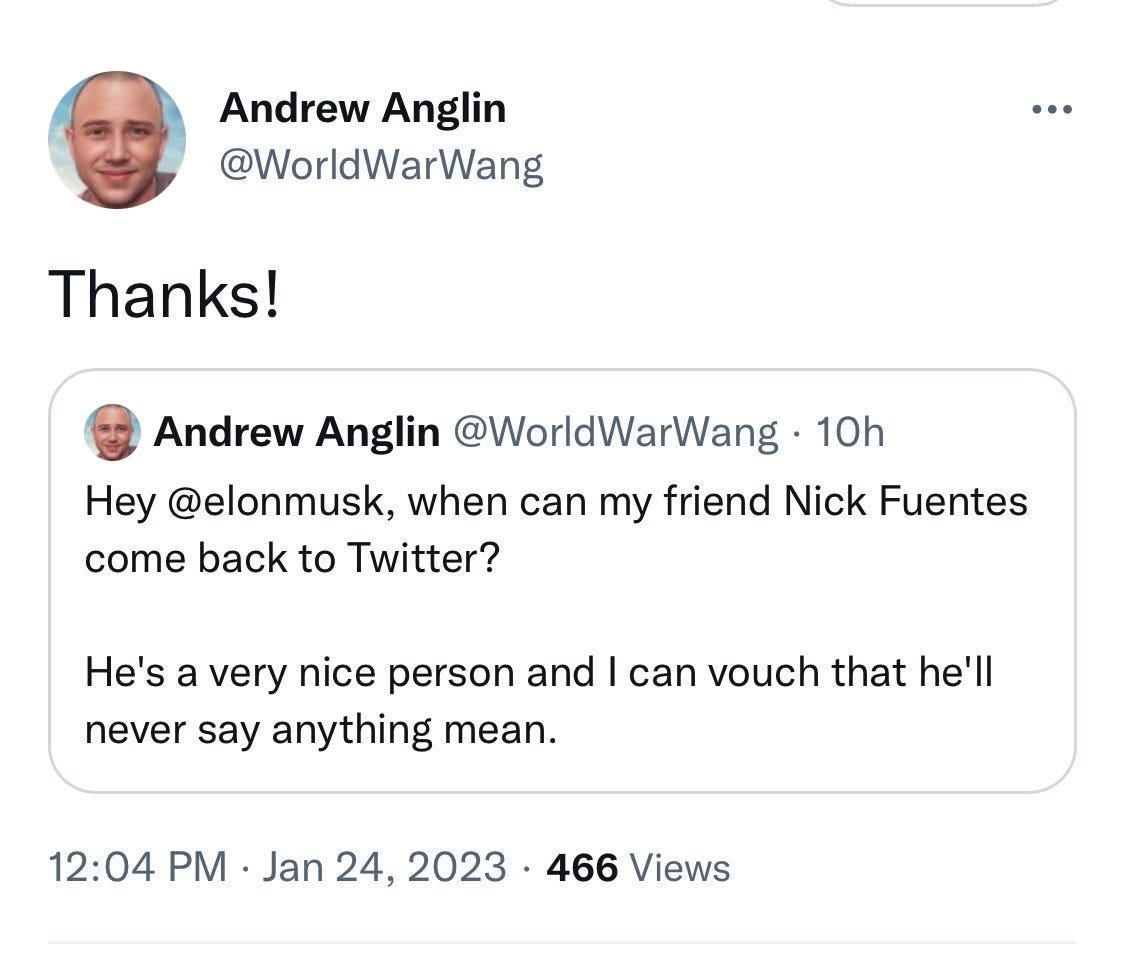
Fuentes, last seen here as Donald Trump’s dinner guest, was reinstated just hours after another actual Nazi, Andrew Anglin— who once described his approach as “Non-ironic Nazism masquerading as ironic Nazism” — asked Musk to bring his friend back on Twitter.

Anglin tweeted Musk that the Holocaust-denying, Jew-baiting Fuentes is “a very nice person and I can vouch that he’ll never say anything mean.”

Leah McElrath @leahmcelrathThe reinstatement of the Twitter account of Nick Fuentes came hours after Andrew Anglin—editor of the neo-Nazi website the Daily Stormer—publicly asked Elon Musk to let Fuentes back on Twitter: 2:51 PM ∙ Jan 24, 202393Likes66Retweets

Musk, apparently took him at his word, and Fuentes made his triumphant return, with his usual restraint, dignity, and class.

Image

**

Who is this new Musk-whisperer?

Back in 2017, The Atlantic profiled Anglin: “The Making of An American Nazi.”

Anglin is an ideological descendant of men such as George Lincoln Rockwell, who created the American Nazi Party in the late 1950s, and William Luther Pierce, who founded the National Alliance, a powerful white-nationalist group, in the 1970s. Anglin admires these predecessors, who saw themselves as revolutionaries at the vanguard of a movement to take back the country. He dreams of a violent insurrection.

But where Rockwell and Pierce relied on pamphlets, the radio, newsletters, and in-person organizing to advance their aims, Anglin has the internet. His reach is exponentially greater, his ability to connect with like-minded young men unprecedented.

Since then, Anglin has tried to rebrand himself as just a garden-variety American Nationalist, but this is mostly eye-wash for clueless billionaires. Notes the Anti-Defamation League:

In an effort to validate their leap from neo-Nazis to flag-waving American patriots, he and his followers equate American nationalism to white nationalism by claiming America was founded on anti-Semitic and racist principles.

**

Anglin is also one of the most vicious trolls on the far-right. I wrote about him in my book, “How the Right Lost Its Mind,” describing the explosion of harassment aimed at Jewish critics of Donald Trump at the time.

Many of the worst instances of harassment were connected to a website known as the Daily Stormer and its founder, a neo-Nazi activist named Andrew Anglin.

I first became aware of the site when I received, via email, a photoshopped image of my picture inside a gas chamber. A smiling Donald Trump wearing a German military uniform is poised to press the red “gas” button. The photoshopping tool had been created by the website and was widely used to troll both Jewish and non-Jewish critics of the Trump campaign.

The site takes its name from the German Nazi newspaper Der Stürmer,which was notorious for the viciousness of its anti-Semitic caricatures of Jews. After World War II, Der Stürmer’s publisher, Julius Streicher, was executed for crimes against humanity.

Anglin created the site in 2013 as an updated version of his previous website, which he called Total Fascism. As of this writing, the new website features pictures of Ronald Reagan and Donald Trump and the slogan “Daily Stormer— The World’s Most Goal-Oriented Republican Website.”

It is important to emphasize again that the Alt Right is a mansion with many rooms and some very real divisions. Anglin, for example, is not a fan of Milo Yiannopoulos, who is depicted on the Daily Stormer with a cartoon of the Jewish nose superimposed on his face and is referred to as “Filthy Rat Kike Milo.”

But Anglin is also interested in emphasizing the common ground among the various disparate groups and interests that make up the white nationalist movement. In his own guide to the Alt Right, Anglin notes that the movement included various factions, but that they had all been led “toward this center-point where we have all met. The campaign of Donald Trump is effectively the nexus of that centerpoint.”

Impressed by Trump’s rhetoric on illegal immigrants, Anglin endorsed Trump in 2015 and urged the readers of the Daily Stormer to “vote for the first time in our lives for the one man who actually represents our interests.”

After Trump called for barring Muslims from the country, the site declared: “Heil Donald Trump— The Ultimate Savior.” But Anglin’s greatest accomplishment was the creation of what he calls his “Troll Army,” which he uses to attack political opponents, deployed to great effect in early 2016.

After GQ magazine published a profile of Melania Trump by writer Julia Ioffe, the future First Lady took to Facebook to denounce the piece as “yet another example of the dishonest media and their disingenuous reporting.” Anglin quickly mobilized his Troll Army, posting an article headlined: “Empress Melania Attacked by Filthy Russian Kike Julia Ioffe in GQ!”

The post featured a picture of Ioffe wearing a Nazi-era yellow star with the word “Jude” and a call to action from Anglin:

“Please go ahead and send her a tweet and let her know what you think of her dirty kike trickery. Make sure to identify her as a Jew working against White interests, or send her the picture with the Jude star from the top of this article.”

The result was a torrent of abuse, including death threats against the journalist.

On Twitter, she was sent pictures of Jews being shot in the head and pictures of her wearing concentration camp stripes. When she answered her phone, a caller began playing a recording of a speech by Adolf Hitler.

“The irony of this is that today,” Ioffe told the British newspaper the Guardian, “I was reminded that 26 years ago today my family came to the US from Russia. We left Russia because we were fleeing antisemitism. It’s been a rude shock for everyone.”

The response from the GOP nominee was also troubling. When Trump was asked by CNN’s Wolf Blitzer about the anti-Semitic attacks and death threats, the future president pointedly refused to condemn them, pleading ignorance and saying, “I don’t have a message to the fans. A woman wrote an article that was inaccurate.”

Trump’s refusal to denounce the Troll Army was greeted with delight by Anglin, who immediately posted: “Glorious Leader Donald Trump Refuses to Denounce Stormer Troll Army.” He exulted:

“Asked by the disgusting and evil Jewish parasite Wolf Blitzer to denounce the Stormer Troll Army, The Glorious Leader declined. The Jew Wolf was attempting to Stump the Trump, bringing up Stormer attacks on Jew terrorist Julia Ioffe. Trump responded to the request with “I have no message to the fans” which might as well have been “Hail Victory, Comrades!”

**

Fast-forward to 2023:

Image

Florida Governor Ron DeSantis issued a statement about his higher education agenda. He intends to expunge all references to or studies of diversity, equity, inclusion and “critical race theory,” the study of institutionalized racism from the curriculum of the state’s colleges and universities. He also wants to place the hiring of new faculty in the hands of college presidents and boards of trustees, whom he controls. The hiring of new faculty typically is in the hands of the faculty, not the president or the board of trustees.

DeSantis claims that he is furthering “civil discourse and intellectual freedom” by suppressing the ideas he disagrees with. He believes that the only studies that belong on a college campus are the achievements and thoughts of white men.

He has flipped the script, accusing those who defend the freedom to teach and learn of “suppressing” free thought. It is he who is suppressing intellectual freedom.

In Florida, faculty are free to express Governor DeSantis’ views. They are not free to express dissent from the party line. That is not freedom.

Ron DeSantis is the ultimate arbiter of truth in Florida. None dare challenge him if they teach in a public school, college, or university. There’s a word for this ideology: fascism.

“Today, Governor Ron DeSantis announced legislation for the 2023 Session to further elevate civil discourse and intellectual freedom in higher education, further pushing back against the tactics of liberal elites who suppress free thought in the name of identity politics and indoctrination. Among its many provisions, the legislation will ensure Florida’s public universities and colleges are grounded in the history and philosophy of Western Civilization; prohibit DEI, CRT (CRITICAL RACE THEORY), and other discriminatory programs and barriers to learning; and course correct universities’ missions to align education for citizenship of the constitutional republic and Florida’s existing and emerging workforce needs.”

“In Florida, we will build off of our higher education reforms by aligning core curriculum to the values of liberty and the Western tradition, eliminating politicized bureaucracies like DEI, increasing the amount of research dollars for programs that will feed key industries with talented Florida students, and empowering presidents and boards of trustees to recruit and hire new faculty, including by dedicating record resources for faculty salaries,” said Governor Ron DeSantis.

“This 2023 legislative proposal builds on reforms made during the 2022 Legislative Session through Senate Bill 7044 to dismantle accreditation agency monopolies, increase tenured faculty accountability, and make the transition between a Florida state college and university more seamless. Specifically, the 2023 proposal raises the standards of learning and civil discourse of public higher education in Florida by:

Requiring the State University System Board of Governors (BOG) and State Board of Education (SBOE) to review and realign general education core courses to make sure they provide historically accurate, foundational and career relevant education, not suppress or distort significant historical events or include a curriculum that teaches identity politics;

Prohibiting higher education institutions from using any funding, regardless of source, to support DEI, CRT, and other discriminatory initiatives;

Requiring institutions’ presidents and boards of trustees to take ownership of hiring and retention decisions, without interference from unions and faculty committees;

Allowing institutions’ presidents and boards of trustees to conduct a post-tenure review of a faculty member at any time with cause;

Prohibiting postsecondary institutions from using discriminatory political filters, including political loyalty oaths and DEI statements, in the hiring process.”

“Requiring preeminent state research universities to include annual research expenditures of $50 million or more for STEM-related occupations, businesses, or industry partners in Florida that are employing Florida residents;

Requiring the Board of Governors (BOG) to align universities’ missions to education for citizenship of the constitutional republic and Florida’s existing and emerging workforce needs;

Providing additional responsibilities and clarifications for FSU’s Florida Institute of Politics, including renaming it the Florida Institute for Governance and Civics; and Providing additional responsibilities and clarifications for FIU’s Adam Smith Center for the Study of Economic Freedom.”

The New York Times reported on DeSantis’s aggressive attack on higher education as part of his cynical use of culture war tactics, which build his base nationally.

The DeSantis-controlled board of New College fired its president, English professor Patricia Okker, who was appointed in 2021.

While expressing her love for both the college and its students, Dr. Okker called the move a hostile takeover. “I do not believe that students are being indoctrinated here at New College,” she said. “They are taught, they read Marx and they argue with Marx. They take world religions, they do not become Buddhists in February and turn into Christians in March.”

Governor DeSantis also announced on Tuesday that he had asked the Legislature to immediately free up $15 million to recruit new faculty and provide scholarships for New College….

The shake-up of New College, which also included the election of a new board chairwoman, may be ongoing and dramatic, given the new six board members appointed by Mr. DeSantis.

They include Christopher Rufo, a senior fellow at Manhattan Institute who is known for his vigorous attacks on “critical race theory,” an academic concept that historical patterns of racism are ingrained in law and other modern institutions.

At the time of his appointment, Mr. Rufo, who lives and works in Washington State, tweeted that he was “recapturing” higher education.

Another new board member is Eddie Speir, who runs a Christian private school in Florida. He had recommended in a Substack posting before the meeting that the contracts of all the school’s faculty and staff be canceled.

The other new appointees include Matthew Spalding, dean of the Washington, D.C., campus of Hillsdale College, a private college in Michigan known for its conservative and Christian orientations. An aide to the governor has said that Hillsdale, which says it offers a classical education, is widely regarded as the governor’s model for remaking New College.

In addition to the governor’s six new appointees, the university system’s board of governors recently named a seventh member, Ryan T. Anderson, the head of a conservative think tank, the Ethics and Public Policy Center, which applies the Judeo-Christian tradition to contemporary questions of law, culture, and politics. His selection was viewed as giving Mr. DeSantis a majority vote on the 13-member board.

The plan seems clear: Fire faculty who teach “identity” courses or anything “woke,” drive away the students, who wanted the progressive approach that New College offered, and turn the college into the Florida branch of Hillsdale College.

Governor Ron DeSantis hates the fact that there is a progressive public college called New College that openly teaches diversity, equity, inclusion, feminist studies, ethnic studies, and gay studies. That’s WOKE, and he vowed to crush anything WOKE.

He named 6 conservatives to the 13-member board, and the board of the state university system added another, meaning that Rightwingers are in charge. A hard-right board needs a hard-right president, and they got one.

Their first meeting was this afternoon, and they are expected to appoint former State Commissioner of Education Richard Corcoran as the new president. From the following story, it appears that no one bothered to let the current president of the New College know that she was being shown the door.

DeSantis is showing how to stamp out ideas he doesn’t like, with power, not subtlety. Is he a fascist or is he pretending?

A new board of trustees at New College of Florida intends to name Richard Corcoran as its next President.

Corcoran, a former House Speaker, served as Gov. Ron DeSantis’ first Education Commissioner.

Carlos Trujillo, president and founder of Continental Strategy, revealed the plans in a letter to clients and colleges.

“We are beyond excited to announce that one of our Partners, former Department of Education Commissioner Richard Corcoran, will be returning to higher education to serve as the Interim — and hopeful permanent — President of the New College of Florida, in Sarasota,” Trujillo wrote.

“This move comes as part of Gov. DeSantis ongoing work to refocus the university on providing the most value to its students and their parents.”

Corcoran was a founding partner for the consulting firm.

The news comes hours before the first board meeting since DeSantis appointed six new trustees on the 13-member board. The State University System Board of Governors also appointed a new trustee with a similar conservative think tank background.

Of note, work of Corcoran’s apparent hire comes before any news of current President Patricia Okker’s future with the school. Eddie Speir, co-founder of Inspiration Academy, wrote a blog post this weekend promising to call for Okker to be renamed as interim President and to terminate all faculty and staff before deciding who still fit in the new vision for the college.

While Florida’s Sunshine Law requires all decisions by the board to be made in publicly noticed meetings, Trujillo treats the matter like a done deal.

“The selection of Richard distinguishes our firm as a leader in innovation and strategic solutions for the clients we serve. We look forward to finding new synergies that can better serve our current clients and ensure their goals are made a reality,” his letter reads.

The Miami Herald reported today on Governor DeSantis’ plans to cleanse higher education in the state. Conservatives are creating “civics” institutes as a vehicle for patriotic indoctrination, not as a means to think critically about how to improve democracy. Censorship, which DeSantis practices, would be condemned in any genuine civics class.

Gov. Ron DeSantis on Tuesday announced a package of major reforms to Florida’s higher education system, including tighter controls on faculty tenure, the establishment of “civics institutes” at three universities and prohibitions on diversity, equity and inclusion programs.

Speaking at a news conference in Bradenton, the governor unveiled a plan that would allow university boards of trustees and presidents to conduct reviews of tenured faculty members “at any time,” in addition to the periodic reviews that now take place. Regarding university presidents in particular, he proposes “reestablishing their authority over the hiring process.”

Currently, according to a flier distributed by the governor’s staff, “faculty committees can tie the hands of university presidents and bind them to only consider a small pool of recommended candidates.”

And under a heading in the flier that reads “Education not indoctrination,” he proposes changes in standards and course content “to ensure higher education is rooted in the values of liberty and western tradition.” His plan would require schools to “prioritize graduating students with degrees that lead to high-wage jobs, not degrees designed to further a political agenda.”

The proposal also would prohibit state schools from “supporting campus activities or programs that promote divisive concepts like DEI and CRT.” The letters refer to diversity, equity and inclusion programs and critical race theory.

In addition, he proposes establishing “world-class civics institutes” at the University of Florida, Florida International University and Florida State University. The institutes, according to the flier, would develop courses and curricula “that can be used to educate the next generation on the values of liberty and constitutionalism.”

The flier included information on the governor’s higher education budget proposals as well. He proposes $100 million for “recruitment and retention of highly qualified faculty at state universities” and $15 million for faculty and student recruitment at New College of Florida, where he recently appointed six conservative members to the board of trustees.

The New College board meets Tuesday for the first time since the appointments.

Read more at: https://www.miamiherald.com/article271870522.html#storylink=cpy

Republicans in Texas are obsessed with voter fraud. Trump won the state in 2020, as did the Republican Governor, Lieutenant Governor, Attorney General, and other statewide offices. Apparently Republican legislators think it’s suspicious that Democratic candidates won any votes at all. So they are launching a fusillade of bills to make it harder to vote.

Michael Hardy of The Texas Monthly reports:

For decades, Texas has maintained one of the worst voter-turnout rates in the country. Less than 61 percent of eligible Texans voted in the 2020 presidential election, placing us forty-third out of fifty states. (In Minnesota, the highest-turnout state, nearly 80 percent of eligible voters participated.) In November, 42.5 percent of eligible Texans cast ballots in the midterm election, placing us thirty-ninth in the nation. Embarrassed by these dismal figures, Texas political leaders will spend the Eighty-eighth Legislature passing laws to encourage more participation in the democratic process.

Just kidding! Instead of removing obstacles to voting, Republican legislators are introducing a slew of new bills that could disrupt elections and further depress turnout. GOP lawmakers say the bills are designed to prevent fraud and ensure election integrity. But several of the proposals—such as a bill by Republican representative Bryan Slaton, of Royse City, that would shorten the early-voting period from two weeks to one week—have no obvious rationale other than to make voting less convenient. (Slaton did not respond to an interview request.) Indeed, this and many other bills seem to proceed from the assumption that too many Texans are taking advantage of their constitutional right to select their leaders. Narrowing the franchise has long been a national Republican priority, although politicians are seldom as explicit as former president Donald Trump, who warned that 2020 voting reforms proposed by congressional Democrats would lead to “levels of voting that if you’d ever agreed to it, you’d never have a Republican elected in this country again.”

Trump’s concern was probably unfounded. There’s no consensus among political scientists on whether higher turnout benefits one party over another. Indeed, rising turnout in recent Texas elections has simply led to more Republican victories. The Texas GOP, it would appear, has little to fear from more election participation. But that doesn’t seem to have dampened the party’s enthusiasm for making it harder to vote. On the contrary: fueled by Trump’s false claims of a stolen election, Texas Republicans have become obsessed with the specter of voter fraud. Attorney General Ken Paxton has spent at least $2.2 million on an Ahab-like quest to find incidents of voter fraud. Between January 2020 and September 2022, he opened nearly four hundred investigations into potential election crimes yet secured only five election-related convictions.

In 2021, Governor Greg Abbott signed Senate Bill 1, a far-reaching “election integrity and security” package, into law. The measure prohibited 24-hour voting and drive-through voting, pandemic-inspired innovations in Harris County that drove up turnout in 2020. It also imposed confusing new vote-by-mail requirements, including forcing each voter to write the ID number with which they registered to vote—either their driver’s license number or the last four digits of their Social Security number—on the ballot. (If they forgot which ID they used to register and picked the wrong one, they were out of luck.) Failure to meet the new requirements led to an unprecedented 12 percent of mail-in ballots being rejected in last year’s primary. (The rejection rate fell for the general election, as Texas voters learned to include both their driver’s license and Social Security numbers.) The bill, Abbott proclaimed in 2021, would “make it easier to vote and harder to cheat.” The same year, Texas secretary of state John Scott launched a “full forensic audit” of the 2020 presidential election in four large Texas counties. The audit, which wrapped up in December 2022, found significant administrative dysfunction in Harris County, but no evidence of widespread voter fraud. Scott, who resigned in December after a little more than a year on the job, has urged “Stop the Steal” activists to accept President Biden’s victory in 2020, blaming their concerns on “a lack of information.”

But as noted philosopher Donald Rumsfeld liked to say, absence of evidence is not evidence of absence. Just as Saddam Hussein’s possession of weapons of mass destruction was an article of faith in the Bush White House, the existence of widespread election fraud has become an article of faith for many in the Texas GOP. To cite just one example, Republican representative Steve Toth, of the Woodlands, author of a bill requiring unique electronic codes for absentee ballots, has accused Democrats of using paper ballots to commit voter fraud and defended MyPillow CEO Mike Lindell’s crusade to prove that the 2020 presidential election was stolen. At its summer convention, the Texas GOP adopted a platform calling President Joe Biden’s victory illegitimate and urging politicians to focus on “election integrity.” To this end, Republican lawmakers have filed more than a dozen bills designed to root out supposed electoral chicanery. To be sure, Democrats have filed plenty of their own election bills, most of them intended to encourage voter registration and make it easier to cast a ballot. But with Republicans controlling the House, Senate, and Governor’s Mansion, there is little chance of the Democratic bills becoming law. Nor will every Republican-authored bill ultimately pass.

With those caveats out of the way, here’s a preview of the major voting bills filed so far in the Eighty-eighth Legislature.

HB 52 & HB 1243 / SB 166

Authors: Representatives David Spiller (R-Jacksboro) and Cole Hefner (R-Mount Pleasant) / Senator Bryan Hughes (R-Mineola)

Purpose: Increases penalty for voter fraud from a Class A misdemeanor to a felony.

Background: In 2021, Governor Abbott signed SB 1, the controversial voting bill that Democrats attempted to block by fleeing to Washington, D.C. The bill eventually passed, but not before a conference committee added a provision lowering the offense of voting illegally from a second-degree felony to a Class A misdemeanor. Less than a month later, after receiving blowback from fellow Republicans, Abbott called on lawmakers to make voter fraud a felony again. These bills answer his call. Class A misdemeanors are punishable by up to a year in jail, while a second-degree felony is punishable by up to twenty years in prison.

HB 125

Author: Representative Bryan Slaton (R-Royse City)

Purpose: Requires district attorneys, under penalty of removal from office, to enforce state election laws.

Background: Republicans have accused the Democratic district attorneys in large cities such as Dallas and Austin of failing to pursue election fraud with sufficient vigor. Attorney General Ken Paxton has sought to prosecute election cases himself, but in September, the Texas Court of Criminal Appeals ruled that he must receive permission from local prosecutors to pursue such cases.

HB 161

Author: Representative Steve Toth (R-The Woodlands)

Purpose: Requires each absentee ballot to include a unique electronic code to verify its authenticity.

Background: For years, right-wing activists have claimed that voting by mail is uniquely vulnerable to election fraud. Former president Trump urged his supporters to vote in person, and he cast efforts to encourage voting by mail during the COVID-19 pandemic as a way for Democrats to steal the election. This bill appears designed to prevent voters from photocopying absentee ballots—a phenomenon for which there is no evidence.

HB 549 / SB 220

Authors: Representative Valoree Swanson (R-Spring) / Senator Paul Bettencourt (R-Houston)

Purpose: Establishes a cadre of “election marshals”—law enforcement officers appointed by the Secretary of State to investigate election fraud. Calls for regional task forces of judges to adjudicate allegations of election fraud on and before Election Day.

Background: This bill is one of numerous GOP proposals in the current Legislature inspired by Florida governor Ron DeSantis. In this case, the new office of election marshal appears modeled after Florida’s Office of Election Crimes and Security, which has charged 20 Floridians (out of 11 million voters in 2020) with voting illegally since it was established last year. The Texas bill prohibits judges from overseeing election challenges in their own counties, apparently under the assumption that these judges would be biased against the candidates challenging the election.

Open the link and read about more bills that are supposedly necessary to protect “election integrity” but whose actual result will suppress the vote by confusing voters and making the process of voting more complicated than at present.

Libby Stanford of Education Week reports on the sudden explosion of voucher legislation in Republican-controlled states. She quotes a spokesman for the Heritage Foundation, who says that school choice is expanding because of parent dissatisfaction with public schools.

But this acceleration is not a consequence of parental dissatisfaction, as the spokesman claims. It is the result of a well-organized, well-orchestrated, lavishly-funded campaign to defame public schools, led by the religious right and such organizations as the Koch network, the Heritage Foundation, The American Legislative Exchange Council, Betsy DeVos’ American Federation for Children, and the front groups they fund, such as Moms for Liberty and Parents Defending Freedom. ALEC undoubtedly prepared model legislation and handed it out to their far-right allies in state legislatures.

None of these funders or their puppet groups are mentioned in the article. It is no accident that multiple red states are debating bills to enact vouchers for private and religious groups or that 75-80% of the voucher funding in every state will end up in the bank accounts of families whose children never attended public schools. The legislation should be characterized as a handout to families whose children never attended public school.

It doesn’t take much digging to understand that the crusade against “critical race theory” (which is taught in graduate classes in law and education, not in K-12), against any mention of homosexuality, against “dangerous” books in school libraries, against fictional children who need litter boxes in the classroom because they think they are cats or dogs—is absurd propaganda designed to discredit public schools and pave the way for public funding of religious schools, which freely discriminate against students and families and openly indoctrinate their students into their dogma.

Instead of identifying the Heritage Foundation as a major player in the war to destroy public education, Stanford quotes its spokesman, who spouts the line that school choice is the result of parent dissatisfaction. What she does not mention is that voucher supporters maneuver to avoid public referenda because they know the public is opposed to vouchers. Right wingers go to great lengths to avoid the word “vouchers” and to quash referenda, because they are afraid of the voters.

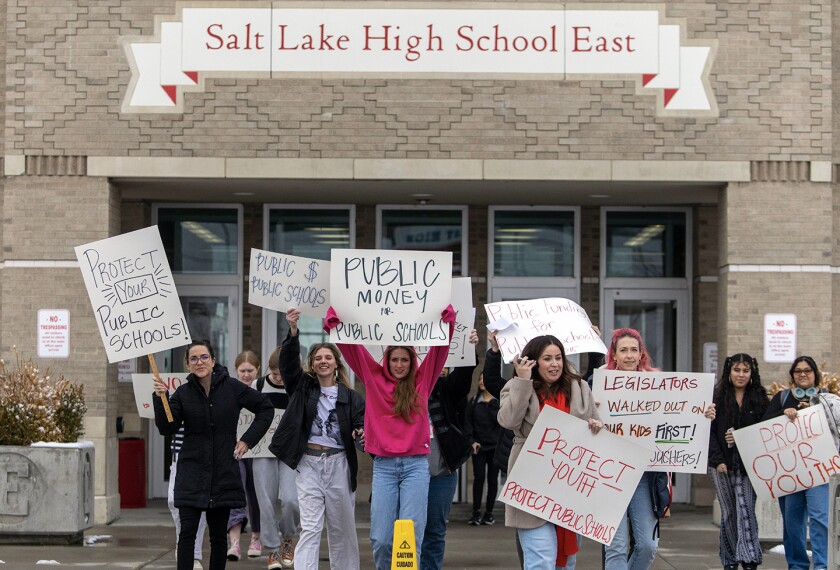
Students and teachers from East High School in Salt Lake City walk out of school to protest the HB15 voucher bill, on Wednesday, Jan. 25, 2023. Several years of pandemic restrictions and curriculum battles have emboldened longtime advocates of funneling public funds to private and religious schools in statehouses throughout the country.

Students and teachers from East High School in Salt Lake City walk out of school on Jan. 25, 2023, to protest legislation that would create private-school vouchers in the state. Several years of pandemic restrictions and curriculum battles have emboldened longtime advocates of funneling public funds to private and religious schools in statehouses throughout the country.

Rick Egan/The Salt Lake Tribune via AP

Stanford begins:

Emboldened by frustrations with pandemic-era policies and battles over what schools are teaching, conservative parents and politicians have accelerated a push for school choice policies that would funnel public funds into private schools.

Though school choice has been debated for decades, the movement is in a unique moment as advocates use parent concerns over COVID-era mask requirements; curriculum addressing race, gender, and sexuality; and library book content to bolster their argument that families should have more options outside of traditional public schools. And the school choice proposals states are considering—and, in some cases, have already passed—are more sweeping than previous iterations.

Already this year, lawmakers in at least 11 states—Idaho, Iowa, Kansas, Missouri, Nebraska, North Dakota, Oklahoma, South Carolina, Texas, Utah, and Virginia—have introduced and, in some cases, passed school choice bills. Although they vary in scope, many of the bills would establish or expand private school voucher and education savings account programs that give families public funds to pay for tuition at private schools, cover the costs of homeschooling, or pay for other schooling expenses.

The resurgence of school choice action shouldn’t come as a surprise. During the 2022 midterm election cycle, 19 Republican gubernatorial candidates advocated for school choice, mostly in the form of vouchers and education savings accounts, on campaign websites. This year, seven governors so far have talked about school choice policies in their state of the state addresses, according to the Education Commission of the States.

The policies are a result of parents’ declining satisfaction with schools following the pandemic, said Jonathan Butcher, an education policy analyst for the Heritage Foundation, a conservative think tank that advocates for school choice policies.