In a fascinating article, the Washington Post reported that several of Trump’s lawyers urged him to avoid an indictment by returning all the classified documents. He refused. He chose instead to take the advice of Tom Fitton, head of the conservative group Judicial Watch, who told him he could keep the documents. Fitton is not a lawyer. Early on, in 2021, one of Trump’s lawyers tried to persuade him to negotiate a return, to avoid an indictment. Trump refused.

Since the National Archives first asked for the return of presidential documents in Trump’s possession in February 2021 and until a grand jury issued its indictment this month, Trump was repeatedly stubborn and eschewed opportunities to avoid criminal charges, according to people with knowledge of the case, many of whom spoke on the condition of anonymity to reveal internal details. They note that Trump was not charged for any documents he returned voluntarily.


Interviews with seven Trump advisers with knowledge of the probe indicate he misled his own advisers, telling them the boxes contained only newspaper clippings and clothes. He repeatedly refused to give the documents back, even when some of his longest-serving advisers warned of peril and some flew to Mar-a-Lago to beg him to return them.


When Trump returned 15 boxes early last year — leaving at least 64 more at Mar-a-Lago — he told his own advisers to put out statements to the National Archives and to the public that “everything” had been returned, The Washington Post has previously reported. But he quietly kept more than 100 classified documents….

Trump time and again rejected the advice from lawyers and advisers who urged him to cooperate and instead took the advice of Tom Fitton, the head of the conservative group Judicial Watch, and a range of others who told him he could legally keep the documents and should fight the Justice Department, advisers said. Trump would often cite Fitton to others, and Fitton told some of Trump’s lawyers that Trump could keep the documents, even as they disagreed, the advisers said…

“I think what is lacking is the lawyers saying, ‘I took this to be obstruction,’” said Fitton. “Where is the conspiracy? I don’t understand any of it. I think this is a trap. They had no business asking for the records … and they’ve manufactured an obstruction charge out of that. There are core constitutional issues that the indictment avoids, and the obstruction charge seems weak to me.”


Several other Trump advisers blamed Fitton for convincing Trump that he could keep the documents and repeatedly mentioning the “Clinton socks case” — a reference to tapes Bill Clinton stored in his sock drawer of his secret interviews with historian Taylor Branch that served as the basis of Branch’s 2009 book documenting the Clinton presidency.


Judicial Watch lost a lawsuit in 2012 that demanded the audio recordings be designated as presidential records and that the National Archives take custody of the recordings. A court opinion issued at the time stated that there was no legal mechanism for the Archives to force Clinton to turn over the recordings.


For his part, Fitton said Trump’s lawyers “should have been more aggressive in fighting the subpoenas and fighting for Trump.”


Trump’s unwillingness to give the documents back did not surprise those who knew him well. Former White House chief of staff John F. Kelly said that he was particularly unlikely to heed requests from people or agencies he disliked.


“He’s incapable of admitting wrongdoing. He wanted to keep it, and he says, ‘You’re not going to tell me what to do. I’m the smartest guy in the room,’” Kelly said Tuesday…

Other advisers said the FBI and National Archives wanting the documents so badly made Trump less likely to give them back…

“It’s mine,” Trump said, explaining why he did not want to give the materials back, according to people with knowledge of his comments.

If this sounds like the behavior of a 2-year-old, well, draw your own conclusions.

Carol Burris is the Executive Director of the Network for Public Education. She was a much honored high school principal in New York State, following many years in the classroom. She earned her doctorate from Teachers College, Columbia University.

From my perspective, I think it always wise to pay attention to the funders of any study, especially when the funders have a strong point of view about the outcome. Just as we are wary when the tobacco industry releases a study that “proves” the safety of tobacco use, or the pharma industry funds a study claiming that opioids are not addictive, we should be wary of any study funded by the major sponsors of the charter school movement. “Follow the money” is a principle that should never be ignored.

Burris writes here about the new national CREDO study of charter schools, which was uncritically reviewed by Education Week and other publications, which simply quoted the press release.

She writes:

Last week the Center for Research on Education Outcomes (CREDO) released its third National Study on charter schools. The report was funded by two nonprofits that wholeheartedly support charter schools and generously fund them—the Walton Family Foundation and The City Fund. The City Fund, which was started and funded by pro-charter billionaires John Arnold and Reed Hastings, exists to turn public school districts into “portfolio” districts of charter schools and charter-like public schools. 

Commenting on the report, Margaret “Macke” Raymond, founder and director of CREDO, told Ed Week’s Libby Stanford that the results were “remarkable.” Stanford claimed that “charters have drastically improved, producing better reading and math scores than traditional public schools.”

However, neither of those claims describes the reality of what the report found, as I will explain.  

Let’s begin with what CREDO uses as its measure of achievement. In all of its reports, CREDO uses “days of learning” to attribute differences in student achievement between charter schools and district public schools. That measure creates dramatic bar graphs allowing CREDO to disguise the trivial effects on achievement those “days of learning” represent. 

The overall math state score increase that CREDO attributes to a student attending a charter school is “six days of learning.” But what does that mean in the standard measures most researchers use, such as changes in standard deviations or effect sizes?

According to CREDO, 5.78 days of learning translates to only a 0.01 standard deviation. That means that the 6.0 “days of learning” increase in math translates to about a 0.0104 increase in standard deviations. Does that sound tiny? It is. For comparison, the negative impact on math scores of receiving a voucher in Louisiana was determined to be 0.4 standard deviations – more than 36 times greater magnitude.

After CREDO released its second national charter study in 2013, the National Education Policy Center (NEPC) reviewed it. You can find that critical review here, accompanied by a publication release titled CREDO’s Significantly Insignificant Findings

As the authors of the review (Andrew Maul and Abby McClelland) note, a 0.01 difference (which the 2023 math gain only slightly exceeds) in a standard deviation means that “only a quarter of a hundredth of a percent (0.000025) of the variation” in the test scores could be explained by the type of school (charter or public) that the child attended.  

Put another way, if a student gains six days of math and they originally scored at the 50th percentile on a standardized test, they would move to the 50.4th percentile.  It’s as if they stood on a sheet of loose-leaf paper to stand taller—that’s how small the real difference is.

But what about the reported reading-score increase of 16 days? Sixteen CREDO days account for only a 0.028 standard deviation. Now we are increasing height by standing on two and a half sheets of looseleaf.

According to CREDO, those increases are statistically significant. Shouldn’t that count? As the NEPC reviewers state in their summary, “with a very large sample size, nearly any effect will be statistically significant, but in practical terms these effects are so small as to be regarded, without hyperbole, as trivial.”

To put all of this in a broader perspective, Maul and McClelland point out, “[Eric] Hanushek has described an effect size of 0.20 standard deviations for Tennessee’s class size reform as “relatively small” considering the nature of the intervention.” Hanushek is married to Macke Raymond, who found the much, much, much slighter results of her organization’s study to be “remarkable.”

Using CREDO’s conversion, in order to achieve 0.20 standard deviations of change, the difference would have to be 115.6 days of learning. 

The only place in the report where there was an over 100-day difference was in online charter school students’ results in math. Compared with the public school students included in the study, online charter school students learned 124 fewer days of math. They may have something there.

CREDO Methodology

To draw its conclusions, CREDO matches charter students with what it calls “virtual twins” from public schools. But not all public schools were included, nor were all charter schools. The only public schools included were those in 29 states (for some odd reason, CREDO also includes NYC as a state) and the District of Columbia that met their definition of “feeder schools.” CREDO refers to 31 states, which include New York City and the District of Columbia, throughout the report. 

According to page 35 of the report, in 2017-2018, there were 69,706 open public schools in their included “states,” and of those, fewer than half (34,792) were “feeder schools.” That same year, NCES Common Core of Data reports 91,326 non-charter public schools, 86,315 of which were in states that had charter schools.

From the chart, then, we can estimate that only about 38% of public schools and 94.5% of charter schools were included in the study, at least during the 2017 school year.  

What, then, is a feeder school? The report claims that it is the public school the student would have attended if she were not in the charter school. But that is an inaccurate description. In the methodology report, CREDO explains how they identify feeder schools. “We identify all students at a given charter school who were enrolled in a TPS during the previous year. We identify these TPS as “feeder schools” for each charter school. Each charter school has a unique feeder school list for each year of data.”

While I understand why researchers want to use feeder schools for comparison, it produces an inherent bias in the sample. Feeder schools are, by definition, schools where parents disrupt their child’s schooling and place them in a charter school. They are not, as the report claims, “the school the student would have attended.”  If a child starts in a charter school, her local school would not be a feeder school unless there was a parent who was so dissatisfied with the school that they were willing to pull their child out and place them in a charter, which may even be miles away in a neighborhood with very different demographics. 

Virtual Twins 

In 2013, Maul and McClelland also explained the virtual-twin method along with the problems inherent in its use. 

“The larger issue with the use of any matching-based technique is that it depends on the
premise that the matching variables account for all relevant differences between students;
that is, once students are matched on the aforementioned seven variables [gender, ethnicity, English proficiency status, eligibility for subsidized meals, special education status, grade level, and a similar score from a prior year’s standardized test (within a tenth of a standard deviation), the only] remaining meaningful difference between students is their school type. Thus, for example, one must believe that there are no remaining systematic differences in the extent to which parents are engaged with their children (despite the fact that parents of charter school
students are necessarily sufficiently engaged with their children’s education to actively
select a charter school), that eligibility for subsidized meals is a sufficient proxy for
poverty when taken together with the other background characteristics.”

In addition to the above, special education students are not a monolith. Research has consistently shown that charters not only take fewer special education students but also enroll fewer students with more challenging disabilities that impact learning than public schools. English language learners, who are at different stages of language acquisition, are not a monolith as well. A few years ago, Wagma Mommandi and Kevin Welner filled an entire book (“School’s Choice”) with illustrations of how charter schools shape their enrollment – often in ways that the virtual-twin approach would not control. Therefore, even the included categories are rough proxies. 

Virtual twinning (or “Virtual Control Record” or VCR) also results in an additional problem—large shares of charter school students going “unmatched” and therefore being excluded from the results. Again, I quote NEPC 2013.

“Even more troubling, the VCR technique found a match for only 85% of charter students.
There is evidence that the excluded 15% are, in fact, significantly different from the included
students in that their average score is 0.43 standard deviations lower than the average of
the included students; additionally, members of some demographic subgroups such as
English Language Learners were much less likely to have virtual matches.”

That was in 2013. In this new report, the problem is worse. The overall match rate dropped further to 81.2%. English-language learners had a match rate of 74.9%; multi-racial students had a rate of 58.1%; and the match rate for Native American students was only 38%. 

And in some states, match rates were terrible. In New York, only 43.9% of charter school ELL students had a match, and 51% of special education students were matched. In the three categories that are most likely to affect educational outcomes—poverty, disability, and non-proficiency in English—New York rates were well below the average match rate for each category, which might at least partially explain the state’s above-average results.  

The study itself notes, in a footnote, “Low match rates require a degree of caution in interpreting the national pooled findings as they may not fairly represent the learning of the student groups involved.”

Do Charters Cherry-Pick and Push Low-scoring Students Out?

Perhaps the most incredulous claim, however, in the study was its “proof” that charters do not cherry-pick or skim and, in fact, teach students who are lower initial achievers.

Here is the CREDO methodology on page 41 for making that claim. 

“We compare students who initially enrolled in a TPS and took at least one achievement test before transferring to a charter school to their peers who enroll in the TPS. We can observe the distribution of charter students’ test scores across deciles of achievement and do the same for students in the feeder TPS.”

That may measure something, but not whether charter schools cherry-pick. First, it ignores potential differences in the majority of charter students who never enrolled in a public school. Second, it compares the scores of students whose parents withdrew them from the public school and then compares them with a more satisfied parent population. It’s far more likely that a withdrawal will occur if a student is doing poorly rather than doing well.  

Given the CREDO dataset, it would have been relatively easy to explore the question of whether or not charter schools push lower-achieving students out, but that question was not explored. 

Findings Regarding Charter Management Organizations

Although I did not review the study’s report that compared student achievement between standalone charters and charter management organizations (CMOS), I noticed that the CMOs of four states of the thirty-one were not included, one of which is Ohio, a state in which the vast majority of charters are run by CMOs (78%), with for-profits outnumbering nonprofits by 2 to 1. 

CREDO used the same capricious definition as the National Alliance for Public Charter Schools—a CMO must control three or more schools to be included, which excludes many of the low-performing for-profit-run schools that NPE identified in our report, Chartered for Profit II. While it lists K12 online as a CMO, the equally low-performing Pearson’s Connections Academy was absent from the CMO list. 

Conclusion


My review of the study found that the issues included in NEPC’s 2013 review were unaddressed in the newly released study, and new issues have emerged.  Hopefully, those who are far more skilled in this type of regression analysis than I am will do a more comprehensive review. But given the bias introduced by the methods in matching and the additional biases created by charters’ shaping of their own enrollment, it’s easy to see how the 0.011 or 0.028 SD findings could be masking negative actual charter effects that are at least as large (in the other direction). 

Moreover, based on the trivial topline increases combined with serious methodological issues, I think it is safe to say that despite the billions of tax dollars spent on growing charter schools, overall charter student achievement is about the same as the achievement of students in CREDO’s feeder schools and no conclusions can be drawn regarding the majority of public schools. As to the billionaire funders who financed the report that no doubt cost millions to produce—they got what they paid for. And reporters covering the report have thus far failed to ask the challenging questions that their readers deserve.
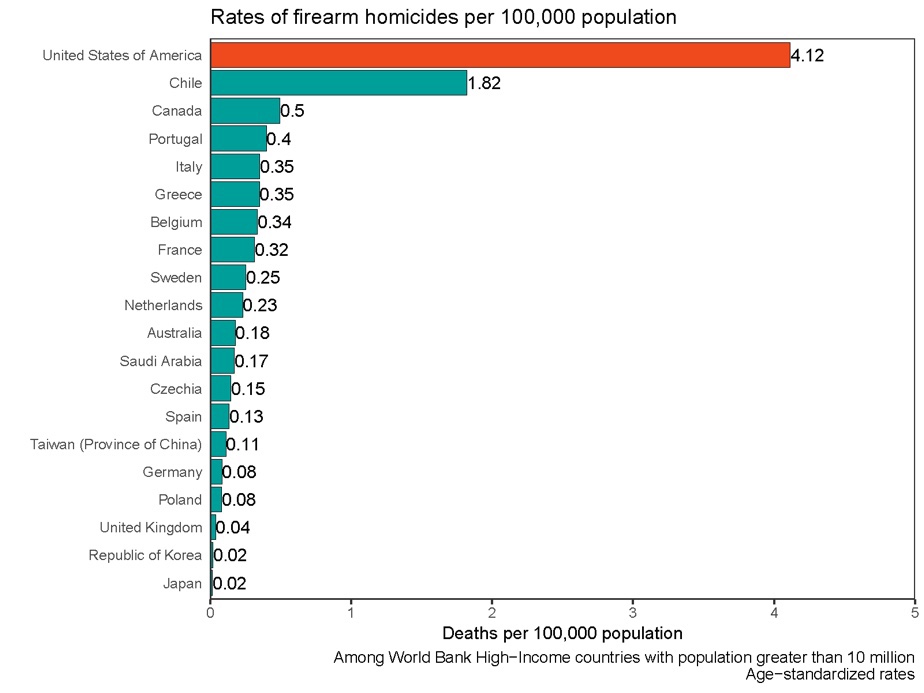
We lead the world in gun deaths. Yet GOP-dominated states like Florida, Texas, and Missouri are making it easier to get and carry a gun. The GOP fights any form of gun control.

Please join me and your many allies in D.C. on October 28-29 for our 10th anniversary conference. It promises to be our best ever! 

Sign up now.

You will have a wonderful time! 

And you will meet your favorite bloggers, hear great speakers, and meet people who are fighting against privatization across the nation.

One of our readers in Indiana noted the paradox that Illinois has banned the banning of books while Indiana Republicans are welcoming any parent or ne’er-do-well to complain about a book and get it removed from school libraries.

Indiana’s Republican-controlled General Assembly decreed this year in House Enrolled Act 1447 that every public school board and charter school governing body must establish a procedure for the parent of any student, or any person residing in the school district, to request the removal of library materials deemed “obscene” or “harmful to minors.”

The procedure may provide for an intermediate response by school personnel to a request to remove a library book, but it must include the school board reviewing, and possibly implementing, each removal request at its next public meeting.

The new law followed claims by Hoosier Republicans that Indiana school libraries are secretly loaded with books containing pornography and other content inappropriate for children.

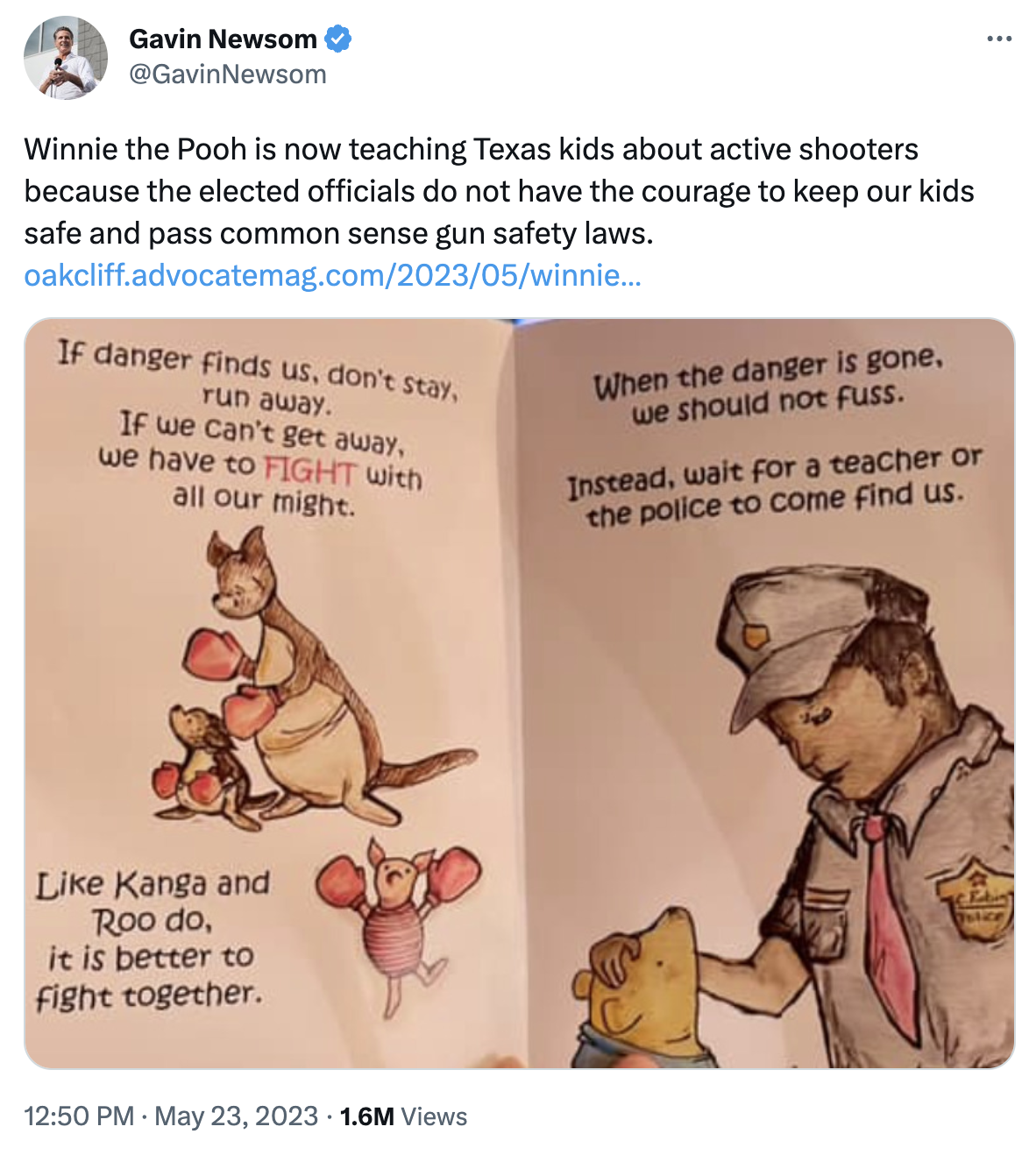
California Governor Gavin Newsom has been blasting away at knuckle-headed Republican governors like Ron DeSantis and Greg Abbott for their cruel indifference to other people. He’s already suggested he may sue DeSantis for kidnapping, after Florida sent two private planes with Venezuelan immigrants to Sacramento. Now, he’s going after Abbott for his refusal to take action against gun violence.

He wrote:

Texas… where elected officials are relying on Winnie the Pooh to teach their kids about active shooters because they don’t have the courage to keep our kids safe.

Tweet from Gavin Newsom: 'Winnie the Pooh is now teaching Texas kids about active shooters because the elected officials do not have the courage to keep our kids safe and pass common sense gun safety laws.'

Texas… where Greg Abbott signed a law to send DNA kits to parents of school children so their bodies can be identified after a shooting.

Tweet from Gavin Newsom: 'Greg Abbott’s solution to gun violence? Send DNA kits to schools so parents can identify their kids’ bodies AFTER they’ve been shot and killed.'

Guns are the leading cause of death for kids in America. Kids!

We’re not talking about accidents, or cancer or something unpreventable. We know the steps to take to save our kids lives. But leaders like Greg Abbott lack the courage to act.

Until then… It’s Winnie the Pooh for Texas families.

Gavin Newsom

J.B. Pritzker, Governor of Illinois, gave a terrific commencement address at Northwestern University, with a fabulous explanation about how to spot an idiot. He says that idiots are not necessarily stupid. They may be your boss. They may even be elected President.

If you want to see the 20+ minute speech, it’s here.

If you want to see the part where Pritzker explains idiots, state at about 7:50 into the speech.

If you are on Twitter, see it here:

Summary:

“Whenever I’m about to do something, I think ‘Would an idiot do that?’ and if they would, I do not do that thing.” – Dwight Schrute

And what is the best way to spot an idiot? Look for the person who is cruel.

In contrast to Florida, Texas, and other red states, Illinois has taken action to protect librarians and the right to read. The legislature passed a law promoting the banning of books for partisan and personal reasons. And Governor J.B. Pritzker signed it. No book banning in Illinois!

SPRINGFIELD, IL — Banned books will soon be a thing of the past at public libraries in Illinois now that the Library Freedom Act has been signed into law. Gov. J.B. Pritzker signed the bill Monday at the Harold Washington Library in Chicago.

Under the new law, public libraries must reject outside attempts at banning books for reasons that are partisan or doctrinal, to retain their eligibility for Illinois state grants.

The law allows Illinois to withhold state funding from public libraries and schools that remove books from their shelves and do not follow the American Library Association’s “Bill of Rights,” which states that books “should not be removed or restricted because of partisan or personal disapproval.”

“Here in Illinois, we don’t hide from the truth, we embrace it,” Gov. Pritzker said in a statement. “Young people shouldn’t be kept from learning about the realities of our world; I want them to become critical thinkers, exposed to ideas that they disagree with, proud of what our nation has overcome, and thoughtful about what comes next. Everyone deserves to see themselves reflected in the books they read, the art they see, the history they learn. In Illinois, we are showing the nation what it really looks like to stand up for liberty.”

Ron DeSantis got the Florida legislature to pass strong legislation that puts undocumented immigrants at risk of deportation and puts anyone who helps them at risk of arrest.

Meanwhile, the agriculture industry—a key driver of the state’s economy—is worried about finding enough workers to harvest the crops.

Immigrant advocates warned them to stay home.

But farmers are pleading with immigrants not to leave the state. Even Republican legislators worry that the anti-immigrant law was a mistake.

Republican lawmakers in Florida concerned about the state’s new anti-immigration law and its possible economic consequences begged Latinos to not leave the state in clips from a Monday morning meeting.

The footage, which provides evidence of the law’s “downstream impacts on the state economy” according to MSNBC, shows two conservative Florida legislators attempting to minimize the harm that the law, Senate Bill 1718, could cause, with one asking attendees to advise Latinos against leaving Florida.

“This bill is 100% supposed to scare you,” Republican state Rep. Rick Roth said in a clip shared on Twitter by Democratic activist Tom Kennedy. “I’m a farmer, and the farmers are mad as hell. We are losing employees. They’re already starting to move to Georgia and other states. It’s urgent that you talk to all your people and convince them that you have resources — state representatives and other people — that can explain the bill to you.”

But no one blames DeSantis, who needed to prove his contempt for immigrants.

Agriculture is a big part of Florida’s economy. Who will bring in the crops?

Before the bill passed, the Farmworkers Association warned that about 300,000 of the state’s 500,000 farmworkers are likely undocumented.

Here’s a chance for DeSantis to create jobs for his fervent white supporters. They can pick oranges and grapefruit and other crops in the blazing sun. At minimum wage.

Peter Greene was a teacher in Pennsylvania for 39 years. He is now a regular writer at Forbes and a super star blogger. This column appeared on his blog. He responded to Rick Hess’s claim that school choice is not an attack on public education but part of a long history of trying to improve them. From my perspective, it’s hard to understand how public schools improve by defunding them and replacing them with religious schools, low-quality private schools, home schooling, and cyber charters.

This is what Peter Greene wrote:

Rick Hess (American Enterprise Institute) is one of those occupants of the reformy camp that I take seriously, even when I think he’s wrong. So when he raises the question of whether or not school choice is an “attack” on public education, I think it’s a question worth talking about, because I think the answer is a little bit complicated. So let me walk through his recent piece on that very question bit by bit.

After an intro suggesting that choice expansion flows directly from the pandemic while ascribing opposition to choice to a shadowy cabal that flows from teachers unions, Hess gets to his point, which is that seeing choice as an anti-public school is “misleading and misguided.”

Hess puts choice in the context of a century’s worth of public school fixer-uppers, “a barrage of reforms.” He offers a list–“compulsory attendance, district consolidation, larger schools, smaller schools, magnet schools, standards, test-based accountability, merit pay, and more.”

Some of these ideas were good. Some weren’t. But in hindsight, it’s pretty clear that they weren’t “attacks” on public education; rather, they were attempts to improve it.

I disagree. Some of these ideas were offered with sincere hope for the best. But I’m going to single out the standards movement and test-based accountability for special recognition here.

If you weren’t teaching during the rise of No Child Left Behind, Common Core, and Race To The Top, I’m not sure if I can really capture for you the dawning sense of horror, frustration and futility among teachers at the time.

Word came down that new regulations required us to get test scores up– a little bit per year for starters, then ramping up to an impossible climb, until somehow every single student would be above average. If not, there would be penalties, maybe the complete dismantling and rebuilding of the district, perhaps as a privately-run charter school. “This is not possible,” educators said. “All will learn all,” replied the Powers That Be. “Don’t you believe that students can learn? And which child do you propose to leave behind.”

Then there were the tests themselves. Not very good, and with results coming back with so little detail–and so very late in the game–that they were less than no help at all. “Well, if we just teach the standards, the tests scores will follow,” said some optimistic educators. That didn’t happen. Schools rejiggered curriculum, pulled students away from untested material like art and recess so that they could be double-whammied with test prep.

“Maybe Obama will fix it,” we hoped. He did not. He doubled down. And 2014–the year for 100%–came closer and closer, the year when anyone dealing with educational reality knew that every district in the country would be either a) failing or B) cheating.

And through those years, one at a time or in small groups, teachers arrived at an unpleasant conclusion.

They are setting us up for failure. They want us to fail.

Why would they want that? The rhetoric had already been around on the far right, back all the way to Milton Friedman and on through his intellectual spawn– public education should be dismantled. There was a new push for vouchers and especially charter schools, and that coincided with rising noise about “failing” public schools. There was very little “let’s expand the educational ecosystem” and an awful lot of “we must help students escape failing public schools.” The constant refrain of “school choice will force public schools to improve because competition” was also an omnipresent crock, a slap in the face to educators who were already working their butts off and resented the suggestion that they were either incompetent or lazy. And that thread runs all the way up guys like Christopher Rufo arguing that to get to universals school choice, you have to get to universal distrust of public schools.

Maybe school choice wasn’t in and of itself an attack on public education, but it certainly seemed as if attacking public education was a means of promoting school choice.

I have no doubt that there are people who believe that education would work better if handled by the free market (I think their belief is magical, misguided and wrong, but I do believe it’s sincere). I believe there are technocrats who believe that standards, tests and data would improve education (ditto).

But to be a public school educator on the receiving end of all this (and more) absolutely felt like an attack. The irony is that when reformsters eventually figured out that the attack-filled rhetoric wasn’t helping and they dialed it back, the attacks themselves had become more real.

But let’s get back to Hess.

Public education can encompass a lot of approaches, and it can be organized in many different ways. Rather than blindly insist that “defending public schooling” requires clinging to outdated policies from decades (or centuries) past, we would do better to clarify principles, examine particulars, and then debate proposals.

All of this language is doing a lot of work, but as far as it goes, Hess and I probably agree more than we disagree. But the disagree part comes in the very next paragraph.

Indeed, the pandemic was a stark reminder that there are lots of ways to deliver schooling, including innovations such as learning pods, microschools, virtual tutors, and education savings accounts.

Learning pods and microschools are okay if you’re wealthy. As policy ideas in the vein of the DeVosian, “Well, your voucher may not be enough to get into a good private school, but you can always start a microschool,” they suck. I don’t think there are more than a hundred people in the country who came out of the pandemic thinking virtual education is a great idea. And education savings accounts are just vouchers with extra super-powers and porcine lip gloss. And none of these are really new ideas. They also all suffer from the same issue, which is the notion that any school choice system must be done free market style. We can do a great choice system without the free market at all (but that’s a post for another day).

Hess identifies one of the issues as the fuzziness of the word “public.” On this point, I think he gets some things wrong.

Choice opponents assert that public schools are “public” because they’re funded by public tax dollars.

No, that’s choicers. It’s been part of the charter school argument that charter schools are public schools because they are funded with public dollars. This pro-public ed writer (I’m not anti-choice, but I am anti-most-of-the-versions-of-choice-with-which-we’ve-been-presented) would say that public schools are public because they the public funds them, owns them, and operates them via representatives. Furthermore, they are public schools because they have a responsibility to the public to serve all students.

You can argue, as Hess and others do, that districts regularly hire outside firms to handle certain functions and occasionally outsource the teaching of certain students with exceptional special needs. But in all those cases, the responsibility for the management of those outside contracts rests with the public school district. A charter or private voucher-fed school carries no such responsibility. A public school district cannot, as can charters and voucher schools may, simply show parents the door and say, “Good luck. Your child is not our problem.” Do all public systems meet that responsibility as well as they ought to? Absolutely not. But at least the responsibility exists. A parent who thinks the public system is short-changing their child can (and often will) sue the district. They have no such option in a choice system, as such systems are currently conceived.

Hess is correct in calling public education “a pretty expansive category.” But it hinges on far more than whose money is being used.

In fact, I’d argue that it is the responsibility portion that is the big difference in the brand of choice being pushed by many these days. Our public system is based, however imperfectly, on the notion that we bear a collective responsibility for educating the young. Modern choice, particularly the current version sold under the culture warrior parental right brand, is about saying that getting a child an education is the responsibility of the parents, and that’s it. Yes, many choicers are also trying to privatize the ownership and provision of education, but it is the privatizing of responsibility for a child’s education that is perhaps the most profound and fundamental shift.

More importantly, simply calling something “public” doesn’t make it a good thing. While the phrase “public schooling” is suffused with happy notions of inclusivity and fairness, “public” isn’t a magic word.

Ain’t it that truth. Public education has a wide variety of issues–though some of those are the direct result of reformster attempts to “fix” things (see above re: standards and testing). But I’ve never argued that I’m against modern school choice and ed reform because public schools are perfect the way they are and everything else sucks. My most fundamental issue is that public schools have some serious issues, and modern ed reform and school choice don’t solve any of them (yes, that is also another long post). They just weaken public school’s ability to work on them while blowing through a giant pile of taxpayer money.

The point isn’t to play word games but to understand that things are less clear-cut than defenders of the status quo are prone to acknowledge. There are many ways to provide and serve the aims of public education.

After all these decades in the ed biz, I’m inclined to assert, repeatedly, that everything in education is less clear-cut that the vast majority of people acknowledge. Some folks on my side of the aisle are quick to infer nefarious and/or greedy motives when, sincere ideology is sufficient explanation (much as some folks in the choice camp assume that the only reason someone would stick up for public ed is because she’s on the union payroll). Some choicers are simply ignorant of how any of this school stuff works. Some are up against a particularly dysfunctional local version of public education. Some are anti-democrats for whom this is just one issue of many, one more way in which the government steals their money to spend it on Those People. Some want to recapture education for a particularly conservative version of christianist religion. Some want to social engineer their way to a more efficient society. Some are serious people, and some are not.

In short, the choicer and reformster camp contains a great variety of individuals.

Are some of those individuals interested promoting school choice as a way of making public education better? Is it possible to make public education better by incorporating some choice ideas? I believe that latter is true, and I swear I’m going to post about it in the not too distant future, and as for the former, well… yes, but.

But for all the variety in the choicer camp, they mostly adhere to two flawed premises– that a choice landscape should rest on a bedrock of free market mechanics and that the resulting system shouldn’t cost a cent more than the current one. As long as we start with those premises, school choice must be a zero sum game, and even if all the people who have spent the past four decades trying to tear public ed down so that choice will look better–even if all those people shut up, the zero sum game feature seems guaranteed to turn school choice into an attack on public education.