Arthur Goldstein retired recently after a long career as a high school teacher in New York City. Now that he is registered on Medicare, he is outraged that his union (the United Federatuon of Teachers) is pressuring retirees to join a Medicare Advantage plan. Should that happen, the city government would save $600 million a year but the 250,000 retirees would be pushed into a plan that (unlike Medicare) may deny service and may not be accepted by all doctors. In this post, he points out that some hospitals no longer accept Medicare Advantage.

Full disclosure: I too am affected by what happens to the city’s retirees. I am covered by my spouse’s secondary. The retirees have sued the city and won repeatedly, because they were promised Medicare when they started their careers, not a for-profit health plan that could deny services that their doctors recommend. The city and its unions intend to appeal the judgments they lost in court. If the city prevails, we will stay on Medicare and buy our own secondary, a decision that many retired municipal workers cannot afford.

He writes:

Most developed countries have some form of national health care. That’s important, because frankly, there is nothing more important than health. It really makes me sad when I see fund-raisers for musicians or artists who have health issues. In Canada, for example, these artists wouldn’t need to resort to GoFundMe, or whatever.

In the United States, there are very few forms of public health care. We have Medicaid for those with low income, and Medicare for those with high ages. I’ve been on Medicare since July, and I can’t tell you how thrilled I am to see doctors and not pay co-pays. Of course, that entails having a Medigap program that covers the 20% Medicare does not.

As a teacher, I’ve heard a lot about value-added. Bill Gates sent his people to our school and tried to initiate a program to place cameras in rooms to find out just what those teachers who got higher test scores did differently. I can tell you, though, that I can teach the very same lesson to two groups of kids and get wildly different results. (It’s odd that education experts like Gates don’t know those things.)

It’s very, very hard to measure the value an individual teacher adds, and I’d argue that test scores are a very small portion of that value. In fact, given the quality of standardized tests, I might argue their results show nothing, or even less than nothing. 

Health care is another thing entirely. UFT President Michael Mulgrew, NYC Mayor Eric Adams, and their BFFs on the Municipal Labor Committee want to take Medicare away from not only me, but also every New York City retiree. They want to place us in a plan administered by Aetna. I can tell you precisely what value Aetna adds to Medicare—none whatsoever. 

Aetna, along with every so-called Medicare Advantage plan, takes a cut of what the government contributes to Medicare. How do they make money? They make money by paying doctors less, and by denying care they deem unnecessary. Mulgrew says Aetna will pay doctors the same Medicare does, and that may be true. But it may not be permanent. Mulgrew is always “improving” our health care by having us pay more. Which experienced city employee doesn’t believe he’d improve it further by paying doctors less? 

Mulgrew originally tried selling Advantage by saying every doctor who took Medicare would take this plan. But when members asked their doctors if that were true, they learned it was not. Is Mulgrew a liar? Well, if he isn’t, he’s woefully uninformed. Either way, it renders him unfit to lead a group which, to a very large function, regulates the health care of its members.

Mulgrew can tell retirees that this hospital, or that group of hospitals will take this plan or that. But that may not last. Hospitals are dumping Advantage plans in large numbers. 

Enticed by incessant TV ads blaring every night with those fictional characters Martha and Karen and that old shill Joe Namath pushing plans, especially those with zero premiums, more converts have signed up for potentially less health care coverage and more out-of-pocket expense when illness strikes. In return, they are told they may have no monthly premium and receive a grab bag of goodies like grocery cards and a handful of toiletries. Those goodies may be less attractive, however, when that health plan makes you wait weeks for a diagnostic test to see if you have cancer or will only pay a small portion of the bill if you do.

Do you really believe that health care companies would spend millions of dollars on advertising out of the goodness of their hearts? Do you think that their offers of this or that really mean you and yours will receive better care? I think that, if I sign up for a Medicare Advantage plan, millions of dollars that should be spent toward my health care will go to pay Joe Namath. Many, many more millions will go to Aetna, or whatever parasitical entity is withholding health care and medical compensation to profit off of me and my fellow Americans.

Aetna is not interested in your health. Aetna is interested in profiting from your health, or lack thereof.

Please open the link to finish the article.
John Thompson, retired teacher and historian in Oklahoma, noticed that the mainstream media loves bad news about public schools. Even when the news is good, the media somehow twist it into an indictment of public schools, teachers, and/or kids today. This drumbeat of negative coverage feeds into the narrative of the privatizers like DeVos and Koch. The latest example, he notes, are the recently reported scores from an international test.

He writes:

I recently wrote about the two tales of the Oklahoma school Report Card – the alt facts used by State Superintendent Ryan Walters to disparage public education, and the more nuanced view of a serious journalist. This is about the more subtle, but more important, two tales of the OECD’s PISA test scores.

I have become more worried that the newspapers I most respect are paying more attention to winners and losers of edu-political horse races, as opposed to the complexities of public schooling. Then, it was called to my attention by The Grade that “big international wire services tended to emphasize the dismal overall results (Reuters, A.P.). Mainstream national outlets tended to highlight the poor showing from U.S. kids, especially when it comes to math (New York Times, Washington Post, Axios).”So, I followed its links.

I also worry that this might be part of a larger pattern where the press is paying relatively more attention to polling data and attention-grabbing bad news for the Biden administration, such as inflation, immigration, and populist anger, and under-reporting the often more upsetting, complex, problems in other affluent nations.

Starting with the A.P. coverage, it began with “the average international math score [which] fell by the equivalent of three-quarters of a year of learning. Reading scores fell by the equivalent of half a year.” Granted, there are flaws in the way that those numbers are reached, but these “setbacks spanned nations rich and poor, big and small, with few making progress.” And the A.P. quickly noted that Germany, Iceland and the Netherlands “saw drops of 25 points or more in math scores.”

Then, it reported, “In the U.S., which historically has lagged in math, the average math score fell by 13 points.” But its reading and science “stayed mostly even, in contrast to an international drop of 10 points.” The A.P. then explained that the U.S. “improved to No. 26 in math, up three spots from 2018. It ranked No. 6 in reading and 10th in science, up two and one spots, respectively.”

Moreover, the A.P. addressed the endless headlines about learning loss during Covid, which are continually used as weapons against educators; School closures “didn’t always lead to lower scores.” There was “no clear difference” in performance trends between countries that had limited closures, including Iceland and Sweden, and those with longer closures, including Brazil and Ireland, according to the report.” And the A.P. quoted the OECD, “Many other factors impacted learning during this period, such as the quality of remote teaching and levels of support granted to struggling students.”

Similarly, Reuters quoted OECD director of education Andreas Schleicher who said, “Covid probably played some role but I would not overrate it.” Moreover, “Poorer results tended to be more associated with higher rates of mobile phone use for leisure and where schools reported teacher shortages.”

The New York Times began with, “The math performance of U.S. teenagers has sharply declined since 2018, with scores lower than 20 years ago, and with American students continuing to trail global competitors.” Two paragraphs later, it reported, “The bleak math results were offset by a stronger performance in reading and science, where the United States scored above average internationally.” But for the next 5 paragraphs, the Times focused on the bad news for U.S. schools, as well as saying “Countries that kept schools closed longer generally saw bigger declines.”(In fairness, however, the Times also reported, “In a surprising result, the PISA test did not find a growing gap in math and reading between the highest and lowest U.S. performers during the pandemic.”)

The article briefly reported:

The United States lost less ground than some European countries that prioritized opening schools more quickly. And the United States held steady in reading and science.

The United States even moved up in world rankings — largely because of the declines of other nations.

However, the next 15 paragraphs focused on math declines, which admittedly are extremely upsetting, while often implicitly criticizing schools. It wasn’t until the last paragraph that this context was added:

On other measures, the United States stood out for having more children living with food insecurity (13 percent, compared with an average of 8 percent in other O.E.C.D. countries), more students who are lonely at school (22 percent, versus 16 percent) and more students who do not feel safe at school (13 percent, versus 10 percent).

I also agree with criticism of Axios’ coverage, but I’d push back on the complaint about the Washington Post, at least for now. The Post’s headline, justifiably, was alarming, “Math scores for U.S, students hit all-time low on International exam,” but its subtitle was, “Even so, U.S. students performed better relative to their peers than in past years.” Its article was shorter, not leaving room for details about European declines, but it quoted Peggy Carr, commissioner of the National Center for Education Statistics on the math declines, “Only now can we see that it is a global concern.”

The most balanced report was published in Chalkbeat, which gave equal space to how “The U.S. ranked sixth in reading and 10th in science among the 81 school systems that gave the PISA last year. In 2018, the U.S. ranked eighth in reading and 11th in science.” Moreover:

The steady reading results among U.S. high schoolers run counter to the significant reading declines observed last year for younger students on the National Assessment of Educational Progress, or NAEP. Academic recovery in reading has also been uneven. Carr said that could indicate that the NAEP has a higher difficulty level than the PISA.

Chalkbeat also quoted U.S. Secretary of Education Miguel Cardona who:

Pointed to the results as an indicator of the impact of the federal investments made in schools during the pandemic, much of which was spent on academic recovery initiatives, such as tutoring and mental health support for students.

That spending “kept the United States in the game,” Cardona said. Without it, he said, the U.S. would be “in the same boat” as other countries that didn’t spend as much and saw steeper declines. .

And that brings me back to my wider worry that the press, in a time when the presidential race could determine whether our democracy survives, is headlining American problems, without revealing that affluent European nations are doing worse in many areas where President Biden is being blamed for not solving long term challenges, ranging from inflation to anti-immigrant-driven populism.

The news media keep a set of stock headlines at the ready whenever national or international test scores are posted: SCORES DECLINE! U.S. STUDENTS FAILING! A SPUTNIK MOMENT! OUR SCHOOLS ARE FAILING!

All these cries of “failure” feed the phony narrative of the privatization movement. Organizations funded by rightwing billionaires promote the idea that students will get higher scores in charters or voucher schools (we now know that this claim is not true, that charter schools are no better (and often worse) than public schools, and that vouchers subsidize wealthy families and do not save poor kids.

It is a fact that U.S. students have never performed well on international tests, as I explained in my book REIGN OF ERROR. Since the 1960s, when the first international tests were administered, our scores on these tests were mediocre to awful. Nonetheless, our economy has outperformed nations whose students got higher scores decades ago.

Now for the good news.

The latest international test scores were released a few days ago, and scores went down everywhere due to the pandemic. David Wallace-Wells, an opinion writer for The New York Times, reported that even with dropping scores, U.S. students outperformed the rest of the world!

He writes:

By now, you’ve probably registered the alarm that pandemic learning loss has produced a “lost generation” of American students.

This self-lacerating story has formed the heart of an indictment of American school policies during the pandemic, increasingly cited by critics of the country’s mitigation policies as the clearest example of pandemic overreach.

But we keep getting more data about American student performance over the last few years, and the top lines suggest a pretty modest setback, even compared to how well the country’s students performed, in recent years, in the absence of any pandemic disruption.

Now, for the first time, we have good international data and can compare American students’ performance with students’ in peer countries that, in many cases, made different choices about whether and when to close schools and whether and when to open them.

This data comes from the Program for International Student Assessment, coordinated by the Organization for Economic Cooperation and Development in almost 80 countries typically every three years — a long-running, unimpeachable, nearly global standardized test measure of student achievement among the world’s 15-year-olds in math, reading and science.

And what it shows is quite eye-opening. American students improved their standing among their international peers in all three areas during the pandemic, the data says. Some countries did better than the United States, and the American results do show some areas of concern. But U.S. school policies do not seem to have pushed American kids into their own academic black hole. In fact, Americans did better in relation to their peers in the aftermath of school closures than they did before the pandemic.

The performance looks even stronger once you get into the weeds a bit. In reading, the average U.S. score dropped just one point from 505 in 2018 to just 504 in 2022. Across the rest of the O.E.C.D., the average loss was 11 times as large. In Germany, which looked early in the pandemic to have mounted an enviable good-government response, the average reading score fell 18 points; in Britain, the country most often compared with the United States, it fell 10 points. In Iceland, which had, by many metrics, the best pandemic performance in Europe, it fell 38 points. In Sweden, the darling of mitigation skeptics, it fell 19 points.

In science, the United States lost three points, about the same decline as the O.E.C.D. average and still above the level Americans reached in 2016 and 2013. On the same test, German students lost 11 points, and British and Swedish students dropped five; performance by students in Iceland fell by 28 points.

In math, the United States had a more significant and worrying drop: 13 points. But across the other nations of the O.E.C.D., the average decline from 2018 to 2022 was still larger: 16 points. And in historical context, even the 13-point American drop is not that remarkable — just two points larger than the drop the country experienced between the 2012 and 2015 math tests, suggesting that longer-term trajectories in math may be more concerning than the short-term pandemic setback. Break the scores out to see the trajectories for higher-performing and lower-performing subgroups, and you can hardly see the impact of the pandemic at all.

Of course, the Program for International Student Assessment is just one test, with all the limitations of any standardized measure. It is not good news, in general, if the world is struggling academically. And none of this is an argument for American educational excellence or never-ending remote learning or a claim there was no impact from closures on American kids or a suggestion that the country’s schools should have stayed closed as long as they did.

It is simply a call to assess the legacy of those closures in the proper context: a pandemic that killed 25 million people globally and more than a million in the United States and brought more than a billion children around the world home from school in 2020. In the 18 months that followed, American schools were not choosing between universal closures and an experience entirely undisturbed by Covid-19. They were choosing different ways of navigating the pandemic landscape, as was every other school system in the world. A good first test of whether the country bungled school closures is probably whether peer countries, in general, did better. The test scores imply that they didn’t.

So why do we keep telling ourselves the self-lacerating story of our pandemic educational failure?

One reason could be that while some state-level testing data shows no correlation between school closures and learning loss, some analysis of district-level data has shown a closer correlation. But this suggests that learning loss is not a national problem but a narrower one, requiring a narrower response.

Another is that testing is blind to other markers of well-being. Chronic absenteeism, for instance, is up significantly since before the pandemic and may prove a far more lasting and concerning legacy of school closure than learning loss. And the American Academy of Pediatrics declared a national mental health emergency — language that has been echoed by the American Medical Association.

But while American teenagers have reported higher levels of emotional distress in several high-profile surveys, here, too, the details yield a subtler picture. In the first year of the pandemic, according to a study supported by the National Institute of Mental Health, 17 percent fewer American teens made mental-health visits to emergency rooms than in the year before; in the second year, they made nearly 7 percent more. According to the Centers for Disease Control and Prevention, the proportion of teenage girls reporting persistent feelings of hopelessness and sadness rose from 47 percent in 2019 to 57 percent in 2021 — a concerning rise, though only slightly larger than the six-point increase from 2017 to 2019. The number of male teens reporting the same barely grew, from 27 percent to 29 percent, having risen much faster from 2017 to 2019.

Each of these data points should probably be understood in the context of mental health surveys of older Americans, such as the General Social Survey, which found that the percentage of American adults describing themselves as “very happy” fell from 31 percent in 2018 to 19 percent in 2021 and those describing themselves as “not too happy” nearly doubled to 24 percent. It is hard to disentangle the effects of school closure here from the experience of simply living through an anxious and disruptive time. To judge by the bleakest standard, youth suicide declined during the period of school closure and returned to prepandemic levels only after schools reopened.

Overall, American adults lost some confidence in the country’s school system in those years, with national approval dropping from 50 percent to 42 percent. But the drop is not from current parents of kids in school, whose approval rose throughout the pandemic, according to Gallup, from 72 percent in 2020 to 73 percent in 2021 to 80 percent in 2022. (Other recent surveys, including ones from Pew and The Times, have found similar postpandemic parental approval, between 77 percent and 90 percent.) Instead, as Matt Barnum suggested on ChalkBeat, the decline has been driven by the perspective of people without kids in those schools today — by childless adults and those who’ve opted out of the public school system for a variety of personal and ideological reasons. [Ed.: bold added]

Could we have done better? Surely. We might have done more to open all American schools in the fall of 2020 and to make doing so safe enough — through frequent pooled and rapid testing, more outdoor learning and better indoor ventilation, among other measures — to reassure parents, 71 percent of whom said that summer that in-person school was a large or moderate risk to their children and a majority of whom said that schools should remain closed until there was no Covid risk at all. We could have provided more educational and emotional support through the darkest troughs of the pandemic and probably been clearer, throughout the pandemic, that the risk of serious illness to individual kids was relatively low.

But we could do better now, too, by sidestepping pandemic blame games that require us both to exaggerate the effect of school closures on educational achievement and the degree to which policymakers, rather than the pandemic, were responsible.

You may recall watching Fiona Hill testify in the first Trump impeachment. He was impeached for withholding Congressionally-approved aid to Ukraine unless President Zelensky agreed to dig up dirt on Joe Biden. Hill is a former official at the U.S. National Security Council, specializing in Russian and European affairs. Maura Reynolds of POLITICO interviewed Hill about what happens if the U.S. withholds aid and Putin wins.

It was nearly two years ago that Russia launched its full-scale invasion of Ukraine, and in recent months, the fighting appears to have ground to a stalemate. Aid from the United States has helped Ukraine get this far — but now Americans are asking, how long should they continue to support Ukraine in its war against Russia? At this point, just what are the stakes for the United States?

Since the war began, I’ve turned to Fiona Hill periodically for insight into what’s driving Russian President Vladimir Putin, and where America’s interests lie. She’s a keen observer not just of Russia and its leader, but also of American politics, having served in the White House as a top adviser to both Democrats and Republicans, including President Donald Trump. Since she left the Trump administration (and after a star turn testifying in his first impeachment), she’s become a highly sought-out voice on global affairs as well as the domestic roots of authoritarianism in countries around the world.

When we spoke this week, she made clear that the decision of whether Ukraine wins or loses is now on us — almost entirely. As Congress debates how much more money to authorize for Ukraine’s assistance amid growing Republican opposition, she says that what we are really debating is our own future. Do we want to live in the kind of world that will result if Ukraine loses?

Hill is clear about her answer. A world in which Putin chalks up a win in Ukraine is one where the U.S.’s standing in the world is diminished, where Iran and North Korea are emboldened, where China dominates the Indo-Pacific, where the Middle East becomes more unstable and where nuclear proliferation takes off, among allies as well as enemies.

“Ukraine has become a battlefield now for America and America’s own future — whether we see it or not — for our own defensive posture and preparedness, for our reputation and our leadership,” she told me. “For Putin, Ukraine is a proxy war against the United States, to remove the United States from the world stage.”

Hill sees U.S. domestic politics as the main obstacle to Ukraine’s ability to win. She has long warned, including in a book published after she left the White House, that high levels of partisanship in the United States promote authoritarianism both at home and around the world. She’s been talking to some lawmakers about Ukraine, and she’s worried that their partisanship has blinded them to the dangers the country faces if Putin gets his way.

“The problem is that many members of Congress don’t want to see President Biden win on any front,” she said. “People are incapable now of separating off ‘giving Biden a win’ from actually allowing Ukraine to win. They are thinking less about U.S. national security, European security, international security and foreign policy, and much more about how they can humiliate Biden.”

“In that regard,” she continued, “whether they like it or not, members of Congress are doing exactly the same thing as Vladimir Putin. They hate that. They want to refute that. But Vladimir Putin wants Biden to lose, and they want Biden to be seen to lose as well.”

This transcript has been edited for length and clarity.

Ukraine is fighting the Russian invasion on several fronts: military, financial, political. In each of those areas, is Ukraine winning, or is Russia?

We have to think about where we would have been in February of 2022. Russia’s intent was to decapitate the Ukrainian government so it could take over the country. That’s what we all anticipated. We anticipated that [Ukrainian President Volodymyr] Zelenskyy would have gone into exile, the Ukrainians would have capitulated, then there would be a very messy insurgency against the Russian forces. So if we start from that point, militarily, and we look at what’s happened over the last two years, we can actually say that Ukraine has won in terms of securing its independence, and has won by fighting Russia to a standstill.

But then we get into the details. Because, of course, the standstill is the main issue at hand. The Ukrainians were initially able to take back quite a lot of the territory that the Russians seized in the early phases of the invasion, but then the Russians dug in. We had all the hype around a counteroffensive this past summer, a lot of expectations built up inside and outside of Ukraine, especially here in the United States. If we look at other wars, major wars, often these much-anticipated individual battles don’t turn out the way that the planners or the fighters actually anticipate. Now we are in a scenario where having not succeeded in reaching the stated goals of the counteroffensive, we’re basically positing that Ukraine has somehow lost the entire war.

Ukraine has succeeded so far because of massive military support from European allies and other partners. So in that regard, we’ve now reached a tipping point between whether Ukraine continues to win in terms of having sufficient fighting power to stave Russia off, or whether it actually starts to lose because it doesn’t have the equipment, the heavy weaponry, the ammunition. That external support is going to be determinative.

So it’s maybe too soon to answer the question of has Ukraine won or lost militarily.

How about in the financial and diplomatic arenas?

It’s a question of whether Ukraine has enough resources, financial resources, not just to keep going on the battlefield, but also to keep the country together at home. And up until now you’re still seeing a lot of European countries stepping up. Not just you know, the United States, but definitely the EU, Japan, South Korea and others. Japan recently made an offer of additional major financial support. The Germans have said that they’ll make sure that the Ukrainian economy will continue to not just survive, but thrive, and over the longer term, they’ll help rebuild. This is still somewhat positive.

On the political side, however, we’ve got the problems of the policy battlefields on the domestic front. Ukraine has now become a domestic political issue in a whole range of countries, not just here in the United States, but in countries like Poland, Slovakia, Hungary, Germany and many more. And that’s an issue where it’s going to be very hard for Ukraine to win. Because when you get into the transactional issues of domestic politics, and you’re no longer thinking about national security, or these larger imperatives, then Ukraine dies a thousand deaths from all of the transactional efforts that domestic politicians engage in. Most political constituents, no matter the country, can’t really see beyond their own narrow interests.

So Ukraine isn’t losing yet. But depending on the domestic situation in the United States, and with its European allies, it could? It could start losing very soon?

That’s right, we’re at a pivotal point. There’s a lot of detail, but the bottom line is that we are at an inflection point, a juncture where it could very rapidly tip, in fact this month — December and January — into a losing proposition for Ukraine.

What do you think Putin sees when he’s watching the debate taking place in the United States right now?

He does see the entire battlefield of the military, financial and political arenas tipping to his benefit. Putin really thinks that he is on the winning side. We’ve just seen in the last few weeks, something that looks rather suspiciously like a preparatory victory tour [by Putin] around the Middle East, visiting the UAE and Saudi Arabia, stepping out again in “polite company,” preparing to go to other major meetings. And then the coverage in the Russian press — their commentators are crowing with glee at the predicament of the Ukrainians, clapping their hands, literally and figuratively, about the peril for Ukraine in the U.S. Congress.

One thing that we need to bear in mind here is that Putin turned for assistance to two countries that should give Americans and members of Congress pause — Iran and North Korea. Russia has had significant shortfalls of ammunition and sophisticated technology because of sanctions and other constraints. Ammunition has come from North Korea, which continues to provide Russia with all kinds of rounds for shells, and Iran has stepped up with the production of drones. Iran and North Korea both see this as a kind of international opening for them. If Russia prevails on the battlefield, you can be sure that Iran and North Korea will get benefits from this. We already see Russia shifting its position on the Iranian nuclear front, and we also see Russia making a major shift in its relationship with Israel. Putin has gone from being a major supporter of Israel, to now an opponent, and has switched from what was always very careful public rhetoric about Israel to pretty antisemitic statements. Putin never denigrated Jews in the past. On the contrary, he presented himself as a supporter of the Jewish population. This is a dramatic shift and clearly because of Iran. Now, whether Iran asked Putin to do this, I honestly can’t say, but we can all see this deepening relationship between Russia and Iran. That is a real problem for the administration and for others who are now looking at the Middle East and trying to figure out how to stop a broader war with Lebanon, with the Houthis in Yemen, and all of the Iranian proxies, because Iran and Russia have become fused together now in two conflicts.

Please open the link to finish reading the interview.

Ruth Ben-Ghiat is a professor at New York University and an authority on fascism and dictatorship. Here, she analyzes the shocking decision by Mike Johnson, the House Spraker, to release the tapes of the January 6 insurrection with the faces of participants blurred so they can’t be identified and prosecuted. If they are releasing tapes of criminal activity, why are they blurring the faces of criminals? To protect them.

She writes:

Authoritarianism revolves around the power to commit crimes with impunity. That is why protecting and promoting criminals and turning violent and corrupt activities into patriotic and necessary actions are always priorities of authoritarian parties and governments. The statement by Speaker of House Mike Johnson (R-LA) that House Republicans will blur footage from the Jan. 6 attack to help participants avoid being brought to justice is symptomatic.

When autocratic forces triumph, the rule of law becomes rule by the lawless. If Donald Trump returns to the White House, this will be the situation in the United States.

The party took a big step forward in the process of normalizing impunity when they made the methods and philosophy of the Jan. 6 attempted coup into party dogma. A 2022 GOP resolution decreed the assault on the Capitol to be “legitimate political discourse.” This rhetorical defense provides an “intellectual” rationale for the overturning of our democracy.

Normalizing impunity also means actively shielding participants in the coup attempt from being brought to justice and discrediting democratic institutions of justice in the eyes of the public. This is what keeper of the MAGA cult Johnson sought to do with his statement. “We have to blur some faces of persons who participated in the events of that day because we don’t want them to be retaliated against and to be charged by the DOJ,” he said.

As with everything Johnson says and does, this declaration was meant for an audience of one. It was a loyalty performance meant to reassure Trump that the GOP will defend those who tried to save him from the awful fate of accepting democratic precedent and leaving office when he was voted out.

Johnson’s statement also sends a strong message to MAGA thugs and fanatics that the Republican party will defend them if they engage in acts of political violence going forward. And it reduces the DOJ’s actions to hold criminals accountable to “retaliation.”

Crime, and the law, have a different meaning for authoritarians and their enablers. In the amoral and transactional world of leaders such as Trump, all means are justified to get to power and stay there. So, actions that might be defined as criminal in a democracy take on a different meaning in an autocracy. Elites and foot soldiers are rewarded for engaging in corruption, lying, and violence.

Creating an environment propitious to such violence is a key element of preparing for and managing autocracy. Spouting dehumanizing and violence-inciting rhetoric is not enough: you have to give people incentives to engage in corrupt and violent acts.

The promise and reality of pardons plays a role here. MAGA loyalist Rep. Paul Gosar (R-AZ) used the idea of a ” blanket pardon” to get people to participate in the insurrection. Trump has deployed this ever since. “If I run, and if I win, we will treat those people from January 6 fairly,” the former president stated at a Jan. 2022 rally. “And if it requires pardons, we will give them pardons, because they are being treated so unfairly.”

As I observed in an earlier Lucid essay, illiberal leaders have long used pardons to corrupt people, discourage dissent in and outside of the party, hide their crimes, and free up the most criminal and unscrupulous elements of society for service to the party and the state.

Benito Mussolini inaugurated this strategy. In 1925, soon after he declared himself dictator, he pardoned all “political criminals,” meaning the Blackshirts whose violence had helped him come to power in 1922 and intimated and killed people ever since. Murderers, specialists in torture, and more were now available to serve in Il Duce’s new militia or take jobs in the party and the state bureaucracy.

Five years after the 1973 coup destroyed Chilean democracy, dictator Augusto Pinochet amnestied all political criminals. Tellingly, the junta pardoned not just “authors” and “accomplices” of crimes, but also “concealers” of those crimes, so that military and security service agents who had committed human rights abuses now had their service records cleansed of incriminating evidence.

In blurring the faces of those who engaged in violent actions on behalf of an autocrat, and stating that they do not want those who assaulted the Capitol to be brought to justice, Johnson and the GOP place themselves in authoritarian tradition. They are releasing the altered footage because they need to consolidate a revisionist narrative about Jan. 6 for campaign purposes.

The DOJ has the unaltered footage, and living in a democracy means evidence of actions that incriminate those who commit violence on behalf of the powerful cannot easily be destroyed. The GOP intends to cleanse the DOJ if they return to power and likely scrub all such evidence. In the meantime, they must settle for blurring the faces of those they want to use for future anti-democratic actions. “We don’t want them…to be charged by the DOJ,” Johnson said. This is why.

If Trump and the GOP have their way, as of 2025 the DOJ would be remade to serve autocratic goals, protecting criminals rather than holding them accountable.

Dr. Peggy Carr is Commissioner of the National Center on Education Statistics, a prestigious, major federal agency. NCES preceded the U.S. Department of Education by more than a century, having been created by Congress in 1867 to report on the progress and condition of American education. NCES releases regular reports on education. It also oversees the National Assessment of Educational Progress (NAEP), the federal testing agency.

T. Keung Hui of the Charlotte Observer reported that Dr. Carr is ensnared in a state investigation of a charter school called Children’s Village Academy and its financial affairs. The school’s charter is up for renewal in 2024.

A North Carolina charter school is being accused of misspending thousands of taxpayer dollars, including funds spent on behalf of a high-ranking federal education official who is a leader at the school.

Staff from the state Department of Public Instruction this week presented reports alleging conflict of interest violations involving the spending of state and federal dollars at Children’s Village Academy in Kinston. Many of the questions revolved around money exchanged between the school and its board vice chair Peggy Carr, who is also commissioner of the National Center for Education Statistics.

Specific concerns include Carr getting $155,000 in interest payments on a $188,000 loan she gave the school 15 years ago. Other allegations include the school improperly using taxpayer dollars to reimburse Carr for furniture and utility bills for a home she owns and rents to the school in the summer….

In 2008, Carr gave the school a $188,000 loan that is still being repaid. DPI says there was inadequate documentation of the loan , resulting in misstatement of the school’s finances because it wasn’t listed as being a liability..

McFadden said that Carr has been paid back, with interest, $314,000. But by the time the loan is fully repaid, McFadden said the school will have paid an estimated $155,505 in interest — $109,268 more than it was originally projected to repay.

“DPI is concerned with the legality and validity of the loan payments to date since there is no documentation or evidence that substantiates the CVA Board agreed to or understood the total amount to be paid including interest based on the annual decisions being made,” according to a DPI report.

In addition, DPI has questions about the $894 a month it says Children’s Village is paying to reimburse Carr for small business loans for buildings the school uses…

DPI identified $5,003 in “unallowable costs,” from the summer program, including $4,438 for furnishings that Carr purchased and requested reimbursement for at a house she partially owns in Kinston.

The school leases the home for two months a year for the summer program, DPI says. Items purchased included dining room tables, dining room chairs and decorative items such as a wall mirror, “colorful cows” and pillows. Some of the items were purchased in Maryland, where Carr lives, and shipped to Kinston.

“Per contracts for the property where the furnishings are used, the property is only used for 2 months out of the year,” according to a DPI report. “The furnishings in question are also not a reasonable purchase as they are typically found in a household, they are not furnishings typically found in an academic setting.”

In addition, DPI says the school paid the entire utility bill for the house for two summer months even though part of the property was used by an independent contractor who is related to Carr. That person is the school’s operations manager. A U-Haul business is also in that building.

Even after the summer program ended, DPI says the school paid the utility bills for the home. Altogether, DPI found $3,238 in unallowable utility costs that must be repaid….

DPI outlined a list of other questioned costs, including:

▪ A custodian was paid $17,000 in federal summer program grant month for July through September.

▪ A different custodian/bus driver who is married to the K-5 principal was paid $15,000 in federal grant dollars in July and August. The K-5 principal is also Carr’s sister.

▪ DPI found $8,877 in unallowable costs related to personal expenditures such as a tire replacement for the finance officer’s car, holiday gifts to employees, $500 gift cards to four employees and costs related to a daycare center operating on the campus. McFadden said the daycare owner is related to Carr.

Read more at: https://www.newsobserver.com/news/local/education/article282963048.html#storylink=cpy

When Betsy DeVos was Secretary of Education, she gave $10 million to establish a research center on school choice; she chose carefully. Given who she is, she was not likely to give the money to academics likely to throw cold water on her life’s work. She gave the grant to Tulane, smack dab in the middle of the only city that has no public schools. The organization she funded is called the National Center Research on Education Access and Choice (REACH), led by economist Douglas Harris.

REACH has not been a cheerleader for choice but neither has it been notably critical. The all-charter New Orleans district has not offered much to cheer about. Just days ago, the Orleans Parish School Board closed The Living Charter, which has a large proportion of English learners, because of its test scores. It was the ninth charter school closed in New Orleans since 2018.

Two of the nation’s most active funders of charter schools just awarded nearly $1 million to REACH: the Walton Foundation and the City Fund.

Walton is the single largest private funder of charter schools in the nation. The City Fund was created by billionaires Reed Hastings (Netflix) and John Arnold (ex-Enron) specifically to spur the growth of charter schools.

Tulane announced:

The latest research on school choice suggests that the availability of charter schools alongside other options is producing impacts across entire school systems. However, what works in New Orleans may not work in Arizona. How can we better understand variations across contexts in order to design more effective policies at the system-level?

The National Center for Research on Education Access and Choice (REACH) at Tulane University received a total of $975,964 in funding from both the Walton Family Foundation ($485,914) and City Fund ($490,050) to jointly support a three-year research project on the system-level effects of charter schools at the national level. The goal is to learn how charter schools improve student outcomes and better understand the role of policy in fueling these changes.

Is it too much to suggest that their sponsorship is akin to cigarette companies funding research on the benefits and risks of nicotine?

Harris implied in his comments on the grant that a district with 100% market share was subject to “diminishing returns.” Does he mean that it’s useful to have some public schools to take the students that the charters don’t want?

According to REACH Director and Tulane School of Liberal Arts Professor of Economics Douglas Harris, “This funding will help us improve the functioning of the charter sector by better understanding the roles played by factors such as access to quality teachers and the design of charter policies, including charter school funding. We will also learn about the various mechanisms throughout which charter schools affect students, including indirect effects on traditional public schools. Finally, places like New Orleans have gone 100% charter, but we see some evidence of ‘diminishing returns’ to charter market share.” He added, “We are thankful to both The Walton Family Foundation and City Fund for their generous support of our work.”

No wonder Jeb Bush wrote an opinion article defending his so-called reforms, especially high-stakes standardized testing.

The Republican-controlled Legislature is moving to dismantle the structure that Bush created when he was governor. Some legislators wanted to cancel recess but the outcry from parents made them drop that idea.

Leslie Postal of The Orlando Sentinel, one of the best education writers in the nation, writes here about the seismic changes in Florida:

The Florida Senate backed away Tuesday from plans to end the state’s recess requirement after objections from “recess moms” but moved ahead with proposals to scrap key, and controversial, parts of the Republican education agenda.


The Senate’s fiscal policy committee agreed by an 18-0 vote to end policies ushered in by former Gov. Jeb Bush more than 20 years ago. Those include requirements that high school students pass two exams to graduate and that third graders pass a reading test to move on to fourth grade.


Under the bill approved by the GOP-dominated committee, students would no longer have to pass an Algebra 1 and a language arts exam to earn high school diplomas. But the 10th-grade language arts exam would count as 30% of a student’s final grade in 10th-grade English classes, just as the algebra exam already counts as 30% of the final grade in Algebra 1 classes.


The bill also would allow third graders who failed the state reading test to be promoted to fourth grade, if that is what their parents thought was best.

Jeb Bush’s allies objected to the changes and said they would water down standards. It’s not yet clear whether DeSantis will go along. Moms for Liberty also objected.

But Republicans in the Senate have pushed and supported the measures, and two committees have now approved them.


Senate President Senate President Kathleen Passidomo introduced the proposals in a memo she sent to senators last month that was titled “Learn Local – Cutting Red Tape, Supporting Neighborhood Public Schools.”


The idea, she said, was that after the Legislature expanded school choice (HB 1) earlier this year, making many more children eligible for private school scholarships, it should look in its 2024 session to remove regulations on public schools, which serve the bulk of the state’s students.


In the memo, she called the ideas “bold,” “controversial” and, she conceded, ones that might “not make it across the finish line.”


Many of the Senate’s suggestions have broad support from school superintendents, administrators, teachers and parents.

Representatives from the Broward, Orange and Seminole county school districts all showed their support Tuesday, for example.


Simon noted that Florida’s new standardized test, FAST, is a “progress-monitoring” exam given several times a year starting in pre-Kindergarten.
“We’re able to find those students much earlier on in the process,” he said, making the current third-grade rule unnecessary.

Conservative firebrand Bridget Ziegler insists she will stay on the Sarasota school board after the other members passed a resolution calling on her to resign. The board doesn’t have the legal power to force her removal. Only DeSantis does.

Ziegler is co-founder of Moms for Liberty and a national voice for traditional family values. She has led the crusade to censor books about sexuality and racism. She is an outspoken critic of homosexuality.

Students were not allowed to attend the meeting because of the nature of her activity: three-way sex with her husband and another woman.

Hypocrisy is not a crime.

Maybe now Bridget will stop denouncing gays. Or is that too much to hope?

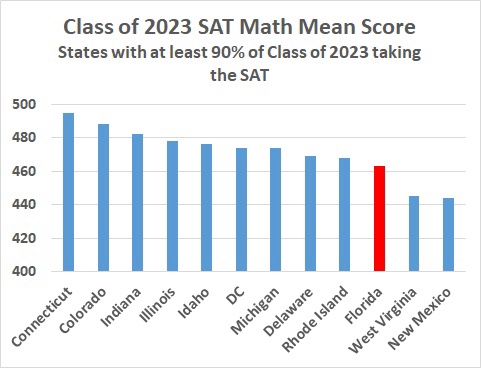
When you hear Jeb Bush or Ron DeSantis boast about the success of education in Florida, don’t believe it. Laugh out loud. Fourth grade reading scores are high, but could it be because low-scoring third graders are retained? Eighth grade reading scores are at the national average on NAEP—nothing to brag about. Florida’s SAT scores are embarrassingly low for a state that brags about test scores. Apparently those impressive reading scores in fourth grade ebb away as each year passes.

Scott Maxwell, opinion columnist for The Orlando Sentinel, called out the fraudsters by pointing to Florida’s pathetic SAT scores.

New rankings show Florida students are posting some of the lowest SAT scores in America.

We’re talking 46th place. Down another 17 points overall to 966, according to the combined reading and math scores shared by the College Board.

Florida trails other Southern states like South Carolina and Georgia. We trail states where more students take the test, like Illinois and Indiana.

We somehow now even slightly trail Washington, D.C. — a district long maligned as one of the supposedly worst in America, where all students take the test.

This should be an all-hands-on-deck crisis. Yet what are Florida education officials obsessing over?

Pronouns. And censoring books.

While other states focus on algebra and reading comprehension, Florida’s top education officials are waging wars with teachers about what kind of pronouns they can use and defending policies that have led to books by Ernest Hemingway and Zora Neale Hurston being removed from library shelves. We are reaping what they sow.

But perhaps the most disturbing thing about Florida’s current crop of top education officials isn’t just the misguided policies they’re pushing, it’s the way they behave. Like it’s all a joke. Like Twitter trolls.

They’re calling names, mocking those trying to have serious conversations about education and generally reveling in owning the libs.

A few months ago, Orlando Sentinel education reporter Leslie Postal spent weeks trying to get public records about a newly hired state education employee. Postal just wanted to explain to taxpayers how their money was being spent. But state officials refused to answer questions.

So Postal wrote up the piece, and Florida Education Commissioner Manny Diaz shared the piece on Twitter (now X) with a two-word comment: “Cry more!”

For those of you who don’t speak troll, “Cry more” is a response used by some social-media users — usually those juvenile in age or intellect — to mock someone who is unhappy. The folks at Urban Dictionary, who revel in all things trolly, define “Cry More” as a “phrase used in online games when someone is getting owned, and they b*tch about it.”

The game in question here, mind you, was the Sentinel’s two-month quest to get answers about how the state was spending tax dollars. And the response from the state’s top education official was: “Cry more!” What a role model for students.

That’s just one example. Last week, after I wrote a column about rampant book-censorship in the state — with one district shelving 300 titles — State Board of Education Member Ryan Petty responded (at quarter ’til 1 in the morning): “Just dumb. This passes as journalism.” Followed by a clown emoji.

OK, for argument’s sake, let’s say I’m the dumbest clod to ever set foot in the Sunshine State. Petty still wouldn’t answer any of the direct questions posed in both the column and on Twitter. Specifically, if the goal isn’t widespread book-banning, why won’t his education department provide a definitive list of what books it believes students shouldn’t have access to in school?

Petty opted for emojis over answers, because that’s what trolls do.

The responses on Twitter to Diaz and Petty — both appointees of Gov. Ron DeSantis — were about what you’d expect. One user told Petty: “My ninth grader could have crafted a more articulate response.” Several users responded similarly to Diaz’s “Cry More!” post, questioning his ability to maturely discuss policy and referring back to a Miami Herald investigation into student claims of “inappropriate behavior” by Diaz back when he was a teacher; claims Diaz said were bogus smears.

None of this did a thing to address this state’s education issues. Yet that’s where we are in Florida these days, mired in culture wars and trolling each other.

We also saw something similar last week when Diaz refused to directly answer questions from Orange County Public Schools about whether teachers were allowed to honor the requests of transgender students who wanted to be addressed with different pronouns — if the teachers wanted to and if those students also had their parents’ written permission. (Think about how bizarre it is that schools must even ask that question … in the so-called “parental rights” state.)

In his response to the district, Diaz offered a theatrical and condescending response that referred to “false” pronouns but which school officials concluded didn’t actually answer the question in a straightforward manner. Just more troll games … involving a population of teens more prone to self-harm and suicide, no less.

As far as the SAT goes, the test certainly has its share of legitimate critics. But it’s still one of the best apples-to-apples metrics we have for student learning.

Yet hardly any Florida media organizations even covered the October release of the new SAT scores that showed Florida’s poor showing. Why? Because we’ve been trained to follow the bouncing-ball, culture-war debate of the day.

So we see plenty of coverage about Florida supposedly ranking No. 1 in “educational freedom” by partisan political groups and scant addition to real education issues.

Call me old-fashioned, but I like hard numbers more than political posturing or magazine rankings. So do others who actually care about and study education.

Paul Cottle, a physics professor who authors a blog that focuses on STEM education, noted Florida’s increasingly cruddy SAT scores back in October when they were released — when everyone else was focused on the debate-of-the-day.

Cottle noted that Florida’s math scores for 4th graders were solid but that the SAT scores for graduating seniors were so bad, they suggested something was going awry for students before Florida schools sent them into the real world.

Cottle called the showing “a sad state of affairs.”

He’s right. Yet we’re getting precisely the educational environment and results that our culture-warring politicians are cultivating — an environment where trolls thrive, even if students don’t.