The advocacy group Illinois Families for Public Schools were shocked by Governor Pritzker’s decision to extend the state voucher program. They were shocked because of his campaign promises not to support schools that discriminate, and they were shocked by the data showing that discrimination against students with disabilities and LGBT students is widespread among voucher schools. Most voucher schools are religious, and they are free to exclude any student they don’t want.

Illinois Families for Public Schools’ Statement on Gov. Pritzker’s Vow to Sign an Extension of the Illinois Voucher Program

Friday October 20, 2023

Illinois Families for Public Schools is profoundly disappointed at Governor Pritzker’s statement yesterday that he is committed to signing any bill sent to him that would extend the Invest in Kids voucher program.

This commitment contradicts the statements he made when he ran for governor in 2018, including his response to our candidate questionnaire:

“I oppose Bruce Rauner’s backdoor voucher program that was inserted into the school funding reform bill last year. As governor, I will work to repeal that measure.”

Worse yet, it conflicts with the values Pritzker has espoused again and again in his time in office: That Illinois is a welcoming and inclusive state where it is unacceptable to treat individuals differently because of their identity, where justice and equity make Illinois a safe space for all, where we want our young people “to become critical thinkers, exposed to ideas that they disagree with, proud of what our nation has overcome, and thoughtful about what comes next”, where K-12 schools are “liberatory learning environments that welcome and affirm LGBTQ+ young people, especially those how are transgender, nonbinary, intersex, Black, Indigenous, people of color, people with disabilities, and all communities that experience marginalization.

Since 2018, the Invest in Kids voucher program has diverted more than $250 million in state funds to private schools, 95% of which are religious. Religious schools, even those getting public dollars, can and do legally discriminate against nearly any protected category of student, family or staff:

  • At least 85 schools in the Invest in Kids program, nearly 1 in 5, have anti-LGBTQ+ policies.
  • Only 13% of private schools in the Invest in Kids program last year reported to the Illinois State Board of Education that they served any special education students. The majority of schools in the program are Catholic schools, and four of six Catholic dioceses in Illinois have policies that say schools may refuse to accommodate students with disabilities.
  • Policies that discriminate against pregnant and parenting students, students who have had an abortion, English-language learners, students with disabilities, undocumented students, and more are widespread in Illinois voucher schools as well.

Due to recent Supreme Court decisions, there is essentially no way to have a state voucher program that only funds non-religious schools or alternatively prohibits religious schools from discriminating based on religious belief. As such, there is no way to end discrimination in voucher schools in Illinois short of ending the program altogether.

Extending the voucher program is supported by anti-public good extremist groups, including Betsy DeVos-funded Illinois Federation for Children, the Koch-funded Americans for Prosperity, Awake Illinois, and Moms for Liberty Lake County.

Access to a well-resourced public education is a fundamental right. Illinois public schools are still short billions of dollars in state funding needed to educate their students.

Public dollars must be for used public schools that welcome and educate all children, as well as protect their civil rights. Strong public schools are the foundation of a healthy, pluralistic democracy and are a public good that benefits everyone in Illinois.

It is unacceptable to continue the Invest in Kids program in any form.

Why is Governor Pritzker thinking so small when it comes to our public schools?

###

Contact: 

Cassie Creswell, 773-916-7794, info@ilfps.org

About Illinois Families for Public Schools

Illinois Families for Public Schools (IL-FPS) is a grassroots advocacy group that represents the interests of families who want to defend and improve Illinois public schools. Founded in 2016, IL-FPS’ efforts are key to giving public ed parents and families a real voice in Springfield on issues like standardized testing, student data privacy, school funding and more. IL-FPS connects families and public school supporters in more than 100 IL House districts. More at ilfps.org.
The National Education Policy Center at the University of Colorado invited scholar Chris Lubienski of Indiana University to review a recent publication of EdChoice (the new name of the Milton and Rose Friedman Foundation), which summarizes what voucher advocates believe about the efficacy of vouchers. The publication is titled “The 123s of School Choice: What the Research Says About Private School Choice Programs, 2023 Edition.”

Not surprisingly, EdChoice concludes that vouchers are effective. Lubienski, however, is critical of the studies they include and those they exclude. In short, EdChoice engages in cherry-picking to bolster its cause.

While the report confidently asserts that school choice works, Lubienski says that the authors ignore recent studies that show the opposite to be true. For many students, vouchers are harmful.

If your district or state is under pressure to endorse vouchers, be sure to read this review.

In this post, Jan Resseger discusses Marilyn Robinson’s essay about the new cruel politics in Iowa, which appeared in the New York Review of Books. Iowans are “free” to work for less. Their children are “free”to attend religious schools at public expense and “free” to work at dangerous jobs. This new definition of freedom risks a future of harm to children and general ignorance.

Resseger encourages everyone to learn about the Iowa regression:

In Dismantling Iowa, in the November 2, 2023 New York Review of Books, Marilynne Robinson examines Governor Kim Reynolds’ Iowa as the microcosm of the conservative Republican attack on the rights of children and on the promise of K-12 and university education. Robinson is a novelist and retired professor of creative writing at the University of Iowa; she has been an artist-in-residence at a number of other colleges. Her style contrasts with the writing of policy wonks, but she comes to the same conclusions. Her comments are about today’s politics in Iowa but at the same time reflect on the politics of other states like Florida and Wisconsin and Ohio.

Robinson begins with a bit of history—the sudden rightward turn of states once known for their progressivism. She defines a “liberal” education, the foundational principle of progressive colleges established in the nineteenth century by abolitionists across the Midwest: “American higher education is of the kind historically called liberal, that is, suited to free people, intended to make them independent thinkers and capable citizens. ‘Liberal’ comes from the Latin word liber, meaning ‘free.’ Aristotle, a theorist on this subject of incalculable influence until recently, considered education a natural human pleasure, essential to the perfecting of the self, which he says it is in our nature to desire. Obviously when he taught there was no thought of economic utility that would subordinate learning to the purposes of others, to the detriment of individual pleasure or self-perfection. Training in athletics, music, then philosophy were to be valued because they are liberating.” “(W)e are in a period when the value of education is disputed. Regrettably, it has become expensive enough to be regarded by some as a dubious investment of time and money. Its traditional form and substance do not produce workers suited to the present or the future economy—as these are understood and confidently imagined by its critics.”

At the K-12 level, Robinson prefers free public education to school privatization exemplified by Iowa’s new publicly funded private school tuition vouchers. She examines the provision of education through the lens of equality, one of the principles our society has historically endorsed, but which Robinson believes Governor Reynolds and her legislature have sacrificed: “The governor has been very intent on achieving equality as she understands it for Iowa students. She and her legislature have provided a grant of public money for every child who is approved by the state to attend a private school, the money to be released when the child is accepted there… It should be noted that ‘private’ in this context can mean religious in some—or any—sense of the word. The constitutional issues that might arise from this use of public money seem to be of no concern. As for the character of these schools… the implicit promise seems to be that contact with ideas and people some find problematic can be avoided, that they can be and will be excluded on what are called religious grounds. So public money will be used to deprive some children of the kind of education the governor deems beneficial while other children are deprived of the education that comes with encountering a world not yet structured around polarization.”

Will the state protect the rights of students receiving state support for private school? “State governments can intervene in public schools, hector, threaten, and substantially control them. Private schools are too disparate to be the objects of sweeping denunciation…Now that state money will come into such private schools as there are in Iowa—forty-one of the ninety-nine counties don’t have even one—it will be interesting to see if the governor and her like have a comparable interest in interfering with them. These schools can be selective, which is a positive word now, though the honor and glory of public education is that it does not select… An element in all this is the fact that we have let the word ‘public’ seem to mean something like ‘second-rate.’ This is very inimical to the open and generous impulses that make a society democratic.”

Robinson explores some other legislative actions Iowa has undertaken supposedly to provide freedom from regulation for Iowa’s parents and children: “Consistent with this current ‘conservative’ passion for dismantling things, including gun laws… the governor and the legislature of Iowa are stripping away legal limits on child labor… All this is being done in the name of freedom. It is always fair to ask when rights are being claimed whether they impinge on others’ rights. The question certainly arises here. We know that the employment of children does not reliably bring out the best in employers… Migrant children, unprotected or worse, work under sometimes intolerable conditions… (I)t is jarring that Iowa children will… do work previously prohibited as dangerous, at hours previously prohibited as incompatible with their schooling. They are making the most of a new opportunity, according to the governor, to ‘develop their skills in the workforce.’ Not incidentally, they will also be easing the labor shortage from which the state suffers. The minimum wage in Iowa is $7.25. In Illinois it is $13.00, in Missouri $12.00, in South Dakota $10.80. Surely these figures suggest another possible solution to the shortage of workers, a better way to compete with surrounding states than to expose children to the possibility of injury, or to the costly lack of a high school diploma. There is much talk about choice in Iowa, but many children will find that, for them, important possibilities have been precluded.”

What about the culture wars in public schools? “(T)he Iowa governor and her legislature have launched a campaign to embarrass the public grade schools. Of course there is now great perturbation about what can or cannot be included in their libraries. This intrusion of the state government on traditionally more or less autonomous communities has the tenor of a moral crackdown. New laws have been enacted to bring unruly librarians to heel. Educational standards for new librarians have been lowered. The governor says, of course, that the legislation ‘sets boundaries to protect Iowa’s children from woke indoctrination.’ It is as if parents zipping up their five-year-old’s jacket feel a qualm of fear because of potential classroom exposure to sinister ideas, not because their state now allows permitless concealed and open carry.”

Please open the link to finish the article.

Florida is not a healthy place for children, thanks to Governor Ron DeSantis. In his zeal to show that he favors parents’ rights more than anyone else. Children in Florida used to be checked for vision, hearing, and other health issues as a matter of course, but no longer. Before they may be screened, a parent must provide written authorization.

Leslie Postal and Caroline Catherman write in The Orlando Sentinel:

Florida’s public schools historically have checked thousands of students a year for vision, hearing and growth problems, hoping to catch early health issues that can impede academic achievement.

But the number of students in Orange and Seminole public schools screened last year plummeted after Florida passed a new law that requires parents to give written permission for their children to take part in school-based health screenings, data from the state and the school districts show.

Orange County Public Schools, for example, screened nearly 55,000 students for vision problems during the 2021-22 school year but fewer than 14,000 students during the 2022-23 school year, a drop of nearly 75%.

Seminole County Public Schools screened about 7,100 students for vision problems last school year down from nearly 18,000 the prior year…

Florida’s Parental Rights in Education law — dubbed “don’t say gay” by critics because it limits instruction about sexual orientation or gender identity — was first adopted in 2021 and then expanded in 2022 and 2023.

It requires parents to provide written consent for medical procedures, including school health screenings and clinic treatments such as ice packs and bandages. It also means schools must request written parent permission for students to be called nicknames, attend school pep rallies or join after-school clubs.

DeSantis is a danger to public health.

Oklahoma has a major charter scandal on its hands, which has not dampened the enthusiasm of the Republican Governor, legislators, and state superintendent for charters and vouchers.

EPIC Charter Schools opened in Oklahoma in 2011. It was the state’s first online school and was hailed for its innovative delivery of education. As early as 2013, authorities suspected financial irregularities. Not until 2019 did the public learned that EPIC was under state investigation for embezzling money and inflating its enrollment. The founders tried to block the investigation by insisting that they were a private business and could not be audited. The company collected tuition from the state and retained 10% of its revenues. The state auditor estimated that EPIC’s founders inappropriately diverted $22 million.

But now the founders face new charges of financial crimes.

Founders of Epic Charter Schools are facing new charges of money laundering and presenting false claims to the state, bringing the total number of charges to 15.

Epic co-founders David Chaney and Ben Harris and Chief Financial Officer Josh Brock, were arrested and charged with a list of felonies in June 2022. Charges included racketeering, embezzlement of state funds, and obtaining money by false pretense.

The amount of diverted money so far totals $30 million. Republicans complain about public schools, but no district superintendent or principal has ever been accused of massive crimes like those of EPIC. Let it be noted that virtual charter schools have been the source of the biggest financial crimes.

In Indiana, state officials sued two defunct virtual charters for defrauding the state of $154 million.

In California, the A3 online charter chain was charged with defrauding the state of $400 million.

Sean McManus of Australia, along with Jason Schrock of Long Beach, led a statewide charter school scheme from 2016 to 2019 in which they used a network of mostly online charter schools to defraud the state of approximately $400 million and used $50 million of that amount for personal use. They did so by falsely enrolling students and manipulating enrollment and attendance reporting across their schools to get more money per student than schools are supposed to, prosecutors said.

In Ohio, the state paid the owner of the Electronic Classroom of Tomorrow (ECOT) about $1 billion, despite its abysmal graduation rates and scores. When the state auditor demanded repayment of $60 million for phantom students, ECOT declared bankruptcy.

In Pennsylvania, the founder of the Pennsylvania CyberCharter School was sentenced to 20 months in prison for pocketing $8 million.

No matter how many frauds are committed by Cybercharters, they do not lose their luster. Why? Usually, they give generous political contributions.

One day after getting bad press in The Houston Chronicle, Superintendent Mike Miles decided to lift his hiring freeze. This allowed hiring a teacher for a physics class where students were teaching each other in the absence of a teacher.

AP Physics students at the DeBakey High School for Health Professions had a new teacher Wednesday, after Houston ISD lifted a hiring freeze that had kept the position vacant since the start of the school year, forcing students to teach themselves college-level science.

The new teacher was hired on Friday, a day after Superintendent Mike Miles said the district was nearly finished with a staffing audit that led them to ask schools to limit hiring, according to an HISD spokesman. Students said they learned about the appointment Wednesday morning and had their first class with the teacher that same day. 

“She seems super nice and (like) a very good teacher,” said senior Zain Kundi, who led a student petition to fill the vacancy, via text message. “She was able to teach us more in 40 minutes than the last eight weeks of us (teaching ourselves)…”

At DeBakey, students and parents were told the hiring freeze was the reason why the school couldn’t fill the AP Physics position, which was left vacant after administrators allegedly tried to foist the responsibility upon a standard physics teacher, who took an extended leave of absence in protest.

Students were left to teach themselves advanced physics for nearly two months, with some students being pulled out of other classes to teach their peers. The school’s Parent Teacher Organization eventually stepped in and enlisted qualified volunteers to provide virtual lessons and tutoring.

There are many wonderful groups fighting the extremists who control the state Republican Party, who regularly bow to Trump and try to surpass him in bigotry and hatred.

One of the groups I frequently donate to is called Mons Against Greg Abbott. You notice that their initials are M-A-G-A. I think of them as the “good MAGA.”

Here is their latest report:

Last week was a whirlwind of activity in the Republican-controlled Texas Senate — sadly, that’s not a positive.

Texas Senate Republicans proved once again how little they care for Texas families and demonstrated how willing they are to sacrifice their principles in support of an extremist MAGA agenda.

Here’s a quick roundup of some of the biggest votes that happened during the Texas Senate’s special session on education:

1. Their School Voucher Bill

As expected, last Thursday (Oct. 12) the Texas Senate passed a substantial voucher program (SB 1), creating an $8,000 / year Education Savings Account (ESA) for eligible students.

If adopted by the Texas House, the voucher program would allow families to access up to $8,000 of taxpayer money / student to pay for private school or homeschooling costs. $500 million of taxpayer money would be allocated initially to help fund the program.

SB 1 also included a provision that would require private schools to tell parents that they are not subject to federal and state laws regarding services to children with disabilities.

So… the takeaway here is that private schools, set to profit from our taxpayer monies will, in fact, NOT be subjected to either federal or state laws that help govern special needs education.

We’ll be closely monitoring the debate over school vouchers in the Texas House this week. So stay tuned, and keep fighting for our public schools!

2. Public School Funding

In addition to SB 1, the Texas Senate did pass a (smaller than desired) school funding bill (SB 2).

Under SB 2, $5.2 billion would be appropriated to public school funding — via an additional teacher retention bonus, increased funds for teacher salaries, an increase by $75 in the basic allotment, and adjustments to the basic allotment calculations.

To be blunt, no one is fooled by a $75 increase and SB 1 falls far short of what our public schools and our public teachers deserve.

In yet another example of poor leadership from the Texas Senate, on Friday, the Republican-controlled Texas Senate passed a sweeping ban on COVID-19 vaccine mandates (SB 7) for employees of private Texas businesses.

If passed, SB 7 would subject private Texas employers to state fines and other actions if they fire or punish employees or contractors who refuse vaccination.

3. Ban on COVID-19 Vaccines

The bill offers no exceptions for doctors’ offices, clinics or other health facilities.

What happened in the Texas Senate this special session is simply a failure of leadership. It is unacceptable that so many of our lawmakers voted against Texas families.

What happens now, in the Texas House, couldn’t be more important. Our legislative action team will be mobilized and doing everything we can to resist the type of draconian and destructive MAGA bills that came out of the Texas Senate last week.

And we are certain that more representatives will stand up and do the right thing. But making sure that happens will take all of us.

If you can support our movement with a contribution today, please know how much your support helps Mothers Against Greg Abbott continue the fight for Texas families.

E.J. Dionne is a thoughtful columnist for the Washington Post. He writes here about the extremists on the left who defend the terrorism and butchery by Hamas. I repost his article because his views are similar to my own. I deplore the callousness and undemocratic policies of the Netanyahu regime. I support a two-state solution. I hope for the day that Israel and its neighbors are willing and able to collaborate to improve the standard of living for everyone in the region. And I deplore the horrific terrorism that Hamas inflicted on Israeli civilians of all ages on October 7. Hamas knew that their attack would provoke a ferocious response by Israel, and that the world would react with fury towards Israel. Hamas uses the Gazans as human shields.

I hope that Netanyahu is permanently disgraced by his failure to seek reconciliation and by the security lapses that allowed Hamas to slaughter civilians. I hope that everyone involved in the attack on Israel is captured and punished. I am deeply concerned about the humanitarian crisis in Gaza and pray for the safety of innocent Palestinians and for a swift end to the Army’s incursion. Above all, I pray for peace among the Israelis and their neighbors.

He writes:

A conversation I had last week with a progressive Jewish friend is, I think, representative of many discussions happening on the left. Most liberals are horrified and outraged over Hamas’s killings and kidnappings in southern Israel but also strongly support a Palestinian state and are deeply critical of Prime Minister Benjamin Netanyahu’s government.

My friend anguished over parts of the left — yes, they are very vocal online but a tiny minority of a broader movement — that not only failed to condemn Hamas’s atrocities but in some cases justified terrorist acts against innocents, many of them left-wing Israelis in kibbutzim who long for peace based on justice for Palestinians and Israelis alike. For my friend, this moral failure signaled that antisemitism had embedded itself in the wing of politics with which she has long identified.

To comment on this intra-left controversy risks distorting the political stakes, since there is a rare consensus in mainstream politics that Hamas’s terrorism was “an act of sheer evil,” as President Biden said in his powerful speechon Tuesday. Little pockets of sympathy for Hamas will have no effect on U.S. politics going forward. The important contrast is between the moral and strategic seriousness of Biden’s response and the petty, unhinged and self-involved rantings of Donald Trump. Maybe, just maybe, Americans pondering a vote for the former president will see more clearly that returning him to the White House would be an act of democratic suicide.

But liberals and supporters of the democratic left like to pride ourselves on being sensitive to injustice, decent in our instincts and capable of making distinctions. To rationalize the sadistic crimes of Hamas meets none of these standards. Doing so also undercuts the arguments that the vast majority on left wants to make about the future of Israel and Palestine.

It’s true that years of right-wing governance in Israel, the spread of settlements on the West Bank and the assault on democracy by the Netanyahu government have altered the balance of forces on the left. Older liberals such as Biden (and, yes, I’m in that camp) have an unshakable and ingrained sympathy for the survival of a Jewish homeland in Israel, while also empathizing with the injustices and suffering that Palestinians confront. We continue to support an increasingly distant two-state solution precisely because we want the Jewish homeland to be democratic and we want Palestinians to have a democratic government of their own.

But the destruction of Israel would be a moral catastrophe, and Hamas longs for that outcome.

Unlike the Palestinian Authority in the West Bank and Palestinian citizens of Israel, Hamas is explicitly antisemitic and will accept nothing short of the end of Israel. Netanyahu thought he could keep Hamas in check and ignore Palestinians, who, like so many of the Israelis slaughtered in the south, were willing to take risks for peace. The strategy of containing Hamas and privileging settlements on the West Bank has failed in an abysmal and tragic way.

The sharp turn to the right in Israel that Netanyahu engineered has undercut support for the country among younger Americans in the United States. Most of these increasingly vocal critics have resisted supporting Hamas, but the gut liberal sympathy for Israel has largely disappeared among those born after Biden’s generation and mine. If Hamas’s shameful attack has mostly restored consensus in the Democratic Party around the need to defend Israel against mass terrorism, the underlying opposition to Israel’s settlement policies and its refusal to engage with Palestinian demands for self-determination remains.

The shock of these traumatic events should shake everyone into a reassessment rooted in moral realism. As my Post colleague Max Bootargued last week, the imperative of accountability should lead eventually to Netanyahu’s ouster. Even as supporters of Israel stand up for its right to self-defense, analysts with long experience in the Middle East, including Thomas L. Friedman of the New York Times and The Post’s David Ignatius, warn of the dangers of overreach in Gaza. Having reported alongside them and learned from them during the war in Lebanon in the 1980s, I share their skepticism of grand military plans that promise to settle a conflict for good. We have seen too many such promises fail in the Middle East. And Biden was right in his speech to call attention to moral obligations that apply even in legitimate wars of self-preservation.

The left should not stop advocating on behalf of justice for Palestinians. And Israel’s center and left should not stop demanding that Netanyahu’s plans to undercut the country’s judiciary be shelved permanently. But terrorism will not create a more democratic Israel or lead to self-determination for Palestinians. The Israeli-Palestinian dispute is rife with ambiguities and conflicting moral claims. This cannot be said of what Hamas did. Its actions are, exactly as Biden said, unambiguously evil.

On her blog called “Teacher in a Strange Land,” Nancy Flanagan describes the heartwarming story of a high school marching band that carried on after their teacher quit and explains why the story is not heartwarming after all.

She writes:

It’s a sad but kind of sweet story:a little rural school (282 students, total, K-12) in West Virginia has a small but mighty high school band, enthusiastically supporting the home team on Friday nights. Over the summer the band director leaves the district. First day of school, the principal shows up in the band room, offering the 38 band members the option of dropping out and taking another class. Ten of the students, however, decide to stay and teach themselves (with the principal’s permission, noting that he had already set money aside in the budget for a band program).

The rest of the story, in the Washington Post, praises the students for making their own rules, playing the fight song and chants at games, and generally keeping the ball rolling, with two bona fide teachers serving as advisors.

The story dedicates half a sentence– West Virginia is experiencing a certified teacher shortage like many states nationwide—to the real, underlying problem. The headline is particularly annoying: A high school band teacher quit. Now, the students teach, direct themselves.

Imagine a first-grade classroom, with a dozen adorable, willing children. Their teacher quits, in August. So the principal decides that a couple of adult wranglers can manage them, because she’s set aside money for new reading books and computers, and because they all learned their letters in kindergarten. Maybe a new teacher will turn up. In the meantime, they can be kept busy doing what they did last year.

Perhaps you’re thinking that the national shortage of teachers is limited to certain sub-specialties, or geographic regions, that no responsible school leader would leave a group of six-year-olds to “teach themselves.” If so, you ought to take a look at the percentages of students, especially in charter schools, with unqualified substitutes. There are uncertified subs everywhere, in all subjects, k-12, and unfilled jobs in prestigious private and suburban schools, two months after the start of the school year.

The loyal-to-band kids in West Virginia do not surprise me. Band students, in my thoroughly biased opinion, are THE BEST, and these kids appear to be like band kids everywhere—self-starters, and leaders. Good kids.There are, of course, good kids in all grades and disciplines, in every school, those who can be trusted to carry on when the chips are down.

But here’s the thing that doesn’t get mentioned in this feel-good story: the band kids in WV learned how to do the things they have done—writing rules, running rehearsals, playing tunes—from a teacher. By all indications, a pretty good teacher, someone who instilled a spirit of cooperation that led students to try to balance out the band sound by switching instruments.

Once football season is over, who will be moving their music education forward, teaching them the new skills and music they deserve? Who is preparing younger students there, who will take become the high school musicians when these amazing kids graduates? There is no building process, no pipeline of activities that lead to cycles of growth. Without a teacher, this program is headed toward a dead end.

Please open the link and finish the story.

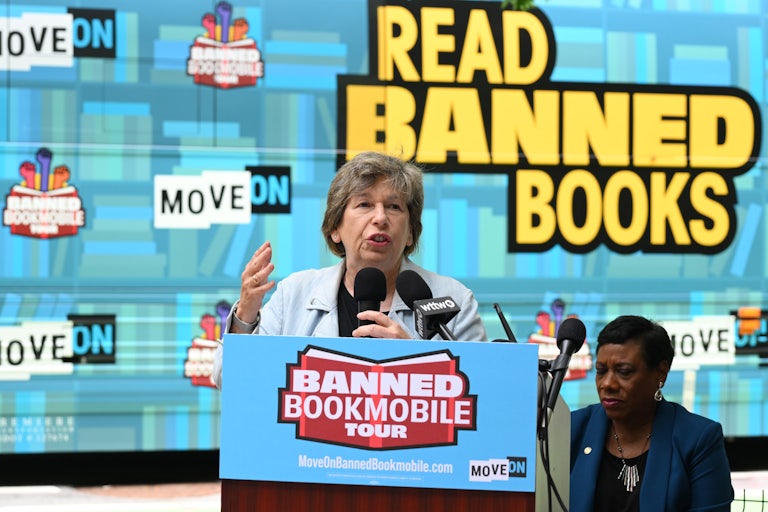
The New Republic convened a meeting to discuss Trump, book banning and the culture wars. Randi Weingarten described the attack on schools as a coordinated strategy to destroy public schools and promote vouchers. Edith Olmsted of The New Republic interviewed her. None of this is new to readers of this blog, but the American public needs to hear this message. Again and again.

Book Bans Are a Conservative Plot to Destroy Public Schools, Says Randi Weingarten, The teachers union head denounced the “extremist strategy,” which also includes voucher campaigns and manufactured outrage over critical race theory.

DANIEL BOCZARSKI/GETTY IMAGES FOR MOVEON

Teachers union head Randi Weingarten says that the campaign by conservatives to ban books isn’t about the books at all, but part of a broader strategy to destroy public schools—one that was supercharged by the pandemic.

“You take the agita and the anxiety that people had at Covid, that fear, and you combine it with a right wing who has wanted to kill public schools for years and take that money for vouchers, and you have the scenario we have,” Weingarten, the president of the American Federation of Teachers, said Wednesday at The New Republic’s Stop Trump Summit.

Vouchers, which use public education dollars to fund private and religious school attendance, are just one pillar of the conservative campaign to “undermine, destroy, and defund” public schools, she said. The other two are book banning and manufactured outrage over critical race theory.

Weingarten pointed to conservative activist Chris Rufo and a comment he made at Hillsdale College, a Christian nationalist school, in which he admitted that focusing on these issues was all part of a master plan to promote universal vouchers: “To get to universal school choice, you really need to operate from a premise of universal public school distrust.”

In an interview with TNR after the event, Weingarten explained the “extremist strategy” Rufo and other conservatives have used to defund public schools. “The hook was trust. If you really create as much distrust as possible in public schooling, then parents will look at privatization as an option,” she said.

That’s where critical race theory comes in.

“[Rufo] tried to make a term that nobody knows so toxic, so that you can weaponize it and make fear,” she said. “Conversations about hard subjects became weaponized as indoctrination. Which is patently ridiculous, and dangerous.”

Race, as well as gender, is the subject conservatives have focused on in their campaigns to ban books in public schools and libraries.

“What [Republican Governor Ron] DeSantis is doing in the so-called ‘war on woke,’ is exactly part of their playbook—to make people afraid of books, and afraid of what we do in school,” Weingarten said. According to Pen America, Florida passed 15 “educational intimidation” bills in the last two and a half years.

The “parents’ rights” movement is made up of a loud minority, Weingarten said, and actively undermines what most parents want. “What we see in Florida is that 60 percent of the book banning has been done by 11 people,” she said.

The AFT has partnered with The New Republic in fighting back against such bans. TNR’s Banned Books Tour has been delivering thousands of banned books across the country this month, most recently in Florida.