John Thompson, historian and retired teacher, wonders whether Ryan Walters, the state superintendent of schools, will at last tell the truth when he is in court? He’s been telling so many lies lately that it’s hard to know if he is aware of the difference between truth and lies.

Thompson writes:

In Oklahoma and across the nation, hate mongers like Oklahoma State Superintendent Ryan Walters have been willing to speak any falsehood they want, portraying them as political narratives, which are legal, even when they are lies. But if Walters repeats false claims when testifying in court, his lies could backfire.

Walters is facing lawsuits for wrongly firing Department of Education employees. One employee, the director of grant development, disproved Walters’ claim that, ‘We have applied for millions and millions of grants since I took office.’” She explained, “We have not applied for one single grant. That was a blatant lie.”

Moreover, State Auditor Cindy Byrd alleged that millions of COVID-19 relief money were misspent by Walters’ department, and the “Oklahoma Attorney General Gentner Drummond said he won’t rule out criminal charges against some state leaders after a report alleged misspending of COVID-19 relief money.A.G. Drummond also has “described what was found as a pervasive culture of waste, mismanagement and apparent fraud. What concerned him the most was the mishandling of money that had been allocated for education expense accounts and tuition assistance programs.”

Walters also used state money to fund an inflammatory anti-union video which he called a “public awareness campaign” about teachers’ unions (which he labels as a “terrorist organization.”) As these investigations continue, Walters has doubled down on falsehoods such as testifying to Congress that the Tulsa Public Schools “maintains an active connection with the [Chinese government] through a program called the Confucius Classroom.”

But what is Walters doing now?

This week’s breaking news includes echoes of past lies. For instance, the Oklahoma Voice reports that the newly appointed Education Secretary Katherine Curry “said she resigned from her position after three months because the state superintendent’s administration limited her oversight of his agency.” Curry “said she repeatedly asked for financial documents showing how the agency budgeted and spent money, but the Oklahoma State Department of Education never provided them.” Curry said Walters’ refusal to respond was “‘100%’ the reason for her resignation.”

Second, two of the five state and federal suits by dismissed employees have gone to court. It is possible that he will be found accountable for both, his official role, and actions as an individual. 

Third, as the Oklahoman reports, after being fined for 14 cases of failure to report campaign donations, Walters now faces a possible fine for failure to report a donation from the 1776 Project PAC. The donor “says on its website it is ‘committed to abolishing critical race theory … from the public school curriculum.’” And his “amended pre-general election report still lists more than a dozen donors with an “x” before the last names, a mistake that prevents accurate searches of his contributions.”

The week’s fourth story may help explain Walters’ continuing lies and allegedly fraudulent behavior. He announced: 

“I fully stand behind President Trump, and I am excited to see him dismantle the Department of Education,”

“President Trump will be able to end radical indoctrination in our schools,” Walters said. “This woke ideology will be driven out of our schools. This cancer that is the teachers union will be driven out of our schools, and parents will be put in charge of their kids’ education.”

Finally, Jennifer Palmer reports that “the state Education Department is looking to hire someone to manage national media appearances, raising concerns the agency would be boosting Superintendent Ryan Walters’ national profile at taxpayer expense.” She adds:

A firm is being sought to provide print and digital op-eds to national outlets, coordinate national events and appearances for executive staff, write speeches and handle some communications. Records show the department wants a minimum of three op-eds, two speeches and 10 media bookings per month

Palmer explains that some Oklahomans have responded that “the public shouldn’t have to pay for Walters’ political ambitions.” But we shouldn’t overlook the costs to people across the U.S. They may have to deal with a new level of Walters’ propaganda.

Sarah Posner, a columnist for MSNBC, summarizes what has been learned about the theocratic vision of Mike Johnson, the recently elected Speaker of the House. Johnson was, of course, a prominent and active election denier. In addition, his views are radically fundamentalist. Whenever possible, he cites the Bible—not the Constitution—as the source of his ideology. Those who do not share his religious views may rightly wonder how someone so deeply indoctrinated in his faith can lead without alienating the majority of his fellow citizens. We know already that he is deeply antagonistic to abortion rights and to those who are LGBT+. In time we will learn what other prejudices he holds and how he will deal with them.

Posner wrote:

The sudden elevation of Rep. Mike Johnson, R-La.,to House speaker pushed his record’s vetting to after his election. So it was only once he became second in line to the presidency that most people learned Johnson played a key role in the House’s efforts to overturn the 2020 election, is virulently anti-abortion and anti-LGBTQ Americans, and has promoted teaching the Bible as a history book in public schools.

Now Johnson and his allies are hitting back against his critics. Remarkably, their response to the exposure of Johnson’s turbocharged theo-politics is not to argue that media reports exaggerate or misapprehend his record as a lawyer or legislator, or his intentions as speaker. Instead, Johnson’s closest allies are amplifying his extreme views, and recasting them as mainstream “truths” that are beyond challenge.

This week Johnson gave an interview to the Daily Signal, the news site of the Heritage Foundation, an agenda-setting hub for the right, and particularly the religious right. Johnson was able to “open up,” as the Daily Signal’s Mary Margaret Olohan put it, about how his Christian faith “informs his politics.” While he’s hardly been tight-lipped about that topic, this fresh clarification of his central political philosophy makes his rapid, uninterrogated ascension even more worrisome.

“It’s a central premise of the Bible that God invented civil government,” Johnson told Olohan, who added that, “like many Americans of faith, Johnson sees government as a ‘design of God’ and ‘a gift to mankind in a fallen society.’” If those jarring statements do not comport with your own understanding of the Bible, or of the constitutional separation of church and state, you are not alone.

The Washington Stand, the news site of the Family Research Council, whose president Tony Perkins is a longtime friend of the new speaker, similarly assailed Johnson’s critics. In an article entitled “Johnson Critics Mistake Christianity, American Principles for ‘Theocracy,’” the Stand senior writer Joshua Arnold turned to the director of FRC’s own Center for Biblical Worldview, David Closson. (The Center for Biblical Worldview, according to its website, says that “a person exhibits a biblical worldview when their beliefs and actions are aligned with the Bible, acknowledging its truth and applicability to every area of life.”)

Closson defended Johnson’s beliefs as “just basic Christian belief coming right out of the Bible.” That “basic Christian belief,” argued Closson, includes that “God is the one that ordains authority. God is the one that gives delegated authority to human beings to wield it on his behalf.” Closson went on to suggest that Johnson’s critics are biblical illiterates who lack any understanding of Christianity. He described them as “folks who don’t have any reference to what the Bible teaches, trying to scare millions of Americans, when so many of us would just be saying ‘Amen.’”

If anything has come into sharper focus over the past week or so, it’s that Johnson has spent his legal and political career immersed in an insular world where everyone around him believes there are certain “truths,” like regressive gender roles, or creationism, or that separation of church and state is a “myth.” Or, as Johnson stated this week without equivocation, “God invented civil government.”

While these views are commonplace on the Christian right, they are far from commonplace among Christians more broadly. “Most Christians wouldn’t say that this is a ‘central premise’ of the Bible, but Johnson’s focus on authority, as well as the way he distinguishes ‘civil government’ from other forms of government, tracks with the language of Christian reconstructionism,” Julie Ingersoll, a religious studies professor at the University of North Florida and author of “Building God’s Kingdom: Inside the World of Christian Reconstruction,” told me. As Ingersoll’s work has illuminated, reconstructionism, a movement developed in the 1970s, teaches that God ordained separate “spheres” of governmental authority — the family, the church and “civil government.” In the reconstructionist view, “civil government” should not do anything that interferes with (conservative Christian) families or churches or what they consider to be their inviolable right to impose their religious beliefs in the public square.

There is virtually no one in today’s religious right who would claim the label “Christian reconstructionist,” largely because they do not want to be tied to the positions of its founder R.J. Rushdoony, who cited supposed “biblical law” to support slavery and the death penalty for homosexuality. But the broad contours of Rushdoony’s framework, as Ingersoll has documented, has left an indelible mark on the modern religious right. The insistence that a “biblical worldview” should bear on every government decision shapes right-wing Christians’ positions on a range of issues. Their objections to abortion and marriage equality, for example, is based on their claim that civil government lacks the God-ordained authority to create laws that (they say) conflict with the Bible. They also consider public education to be an improper, unbiblical exercise of government authority. Because of that, they have undermined public schools, created their own Christian schools, and advocated for and shaped the Christian homeschooling movement.

These kinds of crude dismissals of Johnson’s critics serve two purposes: they reassure the GOP base that their “biblical worldview” is the only correct way to view both the Bible and the government, and that any critiques of it evince a lack of “understanding of just basic Christian tenets,” as Closson put it. Second, and more crucially, they aim to bully reporters and political opponents into retreating from examining Johnson’s record and drawing attention to the ways it threatens pluralism, democracy and the rights of others. By repeating the lie that Johnson’s beliefs are “basic” Christianity, and accusing anyone who fails to understand that of ignorance, the Christian right, and the Republican Party it controls, want scrutiny of Johnson to evaporate. We can only hope their efforts will backfire, as millions of Americans wake up to what it really means to have a top government official proudly tout his supposedly “biblical worldview.”

This story is fascinating. It’s about the quest to understand the origins of a painting of three white children that originally included a young slave. At some point, the enslaved youth was painted over and eliminated.

One determined art collector enlisted the help of art historians to identify the white children and the enslaved youth. The young man was named Bélizaire. The painting was held for decades in storage in a New Orleans art museum. It was just another family painting: three children. If you can open the video, please do (I don’t know if it is behind a pay wall).

Once the original painting was restored and its history documented, it was purchased by the Metropolitan Museum of Art, where it is prominently displayed.

How a Rare Portrait of an Enslaved Child Arrived at the Met” is a 10-minute film that touches on themes of race, art and history.

For many years, a 19th century painting of three white children in a Louisiana landscape held a secret. Beneath a layer of overpaint meant to look like the sky: the figure of an enslaved youth. But a 2005 restoration revealed him and now the painting has a new, very prominent home at the Metropolitan Museum of Art. Who was the enslaved child? Who covered over his figure? Why did the painting languish for decades in attics and a museum basement?

The Times further describes the journey of the painting:

To learn more, read “‘His Name Was Bélizaire’: Rare Portrait of Enslaved Child Arrives at the Met.” Alexandra Eaton writes:

One reason “Bélizaire and the Frey Children” has drawn attention is the naturalistic depiction of Bélizaire, the young man of African descent who occupies the highest position in the painting, leaning against a tree just behind the Frey children. Although he remains separated from the white children, Amans painted him in a powerful stance, with blushing cheeks, and a kind of interiority that is unusual for the time.

Since the Black Lives Matter movement, the Met and other museums have responded to calls to reckon with the presentation of Black figures. When the European Galleries reopened in 2020, the museum included wall texts to highlight the presence of African people in Europe and to call attention to issues of racism, previously unmentioned. In the American Wing, which had presented “a romanticized history of American art,” Kornhauser said, a presidential portrait was recast with the consciousness of the present: John Trumbull’s 1780 portrait of George Washington and his enslaved servant William Lee identified only the former president until 2020, when Lee’s name was added to the title. However, unlike Bélizaire, Lee is depicted at the margins, lacking in any emotion or humanity.

Jeremy K. Simien, an art collector from Baton Rouge, spent years trying to find “Bélizaire” after seeing an image of it online in 2013, following its restoration, that featured all four figures. Intrigued, he kept searching, only to find an earlier image from 2005, after the painting had been de-accessioned by the New Orleans Museum of Art and was listed for auction by Christie’s. It was the same painting, but the Black child was missing. He had been painted out.

“The fact that he was covered up haunted me,” Simien said in an interview.

Arthur Camins writes in The Daily Kos about the war in the Middle East:

So many people I speak with are feeling torn and conflicted. They that say they are afraid to criticize either Hamas or Israel for fear of being attacked for taking one side or the other. I say: If you stand for the human rights and dignity of all, the sides to choose between in the latest Middle East conflict are not the Hamas or Israeli governments. Instead, choose their people.

No, the sides to choose between are:

• Accepting the death of innocent civilians as collateral damage as the price of victory of “our side.”

Or

• Finding the path to peace that starts with mutual respect for democracy and human rights for all.

Neither Hamas nor Israel represents that latter choice. Their behavior says the opposite. So, I condemn both without implied approval of either.

If a path to peace, democracy, and human rights for Israelis and Palestinians–and safety for Jews and Palestinians around the world–are the goals, then attempting to determine moral equivalencies between the behavior of Hamas and the Israeli government is a dead-end.

I also see no need for those of us in the United States to promote a one- or two-state solution. That is up to the people of Israel and Palestine, hopefully with a rejection of both Hamas and the Netanyahu governments, rejection of the primacy of any religion over another or none at all.

Anything short of Israeli abandonment of its illegal settlements in the West Bank and assurance of full Palestinian rights is a non-starter.

A lot of digital ink has been spilled over the definitional accuracy of the terms, war crimes and genocide. We can have that debate, but it deflects attention from the necessary condemnations. It abets useless “whataboutism” rather than forging a path forward.

I am not a pacifist, but I explicitly reject two rationalizations for the murder of innocents: Palestinians have a right to resistance by any means necessary, and Israel has a right to defend itself.

I’m not against resistance to oppression, but that does not include murder and hostage-taking of innocent civilians. I am not opposed to defense against attack, but that does not include bombing and depriving innocent civilians of food, fuel, water, and healthcare.

In the current circumstances, both Hamas and Israel claim that the intransigence, crimes, and inhumanity of the other side justifies their actions. They do not.

Condemnation of both Hamas’s and Israel’s actions is the starting point for any moral and political commitments to working across differences to achieve the safety, respect, democracy, and rights that Palestinians and Israelis deserve.

Empathy is a precondition to peace and justice. If we can imagine the pain and grief of Israelis who lost friends, neighbors, and loved ones to the latest Hamas or any terrorist attack, we must also imagine the loss and suffering of Gazans from the Israeli bombing and blockade. We must also imagine being displaced when our land and homes are violently stolen by illegal settlers.

Call your U.S. Senators and House Representatives. Tell them that a ceasefire, a halt to further military aid, and humanitarian aid to Gazans are the necessary first steps.

Arthur taught and led science professional learning and curriculum and assessment development projects for 50 yrs. He writes about education and social justice. He loves spending time with friends and family, hiking, and gardening.

Steven Monacelli wrote this article for The Texas Observer about the network of rightwing groups flooding local school board elections with big money. He also supplied the photographs.

As the article points out, about 75% of local school board candidates spend less than $1,000 to run for office. In districts targeted for takeover, such modest spending is no longer a path to success.

Monacelli writes:

Over the last three years, an interconnectednetwork of political action committees (PACs), largely funded by billionaires who support school privatization, has begun to transform the nature of local school board elections across Texas. They’ve done this with the help of consultants whose efforts have largely gone unnoticed.

On August 15, 2022, members of the Carroll Independent School District (CISD) board of trustees, all dressed in Southlake Dragons’ green, posed for a photo with representatives of Patriot Mobile, a Christian Nationalist phone company that spent big last spring to help secure the victories of three trustees. The occasion honored the company’s donation of posters that read “In God We Trust.”

The trustee’s acceptance of the red, white, and blue star-spangled posters immediately drew opposition from critics who see those words not just as a motto that appears on dollar bills, but also as a declaration of allegiance to conservative causes. One disapproving parent attempted to donate signs with the same words in Arabic and on a rainbow background but was rejected; the board president said they already had enough.

Other school districts got the posters around the same time. And not all parents who spoke out were critical.

Erik Leist, who resides in the neighboring Keller ISD area, spoke to multiple news outlets about the posters after they were donated. He approved of the state law passed in 2021 that requires schools to display donated signs bearing the national motto in a “conspicuous place.”

“If it’s important to communities, the community will come behind it,” Leist said, according to accounts published in Fox News and the Texas Tribune that identified him only as the father of a kindergartener.

Leist, however, is much more than a concerned dad: He’s a conservative political consultant who at the time had already been paid tens of thousands of dollars by multiple PACs to support the campaigns of new ultraconservative school board members in Carroll and neighboring school districts, trustees who were eager to accept those posters and who later passed policies restricting students’ access to library books and rolling back accommodations for LGBTQ+ students.

Leist is just one well-connected node in a sprawling, hydra-like network of PACs and consulting firms that increasingly are targeting Texas school board races and politicizing those formerly low-budget, nonpartisan campaigns, an investigation by the Texas Observer reveals.

The Observer’s examination of campaign finance records shows that dozens of ultraconservative school board candidates around the state have been backed by PACs that collectively employ a handful of conservative political consulting firms.

Viewed together, the connections among these individuals and organizations reveal a network of major funders and political operatives focused on winning control of the state’s local school boards. The strategy this network employs has been trumpeted in the right-wing press as a blueprint for school board takeovers: Create a PAC, endorse candidates willing to run on politicized issues, hire a consulting firm with ties to the Republican Party, raise enough to outspend opponents, and if victory is secured, pass policies that align with statewide party priorities. The biggest known backers of this network are conservative billionaires who generally don’t live in the districts being targeted but all of whom support school privatization efforts.

The timing of the network’s activities corresponds to revived efforts by Governor Greg Abbott and Republican lawmakers to support vouchers for private schools in the 2021 and 2023 legislative sessions.

To understand how this network developed over time, it’s best to begin in CISD—a district located in Southlake, a wealthy suburb of Fort Worth that is over 70 percent white. It’s where Leist got his start as a school board campaign consultant, supporting an effort praised by the conservative press as a model for other school districts.

In August 2020, the seven-member CISD board held a hearing on something called a Cultural Competence Action Plan, a proposal created in response to a 2018 viral video of Carroll high school students shouting the N-word.

Less than two weeks later, Tim O’Hare, the former chair of the Tarrant County Republican Party and current Tarrant County judge, teamed up with Leigh Wambsganss, a conservative activist and the wife of a former Southlake mayor, to create Southlake Families PAC.

In November 2020, Southlake Families PAC—which describes itself as “unapologetically rooted in Judeo-Christian values”—paid a Keller-based marketing company called 221b Ingenuity, of which Leist was a managing partner, to help set up a website to promote two conservative CISD school board candidates. They ran in opposition to the Cultural Competence Action Plan in the spring 2021 race that featured PAC-funded mailers accusing opponents of pushing “radical socialism.” Both PAC-backed candidates won.

In June 2021, the right-leaning National Review lauded Southlake Families’ victory as a “model for conservative parents confronted by similar situations around the country.” When Southlake Families helped a third candidate win a special election for a vacant CISD seat that fall, the three joined with a fourth PAC-endorsed incumbent to form a conservative majority on the board.

Since then, seven federal civil rights investigations have been opened into allegations of discrimination against Carroll students based on race, disability, and gender or sexual harassment. The most recent began in January 2023, one month after the board removed references to religion, sexual orientation, and gender identity from the district’s nondiscrimination statement, stoking further controversy and making news.

What has drawn less press attention is that the situation in Carroll has inspired a network of copycat PACs supporting conservative candidates in other historically low-budget nonpartisan school board races across the state, in which PACs and the candidates they endorsed hired from the same handful of consulting firms to help with campaigns.

Tentacles of this big-spending network have already reached more than two dozen Texas school districts. The Observer has identified 20 PACs formed since late 2020 that, through early September, have collectively spent more than $1.5 million to support the campaigns of 105 conservative candidates in 35 districts.

Most of the time, that investment has paid off: 65 PAC-supported candidates—or 62 percent—won their elections from 2021 to 2023.

The majority of those PACs are focused on only one school district each. The ultraconservative committees have typically spent tens of thousands of dollars per election, with less than $100,000 in total expenses since they were formed. A handful of PACs have spent more than six figures in total, including Southlake Families, which has spent more than $239,000 since late 2020.

Campaign finance records show that these seemingly grassroots groups often use the same consulting firms like Leist’s Edgerton Strategies, which has worked on behalf of PACs and candidates in at least 14 school districts. Other consulting firms that have made over six figures working on school board campaigns include Axiom Strategies and CAZ Consulting—and both companies’ subsidiaries. They’re the same consultants used by big-spending conservative political PACs like Patriot Mobile Action and Texans for Educational Freedom, which have respectively spent more than $500,000 and $330,000 on school board races and together have endorsed 66 candidates across at least 23 districts.

At least one federal-level super PAC, the 1776 Project, has also invested in 28 school board candidates across eight Texas school districts that were also endorsed by either Patriot Mobile Action, Texans for Educational Freedom, or one of the Southlake Families-style PACs.

This level of outside spending is highly unusual in school board races. The results of a 2018 survey conducted by the National School Board Association showed that 75 percent of all candidates reported spending less than $1,000 per race, with only 9 percent spending more than $5,000.

Analysis of campaign expenses by the nonprofit OpenSecrets shows that spending more money doesn’t always ensure victory—but often does. Given the relatively low cost of school board races, the influx of even a few thousand dollars of outside funding can transform the nature of such elections at a time of high turnover: According to a 2022 survey from School Board Partners, a national organization focused on recruiting and training anti-racist school board members, nearly two-thirds of school board members nationwide said they planned not to seek reelection…


In the southeast Texas city of Humble, another 2021 school board race became a quieter testing ground for a new conservative PAC. Unlike in Carroll ISD, there was no dramatic national coverage or clash over diversity and inclusion. The district, in one of Houston’s sprawling and forested northern suburbs, was the first foray into school board races for Texans for Educational Freedom, a PAC with a mission of “fighting against Critical Race Theory and other anti-American agendas and curriculums.”

Funded primarily by a coterie of conservative billionaires, Texans for Educational Freedom—originally known as the Freedom Foundation of Texas—was founded in early 2021 by Christopher Zook Jr., a former field director for the Harris County Republican Party and senior fellow at Texans For Lawsuit Reform.

In the May 2021 election, the PAC spent more than $10,000 to help three candidates—a significant investment from one source, given that Humble school board candidates tended to spend only about $3,300 from all contributors in contested races. The PAC money was spent on a national political consulting firm called Axiom Strategies. All three of the PAC’s candidates won.

Unlike in majority-white Southlake, the school board election in Humble—where white students are a minority—didn’t feature inflammatory, politicized rhetoric. That helped Texans for Educational Freedom keep a low profile.

“I wasn’t aware there was outside PAC spending,” said Brian Baker, a father of two students in Humble ISD. “I had been paying attention to stories in other parts of the state and I was looking out for candidates and mailers using certain buzzwords like ‘woke,’ but I didn’t really notice any.”

After the initial victory in Humble, Texans for Educational Freedom targeted two more districts near Houston, Cypress-Fairbanks and Klein, in 2021. This time, messaging around critical race theory came to the fore. All three PAC-backed candidates in Cypress-Fairbanks ran against the ostensible inclusion of critical race theory in school curriculum and teacher training, as did one PAC-backed candidate in Klein. Six of the seven candidates won.

By the end of 2021, candidates backed by Texans for Educational Freedom had established near or outright majorities in all three districts—and all three would later rank on a list of book-banning districts put together by PEN America, a nonprofit organization focused on the protection of free expression.

Texans for Educational Freedom has intervened in races across the greater Houston area, including Houston, Conroe, Katy, and Spring Branch. The PAC has also backed candidates in the wooded Austin suburb of Leander, in the oil-rich flats of Midland, in several suburbs of Fort Worth, and in the Panhandle’s Canyon ISD. The PAC backed 12 candidates in 2021, 10 in 2022, and 20 in 2023, covering a total of 17 school districts. Out of all those candidates, 76 percent won their elections.

“Things like this have happened before but not in such a coordinated way,” said Ruth Kravetz, a retired public school administrator and teacher who co-founded Community Voices for Public Education, an advocacy group that seeks to strengthen Houston’s public school system. “In the past it was to promote charter expansion. And now it seems like it’s about promoting the destruction of public education.”

Candidates backed by Texans for Educational Freedom have regularly run on hot-button issues that tie in with state-level Republican policy and rhetoric, such as notions that children are being “indoctrinated” into radical ideologies or “sexually alternative lifestyles.”

In Conroe ISD, three candidates backed by Texans for Educational Freedom ran as the “Mama Bear” slate and won their November 2022 elections after being involved in a push by a group known as Mama Bears Rising to restrict student access to certain books.

“The PACs were able to support a massive printing of voter guides and distribution of mailers,” said Evan Berlin, a resident who lost to one of the Mama Bears. Berlin, a first-time school board candidate who has a conservative voting record, told the Observer he wanted to run on providing education in a non-politicized manner. “I think with PAC money coming from out-of-district donors, just by nature of that we could assume that it’s part of a larger, more strategic effort,” he said.

Last year, while Texans for Educational Freedom was concentrating on Houston area races, Patriot Mobile Action and another 17 PACs were backing candidates in 22 districts across the Dallas-Fort Worth area. Those candidates largely ran on issues that have become a common refrain: allegations of ideological indoctrination, critical race theory, pornography in schools, and the sexualization of children.

Fifteen of the 18 PACs targeting North Texas school districts tapped either Axiom Strategies, Edgerton Strategies, or CAZ Consulting for campaign consulting—as did many school board candidates in the area. The outliers were: McKinney First PAC, which endorsed candidates that worked with those consulting firms; Metroplex Citizens for a Better Tomorrow and Decatur ISD Parents Unite, two groups primarily funded by a Republican mega donor who has contributed to Texans for Educational Freedom; and Collin Conservatives United, a self-described PAC that does not appear in the state PAC registry, whose endorsed candidates received donations from the same megadonor.

As this larger cluster of PACs and consulting firms has grown, its strategy has proved potent. Fourteen of its 17 candidates won in 2021. Another 42 candidates ran in 2022 and 27 won. And so far in 2023, 48 more candidates ran and 26 won.

Open the link to finish the article. I hope it’s not behind a paywall.

If you open the link, you can then see the diagram that displays the intricate interconnections among the rightwing groups and their funders.

Governor Gregg Abbott and Lt. Gov. Dan Patrick expressed optimism about getting a voucher bill passed by the third special session of the Texas legislature, but it’s looking unlikely. The session ends Tuesday, and there is no House bill. Rural Republicans know that vouchers will hurt their schools, and they have with Democrats against them.

Hours after Gov. Greg Abbott said he believed the Legislature could pass a school vouchers bill before the end of the special legislative session, the House all but killed any deal.

The House met briefly Wednesday evening and recessed likely until Monday or Tuesday, pending the Senate’s approval of bills related to border security.

The special session ends Tuesday, and the House has not so much as considered a voucher bill in committee, an early step in the lawmaking process.

Abbott is ready to call a fourth special session. That’s likely to annoy the holdouts, who are tired of his pressure campaign.

There are some wonderful things happening in our public schools. HBO is featuring a film about the music created by students at the Hill-Freedman World Academy. HFWA is a public high school for high-performing students.

**TUNE-IN**TUNE-IN**TUNE-IN**

Presents

STAND UP & SHOUT: SONGS FROM A PHILLY HIGH SCHOOL

Debuts Tuesday, NOVEMBER 7 on HBO and Max

From Get Lifted Film Co.

NOW AVAILABLE TO SCREEN UPON REQUEST

StandUpandShout@id-pr.com  

The HBO Original documentary STAND UP & SHOUT: SONGS FROM A PHILLY HIGH SCHOOL , directed by Emmy ® and Peabody winner Amy Schatz (HBO’s “We Are the Dream: The Kids of the Oakland MLK Oratorical Fest” and “In the Shadow of the Towers : Stuyvesant High on 9/11”) and executive produced by the award-winning team at Get Lifted Film Co., Emmy ® and Tony ® winning producer Mike Jackson, EGOT recipient John Legend, and Emmy ® -winner Ty Stiklorius, debuts TUESDAY , NOVEMBER 7 at 9:00 pm ET/PT on HBO and will be available to stream on Max.

Synopsis: The film follows 10th graders from Hill-Freedman World Academy (HFWA), a Philadelphia public school, who take part in a unique songwriting collaboration. Working in teams with local musicians, students come together to create an album of powerful original songs that capture both the challenging times they’re living in and the joy that music brings.

Back in the classroom after two years of pandemic isolation, the teenagers find a way to express their experiences and feelings in stirring songs that come straight from the heart. HFWA offers a unique music program teaching students to write, compose, produce, and perform, their own work. Although many are new to music, they learn to trust their voices and lift each other up. STAND UP & SHOUT: SONGS FROM A PHILLY HIGH SCHOOL explores the transformative power of music and how arts education can unlock creativity and be a source of hope and healing.

Featured Participants: Joining the courageous and talented students of Hill-Freedman World Academy High School are award-winning musical talents Kristal Oliver, Andrew Lipke, Bethlehem Roberson, and program director and music technology teacher Ezechial Thurman.

Credits: HBO Documentary Films in association with Get Lifted Film Co. presents STAND UP & SHOUT: SONGS FROM A PHILLY HIGH SCHOOL. Directed and produced by Amy Schatz; executive produced by Mike Jackson, John Legend, Ty Stiklorius, and Tommy Benjamin for Get Lifted; For HBO: executive producers, Nancy Abraham, Lisa Heller, and Sara Rodriguez.

Peter Greene writes faster than most people can read, and what he writes is always worth reading. In this article, he describes a remarkable occurrence: the pro-charter Thomas B. Fordham Institute debunked a study by charter advocates claiming that deregulation spurs innovation in the charter sector.

In his latest article, Greene writes:

It’s an ordinary day when a pair of charter school boosters conclude that charters work best when mean old government doesn’t make them follow a bunch of rules and stuff. It is an ordinary day when someone points out they’re full of regular non-innovative baloney. It is a less ordinary day when the baloney is being called out by a piece in the house organ of the Thomas Fordham Institute.

So let’s pretend for a moment that the question of regulations vs. charter innovation is a real question. David Griffith, the Fordham Associate Director of Research, frames this as the old tension between autonomy and accountability, which makes more sense than talking about charter school innovation, because after a few decades of charter proliferation, the amount of innovation they have produced is somewhere between jack and squat. Despite being billed as “laboratories of innovation,” charter schools haven’t come up with much of anything that public schools were not already well aware of.

The study argues for less regulation of charters. Greene responds:

The more regulation, the less innovatiness in charter schools. For charter fans, it’s simple–more options means they can move more product, and while I get their point, it is also true that we would have far more innovation in the food industry without all those government regulations about poison and stuff.

The study was thoroughly demolished by David Griffith, Fordham’s associate director of research.

Greene writes:

Griffith makes a similar observation. Their technique of quantifying “innovation” gives the charter points for being unusual, and that’s problematic:

From a purely normative perspective, an obvious problem with the authors’ approach is that it is content neutral. So, for example, a school that was grounded in Satan Worship would count as highly innovative (provided it didn’t start a movement), as would one that imparted no knowledge whatsoever (as seems to be the case for many virtual schools).

And he doesn’t think “innovation” means what they think it means either, noting that many of their “innovations” aren’t particularly new but instead include “longstanding programs such as Core Knowledge (est. 1986), Waldorf (1919), and Montessori (1907), not to mention “single-sex” education (Harvard, circa 1636) and “project-based” learning (the Pleistocene).” (That is Griffith’s snark there, not mine).

Kudos to David Griffith and the Thomas B. Fordham Institute.

We keep hoping that some sane Republican will emerge and eclipse The Former Guy. It’s probably a vain hope, but one likely prospect was Nikki Haley, former Governor of South Carolina and Trump’s Ambassador to the UN.

While campaigning in Londonderry, New Hampshire, Haley expressed her negative views about the nation’s public schools. Sadly, she parroted the standard Republican tropes.

She said:

“Stop the gender pronoun classes that are happening in the military,” Haley said, as the crowd cheered in response.

Mirroring the recent culture wars that have unfolded in local school districts like Goffstown, Haley called for “complete transparency in the classroom.”

“No parent should ever wonder what’s being said or taught to their children in the classroom,” Haley said.

Haley implored for the end of “national self-loathing” in schools. “Our kids need to know to love America,” Haley said, claiming that kids are being told America is a racist, rotten country.

“I was elected the first female minority governor in history,” Haley said. “America is not racist, we’re blessed.”

Jeanne Kaplan was a tireless champion of public schools in Denver. She was elected to two terms on the Denver school board. She fought for better, more equitable, fully funded schools. She opposed charter schools because they drained funding from public schools. She was a long-time crusader for civil rights, and she appalled by the takeover of the Denver schools by charter interests, who flew a false flag, pretending to care about equity.

Jeannie learned that she had lung cancer last April. Her medical treatment did not slow the disease. She died yesterday. She was 78.

I met Jeannie in Denver in 2010 as I was traveling the country to promote my book The Death and Life of the Great American School System: How Testing and Choice Are Undermining Education. When I met her, we became fast friends. We were on the same page, and she told me about the damage that charter schools were doing to Denver’s public schools. Candidates for the Denver school board were funded by Dark Money, privatizers, and out-of-state billionaires. It was almost impossible for a parent to raise the money to be competitive with the corporate reform candidates.

Jeannie was a warm and caring person who inspired others to get involved, despite the odds crested by Big Money. She started her own blog called “Kaplan for Kids,” and I reposted some of them here.

I think the best way to honor her memory here is to post what seems to be her last commentary, which overflows with wisdom, candor, experience, and common sense. I humbly add her name to the honor roll of the blog.

Jeannie Kaplan wrote:

CHARTERS, CHOICE, and COMPETITION = CLOSURES, CHAOS, and CHURN Principles of Privatization

Posted on November 1, 2022 by Jeannie Kaplan

Reap what you sow and the chickens come home to roost. The elephant in the room.  Aphorisms appropriate to describe what is happening in public education in Denver. 

After 20 years,  more than 5  superintendents, and 11 different school boards, the results of education reform in Denver have become clear, and they aren’t pretty. After opening 72 charters in the last 20 years, 22 of which have closed, the declining enrollments in neighborhood schools have forced the prospect of school closures.  Who knew opening 26 privately run elementary charter schools in competition with district-run schools would ultimately force the district to make some hard financial decisions?  And who knew that ignoring its own 2007 data showing stagnant population growth would lead to less demand for elementary school seats in the 2020s?  Apparently, not those with the power for the last 20 years.  And, as an ironic aside, many of the same people who were the decision-makers in the past and who were unable to make substantive change then, have now decided they will somehow make these previously unattainable changes from their outside “oversight” committee, EDUCATE Denver. In fact one of the co-chairs, Rosemary Rodriguez, was a DPS board member when on March 16, 2017, a Strengthening Neighborhoods Resolution passed, stating:

NOW, THEREFORE, BE IT RESOLVED, that a citywide committee be formed to review changing demographics and housing patterns in our city and the effect on our schools and to make recommendations on our policies around boundaries, choice, enrollment and academic programs in order to drive greater socio-economic integration in our schools.

BE IT FURTHER RESOLVED, that in the face of the sharp decline in the number of school-aged children in gentrifying neighborhoods, the committee is also charged with how to think about school choice and school consolidation to ensure that our schools are able to offer high-quality, sustainable programs for our kids.

These former school board members and former and current civic leaders have formed a “shadow school board” to evaluate and oversee the current superintendent and school board.  Why?  It appears they don’t like what they are seeing being proposed by the current superintendent. What don’t they like?  It appears they have determined the current superintendent is not committed enough to their reform agenda.  You know – the one that has been in place when they were in power, the one that has produced the biggest gaps in the nation, more segregation, and more resource inequity.

As school closures have risen to the fore this week Chalkbeat disclosed these statistics:

“Over the past 20 years, Denver Public Schools has added a lot of schools. It has added students, too — but at a much slower rate.

  • The number of public schools in Denver grew 55% between the 2001-02 and 2021-22 school years, while the number of students grew just 12%.
  • Denver went from having 132 schools serving about 72,000 students in 2001-02 to 204 schools serving nearly 89,000 students in 2021-22.
  • The number of elementary schools in Denver grew 23% over the past 20 years, while the number of students grew just 4%.”

Through expensive marketing and often false narratives, charter schools have had free reign to prey on susceptible families resulting in DPS losing 7400 elementary school students who would have otherwise most likely attended a neighborhood school. Then add in:

  • a state law that prohibits a district from shutting down low enrollment charters, 
  • a district that has ignored demographic information predicting declining enrollment, 
  • a district that employs “attendance zones” and a secretive CHOICE system to often force place students into heavily marketed, often unwanted CHARTER SCHOOLS, and 
  • a competitive financial model called Student Based Budgeting (SBB – money follows the kid) to fund schools, depending on student needs, the goal of which is to close the achievement and resource gaps.  The 2010 Denver Plan/ Strategic Vision and Action Plan describes SBB this way:  
  • Established student-based budget formulas that increase dollars for middle and high school students, special education, English language learners, gifted and talented programs, and students living in poverty. Resource distribution is now more closely aligned with the costs of serving these students. p. 51
  • Refine Student-Based Budgeting formulas to ensure they are best meeting the needs of all of the district’s students. Continue to evaluate and adjust student-based budgeting formulas to 1) meet student needs, 2) make progress on closing the achievement gap, and 3) grow the number of high school graduates and college-ready students. p. 53

No one should be surprised the DPS superintendent is saying schools must be closed (new word is UNIFIED but it still means CLOSURE), given the quagmire he entered.  What would you expect to happen when 72 new charter schools are opened in a landscape of stagnant or declining population growth? Who should be held responsible for the chaos and churn caused by this over-expansion of new charter schools? 

I know, I know. One isn’t supposed to talk about charters any more. But it is the elephant in the room. Education “reformers” want you to believe charters are an irrevocable fact of life in public education, stare decisis if you will. But as we have recently witnessed, that precedent is non-binding. So let’s use it to the advantage of neighborhood school advocates. Let us not assume charters are inevitable, especially given the chaos and poor academic outcomes charters are producing. Denver isn’t the only place experiencing the madness of so many charters. Just this week lifelong educator Arthur Camins wrote:

It is time for Democrats–voters and the politicians who represent them–to abandon charter schools as a strategy for education improvement or to advance equity. Charter schools, whether for- or non-profit, drain funds from public schools that serve all students, increase segregation, and by design only serve the few.

It is worth repeating that in 20 years, DPS has added 72 charter schools, 22 of which have closed.  As students of public education repeatedly attest to, charters have been particularly harmful to neighborhood schools for they gut these schools of resources. Charters have also been disruptive to communities and have contributed to increasing inequity and segregation in our schools. It is not possible to have an honest conversation without addressing that elephant in the room.  Charter schools along with their partners – choice and competition – have had their chance in Denver and their biggest accomplishment has been to pressure neighborhood schools to close.

Let us not overlook the demographic projections DPS has been aware of since the mid 2000’s. 

“It’s really simple, we’ve seen a slow down in births,” said Elizabeth Garner, demographer for the state. “Starting back in 2007, that was our peak birth year, we’ve seen a slowing in births ever since. So with fewer kiddos, that means lower school enrollment.”

Let us not overlook who was supporting and approving this unchecked expansion.  DPS had strong indicators from as early as 2007 onward the population of the city and the number of school-age children was flattening, and yet the district with the strong support of many of the aforementioned  “oversight committee”, EDUCATE Denver, pushed for this proliferation of new charter schools without giving demographics its proper due.

Loss of students = loss of funding (SBB) = loss of programming and supports = closure

Superintendent Alex Marerro has been charged with improving student outcomes and reducing gaps by implementing his strategic plan.  School unifications are one way he has chosen to start this process.  He inherited a district suffering from years of “feel good” oversight from boards and the nonprofit world determined to paint a rosy picture of reform education success, a district more focused on good public relations stories than actual educational outcomes. Now he has to try to provide solutions to problems that have not been dealt with honestly for years. And yes, “unification” has raised as many questions as it has provided answers such as how transportation and language services will be provided and what will be done with these empty buildings. And there is the elephant in the room – again.  Charter schools. Why are they not included in his recommendations? Again, he has no authority to recommend closing them, even though several are also suffering from declining enrollment.  Given this reality, it will be interesting to see how he chooses to address this issue. In the end, how can the board fairly evaluate him according to measures both they and he just agreed on, if it rejects his operational ideas?

As for what neighborhoods these closures would most heavily affect – What would one expect to happen when new charters are opened in neighborhoods heavily populated by families of color and families struggling economically?  Why is there any surprise that most of the schools on the “unification” list affect these neighborhoods?  How could it be otherwise when these are the sites of uncontrolled, privately run options to public schools.  Sadly, it only makes sense that these are the neighborhoods that would suffer the highest impact of school closures.

Few like to close schools.  It is a heart-wrenching, disruptive, negative process. But given the lack of thoughtful planning and oversight for 20 years, what is the better option? Keeping schools open without the financial ability to provide necessary services and supports, or providing unified schools with the money to provide language support,  art, music, nurses, librarians, psychologists, speech therapists?  

Imagine a great school district that had paid attention to population warnings and  hadn’t opened so many charter schools over the last 20 years. Imagine all those charter school children filling those neighborhood schools.

The chickens have come home to roost.

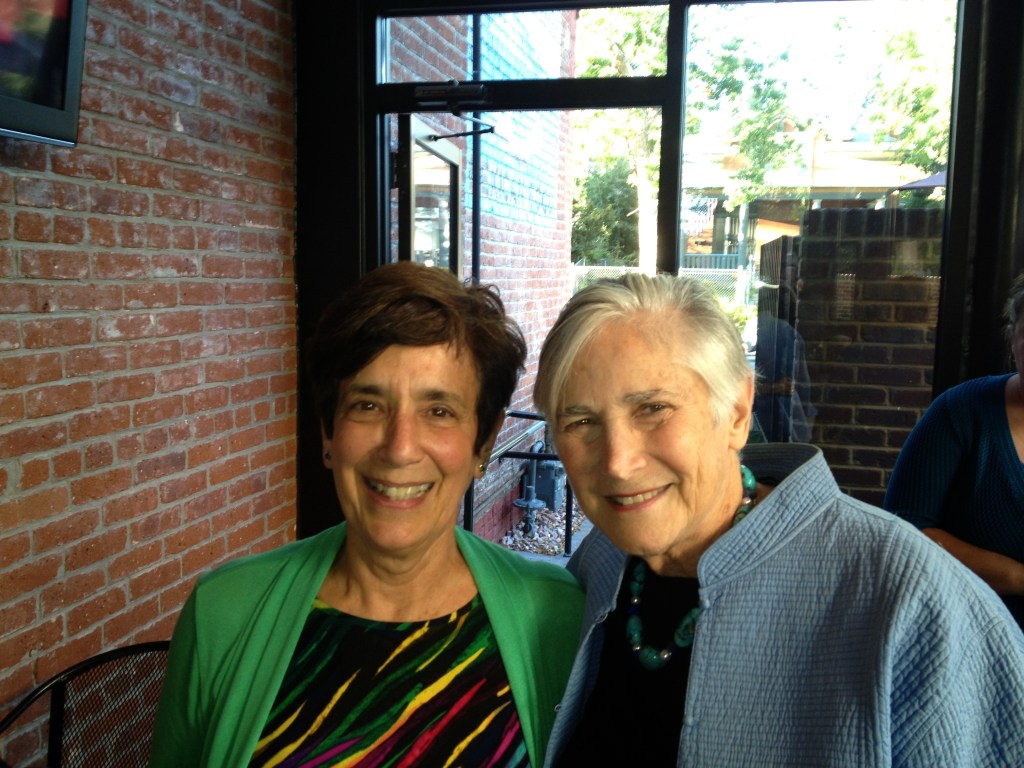
Jeannie and I in Denver, 2013.