This story is deeply worrisome, frightening, alarming. An avid fan of Trump initiated a recall of the elections clerk, Cindy Elgan, of Esmeralda County and two other county officials. 82% of the county’s 620 voters went for Trump. The county uses Dominion Voting machines.

The angry Trump supporter, Mary Jane Zakas, listens to rightwing media exclusively. She is certain that the election was rigged, even though Trump won more than 82% in the county. She believes the Dominion machines were programmed to steal votes. She accuses Elgan of rigging the vote. She has traversed the county collecting signatures of registered voters to recall Elgan.

Elgan is baffled. She is a Republican. She voted for Trump. She knows almost every one of the 620 voters in the sparsely setttled county. But Trump supporters think she’s part of the deep state.

They falsely claimed the election was stolen by voting software designed in Venezuela, or by election machines made in China. They accused George Soros of manipulating Nevada’s voter rolls. They blamed “undercover activists” for stealing ballots out of machines with hot dog tongs. They blamed the Dominion voting machines that the county had been using without incident for two decades, saying they could be hacked with a ballpoint pen to “flip the vote and swing an entire election in five minutes.” They demanded a future in which every vote in Esmeralda County was cast on paper and then counted by hand.

And when Elgan continued to stand up at each meeting to dispute and disprove those accusations by citing election laws and facts, they began to blame her, too — the most unlikely scapegoat of all. She had served as the clerk without controversy for two decades as an elected Republican, and she flew a flag at her own home that read: “Trump 2024 — Take America Back.” But lately some local Republicans had begun referring to her as “Luciferinda” or as the “clerk of the deep state cabal.” They accused her of being paid off by Dominion and skimming votes away from Trump, and even though their allegations came with no evidence, they wanted her recalled from office before the next presidential election in November.

When Zakas brought in a recall petition, Elgan saw the names of friends, people who knew her well but now are convinced the election was stolen from Trump, and she let it happen. The more Elgan defended the accuracy of the vote, the more Zakas was convinced that Elgan was part of the Deep State.

She [Zakas] listened to a self-proclaimed cybersecurity expert from Colorado named Mark Cook, who claimed that voting machines could be hacked with a cellphone. She heard Jim Marchant, then the Republican nominee for Nevada’s secretary of state, say that Nevada’s election officials had been “installed by a deep state cabal.” She heard local Republican leaders say Dominion machines had stolen votes, even though Fox News had agreed to pay Dominion nearly $800 million to settle a lawsuit for spreading the same lies. And most of all she continued to listen to Trump as his election denialism intensified. “We will root out the communists, Marxists, fascists and the radical left thugs that live like vermin within the confines of our country, that lie and steal and cheat on elections,” he said during a Veterans Day speech in New Hampshire last year.

Zakas came up short on the numbers who signed the recall petition. She will appeal to the courts.

Tom Ultican, retired teacher of physics and mathematics, writes here about the recent decision by local officials to open a PUBLIC SCHOOL in New Orleans. This is a symptom of the failure of the “all-charter” idea.

He writes:

New Orleans Public Schools, aka Orleans Parish School District (OPSD), became America’s first and only all charter school district in 2017. After hurricane Katrina, the state took over all but five schools in the city. When management was transferred to charter organizations in 2017, OPSD officially became an all charter district. This August, the city will open district-operated Leah Chase K-8 School, ending the all charter legacy.

According to Superintendent Avis Williams, the infrastructure required for the district to run Leah Chase will make it easier to open future district-run schools. OPSD will become both a charter school authorizer and regular school district. There is hope that New Orleans, Louisiana (NOLA) is pulling out of an abyss and tending towards a healthy public school system….

All-Charter NOLA Doomed from the Beginning

Public investment in education is widely viewed as the key to America’s success. Since the 19thcentury, communities have developed around local public schools. This opportunity was taken from NOLA neighborhoods…

Louisiana’s state takeover law required schools scoring below average to be closed. If this were real, half of the schools in the state would be closed every year. Instead, arbitrary state performance scores based on testing data, attendance, dropout rates and graduation rates were established. Similar ratings are used to evaluate NOLA charter schools. The nature of privatized schools and testing results led to almost half of the charter schools created being closed.

The NOLA school enrollment system allows parents to research the 100 schools and apply for up to eight of them. The algorithm selects the school from one of the eight if space is available. It is not uncommon for students to ride a bus past schools within walking distance of their homes. This complicated system is driving segregation.

For many education professionals, this system looked like a sure failure from the beginning. Communities could not develop around their schools and the schools would not be stable; important aspects of quality public education….

The All Charter District is a Failure

In 2021, Secretary of Education Miguel Cardona visited OPSD. He heard first-hand the growing disillusionment with the all charter system. Four of the six parents told him they wanted to go back to neighborhood schools. Parents complained about Teach for America, placing unqualified teachers in schools and the One App process for not offering school choice.

Senator Bouie wrote a two-page paper, A Moral Imperative and Case For Action”, stating: After spending 6 Billion dollars of tax payers’ money to become the only all-Charter system in the State, a staggering 73% of our children are not functioning at grade level, compared to 63% in 2005, when the State took control of over 100 of our schools.”

He also shared:

“In other words, fellow citizens, this 15-year flawed experiment has yielded no best practices identified to improve student and school performance, no State protocol for Charter Law Compliance, and no student performance improvement. It has, however, yielded other devastating consequences for our children and our community.”

He mentioned the 26,000 students between the ages of 16 and 24 who went missing. The privatized charter school system was unable to account for them which is expected and natural for a public school district.

Bouieu They are transported past a neighborhood school to attend a failing school across town” and eliminating the ineffective One App central enrollment system claiming,It has created inequities by Race and Class and admissions by chance (lottery) and not choice.”

Raynard Sanders who has over forty years of experience in teaching, education administration and community development, said the charter experiment has “been a total disaster in every area.”He asserted NOLA had “the worst test scores since 2006, the lowest ACT scores, and the lowest NAEP (National Assessment of Educational Progress) scores.”

Based on a 2015 study by the Center for Popular Democracy, Sanders declared, “Charter schools have no accountability and, fiscally, charter schools in New Orleans have more fraud than existed in the OPSD (Orleans Parish School District).” The fraud claim was used by the state in 2003 against OPSD to begin taking schools.

Loyola University Law Professor Bill Quigley stated“NOLA reforms have created a set of schools that are highly stratified by race, class, and educational advantage; this impacts the assignment to schools and discipline in the schools to which students are assigned.”

He contended, “There is also growing evidence that the reforms have come at the expense of the city’s most disadvantaged children, who often disappear from school entirely and, thus, are no longer included in the data.”

Professor of Economics, Doug Harris, and his team at Tulane University are contracted to study school performance in New Orleans. Harris claims schools have improved since Hurricane Katrina. However Professor Bruce Baker of Rutgers University disagrees. He noted that the school system is not only smaller but less impoverished. Many of the poorest families left and never returned. So the slightly improved testing results are not real evidence of school improvement.

The latest testing data from 2023 saw NOLA public schools receive failing grades but based on Louisiana’s new progress indicator, the district received a C, meaning an F for assessments and an A in growth.

In a letter to the editor, former OPSD superintendent, Barbara Ferguson, stated:

“The state took over 107 of New Orleans’ 120 public schools and turned them into charter schools. Last year, 56 of New Orleans’ 68 public schools had scores below the state average. Thus, after nearly 20 years, over 80% of New Orleans schools remain below the state average. This charter school experiment has been a failure.”

Final Words

In 2006, with the school board out of the road and RSD in charge, philanthropists Bill Gates, Eli Broad and others were ready to help.

Naomi Klein’s 2007 book, The Shock Doctrine, labeled these school reforms, a prime example of “disaster capitalism”, which she described as “orchestrated raids on the public sphere in the wake of catastrophic events, combined with the treatment of disasters as exciting market opportunities.” She also observed, “In sharp contrast to the glacial pace with which the levees were repaired and the electricity grid brought back online, the auctioning-off of New Orleans’ school system took place with military speed and precision.”

Desires of New Orleans residents were ignored. Neoliberal billionaires were in charge. In all the excitement, few noticed that these oligarchs had no understanding of how public education functions. They threw away 200 years of public school development and replaced it with an experiment. The mostly black residents in the city were stripped of their rights.

Thousands of experienced black educators were fired and replaced by mostly white Teach For America teachers with 5 weeks of training. Instead of stable public schools, people were forced into unstable charter schools. Instead of professional administration, market forces drove the bus!

Clearly, the all charter school system is a failure.

This discussion, led by Dahlia Lithwick of Slate, is the most important information you will read today, this week, this month. It explains the theocratic movement that is taking control of the seats of power, imperiling democracy. It describes who they are. You will learn about “dominionism,” about “the Seven Mountains,” about a distorted view of religion that seeks power. They play the long game, with the goal of controlling our society.

This is the only post today. We really have to focus on the root issue in American political life today, the one that makes it impossible to address any problems. Religious extremism is it.

Lithwick is a lawyer, journalist, and senior editor at Slate. She interviews Rachel Laser, the president and CEO at Americans United for Separation of Church and State—a nonprofit education and advocacy organization that works in courts, legislatures, and the public square to protect religious freedom—and Katherine Stewart, an author and journalist who has closely covered religious extremism for the past fifteen years; her latest book is The Power Worshippers: Inside The Dangerous Rise of Religious Nationalism. Her new book, Money, Lies and God: Inside the Movement to Destroy American Democracy, will be published next February.

Please open the link to Slate to read the arntire discussion. It’s terrifying.

Dahlia Lithwick: So Katherine, I think we’re going to start with you, and we’re going to talk about this movement. I would love to define it, because we put a lot under this rubric of white Christian nationalism.

Katherine Stewart: Let’s talk about what Christian nationalism is and what it isn’t. Christian nationalism is not a religion—it’s not Christianity. I think of it as a mindset, and also a machine. The mindset is this ideology, the idea of America as essentially a Christian theocracy or a Christian nation whose laws should be based on the Bible, and a very reactionary reading of the Bible. It’s also a political movement that exploits religion in this organized quest for power. As a political movement, it is leadership-driven and it’s organization-driven. It has this deeply networked organizational infrastructure that is really the key to its power. There has been five decades of investment in this infrastructure, and it’s the leaders of this network who are really calling the shots.

We can group their organizations into categories. I’ll throw out a few names, but this is by no means comprehensive. There are these right-wing groups like the Family Research Council. You have networking organizations like the Council for National Policy, which gets much of the movement’s leadership cadre on the same page, and brings them together with these very deep-pocketed funders. There are think tanks such as the Heritage Foundation. And there’s a vast right-wing legal advocacy ecosystem that includes groups like the Alliance Defending Freedom, with its $100-plus-million-per-year budget; also, the Becket Fund, Liberty Counsel, First Liberty Institute, Pacific Justice Institute—and they align with the aims of the Federalist Society and related organizations that mobilize enormous sums of money to shape the courts.

Another feature of this movement that is often overlooked is the pastor networks like Watchmen on the Wall and Church United, or groups like Faith Wins, that draw together and then mobilize tens of thousands of conservative or conservative-leaning pastors as movement leaders. If you can get the pastors, you can get their congregations. Often pastors are the most trusted voices in their congregations. So they reach out to these pastors, draw them into networks, and give them tools to turn out their congregations to vote for the far-right candidates that they want.

And then, of course, there’s this information sphere—or propaganda sphere—of the type that the Alitos, with their “Appeal to Heaven” flag, are clearly tied into. It’s a kind of messaging sphere that outsiders often simply don’t know about, but it’s incredibly self-contained and repeats over and over again a certain core set of messages.

Rachel, I think we know about the ways in which these movements and groups have targeted Congress and targeted the executive branch. We have seen the laying on of hands of the clergy when Donald Trump assumed office. We know a lot about Mike Johnson, we know a lot about Marjorie Taylor Greene, and the ways in which these religious ideas have embedded themselves in the other two branches of government.

But it’s harder and murkier to understand how it intersects with the courts. I would love for you to explain when this movement really turns its attention to the courts, and how this movement manages to bring this sprawling network to making change at the federal judiciary.

Rachel Laser: I think we have to start with the Federalist Society, which was founded in 1982. That was around the time when all of the religious-right groups were getting active. They were intentionally shifting their focus from school segregation to abortion. In the late ’80s and early ’90s, we saw this shadow network of legal groups forming. That accompanied what the Federalist Society was doing with the judiciary. The Alliance Defending Freedom was founded in the early ’90s, the Becket Fund in the early ’90s, First Liberty in 1997, Jay Sekulow’s American Center for Law and Justice back in 1990, Liberty Counsel in 1989. So when we were seeing the “moral majority,” and this sort of burgeoning religious extremist movement in the country, they got really smart and decided to focus on the courts, and, boy, are we seeing the rewards of that today.

Stewart: And the movement is extremely strategic. Very patient. I think the key to their success is that long-range thinking and their strategy.

From the very beginning, they set about picking the right cases to bring to the right courts and they created these novel legal building blocks that would sideline, and in some cases obliterate, the establishment clause. They’ve turned civil rights law on its head, and expanded the privileges of religious organizations substantially, including the right to taxpayer money.

Katherine, you wrote a piece in 2022 describing how the movement gets supercharged. You flagged three things that happened after Dobbs: First, the rhetoric of violence among movement leaders appears to have increased significantly from the already alarming levels I had observed in previous years. Second, the theology of dominion—that is the belief that right-thinking Christians have a biblically derived mandate to take control of all aspects of government and society—is now explicitly embraced. And third, the movement’s key strategists were giddy about the legal arsenal that the Supreme Court had laid at their feet as they anticipated the overturning of Roe v. Wade

Can you talk about how those three themes are playing out now? I mean, we live in that world. That’s mifepristone, that’s EMTALA, that’s the in vitro fertilization decision out of the Alabama Supreme Court.

Stewart: By acknowledging the legitimacy of a state interest in zygotes and blastocysts and fetuses, they really provide a legal system with a set of purely religiously grounded rights that can be used to strip women of all kinds of rights and basically turn our bodies and lives over to federal and state authorities.

But Dobbs is really just the inevitable consequence of this movement’s power. They’re not stopping here. The movement leaders are determined to end all abortion access everywhere. When they say abortion, they also mean some of the most effective and popular forms of birth control, as well as miscarriage care that’s necessary to save women’s lives and health. We’re seeing the consequences of this all over the country, where women are suffering devastating health consequences when they can’t get the miscarriage care that they need.

I’ve been attending right-wing conferences and strategy gatherings for 15 years for my research, and they tell us over and over again what they intend to do, and then they do it, and then they boast about what they’ve done. They’re really not hiding, and their aims are not hard to discern if you’re paying attention.

In the last 15 years, the rhetoric of violence has become more extreme. Fifteen years ago, the religious right sometimes wanted to portray itself as just wanting a seat at the table in the noisy forum of American democracy, saying, “We just want to have our voices heard and be counted.” But the calls for dominion, the calls for total domination, have become louder and more explicit. And part of that is a consequence of the rise of a spirit-warrior style of religion, embodied in movements like the New Apostolic Reformation, which is a sort of charismatic Christian evangelical movement. It’s a relational network, rather than a formal denomination, and it’s grown enormously in recent years. It has deep roots in Christian Reconstructionism and Calvinism, but it didn’t really get going until Loren Cunningham and Bill Bright, these two Christian-right leaders, both said they had a dream.

They both seemed to have the same dream that God told them that they needed to take over the seven “mountains,” or spheres, of culture, which they identified as things like government, education, business, media, and the like. They shared these ideas with some figures like Lance Wallnau and Peter Wagner. Wagner was a key figure in the “church planting” movement—a movement of establishing or planting new churches. Wagner ran with the idea of taking over the seven mountains as taking back dominion from Satan.

That notion of “Seven Mountains” dominionism has spread very quickly—not just among networks like the New Apostolic Reformation and other charismatic networks, but the language and style of “Seven Mountains Dominion” and this sort of spirit-warrior religion has spread to other sectors of the movement that are not remotely identified with the NAR or charismatic Christianity.

NAR churches often cite the Watchman Decree, a very theocratic prayer, which references the seven mountains. They often fly the “Appeal to Heaven” flag. Now you have people like Mike Johnson, who’s affiliated with the Southern Baptist Convention, displaying an “Appeal to Heaven” flag outside his office and appearing on podcasts run by very overt “Seven Mountains” dominionists, and you have a lot of white-power and militia groups that were not particularly religious before—they were more focused on race—but now they’re adopting the language and style of “Seven Mountains” dominionism. So when you see Mike Johnson’s “Appeal to Heaven” flag, when you see the Alitos flying the “Appeal to Heaven” flag, it doesn’t mean that they are necessarily affiliated with the New Apostolic Reformation, or that they’re members of these militias at all, but it really tells us who they’ve been talking to.

Most people in the mainstream, at the center right, really don’t know anything about this flag. They wouldn’t think to fly it. It’s like a relic of the revolutionary period. And it’s been revived now, and it’s being promoted by people on the extreme far right. So when they fly it, they’ve reinterpreted it as taking a stand for the idea of America as a Christian theocratic nation rather than a pluralistic democracy. They see it as a call for profound, and even violent, revolution. It’s really astonishing to see it flying over the Alitos’ beach house. Again, it doesn’t mean that they’re paid-up members of militia groups or charismatic Christian groups. It just means they spend their time in the same information and propaganda bubbles where this flag stands for God and country and armed insurrection.

Laser: If you believe that rights are God-given, instead of given by the people, then you can see how you can jump quickly to “and I can use violence to protect those rights.” That’s what has shown up in the polls.

PRRI [Public Religion Research Institute] did a poll on Christian nationalists, and they found Christian nationalists are about twice as likely as the rest of us to believe in political violence. That’s what we saw on Jan. 6 with the parading “Appeal to Heaven” flags that were at the insurrection. I think another important point to make here is the authoritarian nature of this Christian nationalist movement. This movement is rooted in the belief that America is a country given to European Christians, and that our laws and policies must reflect the same. If you believe that, you are antidemocratic, because democracy is rooted in equality. So the end goal of this Christian nationalist movement has to be the toppling of democracy to achieve their goal. And that’s why we saw so many of them fueling the insurrection.

The antidote to Christian nationalism is the separation of church and state, because it refuses to let Christian privilege into the law, it refuses to let conservative Christianity be the guiding principle in America. It insists that America keep to its promises that are embedded in our Constitution, of religious freedom as a basic human right. And that’s why Christian nationalists have gone after the separation of church and state, and that’s why their allies at the Supreme Court are on a crusade to eradicate church–state separation—because they are in lockstep with a movement that must get rid of church–state separation in order to accomplish its goals.

#########################

My comment:

Will we be a theocracy or a society struggling to improve democracy? Please open the link. After reading this, you can understand why it is so important to the theocrats to destroy the separation of church and state and to funnel public money into religious organizations. That’s one of the crucial issues on the ballot in November. If you don’t want to be controlled by these power-hungry zealots, get active.

Heather Cox Richardson relies on her experience and knowledge of history to debunk the demented ideas of the quacks and madmen planning for Trump’s next term in office. They believe that every change in the U.S. Constitution was part of a left wing plot, rather than a natural evolution to adapt to societal change. Please open the link to read her analysis in full.

She writes:

Yesterday the Washington Post published an article by Beth Reinhard examining the philosophy and the power of Russell Vought, the hard-right Christian nationalist who is drafting plans for a second Trump term. Vought was the director of the Office of Management and Budget from July 2020 to January 2021 during the Trump administration. In January 2021 he founded the Center for Renewing America, a pro-Trump think tank, and he was a key player in the construction of Project 2025, the plan to gut the nonpartisan federal government and replace it with a dominant president and a team of loyalists who will impose religious rule on the United States. 

When Republicans took control of the House of Representatives in 2023, Vought advised the far right, calling for draconian cuts to government agencies, student loans, and housing, health care, and food assistance. He called for $2 trillion in cuts to Medicaid over ten years, more than $600 billion in cuts to the Affordable Care Act, more than $400 billion in cuts to food assistance, and so on. 

Last month the Republican National Committee (RNC), now dominated by Trump loyalists, named Vought policy director of the RNC platform committee, the group that will draft a political platform for the Republicans this year. In 2020 the Republican Party did not write a platform, simply saying that it “enthusiastically” supported Trump and his agenda. With Vought at the head of policy, it is reasonable to think that the party’s 2024 platform will skew toward the policies Vought has advanced elsewhere.

Vought argues that the United States is in a “post constitutional moment” that “pays only lip service to the old Constitution.” He attributes that crisis to “the Left,” which he says “quietly adopted a strategy of institutional change,” by which he appears to mean the growth of the federal government to protect individual Americans. He attributes that change to the presidency of President Woodrow Wilson beginning in 1913. Vought calls for what he calls “Radical Constitutionalism” to destroy the power of the modern administrative state and instead elevate the president to supreme authority.

There are historical problems with this assessment, not least that it attributes to “the Left” a practical and popular change in the U.S. government to adjust it to the modern industrial world, as if somehow that change was a fringe stealth campaign. 

While it has been popular among the radical right to bash Democratic president Woodrow Wilson for the 1913 Revenue Act that established the modern income tax, suggesting that it was this moment that began the creation of the modern state, the recasting of government in fact took place under Republican Theodore Roosevelt a decade before Wilson took office, and it was popular without regard to partisanship. 

The liberalism on which the United States was founded in the late 1700s came from the notion—radical at the time—that individuals have rights and that the government generally must not intrude on those rights. This idea was central to the thinking of the Founders who wrote the Declaration of Independence, who put into the form of a mathematical constant—“we hold these truths to be self-evident”—the idea that “all men are created equal” and that they have the right to “life, liberty, and the pursuit of happiness,” as well as the right to live under a government of their own choosing….

Tearing apart the modern state, as those like Vought advocate, would take us back to the world Roosevelt recognized as being antithetical to the rights of individuals promised by the Declaration of Independence. 

A key argument for a strong administrative state was that it could break the power of a few men to control the nation. It is no accident that those arguing for a return to a system without a strong administrative state are eager to impose their religion on the American majority, who have rejected their principles and policies. Americans support abortion rights, women’s rights, LBGTQ+ rights, minority rights: the equal rights articulated in the Declaration of Independence. 

And therein lies the second historical problem with Vought’s “Radical Constitutionalism.” James Madison, the key thinker behind the Constitution, explained why a democracy cannot be based on religion. As a young man, Madison had watched officials in his home state of Virginia arrest itinerant preachers for attacking the established church in the state. He was no foe of religion, but by 1773 he had begun to question whether established religion, which was common in the colonies, was good for society. By 1776, many of his broad-thinking neighbors had come to believe that society should “tolerate” different religious practices, but he had moved past tolerance to the belief that men had a right of conscience. 

In that year, he was instrumental in putting Section 16 into the Virginia Declaration of Rights on which our own Bill of Rights would be based. It reads: “That religion, or the duty which we owe to our Creator, and the manner of discharging it, can be directed only by reason and conviction, not by force or violence; and therefore all men are equally entitled to the free exercise of religion, according to the dictates of conscience; and that it is the mutual duty of all to practice Christian forbearance, love, and charity toward each other.”

In 1785, in a “Memorial and Remonstrance against Religious Assessments,” Madison explained that what was at stake was not just religion, but also representative government itself. The establishment of one religion over others attacked a fundamental human right—an unalienable right—of conscience. If lawmakers could destroy the right of freedom of conscience, they could destroy all other unalienable rights. Those in charge of government could throw representative government out the window and make themselves tyrants. 

Journalist Reinhard points out that Trump strategist Steve Bannon recently praised Vought and his colleagues as “madmen” who are going to destroy the U.S. government. “We’re going to rip and shred the federal government apart, and if you don’t like it, you can lump it,” Bannon said. 

In July 2022 a jury found Bannon guilty of contempt of Congress for his defiance of a subpoena from the House Select Committee to Investigate the January 6th Attack on the U.S. Capitol, and that October, U.S. District Judge Carl Nichols, a Trump appointee, sentenced him to four months in prison. Bannon fought the conviction, but in May 2024 a federal appeals court upheld it. 

On June 6, Judge Nichols ordered him to report to prison by July 1.

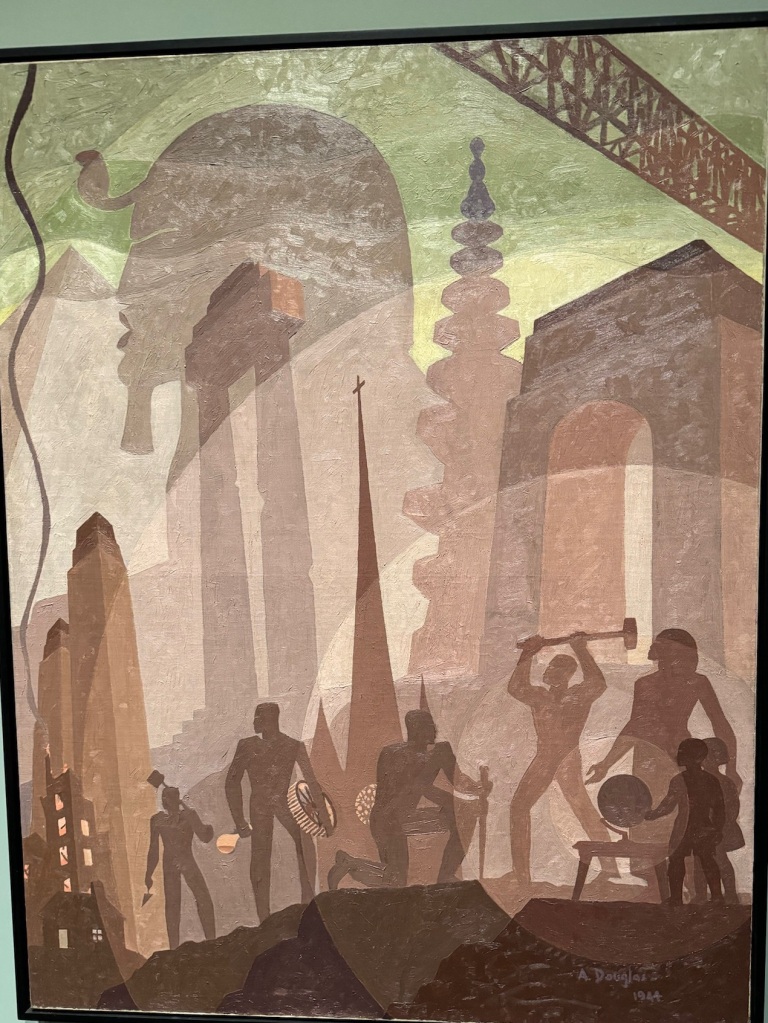
I recently visited the Metropolitan Museum of Art, one of the world’s finest museums, to see a memorable exhibition. It’s called “The Harlem Renaissance and Transatlantic Modernism.”

It is a spectacular collection of works by and about African-American artists. The art is drawn from museums around the country. You may never see these artworks in one space again.

The quality of the art is breath-taking. I know that many of you don’t live in or near New York City, but this is a good reason to plan a trip. The show runs through the end of July.

Here are a few of the photos I took with my cell phone. I wish I had taken more. Some of the pictures are off-center because the crowds were large, and I didn’t have a clear path.

Painted by William H. Johnson (1901-1970), “Mom and Dad, 1944.” This folk-art painting of the artist’s mother and a portrait of his late father was borrowed from the Smithsonian American Art Museum.

Painted by Allan Rohan Crite (1910-2007). It is titled “School’s Out” and was painted in 1936. It depicts children emerging from Everett Elementary School in Boston. It was lent to the exhibition by the Smithsonian American Art Museum.

Painted by Aaron Douglas (1879-1979). Titled “Building More Stately Mansions, 1944.” It is owned by the Fisk University Galleries in Nashville. According to the artist, “his objective was to spotlight the contributions of exploited Black labor to great civilizations worldwide. He thus resituated African American history in a global context, in which the sphinx of Egypt appears together with the spire of a Western cathedral, the tiers of an Asian Buddhist pagoda, and a building crane extending over American skyscrapers, emblems of modernity meant to connote growth.”

Painted by Winold Reiss (1886-1953), who emigrated from Germany to America. It is a painting of Fred Fripp, a graduate of the Penn School and a teacher, with his daughters Carol and Evelyn. The painting is owned by the Fisk University Galleries in Nashville.

The caption of the portrait says:

“The sitter looks away in introspection while his young daughters gaze outward, settled into the security of their father’s steadying embrace.

“Reiss met Fred Fripp when he traveled to South Carolina to portray the Gullah-speaking Black residents of St. Helena Island, whose ancestors were among the last enslaved West African people forcibly brought to the United States. The luminous triple portrait, its triangular composition and gold leaf background reminiscent of Renaissance madonnas, celebrates Fripp as a teacher, scholar, and parent.”

As I viewed this magnificent exhibit, I kept wondering about the African-American artists. In their wildest dreams, did they ever imagine that their paintings and sculptures would one day be shown in the nation’s premiere museum?

The exhibition is a large and rich portrayal of the artists and intellectuals of the Harlem Renaissance. If you can’t get to New York by July 28, the last day, you might consider buying the catalogue from the Met.

The usual understanding of democracy is “one man [person], one vote.” No matter how rich or powerful you are, your vote counts the same as that of the poorest person in the same district. We know from experience that the very rich win power by making lavish political donations, but at the ballot box each person has only one vote and all votes are counted equally.

At its recent convention, The Texas Republican Party endorsed an outrageous scheme to cancel the foundation of democracy. It’s not enough for them that billionaires are funding pliable politicians. The state Republicans want to cancel the principle of “one person, one vote.”

They adopted a plank that imposes a sort of electoral college on statewide elections. The winner will not be the candidate with the most votes, but the candidates who win a majority of counties. “The State Legislature shall cause to be enacted a State Constitutional Amendment to add the additional criteria for election to a statewide office to include the majority vote of the counties with each individual county being assigned one vote allocated to the popular majority vote winner of each individual county,” the new plank says.

Democrats are concentrated in big cities; Republicans are the majority in large numbers of small rural counties. If this plank weee to become part of the State Constitution, Democrats would never again be elected Governor, Lieutenant Governor, or U.S. Senator. Democrats might win the popular vote by a large majority, yet still lose the election if they don’t win a majority of the counties in the state.

This proposed Constitutional Amendment is a stake in the heart of democracy. Democrats must organize and elect candidates who want to strength of our society, not destroy it.

This is an extraordinary clip that shows Biden and Trump speaking without a teleprompter or notes. Biden was asked a question by a reporter, off the cuff. Trump was speaking at a rally in Las Vegas when his teleprompter went off. First he rants about not paying the company that installed the teleprompter. Then he tells a story about visiting a boat manufacturer in South Carolina, where Trump asks him how dangerous it would be if an electric boat sank. Would he be electrocuted or would he be attacked by a shark? He points out that he is very smart because of his connection to MIT (an uncle taught there).

To see more immortal Trump musings at his Las Vegas rally, watch this clip from the Meidas Touch blog.

Susan Glasser of The New Yorker wrote about President Biden’s speech commemorating the 80th anniversary of D-Day, the invasion that began the end of World War II. Others contrasted Biden’s speech with President Ronald Reagan’s 40th anniversary speech on the same occasion. Conservatives in the usual media outlets (FOX) jeered Biden for trying to sound like Reagan. Both of them spoke as patriots, as defenders of democracy, and of critics of isolationism.

Here is Biden’s speech. Rightwing commentators thought that he was “plagiarizing” Reagan because he talked about the heroism of the Army Rangers and the importance of democracy and freedom, for which the troops fought. Pray tell, what else would an American President talk about on such an occasion?

Biden is not the speaker that Reagan was; after all, Reagan was a professional actor who could read his lines with sincerity and fervor. Biden too is a patriot, and he knows what is at stake if we lose the world order created by so much sacrifice and loss of life. What would Trump have said of the Army Rangers hailed by Biden? Would he have expressed his familiar question “What was in it for them?” Would he have said as he did of John McCain, “I don’t like losers.” To Trump, who never served in the military (nor did his sons), winners don’t get captured or killed. Biden’s son Beau served in Afghanistan and subsequently died from brain cancer, which was attributed to the burn pits.

Glasser writes:

Anniversary speeches are, generally speaking, the trivial bane of an American Presidency. They are, by definition, backward-looking. The obligatory patriotic rhetoric, the flag-drenched backdrops—it is hard for them to read as anything other than tired and trite. Speaking in Normandy on Thursday to commemorate the eightieth anniversary of the Allied landings that spelled the beginning of the end of the Second World War, Joe Biden faced all those hurdles, and a few more besides. He is, after all, running for reëlection as America’s oldest-ever President, an octogenarian whose campaign is beset by increasingly pointed questions about whether he is still up to the job. Born in the midst of the war, Biden is all but certain to be the last U.S. President who was alive on June 6, 1944; there will not be another. The solemn D Day commemorations could have easily backfired on him—serving as a reminder that he, like the one hundred and eighty veterans of the Normandy operation able to return for this year’s ceremony, is but a superannuated relic of a bygone era. I have no doubt that in the unkinder, Trumpier precincts of the Internet, this is exactly how his appearance there was received.

It is true that Biden walked slowly during the proceedings and at times stumbled over his words; the White House would do well to stop pretending that, at age eighty-one, the President has not lost a step or two. It is also true that he did not suddenly transform overnight into a spellbinding orator. But, for what may well be his final D Day encore before the great battle passes from living memory, Biden met the moment with a message that was bracing, urgent, and clarifying. In a speech at the Normandy American Cemetery that was anything but generic, he called out both Vladimir Putin’s invasion of Ukraine and, though he did not use his name, Donald Trump’s isolationism—the dual threats that have animated this last political campaign of Biden’s, in a long life full of them. “The autocrats of the world are watching closely,” he said, and it was not a warning, really, so much as a statement of blunt fact about the stakes in this year’s U.S. election and the foreign-policy consequences that will flow from it. His opponent is an admirer of Putin, and, reportedly, of Hitler even. Trump truly supports neither Ukraine nor nato.


As I write this, it still seems insane, unimaginable, that these are sentences about a once and possibly future American President. But they are real, if unfortunately so familiar by now that Trump often benefits from our failure to be shocked all over again. Just two days before Putin’s attack on his neighbor, Trump called him a strategic “genius.” On the campaign trail, Trump frequently speaks about his great relationships with the world’s current crop of autocrats and tyrants, praising Xi Jinping and Kim Jong Un for their strength, while ranting about the weakness of the West. When Trump was President, he told his White House chief of staff, John Kelly, a decorated former Marine general, that he wanted America’s officers to be more like Hitler’s in their unquestioning loyalty to him. He routinely calls his enemies “vermin” and “human scum,” echoing Hitler’s language, and Kelly has said that Trump even told him that “Hitler did some good things.”

While listening to Biden’s speech, I thought about a resignation letter that Mark Milley, the former chairman of the Joint Chiefs of Staff appointed by Trump, wrote but did not send to him in 2020. “It is my deeply held belief that you’re ruining the international order, and causing significant damage to our country overseas, that was fought for so hard by the Greatest Generation that they instituted in 1945,” Milley said in the letter, a draft of which I obtained in the course of writing a book on the Trump Presidency. “It’s now obvious to me that you don’t understand that world order. You don’t understand what the war was all about. In fact, you subscribe to many of the principles that we fought against.”

Biden did not have to mention any of this to make it the inescapable context of his remarks on Thursday. “To surrender to bullies, to bow down to dictators is simply unthinkable,” Biden told the audience pointedly, adding, “Were we to do that, it means we’d be forgetting what happened here on these hallowed beaches.” And yet so much forgetting has happened, and I am not thinking here about the lessons of the past century as much as I am about the lessons of just one four-year Presidential term ago. Does anyone still remember Trump in Helsinki in 2018, tripping over himself as he took Putin’s word over that of America’s intelligence agencies? Or Trump in France, for another set of world-war commemorations later that year, fresh off midterm-election losses and skipping a cemetery visit because he reportedly did not want to get his hair wet? Or Trump, in 2019, blackmailing Ukraine’s young new President, Volodymyr Zelensky, by holding up hundreds of millions of dollars in U.S. military assistance needed to fight off Russia as he demanded Zelensky dig up dirt on Biden?

It is thinkable, then, all too thinkable. At the time of Biden’s speech, the polling averages showed Trump slightly ahead of him. What will happen to Ukraine if he should win?

“Their generation, in their hour of trial—the Allied forces of D Day did their duty,” Biden said, concluding his remarks. “Now the question for us is: In our hour of trial, will we do ours?”

Just a week ago, Trump became the only former President to be convicted of a crime. In a round of interviews defiantly rejecting both the verdict and the legal system that produced it, Trump made the following observation about America’s adversaries: “So you have Russia, you have China. But if you have a smart President, you always handle them quite easily, actually,” he told the hosts of the Fox News weekend morning show. “But the enemy within—they are doing damage to this country.”

Could there be a bigger contrast with Biden’s words in Normandy? “The enemy within” is not the language of a democratic President but of a dangerous demagogue who cares more about loyalty tests than geopolitical realities. Their clashing world views are underrated—or not rated at all—as a campaign issue, in a race overwhelmed by questions about Biden’s age and Trump’s sanity, and dominated by concerns over inflation, immigration, and the general sour mood of the country. And yet I cannot think of a starker delineation between the current President and his predecessor. It says something about the politics of 2024, indeed, that rather than seeing foreign policy as Trump’s vulnerability, some now view it as a problem for Biden, who struggled for months to get the Republican House of Representatives to provide billions of dollars in aid to Ukraine, a delay that caused battlefield setbacks and a drop in morale, even as his own Democratic Party grew painfully divided over the President’s strong public support for Israel in its war against Hamas.

On the eve of Biden’s trip to France, Time magazine released a lengthy interview with him, a striking counterpoint to an interview that the magazine conducted with Trump earlier this spring. Biden’s was dominated by his concerns over the unravelling of the postwar order that he warned about again on Thursday; Trump’s was a portrait of a man consumed by grievances, whether against the “very unfair” European allies who Trump thinks should be contributing more to Ukraine’s defense, or the criminal court cases against him that he blames on Biden. When the Time interviewer told him that many Americans found his rhetoric about being a dictator “for a day” and the suspension of the Constitution contrary to “cherished democratic principles,” Trump’s reply was chilling. “I think a lot of people like it,” he said.

Reading back through the interview the other day, I was struck that Trump had said, almost word for word, the language about Russia and China and “the enemy within” that he repeated once again this week: “I think the enemy from within, in many cases, is much more dangerous for our country than the outside enemies of China, Russia, and various others that would be called enemies depending on who the President is, frankly.” This, then, was not an idle observation of Trump’s but a theme of his campaign—the theme of his campaign.

Biden must have read Trump’s interview, too, as preparation for his own. It clearly informed his passionate case for why Trump is a danger to the international order, his focus on the threat posed by Russia—Trump, in his own interview, had bragged about how well he got along with Putin—and his best off-the-cuff line: “All the bad guys are rooting for Trump, man. Not a joke.”

Neither stirring battlefield rhetoric nor snarky one-liners, though, can explain how Biden can extract himself from his current predicament, running dead even at best against a felonious ex-President who diminishes the threats from America’s adversaries abroad because he is consumed by purging disloyal citizens at home. Tell that to the boys of Pointe du Hoc. I don’t think they’d believe it. ♦︎

Researcher Beth Zirbes, a teacher of advanced mathematics, used her skills to dissect a charter school study produced at Harvard. The study was reported by Paul Peterson in The Journal of School Choice; Peterson, like the Journal, is an outspoken advocate for charters and vouchers. The study claimed that charter schools outperform public schools, and that the charter schools in Alaska were best among all states.

The governor of Alaska cited the study as a reason to increase the number of charter schools.

Zirbes doubted that this was true and decided to do her own analysis. What she found, amazingly, was that the Harvard study ignored vital demographic factors.

She wrote:

When I first saw the results of the Harvard study concerning charter schools I was simultaneously unsurprised and skeptical. I was unsurprised as I have seen many very bright young students in my AP classes come from charter schools. I was skeptical as I suspected much of this performance could be attributed to the type of student who attends Alaska’s charter schools. As a comparative analysis of Alaska’s charter schools and neighborhood schools had not been done, I set out to do one myself.

To determine whether charter schools outperform neighborhood schools I looked at the performance of all schools on the 2018-2019 PEAKS ELA (English Language Arts) assessment from the Alaska Department of Early Childhood Education and Development’s (DEED) report card to the public, as this year was within the same time frame as the data from the Harvard study. The performance of each school is given under the “2018-2019 Performance Evaluation for Alaska’s Schools (PEAKS)” tab. I used the data on this page for every school in the state which allowed me to analyze test scores and demographic characteristics such as the proportion of the school who are economically disadvantaged, English language learners (ELL), and special education (SPED). Demographic characteristics are only given for the set of test-takers and thus all summaries and analyses are for students in grades 3-9 during the 2018-2019 school year. I also removed all correspondence schools from my dataset as these students were not included in the Harvard study, do not take NAEPs tests, and have very low participation rates on state tests. For my analysis on performance, I also restricted my dataset to include schools only in districts where charters are an option to ensure that the student populations were as similar as possible.

At first glance, it appears that charter schools are more successful than neighborhood schools. At charter schools 52.5% (1,866 out of 3,554) of students were proficient on the ELA assessment versus 40.1% (18,655 out of 46,574) of students at neighborhood schools. However, these differences could be explained by the differences in demographics of the student bodies at these schools. To rule this out as a potential issue, statisticians control for these variables in their mathematical models. We can then ask, do the charter schools outperform neighborhood schools that have similar characteristics? Or do charter schools do any better than we would expect, given their student populations? In short, the answer is no, they do not. When I fit a model which controlled for socioeconomic status alone, the type of school (charter versus neighborhood) was not significant. (For anyone who knows statistics, the p-value associated with type of school was 0.57. It wasn’t even close.) In summary, there is no evidence that charter schools outperform neighborhood schools in terms of ELA proficiency once we consider their socioeconomic make-up.

During my data exploration, I discovered that charter schools, on average, have very different student bodies than neighborhood schools. Charter schools have far fewer economically disadvantaged students, far fewer ELL students, and are comparable to neighborhood schools in terms of SPED populations. Here is a summary of how these populations differ for all Alaskan students in the relevant grades in all of Alaska’s brick and mortar schools for the 2018-2019 school year:

  •  Neighborhood schools were 52.2% economically disadvantaged (30,780 out of 58,929 students) compared to 31.3% in charter schools (1,219 out of 3895 students).
  • Neighborhood schools were 15.5% ELL (9,150 out of 58,929 students) compared to 9.3% in charter schools (363 out of 3895 students).
  • Neighborhood schools were 16.3% SPED (9,162 out of 58,929 students) compared to 13.7% in charter schools (532 out of 3895 students).

However, these summaries are highly influenced by a few outliers and obscure some large discrepancies, especially in terms of the economically disadvantaged and ELL students.

  • Of the charter schools, 46.4% (13 out of 28) have economically disadvantaged rates below 20%, compared to just 3.5% of neighborhood schools (15 out of 426).
  • Only 10.7% of charter schools (3 out of 28) have ELL percentages above 10%, compared to 36.9% of neighborhood schools (157 out of 426).

Even if we did a comparison of charter schools and neighborhood schools and found that charter schools did better, we still cannot conclude charter schools are causing the performance difference we observe. A comparative study like this is an example of an observational study and because it is impossible to control for all confounding factors, such as parental involvement, we can’t conclude success is caused by the school type. To definitively conclude that charter schools were causing the observed difference in success compared to neighborhood schools we would have to randomly assign some students to go to a charter school and some students to go to neighborhood schools. After some time, we would then compare the results. Obviously, this is impractical as many charter schools do not have busing, require volunteer hours, can remove students for poor attendance, and some do not even have lunch services.

Before the state uses the results of the Harvard study to change the approval process for charter schools we need to understand if charters are better and, if so, why. So far, I have not seen convincing evidence that charter schools outperform neighborhood schools when we control for various student characteristics. I have an idea for further study which I believe should be completed before any changes to policy are made. We can examine the performance of students who got admitted to charter schools via the lottery to those who applied but did not get in and attended their neighborhood schools instead. The group who was admitted is likely similar to those who applied but were not. This would be as close to a randomized experiment as one could hope to have. From this one could determine whether various factors were causing differences in performance, such as class size and teaching methodology. Additionally, we could use results of such a study to determine which factors correlate with success and apply these strategies in all our schools. As more than 90% of the students at our in-person schools are in neighborhood schools, such reforms will be more wide-reaching than simply adding a few more charter schools.

 2018-2019 PEAKS ELABeth Zirbeseconomically disadvantagedELLGuest ColumnHarvard Charter School StudyNAEPSPED

When a commenter belittled Russian interference in the 2016 election, Democracy returned to provide the evidence of Russia’s active and considerable interference in the election of 2016. The election of Trump was a major coup for Putin.

Democracy wrote:

“Whatever meager influence Russian may have had …”

I suppose this is an improvement over “The fact remains that there is no evidence for Russian involvement in the U.S. election at all.”

This, written at a time when there was — IN FACT – LOTS of evidence of Russian involvement in the 2016 election, from virtually every intelligence agency in the United States government:

US Intelligence news release on October 7, 2016:  

“The U.S. Intelligence Community (USIC) is confident that the Russian Government directed the recent compromises of e-mails from US persons and institutions, including from US political organizations. The recent disclosures of alleged hacked e-mails on sites like DCLeaks.com and WikiLeaks and by the Guccifer 2.0 online persona are consistent with the methods and motivations of Russian-directed efforts. These thefts and disclosures are intended to interfere with the US election process. Such activity is not new to Moscow—the Russians have used similar tactics and techniques across Europe and Eurasia, for example, to influence public opinion there. We believe, based on the scope and sensitivity of these efforts, that only Russia’s senior-most officials could have authorized these activities.”

https://www.dni.gov/index.php/newsroom/press-releases/215-press-releases-2016/1423-joint-dhs-odni-election-security-statement

Reuters:  “The Federal Bureau of Investigation, Central Intelligence Agency and Office of Director of National Intelligence agree that Russia was behind hacks into Democratic Party organizations and operatives ahead of the Nov. 8 presidential election. There is also agreement, according to U.S. officials, that Russia sought to intervene in the election to help Trump, a Republican, defeat Democrat Hillary Clinton.”

http://www.reuters.com/article/us-usa-russia-cyber-idUSKBN14H1SR

There are some people who apply the Trumpian tactic on Michael Cohen to this information, suggesting that because, at certain times in the past, some of these agencies have had credibility issues.

Except, here, private cybersecurity experts have confirmed the information. As The Daily Beast reported in 2017,

“it was a respected computer security company called Crowdstrike that examined the servers, and publicly revealed Russian’s involvement in the DNC hacks last year. It backed up the claim with specific technical information far more useful than anything in the DHS report. Crowdstrike competitors, including Symantec and FireEye, have examined the forensic data from the DNC hack themeselves, and endorsed Crowdstrike’s conclusion that two particular hacking groups were the culprits: ‘Fancy Bear’ and ‘The Dukes.’

http://www.thedailybeast.com/articles/2017/01/06/how-the-u-s-enabled-russian-hack-truthers.html

Here’s how Thomas Rid, formerly at the Department of War Studies at Kings College London, and now the Director of the Institute for Cybersecurity Studies at Johns Hopkins, and who studies and writes about technology and cyber warfare, puts it:

“the evidence is so rich that there are only two reasons not to accept it — one, because you don’t understand the technical details, or because you don’t want to understand it for political reasons… It’s really not controversial that we’re looking at a major Russian campaign.”

Former George W. Bush speechwriter David Frum summarized the whole sordid affair well:

“the outline of the case is no mystery…Democratic and Republican Party servers were hacked by foreign agents, yet the Moscow-friendly folks at Wikileaks somehow only obtained the contents of Democratic servers…Meanwhile, Donald Trump ran a campaign that seemed almost designed to please Russian President Vladimir Putin…The campaign then rewrote the Republican platform in ways sure to please Putin. Trump selected as his principal foreign-policy adviser a retired general previously paid by Russia’s English-language propaganda network, RT…Trump himself publicly urged the Russians to do more hacking of his opponent’s email…Trump endorsed Putin’s war aims in Syria…He suggested he would not honor NATO commitments against Russia…He condoned the invasion and annexation of Crimea…Do Americans really need secret information from the CIA to discern the pattern here?”

Yet there DO appear to be SOME people who still try to play off the Russian ratf*cking as some kind of climate-change-like “hoax.”

Some of them even think that they’re “smart.”

But, hey, I got some news.