Archives for category: Wisconsin

Jill Underly was recently te-elected as State Superintendent of Schools in Wisconsin. She is an active member of the Netwotk for Public Education and attended its last two meetings. She released the following statement after two courts hacked away at Trump’s threat to withhold funds from schools that taught diversity, equity, and inclusion

MADISON, Wis. (WISCONSIN DEPARTMENT OF PUBLIC INSTRUCTION PRESS RELEASE) – State Superintendent Dr. Jill Underly today issued a statement following two federal court rulings that limit the Trump administration’s ability to withhold critical school funding over an unclear certification form and process.

“Our top priority in Wisconsin is our kids and making sure every student has the support they need to succeed. The past few weeks, school leaders have been scrambling to understand what the impact of the U.S. Department of Education’s order could be for their federal funds, forcing them to take their eye off what matters most.

“Today, two separate courts reached a similar conclusion: the USDE’s new certification process is likely unlawful and unconstitutionally vague. That is a welcome development for our schools and communities who, working in partnership with parents and families, are best positioned to make decisions for their communities – not Washington, D.C.

“We are closely reviewing today’s rulings and will continue to stand up for Wisconsin schools, and most importantly, our kids.”

Wisconsin Public Radio reported that State Superintendent Jill Underly has announced that the state will not comply with a letter from U.S. Secretary of Education Linda McMahon in which she directed states to agree with the Trump administration about stamping out diversity, equity, and inclusion. Trump wants to eliminate DEI, which would involve reversing compliance with existing civil rights law. In addition, although McMahon may not know it, she is violating federal law by attempting to influence curriculum and instruction in the schools.

Thank you, Superintendent Underly!

WPR reported:

Wisconsin school districts won’t comply with a directive from the Trump administration to eliminate diversity, equity and inclusion programs until districts have more information.

On Wednesday, state Superintendent Jill Underly asked the U.S. Department of Education for clarification on both the intent and legality of an April 3 directive that schools sign a letter acknowledging they’re following the government’s interpretation of civil rights laws.

Schools were given 10 days to do so, or be at risk of losing Title I funding. The federal government later extended the deadline to April 24. 

This school year, Wisconsin received about $216 million in Title I funds. About $82 million of that money went to Milwaukee Public Schools.

Underly said the request from the Department of Education potentially violates required procedural steps, is unnecessarily redundant and appears designed to intimidate school districts by threatening to withhold critical education funding.

“We cannot stand by while the current administration threatens our schools with unnecessary and potentially unlawful mandates based on political beliefs,” Underly said in a statement. “Our responsibility is to ensure Wisconsin students receive the best education possible, and that means allowing schools to make local decisions based on what is best for their kids and their communities.”

On Feb. 14, the U.S. Department of Education sent a “Dear Colleague” letter giving educational institutions 14 days to eliminate diversity initiatives or risk losing federal funding.

At that time, the state DPI issued guidance to school districts encouraging a “measured and thoughtful approach, rather than immediate or reactionary responses to the federal government’s concerns.”

Secretary of Education Linda McMahon has not clearly defined what the administration considers a violation of civil rights law. The February letter said institutions must “cease using race preferences and stereotypes as a factor in their admissions, hiring, promotion, scholarship.”

In a related document addressing frequently asked questions about how the administration would interpret Title VI of the Civil Rights Act of 1964, the agency said: “Many schools have advanced discriminatory policies and practices under the banner of ‘DEI’ initiatives.” 

The document went on to say that schools could engage in historical observances like Black History Month, “so long as they do not engage in racial exclusion or discrimination.”

Good news in Wisconsin! A local court overturned a notorious piece of anti-union legislation that was passed in 2011, at the instance of then-Governor Scott Walker. At the time, union protestors encircled the Statehouse to protest. Walker was unmoved. He celebrated the defeat of the state’s unions (excluding police and firefighters).

The Guardian writes:

As the labor movement braces for a second Trump term, union members and their leaders are celebrating a major victory over a controversial law that stripped public sector unions of collective bargaining rights.

In response to a lawsuit alleging that a notorious law passed by the former Republican governor of Wisconsin Scott Walker in 2011 is unconstitutional, a county judge ruled on Monday that more than 60 sections of the law and several sections of a follow-up law in 2015, Act 55, are unconstitutional.

Walker called the decision “brazen political activism at its worst” and Republicans plan an appeal.

Thousands protested the introduction of the law, which crippled unions’ funding and powers. Following the passage of Act 10, several Republican-dominated states pushed to pass similar legislation, including Florida which passed a similar law in May 2023 targeting public sector unions, and Iowa, which passed legislation that took away collective bargaining rights from many state employees in 2017.

Act 10 stripped collective bargaining rights from thousands of state employees in Wisconsin, limiting their ability to bargain solely on wage increases that cannot exceed inflation. It also forced public sector labor unions to annually vote, with a majority of members participating and voting, to maintain certification.

“We were kind of just demonized, not just teachers, but public sector workers in general,” said John Havlicek, a high school Spanish teacher in La Crosse, Wisconsin and former president of the La Crosse Education Association which represents teachers in the school district. “Teachers don’t go into it for the money but I also have groceries to buy and bills to pay and stuff like that. A lot of public sector workers, in my experience teachers, really felt like we were being scapegoated. It was really bad.”

The act has had a significant impact on union membership, pay and benefits. In 2010 Wisconsin had a union density rate of 15.1%. That number dropped to 8.4% in 2023.

The law also forced public sector workers to pay more for healthcare and retirement benefits, resulting in around an 8.5% decrease in their pay for workers making $50,000 a year.

An April 2024 report by the Wisconsin department of public instruction found teacher pay had declined from 2010 to 2022 by nearly 20% and about four out of every 10 first year teachers either leave the state or the profession after six years.

Public school funding also drastically declined in Wisconsin after Act 10 was enacted. Per pupil spending in Wisconsin out paced the national average by around $1,100 per student in 2011 and was $327 per pupil lower than the national average in 2021.

The verdict could be overturned on appeal. Stay tuned.

Thirteen years ago, Republican Governor Scott Walker and the legislature of Wisconsin enacted Act 10, which banned collective bargaining for public employees, except for public safety employees. Teachers, social workers, and other public employees were outraged. They encircled the State Capitol for days. Walker became a star, and his sponsors, the Koch brothers, were happy.

But today, Act 10 was declared unconstitutional. Time will tell whether the decision is upheld.

A Dane County judge on Monday sent ripples through Wisconsin’s political landscape, overturning a 13-year-old law that banned most collective bargaining among public employees, consequently decimating the size and power of employee unions and turning then-Republican Gov. Scott Walker into a nationally known political figure.

But there’s been a revival of hope in Wisconsin:

The effort to overturn Act 10 began in November 2023 when several unions representing public employees filed the lawsuit, citing a “dire situation” in workplaces with issues including low pay, staffing shortages and poor working conditions. 

In July,  Dane County Circuit Judge Jacob Frost ruled provisions of Act 10 unconstitutional and denied a motion filed by the Republican-controlled Legislature to dismiss the case.

The lawsuit argued the 2011 law violated equal protection guarantees in the Wisconsin Constitution by dividing public employees into two classes: “general” and “public safety” employees. Public safety employees are exempt from the collective bargaining limitations imposed on “general” public employees.

Bill Lueders wrote this article at the Never-Trump site called “The Bulwark.” He asked the question that is the title of this post. Lueders is editor-army-large for The Progressive. He says that Eric Hovde, who is challenging Senator Tammy Baldwin, has “high hopes and low scruples.”

He writes:

ERIC HOVDE’S CAMPAIGN IS “running out of money.” He told me so the other day. He’s worth hundreds of millions of dollars. But apparently he can’t afford to keep up with the cost of his own attack ads.

“Fellow Conservative,” began his recent email, addressed to me. “I need your immediate help to keep this ad running 24/7 online in Wisconsin through Election Day!” He said it was very important that this particular ad continue to run, as it represents “our best opportunity to expose undecided Wisconsin voters who will decide this TOSS-UP election to Tammy Baldwin’s willingness to line her own pockets at the expense of Wisconsin voters.” 

I don’t know if Hovde’s campaign scared up the $50,000 that he said was needed within 48 hours in order for the ad to keep running, but the ad was definitely not pulled. You can watch it here. It pictures Baldwin, the first openly lesbian (or gay) senator in U.S. history, alongside her partner, Maria Brisbane, who is described in a voiceover as “a Wall Street exec who makes millions advising the super-rich how to make money off of industries Tammy regulates.” 

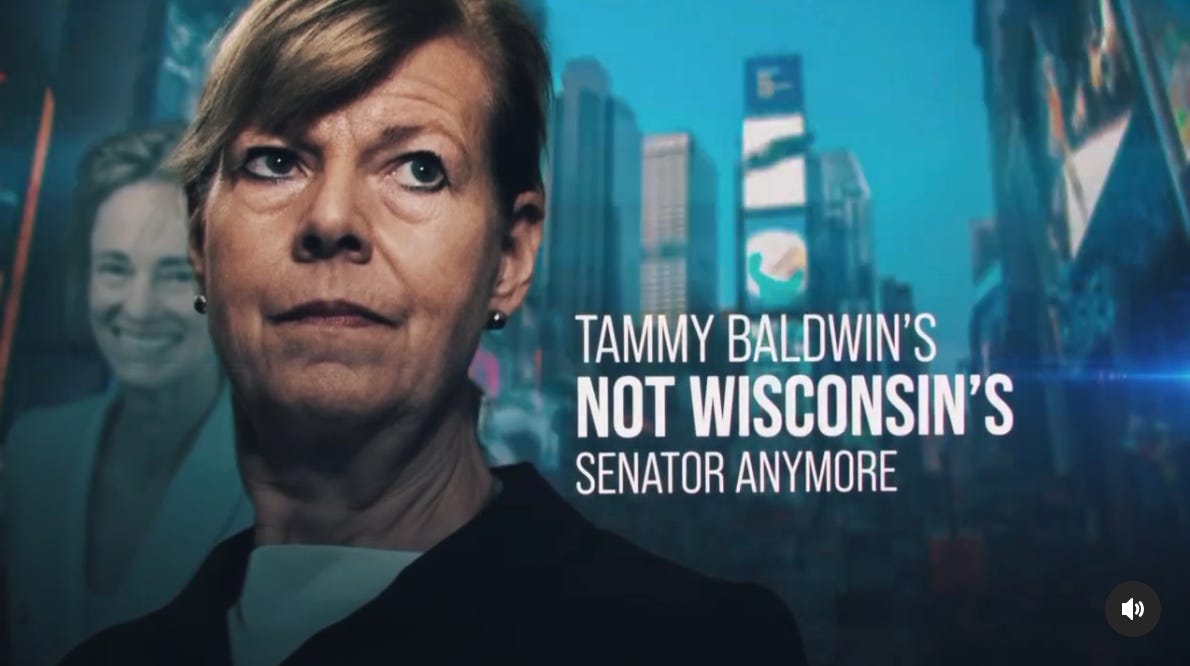
A still from Hovde’s ad.

The ad, part of a tsunami of political spending on the race that has been going on for months, says Baldwin often doesn’t make it home to Wisconsin on weekends because “she’d rather be in New York at Maria’s $7 million condo.” For this reason, the narrator intones, “New Yorkers have given Tammy more than $1.3 million. Tammy Baldwin is not Wisconsin’s senator anymore, she’s the third senator from New York.”

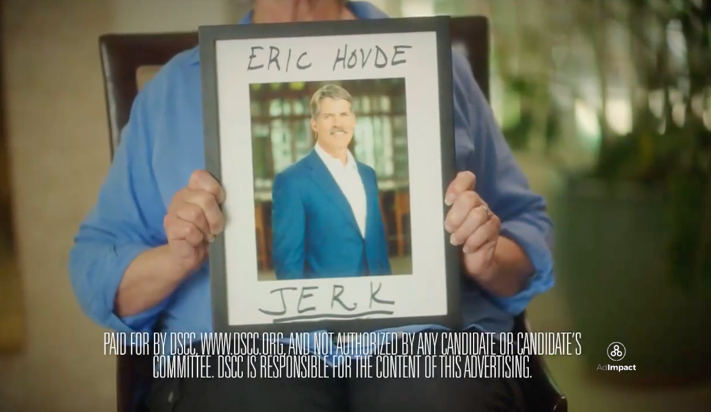
As he heads into what is seen as one of the most competitive and potentially pivotal races for the U.S. Senate on the November 5 ballot, Hovde is doing his darnedest to shake off the image some people have of him as an elite outsider and somewhat of a jerk. He insists this is a false impression. 

Just because he is a California banker with listed assets of between $195 million and $563 million, lives mostly in a $7 million oceanview mansion in Laguna Beach, was for three straight years named one of Orange County’s most influential people by a local business journal, and has frequently not even bothered to vote in Wisconsin elections, doesn’t mean Hovde is not intimately connected to the state’s working stiffs. In February, he even jumped into the icy waters of Lake Mendota in Madison to prove it.

Hovde in a still from his video from Lake Mendota.

“So the Dems and Senator Baldwin keep saying I’m not from Wisconsin,” he says in the video while shirtless in the freezing lake. “Which is a complete joke. All right, Sen. Baldwin, why don’t you get out here in this frozen lake and let’s really see who’s from Wisconsin.” Like most sensible Wisconsinites, the senator stayed out of the frigid water.

Baldwin keeps most of her relatively meager assets, reportedly worth around $1.2 million, in a blind trust. Hovde has not committed to doing so, although he has vowed to “step out of any management role” at the Utah-based bank where he now serves as chairman of board. (The bank, ingeniously named Sunwest Bank, has branchesin five states, not including Wisconsin, and some $3.4 billion in assets.)

And so even though his own financial conflicts are much greater and less well safeguarded, Hovde is going after Baldwin on this score, claiming she’s somehow helping the super-rich “make money off of industries Tammy regulates.” Hovde groused to the Wisconsin State Journalthat Baldwin “doesn’t report what her partner is doing. If she was married, they’d have to report that, right? So she’s, again, trying to confuse people.”

But who is trying to confuse whom? Baldwin and Brisbane are not married, so under the law, neither has to report Brisbane’s assets. Hovde, in contrast, has potential conflicts that are genuinely concerning, including his bank’s decision to accept money from a Mexican bank that has been tied to drug traffickers.….


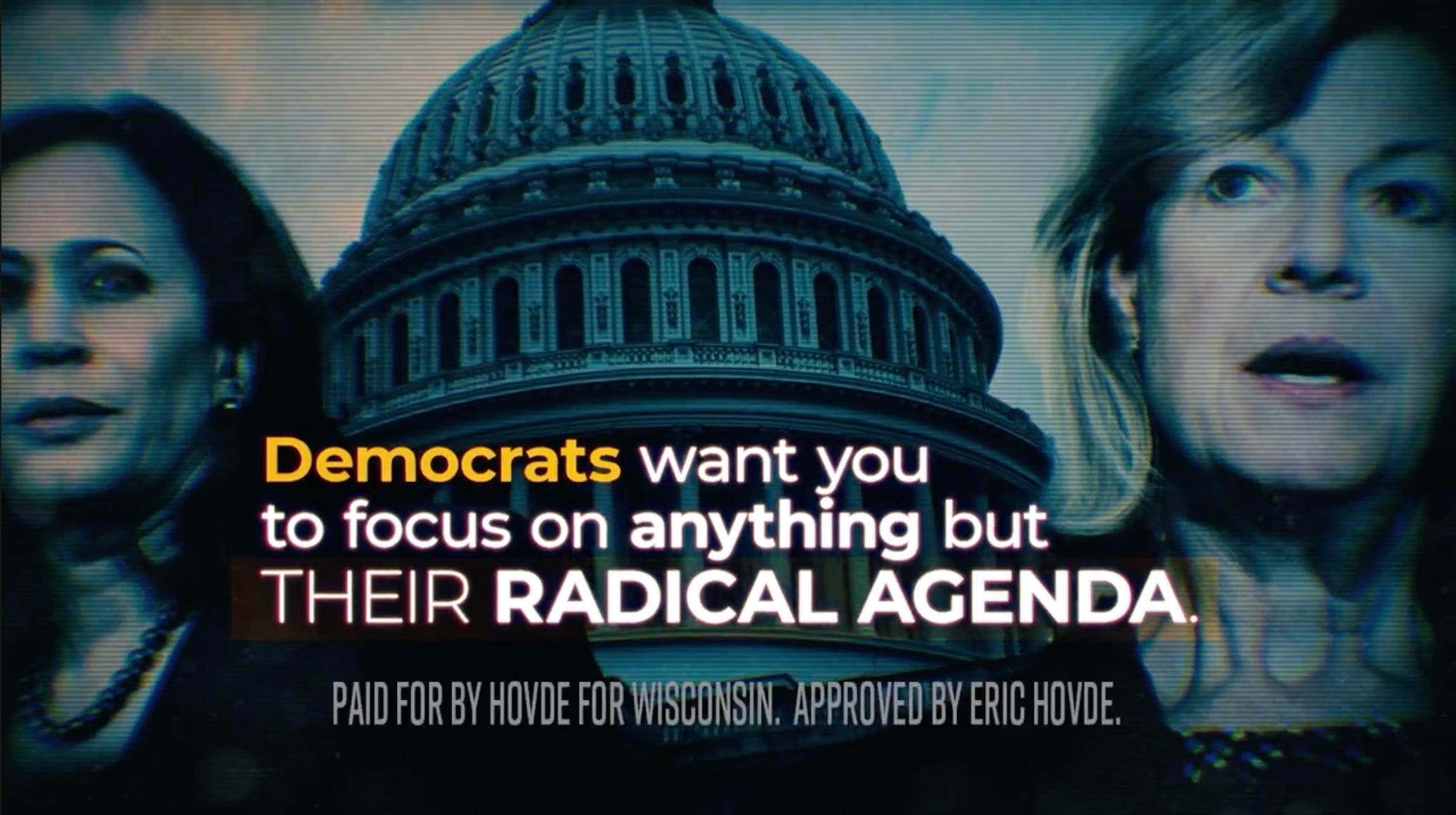
Hovde, meanwhile, has tried to paint Baldwin as a dangerous radical. In a pair of similar ads that began airing last week, the ominous voiceover accuses Baldwin and Vice President Kamala Harris of being birds of a feather in, as one of these ads puts it, “allowing men to compete in girls’ sports, funding a clinic that offers transgender therapy to minors without parents’ consent, giving stimulus checks to illegals while Wisconsin families struggle.”

A still from one of Hovde’s attack ads.

To finish reading, open the link.


A major, nonpartisan review of Milwaukee schools over the past three decades produced a dismal result: No improvement.

Backed by millions from the rightwing Bradley Foundation, voucher advocates promised that competition would produce gains for all sectors. It didn’t.

Milwaukee has a significant number of charter schools and voucher schools. About 55% of all students are enrolled in traditional public schools. The public schools enroll a disproportionate share of students with disabilities.

Rory Linnane of the Milwaukee Journal Sentinel reported:

Three decades since their beginnings in Milwaukee, publicly funded private school programs and independently run charter schools now enroll over 40% of the city’s students.

Reflecting on the city’s shifting education landscape, a new report from the Wisconsin Policy Forum examines enrollment, financing and academic outcomes for Milwaukee schools in every sector, including traditional public schools, private schools and charter schools…

‘Transformed system has not transformed outcomes for children,’ researchers say

Milwaukee in the ’90s was “widely seen as the epicenter of ‘education reform’ in the country,” the forum noted, as state lawmakers opened the door for private operators to start their own schools. Proponents argued that the free-market competition would push all city schools to improve.

In 1990, state lawmakers created the country’s first “voucher” program in Milwaukee, providing public funding for students to attend private schools. Soon after, Minnesota lawmakers were the first to write legislation for charter schools, allowing teacher-led nonprofits to operate schools. Wisconsin was one of the first states to follow in 1993, but without the requirement that teachers lead them.

Thirty years later, the forum noted there is “little evidence … that the average Milwaukee child receives a higher quality education today.”

Heather Cox Richardson wrote the following post on May 8 about President Biden’s recent visit to Wisconsin. She compares Biden to FDR. Under Trump, Wisconsin lost jobs. Under Biden, Wisconsin has gained jobs. That’s the heart of the Biden agenda: building a strong middle-class and creating good union jobs.

She writes:

Today, in Racine, Wisconsin, President Joe Biden announced that Microsoft is investing $3.3 billion dollars to build a new data center that will help operate one of the most powerful artificial intelligence systems in the world. It is expected to create 2,300 union construction jobs and employ 2,000 permanent workers. 

Microsoft has also partnered with Gateway Technical College to train and certify 200 students a year to fill new jobs in data and information technology. In addition, Microsoft is working with nearby high schools to train students for future jobs. 

Speaking at Gateway Technical College’s Racine campus, Biden contrasted today’s investment with that made by Trump about the same site in 2018. In that year, Trump went to Wisconsin for the “groundbreaking” of a high-tech campus he claimed would be the “eighth wonder of the world.” 

Under Republican governor Scott Walker, Wisconsin legislators approved a $3 billion subsidy and tax incentive package—ten times larger than any similar previous package in the state—to lure the Taiwan-based Foxconn electronics company. Once built, a new $10 billion campus that would focus on building large liquid-crystal display screens would bring 13,000 jobs to the area, they promised. 

Foxconn built a number of buildings, but the larger plan never materialized, even after taxpayers had been locked into contracts worth hundreds of millions of dollars for upgrading roads, sewer system, electricity, and so on. When voters elected Democrat Tony Evers as governor in 2022, he dropped the tax incentives from $3 billion to $80 million, which depended on the hiring of only 1,454 workers, reflecting the corporation’s current plans. Foxconn dropped its capital investment from $10 billion to $672.8 million.  

In November 2023, Microsoft announced it was buying some of the Foxconn properties in Wisconsin.

Today, Biden noted that rather than bringing jobs to Racine, Trump’s policies meant the city lost 1,000 manufacturing jobs during his term. Wisconsin as a whole lost 83,500. “Racine was once a manufacturing boomtown,” Biden recalled, “all the way through the 1960s, powering companies—invented and manufacturing Windex…portable vacuum cleaners, and so much more, and powered by middle-class jobs.

“And then came trickle-down economics [which] cut taxes for the very wealthy and biggest corporations…. We shipped American jobs overseas because labor was cheaper. We slashed public investment in education and innovation. And the result: We hollowed out the middle class. My predecessor and his administration doubled down on that failed trickle-down economics, along with the [trail] of broken promises.” 

“But that’s not on my watch,” Biden said. “We’re determined to turn it around.” He noted that thanks to the Democrats’ policies, in the past three years, Racine has added nearly 4,000 jobs—hitting a record low unemployment rate—and Wisconsin as a whole has gained 178,000 new jobs. 

The Bipartisan Infrastructure Law, the CHIPS and Science Act, and the Inflation Reduction Act have fueled “a historic boom in rebuilding our roads and bridges, developing and deploying clean energy, [and] revitalizing American manufacturing,” he said. That investment has attracted $866 billion in private-sector investment across the country, creating hundreds of thousands of jobs “building new semiconductor factories, electric vehicles and battery factories…here in America.” 

The Biden administration has been scrupulous about making sure that money from the funds appropriated to rebuild the nation’s infrastructure and manufacturing base has gone to Republican-dominated districts; indeed, Republican-dominated states have gotten the bulk of those investments. “President Biden promised to be the president of all Americans—whether you voted for him or not. And that’s what this agenda is delivering,” White House deputy chief of staff Natalie Quillian told Matt Egan of CNN in February. 

But there is, perhaps, a deeper national strategy behind that investment. Political philosophers studying the rise of authoritarianism note that strongmen rise by appealing to a population that has been dispossessed economically or otherwise. By bringing jobs back to those regions that have lost them over the past several decades and promising “the great comeback story all across…the entire country,” as he did today, Biden is striking at that sense of alienation.

“When folks see a new factory being built here in Wisconsin, people going to work making a really good wage in their hometowns, I hope they feel the pride that I feel,” Biden said. “Pride in their hometowns making a comeback. Pride in knowing we can get big things done in America still.” 

That approach might be gaining traction. Last Friday, when Trump warned the audience of Fox 2 Detroit television that President’s Biden’s policies would cost jobs in Michigan, local host Roop Raj provided a “reality check,” noting that Michigan gained 24,000 jobs between January 2021, when Biden took office, and May 2023.

At Gateway Technical College, Biden thanked Wisconsin governor Tony Evers and Racine mayor Cory Mason, both Democrats, as well as Microsoft president Brad Smith and AFL-CIO president Liz Schuler. 

The picture of Wisconsin state officials working with business and labor leaders, at a public college established in 1911, was an image straight from the Progressive Era, when the state was the birthplace of the so-called Wisconsin Idea. In the earliest years of the twentieth century, when the country reeled under industrial monopolies and labor strikes, Wisconsin governor Robert “Fighting Bob” La Follette and his colleagues advanced the idea that professors, lawmakers, and officials should work together to provide technical expertise to enable the state to mediate a fair relationship between workers and employers. 

In his introduction to the 1912 book explaining the Wisconsin Idea, former president Theodore Roosevelt, a Republican, explained that the Wisconsin Idea turned the ideas of reformers into a workable plan, then set out to put those ideas into practice. Roosevelt approvingly quoted economist Simon Patten, who maintained that the world had adequate resources to feed, clothe, and educate everyone, if only people cared to achieve that end. Quoting Patten, Roosevelt wrote: “The real idealist is a pragmatist and an economist. He demands measurable results and reaches them by means made available by economic efficiency. Only in this way is social progress possible.”

Reformers must be able to envision a better future, Roosevelt wrote, but they must also find a way to turn those ideals into reality. That involved careful study and hard work to develop the machinery to achieve their ends. 

Roosevelt compared people engaged in progressive reform to “that greatest of all democratic reformers, Abraham Lincoln.” Like Lincoln, he wrote, reformers “will be assailed on the one side by the reactionary, and on the other by that type of bubble reformer who is only anxious to go to extremes, and who always gets angry when he is asked what practical results he can show.” “[T]he true reformer,” Roosevelt wrote, “must study hard and work patiently.” 

“It is no easy matter actually to insure, instead of merely talking about, a measurable equality of opportunity for all men,” Roosevelt wrote. “It is no easy matter to make this Republic genuinely an industrial as well as a political democracy. It is no easy matter to secure justice for those who in the past have not received it, and at the same time to see that no injustice is meted out to others in the process. It is no easy matter to keep the balance level and make it evident that we have set our faces like flint against seeing this government turned into either government by a plutocracy, or government by a mob. It is no easy matter to give the public their proper control over corporations and big business, and yet to prevent abuse of that control.”

“All through the Union we need to learn the Wisconsin lesson,” Roosevelt wrote in 1912.

“We’re the United States of America,” President Biden said today, “And there’s nothing beyond our capacity when we work together.”

Go to the post to read her footnotes.
Joshua Cowen, Professor of Education Policy at Michigan State University, has been researching and writing about vouchers for yearly 20 years. As you will read, school choice advocates were very angry about his criticisms of vouchers. They told him he was wrong. George Mitchell, a founder of School Choice Wisconsin wrote a comment on this blog, highly critical of negative judgments about vouchers. Here is Josh Cowen’s response.

Author: Josh Cowen

Affiliation: Professor of Education Policy, Michigan State University

Topic: Wisconsin Voucher Results

Recently, I made comments to the Wisconsin Examiner that were highly critical of Wisconsin’s system of school vouchers. The columnist for that piece had asked me as a researcher with 18 years of experience on the topic for my professional opinion about a new School Choice Wisconsin report purporting to show that Wisconsin vouchers are more cost-effective than the state’s public schools.

In response to my comments, the director of School Choice Wisconsin issued his second op-ed in one week, slamming both me and the Examiner columnist; a researcher from the Wisconsin Institute for Law and Liberty, which like School Choice Wisconsin is heavily subsidized by the voucher-advocating Bradley Foundation in Milwaukee, issued a similar social media thread; and George Mitchell himself, the co-founder of SCW, sent me not one but two angry and unsolicited emails trying to rebut me.

Among other things, I said to the Examiner: “If you took the report at its word, it’s possible to achieve exactly what they’re describing simply by exiting the children who are the most expensive to educate.”

I make similar assessments in other states, based on the large volume of data showing that voucher programs like Wisconsin’s have huge exit rates among the lowest scoring and lowest income students. I’m used to objections from conservative activists who are for ideological reasons supportive of vouchers, but the sheer volume in this case is frankly odd and warrants extra attention.

Wisconsin is also a bit different because that’s where I got much of my start on voucher research—and that’s where some of the more troubling patterns of student exits from voucher schools first emerged. As an early career analyst on the last official evaluation of vouchers—at the time, limited to the Milwaukee Parental Choice Program between 2005 and 2010—I helped study those data.

Here’s the thing: the Bradley Foundation financially supported that larger evaluation, and School Choice Wisconsin played an integral role in participant recruitment for the study.

What we found in not one but two papers published in the top education research journals in the country was that students left Milwaukee vouchers at high rates, roughly 15% of kids per year (in other states it’s above 20%), and did so in very systematic ways: the lowest scoring kids, lowest income children (even in a program targeted to lower income families to begin with) and students of color were far more likely to experience turnover out of the voucher program.

And crucially, those students did better once turning or returning to Milwaukee Public Schools. That last finding was important because kids who gave up their voucher did not enroll at the highest rated MPS schools, but they still appeared to have been better served there than when they had used a voucher.

That pattern alone can inflate the numerator in the fraction SCW used to claim voucher cost-effectiveness. By dividing the state’s accountability score by a simplistic calculation of the revenue schools receive per kid, SCW was able to claim more voucher bang for the buck. It’s simple algebra: “cost effective” can mean either a high score for a given dollar spent, or a smaller dollar spent for a given accountability score.

And if, as in our MPCP evaluation, students who leave voucher programs are especially low scoring on state exams, that would artificially push SCW’s voucher numerator high. Again, simple algebra.

That is not a particularly controversial statement among serious program evaluators who specialize in such data without an agenda. And while I’m not surprised that as the state’s chief voucher advocacy group, SCW took issue with my data-backed comments, I am surprised they’ve spent as much time as they have issuing new columns and sending me angry emails.

Of course, one way to settle lingering questions about Wisconsin’s voucher program would be to hold another multi-year evaluation, in which groups like School Choice Wisconsin, the Wisconsin Department of Public Instruction, and teacher stakeholder groups came together to agree on a third-party review of these programs.

That happened in 2005 Wisconsin Act 125, which helped create the data in our team’s reports that I cite above. But it has not happened since vouchers expanded statewide. If School Choice Wisconsin is as confident in their numbers as they claim, they should welcome such a new evaluation—just like they did back in the program’s early years.

If that happened, Wisconsin taxpayers wouldn’t have to take voucher advocates’ word for it—or mine for that matter. One of the findings from the last evaluation was that once DPI started reporting voucher results by school name (like public schools have to do), their performance improved. Voucher advocates should want new evaluations—if they don’t, what are they worried those new reviews will find?

Absent a new evaluation, what we know for certain based on what’s available to the research community is that voucher programs have extremely high rates of student turnover, and these rates are driven by particularly high rates among at-risk children. In that, the data are quite consistent with the startling report issued by journalists at Wisconsin Watch in May, documenting strategies that Wisconsin voucher schools use to select children out after admitting them originally.

In Wisconsin, as in other states, there is far more state oversight on entry into choice programs than on exits—and yet we know for a fact that exits are where modern voucher programs truly choose their students.

Either way, and based on the independent data we do have, when it comes to using vouchers it’s the school’s choice, not parental choice.

Democrats in Wisconsin celebrated the election last spring of a liberal judge to the State Supreme Court. Her election was decisive—she won by 11 points. Her election shifted the balance on the court to 4-3 favoring liberals. Justice Janet Protasiewicz made clear as she campaigned that she would support abortion rights and oppose partisan gerrymandering. Republicans claim that her campaign statements demonstrate she is prejudiced, which is grounds for impeachment. The legislature is overwhelmingly Republican, which is evidence of partisan gerrymandering of legislative districts in a state with a Democratic governor.

MADISON, Wis. (AP) — Wisconsin’s Republican-controlled Legislature is talking about impeaching a newly elected liberal state Supreme Court justice even before she has heard a case.

The unprecedented attempt to impeach and remove Justice Janet Protasiewicz from office comes as the court is being asked to throw out legislative electoral maps drawn by the Republican-controlled Legislature in 2011 that cemented the party’s majorities, which now stand at 65-34 in the Assembly and a 22-11 supermajority in the Senate.

Here is a closer look at where things stand:

Protasiewicz won election in April to a 10-year term on the Wisconsin Supreme Court beginning Aug. 1. Her 11-point victory gave liberals a 4-3 majority, ending a 15-year run with conservatives in control.

During her first week in office, two lawsuits were filed by Democratic-friendly groups and law firms seeking to overturn Republican-drawn legislative maps.

WHY IS THERE TALK OF IMPEACHMENT?

Republican lawmakers who have talked about the possibility, most notably Assembly Speaker Robin Vos, allege Protasiewicz has prejudged redistricting cases pending before the Supreme Court because of comments she made during her campaign. They also argue her acceptance of nearly $10 million from the Wisconsin Democratic Party disqualifies her.

The state Democratic Party is not part of either redistricting lawsuit, but supports the efforts.

The court has yet to say whether it will hear the redistricting challenges. Protasiewicz also has yet to say whether she will step aside in the cases, including the decision on whether to hear them.

If she does step aside, the court would be divided 3-3 between liberal and conservative justices. However, conservative Justice Brian Hagedorn has sided with liberals on major cases in the past, angering Republicans.

WHAT EXACTLY DID PROTASIEWICZ SAY?

Protasiewicz frequently spoke about redistricting during the campaign, calling the current Republican-friendly maps “unfair” and “rigged.”

“Let’s be clear here,” she said at a January forum. “The maps are rigged here, bottom line.”

“They do not reflect people in this state,” Protasiewicz said at the same forum. “I don’t think you could sell any reasonable person that the maps are fair. I can’t tell you what I would do on a particular case, but I can tell you my values, and the maps are wrong.”

She never promised to rule one way or another.

WHAT DOES THE LAW SAY ABOUT RECUSAL AND IMPEACHMENT?

On recusal, the U.S. Constitution’s due process clause says a judge must recuse if they have a financial interest in the case, or if there is a strong possibility of bias.

There are also state rules laying out when a judge must step aside from a case. Those generally include any time their impartiality on a case can be called into question, such as having a personal bias toward one of those suing, having a financial interest or making statements as a candidate that “commits, or appears to commit” the judge to ruling one way or another.

On impeachment, the Wisconsin Constitution limits the reasons to impeach a sitting officeholder to corrupt conduct in office or the commission or a crime or misdemeanor.

HAS A WISCONSIN SUPREME COURT JUSTICE EVER BEEN IMPEACHED?

The Wisconsin Legislature has voted only once to impeach a state judge who was alleged to have accepted bribes and heard cases in which he had financial interests. It happened in 1853, just five years after statehood, and the state Senate did not convict.

HOW WOULD SHE BE IMPEACHED?

It takes a majority vote in the Assembly to impeach and a two-thirds majority, or 22 votes, in the Senate to convict. Republicans have enough votes in both chambers to impeach and convict Protasiewicz.

If the Assembly impeached her, Protasiewicz would be barred from any duties as a justice until the Senate acted. That could effectively stop her from voting on redistricting without removing her from office and creating a vacancy that Democratic Gov. Tony Evers would fill.

Vos, the Assembly speaker, has said he is still researching impeachment and has not committed to moving ahead.

The day after Protasiewicz was elected, Wisconsin Senate Majority Leader Devin LeMahieu seemed to cast doubt on the Senate proceeding with impeachment.

“To impeach someone, they would need to do something very serious,” LeMahieu told WISN-TV. “We are not looking to start the impeachment process as a regular occurring event in Wisconsin.”

WHEN COULD THIS GET CLEARED UP?

The court is under no deadline to decide whether it will hear the redistricting challenges. Likewise, Protasiewicz doesn’t have a deadline for deciding whether she will recuse herself. Both decisions could come at any point.

If the court decides to hear the challenges, it would then set a timeline for arguments. It is unclear when, if Protasiewicz remains on the case, the Legislature might proceed with impeachment proceedings.

Why would the Republicans move to impeach the Justice? Power. They have successfully gerrymandered their state and don’t want to lose their super-majorities in both houses, where they can veto anything that Democratic Governor Tony Evers proposes.

Ruth Conniff, editor-in-chief of The Wisconsin Examiner, brilliantly summarizes the war against public education in Wisconsin, which reflects what is happening in many other states. Parents and teachers have mobilized to defend their public schools, while the governor and legislature agree on expanding vouchers and an austerity budget for public schools. She points out that the rightwing angst about CRT and gender is a giant smokescreen to distract public attention from the diversion of public funds to private schools. The attacks are funded, of course, by rightwing billionaires.

Conniff writes:

It’s an understatement to say that public school advocates are not happy with the state budget Gov. Tony Evers signed.

“We’re not here to cheer for crumbs,” Heather DuBois Bourenane, executive director of the Wisconsin Public Education Network, declared at the group’s annual Summer Summit last week. “This budget did not deliver and will not adequately meet the needs of kids.”

It’s a “weird moment” for public school advocates, DuBois Bourenane added, noting the conspicuous absence of Evers, a longtime ally, from the annual gathering of public education organizers. Evers has signed a budget DuBois Bourenane described as “disgusting,” leaving 40% of school districts with less funding this year than they had under last year’s zero-increase budget.

School superintendents who attended the summer summit reeled off program cuts and school closings around the state as districts are forced to tighten their belts even though the state is sitting on more than $6 billion in surplus funds. Wisconsin is entering its 16th year of school funding that doesn’t keep pace with inflation. The toll is visible in districts that have had to close buildings and cancel programs.

“It’s a difficult line, I suppose, to walk,” an unsmiling State Superintendent of Public Instruction Jill Underly told me, standing in the hallway outside the auditorium at South Milwaukee High School after delivering the welcoming speech at the summit. Her theme was growth and change and how no one is perfect, drawing on a poem about caterpillars and butterflies.

“I feel like the governor is caught in a bad spot,” Underly added. Evers had to negotiate a deal with Republicans who were threatening to withhold shared revenue funds from Milwaukee, potentially plunging the state’s largest urban area into bankruptcy.

“It’s all part of politics and negotiation,” Underly said. “I do feel bad for the schools, because we got little, on top of no increase in the past.”

Although the budget deal does allow most school districts to levy an additional $325 per pupil from local property tax payers, that just “puts the burden back on the local districts to make up for that revenue rather than the state,” Underly said. And the state’s failure to meet public school demands that it cover at least 60% of the cost of special education — an expense that is devouring school district budgets, leading to program cuts in other areas — was a “missed opportunity,” Underly said, given the huge budget surplus. “I do feel strongly that our public schools lost out again.”

As for the big increase in taxpayer money going to finance private schools through the voucher expansion Evers signed as part of his deal with Republicans, “It’s hard to swallow,” Underly said, “because, really, we can’t afford two school systems.”

In just two years, all the enrollment caps will come off the school voucher program in 2026 and the problem of supporting two school systems, one public and one private, from the same limited pool of education funds, is going to get even worse.

“I think there’s going to be a reckoning,” Underly said. “I think the people in this state are going to have to do some soul-searching and really answer the question: What future do they want for public schools and kids and communities? Do they want a system that serves everybody? Or do they want to have two systems where the one that serves everybody keeps shrinking?”

That pretty much sums up not just the battle over the future of public schools in Wisconsin this year, but all of the struggles over the future of democracy in our state and around the country that suddenly seem to be coming to a head this year.

Are we going to have a society where we come together around shared values and common interests, or are we going to continue to break into increasingly isolated, hostile camps, tearing down our shared institutions, and leaving individuals and families on their own to grab what they can for themselves?

The Wisconsin Public Education Networks’ slogan, “Public Schools Unite Us” captures the more optimistic of those two roads.

“I don’t know anyone who disagrees with that slogan,” podcaster Todd Albaugh, a former Republican who spent 30 years in government and politics, said during the summit. He talked about the state champion high school baseball team in the little town of Ithaca, Wisconsin, and how everyone rallied around them. “Wisconsin public schools, they are the identity of our communities,” he said.

The Wisconsin Public Education Network has done an admirable job of reinforcing that identity, and defying the “politics of resentment” by bringing people together from urban and rural parts of the state. Together, rural and urban districts hammered out a shared set of priorities and pushed for them in the Capitol. Although they didn’t get what they wanted in the budget, they showed unity of purpose in pushing for a big raise in the state reimbursement for ballooning special education costs and a $1,510 per pupil increase to make up for 15 years of budgets that haven’t kept pace with inflation.

The vision of schools as cradles of a healthy, diverse, civic society was on display at South Milwaukee High, which hosted the summit Aug. 10, with representatives from mostly white rural districts mixing with students of color and teachers and administrators from urban, majority-minority schools.

There was a lot of talk about school funding and not so much on the hot buttons pushed by the right: “critical race theory,” gender pronouns and “parents rights.”

Politicians and school-privatization lobbyists have put a lot of money and energy into stirring up anger and distrust based on those culture war topics, in an effort to distract voters and undermine public schools. But the real aim of rightwing attacks on public schools is not just to teach conservative family values or racist rewrites of history. School privatization advocates have been working for decades to get their hands on the public funds that flow to public schools. As Rupert Murdoch put it, discussing News Corp’s foray into the business of education: “When it comes to K through 12 education, we see a $500 billion sector in the US alone that is waiting desperately to be transformed.” In Wisconsin, that transformation is well underway.

Rod Gramer, president and CEO of Idaho Business for Education, a group of 250 Idaho business leaders who helped beat back publicly funded private school vouchers in their state, urged Wisconsin public school advocates gathered in South Milwaukee last week to keep the focus on the bigger picture.

“People don’t understand this is not a state problem,” Gramer said. “They don’t understand there’s a large group of billionaires who want to abolish public education.

“Billionaires who’ve never set foot in your state are spending billions to elect friendly legislators,” Gramer correctly pointed out. “I think people would be outraged if they know these elite billionaires are trying to undermine education in your state…”

We can do better. Voters, whether they are rural Republicans or urban Democrats, really can get together on defending a shared vision of a decent society. A cornerstone of that society is a free, high-quality public education system with beloved teachers, music programs, sports teams, and the whole sense of community that builds. Public schools do unite us. And as Evers said, before he got his arm twisted and signed the current budget, we should always do what’s best for kids.

Please open the link and read this important article to its conclusion.