Peter Greene realized that supporters of public education have been lacking the very thing that catches the attention of the public and the media: reports backed by data. Especially reports that rank states as “the worst” and “the best.”
Greene’s Curmudgation Institute constructed rubrics to rate the states and developed the Public Education Hostility Index. He has created a website where he defines his methodogy and goes into detail about the rankings.
The #1 ranking, as the state most hostile to public education, is Florida.
The state least hostile to public education is Massachusetts.
Where does your state rank? Open the link and find out.
Michelle Goldberg is a regular columnist for the New York Times. In this post, she says that Republicans are cynically exploiting parents’ exhaustion with pandemic measures and fears of Criticsl Race Theory to undermine public schools and replace them with school choice: charters and vouchers. Democrats have traditionally been the party of public schools. Now it’s time for them to remember that.
She writes:
Last Wednesday morning, Christopher Rufo, the architect of the right-wing crusade against critical race theory, sent me a message asking if I wanted to talk, I suppose because I was one of the first people to write about his project back in February. He was feeling triumphant.
A year ago, few conservatives outside of academia had heard of critical race theory, a graduate school approach to the study of race and power. Now it’s become a central issue in Republican politics, helping to fuel Glenn Youngkin’s victorious gubernatorial campaign in Virginia.
“I’ve unlocked a new terrain in the culture war, and demonstrated a successful strategy,” said Rufo, a documentary filmmaker-turned-conservative activist. With that done, he was getting ready for a new phase of his offensive.
“We are right now preparing a strategy of laying siege to the institutions,” he said. In practice, this means promoting the traditional Republican school choice agenda: private school vouchers, charter schools and home-schooling. “The public schools are waging war against American children and American families,” he said. Families, in turn, should have “a fundamental right to exit.”
Democrats need to take this coming onslaught seriously. The school choice movement is old — it’s often dated back to a 1955 essay by Milton Friedman. But Covid has created fertile ground for a renewed push.
As many have pointed out, the reason education was such an incendiary issue in the Virginia governor’s race likely had less to do with critical race theory than with parent furyover the drawn-out nightmare of online school. Because America’s response to Covid was so politically polarized, school shutdowns were longest in blue states, and Virginia’s was especially severe; only six states had fewer in-person days last year.
“The failure of our leadership to prioritize public education in Virginia is what’s created this firestorm,” said Christy Hudson, one of the founders of the Fairfax County Parents Association, which grew out of a pro-reopening group that formed in the summer of 2020. Critical race theory, she said, “has certainly added flames to that fire,” but “this is 19 months in the making.”
Across the country, the shutdowns have contributed to an exodus from public schools. In Fairfax County, for example, public school enrollment is down by more than 10,000students since before the pandemic, a 5.5 percent decrease. Enrollment in New York City public schools declined by 4.5 percent, about 50,000 students. In California, public school enrollment decreased by 3 percent, or 160,000 students, the largest drop in 20 years. Because school budgets are partly dependent on head counts, these missing students could lead to severe cuts, making public schools even less attractive.
In an environment like this, Republican proposals to subsidize private school tuition are likely to be received gratefully by many parents. It’s a perilous situation for Democrats, the party of public schools. If they want to stanch the bleeding, they should treat the rollout of the children’s Covid vaccine as an opportunity to make public schools feel lively and joyful again.
Public schools may finally be open across the country, but in many districts, things are far from normal. In Fairfax County, an unvaccinated student identified as a “close contact” of someone who tests positive for Covid must quarantine for 14 days, no matter the results of the student’s own Covid tests. At some schools, students have been forbidden to talk during lunch. At my own kids’ school, students must be masked even during outdoor recess.
Randi Weingarten, president of the American Federation of Teachers, wants to see outdoor masking ended as a first step toward unwinding other Covid restrictions. “The C.D.C. has been clear that everyone can unmask outside unless they’re in close contact with each other,” she said. “And I believe that schools should be doing this for recess. And I believe we need to give parents and teachers a road map to what it takes to start undoing the mitigations. It was clear that vaccines for teachers helped us reopen schools. Maybe it’s vaccines for kids helping us get to unmasking of teachers and kids in schools.”
Other post-Covid problems are harder to solve than masks. In Michigan, schools have been forced to close because of staff shortages. “Workers in short-staffed departments are shouldering more work, students have been denied bus rides to get to school, special education students are going without one-to-one aides, classrooms are doubled up and principals are acting as substitutes as pools of candidates dwindle,” reported The Detroit Free Press. This is a complicated problem, but it’s up to the state’s Democratic governor, as well as the Biden administration, to solve it, for their own sake as well as that of their constituents.
Rufo readily admits that school closures prepared the ground for the drive against critical race theory. “You have a multiracial group of parents that felt like the public school bureaucracies were putting their children through a policy regime of chaos, with Covid and shutdowns, and then pumping them full of left-wing racialist ideologies,” he said. He’s right about the first part, even if the second is a fantasy.
Now Democrats have a choice. They can repair the public schools, or watch people like Rufo destroy them.
Bruce Baker, an expert on school finance at Rutgers University, dissects a proposal for vouchers (“education savings accounts”) offered by the Manhattan Institute, a rightwing think tank. Writing for the National Education Policy Center, he concludes that the proposal was poorly thought out and loaded with negative consequences.
He wrote:
The Manhattan Institute’s report promotes Education Savings Accounts (ESAs) by demonstrating that taxpayer expense would fall if the program motivated families to move children from public schools funded by the state to private schools funded primarily by families. However, the report conveniently fails to note a large body of recent, rigorous research demonstrating that similar private school choice, or “voucher,” programs have had significant negative effects on student outcomes. In addition, the report overstates short-term reductions that local districts can achieve, and it sidesteps potential long-term harm to adequate funding for them. Thus, the report provides little or no useful guidance on the broader question of whether an ESA policy is desirable or would be good policy for New York State’s children or taxpayers.
…would look at Florida’s corrupt, failed, and yet lavishly-funded low income school voucher programs with disgust.
She would marvel and protest the squandered voucher billions in corporate tax shelter money and direct tax money. She would object to Doug Tuthill and Step Up for Students getting rich through massive commissions, while scamming millions of kids and building no meaningful private capacity to provide quality education to low income children — or anyone else. She would ask: how does anyone whose heavily segregated, low income voucher programs have two- and three-year drop out rates of 60 and 75 percent have a job?
Mary McLeod Bethune would look with horror at the voucher betrayal of the descendants of her first students. She would not want thousands of black Florida children chased by useless public school testing into brutally substandard, unaccredited, unsupervised, segregated “schools,” which is what Florida’s voucher programs provide. She would not want her name associated with such failure, grift, and incompetence….
Step Up for Students is the unelected state School Board for vouchers. But it performs no oversight — at all. It just hands out checks and pockets commission.
Last legislative session, Step Up worked closely with Florida legislators like Kelli Stargel and Gov. Ron DeSantis to destroy the well-established Gardiner and McKay voucher programs for children with disabilities. While those programs — particularly Gardiner — had some grifty problems, they also functioned a million times better than the atrocity of unsupervised grift that is Florida’s low income voucher program.
Florida’s GOP-dominated government, in its corrupt wisdom, took these functioning programs, and threw them together with low income vouchers with one giant super-voucher pot of grift.
The effect of this is to funnel tax money and tax-sheltered corporate donations away from children with disabilities and to the operators of segregated scam schools like Preparing the Way, A’kelynn’s Angels, and Endtimes Christian School of Excellence.
On top of that, Step Up has thoroughly botched implementation of the new super-voucher grift pot. Parents of kids with disabilities, who were told they would still get Gardiner and McKay-like vouchers for services, are finding Step Up is too incompetent to deliver…
William Mattox and Doug Tuthill: Critical Race Theorists
Tuthill and company want to name the super voucher pot of grift after Florida’s greatest educator and racial freedom activist. They want to use her honored memory as a shield.
Mired in a systemic meltdown entirely of their own making, reflecting their own greed and incompetence, Tuthill and Step Up are doing what they always do when they get in trouble. They’re retreating to their long-standing, hard core version of “Critical Race Theory.” It goes like this:
If you’re a parent — of any kind — who likes quality public schools or quality state-funded services for disabilities — and you don’t want resources diverted from those services so grifters can scam families of color at scale, you’re the real racist.
This CRT has worked many times for Tuthill before. It’s been the refrain of the entire Jeb Bush era. The shameless appropriation of Mary McLeod Bethune is just the latest incarnation…
A report by InDepthNJ.org reported on a meeting of the state education board. The state commissioner Frank Edelblut is a home-schooling parent who has been advocating for vouchers since he was appointed by Sununu.
Vouchers
The board… heard from people about the rules proposed for “education freedom accounts,” or vouchers.
Several people testifying said the rules needed to be tightened up to better address the potential for abuse, that there is little in the way of accountability for how state taxpayer money is spent.
“I hope you ensure the program is going to the purpose which you have stated,” said Manchester Board of School Committee member Jim O’Connell. “I worry about people abusing the system and use state funds for improper purposes.”
Hawkins noted there are areas where “more guardrails are needed,” adding an awful lot of authority is given to a third-party organization. The Children’s Scholarship Fund New Hampshire is administering the program.
Hawkins also raised the issue of income limits and under the current proposal, once a family qualifies, their income can increase beyond the limit and their student would still receive state aid money.
And he said the board needs to clarify what happens if someone fails a background check under the program, and he urged the board to support changes in the law to deal with its shortcomings.
Attorney Gerald Zelin, representing the New Hampshire Association of Special Education Administrators, said the rules need to clarify what rights a special education student would lose under a “parental placement” to participate in the program.
He said he knows the board is waiting for a ruling by the federal government, but its opinion has not been followed by the courts. Under the provision, special education students participating in the program would have to give up their rights to special services.
He was also concerned the rules allow families to bypass the state special education qualifying protocols, instead allowing a physician in any state to diagnose a student with a disability and be able to receive a higher amount of state aid.
The new program did have support from Kate Baker Demers, the executive director of the Children’s Scholarship Fund New Hampshire.
She praised the board and the department for getting the program up and running in such a short time so it could aid students and parents this school year.
“The rules provide rigorous guidance for operating the program,” she told the board.
While Education Commissioner Frank Edelblut predicted less than 100 children would take advantage of the program the first year, 1,635 students were approved at a cost of about $8 million. The money comes from the Education Trust Fund which is used to provide state aid to public education.
Program supporters say it will allow parents to find the most appropriate education for their child, and will, over time, save taxpayers money.
But opponents believe it will harm public schools, allow state money to be used for religious schools with little to no oversight and will allow private and religious schools to discriminate against students with greater educational needs.
Under the new law, a parent seeking to establish an account, would receive between $4,500 to $8,500 per pupil to spend on tuition to any private, religious or alternative school and on other related educational costs including home schooling, computers, books etc.
The student’s parents would receive the basic state adequacy grant of about $3,700 as well as additional money if the student qualified for free or reduced lunches, special education services, English as a Second Language instruction, or failed to reach English proficiency.
The average grant is estimated to be $4,600.
The program is open to the parents of a student in public —traditional and charter — private or religious school, home schooling or other alternative educational programs.
Parents’ income would have to be below about $80,000 a year for a family of four to participate.
Edelblut has been a vocal supporter of the program, which also has the backing of Gov. Chris Sununu.
Bill Phillis is a retired state deputy commissioner of education who is dedicated to the preservation and improvement of public schools in Ohio. He has dedicated his retirement years to publicizing the harm that vouchers and charters do to public schools. He founded the Ohio Coalition for Equity and Adequacy. The Ohio State Constitution guarantees a uniform system of public schools, a commitment that the Republicans who control the state have repeatedly violated with impunity.
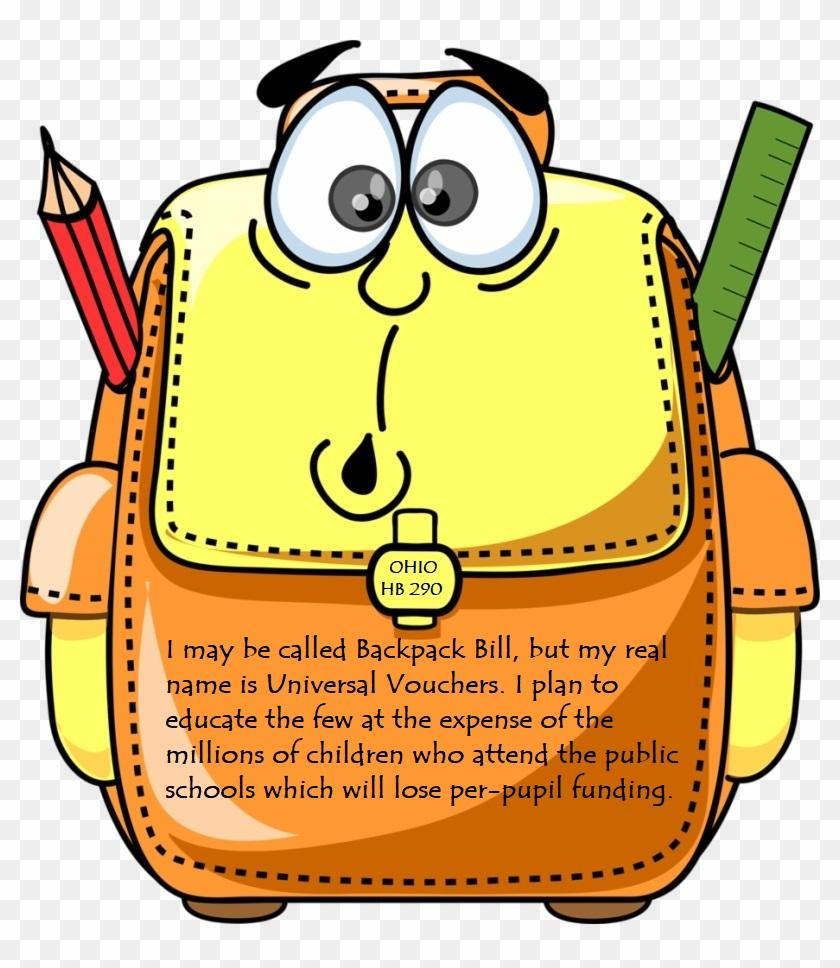
The latest gambit from the Republican privatizers called “the backpack bill,” symbolizing the idea that each child has a “backpack full of cash” to spend in any way their family chooses. They really need to see the wonderful documentary “Backpack Full of Cash.” You can rent the documentary and show it in your community.
Phillis writes:
THE OHIO UNIVERSAL VOUCHER CAMPAIGNERS USE CRITICAL RACE THEORY TO ENTICE FOLKS TO SUPPORT HB290 (UNIVERSAL VOUCHERS) IN A SLICK MAILER
The HB290 crusaders have produced and sent a fundraising mailer signed by one Aaron Baer to an undisclosed list of folks. The seven-page letter warns recipients that public schools are indoctrinating our children into radical anti-Christian ideology, “Critical Race Theory, and trans advocacy”. “They are being trained to hate America”, the letter says. They evidently combed through the classrooms of Ohio and found 4 students whose teachers were doing something that hinted at support for CRT or other controversial issues. They didn’t mention the 100,000 plus public school educators that are working selflessly to grow upstanding citizens. The author of the letter makes such revealing statements as:
“…many of Ohio’s public schools have been failing our students for more than a generation.”
“…I initiated the Backpack Bill (HB290)…” (A couple legislators who sponsored the bill indicate they initiated the bill.)
“…The Backpack Bill ensures every Ohio student can have access to high quality education…”
The P.S. to the letter includes the statement, “Ohio students are trapped in failing public schools…”
The Backpack voucher campaigners are perpetuating the myth of the “failing public school monopoly” as a key plank in their campaign platform.
Public school advocates, who believe HB290 is too extreme to pass, need to wake up.
The WSJ article by law professor Philip Hamburger asserting that public schools are unconstitutional relies on dubious assertions about the history of public schools. As a historian of education who has written about these issues, I disagree with his analysis.
Hamburger’s central critique of the public schools is that they were created by nativists out of fear of Catholicism and their central purpose was to homogenize all children and mold them into Protestants. He repeatedly asserts that the very idea of the public school was shaped by hostility to Catholics.
The earliest public schools, called “common schools,” were organized in the early 19th-century in small towns and villages by families who wanted their children to gain literacy and numeracy. The parents and communities who established common schools were not thinking about stamping out Catholicism. Families wanted their children to be able to read the Bible, and many wanted their sons to have the skills needed to work as clerks or in other non-agricultural work.
He paints an idyllic portrait of 18th century schools, which is a fantasy of his own creation. He writes:
“The shared civic culture of 18th-century America was highly civilized, and it developed entirely in private schools. The schools, like the parents who supported them, were diverse in curriculum and their religious outlook, including every shade of Protestantism, plus Judaism, Catholicism, deism and religious indifference.”
The truth is that very few children of any faith attended school in the 18th-century. Schooling was available to the wealthy, who hired private tutors, and to those who could afford to send their children to a “dame school,” where a woman instructed young children in her home. There were a few religious schools, for those who could pay for them. The children of the poor had no schooling until the turn of the 19th-century, when philanthropic societies began to organize rudimentary “charity schools” for the poor.
As I showed in my history of the New York City public schools (The Great School Wars), the city’s Catholic Bishop John Hughes (later Archbishop) adamantly objected to the schools of the Public School Society, a private group founded by Quakers. Like all schools at the time, the schools of the PSS used the Protestant Bible in their classrooms and had daily prayers. Bishop Hughes insisted that Catholic children should be taught only in Catholic schools, where they would read the Catholic Bible, learn Catholic prayers, and sing Catholic hymns. The founders of the PSS tried to reach a compromise, but Bishop Hughes insisted on creating a separate system of Catholic schools. He asked the Legislature to fund the Catholic “public schools,” as it was funding the Protestant “public schools,” but the legislature refused.
Were there anti-Catholics who supported public schools? Yes. Were there nativists who hated Catholics and who feared that the Pope wanted to seize control of their city or state? Yes.
Was the primary purpose of the public school movement to stamp out the influence of Catholics? No. The overwhelming majority of Americans supported the growth of public schools because they believed that a democratic society needed educated citizens who were prepared for self-government.
The Catholic school system grew and thrived. Catholic leaders thought their schools were unfairly denied public funding, but the idea of prohibiting the public funding of religious schools was broadly popular and appears in almost every state constitution. The public endorsed the proposition that society as a whole, through taxation, is responsible for maintaining a public school system that offers a free education for all who enroll.
Alongside the generalized belief that a democratic society must educate its citizens so that they will vote wisely and be prepared to serve on a jury, there was a concurrent belief that education had a social purpose. In the 19th-century, educators would speak glowingly about the value of children from different economic backgrounds learning together, the banker’s son next to the baker’s son. In the 20th century, the definition of which children learned side-by-side expanded in fits and starts, often with conflict. Education, it was believed, would overcome economic, social, religious, and racial divides, as children learned together.
Few, if any, would contend that the public schools have overcome differences of race, religion, class, and ethnicity. Yet, without them, who can doubt that those differences would be sharpened? For some, the public schools have been a ladder that enabled social mobility, as well as interracial and interreligious friendships. Would we really want to be a society where each sect, each racial and ethnic group has its separate schools? I don’t think so.
While Hamburger pounds his thesis that public schools are and have always been a nativist strategy to crush Catholics, he fails to consider the fact that in mid-20th century America, a significant number of public school teachers and administrators in urban districts were Catholic.
In my view, he misinterprets the seminal Pierce decision of 1925. The state of Oregon passed a law in 1922 that would have required all children to attend public schools, thus banning all private and religious schools. The Society of Sisters sued to prevent the closing of their religious school. The U.S. Supreme Court declared that the law was unconstitutional. The state could not compel children to attend only public school. Children do not belong to the state but to their parents. The decision was not grounded in free speech rights, as the author here contends. The Court declared the right of parents to choose a private school, but did not suggest that public money should be used to pay for their private schooling. The decision confirmed the right of parents to choose either a free public school or a private school at their own expense.
If Professor Hamburger fears that children will be indoctrinated by their teachers, he should stand strongly against the remedies he proposes. The likeliest place where children might be indoctrinated is in a school that reinforces their parents’ views, a school where teachers all agree, a school where dissenting voices are never heard. The best schools, whether public or private, teach young people to make their own decisions, teach them to think for themselves, teach them about the courage of those who dared to stand alone.
The Wall Street Journal, owned by billionaire RupertMurdoch (who also owns Fox News), runs a steady diet of anti-public school editorials. Sometimes they bash public schools. Sometimes they praise charter schools and vouchers. Sometimes they do all of this in the same editorial. While an opinion piece that expresses a dissenting opinion occasionally gets published, it’s fair to say that the WSJ does not like public schools. In my last book, Slaying Goliath, I praised retired Austin librarian Sara Stevenson for responding to every WSJ vilification of public schools.
Peter Greene responded to the opinion piece by law professor Philip Hamburger, who claimed that public schools are not “constitutional” because they suppress parents’ freedom of speech, that is, their ability to ensure that their children hear, read, and learn only what their parents want them to learn.
Greene begins:
Last Friday, the Wall Street Journal (Fox News’ upscale sibling) published an op-ed from Philip Hamburger, a Columbia law professor and head of the New Civil Liberties Alliance, a Koch-funded pro bono firm that takes cases primarily to defend against the “administrative state.” It’s a hit job on public education with some pretty bold arguments, some of which are pretty insulting. But he sure says a lot of the quiet part out loud, and that makes this worth a look. Let me walk you through this. (Warning–it’s a little rambly, and you can skip to the last section if you want to get the basic layout)
Hamburger signals where he’s headed with the very first paragraph: The public school system weighs on parents. It burdens them not simply with poor teaching and discipline, but with political bias, hostility toward religion, and now even sexual and racial indoctrination. Schools often seek openly to shape the very identity of children. What can parents do about it?
Hamburger offers no particular evidence for any of this catalog of arguable points. Various surveys repeatedly show that the majority of parents approve of their child’s public school. The rest is a litany of conservative complaints with no particular evidence, but Hamburger needs the premise to power the rest of his argument.
So here comes Hamburger’s bold assertion:
Education is mostly speech, and parents have a constitutional right to choose the speech with which their children will be educated. They therefore cannot constitutionally be compelled, or even pressured, to make their children a captive audience for government indoctrination. Conservative talking points about public education routinely assert and assume that public education is a service provided to parents, rather than to the students or society at large. It’s case I’ve never seen them successfully make. At the same time, society’s stake in educated members is clear and the entire rationale behind having non-parent taxpayers help pay the cost of public education. In any other instance where the taxpayers subsidize a private individual’s purchase of goods or service (e.g. food stamps, housing), some conservatives say the social safety net is a Bad Thing, so it’s uncharacteristic for them to champion public education as, basically, a welfare program for parents when they want to dramatically reduce all other such programs to bathtub-drowning size (spoiler alert: they’d like to do that with public education, too).
But Hamburger has taken another step here, arguing that speech to children somehow belongs to their parents. It’s a bold notion–do parents somehow have a First Amendment right to control every sound that enters their children’s ears? Where are the children’s rights in this? Or does Hamburger’s argument (as some angry Twitter respondents claim) reduce children to chattel?
Hamburger follows his assertion with some arguments that don’t help. He argues that public education has always attempted to “homogenize and mold the identity of children,” which is a huge claim and, like much of his argument, assumes that schools somehow have the power to overwrite or erase everything that parents have inculcated at home. But then, for the whole argument currently raging, it’s necessary to paint public schools as huge threat in order to justify taking dramatic major action against them….
But “education is speech” is not the really bold part of his argument. That really bold part is where he goes on to say “therefor, parents should have total control over it.” I have so many questions. Should parents have total control over all speech directed at or in the vicinity of their children, including books, and so would I be violating a parent’s First Amendment rights if I gave their child an book for Christmas? And where are the child’s rights in this? Would this mean that a parent is allowed to lock their child in the basement in order to protect that parent’s First Amendment right to control what the child is exposed to?
Hamburger’s argument has implications that he doesn’t get into in his rush to get to “do away with them and give everyone vouchers.” The biggest perhaps is that he has made an argument that non-parent taxpayers should not have to subsidize an education system. I’m betting he’s not unaware of that.
Please open the link and read the rest of the article.
The Wall Street Journal recently published a screed against the very existence of public schools, written by a libertarian lawyer. Imagine teaching in a school where children are allowed to learn only what their parents already believe, no matter how bizarre or hateful it may be. Imagine the difficulty of having a coherent society where there are no compromises, no bonds of mutuality among people of different faiths and ethnicities. The illustration accompanying the article shows the government turning diverse children into identical cookie cutter people. No one today could reasonably argue that the people of the United States, 90% of whom were educated in public schools, have identical views, values, and beliefs. It is Libertarians who would have all of our children molded into clones of their parents and grandparents, with everyone attending schools that narrowly confined them to their own religious, racial, and ethnic enclave. In reality, private sectarian schools are far more likely to “indoctrinate” children than are public schools that include teachers and children from different backgrounds.
Is the Public School System Constitutional?
Education consists mostly in speech, and parents have a right under the First Amendment to exercise authority over what their children hear.
By Philip Hamburger Oct. 22, 2021
ILLUSTRATION: PHIL FOSTER
The public school system weighs on parents. It burdens them not simply with poor teaching and discipline, but with political bias, hostility toward religion, and now even sexual and racial indoctrination. Schools often seek openly to shape the very identity of children. What can parents do about it?
“I don’t think parents should be telling schools what they should teach,” Terry McAuliffe, the Democratic nominee for governor of Virginia, said in a Sept. 28 debate. The National School Boards Association seems to agree: In a Sept. 29 letter to President Biden, its leaders asked for federal intervention to stop “domestic terrorism and hate crimes” against public school officials. Attorney General Merrick Garland obliged, issuing an Oct. 4 memo directing law-enforcement agents and prosecutors to develop “strategies for addressing threats against school administrators, board members, teachers, and staff.”
Mr. Garland’s memo did acknowledge that “spirited debate about policy matters is protected under our Constitution.” That is true but doesn’t go nearly far enough. Education is mostly speech, and parents have a constitutional right to choose the speech with which their children will be educated. They therefore cannot constitutionally be compelled, or even pressured, to make their children a captive audience for government indoctrination.
Public education in America has always attempted to homogenize and mold the identity of children. Since its largely nativist beginnings around 1840, public education has been valued for corralling most of the poor and middle class into institutions where their religious and ethnic differences could be ironed out in pursuit of common “American” values.
The goal was not merely a shared civic culture. Well into the 20th century, much of the political support for public schooling was driven by a fear of Catholicism and an ambition to Protestantize Catholic children. Many Catholics and other minorities escaped the indoctrination of their children by sending them to private schools.
Nativists found that intolerable. Beginning around 1920, they organized to force Catholic children into public education. The success of such a measure in Oregon (with Democratic votes and Ku Klux Klan leadership) prompted the Supreme Court to hold compulsory public education unconstitutional.
The case, Pierce v. Society of Sisters (1925), was brought by a religious school, not a parent. The justices therefore framed their ruling around the threat to the school’s economic rights. But Pierce says that parents can educate their children outside state schools in accord with the parents’ moral and religious views.
Although the exact nature of this parental freedom is much disputed, it is grounded in the First Amendment. When religious parents claim the freedom, religious liberty seems an especially strong foundation. But the freedom of parents in educating their children belongs to all parents, not only the faithful. Freedom of speech more completely explains this educational liberty.
Education consists mostly in speech to and with children. Parents enjoy freedom of speech in educating their children, whether at home or through private schooling. That is the principle underlying Pierce, and it illuminates our current conundrum.
The public school system, by design, pressures parents to substitute government educational speech for their own. Public education is a benefit tied to an unconstitutional condition. Parents get subsidized education on the condition that they accept government educational speech in lieu of home or private schooling.
There is nothing unconstitutional about taxation in support of government speech. Thus taxpayers have no generic right against public-school messages they find objectionable.
But parents are in a different situation. They aren’t merely subsidizing speech they find objectionable. They are being pushed into accepting government speech for their children in place of their own. Government requires parents to educate their children and offers education free of charge. For most parents, the economic pressure to accept this educational speech in place of their own is nearly irresistible.
To be sure, Pierce doesn’t guarantee private education. It merely acknowledges the right of parents to provide it with their own resources. And one may protest that economic pressure is not force. But the Supreme Court has often ruled otherwise.
Merely denying a government benefit will often suffice to violate a right—as when government refuses a benefit without a hearing (Goldberg v. Kelly, 1970), denies a grant on account of the recipient’s religious beliefs (Trinity Lutheran v. Comer, 2017), or subsidizes a media organization on the condition that it refrain from editorializing (FCC v. League of Women Voters, 1984). Financial pressures clearly count.
When government makes education compulsory and offers it free of charge, it crowds out parental freedom in educational speech. The poorer the parents, the more profound the pressure—and that is by design. Nativists intended to pressure poor and middle-class parents into substituting government educational speech for their own, and their unconstitutional project largely succeeded.
Most parents can’t afford to turn down public schooling. They therefore can’t adopt speech expressive of their own views in educating their children, whether by paying for a private school or dropping out of work to home-school. So they are constrained to adopt government educational speech in place of their own, in violation of the First Amendment.
A long line of Establishment Clause decisions recognize the risk of coercion in public-school messages. In Grand Rapids School District v. Ball (1985), the high court condemned private religious teaching in rooms leased from public schools. “Such indoctrination, if permitted to occur, would have devastating effects on the right of each individual voluntarily to determine what to believe (and what not to believe) free of any coercive pressures from the State,” Justice William Brennan wrote for the majority.
Coercion seemed central in such cases because of the vulnerability of children to indoctrination. Summarizing the court’s jurisprudence, Justice Sandra Day O’Connor, concurring in Wallace v. Jaffree (1985), observed that “when government-sponsored religious exercises are directed at impressionable children who are required to attend school, . . . government endorsement is much more likely to result in coerced religious beliefs.”
These precedents concern only religion in public schools and the coercive effect on children under the Establishment Clause. But the danger of coerced belief is not confined to official religious speech. Subjecting children to official political, racial, sexual and antireligious speech can be equally coercive. And if public-school messages are so coercive against children, it is especially worrisome that parents are being pressured to adopt public educational speech in place of their own.
Rights are “exceptions” to power, James Madison observed. That is, rights defeat power. But contemporary judicial doctrine allows power to defeat rights—at least when government asserts what is called a compelling interest. One might think that a state’s compelling interest in public education overpowers any parental speech right. Yet because such analysis allows power to subdue rights, it is important to evaluate whether the claimed government interest is really compelling.
The U.S. was founded in an era when almost all schooling was private and religious, and that already suggests that any government interest in public education is neither necessary nor compelling. Further, the idea that public education is a central government interest was popularized by anti-Catholic nativists. Beginning in the mid-19th century, they elevated the public school as a key American institution in their campaign against Catholicism.
In their vision, public schools were essential for inculcating American principles so that children could become independent-minded citizens and thinking voters. The education reformer and politician Horace Mann said that without public schools, American politics would bend toward “those whom ignorance and imbecility have prepared to become slaves.”
That sounds wholesome in the abstract. In practice, it meant that Catholics were mentally enslaved to their priests, and public education was necessary to get to the next generation, imbuing them with Protestant-style ideas so that when they reached adulthood, they would vote more like Protestants.
This goal of shaping future voters gave urgency to the government’s interest in public education. As today, the hope was to liberate children from their parents’ supposedly benighted views and thereby create a different sort of polity. Now as then, this sort of project reeks of prejudice and indoctrination. There is no lawful government interest in displacing the educational speech of parents who don’t hold government-approved views, let alone in altering their children’s identity or creating a government-approved electorate.
The inevitably homogenizing, even indoctrinating, effect of public schools confirms the danger of finding a compelling government interest in them. A 1904 nativist tract grimly declared that the public school is “a great paper mill, into which are cast rags of all kinds and colors, but which lose their special identity and come out white paper, having a common identity. So we want the children of the state, of whatever nationality, color or religion, to pass through this great moral, intellectual and patriotic mill, or transforming process.”
The idea of a common civic culture among children is appealing when it develops voluntarily, but not when state-approved identities and messages are “stamped upon their minds,” as the 1904 tract put it. Far from being a compelling government interest, the project of pressing children into a majority or government mold is a path toward tyranny.
The shared civic culture of 18th-century America was highly civilized, and it developed entirely in private schools. The schools, like the parents who supported them, were diverse in curriculum and their religious outlook, including every shade of Protestantism, plus Judaism, Catholicism, deism and religious indifference.
In their freedom, the 18th-century schools established a common culture. In contrast, public-school coercion has always stimulated division. It was long used to grind down the papalism of Catholic children into something more like Protestantism. Since then, there has been a shift in the beliefs that public schools seek to eradicate. But the schools remain a means by which some Americans force their beliefs on others. That’s why they are still a source of discord. The temptation to indoctrinate the children of others—to impose a common culture by coercion—is an obstacle to working out a genuine common culture.
There is no excuse for maintaining the nativist fiction that public schools are the glue that hold the nation together. They have become the focal point for all that is tearing the nation apart. However good some public schools may be, the system as a whole, being coercive, is a threat to our ability to find common ground. That is the opposite of a compelling government interest.
The public school system therefore is unconstitutional, at least as applied to parents who are pressured to abandon their own educational speech choices and instead adopt the government’s.
Parents should begin by asking judges to recognize—at least in declaratory judgments—that the current system is profoundly unconstitutional. Once that is clear, states will be obliged to figure out solutions. Some may choose to offer tax exemptions for dissenting parents; others may provide vouchers. Either way, states cannot deprive parents of their right to educational speech by pushing children into government schools.
Judges will be reluctant to vindicate the uncomfortable truth that education is mostly speech. Many have assimilated the nativist ideal that public education is a central and compelling government interest. As in 1925, however, the threat to parental speech has become unbearable.
Mr. Hamburger teaches at Columbia Law School and is president of the New Civil Liberties Alliance.
Duke historian Nancy MacLean, author of the superb Democracy in Chains: The Deep History of the Radical Right’s Stealth Plan for America, wrote recently in The Washington Postabout the sinister origins of school choice. Its true purpose was to protect segregation and abolish public schools. (For my view, see this article in The New York Review of Books.)
MacLean writes:
The year 2021 has proved a landmark for the “school choice” cause — a movement committed to the idea of providing public money for parents to use to pay for private schooling.
Republican control of a majority of state legislatures, combined with pandemic learning disruptions, set the stage for multiple victories. Seven states have created new school choice programs, and 11 others have expanded current programs through laws that offer taxpayer-funded vouchers for private schooling and authorize tax credits and educational savings accounts that incentivize parents moving their children out of public schools.
On its face, this new legislation may sound like a win for families seeking more school options. But the roots of the school choice movement are more sinister.
White Southerners first fought for “freedom of choice” in the mid-1950s as a means of defying the U.S. Supreme Court’s 1954 Brown v. Board of Education decision, which mandated the desegregation of public schools. Their goal was to create pathways for White families to remove their children from classrooms facing integration.
Prominent libertarians then took advantage of this idea, seeing it not only as a means of providing private options, but also as a tool in their crusade to dismantle public schools altogether. This history reveals that rather than giving families more school options, school choice became a tool intended to give most families far fewer in the end.
School choice had its roots in a crucial detail of the Brown decision: The ruling only applied to public schools. White Southerners viewed this as a loophole for evading desegregated schools.
In 1955 and 1956, conservative White leaders in Virginia devised a regionwide strategy of “massive resistance” to the high court’s desegregation mandate that hinged on state-funded school vouchers. The State Board of Education provided vouchers, then called tuition grants, of $250 ($2,514 in 2021 dollars) to parents who wanted to keep their children from attending integrated schools. The resistance leaders understood that most Southern White families could not afford private school tuition — and many who could afford it lacked the ideological commitment to segregation to justify the cost. The vouchers, combined with private donations to the new schools in counties facing desegregation mandates, would enable all but a handful of the poorest Whites to evade compliance.
Other Southern states soon adopted voucher programs like the one in Virginia to facilitate the creation of private schools called “segregation academies,” despite opposition from Black families and civil rights leaders. Oliver Hill, an NAACP attorney key to the Virginia case against “separate but equal” education that was folded into Brown, explained their position this way: “No one in a democratic society has a right to have his private prejudices financed at public expense.”
Despite such objections, key conservative and libertarian thinkers and foundations, including economists Milton Friedman and Friedrich Hayek, Human Events editor Felix Morley and publisher Henry Regnery, backed the White Southern cause. They recognized that White Southerners’ push for “freedom of choice” presented an opportunity to advance their goal of privatizing government services and resources, starting with primary and secondary education. They barely, if ever, addressed racism and segregation; instead, they spoke of freedom (implicitly, White freedom).
Friedman began promoting “educational freedom” in 1955, just as Southern states prepared to resist Brown. And he praised the Virginia voucher plan in his 1962 book, “Capitalism and Freedom,” holding it up as a model for school choice everywhere. “Whether the school is integrated or not,” he wrote, should have no bearing on eligibility for the vouchers. In other words, he knew the program was designed to fund segregation academies and saw it as no barrier to receiving state financing.
Friedman was far from alone. His fellow libertarians, including those on the staff of the William Volker Fund, a leading funder on the right, saw no problem with state governments providing tax subsidies to White families who chose segregation academies, even as these states disenfranchised Black voters, blocking them from having a say in these policies.
Libertarians understood that while abolishing the social safety net and other policies constructed during the Progressive era and the New Deal was wildly unpopular, even among White Southerners, school choice could win converts.
These conservative and libertarian thinkers offered up ostensibly race-neutral arguments in favor of the tax subsidies for private schooling sought by white supremacists. In doing so, they taught defenders of segregation a crucial new tactic — abandon overtly racist rationales and instead tout liberty, competition and market choice while embracing an anti-government stance. These race-neutral rationales for private school subsidies gave segregationists a justification that could survive court review — and did, for more than a decade before the Supreme Court ruled them unconstitutional.
When challenged, Friedman and his allies denied that they were motivated by racial bigotry. Yet, they had enough in common ideologically with the segregationists for the partnership to work. Both groups placed a premium on the liberty of those who had long profited from white-supremacist policies and sought to shield their freedom of action from the courts, liberal government policies and civil rights activists.
Crucially, freedom wasn’t the ultimate goal for either group of voucher supporters. White Southerners wielded colorblind language about freedom of choice to help preserve racial segregation and to keep Black children from schools with more resources.
Friedman, too, was interested in far more than school choice. He and his libertarian allies saw vouchers as a temporary first step on the path to school privatization. He didn’t intend for governments to subsidize private education forever. Rather, once the public schools were gone, Friedman envisioned parents eventually shouldering the full cost of private schooling without support from taxpayers. Only in some “charity” cases might governments still provide funding for tuition.
Friedman first articulated this outlook in his 1955 manifesto, but he clung to it for half a century, explaining in 2004, “In my ideal world, government would not be responsible for providing education any more than it is for providing food and clothing.” Four months before his death in 2006, when he spoke to a meeting of the conservative American Legislative Exchange Council (ALEC), he was especially frank. Addressing how to give parents control of their children’s education, Friedman said, “The ideal way would be to abolish the public school system and eliminate all the taxes that pay for it.”
Today, the ultrawealthy backers of school choice are cagey about this long-term goal, knowing that care is required to win the support of parents who want the best for their children. Indeed, in a sad irony, decades after helping to impede Brown’s implementation, school choice advocates on the right targeted families of color for what one libertarian legal strategist called “forging nontraditional alliances.” They won over some parents of color, who came to see vouchers and charter schools as a way to escape the racial and class inequalities that stemmed from White flight out of urban centers and the Supreme Court’s willingness to allow White Americans to avoid integrating schools.
But the history behind vouchers reveals that the rhetoric of “choice” and “freedom” stands in stark contrast to the real goals sought by conservative and libertarian advocates. The system they dream of would produce staggering inequalities, far more severe than the disparities that already exist today. Wealthy and upper-middle-class families would have their pick of schools, while those with far fewer resources — disproportionately families of color — might struggle to pay to educate their children, leaving them with far fewer options or dependent on private charity. Instead of offering an improvement over underfunded schools, school choice might lead to something far worse.
As Maya Angelou wisely counseled in another context, “When people show you who they are, believe them the first time.” If we fail to recognize the right’s true end game for public education, it could soon be too late to reverse course.

 Diane Ravitch's blog