Archives for category: Teachers and Teaching

Gary Rubenstein has been writing a series of posts on the question of whether the math curriculum is useful. Some parts of it are indeed useful, others not so much. In this post, he describes the “useless” topics.

He writes:

I’d estimate that about 15% to 20% of school time in K-12 is spent on math. Elementary and middle schools often have their students do 90 minutes of math a day. And it is common for students to take a math class every year throughout high school.

In my last post I listed a meager six math topics that I consider ‘useful’ and by that I mean that those math skills are really needed by adult consumers and also, to some degree, in a lot of professions. And if you believe me about this and you think that any math that is not useful should not be taught in school you might wonder how much time should be dedicated to those topics throughout a students schooling. Now I’m not saying that I think that we should cut all topics besides these few but if I had to answer how long it could take to teach those, I’d say that we could do it in about 1/3 the amount of time. Math would be a thing like music, art, or physical education.

It’s still an interesting thing to think about, though, because it gets to the fundamental question of ‘what is the purpose of learning math?’ or ‘what is the purpose of learning anything for that matter?’ or ‘what makes this thing better to learn than that thing?.’ I will eventually provide my opinions on these questions.

But before we cut 2/3 of the time that we dedicate to math, we should take a look at what sorts of things would we be depriving the students of and whether there would be negative side effects of these discarded topics.

In Part 2, I mentioned a topic that I said was not ‘useful’ of finding the prime factorization of composite numbers. While it is true that hardly anyone in their adult lives are ever asked to break 555 into 5*3*37, maybe the ‘use’ of this skill is not so direct. The ‘use’ of some ‘useless’ topics is that they are prerequisite skills to more complicated topics in future years and those more complicated topics might be ‘useful’ in some science applications. So some ‘useless’ topics might have some utility as scaffolding to other topics.

Another reason that something like factoring has more ‘use’ than it at first seemed is that prime numbers are really important in more advanced math. They are the building blocks of all other numbers. Maybe someone who loves factoring eventually becomes a math major and they use advanced factoring to create a new cryptography method based on it.

Open the link and keep reading.

In 2020, when I published my last book, Slaying Goliath, I opined that education “reform” as defined by No Child Left Behind and Race to the Top (standardized testing, school closings, school grades, charter schools, evaluating teachers by student scores, merit pay, Common Core, etc.) was a massive failure. The test-and-punish and standardization mandates had turned schooling into a joyless, test-obsessed experience that demoralized teachers and students alike. None of the promises of “reform” came to pass, but privatization via charter inevitably led to vouchers and the defunding of public schools.

The failure of federally-mandated reforms seemed obvious to me but Congress continues to use standardized tests as the ultimate gauge of students, teachers, and schools, despite the destruction that was obvious to anyone with eyes to see. And the reviewer in The New York Times slammed my book for daring to doubt the virtue of the “Ed reform” movement.

Perry Bacon Jr. wrote an article recently for the Washington Post titled “‘Education Reform’ Is Dying. Now We Can Actually Reform Education.” It was amazing to see this article in The Washington Post because for years its editorial writer was a cheerleader for the worst aspects of that destructive movement (Rhee could do no wrong, charters are wonderful, firing teachers and principal is fine). But the education editorial writer retired, hallelujah, and we get to hear from Perry Bacon Jr., in addition to the always wonderful Valerie Strauss (whose excellent “Answer Sheet” blog does not appear in the printed paper but online).

Earlier today, John Thompson earlier today responded on this blog to Bacon’s brilliant article. I meant to post the article by Bacon but forgot. Here it is. What do you think?

Perry Bacon Jr. wrote:

America’s decades-long, bipartisan “education reform” movement, defined by an obsession with test scores and by viewing education largely as a tool for getting people higher-paying jobs, is finally in decline. What should replace it is an education system that values learning, creativity, integration and citizenship.

Joe Biden is the first president in decades not aggressively pushing an education agenda that casts American schools and students as struggling and in desperate need of fixing. He has not stated that “education is the civil rights issue of our time,” a sentence said by presidents George W. Bush, Barack Obama and Donald Trump. His administration has backed policies, such as an expanded child tax credit, that view giving people more money, not more education, as the main way to reduce poverty.

There is a push from experts and politicians across partisan lines, including from Biden, to get employers to stop requiring college degrees for so many jobs. There is also a growing defense of college students who study English, literature and other subjects that don’t obviously lead to jobs in the way that, say, engineering does.

An education gospel is being dismantled, one that was 40 years in the making. In 1983, the Reagan administration released a report called “A Nation at Risk: The Imperative for Educational Reform.” It warned that America’s status as an economic powerhouse was under threat because its students were doing so much worse than those from other industrialized nations on standardized tests. That report put education reform on the national agenda and explicitly tied it to economic growth.

But this education fixation wasn’t just about the economy. The two parties couldn’t agree on racial policy. Democrats wanted more funding and explicit policies to help Black people and heavily Black areas to make up for past discrimination, and the Republicans largely opposed them.

What Democrats and Republicans could agree on was making education a priority. So Republican politicians, particularly Bush, pumped more money into schools, as Democrats wanted. And Democrats broadly adopted the view that education was the main way for Black people to make up for the effects of racism, thereby shifting responsibility for Black advancement from the government to individual African Americans, as Republicans wanted.

Eventually education, particularly getting a college degree, became viewed as the primary way for economic advancement for not just Black people but people of all races who weren’t born into the middle class.

The result was a bipartisan education fixation for much of the period between 1990 and 2016. It included the expansion of charter and magnet schools as an alternative to traditional public schools; an obsession with improving student test scores; accountability systems that punished schools and teachers if their kids didn’t score well; increased government spending on college loans and grants as part of a movement to make college essentially universal; and a push for Black students in particular not to just get college degrees but ones in “STEM” fields (science, technology, engineering and math) that would help them get higher-paying jobs.

This agenda was racial, economic and education policy all wrapped into one.

The problem is that this education push didn’t work. While the number of Americans who have graduated from high school and college have skyrocketed in the past three decades, wages and wealth haven’t grown nearly as much. Black people in particular haven’t seen economic gains matching these huge increases in education levels.

Instead of increased education benefiting Americans broadly, this education dogma created a two-tiered system. White-collar, secure, higher-paying jobs with good benefits went disproportionately to college graduates, while those in the worst jobs tended to not have degrees. And to get those degrees, Americans often had to borrow tens of thousands of dollars.

So Americans started revolting. The Black Lives Matter Movement emerged in 2013 and expressed frustration not only with police brutality but also with the continued economic struggles of Black Americans. In the 2016 presidential campaign, both Sen. Bernie Sanders (I-Vt.) and Trump appealed to voters who felt abandoned by a bipartisan political establishment that appeared unbothered by the disappearance of manufacturing and other jobs that didn’t require higher education. Sanders called for free college, appealing to young people frustrated that their best path to a good job was accruing tens of thousands of dollars in education debt.

After Trump’s election, both parties embraced the idea that they must try to help Americans, particularly those without college degrees, who feel stuck in today’s economy. So politicians are no longer casting education as the ideal solution to economic or racial inequality. Biden and the Democrats are specifically trying to create jobs that would go to non-college graduates, and they are pushing policies, such as expanding Medicaid, that would disproportionately help Black Americans even if they don’t have much advanced education.

But if the real aim of education policy is no longer really economic and racial policy, what should its goals be? Neither party seems to have a clear answer. Most Democrats defend teachers, a core party constituency, and extol public schools and community colleges, trying to shed the Democrats’ reputation as the party for graduates of Ivy League schools. But they don’t have a broader theory of education policy.

The Republicans are doing something much worse. At the state level, they are largely abandoning public schools and instead aggressively pushing universal voucherlike programs for K-12 education to help as many families as possible to enroll their kids in private and/or religious schools. They are also casting K-12 public school teachers and in particular college professors as propagandists who impose liberal values on students. At the college level, Republicans are trying to force out left-leaning faculty and push campuses to the right.


I certainly prefer the “teachers, professors and public schools are good” perspective (the Democratic one) over “teachers, professors and public schools are bad” (the Republican one). But neither is a real vision for American education.

Here’s one: Our education system should be about learning, not job credentialing. Schools and universities should teach Americans to be critical thinkers, not automatically believing whatever they heard from a friend or favorite news source. They should make sure Americans have enough understanding of economics, history and science to be good citizens, able to discern which candidate in an election has a better plan to, say, deal with a deadly pandemic. They should foster interest and appreciation of music, arts and literature.

They should be places where people meet and learn from others who might not share their race, class, religion or ideology. Our schools and universities should of course also provide people the core skills for jobs that actually require higher education. They should provide a path to becoming a doctor, lawyer, professor or any profession that requires specialized training without going into debt.
What our education system should not be is 16 years of required drudgery to make sure that you can get a job with stable hours and decent benefits — or a punching bag for politicians who have failed to do their jobs in reducing racial and economic inequality.

“What I think colleges and universities should do right now is to stop selling this myth that education is going to be the great equalizer,” University of Wisconsin at Green Bay professor Jon Shelton said in a recent interview with Inside Higher Ed.

Shelton, author of a new book called “The Education Myth: How Human Capital Trumped Social Democracy,” added, “I think what we need to do is focus on being the institutions that are going to help society solve these bigger problems, to be the place where people can encounter controversial ideas on campus, where we can have far-reaching conversations about what needs to change in our economy, and how we’re going to create the kind of world in which climate change doesn’t destroy our entire way of life.”

Blessedly, education reform is dying. Now we can reform our schools and colleges in a way that actually improves teaching and learning.

If you can open the article, you will see two graphs displayed: one shows that Black educational attainment has risen substantially (the percent who have graduated high school and college) but Black income and wealth has stalled. Those who were counting on education alone to eliminate poverty were wrong.

Note to reader: a version of this post was published at 1:30 p.m. This was WordPress’s error. This is the finished version. Too complicated to explain.

Gary Rubinstein is writing a series on whether the math taught in school is useful. Americans typically study math every year, yet don’t remember most of what they learned. This is part 2, in which he identifies the “useful” part of the math curriculum.

He begins:

What if your house was burning down and you could only save one box of your things? What would you save? Fortunately most people will never have to make this decision but it is still an interesting exercise where you think about what it is in your life that really matters.

As a math educator I sometimes think what if I could only choose a small collection of the most ‘useful’ math topics to save from the entire K-12 curriculum. As I argued in the previous post, I think that at least half of the school math topics are not really ‘useful’ in the sense that you will ever actually ‘use’ them in your life. With this narrow definition of ‘useful’ and ‘useless’ an example of something that is pretty useless is to find what’s called the ‘prime factorization’ of a number like 555 and write it as 3*5*37. There might be some uses of prime factorization in some other math topics but certainly on its own it isn’t a very useful skill.

But some math topics are very ‘useful’ and I think that all students should learn them at some point throughout their schooling. In this post I’m going to make an annotated list of what those topics are. These are like the box I’m saving of ‘useful’ math. The list isn’t going to be very long which leads to the question about whether the math curriculum could be compressed so that it doesn’t take 13 years or if some of the less ‘useful’ topics should still be taught for other reasons.

In the old days, like the 1700s, a big thing that math was used for was converting different units of measurement for commerce. So converting ounces to pounds and things like that were very important and you practiced with difference currencies and things like that. Well here in the 21st century we aren’t doing those sorts of conversions very much but in this new world there are different kinds of calculations we have to do. In the news all the time we see different statistics and sometimes two different news sources interpret data in different ways so an informed citizen should have some basic ‘numeracy.’

#1: Basic adding, subtracting, multiplying, and some division. With all the options we have as consumers, it is important for us to be able to look at two competing options and decide which one is better for you. There are different ways to teach these things and I’ll address those later, but these things should be mastered by everyone.

#2: Percentages. Though percentages are really just an application of division and multiplication, I think everyone should have an understanding that 50% of something is the same as half of it while 10% of something is one tenth of it. So 50% of 400 is 200 and 10% of 400 is 40. And once you know about 10%, you can easily calculate or estimate other percentages, like 30% of 400 will be 3 times 10% of 400 which is 3*40=120. Also see how that is a little more than 25% of 400 which is one fourth of 400 or 100. Calculating tips and understanding when businesses offer 30% off or a loan that has a 2.75% interest rate and things like that are really important so consumers can make informed decisions.

#3: Basic Geometry. Knowing how to find the area of a rectangular or triangular floor is something that everyone should know. Put that skill together with multiplying and dividing and you can figure out how much carpet to order and how much it will cost.

#4: Basic statistics and probability. When you make an investment, including whether or not to play the lottery, you are taking a risk. So having some ability to measure this risk will help citizens make the right choices and not get taken advantage of.

#5: Basic ‘data science’. Nowadays we hear so many numbers on the news, but people can’t interpret these numbers without knowing how to think about them. Like we hear that crime has ‘doubled’ from last year and it sounds pretty bad. But someone who has studied this kind of data science knows what the other relevant information is. Like in this case, if crime went up from 1 incident to 2 incidents, that’s a lot different than if crime went up from 10,000 incidents to 20,000 incidents even though they are both ‘double.’ In the education research that I have done, I’ve come across papers that claim that an educational strategy resulted in ‘110 additional days of learning’ which can really mislead a reader who is not aware of the assumptions that go into these sorts of calculations.

#6: Interpreting graphs. So often, especially nowadays, data is presented in a visual form. There are scatter plots and pie charts and so many ways to use pictures to represent information. An educated citizen should be able to look at these and understand them.

Open the link and keep reading.

Arthur Goldstein recently retired, concluding his nearly four decades as a teacher in the New York City public schools. For those who have followed his blog, NYC Educator, it’s clear that Arthur speaks his mind and fears no one. He is devoted to his students, his profession, and his unerring sense of principle. Arthur recently moved his blog to Substack, and we can expect him to continue to speak out against the powerful with clarity and humor.

Kids are kids. They really make this job rewarding. All teachers know, though, that beyond that, the quality of your supervisor can make this job rewarding, bearable, or even unbearable.

I’ve had all kinds. I have to admit, for most of my time in Francis Lewis High School, I’ve been blessed with a few extraordinary supervisors. I had escaped from another school, from a witless administrator who tried to blackmail me to teach Spanish. I know Spanish, but I know English much better, and I love teaching it to newcomers.

I took a UFT transfer, a great thing that was unceremoniously dumped in 2005 contract. I worked for Nivea Cavallo, a very understanding AP who made it a point to actually teach every possible level of every subject she could. One of my colleagues back then was Jackie Irving. Jackie’s the best ESL teacher I’ve ever seen. This notwithstanding, she scratched and clawed her way to the top, until she became my AP. Everyone will tell you she’s a great AP, and that we’re lucky to have her. I’ll try to show you instead.

Jackie and I worked together when she was a lowly coordinator. I was the LAB-Besis coordinator. I took the job because I was chapter leader and it was the only way I could get an actual office. I was terrible at this job, and understood nothing. I had to come in on weekends to keep up with the tedious data entry. Whenever Jackie calmly said, “I have a concern,” it meant “Run for your life! The ship is sinking, it’s the end of the world and nothing will save us now!” To me, there was absolutely nothing more terrifying than that phrase.

I sometimes come to school meetings late. (Perhaps more than that). Whenever I do, I say, “Boy, this place is hard to find.” Really, there’s no excuse for being late. When Jackie observed my class, my beginning English students came late with incomprehensible explanations. I laboriously forced them to say, “Boy, this place is hard to find.” I made sure they emphasized, “Boy.” While it didn’t do much to discourage lateness, it made it more inconvenient, and also forced them to use English publicly.

Another thing Jackie noticed when observing my class is that, whenever someone said, “I’m sorry,” half the class replied, “Sorry is garbage!” I once had a young Korean student of diminutive stature, and he said it frequently. I have no idea where he got it from. But I started repeating it, and it became a part of our classroom vocabulary.

Aside from disciplinary hearings, where I was kind of relentless, Jackie and I had many borderline contentious meetings when I was chapter leader. She would never lose her temper. She would never lose view of her goal. She would sit there, and patiently explain whatever it was until I absolutely agreed with her. I can’t recall a time she didn’t persuade me she was right. No one else has that particular power over me.

Now I’m on the cusp of retirement, and our department just threw a party for new and recent retirees. As chapter leader of a very large school for 12 years, I’ve been to many such parties, but also more disciplinary hearings than I care to recall. I’ve read many a letter to file, and explained them in great detail to many members. By some miracle, over almost 39 years, I’ve never gotten one myself.

On many occasions speaking with Jackie, I’d say, “Let them put a letter in my file.” She would take a very formal tone, and say, “MISTER Goldstein. Do you know who would have to WRITE that letter to file?”

Anyway, at our retirement party, Jackie spoke touchingly of all the other retirees. To me, she gave my first letter to file, and read it aloud to all. Here it is:

Paul Bowers, who covered education for the Charleston Post and Courier, writes on his blog Brutal South about deteriorating working conditions for the state’s teachers. Class sizes are rising, and the state has chosen to divert funding from the public schools.

Compared to 15 years ago, South Carolina public school teachers are doing more work, administering more tests with higher stakes, for wages that increasingly get eaten by inflation, under intensifying scrutiny from aggrieved political actors — and in many cases, they’re doing it with more students than ever.

The last time I looked into the growth of K-12 classroom sizes in my state was 2019, and the picture was bleak. While state regulations1 set strict limits on student-teacher ratios in most types of classrooms, the state legislature had started granting waivers to those caps during the Great Recession and had not resumed enforcement.

Predictably, median classroom size soared as the state stopped funding its obligations to school districts, teachers’ promised pay increases were frozen, and teachers quit the profession faster than the colleges of education could graduate new ones. When I wrote about the trend for The Post and Courier in 2019, classroom sizes had begun to shrink but were still significantly larger than they were in the 2007-08 academic year…

I’m a graduate of South Carolina public schools who sends his kids to South Carolina public schools, and despite the bad headlines and flagging test scores, I’ve seen firsthand how our education system can change people’s lives for the better. I’m certainly better for it, and my own kids are flourishing.

But after a decade-and-a-half of austerity and a century-and-a-half of backlash to the universal public good of education in South Carolina, I’m left wondering how many more hits the system can take….

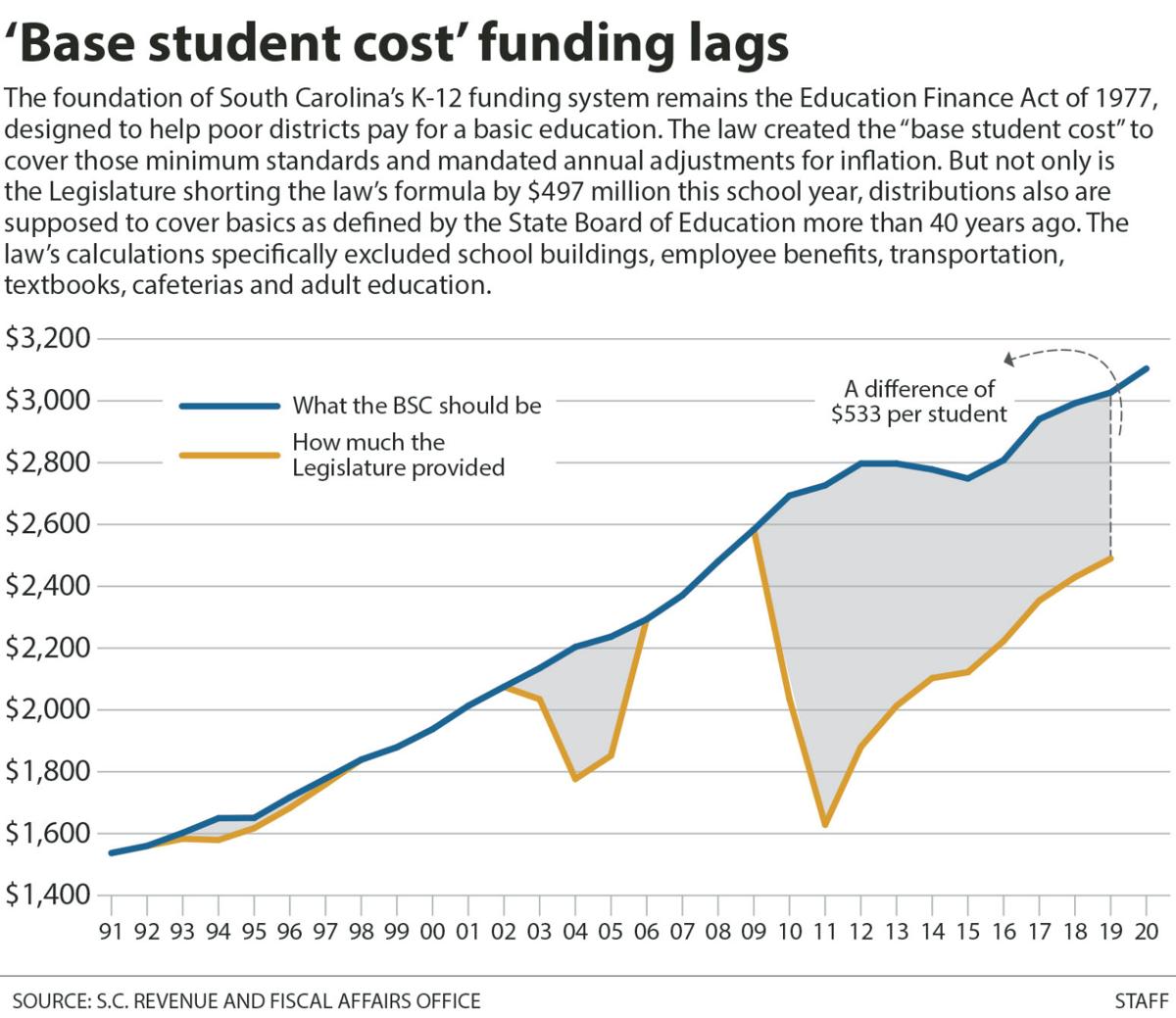
South Carolina Gov. Mark Sanford and the Republican-controlled legislature kneecapped school funding in 2006 with a tax handout to homeowners (Act 388) that routinely wrecks school revenues during economic downturns. As metropolitan school districts have grown thanks in part to an influx of workers for manufacturing concerns like Boeing, Volvo, and BMW, county governments have handed those employers massive tax incentives that cheated schools out of $2.2 billion in the last 5 years alone. And the legislature has not funded its own legally mandated Base Student Cost to districts since 2009, flagrantly violating the law every time it passes a budget — with outsize effects in our poorest rural districts.

Clearly, the leaders of the state don’t understand that their penuriousness towards the schools will hurt the next generation and the future of the state. They think in the moment. They forget about the future. They can attract corporations with a low-wage, non-union workforce, but they can’t build a thriving state unless they educate all the children.

Gary Rubinstein joined Teach for America in its second cohort, three decades ago. He worked diligently for the organization but became disillusioned by its constant boasting and its in attention to preparing teachers well.

In this post, he notes that TFA has plenty of money j the bank, but it has lost its luster. In its glory days, it attracted 6,000 applicants. Now it gets only 2,000.

He writes:

In the last few years, TFA has shrunk. Their incoming corps size dropped from 6,000 to under 2,000. They recently laid off 25% of their staff. And those alumni education leaders have pretty much all resigned and faded into oblivion. TFA is at its lowest point since the mid 1990s.

So when I read about their big new announcement, I wondered what it might be. It turned out to be a ‘rebranding’ that they are really excited about. Basically, a new logo.

As a companion to the new logo, they released the most bizarre FAQ explaining the rationale of the new logo.

Open the link to understand why TFA is excited about its new logo.

I apologize in advance. I am habitually skeptical of fads and movements. When a hot new idea sweeps through education, it’s a safe bet that it will fall flat in the fullness of time. If there is one consistent theme that runs through everything I have written for the past half century, it is this: beware of the latest thing. Be skeptical.

The latest thing is the “Science of Reading.” I have always been a proponent of phonics, so I won’t tolerate being pilloried by the phonics above all crowd. If you read my 2000 book, you will see that I was a critic of Balanced Literacy, which was then the fad du jour.

Yet it turns my stomach to see Educatuon journalist and mainstream dailies beating the drums for SOR. As you know, I reacted with nausea when New York Times’ columnist Nick Kristof said that the SOR was so powerful that it made new spending unnecessary, made desegregation unnecessary, made class size reduction unnecessary. A dream come true for those in search of a cheap miracle!

Veteran teacher Nancy Bailey, like me, is not persuaded by the hype. She wrote a column demonstrating that the corporate reform world—billionaires and politicians—are swooning for the Science of Reading.

She writes:

Many of the same individuals who favor charter schools, private schools, and online instruction, including corporate reformers, use the so-called Science of Reading (SoR) to make public school teachers look like they’ve failed at teaching reading.

Politicians and corporations have had a past and current influence on reading instruction to privatize public schools with online programs. This has been going on for years, so why aren’t reading scores soaring? The SoR involves primarily online programs, but it’s often unclear whether they work.

The Corporate Connection to the SoR

Bill and Melinda Gates Foundation

The Bill and Melinda Gates Foundation fund numerous nonprofits to end public education. The National Council of Teacher Quality (NCTQ), started by the Thomas B. Fordham Foundation backed by Gates and other corporations, an astroturf organization, promotes the SoR.

SoR promoters ignore the failure of Common Core State Standards (CCSS), embedded in most online programs, like iReady and Amplify. CCSS, influenced by the Gates Foundation, has been around for years.

Also, despite its documented failure ($335 million), the Gates Foundation Measures of Effective Teaching, a past reform initiative (See VAMboozled!), irreparably harmed the teaching profession, casting doubt on teachers’ ability.

EdReports, another Gates-funded group, promotes their favored programs, but why trust what they say about reading instruction? They’ve failed at their past education endeavors.

But the Bill and Melinda Gates Foundation continues to reinvent itself and funds many nonprofits that promote their agenda, including the SoR.

Former Governor Jeb Bush’s Organizations

Former Governor Bush of Florida (1999 to 2007) promoted SoR, but if children have reading problems, states should review past education policies, including those encouraged by former Governors, including Mr. Bush. His policymaking in public education has been around for a long time.

One should question, for example, Mr. Bush’s third-grade retention policy ignoring the abundance of anti-retention research showing its harmful effects, including its high correlation with students dropping out of school.

He rejected the class size amendment and worked to get it repealed. Yet lowering class size, especially in K-3rd grade, could benefit children learning to read.

As far back as 2011, Mr. Bush promoted online learning. He’s not talking about technology supplementing teachers’ lessons. He wants technology to replace teachers!

Here’s a 2017 post written in ExelInEd, Mr. Bush’s organization, A Vision for the Future of K-3 Reading Policy: Personalized Learning for Mastery. They’re promoting online learning to teach reading as proven, but there’s no consistent evidence this will work.

Here’s the ExcelinEd Comprehensive Early Policy Toolkit for 2021 where teachers often must be aligned to the SoR with Foundations of Reading a Pearson Assessment. If the teacher’s role loses its autonomy, technology can easily replace them. 

Laurene Powell Jobs and Rupert Murdoch’s Amplify

How did Rupert Murdoch’s old program Amplify become the Science of Reading?

Rupert Murdoch invested in Amplify, News Corp.’s $1 Billion Plan to Overhaul Education Is Riddled With Failures. Then Laurene Powell Jobs purchased it. Does a change in ownership miraculously mean program improvement?

Teachers from Oklahoma described how student expectations with Amplify were often developmentally inappropriate, so how is this good reading science?

Many SoR supporters who imply teachers fail to teach reading do podcasts for Amplify. Are they compensated for their work? Where’s the independent research to indicate that Amplify works?

Amplify, and other online reading programs, are marketed ferociously to school districts with in-house research relying on testimonials. When schools adopt these programs, teachers have a reduced role in students’ instruction.

Chan-Zuckerberg Initiative (CZI) and Their Data Collection

Priscilla Chan pushes Reach Every Reader, including prestigious universities that write SoR reports.

Why must they collect data involving children and their families?

CZI promotes the Age of Learning and ABC Mouse for young children. The reviews of this program appear primarily negative.

I served on the governing board of the National Assessment of Educational Progress (NAEP) for seven years. I was appointed by President Clinton. I learned quite a lot about standardized testing during that time. I enjoyed reading test questions and finding a few that had two right answers. Two subjects where I felt confident as a reviewer, in addition to reading, were history and civics.

I was momentarily dismayed, but not surprised, to learn that the NAEP scores in history and civics had declined, as they had in reading and math, after the disruptions and closings caused by the pandemic. This is not surprising, because fewer days of instruction translates into less learning.

So we know for sure that instructional time matters. You can’t learn what you weren’t taught.

But on second thought, I realized that in these days it is almost impossible to test history and civics and get a meaningful result.

Many states, all Republican-dominated, have censored history teaching. The legislatures don’t want students to learn “divisive concepts.” They don’t want anything taught that will make students “uncomfortable.” They don’t want “critical race theory” to be taught. These ideas have been spun out at length with other vague descriptions of what teachers are NOT allowed to teach.

The people who write test questions for NAEP history are not bound by these restrictions. They are most likely writing questions about “divisive concepts” and “uncomfortable” topics. They might even ask questions that legislators might think are tinged or saturated by critical race theory.

Given the number of states that ban the teaching of accurate, factual history, it’s seems to me impossible to expect students to be prepared to take an American history test.

Even more complicated is civics. A good civics exam might ask questions about the importance of the right to vote. It might ask questions written on the assumption that vote suppression and gerrymandering are undemocratic practices that were long ago banned by the courts. Yet courts are now allowing these baleful practices to stand. How can a student understand that a discredited practice is now openly endorsed in various state laws and have not been discredited by the courts?

Civics classes typically teach that one of the great strengths of American democracy is the peaceful transition of power from one President to another. How can they teach that idea when Trump partisans insist that he won the last election and was ousted in a coup? How can teachers explain the election process when Trump says it’s rigged (he said it before the 2016 election as well)? How can students answer questions about elections and the Electoral College when Trumpers believe they were corrupted in 2020?

How can teachers teach civics when almost every GOP leader asserts that the election was stolen?

How can civics be taught when public officials defy public opinion to allow any individual to buy guns without a background check or a permit. Having bought a gun, they may wear it openly in some states and carry it concealed in some other states. Students have been practicing in case an armed killer walks into their school during the day. They need only google to learn that a majority of the public favors gun control of varying kinds. Why, they might ask their teacher, doesn’t the legislature and Congress act to protect the lives of children?

Is it worse to teach lies or to teach the truth?

Jim Hightower is a Texas populist who has observed the state’s hard rightward swing with dismay. In this post, he flays the profiteers who are attacking teachers and public schools. You should consider subscribing to his blog.

He writes here in honor of teachers:

I’m a child of privilege. Not the privilege of money (I come from a family of small-town working people). But it was my privilege to grow up in the public schools of Denison, Texas.

There I received the rich blessings of dedicated classroom teachers, a diverse student body, playground socialization, librarians, coaches, cafeteria and custodial workers, student politics, vocational training… and a deep appreciation for the unifying value of community and the Common Good.

That’s why I’m flabbergasted by today’s clique of corporate profiteers, theocratic zealots, and laissez-faire knuckleheads who’re lobbying furiously across the country to demonize, defund, and dismantle this invaluable social benefit. If ignorance is bliss, they must be ecstatic!

Public schools do have some real problems: Politicians constantly slashing education budgets, professional burnout created by understaffing and low pay, the devastating strain of a killer pandemic, and a new-normal of assault-rifle murders. But the profiteers, theocrats, and knuckleheads aren’t interested in those, instead focusing on what they say is the fatal flaw in public education: Teachers.

Yes, the claim is that diabolical educators are perverting innocent minds by teaching America’s actual history, showing students that the full diversity of humankind enriches our society, and presenting our Earth as something to be protected, not plundered. And worse – OMIGOSH – many classroom teachers are union members! So, teachers suddenly find themselves political pawns in the GOP’s culture war. “Our schools are a cesspool of Marxist indoctrination,” squawked Sen. Marco Rubio, and Donald Trump squealed that schools are run by “radical left maniacs” and “pink-haired communists.”

These right-wing Chicken Littles are demonizing America’s invaluable educators because they need someone for people to hate, providing cover for their unpopular plot to privatize education. But hate can easily backfire on hatemongers – and local teachers are a whole lot more popular than conniving politicos and profiteers.

Nancy Flanagan, now retired, taught music for many years. She is a keen observer of teaching and also of the pundits who regularly criticize teachers. She has been there, done that, and has no sympathy for armchair “experts.”

She recently reviewed a book that won her praise: Alexandra Robbins’s THE TEACHERS: A YEAR INSIDE AMERICA’S MOST VULNERABLE, IMPORTANT PROFESSION.

This book, Flanagan writes,

does what many other books about teaching are not able to do–take the reader right into the classroom, and describe what’s happening, with empathy and perception. There are lots of books about problems in American education, and lots of books that suggest solutions for those problems, but we seldom get to see examples, conversations and the people doing the work.

If you want a drone’s eye view of American public education—where it’s been, what bedevils the century-old movement to improve it—I would recommend Diane Ravitch’s trio of excellent books that follow education reform over the last couple of decades, or A Wolf at the Schoolhouse Door: The Dismantling of Public Education and the Future of School by Jack Schneider and Jennifer Berkshire.

But if you want to see what happens in the classroom and in the lives of teachers, Robbins accomplishes that better than any book I’ve read since Tracy Kidder’s Among Schoolchildren, written in 1989, which now feels like ancient history. The book is a tour de force—every teacher I know who’s read it agrees—unapologetically written from the POV of teachers without feeling the need to make excuses or backpedal.

I read an advance copy of the book and was similarly impressed. I felt that at this very moment, when teachers are being vilified by the likes of Betsy DeVos, Ron DeSantis, and other red state politicians, Alexandra Robbins’ book is a necessary antidote to scurrilous claims that teachers are “grooming” students for a life of perversity or training them to be Marxists. People who rain insults on teachers should be barred from public life.

Robbins follows three excellent teachers and describes their lives, their trials and successes.

Robbins highlights things that other education books don’t notice or can’t be bothered with–in-building teacher jealousies and vindictiveness, physical violence against teachers, the long-term effects of cuts to things once considered normal in every school, what it’s like to sit in an IEP meeting with a recalcitrant parent or clueless colleague.

Flanagan writes:

This book is also the first and best description I have read about the impact of the pandemic on teaching and learning. There have been endless articles and research on “learning loss”–all rife with meaningless data and numbers–but nobody talks about the impact of being expected to position family needs as secondary to students’ needs. Robbins gets this right–there is a line between acting morally vs. choosing school over family, a choice that teachers were urged to make, and reviled when they chose their own families and their own health. We have not yet reconciled that, here in America—but the book makes a good start on it.

Highly recommended for everyone, but especially teachers. It’s a fairly fast and facile read, although well-documented with endnotes, and should give teachers a lift, knowing that their work and their dilemmas have been acknowledged.