Archives for category: Student Financial Aid and Student Debt

This is a startling and frightening article about the poison pill embedded in Trump’s One Big Ugly Budget Bill. It contains a plan for destroying the student aid program that has subsidized the cost of higher education for middle-income and low-income students. The plan was described in the 900-page Project 2025. Previous generations of lawmakers believed that the nation benefited by investing in the postsecondary education of young people. They could choose the program they wanted, whether in a liberal arts college or a trade school. Whichever route they chose, their education benefited the nation.

But today, Republicans don’t want the federal government to lend money for students to go to college.

The author of the education chapter in Project 2025 is now in charge of implementing the plan to deep-six student loans inside the Department of Education. Read this article and weep.

The article was written by Astra Taylor and Eleni Schirmer and appears in The New Republic:

The Trump administration’s bombastic attacks on the nation’s most prestigious universities have commanded the public’s attention all year long. Now congressional Republicans are poised to dramatically expand that onslaught. If you think the last few months have been bad for Harvard, brace yourself—the “big, beautiful bill” is coming, and with it, a new dimension of destruction. 

While it’s mostly gone unremarked upon in the mainstream media, institutions of higher learning across the country are about to be pummeled by the looming reconciliation bill, which may portend an extinction event for higher education as we know it. The bill weaponizes working-class families’ reliance on debt to finance their college dreams with such intensity that not only will it push millions to the financial brink, it will push them out of higher education altogether. 

For colleges and universities, the potential fallout is hard to overstate. Whatever schools survive are likely to be drained of working- and middle-class families, instead populated only by society’s most wealthy. As it is, millions of people rightly consider universities to be a costly endeavor that is irrelevant to their everyday life. But rather than remaking higher ed into a vibrant and more democratic institution, this bill threatens to do the opposite. It will cement the stereotype of higher education as an elite institution into an ironclad reality. On June 25, student debtors and their allies will be protesting these devastating cuts in Washington, D.C. But so far, very few elected officials are sounding the alarm on these issues with the fever pitch they deserve, let alone doing the work required to slow down and obstruct their passage into law.  

The overhaul of the student lending system championed by Republican legislators has nothing to do with fiscal responsibility or balancing the budget. Instead, it provides an ominous articulation of the Republican Party’s authoritarian ambitions, one that is chillingly consistent with the bill’s massive increases for immigration and border security. This is not a budget bill, it is a debt and deportation bill—and one built on the fascist foundation laid by the Heritage Foundation’s now-notorious Project 2025

As of this month, Lindsey Burke, formerly the Heritage Foundation’s top education policy official, serves as the Education Department’s deputy chief of staff for policy and programs. As the author of Project 2025’s chapter on education policy, Burke recommended gutting student loan relief (along with diversity, equity, and inclusion programs and scientific research funding) to bring universities to heel and reorient American society toward the far right. 

In the words of influential conservative activist Christopher Rufo, “Reforming the student loan programs could put the whole university sector into a significant recession” and state of “existential terror.” The goal is to use economic policy to impose an unpopular and stifling ideological agenda, exacted by punitive student debt. 

Whereas President Biden’s administration was defined by debates over how much student debt should get canceled and how quickly, this bill kicks away the concept of student loan relief altogether. In a draconian sweep, this bill removes the congressionally authorized power to cancel federal student loans that sitting presidents have long possessed. This means that even if the Democrats win back the White House in 2028, the next president will lack a critical tool—one that Biden possessed but, to his lasting shame, refused to use. 

Though many details are not yet settled, as the Senate and House negotiate between their respective versions, there is no doubt that the bill’s impact will be immediate and profound. Eight million student debtors will see their monthly payments spike from $0 to over $400. Dentists and doctors who choose to work in low-paying community health care centers will no longer be eligible for Public Service Loan Forgiveness programs, dramatically reducing the number of health care providers in communities that are already underserved. The bill even comes after the long-standing, Republican-approved federal student loan repayment plans, which allow borrowers to discharge their debts after a certain number of years of regular payments. 

While existing repayment programs cancel loans after 10 to 25 years of repayment, this bill moves the goalposts back to 30 years. As it is, Americans over 60 are the fastest-growing demographic of student debtors: the only age cohort to increase every single quarter of President Biden’s administration. This bill will all but ensure millions of working people carry their debts until death. 

House Republicans, whose proposals are even more extreme than their Senate colleagues’, want to end subsidized loans, driving up costs by tens of thousands of dollars, and place restrictive caps on federal loan amounts. The House bill viciously cuts Pell Grants while increasing the course load required for part-time students to access aid, making it more difficult for people with jobs or family responsibilities to afford to study. 

Both House and Senate versions strive to reduce Parent PLUS and Grad PLUS programs, decreasing working-class families’ abilities to take on loans commensurate with the costs of tuition. Families that can’t afford to pay up front will either have to take their chances with private lenders—who are likely to shut out the neediest families—or choose to forgo the education altogether. Those who take the gamble will face rising debt loads with little possibility of relief, prompting a doom loop of delinquencies, defaults, and tanked credit scores, exacerbating the financial precarity of already over-stressed and stretched borrowers. 

These cuts won’t just harm students who rely on loans to afford college; they will take the doors off colleges’ and universities’ capacity to expand minds and redistribute opportunity. Lost revenue will encourage schools to close programs, squeeze staff, and perhaps shutter entirely. A proposed endowment tax for colleges and universities has prompted fury among higher education lobbyists, but those players have said very little about the bill’s vigorous imposition of debt as a tool of social control. 

Most insidiously, the House bill conscripts colleges and universities themselves into debt. Under the guise of “accountability,” House Republicans want to force colleges and universities to pay back any unpaid federal loans for “high risk” students. This move is designed to penalize institutions for serving the low-income students who often struggle to pay their loans and discourage them from offering majors that are not maximally remunerative. They want to turn the working-class kid studying to become a social worker, artist, or a physician into a liability to her university. 

This kind of social engineering through debt isn’t new. In fact, it hails from the origins of the student loan crisis. In the early 1960s, an ambitious politician named Ronald Reagan made his name by picking a fight with the students protesting racism and war on the state’s then tuition-free campuses. “Those there to agitate and not to study might think twice before they pay tuition—they might think twice how much they want to pay to carry a picket sign,” he said. As California’s governor, Reagan tapped into his base’s anxieties about a rapidly integrating and evolving society to chip away at state support for education. As president, he doubled down on this strategy, following the recommendations of the first edition of the Heritage Foundation’s Mandate for Leadership, Project 2025’s precursor, slashing Pell Grants and tightening student loan eligibility for middle-class families. 

As Ryann Liebanthall details in Unburdened,an in-depth history of the student debt crisis, the number of Black college freshmen fell by nearly 8 percent between 1980 and 1983. More than any other figure, Reagan deserves credit for undermining what once passed as common sense in the U.S.—the principle that public college should be high quality, widely accessible, and tuition-free. Like today’s Republicans, Reagan invoked the figure of the student protester, the specter of racial equality, and the tool of student debt to implement a retrograde agenda. 

Contemporary Republicans are even more brazen. Consider a recent report released by the Heritage Foundation that recommends terminating higher education “subsidies” and student loan cancellation in order to “increase the married birthrate.” What does this goulash mean in plain English? Widespread access to college has enabled women to envision lives beyond childrearing; restricting access will increase fertility rates. Conservative power players are more than willing to cast the country into a scientific dark age in their quest to shore up traditional worldviews, outmoded hierarchies, and concentrated wealth. 

The reconciliation bill threatens to supercharge their oligarchic cause. Rising costs will reinforce the perception that education is the domain of an out-of-touch elite, prompting many to abandon or abort their academic dreams, which will resegregate broad swaths of society. The threat of mounting debt will discourage people from studying their passions or pursuing careers in public service, steering them instead toward the private sector or the military. It will weaken the general bargaining position of workers, who will be less able to use education as a path of upward mobility, while making the labor force more docile; workers burdened by debt are less likely to strike. By funneling student debtors’ ballooning payments into Wall Street coffers and regressive tax cuts, it will ensure that social and economic disparities become more entrenched.

And it will shrink our horizons. At their best, colleges and universities are not just places where people get trained in a skill or earn a degree; they enable people to grapple with bigger questions—to find out who they are, to unlock what they want to be and do, to discover how the world is made, and to dream how it could be remade differently. This is why authoritarians find education so threatening, and why the reconciliation bill must be understood as a strike against our freedom to question, learn, and choose our fates. Even, or especially, when that process challenges authority.

While some Democratic leaders have begun to warn of the economic dangers posed by this bill, none yet seem to grasp the existential stakes—nor the transformative vision required to build the political will required to change course. 

Where higher education is concerned, it is not enough to defend a status quo that the American public knows is broken. Today, an astonishing $1.6 trillion in federal student loans crushes nearly 43 million people. This insurmountable burden has made ordinary people increasingly skeptical of the value of education and more susceptible to anti-intellectual appeals. 

To counter the Republicans’ vision for higher education, Democrats must go far beyond a milquetoast goal of a less predatory student debt system. They must articulate a galvanizing vision for free college. The measure is popular: Surveys show that many people, including pluralities of Republicans and independents, are supportive of free college, despite decades of Republican propaganda demonizing academia. In recent months, faculty, staff, students, and student debtors have come together to lay this groundwork. It’s time for Democratic politicians to catch up. We need a legislative and executive agenda that courageously resists Republican tyranny by defending higher education as a public good that is both universal and free. Free as in cost and, just as importantly, free as in aimed at enhancing individual and collective freedom. We can’t afford anything less.
President Biden announced today that the government will forgive student debt for another 54,900 borrowers, all of whom took jobs in public service to qualify.

The U.S. Department of Education released a statement:

The Biden-Harris Administration announced today the approval of $4.28 billion in additional student loan relief for 54,900 borrowers across the country who work in public service. This relief—which is the result of significant fixes that the Administration has made to the Public Service Loan Forgiveness (PSLF) Program—brings the total loan forgiveness by the Administration to approximately $180 billion for nearly five million Americans, including $78 billion for 1,062,870 borrowers through PSLF. 

 “Four years ago, the Biden-Harris Administration made a pledge to America’s teachers, service members, nurses, first responders, and other public servants that we would fix the broken Public Service Loan Forgiveness Program, and I’m proud to say that we delivered,” said U.S. Secretary of Education Miguel Cardona. “With the approval of another $4.28 billion in loan forgiveness for nearly 55,000 public servants, the Administration has secured nearly $180 billion in life-changing student debt relief for nearly five million borrowers. The U.S. Department of Education’s successful transformation of the PSLF Program is a testament to what’s possible when you have leaders, like President Biden and Vice President Harris, who are relentlessly and unapologetically focused on making government deliver for everyday working people.” 

The Trump Administration has promised to cease any student loan forgiveness. Project 2025 treats loan forgiveness as a racket and a political trick meant to buy votes. Since Biden has taken action after an election that his party lost, it’s hard to know whose votes he is “buying.” It seems more likely that he is keeping a promise made by the government to students who agreed to enter public service jobs after taking a loan. They kept their promise. Now Biden is keeping the government’s promise to them.

Most people are aware that the cost of higher education has dramatically escalated in recent years, for a variety of reasons. Some students do not enroll in college because they can’t afford it. Others graduate with crushing debt, based on student loans. It’s hard to believe that some European nations have made college either free or affordable.

President Biden has tried repeatedly to find ways to help students pay off their college debt. His most ambitious plan was overturned by the Supreme Court in 2023.

Biden devised a new plan, and yesterday the Supreme Court temporarily blocked that one today.

Adam Lipton and Abby VanSickle of The New York Times told the story:

The Supreme Court on Wednesday temporarily blocked a new effort by President Biden to wipe out tens and perhaps hundreds of billions of dollars of student debt.

The plan was part of the president’s piecemeal approach to forgiving debt after the Supreme Court rejected a more ambitious proposal last year that would have canceled more than $400 billion in loans. Mr. Biden has instead pursued more limited measures directed at certain types of borrowers, including people on disability and public service workers, and refined existing programs.

The decision leaves in limbo millions of borrowers enrolled in a new plan, called Saving on a Valuable Education, which ties monthly payments to household size and earnings.

The emergency application was one of two related to the program that the justices decided on Wednesday. The brief order did not give reasons, which is typical, and no public dissents were noted.

Republican-led states had filed a number of challenges to the plan, including a lawsuit in the U.S. Court of Appeals for the Eighth Circuit, in St. Louis, which earlier this summer issued a broad hold on the loan plan while it considers the merits of the case.

That case could soon make its way back to the justices, who indicated that they expected the lower court to act swiftly on the matter.

The Biden administration had argued the new program was authorized by a 1993 law that allowed the secretary of education to fashion “income contingent repayment” plans. The law authorizes the secretary to determine repayment schedules based on “the appropriate portion of the annual income of the borrower.”

Over the years, the secretary has invoked that law several times to relax repayment requirements. The latest plan, the subject of the Supreme Court’s order, was the most generous one.

It reduced the required payments for undergraduate loans to 5 percent from 10 percent of the borrower’s discretionary income, and it redefined discretionary income to be above 225 percent of the poverty line. People making less than that pay nothing. Loans of $12,000 or less are canceled after 10 years — down from 20 or 25 years — so long as the borrower made payments if required to do so.

The SAVE program, issued in June 2023, was challenged nine months later by the attorneys general of 11 Republican-led states, who said it was flawed in ways similar to the one the justices rejected last year. The 1993 law, they said, contemplates repayment rather than actual or effective forgiveness.

In the administration’s Supreme Court brief in response to one of the challenges, Solicitor General Elizabeth B. Prelogar wrote that the new plan “relies on a different statute with different language to provide a different set of borrowers with different assistance from the one-time loan forgiveness the court held invalid.”

The old plan invoked the Higher Education Relief Opportunities for Students Act of 2003, often called the HEROES Act. That law, initially enacted after the terrorist attacks on Sept. 11, 2001, gave the secretary of education the power to “waive or modify any statutory or regulatory provision” to protect borrowers affected by “a war or other military operation or national emergency.”

In its decision last year, the Supreme Court ruled by a 6-to-3 vote that the 2003 law did not authorize forgiving the loans at issue there. That same day, President Biden vowed to find other ways to provide debt relief.

“Today’s decision has closed one path,” Mr. Biden said. “Now we’re going to pursue another.”

The new program was based on a federal law that contemplated reduced payments based on income.

In the Eighth Circuit lawsuit, filed in Missouri, the appeals court temporarily blocked the entire SAVE plan. The Biden administration had asked the justices earlier this month to clear the way for the plan to take effect.

The administration initially estimated that the SAVE plan would cost $156 billion over 10 years, but that amount assumed that the Supreme Court would uphold the earlier plan. The real cost of the new plan, the states challenging it said, is $475 billion over 10 years. The administration says the real number is smaller, particularly as parts of the SAVE plan have not been blocked.

President Biden has repeatedly tried to reduce the debt that college students incurred and that remains a financial burden for years after they finish college. Republicans have adamantly opposed any effort to relieve millions of students of their college debt, which some have been paying off for decades.

I can’t help but remember my visit to Finland, where I learned that all education, at every level, is tuition-free. How is this possible, I asked. I was told that education is a human right, and no one should pay for a human right. From an economic point of view, the entire nation benefits when more people get a college education. Yet over the past few decades, state governments have reduced their support of public higher education, shifting the burden to individual students.

Heather Cox Richardson wrote about the political dimensions of the student debt issue:

Rising costs of college and cuts to government support for education mean that more than 45 million people across the country owe more than $1.6 trillion in federal loans, an amount equal to the size of the Australian economy. That debt absorbs money people at the lower end of the economic scale would otherwise invest in homes, consumer goods, and so on, and the Biden administration has made it a priority to relieve some of that debt.


When she was the California attorney general, Vice President Kamala Harris took on predatory for-profit colleges and won $1 billion for defrauded veterans and students, and when he ran for office, Biden promised to forgive federal student debt for those earning less than $125,000.


Since the Supreme Court on June 30, 2023, rejected the administration’s plan to forgive more than $400 billion in student debt borrowed through government programs, the administration has turned to other approaches.


In April it began to fix the administrative errors that had kept borrowers from receiving relief through income-driven repayment plans and the Public Service Loan Forgiveness program under which they borrowed the money. Those plans were always intended to offer a way to eliminate student debt, but the Government Accountability Office in 2022 found that poor record keeping meant that that promise had not been honored. On July 14 the administration announced that fixes to those programs would relieve more than 800,000 borrowers of more than $39 billion in student debt.

At the time, Biden did not mince words. “Republican lawmakers—who had no problem with the government forgiving millions of dollars of their own business loans—have tried everything they can to stop me from providing relief to hardworking Americans. Some are even objecting to the actions we announced today, which follows through on relief borrowers were promised, but never given, even when they had been making payments for decades. The hypocrisy is stunning, and the disregard for working and middle-class families is outrageous.”


Since then, the administration has provided relief to others caught in the system as well, including relief of $45.7 billion for 662,000 public service workers, $10.5 billion for 491,000 borrowers with a total and permanent disability, and $22 billion for nearly 1.3 million borrowers who were cheated by their schools, saw their schools close, or are covered by a related court settlement.


Today the administration released the Saving on a Valuable Education (SAVE) plan, a new repayment plan to bring order and relief to federal student borrowers. It is an income-driven repayment plan that is based on a borrower’s income and family size rather than their loan balance, prevents the balance from growing because of unpaid interest, and forgives the remaining balance after a number of years. “The benefits of the SAVE plan will be particularly critical for low- and middle-income borrowers, community college students, and borrowers who work in public service,” the White House said.


Relieving student debt helps those at the lower end of the economy, which will boost economic growth, but there is also a political payoff in these efforts for the administration. As Democratic strategist and pollster Celinda Lake and documentary filmmaker Mac Heller pointed out in the Washington Post in July, in the eight years between the 2016 and 2024 elections, 32 million Americans have become eligible to vote. In the same eight years, as many as 20 million older voters have died.


Lake and Heller note that younger Americans are focused on issues, rather than individuals, and skew progressive (prompting some Republicans to talk about raising the voting age to 25). Fulfilling a campaign promise that overwhelmingly benefits those under 50—parents as well as students—is good politics, blending in with the members of Gen Z (the generation born between the mid to late 1990s and early 2010s) forming political PACs of their own and running for office.

This is one of the best letters that Heather Cox Richardson has written since I started reading her posts. It puts the current Supreme Court’s radical decisions into historical perspective. This Court, hand-picked by Leonard Leo and the Federalist Society, is engaged in a shameless effort to move the clock back to the world as it existed before the New Deal. This Court threatens our democracy and our rights.

She writes:

Today the Supreme Court followed up on yesterday’s decision gutting affirmative action with three decisions that will continue to push the United States back to the era before the New Deal.

In 303 Creative LLC v. Elenis the court said that the First Amendment protects website designer Lorie Smith from having to use words she doesn’t believe in support of gay marriage. To get there, the court focused on the marriage website designer’s contention that while she is willing to work with LGBTQ customers, she doesn’t want to use her own words on a personalized website to celebrate gay marriages. Because of that unwillingness, she said, she wants to post on her website that she will not make websites for same-sex weddings. She says she is afraid that in doing so, she will run afoul of Colorado’s anti-discrimination laws, which prevent public businesses from discriminating against certain groups of people.

This whole scenario of being is prospective, by the way: her online business did not exist and no one had complained about it. Smith claims she wants to start the business because “God is calling her ‘to explain His true story about marriage.’” She alleges that in 2016, a gay man approached her to make a website for his upcoming wedding, but yesterday, Melissa Gira Grant of The New Republic reported that, while the man allegedly behind the email does exist, he is an established designer himself (so why would he hire someone who was not?), is not gay, and married his wife 15 years ago. He says he never wrote to Smith, and the stamp on court filings shows she received it the day after she filed the suit.

Despite this history, by a 6–3 vote, the court said that Smith was being hurt by the state law and thus had standing to sue. It decided that requiring the designer to use her own words to support gay marriage violated the First Amendment’s guarantee of free speech.

Taken together with yesterday’s decision ruling that universities cannot consider race as a category in student admissions, the Supreme Court has highlighted a central contradiction in its interpretation of government power: if the Fourteenth Amendment limits the federal government to making sure that there is no discrimination in the United States on the basis of race—the so-called “colorblind” Constitution—as the right-wing justices argued yesterday, it is up to the states to make sure that state laws don’t discriminate against minorities. But that requires either protecting voting rights or accepting minority rule.

This problem has been with us since before the Civil War, when lawmakers in the southern states defended their enslavement of their Black (and Indigenous) neighbors by arguing that true democracy was up to the voters and that those voters had chosen to support enslavement. After the Civil War, most lawmakers didn’t worry too much about states reimposing discriminatory laws because they included Black men as voters first in 1867 with the Military Reconstruction Act and then in 1870 with the Fifteenth Amendment to the Constitution, and they believed such political power would enable Black men to shape the laws under which they lived.

But in 1875 the Supreme Court ruled in Minor v. Happersett that it was legal to cut citizens out of the vote so long as the criteria were not about race. States excluded women, who brought the case, and southern states promptly excluded Black men through literacy clauses, poll taxes, and so on. Northern states mirrored southern laws with their own, designed to keep immigrants from exercising a voice in state governments. At the same time, southern states protected white men from the effects of these exclusionary laws with so-called grandfather clauses, which said a man could vote so long as his grandfather had been eligible.

It turned out that limiting the Fourteenth Amendment to questions of race and letting states choose their voters cemented the power of a minority. The abandonment of federal protection for voting enabled white southerners to abandon democracy and set up a one-party state that kept Black and Brown Americans as well as white women subservient to white men. As in all one-party states, there was little oversight of corruption and no guarantee that laws would be enforced, leaving minorities and women at the mercy of a legal system that often looked the other way when white criminals committed rape and murder.

Many Americans tut-tutted about lynching and the cordons around Black life, but industrialists insisted on keeping the federal government small because they wanted to make sure it could not regulate their businesses or tax them. They liked keeping power at the state level; state governments were far easier to dominate. Southerners understood that overlap: when a group of southern lawmakers in 1890 wrote a defense of the South’s refusal to let Black men vote, they “respectfully dedicated” the book to “the business men of the North.”

In the 1930s the Democrats under President Franklin Delano Roosevelt undermined this coalition by using the federal government to regulate business and provide a social safety net. In the 1940s and 1950s, as racial and gender atrocities began to highlight in popular media just how discriminatory state laws really were, the Supreme Court went further, recognizing that the Fourteenth Amendment’s declaration that states could not deprive any person of the equal protection of the laws meant that the federal government must protect the rights of minorities when states would not. Those rules created modern America.

This is what the radical right seeks to overturn. Yesterday the Supreme Court said that the Fourteenth Amendment could not address racial disparities, but today, like lawmakers in the 1870s, it signaled that it would not protect voting in the states either. It rejected a petition for a review of Mississippi’s strict provision for taking the vote away from felons. That law illustrates just how fully we’re reliving our history: it dates from the 1890 Mississippi constitution that cemented power in white hands. Black Mississippians are currently 2.7 times more likely than white Mississippians to lose the right to vote under the law.

The court went even further today than allowing states to choose their voters. It said that even if state voters do call for minority protections, as Colorado’s anti-discrimination laws do, states cannot protect minorities in the face of someone’s religious beliefs. In her dissent, Justice Sonia Sotomayor wrote that for “the first time in its history,” the court has granted “a business open to the public a constitutional right to refuse to serve members of a protected class.”

It is worth noting that segregation was defended as a deeply held religious belief.

Today, using a case concerning school loans, the Supreme Court also took aim at the power of the federal government to regulate business. In Biden v. Nebraska the court declared by a vote of 6 to 3 that President Biden’s loan forgiveness program, which offered to forgive up to $20,000 of federally held student debt, was unconstitutional. The right-wing majority of the court argued that Congress had not intended to give that much power to the executive branch, although the forgiveness plan was based on law that gave the secretary of education the power to “waive or modify any statutory or regulatory provision applicable to the student financial assistance programs…as the Secretary deems necessary in connection with a…national emergency…to ensure” that “recipients of student financial assistance…are not placed in a worse position financially in relation to that financial assistance because of [the national emergency]”.

The right-wing majority based its decision on the so-called major questions doctrine, invented to claw back regulatory power from the federal government. By saying that Congress cannot delegate significant decisions to federal agencies, which are in the executive branch, the court takes on itself the power to decide what a “significant” decision is. The court established this new doctrine in the West Virginia v. Environmental Protection Agencycase, stripping the EPA of its ability to regulate certain kinds of air pollution.

“Let’s not beat around the bush,” constitutional analyst Ian Millhiser wrote today in Vox, today’s decision in Biden v. Nebraska “is complete and utter nonsense. It rewrites a federal law which explicitly authorizes the loan forgiveness program, and it relies on a fake legal doctrine known as ‘major questions’ which has no basis in any law or any provision of the Constitution.”

Today’s Supreme Court, packed as it has been by right-wing money behind the Federalist Society and that society’s leader, Leonard Leo, is taking upon itself power over the federal government and the state governments to recreate the world that existed before the New Deal.

Education Secretary Miguel Cardona called out the lurch toward turning the government over to the wealthy, supported as it is by religious footsoldiers like Lorie Smith: “Today, the court substituted itself for Congress,” Cardona told reporters. “It’s outrageous to me that Republicans in Congress and state offices fought so hard against a program that would have helped millions of their own constituents. They had no problem handing trillion-dollar tax cuts to big corporations and the super wealthy.”

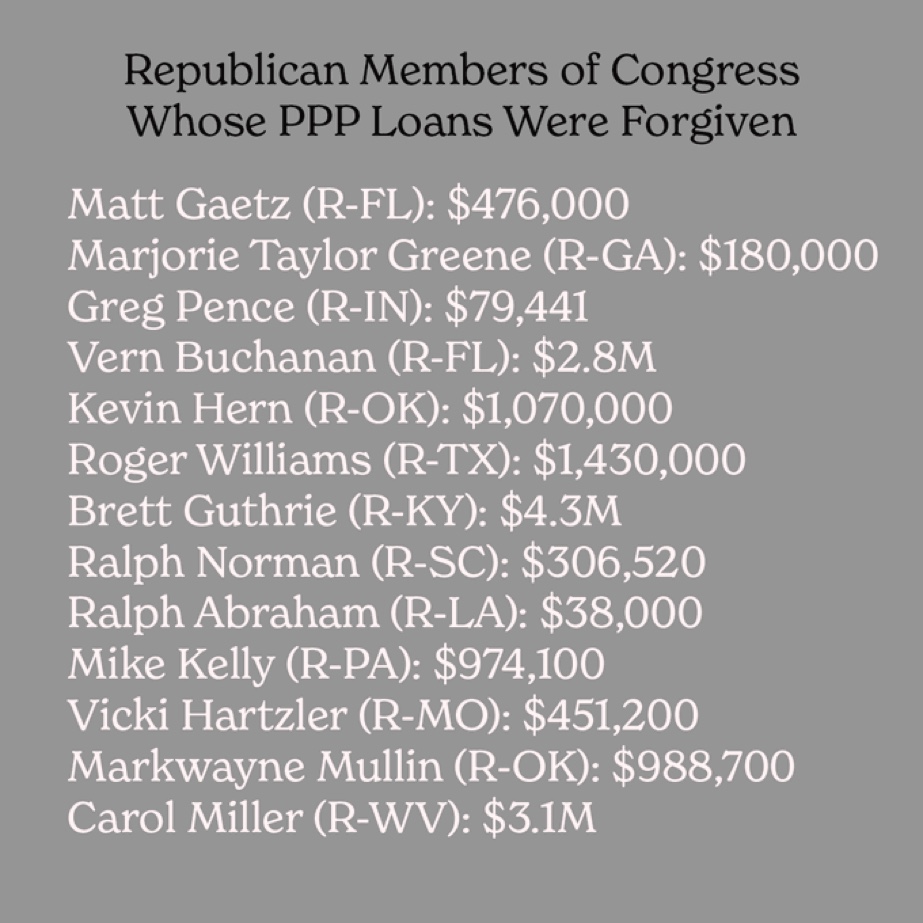
Cardona made his point personal: “And many had no problems accepting millions of dollars in forgiven pandemic loans, like Senator Markwayne Mullin from Oklahoma had more than $1.4 million in pandemic loans forgiven. He represents 489,000 eligible borrowers that were turned down today. Representative Brett Guthrie from Kentucky had more than $4.4 million forgiven. He represents more than 90,000 eligible borrowers who were turned down today. Representative Marjorie Taylor Greene from Georgia had more than $180,000 forgiven. She represents more than 91,800 eligible borrowers who were turned down today.”

In the majority opinion of Biden v. Nebraska, Chief Justice John Roberts lamented that those who dislike the court’s decisions have accused the court of “going beyond the proper role of the judiciary.” He defended the court’s decision and urged those who disagreed with it not to disparage the court because “such misperception would be harmful to this institution and our country.” But what is at stake is not simply these individual decisions, whether or not you agree with them; at stake is the way our democracy operates.

Norman Ornstein of the American Enterprise Institute didn’t offer much hope for Roberts’s plea. “It is not just the rulings the Roberts Court is making,” he tweeted. “They created out of [w]hole cloth a bogus, major questions doctrine. They made a mockery of standing. They rewrite laws to fit their radical ideological preferences. They have unilaterally blown up the legitimacy of the Court.”

In a shot across the bow of this radical court, in her dissent to Biden v. Nebraska, Justice Elena Kagan wrote that “the Court, by deciding this case, exercises authority it does not have. It violates the Constitution.”

The United States Supreme Court has been on a rightwing roll, eliminating affirmative action yesterday, now upholding discrimination against gays, and striking down Biden’s attempt to provide relief to student debtors. The five conservative justices rewarded the faith that Leonard Leo and the Federalist Society placed in them. They were chosen based on their extreme ideology.

This morning, the Court ruled that a person who objects to gays need not do business with them. Colorado bans discrimination based on sexual orientation, but the Extreme Court struck down the state law. The justices in the majority based their decision of free speech rights, upholding the view that the web designer’s free speech was impaired if she had to do work for gay people.

The Boston Globe reported:

WASHINGTON (AP) — In a defeat for gay rights, the Supreme Court’s conservative majority ruled Friday that a Christian graphic artist who wants to design wedding websites can refuse to work with same-sex couples.

The court ruled 6-3 for designer Lorie Smith despite a Colorado law that bars discrimination based on sexual orientation, race, gender and other characteristics. Smith had argued that the law violates her free speech rights.

Smith’s opponents warned that a win for her would allow a range of businesses to discriminate, refusing to serve Black, Jewish or Muslim customers, interracial or interfaith couples or immigrants. But Smith and her supporters had said that a ruling against her would force artists — from painters and photographers to writers and musicians — to do work that is against their beliefs.


“The First Amendment envisions the United States as a rich and complex place where all persons are free to think and speak as they wish, not as the government demands,” Justice Neil Gorsuch wrote for the court’s six conservative justices.

The student debt decision was also 6-3, with the conservative justices knocking out Biden’s efforts to reduce the financial burden on millions of people.

The New York Times reported:

The Supreme Court’s conservative supermajority struck down President Biden’s proposal to cancel at least some student debt for tens of millions of borrowers, saying it overstepped the powers of the Education Department.

In a 6-to-3 decision, Chief Justice John G. Roberts Jr. wrote that a mass debt cancellation program of such significance required clear congressional authorization.

Citing the same authority the Trump and Biden administrations used to pause student loan payments during the pandemic, Mr. Biden promised in August to forgive $10,000 in debt for individuals earning less than $125,000 per year, or $250,000 per household, and $20,000 for those who received Pell grants for low-income families.

Nearly 26 million borrowers have applied to have some of their student loan debt erased, with 16 million applications approved. But no debts have been forgiven or additional applications accepted in light of the legal challenges.

I hope that all 26 million indebted people vote for Biden. He tried.

Lindsay Owens and David Dayen note that some of the most outspoken critics of Biden’s decision to forgive up to $20,000 in student debt are Obama-era economists. Republicans have called it “socialism” and worse, but some Democratic economists are also upset. Owens and Dayen attribute their anger to the failure of Obama’s policy to solve the home foreclosure crisis.

They write:

President Biden’s long-awaited decision to wipe out up to $20,000 in student debt was met with joy and relief by millions of borrowers, and a temper tantrum from centrist economists.null

Moments after the announcement, former Council of Economic Advisers Chair Jason Furman took to Twitter with a dozen tweets skewering the proposal as “reckless,” “pouring … gasoline on the inflationary fire,” and an example of executive branch overreach (“Even if technically legal I don’t like this amount of unilateral Presidential power.”). Brookings economist Melissa Kearny called the proposal “astonishingly bad policy” and puzzled over whether economists inside the administration were “all hanging their heads in defeat.” Ben Ritz, the head of a centrist think tank, went so far as to call for the staff who worked on the proposal to be fired after the midterms.

Histrionics are nothing new on Twitter, but it’s worth examining why this proposal has evoked such strong reactions. Elizabeth Popp Berman has argued in the Prospect that student loan forgiveness is a threat to the economic style of reasoning that dominates Washington policy circles. That’s correct. But President Biden’s elegant and forceful approach to tackling the student loan crisis also may feel like a personal rebuke to those who once worked alongside President Obama as he utterly failed to solve the debt crisis he inherited.

Let’s be very clear: The Obama administration’s bungled policy to help underwater borrowers and to stem the tide of devastating foreclosures, carried out by many of the same people carping about Biden’s student loan cancellation, led directly to nearly ten million families losing their homes. This failure of debt relief was immoral and catastrophic, both for the lives of those involved and for the principle of taking bold government action to protect the public. It set the Democratic Party back years. And those throwing a fit about Biden’s debt relief plan now are doing so because it exposes the disaster they precipitated on the American people.

One reason the Obama administration failed to swiftly help homeowners was their obsession with ensuring their policies didn’t help the “wrong” type of debtor.

President Obama campaigned on an aggressive platform to prevent foreclosures. Larry Summers, one of the critics of Biden’s student debt relief, promised during the Obama transition in a letter to Congress that the administration “will commit substantial resources of $50-100B to a sweeping effort to address the foreclosure crisis.” The plan had two parts: “helping to reduce mortgage payments for economically stressed but responsible homeowners,” and “reforming our bankruptcy laws” by allowing judges in bankruptcy proceedings to write down mortgage principal and interest, a policy known as “cramdown.”

The administration accomplished neither. On cramdown, the administration didn’t fight to get the House-passed proposal over the finish line in the Senate. Credible accounts point to the Treasury Department and even Summers himself (who just last week said his preferred method of dealing with student debt was to allow it to be discharged in bankruptcy) lobbying to undermine its passage. Summers “was really dismissive as to the utility of it,” Rep. Zoe Lofgren (D-CA) said at the time. “He was not supportive of this.”

Summers and Treasury economists expressed more concern for financially fragile banks than homeowners facing foreclosure, while also openly worrying that some borrowers would “take advantage” of cramdown to get undeserved relief. This is also a preoccupation of economist anger at student debt relief: that it’s inefficient and untargeted and will go to the “wrong” people who don’t need it. (It won’t.)

For mortgage modification, President Obama’s Federal Housing Finance Agency repeatedly refused to use its administrative authority to write down the principal of loans in its portfolio at mortgage giants Fannie Mae and Freddie Mac—the simplest and fastest tool at its disposal. Despite a 2013 Congressional Budget Office study that showed how modest principal reduction could help 1.2 million homeowners, prevent tens of thousands of defaults, and save Fannie and Freddie billions, FHFA repeatedly refused to move forward with principal reduction, citing their own efforts to study whether the policy would incentivize strategic default (the idea that financially solvent homeowners would default on their loans to try and access cheaper ones).

Virtually everyone involved with the housing system was stunned that the options of cramdown and principal reduction weren’t taken. Banks literally held meetings in expectation of Obama’s team requiring writedowns, until they didn’t.

Instead, the Obama administration rolled out the industry-backed Home Affordable Modification Program (HAMP), relying on the voluntary cooperation of servicers to modify mortgages. The program was, even by the administration’s own modest objectives, a failure, ultimately reaching less than a quarter of the three to four million homeowners it hoped to target. In the critical first two years, the administration did not even spend 3 percent of what they were allotted to save homeowners.

Just as with cramdown, one reason the Obama administration failed to swiftly help homeowners was their obsession with ensuring their policies didn’t help the “wrong” type of debtor. When Obama first announced HAMP in 2009, he said the program would “not reward folks who bought homes they knew from the beginning they would never afford.” The resulting “Goldilocks” proposal, with its focus on weeding out undeserving borrowers, would not be available to homeowners with incomes too high or too low and would be backstopped with voluminous income and financial verifications (in many cases, more than what was required to take out the loan in the first place). Treasury also tweaked the program numerous times as they went along, confusing servicers and borrowers. The barrage of paperwork ground the program to a halt at many servicers, and ultimately nearly a quarter of modifications were rejected on the grounds that incomplete paperwork was provided.

But it was much worse than that. The mortgage servicers used HAMP like a predatory lending program, squeezing homeowners for as many payments as possible before canceling their modifications and kicking them out of their homes. These companies had financial incentives to foreclose rather than modify loans. In one particularly excruciating example, the servicer arm of Bank of America offered its employees Target gift cards as a bonus for placing borrowers into foreclosure.

This was also by design, or at least benign neglect. Then–Treasury Secretary Timothy Geithner candidly told officials that the program was intended to help banks, not borrowers. The purpose was to “foam the runway” for the banks, Geithner said, with homeowners and their families being the foam crushed by a jumbo jet in that scenario. If the goal was just to let the banks use HAMP for their own benefit, it’s not surprising that would come at homeowners’ expense.

And those banks executed their plan fraudulently, using millions of forged and fabricated documents to illegally foreclose on people. Even with this new leverage against the banks, the administration failed to provide equitable relief. A new program, the National Mortgage Settlement, promised one million principal reductions but delivered only 83,000. Meanwhile, millions more unlawful foreclosures ensued, and no high-level executive was convicted in association with any of these crimes.

In short, the policy apparatus ultimately failed to assist the majority of people who sought help, a suboptimal policy outcome by any metric. Student debt relief skeptics like Furman spent the Obama years advocating for privatizing Fannie and Freddie, rather than apologizing for falling so short on dealing with the massive debt overhang, which stunted the economic recovery.

President Biden’s approach has been markedly different and, if well implemented, is poised to be extremely effective. The simplicity of the program design, with its straightforward cancellation thresholds ($10,000/$20,000) and eligibility criteria (Pell status and household income), means the policy should deliver nearly 90 percent of its relief dollars to those making less than $75,000 a year. Will some small amount of relief dollars land in the bank accounts of borrowers who will make higher incomes in the future? Absolutely. Is preventing that outcome more important than delivering relief to 43 million borrowers? Of course not.

It’s not just the policy design that is a rebuke to the old guard’s theory of debt relief; it’s also the rhetoric. Notably, in his 20-minute speech announcing the rollout of the student loan relief program, President Biden didn’t mention “bad debtors” once. He didn’t spend a single breath on the individual failings of borrowers, make any reference to their poor decision-making, or nod to a handful of unscrupulous debtors trying to game the system.

Instead, he talked about the failings of our higher-education system, in which “an entire generation is now saddled with unsustainable debt.” Instead of blaming borrowers, he showed them empathy. Instead of talking about borrowers taking advantage of the system, he vowed to hold “colleges accountable for jacking up costs without delivering value to students” and crack down on “schools luring students with the promise of big paychecks when they graduate only to watch these students be ripped off and left with mountains of debt.” And he headed concerns about moral hazard off at the pass, vowing to “never apologize for helping the working and middle class.”

Moreover, Biden wasn’t afraid to use all of the tools available to him to get results for indebted borrowers. The Obama administration was given funding from Congress, an explicit mandate for foreclosure prevention, and at the end, a settlement with the banks that authorized even more money. They still failed, because they were more interested in deluded notions of “personal responsibility” than acting to avert disaster.

Biden has flipped the Beltway consensus on policy design around debt forgiveness and modeled a path for viewing student debt as a national crisis, rather than an individual failing. It’s a stunning reversal of the Obama-era consensus and one that casts that failed legacy of mortgage debt relief in an even darker light. Biden has shown us there was an easier, softer way all along.

A number of Republicans received Paycheck Protection Program loans, which were forgiven.

The White House tweeted a response to Republican Congressman Vern Buchanan of Florida, who complained about debt relief for college students. He received a Payroll Protection Program loan from the federal government of $2.3 million. The loan was forgiven.

@WhiteHouse

Congressman Vern Buchanan had over $2.3 million in PPP loans forgiven.

Buchanan had tweeted:

@VernBuchanan

“As a blue-collar kid who worked his way through college, I know firsthand the sacrifices people make to receive an education. Biden’s reckless, unilateral student loan giveaway is unfair to the 87 percent of Americans without student loan debt and those who played by the rules.”

So it’s okay for the federal government to give Congressman Buchanan $2.3 million, which he doesn’t have to pay back, but not to help college kids drowning in debt with a student loan forgiveness of $10,000-20,000?

Republican Mike Kelly of Pennsylvania complained on Twitter:

Asking plumbers and carpenters to pay off the loans of Wall Street advisors and lawyers isn’t just unfair. It’s also bad policy.

Yeah, all those millions of kids who got student loans are rich now, right?

@WhiteHouse tweeted:

Congressman Mike Kelly had $987,237 in PPP loans forgiven.

But that’s not all:

Marjorie Taylor Greene was one of many Republicans complaining about President Biden’s decision to forgive $10,000-20,000 of debt that college students owe for taking out federal loans to finance their education.

The White House released a response: Rep. Marjorie Taylor Greene applied for and received a federal Paycheck Protection Program loan of more than $180,000. The loan was forgiven.

Unlike college students who had a debt of $10,000 forgiven, her debt of $180,000 was forgiven. And she complains about them! That’s called chutzpah.

Alternet reports:

Highlighting the hypocrisy of Greene and other Republicans claiming it’s unfair to have loans forgiven at taxpayer expense, the White House also posted to Twitter that U.S. Rep. Matt Gaetz (R-FL), U.S. Rep. Mike Kelly (R-PA), U.S. Rep. Vern Buchanan (R-FL), and other Republicans attacking the administration for its student loan forgiveness program, had massive PPP loans forgiven….

According to ProPublica, Rep. Greene’s family construction business took out a PPP loan on April 10, 2020, for $182,300. In total, including interest, the federal government forgave her and her family’s loan totaling $183,504.

The PPP loans, also known as the Paycheck Protection Program, originated under President Donald Trump and was facilitated via the Small Business Administration. The were $800 billion in PPP loans made, according to NBC News.

Watchdogs estimate billions in fraudulent PPP loans were forgiven.