Archives for category: Separation of church and state

Now that Florida is a red state, the legislature plans to offer vouchers to every student. The legislators expect to do maximum damage to public schools, which will inexorably lose funding and students. Nothing has been said about how to pay for the proposal. Voucher schools in the state are mostly religious and are completely unregulated. Neither their principals nor their teachers need to be credentialed. They are also free to discriminate on any grounds.

The Miami Herald reports:

Florida Republican lawmakers this year will consider offering every K-12 student thousands of dollars each year for their families to spend on education.

Parents would have access to state-funded accounts and use them to pay for private school tuition plus a wide variety of school-related expenses.

The proposal, if approved, would make the state’s school voucher program bigger than ever. But one key fact about the pitch remains elusive: its cost. It could total billions of dollars.

House Speaker Paul Renner said last week he plans to make the proposal, House Bill 1, a priority during the annual legislative session, which starts March 7.

The measure is already being fast-tracked. It will have its first committee hearing Thursday morning in Tallahassee.

So far, the measure carries no financial impact statement. That’s despite the knowledge that hundreds of thousands more children would be eligible for annual payments of about $8,000 each.

The cost, according to the staff analysis, is “indeterminate.” And that “is not reasonable,” said Norín Dollard, a senior research analyst at Florida Policy Institute, a nonpartisan organization that focuses on quality of life issues for Floridians. The group issued a report on voucher funding in September.

HUNDREDS OF THOUSANDS NEW STUDENTS WOULD BE ELIGIBLE

About 266,000 Florida children attend private schools without using any current state scholarship or voucher, Dollard notes. All would be eligible for education savings accounts under the proposal. In addition, approximately 150,000 children receive home schooling.

HB 1 would provide accounts to as many as 10,000 of them in the first year, with more to come in following years. Conservative back-of-the-napkin math suggests that if just 25% of the newly eligible students participate, and those currently in the program remain, the added cost would reach $600 million, Dollard said.

As participation grows, the total could approach $4 billion or more within five years, she added. If that’s the policy decision in leadership, so be it, Dollard said. But it needs to be funded somehow.

A RECURRING FINANCIAL OBLIGATION

State Rep. Anna Eskamani, D-Orlando, focused on that issue during a hastily called Monday evening Zoom meeting to discuss the measure with public education advocates.“

“We have very, very serious concerns,” Eskamani said during an interview. “This is an annual shift of money. Where is it coming from?”

When unveiling the measure at a news briefing, Renner said it was too early to know how much money might be needed. Much depends on how many children want to avail themselves of the vouchers, he said, and where the Legislature sets per-student funding for the year.

At the same time, Renner stressed his goal is to further open school choice so “no one is left out.” The bill would eliminate most eligibility restrictions, though it would prioritize children whose family income is at or below 185% of the federal poverty level — or $55,500 for a family of four.

It also would broaden uses of the money beyond private school tuition to include education expenses such as tutoring, testing and college courses. It would allow students to bank up to $24,000 for those uses, and further permit children already attending private schools without state support to request a share of the funds.

“To effectively deliver a quality education, policy makers and education advocates must accept that every student has unique learning needs, that education dollars belong to the student and not a system, and that public school choice offers every student an opportunity to customize their own education,” Renner said Tuesday, when asked about the associated costs.

A SPIKE IN PARTICIPATION IS EXPECTED

Dollard and others said they anticipate wide interest in participation, with much of it coming from families already paying for private schools. In Arizona, which has a similar education savings account program, the state reported 80% of applicants never attended public schools.

That flips the idea of money following the student on its head, Dollard suggested, because those students never had their education covered by state money in the first place.

School district finance officers said they understood the leadership’s position that the details aren’t firm enough to know the full financial impact.

But using the state’s most recent voucher expansion plan as a guide, they had concerns that this initiative would take money away from district budgets and leave them little ability to plan.

That’s what happened the last time the state expanded vouchers in 2021 with the taxpayer-funded Family Empowerment Scholarship. Officials touted the program as adding $200 million for vouchers, allowing 61,000 more children to afford private school.

Districts saw some money go out the door, but nothing like what happened in 2022. Halfway through the 2021-22 school year, school budget officers across the state learned that three times the amount of money they had set aside to send to voucher programs would be required, based on updated attendance figures from the state.

In some counties, such as Pasco, efforts to provide employee raises were derailed as the money officials expected to use was diverted to the vouchers. All told, the cost had grown to $1 billion.

The current year has provided similar sticker shock. The Legislature approved a budget with no specific amount set for the scholarships. By the second education funding calculation in July, the price tag had increased to $1.3 billion.

That meant the Miami-Dade County school district would have to send $225 million from its budget to the voucher program, for example, and the Hillsborough County school district would send $75 million.

When the third calculation came out this week, districts learned they would be losing even more. If the state lifts the eligibility restrictions, Pinellas County Schools chief finance officer Kevin Smith predicted, it will become even more difficult to predict the financial impact.

He suggested the state should at least consider taking the money out of the public education funding program and create a separate line item.

That way, schools would know what to expect and they could budget appropriately. In recent years, the DeSantis administration has taken the position that unexpected changes in enrollment can pose a financial strain on local school districts.

Read more at: https://www.miamiherald.com/news/local/education/article271630112.html#storylink=cpy

Gary Rayno writes in InDepth NH about a Democratic proposal to put the State Department of Education in charge of the voucher program. Called “Education Freedom Accounts, the program was sold as a way to help low-income students in bad public schools transfer to better private schools. But about 75% of the students getting voucher money were already enrolled in private and religious schools. The free-market State Education Commissioner Frank Edelblut (who home-schooled his own children) projected that the program would cost $3.3 million, but it has actually cost $27 million in its two years of operation. Edelblut promised it would cut property taxes, but the cost of the program is projected to grow.

Rayno writes:

CONCORD — Several lawmakers seek changes to the new Education Freedom Account program with a package of bills addressing issues raised in its first two years of operation.

The program was included in the state’s two-year operating budget passed in 2021, and has been significantly over budget projections with more students than anticipated and what many view as insufficient oversight.

“It is hard to have oversight,” said the prime sponsor of House Bill 626, Rep. David Luneau, D-Hopkinton, “when you don’t have transparency, when you don’t have the data to look at.”

The bill, which had a public hearing Wednesday before the House Education Committee, would have the Department of Education administer and manage the program instead of the Children’s Scholarship Fund NH, which receives 10 percent of the program’s grant distribution under its contract with the state. The organization’s no-bid contract was approved by the Executive Council soon after the program was approved in the state’s operating budget.

The program allows the money parents receive to roll-over from year to year, unless the amount exceeds what would be a quarterly payment.

If the student graduates, leaves the freedom account program or is removed from the program for misuse of funds, the parents would be required to return any excess money to the Education Trust Fund under the bill.

The bill would also require students in the program to take one of the statewide assessment tests required of public school students as a comparison of how well the students in the program are doing, Luneau said.

Luneau and other supporters of the change say the program needs more oversight, accountability and transparency given the millions of dollars being distributed to parents.

The state has spent about $27 million during the first two years of the program, well above the $3.3 million budget Education Commissioner Frank Edelblut projected would be the cost.

He asked for $30 million each year of the next biennial budget in requests to the Governor’s Office.

Luneau told the committee that is $90 million in the first four years of the program coming out of the Education Trust Fund, and $9 million of it going to the scholarship fund.

He said he believes with added staff, the department could manage and administer the program for much less money and have the data needed for better accountability, transparency and assessment.

Why use tax dollars to pay the overhead of a private company, when you are already paying the department to oversee kids’ education in the state, Luneau said.

To date, about 75 percent of the funds for the program have gone as subsidies to parents of students who were enrolled in private or religious schools prior to the program’s start.

Of the 3,000 students in the program this year, about 700 attended a public school the year before.

Luneau said the reports include the kids who were in private and religious schools before the program began to show how successful it is, but that is not saving any taxpayers money but is using money from the Education Trust Fund.

Luneau is prime sponsor of another bill prohibiting using the money as a subsidy for private or religious school tuition.

Supporters of the program sold it as a way for lower income parents to afford to find the best education opportunities for their students while saving property tax dollars for taxpayers.

Luneau said taxpayers who fund public schools receive a great deal more accountability, oversight and transparency of their tax dollars than they do in the freedom account program, adding the reports the scholarship fund has provided are laughable; they are so incomplete.

The view of Republican legislators is that parents alone offer accountability. If they don’t like the program, they will leave it. Since 3/4 of them are already enrolled in private and religious schools, they should be overjoyed that the taxpayers are underwriting the cost.

Open the link and read the rest of the article.

The Mississippi Free Press is a fearless news outlet that takes on controversial topics and also highlights news and culture in the nation’s poorest state. At the beginning of last year, it ran a three-part series on Christian Dominionism, which has a strong foothold in the state. The Dominionists promoted the abortion law that led to the reversal of Roe v. Wade. But their fight to outlaw abortion is only one aspect of their agenda. Their goal is to change every aspect of the law and society to conform to their view of Christian rule. As part of their mission, they seek to eliminate public schools, which they consider godless. Their goal is to make the United States a Christian nation. They were thrilled by Trump’s appointments to the U.S. Supreme Court.

The following excerpt is drawn from part one of a three-part series. I’m posting only twice today so you will take the time to read this important article in full.

Staff writer Ashton Pittman wrote:

Alliance Defending Freedom’s founders included Mississippian Don Wildmon, who also founded the Tupelo-based American Family Association. Wildmon and the others in the group of nearly three dozen conservative Christians who launched the organization in 1993 as the Alliance Defense Fund envisioned it as a counter to the American Civil Liberties Union, which opposed overt efforts to mix religion and government and was known for its support of abortion rights and the rights of sexual minorities..

Six years after launching, the ADF created The Blackstone Legal Fellowship, a Christian summer training program for up-and-coming attorneys. In the ADF’s 2000 tax filings, the organization explained that the Blackstone program “provides cutting-edge legal education” and also offers attorneys access to “up-to-date developments in the areas of religious liberties, the sanctity of human life, and traditional family values.”

“As a rigorous internship for exceptionally capable and highly motivated law students, the Blackstone Fellowship inspires a distinctly Christian worldview in every area of law, and particularly in the areas of public policy and religious liberty,” the ADF’s IRS tax filings say.

“With this ongoing program, it’s ADF’s goal to train a new generation of lawyers who will rise to positions of influence and leadership as legal scholars, litigators, judges-and perhaps even Supreme Court judges—who will work to ensure that justice is carried out in America’s courtrooms.”

The ADF’s description of itself in those tax filings is emblematic of “full-blown” Christian dominionist thought, Frederick Clarkson told the Mississippi Free Press on Dec. 3, 2021. He is a senior research analyst at Political Research Associates, a Boston-area think tank that monitors anti-democratic movements and ideologies including Christian dominionism and white nationalism.

“That’s the idea that conservative Christians should be dominating every aspect of society,” he explained. Adherents to dominionism often talk about a “biblical worldview” or talk about “building the kingdom,” he added.

Christian dominionism is a religious and political movement that began in earnest during the 20th century and includes a cross-section of various denominations. Many who subscribe to it do not self-identify as dominionists, though, Clarkson noted.

“Not everyone is going to say, ‘Hey, I’m a dominionist. I’m all about theocracy.’ Not many people are going to say that, but this body of theological thought has been percolating throughout the evangelical world for decades,” he said. “If you think that America should be a Christian nation, well, what should that look like? And that’s where the dominionist agenda comes in. It’s not just any conservative thinking.”

Dominionist goals reach far beyond abortion, he said.

“While abortion and Roe and Dobbs are what we’re looking at in the heat of the moment, this is just one battle in a larger war for the world,” Clarkson said….

Taking Control of ‘Seven Mountains’

The New Apostolic Reformation dates back to C. Peter Wagner, who began preaching in the 1950s and died in 2016. He taught that God had begun preparing the world for a “third great awakening” that would sweep the earth before the apocalyptic events foretold in the Book of Revelation take place.

As part of this awakening, Wagner taught, Christians would take dominion over the “seven mountains” or “seven spheres” of cultural influence: family, religion, education, business, government, media and the arts. (Some adherents of the belief, known as “seven mountains dominionism,” instead combine media and arts into a single category and add the military as the seventh “mountain”). Top Mississippi state officials, including Gov. Tate Reeves, attended a prayer event in May 2021 hosted by an organization that openly adheres to “seven mountains” beliefs….

While Calvinism tends toward an intellectual approach to religion and theology, Pentecostalism, which includes hundreds of denominations and independent, non-denominational churches, is much more experientially oriented. Unlike Calvinists, Pentecostals believe in the modern occurrence of spiritual “gifts” such as prophecy, speaking in tongues and supernatural healing.

Despite their differences, including the timeline for Christian dominionism, Reconstructionists and Pentecostals held a series of dialogues throughout the late 20th century to flesh out a common set of goals and principles.

After one series of Reconstructionist-Pentecostal dialogues in Dallas in 1987, Clarkson notes, Christian Reconstructionist pastor Joseph Morecraft declared that “God is blending Presbyterian theology with Charismatic zeal into a force that cannot be stopped.” (“Pentecostal” and “Charismatic” are often used interchangeably or to describe largely overlapping Christian sects that believe in spiritual gifts).

Those dialogues, Clarkson told the Mississippi Free Press, shaped the modern dominionist movement and much of 21st-century American politics.

“That opened the door to political action that brought about the Christian Right that we see today,” Clarkson said.

“So as elements of Pentecostalism adopted these ideas, then we began to see what we now call the New Apostolic Reformation, and they were able to package it in a way where you didn’t have to have a P.h.D. In theology to understand. So they talked about simply dividing up all of society.

“They said, well, there’s seven main sections of society, and you need to figure out which ‘mountain’ you need to be a part of trying to conquer in order to build the kingdom of God. Really smart marketing. That’s what we’re talking about here.”

In his 2008 book, “Dominion! How Kingdom Action Can Change the World,” Wagner, the NAR and Seven Mountains theology pioneer, put it simply: “We have an assignment from God to take dominion and transform society.”

‘The Battle To Take The Land’

Like Engle, Alliance Defending Freedom’s CEO and general counsel Michael Farris has long sought to use the levers of society to establish Christ’s kingdom on earth. He founded the Home School Legal Defense Association, an ADF affiliate that has spent years lobbying state governments to make it easier for Christian parents to homeschool their children. (Rushdoony emphasized the necessity of Christian homeschooling to equip future generations for Christian dominion).

In the first chapter of his 2005 book, “The Joshua Generation: Restoring the Heritage of Christian Leadership,” Farris made a bold claim: “I have met countless future senators, governors, presidents, and Supreme Court justices.” He was describing his meetings with parents of homeschooled children, where he says “dreams of generational greatness burn brightly.”

“These moms and dads truly believe that their children are called to be the leaders of the future. … They believe that their own children, in many cases, have unusually high prospects for being particular people who will rise to the top levels of government, law, journalism, media, religion, art, business, and science,” he wrote, referring to the seven mountains Wagner taught. “I think they are absolutely right.”

In the book, Farris explained that the point of advocating for homeschooling rights in state legislatures was never simply about homeschooling itself.

“While those battles are important and will always continue to some degree, homeschool freedom is not the end goal. It is a means to a far greater end,” Farris wrote. The Christian homeschool movement can judge its long-term success, he said, by evaluating their results against a passage in the Book of Hebrews that describes godly heroes “who through faith conquered kingdoms, administered justice, and gained what was promised; who shut the mouths of lions, quenched the fury of the flames … and who became powerful in battle and routed foreign armies.”

The end goal of the Christian homeschooling movement, he said, was to raise a generation of children who would do those very things in the “Christian assignment of redeeming the culture.”

“How should we judge our success? … Do we see our children administering justice, gaining what was promised, shutting the mouths of lions, and quenching the fury of the flames? … Have they become powerful in battle?”

Public Schools ‘Essentially Satanic’

Farris and others like him, Clarkson said, fear that sending children to public schools is the same as “turning them over to institutions that are essentially Satanic and teaching children things that are not only non-Christian, but anti-Christian.”

“The idea of Christianizing schools or taking these children out of the public schools and into private Christian academies or homeschool has been in the works for a long time,” he said. “They managed to get right-to-homeschool as part of the Republican platform under Reagan in the 1980s. This has been a long-term process.”

Farris is now CEO and general counsel of ADF.

Supreme Court Justice Amy Coney Barrett gave lectures at ADF’s Blackstone training program for future lawyers.

In its 2000 tax filings, the ADF explained that once fellows complete the Blackstone program, they will have “caught a vision for how God can use them as judges, law professors, and practicing attorneys to help keep the door open for the spread of the gospel in America.”

The ADF also said in the filings that it had “effectively equipped attorneys to battle the homosexual agenda, defend parental rights, and protect religious freedom” with a separate training program known as the National Litigation Academy.

The founders of this nation wrote a Constitution to govern the new nation. They did not say it would be a “Christian nation.” They specifically barred any religious tests for holding office. There are many religions in this nation, as well as atheists. The Dominionists threaten the freedoms of all those who do not share their views.

I urge you to send a contribution to the Mississippi Free Press to help them continue the important work they do. I sent them $100, my second contribution to help sustain their wonderful voice in Mississippi.

Florida has one of the largest voucher programs in the nation, and Republicans expect to make the program even larger. With a large majority in both houses and a choice-friendly governor, they will push their bill through with little or no resistance. Florida’s voucher schools are not required to hire certified teachers; their students do not take state tests. Although accountability was a major thrust of the Florida “reforms,” voucher schools are exempt from any accountability. Most are religious schools.

The Miami Herald reported:

Florida’s school voucher program could see a major expansion under new legislation filed Thursday by House Republicans. Standing at a lectern with a sign reading “Your Kids, Your Choice,” House Speaker Paul Renner introduced House Bill 1 to make vouchers available to all Florida children eligible to enter kindergarten through 12th grade. Children from families with incomes up to 185% of the federal poverty level, which is $55,500 plus $9,509 for each additional family member, would continue to get priority for the funding. Children in foster care also would receive priority.

The bill would allow voucher recipients to use the public funds for more than tuition at a private school and transportation, as is currently in law. Families would be allowed to spend the money on home-schooling, college courses, private tutoring and specialized testing such as Advanced Placement exams, among other expenses.

Students may not be in public school to qualify for a voucher, which is the equivalent of per-student funding in a public school — currently about $8,216 per year.

Families would receive the money through state-funded education savings accounts, a longtime goal for Florida Republicans. “It’s about freedom and opportunity,” Renner, R-Palm Coast, said during his news conference. “We empower parents and children to decide the education that meets their needs.”

State Rep. Kaylee Tuck, chairperson of the House Choice and Innovation subcommittee, is carrying the bill. The Lake Placid Republican said the measure should allow families to customize education for their children.

Renner predicted broad bipartisan support for the bill, which he said also should clear the waiting list for students with special education needs to receive a state scholarship. Currently about 9,400 children are on that list, according to Renner’s staff.

DEMOCRATS CALL IT ‘DEFUNDING PUBLIC EDUCATION’

House Democratic Leader Rep. Fentrice Driskell disagreed with Renner’s comments regarding support for the bill. She called it a “defunding of public education” and said she expected most members of her party to oppose it. “There is nothing in this bill that I like, because we continue to take these public dollars and use them for private purposes,” Driskell, D-Tampa, said.

Other Democrats attending a news conference to counter the Republicans’ announcement held similar views. They said they support vouchers for students who need special services, and agreed that parents deserve choices — including within the public schools, which 2.9 million children attend.

“Let’s not defund one institution to fund another one,” said Rep. Felicia Robinson, D-Miami Gardens, who also called for more accountability in the voucher system. Schools that accept vouchers should at least have certified teachers, Robinson said.

And parents who accept funding should have to prove the money is going toward approved education services, added Rep. Yvonne Hayes Hinson, D-Gainesville. ”There is no accountability for tracking funds,” said Hinson.

“This might be a get-rich scheme. I’ve seen it all over the country.” Rep. Allison Tant, D-Tallahassee, referenced her city’s Red Hills Academy, a charter school that closed within weeks of opening last year, citing low enrollment and processing issues, according to the Tallahassee Democrat. ”They got state funding to go create themselves,” Tant said. “Then they turn the kids back to public schools and guess what? They kept the funding.” In Palm Beach County, the founder of one charter school was found profiting off the venture by steering school contracts to companies he owned, according to the Palm Beach Post.

RENNER OFFERS REBUTTAL ON FUNDING

Renner said critics who claim the Republicans are seeking to dismantle public education ignore the fact that the Legislature has put more total dollars into district schools every year, something he said would likely continue. He also pointed to the state’s efforts to improve teacher pay, adding millions of dollars to boost the base salary.

“It’s going to be a good year for our traditional public schools as well,” Renner said.

Read more at: https://www.miamiherald.com/news/local/education/article271373917.html#storylink=cpy

Texas Governor Greg Abbott is determined to pass a voucher bill in the upcoming legislative session, along with voucher zealot Lt. Gov. Dan Patrick. They hope to use the culture war nonsense about public schools “indoctrinating” students on race and gender issues. They pay no attention to the research showing that students who use vouchers are likely to lose ground, academically, and learn less than in public school. Does the legislature really want to harm the state’s public schools while sending kids off to religious and private schools where they are likely to get a worse education than in public schools?

Edward McKinley of the Houston Chronicle wrote recently:

Private school vouchers were within a handful of votes of becoming Texas law in May 2005. Former Rep. Carter Casteel still remembers the constituent who confronted her in her office that day.

“He kind of threatened me, not to harm me, but that I wouldn’t be reelected if I didn’t vote for the vouchers,” Casteel, a New Braunfels Republican, said in an interview. A public school teacher and school board member before she served in the Legislature, Casteel is and was a staunch opponent of private school vouchers.

“I explained to him my position, and he wasn’t very happy, I remember that,” she said. “If you want your child to go to a private school, then that’s your choice and you spend your money, but you don’t take taxpayer dollars away.”

Debate on the floor of the Texas House stretched on for hours, and the voucher bill was gutted following a series of back-and-forth, close votes. Casteel voted no, saying publicly that she was willing to lose her House seat over it.

In a dramatic capstone to the proceedings, Rep. Senfronia Thompson ran across the floor and yanked the microphone out of the bill author’s hand, yelling for attention to a procedural mistake in the bill that led to its death.

That day was the high-water mark in efforts to pass private school vouchers in Texas.

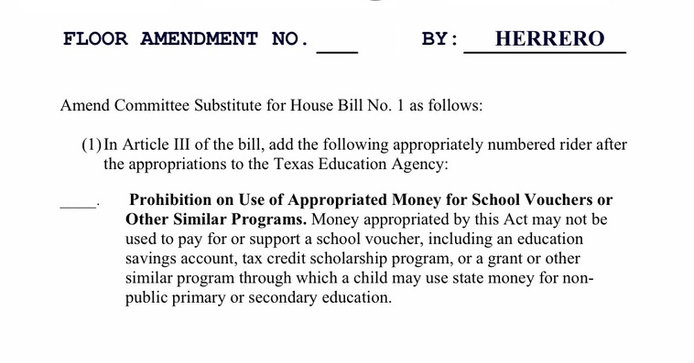
They have been blocked by a powerful coalition of Democrats and rural Republicans in the House. In fact, the House has routinely and overwhelmingly supported a statement policy that outright bans taxpayer funds from going to private schools in sessions since.

But advocates for vouchers believe that those legislative dynamics that have been frozen for the last 17 years may finally be thawing.

As Republicans for the past year have raised alarms over what they see as liberal indoctrination in the public school curriculum — especially in the way racism and LGBT issues are taught — they’ve chalked up victories in statehouses across the country. Texas parents have carried that same fight to school board meetings, their local libraries and trustee elections. Now, Gov. Greg Abbott and Lt. Gov. Dan Patrick are calling for more of the same in the upcoming legislative session, with pledges to back ‘parents matter’ initiatives that include another voucher push.

“Families started to see there’s another dimension to school quality that’s arguably more important, which is whether the school’s curriculum aligns with their values,” said Corey DeAngelis, senior fellow with the American Federation for Children, which advocates for vouchers. “And I think that’s sparked a wave of support for school choice around the country.”

Abbott earlier this year announced his support for a policy that would allow public funds to follow students, regardless of whether they attend public schools or private schools. Shortly after, DeAngelis posted a photo of himself meeting with the governor, and “it’s happening, Texas,” has become a refrain on his popular Twitter account.

“With all the national momentum, I think a lot of people are looking toward Texas as the next step,” DeAngelis said. “It’s going to be all eyes on Texas coming up this session. And people are going to be watching.”

Eyes on Arizona, Virginia

The argument for vouchers has traditionally been that children, particularly in urban areas, are forced to attend struggling schools, when the state could instead subsidize them attending private schools nearby. One problem with this argument is that polling has often found that while people have critical views of public schools generally, they often like their own public schools just fine.

“In the past, they’ve tried to get vouchers by saying we’ve got to do something about kids trapped in failing schools. And so we’d say we’ve got all these failing schools. And then you’d look at the data and you have about 80 campuses out of about 8,500 or so that were ‘improvement required.’ So you’re looking at 1 percent,” said Charles Luke, head of the Coalition for Public Schools, which represents education groups opposing voucher policies.

“So when you’re talking about how horrible the public school system is, 99 percent of them are doing fine,” he said. “A kid takes a test and he gets a 99 on it, you wouldn’t say ‘he’s failing, I’m failing him, The system is failing him.’ You’d say, he’s doing great!”

But instead of school budgets or test scores, this time it’s culture war issues with spinoffs that include whether teachings on racism damage the self-esteem of white kids, and if it’s OK for young children to see a drag show or discuss gender identity.

“There’s this misalignment to what parents thought was going on in their schools and now their eyes have been opened, and now they say hey, hey lets fix this,” said Mandy Drogin, with the Texas Public Policy Foundation. “No more of this social justice warrior, whatever the teacher or administrator feels about pushing into our classrooms. I think that’s where you see so much momentum, and everybody feels and sees that momentum.”

The issue of private school vouchers has historically hewn closely to the culture war issues of the day. The modern voucher advocacy movement has roots connecting to efforts to resist racial integrationafter the Brown v Board of Education U.S. Supreme Court decision in 1954.

In the 1950s and ‘60s, supporters of vouchers wanted to leave “government schools” because they argued such schools were experimenting with “social engineering” and radical ideologies, education historian Jon Hale has noted, particularly desegregation. The debates from yesterday over leaving public schools because of their values mirror contemporary political arguments over how LGBTQ+ issues are discussed or the children who are undocumented immigrants attending American public schools.

One question legislative observers have had is whether those pushing vouchers will attempt to pass a universal program or a more limited one.

Teachers unions, Democrats and other public school advocates have traditionally opposed any voucher program, no matter how small, but voucher advocates have seen success in other states starting small and building out from there.

This year, however, Arizona passed a universal program, and advocates say that should be the goal in Texas.

Mayes Middleton, who served in the House in the 2019 and 2021 sessions and was elected this year to the state Senate, has filed one such bill. His would create education savings accounts, a form of vouchers, that could be used by anyone to send their kids to public school, private school, community college classes, virtual schools or home school.

This approach is the best way to maximize “parental empowerment,” he said in a Friday interview, and to capitalize on the momentum behind that movement that helped carry Virginia Gov. Glenn Youngkin to victory last year. There were also Republicans unseated in the primaries earlier this year across the state who were less supportive of voucher policies, Middleton said, which could help win additional support.

He says his bill could be particularly helpful for rural Texans who want their kids to access more flexible, hybrid home school models, as well as for people who want to send their kids to private Catholic schools but cannot afford it, many of whom he said are Hispanic. Those are groups who would need to support voucher policies for them to win passage in the Legislature.

“Look in Arizona what they did it with one-seat GOP majority in their house and senate,” DeAngelis said. “If every Republican in Arizona can show up for their platform issue, other red states should be able to follow suit as well.”

Vouchers fell far short in 2021

Public school advocates and opponents of vouchers acknowledge that the fight is going to be tighter and more intense than it has been in many years, but they feel that even with intense lobbying in support, the policies will ultimately fall short.

“These are the same issues that raised their ugly head in past sessions,” said Rep. Harold Dutton, a Houston Democrat who chaired the House Public Education Committee last session, noting that more than 100 of the 150 House members voted in favor of an amendment last year barring the state from spending public funds on private schools. “I don’t see that changing a whole lot, and certainly not being able to get a majority.”

Members of the GOP’s right wing have called for House Speaker Dade Phelan to end the practice of naming Democrats to head a limited number of committees. Some have named Dutton in particular as an obstacle last session to school choice legislation.

Dutton said he hadn’t thought about whether or not he’ll be chair again, but noted: “When vouchers failed before, the person in the chair of public education was a Republican, so what does that tell you?”

Several Republican members of Public Education, who might be in line for the chairmanship if Dutton is not selected again, have also expressed skepticism or opposition to voucher proposals. Rep. Ken King from Canadian has said, “If I have anything to say about it, it’s dead on arrival. It’s horrible for rural Texas. It’s horrible for all of Texas,” while Rep. Gary VanDeaver has said, “This sense of community is what makes Texas great, and I would hate to see anything like a voucher program destroy this community spirit.”

As promised, after Casteel’s role in the demise of the voucher bill in 2005, she lost her seat in 2006.

She noted that a prominent San Antonio businessman and GOP donor who was present in the House the day of the vote and advocated strongly for vouchers donated more than $1 million to her opponent, as the donor did for other Republicans who opposed the voucher bill that day.

“I’ve got a great family, I’ve got a great law profession, and whether I’m (there) or I go home it doesn’t make a bit of difference to me. I didn’t go there to do nothing but what’s right,” Casteel said.

“And I did. I went home. And it never came back up — until this year.”

edward.mckinley@chron.com

The claim that public schools “indoctrinate” their students is an integral part of the rightwing attack on public schools . This is a canard, a bald-faced lie.

The rightwingers insist that any efforts to teach tolerance and acceptance of others is “indoctrination.” Teaching children the importance of justice, they say, is “woke.”

This is the mission of public schools: to teach children academic skills and knowledge, of course, but also to teach them to work with people who are different from them and their family.

Teaching children to live, work, and play with others and to respect others is important to the functioning of our democracy. We are a people of many diverse origins, different nationalities, different religions. One of the implicit functions of public schools is to help bind us together as one nation, one people who share civic values.

Do you know which schools truly indoctrinate students? Religious schools. That is one of the essential goals of religious schools. They teach the doctrines of their faith. That is why they exist.

Yet, driven by religious zealots, red states are draining public money from public schools for religious schools.

The latest movement is to allow religious schools to become charter schools, enabling them to access public funds for teaching their doctrine.

Politico wrote:

CHURCH V. STATE — Oklahoma’s departing attorney general just took a big step toward achieving a conservative education milestone.

A state law that blocks religious institutions and private sectarian schools from public charter school programs is likely unconstitutional and should not be enforced, Attorney General John O’Connor and Solicitor General Zach West wrote in a non-binding legal opinion this month .

Their 15-page memo leans on a trio of recent U.S. Supreme Court decisions that favored religious schools and won rapt attention from conservative school choice advocates and faith groups. Oklahoma Republican Gov. Kevin Stitt said the advisory opinion “rightfully defends parents, education freedom, and religious liberty in Oklahoma.” Newly-elected state Superintendent Ryan Walters called it “the right decision for Oklahomans.”

— “The policy implications are huge because this is the first state that is going to allow religious charter schools,” said Nicole Stelle Garnett , a University of Notre Dame law professor and influential religious charter school supporter who wants other states to follow Oklahoma’s lead . “The legal implications are huge because this is the first state that says that they have to,” she told Weekly Education.

Now it’s time to see if faith-based Oklahoma institutions successfully apply for taxpayer support to create charter schools that teach religion as a doctrinal truth just like private schools do today, and if legislators will push to change state law.Also watch if legal authorities in other Republican-led states pen similar opinions.

Those looming decisions and court fights will set the stage for renewed constitutional debates about the line between church and state.

Make no mistake: the bogus claim that public schools “indoctrinate” students is being used to advance the public funding of religious schools whose very mission is indoctrination.

For years, charter friends and charter foes have debated whether charter schools are public schools and whether they are, like public schools, “state actors.” The lame-duck Attorney General of Oklahoma recently declared that religious schools could be charter schools. He seems to believe that privately managed charter schools are not public schools, because no one claims that religious schools are public schools. His opinion does not have the force of law, but you can see that Oklahoma is eager to give public money to religious schools.

The AG’s opinion raises many questions. If charter schools are religious schools, may they limit admission only to members of their faith? May they exclude gay students, teachers, and families? May they substitute religious books for the state textbooks? May they indoctrinate their students into their faith? If charter schools are religious schools, how do they differ from voucher schools? What state regulations apply to them, if any?

Peter Greene writes about the issue here:

The Supreme Court has slowly and steadily busted a hole in the wall between church and state when it comes to education. AG opinion: Statute barring charter school operators from religious affiliation unconstitutional (nondoc.com)

In a fifteen-page opinion issued December 1, Attorney General John O’Connor argued that in the wake of Trinity Lutheran, Espinoza, and Carson, he believed that SCOTUS would “very likely” find Oklahoma’s charter law restriction on nonsectarian or religious charters unconstitutional. Therefore, his opinion is that the state should no longer follow the law forbidding sectarian or religious charter schools.

Each of those cases elevated the free exercise clause of the First Amendment over the establishment clause. In other words, the court has repeatedly (and in a break from previous court decisions) found that the free exercise of religious beliefs outweighs any restrictions against government-sponsored religious activity.

Carson v. Makin in particular established that if the state allows for taxpayer funding of any non-public secular schools, it cannot exclude religious schools from the chance to receive taxpayer funding. While Carson involved school vouchers and private schools, observers like Kevin Welner, director of the National Education Policy Center at the University of Colorado at Boulder’s School of Education, noted that in light of these three decisions, “states will probably be forced to let churches and other religious institutions apply for charters and operate charter schools.”

While charter schools have often been considered public schools (at least part of the time), the extension of free-exercise protections, as Welner wrote after the prior decision, complicate the issue.

If courts side with a church-run charter school, finding that state attempts to restrict religiously infused teachings and practices at the school are an infringement on the church’s free-exercise rights, then the circle is complete: Charter school laws have become voucher laws.

Justice Sotomayor, when dissenting on Carson, noted that

“in just a few years, the Court has upended constitutional doctrine, shifting from a rule that permits States to decline to fund religious organizations to one that requires States in many circumstances to subsidize religious indoctrination with taxpayer dollars.”

Given the previous decisions, an attempt by charter supporters to extend religion to charter schools was probably inevitable.

Charter supporters, including Governor Kevin Sitt and State Superintendent of Public Instruction-elect Ryan Walters praised the decision. Officials of the Catholic Church in Oklahoma, the church likely to go after the taxpayer funding made available by this opinion (there are reports that they have an application for a Catholic virtual charter school ready to go), also praised the decision, as did officials of the American Federation for Children, the pro-privatization group with connections to Betsy DeVos.

The potential complications are many. If the taxpayers of Oklahoma are going to be compelled to fund religious charter schools, which religions will qualify for those dollars, and who will decide?

Oklahoma law designates charters as public schools, but how much discrimination in the name of religious exercise will the state allow? O’Connor argues that charges of discrimination can only be brought against state actors, and “actions taken by charters are unlikely to fit this bill.” So are charter schools public schools or not, and to what degree should taxpayers be forced to fund schools that exist in some sort of fuzzy grey law-free zone?

AG John O’Connor was a Trump nominee for a United States district judge in 2018; the American Bar Association rated him “not qualified,” and his nomination was withdrawn. After Oklahoma’s previous attorney general resigned in May of 2021 over “personal matters,” Governor Stitt appointed O’Connor to the office. O’Connor ran for the office this year and was defeated in the primary, making him a lame duck in the office.

An opinion such a this does not carry the weight of law, and it is possible that the matter will be tested in court. But given the foundation laid by the Supreme Court, it takes no great stretch to reach the conclusion that O’Connor did. They ripped the hole in the wall; he just walked through it.

The state Attorney General in Oklahoma just obliterated the distinction between charters and vouchers by ruling that the state law requiring charters to be non-sectarian was invalid. His decision won plaudits, not surprisingly, from far-right Governor Kevin Stitt, the state’s Catholic Conference, and the state’s American Federation for Children, which is part of Betsy DeVos’s voucher-advocating national group of the same name.

This is the breakthrough that Betsy DeVos has counted on for years: that charter schools would be the stepping stone to vouchers.

Think of all the “liberals” and “progressives” who have supported charters, abetting the eventual and inevitable public funding of religious schools: Senator Cory Booker, Senator Michael Bennett, Congressman Hakeem Jeffries, Secretary of Commerce Gina Raimondo, Arne Duncan, Bill Gates, Michael Bloomberg, Reed Hastings, former Governor Jerry Brown, the Center for American Policy (CAP), DFER, the Obama Education Department, and many more. CAP is supposedly the Democratic Party think tank, but it has resolutely supported charter schools. And now it’s on the same side as Betsy DeVos.

In a 15-page opinion released today, outgoing Oklahoma Attorney General John O’Connor advised charter school authorizers that the aspects of the Oklahoma Charter Schools Act requiring school operators to be non-religious and non-sectarian likely violate the free exercise clause of the First Amendment to the U.S. Constitution and should not be enforced.

Primarily citing three recent U.S. Supreme Court rulings regarding religious liberties in public education — Trinity Lutheran Church of Columbia, Inc. v. Comer (2017); Espinoza v. Montana Department of Revenue (2020); and Carson v. Makin (2022) — O’Connor argued that religiously affiliated private organizations should be allowed to apply to operate charter schools.

“In sum, we do not believe the U.S. Supreme Court would accept the argument that, because charter schools are considered public for various purposes, that a state should be allowed to discriminate against religiously affiliated private participants who wish to establish and operate charter schools in accordance with their faith alongside other private participants,” O’Connor wrote in the opinion which is embedded below.

Charter schools are publicly funded schools that can be governed and operated outside of traditional school districts. The schools can run by private management companies. Currently, Oklahoma statute requires operators of the state’s approximately 30 charter schools to be “non-sectarian” and “non-religious.”

Among the entities allowed to authorizer a charter school in Oklahoma is the Statewide Virtual Charter School Board. Executive director Rebecca Wilkinson originally asked the formal question that resulted in O’Connor’s office issuing an opinion on whether the board may “continue to enforce the nonsectarian requirements set forth” in Oklahoma statute.

Reached for comment Thursday, Wilkinson said she didn’t know the opinion had been released.

“I have not seen it,” Wilkinson said. “I can’t comment on it today, but when we hang up I guarantee you I will be going out to search for it.”

‘Overjoyed with the attorney general’s opinion’

Gov. Kevin Stitt, the Catholic Conference of Oklahoma and the American Federation for Children-Oklahoma celebrated the opinion.

“Attorney General John O’Connor’s opinion rightfully defends parents, education freedom, and religious liberty in Oklahoma,” Stitt said in a statement. “Ultimately, government takes a backseat to parents who get to determine the best learning environment for their child.”

The Catholic Conference of Oklahoma also praised O’Connor’s opinion. In an interview. executive director Brett Farley said the Catholic Conference has an application ready to submit to the SVCSB to operate its own Catholic virtual charter school.

Simply summarized, “religious charter schools are now legal in Oklahoma.”

As a secular Jew, I find it hard to write about the Hasidic community at a time of rising anti-Semitism. But the way they have organized their political power in New York to protect their religious schools is a cautionary tale. They have amassed political power by voting as a bloc. They have used that political clout to gain huge amounts of public money to fund schools that don’t teach English and don’t teach most secular subjects, even though state law requires them to offer an education that is equivalent to a secular school. They ignore the law because they have friends in high places.

The New York Times told the story on Sunday. The Hasidic community is about 200,000, or 1% of the state’s population. Their first priority is to protect their schools. State law says that religious schools, which receive public funding for required services, like transportation and special education, must offer education equivalent to public schools. Recently a state court fined one of thr state’s largest yeshivas $8 million for misusing public funds. The Times previously reported that the 100 of the state’s yeshivas have received more than $1 billion in public funds in the past four years. Most don’t take the state tests but when some did recently, not one student passed the tests. Why? Because they are taught in Yiddish or Hebrew, and many never study history, science or other secular subjects.

The secret of their power was the relationships they cultivated with politicians. Andrew Yang sought their support when he ran for NYC mayor but it was too late: they had already pledged their loyalty to Eric Adams, who won. To win their support means hands off their schools but keep the money flowing. On election night, a Hasidic leader was on the dais with Eric Adams. They previously forged close relationships with Rudy Guiliani and other mayors and governors.

As the Times reported:

During last year’s mayoral primary in New York City, Andrew Yang, then a leading Democratic candidate, made a calculated investment: If he could make meaningful inroads into the Hasidic Jewish community, its bloc of votes could help carry him to victory.

He hired a Hasidic Democratic leader in Brooklyn as his Jewish outreach director. He publicly pledged not to interfere with Hasidic Jewish religious schools, which were being investigated over whether they were providing a basic education. Still, some were not persuaded.

“I told him he might be a very nice person, but I don’t know him,” said Rabbi Moishe Indig, a leader of the Satmar Hasidic group in Williamsburg, Brooklyn. “I said we have a good history with someone who is here for years; we know that he cares for the community. It’s not nice to take an old friend and throw him under the bus.”

That old friend was Eric Adams, then the Brooklyn borough president, who won the primary and became mayor in January. Mr. Adams, like Mr. Yang, has been supportive of the Jewish schools’ independence, saying on the eve of his inauguration that they generally served as the basis for a “well-rounded quality education.”

Particularly disgusting is the Orthodox takeover of school boards in communities in Rockkand County and in New Jersey where their own children do not attend the public schools. The school boards use their power to cut school budgets and to direct public funds to their yeshivas. The children in public schools in these districts suffer the cuts and lack of voice.

Politicians offer services beyond protection of the religious schools.

As mayor, Michael R. Bloomberg once drew more than 10,000 members of the Hasidic community to a rally where they filled six blocks of bleachers. In 2004, he helped bring water from the New York City drinking supply to Kiryas Joel, a village 50 miles outside the city — a project still ongoing.

Mr. de Blasio worked with Orthodox leaders to ease regulations of a circumcision ritual, metzitzah b’peh, that led to numerous babies becoming infected with herpes.

Mr. de Blasio also faced scrutiny in 2019 for acting too slowly to declare a public health emergency in Orthodox communities in Williamsburg, Brooklyn, over a measles outbreak and for not requiring vaccination sooner. The community also resisted vaccination requirements during the coronavirus pandemic, and cases were often higher in their neighborhoods.

In this year’s governor’s race, Mr. Zeldin is enthusiastically courting Hasidic leaders,many of whom are concerned over new state rules requiring private schools to prove they are teaching English and math. Mr. Zeldin, who is Jewish, has defended the schools in his visits to Hasidic areas in Brooklyn and Rockland County, and frequently mentions that his mother once taught at a yeshiva, although it is unclear if it was a Hasidic school.

Many Democratic leaders are also hesitant to criticize yeshivas, or call for greater oversight of them, including Governor Hochul, who said in response to The Times’s investigation that regulating the schools was not her responsibilit

Unfortunately, the otherwise excellent Times article did not mention one of the leading critics of the yeshivas, Naftuli Moster, who organized a group of yeshiva graduates to call attention to the failure of the yeshivas to provide a secular education. Moster was born to a Hasidic family of 17 children. He attended college and then earned a degree in social work. He was keenly aware of the limitations of his yeshiva education. He founded Young Advocates for Fair Education(Yaffed), an advocacy organization dedicated to ensuring that students at Hasidic yeshivas in New York City be given a secular education.

The Texas Monthly describes the takeover of the state Republican Party by evangelical Christians. The party freely uses the language and symbols of evangelicals. Their passionate commitment to freedom and religious Liberty is self-referential.

A recent article begins:

Late last month, Senator Ted Cruz stood beside a pulpit at the Texas Faith, Family, and Freedom Forum, hosted by Texas Values, a conservative policy group based in Austin, and made the case that liberal insanity in Washington was worse than he’d ever seen it. He took Trump-style potshots at the appearance and scruples of his opponents—in this case a handful of congressional Democrats. “Five years ago in the Senate there was one open and avowed socialist,” Cruz said, referring to Bernie Sanders of Vermont. “Crazy uncle Bernie, white hair standing straight up. By the way, would it kill the guy to use a comb? I mean he’s a socialist, he can just take one from someone.”

Calling Democrats lunatics is standard practice for Texas’s junior senator. But mixed in with his jeremiads were other signals more fitting to the setting, a stage at Austin’s Great Hills Baptist Church with a large cross adorning the podium beside him. “A revival is coming,” said Cruz, the son of an evangelical Protestant minister. And while he added that politicians like him were ready to lead it, he also reminded those gathered that much of the public still needs to be won over. “We need to do a much better job as evangelists,” Cruz said. “Evangelists for Jesus, yes, but also in the public sphere as evangelists for liberty, for our values.”

Cruz blended explicit biblical language and patriotic imagery throughout what was, at its core, a speech to rally the political activism of the “joyful warriors” convened that evening by Texas Values, which itself makes little distinction between Republican, Christian, and American priorities. The group’s website explains its position that “government is an institution ordained by God, with the purpose of punishing evil and rewarding good” and adds that “those who serve in government are God’s ministers.” A cross-shaped graphic accompanying the term “Religious Liberty” on the homepage makes clear to which religion’s God the group is referring….

After the Texas Supreme Court sided with cheerleaders in East Texas in August 2018 and allowed them to display a verse from the New Testament on their football team’s run-through banner, state attorney general Ken Paxton tweeted in support. “God bless these young cheerleaders for their faith in God and their fight to protect their religious liberties. Just like their banners said, ‘I can do all things through Christ who strengthens me.’” The verse, taken from St. Paul’s letter to the Philippian church, references the apostle’s spiritual growth, which allows him to endure the unpredictability—including hunger and financial need—in his missionary work. The verse has become popular among athletes, politicians, and other competitors as a triumphalist blessing over their ambitions. It would be better applied as a way of saying “I’ll be fine, even if I lose, because God’s kingdom doesn’t depend on a football game or an election.” But that’s not the message Paxton is sending in the tweet. His public messaging and that of other top Texas politicians implies that the kingdom of God very much depends on who wins elections.