Archives for category: Religion

Katherine Stewart, author of the book “The Good News Club: The Christian Right’s Stealth Assault on America’s Children,writes in the New York Times about the historical origins of attacks on democratic public schools.

When the DeVos crowd and rightwing think tanks refer to “government schools,” they are drawing their rhetoric from a dark and ugly history, tainted by racism, anti-Catholicism, and hatred of democracy itself.

Trump, DeVos, the religious right, and conservatives today promote “school choice” so children do not have to attend “government schools.” But where did this language come from?

She writes:

Before the Civil War, the South was largely free of public schools. That changed during Reconstruction, and when it did, a former Confederate Army chaplain and a leader of the Southern Presbyterian Church, Robert Lewis Dabney, was not happy about it. An avid defender of the biblical “righteousness” of slavery, Dabney railed against the new public schools. In the 1870s, he inveighed against the unrighteousness of taxing his “oppressed” white brethren to provide “pretended education to the brats of black paupers.” For Dabney, the root of the evil in “the Yankee theory of popular state education” was democratic government itself, which interfered with the liberty of the slaver South.

One of the first usages of the phrase “government schools” occurs in the work of an avid admirer of Dabney’s, the Presbyterian theologian A. A. Hodge. Less concerned with black paupers than with immigrant papist hordes, Hodge decided that the problem lay with public schools’ secular culture. In 1887, he published an influential essay painting “government schools” as “the most appalling enginery for the propagation of anti-Christian and atheistic unbelief, and of antisocial nihilistic ethics, individual, social and political, which this sin-rent world has ever seen.”

But it would be a mistake to see this strand of critique of “government schools” as a curiosity of America’s sectarian religious history. In fact, it was present at the creation of the modern conservative movement, when opponents of the New Deal welded free-market economics onto Bible-based hostility to the secular-democratic state. The key figure was an enterprising Congregationalist minister, James W. Fifield Jr., who resolved during the Depression to show that Christianity itself proved “big government” was the enemy of progress.

Drawing heavily on donations from oil, chemical and automotive tycoons, Fifield was a founder of a conservative free-market organization, Spiritual Mobilization, that brought together right-wing economists and conservative religious voices — created a template for conservative think tanks. Fifield published the work of midcentury libertarian thinkers Ludwig von Mises and his disciple Murray Rothbard and set about convincing America’s Protestant clergy that America was a Christian nation in which government must be kept from interfering with the expression of God’s will in market economics.

Someone who found great inspiration in Fifield’s work, and who contributed to his flagship publication, Faith and Freedom, was the Calvinist theologian Rousas J. Rushdoony. An admirer, too, of both Hodge and Dabney, Rushdoony began to advocate a return to “biblical” law in America, or “theonomy,” in which power would rest only on a spiritual aristocracy with a direct line to God — and a clear understanding of God’s libertarian economic vision.

Rushdoony took the attack on modern democratic government right to the schoolhouse door. His 1963 book, “The Messianic Character of American Education,” argued that the “government school” represented “primitivism” and “chaos.” Public education, he said, “basically trains women to be men” and “has leveled its guns at God and family.”

These were not merely abstract academic debates. The critique of “government schools” passed through a defining moment in the aftermath of the Brown v. Board of Education decision of 1954, when orders to desegregate schools in the South encountered heavy resistance from white Americans. Some districts shut down public schools altogether; others promoted private “segregation academies” for whites, often with religious programming, to be subsidized with tuition grants and voucher schemes. Dabney would surely have approved.

Religious fundamentalists and evangelicals today have picked up the use of the term “government schools.” DeVos funds the leading fundamentalist organizations that see the public schools as godless. Religious groups are suing in states like Indiana to allow religious activities within the public schools. Secularism is their enemy.

When these people talk about “government schools,” they want you to think of an alien force, and not an expression of democratic purpose. And when they say “freedom,” they mean freedom from democracy itself.

The advocates of “school choice” bask in this tradition. Recall that Reed Hastings, founder of Netflix, looked forward to the day when there were no more elected school boards. Advocates for private management of schools funded with public money–such as ALEC (the American Legislative Exchange Council)–hail mayoral control, state takeovers, and privatization, anything to undermine and destroy democratic control of public schools.

Remember this history. It matters.
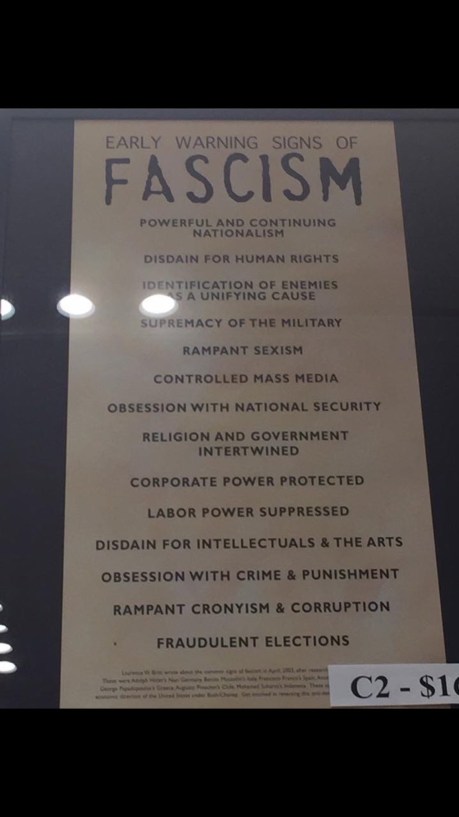
museum

Sound familiar?

Read it again.

Think about it.

Which side are you on?

Snopes says the poster was once available in the gift shop of the Holocaust Museum.

Snopes says:

The list was originally created by Laurence Britt in 2003, for an article published by Free Inquiry magazine (a publication for secular humanist commentary and analysis). While subsequent postings of the list often attribute it to “Dr. Laurence Britt,” the author said that he was not actually a doctor (nor did he claim to be). Britt himself said that he could be more accurately described as an amateur historian

It quotes this note about the poster:

Laurence W. Britt wrote about the common signs of fascism in April 2003, after researching seven fascists regimes. Those were Adolf Hitler’s Nazi Germany, Benito Mussolini’s Italy, Francisco Franco’s Spain, Antontio de Oliveira Salazar’s Portual, George Papadopoulos’s Greece, August Pinochet’s Chile, Mohamed Suharto’s Indonesia. These signs resonate with the political and economic direction of the United states under Bush/Cheney. Get involved in reversing this anti-democratic direction while you still can!

Bill Phillis retired years ago as a Deputy Commission of Education in Ohio. He is passionate about equitable funding for the public schools. He has been relentless in exposing the raids on the state treasury by private profiteers like ECOT and for-profit charters. He founded an organization called Ohio Coalition for Equity and Adequacy. If you live in Ohio, you should join his work.

Bill Phillis is a tireless warrior for public schools. Like almost everyone who fights for Democratic public schools, he is unpaid. He fights because of his convictions, not his wallet. The reverse is true for corporate reformers. Take away the hundreds of millions behind their malevolent privatization movement, and it would collapse.

I name Bill Phillis to the honor roll of this blog. He is a hero of public education.

He said this about the recent Supreme Court decision, which will divert more money from public schools to religious schools:

“U.S. Supreme Court rules Trinity Lutheran Church in Missouri is entitled to public funds for non-religious purposes

“The June 26 ruling in the Missouri case probably will not affect how Ohio does business with churches and parochial schools, but it does provide another wrecking ball to help knock down the wall of separation between church and state. Although it is a narrow decision, it paves the way for further mischief.

“Ohio provides several tax-funded perks for parochial schools-auxiliary services, administrative cost reimbursement, transportation and vouchers. Ohio already is at the very top of the nation in tax support for private parochial schools. The state provides more tax dollars per student to private schools than many public schools receive.

“Companion bills (SB 85 and HB 200), pending in the legislature, would greatly accelerate public support for a parochial education.

“The nation’s founders had good reason for erecting a wall between church and state. Many of them had firsthand knowledge and experience regarding the mischief inherent in mixing the two. Both church and state lose when the two become intertwined. Public support of one’s faith trivializes it. The dominate faith community tends to have undue influence on government. Iran is a good example of a country with no wall between church and state.

“The wall in the United States need repairs, not further demolition.”

William L. Phillis | Ohio Coalition for Equity & Adequacy of School Funding | 614.228.6540 | ohioeanda@sbcglobal.net| http://www.ohiocoalition.org

Ohio E & A, 100 S. 3rd Street, Columbus, OH 43215
ohioeanda@sbcglobal.net

Mercedes Schneider is not a lawyer but she is a very smart reader, who cuts to the chase.

She read the recent decision by the Supreme Court about the church that wanted to participate in a state program to resurface its preschool playground with recycled tires.

The decision doesn’t reach the voucher issue but it gives strong hints about where justices are likely to rule when they do get a voucher decision.

What are the implications, she asks.

You will find her analysis enlightening.

I liked SomeDam Poet’s interpretation of the decision, where she/he asked how access to a new playground–or lack thereof–interfered with the free exercise of religion by members of the Trinity Lutheran Church in Missouri.

Steven Singer has a new view of the recent Supreme Court ruling that the state of Missouri is obliged to pave the playground of a church.

If churches are going to receive federal funding, he writes, they should pay taxes.

What is more, think long term. Church schools that receive federal and state funding should expect to meet accountability standards for their curriculum and their hiring practices. Separation of church and state protected religious institutions from government regulation and control. Well, that’s over.

What conservatives seem to forget is that the wall of separation between church and state wasn’t erected just to protect the state from influence by religion. It also was set up to protect religion from the state.

Once you have money flowing from one to the other, regulations are soon to follow.

Expect your cute little parochial school to put away the Bible and replace it with “The Origin of Species”.

What? Your faith compels you to believe in the Creation of Man by God and not scientific evolution of organisms through heritable traits? I guess you’ll just have to teach the controversy.

Some people in America still think that there’s value in having both public and private schools. They seem to think that it’s actually a benefit having school systems where people are taught differently. But this new ruling paves the way (pun intended) to breaking down the walls between each type of institution.

Yes, public schools will become more like religious schools. But religious schools will also become more like public schools.

The entire education system will become one big watered down whole. And – giggle – those pushing for it actually call the process “School Choice”!

Oh the plutocrats will do their best to cover it all up with culture war nonsense. You’ll hear hours of cable news blather about poor conservative bakers fighting not to make cupcakes for gay people. But behind this high profile grist for the mill will be active efforts at homogenization, government overreach and oligarchy.

SomeDam Poet writes about the Supreme Court decision requiring the state of Missouri to pay for the resurfacing of the playground of the Trinity Lutheran Church:

At first, SDP was puzzled by the decision and asked,

“Is playing on the playground part of the Lutheran religion?

“Is that why refusing the Lutheran school public money for the playground resurfacing constitutes abridgement of free exercise of their religion?”

Today, SDP had figured it out and wrote:

“After sleeping on it, I think I now understand the logic in the Court’s decision.

“The playground is a place for children to exercise “religiously” (on a daily basis), right?

“And if the religious school did not get the money from the state — if they had to pay – to resurface the playground, then that exercise would not be free.

“So, by denying the church school the grant money, the state is abridging free exercise and thereby violating the Free Exercise clause in the Constitution.

“QED.

“PS I also exercise religiously (at Planet Fitness) and as it stands now, I have to pay for that. I am not a lawyer, but given the recent ruling, I believe this may also be unConstutional. It certainly is not good for my constitution to not exercise.”

Peter Greene reviews yesterday’s decision by the U.S. Supreme Court, which said that the state must make public funding available to religious institutions so as not to discriminate against them. The case involved the Trinity Lutheran Church in Missouri, which sought public funding to resurface the playground of its preschool. Initially, the state said the money was only available to public schools, because a prohibition in its state constitution. After the case advanced, the state relented and paved the playground, which made the case moot. But the Court ruled anyway, 7-2, that the state had to fund the church playground.

The Founders were very clear about the importance of not entangling church and state. The First Amendment explicitly says “Congress shall make no law” establishing any religion. It is not a big logical leap to extend that Amendment to say “Congress shall make no law” establishing many religions. Religious liberty is best preserved by keeping church and state separate.

Greene writes:

What matters in a case like this is the reasoning. Here’s the oft-quoted excerpt from the majority:

“The exclusion of Trinity Lutheran from a public benefit for which it is otherwise qualified, solely because it is a church, is odious to our Constitution … and cannot stand,” wrote Chief Justice John G. Roberts Jr.

As Bloomberg notes, this is a big deal:

“It’s the first time the court has used the free exercise clause of the Constitution to require a direct transfer of taxpayers’ money to a church. In other words, the free exercise clause has trumped the establishment clause, which was created precisely to stop government money going to religious purposes. Somewhere, James Madison is shaking his head in disbelief.”

A portion of the majority made an attempt to mitigate the effects of the decision with a small footnote (the full opinion is here).

[The footnote: “This case involves express discrimination based on religious identity with respect to playground resurfacing. We do not address religious uses of funding or other forms of discrimination.”]

That note may be meant to indicate that the ruling is meant to be narrow– but not all of the seven justices who ruled against the state signed off on this footnote.

Reading through the decision leaves little mystery about where the majority are headed. The church argued that it was being disqualified from a public benefit for which it was otherwise qualified. The majority agrees:

“The State has pursued its preferred policy to the point of expressly denying a qualified religious entity a public benefit solely because of its religious quality. Under our precedents, that goes too far.”

And just in case that’s not clear enough, here’s Justice Gorsuch, joined by Justice Thomas, explaining why they don’t agree with footnote three. They argue that there is no point in distinguishing between religious purposes and activities, and that the exercise clause does not care, either.

“…the general principles here do not permit discrimination against religious exercise– whether on the playground or anywhere else.”

In other words, giving public tax dollars to a church-run private school would be just fine. In fact, it’s hard to know exactly where the court would draw the line. If an organization is in the community, competing for community funds for an activity, you can’t rule them out just because they are a religious organization. If a church wants money to pave a playground or run a school, you can’t deny them just because they’re a church.

The dissenting opinion sees this pretty clearly:

To hear the Court tell it, this is a simple case about recycling tires to resurface a playground. The stakes are higher. This case is about nothing less than the relationship between religious institutions and the civil government—that is, between church and state. The Court today profoundly changes that relationship by holding, for the first time, that the Constitution requires the government to provide public funds directly to a church.

That sounds about right. With this decision, the wall between church and state is pretty well shot, and there is nothing to stand in the way of, say, a federally-financed multi-billion dollar program that would funnel money to private religious schools. Trump and DeVos could not have a brighter green light for their voucher program.

I’ll argue, as always, that churches will rue the day the wall is taken down. The separation of church and state doesn’t just protect the state– it protects the church, too. When you mix religion and politics, you get politics. And where federal money goes, federal strings follow. Sooner or later the right combination of misbehavior and people in federal power will result in a call for accountability for private schools that get federal money– even religious schools. And as the requests for private religious vouchers roll in, folks will be shocked and surprised to find that Muslim and satanic and flying spaghetti monster houses of worship will line up for money, then the feds will have to come up with a mechanism for determining “legitimacy” and voila! That’s how you get the federal department of church oversight. Of course, this will only happen once we’re finally tired of the idea that charter and voucher schools don’t have to be accountable for anything to anyone…

The Supreme Court ruled today by 7-2 that Missouri could not deny funding for the resurfacing of a church playground when the state was funding the resurfacing of public school playgrounds. The court apparently overturned the state constitution’s prohibition on funding religious institutions in any manner. If this ruling overturns state constitutional amendments prohibiting the funding of sectarian (religious) schools, it clears the way for state funding of capital cost of religious schools, and very possibly, for vouchers. (Ironically, before the decision, Missouri had already reversed course and resurfaced the church’s school playground.)

“The court ruled 7-2 that religious institutions may not be excluded from state programs with a secular intent — in this case, making playgrounds safer.


“Missouri’s state constitution, like those in about three dozen states, forbade government from spending any public money on “any church, sect, or denomination of religion.”


“Trinity Lutheran Church in Columbia, Mo., wanted to participate in a state program that reimburses the cost of rubberizing the surface of playgrounds. But the state said that was not allowed. The exclusion has raised big questions about how to uphold the Constitution’s prohibition on government support for religion without discriminating against those who are religious.
Missouri’s state constitution, similar to those of about three dozen states, directs that “no money shall ever be taken from the public treasury, directly or indirectly, in aid of any church, sect, or denomination of religion.”

“
Chief Justice John G. Roberts Jr., who authored the opinion, wrote, “The exclusion of Trinity Lutheran from a public benefit for which it is otherwise qualified, solely because it is a church, is odious to our Constitution … and cannot stand.”
The two dissenting votes came from Justices Ruth Bader Ginsburg and Sonia Sotomayor.”

In another decision, the Supreme Court agreeed to hear a case in which a baker refused to make a cake for a gay couple, because of his relious views. Given the decision today about the Missouri case, this Supreme Court might decide that discrimination based on religious principles is constitutional.

Voucher advocates like to point to Vermont as the nation’s oldest program. When it was started in 1869, it was intended to pay the tuition of students whose town did not have a public school. It has very little in common with the curren voucher movement, which takes its inspiration from the libertarian economist Milton Friedman, who wrote a seminal essay in 1955 proposing that all students should receive vouchers to attend the school of their choice. The group that was fastest to seize upon his ideas was Southern segregationists, who saw school choice as an effective way to keep their schools racially segregated. It took a dozen years until the federal courts and the U.S. Department of Education compelled Southern schools to desegregate their schools.

Meanwhile, Vermont’s voucher program continued undisturbed.

Today as education writer Anne Waldman of ProPublica explains, the voucher program funds a disproportionately large number of students from affluent families who choose expensive private schools, including out-of-state boarding schools like Exeter and Deerfield Academy.

“Vermont’s voucher program is a microcosm of what could happen across the country if school-choice advocates such as Education Secretary Betsy DeVos achieve their vision. By subsidizing part of the cost of private schools in or out of state, it broadens options for some Vermonters while diverting students from public education and disproportionately benefiting wealthier families like the Bowmans.

“Vermont vouchers have been used to send students to ski academies, out-of-state art schools and even foreign boarding schools, such as the Sigtunaskolan School in Sweden, whose alumni include Sweden’s current king and former prime minister. Vermont paid more than $40 million in vouchers to more than 60 private schools last year, including more than $1.3 million to out-of-state schools, according to data received from the state’s education agency through a public-records request.

“Of the almost 2,800 Vermonters who use publicly funded vouchers to go to private schools in state, 22.5 percent qualify for free or reduced price lunch, according to state education data. (The data excludes out-of-state private schools.) By contrast, 38.3 percent of public school students in Vermont have family incomes low enough to qualify them for the lunch discount.”

Voucher advocates in other states will insist that they want vouchers for poor black and Hispanic students or for students with disabilities.

Such claims, however, are the first step towards the goal of making vouchers available for everyone.

Vermont sets no income limit for students who choose to use vouchers. However, the vouchers may not be used in religious schools, because the state Supreme Court ruled it unconstitutional in 1999.

Betsy DeVos has said many times that she seeks vouchers for every kind of school, including religious schools. Private and religiousschools set their own admissions requirements, so the schools choose the students. Public schools are required by law to accept all students, regardless of race, religion, family income, sexual orientation, language or disability status.

There are many reasons to object to diverting public dollars to religious and private schools. One reason is that every dollar that goes to a nonpublic school is subtracted from a public school. A vote for vouchers is a vote to defund public schools and impose budget cuts on them.

One of our readers is an avid supporter of school choice. When he asked why anyone objects to school choice, this was my reply:

“I object to paying for religious indoctrination in any faith including my own.

“I object to my tax dollars paying for schools that discriminate against children based on their race, their sexual orientation, or their disabilities.

“If the Supreme Court eliminates the state Blaine amendments and allows tax dollars to subsidize religious schools, expect that lawsuits will challenge their discriminatory admission policies, and states will begin demanding that their students take the same tests and meet the same standards as all publicly funded schools. Expect states to require the hiring of certified teachers in schools that take public money.

“The religious and private schools that want to protect their autonomy will not accept state money. Only the very marginal schools, those that can’t fill their seats, will take the money.”

What are your reasons for supporting or opposing tax dollars for private school choice?