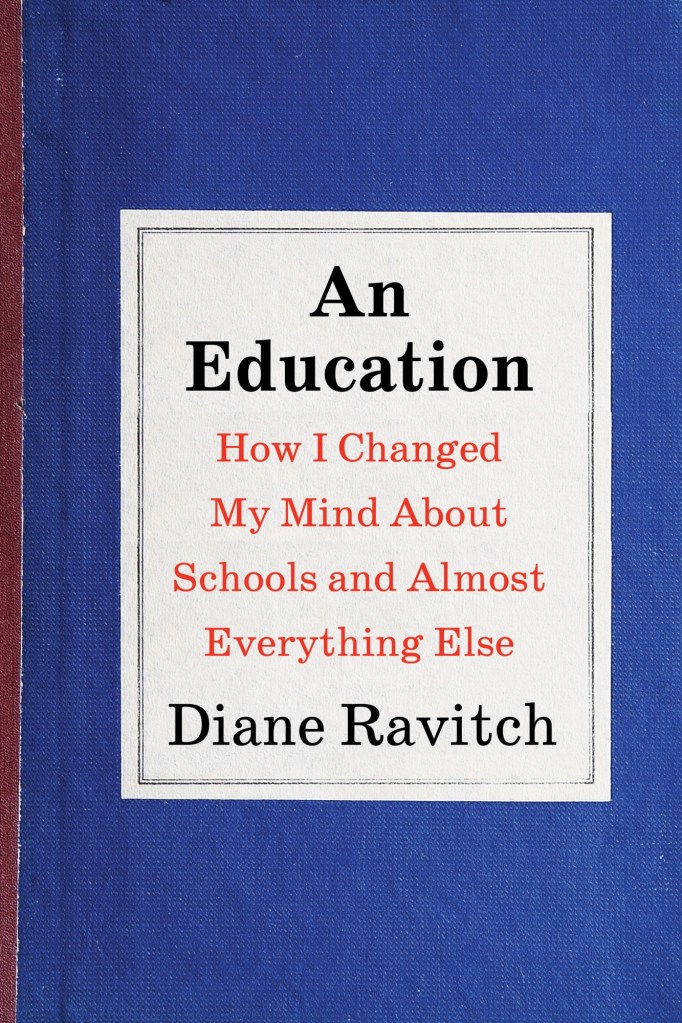
This is a terrific interview conducted by Nick Covington about my bio, An Education: How I Changed My Mind About Schools and Almost Everything Else.
Please listen.
This is a terrific interview conducted by Nick Covington about my bio, An Education: How I Changed My Mind About Schools and Almost Everything Else.
Please listen.
Norman Batley hosts a podcast called “Life Elsewhere with Norman B.” He is based in Tampa, Florida. The program is widely distributed through WMNF and NPR. He asks great questions, and I was thrilled to be invited to be on his show.
John Thompson, historian and retired teacher in Oklahoma, wrote this thoughtful review of my memoirs, An Education: How I Changed My Mind About Schools and Almost Everything Else.
He writes:
Diane Ravitch’s An Education: How I Changed My Mind About Schools and Almost Everything Else is dedicated to her wife Mary; her sons, Joe, Michael, and Steven; her grandsons Nico, Aidan, Elijah, and Asher; and her ex-husband Richard. An Education intertwines deeply emotional personal and family experiences with the history of how she became such a transformative education leader. Although Diane denies it, I believe she’s the most influential education advocate of the last century.
I’ve been reading Diane Ravitch’s work for decades, but An Education is my favorite book. And my favorite passage started with Diane’s citation of Robert Hutchins who said, “We have to learn to live with those whose opinions differ from our own. After all, they may turn out to be right.”
Then she wrote about Hutchins statement, “for three decades I didn’t realize that it was intended for me.”
Being from Oklahoma, I was captured by the first part of her book, about growing up in Texas. I especially loved her story about meeting Roy Rogers at the Rodeo when she was 9 years old. After Rogers slapped her hand, Diane said, “I determined on the spot that I would never wash that hand again!”
Diane was a tomboy who loved horses and dogs. But she experienced sexism and trauma. She said she “did not have an idyllic adolescence. No one ever does.” But her teenage years were “destroyed by my father abusing me.”
During the middle of her book, she recalled her complicated marriage to Richard Ravitch and, then, her wonderful wife, Mary. Mary worked with the progressive educator Deborah Meier and opened a progressive small school in New York City.
I was especially impressed by Diane’s communication with Al Shanker. He sought to allow teachers to start schools within schools to turnaround kids “in the back of the classroom with their heads on their desks.” Back in the late 1980s, it seemed like he might be able to bring diverse factions together. But, by 1994, charters had been high-jacked by corporate reformers and their winners and losers ideology.
In the middle of An Education. Diane revealed in so much detail the inside stories of her years as a conservative. Back then, when I was an academic historian, I learned the most about Diane when reading her 1983 book, “The Troubled Crusade: American Education, 1945 – 1980.” Although I couldn’t yet read her work through the eyes of a teacher, I was exceptionally taken by her calls for teaching background knowledge so students could develop reading comprehension skills so they could “read to learn,” and her placing education pedagogies in a broad historical context.
Diane recalls her support for meritocratic, standardized testing, and color-blind policies, when she questioned bilingual education, and even the benefit of the Equal Rights Amendment. This was the time when she made friends with Bill Bennett, President Reagan’s Secretary of Education, and Chester Finn, and Tennessee Governor Lamar Alexander. I knew she had ties to Daniel Patrick Moynihan, but I too thought that progressives’ criticism of him was too politically correct. And, until I read An Education, I knew little about the two sides of James Coleman’s research, whose earlier research had seemed persuasive to me.
Neither would I have thought that Chester Finn was like a “sibling” to Diane.
When explaining her then-conservative beliefs, I sometimes felt that Diane was too hard on herself. For instance, she was far, far from alone in failing to understand the wisdom of Gov. Ann Richards, who said, “If there ever is school choice in Texas, the hard-right Christians will get the money to indoctrinate children.”
Moreover, as An Education schooled me on the propaganda behind the so-called “Texas Miracle” it did more than foreshadow the “New York City Miracle,” the “Harlem Miracle,” and the “Mississippi Miracle.” It brought me back to the decades-long Oklahoma reality when our curriculum and policies were based on Texas’ accountability systems. During most of my career, our policies were informed by one Texas trick after another to jack up accountability metrics.
Diane served as member of the National Assessment Governing Board from 1997 to 2004, and she would dig deeply into the numbers and the methodologies behind NAEP. But, as she explained, few journalists read the fine print of the research and they wrote “breathlessly” about supposedly dismal results in traditional public schools. They certainly didn’t report properly about the way that students’ outcomes were linked to family income.
When serving in the Education Department, Diane took a lead in establishing national standards for every school subject. Drawing upon excellent historians, multicultural History standards were set. She hoped standards like those would remain voluntary and “unify their respective fields and establish a common ground for a curriculum without telling teachers how to teach.”
But the conservative Lynne Cheney “published a scathing denunciation of them.” Cheney said the History standards focused too much on people like Joe McCarthy and the Ku Klux Klan, and not enough on Ulysses S. Grant, and Robert E. Lee. This launched the modern wars over curriculum that have become especially destructive under President Trump.
Even so, in 2002, Diane hoped that Mayor Mike Bloomberg and Joel Klein (who knew nothing about education) would succeed in improving New York City Schools. Klein reorganized schools from top to bottom, with multiple schools per building drawing on funding by the Gates Foundation. (By the way, I saw the chaos Klein created when visiting dozens of hurriedly opened school, especially in Bedford–Stuyvesant. Usually, leaders of the new schools didn’t even know how many new schools were being opened in their building.)
And, even worse, Jack Welch CEO of General Electric pushed 20-70-10 “stack ranking,” meaning 70% of teachers would be in the middle in terms of effectiveness, and 10% should be “removed,” even if it took the use of invalid and unreliable metrics to evaluate all teachers.
Especially after Diane engaged in a seven-year debate with Deborah Meier, which further “broadened her perspectives,” she became an invaluable leader of the grass-roots opposition to corporate school reforms. She objected to top-down mandates on teaching reading. Diane was among the first to explicitly link in a detailed manner the reforms to the wider privatization movement. And she nailed it when identifying them as the “Billionaires Boys Club.”
Diane analyzed the public relations campaigns which sold “reforms” as the “New York City Miracle.” Drawing upon her insights from serving on the National Assessment Governing Board, she clearly explained why NYC schools flipped back and forth between A and F grades. Then, she linked President Obama’s flawed $5 billion RTTT experiment with the problems with Common Core curriculum and tests that were years above students’ reading levels.
Diane then quotes John Maynard Keynes who said, “When the facts change, I change my mind. What do you do, sir?”
Today, Diane changes minds by clearly explaining the interconnections between Free Market ideology, and profits, and the mindsets of elites that push privatization. She also reports daily on the interconnected attacks on schools throughout the nation. And now she’s sharing the same wisdom when spreading the word about Trumpism and today’s attacks on democracy.
I always read Diane’s daily blog posts. And I so very much appreciate An Education, even if it briefly pulled me away from reading everything in the Diane Ravitch Blog.
I was interviewed by Brian Lehrer of WNYC, public radio about my latest book, probably my last. He is a great interviewer. He asks good questions, followed by people who called in to disagree with me.
It’s an excellent interview.
I apologize if I’m browbeating you with stuff about my book, but the book is really good; I worked on it for two years; the mainstream media has ignored it; and I think you will enjoy reading it.
In case you haven’t noticed, the title is:
An Education: How I Changed My Mind About Schools And Almost Everything Else (Columbia University Press). You can buy it from Columbia University Press, your local independent bookstore, or Amazon.
Gary Rubinstein is a teacher of mathematics at Stuyvesant High School in NYC and a prominent critic of corporate reform. He started his career as one of the first corps members of Teach for America. After many years inside the reform world, he saw its flaws and became an apostate. Like me. With his superb mathematical skills, he has debunked charter school “miracles,” TFA data, the Tennessee Achievement School District, which did a lot of boasting but failed.
His review is a delight to read.
He writes:
Fifty years after the publication of her first book, ‘The Great School Wars’, author and historian Diane Ravitch has released her long awaited memoirs. In ‘An Education: How I Changed My Mind About Schools and Almost Everything Else’ Ravitch takes us through her life from her childhood in Houston through the ups and downs of a long and productive life driven by truth and integrity.

What makes this book a ‘must read’ is that it has the three elements that a great autobiography should. First, her life story is interesting on an objective level. Anyone picking up the book and reading over the book jacket will know that Ravtich is someone who achieved fame and notoriety through the unlikely passion of the history of Education in America. But in this book we learn about the sorrow she had to endure between her great triumphs. So her story, even if it weren’t so well written, would make a very good book. A second component of a great autobiography is the author’s ability to reflect on 80 plus years of life and find the pivotal moments that changed the course of her life. But for an autobiography to be ‘great’ it must be infused and brought to life with excellent precise writing. As ‘An Education’ has all three aspects, this is a book you are going to want to read and then keep to re-read over the years when you are in need of inspiration.
If you have read any of Ravitch’s education books, you know that she is a master of absorbing decades of events and processing them and creating an insightful, and incredibly efficient, thesis which she develops over the course of a book. As she explains in this book, she learned her craft while writing as a journalist for The Wellesley News and then for The New Leader magazine. In all her books she exhibits this efficient technique that would make Strunk and White beam. But, by design, Ravtich’s books on Education are stripped of emotional language. Those books educate you through a series of well chosen facts that lead you to understand the implications and big moments without having to spell out every detail. The big question, which this new book answers with an emphatic ‘Yes’ is whether or not her kind of writing can be used to evoke the joy and the sorrow she experienced through her full 87 years of living.
When I started reading this book, I would bookmark interesting passages that show her talent for memoir. Eventually I realized that I was bookmarking almost every page. So after the first 50 of so pages, I had to slow down on the bookmarking. Here are some of my favorite moments (I will try not to give away too much).
Since Ravitch can write a full tale in the span of five or six lines, there are so many interesting stories in this book. As a writer she reminds me of one of those painters, I don’t know so much about painting to know what this is called – maybe impressionistic? – who, rather than producing a full photographic quality image, instead just does the minimal with the paint and brush to convey the emotion and ideas. This is something that is very difficult to do yet she makes it look easy.
A few pages later, Ravitch relays an amusing story about how as a teen she found a pearl in an oyster and ended up in the newspaper for it and also got food poisoning from eating the oyster: “The next day, after the newspaper appeared with a photograph of me in short shorts, identified by name, strange men began calling the house, asking for me and saying impudent things. That went on for days, along with the vomiting. My mother was not amused.” This is so efficient, not a word wasted and it does convey the absurdity and the humor with a minimal delivery reminiscent of maybe Bob Newhart.
Here’s one I liked: “The only Sunday school teacher I remember was a strapping guy who discussed Bible stories and the Jewish religion with us. He told us that when he was our age he had run away with the circus.” Ah, see how great this is? In the first sentence she sets up the scene. And then in just a few words tells us the perfect thing to understand this guy. No more is needed and no more is said.
Throughout the book, Ravitch takes stories and moments that could easily fill several pages and finds a way to convey them in a few words. For the reader, this has the effect of injecting all the humor and sometimes the sorrow of these moments directly into our brains without it having to be processed and translated in our minds.
Though these two examples are fun and convey the innocence of childhood, Ravitch is similarly terse in her telling of some of the deepest tragic moments of her life. When these happen in the book, the descriptions are so efficiently written that, like sometimes when bad things happen in life unexpectedly, we find ourselves pausing and wondering if that really just happened. The matter of fact telling of memorable moments of life, both big and small, happy and tragic, has a powerful effect on the reader.
The book really gets rolling when Ravitch enters college in 1956 at Wellesley. In one sense she is a fish out of water and then she eventually completely at home with the lifelong friends she made there. This was a really fun chapter to read as Ravitch has the first of her many brushes with fame, like her friend Maddy – eventually Madeleine Albright. Just as always, Ravitch perfectly sets up the matter of fact description of her friend’s background and then, in an instant it is revealed who she became known as. The Madeleine Albright story was less than one page long.
One of my favorite parts was the description about a satirical musical Ravitch and her friends wrote for the Wellesley Junior Show. It was hilarious. I kind of want to see the full script but her description of it, as all her descriptions, gave us just enough that we feel like we saw the whole show but forgot some of the missing details.
After college, Ravitch starts domestic life but isn’t quite content. She then goes on a lifelong quest for love and for purpose. As she goes through different eras in her life, she meets a new cast of colorful characters, some famous, some not, but always relevant to her story.
In this book we learn how she went from being the wife of an influential New York City figure to the influential Dr. Ravitch the Education guru of this country. As she rises in the ranks, she finds herself in the company of so many famous people — even several presidents, yet she conveys in her telling of these encounters that, to her, it wasn’t such a big deal. They are all just people. Anyone who has gotten the chance to meet her in person and see her interact with so many people who are not famous will see that she treats non famous people like they are special and is always asking them questions rather than talking about herself.
One of the funniest anecdotes in the book is when she inadvertently got Isaac Asimov angry with her over small talk related to word processors. Again, this is only a few lines, but another interesting adventure in Ravitch’s full life that put her often in the room with all kinds of famous people.
While married to her husband, Diane unexpectedly meets her soulmate who happens to be a woman. In the chapter about the genesis and growth of her relationship, they have now been together for almost 40 years, she is able to convey what it means to finally experience the joy of true love.
In the last chapters of the book we learn about the Washington years in the Department of Education and how that came about and what she tried to accomplish there. We also learn about what it took to renounce much of her work and to follow the evidence into a more evolved system of beliefs about what can improve education in this country. She lost a lot of friends and titles in the process but she kept her personal integrity and commitment to the truth.
Throughout the book, the theme is that Ravitch is never just one thing or the other. Is she a education conservative or an education liberal? Is she straight or gay? Is she a southerner or a north easterner? Is she an introvert or an extrovert? Is she a socialite or a homebody? And throughout her life she is sometimes one and sometimes the other. She is someone who defies categorization. And though in the subtitle she says she ‘changed her mind about schools and almost everything else’ she never changed her core belief that you don’t just stay in the same place just because you are comfortable there.
And like with her, this book is a lot of different things. On one level it is an amusing and interesting read about someone whose choices led her on an unlikely adventure ending with her being, in some circles, a huge celebrity. But it is also an inspirational tale of how having values and staying true to them can help you overcome some of the unfortunate obstacles you have to deal with in life. And though I doubt it was intended to accomplish something else, I think that for many readers they will want to write down their own memoirs after reading this. Ravitch makes it look so easy to analyze your life, find the key moments in it and write some succinct prose – though of course it isn’t so easy but still a worthwhile task.
After finishing this book, I had an experience that only a few people were also able to have. In the acknowledgements in the ‘friends’ section, among sixteen other names, there was my own. I got a chill seeing this, never expecting it. But this made me think something else, also a lesson, though maybe unintended from this great book. This book reminds us of the importance of relationships. Everyone you know has a story to tell. Some people’s lives may not have the highs and lows of Diane Ravitch’s but for each person, their joys and sorrows are meaningful to them. And even if they don’t have the capability to write the way Ravitch can, if they could, you might find yourselves in the acknowledgement page for that friend or family member. So enjoy the relationships you have while you can and remember that you are an important person in many people’s lives.
So pick up a copy today and take a ride through the ups and downs of a well lived life. Though she has made a career of writing about education and teaching, through this book she educates and teaches us that if you keep an open mind and are committed to learning and following the facts, you might end up in a comfortable home a long way from where you started.
Tom Ultican had a successful career in the private sector when he made a decision that changed his life: He became a teacher of physics and advanced mathematics in California. After he retired, he became blogging about education. He became one of the most perceptive investigators of the powerful people and dark money behind the organized attacks on public schools.
I am delighted to present his review of my just-published memoir, titled AN EDUCATION: HOW I CHANGED MY MIND ABOUT SCHOOLS AND ALMOST EVERYTHING ELSE (Columbia University Press).
I am posting a portion of his review here. I encourage you to open the link and finish his fine commentary.
He wrote:
An Education; How I Changed My Mind About Schools and Almost Everything Else, is highly recommended especially for the thousands of us who consider her a friend. Diane is a very generous person with both her time and resources. I first met Diane through her blog in 2014, then in person at the 2015 NPE conference in Chicago. It was in this time period that she started posting some of my articles on her blog while simultaneously informing me about who was working to destroy public education. At the time, I did not realize what a privilege this was. Her latest book is an intimate memoir that introduces us to Diane Rose Silverstein of Houston, Texas born July 1, 1938. It tells the story of a Jewish Texan from of large struggling family becoming politically influential and a national treasure.
On a page following the dedication page, she quotes Ralph Waldo Emerson:
“Foolish consistency is the hobgoblin of little minds, adored by little statesmen and philosophers and devines.”
I knew that Diane had made a big change and reversed herself on test based accountability and other school reform agendas driven by conservatives and neoliberals. However, the courage this change took and the depth of her reversal were profoundly illuminated by reading this book.
Although growing up in a Roosevelt supporting family and being a registered Democrat, she became deeply conservative. Diane served on the board of the Thomas B. Fordham foundation, contributed to the Manhattan Institute and was a member of the Koret Task Force with the likes of Eric Hanushek and E. D. Hirsch Jr. Her best friends personally and politically all supported the ideas she abandoned. By reversing herself, she walked away from professional security and long held personal friendships. It was courageously principled but must have been a personally daunting move.
The best part of “An Education” for me was Diane’s recounting growing up in Houston and going to a segregated public school. Her experience was just so relatable. She liked all the music my oldest sister liked. Cheating was rampant in her school just like mine and like her; I let my classmates copy my work. My rural Idaho school was kind of segregated but that was because only white people and a few Mexican families lived in the community. The Mexican kids were very popular in our school. I never met a Black person until I was a senior in high school and had only seen a few through a car window when vacationing in Kansas City. It was wonderful to find some commonalities.
I had studied engineering, worked in Silicon Valley and pretty much ignored education. But I did hear from Diane and her friends about what a failure public education had become. By 1999, I became tired of hearing about people becoming rich off their stock options, working on the next greatest hard drive or dealing with the atrocious San Jose traffic. I decided to return to San Diego and do something to help public education by enlisting in a master of education program at the University of California San Diego (UCSD).
The UCSD program was oriented toward constructivist education which I really liked. I read books by Alfie Kohn and papers by Lisa Delpit and was ready to revolutionize public education. Then I got to my first job at Bell Jr. High School and discovered that the teachers there were well informed pros with lots of experience. By comparison, I was not nearly as competent as most of them.
It was then that I started to see that I had been bamboozled about how bad public schools were and started looking for like minded people. Two books, David Berliner’s and Eugene Glass’s “50 Myths and Lies that Threaten America’s Public Schools” and Diane Ravitch’s “The Death and Life of the Great American School System” were like water for the thirsty. Soon after that, I found Diane’s blog and joined the Network for Public Education (NPE) along with many other public school advocates.
I saw Diane at the 2015 NPE conference in Chicago’s Drake Hotel. It was an absolutely inspiring event with a keynote by the amazing Yong Zhao. Although we started communicating a little by email, I did not meet Diane personally until NPE 2016 in Raleigh, North Carolina. It was there that the Reverend William Barber gave a truly inspiring speech.
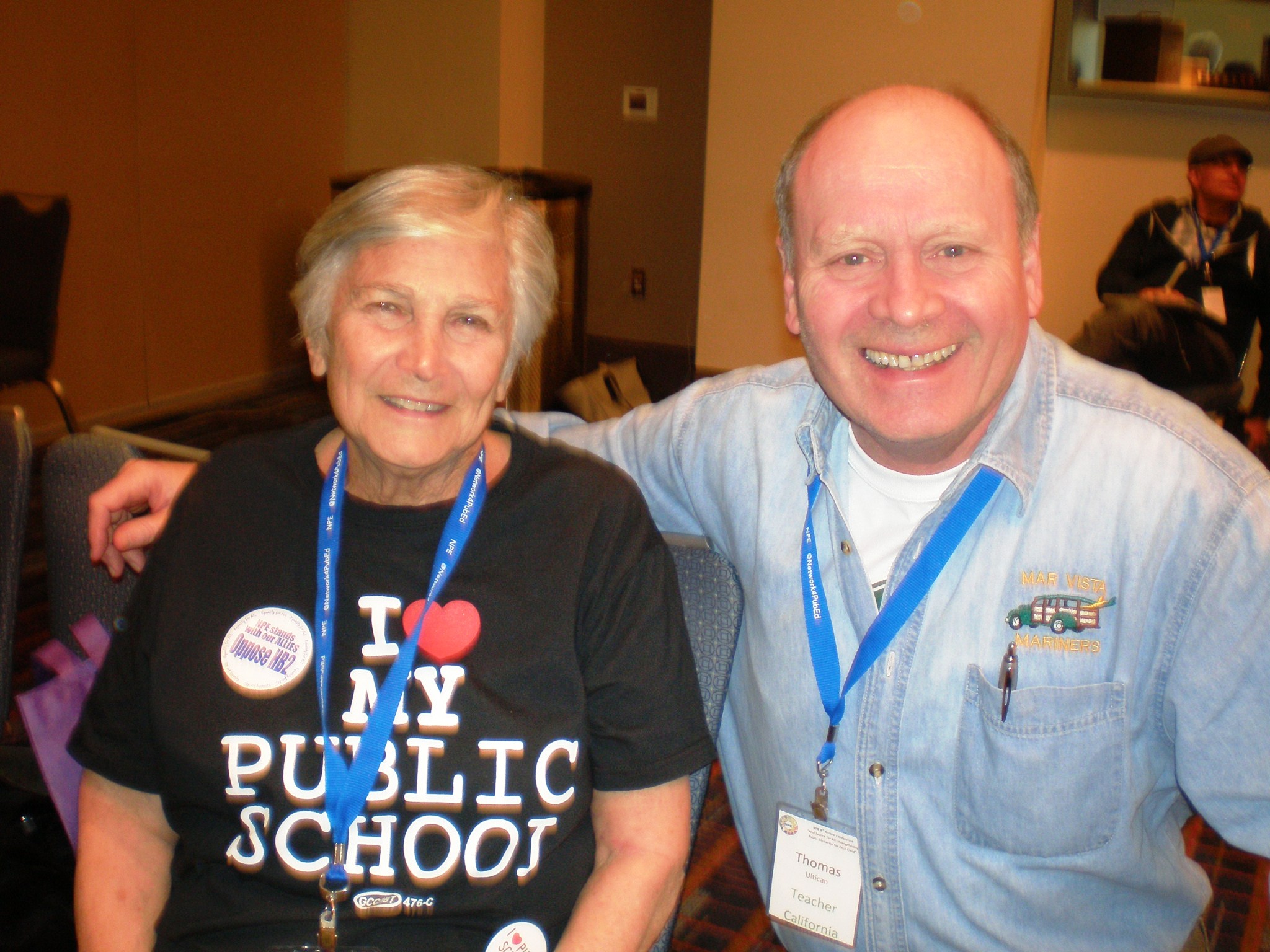
Tom Ultican and Diane Ravitch in Raleigh (by Ultican)
Please open the link and keep reading this excellent review!
Josh Cowen interviewed me by email about my life, after reading my book An Education: How I Changed My Mind About Schools and Almost Everything Else.
I think you will enjoy reading the interview.
He asks important questions about me and changes in my life.
The New Books Network selected my memoir as the book of the day on October 28.
They posted this interview with me about the book. I hope you watch.
I really liked the conversation with Tom Discenna, who is a Professor of Communication at Oakland University whose work examines issues of academic labor and communicative labor more broadly.
Tim read the book. Very often, I have been interviewed by people who read the copy on the jacket or had questions prepared by their staff. Not Tom. He read the book.
Let me know what you think.
I was invited to write about the Trump agenda for education by The New York Review of Books. This is a publication I love to write for, because it’s the most distinguished literary-political-cultural publication in the nation. In addition, the editing process is arduous and careful. Every word, every sentence was carefully scrutinized. I happen to love close editing because it is a demonstration of seriousness. The editors at NYRB are very serious.
Here is the article. It is not behind a paywall.
If you are within driving distance of Salisbury, Maryland, please come to hear me talk on Tuesday at 7 pm.
I will be speaking in a lecture series endowed by veteran educator E. Pauline Riall.

 Diane Ravitch's blog