Far-right extremists concocted a cascading series of so-called culture wars that have no basis in fact or reality. Their purpose is to undermine public trust in teachers and public schools, paving the way for divisive “school choice,” which defunds public schools.
Teachers are intimidated, fearful that they might violate the law by teaching factual history about race and racism. Students are deprived of honesty in their history and social studies classes. Schools are slandered by extremists. Needless divisions are created by the lies propagated by zealots whose goal is to privatize public funding for schools.
First came the furor over “critical race theory,” which is not taught in K-12 schools. CRT is a law school course of study that examines systemic racism. The claim that it permeates K-12 schools was created as a menace threatening the children of America by rightwing ideologue Chris Rufo, who shamelessly smeared the teachers of America as purveyors of race hatred that humiliated white children. Rufo made clear in a speech at Hillsdale College that the only path forward was school choice. The entire point of Rufo’s gambit was the destruction of public trust in public schools.
Then came a manufactured brouhaha over transgender students who wanted to use a bathroom aligned with their sexual identity. The number of transgender students is minuscule, probably 1%. And yet again there was a furor that could have easily been resolved with a gender-neutral bathroom. Ron DeSantis made a campaign ad with a female swimmer who complained that she competed against a trans woman. What she didn’t mention was that the trans woman was beaten, as was she, by three other female swimmers.
And then came the nutty claim that teachers were “grooming” students to be gay. Another smear. No evidence whatever. Reading books about gay characters would turn students gay, said the critics; but would reading about elephants make students want to be elephants?
Simultaneously, extremists raised loud alarms about books that introduced students to dangerous ideas about sexuality and racism. If they read books with gay characters, students would turn gay. If they read about racism, they would “hate America.” So school libraries had to be purged; even public libraries had to be purged. One almost expected public book burnings. So much power attributed to books, as if the Internet doesn’t exist, as if kids can’t watch porn of all kinds, as if public television does not regularly run shows about American’s shameful history of racism.
As citizens and parents, we must stand up for truth and sanity. We must defend our schools and teachers against libelous claims. We must oppose those who would ban books.
Of course, parents should meet with their children’s teachers. They should partner with them to help their children. They should ask questions about the curriculum. They should share their concerns. Learning benefits when parents, teachers, students, and communities work together.
Texas Governor Greg Abbott is determined to pass a voucher bill in the upcoming legislative session, along with voucher zealot Lt. Gov. Dan Patrick. They hope to use the culture war nonsense about public schools “indoctrinating” students on race and gender issues. They pay no attention to the research showing that students who use vouchers are likely to lose ground, academically, and learn less than in public school. Does the legislature really want to harm the state’s public schools while sending kids off to religious and private schools where they are likely to get a worse education than in public schools?
Private school vouchers were within a handful of votes of becoming Texas law in May 2005. Former Rep. Carter Casteel still remembers the constituent who confronted her in her officethat day.
“He kind of threatened me, not to harm me, but that I wouldn’t be reelected if I didn’t vote for the vouchers,” Casteel, a New Braunfels Republican, said in an interview. A public school teacher and school board member before she served in the Legislature, Casteel is and was a staunch opponent of private school vouchers.
“I explained to him my position, and he wasn’t very happy, I remember that,” she said. “If you want your child to go to a private school, then that’s your choice and you spend your money, but you don’t take taxpayer dollars away.”
Debate on the floor of the Texas House stretched on for hours, and the voucher bill was gutted following a series of back-and-forth, close votes. Casteel voted no, saying publicly that she was willing to lose her House seat over it.
In a dramatic capstone to the proceedings, Rep. Senfronia Thompson ran across the floor and yanked the microphone out of the bill author’s hand, yelling for attention to a procedural mistake in the bill that led to its death.
They have been blocked by a powerful coalition of Democrats and rural Republicans in the House. In fact, the House has routinely and overwhelmingly supported a statement policy that outright bans taxpayer funds from going to private schools in sessions since.
But advocates for vouchers believe that those legislative dynamics that have been frozen for the last 17 years may finally be thawing.
As Republicans for the past year have raised alarms over what they see as liberal indoctrination in the public school curriculum — especially in the way racism and LGBT issues are taught — they’ve chalked up victories in statehouses across the country. Texas parents have carried that same fight to school board meetings, their local libraries and trustee elections. Now, Gov. Greg Abbott and Lt. Gov. Dan Patrick are calling for more of the same in the upcoming legislative session, with pledges to back ‘parents matter’ initiatives that include another voucher push.
“Families started to see there’s another dimension to school quality that’s arguably more important, which is whether the school’s curriculum aligns with their values,” said Corey DeAngelis, senior fellow with the American Federation for Children, which advocates for vouchers. “And I think that’s sparked a wave of support for school choice around the country.”
Abbott earlier this year announced his support for a policy that would allow public funds to follow students, regardless of whether they attend public schools or private schools. Shortly after, DeAngelis posted a photo of himself meeting with the governor, and “it’s happening, Texas,” has become a refrain on his popular Twitter account.
“With all the national momentum, I think a lot of people are looking toward Texas as the next step,” DeAngelis said. “It’s going to be all eyes on Texas coming up this session. And people are going to be watching.”
Eyes on Arizona, Virginia
The argument for vouchers has traditionally been that children, particularly in urban areas, are forced to attend struggling schools, when the state could instead subsidize them attending private schools nearby. One problem with this argument is that polling has often found that while people have critical views of public schools generally, they often like their own public schools just fine.
“In the past, they’ve tried to get vouchers by saying we’ve got to do something about kids trapped in failing schools. And so we’d say we’ve got all these failing schools. And then you’d look at the data and you have about 80 campuses out of about 8,500 or so that were ‘improvement required.’ So you’re looking at 1 percent,” said Charles Luke, head of the Coalition for Public Schools, which represents education groups opposing voucher policies.
“So when you’re talking about how horrible the public school system is, 99 percent of them are doing fine,” he said. “A kid takes a test and he gets a 99 on it, you wouldn’t say ‘he’s failing, I’m failing him, The system is failing him.’ You’d say, he’s doing great!”
But instead of school budgets or test scores, this time it’s culture war issues with spinoffs that include whether teachings on racism damage the self-esteem of white kids, and if it’s OK for young children to see a drag showor discuss gender identity.
“There’s this misalignment to what parents thought was going on in their schools and now their eyes have been opened, and now they say hey, hey lets fix this,” said Mandy Drogin, with the Texas Public Policy Foundation. “No more of this social justice warrior, whatever the teacher or administrator feels about pushing into our classrooms. I think that’s where you see so much momentum, and everybody feels and sees that momentum.”
The issue of private school vouchers has historically hewn closely to the culture war issues of the day. The modern voucher advocacy movement has roots connecting to efforts to resist racial integrationafter the Brown v Board of Education U.S. Supreme Court decision in 1954.
In the 1950s and ‘60s, supporters of vouchers wanted to leave “government schools” because they argued such schools were experimenting with “social engineering” and radical ideologies, education historian Jon Hale has noted, particularly desegregation. The debates from yesterday over leaving public schools because of their values mirror contemporary political arguments over how LGBTQ+ issues are discussed or the children who are undocumented immigrants attending American public schools.
Teachers unions, Democrats and other public school advocates have traditionally opposed any voucher program, no matter how small, but voucher advocates have seen success in other states starting small and building out from there.
This year, however, Arizona passed a universal program, and advocates say that should be the goal in Texas.
Mayes Middleton, who served in the House in the 2019 and 2021 sessions and was elected this year to the state Senate, has filed one such bill. His would create education savings accounts, a form of vouchers, that could be used by anyone to send their kids to public school, private school, community college classes, virtual schools or home school.
This approach is the best way to maximize “parental empowerment,” he said in a Friday interview, and to capitalize on the momentum behind that movement that helped carry Virginia Gov. Glenn Youngkin to victory last year. There were also Republicans unseated in the primaries earlier this year across the state who were less supportive of voucher policies, Middleton said, which could help win additional support.
He says his bill could be particularly helpful for rural Texans who want their kids to access more flexible, hybrid home school models, as well as for people who want to send their kids to private Catholic schools but cannot afford it, many of whom he said are Hispanic. Those are groups who would need to support voucher policies for them to win passage in the Legislature.
“Look in Arizona what they did it with one-seat GOP majority in their house and senate,” DeAngelis said. “If every Republican in Arizona can show up for their platform issue, other red states should be able to follow suit as well.”
Vouchers fell far short in 2021
Public school advocates and opponents of vouchers acknowledge that the fight is going to be tighter and more intense than it has been in many years, but they feel that even with intense lobbying in support, the policies will ultimately fall short.
“These are the same issues that raised their ugly head in past sessions,” said Rep. Harold Dutton, a Houston Democrat who chaired the House Public Education Committee last session, noting that more than 100 of the 150 House members voted in favor of an amendment last year barring the state from spending public funds on private schools. “I don’t see that changing a whole lot, and certainly not being able to get a majority.”
Members of the GOP’s right wing have called for House Speaker DadePhelan to end the practice of naming Democrats to head a limited number of committees. Some have named Dutton in particular as an obstacle last session to school choice legislation.
Dutton said he hadn’t thought about whether or not he’ll be chair again, but noted: “When vouchers failed before, the person in the chair of public education was a Republican, so what does that tell you?”
Several Republican members of Public Education, who might be in line for the chairmanship if Dutton is not selected again, have also expressed skepticism or opposition to voucher proposals. Rep. Ken King from Canadian has said, “If I have anything to say about it, it’s dead on arrival. It’s horrible for rural Texas. It’s horrible for all of Texas,” while Rep. Gary VanDeaver has said, “This sense of community is what makes Texas great, and I would hate to see anything like a voucher program destroy this community spirit.”
As promised, after Casteel’s role in the demise of the voucher bill in 2005, she lost her seat in2006.
“I’ve got a great family, I’ve got a great law profession, and whether I’m (there) or I go home it doesn’t make a bit of difference to me. I didn’t go there to do nothing but what’s right,” Casteel said.
“And I did. I went home. And it never came back up — until this year.”
John Merrow warns us that the extremists are upping the pressure to undermine public schools and their teachers. Attend local school board meetings. Run for the local school board. Stand up and be counted.
Perhaps you have been giving thanks that the predicted ‘Red Wave’ did not materialize in November’s midterm elections, but the danger isn’t over. Former President Trump has called for suspending the US Constitution, and most Republicans have refused to condemn his outrageous statement. White nationalists, racists, anti-semites, LGBTQ-haters, and the political opportunists and media whores who enable them are still out in force, working as hard as ever to destabilize our nation.
Because of my belief in the importance of public schools, I’m calling out the right-wing political activists who are working to destroy public education– and keep children from reading, thinking, and questioning. More people need to step up and defend public schools, because classrooms are becoming ‘unsafe spaces’ for exploration of anything that’s remotely controversial. That’s the polar opposite of education….and a genuine threat to our democracy.
At the top of my list is “Moms for Liberty” and its co-founder Tiffany Justice. This group is leading an effort to take over school boards in order to restrict the curriculum and fire supposedly ‘woke’ administrators. She told former Trump consigliere Steve Bannon, “We’re going to take over the school boards, but that’s not enough. Once we replace the school boards, what we need to do is we need to have search firms, that are conservative search firms, that help us to find new educational leaders, because parents are going to get in there and they’re going to want to fire everyone.”
In October The New Yorker profiled the organization, a piece well worth your attention.
Right-wingers took over the “Miami-Dade School Board, where a resolution to recognize LGBTQ History Month (which the district had done just last year) drew a crowd of opponents, including Moms for Liberty, the Christian Family Coalition, and the Proud Boys. The new majority on the board squashed the motion……In Colorado, a superintendent resigned after board members campaigned against his policy priorities. In Florida’s beleaguered Broward County district, a new majority appointed by Governor DeSantis passed a surprise motion to fire the current superintendent…..and in Berkeley County (SC), the new majority, on the same night they were sworn in, fired the superintendent, fired the district legal counsel, cut property taxes, banned “critical race theory,” and set up a committee to begin reviewing and removing books deemed inappropriate. Deon Jackson had served as Berkeley County’s first Black superintendent for just over a year, after long-time employment in the district in other capacities. The board offered no explanation for their action, telling the press only, ‘We expect to be able to share our rationale in the future.’”
Educators, parents, and civil rights groups in Virginia are outraged because Governor Glen Youngkin has directed the rewriting of the state’s history standards. The Youngkin standards eliminate anything that extremists and rightwingers find objectionable. The Youngkin team initially deleted all mention of Dr. Martin Luther King Jr. from the elementary curriculum. Presumably any discussion of Dr. King’s life and legacy might be interpreted as “critical race theory” by the Governor’s allies.
At the same time, Youngkin’s cultural warriors expanded coverage of Ancient Greece and Rome, expecting children in the early elementary years to learn about major figures in those civilizations for whom they have no context or understanding.
And as you will notice, the Youngkin draft refers to Native Americans and indigenous peoples as “the first immigrants.” What?
The Youngkin rewrite shows zero knowledge of what content is age-appropriate. As you will read below, first-graders are expected to learn about the Code of Hammurabi. Are first-graders really ready to learn about ancient Babylon? The educators who wrote the statement below warn that the Code includes references to adultery and sex, possibly violating recent legislation that bans sexual content in the early grades.
Many years ago, I was deeply involved in the revision of the California History-Social Science standards and curriculum framework. The process must involve teachers, historians, and experts from different disciplines (such as geography, sociology, and other social sciences). Our committee reflected the state’s ethnic diversity and included teachers from different grade levels. The draft was circulated to teachers who would teach it to get their comments. It was then presented at public hearings where parents and the public expressed their views. It was a long and arduous process, but the state ended up with a fair and accurate account of state, national, and world history, along with an appreciation of different perspectives about history.
History is not “a story.” It is told differently depending on who is writing it, and it changes as historians learn more.
That kind of deliberation was started in Virginia but it was short-circuited by Governor Youngkin, who wanted to fulfill his campaign promises about “parental rights” and “critical race theory.” The result is that the process was politicized, and the standards were warped by political interference.
The meeting to discuss the standards was held last night. I will let you know what happens. I will keep watch on the effort to whitewash Virginia’s standards of learning and to make them explicitly Eurocentric.
Press Release by Concerned Educators of the Commonwealth
RELEASE DATE: For Immediate Release
CONTACT: Concerned Educators of the Commonwealth
WHAT: The Rewrite of Virginia’s Proposed History and Social Science Standards
WHEN: Thursday, November 17th Board of Education Meeting, James Monroe Building, Richmond
The History and Social Science Standards of Learning have always been written as a non-partisan document that values input from all sides of the aisle in a transparent process. During the October 20, 2022 meeting of the Virginia Board of Education, a number of Board Members pushed to have the proposed History and Social Science Standards along with supporting Curriculum Framework documents presented for “first review” at the next meeting. The State Superintendent of Instruction resisted this in favor of further delay. Instead of honoring her promise for only a brief delay to allow new board members appointed by Governor Youngkin time to review the proposed Standards, the links below reveal that the proposed Standards have been completely rewritten at the last moment and replaced. This rewrite was led by Superintendent Balow, the Superintendent’s selected consultant, Ms. Shelia Byrd Carmicheal and staff from the Governor’s office. It is NOT the original draft of proposed standards created in partnership with countless educators, historians, professors, museums, organizations, parents, teachers, and VDOE staff in the process laid out in Virginia Code. As indicated by Item I Memo, Shelia Byrd Carmichael will present the ¨Final Redraft of VA HSS Standards for K – 12. 11.10.22¨ There is no mention of the VDOE History and Social Science staff members who have led this work for the past two years.
In addition to this flawed and undemocratic process, there are several aspects of the rewritten standards that we find to be unacceptable, and we urge the Virginia Board of Education to reject these rewritten standards and not consider them for first review at their upcoming meeting on November 17th, 2022:
The inital rewrite of the proposed Standards which were made public on November 11, 2022 entirely removed Martin Luther King, Jr. from the elementary curriculum. This selective erasure of one of the most prominent Black men in American history calls into question this entire revision of the proposed Standards. This was partially addressed on November 16th, 2022 with the sudden addition of the “Martin Luther King, Jr. Day” to SOL K.7b. However, the public needs to be aware that this last minute half-measure still removes Martin Luther King, Jr. from the 1st grade and 2nd grade SOLs that have been in place for years. This significant reduction is still unacceptable, and it not only shows how much this process was rushed in isolation with a outside consultant, but it now seems to be a paternalistic attempt to placate and mollify.
The rewrite of the proposed Standards removes most of the 2020 technical edits that were made by the recent Commission on African American History Education (click here in order to see what has been removed).
The rewrite of the proposed Standards refers to Native Americans and Indigenous Peoples as America’s “first immigrants” in SOL K.2a and b – this strips a historically marginalized group of 10,000 years of human history and their heritage as native and indigenous people who numbered in the tens of millions prior to European contact.
The rewrite of the proposed Standards completely removes the African civilization of Mali from the Third Grade standards while Ancient Greece and Rome have been greatly expanded. All of these civilizations should be explored for students to fully understand the world – not just the Western World. This represents another example of erasing people of color from the previous version of the standards while elevating a Eurocentric view of the world.
In addition to political bias, the rewrite of the proposed Standards contains several examples of age-inappropriate content that is far too complex for adolescent children. For example,
The “Code of Hammurabi” is now listed as required content for First Grade (SOL 1.1c). The Code of Hammurabi not only requires considerable historical context for students to understand Ancient Babylon, but many of the codes are inappropriate as they address topics such as adultery, sex, and capital punishment. The time period, as well as the graphic nature of the content, is highly inappropriate for 1st graders. The inclusion of the Code of Hammurabi may come into conflict with the recently passed legislation that forbids the inclusion of sexually explicit content in curriculum.
The Fertile Crescent, Mesopotamia, and the Tigris and Euphrates Rivers are now required content in SOL 1.1 for First Grade. Students in primary grades have limited context of their own communities and the world around them. Therefore, they need to focus on basic map skills and geographic features such as continents and oceans – not on specific locations that require in-depth knowledge about ancient civilizations. it should be noted that the previous revision version of the Standards placed this content appropriately in secondary courses such as World History I and World Geography that is typically taught in 8th or 9th grade. Asking our youngest learners to learn about “civilization” before they have any context of their own “communities” shows a clear lack of understanding about what is developmentally appropriate in grades K-1.
The Third Grade Standards require students to learn about several historic figures that are far too complex for this grade-level such as “Socrates, Plato, Aristotle, Hippocrates, Alexander the Great, Crassus, Julius Caesar, Mark Antony, Trajan, Hadrian, Marcus Aurelius, Constantine, Odysseus, and Aeneas.” While certainly historically significant, these figures are much more appropriate for secondary courses such as World History I which is typically taught in 8th or 9th grade. Such misunderstanding of elementary education calls into question if the person or persons who drafted these revised standards have any understanding of what is developmentally appropriate for younger learners and if they have any experience in elementary education.
The rewrite of the proposed Standards is full of grammatical, spelling, and formatting errors. For example, in SOL 2.2c, the famous closing statement of the Declaration of Independence is misspelled where the signers pledged their “lives, fortunes, and scared [sic.] honor” rather than sacred honor. Another simple mistake appears in SOL USI.7c, where the revised Standard states, “students will describe challenges faced by the new nation by….explaining what the Constitutional Conventions was.”
The rewrite of the proposed Standards is also full of historical errors and inaccuracies. For example, SOL VS.5f requires students to “explain the reasons for the relocation of Virginia’s capital from Jamestown to Williamsburg” as part of the overall standard about the Revolutionary War. However, this makes absolutely no sense given that Virginia’s capital was moved from Williamsburg to Richmond during the Revolutionary War in order to provide greater protection against British attack. A discussion of the move from Jamestown to Williamsburg seems to be a glaring historical error given that Jamestown burned in 1698 and the capital of Virginia was moved to Williamsburg 77 years before the outbreak of the Revolutionary War. The previous version of the proposed Standards did not contain egregious historical errors such as this because they were developed by a team of educators, division leaders, and historians. Another example of historical error appears in SOL VS.6 where Zachary Taylor is incorrectly identified as the most recent President from Virginia. Taylor was Virginia’s 7th President elected in 1848. Woodrow Wilson was Virginia’s 8th President elected in 1912.
The rewrite of the proposed Standards emphasizes the memorization of content knowledge at the expense of skills and deeper understanding. The level of content knowledge is so extensive that it leaves very little time for critical thinking, inquiry, and project-based learning. For example, SOL CE.1n requires students to learn the “charters of the Virginia Company of London April 10, 1606, May 23, 1609, and March 12, 1612.” Such specific content knowledge in this regard promotes rote memorization and detracts from the larger goal of deeper understanding, skill development, and learning the knowledge and facts by anchoring that content to larger conceptual understandings
Contributions from the Sikh and the Asian American Pacific Islander (AAPI) community have been greatly limited in this redraft.
The rewrite of the proposed Standards completely alters the course sequence and will cause major disruptions as divisions struggle to redesign learning materials and resources for courses in grades K-9. If adopted, this mandate would move middle school courses to elementary and high school courses to middle school. This also has the potential to create major staffing issues as teachers will have to change teaching assignments, grade levels, and even schools. The altered sequence of courses negatively impacts students who are already in the middle of a particular course sequence. Publishing companies and education departments have created grade-appropriate materials to accompany the current SOL sequence. Making these drastic changes without allowing time for the creation of high-quality, enriching, age-appropriate supporting documents is disruptive of student learning and compromises Social Studies education.
Note: I can’t guarantee that the links will open, as this is a copy of a copy of a copy.
This post is so important that it is the only one I have scheduled today. Please read it and share it with your friends, your local newspaper, your local radio station, your elected representatives, social media, anyone who cares about the future of our society. This is not a reprint. The author, Josh Cowen, wrote this post for this blog.
Josh Cowen, a professor at Michigan State University, has been studying vouchers for more than 20 years. He has been a member of the teams conducting major studies of vouchers. When I read his article in The Hechinger Report, where he declared that he was convinced that vouchers were disastrous for students who use them, I wanted to know more about him and his experience. I wanted to ask him, “Why did you change your mind?” That’s the question that’s been asked of me hundreds of times. I have a simple answer and a complicated answer: the simple answer is “I was wrong.” The complicated answer is contained in my recent books, starting with The Death and Life of the Great American School System: How Testing and Choice Are Undermining Education.
I invited Josh to explain his views for my blog, and he graciously accepted. I consider this piece to be one of the most important statements I have posted in the decade this blog has been live. Please note two points he makes:
One, vouchers harm the children who leave public schools to use them.
Two, most of the early voucher research was conducted by researchers who were partisan supporters of vouchers.
Josh Cowen writes:
It’ll be a few more days for the final election results to be tallied nationwide, but it seems clear that with midterm wins by voucher supporters in places like Oklahoma, Texas and even Pennsylvania—where even the Democratic gubernatorial victor is on record in cautious favor—voucher opponents are going to have to keep working hard to block public funding of private and religious schools.
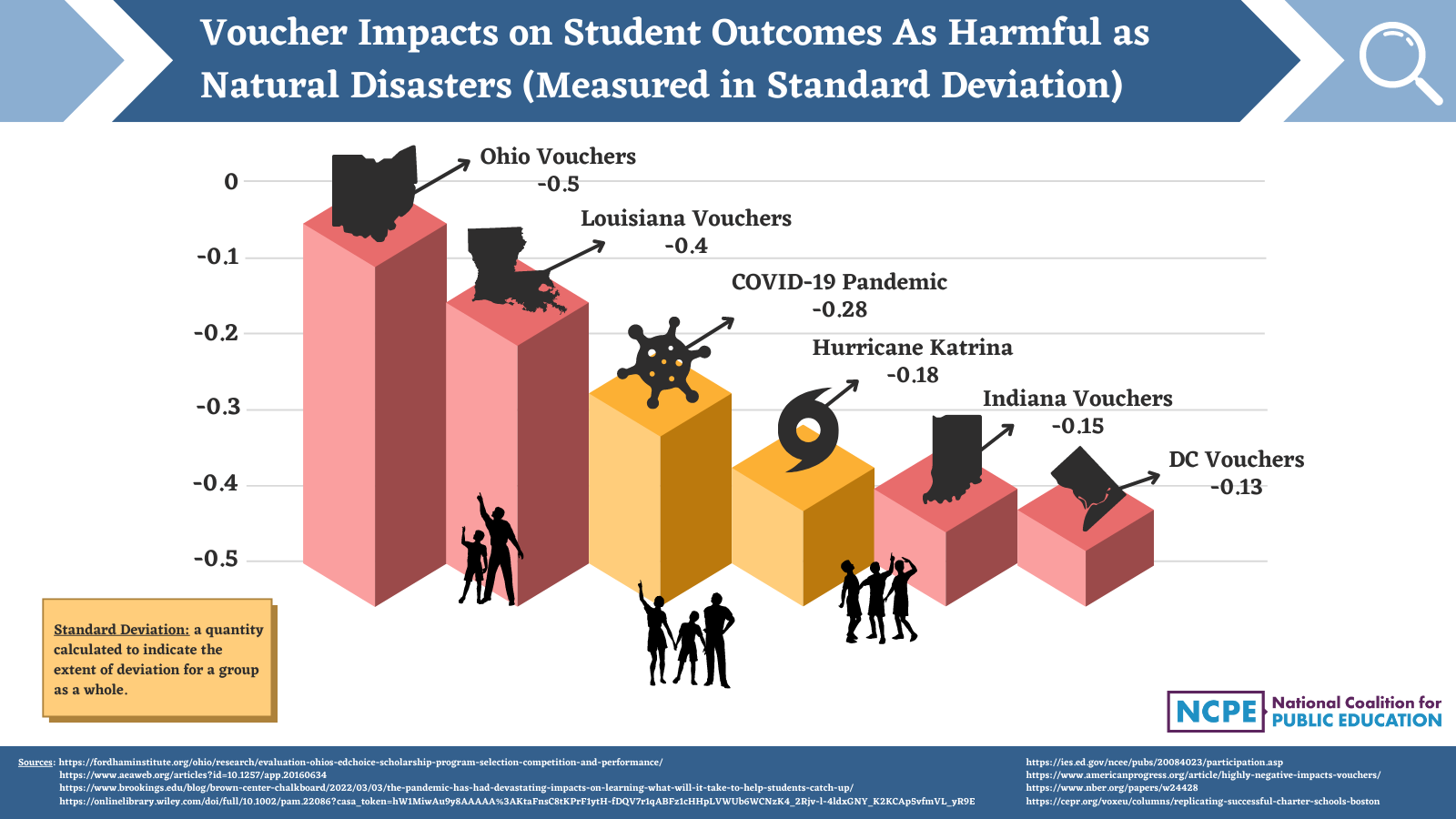
School vouchers have devastating effects on student outcomes. Full stop. That’s something even the nation’s voucher advocate-in-chief Betsy DeVos has had to admit, because the data are so stark.
Large-scale independent studies in D.C.,Indiana, Louisiana, and Ohio show that for kids who left public schools, harmful voucher impacts actually meet or exceed what the pandemic did to test scores. That’s also a similar impact in Louisiana to what Hurricane Katrina did to student achievement back in 2005.
Think about that next time you hear a politician or activist claim we need taxpayer support for private schools to offset what the pandemic did to student learning. Here, their cure would in test score terms be quite literally worse than the disease.
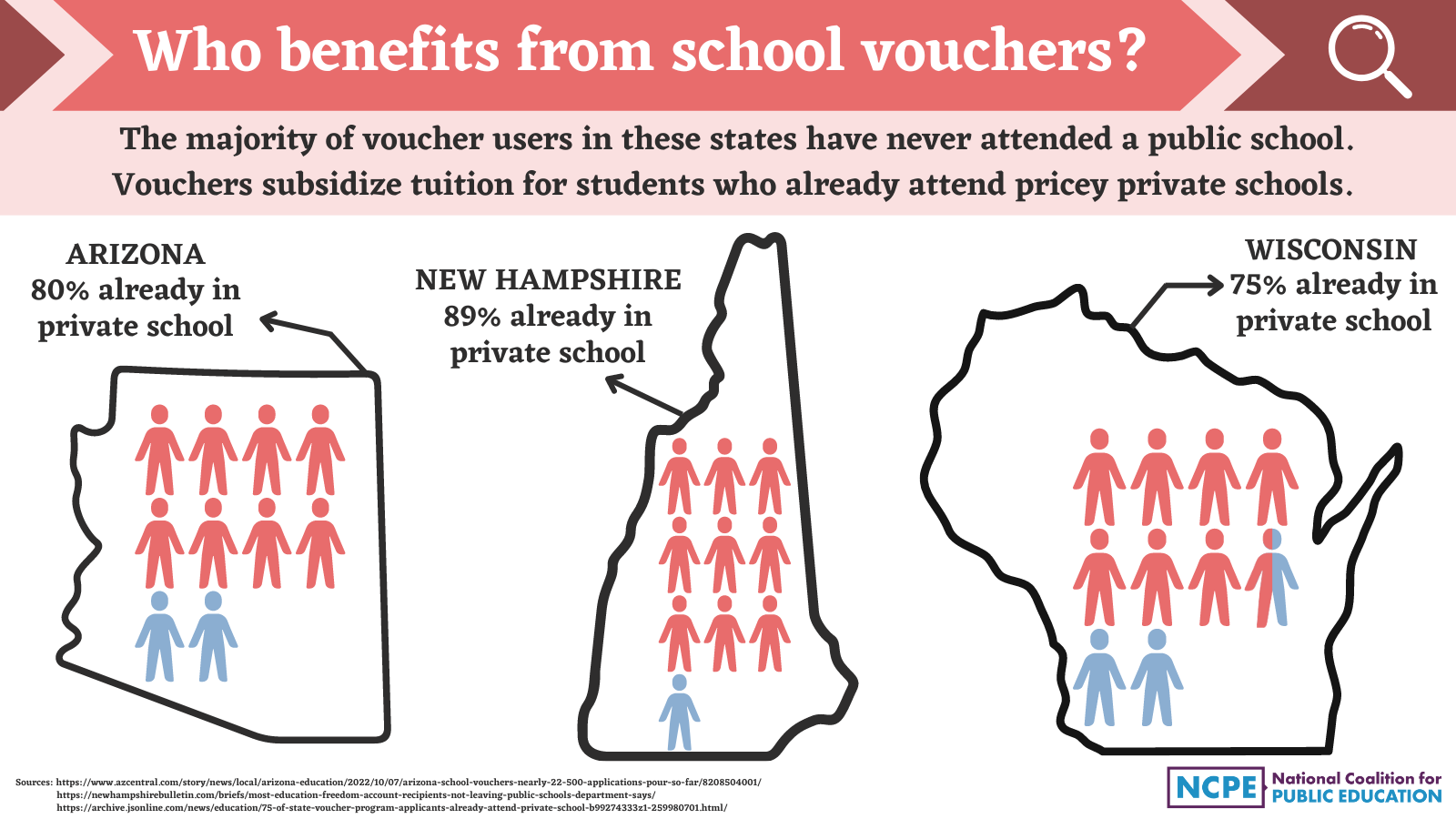
There’s another data point you need to know up front: vouchers overwhelmingly fund children who were already in private school without them. In states that have released those numbers—Arizona, New Hampshire, and Wisconsin—we know more than 75% of voucher applicants came from private schools.
The bottom-line: most kids using vouchers didn’t need them to go to private school, and the few kids who actually did use vouchers to transfer sectors schools suffer average test score drops on par with what a once-in-a-generation pandemic did to test scores too.
If you’re a picture person, our friends at the National Coalition for Public Education were kind enough to put their considerable talents into two graphics based on these data I provided to them.
Notice the citations these graphs include. They’re the same as the hyperlinks above. These data come from independent sources and from non-partisan journalists. That’s a critically important part of this story.
And then there’s this, before we get into the details: the same people pushing vouchers are the same people working to undermine fair elections and the right to vote.
None of these are metaphors, and this is not a drill.
So how did we come to this?
1. A Quick History of Voucher Research
First let’s talk about the evidence.
I came into the school voucher research community early. It was around 2001 or so, as a young graduate student assistant for a study of privately funded vouchers led by the conservative professor Paul E. Peterson who was based at both Harvard and the conservative Hoover Institution at Stanford (never heard of Hoover? Think Condoleeza Rice.)
Peterson and his protégé Jay Greene had already done one study of Milwaukee’s publicly funded voucher program, as well as the one in Cleveland that was about to be the subject of the U.S. Supreme Court’s first favorable ruling on voucher funding. That work generally showed positive results for vouchers. As did the research of a young academic named Cecilia Rouse, who is now President Biden’s chief economist.
But they were small programs. What policymakers and researchers call a “pilot phase.” Back then when both parties cared at least nominally about evidence, you wouldn’t expand a program like vouchers without testing it. So those early tests seemed somewhat positive.
The first research I joined was Peterson and team’s next project: multi-site studies in Dayton, New York City, and Washington D.C. Those programs were also pilot-size. And the New York site in particular showed some limited evidence of voucher success. But overall the lead researchers focused as much on things like parental satisfaction and measures of civic engagement as metrics. That work resulted in a book called The Education Gap. You can find my name in the credits if you own a copy. If you don’t own one, don’t waste your money.
No one knew it at the time, but the mixed results documented in The Education Gap were to be the best vouchers were ever going to do—and ever have done since by an academic based team looking at voucher test scores.
Just a short time later in 2005, I joined a new voucher evaluation led by Patrick Wolf, another Peterson protégé and contributor to The Education Gap. Wolf was by then ensconced with Jay Greene at the University of Arkansas Department of Education Reform, a Walton Family-funded academic group that was about to train a new generation of voucher advocates. Most notably Corey DeAngelis, now at Betsy DeVos’s 501(c)4 voucher lobbying group American Federation for Children.
The Milwaukee evaluation, which was officially done for the state of Wisconsin, lasted from 2005-2010. We found no evidence in five years that voucher kids outperformed public school kids. Two exceptions: we found limited evidence that graduation rates and college enrollment were somewhat higher for the voucher kids. We also found that voucher kids improved when the state required private schools to participate in the same No Child Left Behind-style accountability systems as public schools. In particular once voucher schools knew their performance would be made public they—shockingly!—improved their outcomes.
At the same time as the Milwaukee evaluation, Patrick Wolf and other Arkansas colleagues were working on a new evaluation of Washington D.C.’s federally funded voucher program. That study showed no difference in test scores, but large positive graduate results.
That pattern of “no test score benefits, some attainment benefits” has stuck in the research narrative even among voucher skeptics. But as I recently explained in a piece for the Brookings Institution, it’s just that: a narrative. Other studies in New York, Louisiana and Florida all show no real advantages for vouchers on educational attainment.
And certainly nothing to offset the cataclysmic results that began to come out after the early-stage evaluations I just described. The newer D.C.,Indiana, Louisiana, and Ohio studies that took place after 2013 and have showed pandemic and Katrina-sized harm to student test scores are all of at-scale voucher programs.
What do I mean by “at scale?” I mean that despite limited evidence in those pilot programs, vouchers have been steadily expanding across the country, and within states. So those D.C., Indiana Louisiana and Ohio studies represent our best understanding to date of what happens when you expand vouchers beyond the initial test phase. The answer: horrific impacts on student outcomes.
There are a number of reasons this could be, but I tend to argue we need not overthink this. Vouchers just don’t work. The kids who stand to gain from private schooling were and are already there. For the vast majority of kids, they’re better off in public schools. That’s what the latest voucher research shows.
As an example of what I mean: consider that in Wisconsin (which has not had a statewide study since ours ended in 2010), 41% of voucher-receiving schools have opened and then closed and failed since public funding began in the early 1990s.
That’s what happens when policymakers divert tax dollars to private schools: it’s like venture capitalism for education. It’s like Theranos but for private schooling. New providers race to gobble up new taxpayer money, but most of them have no business near kids.
Now, to fully understand why these terrible policies exist and in fact have never spread faster and further than they are today, we need to understand the politics. And to understand the politics, we need to understand the money.
On the one hand it’s pretty simple. Once you understand that the same people pushing vouchers are the same people funding groups that insist Donald Trump won the election and are now organizing a similar “Big Lie” for 2022’s results, you understand a lot. But read on.
2. Funding Vouchers, Funding Election Lies
It’s difficult to tell how much money has been spent to advocate for school vouchers over the years. But we know perhaps the biggest single funder—perhaps even larger than Betsy DeVos herself—is the Lynde and Harry Bradley Foundation. The Bradley Foundation is a little-known group based in Wisconsin and they’ve given tens of millions of dollars to voucher activism over the years.
Bradley not only funds voucher activism, it funds voucher research too. It was a major funder of the Milwaukee evaluation I was part of and described above. I don’t think they directly influenced our results, but generally speaking you don’t want activism and research funding to mix. Think about it this way: should the Sackler family fund research on the addictive properties of oxycontin? Should Exxon fund studies about the existence of climate change?
For me though, the real problem today is that the Bradley Foundation is hardly limiting itself to supporting research and political advocacy for private schooling. As the New Yorker’s Jane Mayer has meticulously documented in her reporting on financing behind Big Lie activism sowing doubts about President Biden’s 2020 victory, the Bradley Foundation is the convening funder around those activities—the “extraordinary force”, in Mayer’s words, funding and coordinating the Big Lie and other efforts to undermine the integrity of democratic elections.
Bradley is not alone. The Heritage Foundation, a right-wing organization known for its pro-voucher advocacy is, according to Mayer, “working with the American Legislative Exchange Council (ALEC)—a corporate-funded nonprofit that generates model laws for state legislators—on ways to impose new voting restrictions.”
In recent months, Heritage has also distributed talking points that under the guise of objective research attack school diversity and inclusion and directly question health care support for LGBTQ children. Heritage has recently released a report-card style rubric rating state laws on a so-called “Education Freedom” index for tax-supported private tuition. That report card includes the extent to which issues like diversity or sexual preference are components of public school teaching curricula.
The author of each of these documents is a Heritage Senior Fellow named Jay P. Greene. The same Jay Greene who while a conservative scholar at the University of Arkansas was co-director of that Bradley-funded voucher project that hired me back in 2005.
Greene is not alone in the Heritage-Bradley nexus. Cleta Mitchell, a lawyer who participated in Donald Trump’s infamous phone call to the Georgia Secretary of State demanding evidence that would overturn the state’s election results, was actively training poll watchers to question voters leading up to the 2022 midterms in places like my own state of Michigan. The night before the election, the New York Times even ran a story about Mitchell’s work in Michigan. The headline read: “Fueled by Falsehoods, a Michigan Group is Ready to Challenge the Vote.”
Mitchell is a known elections conspiracy theorist, according to CNN, and figures prominently in Mayer’s New Yorker reporting on broader election-related organizing. In her spare time Mitchell is on the Board of Directors of—wait for it!—the Lynde and Harry Bradley Foundation. She’s actually an officer on the Board too.
Michigan is important because we have a voucher proposal waiting to go to the state legislature—even though voucher opponent Gretchen Whitmer has won reelection. That proposal, backed by billionaire and privatization advocate Betsy DeVos, exploits a quirk in the state law allowing lame-duck Republicans to pass the voucher plan without the governor’s signature.
The spokesman for the DeVos voucher campaign is a man named Fred Wszolek. Wszolek is also the strategist for a group that tried unsuccessfully to prevent abortion access from becoming enshrined in the Michigan state constitution. And he heads a political action committee (PAC) called Michigan Strong, which has worked to elect now-defeated DeVos-backed GOP gubernatorial candidate Tudor Dixon.
Also working for Dixon was Kyle Olson of the Education Action Group, an entity devoted to right-wing education reform that’s received money from Charles Koch, the DeVos Family and Harry Bradley—he of the Bradley Foundation.
That’s just one example, but you get the idea: the same people working to push school vouchers are the same people working to undermine elections. And in some cases even reproductive rights.
3. So Why Now?
I’ve spent the last six months writing column after column in opinion pages across the country trying to warn ordinary readers who aren’t education lifers about the dangers of vouchers. You can read samples here or here or here or here if you like. There are more than 10 in all.
Because of my long career working in the middle of all these voucher advocates and researchers, I’ve been asked multiple times what changed my mind. Or, more specifically, why am I speaking out today?
I hope the story I’ve told you above answers some of that. But the reality is, I was also doing other things. I had a young family, other research interests, and other professional tasks like editing the country’s premier education policy journal.
Most of all I had a naïve sense that the facts would speak for themselves. Remember, those pandemic-sized voucher failures began appearing back in 2013. I was an associate professor then, newly arrived at Michigan State University after receiving tenure at the University of Kentucky.
To me, after a decade of mixed-at-best results that I outlined here, I assumed that catastrophic results like those in Louisiana—and then confirmed in Indiana, Ohio, and D.C.—would have killed vouchers a thousand times over.
It’s sort of quaint now, that assumption of mine. In my research community, which is centered in the Association for Education Finance and Policy, we talk a lot about using evidence to inform policy. It’s a nice idea, but vouchers are the big, glaring and alarming counterpoint. We have never seen such one-sided, consistently negative research results as we have for school vouchers in the education research community.
And yet they thrive.
To me, the piece to that puzzle is politics. Negative voucher results aren’t the only thing to happen since 2013.
2016 happened. Donald Trump happened. January 6th happened. Dobbs v. Jackson happened.
Voucher advocates are overwhelmingly on one side of those events. And they’ve racked up some wins.
We know voucher programs exist today not for how they might help some kids, but for how they might exclude others. We know private schools taking public money can and often do discriminate against certain children. In Florida for example, one private school barring LGBTQ kids has received $1.6 million so far in taxpayer funding. In Indiana, more than $16 million has gone to schools refusing to admit LGBTQ kids—or even kids with LGBTQ parents!—or about 1 out of every 10 private schools on the taxpayer dime.
I wish I had come around earlier to the level of alarm I’m raising today. Others have even without having to take a kind of road to Damascus like I did.
I’m a tenured full professor now. I’ve had a successful career working hard to bring evidence to public policy. I firmly believe that school vouchers are a fundamental threat not just to student learning, but also to democracy and to human rights.
So on vouchers I’ve come to the same view any number of us would if we stumbled onto a massive fraud in our workplace, or if we saw a young child being bullied simply for being who they are. None of it is okay.
And if you see something, you have to say something.
It’s time once again to greet the release of another set of data from the NAEP testing machine, which means everyone is warming up their Hot Take generator. But if, like me, you’re getting tired of writing a response to the latest NAEPery, here’s a handy news release that will let you mad lib your way to NAEPy wisdom.
The new scores from the National Assessment of Education Progress (NAEP), known as The Nation’s Report Card, have been released, providing important data about [insert your preferred education policy area]. The recent crisis in [select your favorite policy-adjacent crisis] has clearly created a burgeoning issue of [select whatever Bad Thing you feel will most scare your audience in the direction of your preferred policy].
Says [head of your organization], “The new scores provide important evidence that now is the time for [insert whatever policy action your group always supports]. Clearly the [rise/drop/stagnation] in scores among [whichever subgroup cherry picking best suits your point] proves exactly what we have been arguing for [however long you’ve been at this.]”
[Insert paragraph of data carefully selected and crunched for your purposes. Add a graph if you like. People really dig graphs.]
“This is a clear indication,” says [your favorite go-to education expert], “that it is long past time to [do that thing your organization has been trying to get people to do for years]. Clearly [our preferred solution] is needed.” [Insert further sales pitch here as needed.]
You can expand on this if you wish, but make sure that you definitely do not–
* provide context for the data that you include
* offer perspective from NAEP’s many critics
* absolutely never ever reference the fact that the NAEP folks are extraordinarily clear that folks should not try to suggest a causal relationship between scores and anything else.
As always, the main lesson of NAEP is that contrary to the expectations of so many policy wonks, cold hard data does not actually solve a thing.
The NAEP remains a data-rich Rorschach test that tells us far more about the people interpreting the data than it does about the people from whom the data was collected. Button up your overcoat, prepare for greater-than-usual pearl-clutching and solution-pitching from all the folks who still think the pandemic shutdown is a great opportunity to do [whatever it is they have already been trying to do].
Maurice Cunningham is the nation’s leading expert on “Dark Money” in education. This is money given to organizations and candidates by anonymous donors. When the donors are occasionally revealed, they are typically billionaires who want to destroy public schools and teachers’ unions.
He recently wrote this post, which I excerpt here, about the “management chaos” at the so-called National Parents Union. As he points out, the two leaders of NPU are a married couple.
He writes:
That must have been some “convening” National Parents Union held in September because by October two of NPU’s five board members had disappeared, as had four of the nine individuals on their September 17 “Our Leadership” page and all—ALL—of NPU’s “delegates.” NPU disappears more people than the entire run of The Sopranos. NPU,—not national, not about parents, not a union—is routinely mismanaged, but it seems to be in more chaos than usual.
Board of Directors
Let’s start with the board of directors, a spin-the-bottle operation if there ever was one. Here are the board members identified on the NPU website on September 17 and October 12, 2022:Sept 17, 2022 Board of DirectorsOct 12, 2022 boardPeter CunninghamPeter CunninghamArthur SorianoVincent SlaughterVincent SlaughterMaria Del Carmen Parro CanoDr. Paul BloombergDr. Paul BloombergAnashay Wright
It’s worse than it looks. Ms. Wright was added as a board member on July 28, 2022 along with Shirley Irizarry, On October 3, after two months on the board, Ms. Irizarry was apparently dropped from the board and hired for a staff position as National Organizing Director West Region (according to a Twitter post; she is not on the October 12 website). Mr. Soriano, Mr. Slaughter, Ms. Del Carmen Parro Cano, Dr. Paul Bloomberg, and Vivett Dukes were all added to the board on July 28, 2021. Now Mr. Soriano, Ms. Del Carmen Parro Cano, and Vivett Dukes are all gone. That’s peculiar since Mr. Soriano is supposed to act as president until 2026.
There were three original board members. Mr. Cunningham, Bibb Hubbard (connected to the Gates Foundation), Gerard Robinson (a possible proxy for Charles Koch), and Dan Weisberg. Except for Mr. Cunningham they’re all gone, most within a year of NPU’s launch.
Then there’s the fact that NPU has two boards of directors, the one on the website for public consumption and the one on file with the Massachusetts Secretary of State’s Corporations Division, where NPU is incorporated. Currently NPU lists a board with the Secretary that consists of Mr. Cunningham, Mr. Soriano, Mr. Slaughter, Ms. Del Carmen Parro Cano, Dr. Paul Bloomberg—and Keri Rodrigues and Tim Langan, also identified with the Secretary as president and treasurer, respectively. So far as is known neither Ms. Rodrigues nor Mr. Langan have ever appeared on the website as directors. On the original corporate filings the board was listed as Ms. Rodrigues, Mr. Langan, and Alma Marquez. Ms. Marquez was also on the website as a co-founder and elected treasurer but NPU listed Jennifer Rego as treasurer with the commonwealth of Massachusetts. Ms. Rego disappeared. Ms. Marquez disappeared and Mr. Langan is treasurer. Mr. Langan and Ms. Rodrigues are married. Their compensation from NPU when combined with another Walton family operation named Massachusetts Parents United was $626,777 in 2020 which appears to be wildly out of line with industry standards. But when you’ve replaced the treasurer with . . .
Nancy Flanagan taught music for many years in Michigan. She draws on her deep experience in this post to set the record straight about what parents really want from their schools.
Extremist groups funded by rightwing autocrats claim to speak for parents, but they use their platform to spread propaganda and lies. They say they speak for “parental rights,” but they spread fear, distrust and lies.
John Gibbs, the Republican candidate for Congress in western Michigan, said that:
Folks, did you ever think that one day in America, we’d have to worry about schools putting obscene books in their libraries? This is simply insane–we must stop the madness. Voters overwhelmingly oppose sexually explicit books in public school libraries.
Flanagan answers Gibbs:
Well—folks. I’m not worried about obscene or sexually explicit books in public school libraries. Because there is no madness, no insanity, no pornography in school libraries.
Teachers and school leaders also overwhelmingly oppose sexually explicit books in school libraries. The word we use is ‘inappropriate’—materials are selected by trained school media specialists, who know inappropriate when they see it.
The entire slate of MI Republicans running for statewide or national office, not just Gibbs, is hell-bent on insisting that schools have become (in the past two years) hotbeds of sexual orientation and gender identity transformation, not to mention racial tension and guilt-inducement. They are led in this effort by the Republican candidate for Governor, Tudor Dixon.
Gibbs goes on to say, on behalf of Republican candidate for Governor in Michigan, Tudor Dixon:
What Tudor wants to accomplish is very simple and common sense. She wants to get radical sex and gender theory out of our schools, remove classroom instruction of sexual orientation and gender identity for grades K-3, make sure gender specific sports remain gender specific given biological differences in boys vs. girls and post all curriculum online for parents to see and be involved in their child’s education. Every child deserves a world class education and parents should be in charge of it.
Flanagan answers:
So let’s break this down.
Radical sex and gender theory? (Not a part of the curriculum in any school I’ve been in.)
Classroom instruction on sexual orientation or gender identity for the littles? (Likewise—nope, nope.)
Post all curriculum online? (Sure. Most districts post their standards framework—what gets taught, when– and public high schools in Michigan have adapted the Michigan Merit Curriculum.)
Every child deserves a world class education and parents should be in charge of it. (Right out of the Glenn Youngkin playbook, a statement like this, which is mostly true, really resonates.)
But here’s the truth (from 32 years of classroom experience): What bubbles up in classroom discussions and playgrounds is what’s on the minds of the kids in that classroom. This starts early, in Tudor Dixon’s forbidden zone, grades K-3—like this story about the boy who chose a ‘Frozen’ backpack.
Kids are curious and they’re paying attention to what their parents and their screens (and their friends, and their older siblings) are telling them. I taught music and math, two subjects you’d think were pretty straightforward and controversy-free, but can testify that anytime you get a cluster of kids together, provocative issues emerge.
Please open the link and read the rest of this common sense, informed commentary. Parents are not fooled by this fear mingering. They know their children’s teachers, and they trust them.
Don’t be fooled by “Moms for Liberty,” writes political scientist Maurice Cunningham. They may appear to be a garden-variety group of rightwing extremists, but they are more than that. Keep your eye on the Dark Money that funds them.
He writes:
The group, which claims to be about “parent rights,” has ties to the January 6 insurrection and is expected to provide “foot soldiers” for Florida Governor Ron DeSantis.
Moms for Liberty (M4L) claims the organization was started by moms.
[Insert uproarious laughter.]
But it is hard to believe that three mothers in Florida could start up a grassroots group on January 1, 2021, and then, within a matter of weeks and months, wind up on Rush Limbaugh, Tucker Carlson’s show, Glenn Beck, and Fox News. However, there is a shadowy network of money and influence in right-wing political circles that could arrange that easily.
Among M4L’s financial supporters and profile boosters are some of the most influential organizations, media operations, and wealthy donors in the vast theater of the right-wing propaganda machine.
And it would be a mistake to believe M4L’s agenda is exclusively about maternal concerns over what children learn in schools. Instead, most of the organization’s purported success seems to be in helping to advance a much broader right-wing political agenda through electoral politics. In its short history, M4L has already been credited with helping to engineer a “massive victory,” according to Salon, and ensuring a string of wins for a number of Republican candidates in school board elections across Florida.
Looking ahead at the upcoming elections, M4L is expected to provide the “foot soldiers” for the reelection bid of Florida Governor Ron DeSantis, and many also expect to see the M4L soldiering for DeSantis in the 2024 presidential race.
The Rise of Moms for Liberty…
M4L was born into a full-scale right-wing media rollout. As Olivia Little of Media Matters reported in July 2022, M4L debuted on The Rush Limbaugh Show in January 2021—right out of the cradle. M4L representatives have since appeared “on Fox News at least 16 times and Steve Bannon’s War Room at least 14 times,” according to Little. As her reporting and my own investigation in April 2021indicated, M4L initially had practically no members or state infrastructure. But appearances on Fox and fawning treatment in right-wing outlets like Breitbart News and Glenn Beck propelled its growth.
By June 11, 2021, M4L threw a fundraisercalled “Fearless: An Evening with Megyn Kelly,” the former Fox News celebrity. The highest-priced ticket of $20,000 for the “presenting sponsor” included 20 tickets to a meet-and-greet along with a photo with Megyn Kelly and came with many other benefits. There were other offers that included lesser benefits for donors making contributions of $15,000 or $10,000 and the general admission was $50….
M4L’s grandest event thus far has been its national summit, which took place between July 14 and 17, 2022 in Tampa, Florida. The national summit featured speeches by DeSantis, Florida First Lady Casey DeSantis, Carson, former Florida Governor and current U.S. Senator Rick Scott, and Trump’s former Secretary of Education Betsy DeVos, who advocated for the abolition of the department she had led, according to Florida Phoenix….
When asked, the leaders of M4L say they raise a lot of money from T-shirt sales. [Cue loud laughter.]
But Cunningham knows that’s not the main source of their funding.
Open the link to learn who turned this “parent-led” group into a Dark Money political powerhouse.
The U.S. Department of Education’s Office of the Inspector General conducted an in-depth audit of the federal Charter Schools Program, which was initiated in 1994 with a few million dollars by the Clinton administration. Thanks to astute lobbying by the charter industry, the modest program grew to $440 million a year with little or no accountability. Betsy DeVos pushed it aggressively to large charter chains, including for-profit chains.
This audit demonstrates the power and persistence of the Network for Public Education, a small but smart advocate for public schools. NPE operates with one full-time employee and a small number of part-time employees. Our work is motivated not by greed but by idealism and a passionate commitment to the common good. We believe in well-funded schools with experienced teachers for all children.
The introduction by by Strauss and the analysis by Burris has many links, but none transferred when I copied it. I copied some, but not all of them. I urge you to open the original and find the links.
Strauss begins:
The U.S. Education Department’s Office of Inspector General has released a new audit of the federal Charter School Program that found some alarming results about how charter school networks have used millions of dollars in funding. Among other things, the audit found that charter school networks and for-profit charter management organizations did not open anywhere near the number of charters they promised to open with federal funding. This piece looks at the new audit and what it tells us.
The reason this is not surprising is that investigations into the Charter School Programs by the Network for Public Education, an advocacy group that opposes the growth of charter schools, found that same problem, as well as others and reported it a few years ago. You can read my stories about their “Asleep at the Wheel” here and here. (The second report noted that the state with the most charter schools that never opened was Michigan, home to former education secretary Betsy DeVos, who has pushed to expand charter schools for decades.)
Charter schools are publicly funded but privately managed. The federal charter program, which began in 1994 with the aim of expanding high-quality charters, had bipartisan support for years, but many Democrats have pulled back from the movement, citing the fiscal impact on school districts and repeated scandals in the sector. The Biden administration is making some changes to the program in an effort to stop waste and fraud and provide more transparency to the operation of charters.
This piece was written by Carol Burris, executive director of the Network for Public Education and a former award-winning principal in New York. She has been chronicling the charter school movement and the standardized-test-based accountability movement on this blog for years. The Network for Public Education is an alliance of organizations that advocates for the improvement of public education and sees charter schools as part of a movement to privatize public education.
By Carol Burris
A new report issued by the Office of the Inspector General (OIG) entitled “The Effectiveness of Charter School Programs in Increasing the Number of Charter Schools” documents how states, charter management organizations, and charter developers often make wildly exaggerated claims regarding the number of charter schools they will open or expand to secure large grants.
The OIG, an independent watchdog of the U.S. Department of Education (the Department), found that for grants issued between 2013 and 2016, only 51 percent of the schools promised by Charter School Programs (CSP) recipients opened or expanded.
The OIG audit also exposed the sloppy record keeping and weak oversight that characterize CSP operations. Since 2006, the department has paid a private corporation, WestEd, millions of dollars to compile, check and update CSP records. WestEd’s present CSP contract exceeds $12 million. In total, WestEd has active contracts with the U.S. Department of Education worth more than $27.6 million. Yet an alarming number of grant records could not be found when requested by the OIG auditors. And while the Biden administration is attempting to clean up and reform the CSP, according to the independent OIG, more work needs to be done.
What did the Office of the Inspector General audit? The audit had three goals. The first was to describe how the department’s Office of Elementary and Secondary Education tracked and reported the number of charter schools that opened and expanded using Charter School Program funds. A second goal was to determine whether CSP grant recipients actually delivered the number of charter schools they promised when they applied for their often multimillion dollar awards. Finally, the audit sought to determine how many schools were still open two years after CSP funding ended.
As its title stated, the audit was an attempt to measure the program’s effectiveness in fulfilling its mission. To conduct the audit, the OIG examined 2013 through 2016 CSP grant records. During that period, the department awarded 103 CSP grants to states, charter management organizations, or individual charter developers. Ninety-four were closely investigated by the OIG. The likely reason these years were chosen was that most grants are for five years. The auditors also found that the department often extends them further when grantees have not spent all of their money. Therefore, more recent grants were excluded because records were likely to be incomplete.
Incomplete and inaccurate records
The auditors noted that while the department, through WestEd, tracked spending and schools while grants were open, the tracking stopped as soon as the grant was complete. Therefore, the department had no way of knowing whether schools remained open beyond the years federal funds propped them up. This speaks to the purpose of the program — to open and expand high-quality charter schools.
When auditors asked the department to define the term high-quality, the department responded that the “CSP office does not determine whether a charter school is high-quality because state rules for determining high quality vary.”
“Additionally,” it said, “the determination of whether a charter school is a high quality is often the responsibility of charter school authorizers.” The department also told auditors that tracking a school’s existence after all money was doled out was not its job.
Even if the department wanted to do a quality check of schools as they were funding and expanding, the OIG found that there was no accurate base of information that they could rely on to determine whether they should continue what was often a multimillion-dollar grant. From the audit:
Although the CSP office created processes for tracking and reporting on charter schools that opened and expanded and charter schools that remained open through the grant performance period end date, those processes did not result in CSP grant recipients reporting precise, reliable, and timely information in their FPRs [final performance reports], APRs [annual performance reports], and data collection forms. The processes also did not result in the CSP office receiving all the necessary information to assess grant recipients’ performance or evaluate the overall effectiveness of the CSP.
Specifically, the department could not produce 13 percent of the required final reports from grantees and 43 percent of the required final data collection sheets. Auditors noted that grantees would report different numbers of schools opened or expanded among required collection forms and final reports. The accuracy of the final documents prepared by WestEd for the department was beyond the scope of the audit.
During our research for our second “Asleep at the Wheel” report, we found that the data collection sheets produced by WestEd and published in 2019 by then Education Secretary Betsy De Vos were replete with errors. Schools that had closed or never opened were reported as open or future. We also noted inaccuracies in recently submitted sheets we received from a Freedom of Information Act request, especially relating to the for-profit management status of the awardee.
But the OIG discovered a far worse problem yet. More than half of the schools that grantees committed to opening or expanding did not open or expand at all.
CSP grantees failed to meet commitments Grant applicants asked for and received millions of dollars based on their promises to open and expand charter schools. However, when the auditors examined 94 grantee applications, they found that many grantees fell far short of their commitments.
The OIG determined that based on the commitments made in the 94 applications, state education agencies, CMOs, and developers promised to open or expand 1,570 charter schools using CSP funds.
As of July 2021, approximately 75 percent of the grant funding had been spent, yet grantees had only opened or expanded 51 percent of the charters they had promised.
This begs the question, where did millions of tax dollars go? I identified grantees by matching applications on the department website along with numbers in the data set with grant codes in the OIG report.
In its 2016 CSP application, the Florida Department of Education put forth what it called a “bold and ambitious plan to … develop a high-impact system to dramatically improve the opportunities of educationally disadvantaged students. The department said that it would use the grant to “support the creation of 200 new high-quality charter schools over the next five years.”
Florida received $70.7 million to achieve its “bold and ambitious” plan. According to the OIG report, it had only opened 33 percent — or 66 — of the schools it promised to open as of July 2021, although it had spent over 51 percent of the CSP funds.
Colorado’s 2015 application promised that it would open 72 charter schools with its over 24.2 million dollar grant. In the end, it opened fewer than half — just 33 — and expanded three schools. Nevertheless, it spent 87.5 percent of its funds.
Tennessee ambitiously promised to open 114 charter schools. It opened just 16, though it managed to spend 63 percent of its grant. These states are not outliers. The report shows a pattern.
And CMOs also failed to deliver. The KIPP charter network promised 65 schools for its jumbo $48,750,000 grant, one that well exceeded most states. It delivered 34 schools and expanded one.
Finally, there are grants to developers that the department directly provides. The Innovation Development Corporation received a $405,730 CSP grant to open The Delaware Met. It was open for just a few months before it was shut down. It also received and spent $72,000 to open DE Stem. That school was shut down before it even opened. Willow Public School, a Washington charter school, took and spent a $602,875 grant, opened, ran into trouble, changed its name, and then shut down.
The department and the National Alliance for Public Charter Schools attribute the problem to authorizer reluctance and state caps on the number of schools that can open. Really? Every state that got a grant has a state board that can override local rejections of applications. State applicants and the department are also well aware of caps. Take the case of the 2018 $78,888,888 CSP grant to the New York State Department of Education, which was outside the scope of the OIG audit.
In the New York State application review, which you can find here, raters acknowledge that New York State had not even used up its previous grant which was open beyond its terms and that charter expansion would be limited by the state cap on the number of charters. Yet they gave the application high scores, and it was approved. Where did that 2018 money go? Over $10 million went to provide staff development in technology for charter schools.
Jumbo grants
Why do states and charter management organizations ask for jumbo grants knowing they cannot deliver? Because they want the money to fund their charter school operations.
States and charter management organizations get to keep 10 percent of the cut for grant administration and technical assistance to charter schools. The bigger the grant, the bigger the cut.
Therefore, KIPP was allowed to keep nearly $5 million for its charter management organization, even though it fell way short of its commitment. The Florida Department of Education secured over $7 million for administrative services on its grant. Second, there are no guidelines about how much an individual charter school can get. We have seen grants as low as $250,000 and grants to schools of $1.5 million. When a state realizes it cannot or will not meet its commitment, it just doles out larger amounts.
Third, until President Biden, no prior administration did anything about it over the Charter School Program’s existence. Therefore, states, CMOs, and individual schools realized pretty quickly that they could create grandiose applications, sometimes including falsehoods, and there would be no real consequences if commitments were never met.
The present department has taken a terrible beating for creating modest CSP reform regulations which are still being fought by the charter trade organizations and their proxies, including the Thomas B. Fordham Institute, a charter school authorizer. Challenges include both a lawsuit and a Republican-sponsored bill to overturn the new rules.
But as the OIG audit shows, reforms are desperately needed.