Archives for category: Privatization

Steve Hinnefeld writes about the very expensive and ineffectual voucher program in Indiana, which is based on a lie. On several lies, actually. The promoters of vouchers claimed that vouchers would save poor kids from failing public schools. He shows in this post that most vouchers are used by students who never attended a public school, who are not poor, and who are not getting a better education than students in public schools. The advocates said it would save money, but the cost this year is nearly a quarter billion dollars.

He writes:

Indiana awarded $241.4 million in the 2021-22 school year to pay tuition and fees for students to attend private schools. That’s 44% more than the state spent on vouchers the previous year.

The increase, detailed in a Department of Education report, isn’t surprising. The Indiana General Assembly in 2021 vastly expanded the voucher program, opening it to families near the top of the state’s income scale and making the vouchers significantly more generous.

Nearly all the 330 private schools that received voucher funding are religious schools. Some discriminate against students, families and employees because of their religion, disability status, sexual orientation or gender identity. Indiana is bankrolling bigotry.

And many of the families receiving vouchers could pay private school tuition without public assistance. Some 20% of voucher households last year had an income of $100,000 or more, well above Indiana’s median household income of about $58,000.

The voucher program, created in 2011, was sold as a way to help children from poor families opt out of “failing” public schools. Mitch Daniels, Indiana’s governor at the time and a leading voucher advocate, said students should attend a public school for two semesters to qualify, giving public schools a chance to show what they could do.

But the two-semester requirement fell by the wayside. Students now have nine pathways by which they can qualify. If a family meets the income requirement, which is laughably lax, a private school can find a way to get them vouchers.

When the program started, supporters said it wouldn’t cost anything, because, if the students didn’t have vouchers, the state would be paying for them to attend public schools. They don’t even pretend to believe that anymore. In 2021-22, 70% of voucher students had no record of having attended a public school in the state. Most voucher funding is going to families that intended all along to send their kids to private schools — and often had the means to do so.

The program initially served both low- and middle-income families. Last year, the legislature threw the door open to high-income families. Now, a family of five making $172,000 can receive vouchers worth over $5,400 on average per child. For about half of all voucher students, the award covers the full cost of tuition and fees at their private school.

Voucher participation had stalled, but with last year’s expansion, the number of voucher students exploded: 44,376 students had vouchers in 2021-22, up 24.3% from the previous year.

Over the years, Indiana’s voucher population has grown whiter and markedly less poor. Nearly 60% of voucher students are white, an overrepresentation considering the program is most pervasive in urban areas, where there are many Black and Hispanic students. Only 10.5% of voucher students are Black, compared to 13.5% of Indiana public and charter school students.

The program might still seem justifiable if Indiana private schools were academically superior. They aren’t. Researchers at the universities of Kentucky and Notre Dame found that students who received vouchers fell behind their peers who remained in public schools.

Indiana policymakers no longer care about that either. They’ve embraced the idea that parents should have complete control over their children’s schooling and the public funds that pay for it. In a world of unrestricted school choice, state money will “follow the child,” wherever that may lead. Standards, accountability and academic quality don’t matter.

The point of privatization is not to help needy students but to destroy the public schools.

This article in The Houston Chronicle is infuriating. The subtitle might well be, “If the state board turns you down, buy it.”

As I read it, I felt my blood was coming to a boil. This is a portrayal of tank corruption, corruption of education and corruption of the democratic process. The elected state board of education in Texas denied the charter application of four out of five charters. The charters struck back by dumping vast sums of money into the election for state board and electing hand-picked candidates to give them the approvals they wanted. As I have shown in previous posts, charter schools in Texas are generally low-performing and compare unfavorably to public schools,

The article begins:

The State Board of Education last month denied, for the third time, efforts to launch Heritage Classical Academy in Northwest Houston, a school designed as a conservative response to anti-racism, LGBT-inclusive sex education and other progressive themes in public schools.

But despite Heritage’s recent failure, its future — and that of other charter schools like it in Texas — looks bright.

The state’s fight over charter schools has bubbled slowly for decades since they were first authorized in the 1990s, with the state board standing as the main political roadblock to their expansion.

Now, as Republican lawmakers fight to restrict how teachers discuss social issues in the classroom and generally shift the education system more toward the right, their alliance with charter schools is stronger than ever.

A MOVEMENT: Trump-era rancor spills into Texas school board politics

So much so that three GOP members of the state board, who have sided with Democrats in voting against Heritage Classical Academy, won’t be therenext time — two were beaten in a primary after the family of Heritage’s board chairman donated $250,000 to a PAC supporting their opponents. The third was redistricted out of his seat by the Texas Senate.

Heritage, and other classical academies to come, can count on a more sympathetic board starting in January.

Matt Robinson, the Republican who lost his seat in redistricting — he says he had decided before then not to run for re-election anyway — called his ouster a testament to the power charter school advocates wield.

“There’s a whole pattern here of them really strongly exerting the influence that they have with our elected officials,” he said.

LIBRARY BACKLASH: Texas GOP’s book hunt mostly targets LGBT issues, not critical race theory

The pitch for classical education

Heritage is part of the Barney Charter School initiative, a national charter school movement to introduce a more conservative ideology in schools. The initiative was founded by Hillsdale College in Michigan.

The college doesn’t fund or govern schools directly, but provides curriculum and consulting. Dozens of schools have been started so far across the nation, including one in Gardendale, Texas. The schools serve nearly 15,000 students and 8,000 more on wait-lists.

Its “1776 Curriculum” for charter schools teaches that “America is an exceptionally good country” and includes comprehensive lessons about American history through a conservative lens, including descriptions of the New Deal as bad public policy and of affirmative action as “counter to the lofty ideals of the Founders.”

The wife of conservative Supreme Court Justice Clarence Thomas, Ginni Thomas — who reportedly lobbied to overturn the 2020 presidential election — is a former vice president at the college and ran its Washington programs.

Hillsdale is a nonsectarian Christian university with a mostly white student body that touts its role in the abolition movement of the 1800s, when Black activist Frederick Douglass spoke at the campus.

‘CRITICAL RACE THEORY’ IN SCHOOLS: Abbott signs law forbidding lessons on systemic racism

Across the country, only one Hillsdale-backed charter school serves a majority of economically disadvantaged students, and only two serve a majority of students of color, according to staff at the State Board of Education.

Heritage Classical Academy was voted down for the first time in 2020 by the board, several members said, because of the inclusion of “Brer Rabbit” books in its early grade curricula. The 19th century children’s story has been assailed by critics for promoting racist stereotypes and mimicking dialect used by African-American slaves.

The arguments for and against Heritage over the last few years have added up to more than the sum of their parts. When the board discussed it last month, conversations turned to how racism and slavery are taught, “inappropriate content in public schools,” alleged anti-Islamic Facebook posts made by a Heritage board member, the work experience of the proposed school leadership and more.

Aggressive lobbying from the Heritage board and its supporters also appears to have backfired, becoming a factor in the board’s decision this year to reject the charter.

After the board denied approval for the second time in 2021, Heritage Board Chair Stuart Saunders and his family donated more than $250,000 to a political action committee called Texans for Educational Freedom. That PAC then donate more than $500,000 to local school board races and other candidates who have promoted conservative themes in the schools.

The group donated in four State Board of Education races, including well over $100,000 total in the bids to unseat board members Sue Melton Malone and Jay Johnson, Republicans who opposed Heritage.

In their charter application filed with Texas Education Agency, Heritage reported 17 meetings with public officials ahead of the board’s decision last month, including a July 2021 meeting with TEA Commissioner Mike Morath and state Rep. Steve Toth, who penned the Legislature’s anti-critical race theory law. Signed a year ago by Gov. Greg Abbott, the law limits how public school teachers address systemic racism and the lingering impacts of slavery.

When it convenes in next year after this fall’s elections, the state board will be a more conservative body, with six new members.

“Clearly, (Saunders) was trying to use all his money to remake the SBOE, to buy it,” said Robinson, the board member from Friendswood who is losing his seat in redistricting. “When you really upset wealthy peoplethey don’t take that lightly.”

During an SBOE meeting, Robinson confronted Saunders — who is the chairman of SouthTrust Bank — saying that while Saunders’ donations were legal, they were unethical.

Saunders retorted: “Me and my family have a long history of supporting education initiatives. Part of our involvement includes a history of supporting public policy and education initiatives, and I did give some of my money to a PAC that is involved in education. Their website speaks of wanting to depoliticize the classroom, working to create strong local school boards and to root-out and eliminate sexually explicit materials that have found their way into our schools. And I support those initiatives.”

He said his son was assigned two “inappropriate” books in class, and though he confronted the school’s principal about them, only one of the books was removed from the curriculum.

Texas Ethics Commission records show that the PAC Saunders spoke of donated to SBOE races both before and after he and his family contributed money.

18,000 Texas students in classical schools

Over the last decade, the State Board of Education has generally been a chokepoint to charter school expansion. The board is given final veto power over charter applicants after they are approved by the TEA commissioner. Since 2017, TEA approved 35 schools, but the SBOE only allowed 23 to proceed.

Those who oppose charter schools typically do so because they say it weakens the structure of public education. Charter schools face less accountability than public schools, and when students flee struggling public schools for charters, the school districts lose out on the attendance-based funding they would have received from the state if the child was still a student.

“The idea of 95 percent of kids losing funding and programming and opportunities so that 5 percent can attend a private-light-school and parents aren’t paying a private school bill is just asinine to me,” said state board member Georgina Pérez, a Democrat who votes against all charter applicants.

The Republican-controlled Legislature has been pushing in the opposite direction. The last major change Republicans in Austin made to charter school law was removing the state board’s ability to approve expansions of existing charter schools, in 2013 paving the way for hundreds of new campuses. Charter enrollment has nearly doubled since, to 377,375 students (the state’s K-12 schools serve about 5 million children).

The total number of charter campuses has risen from 588 to 872.

“I always compare charter schools and how they expand to Gremlins if they eat after midnight. Tomorrow morning you’re going to wake up and you don’t know how many of them you’re going to have,” Pérez said.

There’s also an appetite particularly for “Classical” schools such as Heritage, of which there are already a number in Texas, including Aristoi Classical in Katy, the Great Hearts Texas schools, Founders Classical and Houston Classical. Their combined enrollment for the 2016-2017 school year was less than 7,500, and has more than doubled to 18,000, state data shows.

Charter school supporters and several members of the SBOE, they said they expect that another bill will be filed next year with renewed efforts to remove the state board’s authority to approve the schools, leaving the matter up to Education Commissioner Mike Morath, an appointee of Gov. Greg Abbott.

Some members of the state board added that Abbott lobbied their colleagues directly, asking them to approve Heritage’s application and other charter schools over the years.

“Historically it was, (the SBOE wasn’t) approving expansions fast enough, or enough, to keep pace with demand,” said Starlee Coleman, CEO of the Texas Charter Schools Association. “I would not be surprised one bit if a move were made to roll back the board’s authority, even farther.”

Charter school proponents point to a charter school wait-list in the state of more than 58,000 kids. They say families want more options and that public schools aren’t working for everyone. They point to data that show the large majority of charter students are children of color, and that their test scores are better than the public school averages.

“The statute is really clear about legislative intent is that there will be a robust and vibrant charter sector in Texas,” Coleman said. “if the state board can’t agree with that, then I don’t think state legislators feel very compelled to let them continue to be part of the process.”

edward.mckinley@chron.com
The subcommittee of the House Appropriations Committee in charge of education has paid attention to the scandals and closures that mar the charter industry. It issued the following legislative changes for the federal Charter Schools Program for fiscal 2023:

1. A cut in appropriations from $440 million to $400 million for new charters.

2. Eliminate federal funding to for-profit EMOs (education management organizations).

3. Support the U.S. Department of Education’s proposed regulations to provide accountability and oversight for the charter schools it funds.

4. Endorse ED proposal that new charters seeking federal funding analyze need and community impact.

5. Endorse ED proposal that new charters seeking federal funds demonstrate that they will be integrated, not segregated.

6. Note that 15% of federally funded charters either never opened or closed down before the grant ended, which shows why applicants must demonstrate need for their services.

Charter Schools Grants

The Committee recommends $400,000,000 for Charter School Program (CSP) Grants, which is $40,000,000 below the fiscal year 2022 enacted level and the fiscal year 2022 budget request.

CSP awards grants to SEAs or, if a State’s SEA chooses not to participate, to charter school developers to support the development and initial implementation of public charter schools. State Facilities Incentive Grants and Credit Enhancement for Charter School Facilities awards help charter schools obtain adequate school facilities. These programs work in tandem to support the development and operation of charter schools.

For-profit Entities.—The Department has long recognized the particular risks posed by for-profit education management organi- zations (EMOs). In response to a 2016 audit, the Department con- ceded to the Inspector General, ‘‘ED is well aware of the challenges and risks posed by CMOs and, in particular, EMOs, that enter into contracts to manage the day-to-day operations of charter schools that receive Federal funds. We recognize that the proliferation of charter schools with these relationships has introduced potential risks with respect to conflicts of interest, related-party trans-actions, and fiscal accountability, particularly in regard to the use of federal funds.’’ Since that initial acknowledgement by the Department regarding for-profit EMOs, the Committee has been made aware of concerning instances of criminal fraud, conflicts of interest, and inadequate transparency.

In addition, the Committee is deeply concerned that for-profit charter schools, including those run by for-profit EMOs, deliver concerning outcomes for students. A 2017 report from Stanford University’s Center for Research on Education Outcomes compared student performance at non-profit charters, for-profit charters, and traditional public schools and found that for-profit charters perform worse in reading, and significantly worse in math, than non-profit charters. In addition, the report found that for-profit charters per- form worse in math than traditional public schools.

That is why the Committee is strongly supportive of the Department’s proposal to prohibit Federal CSP funding from supporting for-profit EMOs through its notice published in the Federal Reg- ister on March 14, 2022 (87 Fed. Reg. 14197). The Committee in- cludes bill language codifying the prohibition to establish this precedent for fiscal year 2023 and for future years. Moving for- ward, the Committee urges the Secretary to work with Congress on efforts to fully phase out the concerning for-profit EMO sector. Such efforts could include reasonable transition periods that allow schools run by for-profit EMOs to shift to independent or nonprofit management. In the interim, the Committee is committed to con- tinuing its oversight of the for-profit EMO sector and ensuring fewer taxpayer dollars enrich for-profit EMO shareholders.

Defunct CSP Grantees.—The Committee is deeply concerned by the Department’s analysis that fifteen percent ofthe charter schools receiving CSP funding since 2001 have never opened or closed before their three-year grant period is complete, rep- resenting an unacceptable waste of at least $174,000,000 in tax- payer funds. Accordingly, the Committee is strongly supportive of the Department’s fiscal year 2022 CSP notice (87 Fed. Reg. 14197) that requires applicants to demonstrate local demand for new schools. The Committee rejects the premise that grant failure and school closure is the cost of doing business in CSP and welcomes reforms that will improve its performance.

GAO Mandate from House Report 116–450.—The Committee con- tinues to be supportive of GAO’s work on the mandate included in House Report 116–450 regarding the Department’s oversight over CSP and whether the program is being implemented effectively among grantees and subgrantees. The Committee is particularly in- terested in theissue of CSP-funded schools that eventually closed or received funds but never opened; the relationships between charter schools supported by CSP grants and charter management or- ganizations; and enrollment patterns at these schools, especially for students with disabilities. Inaddition, the Committee is interested in recommendations on potential legislative changes to the program that would reduce the potential for mismanagement and inef- fective operations.

Oversight from the Office of Inspector General.—The Committee continues to support efforts by the Department’s Office of Inspector General (OIG) to examine grantee administration of Replication and Expansion Grants, including charter management organization grantees. The Committee also supports the OIG’s efforts to evalu- ate whether the Department adequately monitored grantees’ per- formance and uses of funds for CSP competitions.

Students with Disabilities and English Learners.—The Com- mittee encourages the Department to continue including in their evaluation of State CSP grants the extent to which State entities are utilizing the seven percent of funding received under the pro- gram to ensure that charter schools receiving CSP grants are equipped to appropriately serve students with disabilities and, by extension, prepared to become high-quality charter schools. In ad- dition, the Committee urges the Department to ensure subgrantees are equipped to meet the needs of English learners. The Committee directs the Department to provide an update on these efforts in the fiscal year 2024 Congressional Budget Justification.

Charter School Effects on School Segregation.—The Committee is concerned by findings from a 2019 Urban Institute report which concluded that growth in charter school enrollment increases the segregation of Black, Latino, and white students. To address this concern, the Committee urges the Department to give priority to applicants thatplan to use CSP funds to operate or manage char- ter schools intentionally designed to be racially and socioeconomically diverse.

The Committee is strongly supportive of proposed requirements in the Department’s fiscal year 2022 CSP notice (87 Fed. Reg. 14197) that grantees show that they will not exacerbate school seg- regation. Accordingly, the Committee urges the Department to ex- amine the merits of diversity reporting that compares demographic data ofgrantees to that of local districts. The Committee directs the Department to share its assessment of CSP diversity reporting, along with any prospective plans for implementation, in the fiscal year 2024 Congressional Budget Justification.

Good news from Nevada, conveyed by the Rogers Foundation, which supports public schools.

Las Vegas, NV – Beverly Rogers and Rory Reid, Chairman and Chief Executive Officer of The Rogers Foundation, are celebrating a Nevada Supreme Court decision that has once again halted a constitutional initiative attempting to establish an extreme and unprecedented school voucher scheme in Nevada.

“This is a huge win for students and Nevada families,” said Beverly Rogers, “This would have been detrimental for the public schools our community relies on, leading to even bigger class sizes and massive cuts. It’s a shame these groups want to sacrifice our public schools in favor of discriminatory and unaccountable vouchers. We are glad the courts once again ruled in our favor.”

The Nevada Supreme Court held, in Education Freedom PAC v. Reid, that the PAC’s voucher scheme failed in several key ways. It failed to propose a revenue source to fund the scheme’s substantial costs to taxpayers. Its description of effect was “deceptive and misleading,” failing to inform voters of the impact on the state’s budget and underestimating the cost of the scheme. Lastly, the initiative attempted to improperly direct future legislatures to enact certain laws, impeding their authority. The Court enjoined the PAC from moving forward with the initiative.

“It’s clear this group was trying to push its controversial scheme by deceptively mischaracterizing its impact on our public schools,” said Rory Reid, “Nevada’s highest court has halted their effort, rightly finding the public deserved to know the full truth.”

This failed constitutional initiative would have been one of the most extreme voucher measures in the country, putting taxpayers on the hook for at least $300 million to support the wealthy already enrolled in private schools. This would have resulted in a significant tax hike, deep cuts to public district and charter schools, and the reduction of critical community services.

“These groups will never stop and neither can we. There is a clear effort to destroy our public schools, the only system dedicated to serving all students. We cannot let them. We will not let them. And we will continue to fight on behalf of Nevada’s students and their families,” said Mrs. Rogers.

About Educate Nevada Now

The Rogers Foundation, a Nevada leader in support of public education, joined with local, state and national partners to launch Educate Nevada Now (ENN) in 2015. The organization is committed to school finance reform and improved educational opportunities and outcomes for all Nevada public school children, especially English language learners, gifted and talented students, students with disabilities or other special needs, and low-income students.

More information about ENN can be found athttp://www.educatenevadanow.com

Our mailing address is:
701 S. 9th Street
Las Vegas, NV 89101

Dana Milbank is my favorite columnist at the Washington Post. In this column, he responds to the Texas GOP platform, which proposes that the state secede from the US and become a sovereign nation. Milbank says. “Good riddance!” As a native Texan, I’m ashamed for my state, ashamed that it’s been taken over by theocrats and dumbbells.

The Lone Star State does not have the best track record as a sovereign power. The Republic of Texas survived only 10 years from independence to annexation by the United States in 1845. Texas seceded during the Civil War — and, with the rest of the Confederacy, was crushed.


But, as the saying goes: If at first you don’t secede, try, try again. The Texas GOP now wants the state to vote on declaring independence.


And the United States should let Texas go! Better yet, let’s offer Texas a severance package that includes Oklahoma to sweeten secession — the Sooner the better.

Over the weekend, while many Americans were celebrating the 167th anniversary of Juneteenth (when Union Gen. Gordon Granger, in Galveston, Tex., delivered the order abolishing slavery) the Texas Republican Party voted on a platform declaring that federal laws it dislikes “should be ignored, opposed, refused, and nullified.”


The proposed platform (it’s expected to be approved when votes are tallied) adds: “Texas retains the right to secede from the United States, and the Texas Legislature should be called upon to pass a referendum consistent thereto.” It wants the secession referendum “in the 2023 general election for the people of Texas to determine whether or not the State of Texas should reassert its status as an independent nation.”


Yee-haw!


Of course, protections would have to be negotiated for parts of Texas that wish to remain on Team Normal. Dallas, Houston, Austin, San Antonio and parts of South Texas would remain in the United States, and they will need guaranteed safe passage to New Orleans or Santa Fe, along with regular airlifts of sustainable produce, accurate textbooks and contraceptives.

But consider the benefits to the rest of the country: Two fewer Republican senators, two dozen fewer Republican members of the House, annual savings of $83 billion in defense funds that Texas gets. And the best reason? The Texas GOP has so little regard for the Constitution that it is calling for a “Convention of the States” to effectively rewrite it — and so little regard for the United States that it wishes to leave.


In democracy’s place, the Republican Party, which enjoys one-party rule in Texas, is effectively proposing a church state. If you liked Crusader states and Muslim caliphates, you’ll love the Confederate Theocracy of Texas.


The Texas GOP platform gives us a good idea what such a paradise for Christian nationalists would look like. Texas would officially declare that “homosexuality is an abnormal lifestyle choice.” It would redefine marriage as a “covenant only between one biological man and one biological woman,” and it would “nullify” any court rulings to the contrary. (The gay Log Cabin Republicans were banned from setting up a booth at the convention.) It would fill schools with “prayer, the Bible, and the Ten Commandments” but ban “the teaching of sex education.” It would abolish all abortions and require students to “learn about the Humanity of the Preborn Child.”


The Texas Theocracy, which maintains that President Biden “was not legitimately elected,” would keep only traces of democracy. It wants the Voting Rights Act of 1965 “repealed,” and it would rewrite the state constitution to empower minority rule by small, rural (and White) counties. It would rescind voters’ right to elect senators and the Constitution’s guarantee of birthright citizenship.

The Texas Theocracy would probably be broke; it wants to abolish the federal income tax, “Axe the Property Tax” and do away with the estate tax and various business taxes. Yet it is planning a hawkish foreign policy! The platform argues that Texas is currently “under an active invasion” and should take “any and all appropriate measures the sovereign state defines as necessary to defend” itself. It imagines attacks by a “One World Government, or The Great Reset” — an internet-born conspiracy belief — and proposes “withdrawal from the current United Nations.” The Theocracy would put the “wild” back in the West, abolishing the minimum wage, environmental and banking regulations, and “red-flag” laws or waiting periods to prevent dangerous people from buying guns.

Above all, the Confederate Theocracy of Texas would be defined by thought police. It would penalize “woke corporations” and businesses that disagree with the theocracy over abortion, race, trans rights and the “inalienable right to refuse vaccination.”

Government programs would be stripped of “education involving race.” Evolution and climate change “shall be taught as challengeable scientific theories subject to change.” There would be a “complete repeal of the hate crime laws.” The Texas Revolution “shall not be ‘reimagined’” in a way the theocracy finds “disrespectful.” Confederate monuments “shall be protected,” “plaques honoring the Confederate widows” restored, and lessons on “the tyrannical history of socialism” required.

In their platform, the Texas Republicans invoked “God” or the “Creator” 18 times and “sovereignty” or sovereign power 24 times. And the word “democracy”? Only once — in reference to China.

I hope you can read the comments. Readers suggest other states that should secede with Texas.

Jan Resseger has established a reputation for writing well-researched, fearless articles about unjust education policies. In this post, she reviews a new book about the roots of corporate education reform. I have already ordered it.

She writes:

I remember my gratitude when, back in 2010, I sat down to read Diane Ravitch’s The Death and Life of the Great American School System, which connected the dots across what I had been watching for nearly a decade: the standards movement, annual standardized testing, the operation of No Child Left Behind’s test-and-punish, Mayor Bloomberg’s promotion of charter schools in New York City, and the role of venture philanthropy in all this.

Now over a decade later, many of us have spent the past couple of months worried about pushback from the charter school sector as the the U.S. Department of Education has proposed strengthening sensible regulation of the federal Charter Schools Program. We have been reminded that this program was launched in 1994, and we may have been puzzled that a federal program paying for the startup of privately operated charter schools originated during a Democratic administration.

Lily Geismer, a historian at Claremont McKenna College, has just published a wonderful book which explains how the New Democrats—Bill Clinton, Al Gore, and the Democratic Leadership Council—brought a political and economic philosophy that sought to end welfare with a 1996 bill called the “Personal Responsibility and Work Opportunity Reconciliation Act” and envisioned privately operated charter schools to expand competition and innovation in the public schools as a way to close school achievement gaps. Geismer’s book is Left Behind: The Democrats’ Failed Attempt to Solve Inequality. The book is a great read, and it fills in the public policy landscape of the 1990s, a decade we may never have fully understood.

In the introduction, Geismer explains where she is headed: “Since the New Deal, liberals had advocated for doing well and doing good. However, the form of political economy enacted during the new Deal and, later, the New Frontier and Great Society understood these as distinct goals. The architects of mid-twentieth century liberalism believed that stimulating capital markets was the best path to creating economic growth and security (doing well). The job of the federal government, as they saw it, was to fill in the holes left by capitalism with compensatory programs to help the poor, like cash assistance and Head Start, and to enact laws that ended racial and gender discrimination (doing good). In contrast, the New Democrats sought to merge those functions and thus do well bydoing good. This vision contended that the forces of banking, entrepreneurialism, trade, and technology… could substitute for traditional forms of welfare and aid and better address structural problems of racial and economic segregation. In this vision, government did not recede but served as a bridge connecting the public and private sectors.” (p. 8)

Geismer devotes an entire chapter, “Public Schools Are Our Most Important Business,” to the Clinton administration’s new education policy. She begins by telling us about Vice President Al Gore’s meetings with “leading executives and entrepreneurs from Silicon Valley. The so-called Gore-Tech sessions often took place over pizza and beer, and Gore hoped for them to be a chance for the administration to learn from innovators of the New Economy…. One of these meetings focused on the problems of public education and the growing achievement gap between affluent white suburbanites and students of color in the inner city…. The challenge gave venture capitalist John Doerr, who had become Gore’s closest tech advisor, an idea… The tools of venture capital, Doerr thought, might offer a way to build new and better schools based on Silicon Valley’s principles of accountability, choice, and competition… Doerr decided to pool money from several other Silicon valley icons to start the NewSchools Venture Fund. NewSchools sat at the forefront of the concepts of venture philanthropy. Often known by the neologism philanthrocapitalism, venture or strategic philanthropy focused on taking tools from the private sector, especially entrepreneurialism, venture capitalism, and management consulting—the key ingredients in the 1990s tech boom—and applying them to philanthropic work… Doerr and the NewSchools Fund became especially focused on charter schools, which the Clinton administration and the Democratic Leadership Council were similarly encouraging in the 1990s.” (pp. 233-234)

As she explains, the Clinton administration bought the idea that charter schools would be an effective way to end poverty. It encouraged the growth of the charter sector, not realizing that it was creating an industry that would fight accountability, lobby for more federal funding, and ignore frequent scandals and frauds.

It is a cautionary tale that reminds us that the best way to fight poverty is to raise incomes, create jobs, and support labor unions that will defend the rights of working people and advocate for higher wages and benefits.

Governor Bill Lee of Tennessee is working overtime to destroy public schools in his state with charters and vouchers.

Pastors for Tennessee Children has stood up to him and the legislature, mobilizing public opinion against privatization.

PTC needs our help!

It’s a tumultuous time for public education in Tennessee. There are currently over 130 school privatization lobbyists working the legislature. Their intent is to replace public schools with charters, vouchers and homeschools. The Tennessee Public Education Coalition and Pastors for Tennessee Children have been actively working together to protect our students and teachers. These organizations blocked dangerous legislation including bills to expand vouchers, to allow charter schools to buy publicly owned properties for only one dollar, and to allow the mayoral takeover of elected school boards.

Pastors for Tennessee Children filed an amicus brief in the voucher lawsuit, which is still pending. They have shared our message in op-eds that have run in newspapers statewide and in live news interviews. They met with legislators and became active on social media. In short, They have done outsized work for an organization composed of a small number of committed volunteers who care about our public schools.

They cannot continue without your help.

Please make a donation here.

Or send a check to the following address:

Pastors for Tennessee Children to 7237 Riverfront Drive, Nashville, TN 37221

Talk about cheesy! Talk about hypocrisy! Talk about weasels! Talk about betrayal of the public! Talk about disdain for democracy!

The people of Arizona voted overwhelmingly against vouchers, but the Koch-controlled GOP majority in the legislature is promoting a dramatic expansion of vouchers. Voters be damned!

To buy the support of public school parents, the legislators added a big increase in public school funding, but the new funding is available only if the vouchers are enacted.

Arizona has 1.1 million students, but only 11,775 have used vouchers to leave public schools. Now the Republicans want to fund vouchers for every student in the state. Does it matter that multiple academic studies have found that vouchers do not improve education? Of course not.

Do you think these guys know how repellent they are?

Four years after voters rejected a similar move, Republican lawmakers are pushing ahead with a plan to let any of the 1.1 million students in public schools get vouchers to attend private and parochial schools.

And they are holding a plan to boost aid to public schools hostage until they get what they want.

HB 2853, approved Wednesday by the House Ways and Means Committee on a 6-4 party-line vote, would remove all restrictions on who can get what are called Empowerment Scholarship Accounts. Backers say this ensures that parents get to decide what is the best option for their youngsters.

That assertion was disputed by Beth Lewis, executive director of Save Our Schools.

She said that unlike public schools, private schools can pick and choose who they want to accept. Lewis said those schools, many of which are for-profit corporations, accept those who will cost them the least, meaning the highest achievers and students who do not have special needs.

Republicans said they are not ignoring the needs of public schools, voting Wednesday for HB 2854, which would increase state aid to schools by $400 million, above another $250 million additional already planned.

But there’s less there than meets the eye.

First, only half of that additional cash is permanent. And it is weighted so the districts with the most students in financial need would get more.

Beyond that, schools would have to wait until the 2023-24 school year for the one-time $200 million infusion.

And there’s something else.

House Majority Leader Ben Toma, R-Peoria, who crafted both measures, included a “poison pill” of sorts: It says that if the vouchers do not become law, the public schools don’t get any of that $400 million.

That is designed to deter the education community from doing to HB 2853 what they did to a similar voucher expansion measure approved by GOP lawmakers in 2017.

They collected sufficient signatures to put the expansion on the 2018 ballot. And voters overruled the legislation by a margin of close to 2 to 1…

And Lewis told Capitol Media Services that supporters of public education won’t be deterred, vowing to go to the ballot once again if the Republican-controlled legislature approves universal vouchers. She said while that would mean the loss of $400 million — or, really, $200 million of ongoing funds — that is nowhere near the amount that public schools need in Arizona.

She pointed out that voters in 2020 approved Proposition 208 to infuse another nearly $1 billion into public education. That was sidelined after the Arizona Supreme Court ruled the tax could not be levied because it bumped up against a constitutional limit on education spending.

Lewis, the education community and their Democratic allies are not alone in saying schools need more than HB 2854 is offering.

Sen. Paul Boyer, R-Glendale, said he is holding out for an amount close to that $1 billion figure. And with only 16 Republicans in the 30-member Senate, the plan cannot get final approval without his vote.

Wednesday’s votes come as school districts won a significant legal victory, with a judge saying they are entitled to pursue claims that the legislature shorted them billions of dollars.

North Carolina has a problem. The public consistently chooses to put its children in public schools, but the Tea Party-dominated General Assembly (legislature) favors privatization. No matter how poorly the charter schools and voucher schools perform, the General Assembly wants more of them. I wonder why? Is is campaign contributions or just hostility to anything public?

Tripster Travels

publicschoolsfirstnc.org

June 18, 2022

Time to Reconsider Virtual 

Charter Schools? 

After strong criticism of remote learning during the pandemic by the NC General Assembly and repeated legislative efforts to encourage districts to return to in-class instruction, it would be natural to think that the NC virtual charter schools, which are 100% remote, should come under increased scrutiny. 

Instead, the opposite happened. Last week, SB671, Edition 3 (Virtual Educ./Remote Acad./Virtual Charters) was introduced, which if passed into law, would allow NC’s two virtual charter schools to be upgraded to full charter status with NO REVIEW. The bill passed through the House with little discussion. As part of SB671, the “two pilot virtual charter schools…shall be deemed to be approved as charter schools by the State Board of Education.” In addition, they are allowed to increase enrollment by 20% each year based on their 2021-22 enrollment for the next five years, when their charter may be renewed for 10 more years.

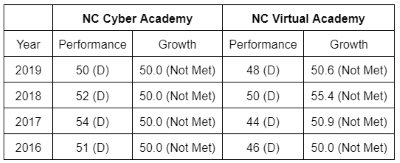
In the 2017-18 SY, two virtual charter schools, North Carolina Cyber Academy (formerly NC Connections Academy) and NC Virtual Academy opened as pilot projects. Because similar virtual charter schools had seen poor outcomes in other states, NC did not want to grant full charter status until the schools had proven themselves. The experiment has not gone well. In the years for which there is performance data (see NC School Report Cards), neither school achieved above a D performance grade or higher than 55 in growth. The NC Cyber Academy earned the lowest possible growth score (50) all four years. 

In addition, both schools currently serve a lower percentage of economically disadvantaged students than the state overall and have much lower four-year graduation rates.

2020-21 Economically Disadvantaged Students

  • State: 38.9% 
  • NC Cyber Academy: 31.5%
  • NC Virtual Academy: 32.4%

2020-21 Four-Year Graduation Rate

  • State: 87.0%
  • NC Cyber Academy: 54.9%
  • NC Virtual Academy: 77.5%

In a classic example of the privatization of public education, The NC Virtual Academy is powered by Stride K-12, an online learning company traded on the NY stock exchange. While the company’s investors may be getting good returns on their investment, the NC taxpayers are not. 

SB671 also introduces an option for public school districts to apply to the State Board of Education for approval to operate small virtual academies enrolling no more than 15% of their students. The bill lists seven required elements for a district’s plan including (#3) Hardware, software, and learning mgmt. platforms that support online learning, (#5) The professional development that will be provided to those teaching in the remote academy related to the pedagogy of providing remote instruction, and (#6) The identified characteristics for successful remote learning…. In addition, clear evaluation guidelines are set out to ensure that the remote academies do not provide a sub-standard education. These and other elements of SB671 are steps that could allow public schools flexibility to meet the needs of their students.

When SB671 went to the Senate for a vote this week, members found too many differences between their original version of SB671 – Edition 2 (Changes to the K-12 Scholarship Programs) and the House’s Edition 3. On a vote of 0-42, members sent the bill to a Conference Committee to iron out the differences. This delay provides an opportunity for NC citizens to reach out to committee members to voice their opinion on the various elements of the bill and what to keep or remove. House members have not yet been identified. The Senate members are 

The past few years have given NC educators, students, and parents plenty of opportunities to see the positive and negative aspects of virtual instruction. Implementing lessons learned and evaluating results as we move forward are critical next steps. SB671 does the NC virtual charter schools a disservice by excluding them from an evaluation of their pilot stage performance

Nora De La Cour is a high school social worker and former teacher in Massachusetts. She writes frequently about the attacks on public schools. In this brilliant article, which appeared in Jacobin, she shows how the privatizatizers have exploited the culture wars to promote their own agenda. They are not interested in better education or students. Their agenda is to destroy the public square.

In a nutshell: “A billionaire-backed network of free-market fundamentalists is ginning up controversy over “wokeness” in American schools with an ulterior motive: to demolish public education.”

Please open the link to read the article in full.

She begins:

In a Massachusetts school district neighboring the one where I work, four parents, backed by a conservative Christian organization, are suing the school committee and multiple district employees for calling students by their preferred names and pronouns without informing home. Because one of the defendants is a counselor, some of my counselor peers in the area are now on guard, afraid we could become the targets of litigation if we allow students to broach sensitive topics in our presence.

Setting aside the very real harm that kids and educators are exposed to as a result of the Right’s eagerness to linkacknowledgement of gay and trans people to sexual predation, there’s another problem here. It’s incredibly difficult to teach or counsel someone if you can’t call them what they wish to be called. Addressing students by their chosen names is a basic sign of respect that says, “I see you and I’m here to work with you.” If you need to call home to get permission first — potentially outing kids to their parents and inviting distressing blowback — you might miss the chance to form the human connection that undergirds collaborative scholarship.

Pandemic school closures reminded us that the social aspects of schooling are among the most vital for young people’s development and for society at large. Specific facts and figures (the what of school learning) can be easily forgotten and recalled with a few keystrokes. But the ability to establish a base level of trust with heterogeneous others in order to solve shared problems (the how of school learning) is absolutely essential for both a fulfilling personal life and engagement in the public square. It’s critical that educators be allowed to build that trust without fear of reprisal.

The Koch-backed parents’ rightsmovement aims to make that trust impossible. By pitting parents against schools, libertarian billionaires and Republican strategists intend to motivate voters in the short term and fully privatize K-12 education in the long term. As Christopher Rufo, the self-styled architect of the so-called war on critical race theory (CRT), has argued, “To create universal school choice [i.e., privatization], you really need to operate from a premise of universal school distrust.” Those poweringthe campaign against classroom “wokeness” are trying to hinder our ability to establish common ground from which to defend our last remaining public goods.

The illiberalism that dominates the Right can best be understood as the advanced stage of a long billionaire-funded plot to undo democracy in order to relieve capitalists of any constraints the rest of us might wish to place on them. This understanding clarifies why classrooms, the training grounds for democratic participation, are primary targets of radical right activism. If liberals are to have any hope of countering this coordinated attack, they need to remember the collective, public value of education.

Laying Siege to the Common Good

It makes sense to focus on the reactionary nature of all of this: the commitment to American exceptionalism animating the so-called CRT bans, the fresh fixation on classical education rife with chauvinist dog whistles, and the shockingly overt bigotry of the anti-LGBT “grooming” discourse. Ron DeSantis’s Florida, as some have observed, is looking more and more like Viktor Orbán’s Hungary. But while these efforts to reverse cultural change are incredibly alarming, we come up short when we try to understand what’s happening purely in terms of identity-based hatred. Intolerance has always been a feature of American politics. Why does it suddenly seem so viciously well-organized?…

Despite attention-grabbing campaigns to terrify them, a majority of public school parents remain satisfied with their children’s schooling. And massive amounts of outside funding notwithstanding, local parents’ rights candidates have in numerous cases failedto deliver decisive wins for the privatization movement. As in segregated Virginia, US families are not quite prepared to sign away their children’s right to publicly funded, democratically controlled schools. It’s the perfect time, in other words, for those looking to contest the radical right to offer a full-throated defense of public education and all public goods.

But Democrats, by and large, have been unwilling to mount that, scarcely standing up even against the horrific attacks on kids, families, and educators that we are seeing across the United States. And when you look at their record on education, it’s pretty clear why: for the past three decades of education reform, Democrats have ignored the social role that schools play in preparing children for engagement in the public square. Alongside Republicans, they have enabled the privatization of public schools. They have also privatized the ideaof schooling down to the individual level. In the view of the Democratic establishment, the sole remit of schools should be to boost “human capital.” Guided by this view, they have yoked the vision of education ever closer to the needs of employers — a kind of corporate indoctrination eerily similar to the “woke” indoctrination Rufo and his cohort tell tales about.

But Bill Clinton’s assertion that “what you earn depends on what you learn” has proven to be a dangerous oversimplification: Americans are more educated than ever before, and yet economic insecurity is rampant and rising. When public schooling is only justifiable insofar as it increases individual earning power, the case for it is wholly dependent on its utility to capitalist markets. Without acknowledging the higher collective purpose that education serves, we won’t be able to defend public schools ordemocratic governance.

Democracy or Capitalism

“Republican politicians and their strategists,” Nancy MacLean told Jacobin,

have seen . . . culture-war tactics help Jair Bolsonaro get elected in Brazil and Viktor Orbán get reelected in Hungary this spring. And, lo, the CPAC (the Conservative Political Action Committee) is traveling to Hungary . . . to learn from Orbán how to use the tools of democracy to rig the rules to achieve autocracy.

The long plot is reaching maturity.

The Right’s appeals to “the family” resonate in part because our oligarchic political system leaves families in the cold, allowing child poverty to soar even as parents spend long and exhausting hours working outside the home. Any effort to save our commons and restore a sense of public spiritedness must include a material response to the significant challenges that parents face.

We need to work fast to reclaim the places where we give one another the benefit of the doubt and collaborate in spite of our differences. Democrats can still enter the battlefield and expose the Right’s deceitful efforts to turn the public against itself. As MacLean argues, the movement Buchanan authored wants to save capitalism from democracy. We can counter it if we are willing to fight to save democracy — beginning with schools — from capitalism.