Archives for category: Privatization

Libby Stanford of Education Week reports on the sudden explosion of voucher legislation in Republican-controlled states. She quotes a spokesman for the Heritage Foundation, who says that school choice is expanding because of parent dissatisfaction with public schools.

But this acceleration is not a consequence of parental dissatisfaction, as the spokesman claims. It is the result of a well-organized, well-orchestrated, lavishly-funded campaign to defame public schools, led by the religious right and such organizations as the Koch network, the Heritage Foundation, The American Legislative Exchange Council, Betsy DeVos’ American Federation for Children, and the front groups they fund, such as Moms for Liberty and Parents Defending Freedom. ALEC undoubtedly prepared model legislation and handed it out to their far-right allies in state legislatures.

None of these funders or their puppet groups are mentioned in the article. It is no accident that multiple red states are debating bills to enact vouchers for private and religious groups or that 75-80% of the voucher funding in every state will end up in the bank accounts of families whose children never attended public schools. The legislation should be characterized as a handout to families whose children never attended public school.

It doesn’t take much digging to understand that the crusade against “critical race theory” (which is taught in graduate classes in law and education, not in K-12), against any mention of homosexuality, against “dangerous” books in school libraries, against fictional children who need litter boxes in the classroom because they think they are cats or dogs—is absurd propaganda designed to discredit public schools and pave the way for public funding of religious schools, which freely discriminate against students and families and openly indoctrinate their students into their dogma.

Instead of identifying the Heritage Foundation as a major player in the war to destroy public education, Stanford quotes its spokesman, who spouts the line that school choice is the result of parent dissatisfaction. What she does not mention is that voucher supporters maneuver to avoid public referenda because they know the public is opposed to vouchers. Right wingers go to great lengths to avoid the word “vouchers” and to quash referenda, because they are afraid of the voters.
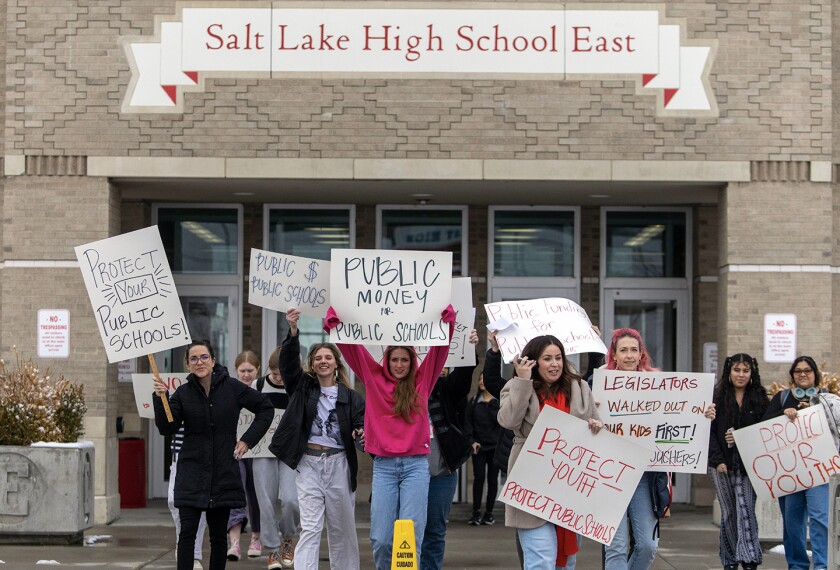
Students and teachers from East High School in Salt Lake City walk out of school to protest the HB15 voucher bill, on Wednesday, Jan. 25, 2023. Several years of pandemic restrictions and curriculum battles have emboldened longtime advocates of funneling public funds to private and religious schools in statehouses throughout the country.

Students and teachers from East High School in Salt Lake City walk out of school on Jan. 25, 2023, to protest legislation that would create private-school vouchers in the state. Several years of pandemic restrictions and curriculum battles have emboldened longtime advocates of funneling public funds to private and religious schools in statehouses throughout the country.

Rick Egan/The Salt Lake Tribune via AP

Stanford begins:

Emboldened by frustrations with pandemic-era policies and battles over what schools are teaching, conservative parents and politicians have accelerated a push for school choice policies that would funnel public funds into private schools.

Though school choice has been debated for decades, the movement is in a unique moment as advocates use parent concerns over COVID-era mask requirements; curriculum addressing race, gender, and sexuality; and library book content to bolster their argument that families should have more options outside of traditional public schools. And the school choice proposals states are considering—and, in some cases, have already passed—are more sweeping than previous iterations.

Already this year, lawmakers in at least 11 states—Idaho, Iowa, Kansas, Missouri, Nebraska, North Dakota, Oklahoma, South Carolina, Texas, Utah, and Virginia—have introduced and, in some cases, passed school choice bills. Although they vary in scope, many of the bills would establish or expand private school voucher and education savings account programs that give families public funds to pay for tuition at private schools, cover the costs of homeschooling, or pay for other schooling expenses.

The resurgence of school choice action shouldn’t come as a surprise. During the 2022 midterm election cycle, 19 Republican gubernatorial candidates advocated for school choice, mostly in the form of vouchers and education savings accounts, on campaign websites. This year, seven governors so far have talked about school choice policies in their state of the state addresses, according to the Education Commission of the States.

The policies are a result of parents’ declining satisfaction with schools following the pandemic, said Jonathan Butcher, an education policy analyst for the Heritage Foundation, a conservative think tank that advocates for school choice policies.

John Thompson, a retired teacher and historian in Oklahoma, has written frequently about events in his state for this blog. Here, he describes the political coercion that determined right-wingers are promoting in Oklahoma and calling it “choice.” From his description, some Republican legislators are worried about “liberal indoctrination,” transgender students using the “wrong” bathroom, litter boxes for children who think they are cats (this seems to be a QAnon idea), and the danger of “social-emotional learning.” Apparently students in Oklahoma have no social or emotional issues.

Ryan Walters, Oklahoma’s newly elected, extreme rightwing Secretary of Education, first says that “the state should have the ‘most comprehensive school choice in the country.’” Secondly, Walters pushes the rightwing Michigan-based Hillsdale College curriculum; he doesn’t want to allow schools to choose to retain research-based curriculums that he identifies as “liberal indoctrination.” As Clark Frailey, executive director of Pastors for Oklahoma Kids, says, Walters seems to be pushing for “Christian Dominionism,” which is “based on the philosophy that Christianity is at the core of America’s foundation and all institutions need to align with that viewpoint. If people won’t convert, then a government religion must be forced upon them.”

Two voucher programs for private schools and homeschools have been filed. The most interesting one is Sen. Shane Jett’s Oklahoma Parent Empowerment Act for Kids (PEAK). Even extremely conservative Republicans legislators worry that vouchers would undermine the finances of their rural schools. Jett seems to be offering a carrot and a stick to those vulnerable constituencies. He would impose vouchers only in counties with a population of more than 10,000 people. But, vouchers would be offered in counties with fewer than 10,000 residents if they are served by a “trigger district.”

The Oklahoman then reports:

Jett defined a “trigger district” as a public school system that allows or tolerates House Bill 1775 violations, use of school bathrooms according to gender identity, anthropomorphic behavior known as “furries,” disparagement of the oil and gas industry, lesson plans promoting social-emotional learning and animal rights activism, among other topics.

In other words, the bill would coerce schools into “choosing” to comply with the entire extremist agenda. But that begs the question about how educators would choose to deal with today’s threats to public education. Republican Sen. Adam Pugh’s newly revealed plan for school improvement was based on meetings with 200 public school superintendents; every college president in Oklahoma; and “hundreds, if not thousands” teachers and parents and advocacy groups.  Based on these listening sessions, Pugh did not propose vouchers.

Pugh’s plan would raise teacher pay so the minimum starting salary was $40,000, “with graduated raises to the minimum salary schedule based on longevity.” The estimated cost would be $241 million, which is less than the cost of Sen. Julie Daniels’ voucher bill ($275 million). They would  also create an “Oklahoma Teacher Corps” and a teacher mentoring system;  provide certain teachers at least 12 weeks of maternity leave; update the school funding formula, and pass Pugh’s seven other constructive reforms. 

As Pugh explained, “I hope this plan will demonstrate to teachers that we’re serious about the work that you do, and we appreciate how you pour your heart and your soul into educating kids, as we need you to stay in the classroom, and we need more of you.”

But, the Stillwater News Press offers an equally important response:

While that offers us a bit of a sigh of relief, Oklahomans should be aware that the push [to] move taxpayer money into private schools isn’t going anywhere. It’s a well-funded campaign and the state’s administrators and board members have been handpicked to make that a top priority.

I’m afraid I agree with the Stillwater News. Pugh’s bills raise hope. But Oklahoma Republicans will continue to coerce schools into compliance with their extremist privatization and Christian Dominionism ideologies – and call it “choice.”

On the other hand, more Republicans sound like they are getting fed up by Walters and his minions. This week, the Secretary of Education was supposed to present a budget to a legislative subcommittee for planning purposes, but a letter obtained by the Tulsa World shows that Walters seems to be prioritizing “ridding public education of ‘liberal indoctrination.’” Walters’ “spokesman” said he “has requested additional information on diversity, equity, inclusion programs (DEI) to fully understand the extent of indoctrination happening in higher education.”

The letter said:

Please provide a full outline and review of every dollar that has been spent over the last 10 years on diversity, equity, inclusion. Additionally, I want an overview of your staffing and the colleges underneath your oversight as the Chancellor of Oklahoma Higher Regents within every DEI program … and expenditures,” Walters wrote on letterhead of the Office of the Secretary of Education. “Lastly, please provide a copy of the materials that are being used in any of these programs.”

Neither has Walters followed legislative norms for presenting a public education budget. As Nondoc reported, Walters said he instituted a hiring freeze and a spending freeze for the State Department of Education when he took office and all related decisions require his approval. And, in addition to demanding vouchers, he has insisted on any teacher pay raise being performance-based. Above all, Walters said he would be bringing a completely different budget than the one his predecessor drafted. 

Republican Toni Hasenbeck (R-Elgin) responded saying, “district superintendents had expressed concern for ‘the next four years’” because of Walters’ campaign comments. Rep. Dell Kerbs, (R-Shawnee) commented, “I don’t need elevator speeches. I need details.” Subcommittee Chairman Mark McBride (R-Moore) understood the argument that performance pay could be a part of teacher pay, but he said that Walters’ plan went too far. And then he tried to get Walters back to the normative procedures which the subcommittee follows for helping craft funding priorities.

McBride “interrupted Walters,” and asked, “Are you saying the budget will totally change — you’re presenting a budget that’s not going to be the same budget, and you’re going to totally change it?”

Nondoc reported that “McBride seemed confused and paused for a moment.” When Walters tried to change the subject, [McBride] interrupted him and asked why Walters was presenting a budget that would not exist in a week. Walters again changed the subject and, as Nondoc reported, “McBride interrupted him again, asking him to stay on topic presenting monetary figures rather than discussing policy and slipping into “campaign rhetoric.” McBride said, “With all due respect, I need the performance review for last year. That’s what you’re here to present.” Then, after that interruption, Walters stopped his presentation.

 After the meeting, Matt Langston, Walters’s “spokesman” (a paid GOP consultant based in Texas) said, “Not one person in Oklahoma is surprised that Democrats are unhappy with the political theater that was orchestrated today.” According to Langston:

They do not want transparency, accountability or even basic reform because they are used to playing in the shadows. Union bosses, whining and liberal tears will not stop education reform, and the superintendent is looking forward to next week’s actual budget hearing.

Stay tuned! When Walters reveals his budget, chaos and vitriol will increase, and we’ll see whether Walters really believes he can implement his promise or “suggestion,” that “received some pushback from lawmakers in 2022,” a ten-year plan to reject all federal spending on education

In a taped conversation, a lobbyist for vouchers in Utah said what everyone suspected: “I can’t say this is a recall of public education, even though I want to destroy public education. I can’t say that. The Legislature can’t say that because they’ll be just scraped over the coals.”

She said the quiet part out loud.

She was supposed to say that vouchers would give every child a chance to get a better education.

She forgot to say that vouchers would enable EVERY child to get a great education “regardless of their zip code.”

She forgot her talking points.

She said what she and her team say when there are no reporters or recorders around. The goal is “to destroy public education.”

When the story was published, the lobbyist apologized for saying what she believed.

Now that Florida is a red state, the legislature plans to offer vouchers to every student. The legislators expect to do maximum damage to public schools, which will inexorably lose funding and students. Nothing has been said about how to pay for the proposal. Voucher schools in the state are mostly religious and are completely unregulated. Neither their principals nor their teachers need to be credentialed. They are also free to discriminate on any grounds.

The Miami Herald reports:

Florida Republican lawmakers this year will consider offering every K-12 student thousands of dollars each year for their families to spend on education.

Parents would have access to state-funded accounts and use them to pay for private school tuition plus a wide variety of school-related expenses.

The proposal, if approved, would make the state’s school voucher program bigger than ever. But one key fact about the pitch remains elusive: its cost. It could total billions of dollars.

House Speaker Paul Renner said last week he plans to make the proposal, House Bill 1, a priority during the annual legislative session, which starts March 7.

The measure is already being fast-tracked. It will have its first committee hearing Thursday morning in Tallahassee.

So far, the measure carries no financial impact statement. That’s despite the knowledge that hundreds of thousands more children would be eligible for annual payments of about $8,000 each.

The cost, according to the staff analysis, is “indeterminate.” And that “is not reasonable,” said Norín Dollard, a senior research analyst at Florida Policy Institute, a nonpartisan organization that focuses on quality of life issues for Floridians. The group issued a report on voucher funding in September.

HUNDREDS OF THOUSANDS NEW STUDENTS WOULD BE ELIGIBLE

About 266,000 Florida children attend private schools without using any current state scholarship or voucher, Dollard notes. All would be eligible for education savings accounts under the proposal. In addition, approximately 150,000 children receive home schooling.

HB 1 would provide accounts to as many as 10,000 of them in the first year, with more to come in following years. Conservative back-of-the-napkin math suggests that if just 25% of the newly eligible students participate, and those currently in the program remain, the added cost would reach $600 million, Dollard said.

As participation grows, the total could approach $4 billion or more within five years, she added. If that’s the policy decision in leadership, so be it, Dollard said. But it needs to be funded somehow.

A RECURRING FINANCIAL OBLIGATION

State Rep. Anna Eskamani, D-Orlando, focused on that issue during a hastily called Monday evening Zoom meeting to discuss the measure with public education advocates.“

“We have very, very serious concerns,” Eskamani said during an interview. “This is an annual shift of money. Where is it coming from?”

When unveiling the measure at a news briefing, Renner said it was too early to know how much money might be needed. Much depends on how many children want to avail themselves of the vouchers, he said, and where the Legislature sets per-student funding for the year.

At the same time, Renner stressed his goal is to further open school choice so “no one is left out.” The bill would eliminate most eligibility restrictions, though it would prioritize children whose family income is at or below 185% of the federal poverty level — or $55,500 for a family of four.

It also would broaden uses of the money beyond private school tuition to include education expenses such as tutoring, testing and college courses. It would allow students to bank up to $24,000 for those uses, and further permit children already attending private schools without state support to request a share of the funds.

“To effectively deliver a quality education, policy makers and education advocates must accept that every student has unique learning needs, that education dollars belong to the student and not a system, and that public school choice offers every student an opportunity to customize their own education,” Renner said Tuesday, when asked about the associated costs.

A SPIKE IN PARTICIPATION IS EXPECTED

Dollard and others said they anticipate wide interest in participation, with much of it coming from families already paying for private schools. In Arizona, which has a similar education savings account program, the state reported 80% of applicants never attended public schools.

That flips the idea of money following the student on its head, Dollard suggested, because those students never had their education covered by state money in the first place.

School district finance officers said they understood the leadership’s position that the details aren’t firm enough to know the full financial impact.

But using the state’s most recent voucher expansion plan as a guide, they had concerns that this initiative would take money away from district budgets and leave them little ability to plan.

That’s what happened the last time the state expanded vouchers in 2021 with the taxpayer-funded Family Empowerment Scholarship. Officials touted the program as adding $200 million for vouchers, allowing 61,000 more children to afford private school.

Districts saw some money go out the door, but nothing like what happened in 2022. Halfway through the 2021-22 school year, school budget officers across the state learned that three times the amount of money they had set aside to send to voucher programs would be required, based on updated attendance figures from the state.

In some counties, such as Pasco, efforts to provide employee raises were derailed as the money officials expected to use was diverted to the vouchers. All told, the cost had grown to $1 billion.

The current year has provided similar sticker shock. The Legislature approved a budget with no specific amount set for the scholarships. By the second education funding calculation in July, the price tag had increased to $1.3 billion.

That meant the Miami-Dade County school district would have to send $225 million from its budget to the voucher program, for example, and the Hillsborough County school district would send $75 million.

When the third calculation came out this week, districts learned they would be losing even more. If the state lifts the eligibility restrictions, Pinellas County Schools chief finance officer Kevin Smith predicted, it will become even more difficult to predict the financial impact.

He suggested the state should at least consider taking the money out of the public education funding program and create a separate line item.

That way, schools would know what to expect and they could budget appropriately. In recent years, the DeSantis administration has taken the position that unexpected changes in enrollment can pose a financial strain on local school districts.

Read more at: https://www.miamiherald.com/news/local/education/article271630112.html#storylink=cpy

This is one of Peter Greene’s finest posts. He explains the real reason that Republicans have fallen in love with vouchers. They want to eliminate public schools and in time shift the financial burden of schools to parents, not taxpayers. One of the loudest voucher advocates, who got his doctorate from the University of Walton….the University of Arkansas’s so-called Department of Educational Reform, where they teach the doctrine of school choice, posted a photograph of himself and a woman whom I assume was his wife at a funeral, celebrating the death of public schools. When we go high, they go low.

Greene writes:

The new wave of voucher bills being rammed through red state legislatures all demonstrate a truth about school voucher policies– vouchers are not about choice. They’re about peeling people away from the public school system in order to defund and dismantle that system.

What makes me think so? Here it is. Sometimes it’s not about what people say, but about what they don’t say.

If the concern were really and truly choice for every student, then voucher fans would be addressing some of the real obstacles to school choice.This door doesn’t lead where they told you it would.

For one, they would be addressing discriminatory and exclusionary policies. Yet when have we ever heard a voucher supporter say, “These discriminatory policies have to stop. LGBTQ+ students deserve just as much school choice as any other students.”

The closest thing we ever get is “Well, then they can start an LGBTQ-friendly school of their own.” Yet when that happens, pro-voucher politicians target that school with terms like “perversion.” And of course in some states, such a school can never happen because talking about LGBTQ students or Black history has been outlawed. And voucher laws are written to hold the private school right to discriminate as it wishes inviolable.

If someone were serious about voucher based choice, they would also address cost. Vouchers are typically far too small to pay for tuition to top schools in the state. If voucher supporters were really interested in making sure that, as Jeb Bush says, “each and every…student can access the education of their choice,” there would be a robust discussion about how to bridge the gap between meager vouchers and expensive schools.

Yet we never hear voucher advocates saying, “We need to find the way to fully fund vouchers so that they provide a real choice to students.” Choice advocates like to point at the inequity of the public system–parent choice is limited by their ability to buy an expensive house in a wealthy neighborhood. But the current crop of voucher programs doesn’t change that a bit–a voucher offers little to change the fact that how much “freedom” you get depends on how wealthy you are.

It has been done. But when Croydon, NH set up a school choice program, a voucher-like system that bore the full cost of sending a student to the school of their choice, local libertarians tried to shut it down because they wanted lower taxes.

Voucher fans love the idea of school choice; they just don’t want to actually pay for it.

If these folks were serious about school choice via vouchers, we would have calls for oversight and accountability. It would make a choice system that much more attractive for parents to know that all the available options have been vetted and screened and will be held to some standards, just like shopping in a grocery store where you can rest easy in near-certainty that whatever you pick, it’s not going to actually poison your family.

And yet not only do voucher fans not call for oversight and accountability, but they actively block it with language that hammers home that nobody can tell vendors what to do or how to do it.

Voucherphiles like to call their system child-centered, but in fact it is vendor-centered, with “protections” for the service providers written into the law, and protections for the students non-existent. Parents are left to navigate an unregulated system of asymmetrical information that favors the businesses– not the families.

Please open the link and finish the post. And while you are at it, subscribe to Peter’s wonderful blog.

Gary Rayno writes in InDepth NH about a Democratic proposal to put the State Department of Education in charge of the voucher program. Called “Education Freedom Accounts, the program was sold as a way to help low-income students in bad public schools transfer to better private schools. But about 75% of the students getting voucher money were already enrolled in private and religious schools. The free-market State Education Commissioner Frank Edelblut (who home-schooled his own children) projected that the program would cost $3.3 million, but it has actually cost $27 million in its two years of operation. Edelblut promised it would cut property taxes, but the cost of the program is projected to grow.

Rayno writes:

CONCORD — Several lawmakers seek changes to the new Education Freedom Account program with a package of bills addressing issues raised in its first two years of operation.

The program was included in the state’s two-year operating budget passed in 2021, and has been significantly over budget projections with more students than anticipated and what many view as insufficient oversight.

“It is hard to have oversight,” said the prime sponsor of House Bill 626, Rep. David Luneau, D-Hopkinton, “when you don’t have transparency, when you don’t have the data to look at.”

The bill, which had a public hearing Wednesday before the House Education Committee, would have the Department of Education administer and manage the program instead of the Children’s Scholarship Fund NH, which receives 10 percent of the program’s grant distribution under its contract with the state. The organization’s no-bid contract was approved by the Executive Council soon after the program was approved in the state’s operating budget.

The program allows the money parents receive to roll-over from year to year, unless the amount exceeds what would be a quarterly payment.

If the student graduates, leaves the freedom account program or is removed from the program for misuse of funds, the parents would be required to return any excess money to the Education Trust Fund under the bill.

The bill would also require students in the program to take one of the statewide assessment tests required of public school students as a comparison of how well the students in the program are doing, Luneau said.

Luneau and other supporters of the change say the program needs more oversight, accountability and transparency given the millions of dollars being distributed to parents.

The state has spent about $27 million during the first two years of the program, well above the $3.3 million budget Education Commissioner Frank Edelblut projected would be the cost.

He asked for $30 million each year of the next biennial budget in requests to the Governor’s Office.

Luneau told the committee that is $90 million in the first four years of the program coming out of the Education Trust Fund, and $9 million of it going to the scholarship fund.

He said he believes with added staff, the department could manage and administer the program for much less money and have the data needed for better accountability, transparency and assessment.

Why use tax dollars to pay the overhead of a private company, when you are already paying the department to oversee kids’ education in the state, Luneau said.

To date, about 75 percent of the funds for the program have gone as subsidies to parents of students who were enrolled in private or religious schools prior to the program’s start.

Of the 3,000 students in the program this year, about 700 attended a public school the year before.

Luneau said the reports include the kids who were in private and religious schools before the program began to show how successful it is, but that is not saving any taxpayers money but is using money from the Education Trust Fund.

Luneau is prime sponsor of another bill prohibiting using the money as a subsidy for private or religious school tuition.

Supporters of the program sold it as a way for lower income parents to afford to find the best education opportunities for their students while saving property tax dollars for taxpayers.

Luneau said taxpayers who fund public schools receive a great deal more accountability, oversight and transparency of their tax dollars than they do in the freedom account program, adding the reports the scholarship fund has provided are laughable; they are so incomplete.

The view of Republican legislators is that parents alone offer accountability. If they don’t like the program, they will leave it. Since 3/4 of them are already enrolled in private and religious schools, they should be overjoyed that the taxpayers are underwriting the cost.

Open the link and read the rest of the article.

At ex-Governor Cuomo’s urging several years ago, the Legislature passed a law requiring the New York City Department of Education to provide free space to charter schools, and if no space was available, to pay their rent in private space. This requirement gave rise to the dreadful practice of “co-location,” in which a new charter school was crammed into an existing public school. The public school typically lost space for class size reduction, performances, special education services, and everything else that was not designated as a classroom. Meanwhile, the charter school got fresh new furniture and the best of everything. There was no collaboration between the schools under the same roof.

A few days ago, charter advocates were stunned when the Department of Education rejected three requests for co-location by the rich and politically powerful Success Academy charter chain. The Wall Street Journal immediately published an editorial blasting Mayor Eric Adams (whose campaign was bankrolled by charter billionaires) and who put charter advocates on the city’s school board. The decision was made by Chancellor David Banks and never reached the pro-charter city board.

For Eva Moskowitz of Success Academy, this was a surprising rejection. She is accustomed to cowing politicians (she has her own PAC) and getting her way.

Charter fans and the pro-charter media blame “the unions,” their usual enemy, but this isn’t correct. Parents and educators in these communities contacted their legislators and won their support. And the legislators and local officials killed the deal.

Congressman Jamaal Bowman stepped up to oppose the co-location in a school that he knew. He wrote a thread on Twitter (@JamaalBowmanNY) that began:

The @NYCSchools proposal to open and co-locate a new @SuccessCharters school in Building X113 is absolutely outrageous. The Panel for Education Policy has to vote against this plan, and I urge my colleagues and neighbors to get loud in opposition. Here’s why: 🧵

As a former educator & principal of a middle school in the same district as X113, I’ve seen up close how the educators there have done a tremendous job serving their students & families. Our community is incredibly grateful for the love they pour into their work every day.

I’ve also seen how charter schools can harm students, educators, and traditional public schools in our communities. We can’t let that happen at X113.

Big charter networks have a history of draining students & funds from traditional public schools, and violating the rights of their students. Last year, Success Academy had to pay out $2.4 million in a federal court settlement for pushing out students with disabilities.

The plan will decrease available space for the existing schools at Building X113 – both district-run public schools – and prevent them from lowering class sizes adequately. Class size matters. We’ve got to demand schools get the resources & physical space to meet student needs.

As many charter school expansions do, this destructive plan will also disproportionately harm students with disabilities. The plan does not include sufficient analysis of what intervention rooms are necessary to provide students with IEPs with the services they need.

Another surprise: the Rupert Murdoch-owned New York Post got the story right. The story recognized that the pressure to block the co-locations came not from the union but from parents. The Post has been a vocal supporter of charters, and Murdoch himself has contributed to them.

Elected officials helped kill a plan to open three new charter schools in existing public schools or other city-owned buildings — after hearing fierce opposition from local parents.

Bronx Borough President Vanessa Gibson — who last week spoke at the ribbon-cutting ceremony for a new DREAM Charter High School in Mott Haven — suggested Tuesday that her hand was forced against the planned Success Academy in Williamsbridge.

“Parents of School District 11 spoke to us loud & clear. The deep rooted history of disinvestment at the Richard R. Green Campus must be recognized. So much progress has been made,” she tweeted.

A City Hall insider also cited “a lot of pushback” from community members opposed to the new charter schools.

“They vote and they hold folks accountable,” the source said.

Schools Chancellor David Banks’ unexpected withdrawal of the proposal came even though Mayor Eric Adams packed the board in charge of the decision with pro-charter allies.

Florida has one of the largest voucher programs in the nation, and Republicans expect to make the program even larger. With a large majority in both houses and a choice-friendly governor, they will push their bill through with little or no resistance. Florida’s voucher schools are not required to hire certified teachers; their students do not take state tests. Although accountability was a major thrust of the Florida “reforms,” voucher schools are exempt from any accountability. Most are religious schools.

The Miami Herald reported:

Florida’s school voucher program could see a major expansion under new legislation filed Thursday by House Republicans. Standing at a lectern with a sign reading “Your Kids, Your Choice,” House Speaker Paul Renner introduced House Bill 1 to make vouchers available to all Florida children eligible to enter kindergarten through 12th grade. Children from families with incomes up to 185% of the federal poverty level, which is $55,500 plus $9,509 for each additional family member, would continue to get priority for the funding. Children in foster care also would receive priority.

The bill would allow voucher recipients to use the public funds for more than tuition at a private school and transportation, as is currently in law. Families would be allowed to spend the money on home-schooling, college courses, private tutoring and specialized testing such as Advanced Placement exams, among other expenses.

Students may not be in public school to qualify for a voucher, which is the equivalent of per-student funding in a public school — currently about $8,216 per year.

Families would receive the money through state-funded education savings accounts, a longtime goal for Florida Republicans. “It’s about freedom and opportunity,” Renner, R-Palm Coast, said during his news conference. “We empower parents and children to decide the education that meets their needs.”

State Rep. Kaylee Tuck, chairperson of the House Choice and Innovation subcommittee, is carrying the bill. The Lake Placid Republican said the measure should allow families to customize education for their children.

Renner predicted broad bipartisan support for the bill, which he said also should clear the waiting list for students with special education needs to receive a state scholarship. Currently about 9,400 children are on that list, according to Renner’s staff.

DEMOCRATS CALL IT ‘DEFUNDING PUBLIC EDUCATION’

House Democratic Leader Rep. Fentrice Driskell disagreed with Renner’s comments regarding support for the bill. She called it a “defunding of public education” and said she expected most members of her party to oppose it. “There is nothing in this bill that I like, because we continue to take these public dollars and use them for private purposes,” Driskell, D-Tampa, said.

Other Democrats attending a news conference to counter the Republicans’ announcement held similar views. They said they support vouchers for students who need special services, and agreed that parents deserve choices — including within the public schools, which 2.9 million children attend.

“Let’s not defund one institution to fund another one,” said Rep. Felicia Robinson, D-Miami Gardens, who also called for more accountability in the voucher system. Schools that accept vouchers should at least have certified teachers, Robinson said.

And parents who accept funding should have to prove the money is going toward approved education services, added Rep. Yvonne Hayes Hinson, D-Gainesville. ”There is no accountability for tracking funds,” said Hinson.

“This might be a get-rich scheme. I’ve seen it all over the country.” Rep. Allison Tant, D-Tallahassee, referenced her city’s Red Hills Academy, a charter school that closed within weeks of opening last year, citing low enrollment and processing issues, according to the Tallahassee Democrat. ”They got state funding to go create themselves,” Tant said. “Then they turn the kids back to public schools and guess what? They kept the funding.” In Palm Beach County, the founder of one charter school was found profiting off the venture by steering school contracts to companies he owned, according to the Palm Beach Post.

RENNER OFFERS REBUTTAL ON FUNDING

Renner said critics who claim the Republicans are seeking to dismantle public education ignore the fact that the Legislature has put more total dollars into district schools every year, something he said would likely continue. He also pointed to the state’s efforts to improve teacher pay, adding millions of dollars to boost the base salary.

“It’s going to be a good year for our traditional public schools as well,” Renner said.

Read more at: https://www.miamiherald.com/news/local/education/article271373917.html#storylink=cpy

Linda Lyon is a retired naval officer and past president of the Arizona School Boards Asociatuon, as well as her local school board. Her blog is called Restore Reason, and she writes here about the struggle to save public schools from antagonists who prefer to save money and who are antagonistic to anything that serves the public good.

She writes:

Those of you’ve who’ve been around awhile will remember lobbyist Grover Norquist, who founded Americans for Tax Reform in 1985. This was during the Reagan years, when government was seen as a drag on the free market. Norquist is probably best known for this quote in 2001: “I don’t want to abolish government. I simply want to reduce it to the size where I can drag it into the bathroom and drown it in the bathtub”

It has been obvious for many years that Arizona Republican lawmakers want to drown our district schools since the budget for K-12 education makes up almost 44% of the state budget. But then, the predominant responsibilities of the AZ state government are to provide for the public safety and public education, so…it stands to figure that education would comprise a large portion of the budget.

If you’ve listened to the AZ Republican lawmaker talking points over the last few years, you’d tend to believe that public education has been showered with funding. The truth however is quite another story. In fact, adjusting for inflation, K-12 funding per public school student hasn’t increased in 21 years and leaves us still 48th in the nation. In 2001, districts were provided $8,824 per student and now, only $8,770. The high-water mark in 2007 of $10,182 per student was under Democratic Governor Janet Napolitano. This was actually $1,412 more than in 2022.

You see, pretty much all the GOP has been doing over the last few years is to reinstate funding they took away to begin with. And to add insult to injury, they’ve been chipping away at the amount available to district schools by continuous expansion of privatization options.

Guess you’d have to be living under a rock to have missed the battle over vouchers (Empowerment Scholarship Accounts) during the past decade. ESAs were enacted in 2011 and GOP lawmakers have been steadily expanding these vouchers over the years. In 2022, (I’m really cutting to the chase here), they were finally successful in enacting a universal expansion. Not only are students no longer required to have previously attended a district school to qualify for a voucher, but there are no guardrails or cap and no transparency or accountability for private schools. And, only two months into the new law, AZ DOE had received nearly 30,000 filings for the vouchers, totaling an immediate hit to the state fund of $210M. The Joint Legislative Budget Committee only budgeted $33M for the program for the 2022-23 school year, but some now estimate the bill could approach as much as $500M.

Student Tuition Organizations (STOs) are another vehicle to poke holes in the district funding life raft. They allow tax payers to take a dollar-for-dollar reduction in their state taxes when they give to an approved STO which provides scholarship funding to children attending grades K-12 at qualified private schools in Arizona. These STOs basically serve as a pass-through for tax credit donations to private schools while keeping 10 percent for themselves. STOs have also seen tremendous expansion over the years with the individual tax credit amount now at $1,306 which is over six times that which taxpayers can give to district schools. There are also two types of tax credits corporations can take and the combined cap for those is now up to $141M.

Just introduced last week by Representative Livingston, is HB 2014 which seeks to expand the aggregate dollar amount of STO tax credits from $6M in 2021-22 to $10M in 2022-23, to $15M in 2023-24, and to $20M in 2024-25. It also would eliminate the need for recipients of a corporate, low-income scholarship to have attended a district school prior to receiving the scholarship. Keep in mind that removing the requirement to have first attended a district school prior to receiving STO or ESA monies, accommodates students already in private school or being homeschooled, at their parent’s expense. In fact, that was the case for 80% of the filings for the universal expansion last year. And, when a student taking an ESA or STO scholarship was never in a district school, there is zero reduction in cost to that district school and ultimately, taxpayers.

These schemes are chipping away at the foundation of our district (community) schools so that eventually, they can be “drowned in the bathtub”. This is not by accident, but rather, by design. There are those in the Legislature, who do not believe in equal opportunity to learn and thrive, but rather, in survival of the fittest. And, they are hell-bent on deciding who the “fittest” are. Privatizing public education primarily serves those who “have” at the expense of those who “have not”. This continued war on public education will continue to weaken our communities and our democracy as it solidifies power and influence with those at the very top.

Want to fight back? Go to SOSArizona.org.

Dr. Charles Foster Johnson, founder of Pastors for Texas Children, is a dear and beloved friend. I can’t give him enough praise for the work he does every day to protect the public schools of Texas and the five million children enrolled in them. He shared the following message today.

Dr. King and the Work for Justice

Dear PTC Pastor and Friend,


It is good to set aside a day as a nation to remember the world-changing life, ministry, and legacy of the Rev. Martin Luther King, Jr. The prophetic vision he cast for our nation is far from realized.


As a 65-year-old white man from Alabama, I remember very well how Dr. King was vilified by the white power structure of this nation. What the Hebrew prophet Isaiah said about the suffering servant was true for Dr. King: he was “despised and rejected.” He was assassinated not because he was popular but because he was hated. Indeed, God has used his death and martyrdom as means to bring our nation into a “more perfect union.”


In 2008, I was privileged to be inducted into the Martin Luther King, Jr. Board of Preachers at Morehouse College. I knelt with other ministers before the full congregation in the King Chapel that day, vowing before God that I too would dedicate my life and ministry to the justice of Christ. It was one of the most moving moments of worship Jana and I have ever experienced.


The Rev. Dr. Billy Kyles, Pastor of the Monumental Baptist Church of Memphis, was the day’s keynote speaker.

Rev. Kyles was on the balcony when Dr. King was murdered. They were on the way to the Kyles’ home for supper. He retold the story that day, moment by moment, building to the awful instant when the shot rang out.


Rev. Kyles began musing to himself in his sermon why God placed him on that Lorraine Motel balcony that day, at that historic moment, standing beside Dr. King. Then he paused, with the perfect timing of a great preacher, and said, “Now I know. I know why the Lord had me right there. Because every crucifixion has to have a witness.”


We dishonor Rev. Martin Luther King’s life and legacy with easy platitudes or historical whitewashing. We honor him– and our Lord who led him– only with the painful, painstaking work of justice-making.


That is why we stand strong for quality public education for all children. We have a long way to go in delivering this promise of justice. But, no private model of education will ever ensure this provision of God. Only the public trust can and will do this.


Thank you for bearing witness so faithfully to this call!


Rev. Charles Foster Johnson, Executive Director

DONATE TO PTC


PO Box 471155, Fort Worth, Texas, 76147

Check out our website