Archives for category: Network for Public Education

Tom Ultican is a retired teacher of physics and advanced mathematics. He is now a tireless blogger who unearths the machinations of the elites and billionaires intent on privatizing public education. Tom has been a strong supporter of the Network for Public Education. He explains here why he will attend the next NPE conference in Columbus, April 5 and 6.

He writes:

I am going to Columbus, Ohio for the 2025 NPE conference the weekend of April 5 and 6. Since 2015, these conferences have been a forward looking delight for me. (I missed the 2014 conference in Austin, Texas.) It is a place to hear from heroes of human rights and amazing defenders of public education. It is here where we unite and organize to take on ruthless billionaires; out to end taxpayer funded free education for all. Meeting and hotel reservations are still available.

Chicago 2015

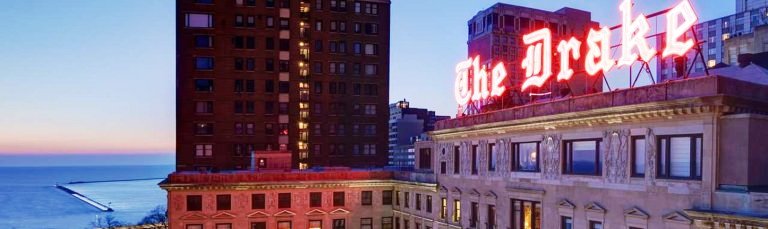
My first NPE conference, in 2015, was held in the historic Drake Hotel on the shore of Lake Michigan. I had been reading blogs by Diane Ravitch, Mercedes Schneider and Anthony Cody. They were all there. In fact, when I arrived the quite tall Cody was walking down a staircase to greet new arrivals. This got my conference off to a thrilling start. Yong Zhao, the keynote speaker, was amazing plus I personally met Deborah Meier and NEA president, Lily Eskelsen García. Always close to my heart will be the wonderful and all too short relationship I developed with our host, Karen Lewis.
Raleigh 2016

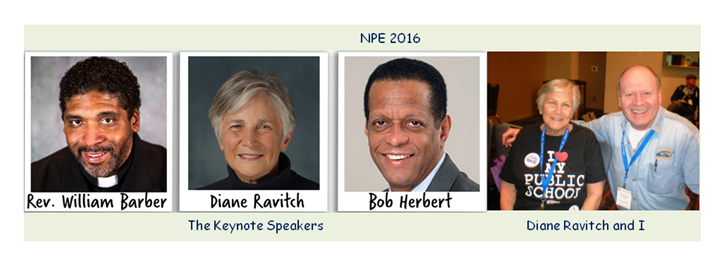
In Raleigh, I met Andrea Gabor, who was working on a book that was released in 2018, After the Education Wars; How Smart Schools Upend the Business of Reform.” She had been an agnostic on charter schools until she went to New Orleans and discovered a mess. The amazing speaker, Rev. William Barber, gave the keynote address. This leader of the “poor people’s campaign” is a truly gifted speaker.
Oakland 2017

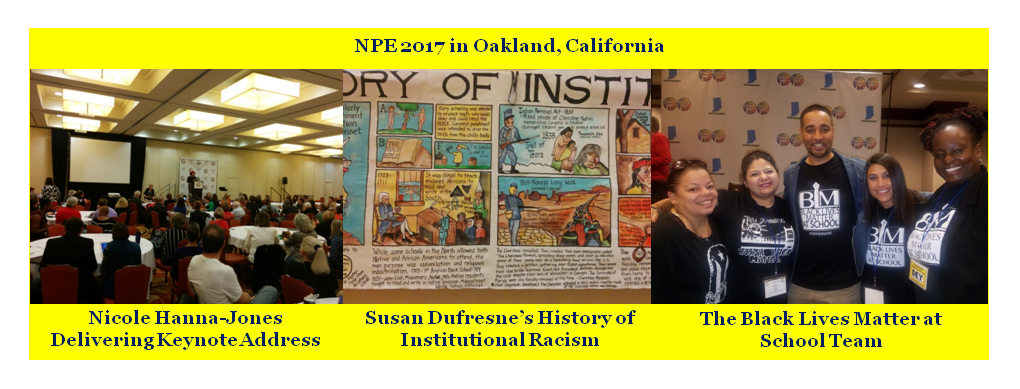
Nicole Hanna-Jones who had just won the MacArthur Foundation genius award and recently published “The 1619 Project” was our keynote speaker. Susan Dufresne lined the walls of the Oakland Marriot’s main conference room with her art depicting institutional racism that was published in book form 6-months later (The History of Institutional Racism in U.S. Public Schools). At a KPFA discussion featuring Diane Ravitch and Dyett High School hunger strike hero, Jitu Brown, I ran into Cindy Martin, then the Superintendent of San Diego Unified School District. She has been the number two at the Department of Education for most of the past four years. Too bad she was not the number one.
Indianapolis 2018

Diane Ravitch opened the conference declaring, “We are the resistance and we are winning!” Finnish educator, Pasi Sahlberg, coined the apt acronym for the worldwide school privatization phenomena by calling it the “Global Education Reform Movement (GERM).” In Indianapolis, we met many new leaders in the resistance like Jesse Hagopian from Seattle. In his introduction, Journey for Justice leader, Jitu Brown, declared, “Jesse is a freedom fighter who happens to be a teacher.” Jesse’s new book “Teach Truth; the Struggle for Antiracist Education was just released.

America’s leading civil rights fighter and president of the NAACP, Derrick Johnson, was our keynote speaker. He said the NAACP was not opposed to charter schools, but is calling for a moratorium until there is transparency in their operations and uniformity in terms of requirements is repaired. Derrick noted the NAACP had conducted an in depth national study of charter schools and found a wide range of problems that needed to be fixed before the experiment is continued.
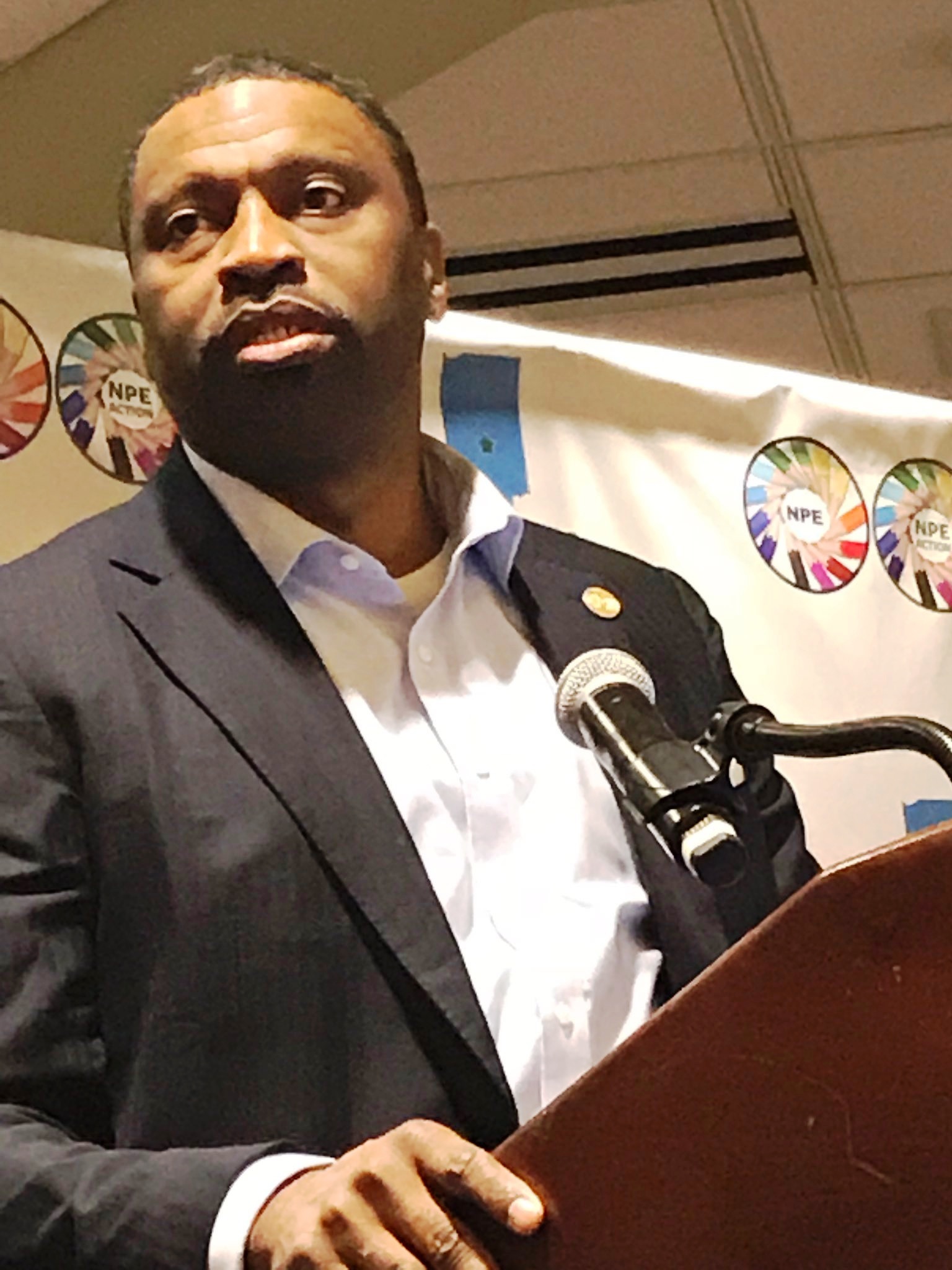
Derrick Johnson, President of NAACP, Speaking at #NPE18Indy – Photo by Anthony Cody

Philadelphia 2022

Like the entire world, NPE activities were seriously interrupted by COVID-19. We were finally able to meet on Broad Street in Philadelphia March 19-20, 2022. This gathering was originally scheduled in 2020. My good friend Darcie Cimarusti, who worked for NPE, called me about joining her for a breakout session on The City Fund, the billionaire founded organization pushing the portfolio model of school management. By 2022, she was so weakened by cancer that I ended up leading the session. Sadly, Darcie passed a few months after the conference.

At the 2022 meeting, we also paid tribute to Phyllis Bush, an NPE founding board member and wonderful person. She was dealing with cancer at the Indianapolis conference and passed some time afterward.

The lunchtime conversation between Diane Ravitch and social activist, musician and actor, Stevie Van Zandt, was special. “Little Stevie” co-founded South Side Johnny and the Asbury Jukes, became a member of the E-Street band with Bruce Springsteen and starred on the Sopranos. It turned out that Diane and Stevie became friends when they were walking a picket line in support of LA teachers.

Ravitch posted afterwards, “I wish you had been in Philly to hear the wonderful “Little Stevie” (formerly the EST band and “The Sopranos”) talk about his love for music, kids, teachers, and arts in the schools at #npe2022philly. Everyone loved his enthusiasm and candor.”
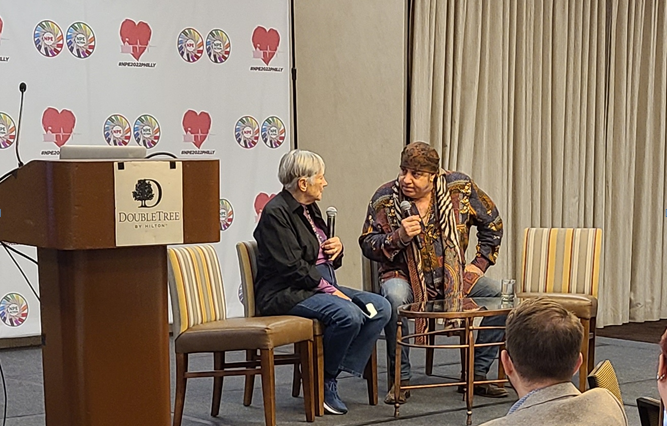
Diane Ravitch and Steven Van Zandt at NPE Philadelphia

Washington DC 2023

October 28-29, 2023, brought the Washington DC NPE conference, a special event. Of particular interest to me was the preconference interview (October 27 evening) of James Harvey by Diane Ravitch. Harvey is known as the author of a “Nation at Risk.” There were so many more of us there than expected; the interview was moved to the old Hilton Hotel’s large conference room. After the change and everyone settled down, Harvey commented, “I remember being at a meeting in this room fifty years ago when we heard that Alexander Butterfield had just testified that there were tapes of the oval office.” There is nothing like being there with people who made and witnessed history.

James also shared that the two famous academics on the panel, Nobel Prize winner, Glen Seaborg, and physicist, Gerald Holton, were the driving forces for politicizing the report. Strangely these two scientists did not come to their anti-public school conclusions based on evidence and they were significant to the reports demeaning public schools using phony data.

Gloria Ladson-Billings from the University of Wisconsin Madison delivered the first Keynote address on Saturday morning. She claimed, “Choice is a synonym for privatization.”  And also stated there is money in the public which wealthy elites do not think common people should have. She also noted, “We are in the business of citizen making.” Ladson-Billings indicated that we do not want to go back to normal because it was not that great.
Conclusion

From the beginning, NPE has not sought donations from wealthy elites. The organization is 100% grass roots supported mainly by educators. When it holds a conference, the information has one purpose and that is protecting public education. If you can break free on the first weekend in April and you regard saving public education important, I encourage joining us in Columbus, Ohio for the 2025 NPE conference.
CBS News in Detroit reported on the latest study by the Network for Public Education, which showed that more than one-third of charter schools close within the first five years. The NPE study is based on federal data. Most charter schools in Michigan operate for-profit. Please open the link to see the video.

(CBS DETROIT) — A new national report finds that more than one in four charter schools fail in their first five years. And by year 15, nearly half have closed. The numbers are even more stark in Michigan charter schools.

The report, “Doomed to Fail: An Analysis of Charter Closures from 1998-2022,” was done by the Network for Public Education. It found that 36% of Michigan charter schools closed within their first five years.

The state’s population is dropping, and traditional public schools are closing as well, but at about half the rate of Michigan’s charter schools.

“I’ve kind of looked at Michigan as the wild Midwest of the charter sector,” said Mitchell Robinson, an associate professor at Michigan State University and a member of the Michigan State Board of Education. 

He said he wasn’t surprised by the report’s findings.

“When we treat education like banks and dollar stores and dry cleaners and McDonald’s franchises, that’s the kind of results we’re going to get.”

Robinson said charter schools popping up and closing soon after hurt students, teachers, and other schools, sometimes creating public school deserts.

“There are parts of Detroit where kids have to travel up to two hours a day to get to a school because charter schools have come in, public schools have closed, then the charter school closes, then there’s no school at all,” he said.

The report by the Network for Public Education analyzed charter school closures across the country from 1998 to 2022. They found Michigan faces its particular challenges as charter schools here have less oversight and can be big money makers. 

“Seventy percent of the charter schools in Michigan are run by for-profit entities. That is the highest percentage in the nation,” said Carol Burris, the Executive Director of the Network for Public Education.

She said every charter school in Michigan must have an authorizer that oversees it, and that authorizer receives up to three percent of the state money that goes to the school.

“Now 3% doesn’t sound like a lot, but it really is,” said Burris. “One case in point, Walker Charter Academy; it’s a National Heritage Charter Academy school. It received about $7.8 million last year in state funding, so 3% of that is $234,000. Now Grand Valley is its authorizer; they have 62 charter schools. You start doing the math; you’re talking about between $10 million and $14 million a year. That’s a lot of money.”

The President of the Michigan Charter School Association was not impressed:

“I’m not sure I understand their assumptions or their basic premises because their conclusions don’t align,” said Dan Quisenberry, the President of Michigan’s Charter School Association.

This morning the Network for Public Education released a new study called “Doomed to Fail” that examines charter school closures from 1998-2022. This is the first time that anyone has performed a comprehensive study of charter school failures.

The charter lobby has created a mythology that charter schools are more successful than public schools. As the study shows, the mythology is not true. What parent would choose a school that is likely to close in a few years?

Parents want to know if they can depend on a school being there not only when their children start but also when they finish. Based on a marketplace model with fewer regulations, the charter school sector is far more unstable than local public schools. 

While the fate of each school cannot be predicted, we can show trends.

Doomed to Fail: An analysis of charter school closures from 1998-2022 uses data from the Common Core of Data, the primary database on non-private elementary and secondary education in the United States, to determine charter school closure rates and the number of students affected when closures occur. The report analyzes charter school closures from 2022 to 2024 to determine the reasons why schools close and how much notice families receive. 

Charter schools come with no guarantees. And, as this report shows, in far too many cases, these schools were doomed to fail from the very start.

Here are some of the key findings of the report:

       -By year five, 26% of charter schools have closed

       -By year ten, nearly four in ten charters fail, rising to 55% by year twenty.

       -More than one million students have now been stranded by charter closures

       -Eight states have closure rates that exceed 45%. 

        -The inability to attract and retain students is the primary reason for failures.

     -The second most frequent reason is fraud and gross mismanagement.

     -Forty percent of closures are abrupt, giving insufficient warning.

      -School operators, not authorizers, initiate the majority of closures (blowing a hole in the “accountability” myth.. 

The report includes some pretty startling examples of charter shutdowns during the last two years, exposing corruption, mismanagment, and operators who did not bother to tell parents the school would be closing until just before it happened. There is also a section written by Gary Rubenstein on the failure of the Tennessee Achievement District. The report can be found here and the Executive Summary here.  

Having spent years covering charter scandals and seeking accountability for charters, the Network for Public Education realized that it could not compete with the high-powered corporate public relations firms representing the charter school industry. So, we decided, the only way to get accountability is to do it ourselves.

So NPE established the National Center on Charter School Accountability, which will produce reviews of charter school performance.

Here it is:

It’s never too soon to reserve a spot at the next annual conference of the Network for public Education! The conference will bring together champions of public schools from across the nation to learn from one another.

2025 NPE/NPE Action National Conference in Columbus Ohio.

Start: Saturday, April 05, 2025 • 8:00 AM

End: Sunday, April 06, 2025 • 3:00 PM

Hyatt Regency Columbus • 350 North High Street, Columbus, OH 43215 US

Host Contact Info: info@networkforpubliceducation.org

Dr. Julian Vasquez Heilig is a noted scholar of charter schools, with experience as a parent of a charter school student and board member of a charter school. He is Provost and Vice-President for Academic Affairs at Western Michigan University. And, he is a founding board member of the Network for public Education!

Recently, Dr. Heilig testified before the House Committee on Education and the Workforce. He explained that the research on charters shows that they are no more successful than public schools, they close frequently, they have high teacher turnover, and they promote segregation. In addition, they exacerbate the problems of the public schools by choosing the students they want and diverting resources.

Dr. Heilig called for more accountability for charters and the need for democratic oversight.

The Republican majority of the Committee called three witnesses. The Democrats were allowed only one, and they chose Dr. Heilig.

They chose well. His testimony is succinct and excellent.

Forgive me for posting two reviews of my last book, which was published on January 20, 2020.

As I explained in the previous post, I did not see either of these reviews until long after they appeared in print. Slaying Goliath appeared just as COVID was beginning to make its mark, only a few weeks before it was recognized as a global pandemic. In writing the book, I wanted to celebrate the individuals and groups that demonstrated bravery in standing up to the powerful, richly endowed forces that were determined to privatize their public schools through charters or vouchers.

America’s public schools had educated generations of young people who created the most powerful, most culturally creative, most dynamic nation on earth. Yet there arose a cabal of billionaires and their functionaries who were determined to destroy public schools and turn them into privately-managed schools and to turn their funding over to private and religious schools.

Having worked for many years inside the conservative movement, I knew what was happening. I saw where the money was coming from, and I knew that politicians had been won over (bought) by campaign contributions.

Publishing a book at the same time as a global pandemic terrifies the world and endangers millions of people is bad timing, for sure.

But the most hurtful blow to me and the book was a mean-spirited review in The New York Times Book Review. The NYTBR is unquestionably the most important review that a book is likely to get. Its readership is huge. A bad review is a death knell. That’s the review I got. The reviewer, not an educator or education journalist, hated the book. Hated it. I found her review hard to read because she seemed to reviewing a different book.

I was completely unaware that Bob Shepherd reviewed the review. I didn’t see it until two or three years after it appeared. He wrote what I felt, but I, as the author, knew that it was very bad form to complain, and I did not.

So I happily post Bob Shepherd’s review of the review here.

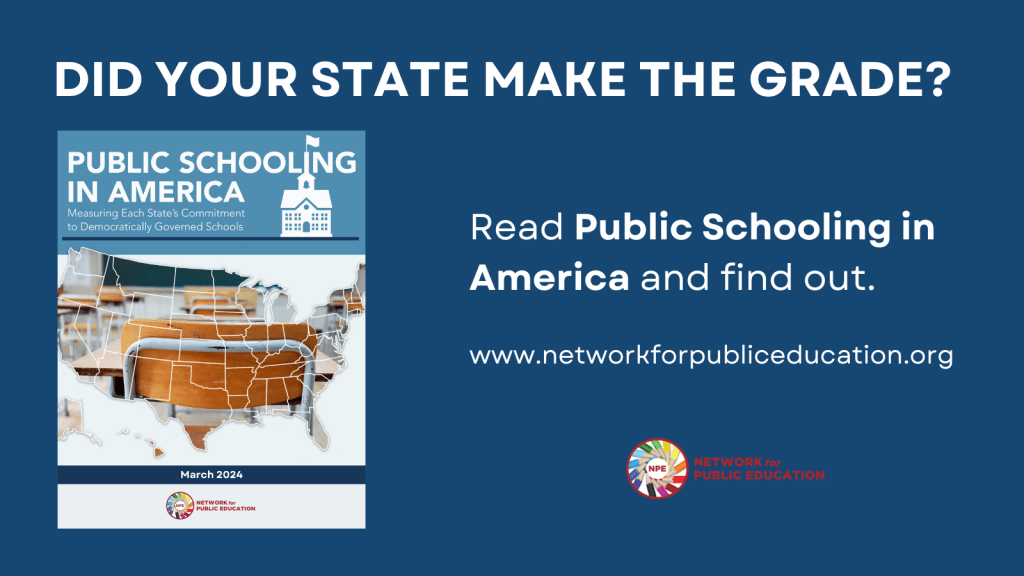
The Network for Public Education released a report card today grading the states on their support for democratically-governed public schools. Which states rank highest in supporting their public schools? Open the report to find out.

Measuring Each State’s Commitment to
Democratically Governed Schools

EXECUTIVE SUMMARY


Neighborhood public schools remain the first choice of the overwhelming majority of Ameri-
can families. Despite their popularity, schools, which are embedded in communities and gov-
erned by elected neighbors, have been the target of an unrelenting attack from the extreme
right. This has resulted in some state legislatures and governors defunding and castigating
public schools while funding alternative models of K-12 education.

This 2024 report, Public Schooling in America: Measuring Each State’s Commitment to
Democratically Governed Schools
, examines these trends, reporting on each state’s commit-
ment to supporting its public schools and the children who attend them.

What We Measure

We measure the extent of privatization in each state and whether charter and voucher laws
promote or discourage equity, responsibility, transparency, and accountability. We also rate
them on the strength of the guardrails they place on voucher and charter systems to protect
students and taxpayers from discrimination, corruption and fraud.

Recognizing that part of the anti-public school strategy is to defund public schools, we rate
states on how responsibly they finance their public schools through adequate and equitable
funding and by providing living wage salaries for teachers.

As the homeschool movement grows and becomes commercialized and publicly funded,
homeschooling laws deserve public scrutiny. Therefore, we rate states on laws that protect
children whose families homeschool.

Finally, we include a new expansive category, freedom to teach and learn, which rewards
states that reject book bans, and the use of unqualified teachers, intolerance of LGBTQ stu-
dents, corporal punishment, and other factors that impinge on teachers’ and students’ rights.

How does your state rank?

The Network for Public Education is the largest organization of volunteers and a tiny staff working every day to stop privatization of our public schools. The following is a message from our executive director, Carol Burris. Unlike the billionaire-funded advocacy groups for charters and vouchers, we need you! Contributions of any size are welcome!

What keeps NPE going are donors like you–friends of public education who are willing to make a one-time or monthly donation to invest in the continuance of our public schools.

We operate on a shoestring. But our reports, action alerts, advocacy, conferences, and webinars with Diane put us at the forefront of saving public education. Behind the scenes in fighting vouchers in Texas or making the case for Charter School Programs reform, NPE is the organization with a tiny budget but a mighty voice.

So please give to NPE this holiday season. You can make an online donation here, or, if you prefer to send a check, our address is:

The Network for Public Education, PO BOX 227, New York City, NY 10156.

At the recent conference of the Network for Public Education, one of the truly outstanding speakers was Dr. Marvin Dunn, professor emeritus at Florida International University. Dr. Dunn has written several books about Black history in Florida, most notably A History of Florida Through Black Eyes. I read that book and realized that Dr. Dunn was the right recipient for NPE’s annual “David Award,” which goes to someone who spoke out and acted on behalf of justice against the powerful, regardless of the personal risks.

Dr. Dunn is not only an author but an active preservationist of Black history. To make sure that the massacre at Rosewood, Florida, would never be forgotten, he bought five acres there and regularly brings students and teachers to learn about it. He tells the story of visiting his land with his son; a “neighbor” tried to run them over in his truck. Dr. Dunn filed a complaint with the police, and the man was convicted and sentenced to 10 years in prison. Dr. Dunn asked to have the sentence reduced, and it was dropped to only one year. The audience was impressed by his generosity of spirit. However, Dr. Dunn tweeted several weeks later that the now-released felon hung a toy skeleton where Dr. Dunn could see it. You don’t need to study Critical Race Theory to know that Racism lives.

I think you will agree that his remarks are highly inspiring.