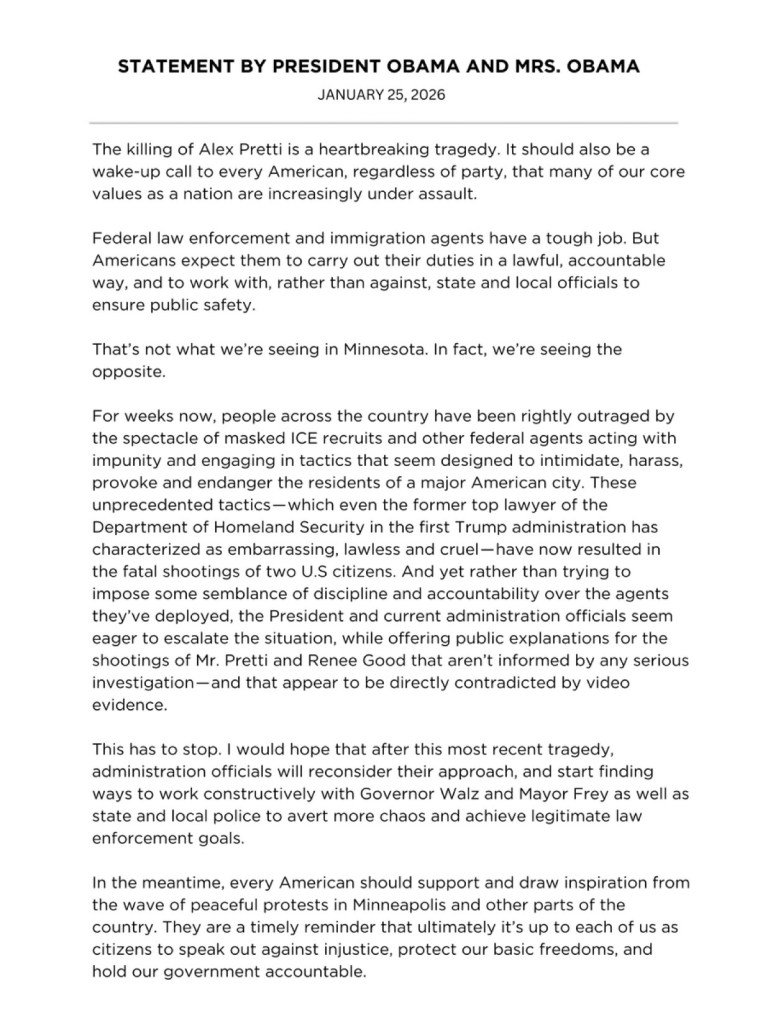
The deployment of ICE to detain and arrest undocumented immigrants threatens to become a war against U.S. citizens who object to ICE’s brutal tactics. We have all seen the videos of ICE agents smashing car windows, knocking men and women to the ground, grabbing women by their hair, pummeling people on the ground, operating in teams of 5 or 6 as they beat up those they choose.
The Fourth Amendment to the Constitution forbids ICE from entering homes. This article appeared on the blog CAFE, where seasoned prosecutors and law professors comment on matters of law and hold the federal government accountable.
No ICE Cannot Enter Your Home Without a Warrant — and Why Doing So Is Very Dangerous For All of Us
By Perry A. Carbone and Mimi Rocah
Dear Insider,
A leaked internal Immigration and Customs Enforcement (ICE) memo claims that ICE agents may enter people’s homes without a judicial warrant. That claim is wrong as a legal matter— and it threatens one of the most basic freedoms Americans have: the right to be safe in their own homes.
The memo—dated May 12, 2025 and signed by Acting Director Todd Lyons—was leaked by two whistleblowers and shared with Senator Richard Blumenthal. According to the whistleblowers, the memo was directed to all personnel but was distributed in a secretive manner to selected personnel.
We spent many years as federal prosecutors enforcing federal law – about 50 years between the two of us. We know firsthand the power of law enforcement authority and how important it is that it be exercised within constitutional limits, especially within the sacrosanct safety of a person’s home.
Our homes have special protection under the Constitution. The Fourth Amendment to the Constitution protects people from unreasonable government searches and seizures and explicitly names “houses” as protected spaces: “The right of the people to be secure in their … houses … against unreasonable searches and seizures, shall not be violated, and no Warrants shall issue, but upon probable cause….”
The Supreme Court has repeatedly made this protection crystal clear.
In Payton v. New York (1980), the Court held that police may not enter a home to make an arrest without a judicial warrant, unless there is an emergency or the resident consents, calling physical entry of the home “the chief evil against which the wording of the Fourth Amendment is directed.”
In Kyllo v. United States (2001), the Court reaffirmed that the home is a place where privacy protection is at its highest. Even using technology to detect heat patterns inside a home — without ever physically entering — violated the Fourth Amendment if it was done without a warrant.
In Florida v. Jardines (2013), the Court held that bringing a drug-sniffing dog to the front porch of a home to investigate constituted an unlawful “search” under the Fourth Amendment, if done without a search warrant.
If the Constitution forbids the government from using technology and animals to sense what happens inside a home, it certainly forbids crossing the threshold without judicial approval.
The whistleblower disclosure shows ICE claiming its agents may enter homes without judicial warrants because immigration enforcement is “civil.” But the Fourth Amendment does not contain a “civil enforcement” carveout. And the relevant Supreme Court’s cases do not turn on whether a matter is labeled “civil” or “criminal.” There is no “immigration exception” to the Constitution.
The ICE memo reportedly relies on Form I-205, a “warrant of removal/deportation” created within the executive branch and not signed by a judge. It authorizes officers to use “necessary and reasonable force” to enter certain residences to arrest people with final removal orders.
That is incompatible with the Fourth Amendment’s demand for judicial oversight. A judicial warrant is one that is issued by an individual who is ”neutral and detached” and can determine probable cause. An administrative warrant, by contrast, is issued by the government agency itself and so does not meet the Constitution and Court’s repeated requirement of being issued by someone “neutral” and “detached.” Federal agencies do not get to rewrite the Constitution through internal memos. Put simply, an administrative warrant is the government agency authorizing itself to enter a home — the constitutional equivalent of letting the fox write its own warrant to enter the henhouse.
This is not an immigration issue. It is a constitutional issue with consequences for all Americans. Yes, it will have huge implications for immigrants, who have long been advisednot to open their door to federal agents unless they have a warrant signed by a judge. But it will not end there. If ICE is permitted to enter homes without judicial warrants, the consequences will not stop with immigration enforcement. Other agencies will follow the same path — and they will do so using the same logic: that civil enforcement, public safety, or administrative necessity justifies bypassing judicial oversight.
One can easily imagine a parade of horribles:
- Tax enforcement: IRS agents entering homes to seize records or property based solely on internal agency warrants, without a judge ever reviewing probable cause.
- Health and safety enforcement:Public health officials entering private residences to conduct inspections or remove occupants during disease outbreaks without judicial authorization.
- Child welfare investigations: Social services entering homes to investigate allegations based only on agency paperwork, without court approval.
- Firearms regulation: Regulatory agents entering homes to inspect compliance with gun laws without judicial warrants.
- Local law enforcement: Police departments reclassifying certain arrests as “civil” or “administrative” to avoid the warrant requirement altogether.
Once the government can enter a home based on its own approval, the Fourth Amendment’s warrant requirement becomes optional — a procedural inconvenience rather than a constitutional command.
And that erosion won’t stop at homes. If agency-issued warrants suffice for entry, then agency-issued authorizations will soon suffice for searches of phones, computers, bank accounts, and digital records — all areas the Supreme Court has increasingly treated as deserving heightened constitutional protection.
The Fourth Amendment was written precisely to prevent this outcome: a system in which government officials authorize their own intrusions. Judicial warrants are not a technicality — they are the firewall between liberty and unchecked power. And when that firewall falls, it does not fall selectively. It falls for everyone.
The home is the heart of American liberty. The Fourth Amendment draws a bright line at the front door — and for good reason. This leaked ICE memo crosses that line. It is legally wrong. It is constitutionally dangerous. And it should concern everyone who values privacy, liberty, and the rule of law — regardless of their views on immigration.
Stay Informed,
Mimi & Perry
CAFE Contributor Mimi Rocah is the former District Attorney for Westchester County, and previously served as an Assistant U.S. Attorney and Division Chief for the Southern District of New York. She is currently an adjunct professor at Fordham School of Law.
Perry A. Carbone served as Chief of the White Plains Division at the U.S. Attorney’s Office for the Southern District of New York; he previously served as an Assistant U.S. Attorney in the District of New Jersey.


 Diane Ravitch's blog