Archives for category: Hoax

Forest Wilder writes in the Texas Monthly about a scheme hatched by charter operators and voucher zealots to launch private school vouchers, which have been stalled in the legislature for years. Vouchers were originally intended to allow white students to escape racially integrated school. Now they are falsely sold as a means of helping poor kids “escape failing schools,” but in fact they are almost always used to subsidize the private school tuition of affluent families.

The article shows how a charter chain—ResponsiveEd—is trying to sneak vouchers into the state. Responsive Ed was called out in Slate in 2014 for teaching creationism. Slate wrote: “Responsive Ed has a secular veneer and is funded by public money, but it has been connected from its inception to the creationist movement and to far-right fundamentalists who seek to undermine the separation of church and state.”

Today, ResponsiveEd has two charters in Texas which operate 91 different charter schools, including an online school. When Betsy DeVos was Secretary of Education, she gave ResponsiveEd a five-year grant for $40.8 million to expand. The CEO of ResponsiveEd is Board Chair of the Texas Charter School Association. State Commissioner Mike Morath approved 13 new campuses for the chain in 2022.

Wilder writes:

The proposal landed on Greg Bonewald’s desk like a pipe bomb. Bonewald, a soft-spoken career educator, had served as a teacher, coach, and principal in the fast-growing Hill Country town of Wimberley for fifteen years. In 2014, he took a bigger job as an assistant superintendent in Victoria, about two hours to the southeast. But he maintained an affection for Wimberley, and when its school board sought to bring him back as superintendent this year, he was thrilled. His honeymoon would be short.

In a document obtained by Texas Monthly, stamped “Confidential” and dated May 3—the day after Bonewald was named the sole finalist for the job—a Republican political operative and a politically connected charter-school executive laid out an explosive proposal for “Wimberly [sic] ISD.” (Out-of-towners frequently misspell “Wimberley,” much to the annoyance of locals.) Apparently, the plan had been in the works for months and had been vetted by the outgoing superintendent. But Bonewald said no one had bothered to mention it to him.

One of the authors of the plan was Aaron Harris, a Fort Worth–based GOP consultant who has made a name for himself by stoking—with scant evidence—fears of widespread voter fraud. In June, he cofounded a nonprofit called Texans for Education Rights Institute, along with Monty Bennett, a wealthy Dallas hotelier who dabbles in what he regards as education reform. The other author was Kalese Whitehurst, an executive with the charter school chain Responsive Education Solutions, based in Lewisville, a half hour north of Dallas.

Their confidential proposal went like this: Wimberley would partner with Harris and Bennett’s Texans for Education Rights Institute to create a charter school tentatively dubbed the Texas Achievement Campus. But “campus” was a misnomer, because there would be none. The school would exist only on paper. Texans for Education Rights would then work with ResponsiveEd, Whitehurst’s group, to place K–12 students from around the state into private schools of their choice at “no cost to their families.”

The scheme was complex but it pursued a simple goal: turning taxpayer dollars intended for public education into funds for private schools. The kids would be counted as Wimberley ISD students enrolled at the Achievement Campus, thus drawing significant money to the district. (In Texas, public schools receive funding based in large part on how many students attend school each day.) But the tax dollars their “attendance” brought to the district would be redirected to private institutions across the state.

The plan was backed not only by an out-of-town Republican operative and a charter-school chain with links to Governor Greg Abbott, but by a Wimberley-based right-wing provocateur who bills himself as a “systemic disruption consultant.” Texas education commissioner Mike Morath—an Abbott appointee—also seemed to support the deal.

Its proponents have called the scheme pioneering and innovative. Though the effort ultimately failed in Wimberley, one of its backers says he is shopping the plan around to other districts. Critics have raised all manner of alarms.

I’m not accusing anyone of laundering money, by the legal definition, but there sure are a lot of hands touching a lot of money in this,” said H.D. Chambers, the superintendent of Alief ISD, a district in the Houston area that serves 47,000 students. He also pointed to another, more sweeping, concern: “It’s a Trojan horse for vouchers.”

Please open the link and read the rest of the story.

Blogger-teacher Steven Singer lists five big lies about public schools that Republicans are pushing.

Be it noted that he leaves out a sixth big lie about public schools: some GOP nuts claim that public schools are putting litter boxes in classrooms for students who say they are cats. No one has identified a classroom where this has happened, but why should facts get in the way of propaganda?

Singer begins:

Critical race theory, pornographic school books, and other bogeymen haunt their platforms without any evidence that this stuff is a reality.

Doug Mastriano, the GOP nominee for Governor of Pennsylvania, actually promises to ban pole dancing in public schools.

Pole dancing!

“On day one, the sexualization of our kids, pole dancing, and all this other crap that’s going on will be forbidden in our schools,” he says.

Mr. Mastriano, I hate to tell you this, but the only school in the commonwealth where there was anything like what you describe was one of those charter schools you love so much. The Harambee Institute of Science and Technology Charter School in Philadelphia used to run an illegal nightclub in the cafeteria after dark.

But at authentic public schools with things like regulations and school boards – no. That just doesn’t happen here.

Maybe if your plan to waste taxpayer dollars on universal school vouchers goes through you’ll get your wish.

Singer goes on to list the following five lies:

1. Teaching boys to hate themselves.

2. Teaching kids to be gay.

3. Teaching kids to be trans.

Open the link to read about the other two.

They are all smears, lies, and propaganda.

In recent years, there has been a full-court press to persuade seniors to transfer from traditional Medicare to private, for-profit plans called “Medicare Advantage.” [MA]

MA plans include prescription coverage and lots of bells and whistles. But something is sacrificed to enable the plans to make a profit. What is sacrificed? Your preferred doctor may not be covered, and you may be denied coverage of some procedures.

Two progressive Congressmen—Ro Khanna and Mark Pocan—have introduced legislation to bar private for-profit plans from using the label “Medicare,” because it confuses seniors into thinking it’s a government plan, the one they paid into for many years. It’s not.

The New York Times wrote a scathing article about MA plans, calling them “cash monsters.”

By next year, half of Medicare beneficiaries will have a private Medicare Advantage plan. Most large insurers in the program have been accused in court of fraud.

The health system Kaiser Permanente called doctors in during lunch and after work and urged them to add additional illnesses to the medical records of patients they hadn’t seen in weeks. Doctors who found enough new diagnoses could earn bottles of Champagne, or a bonus in their paycheck.

Anthem, a large insurer now called Elevance Health, paid more to doctors who said their patients were sicker. And executives at UnitedHealth Group, the country’s largest insurer, told their workers to mine old medical records for more illnesses — and when they couldn’t find enough, sent them back to try again.

Each of the strategies — which were described by the Justice Department in lawsuits against the companies — led to diagnoses of serious diseases that might have never existed. But the diagnoses had a lucrative side effect: They let the insurers collect more money from the federal government’s Medicare Advantage program.

Medicare Advantage, a private-sector alternative to traditional Medicare, was designed by Congress two decades ago to encourage health insurers to find innovative ways to provide better care at lower cost. If trends hold, by next year, more than half of Medicare recipients will be in a private plan.

Medicare Advantage is on track to enroll most Medicare beneficiaries by next year….

But a New York Times review of dozens of fraud lawsuits, inspector general audits and investigations by watchdogs shows how major health insurers exploited the program to inflate their profits by billions of dollars.

The government pays Medicare Advantage insurers a set amount for each person who enrolls, with higher rates for sicker patients. And the insurers, among the largest and most prosperous American companies, have developed elaborate systems to make their patients appear as sick as possible, often without providing additional treatment, according to the lawsuits.

As a result, a program devised to help lower health care spending has instead become substantially more costly than the traditional government program it was meant to improve.

Eight of the 10 biggest Medicare Advantage insurers — representing more than two-thirds of the market — have submitted inflated bills, according to the federal audits. And four of the five largest players — UnitedHealth, Humana, Elevance and Kaiser — have faced federal lawsuits alleging that efforts to overdiagnose their customers crossed the line into fraud.

The fifth company, CVS Health, which owns Aetna, told investors its practices were being investigated by the Department of Justice.

Many of the accusations reflect missing documentation rather than any willful attempt to inflate diagnoses, said Mark Hamelburg, an executive at AHIP, an industry trade group. “Professionals can look at the same medical record in different ways,” he said.

The government now spends nearly as much on Medicare Advantage’s 29 million beneficiaries as on the Army and Navycombined. It’s enough money that even a small increase in the average patient’s bill adds up: The additional diagnoses led to $12 billion in overpayments in 2020, according to an estimate from the group that advises Medicare on payment policies — enough to cover hearing and vision care for every American over 65.

Another estimate, from a former top government health official, suggested the overpayments in 2020 were double that, more than $25 billion.

The increased privatization has come as Medicare’s finances have been strained by the aging of baby boomers. But for insurers that already dominate health care for workers, the program is strikingly lucrative: A study from the Kaiser Family Foundation, a research group unaffiliated with the insurer Kaiser, found the companies typically earn twice as much gross profit from their Medicare Advantage plans as from other types of insurance.

For people choosing between traditional Medicare and Medicare Advantage, there are trade-offs. Medicare Advantage plans can limit patients’ choice of doctors, and sometimes require jumping through more hoops before getting certain types of expensive care.

But they often have lower premiums or perks like dental benefits — extras that draw beneficiaries to the programs. The more the plans are overpaid by Medicare, the more generous to customers they can afford to be.

“Medicare Advantage is an important option for America’s seniors, but as Medicare Advantage adds more patients and spends billions of dollars of taxpayer money, aggressive oversight is needed,” said Senator Charles Grassley of Iowa, who has investigated the industry. The efforts to make patients look sicker and other abuses of the program have “resulted in billions of dollars in improper payments,” he said.

Many of the fraud lawsuits were initially brought by former employees under a federal whistle-blower law that allows them to get a percentage of any money repaid to the government if their suits prevail. But most have been joined by the Justice Department, a step the government takes only if it believes the fraud allegations have merit. Last year, the department’s civil division listed Medicare Advantage as one of its top areas of fraud recovery….

In contrast, regulators overseeing the plans at the Centers for Medicare and Medicaid Services, or C.M.S., have been less aggressive, even as the overpayments have been described in inspector general investigations, academic research, Government Accountability Office studies, MedPAC reports and numerous newsarticles, over the course of four presidential administrations.

Congress gave the agency the power to reduce the insurers’ rates in response to evidence of systematic overbilling, but C.M.S. has never chosen to do so. A regulation proposed in the Trump administration to force the plans to refund the government for more of the incorrect payments has not been finalized four years later. Several top officials have swapped jobs between the industry and the agency….

The popularity of Medicare Advantage plans has helped them avoid legislative reforms. The plans have become popular in urban areas, and have been increasingly embraced by Democrats as well as Republicans. Nearly 80 percent of U.S. House members signed a letter this year saying they were “ready to protect the program from policies that would undermine” its stability.

“You have a powerful insurance lobby, and their lobbyists have built strong support for this in Congress,” said Representative Lloyd Doggett, a Texas Democrat who chairs the House Ways and Means Health subcommittee.

Some critics say the lack of oversight has encouraged the industry to compete over who can most effectively game the system rather than who can provide the best care.

“Even when they’re playing the game legally, we are lining the pockets of very wealthy corporations that are not improving patient care,” said Dr. Donald Berwick, a C.M.S. administrator under the Obama administration, who recently published a series of blog posts on the industry. “When you skate to the edge of the ice, sometimes you’re going to fall in….”

Almost immediately, companies saw ways to exploit that system. The traditional Medicare program provided no financial incentive to doctors to document every diagnosis, so many records were incomplete. Under the new program, insurers began rigorously documenting all of a patient’s health conditions — say depression, or a long-ago stroke — even when they had nothing to do with the patient’s current medical care….

According to the lawsuit, some patients were diagnosed with cancer and heart disease. Nurses were told to especially look for patients with a history of diabetes because it was not “curable,” even if the patient now had normal lab findings or had undergone surgery to treat the condition.

The company declined to comment. “We will vigorously defend our Medicare Advantage business against these allegations,” Cigna said in an earlier statement regarding the lawsuit.

Adding the code for a single diagnosis could yield a substantial payoff. In a 2020 lawsuit, the government said Anthem instructed programmers to scour patient charts for “revenue-generating” codes. One patient was diagnosed with bipolar disorder, although no other doctor reported the condition, and Anthem received an additional $2,693.27, the lawsuit said. Another patient was said to have been coded for “active lung cancer,” despite no evidence of the disease in other records; Anthem was paid an additional $7,080.74. The case is continuing.

The most common allegation against the companies was that they did not correct potentially invalid diagnoses after becoming aware of them. At Anthem, for example, the Justice Department said “thousands” of inaccurate diagnoses were not deleted. According to the lawsuit, a finance executive calculated that eliminating the inaccurate diagnoses would reduce the company’s 2017 earnings from reviewing medical charts by $86 million, or 72 percent….

Kaiser, which both runs a health plan and provides medical care, is often seen as a model system. But its control over providers gave it additional leverage to demand additional diagnoses from the doctors themselves, according to the lawsuit.

“The cash monster was insatiable,” said Dr. James Taylor, a former coding expert at Kaiser who is one of 10 whistle-blowers to accuse the organization of fraud.

Last year, the inspector general’s office noted that one company “stood out” for collecting 40 percent of all Medicare Advantage’s payments from chart reviews and home assessments despite serving only 22 percent of the program’s beneficiaries. It recommended Medicare pay extra attention to the company, which it did not name, but the enrollment figure matched UnitedHealth’s.

A civil trial accusing UnitedHealth of fraudulent overbilling is scheduled for next year. The company’s internal audits found numerous mistakes, according to the lawsuit, which was joined by the Justice Department. Some doctors diagnosed problems like drug and alcohol dependence or severe malnutrition at three times the national rate. But UnitedHealth declined to investigate those patterns, according to the suit…

“Medicare Advantage overpayments are a political third rail,” said Dr. Richard Gilfillan, a former hospital and insurance executive and a former top regulator at Medicare, in an email. “The big health care plans know it’s wrong, and they know how to fix it, but they’re making too much money to stop. Their C.E.O.s should come to the table with Medicare as they did for the Affordable Care Act, end the coding frenzy, and let providers focus on better care, not more dollars for plans.”


Maurice Cunningham is the nation’s leading expert on “Dark Money” in education. This is money given to organizations and candidates by anonymous donors. When the donors are occasionally revealed, they are typically billionaires who want to destroy public schools and teachers’ unions.

He recently wrote this post, which I excerpt here, about the “management chaos” at the so-called National Parents Union. As he points out, the two leaders of NPU are a married couple.

He writes:

That must have been some “convening” National Parents Union held in September because by October two of NPU’s five board members had disappeared, as had four of the nine individuals on their September 17 “Our Leadership” page and all—ALL—of NPU’s “delegates.” NPU disappears more people than the entire run of The Sopranos. NPU,—not national, not about parents, not a union—is routinely mismanaged, but it seems to be in more chaos than usual.

Board of Directors

Let’s start with the board of directors, a spin-the-bottle operation if there ever was one. Here are the board members identified on the NPU website on September 17 and October 12, 2022:Sept 17, 2022 Board of DirectorsOct 12, 2022 boardPeter CunninghamPeter CunninghamArthur SorianoVincent SlaughterVincent SlaughterMaria Del Carmen Parro CanoDr. Paul BloombergDr. Paul BloombergAnashay Wright

It’s worse than it looks. Ms. Wright was added as a board member on July 28, 2022 along with Shirley Irizarry, On October 3, after two months on the board, Ms. Irizarry was apparently dropped from the board and hired for a staff position as National Organizing Director West Region (according to a Twitter post; she is not on the October 12 website). Mr. Soriano, Mr. Slaughter, Ms. Del Carmen Parro Cano, Dr. Paul Bloomberg, and Vivett Dukes were all added to the board on July 28, 2021. Now Mr. Soriano, Ms. Del Carmen Parro Cano, and Vivett Dukes are all gone. That’s peculiar since Mr. Soriano is supposed to act as president until 2026.

There were three original board members. Mr. Cunningham, Bibb Hubbard (connected to the Gates Foundation), Gerard Robinson (a possible proxy for Charles Koch), and Dan Weisberg. Except for Mr. Cunningham they’re all gone, most within a year of NPU’s launch.

Then there’s the fact that NPU has two boards of directors, the one on the website for public consumption and the one on file with the Massachusetts Secretary of State’s Corporations Division, where NPU is incorporated. Currently NPU lists a board with the Secretary that consists of Mr. Cunningham, Mr. Soriano, Mr. Slaughter, Ms. Del Carmen Parro Cano, Dr. Paul Bloomberg—and Keri Rodrigues and Tim Langan, also identified with the Secretary as president and treasurer, respectively. So far as is known neither Ms. Rodrigues nor Mr. Langan have ever appeared on the website as directors. On the original corporate filings the board was listed as Ms. Rodrigues, Mr. Langan, and Alma Marquez. Ms. Marquez was also on the website as a co-founder and elected treasurer but NPU listed Jennifer Rego as treasurer with the commonwealth of Massachusetts. Ms. Rego disappeared. Ms. Marquez disappeared and Mr. Langan is treasurer. Mr. Langan and Ms. Rodrigues are married. Their compensation from NPU when combined with another Walton family operation named Massachusetts Parents United was $626,777 in 2020 which appears to be wildly out of line with industry standards. But when you’ve replaced the treasurer with . . .

GOP-controlled West Virginia enacted a voucher program that allots $4,300 to attend private schools. A Circuit judge enjoined the program, and it is now being argued before the State Supreme Court.

Critics point out that $4,300 is insufficient to pay for any private school, and the money will be used to underwrite the tuition of affluent students. The poor and students with disabilities will be left behind in underfunded public schools.

The vouchers, cynically called HOPE scholarships, violate the state constitution’s promise of a free public education for every child.

Note: if you open the link, which I hope you will, read the article in one sitting. After one look, it goes behind a pay wall.

Alex Jones and his companies Infowars and Free Speech Systems were ordered by a jury in Connecticut to pay nearly $1 billion to some of the parents of victims murdered at the Sandy Hook Elementary School in Newtown, Connecticut, as well as an FBI agent.

Jones falsely claimed that the massacre of children, teachers, and the principal at the school was faked and that the victims were “crisis actors.” He said repeatedly that the purpose of the hoax was to create political pressure for gun control.

Parents and relatives of those who were murdered were harassed and received death threats.

The money will not replace those they lost. The,parents will never hold their babies again. But Jones’ cruel campaign to deny that the massacre ever happened deserved punishment.

This is the second of three trials. Jones has no defense. He maligned the families to make money. Hopefully he will be bankrupted for his sins.

In Arizona, Save Our Schools Arizona and other parent groups are gathering signatures to force a referendum on the legislature’s plan to unleash a universal voucher plan. Parents and teachers overwhelmingly defeated a voucher proposal in 2018, but the salaries Koch-sponsored forces are pushing an even bigger voucher plan than before. In their proposal, every student in the state would be eligible for a voucher.

The Grand Canyon Institute has assembled the facts about the proposal. The greatest beneficiaries would be families whose children already attend private schools and parents affluent enough to pay for the cost of private high school.

Max Goshert, Assistant Research Director of the Grand Canyon Institute, writes:

Phoenix, Arizona – 2022 was a blockbuster year for Arizona policy. Along with a record budget and a billion-dollar investment in water, Arizona passed the largest private school scholarship program in the country. Previously, only families who met certain conditions, such as having a student with a disability, a parent who served in the military, a student who attended a D or F school, a student who lives on a Native American reservation, or a sibling of one of these students, could participate in the Empowerment Scholarship Account (ESA) program.

HB 2853 establishes universal eligibility for the ESA program, meaning that any student attending grades K-12 can receive a scholarship, which is estimated to average $6,966 in FY23 (certain circumstances, like disability status, can change the scholarship size). Unlike the 2017 expansion, which capped participation at 30,000 recipients, there is no limit on the number of students who can participate in the program.

Naturally, the polemic public debate resulting from the seismic shift in education has spawned a gamut of predictions on what the impact of this expansion will be. In an attempt to foster conversation that is grounded in fact, we address several questions about the ESA program by diving into the data.

How will the ESA expansion impact academic outcomes?

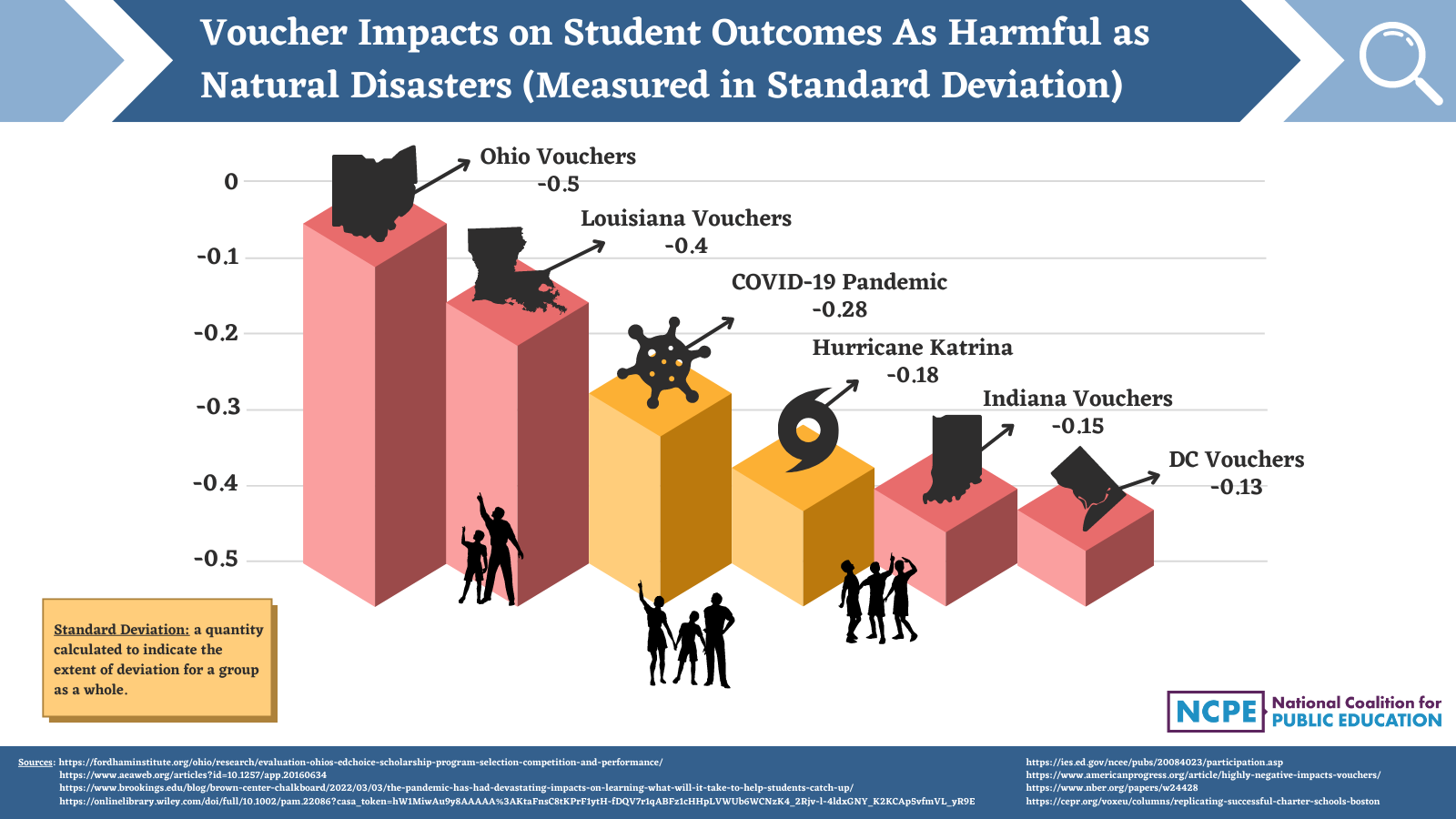
As with any policy that impacts education, the most important feature of the ESA expansion is how it impacts the quality of education that students receive. While the literature on the academic outcomes of participation in voucher programs is mixed, with some research reporting significant positive effects, several recent studies have found negative impacts on student achievement, especially in math, for statewide voucher programs in Ohio, Indiana, and Louisiana (Mills and Wolf, p.8). This is likely due to the rapid expansion of these voucher programs from smaller populations to the entire state, overwhelming existing private school infrastructure (p.43).

Arizona’s expansion is the largest in the country, with the Joint Legislative Budget Committee (JLBC) estimating that 36,078 public school students will begin participating in the ESA program. While some families may choose to homeschool given their new ESA eligibility, most will likely elect to attend a private school. Given that there are currently 59,171 private school students, Arizona private schools will see a 39% rise in demand, a tremendous increase in a short period of time that threatens to overwhelm existing facilities. Consequentially, Arizona will likely see a similar decline in academic outcomes due to the inadequate supply of private schools.

What are the accountability requirements for ESAs?

While ESA participants are required to use a portion of the program funding in reading, grammar, mathematics, social studies, and science, there are no minimum standards of academic achievement, such as reading or math proficiency. Private schools are not required to be accountable for the academic outcomes of their students. This contrasts sharply with Louisiana’s voucher program, where private schools must apply to become voucher recipients and undergo site visits, financial audits, and health and safety assessments from the Louisiana Board of Elementary and Secondary Education (Abdulkadiroglu et al, p. 4). Private schools must maintain eligibility by administering annual state achievement tests to voucher recipients along with financial audits.

Who benefits the most from ESA expansion?

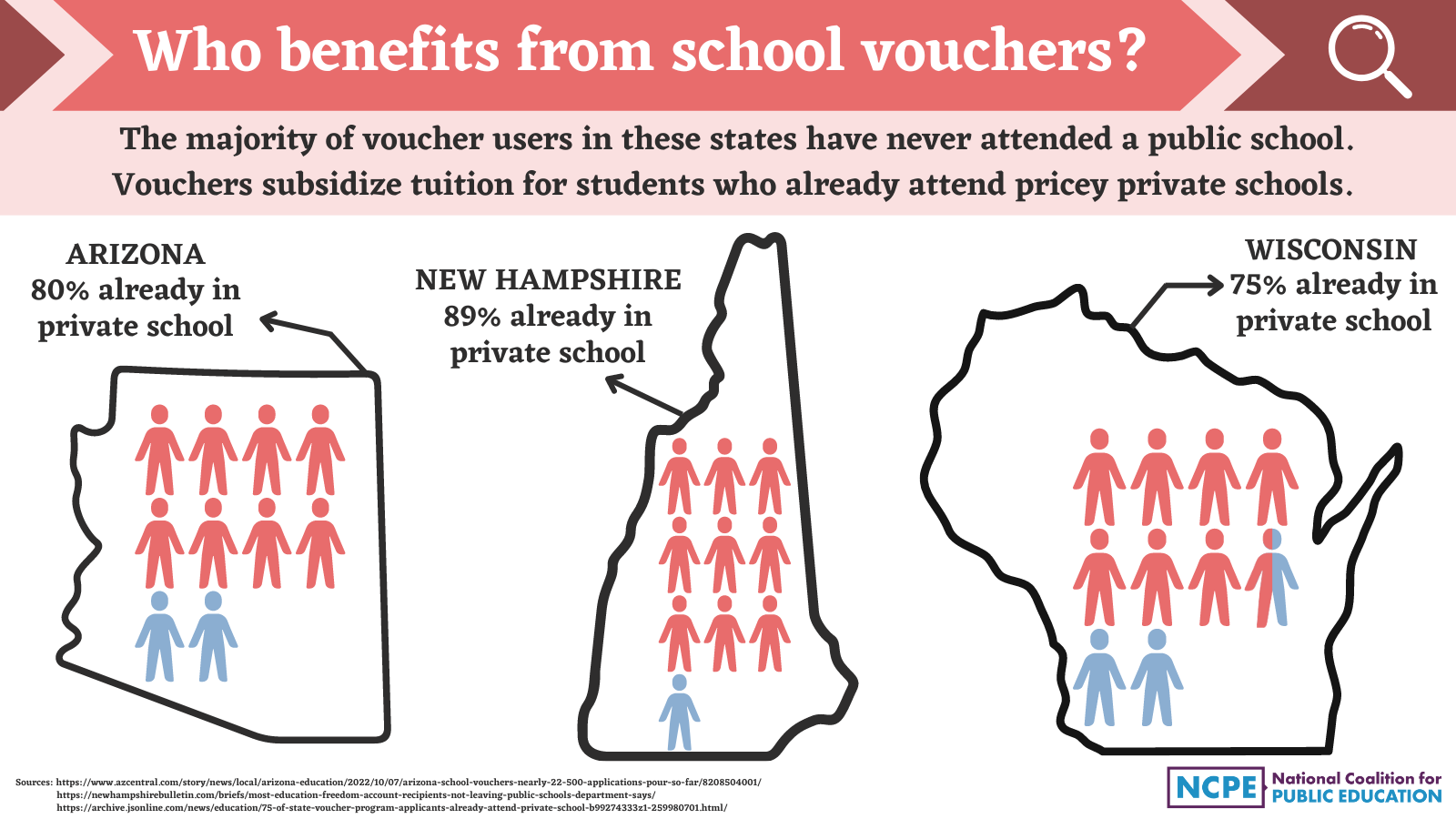
Of the 9,710 applicants to the ESA program for SY2023, approximately 77% do not have a history of attending an Arizona public school. Effectively, these ESAs serve not to enable those attending public school to attend private school, but as a public subsidy for families that already had the means to pay for private schools or homeschooling. This is in line with a 2018 study by the Grand Canyon Institute which found that, while enrollment in the private school sector has been relatively flat, private school subsidies from Arizona’s General Fund have increased 50-fold from $3 million in SY2000 to $141 million in SY2016. As with other private school subsidies, the beneficiaries are largely those who are already attending private schools, not those attending public schools who would otherwise attend privates.

What are the limitations on ESA expenses?

ESA funding can be used to pay private school tuition, curriculum, homeschooling, and other educational expenses. The Arizona Department of Education (ADE) maintains a comprehensive list of approved spending categories and ESA allowable items. However, because state statute on allowable items is broad, parents are able to use ESA dollars for expenses with questionable educational benefit. Uptown Jungle Peoria, an indoor playground, recently attracted attention when they advertised that they would accept ESA money, an expenditure that ADE confirmed was appropriate. Parents may also use ESA dollars to purchase Lego kits, lawn darts, and croquet sets. ADE staff oversee ESA expenditures to ensure that they fall under program guidelines, yet allowable purchases that are more recreational may come at the expense of academic experience.

How much will the ESA expansion cost taxpayers?

Initial estimates from the JLBC are that taxpayers will spend $33 million in FY23, $65 million in FY24, and $125 million in FY25 from empowerment scholarships. With 77% of the 9,710 enrollees this school year coming from outside of the public system, the cost of these students will likely be around $52 million, very close to the JLBC estimate. As participation in the ESA program proliferates due to public awareness in the coming years, the burden of the program on the General Fund will rise substantially.

How will the ESA expansion impact school choice?

Arizona currently has 2,391 public schools and 448 private schools. The estimated award for FY23 of $6,966 covers the entire average cost of private elementary schools ($6,710), but only about a third of the cost of private secondary schools ($18,590). Consequentially, families will have to pay around $12,000 per student out of their own pocket once they reach high school, a financial barrier that will be too burdensome for those who rely on ESAs to pay for private school tuition. The families that experience the greatest expansion of school choice are those who are wealthy enough to pay the difference in tuition at the secondary education level.

The impact of school choice by the ESA expansion is further limited by the lack of public accountability of private schools, creating a vacuum of information on academic outcomes. With little means to determine how well private schools educate their students, parents must rely more on marketing and word-of-mouth, impairing their ability to make well-informed decisions for school choice.

HB 2853 is scheduled to go into effect on September 24 however that date could be put on hold if an initiative successfully gathers sufficient signatures to refer the issue to the November 2024 ballot.

For more information, contact:
Max Goshert, Assistant Research Director
mgoshert@azgci.org, 602.595.1025, Ext. 12

The Grand Canyon Institute (GCI) is a nonpartisan, nonprofit organization dedicated to informing and improving public policy in Arizona through evidence-based, independent, objective, nonpartisan research. GCI makes a good faith effort to ensure that findings are reliable, accurate, and based on reputable sources. While publications reflect the view of the institute, they may not reflect the view of individual members of the board.

A new study confirms what many critics of the Broad Foundation’s Superintendents’ Academy long suspected. Despite Eli Broad’s boasting, his program had no positive effects on student performance, but the “graduates” expanded privatization by charter schools.

Educational Evaluation and Policy Analysis

Month 202X, Vol. 8, No. 1, pp. 1 –27

DOI: 10.3102/01623737221113575

https://doi.org/10.3102/016237372211135


Public-Sector Leadership and Philanthropy: The Case of Broad Superintendents

Thomas S. Dee

Stanford University

Susanna Loeb

Brown University

Ying Shi

Syracuse University


Using a unique panel data set on the 300 larg-est school districts, we examined the impact of Broad superintendents on a broad array of dis-trict outcomes. Our results indicate that the hir-ing of a Broad superintendent had no clear effects on outcomes such as student completion rates, enrollment, the closure of traditional public schools, and per-pupil spending on instruction or on support services. However, one exception to this pattern is particularly notable. We do find evidence that the hiring of a Broad superinten-dent results in a growing charter school sector. Specifically, we find that the hiring of Broad superintendents is associated with a trend toward increased charter school enrollment and a growth in the number of charter schools that extends beyond the short tenure of the typical Broad trainee.

We view the overall implications of these findings as nuanced. On the one hand, this Broad Foundation initiative was successful in placing new leaders with distinctive characteristics and training in a substantial number of U.S. school districts. Yet, we also find that these leaders had unusually short tenures and no clear effects on a variety of district outcomes.

Tom Ultican is one of the very best chroniclers of the “Destroy Public Education” movement. He was thrilled to discover a new book that explains the origins of the attack on public schools and calls out its founding figures. Lily Geismar’s Left Behind is a book you should read and share. It helps explain how Democrats got on board with policies that conservative Republicans like Charles Koch, the Waltons, and Betsy DeVos loved. This bipartisan agreement that public schools needed to be reinvented and disrupted brought havoc to the schools, demoralized teachers, and glorified flawed standardized tests, making them the goal of schooling.

Ultican writes:

Lily Geismer has performed a great service to America. The Claremont McKenna College associate professor of history has documented the neoliberal takeover of the Democratic Party in the 1980’s and 1990’s. In her book, Left Behind: The Democrats Failed Attempt to Solve Inequalityshe demonstrates how Bill Clinton “ultimately did more to sell free-market thinking than even Friedman and his acolytes.” (Left Behind Page 13)

When in the 1970’s, Gary Hart, Bill Bradley, Michael Dukakis, Al Gore, Paul Tsongas, and Tim Wirth arrived on the scene in Washington DC they were dubbed “Watergate Babies.” By the 1980’s Tip O’Neill’s aid Chris Mathews labeled them “Atari Democrats” an illusion to the popular video game company because of their relentless hi-tech focus. Geismer reports.

“Journalist Charles Peters averred that ‘neoliberal’ was a better descriptor. Peters meant it not as a pejorative but as a positive. … Neoliberals, he observed, ‘still believe in liberty and justice and a fair chance for all, in mercy for the afflicted and help for the down and out,’ but ‘no longer automatically favor unions and big government.’” (Left Behind Pages 17-18) [Emphasis added]

Democrats in search of a “third way” formed the Democratic Leadership Council to formulate policies that moved them away from unions, “big government,” and traditional liberalism.

Historian Arthur Schlesinger labeled the DLC “a quasi-Reaganite formation” and accused them of “worshiping at the shrine of the free market.”

Union pollster Victor Fingerhut called them “crypto-Republicans.”

Douglas Wilder a black Virginia politician criticized their “demeaning appeal to Southern white males.”

Others called them the “conservative white caucus” or the “southern white boys’ caucus.”

Jesse Jackson said its members “didn’t march in the ‘60s and won’t stand up in the ‘80s.” (Left Behind Pages 46-47)

In 1989, From convinced Bill Clinton to become the chairman of the DLC. That same year the DLC founded the Progressive Policy Institute to be their think tank competing with the Heritage Foundation and the CATO Institute. Today, it still spreads the neoliberal gospel.

This is an important book that explains how the Democratic Party lost its way.

A 33-year-old woman insinuated herself into the inner circle at Mar-A-Lago, posing as a member of the famed Rothschild family. She used fake identity papers. She played golf with Trump and Lindsay Graham. At the least, the story shows how lax was security at Trump’s resort. At worst, why was she there?

For a time, Anna de Rothschild boasted of her family roots to the European banking dynasty, donning designer clothes, a Rolex watch, and driving a $170,000 black Mercedes-Benz SUV.

She talked about developing a sprawling luxury housing project on Emerald Bay in the Bahamas, a high-rise hotel in Monaco, and a Formula One race track in Miami, say people who knew her.

A pivotal moment for the woman who was fluent in several languages took place last year when she was invited to Mar-a-Lago, where she mingled with former President Donald Trump’s supporters and showed up the next day for a golf outing with Mr. Trump and Sen. Lindsey Graham among other political luminaries….

A year before the FBI’s spectacular raid of the former president’s seaside home, the woman whose real name is Inna Yashchyshyn, a Russian-speaking immigrant from Ukraine, made several trips into the estate posing as a member of the famous family while making inroads with some of the former president’s key supporters.

The ability of Ms. Yashchyshyn — the daughter of an Illinois truck driver — to bypass the security at Mr. Trump’s club demonstrates the ease with which someone with a fake identity and shadowy background can get into a facility that’s one of America’s power centers and the epicenter of Republican Party politics.

Why was she there? Who paid for her car and clothing? How did she get a fake passport?