Archives for category: Higher Education

I spent this past weekend at my sixty-fifth reunion at Wellesley College. Since I graduated in 1960, I have never missed one. Part of my faithfulness is grounded in nostalgia, in a chance to relive a wonderful part of my life. The four years at Wellesley were transformative, and today my closest friends are classmates.

The high point of the weekend is the parade of alumnae on the last day. The youngest cohort goes first, marching about 3/4 of a mile from one end of the campus to the center, called Alumnae Hall. As each group reaches its destination, it stops and lines the road. Then along comes the next group of graduates, five years older. Eventually the road is lined with alumnae from different cohorts, with the oldest ones marching last. That was my group, about 50 women in their mid-80s. The group behind us was the class of 1955, mostly 92 years old, riding in antique Fords, Model A.

1931 Model A Ford
1931 Model A Ford
1931 Model A Ford
1931 Model A Ford

Since we were the last grads standing, we marched past all the younger groups, and they cheered us vigorously, while we applauded them.

What was striking was to see the demographic changes over time. Our class was all white, though we did have a few Asian students. We did have one Puerto Rican in our class; her father was the governor of the island.

The classes of 1965 and 1970 had a few nonwhite faces.

Starting with the graduates of 1975, the numbers of African American, Hispanic, and Asian students noticeably increased. Every class from that point was markedly diverse.

I have to say it filled me with pride to see how my Alma Mater had changed.

An example: when I arrived at our lodgings, there were students to help us settle in. A beautiful and vibrant young woman brought my luggage to the room. I asked her where she was from. “Rwanda,” she said. “Do you like Wellesley?” She replied, “I love it!” She is majoring in biochemistry and plans to be a medical doctor and to return to Rwanda. Again, I was proud of how my college was changing the world for the better.

But there is another personal note that I wanted to share with you.

In late February, I went for my annual mammogram. The test spotted an anomaly. Several mammograms and a sonogram later, the doctor told me I had breast cancer. In April, I had surgery and the cancer was removed. But the surgeon reported that she didn’t get it all, so I had a second surgery. The pathologist decided that it was all out. None of it was painful.

But that’s not the end of the story. I start radiation on June 2, which will be five treatments in five days. Then a daily pill, all for the purpose of ensuring that the cancer doesn’t return.

I am not worried or frightened. I’m taking it all a day at a time, knowing that my case was caught early and that I have excellent doctors.

Frankly, I am truly worried about my beloved dog Mitzi. She was diagnosed with cancer in 2023, we took her to an oncologist, he put her on a drug that worked, and in June 2024, he declared her cancer-free. But a few weeks ago, we noticed that something bad was happening to her skull. The oncologist said she apparently has a trigeminal nerve sheath tumor. Her head, on the right side, is noticeably recessed. That is, it’s caved in above her eye.

I am much more worried about Mitzi than about myself. I will be fine. She won’t be. There is no treatment for her medical problem. So we intend to love her, spoil her, make every day a good day for her.

I love this sweet dog
When Mitzi met Martha Stewart in Greenport. Mitzi was unimpressed.
A beauty

William Kristol was a leading figure in the conservative movement. His father Irving Kristol was renowned as the godfather of neoconservatism. Bill was the editor of the Weekly Standard for many years. But because he is a principled conservative, he loathes what Trump is doing to our nation. He writes at The Bulwark, my favorite Never-Trump blog.

What’s happening is not normal, he writes:

If the Trump administration’s sudden assault on thousands of foreign students legally studying at Harvard seems unprecedented, it’s because it is. If the abrupt abrogation of temporary protected status for hundreds of thousands of Venezuelans legally living and working in the United States seems unprecedented, it’s because it is. If the sudden arrests and deportations of law-abiding immigrants checking in as ordered at government offices seems unprecedented, it’s because it is. If the deportations of other immigrants without anything like due process and basically in defiance of court orders to prisons in third countries seems unprecedented, it’s because it is.

And if it all seems utterly stupid and terribly cruel and amazingly damaging to this country, it’s because it is.

But it turns out nativism is one hell of a drug. The Trump administration has ingested it in a big way, and it’s driving its dealers and users in the administration into a fanatical frenzy of destructive activity. And the Republican party and much of Conservatism Inc.—and too much of the country as a whole—is just watching it happen.

The United States has many problems. No one seriously thinks that Harvard’s certification to participate in the Student and Exchange Visitor Program is one of them. And the Department of Homeland Security’s announcement of the action against Harvard makes clear this isn’t just about Harvard: “Let this serve as a warning to all universities and academic institutions across the country.” Are our other institutions of higher education suffering from their ability to attract and enroll students from abroad, if they chose to do so? Are the rest of us?

No. And to the degree there are some discrete problems, nothing justifies this kind of action against Harvard. As Andrea Flores, a former DHS official, told the New York Times, “D.H.S. has never tried to reshape the student body of a university by revoking access to its vetting systems, and it is unique to target one institution over hundreds that it certifies every year.”

Similarly, what’s the justification for the Trump administration’s unprecedented sudden and early abrogation of temporary protected status for 350,000 Venezuelans who fled tyranny and are now living peacefully and working productively in this country? There is no broad unhappiness at their presence, no serious case that they are causing more harm than doing good. Nor for that matter is there a real argument that the presence of 20,000 Haitians living and working in Springfield, Ohio, is a problem that required first lies to denigrate them and now attempts to deport them.

And this week, the nominee to head U.S. Citizenship and Immigration Services said the Trump administration intends to end the well-established Optional Practical Training Program, which is the single largest channel for highly skilled immigrants to stay and work in the United States after finishing their education here. A study by a leading immigration scholar, Michael Clemens of George Mason University, finds that slashing that program would cause permanent losses to U.S. innovation, productivity, economic growth, and even job opportunities for native workers.

But here we are, with an administration where fantasy trumps reality, ideology trumps evidence, and demagoguery trumps decency. As the economist Dani Rodrik puts it, “Three things made the US a rich and powerful nation: the rule of law, its science & innovation system, and openness to foreign talent. Remarkable how Trump has taken a sledgehammer to all three. No enemy of this country could do more.”

Foreigners studying and working here are not damaging the United States. A virulently nativist administration is what’s damaging the United States. It’s doing so in ways from which it will be difficult to recover. Just as important, it’s doing so in ways that will be a permanent stain on this nation’s history.

The Trump administration upped the stakes in its vindictive campaign against Harvard University. It has canceled Harvard’s enrollment of international students.

Harvard refused to cave to the Trump administration’s demands to monitor its curriculum and its admissions and hiring policies. In response, the administration has suspended billions of federal dollars for medical and scientific research.

The New York Times reported:

The Trump administration on Thursday halted Harvard University’s ability to enroll international students, taking aim at a crucial funding source for the nation’s oldest and wealthiest college in a major escalation in the administration’s efforts to pressure the elite school to fall in line with the president’s agenda.

The administration notified Harvard about the decision after a back-and-forth in recent days over the legality of a sprawling records request as part of the Department of Homeland Security’s investigation, according to three people with knowledge of the negotiations. The people spoke on the condition of anonymity because they were not authorized to discuss the matter publicly.

The latest move is likely to prompt a second legal challenge from Harvard, according to one person familiar with the school’s thinking who insisted on anonymity to discuss private deliberations. The university sued the administration last month over the government’s attempt to impose changes to its curriculum, admissions policies and hiring practices.

“I am writing to inform you that effective immediately, Harvard University’s Student and Exchange Visitor Program certification is revoked,” according to a letter sent to the university by Kristi Noem, the homeland security secretary. A copy of the letter was obtained by The New York Times.

About 6,800 international students attended Harvard this year, or roughly 27 percent of the student body, according to university enrollment data. That is up from 19.7 percent in 2010.

The move is likely to have a significant effect on the university’s bottom line…

In a news release confirming the administration’s action, the Department of Homeland Security sent a stark message to Harvard’s international students: “This means Harvard can no longer enroll foreign students, and existing foreign students must transfer or lose their legal status.”

This message came from a Cabinet member who was asked in a hearing to define “habeas corpus,” and she said it meant that the President can deport anyone he wants to.

This action is a demonstration of Presidential tyranny. It should be swiftly reversed by the courts.

The Trump administration is determined to punish Harvard University for defiance of its efforts to take control of Harvard’s curriculum, admissions, and faculty hiring policies. Having already suspended $2.2 billion in research grants, the Trump administration expanded its attack on Harvard.

This level of petty vengefulness is unprecedented. Trump is turning his wrath upon Harvard and weaponizing the entire federal government to force the nation’s most prestigious institution of higher education to surrender.

The headline of the story: “A Bloodbath.”

Chris Serres at the Boston Globe reported this story:

In yet another escalation of its fight against higher education, the Trump administration has moved to terminate scores of research grants at Harvard University and its medical school, imperiling scores of research projects and potentially upending the futures of dozens of young scientists.

Harvard researchers who rely on federal grants to study cancer, infectious diseases and a range of other topics began receiving termination notices en masse on Thursday from a number of federal agencies, including the National Institutes of Health, the US Department of Defense and the US Department of Energy, according to emails shared with the Globe.

The termination notices threaten tens of millions of dollars in research funding for Harvard and affect a broad swath of the university’s scientific community, including graduate students and postdoctoral researchers who are dependent on federal funding for income.

While not unexpected, the wave of termination letters has roiled the Harvard campus in Cambridge and has left many young scientists anxious about their futures, while others are scrambling to find ways to replace the anticipated loss of federal funding.

Republicans are looking for ways to subsidize tax cuts for billionaires, and one likely target is endowments of colleges and universities. This move is an extension of Trump’s war against elite higher education, especially Harvard.

In Trump’s 2017 tax bill, he levied a tax of 1.4% on institutions of higher education with large endowments, relative to their enrollments. Current Republican thinking is a huge increase in that tax.

Be it noted that endowments fund scholarships for low-income students. The proposed taxes are mean-spirited and short-sighted.

Politico reported:

Endowments valued at $750,000 or less per student would be taxed at the current 1.4 percent rate, according to two of those people. Endowments valued between $750,000 to $1million per student would be taxed at a 10 percent rate and those greater than $1 million per student would be taxed at a 20 percent rate…

Under Trump’s 2017 tax bill, only universities with more than 500 students and endowment assets surpassing $500,000 per student face the current 1.4 percent tax. Ways and Means Republicans have considered both bumping up that tax rate significantly and applying it to a broader mix of U.S. colleges.

A menu of policies prepared by the House Budget Committee and obtained by POLITICO in January suggested bumping up the endowment tax to 14 percent. That would raise $10 billion over 10 years, according to the document.

One bill, introduced by Rep. Troy Nehls (R-Texas), would raise the excise tax on endowment profits up to 21 percent.

A colleague said recently to me that the abandonment of vocational education was one of the great errors in American education in the past generation. I recall when New York City had successful high schools that prepared students for vocations and careers that paid well. The concept of “college for all” undermined support for such schools, and most of them closed.

A few days ago, Randi Weingarten wrote an article in the New York Times endorsing CTE–career and technical education--a cause she has been supporting for years. CTE is an updated term for vocational education. One of the r big complaints about vocational education was that students were being trained to service obsolete machinery. CTE incorporates the latest technology into its curricula.

Isn’t it time to recognize that electricians, plumbers, nurses, computer technicians, auto mechanics, and other skilled occupations are needed as much and often paid more than those with a Ph.D.? To be clear, I admire those who spend years to acquire a doctorate in the liberal arts, but the reality today is that most college professors are underpaid adjuncts.

We should recognize that education is a lifelong endeavor. Everyone needs a strong foundation from K-12 in the skills of reading, writing, thinking, and using technology, as well as a solid grounding in mathematics, civics, history, the sciences, and the arts. Students should graduate high school ready for college or careers. They should be ready to make choices and able to change course, which many adults do.

Randi writes:

For years, America’s approach to education has been guided by an overly simplistic formula: 4+4 — the idea that students need four years of high school and four years of college to succeed in life.

Even with this prevailing emphasis on college, around 40 percent of high schoolers do not enroll in college upon graduating, and only 60 percent of students who enroll in college earn a degree or credential within eight years of high school graduation.

While college completion has positive effects — on health, lifetime earnings, civic engagement and even happiness — it’s increasingly clear that college for all should no longer be our North Star. It’s time to scale up successful programs that create multiple pathways for students so high school is a gateway to both college and career.

More than 80 percent of America’s young people attend public schools, and the challenges many students and their families face are well known. Chronic absenteeismworsened during the pandemic. For many reasons, the country’s lowest-performing students are being left behind. Cellphones and social media have helped fuel an epidemic of bullying, loneliness and mental health struggles among youth. Educators, who have less and less authority in their classrooms, are valiantly fighting those headwinds, too often with insufficient resources.

So far, President Trump’s response has been to order the dismantling of the Department of Education and to propose billions of dollars of cuts to K-12 education that will push our system of public schools closer to the breaking point.

Republican-led states are increasingly embracing school vouchers, which let parents spend public funds on private schools, despite evidence of the negative effect of vouchers on student achievement: Evaluations of vouchers in IndianaLouisianaOhio and Washington, D.C., show that these programs can cause drops in test scores. And vouchers divert vital funding that could and should go to public schools. Arizona is spending millions of dollars on vouchers for kids already attending private schools. Students in Cleveland’s public schools may lose up to $927 per pupil in education spending to vouchers each year.

I propose a different strategy: aligning high school to both college prep and in-demand vocational career pathways. Just as students who plan to go to college can get a head start through Advanced Placement programs, high schools, colleges and employers should work together to provide the relevant coursework to engage students in promising career opportunities.

I’m not suggesting reviving the old shop class, although there is value in aspects of that approach, including hands-on learning. We’ve got to shed the misperception some may still have of technical education as a dumping ground for students headed for low-skill, low-paying jobs.

I taught social studies and A.P. government in a career and technical education, or C.T.E., school. My students not only prepared for careers in health care such as nursing; they also had robust discussions about the Constitution and won national debate competitions. I have seen innovative programs throughout the country, which show that high schools — with work force partners — can prepare all students for a variety of careers and fulfilling lives whether they go on to four-year or two-year college or training for a variety of skilled trades and technical careers.

In April, I attended the opening of a C.T.E. high school, RioTECH, in Rio Rancho, N.M. RioTECH is a partnership between the public schools and a local community college, with support from industry partners and the local teachers union — an affiliate of the organization I lead, the American Federation of Teachers — giving students the opportunity to earn stackable credentials in high-demand skilled trades as well as tuition-free, dual-credit classes that count for both high school and college credit.

The Brooklyn STEAM Center is a public school at the Navy Yard that partners with businesses, public high schools and the local union, the United Federation of Teachers. Students there have access to internships and apprenticeships and the potential of full-time jobs with more than 500 businesses on site. Career pathways include cybersecurity, construction technology and computer-aided design and engineering.

In Newark, students at the Red Hawks Rising Teacher Academy can enter a no-cost, dual-enrollment program in partnership with Montclair State University, Newark Public Schools and the A.F.T. This high school experience with a high-quality teacher preparation program helps create a pipeline to educate, train and retain future teachers, and to diversify the teacher work force.

Last year, the A.F.T. and two affiliates began an advanced technology framework with Micron and the state of New York in 10 school districts, now expanding to districts in Michigan and Minnesota, with federal funding. In this program, high school students acquire technical and foundational skills, creating pathways to middle-class jobs in the microchip sector that often won’t require a four-year college degree.

More than 90 percent of students who concentrate in career and technical education graduate from high school, and about three-quarters of them continue their education after high schoolResearch shows that career and technical education has positive effects on students’ academic achievement, high school completion and college readiness…

Ensuring all students get a great public education takes resources, which is why Mr. Trump’s planned cuts are just plain wrong. The Senate passed a resolution this year “supporting the goals and ideals of ‘Career and Technical Education Month’”; a similar resolution is pending in the House. Now it’s time for Congress and the administration to offer tangible support for those goals in the federal budget.

Rather than undercutting the Education Department, or using the challenges that public schools face as a rationale to cut vital federal funding under the pretext of sending more authority to the states (which already have most of the authority for schools), why not support and scale practices, policies and programs that will make our schools more engaging and relevant to more students?

The Trump administration has declared war on Harvard University, for what is now–in the Trump era–the usual reasons: allegedly, that Harvard is not doing enough to stop anti-Semitism (a claim that is opposed by many Jews, who don’t want to be the favorite cause of a hateful, bigoted President); that Harvard engages in the policies of diversity, equity, and inclusion, which have been banned by the Trump administration; and that Harvard engages in “racism” by admitting and hiring nonwhite students and professors. The Trump administration has demanded the power to monitor Harvard’s curriculum, admissions, and hiring. Such a federal takeover is obviously unacceptable to Harvard, as it should be unacceptable to any private institution.

To Harvard and other universities, such a government intrusion would compromise academic freedom and their independence. Frankly, the best characterization of this government takeover of independent private institutions is fascist.

The Trump administration is currently withholding $2.2 billion that is dedicated to medical and scientific research. Does it make sense to punish Harvard’s alleged DEI transgressions by stopping funding for projects seeking cures for tuberculosis and ALS?

Secretary of Education Linda McMahon wrote a condescending, insulting letter to Harvard, warning that it would no longer receive any funding until it accepted Trump’s demands. She posted it on Twitter.

Page 1
Page 2
Page 3

She accused Harvard of “disastrous mismanagement,” snd she warned, “This letter is to inform you that Harvard should no longer seek grants from the federal government, since none will be provided.” Her biggest grievance appears to be that Harvard continues to practice affirmative action despite the Supreme Court banning it. The Trump administration considers any effort to admit or hire people of color to be racism. So the very presence of Black students and professors is evidence that Harvard engages in “ugly racism.”

In her letter, Secretary McMahon rants about Harvard’s abandonment of “merit” and of the excellence for which it was once known.

This stance is ironic, coming from a member of the most unqualified, incompetent Cabinet in modern American history. Was McMahon the best qualified person to be Secretary of Education? Did her experience in the world of wrestling entertainment qualify her to lecture Harvard about academic excellence? Was there no Republican State Commissioner of Education or university president available?

Was Robert F. Kennedy Jr. the best person to run the department of Health and Human Services? Did Pete Hegseth become Secretary of Defense because of his merit?

Various Twitter accounts have posted a copy of her letter with her grammatical errors marked in red pencil. They claim this was Harvard’s response, but it was not.

Harvard responded with a dignified letter to McMahon that restated their intention not to be cowed by her threats, rudeness, and bluster.

The New York Times reported,

In a statement on Monday night, a Harvard spokesperson said the letter showed the administration “doubling down on demands that would impose unprecedented and improper control over Harvard University and would have chilling implications for higher education.”

The statement suggested it would be illegal to withhold funds in the manner Ms. McMahon described.

“Harvard will continue to comply with the law, promote and encourage respect for viewpoint diversity, and combat antisemitism in our community,” the statement said. “Harvard will also continue to defend against illegal government overreach aimed at stifling research and innovation that make Americans safer and more secure.”

I’m betting on Harvard. They are fighting for academic freedom and for freedom from government control of a private institution. They will have the best legal talent. They will be represented by lawyers with sterling conservative credentials.

Harvard will be here long after the Trump administration is a memory, a very bad memory, like the McCarthy era.

Trump’s war on higher education is similar to his war on every other major institution. He wants everyone to be afraid of him. He wants no critics to escape his wrath. He wants dissident voices silenced. He wants to be our king, our emperor, our dictator.

He has threatened to punish law firms that have represented his opponents, such as his 2016 challenger Hillary Clinton and Special Counsel Jack Smith, who gathered evidence of Trump’s crimes but was ultimately defeated by Trump’s delaying tactics.

He has threatened the news media, hitting CBS News “60 Minutes” with a $10 billion lawsuit for editing its interview with Kamala Harris (which is standard practice) and suing ABC News for a remark by George Stephanopoulos that he didn’t like. Both of these are frivolous lawsuits, but CBS is negotiating a settlement and ABC paid out $15 million to end the lawsuit. In a pre-emptive conciliatory move, Amazon (Jeff Bezos) bought the rights to a documentary about Melania Trump for $40 million, which will be produced by Melania. Bezos owns The Washington Post, where he has told the editorial board to go easy on Trump. The Post lost some of its best journalists after Bezos groveled to Trump.

He has threatened to cut off federal funding to universities if they don’t meet his demands. The ostensible reason for targeting universities is to compel them to combat anti-Semitism on their campuses, but it’s hard to credit Trump’s sincerity. He has defended anti-Semites, dined with them, and received their support. His best friend Elon Musk supported Germany’s far-right AfD party in the recent elections. A man who cares so little about civil rights, who attacks academic freedom, who defunds education and social services, who belittles minorities, who threatens democracy, and who is so utterly lacking in compassion–is no friend of Jews.

Last Friday, Trump said on his “Truth Social” account:

“We are going to be taking away Harvard’s Tax Exempt Status,” Trump wrote in a social media post. “It’s what they deserve!”

The President of the United States cannot take away the tax-exempt status of any individual or organization. That is a decision made by the IRS, and it is illegal for the President or Vice-President or any other government official to interfere in that decision. Such a decision is made by the IRS, must be made for cause, and the institution has the right to defend itself. The process can take years.

If the President could order the IRS to audit or investigate his enemies, it would be a very dangerous policy. He can’t. With Trump, the law is a minor inconvenience, so who knows what he will do. The Supreme Court told him he has absolute immunity so maybe he can disregard the law.

The Trump administration is blasting away at Harvard on multiple fronts. The Department of Homeland Security has threatened to revoke Harvard’s ability to enroll international students, who are 27 percent of Harvard’s enrollments.

The Education Department has demanded that Harvard supply the names and email addresses of all foreign students who were expelled since 2016. The Department also wants the names of all scholars, researchers, students and faculty associated with any foreign government. Just a few days ago, Secretary McMahon informed Harvard that it is no longer eligible for new funding so long as it continues to oppose the president’s agenda. That would mean allowing Trump’s agents to take control of admissions, hiring, and curriculum. The nation’s most prestigious university would have to abandon its independence to Trump.

The Department of Health and Human Services and the National Science Foundation have suspended over $2 billion in grants to Harvard for medical and scientific research. Studies that are focused on causes and cures for tuberculosis and ALS, for example, have come to a halt. Another $7 billion in research funding could be suspended. This could damage the research and work of hospitals across the Boston metro area, and the economy of Massachusetts as well. Since Massachusetts is a blue state, Trump doesn’t care.

If this looks like harassment, that’s because it is.

Trump is certainly no libertarian. He is using every federal source of funding to compel universities, colleges, schools, cities, and states to follow his commands.

That’s not democracy. That’s dictatorship.

Robert Reich has been a champion of democracy throughout the Trump era. An economist, he knows that we are crippled as a nation by escalating income inequality. He describes here how Viktor Orban provided a model for Trumpism and what we should do to resist our headlong plunge into oligarchy, authoritarians, and ultimately full-blown fascism. h/t to Retired Teacher, who called my attention to this article.

Reich writes:

Friends,

A few days ago I had breakfast with my old friend John Shattuck, who, as president of Central European University in Budapest, saw firsthand how Viktor Orbán took over Hungary’s democracy and turned it into an authoritarian state. 

When Trump was elected in 2016, Trump endorsed Orbán, and Orbán started attacking universities — forcing the Central European University out of Hungary. 

John believes Trump is emulating Orbán’s playbook. (Steve Bannon once declared that “Orbán was Trump before there was Trump.”)

Orbân’s playbook has 10 parts, according to John: 

One: Take over your party and enforce internal party discipline by using political threats and intimidation to stamp out all party dissent. 

Two: Build your base by appealing to fear and hate, branding immigrants and cultural minorities as dangers to society, and demonizing your opponents as enemies of the people.

Three: Use disinformation and lies to justify what you’re doing.

Four: Use your election victory to claim a sweeping mandate — especially if you don’t win a majority.

Five: Centralize your power by destroying the civil service.

Six: Redefine the rule of law as rule by executive decree. Weaponize the state against all democratic opponents. Demonize anyone who doesn’t support the leader as an “enemy of the people.” 

Seven: Eliminate checks and balances and separation of powers by taking over the legislature, the courts, the media, and civil society. Target opponents with regulatory penalties like tax audits, educational penalties such as denials of accreditation, political penalties like harassment investigations, physical penalties like withdrawing police protection, and criminal penalties like prosecution. 

Eight: Rely on your oligarchs — hugely wealthy business and financial leaders — to supervise the economy and reward them with special access to state resources, tax cuts, and subsidies. 

Nine: Ally yourself with other authoritarians like Vladimir Putin and support his effort to undermine European democracies and attack sovereign countries like Ukraine.

Ten: Get the public to believe that all this is necessary, and that resistance is futile.

John noted that Orbán’s influence now reaches across Europe.

In Austria, a political party founded by former Nazis will be part of a new coalition government this year headed by a leader who has close ties to Russia and opposes European support for Ukraine. A similar nationalist far-right government has taken over next door in Slovakia.

Europe’s three biggest countries, Italy, France and Germany, have all swung toward the far-right, but so far they remain democracies.

Italy has a nationalist government headed by Prime Minister Giorgia Meloni, who’s followed parts of the Orbán playbook but has been pushed toward the center and has softened her position on immigration and Ukraine.

In France, the far-right party of Marine Le Pen won last year’s parliamentary elections, but a coalition of opposition parties, prodded by Emmanuel Macron, united to deny her party a parliamentary majority. Their resistance will be tested by new elections in June.

In Germany, the center-left government headed by Olaf Scholz fell at the end of last year. In late February, parliamentary elections took place that determined whether the far-right Alternative for Germany (AfD) party would become part of a new government. Viktor Orbán, Elon Musk, and JD Vance all endorsed the AfD before the elections, but it came in second with just under 20 percent of the vote, and polls show that 71 percent of Germans believe that the AfD is a threat to democracy because of its overt connections to the Nazi past.

Poland, the biggest new democracy in Eastern Europe, at first adopted but is now resisting the Orbán model. A far-right government elected in 2015 almost destroyed the independence of the Polish judiciary, but opposition parties united to defend the courts and defeated the government in 2023, replacing it with a centrist regime headed by Donald Tusk, with a strong commitment to restore Polish democracy.

What lessons can be drawn from all this?

John believes that the best way to respond to Orbán’s right-wing populism is by building coalitions for economic populism based on health care, education, taxes, and public spending. 

He points to historical examples of this, like the American Farmer-Labor coalition that brought together urban workers, white farmers, and Black sharecroppers and led to the Progressive Movement and the New Deal in the 20th century. Today there’s an urgent need for a new populist movement to attack economic inequality.

John says that defending democracy should itself be a populist cause. In the Orbán playbook, the national flag was hijacked by the authoritarian leader. John believes that the flag of American democracy must be reclaimed as a symbol of the rule of law, a society built on human rights and freedoms, and international alliances and humanitarian values. 

When these soft-power democratic assets are destroyed, a huge void opens up — to be filled by authoritarians like Xi Jinping and Vladimir Putin, who are the ultimate political models for Viktor Orbán and Donald Trump.

John urges that we pro-democracy anti-Trumpers move quickly with protests, lawsuits, and loud resistance. He says that those who believe Democrats should just play dead and wait for the 2026 midterm elections are profoundly wrong. Speed is essential. 

I was struck by John’s optimism. He believes that the U.S. is better situated than Hungary to resist authoritarianism. We are 30 times bigger and infinitely more diverse, and our diversity is the source of our economic and cultural strength. The U.S. has an enormous and active civil society, a judiciary that remains mostly independent, a free and open if partially captured and manipulated media, and a constitution that guarantees the rights of the people to challenge and change their government. 

Trump won less than 50 percent of the vote in last fall’s election, and his approval rating is well below that in recent polls.

National polls show that 70 percent of Americans today see democracy as a core American value.Resistance to the assault on democracy is not only possible, John says, but it’s essential — and it can work, as shown by the growing number of successful lawsuits that have been brought against Trump’s flood of executive decrees and the rising tide of grassroots mobilization by civil society groups across the country who are organizing demonstrations and lobbying legislators to stand up for democracy.

For two and a half centuries, Americans have fought to expand the right to vote, to achieve equal protection, to oppose intolerance and political violence, to gain freedom of speech and religion, to guarantee due process of law. 

These goals may now seem to be blocked by Trump, but the U.S. is not Germany in the 1930s nor Hungary in 2025. Americans across the country are beginning to resist. John believes American democracy will emerge stronger for our efforts.


Randi Weingarten is president of the American Federation of Teachers. She is my friend.

Randi wrote:

President Donald Trump has declared war on America’s colleges and universities, demanding they bow to his demands on what they can teach and whom they can admit or hire. Trump’s illegal and autocratic actions are tantamount to a war on knowledge intended to force schools to bend the knee to his ideology and chill free speech and academic pursuit.

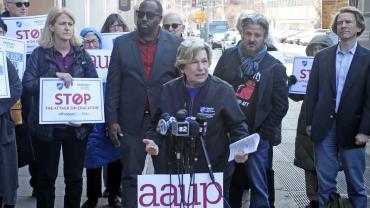
Weingarten announcing a lawsuit to stop the federal funding cuts at Columbia University.
Weingarten announcing a lawsuit to stop the federal funding cuts at Columbia University. CREDIT: AFT

Trump says much of his attack on higher education is in response to antisemitism on campuses. Without a doubt, there was antisemitism before the heinous actions by Hamas on Oct. 7 and the ensuing war, and it has grown since. We need to address antisemitism on campus and ensure Jewish students, and all students, feel safe. But Trump is weaponizing antisemitism investigations to attack disfavored speech and stoke culture wars, distrust and division, and to undermine higher education as a bulwark of democracy and an engine of our economy. It’s wrong, antidemocratic and unconstitutional. The administration is using Jews as an excuse to disappear students who are here legally, with immigration officials arresting and attempting to deport students who have committed no crimes—without due process, a linchpin of American democracy.

This may help Trump’s aim to divide Americans, but it won’t make campuses safer for Jewish students or answer the real issues around antisemitism. That’s one reason that a coalition of Jewish organizations released a statement saying that Trump’s actions make Jewish students and the Jewish community less safe.

Trump has launched investigations into dozens of colleges and universities and stripped billions in research grants from schools. The administration has issued demands ranging from direct government oversight of academic programs—or in the case of Columbia University, oversight of the whole institution—to dictating disciplinary policies and controlling hiring decisions. It is targeting students for exercising their First Amendment rights, and revoking visas for faculty and staff. The administration’s intent is to remake America’s higher education system in its image through blunt force.

The freedom to pursue knowledge, the freedom of expression and the freedom of speech are fundamental American rights that are foundational to a functioning democracy. America’s public schools, colleges and universities cultivate the exploration of knowledge and free expression and empower students to become engaged citizens. One of their hallmarks is that they are a marketplace of ideas where free and open discussion and disagreement is encouraged. That is enabled by ensuring our education institutions are independent from government control or coercion. When a government asserts control over what can be taught, thought or said, democracy itself is at risk.

The free pursuit of knowledge empowers Americans.

Stripping research and innovation funding to force compliance will hurt America’s competitiveness and help our adversaries outpace us in technological and other advancements. America’s university research and innovation centers have long been the envy of the world. The federal government, through federal agencies and grants, is a fundamental powerhouse and supporter of health, scientific, technology and other research. The U.S. is the world leader in this research—research that the private sector cannot and will not do on its own and that leads to discoveries, innovations, cures and advances that benefit the common good and move our society forward. Colleges and universities are also anchors of their local communities, supporting local jobs and small businesses, providing community gathering spaces, and growing industries tied to university research and innovation. 

This war on knowledge and expression must be opposed in the courts, on the streets, and by our colleges and universities.

As the largest union of higher education staff and faculty, the AFT joined our affiliate, the American Association of University Professors, to sue the Trump administration on behalf of our members for unlawfully cutting millions in federal funding for public health research at Columbia.

Last week, Harvard University boldly rejected Trump’s unlawful and unprecedented demands for government control over it. Harvard’s president wrote that “no government … should dictate what private universities can teach, whom they can admit and hire, and which areas of study and inquiry they can pursue.”

Americans have also taken to the streets to oppose this war on knowledge and freedoms. The attacks on higher education were a major focus of the April 5 Hands Off actions that mobilized tens of thousands of Americans across the country to reject Trump’s chaotic and cruel agenda.

The free pursuit and availability of knowledge empowers Americans, strengthens our economy and democracy, and is foundational for opportunity. That’s why we all must take a stand against this war on knowledge.