Archives for category: Higher Education

This is a startling and frightening article about the poison pill embedded in Trump’s One Big Ugly Budget Bill. It contains a plan for destroying the student aid program that has subsidized the cost of higher education for middle-income and low-income students. The plan was described in the 900-page Project 2025. Previous generations of lawmakers believed that the nation benefited by investing in the postsecondary education of young people. They could choose the program they wanted, whether in a liberal arts college or a trade school. Whichever route they chose, their education benefited the nation.

But today, Republicans don’t want the federal government to lend money for students to go to college.

The author of the education chapter in Project 2025 is now in charge of implementing the plan to deep-six student loans inside the Department of Education. Read this article and weep.

The article was written by Astra Taylor and Eleni Schirmer and appears in The New Republic:

The Trump administration’s bombastic attacks on the nation’s most prestigious universities have commanded the public’s attention all year long. Now congressional Republicans are poised to dramatically expand that onslaught. If you think the last few months have been bad for Harvard, brace yourself—the “big, beautiful bill” is coming, and with it, a new dimension of destruction. 

While it’s mostly gone unremarked upon in the mainstream media, institutions of higher learning across the country are about to be pummeled by the looming reconciliation bill, which may portend an extinction event for higher education as we know it. The bill weaponizes working-class families’ reliance on debt to finance their college dreams with such intensity that not only will it push millions to the financial brink, it will push them out of higher education altogether. 

For colleges and universities, the potential fallout is hard to overstate. Whatever schools survive are likely to be drained of working- and middle-class families, instead populated only by society’s most wealthy. As it is, millions of people rightly consider universities to be a costly endeavor that is irrelevant to their everyday life. But rather than remaking higher ed into a vibrant and more democratic institution, this bill threatens to do the opposite. It will cement the stereotype of higher education as an elite institution into an ironclad reality. On June 25, student debtors and their allies will be protesting these devastating cuts in Washington, D.C. But so far, very few elected officials are sounding the alarm on these issues with the fever pitch they deserve, let alone doing the work required to slow down and obstruct their passage into law.  

The overhaul of the student lending system championed by Republican legislators has nothing to do with fiscal responsibility or balancing the budget. Instead, it provides an ominous articulation of the Republican Party’s authoritarian ambitions, one that is chillingly consistent with the bill’s massive increases for immigration and border security. This is not a budget bill, it is a debt and deportation bill—and one built on the fascist foundation laid by the Heritage Foundation’s now-notorious Project 2025

As of this month, Lindsey Burke, formerly the Heritage Foundation’s top education policy official, serves as the Education Department’s deputy chief of staff for policy and programs. As the author of Project 2025’s chapter on education policy, Burke recommended gutting student loan relief (along with diversity, equity, and inclusion programs and scientific research funding) to bring universities to heel and reorient American society toward the far right. 

In the words of influential conservative activist Christopher Rufo, “Reforming the student loan programs could put the whole university sector into a significant recession” and state of “existential terror.” The goal is to use economic policy to impose an unpopular and stifling ideological agenda, exacted by punitive student debt. 

Whereas President Biden’s administration was defined by debates over how much student debt should get canceled and how quickly, this bill kicks away the concept of student loan relief altogether. In a draconian sweep, this bill removes the congressionally authorized power to cancel federal student loans that sitting presidents have long possessed. This means that even if the Democrats win back the White House in 2028, the next president will lack a critical tool—one that Biden possessed but, to his lasting shame, refused to use. 

Though many details are not yet settled, as the Senate and House negotiate between their respective versions, there is no doubt that the bill’s impact will be immediate and profound. Eight million student debtors will see their monthly payments spike from $0 to over $400. Dentists and doctors who choose to work in low-paying community health care centers will no longer be eligible for Public Service Loan Forgiveness programs, dramatically reducing the number of health care providers in communities that are already underserved. The bill even comes after the long-standing, Republican-approved federal student loan repayment plans, which allow borrowers to discharge their debts after a certain number of years of regular payments. 

While existing repayment programs cancel loans after 10 to 25 years of repayment, this bill moves the goalposts back to 30 years. As it is, Americans over 60 are the fastest-growing demographic of student debtors: the only age cohort to increase every single quarter of President Biden’s administration. This bill will all but ensure millions of working people carry their debts until death. 

House Republicans, whose proposals are even more extreme than their Senate colleagues’, want to end subsidized loans, driving up costs by tens of thousands of dollars, and place restrictive caps on federal loan amounts. The House bill viciously cuts Pell Grants while increasing the course load required for part-time students to access aid, making it more difficult for people with jobs or family responsibilities to afford to study. 

Both House and Senate versions strive to reduce Parent PLUS and Grad PLUS programs, decreasing working-class families’ abilities to take on loans commensurate with the costs of tuition. Families that can’t afford to pay up front will either have to take their chances with private lenders—who are likely to shut out the neediest families—or choose to forgo the education altogether. Those who take the gamble will face rising debt loads with little possibility of relief, prompting a doom loop of delinquencies, defaults, and tanked credit scores, exacerbating the financial precarity of already over-stressed and stretched borrowers. 

These cuts won’t just harm students who rely on loans to afford college; they will take the doors off colleges’ and universities’ capacity to expand minds and redistribute opportunity. Lost revenue will encourage schools to close programs, squeeze staff, and perhaps shutter entirely. A proposed endowment tax for colleges and universities has prompted fury among higher education lobbyists, but those players have said very little about the bill’s vigorous imposition of debt as a tool of social control. 

Most insidiously, the House bill conscripts colleges and universities themselves into debt. Under the guise of “accountability,” House Republicans want to force colleges and universities to pay back any unpaid federal loans for “high risk” students. This move is designed to penalize institutions for serving the low-income students who often struggle to pay their loans and discourage them from offering majors that are not maximally remunerative. They want to turn the working-class kid studying to become a social worker, artist, or a physician into a liability to her university. 

This kind of social engineering through debt isn’t new. In fact, it hails from the origins of the student loan crisis. In the early 1960s, an ambitious politician named Ronald Reagan made his name by picking a fight with the students protesting racism and war on the state’s then tuition-free campuses. “Those there to agitate and not to study might think twice before they pay tuition—they might think twice how much they want to pay to carry a picket sign,” he said. As California’s governor, Reagan tapped into his base’s anxieties about a rapidly integrating and evolving society to chip away at state support for education. As president, he doubled down on this strategy, following the recommendations of the first edition of the Heritage Foundation’s Mandate for Leadership, Project 2025’s precursor, slashing Pell Grants and tightening student loan eligibility for middle-class families. 

As Ryann Liebanthall details in Unburdened,an in-depth history of the student debt crisis, the number of Black college freshmen fell by nearly 8 percent between 1980 and 1983. More than any other figure, Reagan deserves credit for undermining what once passed as common sense in the U.S.—the principle that public college should be high quality, widely accessible, and tuition-free. Like today’s Republicans, Reagan invoked the figure of the student protester, the specter of racial equality, and the tool of student debt to implement a retrograde agenda. 

Contemporary Republicans are even more brazen. Consider a recent report released by the Heritage Foundation that recommends terminating higher education “subsidies” and student loan cancellation in order to “increase the married birthrate.” What does this goulash mean in plain English? Widespread access to college has enabled women to envision lives beyond childrearing; restricting access will increase fertility rates. Conservative power players are more than willing to cast the country into a scientific dark age in their quest to shore up traditional worldviews, outmoded hierarchies, and concentrated wealth. 

The reconciliation bill threatens to supercharge their oligarchic cause. Rising costs will reinforce the perception that education is the domain of an out-of-touch elite, prompting many to abandon or abort their academic dreams, which will resegregate broad swaths of society. The threat of mounting debt will discourage people from studying their passions or pursuing careers in public service, steering them instead toward the private sector or the military. It will weaken the general bargaining position of workers, who will be less able to use education as a path of upward mobility, while making the labor force more docile; workers burdened by debt are less likely to strike. By funneling student debtors’ ballooning payments into Wall Street coffers and regressive tax cuts, it will ensure that social and economic disparities become more entrenched.

And it will shrink our horizons. At their best, colleges and universities are not just places where people get trained in a skill or earn a degree; they enable people to grapple with bigger questions—to find out who they are, to unlock what they want to be and do, to discover how the world is made, and to dream how it could be remade differently. This is why authoritarians find education so threatening, and why the reconciliation bill must be understood as a strike against our freedom to question, learn, and choose our fates. Even, or especially, when that process challenges authority.

While some Democratic leaders have begun to warn of the economic dangers posed by this bill, none yet seem to grasp the existential stakes—nor the transformative vision required to build the political will required to change course. 

Where higher education is concerned, it is not enough to defend a status quo that the American public knows is broken. Today, an astonishing $1.6 trillion in federal student loans crushes nearly 43 million people. This insurmountable burden has made ordinary people increasingly skeptical of the value of education and more susceptible to anti-intellectual appeals. 

To counter the Republicans’ vision for higher education, Democrats must go far beyond a milquetoast goal of a less predatory student debt system. They must articulate a galvanizing vision for free college. The measure is popular: Surveys show that many people, including pluralities of Republicans and independents, are supportive of free college, despite decades of Republican propaganda demonizing academia. In recent months, faculty, staff, students, and student debtors have come together to lay this groundwork. It’s time for Democratic politicians to catch up. We need a legislative and executive agenda that courageously resists Republican tyranny by defending higher education as a public good that is both universal and free. Free as in cost and, just as importantly, free as in aimed at enhancing individual and collective freedom. We can’t afford anything less.
James Ryan, the president of the University of Virginia since 2018, announced his resignation under intense pressure from the Trump administration.

The Civil Rights Division of the Trump administration pressured the Board of Governors of the university to remove Ryan because of his support for diversity, equity, and inclusion.

They said that he pretended to comply with the federal demands to eliminate DEI but merely renamed them.

For the past half century, DEI was considered a hallmark of compliance with civil rights laws. DEI programs encouraged women and nonehites to enroll in higher education and to study the history of discrimination.

Under Trump, DEI has been reinterpreted to mean favoring those groups at the expense of white men and thus discriminating against white men.

The Trump administration has cut federal grants to universities that are slow or unwilling to dismantle DEI programs.

The New York Times reported that lawyers for the Civil Rights Division demanded Ryan’s ouster.

The demand to remove Mr. Ryan was made over the past month on several occasions by Gregory Brown, the deputy assistant attorney general for civil rights, to university officials and representatives, according to the three people briefed on the matter.

Mr. Brown, a University of Virginia graduate who, as a private lawyer, sued the school, is taking a major role in the investigation. He told a university representative as recently as this past week that Mr. Ryan needed to go in order for the process of resolving the investigation to begin, two of the people said.

Harmeet K. Dhillon, the Justice Department’s top civil rights lawyer, has also been involved in negotiations with the university. She received her law degree from the University of Virginia, where she was a student in the law school at the same time as Mr. Ryan…

Mr. Ryan, hired in 2018 as the university’s ninth president, has leaned into issues like making the school more diverse, increasing the number of first-generation students and encouraging students to do community service. But his approach, which he says will make the university “both great and good,” has rankled conservative alumni and Republican board members who accuse him of wanting to impose his values on students and claim he is “too woke.”

Before becoming the University of Virginia’s president, Mr. Ryan served as the dean of the Harvard Graduate School of Education, where he was praised for his commitment to D.E.I. programs. Harvard has been one of the Trump administration’s chief targets since it began its assault on higher education.

The administration’s attempt to assert federal influence over state university leadership decisions is also illustrative of how Mr. Trump’s political appointees continue to wield the Justice Department’s investigative powers to achieve policy goals long sought by a top Trump adviser, Stephen Miller.

Legal experts said they could think of few other instances in which an administration had demanded that a school have its president removed in order to resolve a Justice Department investigation.

“This is a tactic you would expect the government to use when it’s playing hard ball in a criminal case involving a corporation accused of serious wrongdoing or pervasive criminal activity,” said Daniel C. Richman, who is a law professor at Columbia University and a former federal prosecutor.

Yesterday a federal judge in Massachusetts again blocked the Trump administration’s efforts to ban international students at Harvard University.

Stephanie Saul wrote in The New York Times:

For the second time in less than a week, a federal judge in Boston rejected efforts by the Trump administration to bar international students at Harvard, blocking a presidential proclamation that would prevent new students from abroad from enrolling at the school.

President Trump had sought to bar the students using a law designed to safeguard national security. In a strongly worded ruling on Monday, Judge Allison D. Burroughs sided with lawyers for Harvard who had argued that such presidential power was intended to be used against foreign enemies, not international students.

The judge’s order temporarily stops the presidential proclamation from going into effect. Judge Burroughs, who was appointed by President Barack Obama, issued a similar decision on Friday. In that ruling, she temporarily blocked another effort by the Trump administration to keep international students out of Harvard through other means.

In her ruling on Monday, Judge Burroughs noted that the issues at stake involved “core constitutional rights that must be safeguarded — freedom of thought, freedom of expression, and freedom of speech” and that free speech, particularly in the academic arena, “must be zealously defended and not taken for granted.”

She continued: “The government’s misplaced efforts to control a reputable academic institution and squelch diverse viewpoints seemingly because they are, in some instances, opposed to this administration’s own views, threaten these rights.”

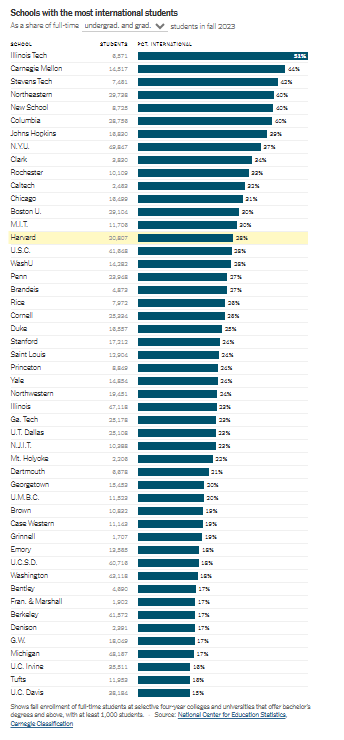
Trump initially demanded that Harvard exclude all of its international students, now. About one-quarter of its students come from other countries.

The Trump Administration is making it harder for international students to study in the U.S. If it could, the Trump regime would ban all foreign students from enrolling in American colleges and universities.

Marco Rubio announced that the State Department would scour the social media accounts of students who apply for a visa. What would the State Department look for? Any comment critical of Trump? Is it legal to deny visas to foreign students who have expressed opinions critical of Trump?

Judge Burroughs previously enjoined Trump’s order to Harvard to transfer out all of its foreign students. This is nuts. Foreign students are a net plus for American higher education. They typically pay for their own tuition and expenses, paid by their families or their government.

The New York Times posted a list of the institutions with the most international students.

The share of international students studying at these colleges and across the United States has been growing for the past two decades as rising incomes in countries like China and India have produced more families looking to educate their children in America.

Domestic forces have played a role, too: Public research universities in particular have turned to international students, who commonly pay full price for tuition, to help compensate for declines in state funding for education.

“We have all this debate about trade deficits with China right now,” said Gaurav Khanna, an economist at the University of California, San Diego, who has studied these shifts in higher education. “That’s a deficit in goods. But when you think of services — like higher ed services — we have a big surplus.”

The Chronicle of Higher Education reports that legislatures in Republican-controlled states are passing laws to restrict teaching about racism or any kind of DEI in higher education. Such state laws follow the lead of Governor Ron DeSantis in Florida, who was first to launch the war on academic freedom, but also the policies of Trump, who has declared that he too will make war on “woke” (that is, anything that is honest about the dark side of the American past.)

Katharine Mangan reported:

Teaching social work in Tuscaloosa, Ala., Cassandra E. Simon often assigns readings that describe how the families her students might one day serve have been impacted by more than a century of housing, employment, and education discrimination. The associate professor has encouraged her students to engage in spirited discussions about race, even assigning a project in which they advocate for or against a social-justice issue.

Doing any of those things today, she argues in a federal lawsuit, could get her fired from the state flagship, where she’s taught for 25 years. Last year, the state’s Republican governor, Kay Ivey, signed into law a sweeping bill that restricts what professors can teach about race. If any of their lessons veer into what conservative politicians have deemed “divisive concepts,” faculty members risk being reported, investigated, and potentially fired.

That kind of incursion into the curriculum is growing and prompting a flurry of First Amendment challenges from Simon and other plaintiffs. It’s a line state lawmakers did not cross early on in their push to dismantle DEI efforts, even as universities shuttered offices, laid off employees, canceled scholarships, and called off diversity training. But over the past two years, more than a dozen laws have been enacted that either limit which classes can be taught or imposed restrictions on what professors can say in the classroom, according to a Chronicle analysis of state legislation and a compilation of what PEN America calls “educational gag orders.”

This year especially “has been a banner year for censorship at a state level across the country,” said Amy B. Reidsenior manager at PEN America’s Freedom to Learn program. “The point of a lot of these restrictions is to put people on guard, worried that anything or everything could be prohibited so you really have to watch what you say.”

Some of the chief architects of the DEI-dismantling playbook have insisted that they’re not trying to silence anyone. In a January 26 letter to the editor in The Wall Street Journal by Ilya Shapiro and Jesse Arm of the Manhattan Institute, the institute declared that “Conservatives Have No Interest In Censorship.”

“By ending practices such as identity-based discrimination and compulsory, politically coercive diversity statements,” these laws “protect the rights of professors and students to engage freely on all topics, including race,” they wrote.

Despite such reassurances, recent bills seeking to eliminate diversity efforts are encroaching on curricula in a variety of ways. Some states, like Texas, Florida, and Utah, are giving boards more control over what goes into the core curriculum, as well as the ability to shut down programs with low enrollments or questionable work-force advantages. Others, like Alabama and Mississippi, have erected guardrails on topics that can be discussed in the classroom.

Supporters say these laws are needed to prevent liberal professors from veering off into lessons that amount to activism. Some conservative lawmakers argue that it’s their responsibility, as stewards of taxpayer dollars, to ensure public universities are offering degrees that will help students be successful and land jobs.

Critics see these incursions as infringements on free speech and academic freedom. 

The intentions of those who launched “the war on woke” are irrelevant to the reality of what happens when their concerns are taken up by legislatures intent on stamping out disturbing but historically accurate discussions of race and gender. When red-state legislators restrict academic freedom, they do it with an axe, not a scalpel. The result is to instill fear in professors about what they teach and whether they will be fired for thought crimes.

In 2017, when Trump passed his first budget bill, his allies inserted into it an unprecedented tax on institutions of higher education that have large endowments. The tax was 1.4%. But that 1.4%, though it seemed small, was money that would not be available for low-income students at expensive colleges and universities. The next logical step–once the government starts taxing nonprofits– would have been to tax megachurches but that didn’t happen.

This year, the Trump administration has included in its “One Big Ugly Budget Bill” a dramatic increase in the tax on higher education endowments.

Instead of 1.4%, the highest rate would climb to 21%.

This onerous tax would limit colleges’ ability to cover the tuition of students who are fully qualified but lack the financial resources to pay. The inevitable result of this tax will be to restrict the number and size of scholarships.

I received this letter from President Paula A. Johnson of Wellesley College, my alma mater. Dr. Johnson grew up in Brooklyn, where she graduated from a large public high school (Samuel J. Tilden), then to Radcliffe and to Harvard Medical School. She was a cardiologist before she was chosen as Wellesley’s president almost a decade ago. She is dedicated to providing scholarships for students who need them.

She wrote to all alumnae:

It is hard to overstate the importance of this moment for higher education. We are being threatened in previously unimaginable ways that cut to the core of our values and endanger a large proportion of our students. At Wellesley, we are deeply concerned about changes that could affect academic freedom, our need-blind status, and our ability to build a diverse community, one made richer by our international students.  

One of the most significant threats comes from the likelihood of a major increase to the tax on college endowments. Last month, the U.S. House of Representatives passed a budget bill that would raise the tax from 1.4% to as much as 21%. Under this proposal, Wellesley would be taxed at 14%, which means our liability under the tax would increase from $3 million, where it is currently, to $30 million per year—an amount equal to fully funding financial aid for 325 students. 

When you consider that more than two-thirds of the $82 million Wellesley spent last year to support financial aid came from our endowment, the disastrous impact of this tax becomes clear. This is a punitive tax on students and families who need financial aid.

The tax would also have a disproportionate impact on small colleges like Wellesley that, without other revenue streams such as graduate programs or large research budgets, rely on endowments to support their mission.

At Wellesley, 43% of our operating budget comes from the endowment, making it our largest source of revenue. A tax increase would have a severe impact on our academic program and our ability to meet students’ financial needs. In addition, the tax would override the intent of generations of alumnae who have given to the endowment to support financial aid and our academic mission. 

That is why Wellesley has joined a coalition of more than two dozen small colleges and universities from 17 states across the country that together serve more than 50,000 students. The coalition’s core argument, which we are sharing with members of Congress, is that endowments are not a luxury for small colleges; they are essential to continuing our commitments to access, opportunity, and educational excellence for students. 

If this totally unwarranted tax is passed, the number of meritorious students from low-income, even middle-income families would shrink dramatically.

This is wrong.

Raise taxes on corporations and billionaires.

Tax megachurches.

Raise the taxes and tariffs on super yachts.

Don’t tax the endowments of institutions of higher education.

Scott Maxwell is an opinion columnist for The Orlando Sentinel. He tells the truth about the state’s sordid politics and backs it up with facts. Learn here how the state chooses college and university presidents.

He writes:

You probably know that Florida’s GOP politicians have taken a wrecking ball to the state’s university system. And the narrative is that they’re on a noble crusade to exorcise evil, “woke” ideology from college campuses.

But if you believe that’s the only goal here, you’ve been duped. This isn’t about politicians going after liberal doctrines nearly as much as it’s about them going after tax dollars.

They’ve turned the university system into a political spoils system where politicians with no higher-ed experience can score lucrative higher-ed jobs for themselves.

It’s been going on for a while now, but the grift was fully exposed this past week. That’s when it was revealed that one of the political has-beens fuming about diversity — as a supposed reason to deny the University of Florida presidency to a qualified applicant — had secretly made a play to try to get the $3 million-a-year job for himself.

See, you have to separate the theater from the grift. The theater was a bunch of privileged guys griping about the concept of diversity and inclusion. The grift was one of those same guys making a secretive play for the very job he was griping about.

More about that in a moment, but first, let’s remember where this all started — at New College of Florida with Richard Corcoran. Two years ago, the former House Speaker craved a fat, higher-ed paycheck. The problem was that Corcoran had as much higher-ed experience as my dead cat, Furball.

So to distract from his lack of qualifications, Corcoran fumed — about DEI, CRT and other scary-sounding acronyms. It was red meat for the trolls. And Corcoran laughed all the way to the bank. He got a $1 million deal to run a tiny college with 698 students. Elementary school principals oversee more pupils.

Then Corcoran and Co. invited other political has-beens to feed at the New College trough. They gave a former Senate president a $500-an-hour legal contract, the governor’s former spokesman a $15,000-a-month PR contract and the wife of the former Republican Party of Florida chairman $175,000 to run the school’s foundation.

With the chow bell rung, the politicians came running. Former U.S. Sen. Ben Sasse of Nebraska scored a $10 million deal for a short-lived and disastrous tenure at UF where the student newspaper discovered he’d quickly blown through $17 million in public money, including $38,000 he spent on a sushi bar.

Lieutenant Gov. Jeanette Nunez snagged the top spot at Florida International University. A cable-company lobbyist friendly with the administration is in line to lead FAMU.
At one college, they had to actually remove the requirement that the president have an advanced degree so that they could give the job to Fred Hawkins, a GOP legislator who lacked one.

But then this past week, the scheme was fully exposed in cringe-worthy fashion.

The scene was the Board of Governors meeting in Orlando where appointees of Gov. Ron DeSantis were once again fuming about the alleged evils of diversity and inclusion. Their reason this time was to try to deny the UF presidency to former University of Michigan President Santa J. Ono.

Somehow, a qualified candidate had actually advanced through the secretive application process — and that would not be tolerated.

So the political appointees accused Ono of all kinds of terrible things like embracing equality and believing in science. Former House Speaker Paul Renner led the anti-woke war.

But then one board member who’d apparently heard enough posturing went off-script.
Eric Silagy, the former CEO of Florida Power and Light, asked if any of his fellow board members — the ones savaging Ono for being too woke — had applied for the very job Ono was seeking.
Yes, responded board chairman Mori Hosseini. “Paul Renner.”

It turned out the very guy claiming Florida needed an anti-woke warrior in this $3 million-a-year position had been salivating over the post.
Renner became visibly enraged when exposed. He indignantly responded that he’d only inquired about the job because other people suggested he do so and that he’d since decided not to accept the high-paying job even if it was offered to him. Sure, Mr. Speaker. Your nobility is noted.

Most of the time, qualified candidates like Ono don’t even get a shot. But occasionally, well-intentioned leaders at individual schools try to give them one — as trustees at Florida Atlantic University did two years ago when they nominated Vice Admiral Sean Buck, the superintendent of the United States Naval Academy, to be FAU’s president.

That’s how these folks treat these positions.

DeSantis would later admit in a moment of surprising candor that he only supported Fine because other GOP legislators disliked Fine and wanted him gone. “They wanted to get him out of the Legislature,” DeSantis said. “So they asked me to put him up for Florida Atlantic president, and I did.”

But Buck didn’t stand a chance in this environment. DeSantis allies savaged the respected admiral’s reputation so that yet another GOP legislator, Randy Fine, could have a shot at the job.

Fine and DeSantis later had a falling out, and Fine didn’t get the gig. But the rules of the game were clear: Qualified applicants need not apply.
An irony is that former politicians actually can become impressive university leaders. Florida State University President John Thrasher, a former GOP house speaker, was one of them. I respected him. So did many others.

But Thrasher, who sadly passed away last week, was a different kind of man than the Florida politicians of today. He was a statesman — not someone willing to savage others’ reputation simply to enrich himself.

In his epic battle to punish the nation’s most prestigious university, Trump claimed that Harvard is teaching remedial math. That was his way of saying that its standards of admission are very low because Harvard wants to recruit unqualified nonwhite students.

Trump has refused to release his own academic record but his public statements indicate that he is in no position to tell Harvard whom to admit or what to teach.

Only 3.6% of the students who applied to Harvard last year were admitted.

The Boston Globe took a close look at the course that Trump–the stable genius–calls “remedial.”

A star student at her small Alabama high school, Kyra Richardson graduated confident in her academic prowess in all but one subject: math.

By the time she arrived at Harvard in the fall of 2024, it had been more than 12 months since Richardson‘s last math class. Even though she passed a college-level AP calculus course as a high school junior, Richardson said it felt more like she was memorizing formulas than truly understanding the concepts behind calculus.

So when it came time for her to begin fulfilling the math requirement associated with Harvard’s pre-medical track, the university recommended (and Richardson agreed) she should take an intro-level calculus course called Math MA.

Even with her previous calculus experience, she said, the Harvard course was far from an easy A. “I’m glad that I took a class that pushed me,” Richardson said.

In recent months, amid the White House’s ongoing battle with Harvard, the Trump administration has used that class to questionthe university’s academic rigor. In what has become a familiar refrain, Education Secretary Linda McMahonJosh Gruenbaum, a top US General Services Administration official, and President Trump himself have all labeled a modified version of the calculus course Richardson completed — known as MA5 — “remedial math.” 

“I want Harvard to be great again,” Trump said in the Oval Office last month. “Harvard announced two weeks ago that they’re going to teach remedial mathematics. Remedial, meaning they’re going to teach low grade mathematics like two plus two is four. How did these people get into Harvard if they can’t do basic mathematics?”

Richardson said she laughed when she heard the remedial math comment because “MA5 is the exact same class [as MA]. It just meets five times a week” as opposed to four. 

According to an online course description of MA5, the extra day of instruction time “will target foundational skills in algebra, geometry, and quantitative reasoning that will help you unlock success in Math MA.” The homework, exams, and grading structure of MA5 are the same as MA, a course Harvard has offered for decades. Even MA5’s format is not entirely new. Five days of instruction was previously required for all students taking Math MA in 2018.

“If you look at academic support and a college trying to help their students, and you think that’s unnecessary or it’s embarrassing that they have to provide that kind of support, then it’s coming from a place of ignorance,” said Richardson. “You have no understanding of how, not just college, but how learning works. You can’t learn without help.”

All Harvard freshmen take a placement exam in mathematics prior to their arrival on campus. Based on how they score, the university suggests which course they should be placed into. Math MA5, MA, and its companion course, MB, make up Harvard’s most basic introductory calculus courses known as the M series. MA5 was introduced last year by Harvard to combat pandemic learning losses, which saw students show up to campus with gaps in their math knowledge, especially in early high school courses like algebra, as a result of virtual learning. 

“When this first came out about us teaching remedial math, I was like, ‘Well, this is news to me and I wouldn’t even know how to do it,’” said Harvard’s director of introductory math Brendan Kelly. “Thinking about how to explain addition to somebody is an expertise that your elementary school teachers and middle school teachers have. … We focus on much more advanced mathematics.”

Only 20 students took MA5 this past academic year according to Kelly. The course was taught across two sections, each with 10 students, Kelly said, all of whom have declared majors like economics or biology that necessitate a strong foundation in calculus…

Remedial math courses in higher education are typically defined as “non credit bearing courses that cover middle school and high school content below that of college algebra,” said Chris Rasmussen, a professor of mathematics at San Diego State University. “So we’re talking fractions or some basic algebraic manipulation.” Rasmussen — who was part of a team of outside professors that recently conducted a full review of Harvard’s math department — said “in no way is MA5 a remedial math course. It’s a rigorous calculus course.”

The article includes a PDF with the course syllabus. How many members of Congress could pass it? Not many. Certainly not Trump or Secretary McMahon.

Governor Ron DeSantis has done everything possible to destroy education in Florida. He apparently hates public schools. He pushed through an expansion of vouchers that provides a subsidy to every student in the state, no matter if the family is rich or poor. Of course, most of those using the voucher never attended public schools. Most vouchers go to students in religious schools. Florida currently spends $4 billion annually on vouchers, a sum sure to increase.

Bad as public K-12 education is, the state’s public higher education system is in worse shape. DeSantis has placed political cronies in charge of every state university. He took charge of tiny New College (700 students) because he was offended that Florida had one progressive institution of higher education where students were encouraged not to conform. DeSantis replaced the board with conservatives who put a political extremist in President. What was once a haven for free-thinking students was transformed into a school for jocks and business majors.

The editorial board of the Sun-Sentinel summarized DeSantis’s record of using higher education as patronage for political cronies:

When Gov. Ron DeSantis won his landslide re-election in 2022, a half-fawning and half-fearful Florida Legislature gave him whatever he wanted.

The Harvard graduate could have used that power to burnish Florida’s celebrated universities. He could have chosen the best and brightest to lead schools already among the nation’s best. He could have been the education governor.

That — not a bellyflopping bid for the White House — could have cemented his legacy.

Instead, DeSantis has earned a doctorate in cronyism. He’ll be remembered as the governor who did everything in his power to erode higher education and independent thought. He puts politics above merit and qualifications, with sham “searches” and secret deals.

College and university campuses are now soft-landing patronage pads for Republican allies, at sky-high salaries.

Former House Speaker Richard Corcoran was installed as president of New College in Sarasota. Another politician, former House Majority Leader Adam Hasner, was handed the FAU presidency. A run-of-the-mill former legislator, Fred Hawkins, won the presidency of a state college in Avon Park despite lacking academic qualifications.

Former Lt. Gov. Jeanette Nuñez is now president of Florida International University. Former U.S. Sen. Ben Sasse of Nebraska was given the prestigious UF presidency, then flamed out amid reports of over-the-top spending.

It’s no surprise, then, that Education Commissioner Manny Diaz, a former Republican legislator from Hialeah who oversees state colleges and K-12 education, will slide into the presidency of the University of West Florida in Pensacola.

For DeSantis and Diaz, no university is too big and no kindergarten picture book is too small to escape being recast in the governor’s philosophy.

Step 1: Stack the board

First, DeSantis stacked UWF’s board of trustees. Then, newly appointed trustee Zach Smith quickly made clear that UWF president Martha Saunders was unwelcome.

Smith, a Heritage Foundation fellow, had to reach back to six years ago to find even a speck of mud to throw: Two student-organized drag shows in 2019; social media messaging about a Black Lives Matter co-founder and a book, “How to be an Antiracist,” once recommended by university librarians.

It’s true that best-seller is full of provocative opinions. But so is Smith’s book, “Rogue Prosecutors,” which pushes dark conspiracies about prosecutors corrupted by a wealthy Jew.

That did not stop his nomination to the UWF board by DeSantis, who only last year declared war on campus antisemitism amid great fanfare.

The widely popular Saunders saw the writing on the wall, and she resigned.

A farcical scene

That board meeting was an ambush, said trustee Alonzie Scott. The next one was a farce.

Without a job posting or a search, Diaz’s name alone surfaced as a replacement. Just as quickly, a special meeting was called by UWF trustees. There would be no search for a temporary president and no effort to pick an interim leader from the university.

There was only a perfunctory vote to install Diaz. Then, farce upon farce, the board voted with a straight face to begin looking for a permanent replacement for Diaz.

Barring a political earthquake, that will be Diaz. As former Pensacola mayor and UWF alum Jerry Maygarden said at the meeting, what serious candidate would apply for a job that smacks of a done deal?

Even Diaz’s roots defy all logic.

UWF’s strength is its strong community support among residents and businesses, including Republican leaders. Diaz’s Miami-Dade home is a 10-hour drive, 700 miles and culturally worlds apart from Escambia County in “Lower Alabama.”

None of this is about rescuing students who feel intimidated and indoctrinated.

After all, a state-mandated 2022 Intellectual Freedom and Viewpoint Diversity report found that a majority of UWF students surveyed felt the school provided them the freedom to express their own opinions. Half said they had no idea if their professors were liberal or conservative.

New College 2.0

Never mind. In April, DeSantis told UWF to “buckle up,” announcing he would do for them what he did for New College.

It’s hard to see the success story in New College since the governor declared war on it. DeSantis’ hostile takeover of the tiny liberal arts college has devolved into a money pit: The state’s cost for each New College student shot to more than $90,000. Other state universities average roughly $8,000.

Last month, New College and the University of South Florida were found to be secretly working on a deal to “transfer” USF’s Sarasota-Manatee campus to New College. It’s dead for the moment. Community leaders, kept in the dark as usual, demand answers.

Meanwhile, USF has become the latest fertile field for DeSantis to reward his friends. USF’s president said she will resign, creating yet another job opportunity for a like-minded crony.

The Sun Sentinel Editorial Board consists of Opinion Editor Steve Bousquet, Deputy Opinion Editor Dan Sweeney, editorial writers Pat Beall and Martin Dyckman, and Executive Editor Gretchen Day-Bryant. To contact us, email at letters@sun-sentinel.com.

Trump is a petty man who is filled with rage, grievance, and a passion for retribution. His current target is Harvard University because the nation’s most prestigious university told him no. Harvard’s President Alan Garber said it would not allow the federal government to control its curriculum, its admissions, and its hiring policies. No.

Every Cabinet department has pulled research grants to Harvard. Now he warns he might turn the billions that were going to medical and scientific research and hand it over to trade schools.

He would rather stop researchers who are trying to find cures for cancer, tuberculosis, Alzheimer’s, multiple sclerosis, and other diseases than back down on his efforts to stifle academic freedom and his vendetta against Harvard.

I don’t know about you, but I would rather see the federal government fund the search for a cure for MS than withdraw the funding. If he wants to fund trade schools, why should he do so at the expense of crucial research?

He wrote on Truth Social yesterday:

“I am considering taking Three Billion Dollars of Grant Money away from a very antisemitic Harvard, and giving it to TRADE SCHOOLS all across our land,” Trump said in a post on social media. “What a great investment that would be for the USA, and so badly needed!!!”

Meanwhile, Trump dreamed up another way to harass Harvard during the hours when he couldn’t get to sleep. He demanded that Harvard give him a list containing the names and countries of origin of all its foreign students. Harvard has nearly 7,000 foreign students. Why? What will he do with those names? Will he say they are spies and try again to expel them? Funny thing is he already has all their names and countries. They were registered when they applied for a visa. It’s all a campaign of endless vengeance by a petty, bitter man.

The American Academy of Arts and Sciences is the most distinguished scholarly organization in the nation. It is dedicated to the advancement of the arts and sciences. It is decidedly nonpartisan. I was elected to membership many years ago. AAAS rarely issues a statement. Its board did so in April because of unprecedented attacks on higher education, scholarly independence, and the rule of law.

A statement from the Board of Directors of the American Academy of Arts & Sciences. 
Approved April 2025. 

Since its founding in 1780, the AmericanAcademy of Arts and Sciences has sought “to cultivate every art and science which may tend to advance the interest, honor, dignity, and happiness of a free, independent, and virtuouspeople.” We do this by celebrating excellence in every field of human endeavor and by supporting the unfettered pursuit of knowledge and its application to the common good.

The Academy fosters nonpartisan, deliberative discourse on pressing issues facing our communities in the United States and the world.Our founders were also the founders of our nation. From them, we inherit a deep commitment to the practice of democratic self-governance. Our constitutional democracy has been imperfect, but almost 250 years since its inception, it remains an inspiration to peoplenear and far. Ours is a great nation because ofour system of checks and balances, separation of powers, individual rights, and an independent judiciary — as the Academy’s founder JohnAdams put it, “a government of laws, not of men.” And we are a great nation because we haveinvested in the arts and sciences while protecting the freedom that enables them to flourish.

These values are under serious threat today.Every president of the United States has the prerogative to set new priorities and agendas; nopublic or private institution is above criticism or calls for reform; and no reasoned arguments, from the left or the right, should be silenced. But current developments, in their pace, scale, and hostility toward institutions dedicated to knowledge and the pursuit of truth, have little precedent in our modern history.

We oppose reckless funding cuts and restrictions that imperil the research enterprise of our universities, hospitals, and laboratories, which contribute enormously to our prosperity, health, and national security. We condemn efforts to censor our scholarly and cultural institutions, to curtail freedom of the press, and to purge inquiry or ideas that challenge prevailing policies. We vigorously support the independence of the judiciary and the legal profession, and opposeactions and threats intended to erode thatindependence and, in turn, the rule of law.

In this time of challenge, we cherish theseprinciples and stand resilient against efforts to undermine them. The Academy will continue to urge public support for the arts and sciences, and also work to safeguard the conditions of freedom necessary for novel discoveries, creative expression, and truth-seeking in all its forms. We join a rising chorus of organizations and individuals determined to invigorate the democratic ideals of our republic and its constitutional values, and prevent our nation from sliding toward autocracy. 

In the coming months and years, the Academy will rededicate itself to studying, building, and amplifying the practices of constitutional democracy in their local and national forms, with particular focus on its pillars of freedom of expression and the rule of law. We call on all citizens to help fortify a civic culture unwavering in its commitment to our founding principles.