Archives for category: Funding

Garry Rayno of InDepthNH reports on opposition to the funding of New Hampshire’s expansive voucher plan, which has never been submitted to a public referendum. A lawsuit has been filed to block the use of public school funds for unaccountable vouchers. The voucher program, serving mostly kids who already attend students in private and religious schools, is far more expensive that its sponsor low-ball projections.

CONCORD — A bill to expand the uses for the state’s Education Trust Fund ran into opposition Friday as opponents said it would give the new Education Freedom Account program a blank check without accountability.

The prime sponsor of House Bill 440, Rep. Glenn Cordelli, R-Tuftonboro, said the bill simply “cleans up and codifies” what is in legislation elsewhere in statutes and comes at the Department of Education’s request. He noted the current trust fund statute does not address money for kindergarten or leases for charter schools.

“This bill clarifies (sections of law),” Cordelli said, “so there is a full picture of what comes out of the Education Trust Fund.”

However, those testifying in opposition at a public hearing Friday before the House Education Committee, said the bill is not a “housekeeping measure” but an attempt to divert millions of dollars to the Education Freedom Account program from public schools without sufficient accountability.

“The program was funded for two years as a pilot program and now you are giving it a blank check,” said David Trumble. “Why take a huge gamble. You built a program with no foundation for it and now you want to build a tall skyscraper on it.”

HB 440 would allow the Education Trust Fund to be used to pay for Education Freedom Account grants to parents and for phase-out grants to school districts losing students to the program.

The bill also changes the funding for the state’s portion for charter school leases from the general fund to the Education Trust Fund.

The Department of Education would be able to use 1 percent of the money in the Education Trust Fund to administer the EFA program, under the bill.

The Legislative Budget Assistant was not able to determine the cost of the changes in the bill because the department had not responded at the time of the bill’s printing, but noted the 1 percent going to the department would be $10.6 million in the current fiscal year, and $11 million in fiscal year 2024 and $11 million in fiscal year 2025.

The use of the fund for the EFA program is being challenged in court as the plaintiffs claim the program uses money earmarked for public education for private programs.

The suit challenging the funding for what has been described as the most expansive voucher program in the country, claims money raised by the Lottery Commission, and money from the Education Trust Fund may only be used for adequate education grants to school districts, citing the law creating the fund in 1999.

The suit, brought by Deb Howes as a citizen taxpayer, who is also president of AFT (American Federation of Teachers)-New Hampshire, seeks an injunction blocking the state from using any more of the Trust Fund Money to fund the EFA program.

Speaking at the public hearing, Howes reiterated her opposition to the bill, saying it is not a housekeeping measure.

“If money is coming out of (the Education Trust Fund),” she said, “does not mean it should be coming out of it.”

Public school and district tax money is not limitless, Howes said, noting it is all coming out of taxpayers pockets.

“When you run short of money,” Howes said, “you are going to shortchange the 160,000 kids in public schools.”

Please open the link to read the rest of the article.
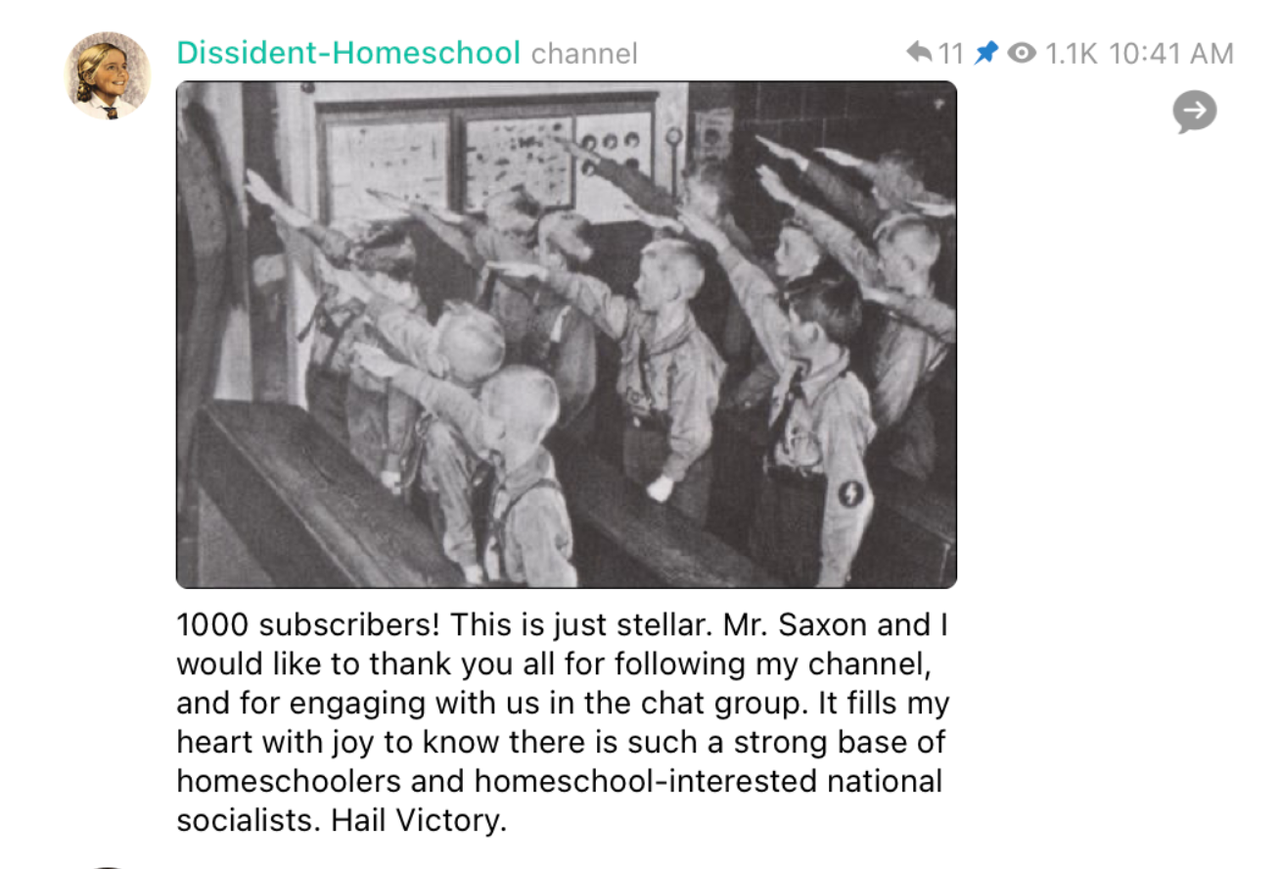
Christopher Mathias wrote at Huffington Post about a group called Dissident Homeschool that provides resources for parents who want to teach their children to be Nazis. Through research and inquiry, he found the names of the couple who administer the site. Many of the states enacting voucher plans include payments for homeschooling. If you live in one of those states, your tax dollars might be subsidizing the training of Nazis.

Please read the entire article. It’s too long to repost in its entirety. It is awful that parents would do this, and worse that it is subsidized by public funds in many state voucher plans.

Mathias writes:

On Nov. 5, 2021, a married couple calling themselves “Mr. and Mrs. Saxon” appeared on the neo-Nazi podcast “Achtung Amerikaner” to plug a new project: a social media channel dedicated to helping American parents home-school their children.

“We are so deeply invested into making sure that that child becomes a wonderful Nazi,” Mrs. Saxon told the podcast’s host. “And by home-schooling, we’re going to get that done.”

The Saxons said they launched the “Dissident Homeschool” channel on Telegram after years of searching for and developing “Nazi-approved material” for their own home-schooled children — material they were eager to share.

The Dissident Homeschool channel — which now has nearly 2,500 subscribers — is replete with this material, including ready-made lesson plans authored by the Saxons on various subjects, like Confederate Gen. Robert E. Lee (a “grand role model for young, white men”) and Martin Luther King Jr. (“the antithesis of our civilization and our people”).

There are copywork assignments available for parents to print out, so that their children can learn cursive by writing out quotes from Adolf Hitler. There are recommended reading lists with bits of advice like “do not give them Jewish media content,” and there are tips for ensuring that home-schooling parents are in “full compliance with the law” so that “the state” doesn’t interfere.

The Saxons also frequently update their followers on their progress home-schooling their own children. In one since-deleted post to Telegram, they posted an audio message of their kids shouting “Sieg Heil” — the German phrase for “hail victory” that was used by the Nazis.

Over the past year, the Dissident Homeschool channel has become a community for like-minded fascists who see home schooling as integral to whites wresting control of America. The Saxons created this community while hiding behind a fake last name, but HuffPost has reviewed evidence indicating they are Logan and Katja Lawrence of Upper Sandusky, Ohio. Logan, until earlier this week, worked for his family’s insurance company while Katja taught the kids at home.

The Anonymous Comrades Collective, a group of anti-fascist researchers, first uncovered evidence suggesting the Lawrences are behind Dissident Homeschool. HuffPost has verified the collective’s research.

The Lawrences did not respond to repeated requests for comment made via phone calls, text messages and emails. A HuffPost reporter also left a message in the Dissident Homeschool channel asking Mr. and Mrs. Saxon for comment about the Anonymous Comrades Collective’s research. That message was immediately deleted by the channel’s administrators, who then disabled the channel’s comment and chat functions.

A short time later, Katja Lawrence deleted her Facebook page.

Although the Lawrences will now surely face some public scorn and accountability, it’s likely their neo-Nazi curriculum is legal. A concerted, decades-long campaign by right-wing Christian groups to deregulate home schooling has afforded parents wide latitude in how they teach their kids — even if that means indoctrinating them with explicit fascism.

Meanwhile major right-wing figures are increasingly promoting home schooling as a way to save children from alleged “wokeness” — or liberal ideas about race and gender — in public and private schools. As extreme as the Dissident Homeschool channel is, the propaganda it shares targeting the American education system is just a more explicit and crass articulation of talking points made by Fox News hosts or by major figures in the Republican Party.

“Without homeschooling our children,” Mrs. Saxon once wrote, “our children are left defenseless to the schools and the Gay Afro Zionist scum that run them….”

Nazi Groomers

A post from Dissident Homeschool, a channel on Telegram where neo-Nazis learn to indoctrinate their children.

Mr. and Mrs. Saxon appeared to be thrilled to see their Dissident Homeschool channel gain a larger following. When the channel reached 1,000 subscribers, Mrs. Saxon posted a Nazi-era photo from Germany of uniformed schoolchildren throwing up fascist salutes. “It fills my heart with joy to know there is such a strong base of homeschoolers and homeschool-interested national socialists,” she wrote to mark the occasion. “Hail victory.”

Mrs. Saxon does the bulk of the posting in Dissident Homeschool, and developed extensive lesson plans that other neo-Nazi parents could use for their children. These lesson plans — about Christopher Columbus, the history of Thanksgiving and German Appreciation Day, as well as a “math assignment” about “crime statistics” that is meant to teach kids which “demographics to be cautious around” — are deeply racist.

One lesson plan about Martin Luther King Jr. tells parents to teach their kids that the revered civil rights leader was “a degenerate anti-white criminal whose life’s work was to make it impossible for white communities to protect their own way of life and keep their people safe from black crime.”

“Typically speaking,” Mrs. Saxon wrote in a post, “whites build societies whereas blacks destroy them.”

Included in the lesson plan is a copywork assignment for parents to print out, so that their kids can practice cursive while writing out a racist quote by George Lincoln Rockwell, the infamous American neo-Nazi.

Now that Florida is a red state, the legislature plans to offer vouchers to every student. The legislators expect to do maximum damage to public schools, which will inexorably lose funding and students. Nothing has been said about how to pay for the proposal. Voucher schools in the state are mostly religious and are completely unregulated. Neither their principals nor their teachers need to be credentialed. They are also free to discriminate on any grounds.

The Miami Herald reports:

Florida Republican lawmakers this year will consider offering every K-12 student thousands of dollars each year for their families to spend on education.

Parents would have access to state-funded accounts and use them to pay for private school tuition plus a wide variety of school-related expenses.

The proposal, if approved, would make the state’s school voucher program bigger than ever. But one key fact about the pitch remains elusive: its cost. It could total billions of dollars.

House Speaker Paul Renner said last week he plans to make the proposal, House Bill 1, a priority during the annual legislative session, which starts March 7.

The measure is already being fast-tracked. It will have its first committee hearing Thursday morning in Tallahassee.

So far, the measure carries no financial impact statement. That’s despite the knowledge that hundreds of thousands more children would be eligible for annual payments of about $8,000 each.

The cost, according to the staff analysis, is “indeterminate.” And that “is not reasonable,” said Norín Dollard, a senior research analyst at Florida Policy Institute, a nonpartisan organization that focuses on quality of life issues for Floridians. The group issued a report on voucher funding in September.

HUNDREDS OF THOUSANDS NEW STUDENTS WOULD BE ELIGIBLE

About 266,000 Florida children attend private schools without using any current state scholarship or voucher, Dollard notes. All would be eligible for education savings accounts under the proposal. In addition, approximately 150,000 children receive home schooling.

HB 1 would provide accounts to as many as 10,000 of them in the first year, with more to come in following years. Conservative back-of-the-napkin math suggests that if just 25% of the newly eligible students participate, and those currently in the program remain, the added cost would reach $600 million, Dollard said.

As participation grows, the total could approach $4 billion or more within five years, she added. If that’s the policy decision in leadership, so be it, Dollard said. But it needs to be funded somehow.

A RECURRING FINANCIAL OBLIGATION

State Rep. Anna Eskamani, D-Orlando, focused on that issue during a hastily called Monday evening Zoom meeting to discuss the measure with public education advocates.“

“We have very, very serious concerns,” Eskamani said during an interview. “This is an annual shift of money. Where is it coming from?”

When unveiling the measure at a news briefing, Renner said it was too early to know how much money might be needed. Much depends on how many children want to avail themselves of the vouchers, he said, and where the Legislature sets per-student funding for the year.

At the same time, Renner stressed his goal is to further open school choice so “no one is left out.” The bill would eliminate most eligibility restrictions, though it would prioritize children whose family income is at or below 185% of the federal poverty level — or $55,500 for a family of four.

It also would broaden uses of the money beyond private school tuition to include education expenses such as tutoring, testing and college courses. It would allow students to bank up to $24,000 for those uses, and further permit children already attending private schools without state support to request a share of the funds.

“To effectively deliver a quality education, policy makers and education advocates must accept that every student has unique learning needs, that education dollars belong to the student and not a system, and that public school choice offers every student an opportunity to customize their own education,” Renner said Tuesday, when asked about the associated costs.

A SPIKE IN PARTICIPATION IS EXPECTED

Dollard and others said they anticipate wide interest in participation, with much of it coming from families already paying for private schools. In Arizona, which has a similar education savings account program, the state reported 80% of applicants never attended public schools.

That flips the idea of money following the student on its head, Dollard suggested, because those students never had their education covered by state money in the first place.

School district finance officers said they understood the leadership’s position that the details aren’t firm enough to know the full financial impact.

But using the state’s most recent voucher expansion plan as a guide, they had concerns that this initiative would take money away from district budgets and leave them little ability to plan.

That’s what happened the last time the state expanded vouchers in 2021 with the taxpayer-funded Family Empowerment Scholarship. Officials touted the program as adding $200 million for vouchers, allowing 61,000 more children to afford private school.

Districts saw some money go out the door, but nothing like what happened in 2022. Halfway through the 2021-22 school year, school budget officers across the state learned that three times the amount of money they had set aside to send to voucher programs would be required, based on updated attendance figures from the state.

In some counties, such as Pasco, efforts to provide employee raises were derailed as the money officials expected to use was diverted to the vouchers. All told, the cost had grown to $1 billion.

The current year has provided similar sticker shock. The Legislature approved a budget with no specific amount set for the scholarships. By the second education funding calculation in July, the price tag had increased to $1.3 billion.

That meant the Miami-Dade County school district would have to send $225 million from its budget to the voucher program, for example, and the Hillsborough County school district would send $75 million.

When the third calculation came out this week, districts learned they would be losing even more. If the state lifts the eligibility restrictions, Pinellas County Schools chief finance officer Kevin Smith predicted, it will become even more difficult to predict the financial impact.

He suggested the state should at least consider taking the money out of the public education funding program and create a separate line item.

That way, schools would know what to expect and they could budget appropriately. In recent years, the DeSantis administration has taken the position that unexpected changes in enrollment can pose a financial strain on local school districts.

Read more at: https://www.miamiherald.com/news/local/education/article271630112.html#storylink=cpy

This is one of Peter Greene’s finest posts. He explains the real reason that Republicans have fallen in love with vouchers. They want to eliminate public schools and in time shift the financial burden of schools to parents, not taxpayers. One of the loudest voucher advocates, who got his doctorate from the University of Walton….the University of Arkansas’s so-called Department of Educational Reform, where they teach the doctrine of school choice, posted a photograph of himself and a woman whom I assume was his wife at a funeral, celebrating the death of public schools. When we go high, they go low.

Greene writes:

The new wave of voucher bills being rammed through red state legislatures all demonstrate a truth about school voucher policies– vouchers are not about choice. They’re about peeling people away from the public school system in order to defund and dismantle that system.

What makes me think so? Here it is. Sometimes it’s not about what people say, but about what they don’t say.

If the concern were really and truly choice for every student, then voucher fans would be addressing some of the real obstacles to school choice.This door doesn’t lead where they told you it would.

For one, they would be addressing discriminatory and exclusionary policies. Yet when have we ever heard a voucher supporter say, “These discriminatory policies have to stop. LGBTQ+ students deserve just as much school choice as any other students.”

The closest thing we ever get is “Well, then they can start an LGBTQ-friendly school of their own.” Yet when that happens, pro-voucher politicians target that school with terms like “perversion.” And of course in some states, such a school can never happen because talking about LGBTQ students or Black history has been outlawed. And voucher laws are written to hold the private school right to discriminate as it wishes inviolable.

If someone were serious about voucher based choice, they would also address cost. Vouchers are typically far too small to pay for tuition to top schools in the state. If voucher supporters were really interested in making sure that, as Jeb Bush says, “each and every…student can access the education of their choice,” there would be a robust discussion about how to bridge the gap between meager vouchers and expensive schools.

Yet we never hear voucher advocates saying, “We need to find the way to fully fund vouchers so that they provide a real choice to students.” Choice advocates like to point at the inequity of the public system–parent choice is limited by their ability to buy an expensive house in a wealthy neighborhood. But the current crop of voucher programs doesn’t change that a bit–a voucher offers little to change the fact that how much “freedom” you get depends on how wealthy you are.

It has been done. But when Croydon, NH set up a school choice program, a voucher-like system that bore the full cost of sending a student to the school of their choice, local libertarians tried to shut it down because they wanted lower taxes.

Voucher fans love the idea of school choice; they just don’t want to actually pay for it.

If these folks were serious about school choice via vouchers, we would have calls for oversight and accountability. It would make a choice system that much more attractive for parents to know that all the available options have been vetted and screened and will be held to some standards, just like shopping in a grocery store where you can rest easy in near-certainty that whatever you pick, it’s not going to actually poison your family.

And yet not only do voucher fans not call for oversight and accountability, but they actively block it with language that hammers home that nobody can tell vendors what to do or how to do it.

Voucherphiles like to call their system child-centered, but in fact it is vendor-centered, with “protections” for the service providers written into the law, and protections for the students non-existent. Parents are left to navigate an unregulated system of asymmetrical information that favors the businesses– not the families.

Please open the link and finish the post. And while you are at it, subscribe to Peter’s wonderful blog.

Jan Resseger looks behind the daily news and ties together fast-moving events in the red states. The sudden proliferation of voucher programs is no accident, she writes, nor is it a response to public demands. It is a carefully crafted, well-funded strategy to defund public schools, to smash teachers’ unions, and to implement a rightwing ideology that does not benefit students or improve education.

She writes:

This week in Iowa, Governor Kim Reynolds signed an Education Savings Account, universal voucher program into law. And last week in Utah, the same kind of voucher plan took the first step toward adoption when it was passed by Utah’s House of Representatives.

The Des Moines Register reports on Iowa’s new vouchers. The program will “phase in over three years and eventually allow all Iowa families to use up to $7,598 a year in an ‘education savings account’ for private school tuition. If any money is left over after tuition and fees, families could use the funds for specific educational expenses, including textbooks, tutoring, standardized testing fees, online education programs and vocational and life skills training. The $7,598 per private school student is the same amount of funding the state provides to public school students and is expected to rise in future years… The bill allows the Iowa Department of Education to contract with a third party to administer the education savings accounts, but the state has not yet issued a request for proposals from companies seeking to manage the funds.”

It would appear that the Iowa Legislature tried to calm the fears of the public school community by promising that, “Public school districts would also receive an additional $1,205 in funding for students receiving education savings accounts who live within the public school district’s boundaries.” But despite that promise, a drop in overall public school funding is expected: “By the fourth year, the (Legislative Services) agency estimates public school districts will receive $49.8 million in new per-student funds for private school students within the public district’s boundaries. The agency also expects a net decrease of $46 million in public school funding as a result of more students attending private schools.”

It is hard to keep track of all the states that now have school vouchers or are considering voucher programs and to know which states have the latest flavor of vouchers—Education Savings Accounts (ESAs). Most ESA programs, unlike Iowa’s, don’t even require that families use the vouchers at private schools. In most places, ESA’s can be used for educational programs, for educational tools and materials like books and computers, and for homeschooling. In some states families can use the money for so-called micro-schools in which families come together and hire a teacher to work with children in someone’s home.

Why is there so much so much legislative activity about expanding vouchers? Several factors are important to consider, and many of them were the subject of economist Gordon Lafer’s analysis in The One-Percent Solution. Lafer’s book focused on the public policy that flowed from state legislatures after the Tea Party wave election in 2010, but his observations are still on point as we begin 2023. Lafer enumerates all the reasons why far-right ideologues and big corporate moneyed interests seek to undermine and privatize public schools: “At first glance, it may seem odd that corporate lobbies such as the Chamber of Commerce, National Federation for Independent Business, or Americans for Prosperity would care to get involved in an issue as far removed from commercial activity as school reform. In fact, they have each made this a top legislative priority… The campaign to transform public education brings together multiple strands of the agenda… The teachers’ union is the single biggest labor organization in most states—thus for both anti-union ideologues and Republican strategists, undermining teachers’ unions is of central importance. Education is one of the largest components of public budgets, and in many communities the school system is the single largest employer—thus the goals of cutting budgets, enabling new tax cuts for the wealthy, shrinking the government, and lowering wage and benefit standards in the public sector all coalesce around the school system… There are always firms that aim to profit from the privatization of public services, but the sums involved in K-12 education are an order of magnitude larger than any other service, and have generated an intensity of corporate legislative engagement unmatched by any other branch of government. Finally, the notion that one’s kids have a right to a decent education represents the most substantive right to which Americans believe we are entitled, simply by dint of residence… (F)or those interested in lowering citizens’ expectations of what we have a right to demand from government, there is no more central fight than around public education. In all these ways, then, school reform presents something like the perfect crystallization of the corporate legislative agenda.” (The One-Percent Solution, pp 128-129)

It is hard for public school advocates to mobilize nationally against the expansion of vouchers. Voucher battles are fought state by state because public education and the funding of public education is a state-by-state issue. Advocates are likely to focus on public education legislation in their own state and not to pay attention to what’s happening elsewhere. And citizens are not likely to pay much attention to what is happening in the legislature. Once again, Gordon Lafer identifies the problem: “(M)any of the factors that strengthen corporate political influence are magnified in the states. First, far fewer people pay attention to state government, implying wider latitude for well-funded organized interests… Apart from labor unions and a handful of progressive activists, the corporate agenda… encounters little public resistance at the state level because hardly anyone knows about or understands the issues… So, too, corporate lobbies’ financial advantage is magnified in the states. Citizens United marked a sea change in state as well as federal politics.” (The One Percent Solution, pp. 34-36)

Christopher Lubienski, a professor of education policy at Indiana University who has studied the impact of school privatization and the politics around privatizing public schools, recently published a reminder that school privatization is driven by the power of the corporate agenda. Expansion of vouchers has never been an expression of voters’ overall preference: “School choice is continuing to expand across the United states…. But these successes often come in spite of overwhelming voter opposition to school choice programs… According to the pro-voucher organization EdChoice.org, the U.S. has over 75 publicly funded private school choice programs, including vouchers, and education savings accounts, as well as another 45 charter school programs. But all of these programs have been implemented by legislators, not the electorate… In fact, voters have been allowed to weigh in on school choice programs only nine times since 2000, and they almost always reject them, often by overwhelming margins. Only twice did school choice programs pass through the ballot box. In 2012, Georgia voters empowered their legislature with the ability to create charter schools. That same year… Washington voters passed a charter school referendum.”

Who are the far-right advocacy groups and think tanks powerfully promoting Education Savings Account vouchers? They include the usual suspects: the American Legislative Exchange Council and a state- by-state group of think tanks that are ALEC’s partners in the State Policy Network, EdChoice, the Goldwater Institute, the Heritage Foundation, and the Institute for Justice, which provides two model laws—“Education Savings Account Act: Publicly Funded,” and “Education Savings Account Act: Tax-Credit Funded“—so that state legislators can merely adapt a canned statute to their own state’s particular needs. SourceWatch reports corporate funding streams for these and other far-right think tanks that promote vouchers—funding from the Koch Brothers, the Bradley Foundation, and investments from the Donor’s Capital Fund, a powerful investor of corporate dark money since the 2010, U.S. Supreme Court ruling in Citizens United.

In the past two years, the campaign to undermine public schooling and promote the expansion of vouchers has developed a new strategy to convince parents that their children in public schools are being brainwashed by critical race theory and surrounded by discussion of gender and sexual orientation. In a new report published by the Network for Public Education this week, political scientist Maurice Cunningham traces the money behind what may appear to be a spontaneous emergence of parents’ groups—Parents Defending Education, Moms for Liberty, and No Left Turn in Education. Cunningham points to clues that these are not local grassroots groups of parents; their websites, for example, betray a big investment in communications. And while, for example, the founders of Parents Defending Education (PDE) claim to be a bunch of working moms, Cunningham explains: “PDE took in $3,178,272 in contributions and grants in 2021… Donor’s Trust, a dark money donor associated with the Koch network donated $20,250 to PDE in 2021. The Achelis & Bodman Foundation which funds voucher and charter school programs and targets public education, contributed $25,000. Searle Freedom Trust, another right-wing donor with ties to Donors Trust, contributed $250,000 in 2021. We don’t know all the names on the checks, but we do know that those checks had to be pretty large, that the attorneys and consultants sit at the hierarchy of right-wing operatives, and that the board members and staffers are connected to the highest levels of conservative donors including the Koch network.”

The same people who are promoting vouchers are working to scare parents with the huge, culture war campaign driven by identifiable funders and a mass of dark money supporting an education marketplace and undermining parents’ confidence in public schools. But as Christopher Lubienski, the scholar who has studied the effect of the privatization of public education reminds us, expanding vouchers has not improved the outcomes for our children: “(R)ecent research is repeatedly showing that… vouchers are not a good investment. Although publicly funded vouchers may be propping up some private schools that might otherwise go out of business, they are not really helping the people they purport to help. In fact… study after study shows that students using vouchers are falling behind where they would have been if they had remained in public schools. Thus, policymakers might think twice about defying voters on initiatives that actually cause harm to children.”

The political theorist Benjamin Barber warns that school choice does not really provide freedom for families: “We are seduced into thinking that the right to choose from a menu is the essence of liberty, but with respect to relevant outcomes the real power, and hence the real freedom, is in the determination of what is on the menu. The powerful are those who set the agenda, not those who choose from the alternatives it offers. We select menu items privately, but we can assure meaningful menu choices only through public decision-making.” (Consumed, p. 139)

Gary Rayno writes in InDepth NH about a Democratic proposal to put the State Department of Education in charge of the voucher program. Called “Education Freedom Accounts, the program was sold as a way to help low-income students in bad public schools transfer to better private schools. But about 75% of the students getting voucher money were already enrolled in private and religious schools. The free-market State Education Commissioner Frank Edelblut (who home-schooled his own children) projected that the program would cost $3.3 million, but it has actually cost $27 million in its two years of operation. Edelblut promised it would cut property taxes, but the cost of the program is projected to grow.

Rayno writes:

CONCORD — Several lawmakers seek changes to the new Education Freedom Account program with a package of bills addressing issues raised in its first two years of operation.

The program was included in the state’s two-year operating budget passed in 2021, and has been significantly over budget projections with more students than anticipated and what many view as insufficient oversight.

“It is hard to have oversight,” said the prime sponsor of House Bill 626, Rep. David Luneau, D-Hopkinton, “when you don’t have transparency, when you don’t have the data to look at.”

The bill, which had a public hearing Wednesday before the House Education Committee, would have the Department of Education administer and manage the program instead of the Children’s Scholarship Fund NH, which receives 10 percent of the program’s grant distribution under its contract with the state. The organization’s no-bid contract was approved by the Executive Council soon after the program was approved in the state’s operating budget.

The program allows the money parents receive to roll-over from year to year, unless the amount exceeds what would be a quarterly payment.

If the student graduates, leaves the freedom account program or is removed from the program for misuse of funds, the parents would be required to return any excess money to the Education Trust Fund under the bill.

The bill would also require students in the program to take one of the statewide assessment tests required of public school students as a comparison of how well the students in the program are doing, Luneau said.

Luneau and other supporters of the change say the program needs more oversight, accountability and transparency given the millions of dollars being distributed to parents.

The state has spent about $27 million during the first two years of the program, well above the $3.3 million budget Education Commissioner Frank Edelblut projected would be the cost.

He asked for $30 million each year of the next biennial budget in requests to the Governor’s Office.

Luneau told the committee that is $90 million in the first four years of the program coming out of the Education Trust Fund, and $9 million of it going to the scholarship fund.

He said he believes with added staff, the department could manage and administer the program for much less money and have the data needed for better accountability, transparency and assessment.

Why use tax dollars to pay the overhead of a private company, when you are already paying the department to oversee kids’ education in the state, Luneau said.

To date, about 75 percent of the funds for the program have gone as subsidies to parents of students who were enrolled in private or religious schools prior to the program’s start.

Of the 3,000 students in the program this year, about 700 attended a public school the year before.

Luneau said the reports include the kids who were in private and religious schools before the program began to show how successful it is, but that is not saving any taxpayers money but is using money from the Education Trust Fund.

Luneau is prime sponsor of another bill prohibiting using the money as a subsidy for private or religious school tuition.

Supporters of the program sold it as a way for lower income parents to afford to find the best education opportunities for their students while saving property tax dollars for taxpayers.

Luneau said taxpayers who fund public schools receive a great deal more accountability, oversight and transparency of their tax dollars than they do in the freedom account program, adding the reports the scholarship fund has provided are laughable; they are so incomplete.

The view of Republican legislators is that parents alone offer accountability. If they don’t like the program, they will leave it. Since 3/4 of them are already enrolled in private and religious schools, they should be overjoyed that the taxpayers are underwriting the cost.

Open the link and read the rest of the article.

Thom Hartmann looks back to the Ronald Reagan presidency to explain how Republicans seized the strategy of tax cuts and spending to counter the Democrats’ winning formula of social welfare spending. Now Republicans are threatening to force the federal government to default on the national debt, which would plunge the global economy into chaos, unless Democrats make deep cuts in social programs like Social Security and Medicare.

Hartmann writes:

The media refers to it as a debate around the debt ceiling, but it’s actually far simpler than that. And entirely political.

Back in November, a few weeks after House Republicans won the election and seized control of that body, I wrote to you warning that the House Republicans would try the same scam that Ronald Reagan first rolled out in the 1980s. I wrapped the article up with the “hope that Democratic politicians and our media will, finally, call the GOP out on Wanniski’s and Reagan’s Two Santa Clauses scam.”

So far, no soap. I haven’t heard a single mention of Two Santas in the mainstream media, and I’ll bet you haven’t, either. That’s the bad news.

The good news — perhaps — is that the scam has lost its sting after working so well for them for 42 years. President Biden and House Democrats are standing firm, saying they have no intention of negotiating around the debt ceiling with terrorists threatening to destroy our economy.

But even if it’s the last gasp of this scam, it appears House Republicans plan to go out with a bang. So let’s quickly review how Two Santas works.

Back in 1976 the Republican Party was a smoking ruin. Nixon had resigned after being busted for lying about his “secret plan to end the Vietnam War,” his involvement in the Watergate burglary, and his taking bribes from Jimmy Hoffa and the Milk Lobby. He only avoided prosecution because Gerald Ford pardoned him. 

His first Vice President, Spiro Agnew, had also resigned to avoid prosecution for taking bribes.

Newspaper and television editorialists were openly speculating the GOP might implode. The Party hadn’t held the House of Representatives for more than two consecutive years since 1930(and wouldn’t until 1994), Jerry Ford had ended the War the year before in a national humiliation, the unemployment rate was over 7 percent, as was inflation after hovering around 11 percent the year before.

The Republican Party had little to offer the American people beyond anti-communism, their mainstay since the 1950s.

Americans knew it was Democrats who’d brought them Social Security, Medicare, Medicaid, unemployment insurance, subsidized college, the right to unionize, antipoverty programs, and sent men to the moon. And they knew Republicans had opposed the “big government spending” associated with every single one of them.

But one man — a Republican strategist and editorial writer for The Wall Street Journal named Jude Wanniski — thought he saw a way out. It was, he argued, a strategy that could eventually bring about a permanent Republican governing majority.

In a WSJ op-ed that year, Wanniski pointed outthat Americans thought of Democrats as the “Party of Santa” and Republicans as, essentially, Scrooge. Republicans, he noted, hadn’t even proposed a tax cut in 22 years!

The solution, Wanniski proposed, was for Republicans to start pushing tax cuts whenever the GOP held the White House. This would establish their Santa bona fides, particularly if Democrats objected. It would flip the script so Democrats would fill the role of Scrooge.

To make it even easier for Republicans to cut taxes, Wanniski invented and publicized a new economic theory called Supply-Side Economics. When taxes went down, he said, government revenue would magically go up!

Four years later, when Reagan came into the White House with the election of 1980, he picked up Wanniski’s strategy and doubled down on it. (In the primary of 1980, he’d even run on it: his primary opponent, George Herbert Walker Bush, derided it as “Voodoo Economics.”)

Reagan not only cut taxes on the rich: he also radically increased government spending, goosing the economy into a sugar high while throwing the nation deeply into debt.

Citing Supply-Side Economics, in eight short years Reagan ran up greater deficits than every president from George Washington to Jerry Ford combined, taking our national debt from around $800 billion all the way up to around $2.6 trillion when he left office.

By 1992, when Bill Clinton won the presidency, Reagan and Bush’s debt had climbed to over $4.2 trillion, giving Republicans a chance to double down on Two Santas. Bill Clinton would be their test case.

House Republicans loudly demanded that Clinton “do something!” about the national debt, waving the debt ceiling like a cudgel. Over the next eight years they repeatedly wielded the debt ceiling, shutting down the government twice. The battles lifted Newt Gingrich to the speakership. 

Clinton caved, making massive cuts to the social safety net to get a balanced budget, a gut-shot to the Democratic Santa programs.

By the end of the Clinton presidency the formula was set. When Republicans held the White House, they’d spend like drunken Santas and cut taxes to the bone to drive up the national debt.

When Democrats come into the presidency, Republicans would use the debt ceiling to force them to cut their own social programs and shoot the Democratic Santa. 

As I noted last November, when Clinton shot Santa Claus the result was an explosion of Republican wins across the country as GOP politicians campaigned on a “Republican Santa” platform of supply-side tax cuts and pork-rich spending increases.

Democrats had controlled the House of Representatives in almost every single year since the Republican Great Depression of the 1930s, but with Newt Gingrich rigorously enforcing Wanniski’s Two Santa Claus strategy, they used the debt ceiling as a weapon.

State after state turned red and the Republican Party rose to take over, in less than a decade, every single lever of power in the federal government from the Supreme Court to the White House.

Looking at the wreckage of the Democratic Party all around Clinton in 1999Wanniski wrote a gloating memo that said, in part:

“We of course should be indebted to Art Laffer for all time for his Curve… But as the primary political theoretician of the supply-side camp, I began arguing for the ‘Two Santa Claus Theory’ in 1974. If the Democrats are going to play Santa Claus by promoting more spending, the Republicans can never beat them by promoting less spending. They have to promise tax cuts…”

Ed Crane, then-president of the Koch-funded Libertarian CATO Institute, noted in a memo that year:

“When Jack Kemp, Newt Gingrich, Vin Weber, Connie Mack and the rest discovered Jude Wanniski and Art Laffer, they thought they’d died and gone to heaven. In supply-side economics they found a philosophy that gave them a free pass out of the debate over the proper role of government. … That’s why you rarely, if ever, heard Kemp or Gingrich call for spending cuts, much less the elimination of programs and departments.”

Two Santa Clauses had fully seized the GOP mainstream.

Never again would Republicans worry about the debt or deficit when they were in office, and they knew well how to scream hysterically about it and hook in the economically naïve media as soon as Democrats again took power….

Please open the link and read the rest of the article.

Pennsylvania has an outdated charter school law that funds charter schools generously. For a long time, the legislature was controlled by Republicans whose billionaire donors wanted to encourage charter schools and defund public schools. The state is also extravagant in funding virtual charter schools, many of which operate for profit. All the virtual charters are low-performing.

The Keystone Center for Charter Change, established by the Pennsylvania School Boards Association, has led a campaign to revise the charter law, especially the funding formula. 89% of the school districts in the state have joined their program for reform.

.@PennsManor Area SD becomes Pennsylvania’s 445th locally elected, volunteer board of school directors to pass a resolution calling upon the General Assembly to pass charter reform.

Keystone Center for Charter Change Website
More than 440 school districts have adopted a resolution calling upon the General Assembly to meaningfully reform the existing flawed charter school funding system to ensure that school districts and taxpayers are no longer overpaying or reimbursing charter schools for costs they do not have. The map and list below will show which school districts have approved a resolution.
If your school board has not yet adopted a resolution, you can find a copy of the resolution and instructions on how to submit the resolution after adoption below.

Florida has one of the largest voucher programs in the nation, and Republicans expect to make the program even larger. With a large majority in both houses and a choice-friendly governor, they will push their bill through with little or no resistance. Florida’s voucher schools are not required to hire certified teachers; their students do not take state tests. Although accountability was a major thrust of the Florida “reforms,” voucher schools are exempt from any accountability. Most are religious schools.

The Miami Herald reported:

Florida’s school voucher program could see a major expansion under new legislation filed Thursday by House Republicans. Standing at a lectern with a sign reading “Your Kids, Your Choice,” House Speaker Paul Renner introduced House Bill 1 to make vouchers available to all Florida children eligible to enter kindergarten through 12th grade. Children from families with incomes up to 185% of the federal poverty level, which is $55,500 plus $9,509 for each additional family member, would continue to get priority for the funding. Children in foster care also would receive priority.

The bill would allow voucher recipients to use the public funds for more than tuition at a private school and transportation, as is currently in law. Families would be allowed to spend the money on home-schooling, college courses, private tutoring and specialized testing such as Advanced Placement exams, among other expenses.

Students may not be in public school to qualify for a voucher, which is the equivalent of per-student funding in a public school — currently about $8,216 per year.

Families would receive the money through state-funded education savings accounts, a longtime goal for Florida Republicans. “It’s about freedom and opportunity,” Renner, R-Palm Coast, said during his news conference. “We empower parents and children to decide the education that meets their needs.”

State Rep. Kaylee Tuck, chairperson of the House Choice and Innovation subcommittee, is carrying the bill. The Lake Placid Republican said the measure should allow families to customize education for their children.

Renner predicted broad bipartisan support for the bill, which he said also should clear the waiting list for students with special education needs to receive a state scholarship. Currently about 9,400 children are on that list, according to Renner’s staff.

DEMOCRATS CALL IT ‘DEFUNDING PUBLIC EDUCATION’

House Democratic Leader Rep. Fentrice Driskell disagreed with Renner’s comments regarding support for the bill. She called it a “defunding of public education” and said she expected most members of her party to oppose it. “There is nothing in this bill that I like, because we continue to take these public dollars and use them for private purposes,” Driskell, D-Tampa, said.

Other Democrats attending a news conference to counter the Republicans’ announcement held similar views. They said they support vouchers for students who need special services, and agreed that parents deserve choices — including within the public schools, which 2.9 million children attend.

“Let’s not defund one institution to fund another one,” said Rep. Felicia Robinson, D-Miami Gardens, who also called for more accountability in the voucher system. Schools that accept vouchers should at least have certified teachers, Robinson said.

And parents who accept funding should have to prove the money is going toward approved education services, added Rep. Yvonne Hayes Hinson, D-Gainesville. ”There is no accountability for tracking funds,” said Hinson.

“This might be a get-rich scheme. I’ve seen it all over the country.” Rep. Allison Tant, D-Tallahassee, referenced her city’s Red Hills Academy, a charter school that closed within weeks of opening last year, citing low enrollment and processing issues, according to the Tallahassee Democrat. ”They got state funding to go create themselves,” Tant said. “Then they turn the kids back to public schools and guess what? They kept the funding.” In Palm Beach County, the founder of one charter school was found profiting off the venture by steering school contracts to companies he owned, according to the Palm Beach Post.

RENNER OFFERS REBUTTAL ON FUNDING

Renner said critics who claim the Republicans are seeking to dismantle public education ignore the fact that the Legislature has put more total dollars into district schools every year, something he said would likely continue. He also pointed to the state’s efforts to improve teacher pay, adding millions of dollars to boost the base salary.

“It’s going to be a good year for our traditional public schools as well,” Renner said.

Read more at: https://www.miamiherald.com/news/local/education/article271373917.html#storylink=cpy

Dr. Charles Foster Johnson, founder of Pastors for Texas Children, is a dear and beloved friend. I can’t give him enough praise for the work he does every day to protect the public schools of Texas and the five million children enrolled in them. He shared the following message today.

Dr. King and the Work for Justice

Dear PTC Pastor and Friend,


It is good to set aside a day as a nation to remember the world-changing life, ministry, and legacy of the Rev. Martin Luther King, Jr. The prophetic vision he cast for our nation is far from realized.


As a 65-year-old white man from Alabama, I remember very well how Dr. King was vilified by the white power structure of this nation. What the Hebrew prophet Isaiah said about the suffering servant was true for Dr. King: he was “despised and rejected.” He was assassinated not because he was popular but because he was hated. Indeed, God has used his death and martyrdom as means to bring our nation into a “more perfect union.”


In 2008, I was privileged to be inducted into the Martin Luther King, Jr. Board of Preachers at Morehouse College. I knelt with other ministers before the full congregation in the King Chapel that day, vowing before God that I too would dedicate my life and ministry to the justice of Christ. It was one of the most moving moments of worship Jana and I have ever experienced.


The Rev. Dr. Billy Kyles, Pastor of the Monumental Baptist Church of Memphis, was the day’s keynote speaker.

Rev. Kyles was on the balcony when Dr. King was murdered. They were on the way to the Kyles’ home for supper. He retold the story that day, moment by moment, building to the awful instant when the shot rang out.


Rev. Kyles began musing to himself in his sermon why God placed him on that Lorraine Motel balcony that day, at that historic moment, standing beside Dr. King. Then he paused, with the perfect timing of a great preacher, and said, “Now I know. I know why the Lord had me right there. Because every crucifixion has to have a witness.”


We dishonor Rev. Martin Luther King’s life and legacy with easy platitudes or historical whitewashing. We honor him– and our Lord who led him– only with the painful, painstaking work of justice-making.


That is why we stand strong for quality public education for all children. We have a long way to go in delivering this promise of justice. But, no private model of education will ever ensure this provision of God. Only the public trust can and will do this.


Thank you for bearing witness so faithfully to this call!


Rev. Charles Foster Johnson, Executive Director

DONATE TO PTC


PO Box 471155, Fort Worth, Texas, 76147

Check out our website