Jason Garcia, an investigative reporter who writes, a blog called “Seeking Rents” uncovered a new Republican plan to shovel taxpayers’ money to charter schools. Under Ron DeSantis and a Republicanncontrolled legislature, Florida is determined to crush public schools by sending public money to charter schools and vouchers.
Here is a new twist: Republicans want school districts to share their funding with charter schools they did not authorize.
Garcia reports:
Five years ago, Republican leaders in Tallahassee gave the charter school industry something it had been seeking for years: A way around local voters.
The change — obscured inside larger education legislation that also included restrictions on the participation of transgender students in school sports — gave state colleges and universities the power to authorize new charter schools.
In other words, it enabled charter schools — public schools run by private management entities rather than public school districts — to bypass locally elected School Boards and work instead through the governor-appointed boards that control state colleges and universities.
The industry now wants to make local voters help pay for these state-imposed charters, too.
The idea is contained inside a package of tax cuts and tax-policy changes proposed last week by the Florida Senate. It would require school districts to split revenue from what’s sometimes called the “additional millage” — an optional property tax that county voters can levy via referendum in order to raise extra funding for their local schools — with every charter school in the area.
A school district currently only has to share proceeds from the additional millage with charters that the school district itself approved.
The immediate impact would be minor: There are currently only 12 charter schools across Florida that have been approved by an “alternate authorizer” like a college or a university.
But it could escalate quickly.
Just last month, for instance, the board of trustees at Miami Dade College signed off on six new charter schools — doubling, in one meeting, the number of charters in Florida approved without permission from the local school board.
They are the first of what could become a wave of new charters unleashed by the Miami college, which just launched a new authorization program late last year, according to WLRN Public Radio and Television.
WLRN reported in December that Dade College had begun pitching its authorization services to prospective charter operators. During one webinar, a college administrator told attendees that they could expect friendlier treatment from governor-appointed college boards than voter-elected school boards.
“I think one of the benefits of going to a college authorizer is that colleges are wanting to do this,” he said. “We’re going to be looking at the same types of things that the districts look at, but with the mindset that we really do want to make this a partnership, and we want to make it successful.”
It’s not the only potential accelerant that could lead to more charters sidestepping school boards.
Florida lawmakers last year approved a major expansion of the state’s “Schools of Hope” program, an incentive program through which charter school operators can get lucrative cash grants and low-interest loans if they open up new campuses in certain locations. The law was pushed through Tallahassee in part by lobbyists for Success Academy, the New York charter network that plans to open new schools in Miami.
The new law enables Schools of Hope charters to work through college and universities rather than solely through school districts.
Miami, Florida’s most populous county, certainly seems to be the focal point of this latest legislative proposal, too.
Additional millage property taxes expire every four years unless extended by voters through. And Miami’s tax, which generates more than $400 million a year, is currently set to lapse on June 30, 2027 — which means the School Board may soon schedule another countywide referendum.
The provision requiring local school districts to share money with state-imposed charters would take effect just before that vote could happen.
The introduction of vouchers for private and religious schools is accompanied by certain lies.
Vouchers won’t cost much
Vouchers will save poor kids from failing public schools.
Voucher schools will be more accountable than public schools.
Vouchers won’t hurt public schools.
Every one of those claims is a lie. Vouchers always cost far more than was predicted. In every state, most vouchers are claimed by students who are already in enrolled nonpublic schools. Voucher schools typically are completely unaccountable for their use of public funds.
West Virginia passed a law to allow taxpayer-funded school vouchers in 2021, and they’ve been tweaking it ever since. They opened it up to more and more students. Consequently, the costs of the program are ballooning: when the law was passed, supporters declared it would cost just $23 million in its first year, and now the estimate for the coming school year is $245 to $315 million.
With that kind of money on the line, you’d think that the state might want to put some accountability and oversight rules in place. You know– so the taxpayers know what they’re getting for their millions of dollars.
But you would be backwards. Instead, the legislature is considering a bill to reduce accountability for private and religious schools. SB 216, the Restoring Private Schools Act of 2026, is short and simple. It consists of the current accountability rules for private, parochial or church schools, or schools of a religious order– with a whole lot of rules crossed out.
What are some of the rules that the legislation proposes to eliminate for private and religious schools? Here’s the list of rules slated for erasure:
The requirement for a minimum number of hours of instruction.
The requirement to maintain attendance and disease immunization records for each enrolled student.
The requirement to provide, upon request of county superintendent, a list of the names and addresses of all students in the school between ages 7 and 16.
The requirement to annually administer a nationally normed standardized test in the same grades as required for public schools. Ditto the requirement to assess the progress of students with special needs.
Since there’s no test requirement, there is also no requirement to provide testing data to parents and the state department of education.
The requirement to establish curriculum objectives, “the attainment of which will enable students to develop the potential for becoming literate citizens.” Scrap also the requirement for an instructional program to meet that goal.
So under this bill, private schools would not have to have a plan for educating students, would not have to spend a minimum amount of time trying to educate students, and would not have to provide the state with any evidence that they are actually educating students.
The bill does add one bit of new language:
As autonomous entities free of governmental oversight of instruction, private, parochial, or church, schools may implement such measures for instruction and assessment of pupils as leadership of such schools may deem appropriate.
In other words, private religious schools accepting taxpayer-funded vouchers may do whatever the hell they want.
The bill is sponsored by Senator Craig Hart. Hart calls himself a school teacher, and is mentioned as an agriculture/FFA teacher, though I could find no evidence of where he teaches. He was elected in 2024 after running as a hardcore MAGA. He has pushed for requiring Bibles in school, among other MAGA causes.
Said Eric Kerns, superintendent of Faith Christian Academy, “It just gives private schools a lot more flexibility in what they would be able to do as far as assessment and attendance and school days. Our accountability is that if people aren’t satisfied with the education they’re receiving, then they go to another private school or back to the public school or they homeschool.” Also known as “No accountability at all.” A school is not a taco truck.
As reported by Amelia Ferrell Knisely at West Virginia Watch, at least one legislator tried to put some accountability back in the bill. GOP Sen. Charles Clements tried to put back a nationally-recognized testing requirement and share results with parents. Said Clements
I want to see private schools survive, but I think we have to have guardrails of some sort. There’s a lot of money around, and it’s a way for people to come in and not produce a product we need … I think it just leaves the door open for problems.
Exactly. And his amendment was rejected. The School Choice Committee chair said the school could still use a real test if they wanted to, but the bill would allow more flexibility to choose newer test options; I’m guessing someone is pulling for the Classical Learning Test, the conservative unwoke anti-SAT test.
Democrat Mike Woelfel tried to put the immunization record back; that was rejected, too.
Look, the Big Standardized Test is a terrible measure of educational quality, and it should be canceled for everyone. But for years the choice crowd promised that once choice was opened up, we’d get a market driven by hard data. Then it turned out that the “hard data” showed that voucher systems were far worse than public schools, and the solution has not been to make the voucher system work better, but to silence any data that reveals a voucher system failure.
The goal is not higher quality education. The goal is public tax dollars for private religious schools– but only if the private religious schools can remain free of regulation, oversight, or any restrictions that get in the way of their power to discriminate freely against whoever they wish to discriminate against.
This is not about choice. It’s about taxpayer subsidies for private religious schools, and it’s about making sure those schools aren’t accountable to anyone for how they use that money. It’s another iteration of the same argument we’ve heard across the culture–that the First Amendment should apply because I am not free to fully exercise my religion unless I can unreservedly discriminate against anyone I choose and unless I get taxpayer funding to do it.
We’ve been told repeatedly that the school choice bargain is a trade off– the schools get autonomy in exchange for accountability, but that surely isn’t what’s being proposed here. If West Virginia is going to throw a mountain of taxpayer money at private schools, those schools should be held accountable. This bill promises the opposite; may it die a well-deserved death.
“I will commit to not firing anybody who’s doing their job.”
“I support vaccines. I support the childhood schedule.”
“My approach to HHS, as I said before…, is radical transparency.”
“I’m pro-good science.”
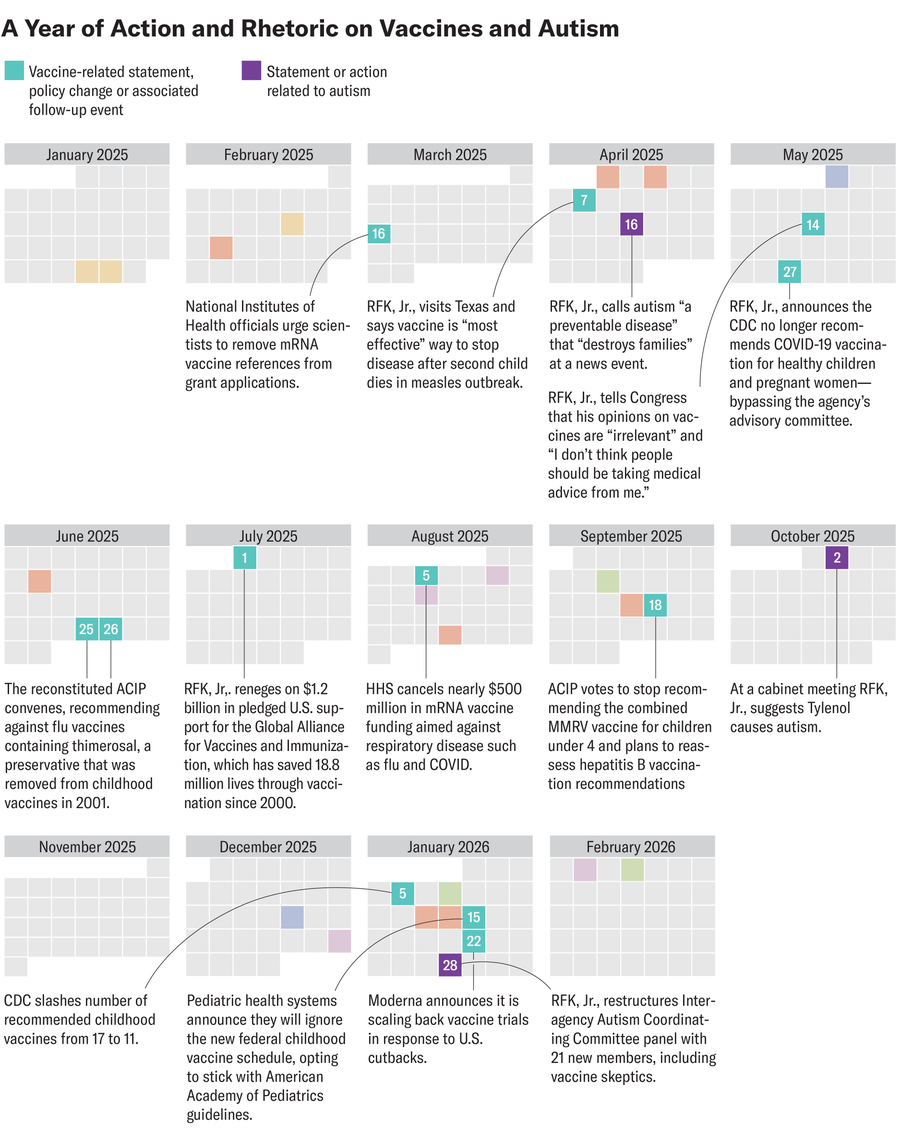
Health experts say Kennedy has made sweeping reversals on these statements. His HHS tenure has seen the U.S. childhood vaccine program reduce the number of recommended shots to protect against 11 diseases instead of 17, thousands of public servants (many of them scientists) have been fired, standard-setting scientific practices at the Centers for Disease Control and Prevention, Food and Drug Administration and National Institutes of Health have been replaced with “gold-standard” dictates that scientists call dishonest, and judges have blocked funding cuts as illegal. Kennedy and HHS officials did not respond to requests for comment.…”
The secretary has spoken broadly about his goals this year to Congress and the public. In September, before a Senate panel, he described his “big-picture” mission as “enacting a once-in-a-generation shift from a sick care system to a true health care system that tackles the root causes of chronic disease.” His “Make America Healthy Again” (MAHA) agenda, now wedded to President Donald Trump’s “Make America Great Again” movement, puts Kennedy atop a new, unorthodox American political coalition. It unites a partisan distrust of science with a deep-rooted skepticism of medicine and the food industry. Roughly four in 10 parents are supporters of the MAHA movement, according to a KFF survey.
“Who can argue with the foundational goal of ‘Making America Healthier Again’? We want parents to want healthier lives for their children,” says Washington University in St. Louis School of Public Health dean Sandro Galea, author of the book Within Reason: A Liberal Public Health for an Illiberal Time. Many of the goals of the MAHA movement—including increasing stalled U.S. life expectancies, bettering childhood health and addressing overmedicalization—are shared by public health experts.
“It would be great to see MAHA be a force for good,” Galea says. “But some of its ideas, frankly, will end up hurting people.” Notably, Kennedy’s decisions on vaccines will inevitably lead to outbreaks, Galea says, and the return of preventable infectious diseases such as measles. “We really haven’t seen an HHS tenure like this in our lifetimes.”
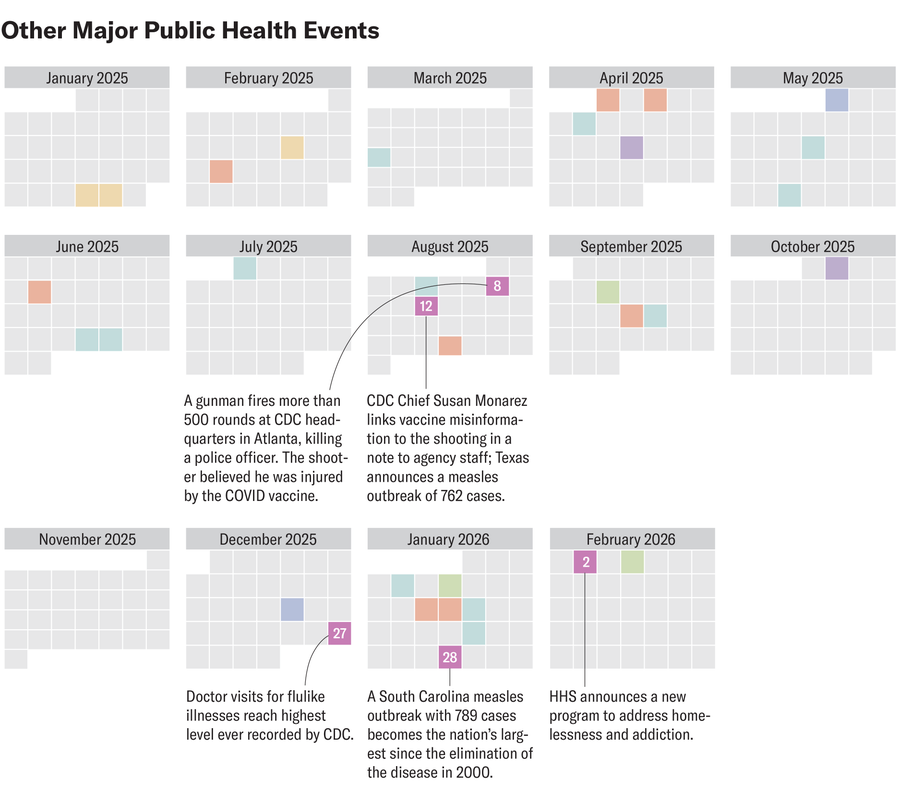
HHS is largely the national social insurance arm of the U.S., with a sideline in medical research and public health. It oversees the massive Social Security, Medicare and Medicaid programs, as well as the FDA, CDC and NIH. In many ways, the colossal agency today continues to function as normal: Social Security checks, Supplemental Security Income or both still lands in nearly 75 million mailboxes every month, one in five Americans receives Medicaid coverage, and the Affordable Care Act that the department administers still covers more than 24 million people nationwide despite Trump administration cuts to health insurance and food assistance. On February 2 Kennedy announced a $100 million pilot program to fund outreach, medical treatment and other support for homeless people and those with substance use disorders in eight cities—in the kind of bipartisan response to the overdose crisis long sought in the public health world.
This kind of tumult is now standard fare at HHS. In his first year, Kennedy fired his own handpicked CDC chief, linked Tylenol to autism with little evidence and urged farmers to let bird flu “run through” their flocks (an idea that could blow chicken prices skyward and spur spread of the virus, experts say). All told, the agency lost more than 17,000 civil servants through firings and resignations in 2025—including many scientific leaders at the FDA, CDC and NIH. An HHS spokesperson defended Kennedy’s cuts to “bloated bureaucracies that were long overdue” to ProPublica in August.
In the September Senate hearing, Kennedy accused one critical lawmaker of “crazy talk” and took out his phone and began scrolling through it while another spoke. “We’re denying people vaccine,” said senator Bill Cassidy of Louisiana, the physician chair of the Senate health committee. “You’re wrong,” Kennedy replied to Cassidy, who provided a crucial Republican vote last February for Kennedy’s confirmation.
Kennedy “comes across as a privileged rich guy with an air of entitlement,” says American Public Health Association executive director Georges Benjamin, whose organization called for Kennedy to resign in April after the mass layoffs at the CDC, FDA and other health agencies. “He’s completely in over his head at this job, has no experience, no training in areas of health he’s affecting and is causing a lot of harm.”
VACCINES
Kennedy has a long history of vaccine opposition. He joined the board of the antivaccine nonprofit Children’s Health Defense in 2015, when it was known as the World Mercury Project (and resigned from his position as chairman in 2024); the organization led numerous lawsuits against vaccine makers. The move from environmental lawyer to antivaccine activist turned out to be well timed for postpandemic politics; attacking COVID vaccines wooed Republican voters. At his confirmation hearing, Kennedy refused to disavow links between vaccines and autism, a favorite theory of outfits spurring vaccine hesitancyamong parents, though numerous studies have found no connection. “News reports have claimed that I am antivaccine or anti-industry,” Kennedy said at his confirmation hearing. “I am neither; I am pro-safety.” What Kennedy meant then by safety has since become clear, Benjamin says: his own judgment.
The FDA’s top vaccine official, Peter Marks, resigned in March, writing of Kennedy, “truth and transparency are not desired by the secretary, but rather he wishes subservient confirmation of his misinformation and lies.” During the pandemic, Marks had famously withstood political pressure to approve COVID shots without safety testing. Now he is out. An HHS official told NPR that Marks “has no place at FDA” because of his opposition to the secretary “restoring science to its golden standard and promoting radical transparency” at the agency.
Kennedy later claimed Monarez had told him she wasn’t “trustworthy”; in Senate testimony, she denied doing so. “The question before us is whether we will keep faith with our children and grandchildren—ensuring they remain safe from the diseases we fought so hard to defeat: polio, measles, diphtheria, whooping cough and many others,” Monarez said at the September 17 Senate hearing. “Undoing that progress would not only be reckless—it would betray every family that trusts us to protect their health.”
In December Kennedy’s reconstituted vaccine panel voted to stop recommending that all newborns be vaccinated for hepatitis B, a disease that contributed to the deaths of 1.1 million people worldwide in 2022. HHS next reduced the number of U.S. childhood vaccine shots so that they protected against 11 diseases instead of 17, basing the decision on the rules of Denmark, a country with a relatively small and homogenous population and publicly funded health care for all. Most recently, the chair of the vaccine panel, a cardiologist, told POLITICO that its focus this year will be on examining vaccine side effects rather than on its longstanding mission of gauging vaccine effectiveness.
WELLNESS
“I walk through the airports today…, and I see these kids that are just overburdened with mitochondrial challenges,” Kennedy said in August at a Texas “Make America Healthy Again” state-law-signing ceremony. Ashish Jha, formerly the Biden administration’s pandemic response czar, called this airport diagnosis “wacky, flat-earth voodoo stuff” on X (formerly Twitter).
“I think what we’re seeing is a mutual partnership between RFK, Jr., and what he says he values and the existing MAHA values and ideals,” says Mariah L Wellman of Michigan State University, a wellness industry scholar. Kennedy’s rhetoric reflects a common ground with influencers like Means, she adds. “I absolutely think there are deep ties between how the wellness industry exists [and] is talked about on social media right now and RFK, Jr.’s beliefs.”
In May, at a Senate Finance Committee hearing, Kennedy called for an end to genetic research on the causes of autism, instead suggesting that “environmental toxins” were the source. Kennedy often claims there that there is an autism “epidemic,” but improved diagnosis largely explains the recent rise in cases.
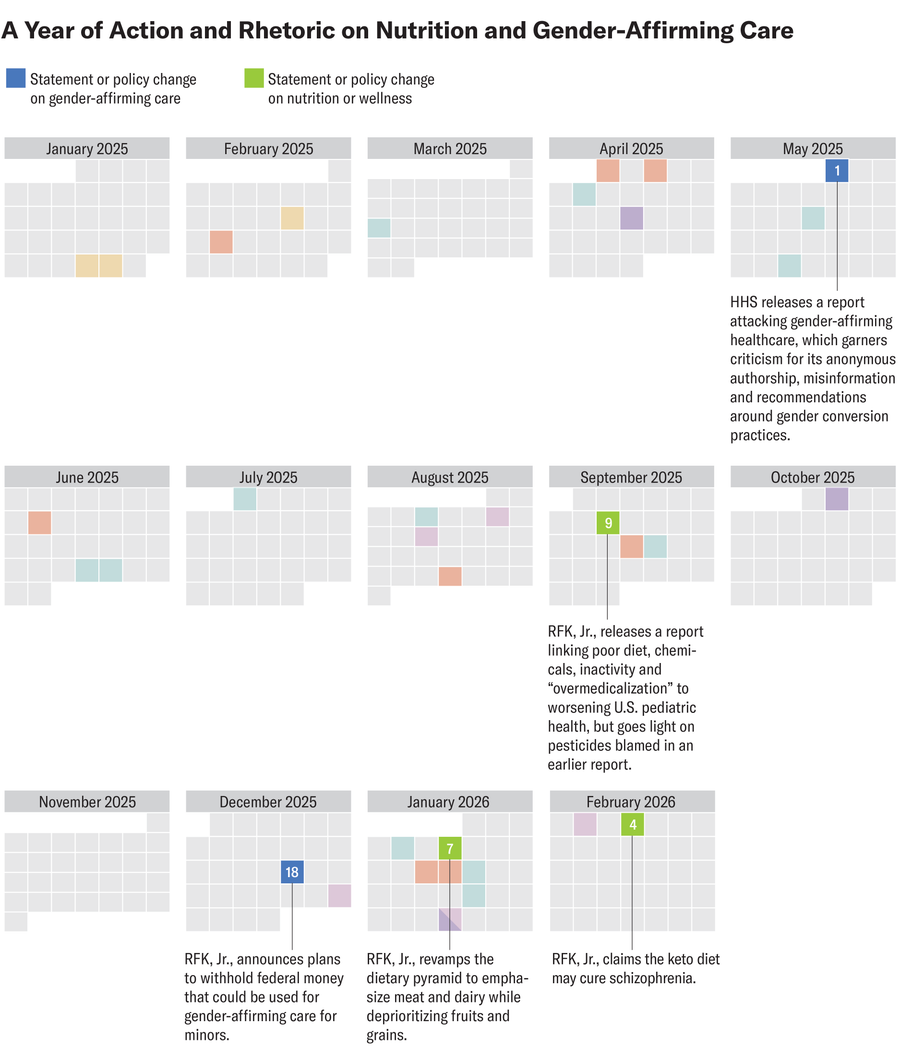
A MAHA commission report released by HHS in September reflected the movement’s signature mixture of concern over real problems, such as rising childhood obesity and illness, with Kennedy’s “pet peeves and half-baked science that doesn’t really get at the root causes of poor health in children,” says Peter Lurie of the Center for Science in the Public Interest. Alongside calls for research on cell-phone-signaleffects on health and vaccine injuries, the report went light on investigating pesticides and the food industry, disappointing some environmental figures.
In September Kennedy joined Trump in suggesting that Tylenol use during pregnancy causes autism—another belief taken up by the wellness industry—based on weak evidence. Scientists, however, say that if the medicine is linked with autism—a connection that’s not yet clear—it could be the fevers and infections the Tylenol was meant to address, and not the pills themselves, that drives increased autism risk. Nevertheless, HHS started the process for an FDA warning to be added to the pain reliever’s label.
The recommendations fit a pattern of Kennedy’s, Benjamin says. “I see him as a sort of environmental purist of sorts,” he says, rejecting medicine just as he once opposed pollution as an environmental lawyer. Fatty “real” foods, even if they are linked to heart disease, look less threatening to a worldview shaped by fears of something “artificial” causing harm, even if (unnatural) prescription drugs such as statins actually reduce the risk of heart disease. “He is an advocate, and he sees the world as a place for advocacy, not [for] the balanced perspective of a scientist or physician,” Benjamin says.
Antidepressants and heart disease medications are now in MAHA’s sights. Kennedy has claimed that medications such as these are overprescribed as a result of what he says is corruption that has affected medical studies—a charge that echoes his environmental movement rhetoric.
POLITICS
“Don’t you want a president that is going to make America healthy again?” Kennedy said at an August 23, 2024, campaign rally in Glendale, Ariz., in which he endorsed Trump. At the event, as Trump was introducing Kennedy to his supporters, he announced his intention to release the assassination files of Kennedy’s uncle John F. Kennedy…
“RFK, Jr., certainly has his own goals and ideology that overlap with Trump’s and are also distinct,” says Pamela Herd of the University of Michigan’s Gerald R. Ford School of Public Policy. “But at the end of the day, it is the Trump administration, and he will be limited to what it is, or isn’t, comfortable with.”
At a December campaign rally-style briefing from the first-floor stage of HHS’s headquarters at the Hubert H. Humphrey Building in Washington, D.C., Kennedy announced sweeping plans to restrict gender-affirming care for U.S. minors. Kennedy recognized political activists and conservative politicians in his opening remarks. Gender-affirming care has not been a historical preoccupation of Kennedy or the wellness industry but rather one “where the [Republican] party sees an advantage,” POLITICO observed.
“I think the MAHA and MAGA [movements] are intersecting circles in a Venn Diagram,” says political scientist David Lewis of Vanderbilt University. Right now, the two movements form a political coalition held together by Trump, he says.
Overall, the most significant effect of Kennedy’s tenure at HHS, Herd says, is his firing of scientific leaders and replacing expertise with political activism, most notably in upending the childhood vaccine schedule. The politicization genie won’t easily go back in the bottle, she says. “I think this this is a much more kind of radical change and one that’s difficult to pull back.”
MAHA and MAGA are now inextricably linked. In February Kennedy spoke at the right-wing Heritage Foundation’s event “One Year of Making America Healthy Again,” attended by political activists and Senator Tommy Tuberville. There Tony Lyons, president of the political group MAHA Action, described the group’s commitment to backing Republican candidates endorsed by Trump, a sign that the political coalition forged in the 2024 election will hold into the midterms. “It’s a joy to work for [Trump],” Kennedy said onstage. “He lets me do stuff that I don’t think anybody else would ever let me do.”
DAN VERGANO is senior editor, Washington, D.C., at Scientific American. He has previously written for Grid News, BuzzFeed News, National Geographic and USA Today. He ischair of the New Horizons committee for the Council for the Advancement of Science Writing and a journalism award judge for both the American Association for the Advancement of Science and the U.S. National Academies of Sciences, Engineering, and Medicine.
It’s Time to Stand Up for Science
If you enjoyed this article, I’d like to ask for your support. Scientific American has served as an advocate for science and industry for 180 years, and right now may be the most critical moment in that two-century history.
I’ve been a Scientific American subscriber since I was 12 years old, and it helped shape the way I look at the world. SciAm always educates and delights me, and inspires a sense of awe for our vast, beautiful universe. I hope it does that for you, too.
If you subscribe to Scientific American, you help ensure that our coverage is centered on meaningful research and discovery; that we have the resources to report on the decisions that threaten labs across the U.S.; and that we support both budding and working scientists at a time when the value of science itself too often goes unrecognized.
Last night Rep. Jamie Raskin posted a comment on Twitter about his visit to a nearby ICE facility:
I just exercised my right as a Member of Congress to conduct an unannounced oversight visit of the ICE field facility in Baltimore. The staff I met with respected my right to visit, but what I saw was disgraceful. Kristi Noem has a budget of $75 billion she could use to ensure humane conditions, but we saw 60 men packed into a room shoulder-to-shoulder, 24-hours-a-day, with a single toilet in the room and no shower facilities. They sleep like sardines with aluminum foil blankets. Whether it’s for three days or seven days, nobody would want a member of their family warehoused there. The room set aside for dangerous criminals and violent offenders was empty. We’re demanding immediate answers and action.
What kind of a person treats other human beings this way?
Over the past few years, vouchers have been endorsed by state legislatures even though the public overwhelmingly opposes them. Nearly a score of state referenda have been held, and in every single state, voters rejected vouchers. Even voters in red states said NO to vouchers.
Voters don’t want to pay for tuition at private and religious schools. But legislators ignore their votes. In Arizona, voters rejected vouchers by 65-35%. But the legislature passed a voucher bill anyway, and the cost to subsidize these nonpublic schools is $1 billion a year.
Today’s evangelists for subsidizing religious schools have chosen to ignore the admonitions of the Founding Fathers, who made clear their opposition to state-funded religion. When Thomas Jefferson wrote about “separation of church and state,” he was referencing a widely held principle.
Since the U.S. Supreme Court rolled back fifty years of national reproductive freedom in Dobbs v. Jackson Women’s Health Organization in 2022, the Christian Right has turned to another long-held priority: an eventual Court ruling that states must fund religious education.
Over the past few weeks, efforts to create religious charter schools have seen new life. Charter schools are public schools operated outside of the traditional district framework. They can be independently managed by a non-profit or, in some states, for-profit management group, or they can be part of larger networks of charter providers. There are roughy 8,000 charter schools across the country, serving nearly 4 million students.
Blurring Public and Private
In mid-2025, a case called St. Isidore of Seville Catholic Virtual School v. Drummond deadlocked at the Supreme Court, 4-4. It returned back to Oklahoma, where that state’s highest court had invalidated efforts by a Catholic-run provider to operate a virtual charter school. Had the Court ruled in St. Isidore’s favor, it would have effectively created the nation’s first church-run public school.
But Justice Amy Coney Barrett recused herself, reportedly because her best friend, a law professor named Nicole Garnett, had worked extensively on the legal defense for the Catholic charter school (Side note: while I’m glad Barrett recused herself, notice that the one conservative woman on the Court has held herself to a higher ethical standard than right-wing guys like Clarence Thomas and Sam Alito).
The Court’s 4-4 ruling was less a definitive position and more an artifact of the small, insular nature of conservative—and especially Catholic conservative—American legal networks. Now, efforts to create a Jewish charter school in Oklahoma, and Christian public schools in Colorado and Tennessee are taking new shape.
Technically, these cases operate in a separate stream of legal theory from school voucher jurisprudence. Vouchers are simply taxpayer subsidies for private schools—either through the tax code or directly through state funds. And since 2002’s Zelman v. Simmons-Harris, their application to religious schools has been constitutional. Three voucher-related cases since 2017—Trinity Lutheran Church of Columbia v. Comer (2017), Espinoza v. Montana Department of Revenue (2020) and Carson v. Makin (2022, 3 days before Dobbs)—have extended protections to religious schools in state voucher systems.
Basically, once states use public dollars to subsidize private providers of a certain social service (such as education), they can’t limit those providers to non-religious organizations.
But for now, state’s don’t have to provide voucher funding to parents. It’s just that if they do fund vouchers, they must allow vouchers to be spent at religious schools too.
This connects to the question of religious charter schools because although charter schools are legally public entities, the organizations operating them in most cases are private. In theory, the arrangements governing these groups are similar to situations where a school district contracts with a private transportation company for their buses, or a cleaning company for their buildings. Except that with charter schools, the contracted party typically provides instructional materials and even often supplies the teachers.
What right-wing activists want is for the Supreme Court to say that states can’t prevent religious organizations from running public schools as part of a charter agreement And in that, they are taking one tactical approach in a broader legal and political strategy to simply require states to fund religious instruction.
Establishment and Free Exercise
Spurred partly by new “education savings accounts” spreading in red states (aka vouchers, with additional allowable expenses beyond tuition), a vast network of conservative Christian homeschoolers is pushing for new legal rights. Including mandatory subsidies for their homeschools.
And Betsy DeVos, the billionaire and former U.S. Education Secretary, has made no secret of her desire to see the Supreme Court overturn more than a century of state “Blaine Amendments” prohibiting public dollars spent on religious schools. That would basically force all states to pay for some form of religious instruction.
All of this is possible in large part due to the efforts of Leonard Leo, the Catholic super-fixer of right-wing judicial politics all-but-responsible for the Court’s current conservative majority. Leo has made clear that following Dobbs, state-funded religious education is his next major project in the federal judiciary. And he’s enlisting the Alliance Defending Freedom (the main litigation group in Dobbs) to help lead the way. Beyond garden-variety culture warring, this is partly what the sustained effort to holler about LGBTQ and especially trans-students in public schools is about.
Meanwhile, brand new guidance from what’s left of the U.S. Department of Education is informing public schools across the country that federal dollars will now be tied to expansive interpretations of the right for school personnel to pray during the day in schools. So long as they do not technically compel students to pray at lunch or at the start of the school day, teachers and school leaders may choose to lead their students in prayer.
The end-game here is to de-emphasize the first part of the First Amendment—the Establishment Clause prohibiting government from establishing a single religion—and to emphasize the second part, the Free Exercise Clause.
The argument pushed by DeVos, Leo, ADF and their allies is that by providing taxpayer support only for secular public schools, states are putting undue hardship on families who see religious education as a fundamental part of their free exercise of faith but must pay out-of-pocket for it.
What’s at Stake
It’s possible—even necessary—to object to all this without attacking faith. I’m a Christian man myself, looking forward to the season of reflection of Lent that begins next week.
But church-based public schools are the plan on the Right. And although it’s mostly a battle that will take place in the courts, it’s also a battle that’ll take place in legislatures and in the court of public opinion. And those venues are determined by elections and by political organizing.
When I argue that Democrats have to get serious about improving public schools as part of defending public schools, I’m not just making an argument about campaign strategy (though I’m making that argument too).
What’s at stake here is that the American Right is obsessed with schools, and with carving more and more dollars out to subsidize religious education. And that’s going to be what happens without countering that objective with a bold, sustained vision for educational opportunity for every child.
Stephen Dyer, former legislator and critic of school privatization in Ohio, explains here how a Republican-sponsored bill will hit Republican districts hardest.
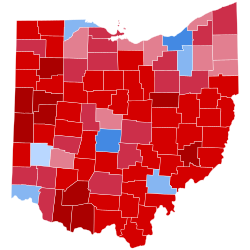
It’s no secret that over the last decade, Ohio has gone from a battleground state to a pretty red one, especially when Donald Trump is on the ballot. The major swing that occurred between 2006 when Democrat Ted Strickland won 70+ counties and 2024 has occurred in rural and urban counties, especially around the Mahoning Valley.
Gov. Ted Strickland’s 2006 victory map
President Donald Trump’s 2024 victory map
So what does the Ohio GOP do this year, which is shaping up to be a tough year for them anyway, to hold onto their Trump coalition?
10th Period is a reader-supported publication. To receive new posts and support my work, consider becoming a free or paid subscriber.
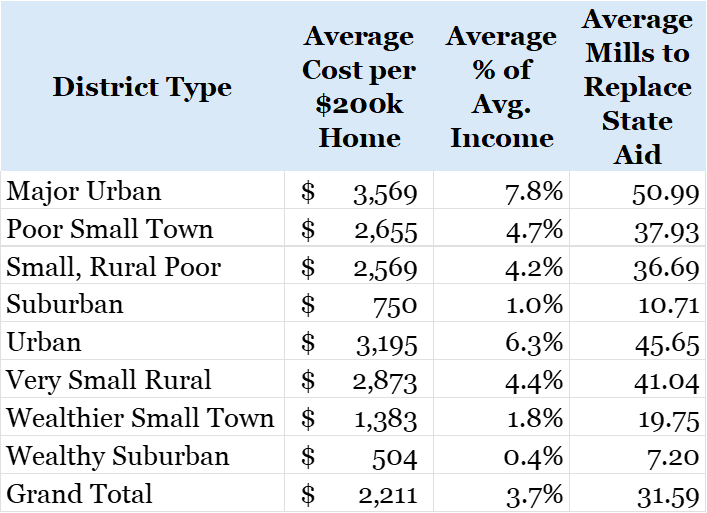
Try this: Introduce a bill that would, if passed, require folks living in Mahoning County to increase their property taxes by an average of $2,300 per $200,000 home and Trumbull County by $1,886, or close their kids’ schools.
During a year where everyone is so pissed about property taxes being high that they want to actually get rid of property taxes.
Yeah. Pretty stupid, right?
Why would they do something so stupid, you ask?
So they can maintain an unconstitutional private school tuition subsidy that lets Les Wexner — the guy who was best buddies with Jeffrey Epstein —get a taxpayer funded break on his private school tuition bill.
I can’t make up this shit, man.
These guys obviously think they’re politically invincible.
I ran some more analysis of the bill that Callender introduced (who was Ohio Charter Schools’ go to lawyer prior to returning to the House a few years ago), which would block state aid to any school district that’s suing the state over its private school tuition subsidy, which, again, has been found to violate the Ohio Constitution.
Needless to say, the results are not awesome.
The average Ohio school district would have to go for a levy that runs about 32 mills and would cost a homeowner of a $200,000 home an additional $2,200 a year. And that’s only if they want to keep their kids’ schools open.
Because scores, if not hundreds, of school districts would cease operating under this bill
As you can see, the impact is worst for urban districts, but rurals are really hammered too.
This data is using the most recent Ohio Department of Education District Profile Report (for income and millage) and the most recent District Payment report for February 2026
I mean, you’re going to have poor, small town¹communities having to contemplate losing an additional 5% or more of their income to pay for Les Wexner’s private school tuition cut? That’s what you’re going with? This year?
Some other tidbits:
Trimble Local in Athens County would have to raise their property taxes by a staggering $11,355 per $200,000 home to replace the extorted money. That’s a 162.26-mill levy to raise what amounts to 23% of the average district resident’s income.
Steubenville — the home of Dean Martin and a famously Trump-y area — would need to go for a 119-mill levy, costing the $200,000 homeowner another $8,350 per year, which is 16% of the average family’s income there.
There are 56 Ohio school districts that would need to go for 50-mill levies or higher to replace the state aid Callender wants to cut. Or those kids — all 137,455 of them — will no longer have schools.
There are families in 22 Ohio school districts that would have to give up 10% or more of their average income to make up for Callender’s proposed cuts.
The average share of the cost in these districts that’s borne by the state is 47%. So the “you need to tighten your belt” argument ain’t working for these districts.
All so Les Wexner can get his private school tuition subsidized.
I could go on. I posted the spreadsheet here, in case you want to look at more of these just amazing consequences. Not every school district has joined the lawsuit. So these data only apply to those who have. But there are so many of them (@300, or half of all Ohio school districts) that you can extrapolate the results. If every district joined, the effect would be nearly identical to what’s happening in those that have already.
I will say that this bill is clearly unconstitutional. I don’t know how the state will argue that removing funding from 700,000 students is going to provide those same students with a thorough and efficient system of common schools, as the Ohio Constitution mandates.
So, in short, there is simply no way this bill survives even a modicum of legal scrutiny. So the chances of this happening are next to nothing.
Bu then if it’s clearly unconstitutional, as Callender must know it to be, then why do it? Scare local school districts form joining the lawsuit, or leaving it? Fat chance of that happening. I’ve been hearing districts and, more importantly, parents are more pissed now than they were before.
Like I said earlier, this is quite a play for Callender to make in an already tough political environment 9 months from an election that is expected to be focused on affordability and corruption.
But hey. It’s worked for these guys before and they keep winning in gerrymandered districts.
So why change now, right?
1. These district types are ones developed by the Ohio Department of Education, not me.
Back in the late 1980s, when charter schools were a brand new idea, advocates said that charter schools would be more accountable, cost less, and would get better results.
It was also speculative, since no charter schools existed then. I believed it would turn out that way, as did other proponents of charter schools.
But none of those beliefs/hopes panned out.
We now know that charter lobbyists oppose accountability in state legislatures.
We now know that charter schools do not get better results than public schools, unless they exclude the kids who get low test scores.
We now know that charter schools do not cost less. Many of their leaders are paid more than public school leaders (some are paid $1 million a year). They lobby legislatures to give them the same funding as public schools. In some states, charters have won the power to locate rent-free in public school buildings.
Peter Greene here explains that the charter industry is seeking federal legislation to underwrite the cost of charter school facilities. The federal Charter School Program already provides $500 million a year to start new charter schools or expand existing ones. This grand gift, which the Trump administration increased, ignores the fact that demand for charter schools has declined while charters continue to close because of falling enrollments.
Among the various bills thrown at Congress is one that finds new ways to throw public money at charter schools.
HB 7086, the “Equitable Access to School Facilities Act,” proposes to send money to charter operators, via the state, to buy and build facilities for schools.
The cost of coming up with a building to put charter schools in might seem like part of the cost of being in the charter school business, but charter operators don’t much care for having to fork over the money. In some states, legislators have solved the problem by just allowing charter schools to just take public property. Florida is rolling out a law that lets charters take public school real estate in whole or in part just by saying, “Hey, we want that.” It’s an extraordinary law, sort of like the opposite of eminent domain, in which the facilities that taxpayers have bought and paid for suddenly belong to a private business.
HB 7086 wants to propose a similar federal solution, delivering grants to any states that come up with clever ways to gift taxpayer dollars to charters that want to build or buy some facilities, or want to come up with fun ways for charters to grab taxpayer-funded buildings.
The bill comes courtesy of Rep. Juan Ciscomani, an Arizona Republican, who just wants to make sure that every school is a great school. In a press release, he explains:
Sadly, access to appropriate and affordable school buildings for charter schools continues to be one of the biggest barriers to growth. Unlike district schools, charter schools aren’t guaranteed access to school buildings or traditional access to facilities funding sources like local property tax dollars.
Yeah, I was going to open a restaurant, but access to food and cooking supplies was a big barrier to growth, so maybe the taxpayers would like to buy that stuff for me?
Or maybe when you decide to go into a business, you do it with a plan that takes into account the cost of being in that business. Certainly the notion that building and financing facilities is easy peasy for public school systems is disconnected from reality. When West Egg Schools want a new building, they have to convince the taxpayers or else that school board will find themselves voted out of office.
If you want to get into the charter school biz, you need a plan about how you’ll manage the cost of getting into the charter school biz. “Well, get the feds to drain taxpayers to fund it for us,” is not such a plan.
The bill does display one of the lies of the charter movement– that we can finance multiple school systems with the same money that wasn’t enough to fund one. Not that I expect any choicers to say so out loud. But no school district (or any other business) responds to tough money times by saying, “I know– let’s build more facilities.” The inevitable side effect of choice systems is that taxpayers end up financing redundant facilities and vast amounts of excess capacity, which means taxpayers have to be hit for even more money. Legislators continue to find creative ways to A) ignore the issue and B) legislate more paths by which taxpayer money can be funneled to choice schools.
This bill hasn’t died yet. Tell your Congressperson to drive a stake through its heart.
Some years back–actually it was 2019–I read an article that gladdened my heart. It was written in The Atlantic by gazillionaire Nick Hanauer. It was titled “Better Schools Won’t Fix America.”
Nick is an interesting guy. He is an entrepreneur in Seattle. He works alongside other successful venture capitalists, and for a time, partnered with Bill Gates to persuade the Washington legislature to endorse charter schools as a remedy to replace “failing” public schools.
But somewhere along the way, he had a change of mind and heart. He realized that the basic problem in the U.S. was income inequality, not “failing schools.”
He began his 2019 article:
Long ago, I was captivated by a seductively intuitive idea, one many of my wealthy friends still subscribe to: that both poverty and rising inequality are largely consequences of America’s failing education system. Fix that, I believed, and we could cure much of what ails America.
This belief system, which I have come to think of as “educationism,” is grounded in a familiar story about cause and effect: Once upon a time, America created a public-education system that was the envy of the modern world. No nation produced more or better-educated high-school and college graduates, and thus the great American middle class was built. But then, sometime around the 1970s, America lost its way. We allowed our schools to crumble, and our test scores and graduation rates to fall. School systems that once churned out well-paid factory workers failed to keep pace with the rising educational demands of the new knowledge economy. As America’s public-school systems foundered, so did the earning power of the American middle class. And as inequality increased, so did political polarization, cynicism, and anger, threatening to undermine American democracy itself.Great public schools are the product of a thriving middle class, not the other way around.
Taken with this story line, I embraced education as both a philanthropic cause and a civic mission. I co-founded the League of Education Voters, a nonprofit dedicated to improving public education. I joined Bill Gates, Alice Walton, and Paul Allen in giving more than $1 million eachto an effort to pass a ballot measure that established Washington State’s first charter schools. All told, I have devoted countless hours and millions of dollars to the simple idea that if we improved our schools—if we modernized our curricula and our teaching methods, substantially increased school funding, rooted out bad teachers, and opened enough charter schools—American children, especially those in low-income and working-class communities, would start learning again. Graduation rates and wages would increase, poverty and inequality would decrease, and public commitment to democracy would be restored.
But after decades of organizing and giving, I have come to the uncomfortable conclusion that I was wrong. And I hate being wrong.
What I’ve realized, decades late, is that educationism is tragically misguided. American workers are struggling in large part because they are underpaid—and they are underpaid because 40 years of trickle-down policies have rigged the economy in favor of wealthy people like me. Americans are more highly educated than ever before, but despite that, and despite nearly record-low unemployment, most American workers—at all levels of educational attainment—have seen little if any wage growth since 2000.
To be clear: We should do everything we can to improve our public schools. But our education system can’t compensate for the ways our economic system is failing Americans. Even the most thoughtful and well-intentioned school-reform program can’t improve educational outcomes if it ignores the single greatest driver of student achievement: household income.
Hanauer recognized that the hollowing out of the middle class was harming our entire society:
In short, great public schools are the product of a thriving middle class, not the other way around. Pay people enough to afford dignified middle-class lives, and high-quality public schools will follow. But allow economic inequality to grow, and educational inequality will inevitably grow with it.
Hanauer’s turnaround resonated with me. He was boldly breaking ranks with his peers. I doubt he suffered ostracism, because many of the elites toy with education; it is not a vital interest to them. In my limited experience, watching the uber-rich participate on behalf of charter schools, it appeared that many were going along with the crowd, while some thought that privatization was a miracle cure.
Hanauer understood that children need a good start in life and they need a stable, secure home life to do their best in school. He understood that economic inequality undermined many children’s interest in school, which was less important than survival or a warm winter coat or medical care. He even understood that the decades-long efforts to stamp out unions contributed to economic inequality.
We spoke on the phone. I did a podcast with him. I was impressed by his keen intellect and independence of mind.
With each book I wrote about privatization, I insisted that schools are vital institutions in educating children, but they can’t do it alone. In Reign of Error, I spelled out what I considered a life-course approach to improving the chances of giving children the education they need and deserve.
In the competition between public schools and charter schools, the only measure that outsiders considered was test scores. But I knew that was not right. For many young people, it’s miraculous when they manage to show up for school. They chose to go to school, not to babysit a younger sibling, not to take a part-time job delivering to customers, not to hang out in the local park.
What kind of a school was that? I came to understand that the closest approximation of a school that I imagined was a community school. Community schools provide wraparound services to students and their parents.
Denis Smith retired after spending years working for the Ohio Departmeny of Education. His last job was overseeing charter schools.
In this post, which appeared in the Ohio Capitol Journal, Smith reviews a proposal by Vivek Ramaswamy, a Republican candidate for Governor, that unintentionally reveals the hypocrisy of public funding for private schools. Ramaswamy wants to mandate the recitation of the Pledge of Allegiance daily in all public schools, but publicly-funded private schools would be exempt from this mandate.
Smith writes:
It’s hard for me to offer a thank you to Vivek Ramaswamy for anything, but he truly deserves our thanks for a recent statement.
Thank you, Vivek, in making the case for public education and demonstrating its true value to the nation.
For someone who reportedly wanted to “detox” from social media only a week ago, your post on X stating that you would make the oral recitation of the Pledge of Allegiance mandatory in the state’s schools has provided added layers of meaning for the public to discern that public education is a public good.
Unbeknownst to the Republican governor candidate, his tweet gives public school supporters added ammunition to hurl back at GOP efforts to fund private and religious schools though universal education vouchers that violate the Ohio Constitution.
“We’ll say the pledge of allegiance every day at every public school after I’m elected,” Vivek wrote.
He went on to say that, “We need more national unity, not less.”
When examined further, his brief post reveals the fatal flaws in Republican efforts to establish a parallel, non-public system of education that violates the Ohio Constitution.
Let’s look at a few flaws that Ramaswamy’s seemingly innocuous post brings to light.
According to the Ohio Revised Code, “The board of education of each city, local, exempted village, and joint vocational school district shall adopt a policy specifying whether or not oral recitation of the pledge of allegiance to the flag shall be a part of the school’s program …”
There is no requirement in that section of the ORC for private and religious schools to adopt policies that would place the oral recitation of the pledge as a regular part of the school program.
That sentence is revealing because it shows that non-public schools can receive state funds but not be encumbered by the many laws and regulations that govern public schools.
That’s having it both ways, an art that non-public schools practice so well. We’ll take your money, thanks, but don’t tell us that this or that law or regulation is mandatory in our (private or religious) schools.
Hmmm. I wonder how Ramaswamy and Republicans privately feel about how public funds might go to non-public schools that might care less about instilling patriotism than inculcating their own brand of ideology and history.
The idea or probability of a publicly funded religious school that teaches its students that the earth is only 6,000 years old readily comes to mind.
With the current devolution of our society, where Republicans achieve a twofer by eroding public education as a way of destroying public employee unions, that idea is not farfetched.
In addition to a possible future Pledge of Allegiance mandate for public schools, as called for in Ohio House Bill 117, where public and religious schools would be exempt from such requirements, there is another hidden structural flaw in Ramaswamy’s post that belies his words:
“We need more national unity, not less,” Ramaswamy wrote.
Huh? How does a parallel, unconstitutional yet publicly funded private and religious school system, funded by universal educational vouchers, contribute to national unity?
Vivek said that we need more national unity. Explain how $1 billion taken from state school aid and given to other, non-public schools that are exempt from so much law and regulation, adds to national unity.
Do these schools pledge allegiance to the state and embrace regulatory compliance in return for such cash? Hardly.
Two years ago on these pages, I offered the views of Dr. Kenneth Conklin, a philosopher who is concerned about “community cohesion and settled social bonds,” along with cultural fragmentation. Here are his considered views:
“If an educational system is altered, its transmission of culture will be distorted,” Conklin wrote. “The easiest way to break apart a society long-term without using violence is to establish separate educational systems for the groups to be broken apart.”(Emphasis mine.)
How do we get more national unity by establishing separate educational systems?
Dr. Conklin added some other thoughts that Ramaswamy and other Republicans such as Ohio Speaker Matt (“We can kind of do what we want”) Huffman and Senate Education Chair Andrew (“Public education in America is socialism”) Brenner might reflect on as our national unity continues to deteriorate.
“A society’s culture can survive far longer than the lifespan of any of its members, because its educational system passes down the folkways and knowledge of one generation to subsequent generations. A culture changes over time, but has a recognizable continuity of basic values and behavioral patterns that distinguishes it from other cultures. That continuity is provided by the educational system.”
Ramaswamy says that he is concerned about national unity. So am I. Indeed, that continuity is provided by a common school system.
If Ramaswamy is truly concerned about national unity, we should await his announcement about the corrosive effect of vouchers, their damage to community cohesion, settled social bonds, and cultural fragmentation.
Garry Rayno, veteran journalist, reports on the latest Republican plan to defund public schools in New Hampshire. They are moving quickly to enact a plan that will fatten rich districts and impoverish poor districts. They have already passed a voucher plan without income limits; the overwhelming majority of students taking vouchers were already attending private schools. in other words, state welfare for the rich.
Rayno writes in IndepthNH.com:
What’s the hurry?
Last week the Senate was in a hurry to pass two bills that will significantly harm the majority of school districts and students in public schools, while property wealthy districts and well-to-do families will benefit, all in the name of school choice.
The plan is to have the House agree Thursday to the amended version of House Bill 751, which would allow a New Hampshire public school student to enroll in any other public school in the state rather than the school where he or she lives.
The Republican controlled House is expected to concur or agree to the Senate amendment, sending the bill to Gov. Kelly Ayotte’s desk for her action.
The bill would go into effect immediately instead of next school year as Senate Bill 101 would do, which is nothing more than an attempt to cut short the beating a similar plan has already taken at deliberative sessions in annual school district meetings around the state.
Something this complicated needs more than a few weeks to implement or it will create chaos and uncertainty.
As it stands, the open enrollment plan would make property poor school districts donor communities to property wealthy communities while increasing per student costs for the poorer districts and lowering the per student costs for the wealthier districts.
This really is Robin Hood in reverse.
And this bill is way more financially harmful to poorer communities than a $5,000 grant through the Education Freedom Account program as school districts would owe other districts tens to hundreds of thousands of dollars a year.
The open enrollment plan would exacerbate the already alarming inequities between the schools in property wealthy communities and those in property poor cities and towns.
To add insult to injury, any shifting of schools for children from poor families will be out of reach because their parents cannot afford transportation or the difference in per student costs they would have to pay if their school district spends less per student than the school their child wants to attend.
The best and well-to-do will be able to go to schools in Bedford, Bow, Amherst, New Ipswich, Rye, Hanover, etc. but the majority of students will be in school districts with declining state aid as it follows the child after the first year and their parents will face ever increasing property tax bills.
This plan is not something that should be fast-tracked, unless you want to destroy public education, which is the goal of the Republican majority in the Legislature.
Under the plan, school districts would have to determine the capacity of the school and the grade levels and update the information each month.
Unlike current law, school districts do not have to vote to approve participating in open enrollment because the state says they shall participate.
The parents of a student living outside the district could apply to attend a different school anywhere in the state if there is a vacancy and the student has not been a disciplinary problem or been expelled from his or her resident school or has a history of chronic absenteeism.
Receiving schools are prohibited from making admission decisions based on “grade or age levels, pupil needs, areas of academic focus, aptitude, academic or athletic achievement.”
Now for the fun part, the home district of the student would pay the receiving district its average per pupil costs, which are determined annually by the Department of Education.
If the sending district’s per-pupil costs are less than the receiving school’s, the parents would have to make up the difference.
It appears if the sending school’s per-pupil costs are more than the receiving school’s, that amount of money would be sent to the receiving school.
Remember the outrage over donor communities, over property taxes raised in one community being sent to another community’s schools, this will make property poor communities donor towns to property wealthy communities who most likely have nicer facilities, better paid teachers and more activities and programs for their students.
It is still exporting property taxes raised in one community to another community’s school district.
The likely scenario is that students whose parents have the economic ability will be enrolled in the better school districts in the state.
That will do two things: It will provide more revenue to a school district that already has a significant tax base, while lowering the money for the student’s home district.
It also will increase the cost per student for that district because there will be a lower number of students, while decreasing the per-pupil costs for the receiving district because there are more pupils.
Analysis by Reaching Higher NH indicates over time, the per-pupil cost of the sending district will be more than the receiving district.
The organization uses the towns of Newport and Sunapee and the scenario of five students leaving Newport each year for Sunapee schools over a five-year period.
The per-pupil cost in Newport is $29,290 and the cost in Sunapee is $31,464.
Newport would have to send Sunapee $146,450 and each family would pay $2,174 to make up the difference, and Sunapee nets $157,320.
The bill allows districts to negotiate to lower the tuition by 80 percent and if that occurs each parent would have to pay $8,032.
During the five-year period, Newport’s per-pupil costs would rise to about $34,000 per pupil and Sunapee would go down to about $29,800.
“Within four years, and after the migration of 20 students, Newport’s cost per-pupil has surpassed Sunapee’s cost per-pupil. The good news for transferring parents is they no longer have to pay out of pocket to cover the difference. The bad news for Newport and its taxpayers is that the bill from Sunapee keeps getting larger, since the cost of open enrollment is tied to the sending district’s cost per pupil,” according to the analysis on the group’s website.
The state school aid, as little as it is, about 22 percent, would follow the child to Sunapee after the first year because the child is now included in the Average Daily Attendance of the Sunapee school district not Newport’s.
What this plan does not do is add one cent to state public education aid, although New Hampshire provides the least amount of state aid of any state in the country including Mississippi or Alabama.
While New Hampshire pays 22 percent, the national average is 47 percent, which is more than double.
If New Hampshire paid the national average, about $1 billion dollars would come off of local property tax bills.
But even with two recent court cases finding the state has failed to live up to its constitutional obligation to provide its students with an adequate education and to pay for it, lawmakers have yet to do anything to address that, any more than they have in the three decades since the original Claremont lawsuit ruling.
Instead Republican lawmakers have voted to ban books; divisive concepts; diversity, equality and inclusiveness’ made record keeping more onerous and repetitive; will spend $112 million this biennium mostly benefiting kids already in religious and private schools, or homeschooled; sought a statewide school budget cap; failed to provide enough money for special education and building costs, sending the bill to local property taxpayers; cut businesses taxes largely benefiting multinationals and large corporation; eliminated the state’s only progressive tax on interest and dividends; and everything else they could do to destroy public education, as they appear to agree with the chair of the House Education Policy and Administration Committee Kristin Noble, R-Bedford, that public schools are leftist indoctrination centers.
This open enrollment plan is the latest in a long line of distractions from the one thing the legislature legally has to do: Pay for a constitutionally adequate education for the state’s students.
Supporters of the open enrollment plan call it a market approach to education. That would be fine if there were a level playing field, but there is not.
The education funding system they don’t want to change has sentenced the students and taxpayers of the property poor communities to higher taxes and a less than adequate education creating an economic death spiral.
Yet those who can afford a private or religious school education are given state subsidies at taxpayer expense that include season passes to Gunstock and tuition to religious summer camps.
The Legislature’s first job should be to provide an adequate education to the state’s students and pay for it. That should be the first priority, not an afterthought.





 Diane Ravitch's blog