President Donald Trump signed an executive order on Thursday evening seeking to prohibit federal funding for NPR and the Public Broadcasting Service (PBS). The order, which could be subject to legal challenge, called the broadcasters’ news coverage “biased and partisan.”
It instructs the Corporation for Public Broadcasting to cease providing direct funds to either broadcaster. It also orders CPB to cease indirect funding of the services through grants to local public radio and television stations.
CPB is the main distributor of federal funds to public media. It receives about $535 million in federal funds per fiscal year, which it mostly spends on grants to hundreds of stations nationwide. The stations spend the grants on making their own programming or on buying programming from services such as NPR and PBS.
CPB, created by an act of Congress in 1967, also sometimes provides direct grants to NPR and PBS to produce national programs. Thursday’s order instructs the CPB board to ensure that stations receiving its grants “do not use Federal funds for NPR and PBS.”
The New York Times published a leaked plan to reorganize the Trump State Department; Rubio disowned it. Its goal is to align the State Department and foreign policy with Trump’s “America First” agenda. It’s a very scary vision of Fortress America, cut off from the rest of the world, with no concern for democracy, climate change, human rights, or Africa.
The Times reported:
A draft of a Trump administration executive order proposes a drastic restructuring of the State Department, including eliminating almost all of its Africa operations and shutting down embassies and consulates across the continent.
The draft also calls for cutting offices at State Department headquarters that address climate change and refugee issues, as well as democracy and human rights concerns.
The purpose of the executive order, which could be signed soon by President Trump, is to impose “a disciplined reorganization” of the State Department and “streamline mission delivery” while cutting “waste, fraud and abuse,” according to a copy of the 16-page draft order obtained by The New York Times. The department is supposed to make the changes by Oct. 1.
Some of the proposed changes outlined in the draft document would require congressional notification and no doubt be challenged by lawmakers, including mass closures of diplomatic missions and headquarters bureaus, as well as an overhaul of the diplomatic corps. Substantial parts of it, if officials tried to enact them, would likely face lawsuits.
Elements of the executive order could change before final White House review or before Mr. Trump signs it, if he decides to do so. Neither the State Department nor the White House National Security Council had immediate comment on the draft order early Sunday.
Secretary of State Marco Rubio wrote a short comment on social media after this article was published calling it “fake news…”
Major structural changes to the State Department would be accompanied by efforts to lay off both career diplomats, known as foreign service officers, and civil service employees, who usually work in the department’s headquarters in Washington, said current and former U.S. officials familiar with the plans. The department would begin putting large numbers of workers on paid leave and sending out notices of termination, they said.
The draft executive order calls for ending the foreign service exam for aspiring diplomats, and it lays out new criteria for hiring, including “alignment with the president’s foreign policy vision.”
The draft says the department must greatly expand its use of artificial intelligence to help draft documents, and to undertake “policy development and review” and “operational planning.”
The proposed reorganization would get rid of regional bureaus that help make and enact policy in large parts of the globe.
Instead, the draft says, those functions would fall under four “corps”: Eurasia Corps, consisting of Europe, Russia and Central Asia; Mid-East Corps, consisting of Arab nations, Iran, Pakistan and Afghanistan; Latin America Corps, consisting of Central America, South America and the Caribbean; and Indo-Pacific Corps, consisting of East Asia, Southeast Asia, India, Bangladesh, Sri Lanka, Nepal, Bhutan and the Maldives.
One of the most drastic proposed changes would be eliminating the bureau of African affairs, which oversees policy in sub-Saharan Africa. It would be replaced by a much smaller special envoy office for African affairs that would report to the White House National Security Council. The office would focus on a handful of issues, including “coordinated counterterrorism operations” and “strategic extraction and trade of critical natural resources.”
The draft also said all “nonessential” embassies and consulates in sub-Saharan Africa would be closed by Oct. 1. Diplomats would be sent to Africa on “targeted, mission-driven deployments,” the document said.
Canada operations would be put into a new North American affairs office under Mr. Rubio’s authority, and it would be run by a “significantly reduced team,” the draft said. The department would also severely shrink the U.S. embassy in Ottawa.
Politico reports that Trump plans to go after the tax-exempt status of non-profit organizations he doesn’t like or send in DOGE to destroy them. Should we refer to him as King Donald? He also intends to wipe out the career civil service, replacing civil servants with appointees who are committed to his agenda, not to the U.S. government.
His second term is not about making America “great again” but about vengeance, retribution, and cruelty, as well as complete power over the federal government. Trump is now intent on punishing anyone who ever criticized him or stood in his way. It doesn’t matter to him that federal law prohibits the President from influencing IRS decisions. When has a law ever stopped him? Emoluments clause? Forget about it. Due process? No way. A nonpartisan civil service? No way.
LATEST: President DONALD TRUMPannounced this afternoon that he plans to invoke “Schedule F,” which would reclassify tens of thousands of federal workers. The change would make it easier for Trump to fire career government employees he believes are not in line with his agenda. The move comes three months after a Day One executive order which reinstalled Schedule F from his first term.
“If these government workers refuse to advance the policy interests of the President, or are engaging in corrupt behavior, they should no longer have a job,” Trump said in his post. “This is common sense, and will allow the federal government to finally be ‘run like a business.’”
NONPROFITS FEEL THE HEAT: The Trump administration is mounting a sweeping offensive on America’s nonprofit sector, deploying a blend of funding cuts, the elimination of tax benefits, bureaucratic paralysis and even installing a small DOGE team to target organizations that challenge the president’s agenda.
The tactics include indirect measures, like hollowing out entire grant-making agencies like AmeriCorps and USAID, and making federal personnel or contract cuts at other agencies so deep that groups can no longer access grants or loans. But there are also more direct efforts, like visits from DOGE or the USDA halting $500 million in deliveries to food banks.
DOGE staffers have attempted to install their own operatives inside major nonprofits like NeighborWorks, a community development group, and the Vera Institute, which advocates for lower incarceration rates.
It’s a campaign that’s hitting a sector that’s already struggling. “You’re cutting or eliminating government funding at the same time when donations are going down, at the same time that costs are going up for the nonprofits and the demand for their services is going up,” said RICK COHEN, chief communications officer at the National Council of Nonprofits.
In just over two months, at least 10,000 nonprofit workers have lost their jobs, according to an estimate from the Chronicle of Philanthropy. And groups providing essential services including housing, education and domestic violence support — and who are already scrambling in an uncertain economic environment — could now face an even steeper funding drought.
“Non profits have been running wild off of the drunken unchecked spending of the federal government and that stopped on Jan 20. We are no longer going to support organizations that stand in stark contrast to the mission of the president of the United States,” White House spokesperson HARRISON FIELDS said in a statement.
The Trump White House is considering a budget proposal that would completely eliminate funding for Head Start, a federal program providing early childhood education administered by 1,700 nonprofit and for-profit organizations, the Associated Press reported. It’s unclear if Congress, as it did during Trump’s first term, will keep funding for groups that Trump’s proposed budgets stripped.
Meanwhile, other groups such as NeighborWorks and the Vera Institute are being pressured from the inside. DOGE staffers met with senior leadership at NeighborWorks on Tuesday and requested that a DOGE operative be embedded in the organization’s staff, according to two people with direct knowledge of the meeting granted anonymity to avoid retribution.
“NeighborWorks America is a congressionally chartered nonprofit corporation,” not a government agency, said NeighborWorks spokesperson DOUGLAS ROBINSON, emphasizing that the group is aligned with the administration’s housing goals.
NeighborWorks, which provides grants and training to 250 community development groups, is usually governed by a five-person board composed of senior leaders from five different federal agencies.
“There’s concern they’re going to load the board up, get rid of officers, and install someone else to implode the organization,” one of the people said. “Slashing that organization during a housing crisis really goes against the president’s platform of creating additional homes and the ticket to the American dream.”
At the same time, Trump is escalating rhetoric against nonprofits that don’t receive federal dollars but have challenged his administration, including good governance groups.
Asked this week about whether he’d consider revoking tax-exempt status from groups beyond Harvard, Trump singled out Citizens for Responsibility and Ethics in Washington, a nonprofit ethics watchdog group. “They’re supposed to be a charitable organization,” Trump said. “The only charity they had is going after Donald Trump.”
“For more than 20 years, CREW has exposed government corruption from politicians of both parties who violate the public trust and has worked to promote an ethical, transparent government,” said CREW spokesperson JORDAN LIBOWITZ.
Meanwhile, White House officials are finalizing a set of executive orders that would revoke the tax-exempt status of environmental nonprofits, particularly those opposing oil, gas and coal development, Bloomberg reported. The move could be unveiled as early as Earth Day on Tuesday, symbolically reinforcing the administration’s fossil-fuel priorities.
Meanwhile the AP reported that DOGE contacted the Vera Institute of Justice, which tries to reduce incarceration rates, and said that DOGE planned to embed a team at Vera and all other nonprofits that receive federal funding. Vera told them they had already lost their federal funding so DOGE staffers were not welcome.
Vera, which has an annual budget of around $45 million that mostly comes from private funders, advocates for reducing the number of people imprisoned in the U.S. They consult with law enforcement and public agencies to design alternative programs to respond to mental health crises or traffic violations, and also support access to lawyers for all immigrants facing deportation.
Nonprofits told the AP that the Trump administration was eroding civil society by its efforts to undermine their work.
Thom Hartmann explains the significance of what Trump did to our democracy yesterday. He killed it. He sneered at the Declaration of Independence and the U.S. Constitution. He snuffed out the rule of law, which is the foundation of democracy.
Yesterday was the day democracy in our nation officially died.
We no longer live in the America we grew up in: “The land of the free and the home of the brave.” The country the rest of the world looked up to and depended on. The country that claimed to follow the rule of law, and valued compassion and the protection of its most vulnerable people.
We are now in the midst of an outright coup against the Constitution, against the United States, and against our founding ideals: Donald Trump proclaimed it yesterday when he openly defied the Supreme Court and our founding documents with a sneer, and his neofascist sycophants chuckled and giggled in the Oval Office.
When Marco Rubio claimed that arresting and deporting a man legally living in the US was “foreign policy” that can’t be overseen by the Supreme Court and then congratulated himself on his cleverness.
Kilmar Abrego Garcia, a legal U.S. resident who committed no crime, is now held in El Salvador’s most notorious concentration camp, where as many as 75 men are packed into cells designed for a fraction of that number.
Prisoners are not allowed outside — not for fresh air, not for exercise — and the fluorescent lights never go off. Food is minimal: plain rice or beans twice a day, with water. There is no possibility of appeal for him or the other 75,000 people El Salvadoran dictator Bukele has arrested and imprisoned without due process.
This father of three US citizens, this husband of a US citizen, who had been in the US with the permission of our government, is today packed in with savage gang members — literally murderers and rapists — in one of the most infamous and violent prisons in the world.
He has no access to legal counsel, no information about charges or release, and medical care is often denied except in extreme emergencies. Days blur into nights as men lie on concrete floors or sit in silence, many carving repetitive paths along the walls to stay sane.
Kilmar may be doing the same, clinging to routine, to hope, to anything that reminds him he once belonged to a country that promised justice.
But then came the most lawless president in the history of America, who yesterday all but declared that we are no longer a constitutional democratic republic as long as he is president.
Article I, Section 9 of the United States’ Constitution is unambiguous about habeas corpus, Latin for “produce the body,” which means no person can be imprisoned without first knowing the charges against them, being able to challenge those charges, and having a court of law decide their fate.
This right embraced by our Founders and written into our Constitution literally dates back to the year 1215 when King John signed the Magna Carta at Runnymede, as Article I Section 9 clearly states:
“The Privilege of the Writ of Habeas Corpus shall not be suspended, unless when in Cases of Rebellion or Invasion the public Safety may require it.”
(Trump is falsely and cynically claiming in an illegal Executive Order that the government of Venezuela has sent gang members to “invade” the US. Bizarrely, even if a court were to uphold this “invasion” gimmick, Kilmar Abrego Garcia is neither a gang member nor even a Venezuelan; he’s a citizen of El Salvador who’s lived in the US since he was 16, is a union worker and beloved member of his community, and was here legally.)
Fifth Amendment to the Constitution:
“No person shall be held to answer for a capital, or otherwise infamous crime, unless on a presentment or indictment of a Grand Jury… nor be deprived of life, liberty, or property, without due process of law…”
Sixth Amendment to the Constitution:
“In all criminal prosecutionsb, the accused shall enjoy the right to a speedy and public trial, by an impartial jury of the State and district wherein the crime shall have been committed, which district shall have been previously ascertained by law, and to be informed of the nature and cause of the accusation; to be confronted with the witnesses against him; to have compulsory process for obtaining witnesses in his favor, and to have the Assistance of Counsel for his defence.”
Seventh Amendment to the Constitution:
“[T]he right of trial by jury shall be preserved…”
Eighth Amendment to the Constitution:
“Excessive bail shall not be required, nor excessive fines imposed, nor cruel and unusual punishments inflicted.”
Please point out to me where, in our Constitution, it says that the President of the United States or the Secretary of State can simply order a “person” (see 5th Amendment; nowhere does the word “citizen” appear) to be arrested and transported to a foreign hellhole concentration camp without a warrant, without an attorney, without a trial, and without even advance notice that might give him a chance to protest his innocence.
An unanimous Supreme Court ruled last week that our Constitution, as quoted above, says exactly what it means and Trump must “facilitate” the return of Kilmar Abrego Garcia, who is not a criminal and has been denied all of the due process provisions detailed above in our Constitution and its amendments.
“The Government’s argument, moreover, implies that it could deport and incarcerate any person, including U. S. citizens, without legal consequence, so long as it does so before a court can intervene. …
“[T]he proper remedy is to provide Abrego Garcia with all the process to which he would have been entitled had he not been unlawfully removed to El Salvador. That means the Government must comply with its obligation to provide Abrego Garcia with ‘due process of law,’ including notice and an opportunity to be heard…
“It must also comply with its obligations under the Convention Against Torture.”
Trump’s response yesterday was a resounding, “Fuck you” to our courts, our Constitution, and our laws. And to the millions of American citizens who are frightened by his systematic dismantling of our legal system.
It was an open assertion by Trump that he can do anything he wants, no matter how unlawful or unconstitutional, without fear of consequences. That he has successfully staged a coup against the government of the United States and her laws and has every intention of running this country like Russia or Hungary.
And not only that, he told El Salvador’s authoritarian president Bukele that the people he next wants to send to his slave labor camp are American citizens like you and me:
“Home grown criminals. Home growns are next. You gotta build about five more places. It’s not big enough.”
Which brings us to a frightening echo of Jefferson’s objections to the “tyranny” of King George II, as outlined in the Declaration of Independence he authored and was signed on July 4, 1776:
“We hold these truths to be self-evident, that all men are created equal, that they are endowed by their Creator with certain unalienable Rights, that among these are Life, Liberty and the pursuit of Happiness.–That to secure these rights, Governments are instituted among Men, deriving their just powers from the consent of the governed…
“The history of the present King of Great Britain is a history of repeated injuries and usurpations, all having in direct object the establishment of an absolute Tyranny over these States. To prove this, let Facts be submitted to a candid world.
“He has refused his Assent to Laws, the most wholesome and necessary for the public good. …
“He has obstructed the Administration of Justice, by refusing his Assent to Laws for establishing Judiciary powers. …
“He has made Judges dependent on his Will alone…
“He has combined with others to subject us to a jurisdiction foreign to our constitution, and unacknowledged by our laws…
“For depriving us in many cases, of the benefits of Trial by Jury:
“For transporting us beyond Seas to be tried for pretended offences: …
“For taking away our Charters, abolishing our most valuable Laws, and altering fundamentally the Forms of our Governments: …
“In every stage of these Oppressions We have Petitioned for Redress in the most humble terms: Our repeated Petitions have been answered only by repeated injury. A Prince, whose character is thus marked by every act which may define a Tyrant, is unfit to be the ruler of a free people.” (emphasis added)
If Trump and his ass-kissing lackeys aren’t stopped by public outrage, our courts, and our Constitution and laws, then America has ceased to be a functioning republic and the future is unknowable but certainly grim.
That would be, the Declaration says, the very definition of tyranny. As Senator Chris Murphy just posted to Bluesky:
“You may not think this case matters to you. But Abrego Garcia was legally in the U.S., just like all the rest of us. His status as an immigrant doesn’t matter as a matter of law. If Trump can lock up or remove ANYONE — no matter what the courts say — we are all at grave risk.”
Trump should be impeached for his defiance of the Supreme Court and our Constitution. For spitting in the face of our Founders and every American veteran who has ever fought (or died) for this country and it’s ideals. For using foreign concentration camps.
Tragically, however, Republicans in Congress and across the country are now fully in on the coup. They have chosen an egomaniacal, self-centered narcissist and his billionaire friends over their integrity, country, and their oath of office.
Show up in the streets this coming Saturday and reach out to your elected representatives to demand a return to the rule of law.
The number for Congress is 202-224-3121, at least for the moment; like with Social Security, Trump may cut that phone number off any day now, too.
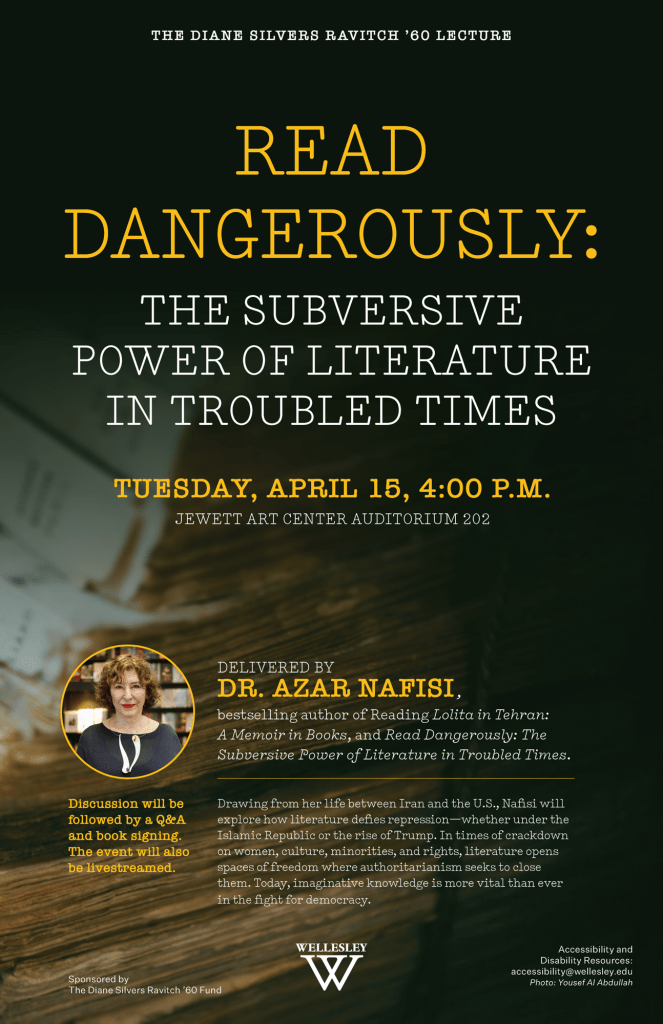
Dr. Azar Nafisi, author of the mega-bestseller Reading Lolita in Tehran, will speak at Wellesley College on April 15 at Wellesley College at 4 p.m. in the Jewett Arts Center. Admission is free.
Please mark the date on your calendar. She is speaking in a lecture series that I endowed several years ago. The lecture will be available eventually on the archive website of the College.
The book, which was a sensation upon its publication for its depiction of life under the mullahs, has recently been made into a film.
This review of the film was published by The Atlantic and written by Arash Azizi. At present, the film can be seen only at film festivals.
He wrote:
The past few years may well be remembered as the nadir of Iranian-Israeli relations, and the first occasion when the two countries attacked each other directly. But they were also a golden period for Iranian-Israeli collaboration in cinema. In 2023, Tatami was the first-ever film to be co-directed by an Israeli (Guy Nattiv) and an Iranian (Zar Amir). And in 2024 came Reading Lolita in Tehran, directed by Eran Riklis, who is Israeli, and adapted from a book by an Iranian author, with an almost entirely Iranian cast. The film premiered at the Rome Film Fest last year and is now starting to tour the United States.
Anyone old enough to remember cultural life at the beginning of this century will know the book. Azar Nafisi’s memoir came out in 2003, spent 36 weeks on the New York Times best-seller list, and quickly developed a cult following. A reviewer for The Nation confessed to missing a dental appointment, a business lunch, and a deadline just because she couldn’t put the book aside.
Literary scholars—Nafisi is an English professor—are not known for their page-turning thrillers. But Nafisi’s story and prose are captivating. She’d gone to Iran shortly after the 1979 revolution in the hope of putting her American education to use by teaching English at a university. Instead, she was hounded out of the classroom by authorities hostile to Western literature. She wound up holding clandestine seminars for young women in her living room, delving into the masterpieces that the Islamic Republic forbade: the Vladimir Nabokov novel that gives the memoir its name, alongside the works of Henry James and Jane Austen, as well as one of Nafisi’s favorites, F. Scott Fitzgerald’s The Great Gatsby. Nafisi brings these classics into dialogue with the real-life stories of young Iranians in the heady decades following the 1979 revolution. Her book isn’t just about reading and teaching literature under a repressive regime, but about how literature in and of itself could serve as an antidote to all that the regime stood for.
Despite its global fame and translation into 32 languages, Reading Lolita in Tehran was never turned into a film before now, mostly because Nafisi didn’t like the proposals she’d received. Then, seven years ago, Riklis came around, as he recounted to a New York audience on January 13, after a special screening of the film. The Israeli director managed to convince Nafisi of his vision—and then to secure the funding, assemble a suitable Iranian cast, and settle on Rome as the shooting location, given that Tehran was not an option.
When the book was initially released in 2003, the American zeitgeist, shaped by 9/11 and the Bush administration’s global War on Terror, was rife with debates about the representations of Muslim women and life in the Middle East. Nafisi’s was one of several popular memoirs by Iranian women published during this period, including Firoozeh Dumas’s Funny in Farsi (2003) and Marjane Satrapi’s Persepolis series (2000–03). And perhaps inevitably, given its success, Nafisi’s book became the subject of political scrutiny, much of it bearing little relation to the book’s content. Although Nafisi opposed the Iraq War, some critics lumped her in with neoconservatives because she portrayed the travails of Iranians under an anti-American regime. One scholar even proclaimed that he saw no difference between her and American soldiers convicted of abusing prisoners in Iraq.
More than 20 years later, Riklis’s loyal adaptation has opponents just as the book did, and even more so because of the nationality of its director. In Tehran, the regime media have denounced the film as furnishing a “pretext for attacking Iran” and called its Iranian actors “traitors working with Zionists.” One outlet claimed that the film peddled a “violent, anti-culture, anti-art, and anti-human view of Iran and Iranians.”
The idea that Reading Lolita in Tehran is anti-Iranian because of its portrayal of the Islamic Republic, and of the life of women under its rule, was always patently ridiculous. The claim bears up particularly poorly in 2024, two years after women-centered protests rocked Iran under the slogan “Women, Life, Freedom.” What Nafisi does best, and the reason her work has endured, is precisely to refuse cartoonish portrayals and basic morality plays.
In Riklis, known for his empathetic depiction of Israelis and Palestinians in films such as Lemon Tree and Dancing Arabs, her book finds an able interpreter who has stayed true to its ethos. The film isn’t neutral. It vividly tells the story of how puritanical Islamist goons attacked universities in the early years after 1979, imposed mandatory veiling on women, and banned books they didn’t like. But neither is it a simple story of scary Islamists versus heroic women resisters.
The film captures the atmosphere of Iran in the 1980s and ’90s remarkably well for having been shot in Italy and directed by an Israeli who has never set foot in the country. The dialogue is mostly in Persian, a language Riklis doesn’t speak; he was able to pull this off with the help of a carefully chosen cast of diasporic Iranians. Golshifteh Farahani, perhaps the best-known Iranian actor outside the country, is at her height as Nafisi, whom she plays as confident but humane, by turns brazen and vulnerable.
The young women of the clandestine class include Sanaz (Zar Amir), who has survived imprisonment and torture; Mahshid (Bahar Beihaghi, in one of the film’s most delightful performances), who, unlike most of her classmates, wore the Islamic veil even before the revolution and defends an ideal of modesty as virtue; and Azin (Lara Wolf), whose multiple divorces make her an object of fascination to the less experienced students, but who turns out to be suffering from domestic abuse.
In Nafisi’s apartment, the students are far from the prying eyes of the regime and also of men (even the professor’s husband is barred from their meetings). They construct for themselves, in that all-female room, a little literary republic that survives the years of war and revolution. In one memorable scene, Nafisi has the students practice a Jane Austen–era dance as part of their study of Pride and Prejudice, drawing parallels between the stifling rules of courtship in Victorian England and those of some contemporary families in Iran.
The film also ventures beyond that cloistered space. Bahri (Reza Diako), a devout 1979 revolutionary, is nevertheless an avid student in Nafisi’s class at the university before it is shut down. Despite their diametrically opposed politics, Nafisi and Bahri form a bond. Early in the story, she tells him his essay on Huckleberry Finn is the best she’s ever received from a student, even in America. The two reconnect when Bahri returns from the Iran-Iraq War of 1980–88, having lost an arm. He has used his family connections to the regime to obtain a surprise gift for his old professor: two tickets to The Sacrifice, by Andrei Tarkovsky, showing at the Tehran film festival. The connection between Nafisi and Bahri is presented with complexity and without sentimentality, neither papering over political differences nor caricaturing Bahri as a generic revolutionary.
In this way, both film and book avoid didacticism. And in doing so, they demonstrate exactly the point Nafisi explores with her students, which is the power of literature to stir empathy across seemingly unbridgeable divides. When the group discusses The Great Gatsby, Nafisi insists on understanding the forbidden love that Daisy Buchanan, the married socialite, has for Jay Gatsby as a true human feeling, not a symbol of Western perfidy, as some of her more revolutionary students claim it to be. The latter advocate banning the book. Nafisi organizes a mock trial for the novel in her class, with students divided into teams for and against.
Nafisi calls on students on both sides of the political divide to treat each other with humanity. When she catches some in her class expressing glee at the wartime deaths of pro-regime peers, she enjoins them not to become like their oppressors. And she is no dogmatic opponent of Islam, only of religiously inspired repressive government: At one point Nafisi tells Bahri, “My grandmother was the most devout Muslim I knew. She never missed a prayer. But she wore her scarf because she was devout, not because she was a symbol.” (I am not the only critic with a Muslim background who found this line powerful.)
The point here isn’t just to repeat the liberal platitude that “the problem isn’t with Islam but with its repressive enforcement.” Rather, Nafisi is rejecting the revolutionaries’ tendency to treat all that surrounds them as a field of symbols. People are worth more than that, she tells them and us, as though echoing the Kantian dictum to treat one another “as an end, never merely as a means.”
This message about the humane power of literature makes Reading Lolita in Tehran a work of art rather than an exercise in sloganeering. And the fact that now, more than two decades after the book’s release, and at a time of regional tension, an Israeli filmmaker has worked with Iranians to adapt Nafisi’s book to the screen gives the film a special power.
The audience at the screening I attended, at a Jewish community center on the Upper West Side, included American Jews, Israelis, and Iranians. What we had in common was the experience of being gripped by a story about the capacity of literature to reveal us to one another as ends rather than as means. The setup might sound mawkish. But I recommend avoiding the temptation of cynicism and embracing the film as truly one for these times.
Trump’s tariffs are getting blowback from some of his rightwing allies. Elon Musk called tariff-lover Peter Navarro “a moron.” Several Republican Senators expressed their opposition to tariffs at a Senate hearing. The National Review tore into Trump’s tariffs and his imperial behavior:
It wrote:
If it seems preposterous that a single person could enjoy this much power over the American economy — and, with it, the global economy — rest assured that it is. In Article I, the Constitution vests the “power To lay and collect Taxes, Duties, Imposts and Excises” in Congress, not in the president. As a result, the president has no power to impose tariffs that he has not been accorded by an act of the legislature. If it desires, Congress can choose to take back as much of that power as it sees fit. It ought to do so — and do so now.
That the Founders placed the power to tax, tariff, and legislate in the hands of the legislature, instead of the executive, was not an accident. On the contrary: This allocation sat at the very core of the system that they designed. Because legislatures play host to a diverse cast of characters — characters who have different views, are elected by different groups, and come from different regions — they are less prone to dogmatism, caprice, and flightiness than are monarchs, presidents, or emperors. Especially within the United States, where the Senate often checks the passions of the House, the procedural challenges that result from this tend to ensure that only those proposals that enjoy broad purchase among the citizenry’s representatives are able to become law. This arrangement has two chief benefits. First, it guarantees that the ideas under consideration will be subject to serious criticism and debate. Second, it makes it difficult to alter the status quo on a whim — which, in turn, makes it easier for the people to understand the laws under which they live.
This predictability is useful in all areas of civic life. But it is especially beneficial in the financial realm, where stability is imperative. Businesses, investors, workers, and families are all aided enormously by a reliable comprehension of what their tax rates, operating rules, regulatory liabilities, and tariff exposures are likely to be for the foreseeable future. When those variables are determined by Congress, the debates that inform them are transparent and the laws that result are built to endure. When those variables are determined by the president, the debates that inform them are opaque and the law is liable to change radically from day to day. In essence, the case for Congress fulfilling its responsibilities is the same as the case for written law per se: No free man wants to be at the mercy of a king.
As you know, Trump took control of The Kennedy Center and named himself chairman of the board. He kicked all Democrats off the board and named Trumpers to replace them.
Some artists cancelled, some continued to perform. Trump’s new director, Richard Grennel, canceled the national tour of a children’s show called “Finn,” because it promoted love, kindness, and tolerance.
A band called Guster was performing at The Kennedy Center on March 29, and the band leader talked about the cancellation of “Finn.” Then he invited the cast of “Finn” to join him onstage and the audience went wild.
President Trump and Vice President Vance berate President Zelensky at the White House, February 28, 2025 (OSV News photo/Brian Snyder, Reuters)
John Connelly is a historian of East Central Europe at the University of California at Berkeley. This essay appeared in Conmonweal. I urge you to subscribe. How I wish someone would read this essay out loud to Donald Trump. Among other things, it demonstrates the importance of learning history and the dangers of historical ignorance.
Connelly writes:
For decades pundits have been urging us to do something about this or that dictator because he was “Hitler.” A quarter century ago, David Brooks was equating Saddam Hussein with the Nazi leader, and a quarter century before that, newspapers portrayed Ho Chi Minh and Fidel Castro as their day’s equivalent of the Führer. The historical episode these writers had in mind was the 1938 Munich Agreement, when Chamberlain and Daladier surrendered Czechoslovakia’s fortified border areas in return for “peace.” Half a year later, Hitler helped himself to the rest of that undefended country, until then the last surviving democracy east of the Rhine. The lesson was that we must not appease dictators: it only encourages them.
In 2022, history finally produced an actual parallel to the attack on Czechoslovakia when Vladimir Putin invaded Ukraine, a functioning East European democracy. Yet, in contrast to 1938, this time the democracy fought back, and the West stood in united support—that is, until the pusillanimous and unprincipled acts of the Trump administration. The U.S. president has already gone far beyond anything Chamberlain might have dreamed of. Trump has not only appeased a dictator but adopted the dictator’s own language and reasoning, and he seems willing to award Putin vast Ukrainian territories before peace negotiations have even begun. As if all this weren’t strange enough, he also sent Vice President J. D. Vance to a conference in Munich to berate our allies for their allegedly undemocratic behavior. He then met with the leader of a party that has downplayed the importance of Hitler to German and world history and who opposes support of Ukraine.
The explosive exchange between President Trump and Ukrainian president Volodymyr Zelensky in the Oval Office prompted commentators to look for other historical parallels. Bartosz T. Wieliński, who writes for Poland’s Gazeta Wyborcza, recalled that the evening before Hitler sent his armies to seize Prague in March 1939, he summoned Czech president Emil Hácha to Berlin and threatened to lay waste to the Czech capital if Hácha did not accept “peace” on German terms. Luftwaffe chief Hermann Göring stood by nodding, nearly causing old Hácha to collapse. By contrast, writes Wieliński, president Zelensky has stood firm.
But an even more apt parallel occurred a few months later, in August 1939, when Hitler and Stalin decided to divide Poland and treat themselves to the spoils, including the country’s grain and oil. Careful historians could list many differences between now and then, but the underlying intention to expropriate a small country’s resources has a familiar ring, as does the imperial attitude behind it. Stalin’s transactional mentality continued after World War II, when he insisted that Poles repay the USSR for having cleared their lands of German troops by awarding it Polish oil and coal.
The United States of that period, led by men committed to defending freedom, behaved very differently. With much of Eastern Europe occupied by the Red Army, it invested huge sums (most in outright aid) to get Western Europe back on its feet and to sustain its democratic governments. The investments served the interests of peace because democratic states seldom go to war with each other.
The current administration relegates such thinking to the past, with Trump likening international affairs to a card game, with some holding stronger “hands” than others. Yet card games at least have rules, while what imperial powers do is help themselves to new cards as they see fit and knock over the card table whenever fair play displeases them. The best-known advocate of such behavior is the Nazi theorist Carl Schmitt, who wrote that different rules apply to great powers; he might be the only serious thinker who would justify Trump’s ambitions to seize Greenland or the Panama Canal.
The Trump team’s imperial attitude was on full display in the Oval Office meeting with Zelensky. Vice President Vance badgered Ukraine’s president to express more gratitude to the United States, even though he has done so profusely for years. What Vance seemed to expect was the sort of self-abasement that vassals once rendered to their lords. As long as humans can think and write freely, that fiasco will go down as a special disgrace for the United States, a low point in meanness and absence of compassion. It is we who should be grateful to Ukrainians—the same way we’re grateful to the men who landed in Normandy in June 1944 or to the soldiers of George Washington’s army. Like those heroes of yesteryear, today’s Ukrainians are putting their lives on the line for the sake of freedom.
That sort of argument may mystify the American right, but it also surprises some people on the left. I’ve heard colleagues in Berkeley denigrate the Ukrainian struggle as one driven by “nationalism” fueled by ancient ethnic chauvinism. In the midst of the Bosnian war, even the well-read and well-meaning Bill Clinton expressed frustration with such “Old World” nationalism, saying, “until those people over there get tired of killing one another, bad things will continue to happen.” Trump himself shows some of this impatience, portraying Zelensky as yet another Eastern European closed to reason.
But what’s happening in Ukraine is not difficult to understand. What we have been witnessing, in the years since 2014, is an East European democratic revolution much like our own, if not more dramatic. The colonists who took up arms in the 1770s were responding to everyday colonialism, of living under an empire that left them little voice in their own affairs and blithely exploited their lives and treasures. At some point, those Americans decided freedom was a cause worth dying for.
This was the sentiment an audience in Berkeley heard last September from Taras Dobko, the rector of the Ukrainian Catholic University. A missile had recently struck an apartment house in Lviv, wiping out a whole family, including Daria Bazylevych, a second-year cultural-studies major. For years, students and professors have been going off to fight and sometimes die, and now the hundreds of mourners at Daria’s funeral Mass recognized a consensus that has strengthened over time: human life is precious, but some things are more important than simple survival.
The Trump team’s imperial attitude was on full display in the Oval Office meeting with Zelensky.
The comparisons I have been invoking are approximate. The imperial aggressors Ukrainians face are endlessly more sinister than George III’s forces. But the similarities are nevertheless striking. Recall the early images from three years ago, just after Russian troops had crossed Ukraine’s borders. All kinds of people sought to repel the invaders—the young, the old, the tough, the nerdy, workers, students. The real issue was not territory on a map but how human beings on any territory are allowed to live their lives. These human beings were desperate not to fall under a regime of lawlessness, where human life is for sale and dignity is trampled by tyranny. Today’s Ukrainian patriotism is not about ethnicity. Many of the troops defending Ukraine are Russian-speaking; the religious communities represented among these troops range from Greek Catholic (Uniate) to atheist.
In the summer of 2022, President Zelensky, who is Jewish, demonstrated his acute historical vision by calling his country a “new nation.” Technically, the claim is wrong. Sources referred to a Ukrainian nation back in the seventeenth century. But the nation Zelensky means transcends that past. He is placing Ukraine in the small company of nations that define their identities by looking forward and not backward. The new Ukraine is a place and a people that seeks to create a future free from tyranny.
Here, Ukraine’s democratic revolution has precedents in European history, but they are few. There was 1789, when the French people walked onto the historical stage with the novel insistence that they had a right to self-rule. There was 1848, when peoples across Europe tried to follow the French example, but that movement soon came apart in ethnic bickering. And then there were the revolutions of 1989, when Europeans between France and Russia rose up against the Soviet empire. In world history, the closest parallel is indeed 1776, when North American colonists rebelled regardless of language and creed and dated their nation from the moment they determined to live freely.
But our day’s Americans can have short memories, a fact that frustrated Zelensky when he visited the Oval Office. For Trump and Vance, the indiscriminate torture and killing of hundreds of civilians committed by Putin’s soldiers just three years ago at Bucha are irrelevant to the challenges of “peace making.” Accusing Zelensky of “hating” Putin, as Trump did, is a bit like criticizing the Czechs or Poles for their animosity toward Hitler. Putin belongs to a small group of strongmen—including Pol Pot and Slobodan Milošević—who have presided over genocidal acts. Of course, sometimes one has to engage in diplomacy with such men, but the reports of U.S. diplomats becoming chummy over shared meals with Sergei Lavrov, Russia’s foreign minister, evoke disgust. Neville Chamberlain at least had the decency to appear uncomfortable in the presence of cynical despots.
American ignorance of the past can extend beyond facts to a misunderstanding of what America is about. Trump’s betrayal of Ukraine is, deep down, a betrayal of the United States. Last summer, Vance said that his ancestors are buried in Kentucky, and he hoped that seven generations of his family would find their final resting places there as well: even if they “would die fighting to protect it. That is the source of America’s greatness.” In fact, where our ancestors lie is irrelevant for our identities as Americans; their graves may be anywhere in the world. We are not a community of soil and blood.
But the sentiment Vance expressed is not unknown elsewhere. In 1984, I went on a field trip to eastern Poland with historians from Jagiellonian University in Krakow. My roommate on the trip, a young instructor, explained to me why Poles could not forget the territories that had once belonged to Poland yet now lay in Ukraine: “Remember, our graves are there.” Fortunately, when their country became free in 1989, the better angels in Polish society prevailed. As Timothy Snyder explained in The Reconstruction of Nations, émigré intellectuals determined that Poland needed peace and not more land. Eastern Europeans have suffered from territorial disputes for centuries, and that moment was a time to look forward and consign destructive bickering to history.
Hence the extraordinary incomprehension with which Poles and other Europeans view the Trump regime, which seems more intent on expanding America’s borders than on protecting existing ones in Europe. Washington now joins Moscow in calling Zelensky a “dictator.” That is why Europeans insist upon security guarantees for Ukrainians: as long as pernicious and demonstrably false ideas about Ukraine are taught as dogma to tens of millions of Russians, there can be no return to normal. An expansionist state backed by an aggressive ideology cannot be appeased; it can only be stopped.
Ukraine’s democratic revolution has precedents in European history, but they are few.
Today’s Ukrainian fighters live in trenches. They spend weeks in puddles of cold water, unable to rest properly, subsisting on terrible food. Like the men of D-Day or those who accompanied Washington to fight in wintry Princeton, they face not only death but discomforts that are difficult to imagine and usually forgotten in history books. Soldiers then and now have suffered these things so that their fellow citizens can say what they want in public, so that journalists can report without fear of retribution from civil authorities, so that teachers can speak freely in their classrooms without having to worry about being reported for indoctrinating their students with “Western ideology.” Growing threats to civil liberties under the Trump regime are of a piece with his admiration for Putin and with Vance’s meeting with neo-fascists in Munich. We are letting our freedoms slip away, and it’s not clear why.
Our founders, despite the checks and balances they built into the new republic, had gloomy forebodings. No matter how brilliantly conceived, they knew a constitution alone could not guarantee civic virtue. Perhaps Benjamin Franklin was right that the demos would one day succumb to corruption, but what would he say about voters who abandoned their God-given critical faculties and supported a man who, just four years earlier, had whipped up a mob to storm the Capitol to prevent the peaceful transfer of power? Video images show the attackers beating police with flagpoles.
For decades, I have been teaching students about interwar Germany’s last free elections in 1932, and when class is over we leave the lecture hall with pained incomprehension at those strange people back then. No longer. Germans of that time faced unemployment, destitution, street violence; they had suffered more in a war than we can imagine. Still, that July, far fewer than half of them voted for the radical right (37.2 percent). The numbers went down to 32 percent in November. His party in decline, Hitler was considering suicide when a coterie of conservatives schemed to bring him to power.
In November 2024, the United States was enjoying high employment, steady growth, and decreasing inflation, yet more than half of us voted for our own brand of right-wing populism. Yes, I am aware there are deep problems with housing, health care, and education, but that is no justification for casting a ballot that jeopardizes democracy. There was no reason to think that a second Trump administration would address those basic problems.
Is it not a kind of civic corruption for a nation to be blessed with abundant resources and fortuitous geography and not appreciate it? (Zelensky, ever the keen student of history, gently tried to remind Vance and Trump that Americans were protected by an ocean—a lesson that did not go over well.) Our conspicuously pious vice president might consider thanking the Almighty that we have peace-loving, democratic Canada on our northern border and not, like the Ukrainians, a rapacious, occasionally genocidal empire three times our size.
We are not in the 1930s. Our European allies have drawn lessons that make a return to Munich unlikely if not impossible. Unlike Czechoslovakia, Ukraine is not isolated, but an object of genuine neighborly concern. In Poland, France, and Austria, centrist forces have rallied to keep the far right out of power. The German elections suggest that when Elon Musk and J. D. Vance promote right-wing extremists abroad, it only drives Europe’s democrats closer together. Europeans display a wariness of neo-fascism that we, who have been spared direct experience of totalitarian rule, evidently lack.
Against the background of an Eastern Europe where nationhood has usually been about ethnicity, Ukraine’s brand of civic nationhood is a world-historical miracle. We don’t know what mysterious pool of ingredients permits democracies to arise and thrive, we know only that, unlike so many places where the United States has involved itself militarily, democracy has taken root in Ukraine. Unlike in 1938, when Czechs hoped that the West would sacrifice blood for their democracy, all that Ukrainians ask of other democracies is military aid, which in our case amounts to about four percent of the defense budget.
But even more important than our material support is their own faith: that some things, like freedom, are worth dying for, as Dobko reminded us in Berkeley. That belief can fade, and when it does, the effect can be contagious. In 1938, Czechs witnessed allies unwilling to stand for shared principles, and after World War II, Czechoslovakia—once the lone democracy east of the Rhine—became the sole European country to submit willingly to totalitarianism. Soviet troops left Czechoslovakian territory in December 1945, yet Czechs streamed into the Communist Party and the final seizure of power in 1948 was generated from below. It took democracy decades to recover.
Who would have thought an American president would make Neville Chamberlain look good? In 1938, the British PM sought peace to avert millions of deaths, while Trump seeks peace to advance “U.S. interests,” which he understands in purely material terms. Peace not for the sake of people, but of mineral rights. All talk of values like freedom or solidarity is anathema, and if “democracy” is invoked, it is only to aid its enemies. History writers of the future will pay close attention to what the United States does now. Far less is asked of us than was asked of the Western powers in 1938, and unless we change course, those historians will judge us far more severely than the men who once tried to appease Hitler.
John Connellyteaches the history of East Central Europe at the University of California, Berkeley, and is the author of From Peoples into Nations: A History of Eastern Europe(Princeton, 2020).
ICE has become the American Gestapo. They are snatching foreign students on American campuses and whisking them away, often to undisclosed locations, with no hearings, no due process.
The latest snatch-and-grab occurred yesterday at Tufts University in Massachusetts.
The Trump administration’s campaign against pro-Palestinian activists reached the Boston area Tuesday evening when an international PhD student at Tufts was arrested by masked federal immigration agents on a residential street and sent to a detention facility in Louisiana, according to federal immigration records and the student’s attorney.
Plainclothes officers handcuffed Rumeysa Ozturk, a 30-year-old Turkish nationalin the US on a student visa, and loaded her into an unmarked SUV with tinted windows as she pleaded for explanations, according to video of the arrest. She was transferred to Louisiana despite a federal judge ordering US Immigration and Customs Enforcement Tuesday night not to remove Ozturk from Massachusetts without prior notice.
The precise timing of Ozturk’s transfer to Louisiana and the issuance of the judge’s order was unclear.
It was also unclear why the government targeted Ozturk, who is doctoral candidate at Tufts department of child study and human development. She had voiced support for the pro-Palestinian movement at Tufts, but was not known as a prominent leader. Her lawyer said she is not aware of any charges against her.
“I don’t understand why it took the government nearly 24 hours to let me know her whereabouts,” her lawyer, Mahsa Khanbabai, said. ”Why she was transferred to Louisiana despite the court’s order is beyond me. Rumeysa should immediately be brought back to Massachusetts, released, and allowed to return to complete her PhD program.”
A spokesperson for the Department of Homeland Security asserted Ozturk “engaged in support of Hamas,” a US-designated terror group behind the Oct. 7 attack on Israel that led to Israel’s retaliatory military campaign in Gaza, but did not provide evidence of that claim.
“A visa is a privilege not a right. Glorifying and supporting terrorists who kill Americans is grounds for visa issuance to be terminated,” the spokesperson said.
A screen grab from a video shows Tufts graduate student Rumeysa Ozturk, in white coat, being approached by federal immigration authorities before being detained on Tuesday, March 25 in Somerville.
Ozturk is the latest international student arrested by the Trump administration, which has vowed to deport non-citizen pro-Palestinian activists whom it accuses of engaging in antisemitic or illegal protests. That campaign is part of Trump’s wider crackdown on elite universities, including funding cuts, bans on diversity programs, and investigations over schools’ alleged inaction on antisemitism.
Earlier in March, Trump’s antisemitism task force canceled $400 million of federal funding for Columbia University. The administration also arrested Mahmoud Khalil, a recent Columbia graduate and Algerian citizen who was a leader of the school’s pro-Palestinian movement. Officials are trying to deport him, too, after Secretary of State Marco Rubio declared his continued presence in the United States was detrimental to US foreign policy.
Ozturk’s lawyer said information about her client was recently added to Canary Mission, a website that compiles information about pro-Palestinian students and professors, and which activists say has led to harassment and doxxing. The website noted Ozturk co-wrote an op-ed in the Tufts student newspaper last year criticizing the university’s response to the pro-Palestinian movement,urging Tufts to “end its complicity with Israel insofar as it is oppressing the Palestinian people and denying their right to self-determination.”
Pro-Palestinian activists and free speech advocates have decried the arrests as unconstitutional repression of political speech.
Massachusetts Attorney General Andrea Campbell called the footage of the arrest “disturbing.”
“Based on what we now know, it is alarming that the federal administration chose to ambush and detain her, apparently targeting a law-abiding individual because of her political views. This isn’t public safety. It’s intimidation that will, and should, be closely scrutinized in court,” Campbell said.
Ozturk’s arrest took place slightly after 5 p.m. Tuesday on Mason Street in Somerville near Tufts, according to a resident who witnessed the arrest and spoke with the Globe on condition of anonymity due to fear of retaliation by the government, as well as security camera footage obtained by the Globe.
While walking his dog, the witness said, he saw a woman screaming outside a house. Half a dozen officers in plainclothes and wearing masks surrounded her, he said. As they handcuffed her, she cried and said, “OK, OK, but I’m a student,” he recalled.
Then they placed her in an unmarked SUV with tinted windows….
Reyyan Bilge, an assistant teaching professor in psychology at Northeastern University, told the Globe she has known Ozturk for more than a decade since Bilge taught Ozturk at Şehir University in Istanbul. Ozturk came to the United States to get her master’s degree at Columbia as a Fulbright scholar, Bilge said.
She graduated in 2020 from the developmental psychology program at Columbia Teacher’s College, according to a 2021 social media post by the school.
Bilge described Ozturk as soft-spoken andkind. “If you were to actually have a chat with her for about five minutes, you would understand how kind and how decent a person she is,” she said….
Tufts University president Sunil Kumar disclosed the arrest in a campus-wide message Tuesday night.
The university “had no pre-knowledge” of the arrest, he said, and Tufts did not share information with authorities, adding that the location of the arrest was not affiliated with the university.
The university was told Ozturk’svisa status was “terminated,” Kumar said in the email.
“We realize that tonight’s news will be distressing to some members of our community, particularly the members of our international community,” he said.
In a three-page order issued Tuesday, federal Judge Indira Talwani ordered ICE to submit a written explanation for relocating Ozturk and notify the court 48 hours before any effort takes place to allow the judge time to review the added information.
Ozturk’s lawyer filed a habeas petition in court on Tuesday asking for her release. Talwani also directed ICE officials to respond to the petition by Friday.
All of Ozturk’s family is in Turkey, and she only has friends here in the United States, Bilge said.
Bilge said Ozturk would never say anything to hurt anyone. “She’s not antisemitic,” Bilge said. But like many other Muslims, Bilge said, Ozturk is concerned about the human rights of Palestinian people. “But that’s freedom of speech,” Bilge said. “That’s just being human.”
On Wednesday evening, more than 2,000 people rallied insupport ofOzturk at a park near Powder House Square and the Tufts campus. Among them were students from Tufts and Harvard, as well as residents from the surrounding neighborhoods. Some wore keffiyehs, a patterned scarf associated with Palestinian nationalism. Others wore yarmulkes, the Jewish skullcap. “Stand up, fight back!” they chanted.



 Diane Ravitch's blog