President Donald Trump signed an executive order on Thursday evening seeking to prohibit federal funding for NPR and the Public Broadcasting Service (PBS). The order, which could be subject to legal challenge, called the broadcasters’ news coverage “biased and partisan.”
It instructs the Corporation for Public Broadcasting to cease providing direct funds to either broadcaster. It also orders CPB to cease indirect funding of the services through grants to local public radio and television stations.
CPB is the main distributor of federal funds to public media. It receives about $535 million in federal funds per fiscal year, which it mostly spends on grants to hundreds of stations nationwide. The stations spend the grants on making their own programming or on buying programming from services such as NPR and PBS.
CPB, created by an act of Congress in 1967, also sometimes provides direct grants to NPR and PBS to produce national programs. Thursday’s order instructs the CPB board to ensure that stations receiving its grants “do not use Federal funds for NPR and PBS.”
Jamelle Bouie, one of the most insightful columnists for The New York Times, observes that Trump has no interest in governing. He is interested in ruling. He thinks he has a mandate, even though he did not win 50% of the popular vote. He thinks his will is as powerful as law. He does not share power with Congress, and he’s testing how far he can go to diminish the courts.
I think it’s obvious that neither President Trump nor his coterie of agents and apparatchiks has any practical interest in governing the nation. It’s one reason (among many) they are so eager to destroy the federal bureaucracy; in their minds, you don’t have to worry about something, like monitoring the nation’s dairy supply for disease and infection, if the capacity for doing so no longer exists.
But there is another, less obvious way in which this observation is true. American governance is a collaborative venture. At minimum, to successfully govern the United States, a president must work with Congress, heed the courts and respect the authority of the states, whose Constitutions are also imbued with the sovereignty of the people. And in this arrangement, the president can’t claim rank. He’s not the boss of Congress or the courts or the states; he’s an equal.
The president is also not the boss of the American people. He cannot order them to embrace his priorities, nor is he supposed to punish them for disagreement with him. His powers are largely rhetorical, and even the most skilled presidents cannot shape an unwilling public.
Trump rejects all of this. He rejects the equal status of Congress and the courts. He rejects the authority of the states. He does not see himself as a representative working with others to lead the nation; he sees himself as a boss, whose will ought to be law. And in turn, he sees the American people as employees, each of us obligated to obey his commands.
Trump is not interested in governing a republic of equal citizens. To the extent that he’s even dimly aware of the traditions of American democracy, he holds them in contempt. What Trump wants is to lord over a country whose people have no choice but to show fealty and pledge allegiance not to the nation but to him.
What was it Trump said about Kim Jong-un, the North Korean dictator, during his first term in office? “Hey, he’s the head of a country. And I mean he is the strong head. Don’t let anyone think anything different,” Trump said in 2018. “He speaks, and his people sit up at attention. I want my people to do the same.”
Jill Underly was recently te-elected as State Superintendent of Schools in Wisconsin. She is an active member of the Netwotk for Public Education and attended its last two meetings. She released the following statement after two courts hacked away at Trump’s threat to withhold funds from schools that taught diversity, equity, and inclusion
MADISON, Wis. (WISCONSIN DEPARTMENT OF PUBLIC INSTRUCTION PRESS RELEASE) – State Superintendent Dr. Jill Underly today issued a statement following two federal court rulings that limit the Trump administration’s ability to withhold critical school funding over an unclear certification form and process.
“Our top priority in Wisconsin is our kids and making sure every student has the support they need to succeed. The past few weeks, school leaders have been scrambling to understand what the impact of the U.S. Department of Education’s order could be for their federal funds, forcing them to take their eye off what matters most.
“Today, two separate courts reached a similar conclusion: the USDE’s new certification process is likely unlawful and unconstitutionally vague. That is a welcome development for our schools and communities who, working in partnership with parents and families, are best positioned to make decisions for their communities – not Washington, D.C.
“We are closely reviewing today’s rulings and will continue to stand up for Wisconsin schools, and most importantly, our kids.”
The Trump administration claims that it wants to reduce federal intervention into the nation’s public and private institutions. But it intervenes forcefully in both public and private sectors to punish anyone with different views. It has threatened to withhold federal funding for research from universities unless the targeted universities allow the federal government to supervise its curriculum, its hiring policies, and its admissions policies. And he threatened to stop the funding of any K12 school that continues DEI programs.
The Trump regime has created a nanny state.
From Day 1, Trump made clear that he would ban practices and policies intended to diversity, equity, and inclusion. He threatened to withhold federal funding of schools that ignored his order to eliminate DEI. He has taken complete control of the Kennedy Center, so as to block DEI programming, and he has appointed a woman with no credentials to remove DEI from the Smithsonian museums.
Who knows how the African American Museum will survive Trump’s DEI purge.
ABC News reported that a federal district judge has halted the DEI ban, at least in schools associated with one of the lawsuit’s plaintiffs, the NEA.
The Trump administration’s attempt to make federal funding to schools conditional on them eliminating any DEI policies erodes the “foundational principles” that separates the United States from totalitarian regimes, a federal judge said on Thursday.
In an 82-page order, U.S. District Judge Landya McCafferty partially blocked the Department of Education from enforcing a memo issued earlier this year that directed any institution that receives federal funding to end discrimination on the basis of race or face funding cuts.
“Ours is a nation deeply committed to safeguarding academic freedom, which is of transcendent value to all of us and not merely to the teachers concerned,” Judge McCafferty wrote, adding the “right to speak freely and to promote diversity of ideas and programs is…one of the chief distinctions that sets us apart from totalitarian regimes.”
“In this case, the court reviews action by the executive branch that threatens to erode these foundational principles,” she wrote.
The judge stopped short of issuing the nationwide injunction, instead limiting the relief to any entity that employs or contacts with the groups that filed the lawsuit, including the National Education Association and the Center for Black Educator Development.
Under the misguided policies of Trump and Hegseth, censorship and book banning have been widespread, especially by the Defense Department. Hegseth is eager to please Trump and has stripped recognition from anyone of distinction who is female and/or non-white. Even a photograph of the Enola Gay, the plane that dropped the first atomic bomb, was taken down–because of its name. The Navajo Code Talkers were put into storage. The first women to achieve military feats and honors were mothballed. The U.S. Naval Academy removed almost 400 books from its library because of DEI (diversity, equity, inclusion) themes.
Ryan Holiday was invited to lecture at the Naval Academy a few weeks ago, as he had in the past. Shortly before he was to speak, he was asked not to mention the books that had been removed from the Academy’s library. When he refused, his speech was canceled.
Question: if the men and women of the U.S. Navy are brave enough to risk their lives, aren’t they brave enough to read a book about race and gender?
For the past four years, I have been delivering a series of lectures on the virtues of Stoicism to midshipmen at the U.S. Naval Academy in Annapolis, Md., and I was supposed to continue this on April 14 to the entire sophomore class on the theme of wisdom.
Roughly an hour before my talk was to begin, I received a call: Would I refrain from any mention in my remarks of the recent removal of 381 supposedly controversial books from the Nimitz library on campus? My slides had been sent up the chain of command at the school, which was now, as it was explained to me, extremely worried about reprisals if my talk appeared to flout Executive Order 14151(“Ending Radical and Wasteful Government D.E.I. Programs and Preferencing”).
When I declined, my lecture — as well as a planned speech before the Navy football team, with which my books on Stoicism are popular — was canceled. (The academy “made a schedule change that aligns with its mission of preparing midshipmen for careers of service,” a Navy spokesperson told Times Opinion. “The Naval Academy is an apolitical institution.”)
Had I been allowed to go ahead, this is the story I was going to tell the class:
In the fall of 1961, a young naval officer named James Stockdale, a graduate of the Naval Academy and future Medal of Honor recipient who went on to be a vice admiral, began a course at Stanford he had eagerly anticipated on Marxist theory. “We read no criticisms of Marxism,” he recounted later, “only primary sources. All year we read the works of Marx and Lenin.”
It might seem unusual that the Navy would send Stockdale, then a 36-year-old fighter pilot, to get a master’s degree in the social sciences, but he knew why he was there. Writing home to his parents that year, he reminded them of a lesson they had instilled in him, “You really can’t do well competing against something you don’t understand as well as something you can.”
At the time, Marxism was not just an abstract academic subject, but the ideological foundation of America’s greatest geopolitical enemy. The stakes were high. The Soviets were pushing a vision of global Communism and the conflict in Vietnam was flashing hot, the North Vietnamese fueled by a ruthless mix of dogma and revolutionary zeal. “Marxism” was, like today, also a culture war boogeyman used by politicians and demagogues.
Just a few short years after completing his studies, in September 1965, Stockdale was shot down over Thanh Hoa in North Vietnam, and as he parachuted into what he knew would be imprisonment and possibly death, his mind turned to the philosophy of Epictetus, which he had been introduced to by a professor at Stanford.
He would spend the next seven years in various states of solitary confinement and enduring brutal torture. His captors, sensing perhaps his knowledge as a pilot of the “Gulf of Tonkin incident,” a manufactured confrontation with North Vietnamese forces that led to greater U.S. involvement in Vietnam, sought desperately to break him. Stockdale drew on the Stoicism of Epictetus, but he also leveraged his knowledge of the practices and the mind-set of his oppressors.
“In Hanoi, I understood more about Marxist theory than my interrogator did,” Stockdale explained. “I was able to say to that interrogator, ‘That’s not what Lenin said; you’re a deviationist.’”
In his writings and speeches after his return from the prison known as the Hanoi Hilton, Stockdale often referred to what he called “extortion environments,” which he used to describe his experience as a captive. He and his fellow P.O.W.s were asked to answer simple questions or perform seemingly innocuous tasks, like appear in videos, and if they declined, there would be consequences.
No one at the Naval Academy intimated any consequences for me, of course, but it felt extortionary all the same. I had to choose between my message or my continued welcome at an institution it has been one of the honors of my life to speak at.
As an author, I believe deeply in the power of books. As a bookstore owner in Texas, I have spoken up about book banning many timesalready. More important was the topic of my address: the virtue of wisdom.
As I explained repeatedly to my hosts, I had no interest in embarrassing anyone or discussing politics directly. I understand the immense pressures they are under, especially the military employees, and I did not want to cause them trouble. I did, however, feel it was essential to make the point that the pursuit of wisdom is impossible without engaging with (and challenging) uncomfortable ideas.
Seneca, the Stoic philosopher, used a military metaphor to make this very argument. We ought to read, he said, “like a spy in the enemy’s camp.” This is what Stockdale was doing when he studied Marxism on the Navy’s dime. It is what Seneca was doing when he read and liberally quoted from Epicurus, the head of a rival philosophical school.
The current administration is by no means unique in its desire to suppress ideas it doesn’t like or thinks dangerous. As I intended to explain to the midshipmen, there was considerable political pressure in the 1950s over what books were carried in the libraries of federal installations. Asked if he would ban communist books from American embassies, Eisenhower resisted.
“Generally speaking,” he told a reporter from The New York Herald Tribuneat a news conference shortly after his inauguration, “my idea is that censorship and hiding solves nothing.” He explained that he wished more Americans had read Hitler and Stalin in the previous years, because it might have helped anticipate the oncoming threats. He concluded, “Let’s educate ourselves if we are going to run a free government.”
The men and women at the Naval Academy will go on to lead combat missions, to command aircraft carriers, to pilot nuclear-armed submarines and run enormous organizations. We will soon entrust them with incredible responsibilities and power. But we fear they’ll be hoodwinked or brainwashed by certain books?
Hitler’s “Mein Kampf” was not one of the books removed from the Naval Academy library, and as heinous as that book is, it should be accessible to scholars and students of history. However, this makes the removal of Maya Angelou’s “I Know Why the Caged Bird Sings” inexplicable. Whatever one thinks of D.E.I., we are not talking about the writings of external enemies here, but in many cases, art, serious scholarship and legitimate criticism of America’s past. One of the removed books is about Black soldiers in World War II, another is about how women killed in the Holocaust are portrayed, another is a reimagining of Kafka called “The Last White Man.” No one at any public institution should have to fear losing their job for pushing back on such an obvious overreach, let alone those tasked with defending our freedom. Yet here we are.
The decision by the academy’s leaders to not protest the original order — which I believe flies in the face of basic academic freedoms and common sense — has put them in the now even stickier position of trying to suppress criticism of that decision. “Compromises pile up when you’re in a pressure situation in the hands of a skilled extortionist,” Stockdale reminds us. I felt I could not, in good conscience, lecture these future leaders and warriors on the virtue of courage and doing the right thing, as I did in 2023 and 2024, and fold when asked not to mention such an egregious and fundamentally anti-wisdom course of action.
In many moments, many understandable moments, Stockdale had an opportunity to do the expedient thing as a P.O.W. He could have compromised. He could have obeyed. It would have saved him considerable pain, prevented the injuries that deprived him of full use of his leg for the rest of his life and perhaps even returned him home sooner to his family. He chose not to do that. He rejected the extortionary choice and stood on principle.
Jason Garcia is an investigative reporter in Florida who has had plenty to investigate during the regime of Ron DeSantis. His blog is called “Seeking Rents.” This is a post you should not miss.
The governor acts like a dictator, and the Republican-dominated legislature doesn’t stop him. Remember the takeover of New College? It was the only innovative, free-thinking public institution of higher education in the state. It was tiny, only 700 students. But DeSantis took control of the college’s board, hired a new president (a crony) and set about destroying everything that made it unique. He issued one executive order after another for the entire state to crush DEI and assure the only permissible thought mirrored his own. He attacked drag queens and threatened to punish bars and hotels that allowed them to perform. He created a private army, subject only to his control. He selected politicians to run major universities. He imposed thought control on the state. Fascism thrives in Florida.
Thus far, he has gotten away with his gambits. But Garcia doesn’t think he will get away with this one.
He writes:
A simmering scandal erupted Friday afternoon when the Tampa Bay Times, Miami Herald and Politico Florida revealed that the administration of Gov. Ron DeSantis orchestrated a $10 million payment last fall to a charity founded by the governor’s wife — which then turned around and gave the money to groups that helped finance the governor’s campaign against a proposed constitutional amendment to legalize marijuana in Florida.
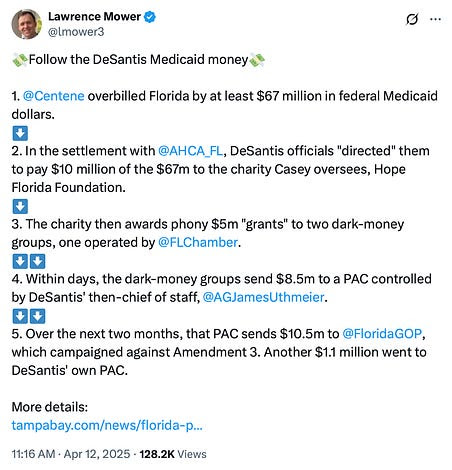
In a nutshell: The DeSantis administration pressured a major state contractor to make a $10 million donation to the Hope Florida Foundation, the controversial charity spearheaded by First Lady Casey DeSantis. It was part of a settlement negotiated with Centene Corp., after the state’s largest Medicaid contractor overbilled the state by at least $67 million.
Days later, Hope Florida transferred that $10 million to a pair of dark-money nonprofits. The state-backed charity gave $5 million each to “Save Our Society From Drugs,” an anti-marijuana group founded by a late Republican megadonor, and “Secure Florida’s Future,” a political vehicle controlled by executives at the Florida Chamber of Commerce, the Big Business lobbying group.
And days after that, Save Our Society From Drugs and Secure Florida’s Future gave a combined $8.5 million to “Keep Florida Clean,” a political committee — chaired by Ron DeSantis’ then-chief of staff — created to oppose Amendment 3, the amendment on last year’s ballot that would have allowed Floridians to use marijuana recreationally rather than solely for medicinal reasons.
It’s a daisy chain that may have transformed $10 million of public money — money meant to pay for health insurance for poor, elderly and disabled Floridians — into funding for anti-marijuana campaign ads.
But at least one prominent GOP lawmaker — Rep. Alex Andrade, a Pensacola Republican who has been presiding over hearings into Hope Florida — told the Times and Herald that the transaction chain “looks like criminal fraud by some of those involved.”
Clearly, this looks very bad. But it is also by no means an isolated incident.
In fact, this is part of a larger pattern of potential abuses that Ron DeSantis committed last fall when he chose to turn the power of state government against two citizen-led constitutional amendments that appeared on the November ballot: Amendment 3 and Amendment 4, which would have ended Florida’s statewide abortion ban.
Consider what we already know about how DeSantis financed his campaigns against the two amendments using public money taken from taxpayers — and private money taken from donors who got public favors from the governor.
Five state agencies directly funded television commercials meant to weaken support for the marijuana and abortion-rights ballot measures. We still don’t know the full extent of their spending, although Seeking Rents has estimated the total taxpayer tab at nearly $20 million. We also know that the DeSantis administration commandeered money for anti-marijuana advertising from Florida’s share of a nationwide legal settlement with the opioid industry — money that was supposed to be spent combatting the opioid addiction crisis.
At the same time, another nonprofit funded by Florida taxpayers poured at least $5 million into television ads attempting to soften Florida’s image on women’s healthcare at a time when Florida’s near-total abortion was under intense attack. It was the Florida Pregnancy Care Networks’ first-ever TV ad campaign. And its commercials, which were overseen by DeSantis administration staffers, complemented the state agency ads against the abortion-rights amendment — right down to using the same slogan.
Last June, after DeSantis vetoed legislation that would have strictly regulated the state’s hemp industry, CBS News Miami revealedthat industry executives and lobbyists promised to raise $5 million in exchange for the veto for the governor to spend on his campaign against Amendment 3. “Our lobby team made promises to rally some serious funding to stand with him on this,” a hemp industry representative wrote in one message that included a bank routing number for the Republican Party of Florida. “We have to pay $5 million to keep our end of the veto,” a hemp executive wrote in another message.
In the closing weeks of the campaign, records show that the Big Tobacco giant Philip Morris International gave $500,000 to DeSantis’ personal political committee — which was also chaired by the governor’s then-chief of staff and which DeSantis was using to campaign against both Amendment 3 and Amendment 4. Shortly after the election, the DeSantis administration handed Philip Morris a lucrative tax break, ruling that the company could sell a new line of electronically heated tobacco sticks free of state tobacco taxes.
There’s a reason why the DeSantis administration made sure to extract a promise of legal immunityfrom the organization that sponsored Amendment 4 as part of a legal settlement negotiated after the election.
DeSantis’ tactics worked. Though Amendments 3 and 4 each won majority support from Florida voters — 55.9 percent for recreational marijuana, 57.2 percent for abortion rights — both fell short of the 60 percent support needed to amend the state constitution.
But, suddenly, it looks like this may not be over — at least not for Ron DeSantis.
What’s more, the House also unveiled a sweeping ethics reform package last week that would, among other things, explicitly expose senior government officials to criminal penalties if they interfere with elections.
That particular legislation would also prohibit state employees from soliciting money for political campaigns — an idea that emerged after DeSantis aides got caught squeezing lobbyistsfor more donations to their boss’ political committee ahead of a possible Casey DeSantis campaign for governor….
Ron DeSantis bet his political future on beating the marijuana and abortion-rights amendments. And he won both of those battles.
But it may turn out that he ultimately lost the war.
Wishful thinking? I hope not.
To give you an idea of how far/right the legislature is, Garcia lists some of the bills that are currently moving through the legislative process:
House Bill 549: Requires all new public school textbooks to refer to the Gulf of Mexico as the “Gulf of America.” Passed the Senate by a 28-9 vote. (See votes) Previously passed the House of Representatives by a 78-29 vote. (See votes) Goes to the governor.
House Bill 575: Replaces Gulf of Mexico with “Gulf of America” in state law. Passed the Senate by a 28-9 vote. (See votes) Previously passed the House of Representatives by a 78-27 vote. (See votes) Goes to the governor….
House Bill 1517: Allows someone to file a wrongful death lawsuit seeking lost wages on behalf of an embryo or fetus. Passed the House of Representatives by a 79-32 vote. (See votes)…
House Bill 7031: Cuts the state sales tax rate from 6 percent to 5.25 percent. Passed the House of Representatives by a 112-0 vote. (See votes)
House Bill 123: Allows a traditional public school to be converted into a charter school without the consent of the teachers who work at the school. Passed the House Education & Employment Committee by an 11-4 vote. (See votes)
Denis Smith retired from his position at the Ohio Department of Education, where he oversaw charter schools (which are called “community schools” in Ohio). In this post, he describes what he saw at the Network for Public Education Conference in Columbus, Ohio, in early April.
He wrote:
When It’s About Hands Off! That Also Applies to Public Schools
The Hands Off! demonstrations at the Ohio Statehouse that drew thousands of protestors wasn’t the only gathering of activists last weekend in downtown Columbus. Just a short distance away at the Hyatt Regency Hotel, a smaller but equally passionate gathering of concerned citizens from across the nation came to Ohio’s capital city to attend the Network for Public Education’s National Conference and affirm their support for the common school, the very symbol of democracy in this increasingly divided nation.
That disunion is driven in part by the rapid growth of universal educational vouchers and charter schools, where public funds flow to private and religious schools as well as privately operated charter schools and where public accountability and oversight of taxpayer funds is limited or even absent. In many states, including Ohio, those public funds in the form of vouchers are drawn from the very state budget line item that is earmarked for public schools.
Of particular concern to the conference attendees is the division in communities fueled by vouchers, which have been shown in some states to subsidize private and religious school tuition exceeding 80% of those enrolled. In Ohio, according to research conducted by former Ohio legislator Stephen Dyer, the figure is 91%.Several speakers referred to this situation as “welfare for the rich” and “an entitlement for the wealthy.”
The research shared at the conference also confirmed the findings of the National Coalition for Public Education that “most recipients of private school vouchers in universal programs are wealthy families whose children never attended public schools in the first place.” So much for the tired Republican rhetoric of vouchers being a lifeline of escape from “failing schools” for poor inner-city children.
Another strong area of concern shared at the NPE event was the growing intrusion of religious organizations like Life Wise Academy which recruit students for release time Bible study during the school day. While attendees were told that school guidelines direct that such activities are to be scheduled during electives and lunch, the programs still conflict with the normal school routine and put a burden on school resources, where time is needed for separating release time students and adjusting the instructional routine because of the arrival and departure of a group within the classroom.
One presenter, concerned about students receiving conflicting information, said that his experience as a science teacher found situations where there was a disconnect between what he termed “Biblical stories and objective facts.” In addition, he shared that a group of LifeWise students missed a solar eclipse because of their time in religious instruction.
Some Ohio school districts, including Westerville and Worthington in Franklin County, had to amend their policies in the wake of HB 8, which mandated that districts have religious instruction release time policies in place. The district policies had been written as an attempt to lessen the possibility of other religious programs wanting access to students and the further disruption that would cause to the school routine.
The recent legislative activity about accommodating religious groups like Life Wise is at variance with history, as conference chair and Network for Public Education founder Dr. Diane Ravitch pointed out in her remarks about the founding of Ohio. As part of the Northwest Territory, she noted that Ohio was originally divided into 32 plots, with plot 16, being reserved for a public school. No plot was set aside for a religious school.
Ohio became the first state to be formed from the Northwest Territory, and its provision for public education would become a prototype for the young republic. The common school, an idea central to the founders of the state, would be located such “that local schools would have an income and that the community schoolhouses would be centrally located for all children.”
Unfortunately, the idea of the common school being centrally located in every community is an idea not centrally located within the minds of right-wing Republican legislators. From the information exchanged at the conference, that is the case in the great majority of statehouses, and a matter of great concern for continuing national cohesiveness.
The theme of the NPE National Conference, Public Schools – Where All Students Are Welcome, stands in marked contrast with the exclusionary practices of private and religious schools where, unlike public schools, there are no requirements to accept and enroll every student interested in attending. While these schools are reluctant to accept students who may need additional instructional support, they show no reluctance in accepting state voucher payments.
Texas Rep. Gina Hinojosa. Photo: Texas House of Representatives
Texas State Representative Gina Hinojosa, one of the keynote speakers, told the audience about her experience in fighting Gov. Greg Abbott’s voucher scheme and the double meaning of the term school choice. “School choice is also the school’s choice,” she told the audience, as she estimated that 80% or more of state funds will go to kids who are already enrolled in private and religious schools.
Her battle with the Texas governor, who has defined the passage of voucher legislation in the Lone Star State as his “urgent priority,” is a tale of his alliance with Jeff Yass, a pro-voucher Pennsylvania billionaire who has donated $12 million so far to Abbott’s voucher crusade.
Hinojosa was scathing in her criticism of Abbott and his fellow Republicans and of a party that once “worshipped at the altar of accountability.” Now, she told the attendees, “they want free cash money, with no strings attached.”
“Grift, graft, and greed” is the narrative of appropriating public funds for private purposes, Hinojosa believes, a tale of supporting “free taxpayer money with no accountability.”
Minnesota Gov. Tim Walz. Photo: Denis Smith
The NPE conference ended with an address by Minnesota Gov. Tim Walz, the 2024 Democratic Vice-Presidential nominee. With his background as a former teacher and coach, Walz had a strong connect with an audience comprised mostly of educators and public school advocates. His folksy language and sense of humor further endeared him to the conference attendees.
Based on the continuing bad behavior of Jeff Yass and other affluent actors in the voucher and charter wars, greedy bastards is a better descriptor than oligarchs, he observed. From the reaction of the audience and what they heard previously from Gina Hinojosa and other presenters, the language offered by Walz was a more accurate definition of welfare for the wealthy.
At the end of his remarks, Walz encouraged educators not to despair but to accept their key place in society. “There is a sense that servant leadership comes out of serving in public education.”
Attendees at the NPE conference included educators, school board members, attorneys, legislators, clergy, and policy makers – a cross-section of America. Their presence affirmed a core belief that the public school, open to all, represents the very essence of a democratic society. And there is no debate about whether or notthose schools are under attack by right-wing legislatures intent on rewarding higher-income constituents with tuition support to schools that choose their students as they exercise the “school’s choice.”(As a devotee of the Apostrophe Protection Society, I applaud this distinction.)
So what are we going to do about this? Attendees left the conference with some strong themes.
The choir needs to sing louder.
Hope over fear. Aspiration over despair.
The road to totalitarianism is littered with people who say you’re overreacting.
Who are the leaders of the Democratic Party? They’re out there. On the streets.
It’s not just don’t give up. Be an activist.
As the loudness about the subject of what is more aptly described as “the school’s choice” gets louder,” you can bet that servant leaders like Diane Ravitch, Gina Hinojosa, Tim Walz and others are making a difference in responding to the challenge of servant leadership to ensure that the common school, so central to 19th century communities in the Northwest Territory and beyond, continues to be the choice of every community for defining America and the democracy it represents.
Aaron Tang, a law professor at the University of California, Davis, explains how the U.S. Supreme Court is more dangerous to the future of public schools than Trump’s policies.
This is a particularly disheartening reality because the Supreme Court has often been one of public education’s greatest champions. As far back as 1954, in Brown v. Board of Education, the court described public schooling as “the very foundation of good citizenship” and the “most important function of state and local governments.” Just four years ago, in an 8-1 opinion involving a Snapchatting cheerleader, the court proudly declared that “Public schools are the nurseries of democracy.”
Later this month, however, the court will hear oral argument in a pair of cases with the potential to radically destabilize public schools as we know them. And there is reason to be deeply worried about how the conservative majority will rule.
Takentogether, Drummond and Mahmoud threaten the twin cornerstones of the American education system that Brown affirmed six decades ago: Since Brown, America’s public schools have operated under a norm of inclusive enrollment, and they’ve offered all children a shared curriculum that reflects the values that communities believe are essential for civic participation and economic success.
If the court tears down these foundational norms, the schools that remain in their wake will be a shell of the democracy-promoting institution the court itself has long lionized — and that healthy majorities of parents continue to support in their local neighborhoods. And although there’s a way to avoid the worst outcome in both cases, the path ahead is uncertain: It will require the court to follow history in an evenhanded manner (in Drummond) and progressives to accept a middle ground (in Mahmoud).
The legal challenges presented in Drummond and Mahmoud did not arise out of thin air. They are part of a long-term conservative movement strategy aimed at eroding public education.
A major component of this strategy has been a consistent call to fund school choice, a broad umbrella term that encompasses various programs such as school vouchers and educational savings accounts that channel taxpayer dollars away from traditional public schools and into private ones. Drummond’s call for a constitutional right to taxpayer-funded religious education can thus be thought of as a major front in Project 2025’s “core principle” of “significantly advanc[ing] education choice.”
Conservatives have likewise sought to brand public schools as purveyors of “woke” ideology rather than facilitators of a shared set of community values. The claim at issue in Mahmoud — a parental right to opt out of curricular choices that some find religiously objectionable — is accordingly another salvo in the broader culture wars, and one in which conservatives are asking the court to grant them a legal trump card.
Ultimately, to a significant cross-section of the Republican Party, public schools are now the “radical, anti-American” enemy. And viewed from that perspective, Drummond and Mahmoud may represent the greatest chance for delivering a knockout blow.
Drummond and Inclusive Enrollment
Technically, the Drummond case is just about Oklahoma. That’s because it arose out of Oklahoma’s refusal to fund a religious charter school named the St. Isidore of Seville Catholic Virtual School. (According to St. Isidore’s handbook, “the traditions and teachings of the Catholic Church and the virtue of Christian living permeate the school day.”)
But make no mistake: It is blue states that have the most to lose in this case. For if St. Isidore has a right to public funding in Oklahoma, that same right would exist for religious charter schools in California and New York — places where, until now, taxpayer funds have never been used to teach religion as truth to K-12 students.
It is hard to overstate how big a sea change this would be. Nonreligious charter schools currently receive more than $26 billion in public funds and educate some four million children. So a ruling in favor of religious charter schools could mean billions of dollars for religious education — a prospect that one Catholic school executive called “game-changing” for how it would enable religious schools to “grow [their] network.”
But the implications are far more than monetary. They strike at the very vision of public schools as places where children come together from all walks of life to learn what the Supreme Court once called the “values on which our society rests.” Bankrolled by taxpayer dollars, Drummond would transform the American education system into a taxpayer-funded mechanism for transmitting each family’s preferred religious tenets.
What is more, religious charter schools will likely argue that they have a further Free Exercise right to restrict enrollment only to adherents of their particular faith (indeed, a religious private school in Maine has already advanced this claim). At the end of that argument is a publicly funded K-12 education system that tribalizes the American people at a time when we need to be doing exactly the opposite: forging bonds of connection across our differences.
Justice Thurgood Marshall once cautioned that “unless our children begin to learn together, there is little hope that our people will ever learn to live together.” If the court rules for the religious charter schools in Drummond, we will come one giant — and regrettable — step closer to the world Marshall feared.
Mahmoud and the Attack on Curriculum
The Mahmoud case emerged out of a 2022 Montgomery County, Maryland, school board policy that introduced a new set of LGBTQ-inclusive storybooks into its pre-K through 12th-grade language arts curriculum. In general, the books aimed at instilling respect and civility for people from different backgrounds. In practice, though, the books led to controversy. One of the books, entitled Pride Puppy, was directed at pre-K students and invited students to search for images of a lip ring and a drag queen.
Montgomery County initially permitted parents to opt their children out of reading these new books. But the district soon changed course, which is what led the Mahmoud family to sue. Their argument was that the Free Exercise Clause grants parents like them the “right to opt their children out of public school instruction that would substantially interfere with their religious development.”
This is a truly difficult case, even for someone who, like me, holds an unyielding commitment to ensuring that all LGBTQ students feel safe at school. But one can hold that commitment while also acknowledging that the choice to force children as young as five years old to read books like Pride Puppy over their parents’ objection is not an obvious one. Indeed, Montgomery County has since removed Pride Puppy from its curriculum — a reasonable concession.
The great danger in this case, though, is not about the parental right to opt 5- and 6-year-olds out of controversial curricula. It’s that a decision recognizing a parental opt-out right would be difficult to contain via a sensible limiting principle. Would parents of middle or high school children enjoy a similar right to opt their children out of any assignment or reading that espouses support for LGBTQ rights? How about a right to opt out of science classes that teach biology or evolution? And what of history classes that some religious parents may find too secular for their liking?
In all of those contexts, lower federal courts had unanimously rejected the contention that simply because a parent finds something to be religiously objectionable, they can excuse their child from a shared curricular goal. Mahmoud could upend that settled consensus and replace it with a world in which public schools are forced to offer bespoke curricula to all different families based on their particular religious commitments.
That’s a recipe for an education system that would certainly teach some values to our children. But this much is for sure: They would no longer be shared ones.
How to Save Public Education at the Court
The plaintiffs in both Drummond and Mahmoud may be optimistic that the 6-3 conservative supermajority will side with them. After all, religious litigants have fared remarkably well at the Supreme Court of late.
But a surprising obstacle exists in the Drummond case — and Maryland officials, if they are smart, may yet have the final word in Mahmoud.
In Drummond, the best argument against the claimed Free Exercise right to taxpayer-funded religious schools comes from the very place that the conservative Supreme Court has lately looked to move the law right on abortionand guns: history and tradition.
As Ethan Hutt, a leading historian of education, and I show in a forthcoming paper, it turns out the denial of funding that St. Isidore complains of today is something that happened routinely during the founding era. Yet no one — no parent, no religious leader, not even a religious school that was denied funds on equal terms with its nonsectarian counterparts — ever filed a lawsuit (much less won one) arguing that the right to Free Exercise demanded otherwise.
This is precisely the historic pattern that the Supreme Court relied on to reject the right to abortion in Dobbs: “When legislators began to [ban abortion in the 19th century], no one, as far as we are aware, argued that [they had] violated a fundamental right.”
If the absence of legal contestation in the face of government action 200 years ago shows that the Constitution’s original meaning does not encompass a claimed right to abortion, it’s hard to see why that logic should differ when the claimed right involves religious school funding. Put simply, the court can be consistently originalist, or it can recognize the religious charter school funding right claimed in Drummond. But it can’t do both.
The legal argument to protect public education is less clear in Mahmoud. But in that case, there is another way to steer clear of a Supreme Court ruling that would imperil evolution, biology, history and LGBTQ-inclusive lessons in the upper grades: Maryland officials can override the Montgomery County policy and extend an opt-out choice to parents of young children like the Mahmouds.
There would be clear precedent for such an action by the state. After New York officials took a similar step to eliminate a policy dispute in a major gun case in 2020, the court dismissed that case as moot — putting off a dangerous ruling for at least the time being.
Of course, doing so would require lawmakers in Maryland to accept parents of young children choosing to withdraw their children from reading controversial LGBTQ-inclusive books. But perhaps lawmakers can see a principled distinction between the desire to make schools a safe space for LGBTQ children — a nonnegotiable, core value — and the desire to use elementary school classrooms as a tool for changing hearts and minds on controversial topics more generally.
In truth, progressives were probably never going to win that battle in kindergarten classrooms, especially with the present political climate. Progress on social attitudes concerning the transgender community was always more likely through the same mechanisms that produced rapid change for the gay and lesbian community — mainstream media, social media and the critical realization that our friends, family and other loved ones are members of these different communities and deserve equal respect.
In the end, the Supreme Court may choose simply to ignore history and tradition in Drummond, where it is inconvenient for a movement conservative cause. And a policy change in Maryland could simply delay the inevitable, as new cases could always be brought advancing
The bigger takeaway, then, is about the war against public education and its likely toll. Public schools were a major part of what made America great. So in seeking public education’s demise, the Drummond and Mahmoud cases could portend staggering consequences: less social tolerance, reduced international competitiveness and continued inequality along economic and racial lines.
But the greatest cost may be for our democracy. After all, the Supreme Court reminded us just four short years ago that public schools are where our democracy is cultivated. That’s why the timing of these cases could not be any worse. In a moment when American democracy is being tested like never before, the court should be the last institution — not the leading one — to dismantle our public schools.
Anand Giridhadaras is a brilliant thinker and writer. He did all of us a service by seeing a therapist to get advice about how to survive the return of Trump, the Abuser-in-Chief. His blog is called “The Ink,” where this post appeared.
We’ve gotten ourselves into an abusive relationship, and it’s one we can’t escape.
The abuser in question is Donald Trump. And by abuse, we’re not talking about abuse of power, real as that may be. We’re talking about emotional abuse, doled out by a narcissist with an unstoppable need to rebuild the world in his image and to use the most powerful office in human history as a treatment center for his wounded ego.
Whether Trump suffers from a real disorder — malignant or traumatic narcissism has been floated — is a matter of debate among psychiatrists and psychologists. Most professionals have refused to make a diagnosis without a clinical interview (the so-called “Goldwater rule”), though before the 2024 election 225 experts felt Trump presented clear enough signs that they published an open letterwarning of his threat to the nation since, in their estimation, if it quacked like a duck, it was a duck:
Trump exhibits behavior that tracks with the American Psychiatric Association’s Diagnostic and Statistical Manual’s (DSM V) diagnostic criteria for “narcissistic personality disorder,” “antisocial personality disorder,” and “paranoid personality disorder,” all made worse by his intense sadism, which is a symptom of malignant narcissism. This psychological type was first identified by German psychologist Erich Fromm to explain the psychology of history’s most “evil” dictators.
We’ve talked often in the newsletter about the way autocrats can build support even without offering anything to their supporters by way of real material improvements, playing on the same deep emotional needs exploited by abusers within relationships and families.
Earlier this year we also looked back to Erich Fromm’s work to understand how Trump’s cultlike appeal depended on a bond of mutual emotional dependence between abuser and abused and against a threatening world — a bond Fromm called “group narcissism.”
“Even if one is the most miserable, the poorest, the least respected member of a group, there is compensation for one’s miserable condition in feeling ‘I am a part of the most wonderful group in the world. I, who in reality am a worm, become a giant through belonging to the group,”
The situation today is even more complex — and dire — than most expected early in the campaign, as Trump competes for power and attention with fellow narcissists: the oligarchs. And chief among them is the shadow president, Elon Musk, whose sense of his own omnipotence and importance is even stronger than Trump’s, and his vision of the future far more dystopian, and his disregard for humanity even more total.
To better understand the situation facing Americans (and, to be honest, everyone around the world) our Nastaran Tavakoli-Far talked to therapist Daniel Shaw about how we can use the techniques that have helped people survive cults, abusive relationships, and toxic families to face and process and maybe even transcend the second Trump administration.
As someone who’s done a lot of reporting on topics involving narcissists and cults, something that’s really striking to me is that the advice given to the people suffering is to get out, go “no contact,” or have as little contact as possible. If you need to speak to this problematic individual do it via a lawyer, you know that kind of thing of just staying as emotionless as possible and not getting involved.
Now, what I always wonder is, because I think a lot of people when they look at Trump and MAGA, I mean a lot of people have said to me, “This is similar to what happened in my family.” A lot of these dynamics, if you’ve been exposed to narcissism, it’s actually very relatable to a lot of people.
But this isn’t a situation where you can go “no contact” because these are the people in power. You’re in a situation where you actually have to engage with these people. You can’t just leave the cult and try and heal. So what is your advice in this sort of scenario?
Stay sane, stay humane, and don’t isolate, would be the three phrases I would use.
Going “no contact” is sometimes a very good idea, but not always. And it’s also an idea that’s been turned around by abusive narcissists who isolate victims from their own families. You know, it’s the same thing that happens in Jehovah’s Witnesses. If you criticize the community, you are disfellowshipped and nobody, not your children, your spouse, your parents, or anybody is allowed to ever talk to you.
In terms of going “no contact” in a political situation, well, you don’t have that option. What are you going to do if, for example, the government benefits that you’ve paid into the system are suddenly turned off and there’s no more Social Security? Are you just going to say “Well, I’m not going to have anything to do with that bad president who just did that to me?” Or are you going to get involved in whatever way possible to fight against it?
Going “no contact” in this situation could be enabling the perpetrator, enabling the autocrat and I think that’s important to understand. If we’re enabling the autocrat, we’re complicit in the autocrat’s abuse.
So what can we do right now? If I wanted to ask for some practical advice?
One of the things that I’ve taken to heart about the current situation is the advice of Timothy Snyder, the historian who has studied the rise and fall of democracies and autocracies in Eastern Europe. One of the things he says is to not submit in advance.
Now, in the case of traumatizing narcissists, having managed a successful seduction they will begin to then create more dependence and they do that paradoxically through becoming more belligerent and belittling and more humiliating or shaming. What that does is create a state of constant intimidation at the same time increasing the sense of dependence the victim has on the narcissist.
In the current situation, it’s clear that everyone who is an opponent of the Trump administration is meant to feel horrified, shocked, belittled, and intimidated. That is what I believe is important: not to submit to the intention to terrify, intimidate, and make people feel powerless and small. So not to submit to that means that I don’t allow myself to be paralyzed with fear. I don’t allow myself to be boiling with rage, and I don’t isolate myself. I remember and connect to what I love about being in the world, about being a person, what I love about other people, and to the people who love me. Staying connected, not isolating, and not allowing yourself to drown in fear or rage is not submitting in advance.
So that’s my sense of what’s important right now.
You mentioned staying sane and about keeping connections. This time around it seems a lot of people are either kind of checking out or not checking the news every day. A lot of people are saying “I just want to do something positive in my community or be there for my family.” and things like that. What do you think about that? Why aren’t people protesting?
Right. I think everybody got exhausted, those who voted against Trump were exhausted by the amount of energy and effort spent hoping to elect Harris. I do limit my exposure so that I can keep my sanity for the time being. I don’t think that’s wrong and I encourage people who need to do that to do it.
So staying sane and humane, having those connections, and speaking up, speaking to our political representatives and pushing them.
People who care about these issues, who do not want to enable autocracy in this country or in general, exist at every level of society, and each of us has a certain amount of power.
I speak primarily to other psychotherapists but some of my ideas can be useful in thinking about the political, so I try to speak where possible within my community. Each of us has a community, and if we can be vocal within our communities at least we can hope to make an impact, even on one person.
Groups will form that we may want to lend our support to, either financial support or volunteer support. I’m currently supporting Democracy Docket, for example, where Mark Elias has been conducting so many successful lawsuits against a lot of abuses of government. I am not a millionaire elite, so I make small donations on a regular basis. People can do that.
People can volunteer, they can protest and demonstrate. All of these things are happening. They will happen, I believe, to a greater extent.
We may be under the threat of martial law in Trump’s world. We’re under the threat of having the National Guard tear-gas us if we take to the streets. He’s already demonstrated that he will do that and he’s saying he’ll do it again. But to whatever extent possible we need to speak, whatever our community might be, no matter how small. If you hold beliefs about injustice, it’s worth speaking out.
So what, exactly, is a traumatizing narcissist?
The traumatizing narcissist is a person who — for various reasons, based on their developmental history — has developed what starts out as a fantasy of omnipotence.
Did you ever buy a lottery ticket? That’s a fantasy of omnipotence. We all have them. It was said by Freud that we start out as babies with a sense of omnipotence because everybody adores us. And that we have to grow up and lose that sense of omnipotence so that we don’t become narcissists.
A traumatizing narcissist doesn’t lose that infantile omnipotence. They go through some kind of traumatic humiliation growing up, and that leads them to the fantasy that they can be the most powerful person in the world and nobody can hurt them or humiliate them or make them feel small or weak. As that fantasy becomes a delusion, they start to be absolutely convinced of their superiority, of their infinite entitlement, and of their greatness.
Some traumatizing narcissists focus on an individual or a family. There they can exercise their delusion of omnipotence over a small group of people or over just one person. But their delusion can be so powerful that it invites others to join in. Often the delusion makes them charismatic and persuasive. They can become, in some cases, autocratic politicians. In other cases, they can become gurus, or they can become internet influencers. They have so much conviction in their own delusion of their own omnipotence that they persuade others to join.
Could you briefly describe the kind of people who join in? Who get into these kinds of relationships?
When people speak to me about having been in this kind of a relationship, they’re often full of shame and trying to understand what’s wrong with them. What I’ll say is, “Well, you were being vulnerable, which is very human.”
There is nobody who volunteers to be groomed and the traumatizing narcissist grooms people. We don’t volunteer for that. Some people may be more vulnerable to grooming than others but I’ve seen some very together, high-functioning people who got groomed by traumatizing narcissists, it’s not about being weak or unstable as a person. Look at Bernie Madoff, who convinced some of the most wealthy, creative, high-functioning people in the world that they should give him all their money.
I was very inspired when I left the cult I had been part of when I was younger by Erich Fromm’s book Escape from Freedom. He tried to understand what was happening in Germany which led people to believe that Hitler was a savior.
I think in a similar vein, people believe that Donald Trump is a savior, and part of the problem is that they are only being exposed to the information that Donald Trump wants them to have, which is the propaganda that is funded by millions and millions and millions of dollars by fossil fuel oligarchs and digital oligarchs. There is extraordinary support for Trump as the CEO and them as the board of directors of the new world they think they’re creating. It’s frightening because it is like they read Orwell’s 1984 and decided the hero was Big Brother.
I would call these people malignant narcissists rather than traumatizing narcissists because they’re not just narcissistic, they’re also sociopathic and they believe that there is no law that they should have to obey, that they make the laws.
Sorry, when you say these people, do you mean Trump, or do you mean Trump and the tech bros and fossil fuel bros?
The group of elites who support autocrats. The autocrat and the elites that support the autocrat are people who see themselves as a superior race of people, entitled to rule over everyone else. Their solution for poor people is to create a jail system.
One of the major thinkers in the tech world has proposed that poor people be made into biofuel, that the prison system could become a factory for creating biofuel out of human beings. These things sound unbelievable. But they are being said publicly.
Yes, that’s the person. He’s extremely influential over Vice President JD Vance, and Peter Thiel is a big disciple of his, as are quite a few other billionaires in the tech world.
So we have an elite oligarchy in support of an autocrat. But why do people view Donald Trump as a savior?
There are a lot of reasons. But what Erich Fromm said is that people are afraid of freedom. They are uncertain of how to be free. And when they feel that there is a powerful leader, it’s like that becomes a magical person who they can feel safe and protected by. The allure of somebody promising absolute total protection, who seems very strong and very powerful and very certain, that is a very powerful allure.
To be a free person means that you have to provide yourself with a sense of safety and you have to create safety in your community.
Petula Dvorak of the Washington Post wrote about the efforts by the Trump administration to rewrite American history. Trump wants “patriotic history,” in which evil things never happened and non-white people and women were seldom noticed. In other words, he wants to control historical memory, sanitize it, and restore history as it was taught when he was in school about 65 years ago (1960), before the civil rights movement, the women’s movement, and other actions that changed what historians know and teach.
Dvorak writes:
A section of Arlington National Cemetery’s website highlighting African American military heroes is gone.
The participation of transgender and queer protesters during the LGBTQ+ uprising at New York’s Stonewall Inn was deleted from the National Park Service’s website [nps.gov] about the federal monument.
And the Smithsonian museum in Washington, which attracts millions of visitors who enter free each year, will be instructed by Vice President JD Vance to remove “improper ideology.”
In a series of executive orders, President Donald Trump is reshaping the way America’s history is presented in places that people around the world visit.
In one order, he declared that diversity, equity and inclusion efforts “undermine our national unity,” and more pointedly, that highlighting the country’s most difficult chapters diminishes pride in America and produces “a sense of national shame.”
The president’s orders have left historians scrambling to collect and preserve aspects of the public record, as stories of Black, Brown, female or LGBTQ+ Americans are blanched from some public spaces. In some cases, the historical mentions initially removed have been replaced, but are more difficult to find online.
That rationale has galvanized historians to rebuke the idea that glossing over the nation’s traumas — instead of grappling with them — will foster pride, rather than shame.
Focusing on the shame, they say, misses a key point: Contending with the uglier parts of U.S. history is necessary for an honest and inclusive telling of the American story. Americans can feel pride in the nation’s accomplishments while acknowledging that some of the shameful actions in the past reverberate today.
“The past has no duty to our feelings,” said Chandra Manning, a history professor at Georgetown University.
“History does not exist to sing us lullabies or shower us with accolades. The past has no obligations to us at all,” Manning said. “We, however, do have an obligation to the past, and that is to strive to understand it in all its complexity, as experienced by all who lived through it, not just a select few.”
That is not to say that the uncomfortable weight of difficult truths isn’t a valid emotion.
Postwar Germans were so crushed by the burden of their people’s past, from the horrors of the Nazi regime to the protection of war criminals in the decades after the war, that they have a lengthy word for processing it: vergangenheitsbewältigung, which means the “work of coping with the past.” It has informed huge swaths of German literature and film and has shaped the physical way European cities create memorials and museums.
America’s version of vergangenheitsbewältigung can be found across the cultural landscape. From films to books to classrooms and museums, Americans are learning more details about slavery in the South, the way racism has affected everything from baseball to health care, and how sexism shaped the military.
Trump, however, looks at the U.S. version of vergangenheitsbewältigung differently. “Over the past decade, Americans have witnessed a concerted and widespread effort to rewrite our Nation’s history, replacing objective facts with a distorted narrative driven by ideology rather than truth,” said the executive order targeting museums, called “Restoring Truth and Sanity to American History.”
That is what “fosters a sense of national shame,” he says in his order.
Historians take exception to that. “I would argue that it’s actually weird to feel shame about what people in the past did,” Georgetown history professor Katherine Benton-Cohen said. “As I like to tell my students, ‘I’m not talking about you. We will not use ‘we’ when we refer to Americans in the past, because it wasn’t us and we don’t have to feel responsible for their actions. You can divest yourself of this feeling,’” she said.
Germans also have a phrase for enabling a critical look at their nation’s past: die Gnade der spät-geborenen, “the grace of being born too late” to be held responsible for the horror of the Nazi years.
Benton-Cohen said she honed her approach to this during her first teaching job in the Deep South in 2003, when she emphasized the generational gap between her students and the history they were studying.
“They could speak freely of the past — even the recent past, like the 1950s and 1960s, because they weren’t there,” she said. “They were free to make their own conclusions. It was exciting, and it worked. Many told me it was the first time they had learned the history of the 1960s because their high schools — both public and private — had skipped it to avoid controversy. We did fine.”
Trump hasn’t limited his attempt to control how history is presented in museums or memorials. Among the first executive orders he issued was “Ending Radical Indoctrination in K-12 Schooling.” Another one sought to eliminate diversity, equity and inclusion in the nation’s workplaces, classrooms and museums. His version of American history tracks with how it was taught decades ago, before academics began bringing more diverse voices and viewpoints into their scholarship.
Maurice Jackson, a history professor at Georgetown University who specializes in jazz and Black history, said Black Americans have fought hard to tell their full story.
Black history was first published as “The Journal of Negro History” in 1916, in a townhouse in Washington when academic Carter G. Woodson began searching for the full story of his roots. A decade later, he introduced “Negro History Week” to schools across the United States, a history lesson that was widely cheered by White teachers and students alongside Black Americans who finally felt seen.
“Black history is America’s history,” Jackson said. And leaving the specifics of the Black experience out because it makes some people ashamed gives an incomplete picture of our nation, he said.
After Trump issued his executive orders, federal workers scrambled to interpret and obey them, which in some cases led to historical milestones being removed, or covered up and then replaced.
Federal workers removed a commemoration of the Tuskegee Airmen from the Pentagon website, then restored it. They taped butcher paper over the National Cryptologic Museum’s display honoring women and people of color, then uncovered the display.
Mentions of Harriet Tubman in a National Park Service display about the Underground Railroad were removed, then put back. The story of legendary baseball player Jackie Robinson’s military career was deleted from the Department of Defense website, then restored several days later.
Women known as WASPs risked their lives in military service — training and test pilots during World War II for a nation that didn’t allow them to open a bank account — is no longer a prominent part of the Pentagon’s digital story.
George Washington University historian Angela Zimmerman calls all the activity. which happened with a few keystrokes and in a matter of days, the digital equivalent of “Nazi book burnings.”
In response, historians — some professional, some amateur — are scrambling to preserve information before it is erased and forgotten.
The Organization of American Historians created the Records at Risk Data Collection Initiative, which is a callout for content that is in danger of being obliterated
This joins the decades-long work of preserving information by the Internet Archive, a California nonprofit started in 1996 that also runs the Wayback Machine, which stores digital records.
Craig Campbell, a digital map specialist in Seattle, replicated and stored the U.S. Geological Service’s entire historical catalogue. His work was crowdfunded by supporters.
“Historical maps are critical for a huge range of industries ranging from environmental science, conservation, real estate, urban planning, and even oil and gas exploration,” said Campbell, whose mapping company is called Pastmaps. “Losing access to the data and these maps not only destroys our ability to access and learn from history, but limits our ability to build upon it in so many ways as a country.”
After astronomer Rose Ferreira’s profile was scrubbed from, then returned, to NASA’s website, she posted about it on social media. In response, an online reader created a blog, Women in STEM, to preserve stories such as Ferreira’s.
“Programs that memorialize painful truths help ensure past wrongs are never revived to harm again,” Rep. Steven Horsford (D-Nevada), said on X, noting that presidents are elected to “run our government — not rewrite our history.”
Authoritarian leaders have long made the whitewashing of history a tool in their regimes. Joseph Stalin expunged rivals from historic photographs. Adolf Hitler purged museums of modernist art and works created by Jewish artists, which he labeled “degenerate.” Museums in Mao Zedong’s China glorified his ideology.
While this may be unfamiliar to Americans, Georgetown University history professor Adam Rothman says that in the scope of human history, “these are precedented times.”
It’s not yet clear what the real-world effect of Trump’s Smithsonian order will be or exactly how it will be carried out. Who will determine what exhibits cause shame and need to be removed? What will the criteria be? Will exhibits that discuss slavery, for instance, be eliminated or altered?
“Our nation is an ongoing experiment,” says Manning, the Georgetown history professor, who has written books about the Civil War. “And what helps us do that now in 2024 compared to 1776 is that we do have a shared past.
“Every single human culture depends upon, grows out of, and is shaped by its past,” she said. “It is the past that has shaped all of us, it is our past that contains the bonds that can really hold us together.”
It’s what makes the study — and threat to — American history unique among nations. Benton-Cohen said that is what she sees happen with her students.
“The American striving to realize the democratic faith and all the difficulties it entailed and challenges overcome should inspire pride, not shame,” she said. “If you feel shame, as the kids would say, that’s a ‘you’ problem. That’s why I still fly the flag at my house; I’m not afraid of the American past, I’m alive with the possibilities — of finding common cause, of fighting for equality, of appreciating our shared humanity, of upholding our freedoms.”



 Diane Ravitch's blog