Archives for category: Freedom to Learn

If you haven’t heard of Curtis Yarvin, you should learn about him now. Yarvin does not believe in democracy. He believes in a society commanded by a king or autocrat. He was a prodigy as a child and now considers himself to be a political genius. Powerful men in the tech industry and politics pay him court and admire him, men like the billionaires Peter Thiel and Marc Andreessen, and Vice-President JD Vance.
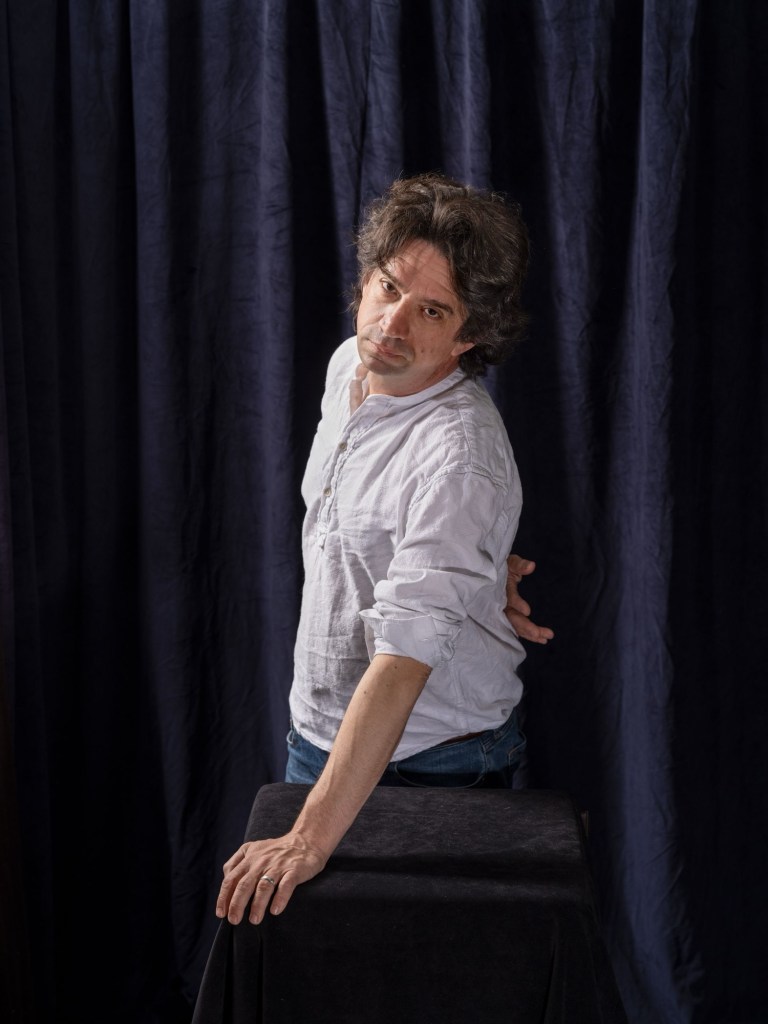
Curtis Yarvin, advisor to Peter Thiel, Donald Trump

This article in The New Yorker by Ava Kolman paints a biographical portrait of Yarvin, summarizes his major ideas and describes his international standing as a philosopher of far-right leaders of the tech industry.

Kolman writes about Yarvin’s extensive range of contacts among the Trump administration and his influence on them, as well as his contact with royalists in other countries..

Kolman begins:

In the spring and summer of 2008, when Donald Trump was still a registered Democrat, an anonymous blogger known as Mencius Moldbug posted a serial manifesto under the heading “An Open Letter to Open-Minded Progressives.” Written with the sneering disaffection of an ex-believer, the hundred-and-twenty-thousand-word letter argued that egalitarianism, far from improving the world, was actually responsible for most of its ills. That his bien-pensant readers thought otherwise, Moldbug contended, was due to the influence of the media and the academy, which worked together, however unwittingly, to perpetuate a left-liberal consensus. To this nefarious alliance he gave the name the Cathedral. Moldbug called for nothing less than its destruction and a total “reboot” of the social order. He proposed “the liquidation of democracy, the Constitution, and the rule of law,” and the eventual transfer of power to a C.E.O.-in-chief (someone like Steve Jobs or Marc Andreessen, he suggested), who would transform the government into “a heavily-armed, ultra-profitable corporation.” This new regime would sell off public schools, destroy universities, abolish the press, and imprison “decivilized populations.” It would also fire civil servants en masse (a policy Moldbug later called rage—Retire All Government Employees) and discontinue international relations, including “security guarantees, foreign aid, and mass immigration.”

Does anything on his wish-list sound familiar to you?

It should. Trump has loaded up his administration with people who imbibe Yarvin.

A decade on, with the Trumpian right embracing strongman rule, Yarvin’s links to élites in Silicon Valley and Washington are no longer a secret. In a 2021 appearance on a far-right podcast, Vice-President J. D. Vance, a former employee of one of Thiel’s venture-capital firms, cited Yarvin when suggesting that a future Trump Administration “fire every single mid-level bureaucrat, every civil servant in the administrative state, replace them with our people,” and ignore the courts if they objected. Marc Andreessen, one of the heads of Andreessen Horowitz and an informal adviser to the so-called Department of Government Efficiency (doge), has started quoting his “good friend” Yarvin about the need for a founder-like figure to take charge of our “out of control” bureaucracy. Andrew Kloster, the new general counsel at the government’s Office of Personnel Management, has said that replacing civil servants with loyalists could help Trump defeat “the Cathedral.”

“There are figures who channel a Zeitgeist—Nietzsche calls them timely men—and Curtis is definitely a timely man,” a State Department official who has been reading Yarvin since the Moldbug era told me. Back in 2011, Yarvin said that Trump was one of two figures who seemed “biologically suited” to be an American monarch. (The other was Chris Christie.) In 2022, he recommended that Trump, if reëlected, appoint Elon Musk to run the executive branch. On a podcast with his friend Michael Anton, now the director of policy planning at the State Department, Yarvin argued that the institutions of civil society, such as Harvard, would need to be shut down. “The idea that you’re going to be a Caesar . . . with someone else’s Department of Reality in operation is just manifestly absurd,” he said.

Yatvin’s ideas are quirky, inhumane, and extreme, to say the least:

On his blog, he once joked about converting San Francisco’s underclasses into biodiesel to power the city’s buses. Then he suggested another idea: putting them in solitary confinement, hooked up to a virtual-reality interface. Whatever the exact solution, he has written, it is crucial to find “a humane alternative to genocide,” an outcome that “achieves the same result as mass murder (the removal of undesirable elements from society) but without any of the moral stigma.”

Yarvin’s call for an American strongman is often treated as an eccentric provocation. In fact, he considers it the only answer to a world in which most people are unfit for democracy….

Yarvin’s influence on Trump’s inner circle is noticeable:

Last month, an anonymous doge adviser told the Washington Post that it was “an open secret that everyone in policymaking roles has read Yarvin.” Stephen Miller, the President’s deputy chief of staff, recently quote-tweeted him. Vance has called for the U.S. to retrench from Europe, a longtime Yarvin desideratum. Last spring, Yarvin proposed expelling all Palestinians from the Gaza Strip and turning it into a luxury resort. “Did I hear someone say ‘beachfront?’ ” he wrote on Substack. “The new Gaza—developed, of course, by Jared Kushner—is the LA of the Mediterranean, an entirely new charter city on humanity’s oldest ocean, sublime real estate with an absolutely perfect, Apple-quality government.” This February, during a joint press conference with Benjamin Netanyahu, the Israeli Prime Minister, Trump surprised his advisers when he made a nearly identical proposal, describing his redeveloped Gaza as “the Riviera of the Middle East.”

Trump, who doesn’t like to read, is unlikely to have read Yarvin’s philosophical treatises about the proper functioning of a modern society–without benefit of a popular vote–but certainly Trump’s view of the unlimited, imperial powers of the Presidency are similar to those of Yarvin.

Read the article if you can access it. Make yourself aware of the man who wields an outsize influence on Trump right now.

To learn more about Yarvin’s influence among rightwing billionaires, read:
https://theconversation.com/an-antidemocratic-philosophy-called-neoreaction-is-creeping-into-gop-politics-182581

The Chronicle of Higher Education reports that legislatures in Republican-controlled states are passing laws to restrict teaching about racism or any kind of DEI in higher education. Such state laws follow the lead of Governor Ron DeSantis in Florida, who was first to launch the war on academic freedom, but also the policies of Trump, who has declared that he too will make war on “woke” (that is, anything that is honest about the dark side of the American past.)

Katharine Mangan reported:

Teaching social work in Tuscaloosa, Ala., Cassandra E. Simon often assigns readings that describe how the families her students might one day serve have been impacted by more than a century of housing, employment, and education discrimination. The associate professor has encouraged her students to engage in spirited discussions about race, even assigning a project in which they advocate for or against a social-justice issue.

Doing any of those things today, she argues in a federal lawsuit, could get her fired from the state flagship, where she’s taught for 25 years. Last year, the state’s Republican governor, Kay Ivey, signed into law a sweeping bill that restricts what professors can teach about race. If any of their lessons veer into what conservative politicians have deemed “divisive concepts,” faculty members risk being reported, investigated, and potentially fired.

That kind of incursion into the curriculum is growing and prompting a flurry of First Amendment challenges from Simon and other plaintiffs. It’s a line state lawmakers did not cross early on in their push to dismantle DEI efforts, even as universities shuttered offices, laid off employees, canceled scholarships, and called off diversity training. But over the past two years, more than a dozen laws have been enacted that either limit which classes can be taught or imposed restrictions on what professors can say in the classroom, according to a Chronicle analysis of state legislation and a compilation of what PEN America calls “educational gag orders.”

This year especially “has been a banner year for censorship at a state level across the country,” said Amy B. Reidsenior manager at PEN America’s Freedom to Learn program. “The point of a lot of these restrictions is to put people on guard, worried that anything or everything could be prohibited so you really have to watch what you say.”

Some of the chief architects of the DEI-dismantling playbook have insisted that they’re not trying to silence anyone. In a January 26 letter to the editor in The Wall Street Journal by Ilya Shapiro and Jesse Arm of the Manhattan Institute, the institute declared that “Conservatives Have No Interest In Censorship.”

“By ending practices such as identity-based discrimination and compulsory, politically coercive diversity statements,” these laws “protect the rights of professors and students to engage freely on all topics, including race,” they wrote.

Despite such reassurances, recent bills seeking to eliminate diversity efforts are encroaching on curricula in a variety of ways. Some states, like Texas, Florida, and Utah, are giving boards more control over what goes into the core curriculum, as well as the ability to shut down programs with low enrollments or questionable work-force advantages. Others, like Alabama and Mississippi, have erected guardrails on topics that can be discussed in the classroom.

Supporters say these laws are needed to prevent liberal professors from veering off into lessons that amount to activism. Some conservative lawmakers argue that it’s their responsibility, as stewards of taxpayer dollars, to ensure public universities are offering degrees that will help students be successful and land jobs.

Critics see these incursions as infringements on free speech and academic freedom. 

The intentions of those who launched “the war on woke” are irrelevant to the reality of what happens when their concerns are taken up by legislatures intent on stamping out disturbing but historically accurate discussions of race and gender. When red-state legislators restrict academic freedom, they do it with an axe, not a scalpel. The result is to instill fear in professors about what they teach and whether they will be fired for thought crimes.

In 2017, when Trump passed his first budget bill, his allies inserted into it an unprecedented tax on institutions of higher education that have large endowments. The tax was 1.4%. But that 1.4%, though it seemed small, was money that would not be available for low-income students at expensive colleges and universities. The next logical step–once the government starts taxing nonprofits– would have been to tax megachurches but that didn’t happen.

This year, the Trump administration has included in its “One Big Ugly Budget Bill” a dramatic increase in the tax on higher education endowments.

Instead of 1.4%, the highest rate would climb to 21%.

This onerous tax would limit colleges’ ability to cover the tuition of students who are fully qualified but lack the financial resources to pay. The inevitable result of this tax will be to restrict the number and size of scholarships.

I received this letter from President Paula A. Johnson of Wellesley College, my alma mater. Dr. Johnson grew up in Brooklyn, where she graduated from a large public high school (Samuel J. Tilden), then to Radcliffe and to Harvard Medical School. She was a cardiologist before she was chosen as Wellesley’s president almost a decade ago. She is dedicated to providing scholarships for students who need them.

She wrote to all alumnae:

It is hard to overstate the importance of this moment for higher education. We are being threatened in previously unimaginable ways that cut to the core of our values and endanger a large proportion of our students. At Wellesley, we are deeply concerned about changes that could affect academic freedom, our need-blind status, and our ability to build a diverse community, one made richer by our international students.  

One of the most significant threats comes from the likelihood of a major increase to the tax on college endowments. Last month, the U.S. House of Representatives passed a budget bill that would raise the tax from 1.4% to as much as 21%. Under this proposal, Wellesley would be taxed at 14%, which means our liability under the tax would increase from $3 million, where it is currently, to $30 million per year—an amount equal to fully funding financial aid for 325 students. 

When you consider that more than two-thirds of the $82 million Wellesley spent last year to support financial aid came from our endowment, the disastrous impact of this tax becomes clear. This is a punitive tax on students and families who need financial aid.

The tax would also have a disproportionate impact on small colleges like Wellesley that, without other revenue streams such as graduate programs or large research budgets, rely on endowments to support their mission.

At Wellesley, 43% of our operating budget comes from the endowment, making it our largest source of revenue. A tax increase would have a severe impact on our academic program and our ability to meet students’ financial needs. In addition, the tax would override the intent of generations of alumnae who have given to the endowment to support financial aid and our academic mission. 

That is why Wellesley has joined a coalition of more than two dozen small colleges and universities from 17 states across the country that together serve more than 50,000 students. The coalition’s core argument, which we are sharing with members of Congress, is that endowments are not a luxury for small colleges; they are essential to continuing our commitments to access, opportunity, and educational excellence for students. 

If this totally unwarranted tax is passed, the number of meritorious students from low-income, even middle-income families would shrink dramatically.

This is wrong.

Raise taxes on corporations and billionaires.

Tax megachurches.

Raise the taxes and tariffs on super yachts.

Don’t tax the endowments of institutions of higher education.

Voice of America is known worldwide for its straightforward, unbiased presentation of world news. Trump placed MAGA enthusiast Keri Lake in charge. At his behest, she just laid off most of the VOA staff. Remember when America was great? We thought we had a message for the world and that the truth would set us free.

But Trump doesn’t want to “Make America great Again.” He wants to make America a land of bitter divisions, where the rich get richer, and the poor get poorer and sicker, unable to get health insurance, medical care, good schools, or any opportunity to rise into the middle class. For that, you need unions and good jobs.

The New York Times just reported:

The Trump administration sent layoff notices on Friday to more than 600 employees at Voice of America, a federally funded news organization that provides independent reporting to countries with limited press freedom.

The layoffs, known as reductions in force, will shrink the staff count at the news organization to less than 200, around one-seventh of its head count at the beginning of 2025. They put Voice of America journalists and support staff on paid leave until they are let go on Sept. 1.

The termination notices are the latest round of the Trump administration’s attack on federally funded news networks, including Voice of America.

In March, President Trump accused the news group of spreading “anti-American” and partisan “propaganda,” calling it “the voice of radical America.” He then signed an executive order that effectively called for dismantling of the news agency and put nearly all Voice of America reporters on paid leave, ceasing its news operations for the first time since its founding in 1942.

Kari Lake, a fierce Trump ally and a senior adviser at the news organization’s oversight agency, U.S. Agency for Global Media, notified Congress earlier this month that her agency intended to eliminate most positions at Voice of America. Her letter identified fewer than 20 employees who must remain at the media organization, according to laws passed by Congress to establish and fund it. Friday’s termination notices leave around 200 employees.

Ms. Lake’s decision “spells the death of 83 years of independent journalism that upholds U.S. ideals of democracy and freedom around the world,” Patsy Widakuswara, a former Voice of America White House bureau chief who was placed on leave and is leading a lawsuit against Ms. Lake and the U.S. Agency for Global Media, said in a statement.

She encouraged Congress to intervene and to signal support for Voice of America, which was founded to combat Nazi propaganda and reported in countries that suppress independent reporting and free speech.

“Moscow, Beijing, Tehran and extremist groups are flooding the global information space with anti-America propaganda,” Ms. Widakuswara said. “Do not cede this ground by silencing America’s voice.”

Joyce Vance is a former federal prosecutor for North Alabama. She writes an important blog called Civil Discourse, where she usually explains court decisions and legal issues. Today she turns to education.

Today I’m recovering from the graduation tour, one in Boulder and one in Boston in the last two weeks, and getting back into the groove of writing as I continue to work on my book (which I hope you’ll preorder if you haven’t already). The graduations came at a good moment. 

Watching my kids graduate, one from college and one with a master’s in science, was an emotional experience—the culmination of their years of hard work, sacrifice, and growth, all captured in a single walk across the stage. They, like their friends, my law students, and amazing students across the county, now enter society as adults. Even beyond the individual stories of hardships overcome and perseverance, witnessing these rites of passage makes me feel profoundly hopeful. The intelligence and commitment of the students—many of whom are already tackling big problems and imagining new, bold solutions—gives me a level of confidence about what comes next for our country. In a time when it’s easy to get discouraged, their commitment and idealism stands as a powerful reminder that they are ready to take on the mess we have left them. 

The kids are alright, even though they shouldn’t have to be. Talking with them makes me think they will find a way, even if it’s unfair to ask it of them and despite the fact that their path will be more difficult than it should be. Courage is contagious, and they seem to have caught it. Their educations have prepared them for the future we all find ourselves in now.

As students across the country prepared to graduate this year, Trump released his so-called “skinny budget.” If that’s how they want to frame it, then education has been put on a starvation diet—at least the kind of education that develops independent thinkers who thrive in an environment where questions are asked and answered. Trump pitches the budget as “gut[ting] a weaponized deep state while providing historic increases for defense and border security.” Defense spending would increase by 13% under his proposal.

The plan for education is titled, “Streamline K-12 Education Funding and Promote Parental Choice.”Among its provisions, the announcement focuses on the following items:

  • “The Budget continues the process of shutting down the Department of Education.” 
  • “The Budget also invests $500 million, a $60 million increase, to expand the number of high-quality charter schools, that have a proven track record of improving students’ academic achievement and giving parents more choice in the education of their children.”

As we discussed in March, none of this is a surprise. Trump is implementing the Project 2025 plan. In December of 2024, I wrote about how essential it is to dumb down the electorate if you’re someone like Donald Trump and you want to succeed. A rich discussion in our forums followed. At the time I wrote, “Voters who lack the backbone of a solid education in civics can be manipulated. That takes us to Trump’s plans for the Department of Education.” But it’s really true for the entirety of democracy.

Explaining the expanded funding for charter schools, a newly written section of the Department of Education website reads more like political propaganda than education information: “The U.S. Department of Education announced today that it has reigned [Ed: Note the word “”reigned” is misspelled] in the federal government’s influence over state Charter School Program (CSP) grant awards. The Department removed a requirement set by the Biden Administration that the U.S. Secretary of Education review information on how states approve select entities’ (e.g., private colleges and universities) authorization of charter schools in states where they are already lawful authorizers. This action returns educational authority to the states, reduces burdensome red tape, and expands school choice options for students and families.”

There are already 37 lawsuits related to Trump’s changes to education. Uncertainty is no way to educate America’s children. Cutting funding for research because you want to score political points about DEI or climate change is no way to ensure we nurture future scientists and other thinkers and doers…

I am reminded again of George Orwell’s words: “The most effective way to destroy people is to deny and obliterate their own understanding of their history.” The historians among us, and those who delve into history, will play a key role in getting us through this. Our love and understanding of history can help us stay grounded, understanding who we are, who we don’t want to become, and why the rule of law matters so damn much to all of it….

Thanks for being here with me and for supporting Civil Discourse by reading and subscribing. Your paid subscriptions make it possible for me to devote the time and resources necessary to do this work, and I am deeply grateful for them.

We’re in this together,

Joyce

In case you wondered, I now call DOGE something else. I call it DOGS, although truthfully that’s not fair to dogs. Dogs are wonderful creatures; In my experience, dogs give you unconditional loyalty and love. These DOGS are loyal to one man, Elon Musk. They are shredding the federal government, destroying the careers and lives of tens of thousands of professional civil servants. They have gathered our personal data. They are embedded in high-level positions across the government. They should all be fired and sent back to Elon Musk.

But the bigger risk to our democracy is Russell Vought, Director of the Office of Management and Budget, one of the most powerful positions in the federal government. He is a self-proclaimed Christian nationalist. He is working in opposition to the Founding Fathers, who made clear their intention to keep religion out of government.

Democracy Docket reports on Vought:

Though Elon Musk is leaving the White House, DOGE isn’t going anywhere.

It appears that Russell Vought — Trump’s budget hawk and one of the chief architects of the Heritage Foundation’s Project 2025 — is stepping in to become DOGE’s new power broker.

With Vought, a self-described Christian nationalist, at the helm, the slash-and-burn effort against the federal government may be on the cusp of an even darker turn.

In many ways, Vought is what Musk is not. After working at public policy organizations for nearly two decades, he has a far better understanding of how the government works — and how its weaknesses can be exploited. Despite advising Trump for almost 10 years, he’s also kept a fairly low profile, rarely giving interviews or speaking in public. 

And Vought appears to be motivated first and foremost by creating a Christian nation controlled by an overtly Christian government. 

Last year, Vought told undercover journalists with the Centre for Climate Reporting that he wants “to make sure that we can say we are a Christian nation.”

“And my viewpoint is mostly that I would probably be Christian nation-ism,” Vought said. “That’s pretty close to Christian nationalism because I also believe in nationalism.”

To achieve that, Vought said in the interview he seeks to replace the non-partisan and merit-based federal civil service with a bureaucracy in which employment hinges on allegiance to Trump. He said he also seeks to impound congressionally approved funding, help coordinate mass deportations and find ways to let Trump use the military to put down protesters.

As former Trump adviser Steve Bannon recently told The Atlantic, “Russ has got a vision. He’s not an anarchist. He’s a true believer.”

Federal agencies, in particular the Office of Personnel Management (OPM), have already implemented numerous policies that Vought drafted to achieve those goals.

Earlier this year, OPM proposed new regulations that would formally revive Schedule F, a key tool developed by Vought to gut the federal government and replace career public servants with partisan ideologues.

In another move championed by Vought, the personnel office last week also announced a s0-called “Merit Hiring Plan” that would, if implemented, ask prospective hires for the thousands of DOGE-induced vacancies across the federal government to write short essays explaining their levels of patriotism and support for the president’s policies.

“How would you help advance the President’s Executive Orders and policy priorities in this role? Identify one or two relevant Executive Orders or policy initiatives that are significant to you, and explain how you would help implement them if hired,” reads one of the essay prompts.

Vought, too, has recently taken steps to impound funds. 

This week, the White House sent Congress proposed spending cuts — also called a rescission package — that’s been backed by Vought in order to formalize cuts made by DOGE. The $9.4 billion package targets funding for NPR, PBS, the U.S. Agency for International Development and other foreign aid spending.

The rescission process allows a president to avoid spending money on discretionary programs, and since rescission bills only require simple majority approval in the House and Senate, there’s a chance some of the proposed cuts will become law. If they do, they will be the first presidentially proposed rescissions accepted by Congress since 1999. 

If Congress doesn’t pass the package, the 1974 Impoundment Control Act, which restricts when and how the president can delay or withhold federal funds, requires Trump to release the funds — that’s assuming that the administration follows the law. 

The same day the White House sent Congress the package, Vought threatened that if lawmakers don’t pass the rescissions, the executive branch would find ways to override Congress’ constitutional authority to allocate funding.

“We are dusting off muscle memory that existed for 200 years before President Nixon in the 1970s and Congress acted to try to take away the president’s ability to spend less,” Vought said.

When asked by CNN whether he was attempting to tee up a legal fight to challenge the Impoundment Control Act as unconstitutional, Vought implied he was.

“We’re certainly not taking impoundment off of the table. We’re not in love with the law,” Vought said.

Governor Ron DeSantis has done everything possible to destroy education in Florida. He apparently hates public schools. He pushed through an expansion of vouchers that provides a subsidy to every student in the state, no matter if the family is rich or poor. Of course, most of those using the voucher never attended public schools. Most vouchers go to students in religious schools. Florida currently spends $4 billion annually on vouchers, a sum sure to increase.

Bad as public K-12 education is, the state’s public higher education system is in worse shape. DeSantis has placed political cronies in charge of every state university. He took charge of tiny New College (700 students) because he was offended that Florida had one progressive institution of higher education where students were encouraged not to conform. DeSantis replaced the board with conservatives who put a political extremist in President. What was once a haven for free-thinking students was transformed into a school for jocks and business majors.

The editorial board of the Sun-Sentinel summarized DeSantis’s record of using higher education as patronage for political cronies:

When Gov. Ron DeSantis won his landslide re-election in 2022, a half-fawning and half-fearful Florida Legislature gave him whatever he wanted.

The Harvard graduate could have used that power to burnish Florida’s celebrated universities. He could have chosen the best and brightest to lead schools already among the nation’s best. He could have been the education governor.

That — not a bellyflopping bid for the White House — could have cemented his legacy.

Instead, DeSantis has earned a doctorate in cronyism. He’ll be remembered as the governor who did everything in his power to erode higher education and independent thought. He puts politics above merit and qualifications, with sham “searches” and secret deals.

College and university campuses are now soft-landing patronage pads for Republican allies, at sky-high salaries.

Former House Speaker Richard Corcoran was installed as president of New College in Sarasota. Another politician, former House Majority Leader Adam Hasner, was handed the FAU presidency. A run-of-the-mill former legislator, Fred Hawkins, won the presidency of a state college in Avon Park despite lacking academic qualifications.

Former Lt. Gov. Jeanette Nuñez is now president of Florida International University. Former U.S. Sen. Ben Sasse of Nebraska was given the prestigious UF presidency, then flamed out amid reports of over-the-top spending.

It’s no surprise, then, that Education Commissioner Manny Diaz, a former Republican legislator from Hialeah who oversees state colleges and K-12 education, will slide into the presidency of the University of West Florida in Pensacola.

For DeSantis and Diaz, no university is too big and no kindergarten picture book is too small to escape being recast in the governor’s philosophy.

Step 1: Stack the board

First, DeSantis stacked UWF’s board of trustees. Then, newly appointed trustee Zach Smith quickly made clear that UWF president Martha Saunders was unwelcome.

Smith, a Heritage Foundation fellow, had to reach back to six years ago to find even a speck of mud to throw: Two student-organized drag shows in 2019; social media messaging about a Black Lives Matter co-founder and a book, “How to be an Antiracist,” once recommended by university librarians.

It’s true that best-seller is full of provocative opinions. But so is Smith’s book, “Rogue Prosecutors,” which pushes dark conspiracies about prosecutors corrupted by a wealthy Jew.

That did not stop his nomination to the UWF board by DeSantis, who only last year declared war on campus antisemitism amid great fanfare.

The widely popular Saunders saw the writing on the wall, and she resigned.

A farcical scene

That board meeting was an ambush, said trustee Alonzie Scott. The next one was a farce.

Without a job posting or a search, Diaz’s name alone surfaced as a replacement. Just as quickly, a special meeting was called by UWF trustees. There would be no search for a temporary president and no effort to pick an interim leader from the university.

There was only a perfunctory vote to install Diaz. Then, farce upon farce, the board voted with a straight face to begin looking for a permanent replacement for Diaz.

Barring a political earthquake, that will be Diaz. As former Pensacola mayor and UWF alum Jerry Maygarden said at the meeting, what serious candidate would apply for a job that smacks of a done deal?

Even Diaz’s roots defy all logic.

UWF’s strength is its strong community support among residents and businesses, including Republican leaders. Diaz’s Miami-Dade home is a 10-hour drive, 700 miles and culturally worlds apart from Escambia County in “Lower Alabama.”

None of this is about rescuing students who feel intimidated and indoctrinated.

After all, a state-mandated 2022 Intellectual Freedom and Viewpoint Diversity report found that a majority of UWF students surveyed felt the school provided them the freedom to express their own opinions. Half said they had no idea if their professors were liberal or conservative.

New College 2.0

Never mind. In April, DeSantis told UWF to “buckle up,” announcing he would do for them what he did for New College.

It’s hard to see the success story in New College since the governor declared war on it. DeSantis’ hostile takeover of the tiny liberal arts college has devolved into a money pit: The state’s cost for each New College student shot to more than $90,000. Other state universities average roughly $8,000.

Last month, New College and the University of South Florida were found to be secretly working on a deal to “transfer” USF’s Sarasota-Manatee campus to New College. It’s dead for the moment. Community leaders, kept in the dark as usual, demand answers.

Meanwhile, USF has become the latest fertile field for DeSantis to reward his friends. USF’s president said she will resign, creating yet another job opportunity for a like-minded crony.

The Sun Sentinel Editorial Board consists of Opinion Editor Steve Bousquet, Deputy Opinion Editor Dan Sweeney, editorial writers Pat Beall and Martin Dyckman, and Executive Editor Gretchen Day-Bryant. To contact us, email at letters@sun-sentinel.com.

Rosa DeLauro (D-Connecticut) is one of the most effective members of Congress. She is pro-labor and pro-public schools.

Watch as she rips into Russ Vought, director of the powerful Office of Management and Budget and primary author of Project 2025.

Prescient

Oliver Darcy, media journalist, writes about NPR’s decision to fight the Trump administration’s efforts to shut it down.

Trump is directly infringing on freedom of the press, punishing NPR because it is not slavishly devoted to him and his views.

I listen to NPR for straightforward, unbiased news. I appreciate their long-form reports on a wide array of subjects. Many parts of the country are news deserts, where the only media available are the rightwing Sinclair radio stations and FOX News.

The nation needs NPR, just as the world needs Voice of America, which Trump is defunding.

As with so many of his decisions, I wonder who benefits? I have no answer.

Darcy writes:

When Trump signed an order to defund NPR, the network faced a choice over how it would respond—but CEO Katherine Maher made one thing clear from the start: there would be no backroom negotiations.

In the days following Donald Trump’s May 1 executive order to strip NPR of all federal funding, leaders at the public broadcaster began deliberating their options. But even before the network’s legal team got to work on the litigation, one decision had already been made. NPR chief executive Katherine Maher made clear that the outlet would not quietly negotiate with the White House—an approach other media companies have recently taken under immense political pressure. 

“As an independent media organization,” Maher told me by phone Tuesday, “we wouldn’t go ahead and have that conversation because that would be negotiating on editorial principle.” 

On Tuesday morning, NPR and three of its member stations in Colorado filed a federal lawsuitagainst Trump and his administration, alleging the executive order he signed was not only punitive, but also unconstitutional. In a 43-page complaint, the stations argued that Trump’s directive violated theFirst Amendment, usurped Congress’authority over federal spending, and more broadly, posed a threat to the editorial independence of public media nationwide. 

The language of the filing was unambiguous. It framed the executive order not as a routine dispute over funding priorities or media policy, but as a retaliatory strike designed to punish critical coverage and reshape the information environment in Trump’s favor. “The Order’s objectives could not be clearer,” the lawsuit stated. “The Order aims to punish NPR for the content of news and other programming the President dislikes and chill the free exercise of First Amendment rights by NPR and individual public radio stations across the country.” 

I asked Maher what it felt like to take a sitting president to court. She didn’t hesitate. “What did it feel like?” she rhetorically asked me. “It felt like recognizing that there are responsibilities that one takes on in running a media organization, and this was one of those.” She emphasized that the case wasn’t just about NPR’s national desk or morning programming—it was about the entire public media system: “We did this on behalf of our newsroom. We did this on behalf of our editorial independence. We did this on behalf of public media at large.”

Maher, who only took the helm of NPR in January 2024, told me that the legal option became increasingly clear as the organization studied the implications of the executive order. “We took a look at [the order] and wanted to be able to make sure that we really analyzed it,” she said. “We got to understand what avenues existed for us to be able to seek relief—and litigation was something that we came to once we realized that fundamentally this was a First Amendment issue.” The legal review moved quickly. “Obviously, it’s only been four weeks,” Maher added, “and so you can imagine it happened on a pretty quick timeline.”

The lawsuit was filed by not just NPR, but also Colorado Public RadioKSUT Public Radio, and Aspen Public Radio. Together, they asked the court to block enforcement of the order and affirm that federal support for public broadcasting, which Congress has repeatedly approved, cannot be overturned by presidential fiat. For its part, NPR receives just 1% of its annual operating budgetdirectly from the Corporation for Public Broadcasting, the private nonprofit that distributes federal funding. But local member stations across the country receive a much larger slice of their budgets from the $535 million in taxpayer funds CPB distributes. PBS, facing a similar predicament, said Tuesday it is also actively weighing a legal challenge of its own.

While Trump has long treated NPR as a proxy for elite coastal media (he’s referred to it as a “liberal disinformation machine,” among other insults), Maher declined to say in her own words why he despises the outlet with the white-hot passion of a thousand suns. “I really couldn’t say what the president thinks or doesn’t think,” she told me. “It’s beyond my powers to get inside his mind.” At the same time, she acknowledged the broader context in which public broadcasting has become a partisan target. “I think that we recognize that there has long been pushback about public media,” she said.

In any case, the legal issue, she insisted, is separate from any political debate. When asked whether she worries that suing the president could further cement in the minds of the MAGA faithful that NPR has a bias against him, she pushed back. 

“I fundamentally reject the idea that defending the Constitution is partisan,” Maher told me. “We are taking this action on behalf of the First Amendment. We’re taking this action on behalf of the free press. Regardless of your political beliefs, we all benefit from that.” She added that the lawsuit should be viewed as an act of civic duty, not political retaliation: “I would much rather people saw this as an act of patriotic commitment to our Constitution on behalf of citizens rather than saying that this is somehow partisan or political.”

Of course, that’s not how her actions have been portrayed by MAGA Media, which—similarly to Trump–views NPR as a liberal mouthpiece of the so-called “deep state.” Maher seemed to acknowledge that reality, but said she would continue to work to get the outlet’s message out. She even said she would be willing to appear on outlets like Fox News to do so. “I’m always happy to talk to people who are happy to talk to us,” Maher said. “I think that we’d be open to having that conversation.”

What happens if the court doesn’t rule in their favor? Maher didn’t give the possibility of such an outcome any oxygen. “I’m really confident that we will [win],” she said. “I feel that we’re on very, very solid ground, so I’m not concerned about the downside.”