Archives for category: Florida

On August 20, the New York Times published a story about how Ron DeSantis joined the “ruling class” but now campaigns against it. His story is shot through with hypocrisy. He paints himself as the public school kid from middle-class Dunedin, Florida, surrounded by snobs from private schools who looked down on him. Yet now as governor, he treats public schools and their teachers with contempt and expanded vouchers to pay billions of taxpayer dollars for kids to go to private schools, including high-income families.

Why is he, the public school kid, subsidizing private and religious schools? Why is he so hostile to public schools? He complains that public schools indoctrinate their students yet he’s willing to send kids to religious schools whose purpose is indoctrination. Why does he subsidize the tuition of rich kids who go to private schools? Aren’t those the kind of kids who treated him with condescension?

Early last year, Gov. Ron DeSantis nestled into his chair onstage in Naples, Fla., to explain to an audience of the would-be conservative elite his journey through the reigning liberal one they hoped to destroy. His host was Larry P. Arnn, the president of Hillsdale College, a small Christian school in southern Michigan that has become an academic hub of the Trump-era right. His subject was Yale University, where Mr. DeSantis was educated and where, as he tells it, he first met the enemy.

The story begins:

“I’m a public school kid,” Mr. DeSantis told the audience, unspooling a story that he has shared in recent years with aides, friendly interviewers, donors, voters and readers of his memoir, “The Courage to Be Free.” “My mom was a nurse, my dad worked for a TV ratings company, installing the metering devices back then. And I show up in jean shorts and a T-shirt.” The outfit “did not go over well with the Andover and Groton kids” — sometimes it is Andover and Groton, sometimes it is Andover and Exeter, sometimes all three — who mocked his lack of polish.

Worse than Yale’s snobbery was its politics: College was “the first time that I saw unadulterated leftism,” he told the Republican Jewish Coalition this March. “We’re basically being told the Soviet Union was the victim in the Cold War.” Teachers and students alike “rejected God, and they hated our country,” he assured the audience in Naples. “When I get people that submit résumés,” he said, “quite frankly, if I got one from Yale I would be negatively disposed.”

Then there are the parts of the story he doesn’t tell: How his new baseball teammates at Yale — mostly fellow athletic recruits from the South and West who likewise viewed themselves as Yale outsiders — were among those who teased him about his clothes, and how he would nevertheless adopt their insular culture as his own. How he joined one of Yale’s storied “secret societies,” those breeding grounds of future senators and presidents, but left other members with the impression that he would have preferred to be tapped by a more prestigious one. How he shared with friends his dream of going to Harvard Law School — not law school, Harvard Law School — and successfully applied there, stacking one elite credential neatly onto another, and co-founded a tutoring firm that touted “the only LSAT prep courses designed exclusively by Harvard Law School graduates.” How his Yale connections helped him out-raise rivals as a first-time candidate for Congress, and how he featured his Ivy credentials — “a political scarlet letter as far as a G.O.P. primary went,” Mr. DeSantis likes to say — on his campaign websites, sometimes down to the precise degree of honors earned. And how that C.V. helped sell him to an Ivy-obsessed President Donald J. Trump, whose 2018 endorsement helped propel Mr. DeSantis to the governor’s office in Florida, where his Yale baseball jersey is displayed prominently on the wall next to his desk…

For Mr. DeSantis and his allies, the culture wars are the central struggle of American public life, and schools are the most important battleground where they will be fought. “Education is our sword,” Mr. DeSantis’s then education commissioner, Richard Corcoran, explained to a Hillsdale audience in 2021. And Mr. DeSantis is the man to wield it — a self-made striver who was “given nothing,” as he told the audience attending his campaign kickoff in Iowa in May. “These elites are not enacting an agenda to represent us. They’re imposing their agenda on us, via the federal government, via corporate America and via our own education system.”

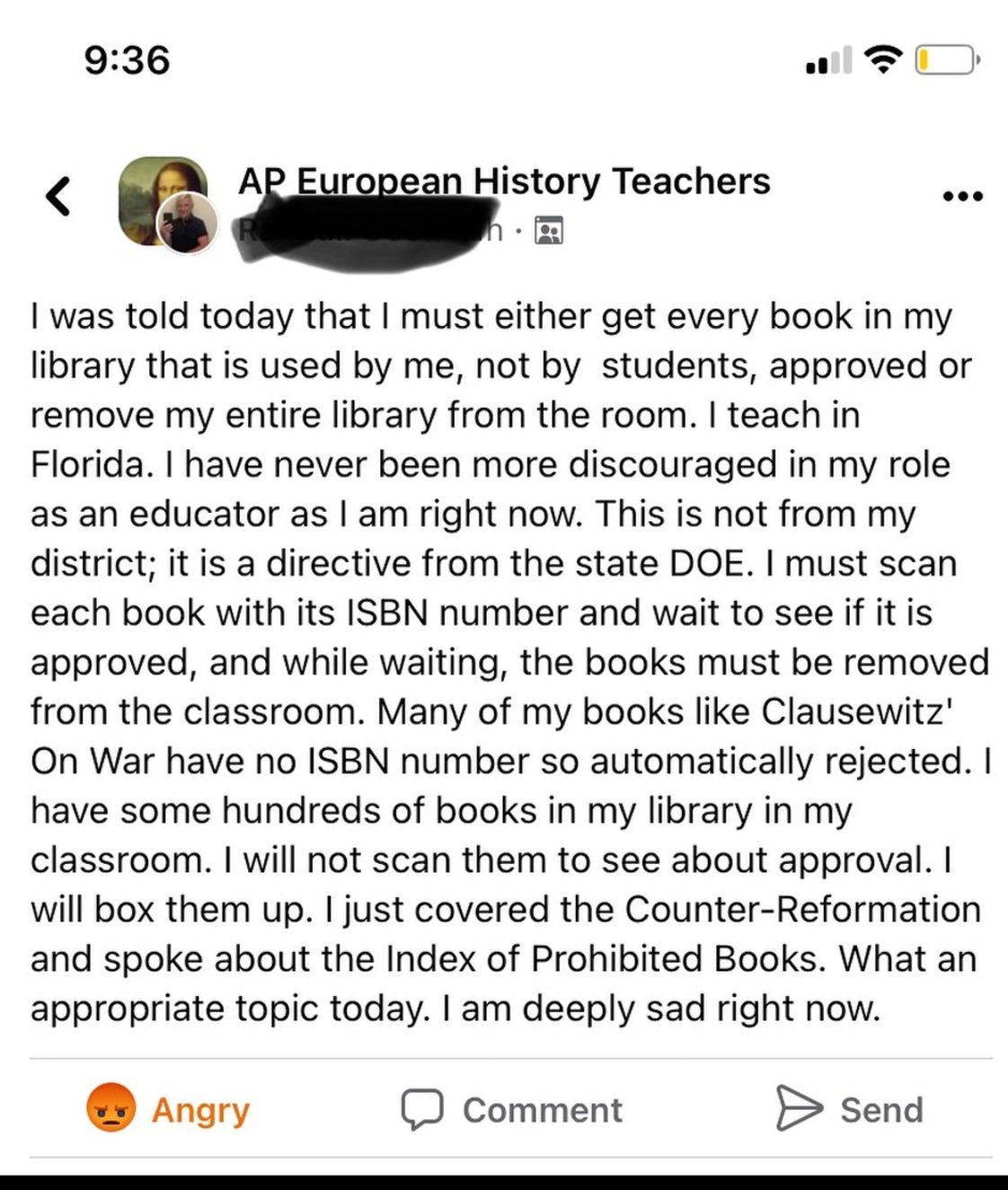
DeSantis has aggressively taken political control of Florida’s schools and universities, passing laws that limit or eliminate what may be taught about gender and race. He has encouraged parent vigilantes to scour classrooms and libraries for books on controversial topics and ban them. His ally, radical conservative Chris Rufo, is quoted in the article:

“The goal of the university is not free inquiry,” Christopher Rufo, a conservative activist and one of the new trustees [of New College], said during a recent appearance in California. Instead, he argued, conservatives need to deploy state power to retake public institutions wherever they can.

“The universities are not overly politicized. The universities are overly ideologized and insufficiently politicized,” Mr. Rufo said. “We should repoliticize the universities and understand that education is at heart a political question.”

At Yale, DeSantis joined Delta Kappa Epsilon (Dekes), which was known for its vicious hazing of pledges. As an upper-class member, DeSantis was known for bullying pledges and forcing them to engage in pranks like dropping their pants and exposing their genitals, while the older members mocked their private parts.

The story says that DeSantis took a course on the Cold War taught by the esteemed scholar John Lewis Gaddis, who was an outspoken critic of the Soviet Union. In other words, DeSantis lied about being exposed to pro-Soviet views of the Cold War.

DeSantis portrayed Harvard Law School, where he studied, as a bastion of left wing thought. But the Dean of the law school when DeSantis arrived belonged to the conservative Federalist Society. And he was not the only member of that group on the faculty.

A 2005 survey of The Harvard Law Review, published in the Federalist Society’s flagship publication, The Harvard Journal of Law & Public Policy, found that staff members “identifying themselves as left-of-center did not comprise even a majority.”

DeSantis neglects to mention that he was an active member of the Harvard Law School’s Federalist Society. He prefers to play the victim.

When he ran for Congress and then for governor, he tapped his Yale and Harvard networks to raise money.

But then he discovered there was even more political advantage for him if he played the role of the enemy of the ruling class.

How better to attack the ruling class than to destroy the public schools that enabled him to enter Yale? If this makes no sense, neither does DeSantis’ fable about being victimized at Yale and Harvard.

Scott Maxwell, a brilliant opinion writer for the Orlando Sentinel, wrote about the latest scandal in DeSantisland. The man in charge of the state ethics office was recently appointed by DeSantis to be head of DeSantis’ board that controls Disney World in Orlando. It’s illegal for a public employee to serve as ethics commissioner. Immediately after Maxwell’s article appeared, the general counsel for the state ethics commission announced that Glen Gilzean could not hold both jobs and had to choose one. What’s interesting is not just the conflict with the law but Gilzean’s former employment with the Urban League, which advocates for diversity, equity and inclusion, all of which DeSantis opposes.

Be it noted that Gilzean responded to the ruling by the ethics commission’s counsel by attacking the release of the ruling:

Instead of resigning, Glen Gilzean is questioning whether Florida’s ethics commission “weaponized” a memo that concluded he was ineligible to serve as both the state’s ethics chairman and administrator of Gov. Ron DeSantis’ tourism oversight district.

The opinion released on Thursday concluded that Gilzean couldn’t do both jobs because of a state law that bars ethics commissioners from holding public employment.

Scott Maxwell writes:

Perhaps you read Tuesday’s front-page story about how the head of Florida’s ethics commission appears to be in violation of … wait for it … Florida’s ethics laws.

This might be the most Florida story ever. The only thing that could make it more Floridian would be if an alligator or sinkhole were somehow involved.

The news was definitely a head-shaker. But it also underscores the ugly reality of just how lax the state’s ethics enforcement is. Public officials routinely flout rules without paying much of a price.

The problem with that is that Florida statutes say no public employees are allowed to serve as ethics commissioners. That’s for a pretty obvious reason: Because you don’t want the fox guarding the henhouse — a public official in a position to investigate himself.

The rule isn’t complicated either. Chapter 112.321 of the Florida statutes describes the requirements for ethics commissioners. And in the very first section, there is this simple, seven-word sentence: “No member may hold any public employment…”

On April 21, Gilzean’s ethics commission dismissed an ethics complaint against Gov. Ron DeSantis that had been filed by allies of Donald Trump who’d argued that DeSantis was inappropriately using the governor’s office to boost his national political profile.

Then on May 10, the governor’s appointees at the Disney taxing district announced they wanted to give Gilzean the $400,000-a-year job.

So, to recap: The governor’s Disney appointees appointed the governor’s ethics appointee to a high-paying job less than three weeks after that same ethics appointee dismissed a complaint against the man who’d appointed him to that position.

Hillbilly family reunions look less incestuous…

Two weeks ago, Gilzean announced the Disney taxing district was ending all of its “so-called diversity, equity, and inclusion initiatives,” calling them “illegal and simply unAmerican.”

Now, if you heard DeSantis say something like that, it wouldn’t be surprising. But it sounded odd coming from a man who spent the last seven-plus years working for the Urban League — a civil rights group that devoutly espouses the value of Diversity Equity and Inclusion (DEI) endeavors. The Urban League not only preaches the value of inclusion, the national nonprofit actually offers services to help otherorganizations implement DEI programs “to make your organization a more equitable workplace.”

Tax records filed last year show Gilzean earned $172,272 while working as CEO of the Central Florida Urban League.

Perhaps not surprisingly, after Gilzean trash-talked the very diversity initiatives his previous employer had touted, his former boss responded with force. National Urban League CEO Marc Morial said Gilzean’s about-face was a “betrayal of the values at the very core of our mission,” telling the Tallahassee Democrat that Gilzean’s “crass political expediency is all the more offensive given his previous vantage point to the harm he knows it will cause.”

Gilzean didn’t respond to questions about that issue either.

If you find this unsavory, you can lodge a complaint with…the state ethics commission.

At the urging of Governor DeSantis, Florida’s legislature rubber stamped his proposal to expand vouchers to all students in the state without income restrictions. As Leslie Postal reported in The Orlando Sentinel, demand for vouchers in the state surged by 44%. Many of the applicants are already enrolled in private and religious schools. In other states where vouchers were made universal, most of the vouchers were claimed by students who never attended public schools. Thus, instead of “saving poor kids from failing public schools,” vouchers have become a subsidy for affluent families.

Postal writes:

The number of Florida students awarded school vouchers jumped by more than 117,500 this year, mostly due to a new state law that made all students eligible for scholarship programs once targeted to low-income children.

By Aug. 11, more than 382,000 students had received vouchers for the 2023-24 school year, giving them access to money for private school tuition, homeschooling services or therapies for children with disabilities, according to Step Up For Students, the private group that administers most of Florida’s scholarship programs.

That represents a 44% increase from a year ago when about 264,400 scholarships were awarded by the same date….

The scholarships are worth an average of about $7,800 a year, though actual amounts vary by student’s grade level and by county. The voucher programs are still required to prioritize giving awards to children whose families earn no more than 185% of the federal poverty limit, or a family of four earning $55,000 a year or less. But everyone, whether middle class or very rich, is now eligible to apply….

The hike in scholarships was expected after Gov. Ron DeSantis in March signed the new law, which he called a “major game changer” that would boost educational options for families. The law was celebrated by GOP leaders, school choice advocates and parents already paying for private school who are now eligible for state assistance.

They argued families who never opted for free public schools still pay school taxes and so it makes sense to provide them school vouchers to help offset private school costs.

This week, the Archdiocese of Miami credited the new law with boosting enrollment at its Catholic schools and creating waitlists at some campuses. “Step Up Blew Up,” it wrote on its website, like many, using Step Up as shorthand for Florida’s school scholarship programs.

The archdiocese noted that at one Catholic school in Coral Gables, with about 900 students, the number of families receiving state scholarships leapt from 160 last year to more than 560 this year.

But the new law also faces fierce critics. They worry its price tag — one estimate says it will cost the state $4 billion in its first years — will devastate public school budgets and dislike that private schools that take vouchers face little regulation from the state.

“The public dollars that they have given to private schools, those are our public school dollars that they are now giving to people to go to a private school,” Castor Dentel said. “Those are public school dollars they are now handling over to unaccountable private schools where you don’t have to have a qualified teacher.”

Private schools that take state vouchers are mostly religious schools, and they make their own decisions as far as teacher qualifications, curriculum and facilities. Some have hired teachers without college degrees and employees with criminal convictions, set up in rundown buildings and offered curriculum outside mainstream academics, the Orlando Sentinel has reported.

Providing scholarships to families whose children already were in private school or were being homeschooled “is absolutely taking away from public school dollars,” said Norin Dollard, a senior policy analyst with the Florida Policy Institute, a progressive think tank that warned back in February that the new law would cost the state billions of dollars.

Dollard said the state earmarked about $3.3 billion for all its scholarship programs this school year and likely will run through that by the end of October, given the number of awards announced so far.

If you thought Betsy DeVos was bad, wait ‘til you meet Erika Donalds! She is adored by both Ron DeSantis and Donald Trump. She hates public schools and spreads lies about them. Sadly for DeSantis, she has cast her lot with Trump.

Kiera Butler wrote about the rise of Erika Donalds in Mother Jones. She begins:

On a hot afternoon in June, some 700 seated attendees of the annual summit of the conservative parents’ rights group Moms for Liberty bowed their heads in prayer. The Moms had waited in a security line that spanned two floors of the Philadelphia Marriott to get here, and even during this somber moment, the giddiness in the ballroom was palpable as they geared up for the highlight of the conference: a speech by former President Donald Trump.

Up at the dais, wearing a shiny green satin T-shirt that stood out against a row of American flags, Moms for Liberty advisory board member and wife of Rep. Byron Donalds (R-Fla.) Erika Donalds offered an invocation. “Lord, you have elevated this organization to do your good work in this country,” she said. “We’re grateful that the truth is being exposed, that parents are being able to see what’s really going on in education in our country.”

Presumably, Donalds was referring to the litany of complaints about public schools that had emerged in the conference breakout sessions: how they were corrupting children with lessons about institutional racism, gender diversity, and sex ed. Trump, when he finally took the stage, put a finer point on these forces of corruption, decrying the “radical left, the Marxists and communists” who had supposedly taken over American education. Then, he thanked Donalds by referring to her as “Byron’s wonderful wife.” He went on, “Where is she? I hope she’s here somewhere because she is an incredible person!”DeSantis helped position Donalds as an educational power player in the state. In return, Donalds has had an outsize influence on Florida’s educational policy.

Trump’s hour-and-a-half speech was a meandering affair, but the Moms were rapt: They booed when he accused President Joe Biden of arranging his indictment, and whooped when he complained about “the 87 different genders that the left says are out there.” But possibly the loudest applause of all came when he returned to the topic of education. “By the way I want to move our education system back to the states,” he said. The audience exploded. “You hear that, Erika?”

That Donalds received two separate Trump shout-outs was noteworthy because, well, she’s not all that famous, at least not outside of her home state. A former school board member from Collier County, Florida, she now runs a local network of charter schools—you’re more likely to have heard of her congressman husband, a Black archconservative who has been touted as a potential Trump running mate in 2024. Trump’s praise of Donalds was even more striking given that she was, until recently, a golden child of one of Trump’s Republican opponents. Over the last decade, Florida Gov. Ron DeSantis helped position Erika Donalds as an educational power player in the state, elevating her work and appointing her to key committees. In return, Donalds has had an outsize influence on Florida’s educational policy, says Sue Legg, a retired University of Florida professor of education who has followed Florida’s move toward conservatism in education.

But in recent months, as DeSantis’ political fortunes shifted, Donalds appears to have dropped the governor and instead hitched her star to Trump’s wagon. Legg believes it’s possible that Donalds may be on the list of possible Trump picks for the next secretary of education, the role previously filled by charter-school crusader Betsy DeVos. In addition to her school-choice advocacy, DeVos threateneddesegregation efforts, rolled back Obama-era protection for transgender students, and has openly called for the dismantling of the Department of Education. “Betsy DeVos was a disaster,” says Legg. “I think Erika Donalds could be worse.”

A fourth-generation Floridian born in 1980, Donalds grew up middle class in Tampa. Her current passion for education wasn’t on display in her early life; in a 2015 interview with the News-Press, she recalled being a mediocre high school student, buckling down only after she learned she would be thrown off the basketball team if she couldn’t get her grades up. With the help of her churchgoing grandparents, she raised her GPA and narrowly qualified for admission to Florida State University, where she excelled, graduating magna cum laude in 2002 with a degree in accounting. It was at Florida State that she met her husband, Byron, who became a Christian after attending Erika’s evangelical church. The pair got married shortly after graduation and moved to the affluent town of Naples in Southwest Florida’s Collier County. Erika went on to earn a master’s degree in accounting from Florida Atlantic University, then to work her way up in an investment firm, an experience that would later serve her well when she became a charter-school entrepreneur.

In 2013, when the second of Erika and Byron’s three sons was in elementary school, the couple began to question the public school that their children attended. During his speech at this year’s Moms for Liberty summit, Byron Donalds recalled his son struggling with math homework that followed the instructional method endorsed by the federal Common Core education program under Obama, which many conservatives see as an example of federal government overreach. “I remember it like it was yesterday,” said Byron. “He’s sitting at the kitchen table. He’s got tears in his eyes crying. ‘This is how they’re teaching me.’ And I said, ‘Son, I don’t know what they’re teaching you. But I promise you this. In the real world, you get fired over doing math like that.’” The Donaldses promptly pulled their son out of their neighborhood public school and enrolled him in private school.

That experience seems to have made a strong impression on Erika Donalds; she soon began advocating for school choice, an educational policy movement that champions charter schools and private school tuition vouchers as alternatives to public schools. In 2013, she helped found a group called Parents’ Rights of Choice for Kids (Parents ROCK), whose members, foreshadowing the current parents’ rights movement, railed against what they saw as government intrusion into the sacred relationship between parents and children. In a July 2013 Facebook post, the group wrote, “We are fighting so hard for all of these parents, and many more who are still unaware that their parental rights have been snatched away by an overreaching school district, hungry for more money and control.”

There is speculation that Erika Donalds might be Trump’s choice for Secretary of Education. Assuming, that is, that he is not incarcerated.

The Miami Herald published an editorial describing the climate of fear that’s descended on the classrooms of Florida. That’s exactly what Republicans want, says the editorial board. Once people start self-censoring, the battle for censorship is won.

The editorial board wrote:

The fear is the point.

Schools in Florida have been canceling — and then, in some cases, reinstating — Advanced Placement psychology courses for high school students because they’ve been told by the College Board, or simply believe, the classes would violate the state’s ban on lessons involving sexual orientation and gender identity.

The worry is understandable — and a bonus for a state intent on waging culture wars in schools and crushing any dissent. If you can get people to self-censor, you’ve pretty much won the battle.

School districts in Miami-Dade and Broward counties announced Wednesday that they would be among those offering the course, although in Broward it will be require parents to “opt-in.” The districts’ decisions came after Education Commissioner Manny Diaz Jr., who is from Miami and once taught in the public schools here, said the class could be taught.

But the fact that school districts have to publicly announce their intent to teach a class that has been around since 1993 is indicative of the problem. Under Florida Gov. Ron DeSantis and his lockstep Legislature, fear has seeped into schools. Teachers and school districts are rightfully worried about violating the Parental Rights in Education Act, the “Don’t say gay” law that outlawed sexual orientation and gender identity teachings. The penalties for a violation are potential career-enders, teaching licenses suspended or revoked..

This all happened after the College Board, the New York City-based nonprofit that manages AP courses in the United States, said last week that it wouldn’t recognize Florida’s AP psychology course and — critically — wouldn’t give students college credit for it because the state wanted any mention of sexual orientation and gender identity stripped out. Any course that censors required content cannot be labeled “AP” or “Advanced Placement,” the board said. Students applying for college rely on AP credits as a plus on their applications.

And school is about to start — next week in Miami-Dade and the following week in Broward.

So now the state says it’s OK to teach the course, but the education world is jittery, with good reason. Can the state be trusted?

In Leon County, where Tallahassee is located, Superintendent Rocky Hanna said the district would offer the class, but he is clearly wary. On Twitter, he wrote: “Our teachers have some concerns but we are going to take the commissioner of education’s word when he says that Advanced Placement Psychology may be taught in its entirety,” Hanna said.

He added that he has told the staff to “respect the law and follow the law but not to fear the law.”

This is where we are in Florida: Instead of supporting our public school teachers, we are instilling fear and worry. Instead of celebrating their hard work, we are threatening them with license suspensions if they dare to cross the power of the mighty state.

Teaching has always required courage. In Florida, it now requires a whole new brand of bravery.

Without any evidence, rightwing talk show host Dennis Prager is convinced that the nation’s public schools are swamped with left wing propaganda. Therefore he feels no compunction about producing rightwing propaganda for the schools and frankly acknowledges that he intends to indoctrinate students with his “PragerU” videos.

Carol Burris, a veteran teacher and principal, gas advice for teachers compelled to use Prager propaganda.

Since the last mid-term election, when young adults came out in high numbers for Democrats, the far-right has stepped up attacks on public schools.  Part of their long-term strategy to stay in power is to mind-snatch young people from public school curricula filled with what they call “dominant left-wing ideology,” hoping to shape the voting habits of the next generation. I never saw any “left-wing indoctrination” in my 30-plus years working in public education, nor do I see it now in my grandchildren’s public schools, but the right wing does, and it wants American parents to believe it is there, too. 


The strategy to convince the public that nonexistent problems exist is one part ban, two parts alternatives—ban books and topics and then impose “snoopervision” of curriculum and library books, establish vouchers and classical charter schools, and provide alternative and supplementary materials for those who remain in public schools to shape young minds. 


Enter PragerU. PragerU, despite the U, is not a university but rather a website-based nonprofit media company founded by Dennis Prager, a self-important pseudo-intellectual with no advanced university degree or teaching credentials. The website has become famous for its videos “that promote liberty, economic freedom, and Judeo-Christian values.” 


Dennis Prager, once a Jimmy Carter Democrat, has now made a career out of sounding the alarm that the barbarians are at the gates. In 1996, he testified at a Congressional hearing against gay marriage. He argues that Judaism rejects homosexuality  and that “the acceptance of homosexuality as the equal of heterosexual marital love signifies the decline of Western civilization.” Like Rush Limbaugh and Tucker Carlson, he excels at making the undereducated to whom Trump professed his love think he is the smartest person in the room. He gives old-fashioned bigotry and right-wing propaganda an intellectual sheen. 


PragerU is not new. It has been around for about a decade but has recently been in the news since the Florida Board of Education approved its “mind-changing” five-minute videos called PragerU Kids for classroom use. New Hampshire and Oklahoma, two states with state superintendents who are idealogues, may soon follow Florida’s lead.


What should teachers do with PragerU materials, especially if they are told to use them?


Put them to good use. Use them to teach students how to debunk propaganda and disinformation campaigns. Researchers at Michigan State University conducted an extensive study on how to battle online campaigns and materials intended to disinform. They found that moderation and even content bans don’t work. What does is teaching how to evaluate information critically, and it works best before opinions harden—hence the importance of teaching such critical thinking K-12.


 To teach such skills, I recommend a technique used extensively in the International Baccalaureate curriculum known as OPVL.

·       The O in OPVL stands for origin. Students first determine who published it and when and where it was published. They research what is known about the author that is relevant to the source’s evaluation.

·        P explores purpose. What message is the material trying to convey? Who is the intended audience, and why was that particular delivery format chosen?

·       V stands for value. To determine value, students answer questions such as, “What can we tell about the author’s perspective, and on which side of controversy does the author stand?” “What was occurring when the piece was created, and how accurately does this piece reflect what was happening?” 

·       Finally, L identifies limitations. Students determine methods to verify content and answer questions such as “Is the piece inaccurate in its depiction of a time period? What is excluded? What is purposefully left unaddressed?” 

PragerUKids provides a treasure trove of videos that are perfect for the initial teaching of this technique because the bias is blatant, and the false information is so easy to identify. For example, there is “PragerU’s Leo and Layla’s History Adventures with Frederick Douglass,” which you can watch here


The video is billed as providing “an honest and accurate look at slavery” and “how to create change.” It begins with wide-eyed Leo and Layla watching news reports of Black Lives Matter protests. Leo tells his sister that his math teacher teaches social justice instead of math. It then morphs into the siblings talking to Frederick Douglass, who both condemns slavery while serving as an apologist for the founding fathers. He tells the kids that the founders did not like slavery but needed to achieve the higher goal of forming a nation. The three then wrap up the discussion with a not-so-veiled condemnation of the protests following George Floyd’s murder.


Students as young as middle school could easily recognize that the purpose (P) of the video is not to present an “honest and accurate look at slavery” but rather to condemn protests as a form of initiating social change. The delivery method, a Black historical iconic figure, is deliberately chosen as the messenger—inaccurately depicting Douglass as a victim of slavery who understands the oppressors, portraying them as deliverers of a higher purpose. 


Determination of value (V) allows students to explore the BLM protests themselves, what the video excludes (the murder of George Floyd), and what misinformation it presents (protestors “want to abolish the police” and “the U.S. system torn down.”)


Further discussion of limitations (L) would note the exclusion of how slavery finally ended (not through gradual change but through civil war); the contradiction between cartoon Douglass’s claim that “our founding fathers knew that slavery was evil and wrong,” and the fact that according to Newsweek, two-thirds of the founding fathers kept slaves, and the easily debunked claim that “it was America that began the conversation to end it [slavery]”  (abolishment of slavery: Spain-1811; Britain-1833; Denmark-1846; France-1848; Netherlands 1861; the United States—1863).  Students could then discuss why the video uses the phrase “began the conversation” –also untrue but harder to disprove.


The beauty of OPVL, is that the teacher teaches the technique, but the students and the source reveal the content. One thing we know about the current disinformation campaign of the right is that it will only get worse. We can’t ban or stop it, but we can give young people the tools to see through it.

Governor Ron DeSantis seized control of New College by installing half-a-dozen hard-right trustees and instructing them to turn the small progressive liberal arts college into the Hillsdale of the South. One of his appointees was Chris Rufo, the extremist who invented the furor over critical race theory.

At a recent campus event, a New College student spit on Rufo. He filed charges against her for her “attack” on him.

The State Attorney’s office dropped misdemeanor battery charges against a New College of Florida student who was accused of spitting on Christopher Rufo, a conservative activist and one of the school’s trustees.

Libby Harrity, 20, was charged with misdemeanor battery on July 7 in connection with a Gov. Ron DeSantis bill signing at New College on May 15, when Harrity allegedly spat at Rufo. DeSantis’ visit to sign a bill banning state funding for diversity, equity and inclusion programs at state universities drew vocal protest from students, who have organized against his reshaping of the college since January.

The governor has said he wants to turn New College into a “classical liberal” college akin to the Christian, conservative Hillsdale College in Michigan.

Michael Hiltzik is the business columnist for The Los Angrles Times, but he has important things to say about Education and the culture wars. In this post, he adds to what we have learned about DeSantis’s efforts to show that slavery was sometimes beneficial to slaves. Some of them—not the ones picking cotton under the blazing sun—learned a trade. Of course, that would not apply to the many slaves who lived and died as slaves. What the Florida excuse-makers don’t get is that we use today’s values to judge slavery, not the values of the slave owners.

Hiltzik writes:

If there’s a bet that you will almost always win, it’s that no matter how crass and dishonest a right-wing claim may seem to be, the reality will be worse.

That’s the case with Florida’s effort to whitewash the truth about slavery via a set of standards for teaching African American history imposed on the state’s public school teachers and students.

The curriculum, you may recall, was condemned for a provision that the curriculum cover “how slaves developed skills which, in some instances, could be applied for their personal benefit.”

Dogs and Negroes Not Welcome

— Sign posted until 1959 at the town line of Ocoee, Florida, site of a 1920 racial massacre

Another provision seemed to blame “Africans’ resistance to slavery” for the tightening of slave codes in the South that outlawed teaching slaves to read and write.

A section referring to “acts of violence perpetrated against and by African Americans” goes on to list five race riots and massacres from American history, every one of which was started by whites.

More on that in a moment. As the indispensable Charles P. Pierce put it, the Florida standards “look as though they were devised by Strom Thurmond on some very good mushrooms.”

I reported last week on this reprehensible project, which was publicly presented as the product of a work group of the state’s African American History Task Force.

Two members of the task force, William B. Allen and Frances Presley Rice, responded to the scathing reaction to the curriculum from Democrats and Republicans with a defensive statement purportedly on behalf of the entire work group.

“Some slaves developed highly specialized trades from which they benefitted [sic],” the statement read. “This is factual and well documented.”

As I reported, however, of the 16 individuals Allen and Rice mentioned to support their assertion, nine never were slaves, seven were identified by the wrong trade and 13 or 14 did not learn their skills while enslaved. One, Betty Washington Lewis, whom Allen and Rice identified as a “shoemaker,” was white: She was George Washington’s younger sister and a slave owner.

Now it turns out that Allen and Rice were not speaking for the work group, but for themselves. Thanks to reporting by NBC News, we know that most of the work group’s 13 members opposed the language suggesting that slaves benefited from their enslavement.

NBC quoted several members anonymously as stating that two members pushed the provision — Allen and Rice. Members “questioned ‘how there could be a benefit to slavery,’” one work group member told NBC.

Others said that the work group met intermittently over the internet and did not collaborate with the state’s African American History Task Force, which was created in 1994 to oversee the curriculum for African American studies in Florida’s K-12 schools.

The work group’s standards were approved unanimously on July 19 by the state board of education, every member of which was appointed by Gov. Ron DeSantis, who is running a natural experiment to see whether bigotry and racism can carry someone to the presidency.

We’ve recently learned more about Allen and Rice. Allen, as I reported earlier, is a retired professor of political science at Michigan State University. (The university removed his bio page from its website sometime in the last few days, but here’s an archived version.)

Allen served as chair of the U.S. Commission on Civil Rights under George H.W. Bush, but angered civil rights activists and members of the commission itself for taking a stand against legal protections for gay people.

At a 1989 conference in Anaheim sponsored by anti-gay Christian fundamentalists, Allen delivered a talk titled, “Blacks? Animals? Homosexuals? What is a Minority?”

Its theme was that treating gays and Black people as distinct minorities would relegate them to animal status. Allen said, “My title is as innocent as a title can be,” a position that prefigured his current defense of the Florida slavery standards as no big deal.

He’s listed as a fellow of the Claremont Institute, which has been funded by a galaxy of right-wing foundations. The institute lists among its senior fellows John Eastman, who is one of the four attorneys identified as “co-conspirators” in the federal indictment of former President Trump for trying to overturn the 2020 presidential election, handed up Tuesday. Eastman is also the target of a California State Bar proceeding aimed at his disbarment for his alleged role in that effort.

As for Rice, she’s chair of the Sarasota-based National Black Republican Assn., which appears to have shared its business addresswith her home address. She identifies herself as “Dr. Frances Presley Rice,” but she doesn’t appear to have a medical degree or PhD; she does hold a juris doctor degree, but that’s just a law degree and doesn’t customarily bestow the “Dr.” designation on its holders.

Rice has conducted a years-long campaign to associate today’s Democratic Party with the Democrats of the 19th century, a pro-slavery party that shares none of its positions on Blacks or slavery with the Democrats of modern times.

The normalization of Florida’s slavery whitewash has been abetted by a supine press. On July 27, for example, Steve Inskeep, the host of NPR’s Morning Edition, conducted a servile interview in which he sat meekly by as Allen spewed unalloyed hogwash.

When Allen suggested that Black journalist Ida B. Wells had drawn “inspiration” from the slavery experience, Inskeep — had he been even minimally prepared — could have pointed out that the Mississippi-born Wells was 5½ months old when the Emancipation Proclamation took effect on Jan. 1, 1863, and 3½ years old when the 13th Amendment abolished slavery.

Nor did Inskeep challenge Allen about the list of 16 supposed slaves that he and Rice issued in defense of their curriculum. The list had been out for a full week before the NPR interview. Inskeep didn’t mention it at all.

When Allen asserted that he was not the author of the curriculum, nor were any other members of the work group, the proper follow-up would have been: “Who wrote it, then?” Inskeep kept mum.

The Washington Post, meanwhile, tried to shoehorn Florida’s whitewashing of slavery into a “both-sides-do-it” framework.

The Post article suggests that the Florida curriculum and President Biden’s July 25 proclamation of a national monument dedicated to Emmett Till, a Black teenager tortured and lynched by a white mob in Mississippi in 1955 for purportedly offending a white woman, are two sides of a “roiling debate” over Black history.

Of course that’s absurd. Most Americans, and most Democrats, don’t see slavery as a topic worthy of reconsideration. That’s all on the Republican side, especially in Florida.

DeSantis and his stooges are pretending that the truth about America’s racist past should be suppressed for fear of making white children feel bad. It’s nothing but a play for the most bigoted members of the GOP base.

That brings us back to Florida’s curriculum. Provisions other than the one about the benefits of slavery aren’t getting the attention they deserve.

Take the part about “acts of violence perpetrated against and by African Americans.” This standard is illustrated in the text by references to race riots in Atlanta in 1906 and Washington, D.C., in 1919, and massacres in Ocoee, Fla. (1920); Tulsa (1921); and Rosewood, Fla. (1923) — rampages by white mobs lasting a day or more.

In what sense do these point to violence perpetrated by Black people? Pierce conjectures that they “might distressingly be referring to attempts by the victims of those bloody episodes to fight back.”

The Ocoee massacre occurred when the town’s Black residents attempted to vote. When a squadron of Klansmen hunted down a Black leader in his home, his daughter tried to prevent them from taking him by brandishing a rifle, which went off, slightly wounding a white member of the gang.

“A volley of gunfire erupted in both directions,” according to an account on the Florida History blog. In the aftermath, nearly 60 Black residents were dead, their community was razed to the ground, and those who survived were driven from the town, never to return. Until 1959, a sign at the town line read, “Dogs and Negroes Not Welcome.”

Is Ocoee supposed to be an example of “violence perpetrated … by African Americans”? Nothing would speak more eloquently to the true nature of the Florida standards for teaching Black history.

The Florida Department of Education has created a new position for an administrator to collaborate with and encourage rightwing school boards. This appointment is intended to cement and expand Governor Ron DeSantis’s control over school boards. DeSantis has endorsed school board candidates to make sure his ideology—and none other—is taught in the public schools.

Leslie Postal of the Orlando Sentinel wrote:

A new office in the Florida Department of Education aims to “facilitate partnerships with district leaders,” but the director’s first months of work show interest in meeting mostly with conservative school board members, records show, including Moms for Liberty members and those endorsed by Gov. Ron DeSantis.

“We would be happy to meet with the Conservative Coalition of School Board Members as a group to explore ways that our efforts may align,” wrote Terry Stoops, the new director, to a Volusia County School Board member on April 23. “If you hold regular meetings and would like us to participate, please let me know.”

In another email, he shared his views of the previous night’s Orange County School Board meeting with Alicia Farrant, a Moms for Liberty member elected to the board in November.

“I watched some of the very misguided public comment at last night’s school board meeting. I just wanted to pass along a note to thank you for serving on the board and standing up for families,” Stoops wrote her on May 10.

“Thank you so much! I’m proud to represent our community and be a voice for many who feel voiceless,” responded Farrant, who has pushed for the school district to remove library books she finds offensive.

Stoops is the director of the education department’s new Office of Academically Successful and Resilient Districts, a job he started in April, according to his LinkedIn page. Stoops spent nearly two decades in North Carolina mostly working for the conservative John Locke Foundation, with a focus on education policy.

The Florida education department’s press office did not respond to emails asking questions about the new office and Stoops’ salary. He is not listed in the state payroll database on the governor’s office website.

In North Carolina, Stoops drafted what would become a framework for a North Carolina “parents’ bill of rights,” legislation that like Florida’s was criticized as anti-LGBTQ, apushed for more school choice options, such as charter schools and school vouchers.

His first months on the job in Florida showed meetings with board members and advocacy groups aligned to DeSantis, according to emails and his calendar obtained by the Florida Freedom to Read Project and shared with the Orlando Sentinel.

The new office shouldn’t be working only with those with certain political views, said Stephana Ferrell, an Orange County mother and one of the project’s founders.

“This department seems formed for the sole purpose of ensuring the DeSantis agenda is worked into policy,” Ferrell said. “It is using tax payer funds in a very deliberate, political way.”

In Orange, for example, Stoops reached out to Farrant but none of the other seven board members, Ferrell said. The same was true in Volusia, she said, where two conservative members got emails but the other three did not.

DeSantis wants to control what is taught in every school and college class. He is a dangerous man.

The Orlando Sentinel published a series of investigative reports about a shocking scandal: for years the ground water in Seminole County was poisoned by toxic chemicals, and the public did not know. The Sentinel published a four-part series, which I highly recommend. It’s a shocking story of political neglect.

Toxic Secret: Our series about 1,4-dioxane in Seminole water

Here is the series:

This is an excerpt from part four.

The Fulmer family dogs died two by two.

Tasha slipped away in 2004 and Rocky passed with cancer three years after. They were Rhodesian ridgebacks. Alan and Patricia Fulmer and their children took in another pair as puppies, Zipporah and Ariel. They would succumb to cancer.

In 2018, the city of Sanford tested their well water and soon came back with results.

“They said don’t drink it, don’t cook with it, don’t brush your teeth with it, don’t bathe in it, don’t touch it,” Patricia Fulmer said, recalling that moment. “It was really scary.”

The Fulmers were blindsided repeatedly.

First, when they learned a chemical called 1,4-dioxane, deemed likely to cause cancer, was in their drinking water coming from their private, household well at a high concentration.

Then they found out officials had known for years that the chemical, linked to hazardous pollution at a former Siemens factory in Lake Mary, was contaminating the underground water supply – the Floridan Aquifer – in all directions around their home just south of Sanford.

The third shock was when Patricia Fulmer was diagnosed with a malignant tumor, adding to the stress of their two daughters coping with chronic illnesses and the passing of a fifth pet, Dunder, a miniature pinscher.

In 2021, they sold their home to a developer and moved away.

The former house of Alan and Patricia Fulmer on a bulldozed lot at the corner of H.E. Thomas Parkway and Cherry Laurel Drive in Sanford, photographed Tuesday, April 11, 2023. The house is located northeast of the former Siemens-Stromberg factory at 400 Rinehart Road in Lake Mary. The Fulmers moved away several years after learning that 1,4-dioxane, a likely carcinogen detected at the former factory site, had contaminated their water well. (Joe Burbank/Orlando Sentinel)

The former house of Alan and Patricia Fulmer on a bulldozed lot at the corner of H.E. Thomas Parkway and Cherry Laurel Drive in Sanford, photographed Tuesday, April 11, 2023, days before the home was demolished. The house is located northeast of the former Siemens-Stromberg factory at 400 Rinehart Road in Lake Mary. The Fulmers moved away several years after learning that 1,4-dioxane, a likely carcinogen detected at the former factory site, had contaminated their water well. (Joe Burbank/Orlando Sentinel

*****

“It all began making sense,” said Patricia Fulmer, whose family has been firm in requesting a measure of privacy as they confront medical struggles and worries about their exposure to 1,4-dioxane. “It’s just so wrong.”

Her reaction has precedent in Florida. Some of the state’s most harrowing pollution episodes played out in stages: anxiety over exposure followed by distrust of officials for silence about a known threat.

1,4-dioxane was in use across the U.S. by the 1970s. The Siemens factory, making telephone network components, had been cited by the Florida Department of Environmental Protection the time it closed in 2003 for shoddy handling of hazardous chemicals.

There may be no way to learn when and at what strength 1,4-dioxane first invaded drinking water in Seminole County, but its presence was confirmed in the tap water of Sanford and the county’s Northwest Service Area in 2013 and in Lake Mary’s water in 2014.

Factory owners, including Siemens Corp. and General Dynamics, have denied liability for toxic pollution at the Lake Mary manufacturing site, but stated in 2017 that contaminants “may have been the result of historical activities at the Former Facility.”

‘You have the right to know’

The Fulmers were not alone in the dark.

Of the tens of thousands of residents and workers of Lake Mary, Sanford and Seminole County also exposed, it’s difficult to know how many have been made aware of the 1,4-dioxane they were consuming in drinking water.

It’s likely to be a very low percentage, judging from people well positioned to have learned of such a contamination of the Floridan Aquifer.