Archives for category: Extremism

Governor Gregg Abbott signed his big voucher bill into law yesterday, repeating promises he has made that are most certainly false. He claimed that vouchers will put Texas on a path to being the number one school system in the nation. Several other states have large voucher programs–e.g., Florida, Arizona, and Ohio–and none of them is the number one rated school system in the nation.

If anything, vouchers and charter schools break up the common school system that states pledge in their constitutions to support. Public schools are one system, regulated by the state, subject to elected local school boards. Charter schools are another, lightly regulated by the state, some for-profit, some as corporate chains, managed by private boards. Voucher schools are a third system, almost entirely deregulated, not required to accept all students, as public schools are. Voucher schools are not required to have certified teachers, as public schools are. Voucher schools are exempt from state testing. Most voucher schools are religious schools, managed by their religious leader. Private and religious schools choose their students.

Vouchers have been a big issue since the early 1990s. The first voucher program was launched in Milwaukee in 1990. The second started in Cleveland in 1996, ostensibly to save poor kids from failing public schools. Neither Cleveland nor Milwaukee is a high-performing district.

What we have learned in the past 30-35 years about vouchers is this:

  1. Most students who use vouchers were already enrolled in nonpublic schools.
  2. The students who transfer from public to private schools are likely to fall behind their peers in public schools. Many return to public schools.
  3. The public does not want their taxes to be spent on religious schools or on the children of affluent families. In nearly two dozen state referenda, voters defeated vouchers every time.
  4. The academic performance of students who leave public schools to attend nonpublic schools is either the same or much worse than students in public schools.
  5. Vouchers drain funding from public schools, where the vast majority of students are enrolled. This, the majority of students will have larger classes and fewer electives to subsidize vouchers.
  6. Vouchers are expensive. Arizona is projecting a cost of $1 billion annually. Florida currently is paying $4 billion annually.

To learn more about the research, read Joshua Cowen’s book The Privateers: How Billionaires Created a Culture War and Sold School Vouchers (Harvard Educatuon Press).

Governor Abbott surely knows these facts, but he determined that vouchers were his highest priority. Certainly they make him the champion of parents who send their children to private and religious school. All will be eligible for a subsidy from the state. And Abbott delivered for the billionaires who funded his voucher campaign.

Edward McKinley of the Houston Chronicle wrote:

Gov. Greg Abbott signed a $1 billion school voucher program into law Saturday, cementing the biggest legislative victory of his decade in office before a huge crowd including families, legislators and GOP donors.

Abbott framed the ceremony as the climax of a multiyear effort by himself and advocates around the state, and touted the state’s new program as the largest to ever launch in the nation. 

“Today is the culmination of a movement that has swept across our state and across our country,” he said, using the speech to call out parents in the crowd who had already pulled their students from “low-performing” public schools to put them into private ones. “It’s time we put our children on a pathway to have the number one-ranked education system in the United States of America.”

He put pen to paper at a wooden desk in front of the Governor’s Mansion, as a gaggle of children stood around him wearing their private school colors and logos. Someone shouted, “Thank you, governor!” before the crowd of nearly 1,400 people erupted in applause. Abbott pumped his fist in the air. 

The ceremony marked a major moment for the third-term Republican, who threw his full political weight and millions of campaign dollars into a push for private school vouchers, overcoming a legislative blockade that had lasted for decades. The bill he signed into law will give Texas students roughly $10,000 a year that they can put toward private school tuition, tutoring, textbooks and other expenses…

Texas Education Agency Commissioner Mike Morath and Pennsylvania billionaire Jeff Yass mingled in the crowd. Yass contributed more than $12 million to Abbott’s campaign last cycle, as the governor sought to unseat anti-voucher Republicans in the 2024 primary election.

Abbott was joined on stage by U.S. Sen. John Cornyn, Lt. Gov. Dan Patrick, House Speaker Dustin Burrows and the House and Senate authors of the bill. Also in attendance were private school leaders, including Joel Enge, director of Kingdom Life Academy. 

After Abbott’s address, Enge told the crowd he founded his Christian school after working in public schools in a low-income area of Tyler and watching children fall behind. His speech had the feel of a sermon.

“Children who have been beaten down by the struggles in the academic system that did not fit the system will now be empowered as they begin to find the right school setting that’s going to support them and to allow them to grow in confidence in who God created them to be,” he yelled, to raucous cheers. “Amen!…”

Hours earlier, Democratic legislators, union leaders and public educators gathered in the parking lot of the AFL-CIO building across the street from the governor’s mansion, where they had a much different message. 

Echoing lines used throughout committee hearings and legislative debates for the past few years, they warned that vouchers would hurt already struggling neighborhood public schools by stripping away their funding. About two dozen people swayed under the direct sun, waving signs that said “public dollars belong in public schools” and “students over billionaires.” 

“Today, big money won and the students of Texas lost,” said state Rep. James Talarico, an Austin Democrat. “Remember this day next time a school closes in your neighborhood. Remember this day next time a beloved teacher quits because they can’t support their family on their salary.”

Several speakers pointed out that while Republicans fast-tracked the voucher bill, they have yet to agree on a package to increase funding to public schools and raise teacher pay.

State Rep. Gina Hinojosa, an Austin Democrat, said she hoped this defeat could sow the seeds of future victories. Abbott and most legislators are up for reelection next year.

“He may have won this battle, but the war is not over,” she said. “There will be a vote on vouchers and he can’t stop it, and it will be in November 2026.”

What’s in the bill

The new law stands to remake education in Texas, granting parents access to more than $10,000 in state funds to pay for private school tuition and expenses, or $2,000 for homeschoolers. The first year of operation will begin in 2027, and in the run-up, the state will choose nonprofits to run the program, develop the application process and pick which families will have access.

All students will be eligible, although families making more than 500% of the federal poverty line, about $160,750 in income for a family of four, cannot take up more than 20% of the funds. The funds will be tied roughly to the amount of money the students would have received in public schools, meaning students with disabilities will receive extra.

School vouchers have become a signature of Abbott’s three terms in office. 

After the COVID-19 pandemic, other Republican-controlled states such as Florida, Arizona, Iowa and Indiana created or expanded their own voucher programs. But school choice advocates repeatedly fell short in Texas thanks to an alliance between Democrats and rural Republicans. Bills passed the Senate but failed to gain traction in the House. 

Then, in May 2022, Abbott announced in a speech at San Antonio’s Southside that he’d be throwing his full weight behind the policy. Even as public schools struggled to keep teachers in the classroom and balance their budgets, the governor told lawmakers he wouldn’t approve extra funds until a voucher bill made it to his desk. When it didn’t happen, even in special sessions, he took to the campaign trail, spending millions to unseat about a dozen key GOP lawmakers who stood in his way.

This session, he enlisted President Donald Trump’s help at the last minute to rally Republican House members, some of whom said they felt forced to back the policy.

Critics warn the state’s voucher program lacks safeguards to ensure it reaches the children it was designed to help and say they expect many of the slots to go to students already in private schools, which can pick and choose who they educate. The majority of private schools in Texas are religiously affiliated, and the average tuition costs upwards of $10,900, according to Private School Review.

Though $1 billion is set aside for the program in the first biennium, the nonpartisan Legislative Budget Board projects it could grow exponentially in the next decade amid huge demand from students currently in private or home schools.

It remains to be seen how many private schools will accept the vouchers, but many advocated their passage, including Catholic, Jewish and Muslim schools.

Although Abbott has said repeatedly that the program won’t pull funds from public schools, because schools are funded based on attendance, the LBB analysis showed that the program would reduce state payments to public schools by more than $1 billion by 2030. 

After Trump introduced Elon Musk and his so-called “Department of Government Efficiency,” several Republican-controlled states created their own DOGE operations. Like the one Musk launched, these were non-governmental, unelected, unaccountable cost-cutters, set loose to apply a chainsaw to state government.

John Thompson reports on what happened in Oklahoma.

CBS’s Sixty Minutes recently reported on the danger of H5N1 bird flu spinning out of control. It cited Dr. Kamran Khan who explained why “We are really at risk of this virus evolving into one that has pandemic potential.” Another expert agreed that “this flu could make Covid look like a walk in the park.”

This frightening reporting comes as the DOGE–OK seeks to cut nearly $150 million for programs that provide immunization services, pathogens surveillance, and emerging infectious diseases prevention, and provide Epidemiology and Laboratory Capacity for Prevention of Control of Emerging Infectious Diseases.

And this is only one reason for looking into the DOGE–OK process.

Anyone paying attention to Elon Musk’s leadership of the Trump administration’s DOGE campaign to cut federal programs has reason the fear the DOGE campaigns launched in 26 states. After all, as the Economic Policy Institute (EPI) explains, when Governor Kevin Stitt opened Oklahoma’s DOGE-OK, he called for a reduction in our personal income and corporate tax rates, thus making the state’s tax code even more regressive.

The EPI further explained that Stitt selected Marc Nuttle, “who was the ‘chief strategist’ behind Oklahoma’s 2001 so-called right-to-work referendum—a policy designed to disempower workers and lower wages (and contrary to proponents’ claims, it did not bolster job growth in the state).” The executive order empowered Nuttle to lead efforts of a newly formed agency to study the state budget.

Moreover, the EPI explains:

DOGE-OK is itself duplicative since the Office of the State Auditor and Inspector is constitutionally mandated to “examine the state and all county treasurers’ books, accounts, and cash on hand, stipulating that [the office] shall perform other duties as may be prescribed by law.” Similar to DOGE-OK, the auditor reviews staffing levels, assesses state spending, and issues public reports to promote transparency.

The DOGE-OK report now explains:

Once DOGE-OK ideas are received, they are analyzed and vetted with the appropriate group. If validated, ideas are added to the DOGE-OK website. 

But, when I studied the report, I found no sign of hard evidence to back its claims. For instance, they didn’t explain their methodology, and offered no cost/benefit analyses. DOGE didn’t explain what “groups” it considered to be “appropriate,” and what data was used to analyze and vet, and validate their ideas.  

Since the first DOGE headlines focused on $157 million in supposedly “wasteful health grants” by the federal government, I focused on Medicaid and Department of Health cuts.

These proposed cuts are especially disturbing because, as Shiloh Kantz, the executive director of the nonpartisan Oklahoma Policy Institute, explained, “Oklahoma already ranks among the worst in health outcomes.”

First, DOGE-OK claimed that $60 million per year would be saved if the state, not the federal government, performed eligibility checks on children. And, they cited two drugs that received accelerated approval without working, costing $42 million. But, they did not mention the number and the benefits of the other drugs, like the Covid vaccine, that received accelerated approval.

Also, DOGE-OK inexplicably said that easing the prescription drug cost cap would improve prices. And they recommended repeal of staffing requirements for Long-Term Care facilities in order to save $76 million annually, without mentioning harm to elderly patients due to under-staffing.

DOGE-OK also said that three Oklahoma State Department of Health programs should be cut by almost $150 million because their funding exceeded the amount necessary.  As already mentioned, in the wake of Covid pandemic, and as measles and bird flu spread, these programs provide immunization services, pathogens surveillance, and emerging infectious diseases prevention, etc. So, how did DOGE reach the conclusion that the full funding of those programs is no longer necessary?  

Then, DOGE-OK said that 7 programs should have cuts because of “duplication,” with partners doing the same or similar work. They said $2.2 million would be saved by getting rid of the team efforts necessary to improve health.

And Sex Education should be cut by $236,000 because of its low Return on Investment.

Again, I saw no evidence behind their recommendations for $157,606,300 in overall health care reductions. Neither did they address financial costs of implementing their ideas. And, there is no evidence that DOGE seriously considered the costs in terms of the lives that would be damaged or lost.

Given the history of the Trump/Musk DOGE, none of the DOGE–OK should be a surprise. When Gov. Stitt selected Nuttle, a true-believer in Milton Friedman, to run the project, Stitt said, “With his help, we’ll leave state government leaner than we found it.”

Is that the proper way to launch a supposedly balanced and evidence-driven investigation of such complex and crucial policy approaches?

Stitt’s news release previewed Nuttle’s methodology: “use his knowledge of the inner workings of government to comb through agency budgets, legislative appropriations, and contracts.”

So, to paraphrase the DOGE-OK report’s description of its methodology, its proposals would be “analyzed and vetted” by what they see as the “appropriate group.”

In other words, Oklahomans were never promised an open, balanced, evidence-based DOGE process for making our state better. But the same is also true for Musk’s federal DOGE chainsaw.

The Constitution says Congress has the power of the purse, not the president. The president executes the funding decisions of Congress.

Yesterday Trump called on the Corporation for Public Broadcasting to stop funding public radio and public television. Never mind that National Public Radio brings news to listeners in areas totally saturated by rightwing Sinclair stations. Never mind that PBS is the best source of documentaries about science, history, nature, medicine, other nations, and global affairs. PBS is educational television at its best.

The Washington Post reported:

President Donald Trump signed an executive order on Thursday evening seeking to prohibit federal funding for NPR and the Public Broadcasting Service (PBS). The order, which could be subject to legal challenge, called the broadcasters’ news coverage “biased and partisan.”

It instructs the Corporation for Public Broadcasting to cease providing direct funds to either broadcaster. It also orders CPB to cease indirect funding of the services through grants to local public radio and television stations.

CPB is the main distributor of federal funds to public media. It receives about $535 million in federal funds per fiscal year, which it mostly spends on grants to hundreds of stations nationwide. The stations spend the grants on making their own programming or on buying programming from services such as NPR and PBS.

CPB, created by an act of Congress in 1967, also sometimes provides direct grants to NPR and PBS to produce national programs.
Thursday’s order instructs the CPB board to ensure that stations receiving its grants “do not use Federal funds for NPR and PBS.”

The second Trump administration may well go down in history as the most corrupt presidency in our history. We learned yesterday that the Trump family crytocurrency just received an investment of $2 billion from a fund in Abu Dhabi; this is a sure way to gain access to the patriarch in the White House. Not only is he enriching himself and his family, but has also allowed Elon Musk to violate every ethical rule in the federal government while shackling his competitors.

Steven Rattner, a columnist for The New York Times, details some of the ways that Trump enriches himself during his Presidency. We should not be surprised. Throughout his adult life, Trump has been a hustler, a con man, a performer, and a man who loves money.

He wrote:

No presidential administration is completely free from questionable ethics practices, but Donald Trump has pushed us to a new low. He has accomplished that by breaking every norm of good government, often while enriching himself, whether by pardoning a felon who, together with his wife, donated $1.8 million to the Trump campaign; promoting Teslas on the White House driveway; or holding a private dinner for speculators who purchase his new cryptocurrency.

Mr. Trump’s blatant transgressions have swamped those of any modern president and even those of his first term. Remember the outrage when he refused to divest his financial holdings or when he used a Washington hotel he owned as a kind of White House waiting room? Those moves seem quaint in comparison.

In his trampling of historically appropriate behavior, Mr. Trump appears to be pursuing several agendas. Personal enrichment stands out: Imagine any other president collecting a cut of sales from a cryptocurrency marketed with his likeness. There is the way he is expanding his powers: He has ignored or eliminated large swaths of rules that would have inhibited his freedom of action and his ability to put trusted acolytes in key roles. And then there’s rewarding donors, whether through pardons or favors for their clients.

I was working in the Washington bureau of The Times when Richard Nixon resigned, and even he — taken down by his efforts to cover up his misdeeds — did not engage in such a vast array of sordid practices.

The corruption of Trump 2.0 has not gotten the attention it deserves amid the barrage of news about Mr. Trump’s tariff wars, his attack on scientific research and his senior appointees’ Signal text chains. But self-dealing is such a defining theme of this administration that it needs to be called out. Like much that Mr. Trump has done in other areas, it announces to the world that America’s leaders can no longer be trusted to follow its laws and that influence is up for sale.

Just as in the post-Nixon era, when guardrails were established to prevent transgressions, the next president could decide to restore some of the sound government practices that Mr. Trump has trampled on. But the damage he has inflicted by, say, pardoning his donors or lining his own pockets is irreversible.

The below represents just a sampling of what’s transpired these past 100 days.

  • He turned a legitimate federal employee designation into a loophole. By giving senior officials such as Elon Musk the title “special government employee,” Mr. Trump avoided requirements that they publicly disclose their financial holdings and divest any that present conflicts before taking jobs in the administration.
  • He ended bans that stopped executive branch employees from accepting gifts from lobbyists or seeking lobbying jobs themselves for at least two years.
  • He loosened the enforcement of laws that curb foreign lobbying and bribery.
  • He dismissed the head of the office that polices conflicts of interest among senior officials.
  • He jettisoned the head of the office that, among other things, protects whistle-blowers and ensures political neutrality in federal workplaces.
  • He purged nearly 20 nonpartisan inspectors general who were entrusted with rooting out corruption within the government.

Rewarding donors is part of any presidential administration. Every president in my memory appointed supporters to ambassadorships. But again, Mr. Trump has gone much further.

  • Jared Isaacman, a billionaire with deep tentacles into SpaceX, gave $2 million to the inaugural committee and was nominated to head NASA — SpaceX’s largest customer.
  • The convicted felon Trevor Milton and his wife donated $1.8 million to the campaign and Mr. Milton received a pardon, which also spared him from paying restitution.
  • The lobbyist Brian Ballard raised over $50 million for Mr. Trump’s campaign, and Mr. Trump handed major victories to two Ballard clients. He delayed a U.S. ban on China-owned TikTok his first day in office and killed an effort to ban menthol cigarettes, a major priority of tobacco company R.J. Reynolds, on his second.

Mr. Musk, the Tesla and SpaceX billionaire who spent $277 million to back Mr. Trump and other Republican candidates, requires his own category.

As a special government employee, Mr. Musk is supposed to perform limited services to the government for no more than 130 days a year. By law, no government official — even a special government employee — can participate in any government matter that has a direct effect on his or her financial interests. That criminal statute hasn’t stopped Mr. Musk and his so-called Department of Government Efficiency from interacting with at least 10 of the agencies that oversee his business interests.

  • He installed a SpaceX engineer at the Federal Aviation Administration to review its air traffic control system. The F.A.A. is reportedly considering canceling Verizon’s $2.4 billion contract to update its aging telecommunications infrastructure in favor of a SpaceX’s Starlink product. (SpaceX has denied it is taking over the contract.)
  • SpaceX is a leading contender to secure a large share of Mr. Trump’s “Golden Dome” missile defense project, an effort that could involve billions of revenue for the winner.
  • X, Mr. Musk’s social media outlet, has become an official source of government news. The White House welcomed a reporter from the platform at a recent briefing, and at least a dozen government agencies started DOGE-focused X accounts.
  • As Mr. Musk’s political activities started to repel many potential customers of Tesla, his electric vehicle company, Mr. Trump lined Tesla vehicles up on the White House driveway and extolled their benefits. Then Commerce Secretary Howard Lutnick urged Fox News viewers to buy Tesla shares.
  • DOGE nearly halved the team at the National Highway Traffic Safety Administration that regulates autonomous vehicles. The agency has been investigating whether Tesla’s self-driving technology played a role in the death of a pedestrian in Arizona.

Critics of crypto argue that it has demonstrated little value beyond enabling criminal activity. Despite this, Mr. Trump has wasted no time eliminating regulatory oversight of the industry at the Securities and Exchange Commission and the Justice Department, even as his family grows ever more invested in it.

By enabling money to be delivered anonymously and without any bank participation, crypto offers the possibility for any individual or foreign state to funnel money to Mr. Trump and his family secretly. Moreover, Bloomberg News recently estimated that the Trump family crypto fortune is nearing $1 billion.

  • On the eve of his inauguration he released $TRUMP and $MELANIA memecoins — a type of crypto derived from internet jokes or mascots. Next, the S.E.C. announced it would not regulate memecoins. Then last week, Mr. Trump offered a private dinner at his golf club and a separate “Special VIP Tour” to the top 25 investors in $TRUMP, causing the price of the currency to surge and enriching the family. (That tour was initially advertised as being at the White House. Then the words “White House” disappeared, but the rest of that prize remained.)
  • The S.E.C. eliminated its crypto-enforcement program, ending or pausing nearly every crypto-related lawsuit, appeal and investigation. That includes the civil suit against Justin Sun, a crypto entrepreneur who had separately purchased $75 million worth of tokens tied to Mr. Trump’s family after the election.
  • The S.E.C. also suspended its civil fraud case against Binance, the huge crypto exchange that pleaded guilty to money-laundering violations and allowed terrorist financing, hacking and drug trafficking to proliferate on its platform. Soon after, the company met with Treasury officials to seek looser oversight while also negotiating a business deal with Mr. Trump’s family.
  • World Liberty Financial, a crypto company that Mr. Trump and his sons helped launch, said it had sold $550 million worth of digital coins. A business entity linked to him gets 75 percent of the sales.
  • The Trump family has said it will partner with the Singapore-based crypto exchange Crypto.com to introduce a series of funds comprising crypto and securities with a made-in-America focus.
  • The federal government’s “crypto czar,” David Sacks, Mr. Lutnick and Mr. Musk all have connections to the market. (Mr. Musk named DOGE after a memecoin.)
  • Mr. Trump is reportedly on his way to raising $500 million for his political action committees — highly unusual for a president who cannot run for re-election.
  • A new Trump Tower is underway in Jeddah, Saudi Arabia’s second largest city, with plans for two more projects for the kingdom announced after Mr. Trump’s November election victory, all in partnership with a Saudi company with close ties to the Saudi government.
  • Mr. Trump’s team asked about bringing the signature British Open golf tournament to his Turnberry resort in Scotland during a visit of the British prime minister, Keir Starmer, to the White House.
  • He posts news-making announcements on Truth Social, the company in which his family owns a significant stake.

It’s all a sorry and sordid picture, a president who had already set a new standard for egregious and potentially illegal behavior hitting new lows with metronomic regularity.

David Yaffe-Bellany of The New York Times reported on a startling development in Dubai that will enrich the Trump family by hundreds of millions of dollars. Is it a conflict of interest? Of course. Will it matter to the Republican leaders in Congress? No. Has there ever been a President who used his office for financial gain so brazenly? No. Trump is #1.

Gaffe-Bellamy writes:

Sitting in front of a packed auditorium in Dubai, a founder of the Trump family cryptocurrency business made a brief but monumental announcement on Thursday. A fund backed by Abu Dhabi, he said, would be making a $2 billion business deal using the Trump firm’s digital coins.

That transaction would be a major contribution by a foreign government to President Trump’s private venture — one that stands to generate hundreds of millions of dollars for the Trump family. And it is a public and vivid illustration of the ethical conflicts swirling around Mr. Trump’s cryptofirm, which has blurred the boundary between business and government.

Zach Witkoff, a founder of the Trump family crypto firm, World Liberty Financial, revealed that a so-called stable coin developed by the firm, would be used to complete the transaction between the state-backed Emirati investment firm MGX and Binance, the largest crypto exchange in the world.

Virtually every detail of Mr. Witkoff’s announcement, made during a conference panel with Mr. Trump’s second-eldest son, contained a conflict of interest.

MGX’s use of the World Liberty stablecoin, USD1, brings a Trump family company into business with a venture firm backed by a foreign government. The deal creates a formal link between World Liberty and Binance — a company that has been under U.S. government oversight since 2023, when it admitted to violating federal money-laundering laws.

And the splashy announcement served as an advertisement to crypto investors worldwide about the potential for forming a partnership with a company tied to President Trump, who is listed as World Liberty’s chief crypto advocate.

“We thank MGX and Binance for their trust in us,” said Mr. Witkoff, who is the son of the White House envoy to the Middle East, Steve Witkoff. “It’s only the beginning.”

Mr. Witkoff and Eric Trump were speaking on a panel at Token2049, a major crypto conference in the United Arab Emirates, where more than 10,000 digital currency enthusiasts have gathered for a week of networking. It was the latest stop in an international tour by Mr. Witkoff, who visited Pakistan last month with his business partners to meet the prime minister and other government officials. Eric Trump, who runs the family business, has spent the week in Dubai, where he announced plans to back a Trump-branded hotel and tower.

There is more.

This is a gift article so you should be able to read it in full even without a subscription.

Thom Hartmann sees the pattern on the rug. Trump and Musk are stifling democratic institutions and rushing headlong towards the tyranny they both admire. Trump thinks that he can make himself dictator for life, Like his buddies in Russia and North Korea. Will the public defend the Constitution?

He wrote:

When Harvard, one of America’s oldest and most revered institutions of higher learning, stands defiant as the federal government freezes billions in funding simply because it refuses to knuckle under to authoritarian demands — like gutting DEI programs and turning faculty into immigration informants — we’re no longer playing the usual game of politics.


This is the open throttling of academic freedom, part of a larger, deliberate campaign to silence dissent, centralize power, and erase democratic norms.


We’ve seen this playbook before in other countries — but now it’s being run right here, in the land that once proudly called itself the world’s beacon of liberty.


Democracy doesn’t die in darkness, as the saying goes; it suffocates in broad daylight.


Americans are witnessing an unprecedented assault on the very foundations of our democratic experiment, orchestrated with a precision that would make authoritarian strongmen worldwide nod in approval.


Senator Chris Murphy has raised alarm bells about what he describes as a methodical attack on American institutions that are supposed to keep government accountable to its citizens. By his account, the strategy isn’t dramatic coups or burning parliaments; that’s not how modern democracies perish. Instead, they’re slowly dismantled through the calculated erosion of accountability mechanisms.


History provides a disturbing playbook, and we’re watching it unfold right now here in America. Putin, Orbán, and Erdoğan didn’t need tanks in the streets. They understood that the process is multi-part but straightforward:


— Legitimize political violence,
— Capture the media,
— Intimidate lawyers,
— Install corrupt leaders within regulatory and police agencies,
— Disappear first minorities and later opposition leaders,
— Silence universities, and
— Starve opposition movements by denying their nonprofit status and funding.


Consider what we’re seeing unfold. The recent January 6 pardons sent an unmistakable message about the acceptability of political violence. When legislators openly express fears of “retaliation” — as Senator Lisa Murkowski just did — we’re already several steps down a dangerous path.


Meanwhile, the concentration of media power in the hands of billionaires who increasingly bend to political pressure isn’t accidental. Whether through ownership, lawsuits, or regulatory threats, the ability to speak truth to power is being systematically constrained.


Universities, traditionally bastions of free thought and youth activism, face unprecedented pressure to conform or lose federal support.

Legal professionals, our front-line defenders of constitutional rights, are being asked to choose between principles and practice.


The economic dimension of this strategy can’t be ignored. Targeted tariffs and funding cuts effectively create a corporate compliance regime where business survival depends on political loyalty. When small-dollar online giving platforms become targets, it’s clear this is about drying up resources for political opposition.


Senator Murphy’s warning carries particular weight: “I still believe we can stop it,” he says. His prescription includes institutional solidarity, mass mobilization, and political courage. These steps aren’t just wishful thinking: history shows they work when deployed with determination.


The challenges are clear, but so is the path forward. Democrats and defenders of democracy must recognize this isn’t politics as usual. The systematic undermining of accountability mechanisms isn’t merely partisan: it’s anti-democratic in the most fundamental sense.


It’s the first stages of outright tyranny, the first American dictatorship.


If conventional resistance proves insufficient, Murphy suggests civil disobedience may become necessary. That’s not a suggestion to be taken lightly, especially from a sitting US senator.

The coming months will test America’s democratic resolve. The institutions being targeted aren’t merely political; they’re the scaffolding of self-governance itself. As Murphy warns, “We still have the power, but we probably have less time than most think.”


For those wondering where the line exists between alarmism and appropriate warning, consider this: When elected officials speak openly about fear of retaliation, when media owners preemptively capitulate, when universities face unprecedented political pressure, and when legal professionals must toe ideological lines, we’re no longer discussing hypotheticals.


The American experiment has faced threats before, but, outside of the Confederacy, rarely have they been so comprehensively designed or so methodically executed.


Recognition of this reality isn’t partisan, it’s patriotic. The future of American democracy depends on understanding what’s at stake and acting accordingly.


The assault on Harvard is just one chapter in a larger story — one where the villains aren’t hiding in shadows, but are operating in full view with chilling precision.


The question isn’t whether this is happening. It’s whether enough Americans will recognize the danger in time to stop it.

Before Trump was elected, Elon Musk was being investigated by multiple federal agencies. After Trump’s election, Musk persuaded Trump to put him in charge of a cost-cutting operation called “Department of Government Efficiency,” which was tasked with cutting the budgets or shuttering multiple federal agencies.

Musk and his team of hackers were ruthless in closing agencies that did not like. They shut down USAID, which provided food and medicine to the world’s neediest families and children.They terminated scientific research on a large number of university campuses and in the NIH, which sponsors critical research into cures for deadly diseases. They defunded large and small.

But there is one kind of project they not defund: anything that pays federal funds to Elon Musk.

More than that, Musk had a very lucky break. His good friend Trump, to whom he gave nearly $300 million for the 2024 election, is unlikely to prosecute his pal Elon.

Lawrence Darmiento of the Los Angeles Times had the story:

Elon Musk and his companies faced at least $2.37 billion in potential federal fines and penalties the day President Trump took office, according to a congressional report released Monday that highlights the possible conflicts of interest posed by the billionaire’s cost-cutting work in government.

The 43-page memo by the minority staff of the Senate’s Permanent Subcommittee on Investigations, led by Sen. Richard Blumenthal (D-Conn.), is the most exhaustive attempt yet to detail Musk’s alleged conflicts as an advisor to Trump and chief promoter of his team called the Department of Government Efficiency, or DOGE.
Based on publicly available documents, media reports and the committee’s own calculations, the memo found that as of Jan. 20, Musk and his companies were “subject to at least 65 actual or potential actions by 11 different federal agencies” and that 40 of those created $2.37 billion in potential liabilities.

“Mr. Musk has taken a chainsaw to the federal government with no apparent regard for the law or for the people who depend on the programs and agencies he so blithely destroys,” the memo stated. “The through line connecting many of Mr. Musk’s decisions appears to be self-enrichment and avoiding what he perceives as obstacles to advancing his interests.”

The memo notes that Musk’s companies have received more than $38 billion in government contracts, loans, subsidies and tax credits going back more than 20 years. And it notes that SpaceX, as of Friday, had $10.1 billion in federal contracts.

“President Trump could not have chosen a person more prone to conflicts of interest,” states the memo, which calls on the president, executive departments and regulatory agencies to “take coordinated action to address Elon Musk’s threat to the integrity of federal governance.”

To no one’s surprise, the white Hohse press office indignantly insisted that Musk had no conflicts of interest.

The committee found that Tesla created most of the potential penalties for Musk — a cumulative $1.89 billion — due to investigations, lawsuits and other issues involving eight agencies.

The largest single liability was a potential $1.19-billion fine due to a reported criminal investigation opened by the Department of Justice into allegedly false or misleading statements made by Musk and the company about its Autopilot and Full-Self Driving Features since as early as 2016.

The Times previously reported the National Highway Traffic Safety Administration is probing the Full-Self Driving technology after reports of four collisions in low-visibility conditions, including one in which a pedestrian was killed.

However, doubts have been raised about the Justice Department’s commitment to any prosecution. The memo notes that in February the department dismissed a lawsuit it filed against SpaceX for allegedly discouraging asylum seekers and refugees from applying for jobs or hiring them because of their citizenship status. It calculated the lawsuit could have exposed SpaceX to $46.1 million in liabilities.

The second single largest liability of $462 million facing Musk also involved Tesla. It arose out of a 2023 lawsuit filed by the Equal Employment Opportunity Commission for the company’s alleged toleration of widespread racial harassment of Black employees at its Fremont, Calif., factory. Tesla has denied the allegations. In January, Trump fired two Democratic commissioners and the agency’s general counsel.

How likely is it that any of these charges will go to trial?

Since Trump invited Elon Musk and his DOGE team to cut the federal budget, the federal government has been subject to a bloodbath of firings, layoffs, and closed agencies. Some of the most shocking budget cuts have focused on scientific research. Reckless cuts have been imposed on the National Science Foundation and on every part of the Department of Health and Human Services, where the Secretary–conspiracy theorist Robert F. Kennedy Jr.–is crushing genuine research and prioritizing his obsession with vaccines as the cause of autism, which has been debunked.

Trump has blocked the payment of millions of dollars to universities that fund basic science research. He is using those blocks to force universities to stop DEI programs.

We can understand why Kennedy wants to destroy science: it has an annoying tendency to undercut his pet conspiracy theories. No matter what science says, he will continue to warn the public that vaccines are dangerous, that fluoridating water is dangerous, and anything that contradicts his ideology is fake, regardless of how many scientists disagree. WHO you gonna believe? The addled RFK Jr. or the world’s top scientists? Or Ghostbusters?

But we do not know why Trump put the nation’s public health agencies into the hands of a man who does not respect science.

Why does Trump want more children to die of measles? Why does he allow Elon Musk to shut down agencies like USAID that have saved millions of lives? Why he is cancelling grants to universities for basic scientific research? Why does he want to stop the work of scientists who are seeking cures for cancer, tuberculosis, AIDS, and other lethal diseases? I don’t know.

Frankly, the cuts are coming so fast that I can’t keep track of them all. I hope soon to find a comprehensive summary of the destruction of federally-funded scientific research.

In the meanwhile, this is the best overview I have seen.

Alan Burdick of the New York Times wrote this story about Trump’s rampage against scientific research:

Late yesterday, Sethuraman Panchanathan, whom President Trump hired to run the National Science Foundation five years ago, quit. He didn’t say why, but it was clear enough: Last weekend, Trump cut more than 400 active research awards from the N.S.F., and he is pressing Congress to halve the agency’s $9 billion budget.

The Trump administration has targeted the American scientific enterprise, an engine of research and innovation that has thrummed for decades. It has slashed or frozen budgets at the National Institutes of Health, the National Science Foundation, the Centers for Disease Control and Prevention and NASA. It has fired or defunded thousands of researchers.

The chaos is confusing: Isn’t science a force for good? Hasn’t it contained disease? Won’t it help us in the competition with China? Doesn’t it attract the kind of immigrants the president says he wants? In this edition of the newsletter, we break out our macroscope to make sense of the turmoil.

American research thrives under a patronage system that funnels congressionally approved dollars to universities, national labs and institutes. This knowledge factory employs tens of thousands of researchers, draws talent from around the world and generates scientific breakthroughs and Nobel Prizes.

It’s a slow-moving system, because science moves slowly. Discoveries are often indirect and iterative, involving collaboration among researchers who need years of subsidized education to become expert. Startups and corporations, which need quick returns on their investment, typically can’t wait as long or risk as much money.

Science is capital. By some measures, every dollar spent on research returns at least $5 to the economy.

President Trump is less patient. He has defunded university studies on AIDS, pediatric cancer and solar physics. (Two prominent researchers are compiling lists of lost N.I.H. grants and N.S.F. awards.) The administration has also laid off thousands of federal scientists, including meteorologists at the National Weather Service; pandemic-preparedness experts at the C.D.C.; black-lung researchers at the National Institute for Occupational Safety and Health. A next-generation space observatory, already built with $3.5 billion over a decade, awaits a launch that now may never happen.

Administration officials offer various reasons for the crackdown: cost-cutting, government efficiency, “defending women from gender ideology extremism.” Many grants were eliminated because they contain words, including climate, diversity, disability, trans or women. Some drew the administration’s ire because the applications included D.E.I. statements required by the previous administration.

It doesn’t take a telescope to see where this leads. American leaders have historically seen science as an investment in the future. Will this administration foreclose it? One-third of America’s Nobel Prize winners have been foreign-born, but an immigration crackdown has swept up scientists like Kseniia Petrova, a Russian who studied aging at Harvard and now sits in a Louisiana detention center. Australian academics have stopped attending conferences in the U.S. for fear of being detained, The Guardian has reported.

Now some American scientists are looking for the exits. France, Canada and other countries are courting our researchers. In a recent poll by the journal Nature, more than 1,200 American scientists said they were considering working abroad. The journal’s job-search platform saw 32 percent more applications for positions overseas between January and March 2025 than during the same period a year earlier.

These are mechanical threats to science — who gets money, what they work on. But there is a more existential worry. The Trump administration is trying to change what counts as science.

One effort aims at what science should show — and at achieving results agreeable to the administration. The health secretary, Robert F. Kennedy Jr., wants to reopen research into a long-debunked link between vaccines and autism. He doesn’t want to study vaccine hesitancy. The National Science Foundation says it will no longer fund “research with the goal of combating ‘misinformation,’ ‘disinformation,’ and ‘malinformation’ that could be used to infringe on the constitutionally protected speech rights of American citizens.” A Justice Department official has accused prominent medical journals of political bias for not airing “competing viewpoints.”

Another gambit is to suppress or avoid politically off-message results, even if the message isn’t yet clear. The government has expunged public data sets on air quality, earthquake intensity and seabed geology. Why cut the budget by erasing records? Perhaps the data would point toward efforts (pollution reduction? seabed mining limits?) that officials might one day need to undertake. We pursue knowledge in order to act: to prevent things, to improve things. But action is expensive, at a moment when the Trump administration wants the government to do as little as possible. Perhaps it’s best to not even know.

One sure way to shut down knowledge is to question who can gather it. The administration is painting scientists with the same liberal brush it has applied to academics more broadly — what Project 2025 describes as “the ‘enlightened,’ highly educated managerial elite.” The N.I.H. is controlled by “a small group of highly paid and unaccountable insiders,” the Project 2025 authors write. The regulatory work of the Environmental Protection Agency “should embrace so-called citizen science” and be left “for the public to identify scientific flaws and research misconduct.”

In science, as in a democracy, there’s plenty of room for skepticism and debate. That’s what makes it work. But at some point, calls for “further research” become disingenuous efforts to obscure inconvenient facts. It’s an old playbook, exploited in the 1960s by the tobacco industry and more recently by fossil-fuel companies.

Now it’s being weaponized by the government against science generally. Facts are elite, facts are fungible, facts are false. And once nothing is true, anything can be true.

Joyce Vance was the U.S. Attorney for the Northern District of Alabama. She writes a smart blog called Civil Discourse, in which she writes about court cases and the law, in language accessible to non-lawyers. In this post, she explains how massive protests can change the course of history.

She writes:

This coming Tuesday marks Donald Trump’s 100th day in office, a tenure that has led to a steady decline in the economy. If we use that measure, which many voters said led them to vote for Trump, these first 100 days have been a failure. Even as Trump has successfully seized power from Congress and some organizations have bent the knee to his every request, lawyers are winning in court, and some law firms, businesses, universities, and individuals are standing up to the president who would rather be a king. Trump may not have lost the first 100 days, but he hasn’t exactly won them either. Our democracy has been weakened, but it can still be saved.

Thursday is May Day, May 1st. There will be renewed protest marches across the country, many of them focused on Americans’ increasing awareness that the fundamentals of democracy, which we’ve taken for granted for so long, are in danger. It’s not just due process concerns, although that is an enormous part of it, as the deportations continue. Last week we learned that included some involved American citizen children and children with cancer, with Secretary Rubio offering a sorry rejoinder on Meet the Press this morning, blaming the mothers who took young children back to their countries of origin with them, rather than being forced to abandon them. There are plenty of reasons to march.

This will not be the first time Americans have engaged in mass protests on May Day. In 1971, tens of thousands of people took to the streets in Washington, D.C., to protest the Vietnam War. They began on May 3 and continued for two more days. By the time the protest ended, more than 12,000 protestors had been arrested. The protesters’ goal was to cause a traffic jam that would keep government employees from getting to work; their slogan was “If the government won’t stop the war, we’ll stop the government.”

Mass protests that are large and sustained have an impact on even an entrenched presidency. They did with Nixon. The White House Historical Association’s official version of events concludes that “the enormity of the protest pushed Nixon to accelerate the nation’s exit from Vietnam.” 

Even though it’s a different era, protests are bound to get to the thin-skinned president whose staffers, during his first term in office, had to prepare folders of positive stories about Trump for him to review twice each day. Imagine having thousands of people protesting within earshot of the White House. It must be even more galling because these protests are nonviolent and aim to support democracy through a legitimate exercise of First Amendment rights. They make a powerful statement, in contrast to a president who has abandoned the rule of law. 

In 1970, two-thirds of Americans had come to believe U.S. involvement in the Vietnam War was a mistake. We are not quite there yet when it comes to people’s view of the Trump administration. The most recent NBC News Stay Tuned Poll shows only 45% of Americans approve of the job Trump is doing. But, when asked about how strongly they hold their beliefs about the president, “the vehemence of the opposition outweighs the intensity of support from the president’s MAGA base.” Twenty-three percent of Americans said they were “furious” about what Trump is doing.

Thursday is also Law Day, an annual celebration of the rule of law. Although it has been in effect since 1958, it doesn’t usually receive much attention. This year, lawyers across the country have big plans for the day—make sure you look to see what’s going on in your area. President Dwight Eisenhower established Law Day as a day of national dedication to the principles of government under law. State Bar Associations hold essay competitions for school children, and there are state and national dinners most years. In 2025, Law Day takes on special significance as Americans’ concerns about due process come to the forefront. How fitting that the May Day protests sync with the Law Day commemoration. 

I’ve been doing a lot of research and writing about the origins of Law Day for my book (Giving Up Is Unforgivable, due out October 21), so I’ll leave that for another time, but I want to make sure everyone knows about Law Day. This year, many lawyers across the country will retake their oath to show their support for the rule of law. There is no reason the rest of the country can’t participate too!

The president issues a proclamation every year for Law Day. Trump did during his first term in office, too. In 2019, the proclamation began, “On Law Day, we renew our commitment to the rule of law and our Constitution. The rule of law requires that no one be above the obligations of the law or beneath its protections, and it stands as a bulwark against the arbitrary use of government power.” Unfortunately, he never lived up to those sentiments. On Thursday, we can look for the proclamation and point out the inconsistencies between what we expect from our presidents and how this one is behaving. The hypocrisy is always full force, and we shouldn’t shy away from pointing it out.

Due process is the sleeper issue of the second Trump presidency. No one really expected democracy issues, let alone concepts like the rule of law and due process to animate a country’s protests. But it’s increasingly clear that Americans are smart, and when we are well-informed, we have no difficulty assessing what matters and what is true. We see more and more of that as Americans carry signs that say “No Kings” and “Due Process” at local rallies. All of us can be advocates for democracy, not just the lawyers among us.

Here at Civil Discourse, we all understand the importance of this. We need to make sure the rest of the country does too. Until the Trump administration is over, it has to be Law Day every day. 

In 2024, the Law Day theme was “Voices of Democracy,” recognizing that the people are the rulers in a democracy. Americans express their views without fear of retribution because of the First Amendment and vote in elections to select their leaders. It’s up to us to make sure it stays that way.

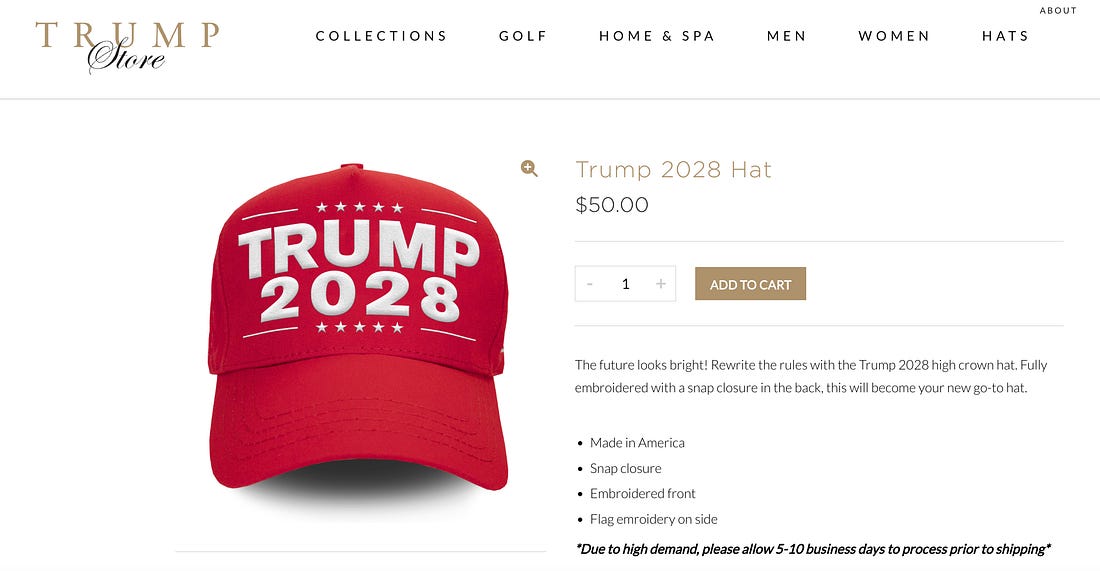
This week will bring more briefings in the Abrego-Garcia case and others. There will be outrages, like the fact that Trump has a website hawking merchandise, literally selling the presidency. It’s not just the $50 price tag on the hat; there’s also the slogan, “Trump 2028,” a reference to Trump’s not-so-subtle hints that he’d like to serve a Constitution-busting third term in office. It’s not a joke. It never is with him.

So, make sure you take some time this week to celebrate Law Day. Invite people over. Go for a walk with friends or neighbors and share your views. Talk with your kids. Democracy is not automatic; it’s a participatory sport we must all play in together, one with critically important outcomes. Democracy is important. Let’s make sure we play for keeps.

We’re in this together,

Joyce

Samuel Abrams has deep experience in the study of education privatization; for many years, he directed an institute on that subject at Teachers College, Columbia University. He is now working with the International Partnership for the Study of Educational Privatization.

He is also affiliated with the National Education Policy Center at the University of Colorado at Boulder, where he published a new report on the problems with education savings accounts (aka, vouchers).

Read the report.

Here is his executive summary:

Education Savings Accounts (ESAs) were first enacted in Arizona in 2011 as a particularly deregulated way to offer vouchers for specific students, particularly those with disabilities. As opposed to conventional private school tuition vouchers, ESAs could be used to cover tuition plus a range of other educational services. Soon thereafter, four additional states substantially replicated this new form of funding. But in 2022, Arizona and West Virginia took ESAs to another level, constructing them as universal vouchers, with all students eligible to participate, without regard to family income, prior public school attendance, or student disability. ESAs in these states could be used to cover either tuition at minimally regulated private schools or pods (mini schools with children of likeminded parents); or costs associated with homeschooling, from books and online curricula to field trips and ancillary goods and services deemed essential. Nine states have since followed suit and more appear poised to do the same. These ESAs constitute a dramatic elevation of educational outsourcing, at once fulfilling Milton Friedman’s long-argued libertarian vision for vouchers and comport-ing with the Trump administration’s commitment to downsize government and let the market fill the void.

Because of the unregulated nature of ESAs, accountability issues quickly emerged regarding both spending and pedagogy. Proper monitoring of spending by parents dispersed throughout a given state, for so many different types of goods and services, has swamped the capacity of state offices. The same holds regarding accountability for the quality of instruction in private schools, pods, and homeschools now supported with taxpayer money.

Meanwhile, because ESAs and other voucher programs tend to serve families who have already opted for private schools or homeschooling, two fiscal outcomes have become apparent. First, the programs create a new entitlement burden for taxpayers; rather than merely shifting an existing subsidy from public to private schools, the programs obligate taxpayers to support new groups of students. Second, the new subsidies have incentivized private schools to bump up tuition, on the grounds that families now have extra money to pay the higher tuition.

In addition, ESAs impact public schools. These schools suffer when substantial funding follows students who use ESAs for homeschooling or attendance at private schools or pods. The stubbornness of fixed costs for core operations for public schools often necessitates cuts to staff, from teachers to nurses, and resources, from microscopes to musical instruments. The impact on rural public schools and thus rural civic life may be greatest. Charter schools and conventional vouchers have played little role in rural America, as filling seats in charter or private schools in sparsely populated parts of the country represents a steep challenge. But with ESAs, students may leave public schools for pods or homeschooling. If enough students leave some small rural schools, those schools will have to consolidate with schools in neighboring towns, meaning significant travel for students and the forfeiture of much community life.

As with conventional vouchers, ESAs can lead to inequities and discrimination in student admissions and retention. Few protections exist in private schools, particularly religious schools, against discrimination based on disabilities, religion, or sexual orientation. Participating schools have also been documented to push out low-achieving students, thus adding to the problem of concentrating these students in default neighborhood public schools. For faculty and most staff, participating religious schools also generally afford no protection from dismissal on the grounds of religious affiliation or sexual orientation.

.***************

RECOMMENDATIONS:

Given the damage Education Savings Accounts can do, the following measures are recommended:

State Departments of Education

• Implement stricter oversight of what goods and services may be purchased with ESA funds.

• Strengthen state capacity to monitor ESA-related purchases.

• Require publication of all participating schools, their graduation rates, and their availability to students with disabilities.

State Lawmakers

• Most importantly, legislators should repeal existing programs.

• If ESAs cannot be repealed in states where they have already taken hold:

o Oppose any expansion of these programs to include new groups or cohorts.

o Pass legislation that imposes clear budget and spending limits on ESA programs to rein in cost overruns that have become common with these programs.o Require stricter oversight of what goods and services can be purchased with ESA funds and strengthen state capacity to monitor ESA-related purchases.

o Mandate periodic audits of curriculum and instructional practices in ESA-receiving schools.

o Require ESA-receiving schools to hire certified teachers.

o Require ESA-receiving schools to conduct the same annual academic assessments that public schools are required to administer.

o Require ESA-receiving schools to abide by existing federal and state civil rights and anti-discrimination laws, especially related to students with disabilities and LGBTQ+ students and faculty.

o Require that any effort to create a new ESA program be subject to open public hearings and, if feasible, public referenda.

Local Government Officials

• In states where ESAs exist, document the effects these programs have on students, families, and local public schools.

• In these same states, seek legislation to alleviate negative effects.

• Engage in awareness-raising efforts, such as informing local constituents of the po-

tential harms of ESAs, especially in rural communities, and adopting resolutions opposing ESAs.