The more we learn about Ron DeSantis, the more obvious it is that he is unfit for any office due to his lack of ethics, his vindictiveness, and his authoritarianism. The Orlando Sentinel published an article about an investigation into the abusive behavior of a DeSantis appointee, who was appointed by DeSantis—without any background check, references or resume— to lead the state’s multi-billion dollar affordable housing program.
TALLAHASSEE — Gov. Ron DeSantis’ affordable housing executive director yelled and screamed at staff, made sexist comments, talked about their weight and threatened their jobs, employees of the Florida Housing Finance Corp. told an inspector general during an investigation.
The behavior of Mike DiNapoli, a former New York City financial adviser chosen by DeSantis to lead the corporation, created a hostile work environment that violated the organization’s policies, the corporation’s inspector general told board members Thursday.
“The conduct is severe and pervasive enough to create a work environment that a reasonable person would consider intimidating, hostile or abusive,” said Chris Hirst, the inspector general.
The investigative report into DiNapoli, which was not released publicly, was highly anticipated by those in Florida’s affordable housing community. Since the board approved hiring DiNapoli in February, 15 employees — 10% of the corporation’s workforce — were either fired by DiNapoli or quit.
DiNapoli was placed on paid administrative leave by the board in July. Last month, DeSantis reinstated him, with a spokesperson for the governor telling Politico that he never should have been suspended and that the investigation “has found nothing to justify the placement of Mr. DiNapoli on administrative leave….”
DeSantis’ press secretary lashed out at the board in a statement Thursday, calling members “clearly incapable of exercising prudent judgment.”
“If anyone wonders what the deep state looks like, this is it,” Jeremy Redfern said. “It’s clear to us that at least some members of this Board believe they can wield unchecked power to recklessly disparage a public official and tarnish his reputation without basic fairness and due process.”
He added, “We will explore every available tool to ensure proper management and oversight of the board and its staff, including the Inspector General, and to ensure further that this agency ultimately remains accountable to the people of Florida….”
DiNapoli also serves on the board of the First Housing Development Corp. of Florida, which has contracts with the corporation. Three of the corporation’s general counsels, who doubled as ethics officers, said it was a conflict of interest. Hirst agreed and concluded it was a violation of the corporation’s policies.
When asked about the conflict, DiNapoli said it was a “gray line,” and “an appearance of a conflict is not a conflict,” Hirst said….
Hirst also found that the corporation violated its hiring policies when it chose DiNapoli.
The corporation was supposed to advertise the executive director position, conduct interviews, do background checks and call work references. None of that happened, Hirst said. The corporation doesn’t even have an application or a resume on file for DiNapoli, he added.
Instead, DiNapoli was simply appointed by DeSantis, with the only letter of recommendation coming from James Uthmeier, DeSantis’ chief of staff who is currently leading DeSantis’ campaign for president.
The Times/Herald has previously reported that, before taking the job with the Florida Housing Finance Corp., DiNapoli had struggled with financial issues, including a bankruptcy, debtors garnishing his wages and a foreclosure on an Ocala home.
So DeSantis hired a guy with no background checks, not even a resume or references, to oversee the disbursement of billions of dollars for affordable housing. What could possibly go wrong?
Jamelle Bouie is an amazing columnist for the New York Times. if you sign up for his extended column, you get fascinating insights, plus a list of what he’s reading now and even a recipe. This column caught my eye because I was thinking about writing a post about how some counties in Texas are criminalizing travel on roads that lead to the airport or out of state if the traveler intends to get an abortion. They are planning to suspend freedom to travel in order to block abortions. But then I saw that Jamelle Bouie wrote about the same subject, noting that it extended beyond Texas, and drew a parallel with slavery, where different states had different laws regulating human bondage.
Bouie wrote:
One of the ironies of the American slave system was that it depended for its survival on a federal structure that left it vulnerable and unstable.
Within the federal union, the slave-dependent states had access to a national market in which they could sell the products of slave labor to merchants and manufacturers throughout the country. They could also buy and sell enslaved people, as part of a lucrative internal trade in human beings. Entitled to representation under the supreme charter of the federal union, slave owners could accumulate political power that they could deploy to defend and extend their interests. They could use their considerable influence to shape foreign and domestic policy.
And because the states had considerable latitude over their internal affairs, the leaders of slave-dependent states could shape their communities to their own satisfaction, especially with regard to slavery. They could, without any objection from the federal government, declare all Black people within their borders to be presumptively enslaved — and that is, in fact, what they did.
But the federal union wasn’t perfect for slaveholders. There were problems. Complications. Free-state leaders also had considerable latitude over their internal affairs. They could, for example, declare enslaved Black people free once they entered. And while leaders in many free states were unhappy about the extent of their free Black populations — in 1807, as the historian Kate Masur tells us in “Until Justice Be Done: America’s First Civil Rights Movement, From the Revolution to Reconstruction,” Ohio lawmakers passed a law requiring free Black migrants to register with the county clerk and have at least two white property owners vouch for their ability to support themselves — they ultimately could not stop the significant growth of free Black communities within their borders, whose members could (and would) agitate against slavery.
The upshot of all of this was that, until the Supreme Court’s decision in Dred Scott v. Sandford settled the matter in favor of slaveholders, the status of an enslaved Black person outside a slave state was uncertain. It was unclear whether property in man extended beyond the borders of states where it was authorized by law.
It was also unclear whether a slave state’s authority over an enslaved Black person persisted beyond its borders. And on those occasions when a free Black person was within the reach of slave-state law — as was true when free Black sailors arrived in Southern ports — it was unclear if they were subject primarily to the laws of their home states or the laws of the slave states. South Carolina assumed the latter, for example, when it passed a law in 1822 requiring that all “free Negroes or persons of color” arriving in the state by water be placed in jail until their scheduled departure.
One would have to conclude, surveying the legal landscape of slavery before Dred Scott, that federalism could not handle a question as fundamental as human bondage. The tensions, contradictions and conflicts between states were simply too great. As Abraham Lincoln would eventually conclude, “A house divided against itself cannot stand. I believe this government cannot endure, permanently half slave and half free. I do not expect the Union to be dissolved — I do not expect the house to fall — but I do expect it will cease to be divided. It will become all one thing or all the other.”
I want you to keep all this in mind while you read about the latest developments in state and local laws regarding abortion. On Monday, Steve Marshall, Alabama’s Republican attorney general, announced in a court filing that the state has the right to prosecute people who make travel arrangements for women to have out-of-state abortions. Those arrangements, he argued, amount to a “criminal conspiracy.”
“The conspiracy is what is being punished, even if the final conduct never occurs,” Marshall’s filing states. “That conduct is Alabama-based and is within Alabama’s power to prohibit.”
In Texas, anti-abortion activists and lawmakers are using local ordinances to try to make it illegal to transport anyone to get an abortion on roads within city or county limits. Abortion opponents behind one such measure “are targeting regions along interstates and in areas with airports,” Caroline Kitchener reports in The Washington Post, “with the goal of blocking off the main arteries out of Texas and keeping pregnant women hemmed within the confines of their anti-abortion state.”
Alabama and Texas join Idaho in targeting the right to travel. And they aren’t alone; lawmakers in other states, like Missouri, have also contemplated measures that would limit the ability of women to leave their states to obtain an abortion or even hold them criminally liable for abortion services received out of state.
The reason to compare these proposed limits on travel within and between states to antebellum efforts to limit the movement of free or enslaved Black people is that both demonstrate the limits of federalism when it comes to fundamental questions of bodily autonomy.
It is not tenable to vary the extent of bodily rights from state to state, border to border. It raises legal and political questions that have to be settled in one direction or another. Are women who are residents of anti-abortion states free to travel to states where abortion is legal to obtain the procedure? Do anti-abortion states have the right to hold residents criminally liable for abortions that occur elsewhere? Should women leaving anti-abortion states be considered presumptively pregnant and subject to criminal investigation, lest they obtain the procedure?
Laws of this sort may not be on the immediate horizon, but the questions are still legitimate. By ending the constitutional guarantee of bodily autonomy, the Supreme Court has fully unsettled the rights of countless Americans in ways that must be resolved. Once again, a house divided against itself cannot stand.
On Saturday, President Joe Biden and First Lady Dr. Jill Biden went to Florida, where he surveyed the damage, praised the Federal Emergency Management Agency (FEMA), and told the people of Florida: “Your nation has your back, and we’ll be with you until the job is done.”
White House press secretary Karine Jean-Pierre reiterated, “It doesn’t matter if it’s a red state or a blue state, the president’s going to show up and be there for the community.” Florida governor Ron DeSantis declined to meet with the president, apparently fearing a backlash from anti-Biden primary voters, but Republican senator and former Florida governor Rick Scott did meet with Biden and praised his rapid response to the hurricane.
Biden’s promise to the Republican-dominated state of Florida even in the face of DeSantis’s pettiness was a striking contrast to former president Trump’s withholding of federal aid from Malden and Pine City, Washington, almost exactly three years ago, when a September 2020 wildfire destroyed 15,000 acres and 85% of the buildings, including 65 homes. Trump held up Washington governor Jay Inslee’s request for a disaster declaration, which frees up federal funds, for more than four months out of spite at the Democratic governor.
It was Biden who finally approved the declaration days after taking office. According to Emma Epperly and Orion Donovan Smith of the Spokane, Washington, Spokesman-Review, when he heard the declaration was finally in place, Malden Mayor Dan Harwood teared up in relief. “Our citizens are going to be able to go forward now,” he said. “We’ve been waiting for this day for a long time. It’s a very, very good day.”
Yesterday the three most senior civilian officials in the Department of Defense responsible for their branches—Secretary of the Navy Carlos Del Toro, Secretary of the Air Force Frank Kendall, and Secretary of the Army Christine Wormuth—wrote in the Washington Post that Senator Tommy Tuberville (R-AL, though it turns out he lives in Florida) is actively eroding “the foundation of America’s…military advantage” with his blanket hold on military promotions.
Tuberville says he launched the hold in protest of the military’s policy of ensuring that military personnel can obtain reproductive health care, including abortions, but as the authors of the Post op-ed say, his policy “is putting our national security at risk.” More than 300 of our critical posts have acting officials in place, and three of our five military branches—the Army, Navy, and Marine Corps—have no Senate-confirmed service chief.
In defense of his position, Tuberville has begun to attack the military leaders whose promotions he is opposing, much as former Fox News Channel personality Tucker Carlson lashed out repeatedly at Joint Chiefs of Staff chair Mark Milley for his support for diversity and inclusion in the military. In their op-ed, the secretaries warned of the danger of politicizing our military and noted that the damage Tuberville is inflicting on the service will echo for years as today’s colonels and captains gather that their service is not valued by members of Congress.
Tonight, Secretary of the Navy Del Toro, who was born in Cuba, said on CNN: “I would have never imagined that…one of our own senators would actually be aiding and abetting communist and other autocratic regimes around the world. This is having a real negative impact and will continue to have a real negative impact on our combat readiness. That’s what the American people truly need to understand.”
Today marked the start of Texas attorney general Ken Paxton’s impeachment trial in the Texas Senate, which has taken on a meaning far larger than the fate of a single state official and become a fight over the future of the Republican Party.
Paxton is a hard-right Republican who has based his political career on his identity as a Christian conservative advancing evangelicals’ culture wars. He has pushed Texas rightward since he took office in 2015, first challenging President Barack Obama’s Affordable Care Act and immigration orders, then championing Trump, then celebrating his wins against “woke Biden administration rules” and defending states’ rights.
Paxton supported Trump’s efforts to overturn the results of the 2020 election, filing a lawsuit drafted by the Trump campaign to challenge other states’ elections and then, when the Supreme Court declined to hear that case, criticizing both the court and other states when he spoke at the January 6 rally at the Ellipse that preceded the attack on the U.S. Capitol.
But Paxton has been embroiled in scandals since being indicted for securities fraud just months after he took office as the state’s top law enforcement officer. That trial has yet to take place, but now he is embroiled in other scandals that have led the Republican-dominated Texas House of Representatives to pass 20 articles of impeachment against him by a vote of 121 to 23. The House started impeachment proceedings after Paxton asked for $3.3 million in state funds to pay a settlement to four whistleblowers who accused him of abuse of office and bribery in 2020 and who were fired within a month.
But the impeachment charges center around his ties to his friend and donor Nate Paul. Paxton is accused of helping Paul in exchange both for gifts and for hiring Paxton’s mistress.
The Texas Senate will conduct the impeachment trial. There are 31 members of the Senate, but one of them is Paxton’s wife, whom the Senate banned from voting after she refused to recuse herself. So to convict him, it will take 21 of the 30 state senators who can vote (his wife’s presence makes the conviction threshold 21 rather than 20). If all 12 Democrats in the Senate vote to convict, it will require 9 of the 18 voting Republicans to convict him.
Robert Downen and Zach Despart of the Texas Tribune yesterday reported that the impeachment trial is expected to focus on Paxton’s infidelity to his wife. He told his staff about the extramarital affair at the center of his relationship with Nate Paul in 2018, when he promised it was over and he was recommitting to his marriage. But, in fact, he didn’t. To hide the affair from his wife and his deeply religious constituents, impeachment managers say, Paxton worked with Paul to get a job for his girlfriend and hide the relationship, and then used his office to help Paul weather lawsuits and bankruptcy.
The Republican Party in Texas is split over Paxton much as the country is split over former president Donald Trump. Some say that Paxton’s extraordinary behavior warrants impeachment and trial and that, after all, a majority of Republicans in the Texas House were so concerned they impeached him.
But others insist that he is, as he claims, a victim of political persecution. They maintain that a flawed man can do God’s will, and they support Paxton no matter what his failings out of support for his political crusades on their behalf. J. David Goodman reported yesterday in the New York Times that right-wing donors have embarked on an expensive, high-pressure campaign to convince Republicans in the Texas Senate to vote against conviction, threatening to primary anyone who votes against Paxton.
Still, his approval rating among Republicans has dropped by 19 percentage points since April, while his disapproval rate has more than tripled since last December.
In other court news, a Florida judge this weekend struck down a state congressional map pushed through the legislature by Florida governor Ron DeSantis, saying it violates the state constitution by diluting Black voting power. The state will automatically appeal.
Today, three Republican-appointed federal judges struck down Alabama’s new congressional map after the state legislature ignored a court order to redraw the state map to include a second majority Black district since the state map put in place after the 2020 census likely violated the 1965 Voting Rights Act.
The judges wrote that they were “disturbed” by the state legislature’s refusal to correct its illegal maps. “We are not aware of any other case in which a state legislature—faced with a federal court order declaring that its electoral plan unlawfully dilutes minority votes and requiring a plan that provides an additional opportunity district—responded with a plan that the state concedes does not provide that district.”
The court will appoint a special master to draw Alabama’s congressional map, but Alabama attorney general Steve Marshall, a Republican, has already appealed the decision to the U.S. Supreme Court.
In Wisconsin, where Republicans have called for impeaching Supreme Court justice Janet Protasiewicz for violating ethics codes by calling the state’s congressional maps “unfair” and “rigged,” a state judiciary disciplinary panel has dismissed those complaints. Republicans drew the congressional map in Wisconsin so fully in favor of their party that in 2018, Democratic candidates for the state assembly won 54% of the popular vote but Republicans “won” 63 of the assembly’s 99 seats, only three seats short of a supermajority that would enable them to override a veto by the Democratic governor.
And finally, U.S. district judge Tim Kelly sentenced former Proud Boys leader Enrique Tarrio today to 22 years in prison. This is the longest sentence handed down for any of the January 6 rioters, though far shorter than the 33 years prosecutors had requested. Kelly also handed down sentences significantly below the guidelines for the crimes Proud Boys leaders committed: Joseph Biggs was sentenced to 17 years; Zachary Rehl, 15 years; and Ethan Nordean, 18 years. Dominic Pezzola, who was found not guilty of seditious conspiracy but guilty of other crimes, received a 10-year sentence.
Tarrio is the last of the gang to be sentenced and was not present at the January 6 attack, underscoring the wide reach of a conspiracy conviction
Ruth Conniff, editor-in-chief of The Wisconsin Examiner, brilliantly summarizes the war against public education in Wisconsin, which reflects what is happening in many other states. Parents and teachers have mobilized to defend their public schools, while the governor and legislature agree on expanding vouchers and an austerity budget for public schools. She points out that the rightwing angst about CRT and gender is a giant smokescreen to distract public attention from the diversion of public funds to private schools. The attacks are funded, of course, by rightwing billionaires.
Conniff writes:
It’s an understatement to say that public school advocates are not happy with the state budget Gov. Tony Evers signed.
“We’re not here to cheer for crumbs,” Heather DuBois Bourenane, executive director of the Wisconsin Public Education Network, declared at the group’s annual Summer Summit last week. “This budget did not deliver and will not adequately meet the needs of kids.”
It’s a “weird moment” for public school advocates, DuBois Bourenane added, noting the conspicuous absence of Evers, a longtime ally, from the annual gathering of public education organizers. Evers has signed a budget DuBois Bourenane described as “disgusting,” leaving 40% of school districts with less funding this year than they had under last year’s zero-increase budget.
School superintendents who attended the summer summit reeled off program cuts and school closings around the state as districts are forced to tighten their belts even though the state is sitting on more than $6 billion in surplus funds. Wisconsin is entering its 16th year of school funding that doesn’t keep pace with inflation. The toll is visible in districts that have had to close buildings and cancel programs.
“It’s a difficult line, I suppose, to walk,” an unsmiling State Superintendent of Public Instruction Jill Underly told me, standing in the hallway outside the auditorium at South Milwaukee High School after delivering the welcoming speech at the summit. Her theme was growth and change and how no one is perfect, drawing on a poem about caterpillars and butterflies.
“I feel like the governor is caught in a bad spot,” Underly added. Evers had to negotiate a deal with Republicans who were threatening to withhold shared revenue funds from Milwaukee, potentially plunging the state’s largest urban area into bankruptcy.
“It’s all part of politics and negotiation,” Underly said. “I do feel bad for the schools, because we got little, on top of no increase in the past.”
Although the budget deal does allow most school districts to levy an additional $325 per pupil from local property tax payers, that just “puts the burden back on the local districts to make up for that revenue rather than the state,” Underly said. And the state’s failure to meet public school demands that it cover at least 60% of the cost of special education — an expense that is devouring school district budgets, leading to program cuts in other areas — was a “missed opportunity,” Underly said, given the huge budget surplus. “I do feel strongly that our public schools lost out again.”
As for the big increase in taxpayer money going to finance private schools through the voucher expansion Evers signed as part of his deal with Republicans, “It’s hard to swallow,” Underly said, “because, really, we can’t afford two school systems.”
In just two years, all the enrollment caps will come off the school voucher program in 2026 and the problem of supporting two school systems, one public and one private, from the same limited pool of education funds, is going to get even worse.
“I think there’s going to be a reckoning,” Underly said. “I think the people in this state are going to have to do some soul-searching and really answer the question: What future do they want for public schools and kids and communities? Do they want a system that serves everybody? Or do they want to have two systems where the one that serves everybody keeps shrinking?”
That pretty much sums up not just the battle over the future of public schools in Wisconsin this year, but all of the struggles over the future of democracy in our state and around the country that suddenly seem to be coming to a head this year.
Are we going to have a society where we come together around shared values and common interests, or are we going to continue to break into increasingly isolated, hostile camps, tearing down our shared institutions, and leaving individuals and families on their own to grab what they can for themselves?
The Wisconsin Public Education Networks’ slogan, “Public Schools Unite Us” captures the more optimistic of those two roads.
“I don’t know anyone who disagrees with that slogan,” podcaster Todd Albaugh, a former Republican who spent 30 years in government and politics, said during the summit. He talked about the state champion high school baseball team in the little town of Ithaca, Wisconsin, and how everyone rallied around them. “Wisconsin public schools, they are the identity of our communities,” he said.
The Wisconsin Public Education Network has done an admirable job of reinforcing that identity, and defying the “politics of resentment” by bringing people together from urban and rural parts of the state. Together, rural and urban districts hammered out a shared set of priorities and pushed for them in the Capitol. Although they didn’t get what they wanted in the budget, they showed unity of purpose in pushing for a big raise in the state reimbursement for ballooning special education costs and a $1,510 per pupil increase to make up for 15 years of budgets that haven’t kept pace with inflation.
The vision of schools as cradles of a healthy, diverse, civic society was on display at South Milwaukee High, which hosted the summit Aug. 10, with representatives from mostly white rural districts mixing with students of color and teachers and administrators from urban, majority-minority schools.
There was a lot of talk about school funding and not so much on the hot buttons pushed by the right: “critical race theory,” gender pronouns and “parents rights.”
Politicians and school-privatization lobbyists have put a lot of money and energy into stirring up anger and distrust based on those culture war topics, in an effort to distract voters and undermine public schools. But the real aim of rightwing attacks on public schools is not just to teach conservative family values or racist rewrites of history. School privatization advocates have been working for decades to get their hands on the public funds that flow to public schools. As Rupert Murdoch put it, discussing News Corp’s foray into the business of education: “When it comes to K through 12 education, we see a $500 billion sector in the US alone that is waiting desperately to be transformed.” In Wisconsin, that transformation is well underway.
Rod Gramer, president and CEO of Idaho Business for Education, a group of 250 Idaho business leaders who helped beat back publicly funded private school vouchers in their state, urged Wisconsin public school advocates gathered in South Milwaukee last week to keep the focus on the bigger picture.
“People don’t understand this is not a state problem,” Gramer said. “They don’t understand there’s a large group of billionaires who want to abolish public education.
“Billionaires who’ve never set foot in your state are spending billions to elect friendly legislators,” Gramer correctly pointed out. “I think people would be outraged if they know these elite billionaires are trying to undermine education in your state…”
We can do better. Voters, whether they are rural Republicans or urban Democrats, really can get together on defending a shared vision of a decent society. A cornerstone of that society is a free, high-quality public education system with beloved teachers, music programs, sports teams, and the whole sense of community that builds. Public schools do unite us. And as Evers said, before he got his arm twisted and signed the current budget, we should always do what’s best for kids.
Please open the link and read this important article to its conclusion.
Thom Hartmann explains that if you get people to vote for racism, against trans people, and against other imaginary threats, they will ignore the facts of poverty, health care, and the extreme income inequality and wealth inequality that characterizes our nation today.
Hartmann writes:
There’s a popular internet meme going around that says:
“Say you’re in a room with 400 people. Thirty-six of them don’t have health insurance. Forty-eight of them live in poverty. Eighty-five are illiterate. Ninety have untreated mental illnesses. And every day, at least one person is shot. But two of them are trans, so you decide ruining their lives is your top priority.”
Consider some of the basic realities of life in modern America:
— Almost 30 million Americans lack health insurance altogether, and 43 percent of Americans are so badly under-insured that any illness or accident costing them more than $1000 in co-pays or deductibles would wipe them out.
— Almost 12 percent of Americans, over 37 million of us, live in dire poverty. According to OECD numbers, while only 5 percent of Italians and 11 percent of Japanese workers toil in low-wage jobs, almost a quarter of Americans — 23 percent — work for wages that can’t support a normal lifestyle. (And low-income Japanese and Italians have free healthcare and college.)
— More than one-in-five Americans — 21 percent — are illiterate. By fourth grade, a mere 35 percent of American children are literate at grade level, as our public schools suffer from a sustained, two-decade-long attack by Republicans at both state and federal levels.
— Fully a quarter of Americans (26 percent) suffer from a diagnosable mental illness in any given year: over half of them (54 percent) never receive treatment and, because of cost and a lack of access to mental health care, of the 46 percent who do get help, the average time from onset of symptoms to the first treatment is 11 years.
— Every day in America an average of 316 people are shot and 110 die from their wounds. Gun violence is now the leading cause of death for American children, a situation not suffered by the children of any other country in theworld.
And these are just the tip of the iceberg of statistics about how Americans suffer from Reagan’s forty-year-long GOP war on working-class and poor people.
— Almost half (44 percent) of American adults carry student debt, a burden virtually unknownin any other developed country in the world (dozens of countries actually pay their young people to go to college).
— Americans spend more than twice as much for healthcare and pharmaceuticals than citizens of any other developed country. We pay $11,912 per person per year for healthcare; it’s $5,463 in Australia, $4,666 in Japan, $5496 in France, and $7,382 in Germany (the most expensive country outside of us).
And we don’t get better health or a longer lifespan for all the money; instead, it’s just lining the pockets of rich insurance, pharma, and hospital executives and investors, with hundreds of billions in profits every year.
— The average American life expectancy is 78.8 years: Canada is 82.3, Australia is 82.9, Japan is 84.4, France is 83.0, and Germany is 81.3.
— Our public schools are an underfunded mess, as are our highways and public transportation systems. While every other developed country in the world has high-speed train service, we still suffer under a privatized rail system that prevents Amtrak from running even their most modern trains at anything close to their top speeds.
Given all this, it’s reasonable to ask why Republicans across the nation insist that the country’s most severe problems are teaching Black History and trans kids wanting to be recognized for who they are.
If you give it a minute’s thought, though, the answer becomes pretty obvious. We have a billionaire problem, compounded by a bribery problem, and the combination of the two is tearing our republic apart.
The most visible feature of the Reagan Revolution was dropping the top income tax bracket for the morbidly rich from 74 percent down to 27 percent and then shooting the tax code so full of loopholes that today’s average American billionaire pays only 3.4 percent income tax. Many, like Trump for decades, pay nothing or next to nothing at all. (How much do you pay?)
But for a few dozen, maybe a hundred, of America’s billionaires that’s not enough.
Afflicted with the hoarding syndrome variant of obsessive compulsive disorder, there is never enough money for them no matter how many billions they accumulate.
If they’d been born poor or hadn’t gotten a lucky break, they’d be living in apartments with old newspapers and tin cans stacked floor-to-ceiling; instead, they have mansions, yachts, and virtual money bins worthy of Scrooge McDuck.
That in and of itself wouldn’t be so problematic if those same billionaires hadn’t worked together to get Clarence Thomas to cast the tie-breaking vote in the Citizens United case a few billionaires helped bring before the Supreme Court.
After Thomas and his wife, Ginni, were showered with millions in gifts and lavish vacations, the corrupt Supreme Court justice joined four of his colleagues — several of whom (Scalia, Roberts) were similarly on thetake — to legalize political bribery of politicians and Supreme Court justices.
The rubric they used was to argue that money isn’t really money; it’s actually “free speech,” so the people with the most money get to have the loudest and most consequential voices in our political and judicial discourse.
To compound the crisis, they threw in thenotion that corporations aren’t corporations but, instead, are “persons” fully deserving of the human rights enshrined in the Bill of Rights, the first ten Amendments to theConstitution — including the First Amendment right of free speech (now redefined as money).
In the forty-two years since the start of the Reagan Revolution, bought-off politicians have so altered our tax code that fully $51 trillion has moved from the homes and savings of working class Americans into the money bins of the morbidly rich.
As a result, America today is the most unequal developed nation in the world and the situation gets worse every day: many of our billionaires are richer than any pharaoh or king in the history of the world, while a family lifestyle that could be comfortably supported by a single income in 1980 takes two people working full-time to maintain today.
In the years since the Court first began down this road in 1976, the GOP has come to be entirely captured by this handful of mentally ill billionaires and the industries that made them rich.
As a result, Republican politicians refuse to do anything about the slaughter of our children with weapons of war; ignore or ridicule the damage fossil fuel-caused global warming is doing to our nation and planet; and continue to lower billionaire and corporate taxes every time they get full control of the federal or a state government.
The price of all this largesse for America’s billionaires is defunding the social safety net, keeping the minimum wage absurdly low, and gutting support for education and public services.
While there are still a few Democrats who are openly and proudly on the take (Manchin, Sinema, the corporate “problem solvers” in Congress), most of the Democratic Party has figured out how severe the damage of these neoliberal policies has been.
In the last session of Congress, for example, the For The People Act passed the House of Representatives with near-united Democratic votes (and not a single Republican) and only died in the Senate when Manchin and Sinema refused to go along with breaking a Republican filibuster.
The Act would have rolled back large parts of Citizens United by limiting big money in politics, providing for publicly funded elections, restoring our political bribery laws, and ending many of the GOP’s favorite voter suppression tactics.
All of this, then, brings us back around to that meme that opened this article:
Why are rightwing billionaires funding “activist” groups and politicians who’re trying to end the teaching of Black History and make the lives of trans people miserable?
When you think about it a minute — and look at the headlines in the news — the answer becomes apparent: as long as we’re all fighting with each other about history or gender, the “hoarding syndrome billionaires” and their corporations are free to continue pillaging America while ripping off working people and their families.
This post is one of Jan Resseger’s best, most trenchant analyses of the robust and evil plot to defund public schools. She explains how the federal government—through No Child Left Behind and Race to the Top—drove federal Test-and-Punish practices and laws into the states. Even though those two vast federal programs failed, they remain alive in the states. Their “success,” if you can call it that, was in discrediting public schools and promoting privately-managed charter schools and vouchers.
The transformation of education from a civic obligation to a consumer good accelerated the passage of voucher legislation. Meanwhile the rhetoric of “saving poor kids from failing public schools” has quietly disappeared. Red states are lifting their income limits on voucher eligibility to make them available to all students, rich and poor. Despite research showing that vouchers are worse for poor students than the public schools they left, red state legislators are undaunted. Despite evidence that most vouchers are claimed by students already enrolled in private schools, red states continue to expand them. In effect, the rationale for privatization is no longer to fund a better alternative to public schools, but to hand public money to a clamorous interest group: private school parents.
Jan Resseger begins:
The federal No Child Left Behind Act (NCLB), passed in 2002, embodied school reform premised on the theory of test-based accountability—the requirement of high-stakes standardized tests for all students and the application of sanctions for schools unable to raise test scores. The idea was that if you threatened schools with closure or threatened to turn them into charter schools or threatened to punish teachers if their students’ overall scores were low, you could make the teachers work harder and somehow raise an entire school’s test scores. It was an experiment whose proponents believed all children could be made proficient by 2014.
By 2013, those of us who support our nation’s public schools knew the experiment had failed. Even the Congressional supporters of No Child Left Behind knew it had not worked; they created waivers for the growing number of school districts unable to guarantee all students would be proficient in 2014. In 2015, when Congress reauthorized the federal education law as the Every Student Succeeds Act, the new law reduced federal punishments, while it still required the states to test students every year and create plans to turn around low scoring schools. Test-and-Punish school reform did not end, however. Its remnants remained in the state policies that had been mandated by NCLB and Race to the Top and had been enacted in state laws.
Today after two decades, it is clear that overall test scores have not risen; neither has the stated goal of corporate school accountability—closing achievement gaps—been accomplished. Diane Ravitch explains that test-and-punish school accountability, “overlooks the well-known fact that test scores are highly correlated with family income and are influenced more by home conditions than by teachers or schools. Hundreds, perhaps thousands, of public schools were closed because of their inability to meet high test score goals. All of the closed schools were in impoverished communities. Thousands of teachers were penalized or fired because they taught the children with the biggest challenges, those who didn’t speak English, those with severe disabilities, those whose lives were in turmoil due to extreme poverty.”
State politics has now, however, made it even more difficult to push back against the forces attacking public schooling. The federal legislation was designed to drive a test-and-punish agenda into the state legislatures. No Child Left Behind began by mandating testing and sanctions. Then Race to the Top bribed states to enact their own sanctions for low-scoring schools and punish teachers by tying their evaluations to their students’ test scores. And ESSA continued requiring testing all students and required states to devise turnarounds for the lowest scoring schools. While under No Child Left Behind and the early days of Race to the Top advocates across the states could collaborate nationally to push back against the federal policy itself, the school reform battle in recent years has devolved to the state legislatures which enacted the federal requirements idiosyncratically into their own laws. Right now we are watching the state takeover of the public schools in Houston, Texas and Oklahoma’s threatened takeover of the Tulsa public schools, at the same time we are watching the consequences ten years later of the closure in 2013 of 50 public schools in Chicago’s poorest African American neighborhoods.
Test-based, punitive school reform has also dangerously discredited the nation’s public schools. The school accountability movement created the concept of “failing schools,” persistently condemned the schools in urban America, and accelerated the drive for school choice and privatization. Twenty years of school reform has culminated in the vast expansion of school privatization in the form of vouchers. This year, 12 states—by my count, and I may have missed some—have enacted or significantly expanded state-funded private school tuition vouchers at the expense of public school funding: Arkansas, Florida, Indiana, Iowa, Montana, Nebraska, North Carolina, Ohio, Oklahoma, South Carolina, Utah, and Wisconsin.
Please open the link and finish reading this important post.
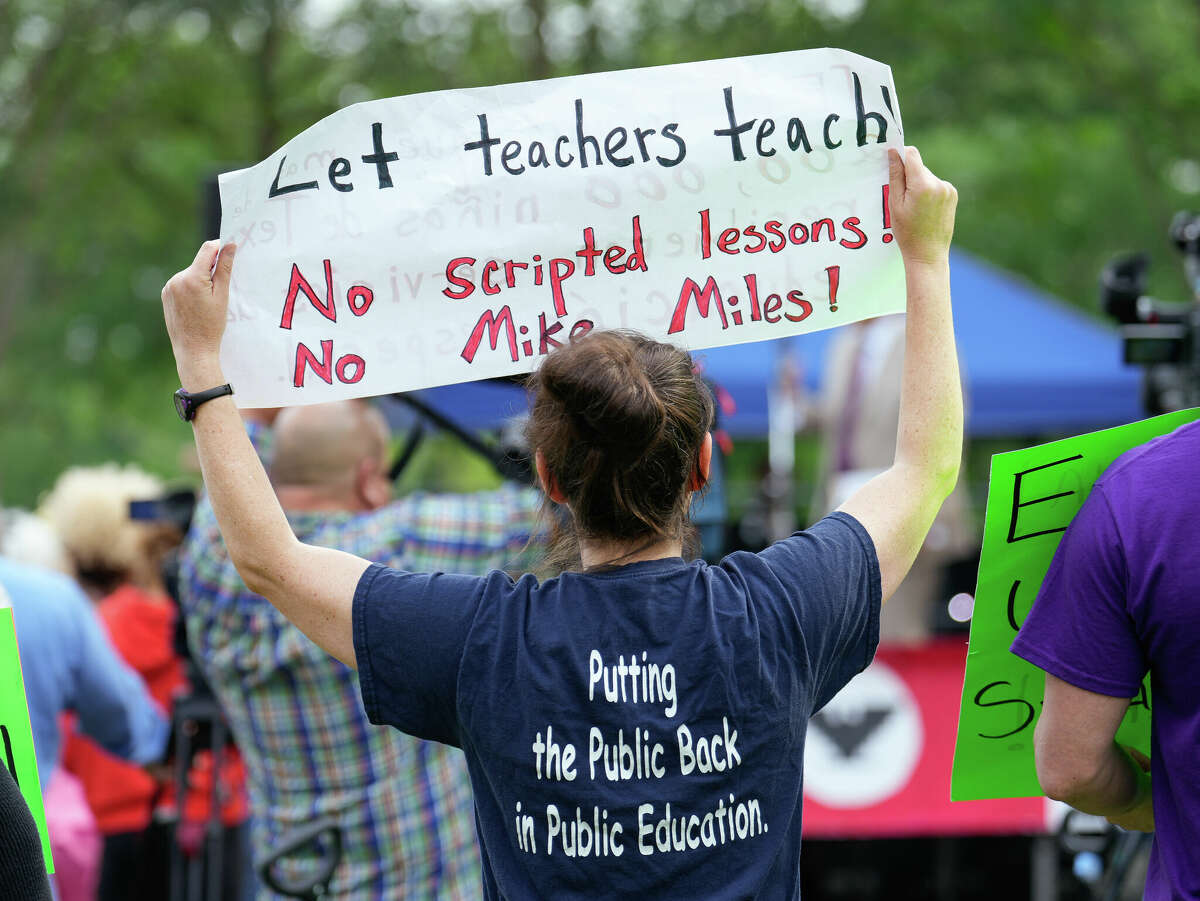
Mike Miles was imposed on the Houston Independent School District by State Commissioner Mike Morath. Neither Miles nor Morath was ever a teacher. HISD was graded a B district before the state takeover. The takeover was based on spite, on Governor Greg Abbott’s hatred for a district that opposes him.
Miles thinks he is an innovator, but none of his authoritarian mandates has ever succeeded anywhere else. They won’t succeed in Houston because he lacks the single most essential ingredient of leadership: Trust.
He rules by fiat. That may work in dictatorships but not in schools. Fear is not a good long-term motivator. If Miles know anything about research on motivation, he would know that the greatest motivators are intrinsic, such as a sense of mastery and autonomy.
The largest school district in Texas has been in the news a lot lately. You may know the district was issued a state takeover and its superintendent was replaced by Mike Miles, who, notably, has never taught.
You may know that as a part of his “wholescale, systemic reform” he identified 28 underperforming schools and identified them as NES Schools—which stands for New Education System.
You may know a few headlines—the most bizarre being that Miles starred in a musical skit for convocation that’s been scrubbed from the Internet.
Often, the real story isn’t as bad as newspaper headlines make them out to be. That’s not the case with what’s happening in H.I.S.D.
The experiences teachers are sharing are a different story entirely.
Here is what this reform looks like on a classroom level, from teachers currently in H.I.S.D.
Teachers read from a script the first two days of school.
Read right off the page. No get-to-know-yous, no surveys, no relationship-building, no games, nothing. Right into curriculum.
Teachers must keep classroom doors propped open.
However, teachers and parents argue this violates past safety mandates to leave classroom doors shut and locked.
Teachers cannot dim lights.
Even if they leave the windows open, have lamps, etc., the lights must be at full power.
Teachers have constant interruptions from administrators and district “minders.”
APs have to submit a minimum of five teacher observations per day, so this means near-constant interruption.
Administrators evaluate teachers on a checklist that has very little to do with pedagogy.
Teachers don’t know how school leaders will use these observations. This is the actual form (big thanks to Janice Stokes).
[Open the link to see the form.]
My first three reactions:
If teachers are reading from a script created by the district, why are we evaluating them on their instruction being relevant and engaging? Isn’t that on your people, Mike?
MRS stands for Multiple Response Strategies. Pair and share, whip around, etc. These are acceptable checks for understanding, but every four minutes is formulaic and prevents any kind of extended focus or stamina.
I haven’t heard “DOL” since 1992.
Classroom monitors can coach teachers on instruction at any time.
Even with students present. Not insulting at all!
No “weak readers” can read aloud because it models disfluency.
A district employee I spoke to insists it is a “flex space that can have other uses besides discipline.” I said, “Oh, like a library?” She did not respond.
Students may not free-write.
Also, they may not work independently for more than four minutes.
Every four minutes, teachers are required to hold an all-class response to check for understanding. Which is great, until you actually have to read a book, take a standardized test, or focus for more than four minutes.
Every classroom activity must tie directly to instruction.
No classroom celebrations, relationship-building activities, brain breaks, or routines/procedures instruction are permitted.
Teachers received extremely limited training on this model.
The location chosen for training left people sitting on floors and stuck in parking lots for over 45 minutes.
There is no information tying any of these strategies to best practice or research on what’s best for kids.
This authoritarian approach to education is taking a huge toll on school climate and morale. A friend of mine said teachers at her school are breaking down on a daily basis. Even the strongest, most experienced educators—department chairs and leaders with stellar records—feel demoralized and unnerved (and that’s saying a lot after the past few years).
And no, the answer isn’t to “just move,” or switch districts, or quit teaching altogether. First, that response is lazy and reductive, but more importantly doesn’t account for the hundreds of thousands of kids in H.I.S.D. schools forced to learn in environments counterproductive to their wellness and development.
Public school teachers in Texas have known for years that it’s in the best interest of the state to destroy public education and reallocate funding to religious and private schools. Years of slashing budgets, demonizing teachers, lowering standards, letting chaplains offer mental health counseling—don’t tell me that’s a state that holds any kind of value for public education. That’s a state that wants to “prove” public education doesn’t work so it can privatize.
It’s just wild to me that they’re not even hiding it anymore.
School started in the Houston Independent School District, and many teachers were stunned by the extent to which their actions were constrained by a script. The new superintendent Mike Miles has be never been a teacher but he thinks he knows everything about teaching. He laid down strict rules, and teachers must comply without hesitation. Miles is the kind of leader who, if put in charge of a hospital, would tell surgeons how to conduct surgeries. This story appeared in the Houston Chronicle and was written by staff writer Anna Bauman.
As she prepared for the start of a new school year in Houston ISD, a fifth-grade reading teacher stripped much of the colorful personality from her classroom, including motivational posters, student art projects, several bins of books and a social-emotional learning nook with comfy furniture.
She wiped away tears and, earlier this week, started teaching at a school under the New Education System, a wholesale reform model introduced by Superintendent Mike Miles, who was appointed in June by the Texas Education Agency to run the largest school system in Texas.
While parents and students may have noticed few of the changes, educators from a wide swath of schools in HISD say they feel micromanaged and stressed in their first week under new district leaders, who are reportedly enforcing strict guidelines and conducting frequent classroom observations that have sparked frustration, fear and low morale among teachers at both NES and non-NES schools.
“I feel like they are not allowing me to do what’s in the best interest of the children,” said the reading teacher. “Every day I go to work, I’m crying. Every day I leave from work, I’m crying.”
The superintendent, meanwhile, said he has been pleased with what he has seen while collecting a “baseline” at NES schools in the first week.
“I was very impressed with their progress, even in one day, but also their preparation for the beginning of the school year,” Miles said. “Teachers were teaching well, they were following the instructional model, and it was pretty good. It shows that the schools and the teachers have been preparing hard for the first day, second day of school.”
The district is laying the groundwork for a pay-for-performance evaluation system geared toward measuring the quality of a teacher’s instruction, although a Harris County judge has temporarily blocked HISD from implementing the system.
“The high-quality instruction, there’s a clear rubric for that, there’s a clear spot observation form, because we have to train teachers,” Miles said. “We can’t just do what we’ve always done, which is go into a classroom every three weeks or three months and think we’re going to see something that is effective teaching, and just rely on, ‘Oh, I’ll know it when I see it.’”
This year, all principals will be evaluated under a new system that requires them to give instructional feedback and spend significant time coaching teachers in classrooms. Principals will be graded in part based on the quality of instruction at their school. Meanwhile, teachers will also be measured with a new evaluation system this year, although those who do not work in the schools targeted for reform may ask for a waiver.
District leaders trained teachers in recent weeks on the evaluation system and new classroom expectations. For example, one slideshow presented during teacher training listed some “common practices that we want to generally avoid,” including stream of consciousness writing, rooms with dim lighting and worksheets that are not purposeful. The training materials also discouraged teachers from showing entire films, letting kids “earn” free time and allowing “poor readers” to read aloud during class.
The slideshow instructed teachers to post a “lesson objective” on the board before the start of each class, avoid wasting time on transitions between activities, teach “bell to bell,” teach grade-level content to “every student every day” and use a timer to guide pacing of the lesson. Teachers should use a “multiple response strategy,” an activity that engages and checks the understanding of all students, every four minutes, according to a sample spot observation form.
On the first day, teachers said they were expected to skip introductions and get-to-know-you games, instead jumping right away into instructional material.
“I don’t even know who my kids are because we haven’t been able to get to know them,” said the fifth-grade reading teacher. “They still call me ‘teacher’ because they can’t remember my name.”
She has struggled to stay on pace with the timed lessons and was scolded for bringing in additional materials to help students, many of whom are Spanish speakers who cannot read on grade level. When she raised concerns about the fast pace, a district official told a campus administrator that the teacher was “moving too slow.”
“We’re not allowed to give them work on a level they understand. Most of the time, they sit there confused,” the teacher said. “I’ve had students crying since day two, saying they’re overwhelmed.”
Meanwhile, Jessica Waligorski, a special education support teacher at Isaacs Elementary School, said she appreciates the rigor, high expectations and organization of the NES model. Administrators are supportive and easily accessible at her NES campus, she said. Teachers lift each other up when doubts creep in and students have taken to the new model “like sponges,” she said.
“Everyone is holding each other to a standard and we’re not wavering,” she said. “We have set the tone, we have set expectations, we have set goals … and our kids have been engaged, learning. They don’t have a minute to misbehave because there’s so many things they’re learning.”
Miles has said there is no directive from the district mandating that teachers at non-NES schools teach with a specific curriculum or follow a certain instructional model. In reality, however, many of the new rules and expectations seem forced on campuses across the district, including high-performing schools that do not fall under NES.
Some of the rules seem to have been taken to an extreme. One teacher said she asked for an accommodation to use lamps instead of florescent lights in her classroom due to a serious medical condition. District officials denied her request and suggested another option: Wear sunglasses.
The teacher has already started getting headaches from the bright lights.
“I have all my lights on,” she said. “I’m trying to get through the day.”
In addition to turning on lights, the teacher, who works at a non-NES middle school, has made several other changes this year, including removing bean bag chairs from her classroom, keeping the classroom door open and following the new instructional techniques outlined on the evaluation rubric.
District staff have been observing classrooms almost every day this week, she said. The teacher said she was nervous to sit down while taking attendance or interrupt a lesson to tell a funny story during class.
“We all feel afraid to step out of line,” she said.
One teacher at a non-NES campus said she was observed by appraisers three times on Monday, creating a climate of fear and nerves even at a top-ranked campus. She loves having visitors in her classroom — “I’m a really good teacher and I’m proud of what I do” — but it feels different when “someone’s sitting there, ticking boxes,” especially on the first day of class.
“People are having trouble sleeping because they’re on edge,” she said. “It’s the constant anxiety that we’re going to be caught and that we’re going to be dinged. … I think you’re going to see a mass exodus of teachers at the end of this year, if this continues.”
One teacher at a different non-NES campus said he and other educators were chastised for spending the first day on introductions, logistics and relationship building with students rather than teaching content.
The teacher stayed three hours late that night to adjust his lesson plans for the second day, and his principal checked in first thing the next morning to make sure that he was prepared to teach a full-blown lesson, as expected by the appraiser in his classroom.
The new expectations and frequent classroom observations from district administrators this week has created a sense of frustration and anxiety on campus, according to the teacher, who said he was ready to quit even though he feels “called” to the profession.
“There’s no grace, there’s no empathy, there’s no treating people as people,” he said. “We are not encouraged to move forward — we’re pushed off the cliff and told to fly. And if you don’t fly, you fail.”
Many of the teachers at his top-rated campus have decades of experience, he said.
“I work at a really special school. … We should not be the target,” he said. “We were hoping that we’d be so far under the radar that we’d be left alone, but that’s not the case.”
With only one exception, I have never before posted two articles by the same person on one day. The exception occurred several years back, when I discovered the brilliant teacher-blogger Peter Greene and devoted an entire day to his insightful, humorous writings. Heather Cox Richardson stands alone as a historian who posts a timely commentary almost every day. Consider subscribing to her blog. You will be glad you did.
Heather Cox Richardson wrote this post to recognize the historical roots that link contrasting visions of slavery and labor. We live in a society now that has no slavery yet has crippled organized labor and tolerates horrible working conditions. Some states, notably Arkansas and Iowa, have weakened child labor laws, so young teens are permitted to toil in dangerous jobs. Parental rights, you know. Texas legislators recently declined to pass a law requiring employers to provide 15 minutes for water breaks for employees working outdoors in a historic heat wave.
On March 4, 1858, South Carolina senator James Henry Hammond rose to his feet to explain to the Senate how society worked. “In all social systems,” he said, “there must be a class to do the menial duties, to perform the drudgery of life.” That class, he said, needed little intellect and little skill, but it should be strong, docile, and loyal.
“Such a class you must have, or you would not have that other class which leads progress, civilization and refinement,” Hammond said. His workers were the “mud-sill” on which society rested, the same way that a stately house rested on wooden sills driven into the mud.
He told his northern colleagues that the South had perfected this system by enslavement based on race, while northerners pretended that they had abolished slavery. “Aye, the name, but not the thing,” he said. “[Y]our whole hireling class of manual laborers and ‘operatives,’ as you call them, are essentially slaves.”
While southern leaders had made sure to keep their enslaved people from political power, Hammond said, he warned that northerners had made the terrible mistake of giving their “slaves” the vote. As the majority, they could, if they only realized it, control society. Then “where would you be?” he asked. “Your society would be reconstructed, your government overthrown, your property divided, not…with arms…but by the quiet process of the ballot-box.”
He warned that it was only a matter of time before workers took over northern cities and began slaughtering men of property.
Hammond’s vision was of a world divided between the haves and the have-nots, where men of means commandeered the production of workers and justified that theft with the argument that such a concentration of wealth would allow superior men to move society forward. It was a vision that spoke for the South’s wealthy planter class—enslavers who held more than 50 of their Black neighbors in bondage and made up about 1% of the population—but such a vision didn’t even speak for the majority of white southerners, most of whom were much poorer than such a vision suggested.
And it certainly didn’t speak for northerners, to whom Hammond’s vision of a society divided between dim drudges and the rich and powerful was both troubling and deeply insulting.
On September 30, 1859, at the Wisconsin State Agricultural Fair, rising politician Abraham Lincoln answered Hammond’s vision of a society dominated by a few wealthy men. While the South Carolina enslaver argued that labor depended on capital to spur men to work, either by hiring them or enslaving them, Lincoln said there was an entirely different way to see the world.
Representing an economy in which most people worked directly on the land or water to pull wheat into wagons and fish into barrels, Lincoln believed that “[l]abor is prior to, and independent of, capital; that, in fact, capital is the fruit of labor, and could never have existed if labor had not first existed—that labor can exist without capital, but that capital could never have existed without labor. Hence they hold that labor is the superior—greatly the superior of capital.”
A man who had, himself, worked his way up from poverty to prominence (while Hammond had married into money), Lincoln went on: “[T]he opponents of the ‘mud-sill’ theory insist that there is not…any such things as the free hired laborer being fixed to that condition for life.”
And then Lincoln articulated what would become the ideology of the fledgling Republican Party:
“The prudent, penniless beginner in the world, labors for wages awhile, saves a surplus with which to buy tools or land, for himself; then labors on his own account for another while, and at length hires another new beginner to help him. This, say its advocates, is free labor—the just and generous, and prosperous system, which opens the way for all—gives hope to all, and energy and progress, and improvement of condition to all.”
In such a worldview, everyone shared a harmony of interest. What was good for the individual worker was, ultimately, good for everyone. There was no conflict between labor and capital; capital was simply “pre-exerted labor.” Except for a few unproductive financiers and those who wasted their wealth on luxuries, everyone was part of the same harmonious system.
The protection of property was crucial to this system, but so was opposition to great accumulations of wealth. Levelers who wanted to confiscate property would upset this harmony, as Hammond warned, but so would rich men who sought to monopolize land, money, or the means of production. If a few people took over most of a country’s money or resources, rising laborers would be forced to work for them forever or, at best, would have to pay exorbitant prices for the land or equipment they needed to become independent.
A lot of water has gone under the bridge since Lincoln’s day, but on this Labor Day weekend, it strikes me that the worldviews of men like Hammond and Lincoln are still fundamental to our society: Should our government protect people of property as they exploit the majority so they can accumulate wealth and move society forward as they wish? Or should we protect the right of ordinary Americans to build their own lives, making sure that no one can monopolize the country’s money and resources, with the expectation that their efforts will build society from the ground up?
On Monday, Mark Meadows, a former White House chief of staff, testified in an effort to move the Georgia racketeering case against his former boss Donald Trump and co-defendants to federal court. On the stand, he said that he believed his actions regarding the 2020 election fell within the scope of his job as a federal official.
The courts will sort out his legal fate in this and other matters. If convicted and sentenced to prison, Mr. Meadows would be the second White House chief of staff, after Richard Nixon’s infamous H.R. Haldeman, to serve jail time.
But as a cautionary tale for American democracy and the conduct of its executive branch, Mr. Meadows is in a league of his own. By the standards of previous chiefs of staff, he was a uniquely dangerous failure — and he embodies a warning about the perils of a potential second Trump term.
Historically, a White House chief of staff is many things: the president’s gatekeeper, confidant, honest broker of information, “javelin catcher” and the person who oversees the execution of his agenda.
But the chief’s most important duty is to tell the president hard truths.
President Dwight Eisenhower’s Sherman Adams, a gruff, no-nonsense gatekeeper, was so famous for giving unvarnished advice that he was known as the “Abominable No Man.” In sharp contrast, when it came to Mr. Trump’s myriad schemes, Mr. Meadows was the Abominable Yes Man.
It was Mr. Meadows’s critical failure to tell the president what he didn’t want to hear that helped lead to the country’s greatest political scandal, and his own precipitous fall.
Donald Rumsfeld, who served as a chief of staff to Gerald Ford, understood the importance of talking to the boss “with the bark off.” The White House chief of staff “is the one person besides his wife,” he explained, “who can look him right in the eye and say, ‘This is not right. You simply can’t go down that road. Believe me, it’s not going to work.’” A good chief is on guard for even the appearance of impropriety. Mr. Rumsfeld once forbade Mr. Ford to attend a birthday party for the Democratic majority leader Tip O’Neill because it was being hosted by a foreign lobbyist with a checkered reputation.
There used to be stiff competition for the title of history’s worst White House chief of staff. Mr. Eisenhower’s chief Adams was driven from the job by a scandal involving a vicuna coat; Mr. Nixon’s Haldeman served 18 months in prison for perjury, conspiracy and obstruction of justice in the Watergate scandal; and George H.W. Bush’s John Sununu resigned under fire after using government transportation on personal trips.
But the crimes Mr. Meadows is accused of are orders of magnitude greater than those of his predecessors. Even Mr. Haldeman’s transgressions pale in comparison. Mr. Nixon’s chief covered up a botched attempt to bug the headquarters of the political opposition. Mr. Meadows is charged with racketeering — for his participation in a shakedown of a state official for nonexistent votes — and soliciting a violation of an oath by a public officer.
Mr. Meadows didn’t just act as a doormat to Mr. Trump; he seemed to let everyone have his or her way. Even as he tried to help Mr. Trump remain in office, Mr. Meadows agreed to give a deputy chief of staff, Chris Liddell, the go-ahead to carry out a stealth transition of power to Joe Biden. This made no sense, but it was just the way Mr. Meadows rolled. Mr. Trump’s chief is a world-class glad-hander and charmer.
As part of the efforts to subvert the 2020 election, Mr. Meadows paraded a cast of incompetent bootlickers into the Oval Office. This culminated in a wild meeting on the night of Dec. 18, 2020 — when Mr. Trump apparently considered ordering the U.S. military to seize state voting machines before backing down. (Even his servile sidekick Rudy Giuliani objected.) A few days later, Mr. Meadows traveled to Cobb County, Ga., where he tried to talk his way into an election audit meeting he had no right to attend, only to be barred at the door.
All the while, the indictment shows that Mr. Meadows was sharing lighthearted remarks about claims of widespread voter fraud. In an exchange of texts, Mr. Meadows told the White House lawyer Eric Herschmann that his son had been unable to find more than “12 obituaries and 6 other possibles” (dead Biden voters). Referring to Mr. Giuliani, Mr. Herschmann replied sarcastically: “That sounds more like it. Maybe he can help Rudy find the other 10k?” Mr. Meadows responded: “LOL.”
Mr. Meadows’s testimony this week that his actions were just part of his duties as White House chief of staff is a total misrepresentation of the position. In fact, an empowered chief can reel in a president when he’s headed toward the cliff — even a powerful, charismatic president like Ronald Reagan. One day in 1983, James A. Baker III, Mr. Reagan’s quintessential chief, got word that the president, enraged by a damaging leak, had ordered everyone who’d attended a national security meeting to undergo a lie-detector test. Mr. Baker barged into the Oval Office. “Mr. President,” he said, “this would be a terriblething in my view for your administration. You can’t strap up to a polygraph the vice president of the United States. He was elected. He’s a constitutional officer.” Mr. Reagan’s secretary of state, George Shultz, who was dining with the president, chimed in, saying he’d take a polygraph but would then resign. Mr. Reagan rescinded the order that same day.
Why did Mr. Meadows squander his career, his reputation and possibly his liberty by casting his lot with Mr. Trump? He once seemed an unlikely casualty of Mr. Trump’s wrecking ball — he was a savvy politician who knew his way around the corridors of power. In fairness to Mr. Meadows, three of his predecessors also failed as Mr. Trump’s chief. “Anyone who goes into the orbit of the former president is virtually doomed,” said Jack Watson, Jimmy Carter’s former chief of staff. “Because saying no to Trump is like spitting into a raging headwind. It was not just Mission Impossible; it was Mission Self-Destruction. I don’t know why he chose to do it.”
In their motion to remove the Fulton County case to federal court, the lawyers for Mr. Meadows addressed Mr. Trump’s now infamous Jan. 2, 2021, call with Georgia’s secretary of state, Brad Raffensperger — during which Mr. Meadows rode shotgun as the president cut to the chase: “All I want to do is this. I just want to find 11,780 votes ….” Addressing Mr. Meadows’s role, his lawyers wrote: “One would expect a chief of staff to the president of the United States to do these sorts of things.”
Actually, any competent White House chief of staff would have thrown his body in front of that call. Any chief worth his salt would have said: “Mr. President, we’re not going to do that. And if you insist, you’re going to make that call yourself. And when you’re through, you’ll find my resignation letter on your desk.”
Mr. Meadows failed as Mr. Trump’s chief because he was unable to check the president’s worst impulses. But the bigger problem for our country is that his failure is a template for the inevitable disasters in a potential second Trump administration.
Mr. Trump’s final days as president could be a preview. He ran the White House his way — right off the rails. He fired his defense secretary, Mark Esper, replacing him with his counterterrorism chief, Chris Miller, and tried but failed to install lackeys in other positions of power: an environmental lawyer, Jeffrey Clark, as attorney general and a partisan apparatchik, Kash Patel, as deputy C.I.A. director.
Mr. Trump has already signaled that in a second term, his department heads and cabinet officers would be expected to blindly obey orders. His director of national intelligence would tell him only what he wants to hear, and his attorney general would prosecute Mr. Trump’s political foes.
For Mr. Meadows, his place in history is secure as a primary enabler of a president who tried to overthrow democracy. But his example should serve as a warning of what will happen if Mr. Trump regains the White House. All guardrails will be gone.
Chris Whipple is the author of “The Gatekeepers: How the White House Chiefs of Staff Define Every Presidency” and, most recently, “The Fight of His Life: Inside Joe Biden’s White House.”