Archives for category: Ethics

Tom Ultican worked in technology before he became a teacher of advanced mathematics and physics in a California high school. He is now retired. Like many other people, he thought that the social isolation of the pandemic and the mental health problems it generated among young people would have dimmed the allure of EdTech.

But the Educational Testing Service and the Carnegie Corporation have latched onto EdTech as the future of education. And Ultican says they are promoting a zombie idea, that is, a policy that has failed and failed yet never dies.

He writes:

Educational Testing Service (ETS) and Carnegie Foundation are partnering to create assessments for competency-based education, claiming it will revive the zombie education policy tainted by a five decade record of failure. The joint announcement was made at the April 2023 ASU+GSV conference in San Diego with Bill Gates as the keynote speaker. Ultimately, it was to make the Orwellian-named “personalized learning”viable for issuing digitally earned certifications.

ASU is Arizona State University and GSV is the private equity firm, Gold Standard Ventures. GSV advertisesThe sector’s preeminent collection of talent & experience—uniquely qualified to partner with, and to elevate, EdTech’s most important companies.” It profits from the corporate education ideology that holds job training as the purpose of public education….

The 1970’s “mastery learning” was detested and renamed “outcome based education” in the 1990s. It is now called “competency based education” (CBE). The name changes were due to a five-decade long record of failure. CBE is a move to use “mastery learning” techniques to create individualized certification paths. However it is still the same mind-numbing approach that the 1970s teachers began calling “seats and sheets….”

Unfortunately the potential for large profits is huge and serially failed education policies are zombies that will not die….

Renewed neoliberal effort to revive CBE now has new players seeking to be big contributors while old hands are filling leadership roles. For example, at the best-known new group called Mastery Transcript Consortium, board member, Tom Vander Ark, the former education director at the Gates Foundation 1999-2006 remains engaged in pushing edtech.

There is very little real change. CBE continues to put kids at computers learning scripted chunks of information and testing for mastery, promising to increase edtech profits and reduce education costs especially teacher salaries. It is awful education and the children hate it.

Just because “children hate it” is not a good reason to axe a zombie idea.

Ultican writes that machine learning can never be authentic education. Students want to interact with teachers and other students.

To me, the biggest problem is that “mastery learning” is proven lousy pedagogy that is unaligned with how learning happens.

In his book Soka Education, Daisaku Ikeda writes,

“Recognizing each student as a unique personality and transmitting something through contacts between that personality and the personality of the instructor is more than a way of implanting knowledge: it is the essence of education.”

Socrates likened this education process to being“kindled by a leaping spark” between teacher and student. CBE, “mastery learning,” “outcome based education” or whatever name is given to teaching students in isolation is bad pedagogy, bordering on child abuse.

Open the link and keep reading for the latest venture into the bold old world of EdTech.

Yesterday I reviewed Nicholas Kristof’s enthusiastic endorsement of Mississippi’s reading program, which has raised test scores in fourth grade without reducing class size, spending more on education, or reducing child poverty. Kristof seems to believe that the so-called “science of reading,” allied with third grade retention and pre-school is the no-cost silver bullet to change American education. It should certainly appeal to those who don’t want to raise taxes or reduce economic inequality. The one study cited by Kristof in support of third grade retention was funded by Jeb Bush’s foundation; Florida enacted third grade retention and saw its fourth grade scores rise (but not scores in eighth grade).

Kristoff quoted a study that reached favorable conclusions about the efficacy of third-grade retention. He said that 9% of third-graders in Mississippi had been held back. I said that might be sufficient to explain the impressive fourth grade scores on NAEP: eliminate the lowest-scoring kids and scores go up.

Nancy Bailey, retired teacher, summarizes some of the research on third-grade retention: it’s bad.

She writes:

How can anyone who claims the Science of Reading is real think it’s OK to retain a third-grade child based on one test or for any reason?

If ever evidence or science existed involving education, understanding the rottenness of retention would be it. Yet some of the same people who believe using phonics (and more) is the one-size-fits-all scientific reading miracle seem fine with retention.

This is a crack in the glass for SoR science because it makes it look political. Retaining third graders because of a test may drive parents to leave public schools.

Children are devastated by retention. Once a child is retained, it changes their world. In Student Ratings of Stressful Experiences at Home and School, Anderson, Jimerson, and Whipple (2008) found that it rated high with various stressors.

Across grade levels, those events rated as most stressful by children were: losing a parent, academic retention, going blind, getting caught in theft, wetting in class, a poor report card, having an operation, parental fighting, and being sent to the principal.

When a child is kept back, they are more likely to be more physically developed in middle school than their peers. This certainly causes a child to rethink school and want to drop out.

In 2001, that’s right, 2001, Shane R. Jimerson’s Meta-analysis of Grade Retention Research: Implications for Practice in the 21st Century summarized studies of a previously published literature review about retention between 1990 and 1999, comparing this research with studies about retention done in the 1970s and 1980s.

Jimerson concludes:

In isolation, neither social promotion nor grade retention will solve our nation’s educational ills nor facilitate the academic success of children. Instead attention must be directed toward alternative remedial strategies. Researchers, educators, administrators, and legislators should commit to implement and investigate specific remedial intervention strategies designed to facilitate socioemotional adjustment and educational achievement of our nation’s youth.

Some SoR enthusiasts say if children had been given evidence-based instruction with phonics, no child would need to be retained. But even if this were true, why would they be on board for retention today when science is more confident of the problems with retention, especially third-grade retention based on one test, than the SoR?

It’s hard to believe Floridians ever permitted retention, since its researchers identified its harmfulness years ago. Many students have been retained in third grade throughout the years.

It’s perplexing to see legislators in other states endorsing it, like it’s a good thing, when the research about it is clear. It’s good that Michigan will no longer do it, but many other states continue to practice grade retention.

Furman professor Paul Thomas, who has written extensively about the SoR, describes retention here and presents a map showing the states currently subscribing to holding third graders back.

The same promoters of the SoR seem to love retention and are trying to connect it to Mississippi, where they appear to have higher test results in fourth grade.

The promoters of third-grade retention seem connected to former Governor Jeb Bush, who, for some strange reason, hitched his education star to third-grade retention based on a test. How sad that he didn’t promote lowering class sizes in K-3rd grade instead.

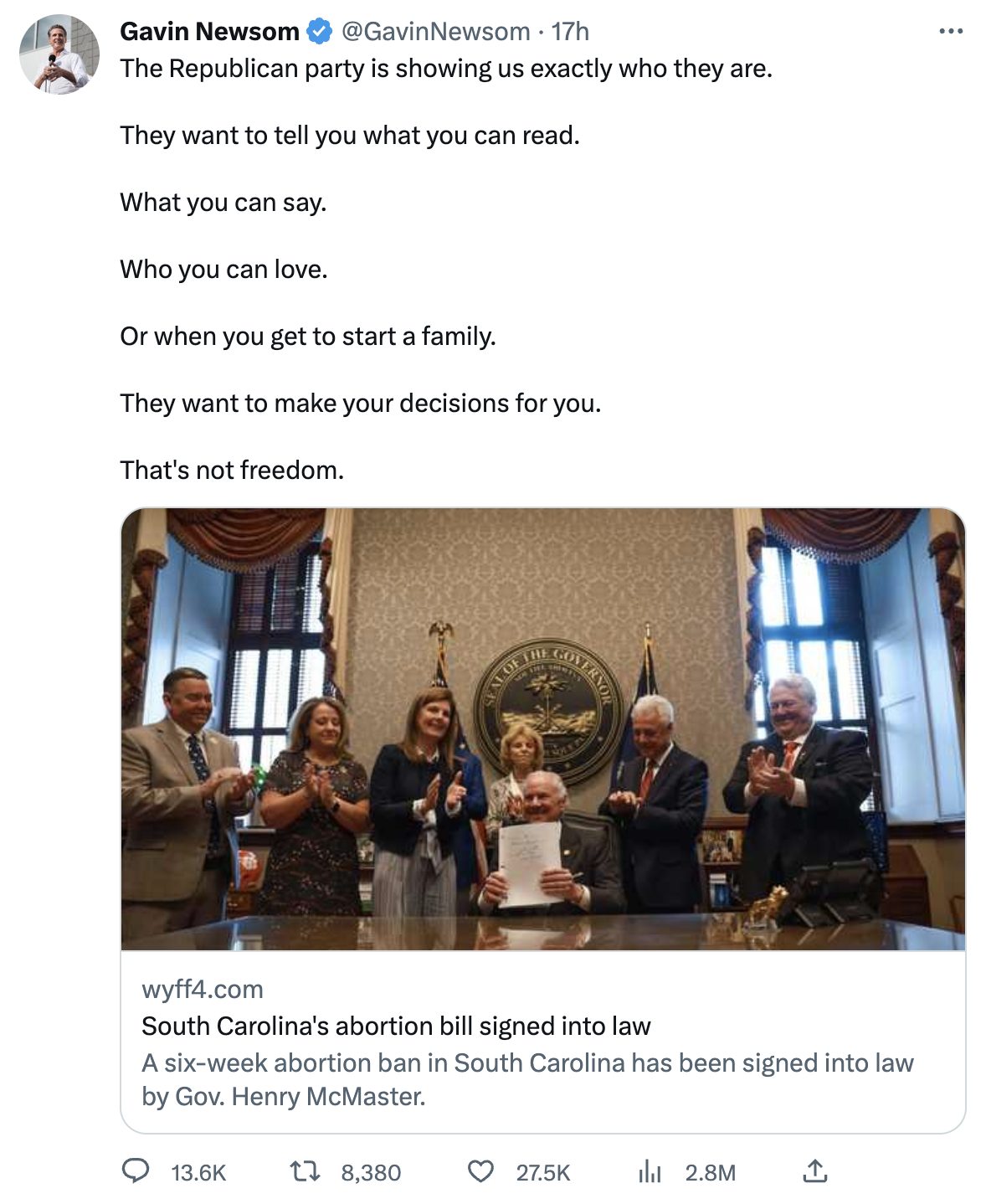
Gavin Newsom, Governor of California, regularly sends out emails pointing out the errors and hypocrisies of Republicans in other states. I enjoy them.

South Carolina, Diane…

Where the Republican governor just signed a six-week abortion ban, which he says will “begin saving lives.” All while that very same governor refuses to do anything about the fact South Carolina has one of the highest homicide rates in the country — more than 2x the rate of California.

Tweet from Gavin Newsom: 'The Republican party is showing us exactly who they are. They want to tell you what you can read. What you can say. Who you can love. Or when you get to start a family. They want to make your decisions for you. That's not freedom.'

You can’t make this up.

Today’s Republican party refuses to regulate assault weapons while gun violence is the leading cause of death of kids in America, but will champion the regulation of women’s bodies and take away reproductive freedom.

This is what Republicans want to do nationally.

And worse.

Be outraged.

Gavin

There is a growing awareness that Biden managed to outsmart Kevin McCarthy in the debt negotiations. Robert Hubbell thinks so. Biden is a lot smarter than he gets credit for. Fifty years in Congress counts for something.

Hubbell writes:

A key part of the Republican mythology heading into 2024 is that Joe Biden is addled to the point of incoherence and incompetence. So, on the eve of the House vote on the debt ceiling legislation, Republicans are struggling with the reality that Biden bested them in a high-stakes negotiation in which they were holding a nuclear bomb they were willing to detonate. 

As Rep. Lauren Boebert admitted on Twitter, “We got absolutely destroyed in this negotiation.” Or, as former-adult-in-the-room GOP Rep. Nancy Mace tweeted, “Republicans got outsmarted by a President who can’t find his pants.” [See my criticism of Rep. Mace in Concluding Thoughts.]

          As Charlie Sykes aptly noted, Republicans are experiencing “cognitive dissonance” as they struggle to digest their defeat. In the Orwellian logic of the GOP, Kevin McCarthy is declaring “total victory” for negotiating a deal that has ignited calls for his removal as Speaker. As Freedom Caucus member GOP Rep. Chip Roy said,

I want to be very clear: Not one Republican should vote for this deal. Not one. It is a bad deal. No one sent us here to borrow an additional $4 trillion to get absolutely nothing in return. . . . [The deal is] a complete and total sellout . . . and a betrayal of the House power-sharing arrangement.

          While McCarthy is attempting to convince his caucus that the sow’s ear compromise bill is a silk purse for Republicans, Biden is being praised in the political press for his Ninja-like negotiating skills. See Jennifer Rubin in Washington PostOpinion | The debt ceiling shows Biden’s underrated deal-making prowess. Or, as Josh Marshall of Talking Points Memo put it, How the “F” Did Joe Biden Do That? For a comprehensive analysis of Biden’s negotiating strategy, see Daily KosThe many levels of genius in Pres. Biden’s negotiating strategy.

          It may take a few days for Republicans to understand what just happened to them, but here is an example. One of McCarthy’s proudest achievements is that he imposed new work requirements for SNAP food assistance for recipients between 50 and 54 years old. But Biden negotiated “carve-outs” to that expanded work requirement that will actually increase the amount of SNAP funding by expanding the pool of eligible recipients. Per the NYTimes,

[The Congressional Business Office] said a series of changes in work requirements for food stamp eligibility — tightening them for some adults, but loosening them for others including veterans — would actually increase federal spending on the program by $2 billion.

While Republicans demanded stricter work requirements be a part of the compromise, the White House bargained to lessen the impact, and the budget office estimated that overall, the deal would increase the ranks of the program, making an additional 78,000 people eligible for nutrition assistance.

          Got that? The signature achievement of Republicans designed to kick people off SNAP will instead increase funding for the program (by $1.8 billion) and expand the number of eligible recipients. As Josh Marshall said, “How the “F” did Biden to that?” Democrats should help pass the bill through Congress before more such details emerge.

         The “good” news is that a floor vote in the House will likely occur on Wednesday—five days before the US will not have sufficient cash to pay all of its bills.  Late on Tuesday evening, the legislation cleared a key hurdle in the House, passing out of the House Rules Committee. As a result, the bill will be put to a vote on Wednesday. See NYTimesDebt Ceiling Deal Moves Toward House Vote Despite GOP Revolt.

          But . . . many Democrats are unhappy with compromises made by Biden to avoid default. Two of the leading criticisms involve the age-based increased work requirements for SNAP recipients and changes to the permitting process for energy projects.

          As to SNAP, Biden agreed to increase the existing work requirements to include beneficiaries 50 to 54 years old. But as noted above, carve-outs to those increased work requirements have the effect of increasing the total number of Americans eligible for SNAP benefits. Still, the precedent of using a debt-ceiling negotiation to target the poorest and most vulnerable Americans is a bad one. See Michael Hiltzik, Los Angeles TimesHiltzik: Debt ceiling deal is all about punishing the poor.

          A corollary to the GOP’s effort to punish the poor is their effort to protect the rich. By reducing funding for the IRS and leaving tax rates untouched, the two groups unaffected by the debt-ceiling compromise are ultra-wealthy Americans and large corporations. See Raw StoryProgressives condemn Biden-GOP debt ceiling deal as ‘cruel and shortsighted’.

A second major point of criticism is the concession to “fast track” future energy projects, thereby limiting environmental review. And the deal expressly grants special consideration for the Mountain Valley Pipeline, a Joe Manchin pet project. See The Guardian, ‘An egregious act’: debt ceiling deal imperils the environment, critics say | Environment.

Per The Guardian,

Environmental groups, already angered by Biden’s ongoing embrace of large fossil fuel projects, such as the recently approved Willow oil drilling operation in Alaska, said these provisions mean that Democrats should block the debt deal when it is voted upon in Congress this week.

“President Biden made a colossal error in negotiating a deal that sacrifices the climate and working families,” said Jean Su, energy justice program director at the Center for Biological Diversity. “Congress should reject these poison pills and pass a clean debt ceiling bill.”

          But apart from the permitting concessions, Biden managed to protect the massive investments in climate and clean energy achieved in the infrastructure bill and Inflation Reduction Act passed during the last session of Congress. The Inflation Reduction Act alone invested $369 billion in climate protection and clean energy—the largest investment in protecting the environment by an order of magnitude. That investment will reduce carbon emissions by 40% by 2030. See CNBC, Inflation Reduction Act: Climate change provisions.

          The criticisms over cruelty targeting the poor and special accommodations for a pipeline that will make Joe Manchin richer are well-taken. But as the director of the Office of Management and Budget, Shalanda Young, said in defense of the bill:

We are in divided government. This is what happens in divided government. They get to have an opinion and we get to have an opinion, and all things equal, I think this compromise agreement is reasonable for both sides.

And we must remember that as we evaluate the provisions of the bill, the implied question is always, “Compared to what?” Here, the relevant comparison is to a national default that would have injured hundreds of millions of Americans and millions of American businesses. Retirement savings would have been decimated, and monthly benefit checks would have been diminished or halted. It is legitimate and reasonable to evaluate (and criticize) the proposed bill, but to do so without recognizing the alternative outcome is an incomplete analysis.

*****************************************

Hubbell goes on to chastise former moderate Nancy Mace of South Carolina, who has gone full-MAGA in her cruel taunts aimed at Biden, who apparently negotiated the pants off McCarthy.

Jeffrey Epstein, sexual predator and child abuser, became a very rich man as a financial advisor to the rich and famous. When he died awaiting trial, he was allegedly worth $600 million. His estate paid off claims to more than 100 women whom he had abused.

Due to his notoriety and his many powerful friends, he continues to be a fascinating figure. The Wall Street Journal somehow obtained his daily diaries and has written several stories about his interactions with his important friends.

This one was published a few weeks ago in the Wall Street Journal:

On Monday, Sept. 8, 2014, Jeffrey Epstein had a full calendar. He was scheduled to meet that day with Bill Gates, Thomas Pritzker, Leon Black and Mortimer Zuckerman, four of the richest men in the country, according to schedules and emails reviewed by The Wall Street Journal.

Epstein also planned meetings that day with a former top White House lawyer, a college president and a philanthropic adviser, three of the dozens of meetings the Journal reported he had with each of them.

Six years earlier, in 2008, Epstein pleaded guilty to soliciting and procuring a minor for prostitution, and he subsequently registered as a sex offender. He was arrested again in 2019 on sex-trafficking charges, and died that year in jail awaiting trial.

Mr. Gates, the co-founder of Microsoft, has said they discussed philanthropy, and it was a mistake to meet with Epstein. Mr. Black, a co-founder of Apollo Global Management, who has said previously he met for tax and estate advice, declined to comment. The other two men haven’t previously discussed their meetings with Epstein and didn’t respond to requests for comment. Mr. Pritzker is chairman of Hyatt Hotels and Mr. Zuckerman is a real-estate investor and media owner.

That Monday featured appointments at two luxury hotels in midtown Manhattan—the Park Hyatt and Four Seasons. Epstein was also scheduled to host several visitors at his sprawling townhouse near Central Park.

Epstein’s driver picked him up in the morning and brought him to meet the Microsoft mogul and Hyatt hotel heir at the Park Hyatt hotel near Central Park.

Epstein had met with each of them before. In 2011, Epstein was discussing a multibillion-dollar charitable fund with JPMorgan Chase executives and wrote in emails to them that he could involve Mr. Gates and Mr. Pritzker.

On this day, Mr. Gates was scheduled to spend several hours with Epstein, accompanying him to various meetings. Mr. Gates runs, with his ex-wife, one of the world’s biggest philanthropies. 

“As Bill has said many times before, it was a mistake to have ever met with him and he deeply regrets it,” said a spokeswoman for Mr. Gates.

Mr. Pritzker, part of a wealthy and politically connected Chicago family, was a frequent guest at Epstein’s townhouse, according to the documents. 

Mr. Pritzker and Hyatt representatives didn’t respond to requests for comment about the scheduled meetings.

The schedule called for Epstein and Mr. Gates to head two blocks along 57th Street to the skyscraper that houses the offices of Apollo Global Management. 

Epstein had been scheduled to meet with its co-founder Mr. Black the day before, and the two men were slated to meet again three days later, the documents show.

Mr. Black had more than 100 meetings scheduled with Epstein from 2013 to 2017. They typically met at Epstein’s townhouse and occasionally at Mr. Black’s office, the documents show.

The billionaire stepped down as Apollo’s CEO in March 2021. An Apollo review found he paid Epstein $158 million for estate planning and tax work. 

Mr. Black declined to comment about the scheduled meetings. Apollo has said Epstein was working for Mr. Black, not Apollo.

Epstein and Mr. Gates were next scheduled to head to Epstein’s townhouse to meet with Mr. Zuckerman, the owner of U.S. News & World Report.

At the time of the meeting, Mr. Zuckerman also owned the Daily News and was executive chairman of Boston Properties, a big owner of office buildings. 

Mr. Zuckerman was scheduled to meet Epstein more than a dozen times over the years. On some occasions, the two men planned to meet at Mr. Zuckerman’s office or home, which was near Epstein’s townhouse, the documents show. 

One night in January 2014, Epstein waited past 11 p.m. to meet with Mr. Zuckerman, who was scheduled to visit his townhouse at 10:30 p.m., the documents show. 

A spokeswoman for Mr. Zuckerman had no comment on the scheduled meetings.

The Four Seasons, a luxury-hotel chain in which Mr. Gates’s investment firm holds a stake, was the next scheduled stop. There, Epstein introduced Mr. Gates to Kathryn Ruemmler, who until earlier that year had served as President Obama’s top White House lawyer.

Over the next few years, Epstein often had appointments with Ms. Ruemmler, who was a partner at Latham & Watkins at the time and is now general counsel at Goldman Sachs

Ms. Ruemmler had a professional relationship with Epstein and many of their meetings were about a mutual client, a Goldman Sachs spokesman said. “I regret ever knowing Jeffrey Epstein,” Ms. Ruemmler said. 

The spokeswoman for Mr. Gates said Epstein never worked for Mr. Gates. A spokeswoman for Latham & Watkins said Epstein wasn’t a client of the firm.

Epstein returned to his Upper East Side townhouse in the afternoon, the schedule shows. One of the largest private homes in Manhattan, the townhouse was originally built for a Macy’s heir.

At 4:30 p.m., Epstein was scheduled to meet with Ramsey Elkholy, a musician and anthropologist. Mr. Elkholy had several other meetings with Epstein over the years.

Mr. Elkholy said one of Epstein’s girlfriends had introduced them, and that he occasionally went to Epstein for financial and book publishing advice. “When I heard about everything that happened, I was sick to my stomach,” he said.

“In hindsight, I realize that Jeffrey was a very good con man,” Mr. Elkholy said. “He could give the impression that he was helping you when in fact he was mostly B.S.-ing.”

The next person on Epstein’s calendar, Leon Botstein, was running late that day. The longtime president of Bard College was arriving at LaGuardia Airport and planned to head straight to the townhouse, the documents show.

Mr. Botstein said he first visited Epstein’s townhouse in 2012 to thank him for $75,000 in unsolicited donations for Bard’s high schools, then visited again over several years in an attempt to get more. He also invited Epstein to events at the college.

Mr. Botstein said fundraising for the school was his responsibility, and that he met just as frequently with other potential donors.

“It was a humiliating experience to deal with him, but I cannot afford to put my pride before my obligation to raise money for the causes I’m responsible for,” Mr. Botstein said.

“It looked like he was someone who was convicted and served his time,” Mr. Botstein said. “That turned out to be corrupt, but we didn’t know that.”

The last meeting scheduled for the day was with Barnaby Marsh, a philanthropic adviser to wealthy families. At the time, Mr. Marsh was an executive at the John Templeton Foundation, which donates to various science and research groups. He had roughly two dozen meetings with Epstein.

Mr. Marsh said he often went to Epstein’s townhouse for gatherings because it was full of academics and wealthy people who discussed philanthropy ideas. “So many of these billionaires knew him,” Mr. Marsh said. “And he would sit in the corner, just kind of watching.”

Mr. Marsh said Epstein openly discussed his jail time. Mr. Marsh said, however, that he never saw evidence Epstein made significant donations. “He was a lot of talk, but he never did anything.” 

That is just one day in Epstein’s calendar. He was scheduled to meet regularly with some of those same people, and infrequently with others. Here is a look at how often they appeared in Epstein’s schedule in the year before and the year after that day:

When Ron DeSantis launched his candidacy on Twitter, he scoffed at the notion that schools were banning books in Florida. That alone should disqualify him, based on what we have seen, heard and read about the state’s encouragement of banning books that refer to gays or racism. A complaint by a single parent is sufficient to get a book removed from the school library. Most recently, a parent at an elementary school complained about Amanda Gorman’s poem “The Hill We Climb,” which she read at President Biden’s inauguration. The poem is now available to middle school children, but not to those in the elementary school.

The Miami Herald published this editorial about the phenomenon that DeSantis says is non-existent, a hoax.

Perhaps it’s because of how Amanda Gorman alluded to the Jan. 6 attack in her famous poem, finished the night after rioters stormed the U.S. Capitol: “We’ve seen a force that would shatter our nation rather than share it.”

Or maybe she wrote too bluntly about race and the legacy of slavery:

“We, the successors of a country and a time where a skinny Black girl descended from slaves and raised by a single mother can dream of becoming president, only to find herself reciting for one.”

Gorman, the youngest inaugural poet in U.S. history, read “The Hill We Climb” at President Joe Biden’s inauguration, watched by about 40 million people. She wrote the poem so “that all young people could see themselves in a historical moment,” she posted on Twitter Tuesday.

But Gorman’s poem is now deemed not age appropriate, one of four library titles Bob Graham Education Center banned, following a parent’s complaint, for elementary school students, the Herald reported. The books are now available only for middle-schoolers at the public school in Miami Lakes, even though some of them were written for younger children.

The school committee that reviewed the material didn’t offer an explanation for its decision. We’re left to wonder: What in the children’s illustrated book “The ABCs of Black History,” written for children ages 5 and up, made it so inappropriate?

Perhaps it was the mention of iconic author James Baldwin’s sexual orientation: “And he was a gay man who believed that when it comes to love, you should ‘go the way your blood beats.” Or the mention of the Little Rock Nine, the “first Black children in all-white schools,” or the Black Panther movement. Or were the colorful drawings of Black female icons like Michelle Obama and Toni Morrison — described as “ queens”— too much?

One thing is clear: Books by Black authors — and about the Black American experience — make up three of the four titles deemed inappropriate for young children at Bob Graham Education Center. The other one, “Cuban Kids,” uses photos to describe the lives of children in Cuba in the early 2000s and how different or similar they are to Americans, according to the author’s homepage. Learning about the lives of their counterparts in a socialist country — including how they got around paper shortages — is sure to turn our kids into communists.

We knew that the movement to “sanitize” school libraries that Gov. Ron DeSantis and the Legislature unleashed would eventually catch up with Miami-Dade. Our melting pot, after all, might not be so different from Escambia County in the Panhandle, whose school board has been sued for removing books about race and LGBTQ topics.

Florida’s laws have emboldened parents and activists like Moms for Liberty to challenge materials dealing with these topics. Most recently, DeSantis signed a bill that empowers one person to file a complaint and ban a book, at least temporarily, while a district reviews it. Parents not satisfied with how a district ruled on the challenge can appeal to the state. That is bound to make schools acquiesce to offended parents.

The result, as Gorman wrote on Twitter after her poem was restricted, is that “most of the forbidden works are by authors who have struggled for generations to get on bookshelves.”

Elementary students were not required to read Gorman’s work or any of the challenged titles. These were options at Bob Graham Education Center’s library. Those options also should be available for the children of all parents, not only those offended by certain content or groups skimming books to find any remote reference to race or LGBTQ issues.

“Love to Langston” was written at a second-grade reading level but no longer is accessible to second-graders at Bob Graham. The illustrated biography of Harlem Renaissancewriter Langston Hughes describes his own elementary school experience, tainted by racism, in the early 1900s:

“In Topeka, Kansas the teacher makes me sit in the corner; in the last row; far away; from the other kids.”

The parent who filed the complaint said “Love to Langston” contained critical race theory, “indirect hate messages,” gender ideology and indoctrination, the Herald reported. It’s unclear how.

It is curious, however, that “indoctrination” and “hate messages” seem to be flagged mostly when when Black authors write about being Black, or when LGBTQ authors write about being queer. The adults must ask themselves why that’s the case before making them inaccessible to children.

Michael Hiltzik of the Los Angeles Times explains how Republicans agreed to the increase in the debt ceiling: by cutting aid to the neediest. He wrote: The cruelty is the point.

No one should be surprised that the resolution of our most moronic fiscal policy, the federal debt ceiling, involved our stupidest social policy, work requirements for assistance programs.

But that appears to be the case. In negotiations between the Biden White House and House Speaker Kevin McCarthy’s Republican caucus, one of the last sticking points was whether, and by how much, to tighten work requirements for food stamps and welfare.

In coming days, as Congress moves toward votes on the deal, political commentators will thoroughly masticate the question of whether Biden or McCarthy (R-Bakersfield) prevailed in this dealmaking and which of them will be hurt or harmed politically by the outcome.

Democrats right now are willing to default on the debt so they can continue making welfare payments for people that are refusing to work.

— Rep. Garret Graves (R-La.) tells a giant lie about the debt ceiling negotiations

That’s not a very interesting parlor game. (Personally, I’d go with the judgment of Timothy Noah of the New Republic, who thinks Biden emerges as the political victor and McCarthy’s days as speaker are numbered, thanks to the choler of his far right wing.)

More important is what the deal says about the principles of both camps. The granular details of the agreement were still murky Sunday, and it could still collapse because of objections from congressional Republicans or Democrats.

The deal, as reported, freezes discretionary federal spending — that is, most of the programs for which Americans depend on the federal government — at current levels for the next two years, with increases lower than inflation. That means an effective budget cut, relative to inflation. In return, the debt ceiling is suspended for two years.

But Biden managed to preserve the accomplishments of his presidency thus far from the GOP’s knives. He fended off their efforts to torpedo the support for renewable energy in last year’s Inflation Reduction Act, their harshest proposed budget cuts, the rollback of student debt relief, and repeal of his budget increase for the Internal Revenue Service.

(Reports say that $10 billion will be shaved off the $80-billion 10-year IRS budget increase, but the money can be redirected to other programs.)

Biden rejected Republican demands to impose work requirements on Medicaid, but allowed some tightening of the rules for food stamps — the Supplemental Nutrition Assistance Program, or SNAP, and Temporary Assistance for Needy Families, or TANF, which is what’s left of traditional welfare.

Make no mistake: No rich American will be harmed even a bit by this deal. Some may even be advantaged, if the carve-out from the IRS budget comes from the agency’s enforcement efforts; that would help the rich, who are the nation’s worst tax cheats.

The most vulnerable Americans, however, will bear the brunt of the deal points. Let’s take a look.

Start with work requirements. As I’ve reported ad infinitum over the years, work requirements on safety net programs accomplish nothing in terms of pushing their beneficiaries into the job market.

They are, however, very effective at throwing people off those programs; that’s what happened in Arkansas , where 17,000 people lost Medicaid benefits in 2019 after only six months of a limited rollout of work rules. A federal judge then blocked the changes.

The debt ceiling deal will tighten work requirements for SNAP by requiring able-bodied, childless low-income adults younger than 55 to work 20 hours a week or be engaged in job training or job searches. If they don’t meet that standard, their SNAP benefits end after three months. Current law applies to those adults only up to the age of 49. The change will expire in 2030.

This rule will do virtually nothing to reduce federal spending, which Republicans say has been the whole point of holding the debt ceiling hostage. The Congressional Budget Office estimated in April that the change would reduce federal spending by $11 billion over 10 years, or $1.1 billion a year.

By my calculation, that comes to 17 thousandths of a percent of the federal budget, which this year is $6.4 trillion.

If it’s scarcely a rounding error in federal accounts, however, it’s critically important to the recipients of food aid. The CBO estimated that about 275,000 people would lose benefits each month because they failed to meet the requirement.

Biden’s negotiators did get the Republicans to waive SNAP rules for veterans and the homeless, which will probably lower that figure and limit the reduction of federal spending.

Work requirements for safety net programs have been a Republican hobby horse for decades. It’s based on the Republican image of low-income Americans as layabouts and grifters — the “undeserving poor.”

Sure enough, Rep. Garret Graves (R-La.), one of McCarthy’s debt-ceiling negotiators, couldn’t resist slandering this vulnerable population during the talks. “Democrats right now are willing to default on the debt so they can continue making welfare payments for people that are refusing to work,” he said during a break.

Of course, it was Republicans who showed willingness to default on the federal debt. Nor is there a smidgen of evidence that any sizable percentage of this target population is “refusing to work.”

The vast majority of SNAP recipients already work, but they’re in low-paying jobs that are so unstable that they often drift in and out of employment. According to the Census Bureau, 79% of all SNAP families include at least one worker, as do nearly 84% of married couples on SNAP.

In other words, the GOP insistence on work requirements is nothing but the party’s typical performative malevolence toward the poor. If they really cared about getting SNAP recipients into the job market, they’d fund job training programs and infrastructure projects. They never do.

In any case, the only cohort of beneficiaries that tends to move into the job market at all are younger recipients — not those in their 50s. All that work requirements accomplish is to erect bureaucratic barriers to enrollment in the safety net. But that’s the point, isn’t it?

The work rules for TANF are managed somewhat differently — they’re directed at the states administering the program, which have been required to ensure that a certain percentage of beneficiaries are working or looking for work. How the debt ceiling deal applies to that program is unclear.

In the next week or so, before June 5 — the putative date at which the Treasury Department says the government runs out of money to pay its bills without a debt ceiling increase and thus flirts with an unprecedented default — Biden and McCarthy will hit the hustings to claim victory.

But there’s really only one way to think about the exercise we’ve just gone through. It was a supreme waste of time.

Republicans showed they were willing to crash the U.S. economy to make some bog-standard complaints about the federal deficit, most of which they created themselves through the 2017 tax cuts they enacted for the wealthy. Their initial negotiating stance was so extreme that they must have known it could never gain Democratic votes in the House or pass the Democratic Senate.

The Democrats held reasonably firm. They agreed to some modest budget constraints for two years, moved the next debt ceiling cabaret off to beyond the next election, and saved millions of Americans from serious economic pain.

As I’ve written before, if Republicans were really serious about restraining federal spending, they wouldn’t have voted for the tax cuts and budget increases that that contribute to the deficit.

Instead, they said the only way to control spending is to refuse to pay the bills they ran up, by refusing to increase the debt ceiling. They lied, and every thinking American knows they lied. So tell me, why did we go through this again?

Peter Dreier exposes here a false screed that appeared in the New York Times. Dreier is the E.P. Clapp Distinguished Professor of Politics at Occidental College in California. Anyone who thinks that the Times is “leftwing” should see how gullible they were in posting a rightwing diatribe. Drier’s article appeared in The American prospect. The article in the Times echoed the complaint of authors that their article on leftwing bias in science had been rejected because of leftwing bias. But there are many reasons why an article might be rejected by scientific research publications, such as, because it’s about politics, not science. Maybe they should submit it to the New York Times Magazine.

Dreier writes:

Americans are more inclined than others to either deny that the climate is changing, or believe that human activity is not responsible for global warming, according to a 23-country survey conducted by the YouGov-Cambridge Globalism Project in 2019. More than one-third (36 percent) of Americans today believe that climate change is primarily due to natural causes—an extraordinary repudiation of the scientific consensus.

Why are so many Americans wrong about this basic question?

A major culprit is the ongoing disinformation campaign waged by oil companies and other fossil fuel profiteers, led by the Koch brothers. Between 1986 and 2018, the Kochs spent at least $168 million financing more than 90 groups that have attacked climate change science and opposed policy solutions, such as a carbon tax, that would regulate the fossil fuel industry. Other fossil fuel giants, including ExxonMobil, and the American Petroleum Institute, the oil industry lobby group, have engaged in a long-standing propaganda war about global warming, pollution, and public health.

These efforts are part of a much broader and persistent campaign by corporate America to challenge scientific findings that identify the serious dangers their practices pose to the environment, workers, consumers, and public health. The key players include major food, chemical, tobacco, pharmaceutical, automobile, and fossil fuel corporations. They each have their own research, public relations, and lobbying counterparts, all designed to mislead the public and policymakers by discrediting science and sowing seeds of doubt about scientific merit and impartiality. It should come as no surprise that polls reveal an increasing distrust of science, disproportionately among Republicans.

“There’s an entire industry called product defense—devoted to creating studies that claim to exonerate dangerous products and activities,” explains Dr. David Michaels, an epidemiologist and professor at the George Washington University School of Public Health. Michaels was the longest-serving assistant secretary of labor for the Occupational Safety and Health Administration (2009-2017) and author of The Triumph of Doubt: Dark Money and the Science of Deception (Oxford University Press, 2020). “It’s very lucrative for these mercenary scientists to manufacture uncertainty about the dangers of the corporate sponsors of their work. Their job is to pollute the scientific literature with ‘doubt science.’”

But if you believe New York Times columnist Pamela Paul, the most egregious efforts to discredit science come from the left, not corporate America. In a May 4 column, “A Paper That Says Science Should Be Impartial Was Rejected by Major Journals. You Can’t Make This Up,” Paul claims that mainstream science has been hijacked by leftist activists who use identity politics, not objective facts, to judge the merits of scientific research. She based her argument on an article written by 29 academics, most of them scientists, entitled “In Defense of Merit in Science.”

That article contends that “social justice” advocates, including feminists and critical race theorists, evaluate scientific work on the gender and racial identity of scientists rather than on careful and scrupulous analysis of objective empirical facts. They even “deny the existence of objective reality,” because there is no scientific truth, but only “multiple narratives.”

To bolster their point that science has been kidnapped by leftists, including the editors of scientific journals, they claim, falsely, that “the paper was rejected by several prominent mainstream journals.” They eventually published it in something called the Journal of Controversial Ideas, a two-year-old publication co-founded by Peter Singer, a Princeton University philosophy professor, that primarily publishes articles from a conservative perspective.

In fact, theirs is not a scientific paper based on analysis of verifiable data. It is an opinion essay, filled with anecdotes and stories, making the uncontroversial claim that scientific research should be impartial and the controversial claim that leftists don’t share that view. The authors compare the alleged left-wing bias in current scientific work with the “dangers of replacing merit-based science with ideological control and social engineering” in the former Soviet Union. The paper goes on to attack critical race theory, affirmative action, and efforts to attract more women and people of color into science through diversity, equity, and inclusion (DEI) training and policies.

The paper “reads like a rant,” said Michaels, the George Washington University epidemiologist. “It’s a hodgepodge of opinions masquerading as a coherent argument about science.”

The 29 authors of this article can hardly complain that they’ve been subjected to hostility by the scientific establishment. Most of them are successful researchers who, between them, have published thousands of articles in various journals. (The co-authors include several non-scientists, including linguist John McWhorter and economist Glenn Loury, both well-known conservatives.)

The authors’ claim that their article was rejected by many scientific journals based on political criteria is false. In an interview, Anna Krylov, a professor of quantum chemistry at the University of Southern California who was one of the scientists who initiated the article, admitted to me that they had formally submitted their article to only one established journal, the Proceedings of the National Academy of Sciences, which rejected it.

What she and other co-authors had actually done was, in Krylov’s words, make “informal inquiries” to journal editors, about whether they might consider the article. This practice violates scientific norms of submitting articles to journals anonymously to avoid potential bias. Despite her efforts to use her and her colleagues’ networks to feel out journal editors, Krylov claimed that all of them discouraged her from submitting the article because of its viewpoint, but she offered no evidence from those conversations or emails.

These authors know very well that the overwhelming majority of research articles submitted to serious scientific journals are rejected. The eminent journal Science accepts only 6.1 percent of submitted papers. Other prestigious journals have similarly low acceptance rates, including Nature (7.6 percent), the British Medical Journal (4 percent), The New England Journal of Medicine (5 percent), The Journal of the American Medical Association (4 percent), and The Lancet (5 percent).

The one journal to which they formally submitted their paper, the Proceedings of the National Academy of Sciences (PNAS), accepts only 15 percent of all submissions, according to Prashant Nair, a spokesperson for the journal. PNAS’s rejection is hardly evidence of the editors’ leftist bias.

Krylov refused to provide copies of the evaluations of their article by the three reviewers solicited by the journal, but she did provide a copy of an email exchange between her and one of the editors, Zan Dodson, who asked the authors to clarify the differences between “merit” in scientific research and in other arenas, such as college admissions. According to PNAS’s Nair, the article “was sent for review, and the Editorial Board found that a number of claims made in the manuscript were unsupported by citations or additional argument. The Board concluded that it cannot recommend any particular protocol for improving the cogency of the arguments. As such, the manuscript was rejected.”

Neither the 29 authors nor Times columnist Paul seem to recognize that increasing the diversity of the scientific landscape has real benefits to the scientific enterprise itself. Nor do they acknowledge that science has often been used as a tool of oppression against relatively powerless people.

The widespread popularity (among prominent scientists and the general public) of the pseudo-science of eugenics in the early 1900s was used by policymakers to adopt laws allowing the sterilization of the “unfit” and to pass federal laws limiting immigration from Asia, Africa, and Southern Europe. It is hard to believe that the infamous Tuskegee experiment would have been conducted had there been any African American officials of the U.S. Public Health Service. That experiment, begun in 1932 ostensibly to find a cure for syphilis, led to the deaths of Southern Black men who were refused treatment for the disease.

The authors of “In Defense of Merit in Science” also say nothing about the biggest threat to public trust in science—the corporate-sponsored “doubt” industry. The critique of science by progressive scientists is not about the goal of impartial research. It is about what questions get asked and how scientific findings are applied in the real world.

It is no accident that few environmental scientists looked at the disproportionate harms of pollution and toxic chemicals on low-income and minority communities until Robert Bullard, a Black sociologist, published Dumping in Dixie in 1990. Now, many scientists are exploring the issue of “environmental racism,” using basic scientific methods and data analysis to examine the health impacts of racial disparities in exposure to pollution and toxins.

Pursuing excellence in research doesn’t conflict with advocating for social justice. When Albert Einstein participated in movements to outlaw lynching and end the use of atomic weapons, nobody questioned his credentials as a scientist.

Michael Hiltzik, columnist for the Los Angeles reviewed the debut of Ron DeSantis’ presidential campaign on Twitter, accompanied by Elon Musk. DeSantis boasted about the glory of debate and free speech, which he has done his best to stifle in Florida. And he adamantly denied that there was any book banning in his state, despite the fact that PEN America says that Florida is number two in the most books banned, behind Texas. The guy rules Florida with an iron hand, suppressing the teaching of history he doesn’t like, demonizing drag queens and anything LGBT, and encouraging vigilante censorship.

Column: Ron DeSantis and Elon Musk give us a preview of the chaos of a DeSantis presidency

The SpaceX Starship

Elon Musk hosted Florida Gov. Ron DeSantis on Twitter for DeSantis’ announcement of his presidential candidacy. It went about as well as the April 20 launch of a rocket by Musk’s SpaceX, which ended in an explosion that destroyed the spacecraft.

(Patrick T. Fallon / AFP via Getty Images)

BY MICHAEL HILTZIK

I was taking my customary siesta Wednesday afternoon when I was jolted awake by the sound of a truck straining to go uphill. Come to discover that I had my computer tuned to Elon Musk’s Twitter, where Florida Gov. Ron DeSantis was struggling to get out the official announcement of his candidacy for president.

The noise turned out to be Musk trying to get the thing to work in real time, amid feedback, weird musical interludes and long stretches of silence. Scheduled to start at 3 p.m. Pacific time, it finally got going on Twitter Spaces, an audio-only application on the platform, about 18 minutes late. I listened, so you don’t have to. You’re welcome.

As he struggled to resolve repeated glitches in Twitter Spaces, Musk and the moderator, a Musk acolyte named David Sacks, kept trying to assert that the technical screw-up was, in fact, a triumph brought about by the large audience. (Sacks claimed that more than 300,000 users had logged in.) “We are melting the servers, which is a good sign,” Sacks said early on.

This reminded many listeners of the claim by SpaceX, another Musk venture, that its April 20 launch of a prototype rocket, which ended with the vehicle exploding in flight four minutes after lift-off, was a success. Never mind that the launch destroyed the launchpad, showered a neighboring community with debris and prompted the Federal Aviation Administration to mount a major investigation.

Once it got underway, the Twitter event unfolded as a love fest between DeSantis and Musk. The general theme was what my mother used to describe as “I like me, who do you like?”

Musk and DeSantis praised each other for their dedication to free speech, and Sacks brought on several right-wing sophists to add their voices. They included Jay Bhattacharya, one of the drafters of the Great Barrington Declaration, which, as I reported this week, advocated letting the COVID virus run rampant through the population in quest of the elusive goal of “herd immunity” — at the cost (thus far) of more than 1.13 million American lives.

Another was Rep. Thomas Massie (R-Ky.), whose claim to fame on a national scale was issuing a Christmas tweet in 2021 showing himself, his wife and their five kids brandishing assault weapons. “Santa, pls bring ammo,” the tweet read. (In December 2021, there were 39 mass shootings in the U.S., taking 36 lives and wounding 160.)

DeSantis said Florida was safer than blue-state cities, where “you got kids more likely to get shot than to receive a first-class education.” A reminder: One of the worst school shootings in American history took place in Parkland, Fla., in February 2018, when 17 people were killed and 17 injured. In April, DeSantis signed a law allowing Floridians to carry guns without a permit.

It would be wrong to say there weren’t some lighthearted moments during the Twitter event. Unfortunately for DeSantis, the best joke came from President Biden: While Musk was struggling to get the event launched, Biden posted a tweet that read, “This link works,” pointing to a fund-raising site for the Biden-Harris campaign.

If you were looking for policy prescriptions from the freshly minted candidate, you didn’t hear anything new. Put it this way: If you were at a party where you had to down a shot of whiskey every time DeSantis uttered the word “woke,” you were reduced to insensibility within ten or twenty minutes. If the drinking game included a shot when DeSantis took a shot at “the legacy media,” you may have needed to get your stomach pumped.

Other than that, it was a festival of cynical lies and rank hypocrisies uttered by DeSantis.

He spoke up for free speech and open debate, for instance. “People should be exposed to different viewpoints,” he said. “You can’t have a free society unless we have the freedom to debate the most important issues that are affecting our civilization.”

This is the guy who has waged a ferocious battle with Walt Disney Co. because Disney had spoken out against his “Don’t Say Gay” law, which stifles the teaching of gender issues in the schools.

When Sacks primed him with a question about the fight with Disney, DeSantis replied, “We believe jamming gender ideology in elementary school is wrong; Disney obviously supported injecting gender ideology in elementary school.” He added that Disney’s “corporate culture had really been outed as trying to inject matters of sex into the programming for the youth.” One doesn’t have to be a fan of Disney to see that as fatuous claptrap.

DeSantis also dismissed accusations that Florida is a hotbed of book-banning as “a hoax.” All his administration has done, he said, has been “to empower parents with the ability to review the curriculum, to know what books are being used in school.” That’s one way of looking at it.

The right way is to observe that he’s empowered a tiny cadre of reactionary activists to force books they don’t like off the shelves of Florida schools. As the Washington Post reported Wednesday, a majority of the complaints about schoolbooks nationwide have come from just 11 complainants. Florida ranks second among the states in the number of schoolbook challenges, after Texas.

By the way, one of the Republican toadies DeSantis appointed to the board created to oversee Disney’s development district (as part of his retaliation against the company) is Bridget Ziegler, co-founder of the right-wing censorship-happy organization Moms for Liberty.

When Bhattacharya came online, DeSantis took the opportunity to boast about his success against the COVID pandemic. The truth is that Florida’s record is one of abject, lethal failure. Florida’s COVID death rate of 411 per 100,000 population is the 10th worst in the nation. DeSantis has appointed Bhattacharya to a state panel investigating federal COVID policy.

DeSantis claimed to have based his COVID policies on his determination to “look at the data…. There was a concerted effort to try to stifle dissent.” This can only be interpreted as some kind of gag. DeSantis installed a COVID crackpot, Joseph Ladapo, as Florida’s surgeon general.

Ladapo has promoted useless anti-COVID nostrums such as ivermectin, and counseled against the COVID vaccines. “Looking at the data”? As the Tampa Bay Times has reported, based on official state documents, Ladapo deliberately removed data from an official state report on the vaccines that contradicted his claim that the vaccines were unsafe for young men; in fact, studies show that the vaccines are far safer for them than being infected by the virus.

The event ended with a paean by Musk and DeSantis to cryptocurrency, which is tantamount to enticing innocent small investors into immolating their nest eggs in a scam.

“We should do it again,” DeSantis said in closing the feed. “We’ll make sure that we come back and do it again. This is a great platform.”

We shall see. The next DeSantis appearance on Twitter could be just as buggy, or worse. All that we can be sure of is that whatever happens, Elon Musk will deem it a great success.

Carolyn K. Johnson writes about science and the business of healthcare for The Washington Post. She recently learned that her child had a rare and dangerous disease, and she became a warrior in a fight to get her private insurance company to cover the high price of the drug. She knows she had advantages unavailable to most parents, given her knowledge and access. What she shows is the fundamental unfairness of the American healthcare system. Another parent, without her background, might have been resigned to watching her child be permanently damaged or die.

Johnson wrote in The Washington Post:

When a salmon-colored rash flared on my 3-year-old son’s tummy one afternoon in August, I shrugged it off. The next time I asked Evan to lift up his shirt to take a photo, it was gone. When he stopped sleeping through the night, I thought it was a dreadful new developmental phase. But then on a Saturday, he stopped walking and spiked a 104-degree fever. A nurse gave me clear directions: “Get in your car, and start driving to the ER.”


After days in the hospital, the doctors had ruled out a long list of infections, as well as scary conditions like leukemia. That left them circling around a rare type of childhood arthritis called systemic onset juvenile idiopathic arthritis, or sJIA, in which the innate immune system, the body’s first line of defense against pathogens, goes haywire. Young children are tormented by daily spiking fevers, a fleeting rash and arthritis. Some develop a life-threatening immune activation syndrome. Untreated, destructive joint damage can occur. We were in shock.

But the doctors mentioned a drug that they’d probably want to try — anakinra, a biologic drug that blocks a key prong of the immune system and quells inflammation. Like most rare disease drugs, anakinra (also known by the trade name Kineret) was obscure, but I’m a health and science reporter and I’d heard of it. In 2020, I interviewed a pediatric rheumatologist, Randy Cron at the University of Alabama at Birmingham, who wanted to test whether anakinra could help people with severe covid-19.

Now, he told me that anakinra and similar biologics had transformed treatment for kids with sJIA. “Remarkably effective and safe,” he’d replied after I emailed him about our situation. “There may be a window of opportunity early during treatment to get the best long-term benefit.”

Anakinra was clearly the favored route back to health for Evan. We were determined to take advantage of any early “window of opportunity.” Unfortunately for us, our insurance company, Aetna, disagreed. We began a health journey that many people encounter when dealing with rare diseases, health insurance and pricey drugs.


Anakinra is expensive — on average, private health plans pay about $4,000 a month for it — so we needed to get approval before it would be covered. In early September, Aetna denied the request, requiring an additional test. Our doctors ordered the test and appealed.


In October, after another emergency room visit, daily spiking fevers, $2,000 of bloodwork and a growing feeling of despair about whether our son would ever be able to walk or play normally again, I received a letter from Aetna. It was a decision to “uphold the denial” to cover the drug, and it came from a team led by a urologist, a medical specialty that would not typically treat sJIA.


Aetna required that Evan try 30 days on drugs such as naproxen or ibuprofen, or two weeks on a steroid first to see if those worked. This type of decision isn’t unusual — nearly all insurance companies use this process, called step therapy, and it’s meant to save health-care dollars.

The idea is a logical one — to “step” up from inexpensive therapies to more expensive ones. It’s a guard rail to prevent unnecessary spending on drugs that cost more but may not offer much more benefit.

The painful irony was that we already had tried those medicines. A few days on ibuprofen and we were back in the ER. It failed to control Evan’s miserable fevers or assuage his knee pain. Steroids, which Evan was still taking, were only sort of helping.


We carried him between his bed and the living room couch, the only two places he was comfortable. We hand-fed him bites of food in bed. We went back to using diapers. One day, I tried to encourage Evan to walk, but watched in horror as I saw his knees buckle underneath him in slow motion, nearly falling backward down a flight of stairs. My mom came to help out, but left our house in tears after a few minutes.

In the midst of our August to October limbo, Evan received his first doses of anakinra through a free program offered by the drugmaker — and his symptoms dissipated. One of his rheumatologists had described this almost magical effect. Before the drug was standard treatment, one of her patients suffered from fevers for a full year. They had abated within hours of the first dose.


Patients vs. insurance companies

This isn’t a unique story about American health care, a single high-priced drug or just one insurance company. It is a tale of routine aggravation, inconvenience, futility and fear, but fortunately, not tragedy. Our battle was hair-raising but typical.

What’s different is that I have more tools, more time and more knowledge about how the system works than the average health-care consumer.


Before I came to The Washington Post, I covered science in Boston — the epicenter of the biotech industry and its sometimes miraculous, almost always high-priced drugs. I had been welcomed into the homes of families on diagnostic odysseys for children with rare and sometimes life-threatening illnesses. At The Post, my first job focused on the affordability of health care to consumers, particularly the weird economics behind drug prices.

I was also knowledgeable, even sympathetic, to the rationale behind insurance company policies that cause immense frustration to people. I’ve interviewed insurance and drug company executives, but I also did billing for a pediatric neuropsychology practice part-time after college.
I felt like I had been preparing for a situation like this for years.

Trying everything

Biologic drugs such as anakinra are produced in bioreactors by living cells. They’re given by injection or IV infusion and are much more expensive to produce than the familiar yellow jar of pills that people pick up at the pharmacy. Prices vary, but the monthly costs typically have a comma in them.

Insurance companies often put obstacles in the way of access to high-priced drugs. There are sensible reasons for this. Doctors aren’t incentivized to pick the most cost-effective care. They are the targets of aggressive marketing by pharmaceutical companies pushing new, more expensive drugs. Yet older, cheaper ones may work just as well.

Like other insurers, Aetna says that its step therapy program had been “designed to ensure patient access to clinically appropriate, evidence-based care” and is updated as new evidence becomes available.
So when the company denied the drug right off the bat in September, upset and worried as we were, we were also not surprised.

The doctors appealed the decision. We crossed our fingers. Evan’s fevers came under control while he was on high doses of steroids, but he refused to walk, couldn’t sleep at night, demanded meals at 1 a.m. and never seemed comfortable. He spent most of his time in bed, moaning. And we waited.

These insurance barriers are so common that drug companies sometimes provide initial doses of a drug for free, to bridge the time before insurance begins to cover it. Which is why, as we awaited action on our appeal, we were able to get three weeks’ worth of free drugs from Sobi, the drugmaker. It was enough though to get our little boy out of bed and eating dinner at the table for the first time in weeks.

These free drug programs are not a form of selfless charity. They offer immediate access to patients but also give drug companies cover, insulating them against critiques of the prices of their medicines.
“Once they hook you, they are going to go to the insurer and get the real dollars,” Ezekiel J. Emanuel, an architect of the federal Affordable Care Act and a professor at the University of Pennsylvania, told me.

Put more simply: Health care is a battlefield. Patients often become cannon fodder.

I knew all this. I expected it. Still, when our appeal was denied in October, I felt like I had been punched.


Several specialists told me that a short trial of ibuprofen — not 30 days — could be tried, but in their experience didn’t work in most children with this disease. Steroids are not recommended as an initial solo therapy by guidelines and, if used, are cautioned to be limited “to the lowest effective dosage for the shortest duration possible.”


“Your son was sick, but some of these kids die,” said Cron, who co-wrote the 2021 American College of Rheumatology guidelines on how to treat sJIA. He has also served as a consultant to Sobi, receiving $6,400 in fees in 2021. “So if you waited to put him on anakinra, that would not go well.”


The sludge effect


After I received that denial in October, I set aside chunks of time each day to make phone calls — primarily to my insurer, but also to a care manager at Sobi’s patient support program, Evan’s rheumatologists and a specialty pharmacy in Massachusetts that had sent us the free drugs.


Why was I notified of the denial nine days after the decision? Why did a urologist, who had probably never seen a child with sJIA, have the last word on how my son should be treated? I wanted another option besides filling out a second appeal form and faxing it into the void. I was terrified about what would happen when we used up our last dose in a few days.
I kept detailed notes about the calls. Jordan, Alicia, Joseph, Alex, Alexis, Julie, April, etc., were polite but largely unhelpful. My son’s doctor suggested screaming and crying to get better results.


This tip — a serious suggestion — pushed me over the edge. I called other rheumatologists to find out if what we were going through was unusual. No. Other doctors echoed what our own had told us: requests typically got denied right off the bat, but were often approved after an appeal — or two.

Put more simply: Health care is a battlefield. Patients often become cannon fodder. I knew all this. I expected it. Still, when our appeal was denied in October, I felt like I had been punched.

The struggle varied, depending on the insurer and the specific drug that the child needed, but it seemed especially cruel in this case, because “there isn’t a clear alternative that has a reasonable chance of being effective,” said Grant Schulert, a pediatric rheumatologist at Cincinnati Children’s Hospital.


“It’s something we spend a huge amount of largely uncompensated time on, as providers. And for patients, it delays significantly the time it takes to access care,” he added.


There is a name for what I was going through, which is also an accurate description of how I felt: sludge. The administrative burden of people dealing with their insurance adds up to about $21.6 billion a year in lost productivity, half of it during work hours, according to a paper from Jeffrey Pfeffer at Stanford Graduate School of Business.


Pfeffer said that, like me, he got interested in the problem when he ran into insurance barriers and realized how many advantages it took to succeed. “I have fancy doctors who know how to play the system,” Pfeffer said. “If you don’t have those resources, if you’re a less-educated human being with a crappy job and maybe African American or Latino, your ability to access the system is much less.”


I tweeted about my frustration, without mentioning most of the details — and got an outpouring of empathy. My Twitter profile identifies me as a Washington Post reporter, but I shared the story because it felt like a universal problem with American health care. Someone offered to ship doses from their personal stockpile of a similar drug. People inside insurance companies messaged me, offering personal contact information for executives. A person with Type 1 diabetes told me that due to her activism online, she had been labeled a “media threat” and now had the phone number of a person inside her insurance company to help get prescriptions covered.

Receiving health care shouldn’t require special favors. I interacted with Aetna as an ordinary health-care consumer, and kept trying 800 numbers.


After nearly three weeks on the anakinra doses supplied by Sobi, Evan’s doctors confirmed what we knew. He was so much better. Bloodwork showed his out-of-whack immune response was headed back in the right direction. After weeks of refusing to stand or walk across a room, he ran down the hallway and smiled behind his mask. We’d gone hiking.
It was great news, but we had only one syringe of anakinra left in the fridge.
Because getting anakinra covered had proved so difficult, our medical team had decided to shift gears a week before we even knew about the final denial. They decided to try, in parallel, to see if insurance would approve a different biologic drug called canakinumab that worked in a similar way but cost about four times as much. The doctors had started with anakinra, a fast-acting, once-a-day injection, to see if Evan responded. They’d preferred, based on his case, to start with a short-term daily shot, instead of canakinumab, which is given once a month and offers less flexibility.
Shortly after we lost the battle for anakinra, we qualified for a free first dose of canakinumab from Novartis, the company that makes that drug. But with only one syringe left in the fridge, there would be a gap. These drugs can’t just be picked up at the local pharmacy. Our free dose would be shipped to us from a pharmacy in Massachusetts, then we’d need a nurse to come to our house to administer it.
Our doctors mulled various options. Could we go to the ER to get a shot? What about going back on high-dose steroids? That afternoon, I took out our last syringe, and began squirting bits of the medicine into other syringes. It was not a recommended practice, but a way to stretch the supply.
Three days later, our first free dose of the new drug arrived. A nurse came on a Sunday at 8 p.m. to give it to Evan. His illness stayed at bay.
This is, in many ways, a story of a success in saving health-care dollars. For two months, our health insurance avoided paying for expensive drugs. The canakinumab was ultimately covered.
In January, after an editor suggested I write about the experience, I asked Aetna for their perspective.
“In reviewing the situation for your son, our team could have explained all requirements for step therapy more clearly in the first letter to you. Our initial decision was upheld on appeal, based on the information we had available at the time,” Aetna spokesman Ethan Slavin said in a statement. “We are working to clarify our communications process on these types of matters.”


Aetna said the canakinumab was approved because it was subject to different rules. “Your health care provider submitted the request as a continuation of existing care,” Aetna said in a statement. Reading between the lines: Evan was doing well on another biologic drug when the doctors made the request for the new one. He now qualified for the treatment, no thanks to our health insurance.

As a journalist, I often found prior authorization a difficult story to sell to an editor. The process caused families stress and delayed needed treatment. It drove doctors and nurses absolutely crazy. But it is a clumsily applied Band-Aid on a legitimate problem: high-priced drugs.

And as with us, a Rube Goldberg-like workaround often materialized.
The people who simply give up may not have the time, resources or sense of entitlement to keep fighting — or tell their stories to reporters.
In our case, we patched together two free drug programs and split up doses. It was incredibly precarious, time-consuming and tense. Other families face longer, harder fights. We were lucky. It was still horrible.


We don’t know what the future holds. Evan might need the medication long-term. He might need to try other drugs, if it stops working. He may be able to wean off it. What we do know: We’ll need to be ready for the next battle.

My struggle to get essential health care covered taught me how isolating the experience can be. We would like to collect these stories.

Have you struggled to get insurance to pay for high-priced drugs? Tell The Post your story here: wapo.st/insurerstories.