Archives for category: Equity

Dr. Helen F. Ladd is one of the most eminent economists of education, possibly the most eminent. She has written important studies that document the importance of poverty in the lives of children and its impact on their educational outcomes. She has written critically about No Child Left Behind. And she has written international studies of school choice with her husband Edward Fiske, a veteran journalist.

I sponsor an annual lecture series on education at Wellesley College, my alma mater, and was delighted when Sunny Ladd, as she is known, accepted my invitation to be the first post-pandemic lecturer. She prepared this paper, which has been published by the National Education Policy Center.

She maintains that charter schools disrupt sound educational policy making.

This an overview of her important paper:

As publicly funded schools of choice operated by private entities, charter schools differ from traditional public schools in that they have more operational autonomy, their teachers are not public employees, and they are operated by nonprofit or for-profit private entities under renewable contracts. The main sense in which they are public is that they are funded by taxpayer dollars. This policy memo describes how charter schools disrupt four core goals of education policy: establishing coherent systems of schools, attending to child poverty and disadvantage, limiting racial segregation and isolation, and ensuring that public funds are spent wisely. The author recommends that policies be designed both to limit the expansion of charters and to reduce the extent to which they disrupt the making of good education policy.

Open the link and read it in full.

Arthur Camins—teacher, scientist, technologist— argues in The Daily Kos that it’s time for Democrats to abandon their support for charter schools. Are you listening, Senator Corey Booker of New Jersey, Senator Michael Bennett of Colorado, Governor Jared Polis of Colorado, Rep. Hakeem Jeffries and other charter allies?

Camins writes:

It is time for Democrats–voters and the politicians who represent them–to abandon charter schools as a strategy for education improvement or to advance equity. Charter schools, whether for- or non-profit, drain funds from public schools that serve all students, increase segregation, and by design only serve the few. Continuation of tax generated funds for charter schools, all of which are privately governed, support the current broader assault on democracy. That should not be the way forward for democracy loving Democrats. In addition, public support for private alternatives to public education suborns the lie that government cannot be the agency for solving problems.

The United States is tilting sharply toward, if not rushing headlong into, a less equitable, less democratic, more authoritarian, more racially divided, and meaner way of governing and living together. Out-for-youselfism is alarmingly rampant. Sadly, continued bipartisan state and federal support for charter schools that pit parents against one another for limited student slots reflects those tendencies.

We have been heading in that direction for decades, led by pro-wealth, anti-regulation billionaires and corporations allied with Christian religious extremists and ideological libertarians. Exacerbating extant racist, xenophobic, and misogynistic resentment is their core strategy. It is represented by a Republican Party whose only moral compass is power and for whom democracy is an expendable inconvenience.

Republican opposition to equity advances for all people, such as the National Labor Relations Act, Unemployment Insurance, Social Security, and Medicare, is nothing new. However, until the emergence of the Republican-light Democratic Leadership Council, there was a strong pro-government, pro-worker, if frequently inconsistent, opposition political party. In the absence of an explicit effort by Democrats to articulate a rationale for a multi-racial, working-class coalition, resentment flourished. Instead, many Democrats embraced deregulation and campaign cash, including contributions from the charter school industry.

This Republican-light Democratic shift could not have come at a worse time, as globalization and automation threatened the livelihood of many Americans, shaking the foundations of post-WWII perception of security, especially for many white working- and middle-class Americans. As scarcity and inequity came to be accepted as the unalterable norm, advances for some–left-out people of color, recent immigrants, and women–came to seen as coming at the expense of others. In that context, charter schools appealed social and economic insecurity.

Nonetheless, Democratic politicians from Bill Clinton to Barrack Obama embraced charter schools. The essential notion was that take-all-comers schools governed by locally elected school boards for the common good were an old-school failure. The supposed evidence was the failure to close the achievement gaps between kids from poor and well-off households. The fact that family socio-economic status explains most of the achievement gaps was ignored in favor of a blame-the-teacher and their unions ethos and test-driven blame. In supporting charter schools Democrats implicitly endorsed a competitive watch–out-for-my-own kid ethos. It is time for a new direction.

Even with substantial evidence of rampant corruption and increased segregation, national Democratic leadership has yet to fully abandon the belief in charter schools as an improvement strategy. In doing so, they abet the ongoing Republican claim that government and democracy are incapable of effective problem solving. Opposition to for-profit charter school and vouchers is insufficient. Increased oversight and rejection of for-profit charter schools is, of course, a positive step. However, the notion of schools as primarily a personal rather than a social benefit and that market-competition as an improvement driver remains intact.

Step away from charter schools, Democrats. Instead, embrace full equitable funding for all schools. Embrace professional salaries, respect, and working conditions for teachers. Embrace union protection. Embrace community schools to meet the needs of children and their families. Embrace small class size so every child can get the academic, social, and emotional supportthey need. Embrace schools to develop socially responsible citizens for a democratic equitable society.

That is the way forward for Democrats and Democracy!

New York City has a large number of schools with competitive admissions. Some, like the Bronx High School of Science and Stuyvesant High School, are protected by state law because their graduates are successful and vocal and oppose any loosening of the entrance requirements they met. Many additional screened schools were added during the administration of Mayor Bloomberg, perhaps hoping to hold onto the relatively small number of white students in the public schools. Asian American families strongly defend test-based admissions policies, and their children are over-represented at the most selective schools.

Mayor Adams, who controls the city’s public schools, announced a restoration of screened admissions.

The New York Times reported:

New York City’s selective middle schools can once again use grades to choose which students to admit, the school chancellor, David C. Banks, announced on Thursday, rolling back a pandemic-era moratorium that had opened the doors of some of the city’s most elite schools to more low-income students.

Selective high schools will also be able to prioritize top-performing students.

The sweeping move will end the random lottery for middle schools, a major shift after the previous administration ended the use of grades and test scores two years ago. At the city’s competitive high schools, where changes widened the pool of eligible applicants, priority for seats will be limited to top students whose grades are an A average.

The question of whether to base admissions on student performance prompted intense debate this fall. Many Asian American families were particularly vocal in arguing that the lotteries excluded their children from opportunities they had worked hard for. But Black and Latino students are significantly underrepresented at selective schools, and some parents had hoped the previous admissions changes would become permanent to boost racial integration in a system that has been labeled one of the most segregated in the nation.

“It’s critically important that if you’re working hard and making good grades, you should not be thrown into a lottery with just everybody,” Mr. Banks said, noting that the changes were based on family feedback.

Jitu Brown has built a national civil rights organization called Journey for Justice, with chapters in 38 cities. He is a large and powerful man who speaks from personal experience and brings a message of determination and hope.

Jitu Brown is leading a national equity campaign based on a Quality of Life agenda that will be released with congressional members, union leaders, and others in Washington D.C. on September 22, 2022. This will be part of an Advocacy Day with hundreds of leaders from across the country supporting this platform.

Brown, a member of the board of the Network for Public Education, was recently profiled by The Hill, an influential publication in D.C. He spoke at the annual NPE conference in Philadelphia and challenged the audience to commit themselves to equity in education.

On Saturday, September 24, 2024 there will be a Quality of Life Festival held in D.C. with speakers and music, attended by thousands of people from across the country.

Most recently, Jitu and his team brought clean water to the people of Jackson, Mississippi, where the municipal water is unsafe.

The Hill wrote about him:

Speaking to The Hill from a Chicago office adorned with posters screaming “Equality or Else” and “Water Is a Human Right,” Brown talked about growing up in the Rosemoor neighborhood of Chicago’s Far South Side during the 1970s.

The son of a nurse and a steelworker, Brown was the beneficiary of the civil rights movement: He lived in a working-class, Black community and had educators who looked like him and a school that encouraged cultural awareness.

“I remember growing up as a child, feeling very warm, feeling protected, not being afraid to walk, catching the bus all over the city,” Brown said.

That didn’t mean there weren’t issues in his community. Brown’s neighborhood was straddled by two of the city’s most prominent rival gangs: the Gangster Disciples and the Vice Lords.

Brown said he could have easily become wrapped up in the gangs, but he had the support of his family and friends.

Jitu had his own personal struggles, but then joined a hip-hop musical group that was signed by a major label.

He left the music industry to become a community organizer with the Kenwood Oakland Community Organization in Chicago.

Brown started KOCO’s youth development and youth leadership programs. As he worked with the students, schools began to take an interest. They wanted, in particular, Black men to bring their experience and knowledge into the classrooms. So Brown did.

And as he did, the inequity in the schools became quite clear.

“You’re working with these young people, but you’re noticing that at this school, there’s one computer in the entire class and there’s no air conditioning,” he recalled. “Then I’m also going to schools and other communities and I’m working with student councils. You walk in and the school is bright. The classrooms are small. They got world language. They have counselors. They have teacher aides in every class.”

Brown began to realize the discrepancies between the schools were systemic. KOCO started organizing more and more, working to stop the city from closing more than 20 schools serving predominantly Black and Brown students and conducting sit-ins at City Hall for more youth job opportunities.

The goal was — and remains — to create an equitable schooling system regardless of the students’ races, leading to the founding of the Journey for Justice Alliance in 2012.

The Alliance focuses on enacting a “sustainable community school village.”

Sustainable community schools are rooted in the principles that everybody in the school community should have input on what an engaging and relevant and rigorous curriculum looks like, schools should offer high-quality and culturally competent teaching, and wraparound supports should be available to each child.

Wraparound supports are a big focus for the Journey for Justice Alliance, Brown said.

Keep your eyes on Jitu Brown and Journey for Justice. They are on the ground and teaching people how to speak, get active, and advocate for equity.

Nothing less will do.

Big business has been trying to get rid of unions since the first union was created. Corporations don’t want workers to have collective power. They prefer a workplace where they make all the decisions and don’t have to listen to workers’ voices. The share of unionized workers in the private sector is near an all-time low, but that may change. Recently there have been inklings of a rebirth of unionism. We see it in the growing number of Starbucks and Amazon workers who have voted to unionize. But their numbers remain small. Happily, public opinion is trending in favor of unions.

Someone recently asked me why there was so much hostility to teachers’ unions, and I answered, “Because they are the largest unions.” Teachers’ unions are blamed for whatever critics don’t like in schools, even though they fight for adequate school funding and decent working conditions. Those who have wanted to crush all unions focus their wrath on the NEA and the AFT, while overlooking the police union and the firefighters unions.

My view: if you want to reduce poverty and build a robust middle-class, support unions.

The Economic Policy Institute reports:

It’s been nearly 60 years since approval for unions in the U.S. has been this high.

More than 70% of Americans now approve of labor unions. Those are the findings of a Gallup poll released this morning, and they shouldn’t be surprising.

Why? U.S. workers see unions as critical to fixing our nation’s broken workplace—where most workers have little power or agency at work.

The pandemic revealed much about work in this country. We saw countless examples of workers performing essential jobs—such as health care and food service. They were forced to work without appropriate health and safety gear and certainly without pay commensurate with the critical nature of the work they were doing.

Those conditions, however, pre-dated the pandemic. The pandemic merely exposed these decades old anti-worker dynamics. Clearly, as the new poll and recent data on strikes and union organizing shows, workers today are rejecting these dynamics and awakening to the benefits of unions.

Nonunion workers are forced to take their jobs—accept their employer’s terms as is—or leave them. Unions enable workers to have a voice in those terms and set them through collective bargaining.

We know the powerful impact unions have on workers’ lives, and broader effects on communities and on our democracy.

Here’s a run-down based on the Economic Policy Institute’s extensive research on unions:

Pay and benefits 

  • Unionized workers (workers covered by a union contract) earn on average 10.2% more in wages than nonunionized peers (workers in the same industry and occupation with similar education and experience).
  • Unions don’t just help union workers—they help all of us. When union density is high, nonunion workers benefit, because unions effectively set broader standards—including higher wages.
  • Union workers are more likely to be covered by employer-provided health insurance. More than 9 in 10 workers covered by a union contract (95%) have access to employer-sponsored health benefits, compared with just 69% of nonunion workers.
  • Union workers have greater access to paid vacation days. 90% of workers covered by a union contract received paid holidays off compared to 78% of nonunion workers.
  • Union workers also have greater access to paid sick days. 9 in 10 workers covered by a union contract (92%) have access to paid sick days, compared with 77% of nonunion workers.

The 17 U.S. states with the highest union densities:

  • Have state minimum wages that are on average 19% higher than the national average and 40% higher than those in low-union-density states.
  • Have median annual incomes $6,000 higher than the national average.
  • Have higher-than-average unemployment insurance recipiency rates (that is, a higher share of those who are unemployed actually receive unemployment insurance).

Equity and Equality

  • Black and Hispanic workers get a larger boost from unionization. Black workers represented by a union are paid 13.1% more than their nonunionized peers. Hispanic workers represented by unions are paid 18.8% more than their nonunionized peers.
  • Unions help raise women’s pay. Hourly wages for women represented by a union are 4.7% higher on average than for nonunionized women with comparable characteristics.
  • Research shows that deunionization accounts for a sizable share of the growth in inequality between typical (median) workers and workers at the high end of the wage distribution in recent decades—on the order of 13–20% for women and 33–37% for men.

Democracy 

  • Significantly fewer restrictive voting laws have been passed in the 17 highest-union-density states than in the middle 17 states (including D.C.) and the 17 lowest-union-density states.
  • Over 70% of low-union-density states passed at least one voter suppression law between 2011 and 2019.

The growing approval of unions is playing out on the ground with more workers seeking to exercise their collective bargaining rights.

Data from the National Labor Relations Board recently analyzed by Bloomberg Law show the exponential increase in election petitions being filed. While the Gallup poll states that most nonunion workers do not respond that they want to join a union, clearly workers are petitioning for union election at elevated rates.

And workers have increasingly felt empowered to fight for what they want.

We were already seeing signs of workers being willing to strike to demand better wages and working conditions. Data from the Bureau of Labor Statistics showed an upsurge in major strike activity in 2018 and 2019, marking a 35-year high.

We are experiencing a labor enlightenment of sorts in this country, one in which workers are fed up with an economy and workplace that does not work for them. With approval for unions at the highest since 1965, there is a growing realization that unions can potentially make both work better for all.

Lindsay Owens and David Dayen note that some of the most outspoken critics of Biden’s decision to forgive up to $20,000 in student debt are Obama-era economists. Republicans have called it “socialism” and worse, but some Democratic economists are also upset. Owens and Dayen attribute their anger to the failure of Obama’s policy to solve the home foreclosure crisis.

They write:

President Biden’s long-awaited decision to wipe out up to $20,000 in student debt was met with joy and relief by millions of borrowers, and a temper tantrum from centrist economists.null

Moments after the announcement, former Council of Economic Advisers Chair Jason Furman took to Twitter with a dozen tweets skewering the proposal as “reckless,” “pouring … gasoline on the inflationary fire,” and an example of executive branch overreach (“Even if technically legal I don’t like this amount of unilateral Presidential power.”). Brookings economist Melissa Kearny called the proposal “astonishingly bad policy” and puzzled over whether economists inside the administration were “all hanging their heads in defeat.” Ben Ritz, the head of a centrist think tank, went so far as to call for the staff who worked on the proposal to be fired after the midterms.

Histrionics are nothing new on Twitter, but it’s worth examining why this proposal has evoked such strong reactions. Elizabeth Popp Berman has argued in the Prospect that student loan forgiveness is a threat to the economic style of reasoning that dominates Washington policy circles. That’s correct. But President Biden’s elegant and forceful approach to tackling the student loan crisis also may feel like a personal rebuke to those who once worked alongside President Obama as he utterly failed to solve the debt crisis he inherited.

Let’s be very clear: The Obama administration’s bungled policy to help underwater borrowers and to stem the tide of devastating foreclosures, carried out by many of the same people carping about Biden’s student loan cancellation, led directly to nearly ten million families losing their homes. This failure of debt relief was immoral and catastrophic, both for the lives of those involved and for the principle of taking bold government action to protect the public. It set the Democratic Party back years. And those throwing a fit about Biden’s debt relief plan now are doing so because it exposes the disaster they precipitated on the American people.

One reason the Obama administration failed to swiftly help homeowners was their obsession with ensuring their policies didn’t help the “wrong” type of debtor.

President Obama campaigned on an aggressive platform to prevent foreclosures. Larry Summers, one of the critics of Biden’s student debt relief, promised during the Obama transition in a letter to Congress that the administration “will commit substantial resources of $50-100B to a sweeping effort to address the foreclosure crisis.” The plan had two parts: “helping to reduce mortgage payments for economically stressed but responsible homeowners,” and “reforming our bankruptcy laws” by allowing judges in bankruptcy proceedings to write down mortgage principal and interest, a policy known as “cramdown.”

The administration accomplished neither. On cramdown, the administration didn’t fight to get the House-passed proposal over the finish line in the Senate. Credible accounts point to the Treasury Department and even Summers himself (who just last week said his preferred method of dealing with student debt was to allow it to be discharged in bankruptcy) lobbying to undermine its passage. Summers “was really dismissive as to the utility of it,” Rep. Zoe Lofgren (D-CA) said at the time. “He was not supportive of this.”

Summers and Treasury economists expressed more concern for financially fragile banks than homeowners facing foreclosure, while also openly worrying that some borrowers would “take advantage” of cramdown to get undeserved relief. This is also a preoccupation of economist anger at student debt relief: that it’s inefficient and untargeted and will go to the “wrong” people who don’t need it. (It won’t.)

For mortgage modification, President Obama’s Federal Housing Finance Agency repeatedly refused to use its administrative authority to write down the principal of loans in its portfolio at mortgage giants Fannie Mae and Freddie Mac—the simplest and fastest tool at its disposal. Despite a 2013 Congressional Budget Office study that showed how modest principal reduction could help 1.2 million homeowners, prevent tens of thousands of defaults, and save Fannie and Freddie billions, FHFA repeatedly refused to move forward with principal reduction, citing their own efforts to study whether the policy would incentivize strategic default (the idea that financially solvent homeowners would default on their loans to try and access cheaper ones).

Virtually everyone involved with the housing system was stunned that the options of cramdown and principal reduction weren’t taken. Banks literally held meetings in expectation of Obama’s team requiring writedowns, until they didn’t.

Instead, the Obama administration rolled out the industry-backed Home Affordable Modification Program (HAMP), relying on the voluntary cooperation of servicers to modify mortgages. The program was, even by the administration’s own modest objectives, a failure, ultimately reaching less than a quarter of the three to four million homeowners it hoped to target. In the critical first two years, the administration did not even spend 3 percent of what they were allotted to save homeowners.

Just as with cramdown, one reason the Obama administration failed to swiftly help homeowners was their obsession with ensuring their policies didn’t help the “wrong” type of debtor. When Obama first announced HAMP in 2009, he said the program would “not reward folks who bought homes they knew from the beginning they would never afford.” The resulting “Goldilocks” proposal, with its focus on weeding out undeserving borrowers, would not be available to homeowners with incomes too high or too low and would be backstopped with voluminous income and financial verifications (in many cases, more than what was required to take out the loan in the first place). Treasury also tweaked the program numerous times as they went along, confusing servicers and borrowers. The barrage of paperwork ground the program to a halt at many servicers, and ultimately nearly a quarter of modifications were rejected on the grounds that incomplete paperwork was provided.

But it was much worse than that. The mortgage servicers used HAMP like a predatory lending program, squeezing homeowners for as many payments as possible before canceling their modifications and kicking them out of their homes. These companies had financial incentives to foreclose rather than modify loans. In one particularly excruciating example, the servicer arm of Bank of America offered its employees Target gift cards as a bonus for placing borrowers into foreclosure.

This was also by design, or at least benign neglect. Then–Treasury Secretary Timothy Geithner candidly told officials that the program was intended to help banks, not borrowers. The purpose was to “foam the runway” for the banks, Geithner said, with homeowners and their families being the foam crushed by a jumbo jet in that scenario. If the goal was just to let the banks use HAMP for their own benefit, it’s not surprising that would come at homeowners’ expense.

And those banks executed their plan fraudulently, using millions of forged and fabricated documents to illegally foreclose on people. Even with this new leverage against the banks, the administration failed to provide equitable relief. A new program, the National Mortgage Settlement, promised one million principal reductions but delivered only 83,000. Meanwhile, millions more unlawful foreclosures ensued, and no high-level executive was convicted in association with any of these crimes.

In short, the policy apparatus ultimately failed to assist the majority of people who sought help, a suboptimal policy outcome by any metric. Student debt relief skeptics like Furman spent the Obama years advocating for privatizing Fannie and Freddie, rather than apologizing for falling so short on dealing with the massive debt overhang, which stunted the economic recovery.

President Biden’s approach has been markedly different and, if well implemented, is poised to be extremely effective. The simplicity of the program design, with its straightforward cancellation thresholds ($10,000/$20,000) and eligibility criteria (Pell status and household income), means the policy should deliver nearly 90 percent of its relief dollars to those making less than $75,000 a year. Will some small amount of relief dollars land in the bank accounts of borrowers who will make higher incomes in the future? Absolutely. Is preventing that outcome more important than delivering relief to 43 million borrowers? Of course not.

It’s not just the policy design that is a rebuke to the old guard’s theory of debt relief; it’s also the rhetoric. Notably, in his 20-minute speech announcing the rollout of the student loan relief program, President Biden didn’t mention “bad debtors” once. He didn’t spend a single breath on the individual failings of borrowers, make any reference to their poor decision-making, or nod to a handful of unscrupulous debtors trying to game the system.

Instead, he talked about the failings of our higher-education system, in which “an entire generation is now saddled with unsustainable debt.” Instead of blaming borrowers, he showed them empathy. Instead of talking about borrowers taking advantage of the system, he vowed to hold “colleges accountable for jacking up costs without delivering value to students” and crack down on “schools luring students with the promise of big paychecks when they graduate only to watch these students be ripped off and left with mountains of debt.” And he headed concerns about moral hazard off at the pass, vowing to “never apologize for helping the working and middle class.”

Moreover, Biden wasn’t afraid to use all of the tools available to him to get results for indebted borrowers. The Obama administration was given funding from Congress, an explicit mandate for foreclosure prevention, and at the end, a settlement with the banks that authorized even more money. They still failed, because they were more interested in deluded notions of “personal responsibility” than acting to avert disaster.

Biden has flipped the Beltway consensus on policy design around debt forgiveness and modeled a path for viewing student debt as a national crisis, rather than an individual failing. It’s a stunning reversal of the Obama-era consensus and one that casts that failed legacy of mortgage debt relief in an even darker light. Biden has shown us there was an easier, softer way all along.
The superintendent of schools in Granbury, Texas, made clear that he didn’t want any books about LGBT characters or LGBT issues in the school library. He agreed with the angry conservatives who showed up at school board meetings to demand book-banning.

Superintendent Jeremy Glenn has previously emphasized to the district’s librarians that their community was “very, very conservative” and that any school employee who does not possess conservative beliefs “better hide it.” While he started by saying he didn’t care if the books were about homosexuality or heterosexuality, he spoke explicitly about banning books with LGBTQ content.

“And I’m going to take it a step further with you. There are two genders. There’s male, and there’s female. And I acknowledge that there are men that think they’re women. And there are women that think they’re men. And again, I don’t have any issues with what people want to believe, but there’s no place for it in our libraries.”

But then a parent with a child in the Granbury schools got up and pointed out that the folks who were complaining the loudest did not have any children in the schools. And she let them have it for their effort to impose their religion on her child’s public school.

Adrienne Quinn Martin went to the podium and let it rip.

“We know that books are continuing to be purged. We know student library aides have been banned. We know that a group of non-parents have pushed for these removals and continue to do so,” she began. “So, being a taxpayer does not grant special privileges over students, staff, and parents. I do not want random people with no education background or experience determining what books my child can read, what curriculum they learn, and what clubs they can join.”

“Just because you can get up at every meeting and rant and rave does not give you authority over my child’s education.”

“Your personal religious beliefs, people in this room and on this board, should not have an effect on my child’s education either. Our school are not to be used for personal political agendas and our children are here for education, not religious indoctrination,” she told the room as she looked various board members and attendees directly in the eye.

“I implore the board to put an end to attempts to appease these extremists. Focus on retaining staff, providing excellent public education and a safe and welcoming learning space for all students. The speakers speaking about what great Christians they are? Great. Go tell your pastor. Our schools are not your church.”

And as the room erupted in applause for her bold speech, Martin gathered up her papers and, with a nod, left the podium. The superintendent did not reply.

If you want to see her speech, it’s on her Twitter account @Mrsamartini

For her courage and common sense, I add her to the honor roll of this blog.

Kathryn Joyce writes in Salon about a new “patriotic” social studies curriculum that celebrates rightwing ideology and deletes social justice from American history. The goal of the new curriculum is to fight “critical race theory” and “wokeness,” which are allegedly trying to “overthrow America.”

Just to be clear, the goal of the new curriculum is to delete the accurate and tragic facts about racism, past and present. They want teachers to stuff children’s heads with fake history. They assume that if students learn the truth about slavery, the Ku Klux Klan, Jim Crow, segregation, redlining, and the unfinished struggle for equal rights for all, they will not have faith in America. If they learn the truth, they think, they will want to “overthrow” the government. This is almost too insane to write or repeat, but it’s happening. Crazy people want teachers of social studies and history to teach lies.

We used to teach children that it was wrong to tell lies. But these extremists want the entire education system to embrace lies. The danger is that students will watch documentaries on television and discover that everything they learned in social studies was a pack of lies. What then? Who will they want to overthrow?

Joyce writes:

In late June, a conservative education coalition called the Civics Alliance released a new set of social studies standards for K-12 schools, with the intention of promoting it as a model for states nationwide. These standards, entitled “American Birthright,” are framed as yet another corrective to supposedly “woke” public schools, where, according to Republicans, theoretical frameworks like critical race theory are only one part of a larger attack on the foundations of American democracy. 

“Too many Americans have emerged from our schools ignorant of America’s history, indifferent to liberty, filled with animus against their ancestors and their fellow Americans, and estranged from their country,” reads the introduction to “American Birthright.” (The “birthright” here refers to “freedom.”) And the fields of history and civics, it suggests, exemplify the worst of that trend. “The warping of American social studies instruction has created a corps of activists dedicated to the overthrow of America and its freedoms, larger numbers of Americans indifferent to the steady whittling away of American liberty, and many more who are so ignorant of the past they cannot use our heritage of freedom to judge contemporary debates.” 

While it claims to represent an ideologically neutral, apolitical history, the document holds that most instruction that references “diversity, equity and inclusion” or “social justice” amounts to “vocational training in progressive activism” and “actively promote[s] disaffection from our country.” It heralds Ronald Reagan as a “hero of liberty” alongside Abraham Lincoln and Martin Luther King Jr. Its proposed lessons in contemporary U.S. history include Reagan’s revitalization of the conservative movement, Bill Clinton’s impeachment, “Executive amnesties for illegal aliens” and the “George Floyd Riots.”  

American Birthright is just one of numerous recent right-wing efforts to overhaul public K-12 curricula to align with the dictates of current conservative ideology. 

Last week, the Miami Herald reported that Florida’s Department of Education has begun holding three-day training sessions for public school teachers around the state to prepare them to implement the state’s new Civics Literacy Excellence Initiative, Gov. Ron DeSantis’ flagship effort to create a more “patriotic” civics curriculum. The new Florida standards were created in consultation with Hillsdale College, a small Christian college that has become a guiding force on the right, and the Charles Koch-founded Bill of Rights Institute. 


These new rightwing curriculum writers want to impose the evangelical Christian worldview on America’s children. They want to force their fundamentalists ideology on everyone. Once they have gained control of the Governor’s office, they want to gain control of the schools and use them as centers of indoctrination. You may believe, with some evidence, that public schools have always taught American history with the atrocities edited out. But not even the bowdlerized textbooks were as audacious as the outright lies that the fundies are pushing now.

Mainstream textbook editors might balk at portraying Ronald Reagan as the equal of Abraham Lincoln. If so, the states that want anti-woke (i.e., unconscious) accounts of history can always purchase the texts produced by the publishers that supply Christian fundamentalist schools and Bob Jones University. The Abeka curriculum, written for homeschoolers and Christian schools, might become the official textbooks of Florida and other red states.

Who needs an educated citizenry? Apparently the educated are a threat to the indoctrinated.

The Economic Policy Institute is one of the very few think tanks in Washington, D.C. that cares about the status of working people. When one of its reports gets attention, critics are fast to point out that it is funded by unions. The same critics are silent when a think tank is funded by one or more billionaires, who like low taxes.


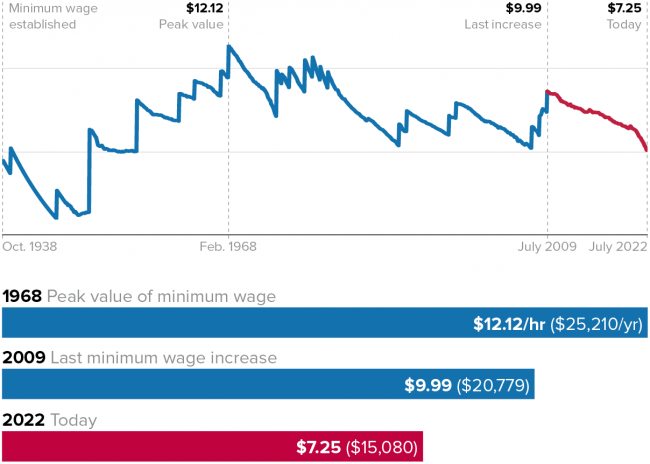
The value of the federal minimum wage has reached its lowest point in 66 years, according to an EPI analysis of recently released Consumer Price Index (CPI) data. Accounting for price increases in June, the current federal minimum wage of $7.25 per hour is now worth less than at any point since February 1956. At that time, the federal minimum wage was 75 cents per hour, or $7.19 in June 2022 dollars.

We are currently in the longest period without a minimum wage increase since Congress established the federal minimum wage in 1938.

As shown in the chart below, a worker paid the current $7.25 federal minimum wage earns 27.4% less in inflation-adjusted terms than what their counterpart was paid in July 2009 when the minimum wage was last increased. They earn 40.2% less than a minimum wage worker in February 1968, the historical high point of the minimum wage’s value.

After the longest period in history without an increase, the federal minimum wage today is worth 27% less than 13 years ago—and 40% less than in 1968

Real value of the minimum wage (adjusted for inflation)

Note: All values in June 2022 dollars, adjusted using the CPI-U in 2022 chained to the CPI-U-RS (1978–2021) and CPI-U-X1 (1967–1977) and CPI-U (1966 and before).

Source: Fair Labor Standards Act and amendments.

Economic Policy Institute

Hello, Democrats! Wake up!

Journalist Jennifer Berkshire and historian Jack Schneider report that voters in school board elections are not falling for rightwing slanders of their public schools and teachers!

Democrats: your best strategy for the fall elections is to campaign aggressively for public schools.

Berkshire and Schneider write that Democrats were panicked by Glenn Youngkin’s election as Governor in Virginia, which they attributed to his attacks on “critical race theory” in the schools and his pandering to far-right fake parents’ groups. Steve Bannon (and Chris Rufo) claimed that the road to a takeover was by seizing control of local school boards and destroying public schools.

Berkshire and Schneider say that their campaign is failing. Even in Trump territory, voters are supporting their public schools and rejecting the crazies.

They write:

As it turns out, GOP candidates running on scorched-earth education platforms have fared quite poorly in school board elections. In places like Georgia, Montana, New Hampshire and New York, voters have rejected culture warriors running for school board, often doing so by wide margins. A recent Ballotpedia review of more than 400 school board contests in Missouri, Oklahoma and Wisconsin found that race, gender and COVID were indeed influential in determining election outcomes, but not in the way one might expect. As they found, candidates who ran in opposition to a “conflict issue” — sexual education curricula, for instance, or a focus on race in the district — were more likely to lose their races.

Cherokee County, Ga., a rural county northwest of Atlanta, offers an instructive example. The county’s schools made national headlines recently after ProPublica reported on a group of white parents protesting the hiring of a Black educator brought on to serve as the first Diversity, Equity and Inclusion officer. Yet voters in the county, which Trump won by nearly 70 percent in 2020, overwhelmingly rejected hardline candidates for school board. A self-proclaimed family values slate, backed by the national 1776 Project PAC, and which ran in opposition to critical race theory and school district equity plans, failed to pick up a single seat.

Voters in Coweta County, Ga., sent a similar message to another slate of candidates endorsed by the 1776 Project. All four challengers were bested by board incumbents in the May primary, while a fifth — a controversial incumbent who participated in the Jan. 6 insurrection and claimed that students were being indoctrinated with critical race theory through district-provided Chromebooks — was unseated by a landslide in a runoff election in June.

It isn’t that these deep red countries have suddenly begun to turn blue. Instead, the culture war approach is falling short because Americans have direct experiences that contradict what they’re hearing from candidates.

Please open the link and read the good news for yourself.