Archives for category: Equity

Lindsay Owens and David Dayen note that some of the most outspoken critics of Biden’s decision to forgive up to $20,000 in student debt are Obama-era economists. Republicans have called it “socialism” and worse, but some Democratic economists are also upset. Owens and Dayen attribute their anger to the failure of Obama’s policy to solve the home foreclosure crisis.

They write:

President Biden’s long-awaited decision to wipe out up to $20,000 in student debt was met with joy and relief by millions of borrowers, and a temper tantrum from centrist economists.null

Moments after the announcement, former Council of Economic Advisers Chair Jason Furman took to Twitter with a dozen tweets skewering the proposal as “reckless,” “pouring … gasoline on the inflationary fire,” and an example of executive branch overreach (“Even if technically legal I don’t like this amount of unilateral Presidential power.”). Brookings economist Melissa Kearny called the proposal “astonishingly bad policy” and puzzled over whether economists inside the administration were “all hanging their heads in defeat.” Ben Ritz, the head of a centrist think tank, went so far as to call for the staff who worked on the proposal to be fired after the midterms.

Histrionics are nothing new on Twitter, but it’s worth examining why this proposal has evoked such strong reactions. Elizabeth Popp Berman has argued in the Prospect that student loan forgiveness is a threat to the economic style of reasoning that dominates Washington policy circles. That’s correct. But President Biden’s elegant and forceful approach to tackling the student loan crisis also may feel like a personal rebuke to those who once worked alongside President Obama as he utterly failed to solve the debt crisis he inherited.

Let’s be very clear: The Obama administration’s bungled policy to help underwater borrowers and to stem the tide of devastating foreclosures, carried out by many of the same people carping about Biden’s student loan cancellation, led directly to nearly ten million families losing their homes. This failure of debt relief was immoral and catastrophic, both for the lives of those involved and for the principle of taking bold government action to protect the public. It set the Democratic Party back years. And those throwing a fit about Biden’s debt relief plan now are doing so because it exposes the disaster they precipitated on the American people.

One reason the Obama administration failed to swiftly help homeowners was their obsession with ensuring their policies didn’t help the “wrong” type of debtor.

President Obama campaigned on an aggressive platform to prevent foreclosures. Larry Summers, one of the critics of Biden’s student debt relief, promised during the Obama transition in a letter to Congress that the administration “will commit substantial resources of $50-100B to a sweeping effort to address the foreclosure crisis.” The plan had two parts: “helping to reduce mortgage payments for economically stressed but responsible homeowners,” and “reforming our bankruptcy laws” by allowing judges in bankruptcy proceedings to write down mortgage principal and interest, a policy known as “cramdown.”

The administration accomplished neither. On cramdown, the administration didn’t fight to get the House-passed proposal over the finish line in the Senate. Credible accounts point to the Treasury Department and even Summers himself (who just last week said his preferred method of dealing with student debt was to allow it to be discharged in bankruptcy) lobbying to undermine its passage. Summers “was really dismissive as to the utility of it,” Rep. Zoe Lofgren (D-CA) said at the time. “He was not supportive of this.”

Summers and Treasury economists expressed more concern for financially fragile banks than homeowners facing foreclosure, while also openly worrying that some borrowers would “take advantage” of cramdown to get undeserved relief. This is also a preoccupation of economist anger at student debt relief: that it’s inefficient and untargeted and will go to the “wrong” people who don’t need it. (It won’t.)

For mortgage modification, President Obama’s Federal Housing Finance Agency repeatedly refused to use its administrative authority to write down the principal of loans in its portfolio at mortgage giants Fannie Mae and Freddie Mac—the simplest and fastest tool at its disposal. Despite a 2013 Congressional Budget Office study that showed how modest principal reduction could help 1.2 million homeowners, prevent tens of thousands of defaults, and save Fannie and Freddie billions, FHFA repeatedly refused to move forward with principal reduction, citing their own efforts to study whether the policy would incentivize strategic default (the idea that financially solvent homeowners would default on their loans to try and access cheaper ones).

Virtually everyone involved with the housing system was stunned that the options of cramdown and principal reduction weren’t taken. Banks literally held meetings in expectation of Obama’s team requiring writedowns, until they didn’t.

Instead, the Obama administration rolled out the industry-backed Home Affordable Modification Program (HAMP), relying on the voluntary cooperation of servicers to modify mortgages. The program was, even by the administration’s own modest objectives, a failure, ultimately reaching less than a quarter of the three to four million homeowners it hoped to target. In the critical first two years, the administration did not even spend 3 percent of what they were allotted to save homeowners.

Just as with cramdown, one reason the Obama administration failed to swiftly help homeowners was their obsession with ensuring their policies didn’t help the “wrong” type of debtor. When Obama first announced HAMP in 2009, he said the program would “not reward folks who bought homes they knew from the beginning they would never afford.” The resulting “Goldilocks” proposal, with its focus on weeding out undeserving borrowers, would not be available to homeowners with incomes too high or too low and would be backstopped with voluminous income and financial verifications (in many cases, more than what was required to take out the loan in the first place). Treasury also tweaked the program numerous times as they went along, confusing servicers and borrowers. The barrage of paperwork ground the program to a halt at many servicers, and ultimately nearly a quarter of modifications were rejected on the grounds that incomplete paperwork was provided.

But it was much worse than that. The mortgage servicers used HAMP like a predatory lending program, squeezing homeowners for as many payments as possible before canceling their modifications and kicking them out of their homes. These companies had financial incentives to foreclose rather than modify loans. In one particularly excruciating example, the servicer arm of Bank of America offered its employees Target gift cards as a bonus for placing borrowers into foreclosure.

This was also by design, or at least benign neglect. Then–Treasury Secretary Timothy Geithner candidly told officials that the program was intended to help banks, not borrowers. The purpose was to “foam the runway” for the banks, Geithner said, with homeowners and their families being the foam crushed by a jumbo jet in that scenario. If the goal was just to let the banks use HAMP for their own benefit, it’s not surprising that would come at homeowners’ expense.

And those banks executed their plan fraudulently, using millions of forged and fabricated documents to illegally foreclose on people. Even with this new leverage against the banks, the administration failed to provide equitable relief. A new program, the National Mortgage Settlement, promised one million principal reductions but delivered only 83,000. Meanwhile, millions more unlawful foreclosures ensued, and no high-level executive was convicted in association with any of these crimes.

In short, the policy apparatus ultimately failed to assist the majority of people who sought help, a suboptimal policy outcome by any metric. Student debt relief skeptics like Furman spent the Obama years advocating for privatizing Fannie and Freddie, rather than apologizing for falling so short on dealing with the massive debt overhang, which stunted the economic recovery.

President Biden’s approach has been markedly different and, if well implemented, is poised to be extremely effective. The simplicity of the program design, with its straightforward cancellation thresholds ($10,000/$20,000) and eligibility criteria (Pell status and household income), means the policy should deliver nearly 90 percent of its relief dollars to those making less than $75,000 a year. Will some small amount of relief dollars land in the bank accounts of borrowers who will make higher incomes in the future? Absolutely. Is preventing that outcome more important than delivering relief to 43 million borrowers? Of course not.

It’s not just the policy design that is a rebuke to the old guard’s theory of debt relief; it’s also the rhetoric. Notably, in his 20-minute speech announcing the rollout of the student loan relief program, President Biden didn’t mention “bad debtors” once. He didn’t spend a single breath on the individual failings of borrowers, make any reference to their poor decision-making, or nod to a handful of unscrupulous debtors trying to game the system.

Instead, he talked about the failings of our higher-education system, in which “an entire generation is now saddled with unsustainable debt.” Instead of blaming borrowers, he showed them empathy. Instead of talking about borrowers taking advantage of the system, he vowed to hold “colleges accountable for jacking up costs without delivering value to students” and crack down on “schools luring students with the promise of big paychecks when they graduate only to watch these students be ripped off and left with mountains of debt.” And he headed concerns about moral hazard off at the pass, vowing to “never apologize for helping the working and middle class.”

Moreover, Biden wasn’t afraid to use all of the tools available to him to get results for indebted borrowers. The Obama administration was given funding from Congress, an explicit mandate for foreclosure prevention, and at the end, a settlement with the banks that authorized even more money. They still failed, because they were more interested in deluded notions of “personal responsibility” than acting to avert disaster.

Biden has flipped the Beltway consensus on policy design around debt forgiveness and modeled a path for viewing student debt as a national crisis, rather than an individual failing. It’s a stunning reversal of the Obama-era consensus and one that casts that failed legacy of mortgage debt relief in an even darker light. Biden has shown us there was an easier, softer way all along.

The superintendent of schools in Granbury, Texas, made clear that he didn’t want any books about LGBT characters or LGBT issues in the school library. He agreed with the angry conservatives who showed up at school board meetings to demand book-banning.

Superintendent Jeremy Glenn has previously emphasized to the district’s librarians that their community was “very, very conservative” and that any school employee who does not possess conservative beliefs “better hide it.” While he started by saying he didn’t care if the books were about homosexuality or heterosexuality, he spoke explicitly about banning books with LGBTQ content.

“And I’m going to take it a step further with you. There are two genders. There’s male, and there’s female. And I acknowledge that there are men that think they’re women. And there are women that think they’re men. And again, I don’t have any issues with what people want to believe, but there’s no place for it in our libraries.”

But then a parent with a child in the Granbury schools got up and pointed out that the folks who were complaining the loudest did not have any children in the schools. And she let them have it for their effort to impose their religion on her child’s public school.

Adrienne Quinn Martin went to the podium and let it rip.

“We know that books are continuing to be purged. We know student library aides have been banned. We know that a group of non-parents have pushed for these removals and continue to do so,” she began. “So, being a taxpayer does not grant special privileges over students, staff, and parents. I do not want random people with no education background or experience determining what books my child can read, what curriculum they learn, and what clubs they can join.”

“Just because you can get up at every meeting and rant and rave does not give you authority over my child’s education.”

“Your personal religious beliefs, people in this room and on this board, should not have an effect on my child’s education either. Our school are not to be used for personal political agendas and our children are here for education, not religious indoctrination,” she told the room as she looked various board members and attendees directly in the eye.

“I implore the board to put an end to attempts to appease these extremists. Focus on retaining staff, providing excellent public education and a safe and welcoming learning space for all students. The speakers speaking about what great Christians they are? Great. Go tell your pastor. Our schools are not your church.”

And as the room erupted in applause for her bold speech, Martin gathered up her papers and, with a nod, left the podium. The superintendent did not reply.

If you want to see her speech, it’s on her Twitter account @Mrsamartini

For her courage and common sense, I add her to the honor roll of this blog.

Kathryn Joyce writes in Salon about a new “patriotic” social studies curriculum that celebrates rightwing ideology and deletes social justice from American history. The goal of the new curriculum is to fight “critical race theory” and “wokeness,” which are allegedly trying to “overthrow America.”

Just to be clear, the goal of the new curriculum is to delete the accurate and tragic facts about racism, past and present. They want teachers to stuff children’s heads with fake history. They assume that if students learn the truth about slavery, the Ku Klux Klan, Jim Crow, segregation, redlining, and the unfinished struggle for equal rights for all, they will not have faith in America. If they learn the truth, they think, they will want to “overthrow” the government. This is almost too insane to write or repeat, but it’s happening. Crazy people want teachers of social studies and history to teach lies.

We used to teach children that it was wrong to tell lies. But these extremists want the entire education system to embrace lies. The danger is that students will watch documentaries on television and discover that everything they learned in social studies was a pack of lies. What then? Who will they want to overthrow?

Joyce writes:

In late June, a conservative education coalition called the Civics Alliance released a new set of social studies standards for K-12 schools, with the intention of promoting it as a model for states nationwide. These standards, entitled “American Birthright,” are framed as yet another corrective to supposedly “woke” public schools, where, according to Republicans, theoretical frameworks like critical race theory are only one part of a larger attack on the foundations of American democracy. 

“Too many Americans have emerged from our schools ignorant of America’s history, indifferent to liberty, filled with animus against their ancestors and their fellow Americans, and estranged from their country,” reads the introduction to “American Birthright.” (The “birthright” here refers to “freedom.”) And the fields of history and civics, it suggests, exemplify the worst of that trend. “The warping of American social studies instruction has created a corps of activists dedicated to the overthrow of America and its freedoms, larger numbers of Americans indifferent to the steady whittling away of American liberty, and many more who are so ignorant of the past they cannot use our heritage of freedom to judge contemporary debates.” 

While it claims to represent an ideologically neutral, apolitical history, the document holds that most instruction that references “diversity, equity and inclusion” or “social justice” amounts to “vocational training in progressive activism” and “actively promote[s] disaffection from our country.” It heralds Ronald Reagan as a “hero of liberty” alongside Abraham Lincoln and Martin Luther King Jr. Its proposed lessons in contemporary U.S. history include Reagan’s revitalization of the conservative movement, Bill Clinton’s impeachment, “Executive amnesties for illegal aliens” and the “George Floyd Riots.”  

American Birthright is just one of numerous recent right-wing efforts to overhaul public K-12 curricula to align with the dictates of current conservative ideology. 

Last week, the Miami Herald reported that Florida’s Department of Education has begun holding three-day training sessions for public school teachers around the state to prepare them to implement the state’s new Civics Literacy Excellence Initiative, Gov. Ron DeSantis’ flagship effort to create a more “patriotic” civics curriculum. The new Florida standards were created in consultation with Hillsdale College, a small Christian college that has become a guiding force on the right, and the Charles Koch-founded Bill of Rights Institute. 


These new rightwing curriculum writers want to impose the evangelical Christian worldview on America’s children. They want to force their fundamentalists ideology on everyone. Once they have gained control of the Governor’s office, they want to gain control of the schools and use them as centers of indoctrination. You may believe, with some evidence, that public schools have always taught American history with the atrocities edited out. But not even the bowdlerized textbooks were as audacious as the outright lies that the fundies are pushing now.

Mainstream textbook editors might balk at portraying Ronald Reagan as the equal of Abraham Lincoln. If so, the states that want anti-woke (i.e., unconscious) accounts of history can always purchase the texts produced by the publishers that supply Christian fundamentalist schools and Bob Jones University. The Abeka curriculum, written for homeschoolers and Christian schools, might become the official textbooks of Florida and other red states.

Who needs an educated citizenry? Apparently the educated are a threat to the indoctrinated.

The Economic Policy Institute is one of the very few think tanks in Washington, D.C. that cares about the status of working people. When one of its reports gets attention, critics are fast to point out that it is funded by unions. The same critics are silent when a think tank is funded by one or more billionaires, who like low taxes.


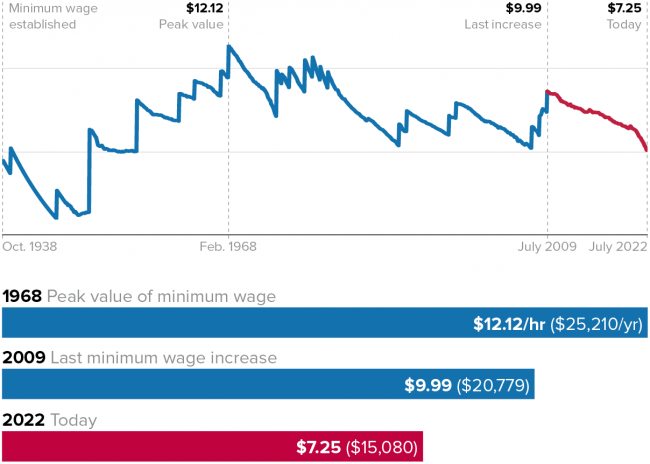
The value of the federal minimum wage has reached its lowest point in 66 years, according to an EPI analysis of recently released Consumer Price Index (CPI) data. Accounting for price increases in June, the current federal minimum wage of $7.25 per hour is now worth less than at any point since February 1956. At that time, the federal minimum wage was 75 cents per hour, or $7.19 in June 2022 dollars.

We are currently in the longest period without a minimum wage increase since Congress established the federal minimum wage in 1938.

As shown in the chart below, a worker paid the current $7.25 federal minimum wage earns 27.4% less in inflation-adjusted terms than what their counterpart was paid in July 2009 when the minimum wage was last increased. They earn 40.2% less than a minimum wage worker in February 1968, the historical high point of the minimum wage’s value.

After the longest period in history without an increase, the federal minimum wage today is worth 27% less than 13 years ago—and 40% less than in 1968

Real value of the minimum wage (adjusted for inflation)

Note: All values in June 2022 dollars, adjusted using the CPI-U in 2022 chained to the CPI-U-RS (1978–2021) and CPI-U-X1 (1967–1977) and CPI-U (1966 and before).

Source: Fair Labor Standards Act and amendments.

Economic Policy Institute

Hello, Democrats! Wake up!

Journalist Jennifer Berkshire and historian Jack Schneider report that voters in school board elections are not falling for rightwing slanders of their public schools and teachers!

Democrats: your best strategy for the fall elections is to campaign aggressively for public schools.

Berkshire and Schneider write that Democrats were panicked by Glenn Youngkin’s election as Governor in Virginia, which they attributed to his attacks on “critical race theory” in the schools and his pandering to far-right fake parents’ groups. Steve Bannon (and Chris Rufo) claimed that the road to a takeover was by seizing control of local school boards and destroying public schools.

Berkshire and Schneider say that their campaign is failing. Even in Trump territory, voters are supporting their public schools and rejecting the crazies.

They write:

As it turns out, GOP candidates running on scorched-earth education platforms have fared quite poorly in school board elections. In places like Georgia, Montana, New Hampshire and New York, voters have rejected culture warriors running for school board, often doing so by wide margins. A recent Ballotpedia review of more than 400 school board contests in Missouri, Oklahoma and Wisconsin found that race, gender and COVID were indeed influential in determining election outcomes, but not in the way one might expect. As they found, candidates who ran in opposition to a “conflict issue” — sexual education curricula, for instance, or a focus on race in the district — were more likely to lose their races.

Cherokee County, Ga., a rural county northwest of Atlanta, offers an instructive example. The county’s schools made national headlines recently after ProPublica reported on a group of white parents protesting the hiring of a Black educator brought on to serve as the first Diversity, Equity and Inclusion officer. Yet voters in the county, which Trump won by nearly 70 percent in 2020, overwhelmingly rejected hardline candidates for school board. A self-proclaimed family values slate, backed by the national 1776 Project PAC, and which ran in opposition to critical race theory and school district equity plans, failed to pick up a single seat.

Voters in Coweta County, Ga., sent a similar message to another slate of candidates endorsed by the 1776 Project. All four challengers were bested by board incumbents in the May primary, while a fifth — a controversial incumbent who participated in the Jan. 6 insurrection and claimed that students were being indoctrinated with critical race theory through district-provided Chromebooks — was unseated by a landslide in a runoff election in June.

It isn’t that these deep red countries have suddenly begun to turn blue. Instead, the culture war approach is falling short because Americans have direct experiences that contradict what they’re hearing from candidates.

Please open the link and read the good news for yourself.

The courts are still dispensing justice! In West Virginia, if not in DC.

WEST VIRGINIA CIRCUIT COURT STRIKES DOWN UNCONSTITUTIONAL PRIVATE SCHOOL VOUCHER LAW


Press Contact:

Sharon Krengel

skrengel@edlawcenter.org


FOR IMMEDIATE RELEASE


Charleston, WV – This morning, Judge Joanna Tabit of the Circuit Court of Kanawha County granted West Virginia parents’ request to halt implementation of the state’s expansive new private school voucher law. The hearing this morning in Beaver v. Moore resulted in Judge Tabit granting a preliminary injunction and permanently enjoining the program, which would have siphoned millions of public dollars from the state’s underfunded public schools to subsidize private education.


The Beaver plaintiffs are public school parents challenging the private school voucher law under the West Virginia Constitution. The President of West Virginia’s Board of Education and the State Superintendent are courageously standing with the parents in support of their request.


The state defendants and pro-voucher lawyers from the Institute for Justice had asked the court to dismiss the lawsuit. Judge Tabit denied their motions.


“The judge clearly understood that the West Virginia Constitution does not allow for this voucher program,” said Tamerlin Godley, partner at Paul Hastings LLP, co-founder of Public Funds Public Schools, and lead lawyer for the case. “Stopping the voucher program was absolutely essential to protect the state’s students and their public schools.”


West Virginia’s 2021 voucher law authorizes the broadest voucher program in the nation, with eligibility for any student who attends public school for 45 days or is entering kindergarten, regardless of family income. Under the voucher law, the State deposits public funds in private accounts for use on a wide range of private education expenses. There are no accountability or quality safeguards. Over time, the law will force West Virginia taxpayers to subsidize all private and homeschooling in the state, totaling over $120 million a year.


“West Virginia has a proud history of prioritizing quality public schools for all the state’s children, and that commitment is enshrined in our constitution,” said Jack Tinney, co-counsel for the parent plaintiffs and a partner at Hendrickson & Long in Charleston. “We could not stand by and allow the voucher law to undermine West Virginia students’ constitutional rights.”


In the Beaver lawsuit, the parent plaintiffs highlight the numerous ways the voucher law violates the Education Clause of the West Virginia Constitution. The Legislature has no authority to fund a separate system of private schooling that infringes on its ability to provide a “thorough and efficient system of public schools.” The voucher law also violates the State Constitution’s prohibition against “special laws” that treat similar people differently because it excludes voucher students from critical protections afforded public school students against discrimination based on disability, religion, or LGBTQ status.


“In my view, the Legislature has violated its constitutional level obligations regarding public education and funding by enacting House Bill 2013 for the Hope scholarship fund,” Judge Tabit stated in explaining her decision.


The plaintiff families in Beaver v. Moore are represented pro bono by the law firm Paul Hastings LLP, Education Law Center, and the West Virginia office of the firm Hendrickson & Long. Education Law Center co-leads the Public Funds Public Schools campaign, which works to ensure public funds are spent on public education and not diverted to private schools. Paul Hastings partner Tamerlin Godley has spearheaded other successful PFPS efforts, including NAACP v. DeVos, which stopped former Secretary of Education Betsy DeVos from diverting hundreds of millions of dollars in pandemic relief funds to private schools, and a 2016 lawsuit that permanently enjoined a similarly expansive voucher law in Nevada.


For more information, visit the Beaver v. Moore page on the PFPS website.

Mark Joseph Stern wrote recently in Slate about the dangers embedded in the Supreme Court’s Carson v. Makin decision. In this decision, the Supreme Court ruled that the state of Maine was compelled to pay tuition at religious schools because it paid tuition at some other private schools. Stern warns that the Supreme Court is very likely to extend this concept to every state that underwrites nonsectarian private schools. The Court’s zeal for religious schools is not going to end in Maine. Please open the link and read the entire article. Make no mistake: This Supreme Court is determined to abolish any separation between church and state and to require every state to pay for religious education. So you don’t want your tax dollars to underwrite a school that would not admit your own children or grandchildren; too bad. So you don’t want to pay for Madrassas, yeshivas, or schools that teach racial hatred? Too bad.

The Republican majority on the Supreme Court claims it is dedicated to the principles of the Original Constitution, as written. They say they are Constitutional fundamentalists. This decision demonstrates how phony their “Originalism” is. The Founding Fathers were very explicit in their desire to separate religion from the state. This Court is not dedicated to the Constitution or its principles. If it were, it would never have written this decision.

He writes:

The Supreme Court’s conservative supermajority effectively declared on Tuesday that the separation of church and state—a principle enshrined in the Constitution—is, itself, unconstitutional. Its 6–3 decision in Carson v. Makin requires Maine to give public money to private religious schools, steamrolling decades of precedent in a race to compel state funding of religion. Carson is radical enough on its own, but the implications of the ruling are even more frightening: As Justice Stephen Breyer noted in dissent, it has the potential to dismantle secular public education in the United States.

Carson challenges Maine’s effort to provide quality civic education to every child in the state. The government created a tuition assistance program to help families who live in remote, sparsely populated regions without any public schools. Under the program, parents can send their kids to certain private schools, and the state covers the cost of tuition. To qualify, these schools must give students a secular education. They may be affiliated with, or even run by, a religious organization. But their actual curricula must align with secular state standards.

Two families challenged this limitation, arguing that it violated the First Amendment’s free exercise clause. Just two decades ago, this claim would’ve been laughed out of court: SCOTUS only permitted states to subsidize religious schools in 2002; at the time, it would’ve been absurd to say that states have a constitutional obligation to subsidize them. Beginning in 2017, the court began to assert that states may not exclude religious schools from public benefits that are available to their secular counterparts. And in 2020, the conservative justices forced states to subsidize religious schools once they began subsidizing secular private education.

Tuesday’s decision in Carson takes this radical theory to a new extreme, ordering Maine to extend public education funds to religious indoctrination.

The upshot of Chief Justice John Roberts’ opinion for the court is that states have no compelling interest in providing public, secular education to children. Indeed, Roberts suggests that the very concept of secular schooling is a smokescreen for “discrimination against religion”—a pretext for unconstitutional animus toward pious Americans. His opinion reaches far beyond Maine. About 37 states have amendments to their constitutions that bar government funding of religious institutions, including schools. Carson essentially invalidates those laws while undermining the broader constitutional basis for the nation’s public school system.

Roberts reached this astonishing result by overruling broad swaths of precedent respecting states’ authority to separate church and state more strictly than the U.S. Constitution requires. The court previously upheld states’ interest in avoiding the “establishment” of religion by refusing to underwrite the indoctrination of students into a particular faith. No longer. Roberts condemned Maine’s efforts to guard against religious establishment as nothing more than “discrimination against religion”—an effort to “exclude some members of the community” from public benefits “because of their religious exercise.” He also overruled a line of cases that let the government withhold funding on the basis of religious use (like indoctrination) but not religious status (like affiliation with a church). That distinction, he wrote, “lacks a meaningful application not only in theory, but in practice as well,” tossing it in the precedential dumpster.

The chief justice maintained that Carson’s rule only kicks in once a state starts sending taxpayer dollars to private schools through vouchers, tax credits, or scholarships. So, in theory, a state can send all its money to public schools and avoid constitutional concerns. Even if that’s true, the consequences are sweeping: Most states offer at least one of these programs, so Carson gives millions of families an opportunity to bail out of the public school system and demand public money for parochial education...

It’s worth pausing, as both Breyer and Justice Sonia Sotomayor did in dissent, to reflect on the victims of Tuesday’s decision. The two Maine schools that may now receive public funding are openly discriminatory, expelling students and teachers who do not adhere to evangelical Christianity. LGBTQ students, as well as straight children of same-sex couples, are not welcome, nor are LGBTQ teachers. Even custodians must be born-again Christians. One school teaches students to “refute the teachings of the Islamic religion” and believe that men serve as the head of the household. Another requires students to sign a “covenant” promising to glorify Jesus Christ and attend weekly religious services.


The Supreme Court’s conservative supermajority effectively declared on Tuesday that the separation of church and state—a principle enshrined in the Constitution—is, itself, unconstitutional. Its 6–3 decision in Carson v. Makin requires Maine to give public money to private religious schools, steamrolling decades of precedent in a race to compel state funding of religion. Carson is radical enough on its own, but the implications of the ruling are even more frightening: As Justice Stephen Breyer noted in dissent, it has the potential to dismantle secular public education in the United States.

Carson challenges Maine’s effort to provide quality civic education to every child in the state. The government created a tuition assistance program to help families who live in remote, sparsely populated regions without any public schools. Under the program, parents can send their kids to certain private schools, and the state covers the cost of tuition. To qualify, these schools must give students a secular education. They may be affiliated with, or even run by, a religious organization. But their actual curricula must align with secular state standards.

Two families challenged this limitation, arguing that it violated the First Amendment’s free exercise clause. Just two decades ago, this claim would’ve been laughed out of court: SCOTUS only permitted states to subsidize religious schools in 2002; at the time, it would’ve been absurd to say that states have a constitutional obligation to subsidize them. Beginning in 2017, the court began to assert that states may not exclude religious schools from public benefits that are available to their secular counterparts. And in 2020, the conservative justices forced states to subsidize religious schools once they began subsidizing secular private education.

Tuesday’s decision in Carson takes this radical theory to a new extreme, ordering Maine to extend public education funds to religious indoctrination.

The upshot of Chief Justice John Roberts’ opinion for the court is that states have no compelling interest in providing public, secular education to children. Indeed, Roberts suggests that the very concept of secular schooling is a smokescreen for “discrimination against religion”—a pretext for unconstitutional animus toward pious Americans. His opinion reaches far beyond Maine. About 37 states have amendments to their constitutions that bar government funding of religious institutions, including schools. Carson essentially invalidates those laws while undermining the broader constitutional basis for the nation’s public school system.

Roberts reached this astonishing result by overruling broad swaths of precedent respecting states’ authority to separate church and state more strictly than the U.S. Constitution requires. The court previously upheld states’ interest in avoiding the “establishment” of religion by refusing to underwrite the indoctrination of students into a particular faith. No longer. Roberts condemned Maine’s efforts to guard against religious establishment as nothing more than “discrimination against religion”—an effort to “exclude some members of the community” from public benefits “because of their religious exercise.” He also overruled a line of cases that let the government withhold funding on the basis of religious use (like indoctrination) but not religious status (like affiliation with a church). That distinction, he wrote, “lacks a meaningful application not only in theory, but in practice as well,” tossing it in the precedential dumpster.

The chief justice maintained that Carson’s rule only kicks in once a state starts sending taxpayer dollars to private schools through vouchers, tax credits, or scholarships. So, in theory, a state can send all its money to public schools and avoid constitutional concerns. Even if that’s true, the consequences are sweeping: Most states offer at least one of these programs, so Carson gives millions of families an opportunity to bail out of the public school system and demand public money for parochial education.

But can this distinction hold? Roberts’ bright line dims under scrutiny: Maine, after all, wanted private schools to replace public education for some students, not supplement it. And yet the court found no good reason for the state to insist that these substitute schools adhere to secular standards. Indeed, the chief justice’s rhetoric depicts education not as a state-sponsored benefit for all, but rather as a personal matter best left up to parents. There is, he claimed, no “historic and substantial state interest” in preserving secular education. If that’s true, how can any state refuse to fund religious schooling?

It’s worth pausing, as both Breyer and Justice Sonia Sotomayor did in dissent, to reflect on the victims of Tuesday’s decision. The two Maine schools that may now receive public funding are openly discriminatory, expelling students and teachers who do not adhere to evangelical Christianity. LGBTQ students, as well as straight children of same-sex couples, are not welcome, nor are LGBTQ teachers. Even custodians must be born-again Christians. One school teaches students to “refute the teachings of the Islamic religion” and believe that men serve as the head of the household. Another requires students to sign a “covenant” promising to glorify Jesus Christ and attend weekly religious services….

“Legislators,” Breyer wrote, “did not want Maine taxpayers to pay for these religiously based practices,” as doing so might violate their own faith or conscience. The majority tells these Mainers their own views don’t matter, because the First Amendment forces them to foot the bill for other people’s religious indoctrination. Doing so creates a “serious risk of religion-based social divisions,” Breyer explained, exacerbating the “religious strife” that the religion clauses “were designed to prevent.” Sotomayor put the point more sharply: “While purporting to protect against discrimination of one kind,” she wrote, “the court requires Maine to fund what many of its citizens believe to be discrimination of other kinds.”

The conservative majority, however, has perfected the art of ignoring genuine discrimination while perceiving anti-Christian persecution where none exists. In the process, they are elevating the rights of one sect over all others. Carson will not benefit any religious minorities; there are not enough Muslims or Jews to create a school in the far-flung corners of Maine. Every time Roberts uses the word “religion,” he might as well be saying “Christian.” The right will praise Carson as a triumph of religious liberty. But if you practice a religion that does not stand to gain from the ruling, your liberty does not matter to this Supreme Court.
Nora De La Cour is a high school social worker and former teacher in Massachusetts. She writes frequently about the attacks on public schools. In this brilliant article, which appeared in Jacobin, she shows how the privatizatizers have exploited the culture wars to promote their own agenda. They are not interested in better education or students. Their agenda is to destroy the public square.

In a nutshell: “A billionaire-backed network of free-market fundamentalists is ginning up controversy over “wokeness” in American schools with an ulterior motive: to demolish public education.”

Please open the link to read the article in full.

She begins:

In a Massachusetts school district neighboring the one where I work, four parents, backed by a conservative Christian organization, are suing the school committee and multiple district employees for calling students by their preferred names and pronouns without informing home. Because one of the defendants is a counselor, some of my counselor peers in the area are now on guard, afraid we could become the targets of litigation if we allow students to broach sensitive topics in our presence.

Setting aside the very real harm that kids and educators are exposed to as a result of the Right’s eagerness to linkacknowledgement of gay and trans people to sexual predation, there’s another problem here. It’s incredibly difficult to teach or counsel someone if you can’t call them what they wish to be called. Addressing students by their chosen names is a basic sign of respect that says, “I see you and I’m here to work with you.” If you need to call home to get permission first — potentially outing kids to their parents and inviting distressing blowback — you might miss the chance to form the human connection that undergirds collaborative scholarship.

Pandemic school closures reminded us that the social aspects of schooling are among the most vital for young people’s development and for society at large. Specific facts and figures (the what of school learning) can be easily forgotten and recalled with a few keystrokes. But the ability to establish a base level of trust with heterogeneous others in order to solve shared problems (the how of school learning) is absolutely essential for both a fulfilling personal life and engagement in the public square. It’s critical that educators be allowed to build that trust without fear of reprisal.

The Koch-backed parents’ rightsmovement aims to make that trust impossible. By pitting parents against schools, libertarian billionaires and Republican strategists intend to motivate voters in the short term and fully privatize K-12 education in the long term. As Christopher Rufo, the self-styled architect of the so-called war on critical race theory (CRT), has argued, “To create universal school choice [i.e., privatization], you really need to operate from a premise of universal school distrust.” Those poweringthe campaign against classroom “wokeness” are trying to hinder our ability to establish common ground from which to defend our last remaining public goods.

The illiberalism that dominates the Right can best be understood as the advanced stage of a long billionaire-funded plot to undo democracy in order to relieve capitalists of any constraints the rest of us might wish to place on them. This understanding clarifies why classrooms, the training grounds for democratic participation, are primary targets of radical right activism. If liberals are to have any hope of countering this coordinated attack, they need to remember the collective, public value of education.

Laying Siege to the Common Good

It makes sense to focus on the reactionary nature of all of this: the commitment to American exceptionalism animating the so-called CRT bans, the fresh fixation on classical education rife with chauvinist dog whistles, and the shockingly overt bigotry of the anti-LGBT “grooming” discourse. Ron DeSantis’s Florida, as some have observed, is looking more and more like Viktor Orbán’s Hungary. But while these efforts to reverse cultural change are incredibly alarming, we come up short when we try to understand what’s happening purely in terms of identity-based hatred. Intolerance has always been a feature of American politics. Why does it suddenly seem so viciously well-organized?…

Despite attention-grabbing campaigns to terrify them, a majority of public school parents remain satisfied with their children’s schooling. And massive amounts of outside funding notwithstanding, local parents’ rights candidates have in numerous cases failedto deliver decisive wins for the privatization movement. As in segregated Virginia, US families are not quite prepared to sign away their children’s right to publicly funded, democratically controlled schools. It’s the perfect time, in other words, for those looking to contest the radical right to offer a full-throated defense of public education and all public goods.

But Democrats, by and large, have been unwilling to mount that, scarcely standing up even against the horrific attacks on kids, families, and educators that we are seeing across the United States. And when you look at their record on education, it’s pretty clear why: for the past three decades of education reform, Democrats have ignored the social role that schools play in preparing children for engagement in the public square. Alongside Republicans, they have enabled the privatization of public schools. They have also privatized the ideaof schooling down to the individual level. In the view of the Democratic establishment, the sole remit of schools should be to boost “human capital.” Guided by this view, they have yoked the vision of education ever closer to the needs of employers — a kind of corporate indoctrination eerily similar to the “woke” indoctrination Rufo and his cohort tell tales about.

But Bill Clinton’s assertion that “what you earn depends on what you learn” has proven to be a dangerous oversimplification: Americans are more educated than ever before, and yet economic insecurity is rampant and rising. When public schooling is only justifiable insofar as it increases individual earning power, the case for it is wholly dependent on its utility to capitalist markets. Without acknowledging the higher collective purpose that education serves, we won’t be able to defend public schools ordemocratic governance.

Democracy or Capitalism

“Republican politicians and their strategists,” Nancy MacLean told Jacobin,

have seen . . . culture-war tactics help Jair Bolsonaro get elected in Brazil and Viktor Orbán get reelected in Hungary this spring. And, lo, the CPAC (the Conservative Political Action Committee) is traveling to Hungary . . . to learn from Orbán how to use the tools of democracy to rig the rules to achieve autocracy.

The long plot is reaching maturity.

The Right’s appeals to “the family” resonate in part because our oligarchic political system leaves families in the cold, allowing child poverty to soar even as parents spend long and exhausting hours working outside the home. Any effort to save our commons and restore a sense of public spiritedness must include a material response to the significant challenges that parents face.

We need to work fast to reclaim the places where we give one another the benefit of the doubt and collaborate in spite of our differences. Democrats can still enter the battlefield and expose the Right’s deceitful efforts to turn the public against itself. As MacLean argues, the movement Buchanan authored wants to save capitalism from democracy. We can counter it if we are willing to fight to save democracy — beginning with schools — from capitalism.

Scholar Christopher Lubienski at Indiana University reviewed a report from the Hoover Institution offering strategies for making choice equitable. His review was published by the National Education Policy Center.

The Hoover Institution (where I was a Fellow until 2009) is very pro-school choice. (It’s also a wonderful repository for materials about war and peace, the Russian Revolution, and international politics). Many educators, regardless of their views, have given their papers to the Hoover archives, including me.

The report reviewed by Lubienski was written by Paul Peterson, who is an enthusiastic proponent of school choice.

The official overview says:

A report from the Hoover Institution seeks to offer evidence-based guidance for policymakers in shaping more equitable outcomes from school choice programs. This review examines the report’s claims, its representation of the research, and its use of research in forming those recommendations. The review finds that although the report is useful as a snapshot of the current status of choice programs in the United States, its use of research is often problematic. Some of the research is misrepresented, many claims are made without citations to evidence, and some of the recommendations bear no connection to the evidence provided in the report. As such, the report is, as intended, a political guidebook for conservative policymakers that fails to offer evidence-based guidance on making choice more equitable.

Another way to describe the interaction between choice and equity: Choice, almost by definition, exacerbates inequities.

Tom Ultican, retired teacher of advanced mathematics and physics in California, is now a significant chronicler of the Destroy Public Education movement. He attended the recent national conference of the Network for Public Education in Philadelphia and recapitulates the excitement we shared at being in person after a 2-year hiatus.

After every conference, attendees say, “This was the best one yet.” They enjoy meeting people who are doing the same work to fight privatization of their public schools. By the end of the conference, attendees say they feel energized, hopeful, and happy to know that they are not alone.

I urge you to read Tom’s post. You will get a sense of the embarrassment of riches available to attendees.

I should add that the Nebraska Save Our Schools group shared the Phyllis Bush Award for Grassroots Activism. Nebraska is one of the few states that has managed to protect its public schools and keep out both charters and vouchers, despite being a Red State.

The Pastors for Texas Children, a co-winner of the award, has repeatedly blocked vouchers in the Texas Legislature and has consistently fought for funding for public schools. PTC has opened chapters in other Red states, where they mobilize clergy to support public schools.

A high point for me was interviewing “Little Stevie” Van Zandt, a legendary rock star and actor (“The Sopranos”), who is dedicated to getting the arts into schools, not as an extra, but across the curriculum. we had a wonderful conversation. He has funded lesson plans based on rock and roll, available free at his website TeachRock.

All of the general sessions were taped. I will post them when they become available.