Archives for category: Elections

Julie Vassilatos, a parent activist and blogger in Chicago, writes here about the case for Brandon Johnson. She and others have written passionately against Paul Vallas, but here she explains why Brandon Johnson is well prepared to serve as Mayor. Because of his knowledge and experience, he not only knows the city’s budgetary issues well, but he is able to address the root causes of crime and the real needs of students.

She writes:

Friends, so many of us have been carrying on about the dangers of Paul Vallas so incessantly, you’d be forgiven for thinking that he’s running for mayor of Chicago unopposed.

But Vallas does have an opponent—one who is talented, thoughtful, experienced, and a real true Chicagoan raising his family on the west side: Brandon Johnson.

Johnson is getting a lot of heat from Vallas and his supporters right now. No lesser a personage than Darren Bailey, defeated far-right candidate for IL governor and unofficial endorser of Vallas, has announced that if Johnson is elected, it will be a “dark day” for Chicago. Yes. A dark day indeed. Get it?

I’m pretty sure Darren Bailey fans get it.

Then there’s FOP president/disgraced cop John Catanzara, who foresees that 1000 cops will walk off the job if Johnson wins, and there will be blood in the streets.

Vallas himself, who routinely speaks of Johnson in kind of Godzilla terms, has called him and the CTU a destructive force wreaking devastation on the city.

In addition to its coded race language, this election has rather inflated rhetoric.

I’m trying to keep mine toned down, or at least backed up by evidence. While it’s hard to pin “generational” devastation on Johnson or the CTU, it’s actually possible to do this for Vallas. He has set many destructive policies in motion in urban areas globally that have left decades of harm in their wake. Also financial calamity. But I and many others have told you all this over and over again. And this post is not about that guy.

This post is about Brandon Johnson.


Truth to tell, at the outset of the race I was slow to warm up to Johnson the candidate. But then I remembered that he was at the front lines of a struggle I will never forget—the 2013 mass school closures. So many folks did all we could do to try and stop that, well, generationally damaging policy. And those who led the way in that effort? I’d probably follow them into a fire.

But what about Brandon Johnson now? What are his credentials? Haven’t you, like me, read all that stuff about how he has no experience? How he’s never managed a budget? How he seems (unfathomably) to like crime and together with CTU wants our city to be unsafe, because….because….well, because reasons?

Well, maybe we need to look a little deeper than the media/social media blah blah blah.

In a recent mayoral forum Vallas asserted that “Brandon has run nothing.” Since Vallas hasn’t really lived here much I guess he may not know that Johnson has served on the Cook County Board of Commissioners since 2018 and has managed a great deal, including the $8.75B Cook County budget. The Cook County Board has wide ranging responsibilities, and if you’ve always wondered but never known what the Board does, you should take this time to educate yourself, starting at the Cook County Board website. Here’s a basic summary:

The Cook County Board of Commissioners oversees County operations and approves the budget of elected County officials including the Assessor, Board of Review Commissioners, County Clerk, Clerk of the Circuit Court, Recorder of Deeds, Sheriff, States Attorney and Treasurer.

The Commissioners also serve as the Board of the Cook County Forest Preserve District, a special purpose taxing district. The Board also sets policy, levies taxes, passes ordinances, approves all county purchases over $10,000, and adopts the annual budget for the entire county government.

That 2023 Cook County Budget was praised by the Civic Federation:

The Civic Federation supports the Cook County FY2023 Executive Budget Recommendation of $8.75 billion because it reflects strong financial management and puts the County in a good position moving forward post-pandemic. The County’s FY2023 proposed budget includes a strong level of reserves and positive revenue projections, without any increases in taxes or fees.

The budget gap is smaller than it’s been in years, supplemental payments to the pension fund have been made for the eighth year in a row, and the County’s fiscal position is “strong…following robust revenue performance and built-up reserves.” And observe that there are in this budget, no tax increases. (Here I note we can be grateful to Board President Toni Preckwinkle who has shepherded this budget for 13 years. And I note further, she has endorsed Johnson.)

Now let’s review the budgets Vallas has overseen.

In Philadelphia, Vallas managed a $2B budget and left a surprise $73M deficit on his way out the door. In the Louisiana Recovery District his budget was $176M. He got an extra $1.8B to work with from FEMA, and before he was done with the NOLA job he wandered repeatedly over to Haiti, missing weeks at a time of work in New Orleans (that’s beside the point, but I just thought you should know). And in Bridgeport CT, his budget was $232M. Of course he was pushed out of that job before he could really do much financial damage there.

For those of you keeping score, Vallas hasn’t ever drafted, managed, or implemented a budget even close to the size that Brandon Johnson has worked with as a member of the Cook County Board.

Before his County Board days, Johnson was a teacher. He taught middle school social studies at Jenner from 2007 to 2010 (years when most of his students were able to watch, right from school windows, wrecking balls demolishing their homes as the city brought down public housing), and then at Westinghouse for a year. He then became a CTU organizer and the leader of its Black Caucus. In those years he had a front row view on lots of turmoil in the district: school closures and turnarounds via the failed Renaissance 2010 initiative, the loss of Black teachers in the classroom as a result of closures and CPS policy choices, the 2012 teacher strike, the 2013 mass school closures, a churn of district CEOs, some of whom ended up in prison, illegal special education cuts, and rapid charter expansion.

While Johnson was organizing teachers and collaborating with parents in response to district policies that were crushing schools and services (and I do mean that literally, with at least one occasion of bulldozers bringing down a school library on a day when parents were instead expecting a meeting), he lived the experience of the folks who’ve been at the mercy of “education reform” for decades. He saw first hand what disinvestment has done to CPS students—resulting in teacher cuts, special ed cuts, after-school cuts, nursing cuts, and the whittling away of libraries, down to only 90 remaining in a total of 513 schools. He’s seen the violent legacy of closing the community anchor that is a public school. He’s watched, along with all of us, poor choices at the top—everything from grifting, self-dealing, and bribery, to no-bid contracts and cronyism—and how those things bust budgets and destroy trust. He stood with community members on a hunger strike to save a school, then joined in it himself. He’s seen the negative academic and social impacts of excessive testing, privatization, and vouchers. He’s seen these things from the perspective of 25,000 teachers and hundreds of thousands of public school families.

Vallas, meanwhile, has been the man who set those policies. He set them in motion right here in Chicago in 1995, and traveled the country and globe continuing to implement them from then until now.

He may talk a good game about Doing It All For The Children, but the fact of the matter is, Vallas has never had to stick around and watch the long term impacts of his policy decisions on The Children. Those impacts have caused years of student protests in Chile. Have kept special ed kids struggling for spots in schools in New Orleans. Have left Philadelphia in “constant crisis mode.” Led directly to our own CPS budget crisis.

Brandon Johnson has large scale urban management experience with a Board that’s closing budget gaps and overseeing a vast array of county services. He manages a bigger budget right now than Vallas ever has. And Johnson has face-to-face, personal experience with the folks who live and work and raise their children in Chicago. His years as a teacher and with CTU have given him the perspective of individuals and families on a hyper-local basis. His work has encompassed both the broad span of countywide planning and management, and the particular lens on particular people and particular struggles.

Brandon Johnson is obviously qualified for the job.

You can check out how his qualifications and vision work themselves into a platform on his website. It’s practical and passionate and outlines a vision for the city that benefits everyone, even those struggling folks who never seem to catch a break from city leaders.

Johnson understands we cannot solve violence without dealing with its root causes; more policing, surveilling, and arresting alone won’t do the trick. We can’t fix the schools without listening to communities, parents, and educators; we must reject the failed status quo of Vallas’s “education reform.” And we can’t expect our teachers and police to solve poverty and homelessness all on their own.

The choice we have before us, it seems to me, is whether we’re going to listen to the incessant hype about a “fix-it man”—who has never fixed anything. Or dig a little deeper ourselves and see that the mayor we need has been here all along, working to make our city better for his entire career, with poise and passion.

Are we going to listen to voices that allude to “dark days” and blood baths in the streets? Or are we going to listen to a man who has a vision for his city rooted in love and practical experience?

You pick, Chicago.
March for Our Lives is the organization created by students at Marjory Stoneman Douglas High School in Parkland, Florida, after the massacre of 14 students and three staff members on February 14, 2018. The students organized massive rallies demanding gun control. Florida Governor Rick Scott signed gun control legislation: however, in the past few days the Florida legislature rolled back the post-Parkland gun control and made it legal to carry a gun without so much as a permit.

Please note that Rep. Andy Ogles, pictured below with his family, brandishing guns, represents the district in Nashville where the Coventry School is located. His district was created as a result of a gerrymander when the legislature split Nashville in two.

This Monday, we lost three children and three adults to gun violence in yet another school shooting in Nashville, Tennessee: Cynthia Peak, 61, Katherine Koonce, 60, Michael Hill, 61, Evelyn Dieckhaus, 9, Hallie Scruggs, 9, and William Kinney, 9.

The perpetrator used an AR-15 rifle to kill three children and school staff, including a substitute teacher, custodian, and school head. Instead of using their power to act, two Tennessee Congressmembers are treating calls for gun safety legislation as a joke. Rep. Andy Ogles represents the district in Nashville where the Covenant School shooting occurred. Do you know what his response was? Thoughts and prayers. This is the same congressman who glorified guns with his family in this holiday photo:Photo of Rep Ogles' family holding assault weapons in front of a holiday treeWhen reporters asked him if he regrets even sharing that photo, he doubled down by saying, “Why would I regret a photograph with my family exercising my rights to bear arms?”

Another Tennessee lawmaker, Rep. Tim Burchett, told reporters, “We’re not gonna fix it. Criminals will be criminals.” In other words, get used to it. Of course, both of these elected officials have accepted campaign contributions from the NRA.

When corrupt, pro-NRA legislators throw their hands up and claim there’s nothing they can do to stop this country’s rampant gun violence crisis, we call BS. It’s their JOB to come up with solutions to our country’s problems — especially the number one cause of death amongst children and teenagers.

Any politician who cares more about protecting the gun lobby’s profits than saving our children from gunfire does NOT belong in Congress.

We’re calling on these two clowns— Rep. Burchett and Rep. Ogles — to resign immediately. If you agree that failure and incompetence have no place in Congress, sign our petition today →SIGN PETITION

Politicians like Rep. Burchett and Rep. Ogles have grown too comfortable repeating thoughts and prayers instead of actually delivering solutions. But we’re paying attention to their empty words, and we are prepared to do the work to elect gun safety champions to replace them in office.Thank you for all your support.In solidarity,

March For Our Lives


(P.S. Our movement is powered by grassroots supporters committed to ending gun violence. Chip in to fuel our year-round organizing work→) DONATE NOWLike on FacebookFollow on TwitterFollow on InstagramMarch For Our LivesContributions will benefit March For Our Lives Action Fund, a 501(c)(4) social welfare organization. Contributions or gifts to March For Our Lives Action Fund are not deductible for federal income tax purposes as charitable contributions.
Update your donation information here.

March For Our Lives
P.O. Box 3417
New York, NY 10008


You received this email because you signed up for communications from March For Our Lives. Copyright (C) 2021 March For Our Lives. All Rights Reserved.

We saw this coming. The GOP candidates for President have decided, for now, to focus their campaigns against “critical race theory,” Black history, the threat posed by transgender students, and any teaching about race, sex, and gender.

Juan Perez of Politico reports:

CULTURE CLASH — Once upon a time, back when people used fax machines, education policy — test scores, spending, school choice and the like — were a notable feature of Republican presidential campaigns.

Former President George W. Bush’s support for education spending and the transformative No Child Left Behind Act was enshrined in the party’s 2004 platform. Former Arkansas Gov. Mike Huckabee railed that a general lack of concern about education in the 2008 presidential field “frustrates the fire out of me.” Bush’s brother, Jeb, invoked Martin Luther King Jr.in 2016 when he proposed a detailed education platform before his campaign fizzled.

This year, education is re-emerging as a prominent issue for the budding 2024 GOP field. But America is poised to witness a presidential contest where the debate over school policy sounds dramatically different — with discussions over academic standards and the stunning, once-in-a-generation hitto test scores taking a back seat to issues with a more distinct culture war bent.

Former South Carolina Gov. Nikki Haley is salting a back-to-basics education mantra with brimstone, targeting school lessons on race and sexuality. Former Vice President Mike Pence has put a small Iowa school system’s gender identity policy in the national spotlight. And Former President Donald Trump is stirring up concerns about “pink-haired communists teaching our kids.”

Haley’s campaign launch last week offered a sign of the heightened role the education wars are about to play in the GOP primary.

“They’re talking about critical race theory, where if you send a five year old kindergartner into school — if she’s white, you’re telling her she’s bad, and if she’s brown or Black you’re telling her she’s never going to be good enough and she’s always going to be a victim,” Haley said of the academic practice to a New Hampshire crowd last week. “That’s abusive.”

She added that a Florida ban on sexual orientation and gender identity lessons for young students — championed by rival Republican Gov. Ron DeSantis and dubbed by critics as the “Don’t Say Gay” law — “didn’t go far enough.”

“When I was growing up, we didn’t have sex ed until seventh grade,” Haley said to applause in New Hampshire. “That’s the kind of stuff you do at home, you don’t do that at school. That’s the kind of thing parents do.”

For his part, Pence has focused attention on an Iowa dispute, in which the conservative Parents Defending Education organization is suing the Linn-Mar Community School District to stop it from enforcing a policy that directs educators to protect their students’ gender identities on campus.

The court case has garnered supportive briefs from the Pence-backed Advancing American Freedom organization plus a coalition of Christian groups and Republican state attorneys general. The legal battle is also the focus of a Pence political initiative— funded with an initial budget of $1 million — that will advocate for “parental rights” policies embraced by conservatives.

“We’re told that we must not only tolerate the left’s obsessions with race and sex and gender but we must earnestly and enthusiastically participate or face severe consequences,” Pence told supporters last week. “Nowhere is the problem more severe, or the need for leadership more urgent, than in our public school classrooms,” he said.

Trump’s education plan, unveiled last month, calls for cutting federal funding for any school or program that includes “critical race theory, gender ideology, or other inappropriate racial, sexual, or political content onto our children.”

Trump would also open civil rights investigations into any school district that has engaged in race-based discrimination, particularly against Asian American students. He also called to “keep men out of women’s sports,” make significant cuts to school administrative personnel, elect school principals and end teacher tenure.

“As the saying goes, personnel is policy and at the end of the day if we have pink-haired communists teaching our kids we have a major problem,” Trump said.

Sen. Tim Scott, who is testing the waters on a potential presidential bid, is taking a less combative approach. Speaking at a GOP Black History Month event in Charleston last week, the South Carolina senator said “the story of America is not defined by our original sin, the story of America is defined by our redemption” and urged Republicans to “be the party of parents.”

Scott and others are responding to the GOP grassroots energy surrounding issues at the intersection of race, gender, culture and education — which Virginia GOP Gov. Glenn Youngkin successfully harnessed in his 2021 blue-state victory.

The sharp-edged rhetoric might get sanded down for the general election. But for now, not getting outflanked on education controversies that currently animate the right appears to be the first order of business for the 2024 field.

MEDIA STATEMENT

FOR IMMEDIATE RELEASE

Friday March 31, 2023

Contact: Cassie Creswell, Illinois Families for Public Schools, 773-916-7794

PAUL VALLAS LIES ABOUT SUPPORT, CONNECTIONS WITH TRUMP SECRETARY OF ED BETSY DEVOS

DEVOS’ SUPER PAC CHAIR ATTENDS VALLAS EVENTS; VALLAS HOSTED EVENT WITH DEVOS IN 2021

CHICAGO — Mayoral candidate Paul Vallas is falsely denying his connections to former President Trump’s former Secretary of Education Betsy DeVos and an Illinois Super PAC that DeVos funds.

DeVos funds and controls the Illinois Federation for Children PAC which made a $59,000 independent expenditure in support of Vallas’ campaign last week. On the same day, DeVos’ American Federation for Children Action Fund, a national 527 PAC funded primarily by DeVos and her husband, made a $65,000 contribution to the Illinois Federation for Children PAC.

Yesterday evening at the Sun-Times-WBEZ mayoral debate, Vallas denied having contact with DeVos, stating “I’ve never had any conversations or contact with Betsy DeVos. And our campaign has not received any money from her.” 

The Vallas campaign said on Wednesday evening that “our campaign has not been in contact with this organization [Illinois Federation for Children PAC].”

In reality, Vallas and DeVos served together as hosts at an Urban League of Chicago event on September, 9 2021 in honor of the superintendent of schools of the Catholic Archdiocese of Chicago.

Moreover, the chair of the Illinois Federation for Children PAC Nathan Hoffman has been regularly attending Vallas campaign events in the last month, including Vallas’ February 28th election night party:

Hoffman was a registered contract lobbyist in Springfield for the DeVos-founded and funded 501c4 American Federation for Children until January 2023. 

On June 18, 2022, Vallas appeared on a panel hosted by extremist anti-LGBTQ+ group Awake Illinois with keynote speaker Corey DeAngelis, senior fellow at DeVos-founded and funded American Federation for Children.

Paul Vallas’ decades-long history of privatizing multiple school districts in the US and extensive support for transferring public funds to private schools are tightly aligned with DeVos’ ideological opposition to the existence of publicly-run, publicly-funded schools.

###

The Illinois charter lobby has spent heavily in the Chicago mayoral race. In recent weeks, the charter lobby has run a barrage of ads attacking Brandon Johnson, the City Commissioner who is running against Vallas.

WTTW News reported:

A statewide advocacy organization designed to promote charter schools spent $617,000 to oppose Brandon Johnson’s campaign for mayor of Chicago, records filed with the Illinois State Board of Elections show.

The independent expenditure by the INCS Action Independent Committee, funded by the Illinois Network of Charter Schools, paid for $258,000 in cable television advertisements on March 16 and $359,000 in digital advertising on March 15, records show. Election Day is April 4, and early voting is underway.

Before the first round of voting took place, the INCS Action Independent Committee spent an additional $63,000 to oppose Johnson’s campaign. In addition to their spending on the mayoral race, the committee has spent at least $107,000 to support City Council candidates in runoff elections, according to records.

Vallas has a well-established record as a passionate advocate of privatization. He supports both charter schools and vouchers.

Vallas wiped out public schools in New Orleans. He launched a massive privatization program in Philadelphia, and he left the district with a deficit.

Inside Philanthropy reported on the major funding behind the push for vouchers.

Vouchers are not popular.

There have been nearly two dozen state referenda about vouchers. Vouchers have always lost, usually by large margins.

State legislatures have ignored the voice of the people and passed voucher legislation despite the public vote against them. Vouchers were rejected in Utah in 2007. Vouchers were rejected in Florida in 2012. Vouchers were rejected in Arizona in 2018. Yet the legislators in these states passed sweeping voucher laws, benefitting home schoolers and students already attending private schools.

Why?

There is a lot of money behind the voucher “movement.” The only thing moving in this “movement” is millions of dollars from rightwing billionaires into the pockets of Republican politicians.

All the usual rightwing suspects are pumping big money into the push for vouchers. Betsy DeVos, Charles Koch, the Bradley Foundation.

Connie Matthiessen of Inside Philanthropy writes:

Who is funding the push for school vouchers?

Dark money and disclosure rules make it difficult to pinpoint the funders that support vouchers or how much they are spending on these efforts. But what we do know is that a lot of the typical channels of conservative-leaning philanthropy are funding the organizations that support vouchers.

One reason it’s so hard to track is that a lot of that money is going through donor-advised funds, which don’t have to identify which individual DAF holders are making specific grants. The conservative DAF DonorsTrust, for example, and its affiliated Donors Capital Fund have been moving money to groups that support vouchers. As my colleague Philip Rojc reported in 2021, “Since its founding, DonorsTrust has given out over $1.5 billion. In addition to the sheer volume of money, a large proportion of DonorsTrust’s grantees operate in the policy arena, magnifying the impact of this funding on the public sphere.” It also raked in over $1 billion that year, according to Politico.

DonorsTrust grantees include voucher advocates like the Heritage Foundation, the American Federation for Children, which was created by Trump administration Education Secretary Betsy Devos, as well as the conservative Independent Women’s Forum. The Cardinal Institute, which is supporting education savings accounts in West Virginia, is also a grantee.

We do know some of the non-DAF funders that are supporting the voucher movement, and a few names come up repeatedly. One of these philanthropies is the Milwaukee-based Lynde and Harry Bradley Foundation, a long-running conservative funder that has had a major influence in Wisconsin politics and also helped bankroll efforts to discredit the 2020 election results, as Jane Mayer reported in The New Yorker….

The Bradley Foundation funds the Wisconsin Center for Law and Liberty, which supports education vouchers through its Bradley Impact Fund, a donor-advised fund. The Bradley Impact Fund includes among its grantees the Badger Institute, a conservative Wisconsin think tank that is advocating for the expansion of the privatization of the state’s public education system, as the Wisconsin Examiner reported. According to its 2021 grants list, the foundation has also supported Ohio-based Buckeye Institute and the Goldwater Institute in Arizona, which are both pushing voucher-type movements in their respective states.

DeVos herself is another major voucher backer, and has supported efforts in her home state of Michigan and beyond. She is involved with a number of organizations, including the American Federation for Children, which she chaired and helped found. That organization and its affiliates — the American Federation for Children Action Fund (a 527 group that supports candidates) and the 501(c)(3) American Federation for Children Growth Fund — have promoted education vouchers for years, including in Washington, D.C., as the Washington Post reported in 2017. More recently, it backed efforts to push ESA legislation in Idaho, according to a report in the Idaho Capital Sun (Republican state legislators just rejected a voucher bill there). The organization has also been active in privatization efforts in Texas, according to the Texas Monthly; and in Nebraska, the Nebraska Examiner reports that DeVos and her husband provided most of the dollars identified as funding from the American Federation for Children.

DeVos has worked hard to influence education policy in her home state of Michigan, with some success, but so far, has failed to establish a voucher program there. Most recently, in November, voters overwhelmingly opposed a school voucher plan she helped fund, as Chalkbeat reported. Devos and her family gave $6.3 million in support of the ballot proposal.

The State Policy Network also played a role in the pro-voucher campaign in Idaho, according to the Idaho Capitol Sun report. That organization, which oversees a coalition of state-based conservative think tanks, is backed by the Lynde and Harry Bradley Foundation and Charles Koch, according to a report by Documented, and has also received funding from DonorsTrust and Donors Capital Fund, according to Jane Mayer’s reporting. In an opinion piece for Washington Examiner, Chantal Lovell, the State Policy Network’s director of policy advancement, credited her group for expansion of education savings accounts across the country.

A number of organizations that Charles Koch has funded over the years have played a role in the voucher movement. The American Legislative Exchange Council (ALEC), a membership organization of right-leaning state legislators, promotes education vouchers, for example. ALEC has received support from Charles Koch, Donors Trust and the Bradley Foundation. ALEC-affiliated state legislators have spearheaded the voucher movement in Texas, according to the Texas Monthly. The libertarian Cato Institute, which Charles Koch helped create, according to Mayer, supports a form of school voucher called Scholarship Tax Credits.

Open the link and read the article to learn who else is funding the voucher putsch. You may surprised, as I was, to learn that the Gates Foundation gave $1 million to the Reason Foundation, a libertarian organization that supports vouchers and opposes public schools.

We know that Mayoral candidate Paul Vallas is getting money from Betsy DeVos. Vallas is also getting even larger contributions from hedge fund financiers because Vallas has promised not to raise taxes on them. His opponent Brandon Johnson wants to tax the highest earners to pay for improved education, mental health, and social services.

Matthew Cunningham-Cook reports in The Lever:

In the final stretch of Chicago’s closely watched mayoral race, candidate Paul Vallas is attacking his progressive opponent’s plan to fund public schools and infrastructure by taxing the wealthy — including a tax on financial trading that would hit some of Vallas’ top campaign donors.

The revenue plan proposed by Cook County Commissioner Brandon Johnson includes what he calls a “Big Banks Securities and Speculation Tax,” which would levy a $1 or $2 charge on most trades. Johnson’s campaign estimates this financial transaction tax could raise as much as $100 million annually for the city.

Vallas opposed Johnson’s tax plan during a debate last week, arguing that raising taxes “is the absolute wrong approach to take,” and that Chicago’s next mayor should instead focus on reducing spending.

Johnson’s tax proposal would hit financial firms that profit from speculative trades, often conducted at the millisecond level. Executives at six such firms have contributed $1.6 million to Vallas’ bid, according to a Lever review of campaign finance records. That’s nearly 10 percent of Vallas’ total mayoral fundraising haul.

Among the firms that profit from speculative trading is the hedge fund giant Citadel, whose financial dealings were swept up in the 2021 Gamestop controversy. Citadel’s billionaire founder and CEO Ken Griffin, Jr. has been a major funder of right-wing politicians like Florida Gov. Ron DeSantis and former Illinois Gov. Bruce Rauner.

Earlier this month, Griffin endorsed Vallas, telling Bloomberg News, “I really admire my colleagues who have supported Paul Vallas publicly with their voice and with their money.”

Johnson’s financial transaction tax plan mirrors those proposed by progressives at the state and federal levels. Griffin is on record opposing the idea, claiming during a 2021 congressional hearing that a national financial transaction tax would “injure Americans hoping to save for retirement.”

Ten Citadel executives have contributed a total of $762,000 to Vallas, a former Chicago Public Schools chief who helped Wall Street firms extract more than $1 billion in additional interest payments from the school district during his tenure, as The Lever reported last week.

Johnson is a former social studies teacherendorsed by the Chicago Teachers Union, which has denounced Griffin’s past interventions in local politics and support for mass school closings.

Vallas has additionally received donations from executives at Calamos Investments, the Chicago Trading Company, Cognitive Capital, Consolidated Trading, and DRW — firms that also profit from speculative trades.

Some of the largest U.S. financial exchanges are based in Chicago, including the Chicago Board Options Exchange and the Chicago Mercantile Exchange.

Critics of the proposed financial transaction tax say that it could drive some financial firms out of Chicago. Given the robustconnections between financialization and inequality, and the relatively small number of good jobs created by the financial sector, it’s unclear whether the departure of the industry would be a net negative for the city.

On the other hand, the passage of a financial transaction tax in Chicago or in Illinois could buttress efforts to pass such policies in New York — which had a stock transfer tax for most of the 20th century — and New Jersey.

“Enough of Illinois”

The bestselling 2014 book Flash Boys, authored by Michael Lewis, chronicles the world of high-frequency traders, who make enormous sums of money by running trades at the millisecond level, exploiting minor differences in prices to collect huge profits.

Citadel and its affiliated market making firm, Citadel Securities, have long been players in this arena. A 2013 CNN report showed Citadel employees executing 21 million trades in less than three minutes.

In January, Citadel was fined $10 million by South Korean regulators for violating the country’s securities laws while using its proprietary high-frequency trading algorithm.

Griffin moved Citadel from Chicago to Miami in 2021, telling Bloomberg this month that he’d “had enough of Illinois.” But the firm still maintains a significant presence in the city, and as an active high-frequency trader, the financial transaction tax championed by Johnson could cost Citadel enormously.

On January 23, when Johnson announced his financial transaction tax proposal, polls had begun to show a likely runoff between Johnson and Vallas in a then-crowded field of candidates. In Chicago’s municipal elections, if no candidate garners a majority in the first round of voting, the top two advance to a runoff.

That same day, Citadel executive Gerald Beeson contributed $100,000 to Vallas’ campaign, records show. Two days later, another Citadel executive gave $75,000. After Johnson and Vallas proceeded to a runoff, the cash pump was unleashed, with executives at companies connected to aggressive trading donating another $1 million to Vallas.

“Brandon Johnson wants to improve services like mental health and youth jobs programs by taxing speculative financial trading,” said Saqib Bhatti, co-executive director of the Action Center on Race and the Economy, which backs the transaction tax. “It doesn’t surprise me that executives at firms that specialize in this risky trading would pour money into his opponent’s campaign.”

A Citadel spokesperson told The Lever, “We moved our HQ from Chicago to Miami last year, and with it the bulk of our investment professionals and trading activity takes place outside of Illinois.”

Citadel did not answer questions about the number of employees the firm maintains in Chicago, nor the estimated impact of Johnson’s proposed financial transaction tax on its business. In city election records, all but one of the donations to Vallas from Citadel executives list addresses in Illinois.

The Vallas campaign did not respond to a request for comment.

Protecting Retirees

Griffin, Citadel’s CEO, opposed the idea of a financial transaction tax in a 2021 congressional hearing on the video game retailer Gamestop and other “meme stocks.” Citadel was accused by retail investors of ordering stock trading firm Robinhood to stop executing trades in Gamestop as the stock was rising, threatening Citadel’s short positions.

In the hearing, held over Zoom, progressive Rep. Rashida Tlaib (D-Mich.) asked Griffin whether his firm’s trading algorithm is programmed to trade ahead of transactions by pension and retirement funds — and whether that increases costs for such funds.

Griffin replied that his firm has “generated exceptional returns for pension plans and for endowments.”

Tlaib noted that as a result of high frequency trading, ordinary investors end up effectively paying a $5 billion tax each year.

“This means that Wall Street firms like yours engaging in high frequency trades are actually making money at the expense of my residents’ retirement funds,” she said, before asking whether Citadel opposed a federal financial transaction tax.

“We firmly believe that a transaction tax will injure Americans hoping to save for retirement,” said Griffin.

Citadel has also been a member of the Coalition to Prevent the Taxing of Retirement Savings, a collection of stock exchanges and trading platforms that banded together in 2020 to defeat a proposed financial transaction tax in New Jersey.

The coalition opposed the idea nationally in 2021 when it was being floated by the Biden administration, telling CNN, “This approach has a long history of unintended consequences that will penalize workers, pensioners, and American families.”

Griffin has a history of spending big to oppose increases on his taxes: In 2020, he spent nearly $54 million to help defeat a constitutional amendment that would have allowed the state of Illinois to establish a progressive income tax, akin to income taxes on the federal level. Last year, ProPublicaestimated that Griffin’s gamble could save him $51 million in taxes annually.

In the 2022 election cycle, Griffin spent nearly $75 million backing federal Republican candidates and committees, according to a Lever review of campaign finance data.

In the same March interview where Griffin praised Vallas, Griffin also endorsed a 2024 presidential run by DeSantis, saying, “I would love to see him run.” Griffin has donated nearly $11 million to DeSantis’ political committee, according to Florida records.

Current polls show a tight race between Vallas and Johnson. Chicago’s runoff election will take place April 4.


Was this email forwarded to you? Sign up for free to receive original reporting like this in your inbox every day.The Lever © 2023 – Unsubscribe

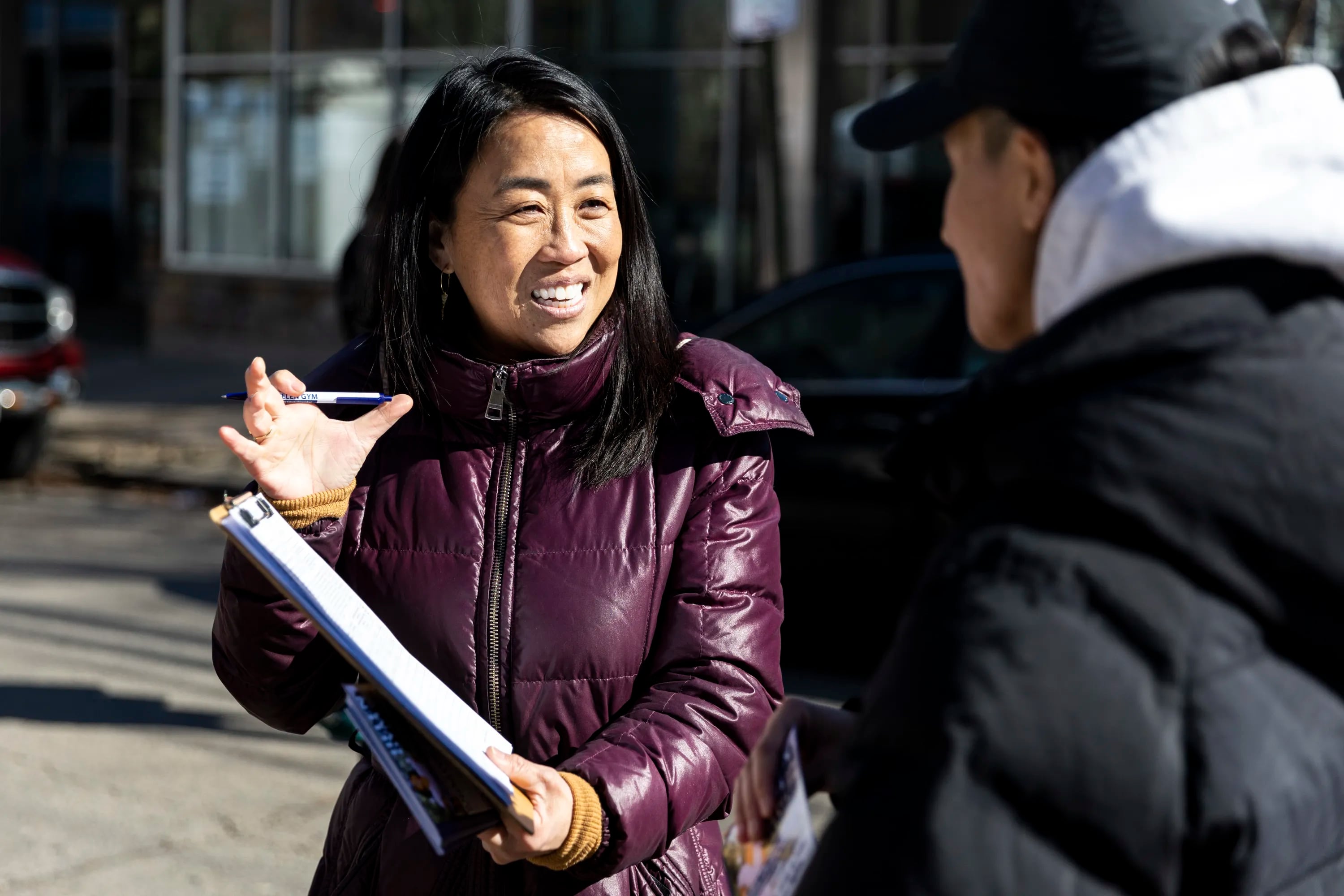
Helen Gym is running to be the Mayor of Philadelphia. She is the only progressive in the race. Helen is a friend of mine. I love her courage, her convictions, and her tenacity. She fights for the underdog. She knows that the state of Pennsylvania has shortchanged the students and public schools of Philadelphia for years. She knows the bleak conditions of the public schools. She has tirelessly fought for students, parents, teachers, and communities. She has stood strong against privatization of the schools. She has made enemies in the Establishment, which stood by as the city’s once-proud public schools were allowed to crumble and were closed to make way for charter chains.

The primary elections are May 16.

Helen Gym is my candidate. I have donated to her campaign. I hope you will help her with a contribution of any size—$10, $20, $30, $50, $100 or more. She needs our help!

The story below raises the question of whether Philadelphia can tolerate a mayor who fights for the weakest, most marginalized members of society, or whether it prefers someone as mayor who doesn’t take sides.

Anna Orso wrote this profile in The Philadelphia Inquirer:

Helen Gym was in the way.

It was June 2021 and the Philadelphia City Council member was blocking the doors of the Pennsylvania state Senate alongside activists demanding more funding for public schools.

“Shame on the unjust funding of our school kids!” Gym shouted as police handcuffed her. She was issued a citation, then released.

The day encapsulates the duality of Philadelphians’ impression of Gym. Her supporters saw a champion — a longtime schools advocate who would stop at nothing to call attention to injustice, and someone who has backed up her rhetoric with tangible action.

But her critics saw a performance — a moment ripe to be used in a future campaign. They describe her as a populist, and someone who speaks the language of social justice but hasn’t always lived up to it.

Through three decades in Philadelphia, Gym has evolved from a teacher into a leader of the city’s social justice movement and now a mayoral candidate running as a “tough Philly mom.” The question is whether she’d be a mayor with the elbows-out posture of a longtime activist — and if that’s what the city wants in its next chief executive.

Gym has become a polarizing political figure, in part because she occupies a clear lane as a progressive in the mayoral field. It could also be because she has so often described herself in fighting terms. And fighters have opponents.

She fought the state takeover of Philly schools and fought against planned school closures. As a legislator, she fought for a defense fund for immigrants, fought for legislation to benefit hourly workers, fought for novel legal protections for people facing eviction.

In many cases, her approach worked. She won concessions as an advocate, and while she ruffled plenty of feathers in City Hall, she was a productive lawmaker for seven years on Council.

Asked if her style translates to the Mayor’s office, where she’d lead a workforce and be responsible for keeping a bevy of department heads happy, Gym rejected the notion, saying her vision for the city is larger than keeping people comfortable.

“I’m trying to lead us on a common mission,” she said, “to transform people’s lives.”

Lessons learned, from Ohio to Philly

Gym, 55, lives in Philadelphia’s upscale Logan Square section today, but she grew up in a suburb outside Columbus, Ohio. The daughter of Korean immigrants, Gym was a bookish teenager with little interest in politics.

She studied history and economics at the University of Pennsylvania, but she likes to say she graduated from The Daily Pennsylvanian, the student newspaper. Her first job was at a tiny paper in Mansfield, Ohio, a manufacturing town.

There, she interviewed a steel worker who’d lost his legs in an accident, and she assured him he could “probably find another job.” He explained that he had an eighth-grade education and couldn’t find work that would pay what he and his family were worth.

Gym was mortified.

“I never forgot what he said,” she recalled, “and I never forgot how I felt.”

She returned to Philadelphia in the early 1990s and took a job at a community center in Olney, then became a teacher at James R. Lowell Elementary School in the neighborhood.

Gym felt there was pent-up energy to improve schools in underserved neighborhoods, but not many solutions coming from institutions. She cofounded a news organization to cover education, and after leaving her district job in 1997, fell deeper into community-based work.

She fought against a baseball stadium in Chinatown in 2000 (she’s said she is “skeptical” of the proposal for a Sixers arena in Center City). And as she was raising her children, Gym cofounded Parents United for Public Education, fighting the state’s takeover of Philadelphia schools and advocating against the expansion of for-profit charters.

For years, she lobbied Council, spoke at school board meetings, and took the mayor to task for what she saw as a divestment of public education.

One of the most high-profile sagas was in 2009, when South Philadelphia High School was roiled by racial discord. Gym partnered with students, many of them Asian immigrants, who staged a boycott and spurred a movement for safer schools.

“Our society sometimes is not that patient to young people,” Wei Chen, one of the students, said recently. “They always see the young people as troublemakers. But Helen Gym doesn’t feel that.”

In 2013, when the state-controlled School Reform Commission voted to close some two-dozen schools, Gym rallied hard against it.

“You want Helen to be in the trenches with you when you’re in a fight,” said Randi Weingarten, president of the American Federation of Teachers, who was arrested protesting that plan. “And that’s the kind of mayor you want: Somebody willing to be in the trenches, somebody who can walk the walk with parents and with workers and with kids.”

Gym became one of the district’s staunchest critics — earning her new scrutiny amid the reform movement. Charter school advocates questioned her motives, pointing out that her children attended a charter that Gym cofounded in the early aughts. The school, the Folk Arts-Cultural Treasures charter, was established in Chinatown after the stadium battle and when the district was under state control.

The school wasn’t intended to be “in lieu of public education,” Gym says, but a “supplement.”

“It felt really important to prove that we could build a school that would lift our values,” she said. “Many charter operators open schools they would never imagine sending their own kids to.”

Her critics say her advocacy against expanding the charter-school footprint rang hollow.

David Hardy, the cofounder of Boys’ Latin Charter School who has long opposed Gym’s education positions, said she presents as a “feisty fighter” for families, but has hampered their ability to choose a charter over traditional school.

“She’s created this character, and a lot of people in this town buy into that nonsense,” he said. “They make it seem like they’re for public education, but you don’t see a whole lot of success for poor children in this city.”

‘She will not let up’

With the backing of the city’s teacher’s union, Gym came in fifth in the 2015 Democratic primary for an at-large Council seat — only the top five vote-getters continue on — and became the first Asian American woman on Council.

Gym learned to legislate through the lens of a broader progressive movement, said Wilson Goode Jr., a former Council member and son of the former mayor. He handpicked Gym to succeed him on the board of Local Progress, a national organization for local officials.

He said her leadership flourished after Donald Trump was elected president. Gym rallied thousands at the airport in 2017 to protest his travel ban.

“[Trump’s election] changed the way we view politics, and I think changed people’s expectations of Council people,” Goode said. “She performed well in Council in terms of crafting a legislative agenda, but at the same time rose to a different level of leadership.”

But she turned off some Council colleagues, who have said publicly and privately that Gym could be rigid during negotiations.

William K. Greenlee, a former Democratic Councilmember who served with Gym, described her as rarely veering from her positions, but also capable of compromise.

Greenlee, who is backing Cherelle Parker in the mayor’s race, recalled that Gym revised her 2018 Fair Workweek legislation — which requires predictive scheduling for workers — after business community opposition threatened its passage. It was a sign she could make an agreement.

Where Greenlee said he takes issue with Gym’s campaign is posturing — which he said is espoused mostly by her supporters — that she’s “above the fray.”

“We’re politicians, and I’m sure Helen made agreements on things, or to get things, that’s what we all did,” Greenlee said. “My only problem with that is that I admit that.”

Gym says she worked to win over colleagues of different political persuasions. She said the issues she took on, like unsafe drinking water in schools, may seem popular — but solutions were rarely simple.

“The status quo for Philly politics is that people acknowledge that there are really important issues and they’re popular, and yet nothing ever gets done,” Gym said. “I never accept half-assed ideas to solve really big problems. And if that rubs somebody the wrong way, I think that reflects more on them.”

When Gym ran for reelection in 2019, she proved to be one of the city’s most popular politicians, winning more primary votes than any Council candidate in decades.

That year, she angered Democratic party leadership when she endorsed Kendra Brooks, who ran for Council as a member of the liberal Working Families Party. Gym tweeted that “in a time of corporate Dem shills and keyboard warriors acting as pseudo progressives, Kendra has walked the walk.”

Brooks won, as did Democrat Jamie Gauthier, who beat a West Philadelphia incumbent. The three made up a progressive bloc on Council that was far from a majority, but wielded real influence. They pushed for a program to cut evictions by diverting landlords and tenants to mediation, and advocated for behavioral health providers to respond to mental health calls instead of police.

Toni Damon, the ex-principal at Murrell Dobbins Career and Technical Education High School in North Philly, said Gym’s work went beyond legislation. When Damon had one counselor and one assistant principal serving 500 students, Gym advocated to secure one more of each.

“She came when we needed her,” Damon said. “People say the squeaky wheel gets the oil. She doesn’t back down. She’s persistent. And she will not let up.”

What comes next

On Jan. 30, Gym stood at City Hall and accepted the endorsement of the Working Families Party, saying that together, they’d lift up the people ignored by “career politicians, austerity bureaucrats, and too much of the wealthy and privileged in Philadelphia.”

She wrapped up the news conference, hopped on her bicycle, and rode away.

Hours later, she visited the Union League, the ritzy private club she’d denounced days earlier because it honored Florida Gov. Ron DeSantis. She made the stop in the midst of a well-publicized campaign against the club that was led by Black clergy and officials.

Her attendance at the event, hosted by the General Building Contractors’ Association, drew criticism and questions about authenticity. A group of Black ward leaders said “her blatant hypocrisy draws significant concern.”

She apologized. But some remain deeply bothered. Blondell Reynolds Brown, a former Democratic Council member, said recently it was a poor show of character.

“When people like Helen Gym show you who they are, believe them,” she said.

Gym’s campaign has said it’s “moving forward.” They say she should be evaluated based on her track record and her plans to improve public safety, education, and economic opportunity.

Helen Gym, Mayoral candidate, is walking around Clark Park getting signatures for her petition to be on the ballot in Philadelphia last month.
Helen Gym, Mayoral candidate, is walking around Clark Park getting signatures for her petition to be on the ballot in Philadelphia last month.Read moreTyger Williams / Staff Photographer

Her biggest advantage may be that her supporters are loyal. After the Union League flap, there was little sign of a crack in her base. She continued to win endorsements from well-organized groups that say she’d be one of the nation’smost progressive big-city mayors.

And she was defended by the teachers’ union, which sees an opportunity to elect a close ally. They’ve backed winners before — but this would feel like one of them.

Damon said Gym’s critics have overblown the Union League visit, saying: “People who know her know the work that she’s done.”

“You can’t take center stage,” Damon said, “if you weren’t there from the beginning.”

Inquirer staff writer Julia Terruso contributed.

MEDIA RELEASE


FOR IMMEDIATE RELEASE Wednesday March 29, 2023


Contact: Cassie Creswell, Illinois Families for Public Schools,773-916-7794


BETSY DEVOS’ SUPER PAC SPENDING THOUSANDS TO ELECT PAUL VALLAS MAYOR OF CHICAGO


VALLAS’ EDUCATION PLATFORM PULLED FROM DEVOS’ PRIVATIZATION PLAYBOOK

CHICAGO – Last week ex-President Trump’s former Secretary of Education Betsy DeVos made a $59,000 independent expenditure in support of mayoral candidate Paul Vallas’ campaign from a Super PAC she funds, the Illinois Federation for Children PAC.

The Illinois Federation for Children PAC was established in March 2022 and has received $465,000 in total from DeVos’ American Federation for Children Action Fund, a national 527 PAC. The Illinois Federation PAC’s chair, Nathan Hoffman, was a registered contract lobbyist in Springfield for the American Federation for Children until January this year.

Although DeVos has not endorsed Vallas, Vallas’ education plans for Chicago’s school system are directly aligned with DeVos agenda of school privatization, one she supported as Secretary of Education and promotes through her national network of advocacy organizations and PACs: defunding and dismantling public school systems and redirecting public funds via programs like vouchers for private schools.

In a little-noticed February 2022 op-ed in the Chicago Tribune, Vallas laid out a radical plan for privatizing Chicago Public Schools (CPS). In addition to supporting Illinois’ existing Invest in Kids tax credit scholarship voucher program, which already diverts millions to pay for vouchers for more than 4000 Chicago children, Vallas would create a city-funded voucher program and pay for it with funds from the CPS operating budget earmarked for teacher pensions. The pension payments would then instead be covered by surplus Tax Increment Financing dollars.

In that same op-ed, Vallas also proposes allowing religious private schools to become district-funded charter (or “contract”) schools, a policy so extreme that it was recently rejected by the conservative Republican attorney general of Oklahoma as “state-funded religion.”

Vallas also voices his support for “a reconstituted system in which parents get to direct the per-pupil public dollars to the school (or education model) of their choosing.” More recently, Vallas told WBEZ that “money should follow the students” and “we should be running districts of schools, not school districts.” The education platform on Vallas’ website calls for “dismantling the central administration” of CPS. These are exactly the policies that DeVos and American Federation for Children are advocating: funding students not systems and that dollars must follow students.
In June 2022, Vallas appeared on a panel with keynote speaker Corey DeAngelis, senior fellow at American Federation for Children. The panel, organized by extremist anti-LGBTQ+ parent group, Awake Illinois. Vallas later denounced Awake Illinois, but did not dissociate himself from DeAngelis or American Federation for Children.

Secretary DeVos’ education agenda was harmful to public schools on a national scale. Chicago voters should know that DeVos supports Vallas’ candidacy and that there is no daylight between DeVos and Vallas’ education policies.


###

Cassie Creswell and Diane Horwitz wrote the following article for Valerie Strauss’s blog “The Answer Sheet” at the Washington Post. Both residents of Chicago, they are fearful of what Paul Vallas will do to the Chicago Public Schools if he is elected Mayor. They urge Chicagoans to reject his candidacy. The latest poll shows the two candidates tied. Every vote matters.

Valerie Strauss wrote the introduction.

On April 4, Chicago voters will choose a new mayor — and the decision could have a profound effect on the future of the country’s third-largest public school district, which is under mayoral control. The two candidates in the runoff election are Paul Vallas and Brandon Johnson, Democrats who offer vastly different views of public education.

Vallas is a politician and a former education superintendent in Bridgeport, Conn.; at the Recovery School District of Louisiana (most of the schools were in New Orleans); and in Philadelphia and Chicago. Vallas became known as a “turnaround” specialist, meaning he moved into troubled districts and supposedly turned them around.

However, as education historian Larry Cuban wrote: “Whether, indeed, Vallas turned around Chicago, Philadelphia, and New Orleans is contested. Supporters point to more charter schools, fresh faces in the classroom, new buildings, and slowly rising test scores; critics point to abysmal graduation rates for Black and Latino students, enormous budget deficits, and implementation failures.”

Vallas has also unsuccessfully run for several offices, including mayor of Chicago in 2019 and lieutenant governor of Illinois in 2014.

Johnson was a public school teacher in high-poverty areas where school closures and gun violence affected the communities. He then became an organizer for the Chicago Teachers Union and fought to keep neighborhood schools open, expand state funding to district schools and reduce the use of high-stakes standardized tests. He has said he will not cut funding from Chicago public schools if he is elected mayor.In 2018, he was elected commissioner of the 1st District of Cook County, where he led a successful effort to ban housing discriminating against formerly incarcerated people.

The following was written by Cassie Creswell and Diane Horwitz, who are concerned about the privatization of public education. Creswell is a public school parent in Chicago and director of Illinois Families for Public Schools, a nonprofit advocacy group that lobbies for policies that support public education, which it sees as a public good. Horwitz is a graduate of Chicago public schools, a retired educator and a board member of Illinois Families for Public Schools. Both are writing as individuals and are not speaking for the organization.

By Cassie Creswell and Diane Horwitz


In just a week, the future direction of Chicago Public Schools will be decided by voters in a pivotal mayoral election. The two candidates, Paul Vallas, a former CEO of Chicago Public Schools, and Brandon Johnson, a former teacher and teachers union organizer, offer diametrically opposed visions for schools in Chicago, which will remain under mayoral control at least through January 2027.

We see the choice as stark. Will Chicago move in the direction of school privatization, a movement gaining ground in a number of states around the country with the growth of charter schools as well as school funding programs that use public money to fund private and religious education?

Or will there be a commitment to well-resourced neighborhood schools and increased funding that would be used to reduce class size, expand mental health services and bilingual education, and ensure that every school has a nurse and a librarian?
Will there be a recognition that the conditions in which many Chicago public school students live — in impoverished and segregated communities marked by violence and disinvestment — must be tackled as part of a broad education improvement agenda?

Johnson’s education platform emphasizes that families should not have to leave their communities or compete to secure a spot in a school that meets their needs and includes a library, music and art program, and small class sizes. He says that neighborhood schools contribute not only to the well-being of students but also to that of the communities in which they are located.

Saying that Chicago public schools are underfunded, he has called for more resources from the state that would be distributed based on the needs of a school’s student population and not solely on enrollment numbers. He has called for creating sustainable community schools with wraparound supports and his education plan integrates proposals for affordable housing, transportation and safety.

Vallas has criticized the operation of Chicago public schools and says he will make schools safer while creating new programs to bring back students who have left the system. He also said he would work to expand alternatives to public schools for families and would change the way schools are funded to “follow the student.”

Vallas has long supported initiatives that critics say are aimed at privatizing public education. He spelled out his vision for the future of Chicago’s school system in a little-noticed op-ed that he wrote for the Chicago Tribune in February 2022, months before declaring his candidacy — and that is what we focus on here. Here are some of his most revealing statements:

Expanding vouchers

Vallas supports expanding Illinois’ existing “Invest in Kids” voucher program, a tax credit scholarship program that offers a 75 percent income tax credit to individuals and businesses that contribute to organizations that pay for private and religious schools. A full 95 percent of participating schools are religious. More than 4,000 Chicago students were funded in this way in the last school year.

Vallas has also floated the idea of using tax increment financing (TIF) dollars to pay for K-12 school vouchers during the current campaign. TIF is a complex, and often misused, public financing initiative designed to fund development through investments and infrastructure in economically struggling communities.

The details of Vallas’ proposal in the Tribune highlight a fiscal initiative that we think is rash. He proposes applying TIF surplus dollars to cover teachers’ pension costs, and then using money that should be earmarked for pensions for vouchers. Vallas says this will allow these diversions of funds to be “legally accomplished.” One of the key concerning legacies of Vallas’ time as the chief executive officer of Chicago Public Schools was years of unpaid pension debt, generated by diverting funds that should have gone to teachers’ pensions into operating costs.

Religious charter schools

In Oklahoma, the Catholic Church recently asked the state to establish a virtual, openly religious charter school. In December 2022, Oklahoma’s outgoing attorney general issued a controversial legal opinion supporting the church’s application, saying that prohibiting religious charter schools violated the First Amendment. It was praised by Oklahoma’s Republican governor and state superintendent.

Ten months earlier, Paul Vallas’ op-ed called for religious contract schools, a type of charter school, to be established in Chicago. He wrote: “Longer term, the city can invite state-recognized parochial and private schools to become ‘contract schools’ in which the district contributes to or covers tuition for students who attend.”

Oklahoma’s new attorney general, a conservative Republican, took office in January and quickly rescinded his predecessor’s opinion, saying it “misuses the concept of religious liberty by employing it as a means to justify state-funded religion.”

Vallas also gave a nod of support to the 2022 Supreme Court Carson v. Makin decision, in which six ultraconservative justices ruled that the state of Maine could not exempt religious institutions from a school voucher program.

An unusual precedent

Vallas justified his vision for charter school expansion on “a long history of contracting out for private educational services. There is precedent.”

He then wrote:

“The Supreme Court’s landmark 1954 decision in Brown v. Board of Education grants the right to equitable educational opportunity. It is a right guaranteed by the Equal Protection Clause of the 14th Amendment. Those in power in Chicago have chosen to interpret this right as a mandate that all public financing of education be allocated exclusively to ‘public’ or government-run schools.”

Let it be noted that after Brown v. Board of Education, many communities in Southern states responded by spending public dollars on private schools using voucher schemes — private academies created for White students whose families refused to send them to public schools with Black children and were given public dollars to fund tuition.

It seems to us that Vallas is twisting the import of the Brown v. Board of Education ruling, using it to include the use of public dollars to fund children’s departure from public — or, as he called them, “government- run” — schools. His use of the phrase “government-run schools” mirrors the language used by former president Donald Trump and his education secretary, Betsy DeVos, who framed public education as a government institution essentially holding students hostage.

Private and religious schools that take public funds are not bound by the same anti-discrimination regulations as public schools, leaving them free to discriminate on the basis of disability, LGBTQ+ status, parenting and pregnancy status, English-language learner status and religion itself.

“Dollars follow students”


Vallas ended his op-ed by saying that he supports the “explicit endorsement of a reconstituted system in which parents get to direct the per-pupil public dollars to the school (or education model) of their choosing.”

This is exactly what DeVos has long advocated: “Fund students, not systems.”

DeVos is a leader in the national movement toward the privatization of our public schools, via vouchers, charter schools — which are publicly funded but privately operated — and other often poorly regulated funding programs. Those include education savings accounts and direct financial support for home schooling. The goal: discrediting and dismantling our public schools districts.
Vallas was clear about his plans, which would work toward that goal in Chicago. It’s up to the voters now.