“If the come for me in the morning, they’ll come for you at night.” I heard that phrase recently and eventually found it attributed to Angela Davis. I was never in her fan club, but the statement is profound, not unlike the famous quote “First they came for the trade unionists, but I was not a trade unionists so I didn’t care.” Translation: when anyone’s freedom is curtailed, we are all endangered.
It’s easy for hateful politicians like Ron DeSantis to target trans kids and deny them the treatment recommended by their doctors, because transgender people are a tiny number and have few defenders. Drag queens are also a target for those who want to restrict freedom because they too are a tiny minority without a political constituency to defend them.
Closet fascists experienced a setback in Florida, when a federal judge put a temporary block on the state’s law meant to make drag queens disappear. Drag queens are performers; their acts are meant to entertain. Drag has been on the stage for hundreds of years, maybe longer.
A federal judge on Friday temporarily blocked a Florida law that he says is aimed at limiting the rights of drag performers.
U.S. District Judge Gregory Presnell of Orlando wrote in his order that “this statute is specifically designed to suppress the speech of drag queen performers.”
“In the words of the bill’s sponsor in the House, State Representative Randy Fine: “…HB 1423…will protect our children by ending the gateway propaganda to this evil — ‘Drag Queen Story Time,’” Presnell’s ruling said.
Fine, a Republican from Brevard County, declined to comment.
The court battle was initiated by the Hamburger Mary’s restaurant in Orlando over a law that contains penalties for any venue allowing children into a sexually explicit “adult live performance.” The law includes potential first-degree misdemeanor charges for violators.
“Of course, it’s constitutional to prevent the sexualization of children by limiting access to adult live performances,” said Jeremy Redfern, a spokesman for Gov. Ron DeSantis, who signed the law in May. “We believe the judge’s opinion is dead wrong and look forward to prevailing on appeal.”
Hamburger Mary’s filed a lawsuit in May against DeSantis, the state, and Melanie Griffin, secretary of Florida’s Department of Business and Professional Regulation. DeSantis and the state have since been dropped as defendants, with Griffin remaining.
The downtown restaurant’s lawsuit argued the law would have a “chilling effect on the First Amendment rights of the citizens of Florida.”
Hamburger Mary’s, which opened in 2008, has hosted drag performances that include bingo, trivia and comedy. After the law was signed, the restaurant restricted children from drag shows and then lost 20% of its bookings, according to the lawsuit.
Presnell’s order prevents the state agency from enforcing the law pending the outcome of a trial. He also denied the state’s motion to dismiss the lawsuit.
The release of the NAEP Long-Term Trend data yesterday set off the usual hysterical reaction. The scores fell as a consequence of the pandemic, when most kids did not get in-school instruction.
These are not secrets but they bear repeating:
*Students don’t learn what is tested when they are not in school for long periods of time.
*Learning online is inferior to learning in-person from a qualified teacher.
*It’s better to lose points on a test than to risk serious illness or death or infecting a family member or teacher or other member of the school staff.
During the depths of the pandemic, no one knew for sure whether it was better to keep schools open or closed. A superintendent in Florida—Rocky Hanna of Leon County— was threatened with loss of his license after he closed the schools, following the death of a third-grader from COVID. Teachers died of COVID. Some children lived with elderly grandparents at risk of getting COVID. Which matters most: lives or test scores?
Whatever was lost can be regained if students have good instruction and stability.
It is not surprising that test scores went down after a once-in-a-century pandemic.
This is not a “Sputnik moment.”
The Washington Post reported, under a ridiculous scare headline “National test scores plunge, with still no sign of pandemic recovery” (Patience needed!):
National test scores plummeted for 13-year-olds, according to new data that shows the single largest drop in math in 50 years and no signs of academic recovery following the disruptions of the pandemic.
Student scores plunged nine points in math and four points in reading on the National Assessment of Educational Progress (NAEP), often regarded as the nation’s report card. The release Wednesday reflected testing in fall 2022, comparing it to the same period in 2019, before the pandemic began.
“These results show that there are troubling gaps in the basic skills of these students,” said Peggy G. Carr, commissioner of the National Center for Education Statistics (NCES), which administers the tests. The new data, she said, “reinforces the fact that recovery is going to take some time.”
The average math score is now the same as it was in 1990, while the average reading score is the same as it was in 2004.
Hardest hit were the lowest-performing students. In math, their scores showed declines of 12 to 14 points, while their highest-performing peers fell just six points. The pattern for reading was similar, with lowest performers seeing twice the decline of the highest ones.
Students from all regions of the country and of all races and ethnicities lost ground in math. Reading was more split. Scores dropped for Black, multiracial and White students. But Hispanic, Asian, American Indian and Alaska Native students were described as “not measurably different.”
Most of those tested were 10 years old, in fourth or fifth grade, at the onset of the pandemic. They were in seventh or eighth grade as they took the tests.
Will politicians whip up a panicked response and demand more of what is already failing, like charter schools, vouchers, high-stakes testing, and Cybercharters? or will they invest in reduced class sizes and higher teacher pay?
The theocrats are on the march, and they won’t rest until they have overthrown the Founding Fathers’ vision of a secular republic. We used to call them “Fundamentalists,” but now they are known as “Christian nationalists” or Dominionists. Different name. Same game. Make America a Christian nation, but their kind of Christian.
The Founding Fathers had studied history. They knew that Europe had been torn apart by religious wars and religious persecution. They wanted their new nation to be free of sectarian strife. Their Constitution foot the action protected free exercise of religion while assuring that government neither favored nor disfavored any religion.
Frederick Clarkson wrote a frightening article for Salon about the determination of the evangelical right to conquer the nation for their religious views.
Their target right now, he writes, is Pennsylvania, but they are active in every state. This is ironic because Pennsylvania was founded by Quakers, who were committed to religious freedom, and Quakers would not be welcome in the society envisioned by these militant evangelicals.
Clarkson begins:
“You’ve got a friend in Pennsylvania!” was the theme of the state’s ad campaign to promote tourism in the 1980s. That was a veiled historical reference to the Society of Friends, better known as the Quakers, the liberal Christian sect to which William Penn, for whom Pennsylvania is named, belonged. But since the early 2000s there has been a quiet campaign in the Keystone State and beyond to unfriend anyone outside certain precincts of Christianity — and most Quakers would almost certainly be among the outcasts.
That campaign got a lot less quiet this April, as many leaders of the neo-charismatic movement known as the New Apostolic Reformation, who have been hiding in plain sight for a generation, began ramping up a contest for theocratic power in the nation and the world. Their first target is Pennsylvania.
On April 30, Sean Feucht, a musician and evangelist for conservative Christian dominion, spoke at Life Center Ministries, the Harrisburg megachurch of Apostle Charles Stock. (The honorific “Apostle” designates a leading church office in the NAR. That said, there are many apostles in the movement, and not all of them pastor churches.) During his appearance, Feucht highlighted his national tour of state capitals, called Kingdom to the Capitol, that he was conducting along with Turning Point USA, the far-right youth group led by Charlie Kirk. “[W]e are going to end this 50-state tour here in Harrisburg,” he announced….
Feucht’s effort to connect young people with what his movement considers William Penn’s ancient vision for Pennsylvania is part of the wider, epochal campaign of the New Apostolic Reformation (NAR), a movement at the cutting edge of Pentecostal and Charismatic evangelicalism, which is now the second largest Christian faction in the world after the Roman Catholic Church and the largest growth sector in American and global Christianity…
The NAR seeks to consolidate those Christians it recognizes as “the Church” in what it believes to be the End Times. Although many NAR leaders have been closely aligned with Donald Trump, they insist that they aim for a utopian biblical kingdom where only God’s laws are enforced. Most therefore hold to a vision of Christian dominion over what they call the “seven mountains“: religion, family, education, government, media, entertainment and business. (This is what is meant by Dominionism.)
This aggressive movement is in conflict with the republic created by the Founding Fathers. It seeks control, power, for its faith only.
Carol Burris is the Executive Director of the Network for Public Education. She was a much honored high school principal in New York State, following many years in the classroom. She earned her doctorate from Teachers College, Columbia University.
From my perspective, I think it always wise to pay attention to the funders of any study, especially when the funders have a strong point of view about the outcome. Just as we are wary when the tobacco industry releases a study that “proves” the safety of tobacco use, or the pharma industry funds a study claiming that opioids are not addictive, we should be wary of any study funded by the major sponsors of the charter school movement. “Follow the money” is a principle that should never be ignored.
Burris writes here about the new national CREDO study of charter schools, which was uncritically reviewed by Education Week and other publications, which simply quoted the press release.
She writes:
Last week the Center for Research on Education Outcomes (CREDO) released its third National Study on charter schools. The report was funded by two nonprofits that wholeheartedly support charter schools and generously fund them—the Walton Family Foundation and The City Fund. The City Fund, which was started and funded by pro-charter billionaires John Arnold and Reed Hastings, exists to turn public school districts into “portfolio” districts of charter schools and charter-like public schools.
Commenting on the report, Margaret “Macke” Raymond, founder and director of CREDO, told Ed Week’s Libby Stanford that the results were “remarkable.” Stanford claimed that “charters have drastically improved, producing better reading and math scores than traditional public schools.”
However, neither of those claims describes the reality of what the report found, as I will explain.
Let’s begin with what CREDO uses as its measure of achievement. In all of its reports, CREDO uses “days of learning” to attribute differences in student achievement between charter schools and district public schools. That measure creates dramatic bar graphs allowing CREDO to disguise the trivial effects on achievement those “days of learning” represent.
The overall math state score increase that CREDO attributes to a student attending a charter school is “six days of learning.” But what does that mean in the standard measures most researchers use, such as changes in standard deviations or effect sizes?
According to CREDO, 5.78 days of learning translates to only a 0.01 standard deviation. That means that the 6.0 “days of learning” increase in math translates to about a 0.0104 increase in standard deviations. Does that sound tiny? It is. For comparison, the negative impact on math scores of receiving a voucher in Louisiana was determined to be 0.4 standard deviations – more than 36 times greater magnitude.
After CREDO released its second national charter study in 2013, the National Education Policy Center (NEPC) reviewed it. You can find that critical review here, accompanied by a publication release titled CREDO’s Significantly Insignificant Findings.
As the authors of the review (Andrew Maul and Abby McClelland) note, a 0.01 difference (which the 2023 math gain only slightly exceeds) in a standard deviation means that “only a quarter of a hundredth of a percent (0.000025) of the variation” in the test scores could be explained by the type of school (charter or public) that the child attended.
Put another way, if a student gains six days of math and they originally scored at the 50th percentile on a standardized test, they would move to the 50.4th percentile. It’s as if they stood on a sheet of loose-leaf paper to stand taller—that’s how small the real difference is.
But what about the reported reading-score increase of 16 days? Sixteen CREDO days account for only a 0.028 standard deviation. Now we are increasing height by standing on two and a half sheets of looseleaf.
According to CREDO, those increases are statistically significant. Shouldn’t that count? As the NEPC reviewers state in their summary, “with a very large sample size, nearly any effect will be statistically significant, but in practical terms these effects are so small as to be regarded, without hyperbole, as trivial.”
To put all of this in a broader perspective, Maul and McClelland point out, “[Eric] Hanushek has described an effect size of 0.20 standard deviations for Tennessee’s class size reform as “relatively small” considering the nature of the intervention.” Hanushek is married to Macke Raymond, who found the much, much, much slighter results of her organization’s study to be “remarkable.”
Using CREDO’s conversion, in order to achieve 0.20 standard deviations of change, the difference would have to be 115.6 days of learning.
The only place in the report where there was an over 100-day difference was in online charter school students’ results in math. Compared with the public school students included in the study, online charter school students learned 124 fewer days of math. They may have something there.
CREDO Methodology
To draw its conclusions, CREDO matches charter students with what it calls “virtual twins” from public schools. But not all public schools were included, nor were all charter schools. The only public schools included were those in 29 states (for some odd reason, CREDO also includes NYC as a state) and the District of Columbia that met their definition of “feeder schools.” CREDO refers to 31 states, which include New York City and the District of Columbia, throughout the report.
According to page 35 of the report, in 2017-2018, there were 69,706 open public schools in their included “states,” and of those, fewer than half (34,792) were “feeder schools.” That same year, NCES Common Core of Data reports 91,326 non-charter public schools, 86,315 of which were in states that had charter schools.
From the chart, then, we can estimate that only about 38% of public schools and 94.5% of charter schools were included in the study, at least during the 2017 school year.
What, then, is a feeder school? The report claims that it is the public school the student would have attended if she were not in the charter school. But that is an inaccurate description. In the methodology report, CREDO explains how they identify feeder schools. “We identify all students at a given charter school who were enrolled in a TPS during the previous year. We identify these TPS as “feeder schools” for each charter school. Each charter school has a unique feeder school list for each year of data.”
While I understand why researchers want to use feeder schools for comparison, it produces an inherent bias in the sample. Feeder schools are, by definition, schools where parents disrupt their child’s schooling and place them in a charter school. They are not, as the report claims, “the school the student would have attended.” If a child starts in a charter school, her local school would not be a feeder school unless there was a parent who was so dissatisfied with the school that they were willing to pull their child out and place them in a charter, which may even be miles away in a neighborhood with very different demographics.
Virtual Twins
In 2013, Maul and McClelland also explained the virtual-twin method along with the problems inherent in its use.
“The larger issue with the use of any matching-based technique is that it depends on the premise that the matching variables account for all relevant differences between students; that is, once students are matched on the aforementioned seven variables [gender, ethnicity, English proficiency status, eligibility for subsidized meals, special education status, grade level, and a similar score from a prior year’s standardized test (within a tenth of a standard deviation), the only] remaining meaningful difference between students is their school type. Thus, for example, one must believe that there are no remaining systematic differences in the extent to which parents are engaged with their children (despite the fact that parents of charter school students are necessarily sufficiently engaged with their children’s education to actively select a charter school), that eligibility for subsidized meals is a sufficient proxy for poverty when taken together with the other background characteristics.”
In addition to the above, special education students are not a monolith. Research has consistently shown that charters not only take fewer special education students but also enroll fewer students with more challenging disabilities that impact learning than public schools. English language learners, who are at different stages of language acquisition, are not a monolith as well. A few years ago, Wagma Mommandi and Kevin Welner filled an entire book (“School’s Choice”) with illustrations of how charter schools shape their enrollment – often in ways that the virtual-twin approach would not control. Therefore, even the included categories are rough proxies.
Virtual twinning (or “Virtual Control Record” or VCR) also results in an additional problem—large shares of charter school students going “unmatched” and therefore being excluded from the results. Again, I quote NEPC 2013.
“Even more troubling, the VCR technique found a match for only 85% of charter students. There is evidence that the excluded 15% are, in fact, significantly different from the included students in that their average score is 0.43 standard deviations lower than the average of the included students; additionally, members of some demographic subgroups such as English Language Learners were much less likely to have virtual matches.”
That was in 2013. In this new report, the problem is worse. The overall match rate dropped further to 81.2%. English-language learners had a match rate of 74.9%; multi-racial students had a rate of 58.1%; and the match rate for Native American students was only 38%.
And in some states, match rates were terrible. In New York, only 43.9% of charter school ELL students had a match, and 51% of special education students were matched. In the three categories that are most likely to affect educational outcomes—poverty, disability, and non-proficiency in English—New York rates were well below the average match rate for each category, which might at least partially explain the state’s above-average results.
The study itself notes, in a footnote, “Low match rates require a degree of caution in interpreting the national pooled findings as they may not fairly represent the learning of the student groups involved.”
Do Charters Cherry-Pick and Push Low-scoring Students Out?
Perhaps the most incredulous claim, however, in the study was its “proof” that charters do not cherry-pick or skim and, in fact, teach students who are lower initial achievers.
Here is the CREDO methodology on page 41 for making that claim.
“We compare students who initially enrolled in a TPS and took at least one achievement test before transferring to a charter school to their peers who enroll in the TPS. We can observe the distribution of charter students’ test scores across deciles of achievement and do the same for students in the feeder TPS.”
That may measure something, but not whether charter schools cherry-pick. First, it ignores potential differences in the majority of charter students who never enrolled in a public school. Second, it compares the scores of students whose parents withdrew them from the public school and then compares them with a more satisfied parent population. It’s far more likely that a withdrawal will occur if a student is doing poorly rather than doing well.
Given the CREDO dataset, it would have been relatively easy to explore the question of whether or not charter schools push lower-achieving students out, but that question was not explored.
Findings Regarding Charter Management Organizations
Although I did not review the study’s report that compared student achievement between standalone charters and charter management organizations (CMOS), I noticed that the CMOs of four states of the thirty-one were not included, one of which is Ohio, a state in which the vast majority of charters are run by CMOs (78%), with for-profits outnumbering nonprofits by 2 to 1.
CREDO used the same capricious definition as the National Alliance for Public Charter Schools—a CMO must control three or more schools to be included, which excludes many of the low-performing for-profit-run schools that NPE identified in our report, Chartered for Profit II. While it lists K12 online as a CMO, the equally low-performing Pearson’s Connections Academy was absent from the CMO list.
Conclusion
My review of the study found that the issues included in NEPC’s 2013 review were unaddressed in the newly released study, and new issues have emerged. Hopefully, those who are far more skilled in this type of regression analysis than I am will do a more comprehensive review. But given the bias introduced by the methods in matching and the additional biases created by charters’ shaping of their own enrollment, it’s easy to see how the 0.011 or 0.028 SD findings could be masking negative actual charter effects that are at least as large (in the other direction).
Moreover, based on the trivial topline increases combined with serious methodological issues, I think it is safe to say that despite the billions of tax dollars spent on growing charter schools, overall charter student achievement is about the same as the achievement of students in CREDO’s feeder schools and no conclusions can be drawn regarding the majority of public schools. As to the billionaire funders who financed the report that no doubt cost millions to produce—they got what they paid for. And reporters covering the report have thus far failed to ask the challenging questions that their readers deserve.
Peter Greene was a teacher in Pennsylvania for 39 years. He is now a regular writer at Forbes and a super star blogger. This column appeared on his blog. He responded to Rick Hess’s claim that school choice is not an attack on public education but part of a long history of trying to improve them. From my perspective, it’s hard to understand how public schools improve by defunding them and replacing them with religious schools, low-quality private schools, home schooling, and cyber charters.
This is what Peter Greene wrote:
Rick Hess (American Enterprise Institute) is one of those occupants of the reformy camp that I take seriously, even when I think he’s wrong. So when he raises the question of whether or not school choice is an “attack” on public education, I think it’s a question worth talking about, because I think the answer is a little bit complicated. So let me walk through his recent piece on that very question bit by bit.
After an intro suggesting that choice expansion flows directly from the pandemic while ascribing opposition to choice to a shadowy cabal that flows from teachers unions, Hess gets to his point, which is that seeing choice as an anti-public school is “misleading and misguided.”
Hess puts choice in the context of a century’s worth of public school fixer-uppers, “a barrage of reforms.” He offers a list–“compulsory attendance, district consolidation, larger schools, smaller schools, magnet schools, standards, test-based accountability, merit pay, and more.”
Some of these ideas were good. Some weren’t. But in hindsight, it’s pretty clear that they weren’t “attacks” on public education; rather, they were attempts to improve it.
I disagree. Some of these ideas were offered with sincere hope for the best. But I’m going to single out the standards movement and test-based accountability for special recognition here.
If you weren’t teaching during the rise of No Child Left Behind, Common Core, and Race To The Top, I’m not sure if I can really capture for you the dawning sense of horror, frustration and futility among teachers at the time.
Word came down that new regulations required us to get test scores up– a little bit per year for starters, then ramping up to an impossible climb, until somehow every single student would be above average. If not, there would be penalties, maybe the complete dismantling and rebuilding of the district, perhaps as a privately-run charter school. “This is not possible,” educators said. “All will learn all,” replied the Powers That Be. “Don’t you believe that students can learn? And which child do you propose to leave behind.”
Then there were the tests themselves. Not very good, and with results coming back with so little detail–and so very late in the game–that they were less than no help at all. “Well, if we just teach the standards, the tests scores will follow,” said some optimistic educators. That didn’t happen. Schools rejiggered curriculum, pulled students away from untested material like art and recess so that they could be double-whammied with test prep.
“Maybe Obama will fix it,” we hoped. He did not. He doubled down. And 2014–the year for 100%–came closer and closer, the year when anyone dealing with educational reality knew that every district in the country would be either a) failing or B) cheating.
And through those years, one at a time or in small groups, teachers arrived at an unpleasant conclusion.
They are setting us up for failure. They want us to fail.
Why would they want that? The rhetoric had already been around on the far right, back all the way to Milton Friedman and on through his intellectual spawn– public education should be dismantled. There was a new push for vouchers and especially charter schools, and that coincided with rising noise about “failing” public schools. There was very little “let’s expand the educational ecosystem” and an awful lot of “we must help students escape failing public schools.” The constant refrain of “school choice will force public schools to improve because competition” was also an omnipresent crock, a slap in the face to educators who were already working their butts off and resented the suggestion that they were either incompetent or lazy. And that thread runs all the way up guys like Christopher Rufo arguing that to get to universals school choice, you have to get to universal distrust of public schools.
Maybe school choice wasn’t in and of itself an attack on public education, but it certainly seemed as if attacking public education was a means of promoting school choice.
I have no doubt that there are people who believe that education would work better if handled by the free market (I think their belief is magical, misguided and wrong, but I do believe it’s sincere). I believe there are technocrats who believe that standards, tests and data would improve education (ditto).
But to be a public school educator on the receiving end of all this (and more) absolutely felt like an attack. The irony is that when reformsters eventually figured out that the attack-filled rhetoric wasn’t helping and they dialed it back, the attacks themselves had become more real.
But let’s get back to Hess.
Public education can encompass a lot of approaches, and it can be organized in many different ways. Rather than blindly insist that “defending public schooling” requires clinging to outdated policies from decades (or centuries) past, we would do better to clarify principles, examine particulars, and then debate proposals.
All of this language is doing a lot of work, but as far as it goes, Hess and I probably agree more than we disagree. But the disagree part comes in the very next paragraph.
Indeed, the pandemic was a stark reminder that there are lots of ways to deliver schooling, including innovations such as learning pods, microschools, virtual tutors, and education savings accounts.
Learning pods and microschools are okay if you’re wealthy. As policy ideas in the vein of the DeVosian, “Well, your voucher may not be enough to get into a good private school, but you can always start a microschool,” they suck. I don’t think there are more than a hundred people in the country who came out of the pandemic thinking virtual education is a great idea. And education savings accounts are just vouchers with extra super-powers and porcine lip gloss. And none of these are really new ideas. They also all suffer from the same issue, which is the notion that any school choice system must be done free market style. We can do a great choice system without the free market at all (but that’s a post for another day).
Hess identifies one of the issues as the fuzziness of the word “public.” On this point, I think he gets some things wrong.
Choice opponents assert that public schools are “public” because they’re funded by public tax dollars.
No, that’s choicers. It’s been part of the charter school argument that charter schools are public schools because they are funded with public dollars. This pro-public ed writer (I’m not anti-choice, but I am anti-most-of-the-versions-of-choice-with-which-we’ve-been-presented) would say that public schools are public because they the public funds them, owns them, and operates them via representatives. Furthermore, they are public schools because they have a responsibility to the public to serve all students.
You can argue, as Hess and others do, that districts regularly hire outside firms to handle certain functions and occasionally outsource the teaching of certain students with exceptional special needs. But in all those cases, the responsibility for the management of those outside contracts rests with the public school district. A charter or private voucher-fed school carries no such responsibility. A public school district cannot, as can charters and voucher schools may, simply show parents the door and say, “Good luck. Your child is not our problem.” Do all public systems meet that responsibility as well as they ought to? Absolutely not. But at least the responsibility exists. A parent who thinks the public system is short-changing their child can (and often will) sue the district. They have no such option in a choice system, as such systems are currently conceived.
Hess is correct in calling public education “a pretty expansive category.” But it hinges on far more than whose money is being used.
In fact, I’d argue that it is the responsibility portion that is the big difference in the brand of choice being pushed by many these days. Our public system is based, however imperfectly, on the notion that we bear a collective responsibility for educating the young. Modern choice, particularly the current version sold under the culture warrior parental right brand, is about saying that getting a child an education is the responsibility of the parents, and that’s it. Yes, many choicers are also trying to privatize the ownership and provision of education, but it is the privatizing of responsibility for a child’s education that is perhaps the most profound and fundamental shift.
More importantly, simply calling something “public” doesn’t make it a good thing. While the phrase “public schooling” is suffused with happy notions of inclusivity and fairness, “public” isn’t a magic word.
Ain’t it that truth. Public education has a wide variety of issues–though some of those are the direct result of reformster attempts to “fix” things (see above re: standards and testing). But I’ve never argued that I’m against modern school choice and ed reform because public schools are perfect the way they are and everything else sucks. My most fundamental issue is that public schools have some serious issues, and modern ed reform and school choice don’t solve any of them (yes, that is also another long post). They just weaken public school’s ability to work on them while blowing through a giant pile of taxpayer money.
The point isn’t to play word games but to understand that things are less clear-cut than defenders of the status quo are prone to acknowledge. There are many ways to provide and serve the aims of public education.
After all these decades in the ed biz, I’m inclined to assert, repeatedly, that everything in education is less clear-cut that the vast majority of people acknowledge. Some folks on my side of the aisle are quick to infer nefarious and/or greedy motives when, sincere ideology is sufficient explanation (much as some folks in the choice camp assume that the only reason someone would stick up for public ed is because she’s on the union payroll). Some choicers are simply ignorant of how any of this school stuff works. Some are up against a particularly dysfunctional local version of public education. Some are anti-democrats for whom this is just one issue of many, one more way in which the government steals their money to spend it on Those People. Some want to recapture education for a particularly conservative version of christianist religion. Some want to social engineer their way to a more efficient society. Some are serious people, and some are not.
In short, the choicer and reformster camp contains a great variety of individuals.
Are some of those individuals interested promoting school choice as a way of making public education better? Is it possible to make public education better by incorporating some choice ideas? I believe that latter is true, and I swear I’m going to post about it in the not too distant future, and as for the former, well… yes, but.
But for all the variety in the choicer camp, they mostly adhere to two flawed premises– that a choice landscape should rest on a bedrock of free market mechanics and that the resulting system shouldn’t cost a cent more than the current one. As long as we start with those premises, school choice must be a zero sum game, and even if all the people who have spent the past four decades trying to tear public ed down so that choice will look better–even if all those people shut up, the zero sum game feature seems guaranteed to turn school choice into an attack on public education.
If you read only one article today, read this one. It’s powerful and poignant. The article was written by Forrest Wilder and appears in the Texas Monthly, a terrific publication.
To understand why Republican legislators from rural districts helped to defeat vouchers in Texas, read this article about the schools of Fort Davis in Jeff Davis County in rural West Texas. The superintendent is a bedrock conservative who is dead set against vouchers. His schools are on the verge of bankruptcy due to the state’s Byzantine school-finance system. The state government doesn’t care. At the end, you will understand Governor Abbott’s long-term goal: to eliminate property taxes and completely privatize education.
Texas doesn’t have a mile-high city, but Fort Davis comes close at 4,892 feet. The tiny unincorporated town is nestled in the foothills of the Davis Mountains, where bears and mountain lions and elk stalk among pine-forested sky islands. Fort Davis is the seat of Jeff Davis County, whose population of 1,900 is spread among 2,265 square miles, 50 percent bigger than Rhode Island. The sparsely populated desert country of Mongolia has nearly seven times the population density of Jeff Davis County. Odessa, the nearest city to Fort Davis, is two and a half hours away. The state Capitol is six and a half.
For Graydon Hicks III, the far-flunged-ness of Fort Davis is part of its appeal. He likes the high and lonesome feel of his hometown—the “prettiest in Texas,” he says. But these days, it has never felt further from the state’s political center of gravity.
For years, Hicks, the superintendent of Fort Davis ISD, has been watching, helplessly, as a slow-motion disaster has unfolded, the result of a flawed and resource-starved public-school finance system. Over the last decade, funding for his little district, which serves just 184 K–12 students, has sagged even as costs, driven by inflation and ever-increasing state mandates, have soared. The math is stark. His austere budget has hovered around $3.1 million a year for the past six years. But the state’s notoriously complex school finance system only allows him to bring in about $2.5 million a year through property taxes.
Hicks has hacked away at all but the most essential elements of his budget. More than three-quarters of Fort Davis’s costs come in the form of payroll, and the starting salary for teachers is the state minimum, just $33,660 a year. There are no signing bonuses or stipends for additional teacher certifications. Fort Davis has no art teacher. No cafeteria. No librarian. No bus routes. The track team doesn’t have a track to train on.
But Hicks can’t cut his way out of this financial crisis. This school year, Fort Davis ISD has a $622,000 funding gap. To make up the difference, Hicks is tapping into savings. Doug Karr, a Lubbock school-finance consultant who reviewed the district’s finances, said Fort Davis ISD was “wore down to the nub and the nub’s all gone. And that pretty much describes small school districts.”
“I am squeezing every nickel and dime out of every budget item,” Hicks said. “I don’t have excess of anything.” When I joked that it sounded like he was holding things together with duct tape and baling wire, he didn’t laugh. He said: “I literally have baling wire holding some fences up, holding some doors up.”
The district’s crisis comes at a time when the state is flush with an unprecedented $33 billion budget surplus. Hicks is a self-described conservative, but he thinks the far right is trying to destroy public education. For years, the state has starved public schools of funding: Texas ranks forty-second in per-pupil spending. And yet Governor Greg Abbott is spending enormous political capital on promoting a school voucher plan, which would divert taxpayer funds to private schools. Public education, Abbott has repeatedly said, will remain “fully funded,” though public-education spending is lower now than when he took office in 2015, and the Legislature recently passed a $321.3 billion budget with no pay raise for teachers and very little new funding for schools. Unable to get his voucher plan through the regular legislative session, Abbott is threatening to call lawmakers back to Austin until he gets his way.
Lieutenant Governor Dan Patrick, long a champion of vouchers, is backing legislation that would attempt to appease rural Republican legislators—a bloc long wary of vouchers—by offering $10,000 to districts that lose students to private schools. Hicks can barely contain his anger when he hears such talk. He has been lobbying state leaders for years to fix the crippling financial shortages that plague districts like his. “Take your assurances and shove ’em up your ass,” he says, before softening a bit. “I’m so tired. I’m so frustrated. We have tried. I have fought and fought and fought.”
With each passing month, his rural district inches closer to financial ruin. If nothing changes by next summer or fall, Fort Davis will have depleted its savings. He doesn’t know the exact day that his school district will go broke, but he can see it coming.
It’s easy enough to grasp the basic problem in Fort Davis. But what’s going on beneath the surface is another story.
During my twenty years of reporting on Texas politics, I’ve often heard that only a handful of people in the state understand the school-finance system, with its complicated formulas, allotments, maximum compressed tax rates, guaranteed yields, and “golden pennies.” A former colleague of mine, who once spent months trying to make sense of the topic, warned me against writing about it. Karr, the school finance consultant, compares the process of making sense of our public education funding to encountering a fire at a roadside cotton gin on some lonely West Texas highway. “You drive off into that smoke and you might never drive out,” he said. “You might end up getting killed.”
A thorough explanation of the system is the stuff of graduate theses, but the broad strokes are straightforward enough. How a school district is funded begins with two key questions: How much money is the district eligible for? And who pays for it?
Here it’s helpful to use a venerable school finance analogy: buckets of water. The size of a school district’s bucket—how much money it’s entitled to—is largely determined by the number of students in attendance. Every district receives at least $6,160 per pupil, an amount known as the basic allotment, an arbitrary number dreamed up by the Legislature and changed according to lawmakers’ whims.
At this point in the article, Wilder goes into the intricacies of school finance in Texas. Very few people understand it. All you need to know is that some districts are lavishly funded while others, like Fort Davis, are barely scraping by and may go bankrupt.
Hicks is not alone in thinking the opaqueness is intentional. “They make it just as complicated as they can,” he said of state officials. “Because how do you explain something so complicated to the average voter?” In other words, if constituents can’t easily grasp the perplexing and unnecessarily knotty framework, it’s tougher to hold officials accountable for budget decisions.
Though the spreadsheets may be head-spinning, they tell a story. In a state where some wealthy suburban communities build $80 million high school football stadiums, Fort Davis ISD is one of many rural communities literally struggling to keep the lights on.
I first heard from Hicks in March 2021, when he emailed state officials and journalists with a dire message: “What, exactly, does the state expect us to do? What more can we do? What more do our children need to be deprived of? At what point does our community break?” Hicks has received few answers, even as his situation has grown more desperate.
When I visited him in April, we met in his office, where he keeps a book on Texas gun laws, a photo of his West Point 1986 graduating class (which included Donald Trump’s secretary of state Mike Pompeo), and a list of quotes from General George Patton (“Genius comes from the ability to pay attention to the smallest details”). Hicks, who’s stout and serious and talks in a sort of shout-twang because of partial hearing loss, wore a cross decorated in the colors of the American flag. He was eager to show me the fine line he walks between fiscal prudence and dilapidation. The first lesson came as he stood from his desk and I noticed the holstered handgun on his hip. The district, he explained, can’t afford to hire a school security officer, so he and eleven other district employees carry firearms.
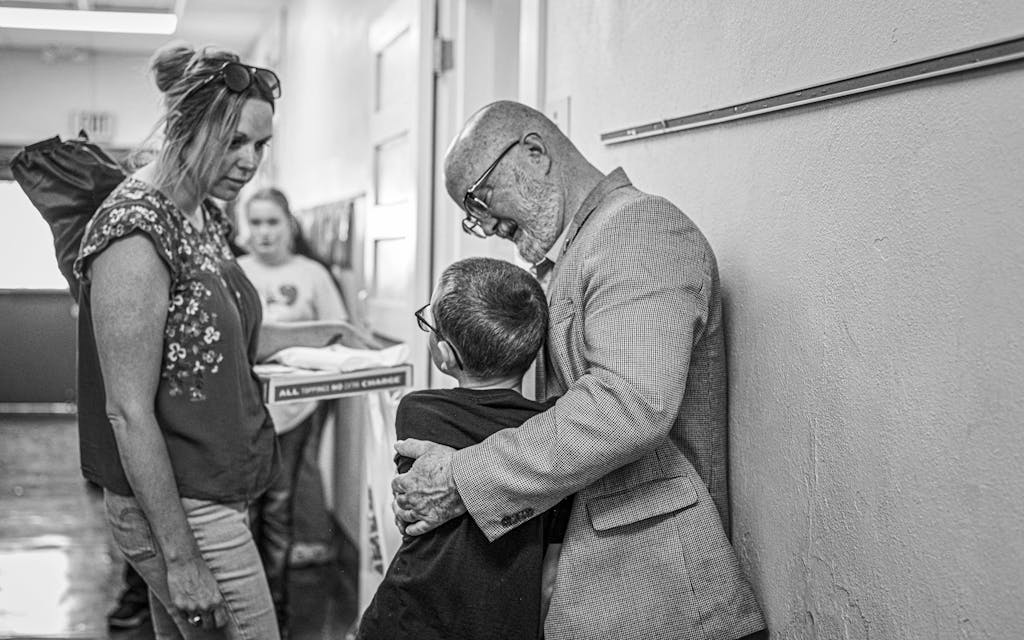
His family has been in the area since the 1870s, when federal soldiers still pursued Comanche and Apache from the town’s namesake garrison. His great uncle was one of the first superintendents of Fort Davis ISD. (At one point, Hicks showed me a copy of his great-uncle’s 1942 master’s thesis, “The Early Ranch Schools of the Fort Davis Area.”) Later, as we were walking around campus, Hicks’s ten-year-old grandson, a thin fourth-grader wearing blue-rimmed glasses and blue jeans tucked into a pair of cowboy boots, ran up to Hicks and gave him a hug.
Superintendent Hicks hugs his grandson in the hallway at Dirks-Anderson Elementary School in Fort Davis.Photograph by Maisie Crow
Both the elementary school and the high school—where Hicks graduated in 1982—were built in 1929, Hicks explained. Walking through their timeworn hallways is to step back in time. In places, the plaster is flaking off the original adobe walls. The elementary school gym floor is bubbling up because of a leak under the foundation. The wooden seats in the high school auditorium have never been replaced. The urinals in the elementary school are original too. The newest instructional facility, a science lab, was built in 1973. In the summer, Hicks mows the football field, the same one he played on five decades ago. “Every bit helps,” he said.
The funding challenges create all manner of ripple effects. Hicks has trouble recruiting and retaining teachers, and some students drift away from school without extracurriculars to hold their interest. “You lose teachers, then you start losing kids, and then your funding gets worse,” he said. “It’s a circle-the-drain kinda thing. And it’s really speeding up for Fort Davis.”
The first problem is the size of the district’s bucket. For the last decade, TEA has calculated that Fort Davis’s Tier I annual allotment is between $2 million and $2.5 million, well short of its already spartan $3.1 million budget.
And then there’s the matter of how that bucket is filled. In the 2011–2012 school year, the state covered two-thirds of Fort Davis’ entitlement, about $2.1 million. Today, it chips in about $150,000, a 93 percent decrease. How to explain that change?…
In June 2019, the Big Three figures in state government—Abbott, Patrick, and then–House Speaker Dennis Bonnen—gathered at an elementary school in Austin for an almost giddy bill-signing ceremony. As a bipartisan group of lawmakers watched, Abbott signed into law House Bill 3, an $11.6 billion package of property tax cuts and education funding that had received near-unanimous support in both the House and Senate, a rarity in the highly polarized Legislature. “This one law does more to advance education in the state of Texas than any law that I have seen in my adult lifetime,” said Abbott.
For almost a year, an appointed commission of experts had met to discuss how to overhaul the school-finance system, issuing a report in December 2018 that called on the Lege to “redesign the entirety of our state’s funding system to reflect the needs of the 21st century.” HB 3 was the by-product of that prompt. Lawmakers rejiggered many of the system’s outdated formulas, offered pay raises to teachers, fixed some of the most glaring inequities, and reduced the amount of money recaptured by the state from property-wealthy districts. Most important, HB 3 represented a much-needed infusion of cash for struggling schools. The basic allotment was raised from $5,140 to $6,120 per student.
But HB 3 also exacerbated disparities among property-wealthy and property-poor districts. Because of changes to the way Tier II enrichment funding works, some communities were able to cut tax rates and generate significant new revenues from their tax base. For others, a minority of districts, HB 3 actually created new problems. Around 10 percent of districts saw a decrease in formula funding. This year, Alpine has $220,000 less than it would have had under the old system, even as some of the richest districts in the state—tiny West Texas communities with lots of oil wealth—saw their funding explode. Rinehart contrasts Alpine, which has almost no mineral wealth, with Rankin ISD, 130 miles northeast in the Permian Basin oil patch. While Alpine’s funding went down 2 percent, Rankin’s went up 339 percent. Even though Rankin is projected to return close to $100 million in recapture payments to the state this year, the district is fabulously wealthy. “Alpine’s budget is $10 million,” Rinehart points out. “Rankin’s is $14 million. We educate a thousand kids and they educate three hundred kids. So they are a third of our size and have a budget 40 percent larger than ours.”
Rinehart doesn’t begrudge Rankin’s wealth—she recently served as assistant superintendent there—but uses the Alpine–Rankin comparison as a “wild” example of how HB 3 exacerbated inequities, making the rich richer and the poor poorer.
Hicks, too, has noticed. “Rankin just built a whole new school,” he told me. “They got a new fieldhouse, a new gym. Two new science labs. A turf practice field, a turf game field. A new track, a new stadium. And my buildings were built in 1929.” Rankin is planning to build ten new “teacherages”—district-funded housing for teachers, important to attracting and retaining talent in areas with scant or affordable residences.
Jeff Davis County, on the other hand, has no oil and gas and very little industry; any school debt would thus be borne by homeowners through bonds. Hicks’s district has never issued a bond, in part because it would be unlikely to pass; the voters wouldn’t support a tax increase. The school’s ag barn was built in 2019 with local donations. The band program, suspended for nine years as a cost-saving measure, was only revived in 2023 after a philanthropist left his estate to the school.
To be sure, Alpine and Fort Davis are outliers. Most districts saw an immediate boost to their finances from HB 3, and advocates celebrated a meaningful investment in public education after $5.4 billion in devastating cuts in 2013. But even for those districts, the sugar rush from HB 3 didn’t last long. According to Chandra Villanueva, the director of policy and advocacy at the progressive nonprofit Every Texan, the $1,000 increase in the basic allotment was “roughly enough to cover one year of inflation….”
The property tax system and the school finance system are inextricably linked, Rube Goldberg–style. Twist a dial here and a light will come on over there. Slip a gear here and spring a leak there. As state lawmakers have prioritized tax cuts over public education funding, the trade-offs have grown clearer. This year represents a potential turning point. But rather than trying to solve the problem using the $33 billion budget surplus—a generational bonanza—Abbott and Patrick have overwhelmingly focused their attention on property tax cuts and a school-voucher plan loathed by almost everyone in public education, in part because it would threaten to strip even more funding from school districts.
The just-completed regular session was a bloodbath. The 88th Legislature began in January with the governor and lieutenant governor promising to pass a transformative voucher program and a record-setting $17 billion in property-tax cuts. Funding for public education, often a banner issue, was scarcely discussed. Even the House, the friendlier chamber toward public education, only proposed raising the basic allotment by $140, from $6,160 to $6,300 per student—far less than the $1,500 increase needed to keep up with inflation since 2019, according to the Texas American Federation of Teachers. But in the end, teachers and public schools got virtually nothing.
Teachers and administrators were stunned. Zeph Capo, the president of Texas AFT, called it a “joke.” HD Chambers, the executive director of the Texas School Alliance, accused Patrick and Abbott of playing a “hostage game” with Texas’s teachers and public school students by tying education funding to vouchers. “It’s pretty simple. The governor and Senate says, ‘If you don’t give us the kind of vouchers we want, we’re not giving you any money.’” The House refused to budge, and the regular session concluded without a deal on property tax relief, vouchers, and other GOP priorities.
Now, the governor has promised to convene multiple special sessions to take up the unresolved issues. The first special session began three hours after the regular one ended, and effectively wrapped up less than 24 hours later, with the House rejecting the Senate property-tax plan, passing its own program consisting solely of property-tax compression, and then abruptly adjourning. Abbott threw his support behind the House plan. The message to the Senate was clear: take it or leave it. If the Senate yields, the House version would push some school districts down to as low as $0.60 per $100, with no new source of revenue to backfill for the reduced funding in case of a bad economy.
Abbott has said his goal is to completely eliminate the main school property tax. In such a scenario, Texas’s thousand-plus school districts would be at the mercy of the Legislature for funding—a troubling scenario, says Villanueva. She suspects vouchers would then become inevitable. “At that point, it’s like, ‘You know what, we don’t have the money to fund schools. Everyone take five thousand bucks, figure it out for yourselves.’”
That day, if it ever comes, may still be far off. But the education system is in crisis right now, and unlike previous hard times, the state is flush with cash. The pain, Chambers says, is being intentionally inflicted by Abbott and Patrick. “Because of this one pet project that the governor has”—vouchers—“they are purposely creating a financial environment where every school district in Texas is being set up to fail.”
The result is that Texas schools, already operating on “shoestring budgets,” will have a harder time attracting and retaining educators, said Josh Sanderson, the deputy executive director of the Equity Center, a nonprofit that represents six hundred Texas school districts. They will run up deficits. They may have to cut extracurriculars and athletic programs. Some, like Fort Davis, may become insolvent and be forced to consolidate with another district, an often painful process.
As we were sitting in his red pickup with the engine idling outside his office, Hicks told me that he’d given up on lobbying the Legislature. He mentioned again that Patrick and other GOP lawmakers are trying to destroy public education by using vouchers to privatize schools, and he said that most other politicians “don’t give a shit about West Texas.” But for the time being he was still fighting: writing op-eds, firing off plaintive missives, asking concerned citizens to contact their legislators.
Toward the end of our visit, I asked Hicks what’s going to happen to his schools. “I don’t know,” he said. “I’m not patient enough to spend time with assholes in Austin, and I’m not rich enough to buy any votes.” TEA has suggested consolidating with another district—most likely nearby Valentine ISD—but Hicks said this would harm both Fort Davis and the other district.
He seemed resigned to his role as a Cassandra warning of impending doom, destined to be ignored. He reminded me that his grandson goes to school here, and that the painful road ahead feels both personal and existential. “If you don’t have a school,” he said, “you don’t have a community.”
Two months later, Hicks called me with some news. He’d decided to resign this summer, joining the mass exodus of school leaders that have fled the profession in the past few years. To anyone who closely follows public education in Texas, his reasoning was tragically familiar: He said he was too tired to fight anymore.
Retired educator Rich Migliore knows that the current rightwing demands for censorship violate the Constitution. Sadly, the current Supreme Court seems determined to obliterate the long-honored tradition of separation of church and state, creating a breach into which religious zealots are eagerly pushing their creeds. The high court has signaled through several of its recent decisions that at least five, possibly six, of its members are willing to eviscerate that separation.
He writes:
Freedom of thought, freedom of belief, freedom of religion, freedom of speech, freedom of expression, and the freedom to read books of our choice are among our most precious human rights. And the freedom from having other people’s religion and beliefs imposed upon us is among our basic human rights as a free people. That is why they were placed first in the Bill of Rights.
When we allow others to impose their religion and beliefs upon us we cease to be a free people. May I again quote from my favorite Supreme Court Opinion issued in the year that I graduated from high school.
“The vigilant protection of constitutional freedoms is nowhere more vital than in the community of American schools.” Tinker v. Des Moines Independent Community School District; U.S. Supreme Court (1969), (quoting Justice Brennan in Keyishian v. Board of Regents.
“The classroom is peculiarly the ‘marketplace of ideas.’ The nation’s future depends upon leaders trained through wide exposure to that robust exchange of ideas which discovers truth ‘out of a multiple of tongues, (rather) than through any kind of authoritative selection.”
Our founders wisely separated church and state. And the Fourteenth Amendment’s Due Process clause protects our liberty interest in freedom of thought, freedom of belief and freedom of religion.
We do not give up those rights “when we cross the school house gates.” Nor do our children.
Nicholas Kristof is a columnist who is terrific on many issues but consistently wrong when he writes about education. As far back as 2009, I criticized Kristoff for a column in which he called American education “our greatest national shame,” citing Eric Hanushek’s since-discredited work on teachers (the best get students to produce high test scores, bad teachers don’t). Peter Greene took Kristoff to task in 2015 for being an educational tourist, making quick visits and issuing pronouncements that are wrong. I also chastised him in 2017 for endorsing for-profit schools in Africa.
Based on the impressive rise of 4th grade reading scores on NAEP, Kristof proclaims that Mississippi has lessons for the nation.
With an all-out effort over the past decade to get all children to read by the end of third grade and by extensive reliance on research and metrics, Mississippi has shown that it is possible to raise standards even in a state ranked dead last in the country in child poverty and hunger and second highest in teen births.
In the National Assessment of Educational Progress, a series of nationwide tests better known as NAEP, Mississippi has moved from near the bottom to the middle for most of the exams — and near the top when adjusted for demographics. Among just children in poverty, Mississippi fourth graders now are tied for best performers in the nation in NAEP reading tests and rank second in math.
Its success wasn’t because of smaller classes. That would cost money.
It wasn’t because of increased funding.
It wasn’t because Mississippi reduced child poverty.
It wasn’t because of desegregation.
It was because Mississippi embraced the “science of reading,” strict discipline, relentlessly focusing on test scores, and using behavioral methods that sound akin to a “no excuses” charter school.
In 2000, Mississippi received a gift of $100 million from a Mississippi-born tech entrepreneur to launch a statewide reading initiative. In 2013, the legislature invested in full-day pre-K, where children got a start on letters, numbers, and sounds.
The 2013 legislation also enacted third-grade retention. Any child who didn’t pass the third-grade reading test was retained. Most researchers think retention is a terrible, humiliating policy. But Kristof assures readers that failing students get a second chance to pass. 9% of students in third grade flunked. He considers this policy to be a great success, inspiring third graders to try harder, citing a study funded by Jeb Bush’s foundation (Florida also practices third grade retention, which lifts its fourth grade reading scores on NAEP).
Kristof writes:
“Mississippi is a huge success story and very exciting,” David Deming, a Harvard economist and education expert, told me. What’s so significant, he said, is that while Mississippi hasn’t overcome poverty or racism, it still manages to get kids to read and excel.
“You cannot use poverty as an excuse. That’s the most important lesson,” Deming added. “It’s so important, I want to shout it from the mountaintop.” What Mississippi teaches, he said, is that “we shouldn’t be giving up on children.”
The lessons: it’s okay to forget about poverty; forget about segregation; forget about funding. Rely on “the science of reading” and third-grade retention. It’s cheap to follow Mississippi’s lead, which Kristof considers an advantage.
But!
Kristof minimizes Mississippi’s eighth-grade scores on NAEP. He writes: “One challenge is that while Mississippi has made enormous gains in early grades, the improvement has been more modest in eighth-grade NAEP scores.”
That’s an understatement.
Eighth grade reading scores in Mississippi have gone up over the past two decades, but scores went up everywhere. In the latest national assessment (NAEP), 37 states had scores higher than those of Mississippi on the NAEP eighth grade reading test. Only one state (New Mexico) was lower. The other 13 were tied. In Mississippi, 25% of the state’s students in 2019 (pre-pandemic) were at or above proficient, compared to 20% in 2003. Nationally, in 2019, 29% of students were at or above proficient*.
In 2019, 42 states and jurisdictions outperformed Mississippi in percentage of students at or above proficient in eighth grade math, eight were tied, and only two scored below Mississippi. 24% were at or above proficient in 2019, a big increase over 2009 when it was 15%. But Mississippi still lags the national average, because scores were rising in other states.
Has Mississippi made progress in the past decade? Yes. Is it a model for the nation? No. When impressive fourth grade scores are followed by not-so-impressive scores in eighth grade, it suggests that the fourth grade scores were anti Oakley boosted by holding back the 9% who were the least successful readers. A neat trick but not an upfront way to measure progress.
It seems fairly obvious that the big gains in NAEP in fourth grade were fueled by the policy of holding back third graders. Jeb Bush boasted of the “Florida Miracle,” which was based on the same strategy: juice up fourth grade scores by holding back the lowest performing third graders.
Mississippi has made progress, to be sure. But it is not a national model. Not yet.
What’s worrisome about this article is that Kristof asserts that poverty doesn’t matter (it does); funding doesn’t matter (it does); class size doesn’t matter (it does). In his account, states that want to improve test scores can do it without raising teachers’ salaries, without upgrading buildings, without spending a nickel to improve the conditions of the schools or the well-being of children. Children who are hungry, lack medical care, and are homeless or ill-housed are not likely to learn as well as those who have advantages.
Does this explain why so many rightwingers love “the science of reading”? Publishers are rolling out new programs. Education can be reformed in the cheap. Can’t expect taxpayers to foot the bill, can you?
Kristof’s fundamental error is his determination to find miracles, silver bullets, solutions that fix everything. He did it again.
The U.S. Department of Education appends this disclaimer to every NAEP publication.
*NAEP achievement levels are performance standards that describe what students should know and be able to do. Results are reported as percentages of students performing at or above three achievement levels (NAEP Basic, NAEP Proficient, andNAEP Advanced). Students performing at or above the NAEP Proficient level on NAEP assessments demonstrate solid academic performance and competency over challenging subject matter. It should be noted that the NAEP Proficient achievement level does not represent grade level proficiency as determined by other assessment standards (e.g., state or district assessments). NAEP achievement levels are to be used on a trial basis and should be interpreted and used with caution. Find out more about the NAEP reading achievement levels.


 Diane Ravitch's blog