Archives for category: Education Reform

Jeanne Kaplan was a tireless champion of public schools in Denver. She was elected to two terms on the Denver school board. She fought for better, more equitable, fully funded schools. She opposed charter schools because they drained funding from public schools. She was a long-time crusader for civil rights, and she appalled by the takeover of the Denver schools by charter interests, who flew a false flag, pretending to care about equity.

Jeannie learned that she had lung cancer last April. Her medical treatment did not slow the disease. She died yesterday. She was 78.

I met Jeannie in Denver in 2010 as I was traveling the country to promote my book The Death and Life of the Great American School System: How Testing and Choice Are Undermining Education. When I met her, we became fast friends. We were on the same page, and she told me about the damage that charter schools were doing to Denver’s public schools. Candidates for the Denver school board were funded by Dark Money, privatizers, and out-of-state billionaires. It was almost impossible for a parent to raise the money to be competitive with the corporate reform candidates.

Jeannie was a warm and caring person who inspired others to get involved, despite the odds crested by Big Money. She started her own blog called “Kaplan for Kids,” and I reposted some of them here.

I think the best way to honor her memory here is to post what seems to be her last commentary, which overflows with wisdom, candor, experience, and common sense. I humbly add her name to the honor roll of the blog.

Jeannie Kaplan wrote:

CHARTERS, CHOICE, and COMPETITION = CLOSURES, CHAOS, and CHURN Principles of Privatization

Posted on November 1, 2022 by Jeannie Kaplan

Reap what you sow and the chickens come home to roost. The elephant in the room.  Aphorisms appropriate to describe what is happening in public education in Denver. 

After 20 years,  more than 5  superintendents, and 11 different school boards, the results of education reform in Denver have become clear, and they aren’t pretty. After opening 72 charters in the last 20 years, 22 of which have closed, the declining enrollments in neighborhood schools have forced the prospect of school closures.  Who knew opening 26 privately run elementary charter schools in competition with district-run schools would ultimately force the district to make some hard financial decisions?  And who knew that ignoring its own 2007 data showing stagnant population growth would lead to less demand for elementary school seats in the 2020s?  Apparently, not those with the power for the last 20 years.  And, as an ironic aside, many of the same people who were the decision-makers in the past and who were unable to make substantive change then, have now decided they will somehow make these previously unattainable changes from their outside “oversight” committee, EDUCATE Denver. In fact one of the co-chairs, Rosemary Rodriguez, was a DPS board member when on March 16, 2017, a Strengthening Neighborhoods Resolution passed, stating:

NOW, THEREFORE, BE IT RESOLVED, that a citywide committee be formed to review changing demographics and housing patterns in our city and the effect on our schools and to make recommendations on our policies around boundaries, choice, enrollment and academic programs in order to drive greater socio-economic integration in our schools.

BE IT FURTHER RESOLVED, that in the face of the sharp decline in the number of school-aged children in gentrifying neighborhoods, the committee is also charged with how to think about school choice and school consolidation to ensure that our schools are able to offer high-quality, sustainable programs for our kids.

These former school board members and former and current civic leaders have formed a “shadow school board” to evaluate and oversee the current superintendent and school board.  Why?  It appears they don’t like what they are seeing being proposed by the current superintendent. What don’t they like?  It appears they have determined the current superintendent is not committed enough to their reform agenda.  You know – the one that has been in place when they were in power, the one that has produced the biggest gaps in the nation, more segregation, and more resource inequity.

As school closures have risen to the fore this week Chalkbeat disclosed these statistics:

“Over the past 20 years, Denver Public Schools has added a lot of schools. It has added students, too — but at a much slower rate.

  • The number of public schools in Denver grew 55% between the 2001-02 and 2021-22 school years, while the number of students grew just 12%.
  • Denver went from having 132 schools serving about 72,000 students in 2001-02 to 204 schools serving nearly 89,000 students in 2021-22.
  • The number of elementary schools in Denver grew 23% over the past 20 years, while the number of students grew just 4%.”

Through expensive marketing and often false narratives, charter schools have had free reign to prey on susceptible families resulting in DPS losing 7400 elementary school students who would have otherwise most likely attended a neighborhood school. Then add in:

  • a state law that prohibits a district from shutting down low enrollment charters, 
  • a district that has ignored demographic information predicting declining enrollment, 
  • a district that employs “attendance zones” and a secretive CHOICE system to often force place students into heavily marketed, often unwanted CHARTER SCHOOLS, and 
  • a competitive financial model called Student Based Budgeting (SBB – money follows the kid) to fund schools, depending on student needs, the goal of which is to close the achievement and resource gaps.  The 2010 Denver Plan/ Strategic Vision and Action Plan describes SBB this way:  
  • Established student-based budget formulas that increase dollars for middle and high school students, special education, English language learners, gifted and talented programs, and students living in poverty. Resource distribution is now more closely aligned with the costs of serving these students. p. 51
  • Refine Student-Based Budgeting formulas to ensure they are best meeting the needs of all of the district’s students. Continue to evaluate and adjust student-based budgeting formulas to 1) meet student needs, 2) make progress on closing the achievement gap, and 3) grow the number of high school graduates and college-ready students. p. 53

No one should be surprised the DPS superintendent is saying schools must be closed (new word is UNIFIED but it still means CLOSURE), given the quagmire he entered.  What would you expect to happen when 72 new charter schools are opened in a landscape of stagnant or declining population growth? Who should be held responsible for the chaos and churn caused by this over-expansion of new charter schools? 

I know, I know. One isn’t supposed to talk about charters any more. But it is the elephant in the room. Education “reformers” want you to believe charters are an irrevocable fact of life in public education, stare decisis if you will. But as we have recently witnessed, that precedent is non-binding. So let’s use it to the advantage of neighborhood school advocates. Let us not assume charters are inevitable, especially given the chaos and poor academic outcomes charters are producing. Denver isn’t the only place experiencing the madness of so many charters. Just this week lifelong educator Arthur Camins wrote:

It is time for Democrats–voters and the politicians who represent them–to abandon charter schools as a strategy for education improvement or to advance equity. Charter schools, whether for- or non-profit, drain funds from public schools that serve all students, increase segregation, and by design only serve the few.

It is worth repeating that in 20 years, DPS has added 72 charter schools, 22 of which have closed.  As students of public education repeatedly attest to, charters have been particularly harmful to neighborhood schools for they gut these schools of resources. Charters have also been disruptive to communities and have contributed to increasing inequity and segregation in our schools. It is not possible to have an honest conversation without addressing that elephant in the room.  Charter schools along with their partners – choice and competition – have had their chance in Denver and their biggest accomplishment has been to pressure neighborhood schools to close.

Let us not overlook the demographic projections DPS has been aware of since the mid 2000’s. 

“It’s really simple, we’ve seen a slow down in births,” said Elizabeth Garner, demographer for the state. “Starting back in 2007, that was our peak birth year, we’ve seen a slowing in births ever since. So with fewer kiddos, that means lower school enrollment.”

Let us not overlook who was supporting and approving this unchecked expansion.  DPS had strong indicators from as early as 2007 onward the population of the city and the number of school-age children was flattening, and yet the district with the strong support of many of the aforementioned  “oversight committee”, EDUCATE Denver, pushed for this proliferation of new charter schools without giving demographics its proper due.

Loss of students = loss of funding (SBB) = loss of programming and supports = closure

Superintendent Alex Marerro has been charged with improving student outcomes and reducing gaps by implementing his strategic plan.  School unifications are one way he has chosen to start this process.  He inherited a district suffering from years of “feel good” oversight from boards and the nonprofit world determined to paint a rosy picture of reform education success, a district more focused on good public relations stories than actual educational outcomes. Now he has to try to provide solutions to problems that have not been dealt with honestly for years. And yes, “unification” has raised as many questions as it has provided answers such as how transportation and language services will be provided and what will be done with these empty buildings. And there is the elephant in the room – again.  Charter schools. Why are they not included in his recommendations? Again, he has no authority to recommend closing them, even though several are also suffering from declining enrollment.  Given this reality, it will be interesting to see how he chooses to address this issue. In the end, how can the board fairly evaluate him according to measures both they and he just agreed on, if it rejects his operational ideas?

As for what neighborhoods these closures would most heavily affect – What would one expect to happen when new charters are opened in neighborhoods heavily populated by families of color and families struggling economically?  Why is there any surprise that most of the schools on the “unification” list affect these neighborhoods?  How could it be otherwise when these are the sites of uncontrolled, privately run options to public schools.  Sadly, it only makes sense that these are the neighborhoods that would suffer the highest impact of school closures.

Few like to close schools.  It is a heart-wrenching, disruptive, negative process. But given the lack of thoughtful planning and oversight for 20 years, what is the better option? Keeping schools open without the financial ability to provide necessary services and supports, or providing unified schools with the money to provide language support,  art, music, nurses, librarians, psychologists, speech therapists?  

Imagine a great school district that had paid attention to population warnings and  hadn’t opened so many charter schools over the last 20 years. Imagine all those charter school children filling those neighborhood schools.

The chickens have come home to roost.
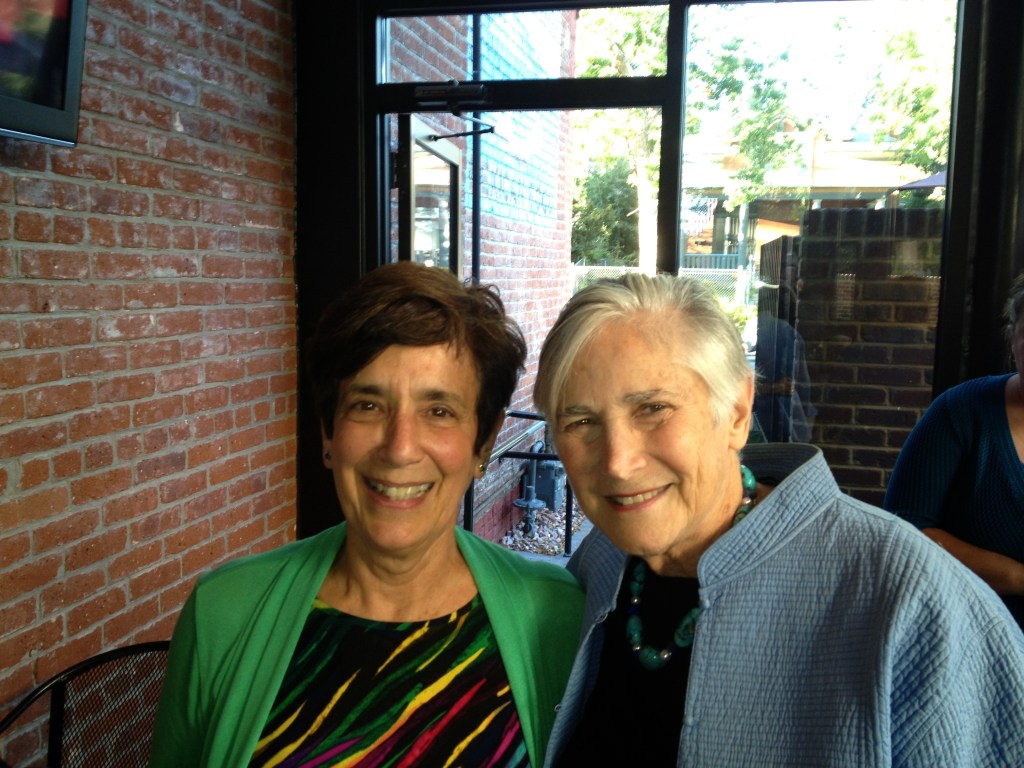
Jeannie and I in Denver, 2013.

Thomas Ultican of California has become a regular attendee at the annual meetings of the Network for Public Education. He attended every keynote and many panels, and he reports here on what he heard.

Ultican wrote:

NPE met at the Capitol Hilton for a weekend conference beginning on Friday, October 27. The old hotel seemed well maintained. That first evening, Diane Ravitch interviewed James Harvey who was a key contributor to “A Nation at Risk.”We gathered in a large conference room which caused Mr. Harvey to comment, “I remember being at a meeting in this room fifty years ago when we heard that Alexander Butterfield had just testified that there were tapes of the oval office.” With that historical reference, the conference was off to a wonderful start.

A Nation at Risk” is seen as an unfair turning point that undermined public education. Mr. Harvey’s job was to synthesize the input from members of the National Commission on Excellence in Education, which was created by Secretary of Education Terrence Bell to produce the report. He shared with us that two famous academics on the panel, Nobel Prize winner Glen Seaborg and physicist Gerald Holton, were the driving forces for politicizing public education.

Diane Ravitch and James Harvey

That first night’s presentation was actually an added event for the benefit of us coming in on Friday afternoon. The conference had three keynote addresses, two panel discussions and seven breakout sessions. The difficult problem was choosing which of the six offerings in the breakout sessions to attend.

Pastors for Children

For session one, I attended “Mobilizing Faith Leaders as Public Education Allies.” The amazing founder of Pastors for Children, Charles Foster Johnson, and his two cohorts were well reasoned and did not proselytize us. Their movement really does seem to be about helping communities and not building their church. Among Johnson’s points were,

  • “Privatized religion teachers believe “God likes my tribe best.”
  • “We are the reason there is not a voucher program in Texas.”
  • “Conservatives and liberals come together over education.”
  • “Faith leaders have a different effect when lobbying politicians.”
  • “We are making social justice warriors out of fundamentalist Baptist preachers.”

Houston School Takeover

I have no intention of writing about each of the 7 sessions I attended, but the session on the Houston School District takeover needs mention.

Texas took-over Houston Independent School District (ISD) on June 1, 2023. It is the largest school district in the state and eighth largest in the country with more than 180,000 students attending 274 schools. The student demographics are 62% Hispanic, 22% African-American, 10% White and 4% Asian with 79% identified as economically disadvantaged.

In 2021, Millard House II was selected by a unanimous vote of the Houston ISD school board to be Superintendent. Under his leadership, Houston ISD was rated a B+ district and the school in one of Houston’s poorest neighborhoods that was used to excuse the takeover received a passing grade on Texas’s latest STAR testing. The take-over board replaced House with Mike Miles, a charter school operator from Colorado who previously only lasted 2 years of his five year contract to lead the Dallas ISD.

Ruth Kravetz talked at some length about the how angry Houstonians are and their effective grassroots organizing. Kravetz stated, “We want Mike Miles gone.” She noted that the local media started turning against the takeover when citizens were locked out of the first takeover board meetings. Kravetz intoned,

  • “Teachers no longer need a certificate or college degree to teach in Houston ISD.”
  • “Seven year-olds are not allowed to use restrooms during instructional times. They must wait.”
  • “People are being fired for ridiculous reasons. Five people were fired last week over a made up story.”
  • Expect more student action against the takeover.
  • “Rolling sickouts are coming.”

Jessica Campos is a mother in one of Houston’s poorest communities. She said her school is made up of 98% Mexicans with 68% of them being Spanish speakers. Jessica claims, “Our school community has been destroyed” and reported that all teachers were removed with many being replaced by uncertified teachers.

Daniel Santos (High School social studies teacher) said,

“It is all about dismantling our school district. We wear red-for-Ed every Wednesday and Mayor Turner lights up city hall in red.”

The Keynote Addresses

Gloria Ladson-Billings from the University of Wisconsin Madison delivered the first Keynote address on Saturday morning.

She mentioned that we were really dealing with 4 pandemics:

  1. Covid-19
  2. George Floyd murder
  3. Economic Shesession” (Large numbers of women were forced to leave the workforce.)
  4. Climate catastrophe

Professor Ladson-Billings claims the larger agenda is the complete eradication of public education in what she sees as an evolving effort.

  • The evacuation of the public spaces which are being privatized.
  • Affordable, Reliable and Dependable (public space keys) is being undermined.
  • Public housing is closing.
  • The last domino is public education!

Ladson-Billings says, “choice is a synonym for privatization.” There is money in the public and wealthy elites do not think the public should have it.

She noted, “We are in the business of citizen making.” We do not want to go back to normal because it was not that great.

Ladson-Billings ended on a positive note about the attack on public education in Florida, “All is not lost – people on the ground in Florida are working hard to reverse it.”

History Professor Marvin Dunn from Florida was our lunch time keynote speaker. Professor Dunn has been working hard to educate the children of Florida about the states racist past including giving guided tours of the site of the 1923 Rosewood Massacre of an African American community.

He noted that “Racism is in our national DNA” and shared that George Washington owned 500+ slaves. When he was 11 years-old, Washington was given his first slave. Still, 500 black soldiers were with him at the crossing of the Delaware river.

Another American icon mentioned by Professor Dunn was Thomas Jefferson. The third president of the United States was 41 years-old when first having sexual relations with Sally Hemings; she was 14.

Julian Vasquez Heilig, Josh Cowen and Jon Hale held a public discussion late in the afternoon on Saturday. The moderator, Heilig, made the point that instead of funding one system, now many states are funding three systems with the same amount of dollars.

Josh Cowen, from Michigan State University, noted that using evidence based data, since 2013, vouchers have been catastrophic. If we were using evidence informed education policy, vouchers would have died 5 years ago. Test score losses from voucher students are greater than those experienced in either Katrina or Covid-19. He also noted that 20% – 30% of children give up their voucher each year.

Cowen added don’t believe a word coming out of Iowa Governor Kim Reynolds’ mouth. She has instituted vouchers, opposed abortion and supported child labor. Reynolds is pushing Christian nationalism.

Jon Hale, from the University of Illinois says white architects of choice have a 70 year history. He says it was never about improving schools. The white supremacist movement sprung up after Brown versus the Board of Education in 1954…

What I Found

Several participants showed up kind of down in the mouth. However, by the end of the conference they were heading back home with new energy and resolve. Billionaires are spending vast sums of money trying to end public school because if public education goes then all of the commons will follow. Their big problem is that vast wealth and spending is not a match for the grassroots organizing that is happening throughout America.

Diane Ravitch, Carol Burris and the members of NPE have become a bulwark for democracy and public education.

Paul Thomas of Furman University is a clear-sighted analyst of education policy. He is fearless when it comes to calling out frauds. This post is a good example.

He writes:

“The administrations in charge,” write Gilles Deleuze in Postscript on the Societies of Control, “never cease announcing supposedly necessary reforms: to reform schools, to reform industries, hospitals, the armed forces, prisons” (p. 4).

Deleuze’s generalization about “supposedly necessary reforms” serves as an important entry point into the perpetual education crisis in the US. Since A Nation at Risk, public education has experienced several cycles of crisis that fuel ever-new and ever-different sets of standards and high-stakes testing.

Even more disturbing is that for at least a century, “the administrations in charge” have shouted that US children cannot read—with the current reading crisis also including the gobsmacking additional crisis that teachers of reading do not know how to teach reading.

The gasoline that is routinely tossed on the perpetual fire of education crisis is test scores—state accountability tests, NAEP, SAT, ACT, etc.

While all that test data itself may or may not be valuable information for both how well students are learning and how to better serve those students through reform, ultimately all that testing has almost nothing to do with either of those goals; in fact, test data in the US are primarily fuel for that perpetual state of crisis.

Here is the most recent example—2023 ACT scores:

I have noted that reactions and overreactions to NAEP in recent years follow a similar set of problems found in reactions/overreactions to the SAT for many decades; the lessons from those reactions include:

  • Lesson: Populations being tested impact data drawn from tests.
  • Lesson: Ranking by test data must account for population differences among students tested.
  • Lesson: Conclusions drawn from test data must acknowledge purpose of test being used (see Gerald Bracey).

The social media and traditional media responses to 2023 ACT data expose a few more concerns about media, public, and political misunderstanding of test data as well as how “the administrations in charge” depend on manipulating test data to insure the perpetual education crisis.

Many people have confronted the distorting ways in which the ACT data are being displayed; certainly the mainstream graph from Axios above suggests “crisis”; however, by simply modifying the X/Y axes, that same data appear at least less dramatic and possibly not even significant if the issues I list above are carefully considered….

This crisis-of-the-day about the ACT parallels the central problem with NAEP, a test that seems designed to mislead and not inform since NAEP’s “Proficient” feeds a false narrative that a majority of students are not on grade level as readers.

The ACT crisis graph being pushed by mainstream media is less a marker of declining educational quality in the US and more further proof that “the administrations in charge” want and need testing data to justify “supposedly necessary reforms,” testing as gas for the perpetual education crisis fire.

Please open the link to read this excellent analysis in full.

In case you missed the Network for Public Education’s 10th annual conference, Jan Resseger gives you here a brief overview.

It was a well-planned conference with great speakers and panels. Every year, we say, “This was the best ever.” We said it again this time. How will we top this next year? The presentations of the keynote speakers were recorded and I will post them.

Jan Resseger writes:

It was while I was traveling home from last weekend’s Network for Public Education Conference that I realized I had not once heard Miguel Cardona’s name mentioned—even though the meeting was in Washington, D.C. Miguel Cardona is, of course, the U.S. Secretary of Education.

This year’s conference felt different than earlier conferences, when worries about federal policy brought by previous Secretaries of Education became a unifying focus. Rod Paige brought us “the Texas Miracle,” the test-and-punish model policy that spawned No Child Left Behind. Arne Duncan bribed the states with huge federal grants if they agreed to adopt his favorite Race to the Top priorities. And Betsy DeVos talked on and on about her favorite subject, school privatization.

Federal policy can be helpful or harmful for public schools. But with Miguel Cardona’s quiet management style and in the context of a badly divided Congress, any chance of our framing a collective narrative response to a nationwide policy has faded. It is, of course, true that a lot of awful remnants of the No Child Left Behind and the Race to the Top era, like the federal Charter Schools Program that continues to support privately operated charter schools, remain in federal law. The remains of Race to the Top also still clutter the laws from state to state. But except for the Network for Public Education’s dogged effort to end funding for the federal Charter Schools Program, the focus on federal advocacy at this year’s conference seemed to have become limited. Keynoters were clear, however, that the attack on absolutely essential Title I funding from House Republicans is being vigorously countered by the Biden administration and in the U.S. Senate.

At last weekend’s conference it was clear that today the most damaging education policy is emerging in the 50 state legislatures, a situation which creates a challenge for collective advocacy. While states like Wisconsin, Indiana, and Ohio are all facing school funding shortages and concurrent growth in the diversion of state dollars to school vouchers, state laws and state politics make it extremely challenging for advocates even in these three similar states to pull together a coherent and moving universal narrative that also accounts for each state’s wonky legislative differences. At last week’s conference, workshops on the implications of state policy informed participants about work to reform Pennsylvania’s charter schools; to defend public schools from Ron DeSantis’s attack on teaching inclusive history in Florida; to push back against state takeovers in Houston, Lorain, Ohio, and Nashville; to inform the public about school funding lost to tax abatements in Kansas, South Carolina, Louisiana, and Missouri; to press for the end of portfolio school reform in Denver; and to help parent and teachers union advocates work together to build support for investment in equitable public schools as they did during teachers’ strikes in Los Angeles and Oakland.

Opposing the Growth of School Privatization via Vouchers

In this year of explosive growth of private school tuition vouchers across the states, several workshops explored the evidence that vouchers don’t fulfill the promises of their proponents. Experts presented research findings demonstrating that parents sign away their children’s constitutional protections when they accept a voucher to send a child to a private school. One researcher described the result as “the outsourcing of discrimination.” Another presented peer-reviewed research showing that students’ test scores in both math and reading dropped significantly after they took a voucher to attend a private school, and that many return suddenly to the public school district when their voucher school forces them out for one reason or another or she school suddenly closes. Public schools are prohibited by law from routinely expelling students; private schools accepting vouchers often push out children with special needs or those who do not fit their school’s profile.

Several workshops examined the fiscal damage when states divert massive tax dollars to uncapped voucher and Education Savings Account programs, which are often unregulated and poorly managed. Public Funds Public Schools, a collaboration of the Education Law Center and the Southern Poverty Law Center, shared its website that tracks voucher schemes across the states and provides up to date resources for advocacy. Two workshops presented full-service Community Schools, which are likely to become any family’s best school choice as medical, family, and community services are located right inside the neighborhood public school.

Refusing to Be Distracted by the Far-Right Culture Wars

Another factor creating today’s difficult public education policy climate is the massive investment in racist and homophobic “culture war” disruption by billionaire philanthropists and dark money groups. In A Citizen’s Guide to School Privatization, a new resource just published on the Network for Public Education’s website, Massachusetts political science professor Maurice Cunningham traces the dangerous groups working together to rile up and divide parents and distract us all from more constructive efforts to strengthen public schooling and make our schools more inclusive. The result? “Chaos is the product. It’s a lot easier to break something than to build something or to improve upon it.”

In a workshop last weekend, Cunningham described some of the research he has published in his new, and well documented Citizen’s Guide, for example, the following about the national organization that basically funds and operates Moms for Liberty: “The Council for National Policy… brings together wealthy conservatives, many from the oil and gas realm; Christian evangelists with vast communications networks; and groups that can turn out groups like the National Rifle Association. The Council for National Policy is a central directorate passing down plans to ‘obedient franchises’ like Moms for Liberty. The key Council for National Policy members that oversee Moms for Liberty are the Leadership Institute and Heritage Foundation. They run the annual summits, provide the training and literature, and even sue the Biden administration on Moms for Liberty’s behalf.”

What About the Separation of Church and State?

One workshop last weekend brought researchers from Documented to explore the Christian Right organization, the Alliance for Defending Freedom, which has worked to develop a legal strategy to confront public schools around the idea that “public schools are indoctrinating children with a secular worldview that amounted to a godless religion.”

While private schools accepting vouchers have been quietly teaching religion for years and at the same time failing to protect the rights of their students, in a workshop last weekend three legal experts set out to clarify the issues posed by an explicitly religious charter school, St. Isidore of Seville Catholic Virtual School, which the Roman Catholic Archdiocese of Oklahoma City has proposed to open. The presenters explored the question legally: whether, as publicly funded private contractors, charter schools are “state actors.” The issue is so complex in terms of legal precedents that even among the presenters there was subtle disagreement.

Participants in this and another workshop I attended seemed concerned about the broader constitutional question of the separation of government and religion. Many seemed clearly to grasp the importance of the first Amendment’s Establishment Clause’s protection of church-state separation, and many were concerned and confused about the current U.S. Supreme Court’s reliance on the Free Exercise Clause instead. It seemed a good thing that staff from Americans United for Separation of Church and State were workshop presenters in this year’s Network for Public Education conference to help clarify the issues around the current U.S. Supreme Court’s interpretation of religious liberty.

Working for Racial Justice

Many of the leaders and powerful speakers at last week’s conference identified racism and its lingering role as the greatest factor undermining children’s experience in public school along with the unequal school funding from state to state that regularly disadvantages Black and Brown children. It is clear that today’s attacks on the honest teaching of American history, on critical race theory, and on “diversity, equity and inclusion” are a blatant attempt to marginalize Black, immigrant, and gay, lesbian, and transgender children and adolescents.

Last weekend we heard about and talked about what happens when Ron DeSantis and others attack “diversity, equity, and inclusion” efforts as “woke.” Their goal is to ensure that schools can remain segregated by race and economics so that parents can protect their children from exposure to diversity; that state school funding schemes remain inequitable by favoring wealthy suburbs; and that public schools can exclude the history and culture and identity of some children from the curriculum and ban books about these children. Promoting homophobia and “fear of the other” is central to this agenda. Speakers throughout the event traced the advent of school vouchers back to the segregation academies that were a response to Brown v. Board of Education.

Gloria Ladson-Billings, the retired Kellner Family Distinguished Professor of Urban Education at the University of Wisconsin, Madison, seemed the perfect person to launch the conference’s opening plenary in this year filled with attacks on efforts by schools to protect diversity, multicultural education and authentic welcome for all students. Ladson-Billings’ own website introduces her as “known for her work in the fields of culturally relevant pedagogy and critical race theory, and the pernicious effects of systemic racism and economic inequality on educational opportunities.” Keynoter, Dr. Marvin Dunn, Professor Emeritus in the Department of Psychology at Florida International University, described his project to lead students on tours of the site of the 1923 Rosewood Massacre of an African American community in Florida. Governor Ron DeSantis has attempted to suppress teaching about such events. A workshop highlighted the work of the Schott Foundation’s Opportunity to Learn Network along with the role of full-service Community Schools to house social, medical and community services to serve families and make them feel welcome and supported. Finally Jitu Brown and staff from the Journey for Justice Alliance introduced the Journey for Justice Alliance’s national Equity or Else Campaign for racial justice.

Remembering the Urgent Importance of Public Schooling for These Tough Times

Many of the event’s speakers called the growing attack on public education combined with rapid expansion of private school tuition vouchers and states’ investment in privately operated charter schools an existential threat to the primary institutions that anchor every small town, city neighborhood and suburb: the public schools that continue to educate the vast majority of our children and adolescents. As we strategize about how to push back against the threats to our public schools, however, the National Education Association’s Susan Nogan ended her workshop presentation with a reminder: “We must lead with our shared values.” Ladson-Billings opened the conference with a keynote entitled, “Regaining a ‘Public’ for Public Education.” Keynoter Julian Vasquez Heilig, Provost and Vice President for Academic Affairs at Western Michigan University declared, “Equity, inclusivity and democracy are what our public schools represent.” The American Federation of Teachers’ Randi Weingarten reminded a luncheon plenary: “Public school is the place where we do pluralism.”

I was reassured that despite a lot of worrying about threats to public education, speakers shared their confidence in the foundational principles underneath our American system of public schools. Public schools are publicly funded, universally available and accessible, and guaranteed by law to meet each child’s needs and protect all children’s rights. Public schooling represents not only individualist concern for one’s own children, but also a sense of obligation to all of the community’s children.

School privatization cannot move our society closer to these principles. Last week’s 10th Anniversary Network for Public Education Conference represented a commitment to work together to ensure greater equality of opportunity and to improve our public schools, but at the same time to affirm public education as the optimal educational institution for the investment of our efforts and tax dollars.


One of my grandsons sent me an article about the national rush to mandate “the science of reading,” and it caused me to explain briefly (without boring him) the background of the latest panacea.

I didn’t tell him the history of the “reading wars,” which I researched and wrote about in Left Back (2000). I didn’t tell him that reading instruction has swung back and forth between the phonetic method and the “whole word” method since the introduction of public schooling in the first quarter of the 19th century. Horace Mann opposed phonics. But the popular McGuffey readers of that century were phonetic. In 1930, the Dick-and-Jane readers were introduced, and they swept the country. Unlike the McGuffey readers, they featured pictures of children (white and suburban), they used simple words that could be easily recognized, and they were bright and colorful. By the 1950s, Dick and Jane style readers were used in about 80% of American schools. They relied on the whole word method, also know as look-say.

In 1955, this national consensus was disrupted by the publication of Rudolf Flesch’s wildly popular book, Why Johnny Can’t Read, which castigated the look-say method and urged a revival of phonics. The fervor for phonics then is similar to the fervor now.

But the debate about which method was best quickly became politicized. “Bring back phonics” was the battle cry of very conservative groups, who lambasted the whole-word method as the conspiratorial work of liberal elites. Phonics thus was unfairly tarnished as a rightwing cause.

The definitive book about the teaching of reading was written in 1967 by Harvard literacy expert Jeanne Chall: Learning to Read: The Great Debate. Chall wrote about the importance of phonics as part of beginning reading instruction, followed up by wonderful children’s literature. She warned against going to extremes, a warning that has been ignored with every pendulum swing.

The 1980s began the dominance of whole language, which brought back whole-word sight reading and de-emphasized phonics. Textbook companies boasted that their programs were whole language. Literacy conferences were focused on whole language. Phonics was out. Many reading teachers held on their phonics books, even though phonics was out of style.

There is always a crisis in reading, so in the late 1990s, the pendulum began to move again. As it happened, a very influential supporter of phonics held a key position at the National Institutes of Health. Dr. Reid Lyon was director of the NIH’s National Institute of Child Health and Development. His field of expertise was learning disabilities.

From Wikipedia:

From 1992 to 2005, Lyon served as a research neuropsychologist and the chief of the Child Development and Behavior Branch of the NICHD at the National Institutes of Health; in this role he developed and oversaw research programs in cognitive neuroscience, learning and reading development and disorders, behavioral pediatrics, cognitive and affective development, School Readiness, and the Spanish to English Reading Research program. He designed, developed and directed the 44-site NICHD Reading Research Network.

Lyon selected the members of the National Reading Panel. Like him, most were experimental researchers in higher education. Only one—Joanne Yatvin— was experienced as an elementary school teacher and principal. She wrote a “minority view” dissenting from the report, and she worried that the report would be misused.

President George W. Bush signed No Child Left Behind into law on January 8, 2002. This law was the single largest intrusion of the federal government into education in American history. Before NCLB, education was a state responsibility. Since passage of NCLB, the federal government established mandates that schools had to obey.

One of the components of this law was the Reading First program. RF was based on the report of the National Reading Panel, which emphasized the importance of phonemic awareness, phonics, decoding, and fluency.

The Reading First program allocated $6 billion over six years to encourage districts to adopt the “science of reading,” as established by the National Reading panel.

There were two reasons that the program ended.

First, there were financial scandals. Google “Reading First Program Scandals”). The New York Times reported here about conflicts of interest and steering of contracts to favored textbook publishers. “In a searing report that concludes the first in a series of investigations into complaints of political favoritism in the reading initiative, known as Reading First, the report said officials improperly selected the members of review panels that awarded large grants to states, often failing to detect conflicts of interest. The money was used to buy reading textbooks and curriculum for public schools nationwide.”

Second, the final evaluation of the program found that it taught what it aimed to teach but there was no improvement in students’ comprehension.

Here is the summary of the final evaluation:

The findings presented in this report are generally consistent with findings presented in the study’s Interim Report, which found statistically significant impacts on instructional time spent on the five essential components of reading instruction promoted by the program (phonemic awareness, phonics, vocabulary, fluency, and comprehension) in grades one and two, and which found no statistically significant impact on reading comprehension as measured by the SAT 10. In addition to data on the instructional and student achievement outcomes reported in the Interim Report, the final report also presents findings based upon information obtained during the study’s third year of data collection: data from a measure of first grade students’ decoding skill, and data from self-reported surveys of educational personnel in study schools.

Analyses of the impact of Reading First on aspects of program implementation, as reported by teachers and reading coaches, revealed that the program had statistically significant impacts on several domains. The information obtained from the Test of Silent Word Reading Fluency indicates that Reading First had a positive and statistically significant impact on first grade students’ decoding skill.

The final report also explored a number of hypotheses to explain the pattern of observed impacts. Analyses that explored the association between the length of implementation of Reading First in the study schools and reading comprehension scores, as well as between the number of years students had been exposed to Reading First instruction and reading comprehension scores were inconclusive. No statistically significant variation across sites in the pattern of impacts was found. Correlational analyses suggest that there is a positive association between time spent on the five essential components of reading instruction promoted by the program and reading comprehension measured by the SAT 10, but these findings appear to be sensitive to model specification and the sample used to estimate the relationship.

The study finds, on average, that after several years of funding the Reading First program, it has a consistent positive effect on reading instruction yet no statistically significant impact on student reading comprehension. Findings based on exploratory analyses do not provide consistent or systematic insight into the pattern of observed impacts.

After the disgrace of the Reading First program, support for phonics dissipated. But in the past few years, journalists (led by Emily Hanford) have trumpeted the idea that the report of the National Reading Panel established the “science of reading.” New York Times columnist Nicholas Kristof wrote about the “Mississippi Miracle,“ claiming that the “science of reading” had lifted fourth grade reading scores, and no new spending was needed in a very poorly resourced state. Kristof did not explain why the SOR did not cause a rise in eighth grade scores in Mississippi, nor did he understand that retaining low-scoring third graders raises the percentage of fourth graders who get high test scores. State after state is now mandating the “science of reading.”

And so the cycle begins again.

In Houston, the backlash against the authoritarianism of state-imposed superintendent Mike Miles continues to grow. Teachers of special education and bilingual education don’t like the standardized curriculum.

If I’m focused on what’s happening in Houston, there are two reasons:

1. I’m a graduate of the Houston Independent School District, and I don’t like to see it under siege by a know-nothing Governor and his puppet state superintendent.

2. This state takeover demonstrates the utter bankruptcy of state takeovers. It was concocted out of whole cloth, on the claim that one school in the entire district was “failing.” Before the takeover, that school—Wheatley High School—received a higher score (based on state tests) and was no longer “failing,” but the state took over the entire district anyway. So Houston is a national example of the vapidness of “education reform,” meaning non-educators like Miles, Governor Abbott, and State Chief Mike Morath telling professional educators how to do their jobs.

Anna Bauman of The Houston Chronicle writes:

A cornerstone of the New Education System introduced by Superintendent Mike Miles is a highly specific and rigorous instructional model.

As many students and teachers know by now, the system includes a standardized curriculum provided by the district, frequent classroom observations and grade level materials. Each day, teachers in core classes provide direct instruction for 45 minutes, give students a timed quiz and then split the children into groups based on their understanding of the lesson, with struggling learners getting more help from their teacher.

Miles says the model is meant to improve academic achievement, especially among student populations whose standardized test scores often lag behind their peers, and has disputed any claims that the system fails to accommodate the diverse needs of students.

In conversations over recent weeks, however, seven teachers at five different schools told me they are struggling to meet the needs of children with disabilities or emergent bilingual studentsbecause the model is too rigid, fast-paced and inflexible to provide accommodations for these learners.

For example, one teacher at an NES-aligned campus told me she cannot realistically give students extra time, a common accommodation for special education students, on the timed Demonstration of Learning. If she lags behind schedule, administrators will enter her classroom and demand: “Why aren’t we where we’re supposed to be?”

A teacher at Las Americas Newcomer School, home to many refugee and immigrant students, said district officials instructed educators to remove alphabet posters from their classrooms and limit the use of dictionaries, which many non-native English speakers rely on during class.

“Many of them, it’s their first year being in school. They don’t know the language. I have a classroom with at times four different languages spoken. And we’re forced to do the same slides and the same work as a regular, general education school,” the teacher said.

Only time will tell whether the new system will boost academic achievement as Miles intends, but for now, teachers are speaking out because they are concerned about doing what is right for their most vulnerable students.

“When I go home at night, I want to know when I put my head down on my pillow that I did the best I could by my kids,” said Brian Tucker, a special education teacher at Sugar Grove Academy.

You can read more in-depth about these issues in separate stories published this week about special education students and English language learners.

Jan Resseger lives in Ohio. She has spent her career as an advocate for social justice and educational equity. Her blog is a must-read. This column probes the growing gap in pay between teachers and other college graduates. It is ironic and pathetic that self-styled “reformers” like Bill Gates, Laurene Powell Jobs, and Mark Zuckerberg are silent on the issue of teacher pay, but expend their resources to promote teacher evaluation, merit pay, innovation, and other dead ends. They know they have to pay for talent in their own organizations. Why not in schools?

She writes:

In our society, teaching is not a high status position. It used to be considered women’s work, probably still is by many people. How wonderful it would be if we had fully transcended the cruelty of the old joke: “Those who can, do; those who can’t, teach; those who can’t teach, teach gym.” But we haven’t. I regularly hear legislators in my state explaining that if someone who knew what he was doing were put in charge, teachers would be forced to improve test scores immediately. The implication, of course, is that teaching is simply a matter of the production of test scores, and teachers don’t produce.

The tragedy of this kind of thinking is that the same teachers whom people attack and insult are the human beings to whom we trust the formation of our children. The opinion polls tell us that we handle this contradiction by learning to know, respect, and appreciate our own child’s teacher even as we fail to protest the barrage of attacks on teachers in general.

We forget to consider that teaching is a relentlessly hard job. Teachers work with masses of children and adolescents all day without much of a break. The pressure is relentless. Regents’ Professor of Education, Emeritus, at Arizona State University and the past president of both the American Educational Research Association (AERA) and the Division of Educational Psychology of the American Psychological Association, David Berliner describes just some of the complexity of a teacher’s day:

“A physician usually works with one patient at a time, while a teacher serves 25, 30 or in places like Los Angeles and other large cities, they may be serving 35 or more youngsters simultaneously… (T)eachers have been found to make about .7 decisions per minute during interactive teaching… (A) researcher estimated that teachers’ decisions numbered about 1,500 per day. Decision fatigue is among the many reasons teachers are tired after what some critics call a short work day, forgetting or ignoring the enormous amount of time needed for preparation, for grading papers and homework, and for filling out bureaucratic forms and attending school meetings.”

Teachers know how to build trusting relationships with their students and to help students respect each other while they all engage with their academic work. One of the best writers about teaching , the late Mike Rose published my favorite definition of excellent teaching based on years of observing teachers in their classrooms: “Some of the teachers I visited were new, and some had taught for decades. Some organized their classrooms with desks in rows, and others turned their rooms into hives of activity. Some were real performers, and some were serious and proper. For all the variation, however, the classrooms shared certain qualities… The classrooms were safe. They provided physical safety…. but there was also safety from insult and diminishment…. Intimately related to safety is respect…. Talking about safety and respect leads to a consideration of authority…. A teacher’s authority came not just with age or with the role, but from multiple sources—knowing the subject, appreciating students’ backgrounds, and providing a safe and respectful space. And even in traditionally run classrooms, authority was distributed…. These classrooms, then, were places of expectation and responsibility…. Overall the students I talked to, from primary-grade children to graduating seniors, had the sense that their teachers had their best interests at heart and their classrooms were good places to be.”

In the introduction to her annual report on the teacher pay penalty, published last week by the Economic Policy Institute (EPI) and the Center for Economic and Policy Research, Sylvia Allegretto acknowledges the challenges teachers face: “Teachers have one of the most consequential jobs in the country—they have the future of the U.S. in front of them every day. But teaching is becoming a less appealing career choice for new college graduates. Not only are levels of compensation low, but teaching is becoming increasingly stressful as teachers are forced to navigate battles over curriculum and COVID-19 related mandates as well as rising incidence of violence in schools. Low pay makes recruiting and retaining highly qualified teachers difficult.

Here are Allegretto’s conclusions about the trend in teachers’ wages and compensation through 2022:

  • “The pay penalty for teachers—the gap between the weekly wages of teachers and college graduates working in other professions—grew to a record 26.4% in 2022, a significant increase from 6.1% in 1996.
  • “Although teachers tend to receive better benefits packages than other professionals do, this advantage is not large enough to offset the growing wage penalty for teachers.
  • “On average, teachers earned 73.6 cents for every dollar that other professionals made in 2022. This is much less than the 93.9 cents on the dollar they made in 1996.”

Allegretto explains: “Because public school teachers must attain at least a bachelor’s degree to teach in the U.S., this research compares teachers with college graduates working in other professions… Over the past two decades, the weekly wages and total compensation of public school teachers have fallen further and further behind… Recent high inflation has significantly reduced the average weekly wages of teachers but has had less of an effect on other college graduates… The erosion of relative weekly wages for teachers continued apace in 2022.” “Teachers generally receive a higher share of their total compensation as benefits than other professionals do, partially offsetting the weekly wage penalty.” But, “the benefits advantage for teachers has not been enough to offset the growing wage penalty.”

Inflation has been a significant factor recently: “From 2021 to 2022, real wages for teachers fell by a bit more than inflation (8.8% vs 8.1%), meaning that the lion’s share of the decline was due to inflation, not a large drop in nominal wages. Regardless, the buying power of teachers took a big hit…. This dynamic is likely explained (at least in part) because teachers’ wages are often set by long-term union contracts and dependent on government budgets. In contrast, the private sector can often respond more quickly to improving or deteriorating economic conditions by adjusting wages. Other college graduates were able to garner an increase in nominal wages to keep pace with inflation….”

In 31 states, in 2022 the relative teacher wage penalty was greater than 20 percent. The five states with the greatest relative teacher wage penalty in 2022 were Colorado at 37.4 percent, Arizona at 33.2 percent, Virginia at 32.1 percent, Oklahoma at 31.8 percent, and Alabama at 30.9 percent. You can check your state’s relative teacher wage penalty on page 8 of Allegretto’s report.

Allegretto concludes: “One of our nation’s highest ideals is the promise to educate every child without regard to means. In many respects, we have always fallen short on that promise. And there are many issues to be addressed around public education and its funding… But one thing is for sure. A world-class public educational system cannot be accomplished without the best and the brightest heading our classrooms. And it cannot be done on the cheap.”

Nancy Flanagan, retired teacher of music in Michigan, writes here about how “school choice” has damaged the perception of public schools, turning them from a valued public good to just another consumer choice. when she started teaching, public schools were the glue of the community. Now they are forced to compete with multiple private choices, which claim to be better although they are not.

She explains why we could have good public schools in every community, but we have lost the will to pursue that goal. instead we have pursued a series of demonstrably failed ideas, wasting money and lives, while disintegrating the will to improve our public schools.

She writes:

The only contentious thing I ever talk about, at holiday hang-outs or on Facebook (our new town square), is education policy. I will talk to just about anybody—persistently and passionately—about schools, and what it would take to make our public education system not merely workable, but beneficial for all kids in the United States.

This is, by the way, a goal that could largely be accomplished. We have the human capital, the resources and the technical knowledge to transform public education over a generation. What we lack is the public will to do so—for children other than our own, at least.

This represents a sea change in our 20th century national approach to public education, that post-war America where the GI Bill and the Baby Boom made tan, rectangular brick elementary schools spring up like mushrooms in the 1950s. Teachers were in high demand, and state universities were adding a new dormitory every year. Education was going to lift us up, make us (here it comes) the greatest nation on earth.

We don’t think that way anymore.

Somewhere in between our rush to put a man on the moon and the advent of computers in all our classrooms, we lost our “public good” mojo, the generous and very American impulse to stir the melting pot and offer all children, our future citizens, a level playing field, educationally. Lots of edu-thinkers trace this to 1983 and the Nation at Risk report, but I think that the origins of losing that spirit of unity are deeper and broader than that.

Recently, I posted an article from American Prospect on my Facebook page—The Proselytizers and the Privatizers: How religious sectarian school voucher extremists made useful idiots of the charter movement (Katherine Stewart). You can read divergent articles on charter schools (the most obvious and deceptive signal of the loss of our sense of “public good” in education) everywhere, but this was a particularly good piece, honest without being accusatory, damning but cautious:

A wing of the charter movement that is ideologically or religiously opposed to “government schools” was present at the charter movement’s creation, and has grown to comprise a sizable segment of the charter universe. With the election of Donald Trump and the appointment of Betsy DeVos as education secretary, it is presently empowered as never before. Public confusion about vouchers and charters continues to create opportunities. A lightly regulated charter school industry could achieve many of the same goals as voucher programs. They could drain funding from traditional public schools, deregulate the education sector, and promote ideological or religious curricula—all without provoking the kind of resistance that vouchers received.

I posted the article because it was true and thoughtful.

I live in Michigan, where charters took root over two decades ago. Like a handful of other states, we now know what happens to public education, including healthy districts, when charter schools damage the perceived desirability of one—thriving, publicly supported—school for all children. It’s happened all over our state, first in the urban and rural districts, struggling to maintain programming and viability, and now in Alpha districts, as their budgets are diminished and their student populations lured to schools that are “safer” (read: whiter).

After I posted the article, the online conversation was revealing. Teachers (and a lot of my Facebook friends are educators) contributed positive commentary. But there was also a fair amount what Stewart calls public confusion.

  • A sense that charter schools are, somehow, de facto, better than public schools—simply by the virtue of the fact that they’re not public, but selective and special.
  • Assertions that public schools (schools I know well, and have worked in) are attended by children who haven’t learned how to behave properly.
  • Blaming teacher unions for doing what unions do: advocating for fairness, serving as backstop for policy that prioritizes the community over individual needs or wants.

None of these things is demonstrably true. The conversation illustrated that many parents and citizens are no longer invested in public education, emotionally or intellectually. School “choice” is seen as parental right, not something that must be personally paid for. There is now agreement with an idea once unthinkable in America: corporations also have a “right” to advertise and sell a for-profit education, using our tax dollars.

Education is a major major public good where we tax the rich in order to provide a public benefit that you get just by right of being a citizen. When they talk about needing to do away with the entitlement mentality, the most problematic entitlement for them is not Medicare or Social Security. It’s education. Education is even more of a problem for them because teachers are trying to encourage kids to think they can do more. And that’s dangerous.

The core of the public confusion around schooling has been carefully cultivated for decades.

It’s worth talking about—the uniquely American principle of a free, high-quality education for every single child—even if the dialogue is heated. We’re in danger of losing the very thing that made us great. 

Hatred is corrosive. It dehumanizes its perpetrators, as well as its victims. The Israel Defense Forces collected the contents of body cameras worn by terrorists on October 7. It showed these videos to journalists. One who saw the display was Graeme Wood of The Atlantic. I hope and pray that Israel does not invade Gaza. The bloodshed on all sides would be horrendous. I pray for Netanyahu’s ouster. I pray for peace. The Biden administration has been pursuing negotiations in order to free the hostages and avert a wider war. I pray for the President’s success and am glad that he is in charge of our foreign policy at this woeful moment.

Wood describes what he saw:

This afternoon, at a military base north of Tel Aviv, the Israel Defense Forces held a grisly matinee screening of 43 minutes of raw footage from Hamas’s October 7 attack. Members of the press were invited, but cameras were not allowed. Hamas had the opposite policy on cameras during the attack, which it documented gleefully with its fighters’ body cams and mobile phones. Some of the clips had been circulating already on social media in truncated or expurgated form, with the footage decorously stopped just before beheadings and moments of death. After having seen them both in raw and trimmed forms, I can endorse the decision to trim those clips. I certainly hope I never see any of the extra footage again.

It was, as IDF Major General Mickey Edelstein told the press afterward, “a very sad movie.” Men, women, and children are shot, blown up, hunted, tortured, burned, and generally murdered in any horrible manner you could predict, and some that you might not. The terrorists surround a Thai man they have shot in the gut, then bicker about what to do next. (About 30,000 Thais live in Israel, many of them farmworkers.) “Give me a knife!” one Hamas terrorist shouts. Instead he finds a garden hoe, and he swings at the man’s throat, taking thwack after thwack.

The audience gasped. I heard someone heave a little at another scene, this one showing a father and his young sons, surprised in their pajamas. A terrorist throws a grenade into their hiding place, and the father is killed. The boys are covered in blood, and one appears to have lost an eye. They go to their kitchen and cry for their mother. One of the boys howls, “Why am I alive?” and “Daddy, Daddy.” One says, “I think we are going to die.” The terrorist who killed their father comes in, and while they weep, he raids their fridge. “Water, water,” he says. The spokesman was unable to say whether the children survived.

The videos show pure, predatory sadism; no effort to spare those who pose no threat; and an eagerness to kill nearly matched by eagerness to disfigure the bodies of the victims. In several clips, the Hamas killers fire shots into the heads of people who are already dead. They count corpses, taking their time, and then shoot them again. Some of the clips I had not previously seen simply show the victims in a state of terror as they wait to be murdered, or covered with bits of their friends and loved ones as they are loaded into trucks and brought to Gaza as hostages. There was no footage of rape, although there was footage of young women huddling in fear and then being executed in a leisurely manner.

Edelstein said that the IDF chose to show the footage out of necessity. It is not every day that snuff films of Jews are shown at an IDF screening hall. (The original site of the screening was a commercial theater, which would have been even worse.) “What we shared with you,” Edelstein said, searching for words, “you should know it.” And he said he struggled to understand how some journalists could present the IDF and Hamas as comparable. This footage would refute that false equivalence.

“We are not looking for kids to kill them,” he said. “We have to share it with you so no one will have an idea that someone is equal to another.”

To me the most disturbing section was not visual at all. Like the clip of the father and his boys hunted in their pajamas, it was upsetting in part because it showed a relationship between parent and child. The clip is just a phone call—placed by a terrorist to his family back in Gaza. He tells his father that he is calling from a Jewish woman’s phone. (The phone recorded the call.) He tells his father that his son is now a “hero” and that “I killed 10 Jews with my own hands.” And he tells his family, about a dozen times, that they should open up WhatsApp on his phone, because he has sent photographs to prove what he has done. “Put on Mom!” he says. “Your son is a hero!”

His parents, I noticed, are not nearly as enthusiastic as he is. I believe that the mom says “praise be to God” at one point, which could be gratitude for her son’s crimes or pure reflex, indicating her loss for words to match her son’s unspeakable acts. They do not question what their son has done; they do not scold him. They tell him to come back to Gaza. They fear for his safety. He says, amid rounds of “Allahu akbar,” that he intends “victory or martyrdom”—which the parents must understand means that he will never come home. From their muted replies I wonder whether they also understand that even if he did come home, he would do so as a disgusting and degraded creature, and that it might be better for him not to.

Graeme Wood is a staff writer at The Atlantic and the author of The Way of the Strangers: Encounters With the Islamic State.

Jan Resseger is a dedicated supporter of public schools. She has a deep understanding of the role that public schools play in building community and strengthening democracy. she is coming to the Network for Public Education conference in D.C. this weekend. There is still time for you to register!

Jan Resseger writes:

Many of us will be traveling to Washington, D.C. next weekend for the 10th Anniversary Conference of the Network for Public Education. We will have an opportunity to greet friends and colleagues, listen to experts examine today’s attack on public schooling, and strategize about confronting the opponents of our society’s historic system of free and universal public education.

As well-funded interests like Moms for Liberty try to invade local school boards, as the Heritage Foundation, EdChoice, the Bradley Foundation, Koch and Walton money, and Betsy DeVos’s American Federation for Children support a school voucher revolution across the state legislatures, and as state legislators in many places obsess over test scores without grasping the human work teachers and students must accomplish together, we will gather to strategize about strengthening support for the public schools that remain the central institution in most American towns and neighborhoods.

There will be keynotes from Gloria Ladson-Billings, former chair of urban education at the University of Wisconsin, Madison; Becky Pringle, President of the NEA; Randi Weingarten, President of the AFT; Diane Ravitch, and several other prominent speakers. Participants will also be able to choose from among more than 40 workshops:

  • sessions exploring strategies and messaging to fight school privatization—including reports from Indiana, Florida and Arizona on vouchers; sessions on problems with charter schools in Pennsylvania and Texas; and a workshop on constitutional issues around religions charter school;
  • workshops addressing the need to overcome far-right attempts to hijack school boards including the fake grassroots parents’ groups funded by far-right philanthropy; reports on advocates working in a number of communities to engage parents as local school board advocates; and several Florida school board members sharing their experiences as their school boards were taken over and politicized;
  • discussions exploring the long impact of test-and-punish school reform including workshops examining state takeovers in several districts including this year’s state seizure of the Houston, Texas Public Schools; and a session about efforts to rid the Denver Public Schools of Portfolio School Reform;
  • conversations helping advocates support the retention and recruitment of teachers in these difficult times when, after COVID, many have blamed teachers for test scores and discipline problems, and when teachers’ autonomy has been undermined and their salaries remain low;
  • sessions to develop skills for coalition building, one of them from California stressing the need to build joint parent-teachers union coalitions; another from Wisconsin on statewide parent organizing; and other workshops emphasizing coalition building with communities of faith to preserve the Constitutional protections for religious liberty;
  • conversations helping advocates better frame and articulate an agenda to undermine racism, protect a diverse curriculum, and focus on students’ needs;
  • workshops celebrating full-service, wraparound Community Schools and strategizing to expand the number of Community Schools; and
  • discussions of specific issues: support for early childhood education, the need to protect student privacy, and the danger of outsourcing the work of education support professionals to private contractors.

As a blogger and an Ohio resident who worries about the diversion of public school funding to our state’s new universal vouchers, however, I am also looking for some broader help than any one of these specific workshops can provide. While it is possible to identify the forces unraveling support for public education, I struggle to find adequate language to articulate why the public schools we have taken for granted for generations are so important. I will be grateful at this conference to listen as experts name the essential role of the public schools in our diverse, democratic society. I will be listening as presenters and advocates emphasize these core principles.

Here are three examples of people writing about or speaking about what public schooling can accomplish. First from the late political theorist Benjamin Barber is a rather complex but also important declaration about school privatization as an expression of radical individualism in contrast with public education as an institution in which the public can protect citizens’ rights: “Privatization is a kind of reverse social contract: it dissolves the bonds that tie us together into free communities and democratic republics. It puts us back in the state of nature where we possess a natural right to get whatever we can on our own, but at the same time lose any real ability to secure that to which we have a right. Private choices rest on individual power… personal skills… and personal luck. Public choices rest on civic rights and common responsibilities, and presume equal rights for all… With privatization, we are seduced back into the state of nature by the lure of private liberty and particular interest; but what we experience in the end is an environment in which the strong dominate the weak… the very dilemma which the original social contract was intended to address.” (Consumed, pp. 143-144)

Second, William Ayers updates John Dewey’s 1899 declaration in The School and Society: “What the best and wisest parent wants for his own child, that must the community want for all of its children.” Here is how, in an essay in the 2022, Public Education: Defending a Cornerstone of American Democracy, Ayers defines the kind of public education that every American child today ought to have: “Every child has the right to a free, high-quality education. A decent, generously staffed school facility must be in easy reach for every family. This is easy to envision: What the most privileged parents have for their public school children right now—small class sizes, fully trained and well compensated teachers, physics and chemistry labs, sports teams, physical education and athletic fields and gymnasiums, after-school and summer programs, generous arts programs that include music, theater, and fine arts—is the baseline for what we want for all children.” (Public Education: Defending a Cornerstone of American Democracy, p. 315)

Third, Jitu Brown, the Chicago community organizer who now leads the national Journey4Justice Alliance, will be a presenter again at this year’s Network for Public Education conference. My notes from one of the earlier conferences quote Brown rephrasing in another way Dewey’s formulation about what public schooling must accomplish: “We want the choice of a world class neighborhood school within safe walking distance of our homes. We want an end to school closings, turnarounds, phase-outs, and charter expansion.”

I am looking forward to next week’s conference. In addition to all the practical strategy sessions and great keynotes, I hope we will actively be sharing our continued confidence in the foundational values represented by our American system of public schools—publicly funded, universally available and accessible, and guaranteed by law to meet each child’s needs and protect all children’s rights. School privatization cannot move our society closer to these goals. Although we will need to work doggedly to ensure greater equality of opportunity and to continue to improve our public schools, they remain the optimal educational institution for the investment of our efforts and tax dollars.


https://janresseger.wordpress.com/2023/10/24/why-i-am-looking-forward-to-next-weekends-network-for-public-education-conference/